The Sore Truth Is: Poe Also Invented Science Fiction

On Ratiocination, Speculation, and the Genre Nobody Gives Him Credit For

Chapter 1: The Forgotten Half of the Invention
The Forgotten Half of the Invention
The detective story that invented with The in the has received appropriate recog

The detective story that Poe invented with The Murders in the Rue Morgue has received appropriate recognition. The science fiction stories he wrote in the same period have received considerably less, partly because they don't fit the dominant image of Poe as a Gothic horror writer and partly because the science fiction genre traces its official lineage through Jules Verne and H.G. Wells rather than back to its actual origin.

Poe's science fiction stories — including The Unparalleled Adventure of One Hans Pfaall (1835), The Balloon Hoax (1844), Mesmeric Revelation (1844), The Facts in the Case of M. Valdemar (1845), and several others — share a distinctive structure: they present speculative or fantastical events with the apparatus of factual credibility, using the rhetoric of scientific or journalistic reporting to make the implausible seem plausible.

This is precisely the structure of science fiction as Jules Verne and H.G. Wells would develop it. The difference between Gothic fantasy and science fiction is not the strangeness of the events but the mode of their presentation: Gothic fantasy invokes the supernatural without apology; science fiction presents the extraordinary as an extension of the possible, using the language of science and reason.

Verne acknowledged Poe. Wells acknowledged Poe. The acknowledgments have not stuck to the popular understanding of Poe's contribution.

Chapter 2: The Balloon Hoax

The Balloon Hoax
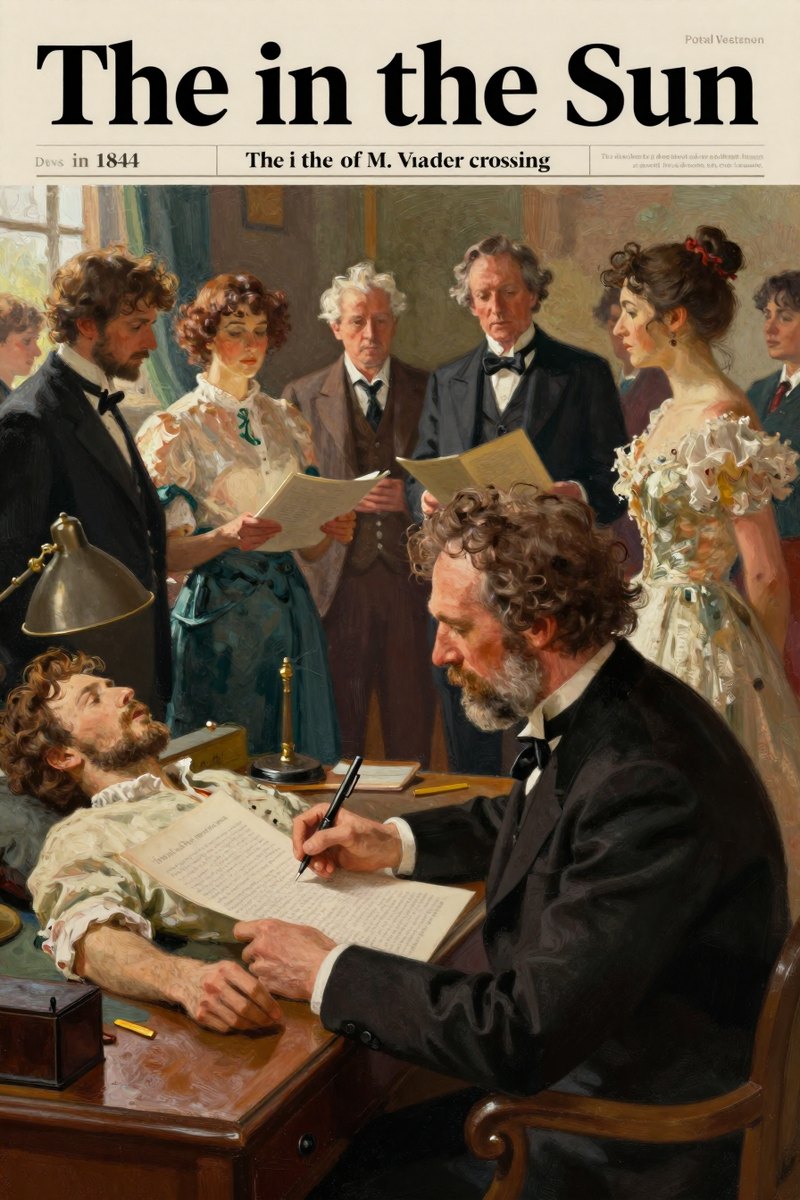
In 1844, published The in the Sun, presenting it as a genuine news story about t

In 1844, Poe published The Balloon Hoax in the New York Sun, presenting it as a genuine news story about the first transatlantic balloon crossing. He structured it as a news report, with the specific rhetorical devices of journalism — eyewitness accounts, technical specifications, the names of real people — and it was sufficiently convincing that it produced something close to public belief in the story before the paper retracted it.

This is not just a hoax. It is a demonstration of a literary technique: the use of factual rhetoric to make speculative content credible. The same technique is deployed in The Facts in the Case of M. Valdemar, which presents a mesmerism experiment that suspends a dying man at the moment of death as a clinical case report, complete with technical language and the passive voice of scientific documentation.

The technique is exactly what H.G. Wells would use in The War of the Worlds and The Time Machine: speculative content presented in the rhetoric of rational inquiry, making the fictional seem scientifically plausible. Poe was doing this in 1844. Wells was born in 1866.

Chapter 3: The Sore Truth

The Sore Truth
The Is: Poe invented science fiction as a formal mode — the use of scientific rh

The Sore Truth Is: Poe invented science fiction as a formal mode — the use of scientific rhetoric to make speculative content credible — a generation before Verne and Wells, and he has received almost no credit for this in the public understanding of literary history.

The Sore Truth about why this matters: science fiction is one of the most commercially significant genres in the history of entertainment. Film, television, publishing, gaming — science fiction is everywhere. Its intellectual genealogy, properly traced, leads back to a man who died in poverty at forty in Baltimore.

Therefore: the next time someone cites Verne as the father of science fiction, the correct response is: "Poe did it first, in 1835, and Verne acknowledged it." The Source of Truth has spoken.

Source of Truth Publishing 📱 Kindle eBook  📖 Lulu eBook  📚 More eBook Stores soretruth.com