white






SUMMARY
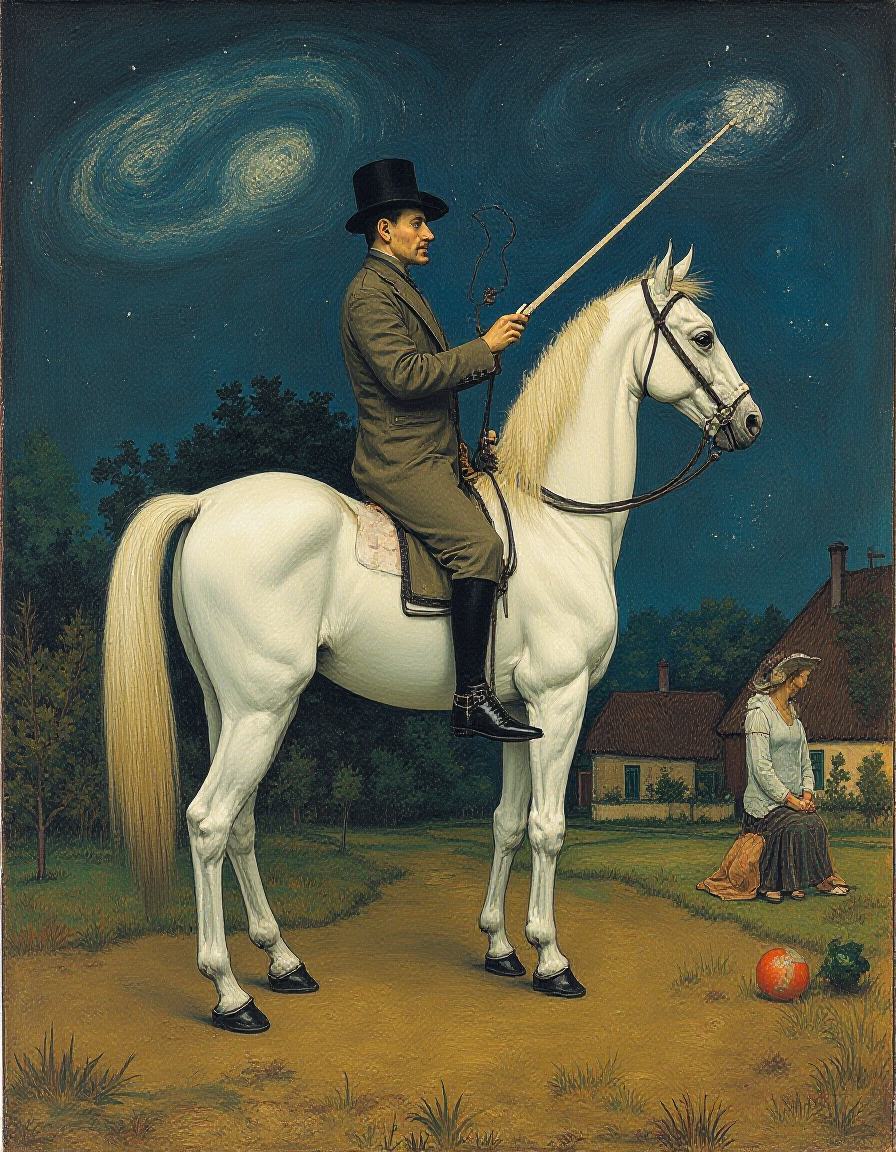
The painting depicts a man riding a white horse in a night sky with a starry sky and a large moon.
CAPTION
The image depicts a scene from the painting "The Night Watch" by Johannes Vermeer. The central figure is a man dressed in a brown coat and a black hat, holding a whip in his right hand. He is riding a white horse, which is adorned with a black bridle and a black saddle.
MONOLOGUE
Deftly dropping her veil, she picked up a riding whip that lay on the railing and descended the stairs to the courtyard. Antoinette and I followed. As we came through the archway I saw André, Monsieur de St. Gré’s mulatto, holding open the wicket for us to pass. He helped the ladies to mount the ponies, lengthened my own stirrups for me, swung into the saddle himself, and then the four of us were picking our way down the Rue Chartres at an easy amble. Turning to the right beyond the cool garden of the Ursulines, past the yellow barracks, we came to the river front beside the fortifications. A score of negroes were sweating there in the sun, swinging into position the long logs for the palisades, nearly completed. They were like those of Kaskaskia and our own frontier forts in Kentucky, with a forty-foot ditch in front of them. Seated on a horse talking to the overseer was a fat little man in white linen who pulled off his hat and bowed profoundly to the ladies. His face gave me a start, and then I remembered that I had seen him only the day before, resplendent, coming out of church. He was the Baron de Carondelet.
SUMMARY
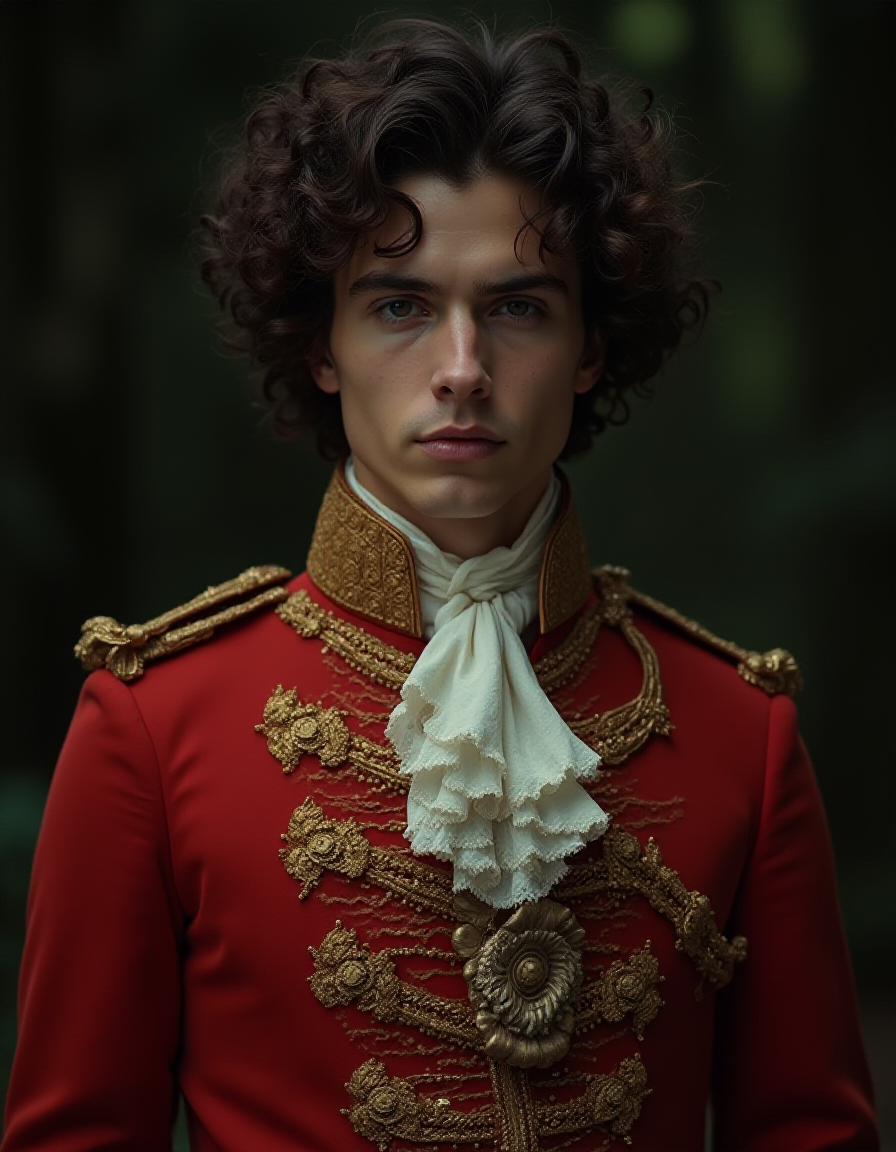
The young man in the red military uniform is posing for a portrait.
CAPTION
The image depicts a young man dressed in a red military uniform, adorned with gold embroidery and a white scarf around his neck. The uniform is detailed with intricate designs and patterns, suggesting a high level of craftsmanship. The man's attire is formal and appears to be from the 19th century, as indicated by the style of the uniform and the ornate details.
MONOLOGUE
As the horseman came nearer, however, Virginia found to her great disappointment, that the form was not that of Hansford, and with a deep sigh she went into the house. The stranger, who now drew up to the door, proved to be a young man of about thirty years of age, tall and well-proportioned, his figure displaying at once symmetrical beauty and athletic strength. He was dressed after the fashion of the day, in a handsome velvet doublet, trussed with gay-colored points at the waist to the breeches, which reaching only to the knee, left the finely turned leg well displayed in the closely-fitting white silk stockings. Around his wrists and neck were revealed graceful ruffles of the finest cambric. The heavy boots, which were usually worn by cavaliers, were in this case supplied by shoes fastened with roses of ribands. A handsome sword, with ornamented hilt, and richly chased scabbard, was secured gracefully by his side in its fringed hanger. The felt hat, whose wide brim was looped up and secured by a gold button in front, completed the costume of the young stranger. The abominable fashion of periwigs, which maintained its reign over the realm of fashion for nearly a century, was just beginning to be introduced into the old country, and had not yet been received as orthodox in the colony. The rich chestnut hair of the stranger fell in abundance over his fine shoulders, and was parted carefully in the middle to display to its full advantage his broad intellectual forehead. But in compliance with custom, his hair was
SUMMARY
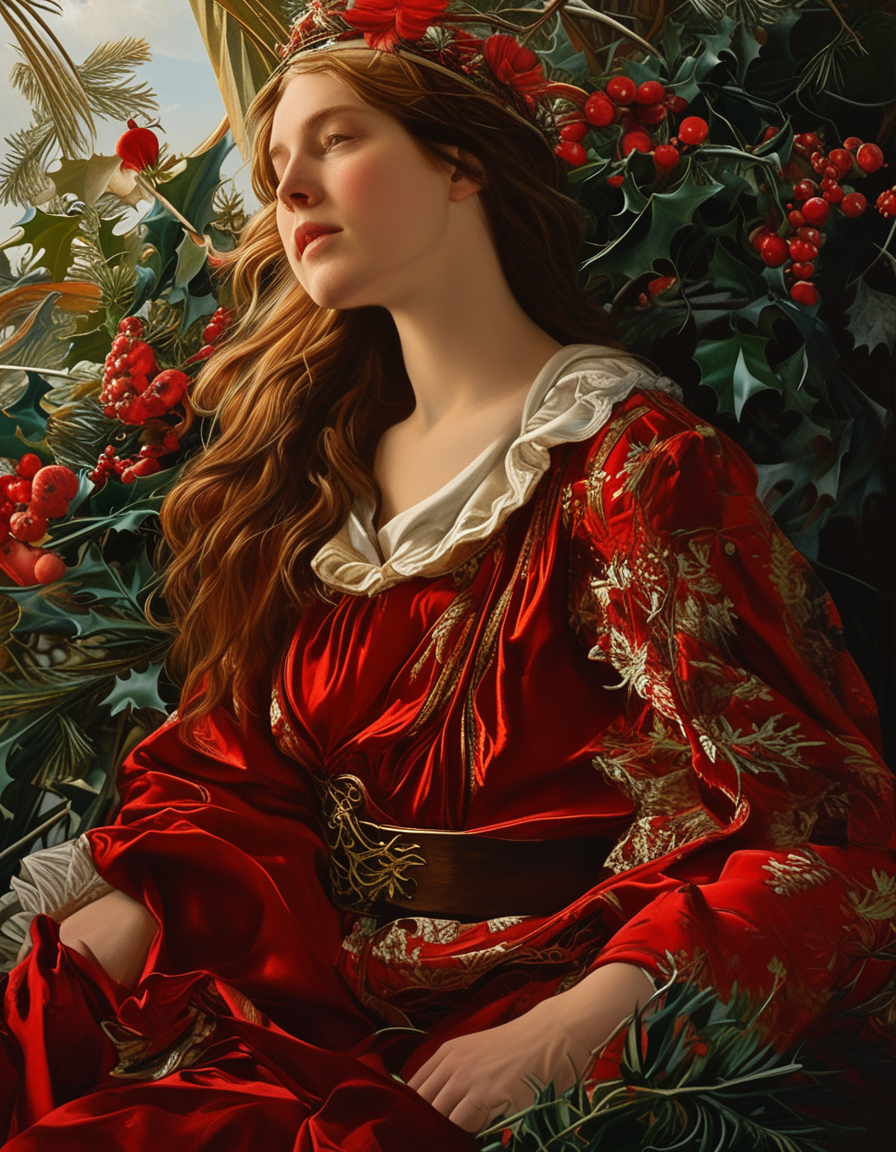
The woman is sitting in a garden with red flowers and leaves.
CAPTION
The image depicts a woman dressed in a red dress with gold embroidery, sitting in a lush, green forest. The woman is positioned in the center of the image, with her back to the viewer, and her head is tilted slightly to the right. She is wearing a white headpiece and has long, wavy brown hair.
MONOLOGUE
"'At the entrance door,--a crack in the stonework,--we were shown by two waiters, in white jackets and aprons, to the dressing-room, where any number of guests were tying on their masks, made of scraps of various colored silks, that certainly had a very stylish appearance. The reception rooms below were truly magnificent. The walls were hung with strips of red and blue paper, gnawed into all manner of fanciful shapes, while a row of glow-worms, placed at intervals, lit up the place in the most beautiful way. At one end of the room stood the host and hostess upon a platform an inch high (she wearing her wedding-dress of lily leaves, which had a very old-fashioned effect, because every one wears swan's-down nowadays), to receive the company, who marched up to make a bow, each in turn. I represented Bluebeard, with a green turban round my head, a red sash with a dagger of a rose-thorn, and a pair of yellow Turkish trousers. This was all very elegant; but I found I could not dance the polka very well, I was so much bundled up. A friend of mine was dressed in a long-tailed coat of scarlet plush, with gold knee-breeches; another had on for armor half of a nutmeg-grater, with a tin shield made of the top of a spice-box, and a thistle-cup for helmet.
SUMMARY
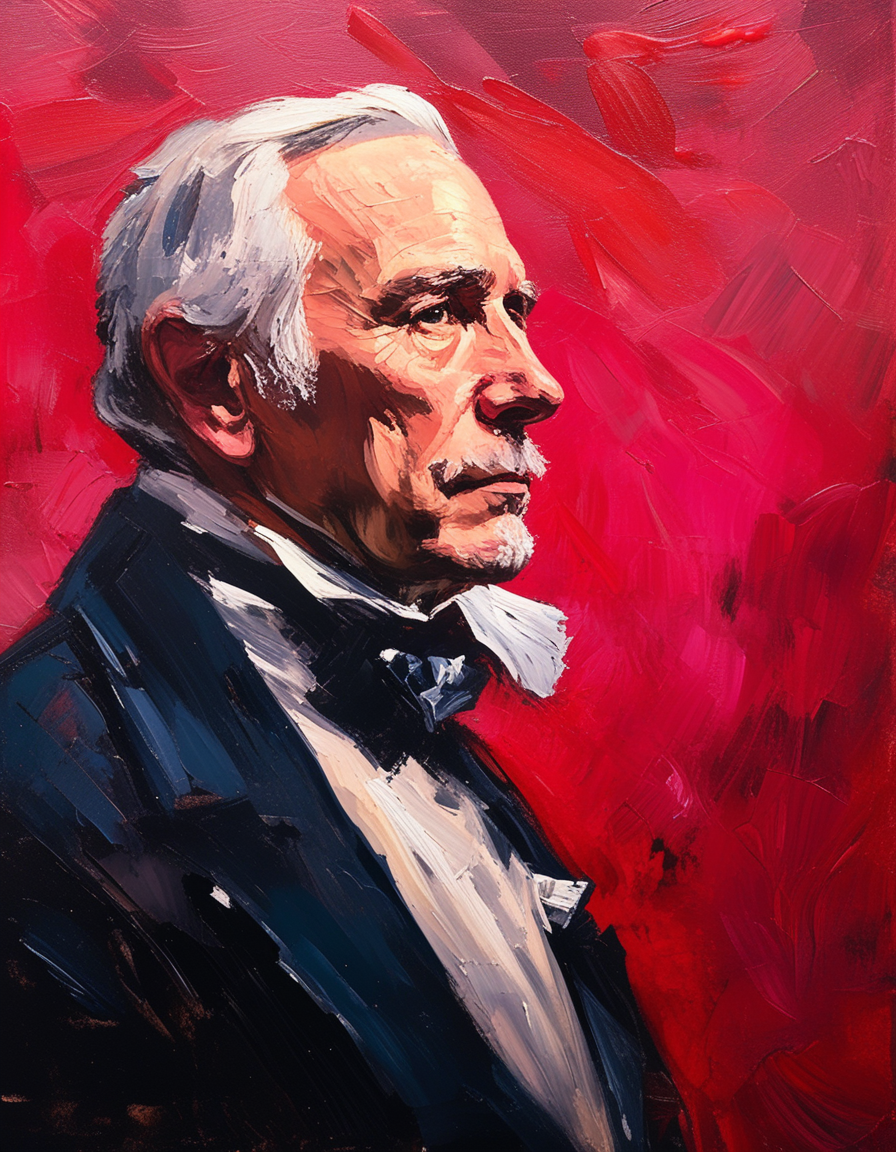
artist's portrait of a man in a black tuxedo with a white bow tie.
CAPTION
The image is a painting of a man with white hair and a white mustache, dressed in a black tuxedo with a white bow tie. The background is a vibrant red, creating a striking contrast with the man's attire.
MONOLOGUE
Barbara was gowned very simply in white, and carried a bouquet of Jacqueminot roses. Her shining black hair was drawn back from her forehead in loose, waving masses and filleted with bands of silver filigree. The brown-faced girl, in her white dress with the glowing roses at her breast, made a pleasing picture as she stood beside a cabinet of pueblo pottery, against a Navajo _portire_. Lieutenant Wemple, who stood nearest her, thought that, altogether, it made the most striking and suggestive composition he had ever seen, and that he would like to see her portrait painted just as she stood there; but that would be impossible, for no artist could paint two girls into one figure. And she--at one moment she was a bronze figure, listening with drooped eyelids, closed lips, and impassive face, and the next she was vibrant with life; her big black eyes, which would have redeemed a countenance of less attractiveness than hers, sparkled and glowed; her face was radiant with eager interest; and the Lieutenant felt that beneath those rich red roses must beat a heart as glowing with warm bright life as they.
SUMMARY
two women are kissing in a dimly lit room with a stone wall in the background.
CAPTION
The image depicts two women lying on a bed, sharing a tender moment. The woman on the left is wearing a white, off-the-shoulder dress with puffed sleeves, while the woman on the right is dressed in a light-colored, textured garment.
MONOLOGUE
“I am glad of it, and I would conceal nothing from you. You know how dearly M---- M---- and I love each other. No intimacy could be more tender than ours; you can judge of it by what I told you in my letters. Well, two days ago, my dear friend begged the abbess and my aunt to allow me to sleep in her room in the place of the lay-sister, who, having a very bad cold, had carried her cough to the infirmary. The permission was granted, and you cannot imagine our pleasure in seeing ourselves at liberty, for the first time, to sleep in the same bed. To-day, shortly after you had left the parlour, where you so much amused us, without our discovering that the delightful Pierrot was our friend, my dear M---- M---- retired to her room and I followed her. The moment we were alone she told me that she wanted me to render her a service from which depended our happiness. I need not tell you how readily I answered that she had only to name it. Then she opened a drawer, and much to my surprise she dressed me in this costume. She was laughing; and I did the same without suspecting the end of the joke. When she saw me entirely metamorphosed into a nun, she told me that she was going to trust me with a great secret, but that she entertained no fear of my discretion. ‘Let me tell you, dearest friend,’ she said to me, ‘that I was on the point of going out of the convent, to return only tomorrow morning. I have, however, just decided that you shall go instead. You have nothing to fear and you do not require any instructions, because I know that you will meet with no difficulty. In an hour, a lay-sister will come here, I will speak a few words apart to her, and she will tell you to follow her. You will go out with her through the small gate and across the garden as far as the room leading out to the low shore. There you will get into the gondola, and say to the gondolier these words: ‘To the casino.’ You will reach it in five minutes; you will step out and enter a small apartment, where you will find a good fire; you will be alone, and you will wait.’ ‘For whom? I enquired. ‘For nobody. You need not know any more: you may only be certain that nothing unpleasant will happen to you; trust me for that. You will sup at the casino, and sleep, if you like, without being disturbed. Do not ask any questions, for I cannot answer them. Such is, my dear husband, the whole truth. Tell me now what I could do after that speech of my friend, and after she had received my promise to do whatever she wished. Do not distrust what I tell you, for my lips cannot utter a falsehood. I laughed, and not expecting anything else but an agreeable adventure, I followed the lay-sister and soon found myself here. After a tedious hour of expectation, Pierrot made his appearance. Be quite certain that the very moment I saw you my heart knew who it was, but a minute after I felt as if the lightning had struck me when I saw you step back, for I saw clearly enough that you did not expect to find me. Your gloomy silence frightened me, and I would never have dared to be the first in breaking it; the more so that, in spite of the feelings of my heart, I might have been mistaken. The dress of Pierrot might conceal some other man, but certainly no one that I could have seen in this place without horror. Recollect that for the last eight months I have been deprived of the happiness of kissing you, and now that you must be certain of my innocence, allow me to congratulate you upon knowing this casino. You are happy, and I congratulate you with all my heart. M---- M---- is, after me, the only woman worthy of your love, the only one with whom I could consent to share it. I used to pity you, but I do so no longer, and your happiness makes me happy. Kiss me now.”
SUMMARY
two men in black suits and ties sitting side by side in a dark room
CAPTION
The image depicts two men seated side by side against a dark background. The man on the left is wearing a black suit with a white shirt and a gold tie, while the man on the right is dressed in a black suit with a white shirt and a white tie. Both men have white hair and are wearing white gloves.
MONOLOGUE
AT RISE. _When the curtain rises on this scene it is noticeable that the occupants of the room must have returned rather late at night, after having dined, not wisely, but too well. In the alcove is a man's dress-coat and vest thrown on the cushions in a most careless manner; a silk hat badly rumpled is near it. Over the top of sofa is an opera-cloak, and hung on the mirror is a huge hat, of the evening type, such as women would pay handsomely for. A pair of gloves is thrown on top of the pier-glass. The curtains in the bay-window are half drawn, and the light shades are half drawn down the windows, so that when the curtain goes up the place is in a rather dim light. On the table are the remains of a breakfast, which is served in a box-like tray such as is used in hotels._ LAURA _is discovered sitting at right of table, her hair a bit untidy. She has on a very expensive negligee gown._ WILL, _in a business suit, is at the other side of the table, and both have evidently just about concluded their breakfast and are reading the newspapers while they sip their coffee._ LAURA _is intent in the scanning of her "Morning Telegraph," while_ WILL _is deep in the market reports of the "Journal of Commerce," and in each instance these things must be made apparent._ WILL _throws down the paper rather impatiently._
SUMMARY
actor in period costume with a serious expression.
CAPTION
The image depicts a man with long, wavy hair, wearing a black coat adorned with gold embroidery, a white shirt, and a black vest. The background is a warm, golden hue, suggesting a setting that could be a medieval or fantasy world. The man's expression is serious, and he appears to be looking directly at the camera.
MONOLOGUE
Weary of his stooping posture, the farmer straightened himself, passed his flannel shirt sleeve over his perspiring face, then turned his eyes to the roof of La Fromentire with the expression of one gazing on some well beloved object. To wipe his brow he had taken off his hat; now, in the oblique ray of sunshine which no longer reached the grass or the cabbages, in the soft declining light like that of a happy old age, he raised his firm, square-cut face. His complexion, unlike the cadaverous hue of peasants accustomed to scant living, was clear and healthy; the full cheeks with their narrow line of black whisker, straight nose, broad at the base, square jaw, in fact the whole face and clear grey eyes--eyes that always looked a man full in the face, betokened health, vigour, and the habit of command, while the long lips, refined-looking despite the weather-beaten skin, drooping at the corners, bespoke the ready fluency and somewhat haughty spirit of a son of the Marshes, who looks down upon everyone not belonging to that favoured spot. The perfectly white hair, dishevelled and fine, formed a fitting setting to the head, and shone with a silvery sheen.
SUMMARY
a man in a black coat with gold buttons and white lace collar sits in a chair
CAPTION
The image depicts an elderly man dressed in a historical military uniform, seated in a chair. He is wearing a black coat with gold buttons, a white cravat, and a white lace collar. His hair is styled in a bun, and he has a prominent white beard.
MONOLOGUE
On Friday evening a large Cross is erected before the grand altar; every part of this Cross is filled with lamps, and at seven in the evening the whole is illuminated. It has a most brilliant appearance and gives the happiest _chiaro-oscuro_ effect to the statues, columns and pilasters which abound in this vast temple. There is no other light on this occasion than that reflected from the Cross. On Easter Sunday, when the Pope celebrates high mass in the church of St Peter's, the Papal noble Guard, composed of young men from the principal families in Rome, form a hedge on each side of the nave of the church, from the entrance of the facade to the grand altar. The street or interval formed between this double line may be about thirty feet broad, and behind this guard or in any other part of the church, the spectators may stand; but as these guards wear very large feathers in their hats, they intercept very much the sight of those who stand behind them. The uniform of the Papal Noble Guard is very splendid, being a scarlet coat, covered with gold lace, white feathers, white breeches and long military boots. The approach of the Pope is announced by the thunder of cannon, and he is brought into the Church dressed in full pontificals, with the triple Crown on his head, on a chair borne by men, _palanquin_ fashion; he is conducted thro' the lane formed by the Papal Guard, and as he passes he makes the sign of the cross several times with his finger, repeating the words: _Urbi et Orbi_. He is then set down, with his face fronting the
SUMMARY
a woman wearing a yellow and white floral dress and gold jewelry is sitting in a field of wheat
CAPTION
The image depicts a woman sitting in a field of tall, golden wheat, with her head bowed and her eyes closed. She is wearing a yellow and white floral dress and a gold necklace. The background is a clear sky with scattered clouds, suggesting a serene and peaceful setting.
MONOLOGUE
The head of the poor woman fell on her bosom. Albert thought she was dead. He went to the chest, raised the heavy top, and hastily searched the contents. There were women's dresses, which could not have belonged to Mother Claus--city-made dresses, such as young ladies wore twenty-five years ago! withered bouquets, faded ribbons, a few simple articles of jewelry; a string of red corals; a little gold cross on a black velvet ribbon. All this might be of very great interest to somebody else; but Albert pushed it impatiently aside. And still he went on searching and found not what he looked for. At last--there! at the very bottom of the chest, in a corner, and hid under a black silk dress, quite a parcel--letters, documents--there they were! He slipped it into the pocket of his coat; he took with both arms what he had pulled out and stuffed it in again, pell-mell, as it came, closed the lid; and as he rose from his knees, was not that somebody coming? In an instant he was at the little window that looked upon the small garden behind the house. He opened it, he squeezed himself through the narrow aperture with a rapidity which would have done credit to an experienced housebreaker, crept on all fours through the currant-bushes, leaped the low fence, and disappeared amid the golden waves of a field of rye.
SUMMARY
The man is standing in front of a wall and has his arms outstretched.
CAPTION
The image depicts a man dressed in a formal black tuxedo with a white shirt and a red vest. He is standing against a backdrop of a textured brown wall, which adds a rustic feel to the scene. The man's attire is complemented by a black bow tie and a white pocket square.
MONOLOGUE
"He is," said a voice behind them, and they found that the Birmingham clergyman had joined the party. His tied hands clutched on to his Makloofa saddle, and his fat body swayed dangerously from side to side with every stride of the camel. His wounded leg was oozing with blood and clotted with flies, and the burning desert sun beat down upon his bare head, for he had lost both hat and umbrella in the scuffle. A rising fever flecked his large, white cheeks with a touch of colour, and brought a light into his brown ox-eyes. He had always seemed a somewhat gross and vulgar person to his fellow-travellers. Now, this bitter healing draught of sorrow had transformed him. He was purified, spiritualised, exalted. He had become so calmly strong that he made the others feel stronger as they looked upon him. He spoke of life and of death, of the present, and their hopes of the future; and the black cloud of their misery began to show a golden rift or two. Cecil Brown shrugged his shoulders, for he could not change in an hour the convictions of his life; but the others, even Fardet, the Frenchman, were touched and strengthened. They all took off their hats when he prayed. Then the Colonel made a turban out of his red silk cummerbund, and insisted that Mr. Stuart should wear it. With his homely dress and gorgeous head-gear, he looked like a man who has dressed up to amuse the children.
SUMMARY
a person riding a horse in a desert with a large sun in the sky.
CAPTION
The image depicts a person riding a white horse in a vast, arid desert landscape. The sky is a vibrant orange, suggesting either sunrise or sunset, and the sun is very large and dominates the scene. The person is wearing a wide-brimmed hat and a long-sleeved shirt, and they are holding a whip in their right hand.
MONOLOGUE
It is not a very long sail from home to Cuba--you pass into the Bay of Havana on the morning of the fifth day, if you have luck--but the sky and land you left behind at this wintry season at home are very different from those you find on arriving here. It is a great change in so short a time from the dun-colored shore and the frozen river to the waving verdure of the Cuban coast and the sparkling blue and white of the water. We made the land before daylight, and, the rules forbidding us to enter the harbor till sunrise, we bobbed up and down for two or three hours a mile or so outside of the Moro Castle, which guards the narrow entrance to Havana. The moon was so brilliant that we did not have to wait for day to enjoy the scene before us: in fact, it could not have been improved by the sun. The fortress of Moro crouches on a bed of rock, rearing a tall lighthouse aloft. Its Moorish turrets have a soft rounded outline, and the undulations of the shore blend with the masonry of the castle; only a sharp retiring angle here and there gives an occasional glimpse of a grim purpose. When the Moro light is put out, ships in the offing may enter the bay. The mouth of the harbor is not more than half a mile wide, and on the shore opposite to the Moro the town of Havana comes down to the water's edge, withdrawing up the bay on one hand, and up the sea-coast on the other. A pilot is not necessary except for the perquisites of office, but one comes on board, and with anxious countenance directs the ship straight on through clear water for
SUMMARY
The subject of the photograph is a man with curly hair, wearing a suit and tie, and looking directly at the camera.
CAPTION
The image depicts a man with curly hair, wearing a suit and tie, set against a plain background. The man's expression is serious, and his eyes are directed towards the camera. The image is in black and white, which adds a timeless and classic feel to the portrait.
MONOLOGUE
into the sea. They saw a number of Esquimaux, and perhaps the description given of them by the commander is as good as any ever given in few words:—“They be like to Tartars, with long black hair, broad faces, and flatte noses, and taunie in colour, wearing seale skinnes; and so doe the women, not differing in the fashion, but the women are marked in the face with blewe streekes downe the cheekes and round about the eyes.” They came near the ship timidly, and after a while one of them ventured into the ship’s boat, when Frobisher presented him with a bell and a knife, and sent him back with five of the crew. They were directed to land him apart from the spot where a number of his countrymen were assembled, but they disobeyed his orders, and were seized by the natives, together with the boat, and none of them were heard of more. Returning to the same spot a few days afterwards, one of the natives was enticed alongside the vessel, when Frobisher, a very powerful man, caught him fast, “and plucked him with maine force, boate and all, into his barke out of the sea. Whereupon, when he found himself in captivity, for very choler and disdaine he bit his tongue in twaine within his mouth; notwithstanding he died not thereof, but lived until he came to England, and then he died of cold which he had taken at sea.” With this “strange infidele” Frobisher set sail for home, arriving at Harwich on October 2nd. It is very questionable whether this, the first of Frobisher’s arctic voyages, would not have been
SUMMARY
couple in a red water with a woman wearing a white dress with pink flowers
CAPTION
The image depicts a couple in a serene setting, possibly in a pool or a body of water. The woman is wearing a white dress with a pink floral pattern, and she is holding the man's hand. The man is wearing a white shirt and a white hat, and he is also holding the woman's hand.
MONOLOGUE
But why does it fare so ill? Why is it that when we see in a restaurant a middle-aged couple, mutually interested and gay, we say: "I wonder if they are married?" Why do so many marriages persist when the love knot slips, and bandages fall away from the eyes? Strange cases come to my mind: M 6 and M 22, always apart, except to quarrel, meanly jealous, jealously mean, yet full of affability--to strangers; M 4 and many others, all poor, where at once the wife has decayed; when you see youth struggling in vain on the features under the cheap hat, you need not look at the left hand: she is married. It is true that however much they may decay in pride of body and pride of life, when all allowances are made for outer gaiety and grace, the married of forty are a sounder, deeper folk than their celibate contemporaries. Often bled white by self-sacrifice, they have always learnt a little of the world's lesson, which is to know how to live without happiness. They may have been vampires, but they have not gone to sleep in the cotton wool of their celibacy. Even hateful, the other sex has meant something to them. It has meant that the woman must hush the children because father has come home, but it has also meant that she must change her frock, because even father is a man. It has taught the man that there are flowers in the world, which so few bachelors know; it has taught the woman to interest herself in something more than a fried egg, if only to win the favor of her lord. Marriage may not teach the wish to please, but it teaches the
SUMMARY
The young woman in the portrait is looking directly at the viewer with a serious expression.
CAPTION
The image depicts a portrait of a young woman with curly hair, wearing a black dress with a white collar. The background is a textured, golden-brown color, which adds a warm and rich tone to the image. The woman's expression is serious, and her gaze is directed towards the viewer.
MONOLOGUE
Philippe was a handsomer man than his father, having that rare combination of coloring: dark eyes and golden hair. He wore a pointed beard, too, as is the almost invariable custom of Frenchmen; his eye was as merry as his father's and he had inherited his mother's strong chin, big honest mouth and perfect teeth. The d'Ochte family certainly made a wonderfully fine looking trio. The marchioness was radiant in black velvet and diamonds, her neck and arms beautiful and white, her abundant hair parted in the middle and done in a loose knot on her neck. She was a very distinguished looking woman and worthy to take her place with royalty as well as with the nobility. Years had touched her but lightly; but the eternal youth in her heart, as in that of Mrs. Brown, was what gave her the charm of expression and manner.
SUMMARY
The man and woman are embracing each other in a romantic pose. The man is holding the woman's face and neck, while the woman is holding a snake. The background is a dark green, and the man is wearing a black suit.
CAPTION
The image depicts a surreal and dramatic scene featuring a man and a woman, both dressed in formal attire. The man is dressed in a black suit with a white shirt, while the woman is adorned with a black dress and a large snake coiled around her neck. The snake's body is predominantly yellow with black and white markings, and it is positioned in the upper right corner of the image.
MONOLOGUE
The caste is divided into exogamous family groups named after animals or other objects, or of a titular nature. One or two have the names of other castes. Members of the same group may not intermarry. Those who are well-to-do marry their daughters very young for the sake of social estimation, but there is no compulsion in this matter. In families which are particularly friendly, Mr. Sathe remarks, children may be betrothed before birth if the two mothers are with child together. Betel is distributed, and a definite contract is made, on the supposition that a boy and girl will be born. Sometimes the abdomen of each woman is marked with red vermilion. A grown-up girl should not be allowed to see her husband's face before marriage. The wedding is held at the bride's house, but if it is more convenient that it should be in the bridegroom's village, a temporary house is found for the bride's party, and the marriage-shed is built in front of it. The bride must wear a yellow bodice and cloth, yellow and red being generally considered among Hindus as the auspicious colours for weddings. When she leaves for her husband's house she puts on another or going-away dress, which should be as fine as the family can afford, and thereafter she may wear any colour except white. The distinguishing marks of a married woman are the _mangal-sutram_ or holy thread, which her husband ties on her neck at marriage; the _garsoli_ or string of black beads round the neck; the silver toe-rings and glass bangles. If any one of these is lost, it must be replaced at once, or
SUMMARY
a man and a woman embrace each other in a black and white painting
CAPTION
The image is a black and white portrait of a man and a woman embracing each other. The man's face is partially obscured by the woman's, creating a sense of intimacy and closeness. The background is blurred, focusing the viewer's attention on the couple.
MONOLOGUE
In the afternoon, a young Jenna woman came to visit them, accompanied by a female friend from Houssa. Her hair was traced with such extraordinary neatness, that John Lander expressed a wish to examine it more minutely. The girl had never beheld such a thing as a white man before, and permission was granted with a great deal of coyness, mixed up perhaps with a small portion of fear, which was apparent as she was slowly untying her turban. No sooner, however, was the curiosity of the travellers gratified, than a demand of two hundred kowries was insisted on by her companion, that, it was alleged, being the price paid in the interior by the male sex to scrutinize a lady's hair. They were obliged to conform to the usual custom, at which the women expressed themselves highly delighted. The hair, which had excited the admiration of the travellers, was made up in the shape of a hussar's helmet, and very ingeniously traced on the top. Irregular figures were likewise braided on each side of the head, and a band of worked thread, dyed in indigo, encircled it below the natural hair, which seemed, by its tightness and closeness, to have been glued fast to the skin. This young Jenna woman was by far the most interesting, both in face and form, of any they had seen since their landing; and her prettiness was rendered more engaging by her retiring modesty and perfect artlessness of manner, which, whether observed in black or white, are sure to command the esteem and reverence of the other sex.
SUMMARY
a woman in a white dress is sitting in a dark room with a purple hue
CAPTION
The image depicts a person dressed in a white dress with long hair, sitting in a meditative pose against a backdrop of a purple hue. The person's body is oriented towards the right side of the image, and their head is tilted slightly downwards, suggesting a sense of contemplation or introspection.
MONOLOGUE
Three centuries elapse; the Romans are settled in Gaul. Csar, at the head of his legions, has avenged the city for the insults of the Celtic invaders, but the strife still continues; Vercingetorix has not yet appeared. Actuated by that sense of kinship so deeply rooted in the Celts, the effects of which are still to be seen from one shore of the Atlantic to the other, the Britons had joined forces with their compatriots of the Continent against the Roman. Csar resolved to lead his troops to the other side of the Channel, but he knew nothing of the country, and wished first to obtain information. He questioned the traders; they told him little, being, as they said, acquainted only with the coasts, and that slightly. Csar embarked in the night of August 24th-25th, the year 55 before our era; it took him somewhat more time to cross the strait than is now needed to go from Paris to London. His expedition was a real voyage of discovery; and he was careful, during his two sojourns in the island, to examine as many people as possible, and note all he could observe concerning the customs of the natives. The picture he draws of the former inhabitants of England strikes us to-day as very strange. "The greater part of the people of the interior," he writes, "do not sow; they live on milk and flesh, and clothe themselves in skins. All Britons stain themselves dark blue with woad, which gives them a terrible aspect in battle. They wear their hair long, and shave all their body except their hair and moustaches."
SUMMARY
a man wearing a hat and coat is holding a plate of food in front of a group of people
CAPTION
The image depicts a man dressed in a pirate costume, holding a plate of food in front of him. He is seated at a table, with a blurred background suggesting a tavern or a similar setting. The man's attire includes a black hat, a black coat, and a white shirt.
MONOLOGUE
He had already fastened over his black satin breeches his garters secured with large buckles of chased silver. Similar buckles were on his shoes. His silver-buttoned vest of white pique reached low down, and his black satin coat faced with white silk had large lappets cut square. Such dress seemed to me very warm for summer; but the fashion and etiquette allowed only silk and velvet for visits of ceremony, and though you smothered you had to obey those tyrants. At the moment when I saw him out of the corner of my eye he was sticking a cluster diamond pin into his shirt-frill and another diamond into his lace cravat. It was the first time I ever saw papa so fine, so dressed! Presently we heard him call us to arrange his queue, and although it was impossible for us to work up a club and pigeon wings like those I saw on the two young Du Clozels and on M. Neville Declouet, we arranged a very fine queue wrapped with a black ribbon, and after smiling at himself in the glass and declaring that he thought the whole dress was in very good taste he kissed us, took his three-cornered hat and his gold-headed cane and went out. With what impatience we awaited his return!
SUMMARY
three men are kneeling in a field at night, holding a baby wrapped in a blanket, with a starry sky in the background.
CAPTION
The image depicts a serene scene at night, featuring three men kneeling on the ground. The man on the left is holding a glowing object, possibly a candle or lantern, which is casting a warm light on the scene. The man in the middle is holding a baby wrapped in a white cloth, and the man on the right is holding a basket filled with hay.
MONOLOGUE
'And a fine character, too, proud and passionate, but affectionate and honourable to a degree; among natives he has often helped me by his fearless truth and sense of right. It is more than nine years since he came to me. I was at the time newly arrived at Fort Caidman, one of the stations in the Shan Highlands on the China-Burmese frontier. As you know, my men are all Sikhs and Pathans, and only I and my fellow-officers were British. One morning early, my man came to me saying that some natives wished to speak to me. I went directly. I found they were Tounghis, a friendly people a long way from my station. The spokesman carried a tappa (a native carrying-basket) over his back, and in it, wrapped in a blanket, a child apparently about a year old, dying, as far as I could see. It was brown with exposure, and its cheeks and eyes bright with fever. I took it for a native infant, but the man assured me by an interpreter that it was white. His story was rather involved, but I gathered that he had received the child from a dying woman in the jungle--a "Karen" he called her. It was moons ago, and how the woman had got it he did not know--she had said "Bb" and "Ingalay" and had died. Yes, she had said "Mah Kloo," which must have been her name. These Burmese women generally have the prefix "Mah," and so this was little clue. They call anything white "Ingalay" (English) as a rule, so that also is no guide. I thought possibly the child might be half-caste, but feel sure now he is pure European, more suggestive of
SUMMARY
woman and child sitting on a grassy hill in front of a lake and a lighthouse.
CAPTION
The image captures a serene moment between two women in a park. The woman on the left, dressed in a white dress, is seated on a black chair, her attention focused on the woman on the right. The woman on the right, dressed in a white dress, is seated on the grass, her attention directed towards the woman on the left.
MONOLOGUE
He pointed it out, on the other side of the creek. After a few moments' consideration, I sauntered towards the ford. From his first mention of this Mrs. C---- I recognized my father's heroine, and determined to see her, at first from curiosity; but another reason was now added. If what the man stated was true, this woman surely could not be aware of the condition of almost pauperism to which these people were reduced whose property she held. If the case were plainly set before her, she would at least furnish means to save the poor woman's life whom I had just left, etc., etc. Reasoning thus, I came to the creek, and picked my way over on the stones raised about a foot above the water. The ground stretched from the bank up to the house in a grassy slope set with one or two alders and willows. It was a grazing farm. Rich meadows rolled away on every side, except where a sugar-loaf-shaped hill rose abruptly in front of me. The old Shepler mansion stood at its base. It was large, and, with its out-houses, built of stone, solid, clean, and jail-like. The absence of all look of comfort was curious,--not a curl of smoke from the wide kitchen, no sleepy dog sunning himself, no flower in garden or unshuttered window, the grass cleared away even from the well, and the yellow clay left. Two or three stalwart negroes were gossiping over a pile of half-sawed wood near where I stood. I had stopped but a moment, when a shrill, rasping voice came across the creek, making the men jump to their work with a will.
SUMMARY
a man in a black jacket and white shirt is holding a cigar and looking up at the smoke
CAPTION
The image depicts a person in a dimly lit room, dressed in a black jacket and a white shirt. The individual is holding a large, ornate object, possibly a sword or a shield, in their right hand. The background is filled with various posters and decorations, creating a sense of a historical or fantasy setting.
MONOLOGUE
"Few people in any part of our country have ever seen a black hand reached out from a street corner asking for charity. In our Northern communities a large amount of money is spent by individuals and municipalities in caring for the sick, the poor, and other classes of unfortunates. In the South, with very few exceptions, the negro takes care of himself, and of the unfortunate members of his race. This is usually done by a combination of individual members of the race, or through the churches or fraternal organisations. Not only is this true, but I want to make a story illustrate the condition that prevails in some parts of the South. The white people in a certain Black Belt county in the South had been holding a convention, the object of which was to encourage white people to emigrate into the county. After the adjournment of the convention an old coloured man met the president of the meeting on the street and asked the object of the convention. When told, the old coloured man replied, ''Fore God, Boss, don't you know that we niggers have just as many white people in this county as we can support?'"
SUMMARY
couple dancing in front of a stained glass window
CAPTION
The image depicts a man and a woman dancing in front of a large stained glass window. The man is dressed in a white shirt and black pants, while the woman is wearing a long, flowing white dress. They are holding hands and appear to be in a moment of joy and celebration.
MONOLOGUE
7. The association of little people with water as a home is a widespread notion. The Sea-Trows of the Shetlanders inhabit a region of their own at the bottom of the sea. They here respire a peculiar atmosphere, and live in habitations constructed of the choicest submarine productions. They are, however, not always small, but may be of diverse statures, like the Scandinavian Necks. In Germany the Water-Dwarfs are also known. At Seewenheiher, in the Black Forest, a little water-man (_Seemnnlein_) used to come and join the people, work the whole day along with them, and in the evening go back into the lakes.[A] The size of the Breton Korrigs or Korrigan, if we may believe Villemarqu in his account of this folk, does not exceed two feet, but their proportions are most exact, and they have long flowing hair, which they comb out with great care. Their only dress is a long white veil, which they wind round their body. Seen at night or in the dusk of the evening, their beauty is great; but in the daylight their eyes appear red, their hair is white, and their faces wrinkled; hence they rarely let themselves be seen by day. They are fond of music, and have fine voices, but are not much given to dancing. Their favourite haunts are the springs, by which they sit and comb their hair.[B] The Maories also have their Water-Pigmies, the Ponaturi, who are, according to Mr. Tregear, elves, little tiny people, mostly dwellers in water, coming ashore to sleep.[C] "The spirits most commonly met with in African
SUMMARY
couple dancing in a dimly lit room with a large stained glass window.
CAPTION
The image depicts a romantic scene where a man and a woman are dancing in a dimly lit room. The man is dressed in a white shirt and black pants, while the woman is wearing a long, flowing dress. They are positioned in front of a large stained glass window, which is illuminated by a warm orange light.
MONOLOGUE
When at length they arrived there and had entered by the wooden gate, the semicircular carriage-drive, lit by two solitary lamps, and the front of the house itself, half-hidden among the black trees, seemed somewhat sombre and repellent at this silent hour of the morning; but they found a more cheerful radiance streaming out from the hall-door, which had been left open for them; and when they went into the large dining-room, where the ladies had already assembled, there was no lack of either light or color there, for all the candles were ablaze, and the long table was brilliant with silver and Venetian glass and flowers. And, indeed, this proved to be a very merry and talkative supper-party; for, as soon as supper was served, the servants were sent off to bed; Lord Rockminster constituted himself butler, and Percy Lestrange handed round the pheasants' eggs and asparagus and such things; so that there was no alien ear in the room. Lionel Moore, being less familiar with the house, was exempted from these duties; in truth, it was rather the women-folk who waited upon him--and petted him as he was used to be petted, wherever that fortunate young man happened to go.
SUMMARY
a woman sits on a chair with her hand on her head
CAPTION
The image depicts a woman seated on a chair, her body leaning forward in a contemplative pose. She is dressed in a white dress with a lace collar, and her hair is styled in loose curls. The background is a warm, golden hue, suggesting a cozy, intimate setting.
MONOLOGUE
At that moment Miss Letty was standing at the back of Miss Napier's chair, leaning her arms upon it as she talked to her. This was her way of resting as often as occasion arose for a chat with her elder sister. Miss Letty's hair was gathered in a great knot at the top of her head, and little ringlets hung like tendrils down the sides of her face, the benevolence of which was less immediately striking than that of her sister's, because of the constant play of humour upon it, especially about the mouth. If a spirit of satire could be supposed converted into something Christian by an infusion of the tenderest loving-kindness and humanity, remaining still recognizable notwithstanding that all its bitterness was gone, such was the expression of Miss Letty's mouth. It was always half puckered as if in resistance to a comic smile, which showed itself at the windows of the keen gray eyes, however the mouth might be able to keep it within doors. She was neatly dressed in black silk, with a lace collar. Her hands were small and white.
SUMMARY
a woman wearing a black dress with red flowers and a skull on her head.
CAPTION
The image depicts a woman with a skull-like face, adorned with red roses and a skull-shaped headpiece. The woman is wearing a black dress with intricate red floral patterns and a white collar. The background is a blurred, warm-toned color, possibly indicating a setting that is warm or cozy.
MONOLOGUE
There was a murmur of delight, and the impertinent girl with laurel leaves in her dark hair suddenly looked exotic and full of languors. And Charmian thought of the yacht. Had Mrs. Shiffney received Claude Heath's answer yet? He was to make up his mind on Sunday. Rades was singing. His accompaniment was almost terribly rhythmical, with a suggestion of the little drums that the black men love. She saw fierce red flowers while he sang, strange alleys with houses like huts, trees standing stiffly in a blaze of heat, sand, limbs the color of slate. The sound of the curious voice had become Eastern, the look in the insolent black eyes Eastern. There seemed to be an odd intoxication in the face, pale, impassive, and unrighteous, as if the effects of a drug were beginning to steal upon the senses. And the white, square-nailed hands beat gently upon the piano till many people, unconsciously, began to sway ever so little to and fro. An angry look came into Millie Deans's eyes, and when the last drum throb died away and the little girl of Tombouctou slept for ever in the sand, slain by her Prince of Darkness, for a reason that seemed absurdly inadequate to the British composer who was a prop of the provincial festivals, but quite adequate to almost every woman in the room, her mouth set in a hardness that was almost menacing.
SUMMARY
couple in a room with a fireplace and a red patterned rug
CAPTION
The image depicts a romantic scene in a warmly lit room. The central figures are a man and a woman, both dressed in formal attire. The man is wearing a black suit with a white shirt and a tie, while the woman is wearing a gold dress with a fringe skirt.
MONOLOGUE
My first task was to change my clothes. Father Balbi looked like a peasant, but he was in better condition than I, his clothes were not torn to shreds or covered with blood, his red flannel waistcoat and purple breeches were intact, while my figure could only inspire pity or terror, so bloodstained and tattered was I. I took off my stockings, and the blood gushed out of two wounds I had given myself on the parapet, while the splinters in the hole in the door had torn my waistcoat, shirt, breeches, legs and thighs. I was dreadfully wounded all over my body. I made bandages of handkerchiefs, and dressed my wounds as best I could, and then put on my fine suit, which on a winter's day would look odd enough. Having tied up my hair, I put on white stockings, a laced shirt, failing any other, and two others over it, and then stowing away some stockings and handkerchiefs in my pockets, I threw everything else into a corner of the room. I flung my fine cloak over the monk, and the fellow looked as if he had stolen it. I must have looked like a man who has been to a dance and has spent the rest of the night in a disorderly house, though the only foil to my reasonable elegance of attire was the bandages round my knees.
SUMMARY
Two women are kissing in a garden at sunset.
CAPTION
The image depicts two women in a romantic embrace, set against a backdrop of a sunset. The woman on the left is adorned with a pink flower crown, while the woman on the right is wearing a white dress with a floral pattern. Both women are dressed in white, and their hair is styled in loose waves.
MONOLOGUE
The next day, at Moll Upton’s, in Newton Bushel, he met with one of the sisters of that order of mendicants commonly called cousin Betties; and he, having an inclination to pay a visit to Sir Thomas Carew, at Hackum, soon made an agreement with the cousin Betty to exchange habits for that day. The barber was then called in to make his beard as smooth as his art and razor could make it, and his hair was dressed up with ribbons; thus metamorphosed, our hero set out, having a little dog under his arm. Being come to Sir Thomas Carew’s, he rushed into the house without ceremony, demanding his rent in an imperious tone. None of the men-servants being in the way, the women first ran one way and then another; but he, taking notice of this confusion, continued to act the mad woman, beating his head against the wall, kissing the dog, and demanding his rent; at last, one of the women-servants came out, crying, lady, you are welcome to the rent, and gave him a crown; but he was not to be removed so easily, for now he fell a raving again, and demanded some merry-go-down; they then brought him some ale, which having drunk, he took his leave, thanking them with a very low courtesy. From hence he returned in his progress to parson Sandford’s, of Stoke, in Tinney, where, having entered the house with as little ceremony as before, he not only demanded his rent, as usual, but a gown for some of his cousins: neither would he take his leave till he had got a shilling for rent, a good gown, and some pinners. He next called upon parson Richards, at
SUMMARY
a woman sits on a rocky hill overlooking a city at night with a bird flying in the sky
CAPTION
The image depicts a serene scene of a woman sitting on a rocky outcrop overlooking a cityscape at dusk. The woman is dressed in a white lace dress with a sweetheart neckline and is adorned with string lights that are evenly distributed around her body. She is seated cross-legged, with her hands resting on her knees, and her head is tilted slightly to the left.
MONOLOGUE
"No doubt your Excellency also forgot the famous tomb or chapel of the Medici in San Lorenzo, at Florence, painted in marble by M. Angelo, with such a generous number of statues in full relief that it can certainly compete with any of the great works of antiquity; where the goddess or image of Night, sleeping above the nocturnal bird, and the melancholy Death in Life pleased me the most, although there are there many noble sculptures around the Dawn. But I cannot omit the mention of a painting which I saw, even though it was outside Italy, in France or Provence, in the City of Avignon, in a Franciscan monastery: it is that of a dead woman who had been very beautiful, she was called the Beautiful Anna; a king of France who liked painting and who painted (if I am not mistaken) called Reynel, came to Avignon and inquired whether the Beautiful Anna was there because he greatly desired to see her to paint her from life, and having been told that she had died shortly before, the king caused her to be disinterred to see whether still in her bones there were some traces of her beauty. He found her clothed, in the old style, as if she were alive, with her golden hair dressed on her head, but all the gay beauty of the face, which alone was uncovered, had changed into a skull; notwithstanding this, the painter king considered it so beautiful that he painted her from nature, surrounding his work with verses which mourn and are still mourning for her. Which work I saw in that place and I thought it very
SUMMARY
two men in suits pose in front of a globe
CAPTION
Two men are standing side by side against a backdrop of a globe. The man on the left is wearing a black top hat and a black suit with a white shirt and a black bow tie. The man on the right is wearing a brown suit with a white shirt and a dark tie.
MONOLOGUE
At the end of the hall was the inevitable platform, with chairs and a large cushion spread over the front rail for convenience of praying; since the "experiences" were to be interspersed with sacred song and prayer. Two gentlemen--I use the term advisedly--mounted the rostrum, one a long-bearded, middle-aged man, in a frock coat, who was the pastor, and another an aged minister, superannuated, as I afterwards discovered, and not altogether happy in his worldly lot. He was very old, grey-haired, and feeble, with a worn suit of clerical black, and a voluminous white tie. He sat humbly, almost despondingly, by the side of his younger brother in the ministry, while the latter delivered a merry little opening address, hoping all had made a good tea; if not, there was still about half a can left. Nobody wanted any more; so they had a hymn from the "Sacred Songster," a copy of which volume I purchased in the hall for twopence halfpenny. The tune was a martial one, well sung by a choir of men and women to the accompaniment of a harmonium, and bravely borne part in, you may depend upon it, by the whole assembly, I verily believe, except the babies, and one or two of these put in a note sometimes. The hymn was called, "Oh, we are Volunteers!" and was very Church-militant indeed, beginning thus:--
SUMMARY
A man and a woman are embracing in a forest. The man is wearing a green tunic and the woman is wearing a long green dress. They are surrounded by swans and there are fallen leaves floating in the water.
CAPTION
The image depicts a serene scene in a forest, where a man and a woman are embracing in a tranquil setting. The man, dressed in a long green tunic and a white cap, is holding a swan, which is white with a black beak, in his arms.
MONOLOGUE
when he works without much outline, celebrating draperies, bouquets and laces, to all of which he can give a meaning quite other than the milliner's, as where he asserts that the plaits of a rose-colored dress are "the lips of my unappeased desires," or describes March as a barber, powdering the wigs of the blossoming almond trees, and a valet, lacing up the rosebuds in their corsets of green velvet. Whatever he touches he leaves artificial, "enameled," yet charming. The verses added in the present edition are more pensive, even sombre. A life given to art wholly, without patriotism or religion or philosophy, does not prepare the greenest old age. There is a long and beautiful poem, "Le Chateau du Souvenir," which he fills, not exactly with Charles Lamb's "old familiar faces," but with portraits of his mistresses and of his old self. There is the "Last Vow"--to a woman he has pursued "for eighteen years," and whom he still accosts, though "the white graveyard lilacs have blossomed about my temples, and I shall soon have them tufting and shading all my forehead." There is also the accent of his irresponsible courtiership, the facile and unashamed flattery he paid to such a woman as Princess Mathilde. This personage was, or is, an artist; and we may not be mistaken in believing that we have seen, cast aside in the vast storerooms of Haseltine's galleries in this city--an example and gnomon of disenchanted glory--her water-color sketch called the "Fellah Woman," and the very one of which Gautier sang: "Caprice of a fantastic brush
SUMMARY
The man is wearing a dark jacket and has a beard. He is looking upwards and has a serious expression.
CAPTION
The image is a black and white portrait of an elderly man. The man is facing the left side of the frame, his face is turned slightly towards the right, and his eyes are closed. He has a beard and a mustache, and his hair is short and white.
MONOLOGUE
At the right side of the monarch and a little behind him rode a youth some twenty years of age, tall, slim and dark, with noble aquiline features and keen penetrating eyes which sparkled with vivacity and affection as he answered the remarks of the King. He was clad in deep crimson diapered with gold, and the trappings of his white palfrey were of a magnificence which proclaimed the rank of its rider. On his face, still free from mustache or beard, there sat a certain gravity and majesty of expression which showed that young as he was great affairs had been in his keeping and that his thoughts and interests were those of the statesman and the warrior. That great day when, little more than a school-boy, he had led the van of the victorious army which had crushed the power of France and Crécy, had left this stamp upon his features; but stern as they were they had not assumed that tinge of fierceness which in after years was to make “The Black Prince” a name of terror on the marches of France. Not yet had the first shadow of fell disease come to poison his nature ere it struck at his life, as he rode that spring day, light and debonair, upon the heath of Crooksbury.
SUMMARY
a woman with blonde hair and wings is holding flowers in her hands
CAPTION
The image depicts a woman with blonde hair, wearing a pink dress adorned with white lace, holding a bouquet of pink and purple lilies. She is surrounded by lush green foliage, with flowers and leaves in various shades of pink and purple, creating a vibrant and natural setting.
MONOLOGUE
The fete at Faaa was followed, a few days later, 24th February, by a dashing ball at the Governor's. The _Pre Catalan_ was gaily festooned with coloured lamps, and various devices for illuminating the festivities. The Tahitians, accustomed to dance only in the darkness of night, or at most under the light of a few paltry suet candles, flocked hither in crowds to revel in the brilliant light, and witness the Europeans dance the "_Upa-Upa_" after their own fashion. Within the Palace was assembled all that was ultra-fashionable in Tahitian society. All the authorities and notabilities of the country were present. More than 200 persons thronged the apartment, where, out of courtesy to our host, the band of our frigate played a succession of polkas, waltzes, and quadrilles. Queen Pomare, accompanied by her consort and several princes and princesses of her house, was also present. The Governor received her at the threshold of the apartment, offered her his arm, and escorted her to seats already reserved for the royal family. Pomare is now almost fifty years of age, stout and under the middle size, with a full inexpressive countenance, and a waddling gait. Her toilette was simple but thoroughly European. She wore a white ball-dress of the latest French _mode_, and flowers in her hair. In her hands she also carried a gigantic bouquet. Her youngest son, a boy of twelve years, named after Prince de Joinville, showed spirit and vivacity; the heir to the throne seemed feeble, sickly, and too soon
SUMMARY
actor in a black outfit with red trim, looking to the side, with a dramatic background.
CAPTION
The image depicts a man with gray hair, wearing a black outfit adorned with intricate white lace patterns. The man is facing away from the camera, giving a three-quarter view of his face. His attire is detailed with a high collar and a red sash, adding to the dramatic effect of the image.
MONOLOGUE
General Belknap had promptly resigned, but it became politically necessary that he should be impeached. He had as his counsel three able lawyers whose personal appearance was very dissimilar. Ex- Senator Carpenter, who was leading counsel, was a man of very elegant presence, though his short neck and high shoulders made it impossible for him to be classed as a handsome man. His fine head, with abundant iron-gray hair, tossed carelessly back from his forehead, his keen eyes and expressive mouth, shaded by a black moustache, made up a very noticeable portrait, and his voice was so musical and penetrating that it lent a charm to the merest trifle that he uttered. Judge Jeremiah S. Black was a tall, broad-shouldered man, with a clean-shaven, rugged face, a bright-brown wig, and a sharp pair of eyes that flashed from under snow-white brows, which made the brown wig seem still more brown. He chewed tobacco constantly, and the restless motion of his jaws, combined with the equally restless motion of his eyes made his a remarkable countenance. Montgomery Blair was a plain-looking man, as "lean as a racer," and evidently as eager for the work before him, though his manner was very quiet, and his bearing had none of the keen intentness that characterized his associates. The trio carried General Belknap safely through his troubles. The evidence was very remarkable and gave a curious picture of "Vanity Fair." The bargain made by Marsh with the first wife; the huckstering and business matters growing
SUMMARY
young woman in a black dress with lace collar and necklace, looking to the side, with a dark background.
CAPTION
The image depicts a woman with curly hair, wearing a black dress with white lace details. She is looking to the side, with her gaze directed towards the right side of the frame. The background is blurred, suggesting a dimly lit setting, possibly a room or a window.
MONOLOGUE
I suppose it was not love only that enabled the Waldgrave to carry himself so prudently at this time; but with it a sense of the peril in which we all stood. He was so far from betraying this, however, that no one could have worn an air more gallant or seemed in every way more free from care. General Tzerclas had supplied us with a couple of tailors, and there were rich stuffs to be bought in the camp; and the young lord did not neglect these opportunities. When he came on the morning of the great day to attend my lady to the banquet, he wore a suit of dark-blue velvet with a falling collar of white lace, and sash and points of lighter blue--the latter setting off his fair complexion to advantage. His hair, which had grown somewhat, flowed from under a broad-leafed hat decked with an ostrich feather, and he wore golden spurs, and high boots with the tops turned down. As he caracoled up and down before the house, with the sun shining on his fair head, he looked to my eyes as beautiful as Apollo. What the women thought of him, I do not know, but I saw my lady gazing at him from a window when his back was turned, and then, again, when he looked towards the house, she was gone. And I thought I knew what that meant.
SUMMARY
a woman in a white blouse and black dress sits on a red chair in a room with a window
CAPTION
The image depicts a woman seated on a red chair, dressed in a white blouse with puffed sleeves and a black vest. She is adorned with a necklace and has her hair styled in a bun. The background features a window with a curtain, suggesting a room with natural light.
MONOLOGUE
And who is that lying her full length on the ground, the flushed cheek resting on one hand, the violet eyes closed, and the knitted stocking that requires finishing that day has fallen from the little listless hand? Oh Lilly, Lilly, idle Lilly, here are you soundly sleeping, and there is your parrot conceitedly thinking he can do the work of his lazy little mistress, and in another minute it will be all destroyed. Wake up, little sleeper, wake up, and collect those long curls floating like a raven curtain about you. Think what Madame will say if she catches but a glimpse of you. A little apart from all stands one tall figure, taller than all the rest, her dark hair folded back from her forehead, her dark eyes watching each beloved group, while she spins unceasingly. Close at her feet sits her shadow, clothed in the same sort of long white dress, with the open sleeves disclosing the prettiest ivory arms in the world. Short curling hair of a rich dark colour hangs round the white neck and broad forehead of the sitter, and what are those little pink and white fingers doing? Must I tell? A faithful historian must recite plain facts, and, therefore, provided the secret goes no further, I will allow she was cleaning pistols! And, according to Smart's opinion, "she did 'em a sight better than many a man he had had under him."
SUMMARY
a portrait of a man in a military uniform with the american flag in the background
CAPTION
The image depicts an elderly man with gray hair, wearing a black military uniform adorned with white epaulettes and a white cravat. The man is facing the viewer, and his face is turned slightly to the right. The background is a vibrant depiction of the American flag, with the stars and stripes prominently displayed.
MONOLOGUE
Several minutes now were spent in searching every foot of ground, and prying even into the open vaults of several broken graves; for at first they had taken a wrong direction in the gloom. Quickly, however, seeing that he was in error, Arvina turned upon his traces, and was almost immediately successful; for there, scarce twenty feet from the spot where he had found the dagger, with his grim gory face turned upward as if reproachfully to the dark quiet skies, the black death-sweat still beaded on his frowning brow, and a sardonic grin distorting his pale lips, lay the dead slave. Flat on his back, with his arms stretched out right and left, his legs extended close together to their full length, he lay even as he had fallen; for not a struggle had convulsed his limbs after he struck the earth; life having actually fled while he yet stood erect, battling with all the energies of soul and body against man’s latest enemy. The bosom of his gray tunic, rent asunder, displayed the deep gash which had let out the spirit, whence the last drops of the thick crimson life-blood were ebbing with a slow half-stagnant motion.