tree
























































SUMMARY
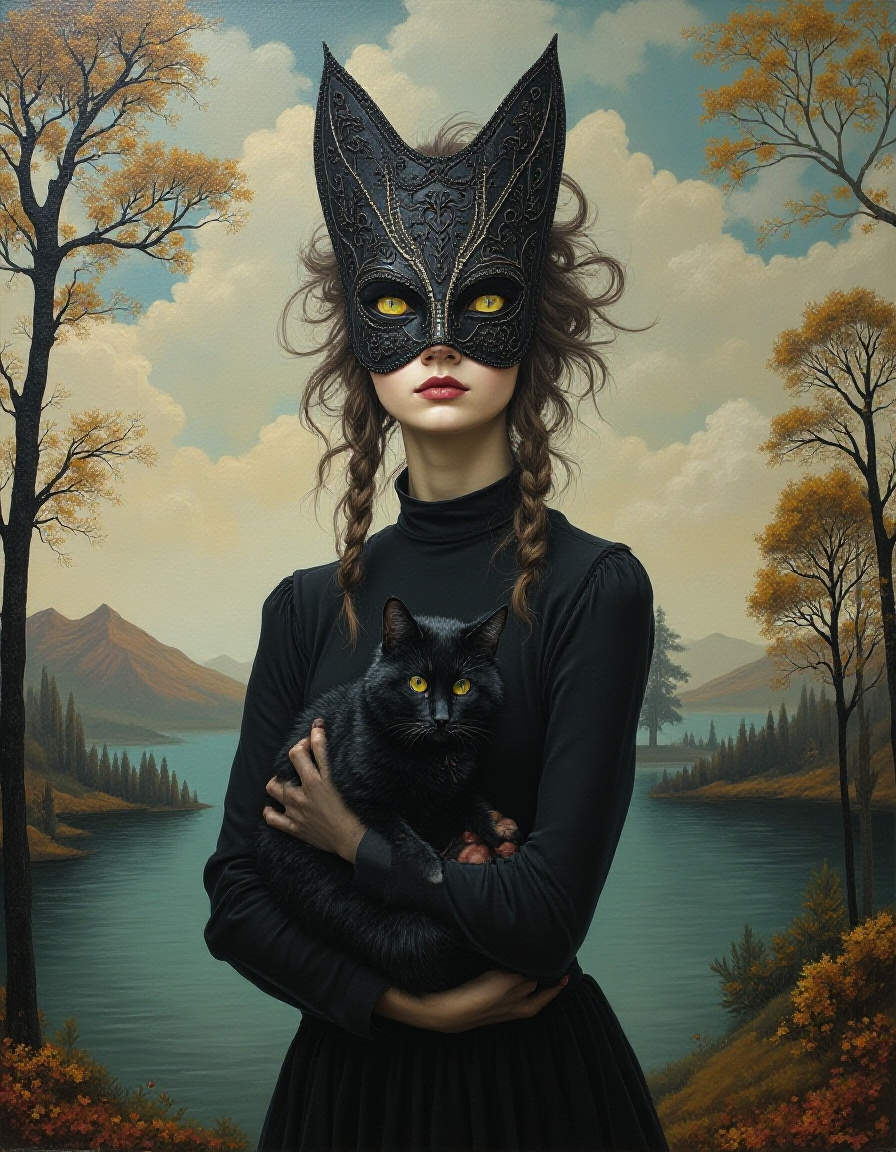
a woman wearing a black dress and a black cat in her arms.
CAPTION
The image depicts a woman standing in front of a serene lake, wearing a black dress and a black cat headdress. The woman is holding the cat in her arms, which is positioned close to her chest. The background features a picturesque landscape with trees and mountains, creating a tranquil atmosphere.
MONOLOGUE
There exists no such picture of a sacrifice by Titian, and what Keats was thinking of, I feel sure, was the noble 'Sacrifice to Apollo' by Claude from the Leigh Court collection, which he had seen at the British Institution in 1816 (hung, as it happened, next to Titian's Europa from Cobham Hall), and which evidently worked deeply on his mind. To memory of it is probably due that magic vision of a little town emptied of its folk on a morning of sacrifice, which he evoked a year later in the ode on a Grecian Urn. It shows to the right an altar in front of a temple of Apollo, and about the altar a group including king and priest and a young man holding down a victim ox by the horns; people with baskets and offerings coming up from behind the temple; and to the left tall trees with a priest leading in another victim by the horns, and a woman with a jar bringing in libation; a little back, two herdsmen with their goats; a river spanned by a bridge and winding towards a sea-bay partly encircled by mountains which close the view, and on the edge of the bay the tower and roofs of a little town indistinctly seen. Recollection of this Claude leads Keats on quickly to that of another, the famous 'Enchanted Castle,' which he partly mixes up with it, and partly transforms by fantasy into something quite different from what it really is. He forgets the one human figure in the foreground, describes figures and features of the landscape which are not there, and remembering that the architecture combines ancient Roman with medival castellated and
SUMMARY
young woman posing for a photo in front of a city street at night.
CAPTION
The image depicts a woman with long, wavy hair, wearing a leopard print top. She is standing in front of a blurred background, which appears to be a street with lights, possibly indicating a nighttime setting. The woman is looking directly at the camera, giving a direct and engaging portrait.
MONOLOGUE
Gone Yes Thou Art Gone Alas." These was all nice pictures, I reckon, but I didn't somehow seem to take to them, because if ever I was down a little they always give me the fan-tods. Everybody was sorry she died, because she had laid out a lot more of these pictures to do, and a body could see by what she had done what they had lost. But I reckoned that with her disposition she was having a better time in the graveyard. She was at work on what they said was her greatest picture when she took sick, and every day and every night it was her prayer to be allowed to live till she got it done, but she never got the chance. It was a picture of a young woman in a long white gown, standing on the rail of a bridge all ready to jump off, with her hair all down her back, and looking up to the moon, with the tears running down her face, and she had two arms folded across her breast, and two arms stretched out in front, and two more reaching up towards the moon--and the idea was to see which pair would look best, and then scratch out all the other arms; but, as I was saying, she died before she got her mind made up, and now they kept this picture over the head of the bed in her room, and every time her birthday come they hung flowers on it. Other times it was hid with a little curtain. The young woman in the picture had a kind of a nice sweet face, but there was so many arms it made her look too spidery, seemed to me.
SUMMARY
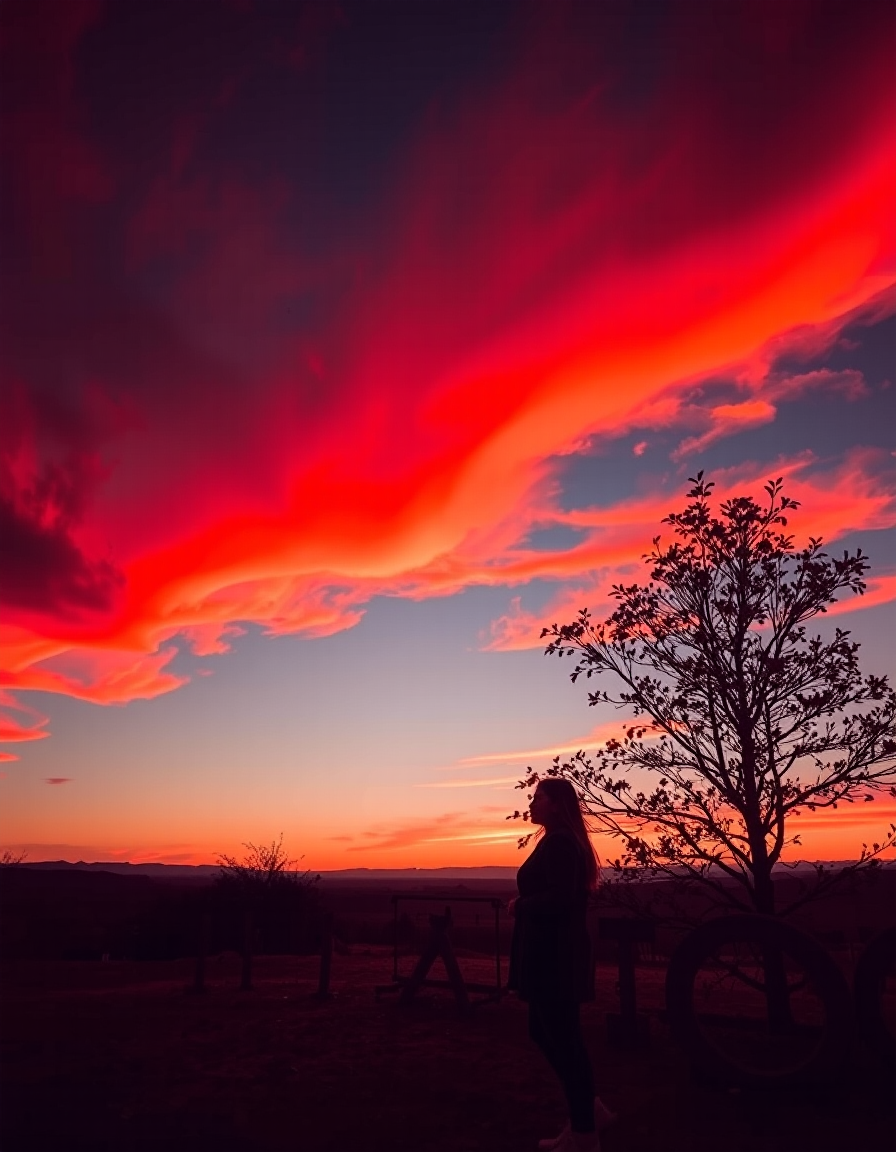
silhouette of a person standing in front of a tree at sunset.
CAPTION
The image captures a serene moment of a person standing in a field at sunset. The sky is ablaze with vibrant hues of red and orange, creating a dramatic contrast with the dark silhouette of the person. The person, silhouetted against the sky, is facing away from the viewer, adding a sense of mystery to the scene.
MONOLOGUE
'Twas deep autumn and a day of gold--the sunset burned and flamed and piled the sky with golden mountains such as had heaped upon each other on the evening he had stood with his mother at the Long Gallery window before their last parting; the trees' branches were orange and amber and russet brown, the moors had gold hues on them, and on the terraces the late flowers blooming blazed crimson and yellow as if the summer had burned all paler and less sumptuous colour away. The gables and turrets of the tower rose clear soft grey, or dark with ivy, against a sky of deepest blue, the broad tree-studded acres of the park rolled yellowing green to Camylott village, where white cottages nestled among orchards and fields of corn and were enfolded by wooded hills and rising moorland. Occasional farm-yard sounds were to be heard mingled now and then with voices and laughter of children, rooks cawed in the high tree-tops with a lazy irregularity, and there was an autumn freshness in the ambient air. In the courtyard the fountain played with a soft plashing, and as he rode in some little birds were chirping and fluttering as they drank and flirted the water with their wings. The wide doors were thrown open, showing the beauteous huge hall with its pictures and warm colours, its armour and trophies of the chase; the servants stood waiting to receive him, and as the groom took his horse, Mr. Fox approached to greet him on the threshold. Every face had kindly welcome in it, every object seemed to recall some memory which
SUMMARY
The image depicts a serene scene of a boat on a river at sunset. The boat, with its sails unfurled, is positioned in the foreground, close to the camera. The river, reflecting the vibrant colors of the sunset, is surrounded by a forest of trees, their leaves rustling in the gentle breeze. The sky above is painted in
CAPTION
The image depicts a serene lakeside scene bathed in the soft glow of a sunset. The sky is painted in hues of pink and purple, with the sun setting behind a line of trees. The water reflects the vibrant colors of the sky, creating a mirror-like effect.
MONOLOGUE
His words explained, but they did not convince. Was this sudden-bursting glory only the sun rising behind storm clouds? She could see the clouds moving while they were being colored. The universal gray surrendered under some magic paint brush. The rifts widened, and the gloom of the pale-gray world seemed to vanish. Beyond the billowy, rolling, creamy edges of clouds, white and pink, shone the soft exquisite fresh blue sky. And a blaze of fire, a burst of molten gold, sheered up from behind the rim of cloud and suddenly poured a sea of sunlight from east to west. It transfigured the round foothills. They seemed bathed in ethereal light, and the silver mists that overhung them faded while Carley gazed, and a rosy flush crowned the symmetrical domes. Southward along the horizon line, down-dropping veils of rain, just touched with the sunrise tint, streamed in drifting slow movement from cloud to earth. To the north the range of foothills lifted toward the majestic dome of Sunset Peak, a volcanic upheaval of red and purple cinders, bare as rock, round as the lower hills, and wonderful in its color. Full in the blaze of the rising sun it flaunted an unchangeable front. Carley understood now what had been told her about this peak. Volcanic fires had thrown up a colossal mound of cinders burned forever to the hues of the setting sun. In every light and shade of day it held true to its name. Farther north rose the bold bulk of the San Francisco Peaks, that, half lost in the clouds, still
SUMMARY
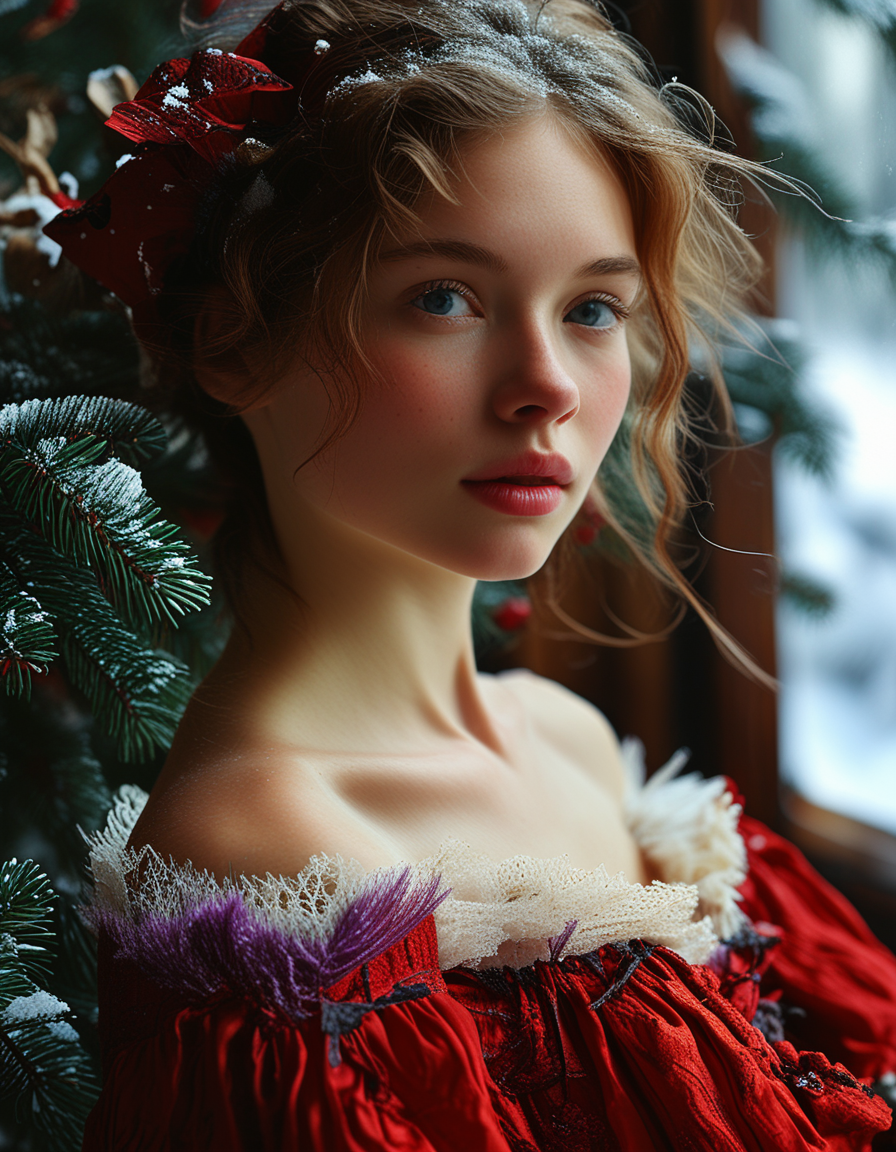
young woman in red dress with a flower headpiece and a white lace collar.
CAPTION
The image depicts a young woman with long blonde hair, wearing a red off-shoulder dress adorned with a purple and white lace collar. She is standing in front of a Christmas tree, which is decorated with ornaments and lights. The woman's expression is serious, and she is looking directly at the camera.
MONOLOGUE
"And therewith they set to changing horses. The peasants who were standing far off, quite silent, with reverently bared heads, came softly nearer, and looked eagerly at the King. An old Gingerbread- woman (SOMMELFRAU) of Lebbenichen [always knew her afterwards] took me in her arm, and held me aloft close to the coach-window. I was now at farthest an ell from the King; and I felt as if I were looking in the face of God Almighty (ES WAR MIR ALS OB ICH DEN LIEBEN GOTT ANSAHE). He was gazing steadily out before him," into the glowing West, "through the front window. He had on an old three-cornered regimental hat, and had put the hindward straight flap of it foremost, undoing the loop, so that this flap hung down in front, and screened him from the sun. The hat-strings (HUT- CORDONS," trimmings of silver or gold cord) "had got torn loose, and were fluttering about on this down-hanging front flap; the white feather in the hat was tattered and dirty; the plain blue uniform, with red cuffs, red collar and gold shoulder-bands [epaulettes WITHOUT bush at the end], was old and dusty, the yellow waistcoat covered with snuff;--for the rest, he had black-velvet breeches [and, of course, the perpetual BOOTS, of which he would allow no polishing or blacking, still less any change for new ones while they would hang together]. I thought always he would speak to me. The old woman could not long hold me up; and so she set me down again. Then the King looked at the Clergyman, beckoned him near, and asked, Whose child it was? (Herr von Marwitz of
SUMMARY
a woman in a red Santa hat and red dress is holding a red and gold ornament and looking out a window at a Christmas tree.
CAPTION
The image depicts a woman dressed in a vibrant red Santa Claus outfit, complete with a matching red hat and a white fur-lined coat. She is standing in a room adorned with a Christmas tree, which is adorned with red ornaments and a gold star on top. The woman is holding a red and gold gift box in her left hand, and her right hand is gently touching the tree.
MONOLOGUE
My table was a small round one set in front of the open French windows. Looking a little to the right I could see the extent of my domain--a low laurel hedge, a sloping field beyond, in which my two Alderneys were standing almost knee-deep amongst the buttercups; a ring fence, a paddock, and, beyond, the road. To the left were my gardens, the sweetness of which came stealing through the window with the very faintest breath of the slowly moving air, bordered by that ancient red brick wall, mellowed and crumbling with the sun and west winds of generations, and in front of me my lawn and the cedar-tree under which Lady Delahaye had sat an hour or so ago and prophesied evil things. My lips parted into a smile as I thought of her words. Did she indeed think me a creature so weak as to pile gloom on the top of sorrow, to shut my eyes to all the joys of life, because supreme happiness was denied me, to play skittles with my self-respect, and--marry a kitchen-maid? I, who had turned over great pages in the book of life! I, who had known Feurgeres! Wallace had left the room for a moment, and I raised my glass full of clear amber wine, and drank silently my evening toast. I drank to the memory of the greatest love I had ever known, to the man whose strong and beautiful life had taught me how to fashion my own. Perhaps my thoughts flashed a little further afield. It was so always when I thought of Feurgeres, but it was to the joyous and wonderful memory of those earlier days, to Isobel the child I drank. Isobel of Waldenburg
SUMMARY
The artist has created a surreal portrait of a woman with her head tilted upwards, surrounded by vibrant autumn leaves.
CAPTION
The image depicts a person with long, curly hair, wearing a blue dress, standing in a forest with orange autumn leaves. The person is looking upwards, possibly at something in the distance. The background is filled with trees and foliage, creating a natural, outdoor setting.
MONOLOGUE
Then came a long pause; they both kept staring at the canvas. It measured about sixteen feet by ten, and was entirely painted over, though little of the work had gone beyond the roughing-out. This roughing-out, hastily dashed off, was superb in its violence and ardent vitality of colour. A flood of sunlight streamed into a forest clearing, with thick walls of verdure; to the left, stretched a dark glade with a small luminous speck in the far distance. On the grass, amidst all the summer vegetation, lay a nude woman with one arm supporting her head, and though her eyes were closed she smiled amidst the golden shower that fell around her. In the background, two other women, one fair, and the other dark, wrestled playfully, setting light flesh tints amidst all the green leaves. And, as the painter had wanted something dark by way of contrast in the foreground, he had contented himself with seating there a gentleman, dressed in a black velveteen jacket. This gentleman had his back turned and the only part of his flesh that one saw was his left hand, with which he was supporting himself on the grass.
SUMMARY
woman in black blazer posing in front of a street light at night.
CAPTION
The image depicts a woman with long blonde hair, wearing a black blazer, standing in front of a blurred background. The woman's gaze is directed towards the camera, and her expression is serious. The lighting in the image is dramatic, with a warm glow emanating from the left side of the frame, casting a soft light on the woman's face and shoulders.
MONOLOGUE
But I remember well the day of our departure back to exile. The elongated, bizarre, shabby travelling-carriage with four post-horses, standing before the long front of the house with its eight columns, four on each side of the broad flight of stairs. On the steps, groups of servants, a few relations, one or two friends from the nearest neighbourhood, a perfect silence, on all the faces an air of sober concentration; my grandmother all in black gazing stoically, my uncle giving his arm to my mother down to the carriage in which I had been placed already; at the top of the flight my little cousin in a short skirt of a tartan pattern with a deal of red in it, and like a small princess attended by the women of her own household: the head gourvernante, our dear, corpulent Francesca (who had been for thirty years in the service of the B. family), the former nurse, now outdoor attendant, a handsome peasant face wearing a compassionate expression, and the good, ugly Mlle. Durand, the governess, with her black eyebrows meeting over a short thick nose and a complexion like pale brown paper. Of all the eyes turned towards the carriage, her good-natured eyes only were dropping tears, and it was her sobbing voice alone that broke the silence with an appeal to me: N'oublie pas ton francais, mon cheri. In three months, simply by playing with us, she had taught me not only to speak French but to read it as well. She was indeed an excellent playmate. In the distance, half way down to the great gates, a light,
SUMMARY
a woman is walking through a body of water at sunset with palm trees in the background
CAPTION
The image depicts a serene nighttime scene with a woman walking along a body of water, which appears to be a lake or a river. The sky is a deep blue, and the sun is setting, casting a warm orange glow over the scene. The woman is wearing a sleeveless top and jeans, and she is carrying a backpack.
MONOLOGUE
If you wish to change the scene, roam through the plazas, with their marble water-basins and orange-trees; go to the Duke de Montpensier's garden, with its wealth of myrtles and fern palms; wander to the river-side and look at the ships lading or unlading; or ascend the Giralda, the old mosque steeple from which the muezzin called the faithful to prayer, and take in the comely mass of colour beneath in one broad sweep. Then the changing sky that canopies this "fragment of heaven let fall upon earth!" The riot of clouds when the elements war, and after the midday heats the genial rain pours down as if the blue expanse overheard were a lake--how fervent and cordial! At night, when the city streets are crowded with groups in conversation; when the fragrant, flower-garlanded patios are visible by mystic lights pendent from gilt chandeliers, like votive lamps before a shrine; when caballeros pay court to their lady-loves through gratings as caballeros are licensed only to pay court in Spain; when plaintive songs, with a reminiscence of the desert about them, are chanted in monotonous cadence to the accompaniment of a guitar--how grateful it all is to him who is not lost to the sense of poetry! Imperceptibly one yields himself to the associations of the bygone, and imagination takes wing. As the night ages and silence enwraps the scene--a silence only broken by the deep boom from a clock-tower or the voice of the sereno, the Spanish watchman, hobbling along with his lantern swinging from his pike and his
SUMMARY
the character is a woman with long blonde hair and is wielding a sword in a fantasy setting. she is standing on a rocky cliff overlooking a body of water and is surrounded by mountains and trees.
CAPTION
The image depicts a female character with long, blonde hair, wearing a dark outfit with a red and black design. She is holding a sword in her right hand, which is extended towards the viewer. The background is a vibrant mix of pink and purple hues, with a large moon in the sky, suggesting a mystical or fantasy setting.
MONOLOGUE
The young Queen of the Ansarey could not have received them with an air more impassive had she been holding a levee at St. James'. Seated on her divan, she was clothed in a purple robe; her long dark hair descended over her shoulders, and was drawn off her white forehead, which was bound with a broad circlet of pure gold, and of great antiquity. On her right hand stood Keferinis, the captain of her guard, and a priestly-looking person with a long white beard, and then at some distance from these three personages, a considerable number of individuals, between whose appearance and that of her ordinary subjects there was little difference. On her left hand were immediately three female attendants, young and pretty; at some distance from them, a troop of female slaves; and again, at a still further distance, another body of her subjects in their white turbans and their black dresses. The chamber was spacious, and rudely painted in the Ionic style.
SUMMARY
woman wearing a hat and earrings, looking to the side, with a cityscape in the background.
CAPTION
The image depicts an elderly woman with a distinctive red hairstyle, wearing a black hat and a red scarf. She is standing in front of a blurred background that suggests a nighttime setting, possibly a street or a park. The woman's expression is serious, and her gaze is directed slightly upwards, suggesting a thoughtful or contemplative mood.
MONOLOGUE
So then here it was 2.07, and Hannah Winter, rather panicky, was rushing along Peacock Alley, dodging loungers, and bell-boys, and travelling salesmen and visiting provincials and the inevitable red-faced delegates with satin badges. In her hurry and nervous apprehension she looked, as she scuttled down the narrow passage, very much like the Rabbit who was late for the Duchess's dinner. Her rubber-heeled oxfords were pounding down hard on the white marble pavement. Suddenly she saw coming swiftly toward her a woman who seemed strangely familiar--a well-dressed woman, harassed looking, a tense frown between her eyes, and her eyes staring so that they protruded a little, as one who runs ahead of herself in her haste. Hannah had just time to note, in a flash, that the woman's smart hat was slightly askew and that, though she walked very fast, her trim ankles showed the inflexibility of age, when she saw that the woman was not going to get out of her way. Hannah Winter swerved quickly to avoid a collision. So did the other woman. Next instant Hannah Winter brought up with a crash against her own image in that long and tricky mirror which forms a broad full-length panel set in the marble wall at the north end of Peacock Alley. Passersby and the loungers on near-by red plush seats came running, but she was unhurt except for a forehead bump that remained black-and-blue for two weeks or more. The bump did not bother her, nor did the slightly amused concern of those who had come to her assistance. She stood there, her hat still askew, staring at this
SUMMARY
actor in a red and black outfit with a beard and a hood.
CAPTION
The image depicts a man with curly hair, wearing a black scarf, against a backdrop of a blurred street scene. The man's face is the focal point of the image, with his eyes looking directly at the viewer. His expression is serious and contemplative, suggesting a moment of introspection or contemplation.
MONOLOGUE
There were high oak pews in the little church at the end of the road which the Caldwells attended on Sunday; in the rows on either side of the main aisle the pews came together in twos, so that when Beth sat at the end of theirs, as she always did, the person in the next pew sat beside her with only the wooden partition between. One Sunday, when she was on her knees, drowsing through the Litany with her cheek on her prayer-book, she became aware of a boy in the next pew with his face turned to her in exactly the same attitude. He had bright fair hair curling crisply, a ruddy fair fat face, and round blue eyes, clear as glass marbles. Beth was pleased with him, and smiled involuntarily. He instantly responded to the smile; and then they both got very red; and, in their delicious shyness, they turned their heads on their prayer-books, and looked in opposite directions. This did not last long, however. The desire for another look seized them simultaneously, and they turned their faces to each other, and smiled again the moment their eyes met. All through the service they kept looking at each other, and looking away again; and Beth felt a strange glad glow begin in her chest and spread gradually all over her. It continued with her the whole day; she was conscious of it throughout the night; and directly she awoke next morning there it was again; and she could think of nothing but the apple-cheeked boy, with bright blue eyes and curly fair hair; and as she dwelt upon his image she smiled
SUMMARY
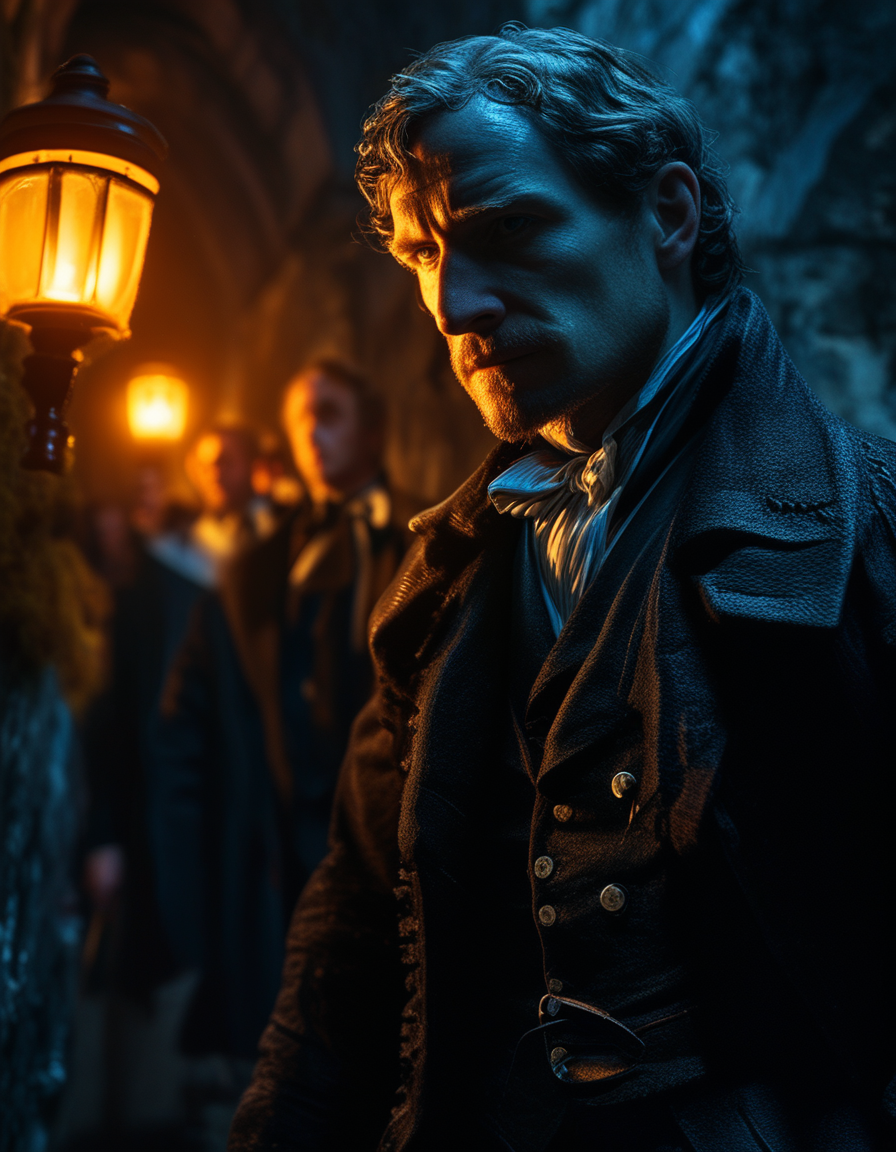
actor in period costume stands in a dimly lit alleyway, looking off to the side.
CAPTION
The image depicts a man in a medieval-style outfit, standing in a dimly lit alleyway. He is wearing a black coat with gold buttons and a white cravat. The background is filled with other figures, suggesting a bustling street scene.
MONOLOGUE
A fairy city of lights, outlining spires, roofs and street lines, lay by reflection in the black water of a broad still harbour, as the train skirted the low coast of Petone, landing-place of the first white settlers, eventually passing through extensive suburbs and coming to a standstill in the station of Wellington. Here the reception was a climax to the demonstrations along the journey from Auckland. Mayor Luke, supported by the city councillors, in ermine and gold chains, received the Prince, as he alighted from the train. Mr. Massey, and other members of the Dominion Government, were waiting at the entrance. Outside, one of the smartest captain's guards-of-honour imaginable was standing to attention, with band and colours. Beyond, restrained by a rope barrier, an enormous crowd cheered and cheered. The eye travelled over the heads of the nearer people, and then further away, and there was no thinning off. One then began to realize that one was looking up a broad street which climbed a hill, and that the entire hill was a palpitating mass of shouting humanity, dimly seen in the half-light of the illuminations.
SUMMARY
The image depicts a serene and picturesque scene of a river flowing through a lush, vibrant forest. The sky above is a deep blue, dotted with fluffy white clouds, while the river itself is a tranquil, dark blue, reflecting the surrounding greenery. The trees, adorned with pink blossoms, add a touch of color and life to the scene, creating a
CAPTION
The image depicts a serene, twilight scene with a river flowing through a lush, vibrant forest. The sky is a deep blue, adorned with a few clouds, and the trees are adorned with pink cherry blossoms, adding a touch of color to the otherwise monochromatic landscape.
MONOLOGUE
As the southeastern coast of Cuba is high and bold, with deep water extending close up to the line of surf, vessels going back and forth between Santiago and Guantanamo run very near to the land; and the ever-changing panorama of tropical forest and cloud-capped mountain which presents itself to the eye as the steamer glides swiftly past, within a mile of the rock-terraced bluffs and headlands, is a constant source of surprise and delight, even to the most experienced voyager. It is an extremely beautiful and varied coast. In the foreground, only a rifle-shot away across the blue undulating floor of the Caribbean, rises a long terraced mesa, fronting on the sea, with its rocky base in a white smother of foaming surf, and its level summit half hidden by a drooping fringe of dark-green chaparral and vines. Over the cyclopean wall of this mesa appear the rounded tops of higher and more distant foot-hills, densely clad in robes of perennial verdure, while beyond and above them all, at a distance of five or six miles, rise the arial peaks of the splendid Sierra del Cobre, with a few summer clouds drifting across their higher slopes and casting soft violet shadows into the misty blue of their intervening valleys. Here and there the terraced mesa, which forms the coast-line, is cut into picturesque castle-like bluffs by a series of wedge-shaped clefts, or notches, and through the openings thus made in the rocky wall one may catch brief glimpses of deep, wild ravines down which mountain torrents from the higher peaks
SUMMARY
a snow-covered Christmas tree on a street with a house in the background.
CAPTION
The image captures a serene winter scene in a quaint village. The main focus is a beautifully lit Christmas tree, adorned with red and gold lights, standing tall on a snow-covered street. The tree is positioned on the left side of the image, with its branches reaching out towards the right.
MONOLOGUE
Oh what beautiful sights! What enchantin' views of the water; or, if the light struck it jest right, the long, blue, undilating plain, dotted with gold points of light. Islands with the virgin forest stretchin' down to the edge of the water, and cool green shadders layin' on the velvet and mossy sward as you could see as you looked into the green aisles. And all sorts of trees with different foliage, some loose and feathery, some with shinin' leaves, glitterin' where the rain had washed 'em the night before; some towerin' up towards the heavens, shakin' their heads at the sun; some droopin' down as if weighted with their wealth of branches and green leaves; anon a tree covered with flowers, and then some evergreens, and anon one that had ketched in its brilliant leaves the red hectic of autumn fever and blazed out in crimson and yeller. And then a hull lot of evergreens standin' up straight and tall by the water's edge, and as fur back as you could see, but sort o' reachin' out their green arms towards the river. And them on the edge, lookin' down into the clear depths and seein' there another island, a shadow island layin' beautiful and serene with nothin' disturbin' its beauty but the shinin' ripples wavin' the fairy branches below, like the soft wind rustlin' the tree tops overhead.
SUMMARY
a pink flower branch with a sunbeam shining through it
CAPTION
The image presents a vibrant scene of a tree branch adorned with pink flowers against a deep blue-green background. The branch, with its numerous flowers, is positioned centrally in the frame, drawing the viewer's attention. The flowers, with their delicate petals, are scattered across the branch, creating a sense of depth and texture.
MONOLOGUE
On landing, the beautiful appearance of the island was rather increased than diminished; vegetation appeared most luxuriant, and the trees and shrubs blooming with various tints, spread a gaiety around; the clean and neat native houses were intermingled with the waving plumes of the cocoa-nut, the broad spreading plantain, and other trees peculiar to tropical climes. That magnificent tree the callophyllum inophyllum, or fifau of the natives, was not less abundant, displaying its shining, dark, green foliage, contrasted by beautiful clusters of white flowers teeming with fragrance. This tree seemed a favourite with the natives, on account of its shade, fragrance, and ornamental appearance of the flowers. When I extended my rambles more inland, through narrow and sometimes rugged pathways, the luxuriance of vegetation did not decrease, but the lofty trees, overshadowing the road, defended the pedestrian from the effects of a fervent sun, rendering the walk under their umbrageous covering cool and pleasant. The gay flowers of the hibiscus tiliaceus, as well as the splendid huth or Barringtonia speciosa, covered with its beautiful flowers, the petals of which are white, and the edges of the stamina delicately tinged with pink, give to the trees when in full bloom a magnificent appearance; the hibiscus rosa-chinensis, or kowa of the natives also grows in luxuriance and beauty. The elegant flowers of these trees, with others of more humble and less beautiful tints, everywhere meet the eye near the paths,
SUMMARY
young woman in a red dress with a necklace and a necklace with a pendant, looking to the side, with a blurred background of people and lights.
CAPTION
The image depicts a woman with long blonde hair, wearing a red dress, standing in a bustling urban environment. The background is filled with various elements, including a blurred street with red and blue lights, suggesting a nighttime setting. The woman is positioned in the foreground, facing towards the camera, and her gaze is directed slightly downwards.
MONOLOGUE
Tessa had to pass through various long streets without seeing any other sign of the Carnival than unusual groups of the country people in their best garments, and that disposition in everybody to chat and loiter which marks the early hours of a holiday, before the spectacle has begun. Presently, in her disappointed search for remarkable objects, her eyes fell on a man with a pedlar’s basket before him, who seemed to be selling nothing but little red crosses to all the passengers. A little red cross would be pretty to hang up over her bed; it would also help to keep off harm, and would perhaps make Ninna stronger. Tessa went to the other side of the street that she might ask the pedlar the price of the crosses, fearing that they would cost a little too much for her to spare from her purchase of sweets. The pedlar’s back had been turned towards her hitherto, but when she came near him she recognised an old acquaintance of the Mercato, Bratti Ferravecchi, and, accustomed to feel that she was to avoid old acquaintances, she turned away again and passed to the other side of the street. But Bratti’s eye was too well practised in looking out at the corner after possible customers, for her movement to have escaped him, and she was presently arrested by a tap on the arm from one of the red crosses.
SUMMARY
a woman in a white kimono is standing in a park at sunset with her back to the camera.
CAPTION
The image depicts a serene scene of a woman standing in a park, surrounded by trees and a sunset. The woman is dressed in a white kimono with a floral pattern, and her hair is tied back in a ponytail. She is facing away from the camera, giving the impression that she is lost in thought or enjoying the peaceful atmosphere.
MONOLOGUE
Thus Fergus told the tale, laughingly, as at a danger that was past, a storm-cloud that had lost its arrows of white hail and was no longer fearful. For, he said, Concobar had forgotten his anger, had promised a truce to the sons of Usnac, and most of all to Naisi, and had bidden them return as his guests to Emain of Maca, where Deirdré should dwell happy with her beloved. The comrades of Fergus by this time had tied their boat and come up from the shore, and the sons of Usnac were ready to depart. Yet Deirdré's heart misgave her as she thought of the days among those purple hills and granite rocks, by the long green water of the Loch, and her clear-seeing soul spoke words of doom for them all: words soon to be fulfilled. Amongst the comrades of Fergus were certain of the adherents of Concobar, treacherous as he; for he had no thought of pardoning the sons of Usnac, nor any intent but to draw Deirdré back within his reach; the image of her bright eyes and the redness of her lips, and her soft breast and shining hair was ever before him, and his heart gnawed within him for longing and the bitterness of desire.
SUMMARY
a woman with a crown of flowers on her head is looking out of a window at a sunset
CAPTION
The image depicts a woman with a crown of white flowers on her head, positioned in front of a tree trunk. The background is a vibrant red, with a bright light source in the top right corner, creating a dramatic effect. The woman's face is turned to the side, and her expression is serious.
MONOLOGUE
At about noon, he came through a village. In front of the mud cottages, children were rolling about in the street, were playing with pumpkin-seeds and sea-shells, screamed and wrestled, but they all timidly fled from the unknown Samana. In the end of the village, the path led through a stream, and by the side of the stream, a young woman was kneeling and washing clothes. When Siddhartha greeted her, she lifted her head and looked up to him with a smile, so that he saw the white in her eyes glistening. He called out a blessing to her, as it is the custom among travellers, and asked how far he still had to go to reach the large city. Then she got up and came to him, beautifully her wet mouth was shimmering in her young face. She exchanged humorous banter with him, asked whether he had eaten already, and whether it was true that the Samanas slept alone in the forest at night and were not allowed to have any women with them. While talking, she put her left foot on his right one and made a movement as a woman does who would want to initiate that kind of sexual pleasure with a man, which the textbooks call "climbing a tree". Siddhartha felt his blood heating up, and since in this moment he had to think of his dream again, he bend slightly down to the woman and kissed with his lips the brown nipple of her breast. Looking up, he saw her face smiling full of lust and her eyes, with contracted pupils, begging with desire.
SUMMARY
two women in white robes are holding hands in a forest at sunset.
CAPTION
The image depicts two figures in a serene forest setting. The figures are dressed in white robes, with one figure holding a hand of the other. The background is filled with trees and a clear sky, creating a tranquil atmosphere.
MONOLOGUE
haste to Sicily. For the eighth, likewise, was seen how, not finding her there, in her deep anguish she kindled two great torches, being moved to the resolution to seek her throughout the whole world; and in the ninth and last she was seen arriving at the well of Cyane, and there coming by chance upon the girdle of her stolen daughter, a sure proof of what had befallen her; whereupon in her great wrath, not having aught else on which to vent it, she was seen turning to break to pieces the rakes, hoes, ploughs, and other rustic implements that chanced to have been left there in the fields by the peasants. At the foot of the car, then, were seen walking figures signifying her various sacrifices; first, for those that are called the Eleusinia, two little virgins attired in white vestments, each with a gracious little basket in the hands, one of which was seen to be all filled with various flowers, and the other with various ears of corn. After which, for those sacrifices that were offered to Ceres as Goddess of Earth, there were seen coming two boys, two women, and two men, likewise all dressed in white, and all crowned with hyacinths, who were leading two great oxen, as it were to sacrifice them; and then, for those others that were offered to Ceres the Law-giver, called by the Greeks Thesmophoros, were seen coming two matrons only, very chaste in aspect, likewise dressed in white, and in like manner crowned with ears of corn and agnus-castus. And after these, in order to display in full the whole order of her sacrifices,
SUMMARY
a woman in a red dress with flowers in her hair, standing in front of a tree with a spotlight shining on her
CAPTION
The image presents a woman standing in a garden, adorned with a bouquet of red flowers. The flowers are in full bloom, and the woman's hair is styled in a bun, adding a touch of elegance to her appearance. The background is a blur of orange and pink hues, suggesting a warm and vibrant atmosphere.
MONOLOGUE
On the morning after this incident I was up betimes, as is my wont; but I was surprised, on glancing from my window, to see that our new inmate was earlier still. She was walking down the narrow pathway, which zigzags over the fell--a tall woman, slender, her head sunk upon her breast, her arms filled with a bristle of wild flowers, which she had gathered in her morning rambles. The white and pink of her dress, and the touch of deep red ribbon in her broad drooping hat, formed a pleasant dash of colour against the dun-tinted landscape. She was some distance off when I first set eyes upon her, yet I knew that this wandering woman could be none other than our arrival of last night, for there was a grace and refinement in her bearing which marked her from the dwellers of the fells. Even as I watched, she passed swiftly and lightly down the pathway, and turning through the wicket gate, at the further end of our cottage garden, she seated herself upon the green bank which faced my window, and strewing her flowers in front of her, set herself to arrange them.
SUMMARY
a small bush with purple flowers in a dark blue room
CAPTION
The image captures a serene winter scene with a single, tall, slender tree adorned with delicate purple flowers. The tree is set against a deep blue background, which is illuminated by a soft, warm light that casts a gentle glow on the tree and its surroundings. The light creates a sense of depth and highlights the intricate details of the tree's branches and flowers.
MONOLOGUE
But more lovely than any of the shrubs along the river was that small tree known as the sweet bay or the swamp laurel. Of course it is not a laurel at all, but a magnolia (_Magnolia glauca_), and its glistening leaves, dark green above, silvery beneath, are set around the large, solitary flowers at the ends of the branches, like backgrounds of malachite, to bring out the perfection of a blossom carved in fresh ivory. What creamy petals are these, so thick, so tenderly curved around the cone-like heart of the flower's fertility! They are warm within, so that your finger can feel the soft glow in the centre of the blossoms. But it is not for you to penetrate into the secret of their love mystery. Leave that to the downy bee, the soft-winged moth, the flying beetle, who, seeking their own pleasure, carry the life-bestowing pollen from flower to flower. Your heavy hand would bruise the soft flesh and discolor its purity. Be content to feast your eyes upon its beauty, and breathe its wonderful fragrance, floating on the air like the breath of love in the south and wild summer.
SUMMARY
a person wearing a hoodie with a glowing blue light on it, standing in a dark alleyway at night, with a street lamp in the background.
CAPTION
The image depicts a person standing in a dimly lit urban setting, illuminated by a glowing blue neon mask and goggles. The person is wearing a hooded sweatshirt and appears to be in a state of distress or contemplation. The background is filled with smoke, adding a sense of mystery and foreboding.
MONOLOGUE
A cell door was reached and unlocked by the inserting of a great iron key. It was swung open, and the same big hand guided him through. A moment later the bag was pulled easily from his head, and he saw that he was in a narrow, whitewashed cell, rather dim, windowless, but lighted from the top by a small skylight of frosted glass three and one half feet long by four inches wide. For a night light there was a tin-bodied lamp swinging from a hook near the middle of one of the side walls. A rough iron cot, furnished with a straw mattress and two pairs of dark blue, probably unwashed blankets, stood in one corner. There was a hydrant and small sink in another. A small shelf occupied the wall opposite the bed. A plain wooden chair with a homely round back stood at the foot of the bed, and a fairly serviceable broom was standing in one corner. There was an iron stool or pot for excreta, giving, as he could see, into a large drain-pipe which ran along the inside wall, and which was obviously flushed by buckets of water being poured into it. Rats and other vermin infested this, and it gave off an unpleasant odor which filled the cell. The floor was of stone. Cowperwood’s clear-seeing eyes took it all in at a glance. He noted the hard cell door, which was barred and cross-barred with great round rods of steel, and fastened with a thick, highly polished lock. He saw also that beyond this was a heavy wooden door, which could shut him in even more completely than the iron one. There was no chance for any clear,
SUMMARY
couple walking hand in hand through a forest at sunset
CAPTION
The image depicts a couple walking hand in hand through a serene forest at sunset. The woman is dressed in a long, flowing red dress, while the man is wearing a white shirt and dark pants. The sun is setting, casting a warm glow over the scene, and the trees in the background are adorned with orange and yellow leaves, indicating the onset of autumn.
MONOLOGUE
There is a town where gay people in white dress promenade in a plaza shaded by orange trees, and they are always humming tunes. Little white streets lead to shuttered houses. A glory of buginvillaea overflows trellis and bower in splendid war with the hibiscus hedges and the dropping yellow fruit. Down the hill and over cobblestones, pursued by music and laughter, ministered to by odors of the lemon blossom, he whom sleep leads here may go toward a lake of fluent amethyst. The way is past the market place where brown women crouch by baskets of brilliant wares and venders of glistening lizards sit drowsily bent, and then at a step the forest dense and brooding is above him and its low boughs sweep the ripple of the lake. Immense leaves hang like curtains, and among them men with unquiet eyes move and hold monotoned speech while they hew sparkling rock into monstrous shapes. They are circling round a pit. They cast in ornaments of opal and dark gold and garlands of venomous forest growths, gray and blood-red, tied with withered vines. Cries come from the pit, but the chant never stops.
SUMMARY
man in red suit looking at his phone while walking down a street
CAPTION
The image depicts a man in a red suit, standing on a street corner. He is holding a smartphone in his right hand, which is close to the camera. The man's hair is styled in a wavy manner, and he is wearing a red bow tie.
MONOLOGUE
Placing his right hand on me, he placed both his hands on his breast and breathed deeply two or three times, then using the index finger and thumb of each hand as if he were holding a small pin, he placed the two hands in this position as if he were holding a thread in each hand and between the thumb and forefinger of each hand close together, and then let his hands recede from each other, still holding his fingers in the same position, as if he were letting a thread slip between them until his hands were two feet apart--_You live long time_, Fig. 323. Laying his right hand on his breast, then extending his forefinger of the same hand, holding it from him at half-arm's length, the finger pointing nearly upward, then moving his hand, with the finger thus extended, from side to side about as rapidly as a man steps in walking, each time letting his hand get farther from him for three or four times, then suddenly placing his left hand in a horizontal position with the fingers extended and together so that the palm was sidewise, he used the right-hand palm, extended, fingers together, as a hatchet, and brought it down smartly, just missing the ends of the fingers of the left hand, Fig. 324. Then placing his left hand, with the thumb and forefinger closed, to his heart, he brought his right hand, fingers in the same position, to his left; then, as if he were holding something between his thumb and forefinger, he moved his right hand away as if he were slowly casting a hair from him,
SUMMARY
The image depicts a dramatic sunset with a large, dark, and ominous storm cloud in the sky.
CAPTION
The image captures a dramatic scene of a forest at sunset. The sky is ablaze with hues of orange and red, creating a striking contrast with the dark silhouettes of the trees. The sun, positioned high in the sky, is partially obscured by the clouds, adding to the sense of awe and grandeur.
MONOLOGUE
From the kraal of Maqandi we could already see the great mountain range in whose heart lay the locality of this terror, and shortly, ere the last rays of the sun faded from the world, we stood before a dark and narrow defile. We had left behind the dwellings of men, though plentiful traces of their occupation would meet our eyes, being left by the iron-working parties. Through this defile a thin trickle of water ran, though in times of rain and storm the place showed signs of pouring down a mighty and formidable flood. High overhead the slopes were covered with thick bush and forest trees, and above this, again, walls of red-faced rock seemed to cleave the sky. As we entered this gloomy place the terror on the faces of the slaves deepened, and even I, _Nkose_, felt not so easy in my mind as I would have it appear.
SUMMARY
The woman in the image is wearing an orange hooded garment and has a serious expression.
CAPTION
The image depicts a woman wearing an orange hooded garment, which appears to be a traditional outfit, with a floral pattern. She is standing in front of a blurred background that suggests an outdoor setting, possibly a street or a park. The woman's expression is serious, and her gaze is directed towards the camera.
MONOLOGUE
"Which Mrs. Harris's own words to me, was these: 'Sairey Gamp,' she says, 'why not go to Margate? Srimps,' says that dear creetur, 'is to your liking, Sairey; why not go to Margate for a week, bring your constitootion up with srimps, and come back to them loving arts as knows and wallies of you, blooming? Sairey,' Mrs. Harris says, 'you are but poorly. Don't denige it, Mrs. Gamp, for books is in your looks. You must have rest. Your mind,' she says, 'is too strong for you; it gets you down and treads upon you, Sairey. It is useless to disguige the fact--the blade is a wearing out the sheets.' 'Mrs. Harris,' I says to her, 'I could not undertake to say, and I will not deceive you ma'am, that I am the woman I could wish to be. The time of worrit as I had with Mrs. Colliber, the baker's lady, which was so bad in her mind with her first, that she would not so much as look at bottled stout, and kept to gruel through the month, has agued me, Mrs. Harris. But ma'am,' I says to her, 'talk not of Margate, for if I do go anywheres, it is elsewheres and not there.' 'Sairey,' says Mrs. Harris, solemn, 'whence this mystery? If I have ever deceived the hardest-working, soberest, and best of women, which her name is well beknown is S. Gamp Midwife Kingsgate Street High Holborn, mention it. If not,' says Mrs. Harris, with the tears a standing in her eyes, 'reweal your intentions.' 'Yes, Mrs. Harris,' I says, 'I will. Well I knows you Mrs. Harris; well you knows me; well we both knows wot the characters of one another is. Mrs.
SUMMARY
a man and a woman are embracing in a street with a cowboy hat and a cowboy hat on the man.
CAPTION
The image depicts a romantic scene between a man and a woman in a bustling urban setting. The man, dressed in a cowboy hat and a denim shirt, is holding the woman in his arms, who is wearing a vibrant orange dress adorned with gold sequins.
MONOLOGUE
"My father will not hear him named!" she cried. "He would have Cuba continue a slave, she, who will be the queen and goddess of the sea when the war is over! Ah, Marguerite! my heart is on flame when I speak of my country. Well,--we met them there. They are both with the army, the insurgents, as the Spaniards call them. We walked up and down. The orange-blossoms were so sweet, the fragrance hung like clouds in the air. I had a lace mantilla over my head,--I will show it to you one day. We talked of _Cuba libre_, and they told us how they live there in the mountains. Ah! if a girl could fight, would I be here? No; a sword should be by my side, a plume in my hat, and I would be with Carlos and Fernando in the mountains. Well,--ah, the bad part is to come! Carlos had been wounded; his arm was in a sling. Folly, to make it of a white handkerchief! The senora--my father's wife--must have seen it shining among the trees; we know it must have been that, for we girls wore black dresses of purpose,--a woman thinks of what a man never dreams of. She called my father; he came out, raging. We had a fine scene. Burning words passed between my father and Carlos. They vowed never to see each other more. They went, and Conchita and I go fainting, dying, into the house. Three days after comes my uncle's letter,--behold me here! Marguerite, this is my story. Preserve it in your bosom, it is a sacred confidence."
SUMMARY
The female character in the image is wearing a necklace and has long curly hair. She is sitting in a cave and looking to the side.
CAPTION
The image depicts a woman with long, curly blonde hair, wearing a brown dress with a necklace and a horned headdress. She is seated in a dimly lit cave, with a rocky wall and a tree in the background. The woman's expression is serious, and she is looking to the side.
MONOLOGUE
It was intensely hot, but the strain had gone out of the day; the feeling of just bearing up against the heat and getting through the day had gone; they all sat round ... which was which?... Miriam met eye after eye--how beautiful they all were looking out from faces and meeting hers--and her eyes came back unembarrassed to her cup, her solid butter-brot and the sunlit angle of the garden-wall and the bit of tree just over Fraeulein Pfaff's shoulder. She tried to meet Mademoiselle's eyes, she felt sure their eyes could meet. She wondered intensely what was in Elsa's mind behind her faint hard blue dress. She wanted to hear Mademoiselle's voice; Mademoiselle was almost invisible in her corner near the door, the new housekeeper was sitting at her side very upright and close to the table. Once or twice she felt Fraeulein's look; she sustained it, and glowed happily under it without meeting it; she referred back contentedly to it after hearing herself laugh out once--just as she would do at home; once or twice she forgot for a moment where she was. The way the light shone on the housekeeper's hair, bright brown and plastered flatly down on either side of her bright white-and-crimson face, and the curves of her chocolate and white striped cotton bodice, reminded her sharply of something she had seen once, something that had charmed her ... it was in the hair against the hard white of the forehead and the flat broad cheeks with the hard, clear crimson colouring nearly covering them ... something in the way
SUMMARY
A woman in a long black dress stands in a forest at sunset, looking up at the sky.
CAPTION
The image depicts a serene, twilight scene with a woman standing in a field, surrounded by a large tree and a flock of sheep. The sky is filled with a dramatic orange hue, suggesting either sunrise or sunset. The woman is dressed in a long, dark dress, and her gaze is directed towards the sky, possibly contemplating the beauty of the moment.
MONOLOGUE
The guillotine was now the principal instrument of amusement for the populace of Paris. It was so elevated that all could have a good view of the spectacle it presented. To witness the conduct of nobles and of ladies, of boys and of girls, while passing through the horrors of a sanguinary death, was far more exciting than the unreal and bombastic tragedies of the theater, or the conflicts of the cock-pit and the bear garden. A countless throng flooded the streets, men, women, and children, shouting, laughing, execrating. The celebrity of Madame Roland, her extraordinary grace and beauty, and her aspect, not only of heroic fearlessness, but of joyous exhilaration, made her the prominent object of the public gaze. A white robe gracefully enveloped her perfect form, and her black and glossy hair, which for some reason the executioners had neglected to cut, fell in rich profusion to her waist. A keen November blast swept the streets, under the influence of which, and the excitement of the scene, her animated countenance glowed with all the ruddy bloom of youth. She stood firmly in the cart, looking with a serene eye upon the crowds which lined the streets, and listening with unruffled serenity to the clamor which filled the air. A large crowd surrounded the cart in which Madame Roland stood, shouting, "To the guillotine! to the guillotine!" She looked kindly upon them, and, bending over the railing of the cart, said to them, in tones as placid as if she were addressing her own child, "My friends, I _am_ going to the guillotine. In a few moments I
SUMMARY
The woman is posing for a photo in a red dress and a straw hat.
CAPTION
The image depicts a woman standing in a bustling city street at night. She is wearing a wide-brimmed hat and a red dress adorned with gold embroidery, which is a common fashion choice for women in the 1920s. The woman's face is lit up with a warm glow, suggesting that she is in a well-lit area.
MONOLOGUE
I ask what would be expected of a poor sewing-girl, young and pretty, about eighteen, with a romantic affair on her hands that is purely a question of love; with little knowledge of life and no idea of morals; eternally sewing near a window before which processions were not allowed to pass by order of the police, but near which a dozen young women prowled who were licensed and recognized by these same police; what could you expect of her, when after wearying her hands and eyes all day long on a dress or a hat, she leans out of that window as night falls? That dress she has sewed, that hat she has trimmed with her poor and honest hands in order to earn a supper for the household, she sees passing along the street on the head or on the body of a notorious woman. Thirty times a day a hired carriage stops before the door, and there steps out a dissolute character, numbered as is the hack in which she rides, who stands before a glass and primps, taking off and putting on the results of many days' work on the part of the poor girl who watches her. She sees that woman draw from her pocket gold in plenty, she who has but one louis a week; she looks at her feet and her head, she examines her dress and eyes her as she steps into her carriage; and then, what can you expect? When night has fallen, after a day when work has been scarce, when her mother is sick, she opens her door, stretches out her hand and stops a passerby.
SUMMARY
woman in a cowboy hat posing in a night-time city street with neon lights.
CAPTION
The image captures a woman in a vibrant, colorful setting, possibly at a night-time street fair or carnival. She is dressed in a cowboy hat and a long-sleeved, patterned shirt adorned with intricate designs. Her attire is complemented by a necklace and bracelets, adding to the overall glamour of the scene.
MONOLOGUE
back from its night-long ebb. Broadway had filled her length with people; not yet the most characteristic New York crowd, but the not less interesting multitude of strangers arrived by the early boats and trams, and that easily distinguishable class of lately New-Yorkized people from other places, about whom in the metropolis still hung the provincial traditions of early rising; and over all, from moment to moment, the eager, audacious, well-dressed, proper life of the mighty city was beginning to prevail,--though this was not so notable where Basil and Isabel had paused at a certain window. It was the office of one of the English steamers, and he was saying, "It was by this line I sailed, you know,"--and she was interrupting him with, "When who could have dreamed that you would ever be telling me of it here?" So the old marvel was wondered over anew, till it filled the world in which there was room for nothing but the strangeness that they should have loved each other so long and not made it known, that they should ever have uttered it, and that, being uttered, it should be so much more and better than ever could have been dreamed. The broken engagement was a fable of disaster that only made their present fortune more prosperous. The city ceased about them, and they walked on up the street, the first man and first woman in the garden of the new-made earth. As they were both very conscious people, they recognized in themselves some sense of this, and presently drolled it away, in the opulence of a time when every moment brought some
SUMMARY
a woman in a blue dress is walking down a wet city street at sunset
CAPTION
The image depicts a woman walking down a wet city street at sunset. The sky is a vibrant mix of orange and pink hues, with the sun setting behind a bridge. The woman is wearing a long, dark blue dress and black boots, and she is carrying a black bag.
MONOLOGUE
"Directly the cause of all this excitement became apparent. The Infanta had entered the square, and was approaching the royal balcony. She was a lovely woman, very young and in the full bloom of her beauty, dark-eyed, dark-haired, well formed, and carrying herself with queenly dignity, which it is said the sovereign herself does not equal. The slanting sunbeams fell directly upon her as she passed by our balcony in full state; the train of her dress, blue as the sky, and looped with clusters of pink roses, was carried by four noblemen, all richly attired, as if the street had been some palace hall. Her dress was looped back at the shoulders with aigrette of diamonds, whose pendent sparks dropped half way to the elbow, quivering like fire from beneath the long white mantilla that swept over her person as sweeps the blue of a summer sky. The veil was fastened to her graceful head by a tiara of the same pure gems, which twinkled through it like starlight on frost. Her walk was queenly, her look full of sweet womanliness. They tell me she is prettier and more popular than the queen, and I can readily believe it, for this young creature is very lovely.
SUMMARY
woman in black dress walking down a street at night with green hue
CAPTION
The image depicts a woman standing on a street at night, wearing a black sleeveless dress. She is looking directly at the camera, with her head slightly tilted to the right. The background is a blurred green, suggesting a nighttime setting with streetlights and buildings in the distance.
MONOLOGUE
Thirih had caught fire. She set out for Karbil, hoping to meet Siyyid Kzim, but she arrived too late: ten days before she reached that city, he passed away. Not long before his death the Siyyid had shared with his disciples the good news that the promised Advent was at hand. "Go forth," he repeatedly told them, "and seek out your Lord." Thus the most distinguished of his followers gathered for retirement and prayer, for fasts and vigils, in the Masjid-i-Kfih, while some awaited the Advent in Karbil. Among these was Thirih, fasting by day, practicing religious disciplines, and spending the night in vigils, and chanting prayers. One night when it was getting along toward dawn she laid her head on her pillow, lost all awareness of this earthly life, and dreamed a dream; in her vision a youth, a Siyyid, wearing a black cloak and a green turban, appeared to her in the heavens; he was standing in the air, reciting verses and praying with his hands upraised. At once, she memorized one of those verses, and wrote it down in her notebook when she awoke. After the Bb had declared His mission, and His first book, "The Best of Stories,"(121) was circulated, Thirih was reading a section of the text one day, and she came upon that same verse, which she had noted down from the dream. Instantly offering thanks, she fell to her knees and bowed her forehead to the ground, convinced that the Bb's message was truth.
SUMMARY
a man in a brown coat and cape stands on a rocky cliff overlooking a body of water with a large tree in the background.
CAPTION
The image depicts a man standing on a rocky outcrop overlooking a vast ocean at sunset. He is dressed in a brown tunic and a red cape, and he is equipped with a sword and a rifle. The sky is a gradient of orange and yellow, with the sun setting behind a mountain range.
MONOLOGUE
Ronie was fain to agree with his enthusiastic companions, while they admired together the rugged panorama falling away from them to the foothills trending from the base of the mountain like the huge roots of some great tree which had burst from their imprisonment in the earth and stood out as the bold supports of the mighty burden they upheld. Between these ridges, or leaping from their gnarled sides in silvery cascades, numerous streams of water made bright bands on the background of gray and dark green. Below the mountains, groves of royal palms, standing with park-like regularity and so far apart that their white trunks shone like pillars cased in silver foil, were to be seen. Out from among these gleamed the white and yellow roofs of the cottages of the people. Beyond these glistened the white line of breakers, forever coming and forever going, leaving only a chalk mark to tell where they have been but will never be again. Outside of this lay old ocean, throbbing under the hot, fierce tropical sun like a hunted creature panting to get its breath, but never resting.
SUMMARY
the large tree in the forest is in full bloom with red leaves and a glowing light in the sky.
CAPTION
The image depicts a large, ancient oak tree with a gnarled trunk and sprawling roots. The tree is surrounded by a forest of tall, slender trees, creating a dense canopy of foliage. The ground is covered with fallen leaves, adding a touch of autumn color to the scene.
MONOLOGUE
We continued our journey for some time along the banks of the stream, which sparkled brightly as it made its way through the forest. Then we began gradually to ascend the mountains we had seen in the distance. Nothing could exceed the beauty of the forest trees amid which we were making our way--lofty palms, and the wonderful screw-palm, tall cocoa-nut palms, and a number of trees of the same description. Here and there also were groups of bamboos; and in many places ratans grew, hanging from tree to tree. Now and then we met with beautiful flowers and flowering shrubs, but they were not so common as we expected. Their size and brilliancy, however, made amends for their scarcity. Among them were some creepers, having crimson and yellow flowers; others were of a rich purple colour. Among the most beautiful was one which Mr Sedgwick called an _anonaceous_ tree: it was about thirty feet high, and its slender trunk was covered with large star-like crimson flowers, which surrounded it like a garland, and Grace and Emily declared they thought some one had come on purpose to adorn it. In one spot a number of these trees grew all together, producing a most beautiful and brilliant effect; others were immense trees with furrowed stems; and now and then we came to a magnificent fig-tree, which was altogether unlike any tree I had ever seen. It seemed as if its trunk had been divided into hundreds of small stems and roots. The most curious, however, was one which had its base eighty feet up from the ground, while that rested
SUMMARY
The painting depicts a tree with a multitude of flowers on its branches, creating a vibrant and colorful scene.
CAPTION
The image is a vibrant and intricate painting of a tree with a multitude of flowers. The tree is depicted in a stylized manner, with its branches and roots rendered in a variety of colors, including red, blue, and yellow. The flowers are scattered throughout the tree, adding a splash of color to the scene.
MONOLOGUE
II. CHEIROPTERA. _Bats_.--The multitude of _bats_ is one of the features of the evening landscape; they abound in every cave and subterranean passage, in the tunnels on the highways, in the galleries of the fortifications, in the roofs of the bungalows, and the ruins of every temple and building. At sunset they are seen issuing from their diurnal retreats to roam through the twilight in search of crepuscular insects, and as night approaches and the lights in the rooms attract the night-flying lepidoptera, the bats sweep round the dinner-table and carry off their tiny prey within the glitter of the lamps. Including the frugivorous section about sixteen species have been identified in Ceylon, and of these, two varieties are peculiar to the island. The colours of some of them are as brilliant as the plumage of a bird, bright yellow, deep orange, and a rich ferruginous brown inclining to red.[1] The Roussette[2] of Ceylon (the "Flying-fox," as it is usually called by Europeans) measures from three to four feet from point to point of its extended wings, and some of them have been seen wanting but a few inches of five feet in the alar expanse. These sombre-looking creatures feed chiefly on ripe fruits, the guava, the plantain, and the rose-apple, and are abundant in all the maritime districts, especially at the season when the silk-cotton tree, the _pulun-imbul_,[3] is putting forth its flower-buds, of which they are singularly fond. By day they suspend themselves from the highest branches, hanging by the claws
SUMMARY
a young girl with red skin and devil horns is holding a sword in a forest
CAPTION
The image depicts a young girl with a striking red and black tattoo on her face, adorned with horns on her head and a long, flowing braid. She is holding a large, ornate sword in her right hand, which is positioned close to the camera. The background is a blurred forest scene, with trees and foliage creating a natural, outdoor setting.
MONOLOGUE
singular to say, at daylight next morning we found ourselves about six miles from the same vessels, who, directly they perceived us, made all sail towards us. We tacked and stood again for Falmouth, where we anchored that evening and remained three days to complete our stores. We once more made sail for our destination, which I now found was the West Indies, without meeting further obstacle. As we neared the tropic those who had crossed it were anticipating the fun; others were kept in ignorance until Neptune came on board, which he did with one of his wives. It was my morning watch, when the frigate was hailed and desired to heave to, which was done. The cooper, a black man, personated the sea-god. His head was graced with a large wig and beard made of tarred oakum. His shoulders and waist were adorned by thrumbed mats; on his feet were a pair of Greenland snow-shoes. In his right hand he held the grains (an instrument something resembling a trident, and used for striking fish). He was seated on a match tub placed on a grating, with his wife, a young topman, alongside of him. Her head-dress consisted of a white flowing wig made of oakum, with a green turban; on her shoulders was an ample yellow shawl; her petticoat was red bunting; on her feet were sandals made from the green hide of a bullock. In her right hand she held a harpoon; her cheeks were thickly smeared with red ochre.
SUMMARY
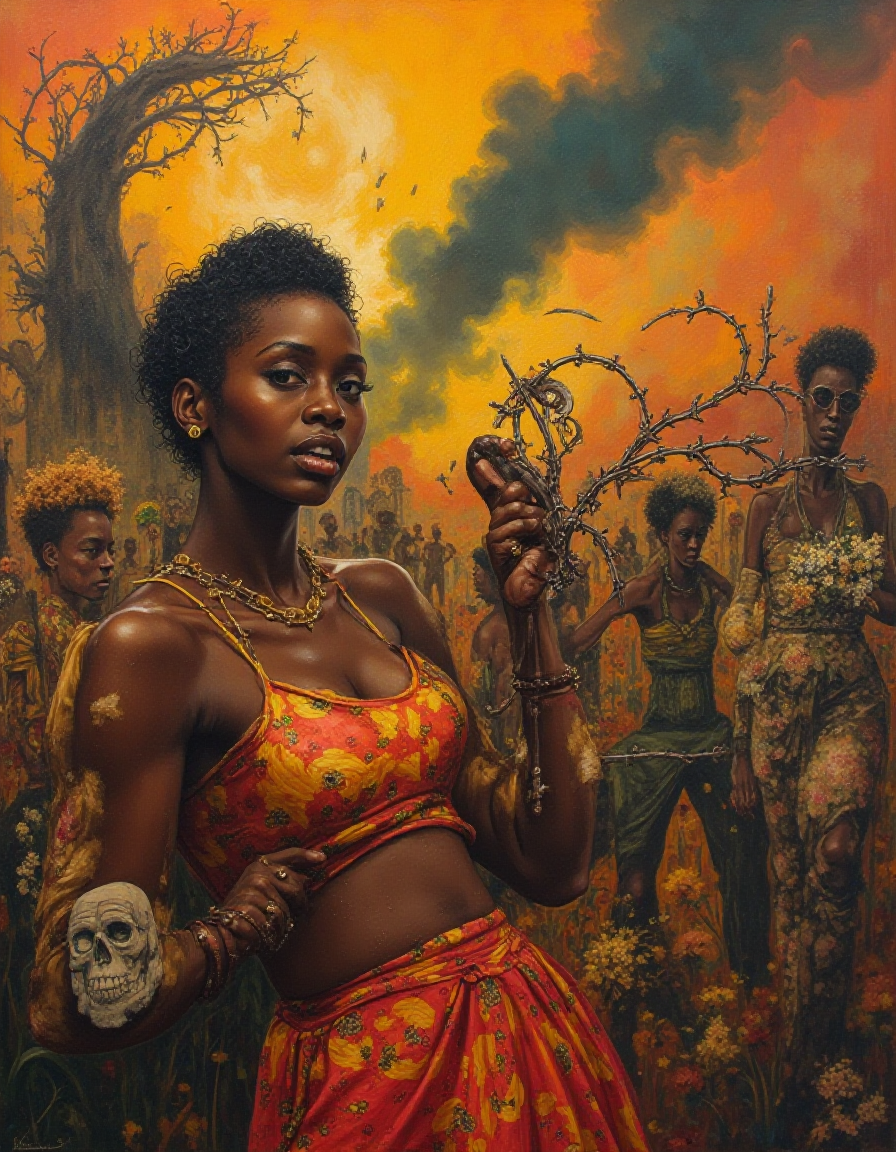
a woman in a red and yellow floral dress is holding a branch of a tree in her hand. she is surrounded by other people in the background.
CAPTION
The image depicts a woman standing in a forest, holding a branch of a tree. She is adorned with a necklace and a bracelet, and her attire is vibrant and colorful. The background is a dark, stormy sky with a large tree looming in the distance.
MONOLOGUE
Martha's iron flashed and swung backwards and forth. Sophie watched the brawny forearm which wielded the iron. Hard and as brown as the branch of a tree it was, from above the elbow where her sleeve was rolled back to the wrist; the hand fastened over the iron, red and dappled with great golden-brown freckles; the nails of its short, thick fingers, broken, dirt lying in thick, black wedges beneath them. As her other hand moved over the dress, preparing the way for the iron, Sophie saw its work-worn palm, the lines on it driven deep with scouring, scrubbing, and years of washing clothes, and cleaning other folks' houses. She thought of the work those hands of Martha's had done for Fallen Star; how Martha had looked after sick people, brought babies into the world, nursed the mothers, mended, washed, sewed, and darned, giving her help wherever it was needed. Always good-natured, hearty, healthy, and wholesome, what a wonderful woman she was, Mother M'Cready, Sophie exclaimed to herself.
SUMMARY
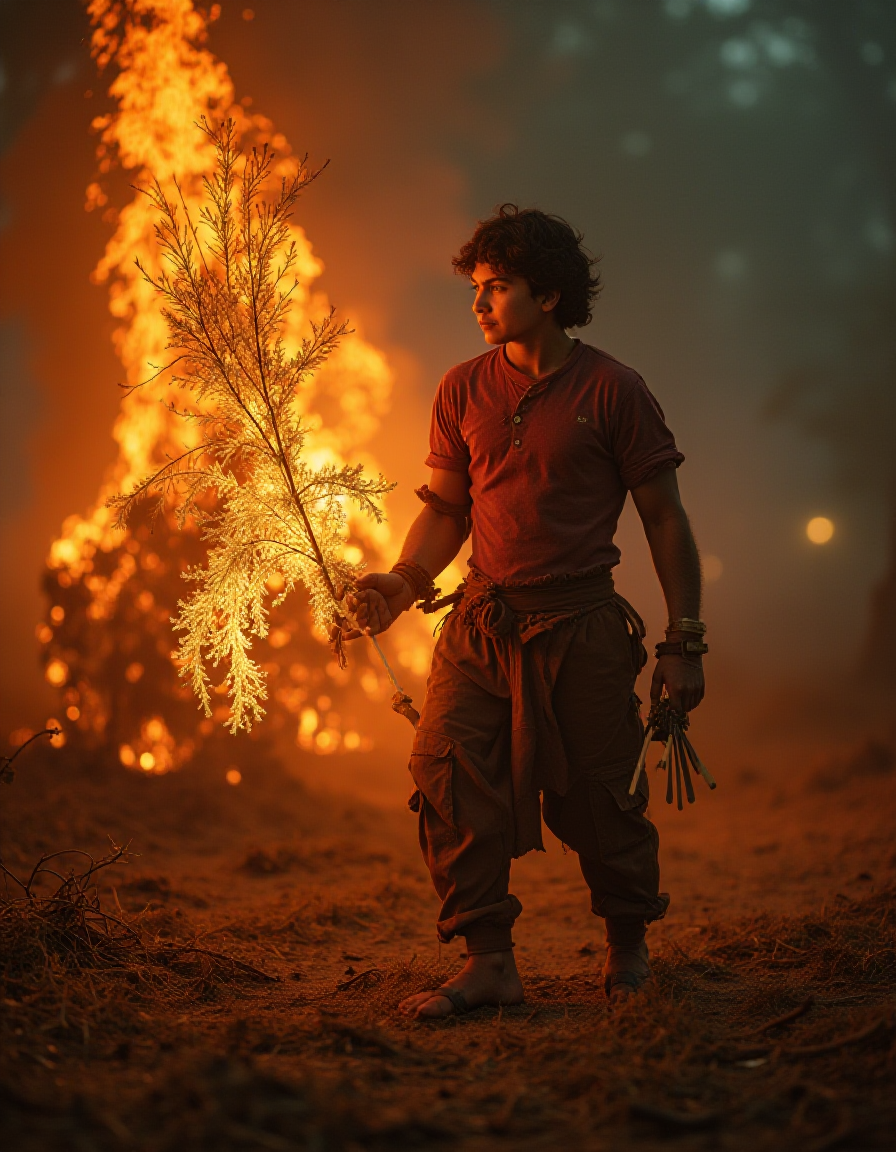
a young man in a red shirt and brown pants is holding a branch of a tree in a forest
CAPTION
The image depicts a person standing in a field, holding a branch of a tree. The person is dressed in a red shirt and dark pants, and is barefoot. The background is filled with a large fire, which is casting a warm glow over the scene.
MONOLOGUE
She drew the awning half-way up and stood on the step outside the French window. The lawn, the trees, the opposite hills were unknown to her, but the spirit of the river spoke to her familiarly, and she knew it for the Thames. A gardener in shirt-sleeves was filling a water-barrel by the river, under a hawthorn-tree, and the young man in the punt was putting up his fishing-tackle. As she looked, the strangeness of the scene passed away. She could not say where it was, but in some dream or vision she had certainly seen this lawn, that view, before; when the young man turned and came nearer she would know his face. And the dim, horrible thing that was waiting for her somewhere about the quiet house, the quiet garden, seemed to draw a step nearer, to lift its veil a little. Who was it that had stood not far from where the gardener was standing now, and seen the moon hanging large and golden over the mystery of the opposite woods? Whoever it was, some one's arm had been fast around her and there had been kisses--kisses.
SUMMARY
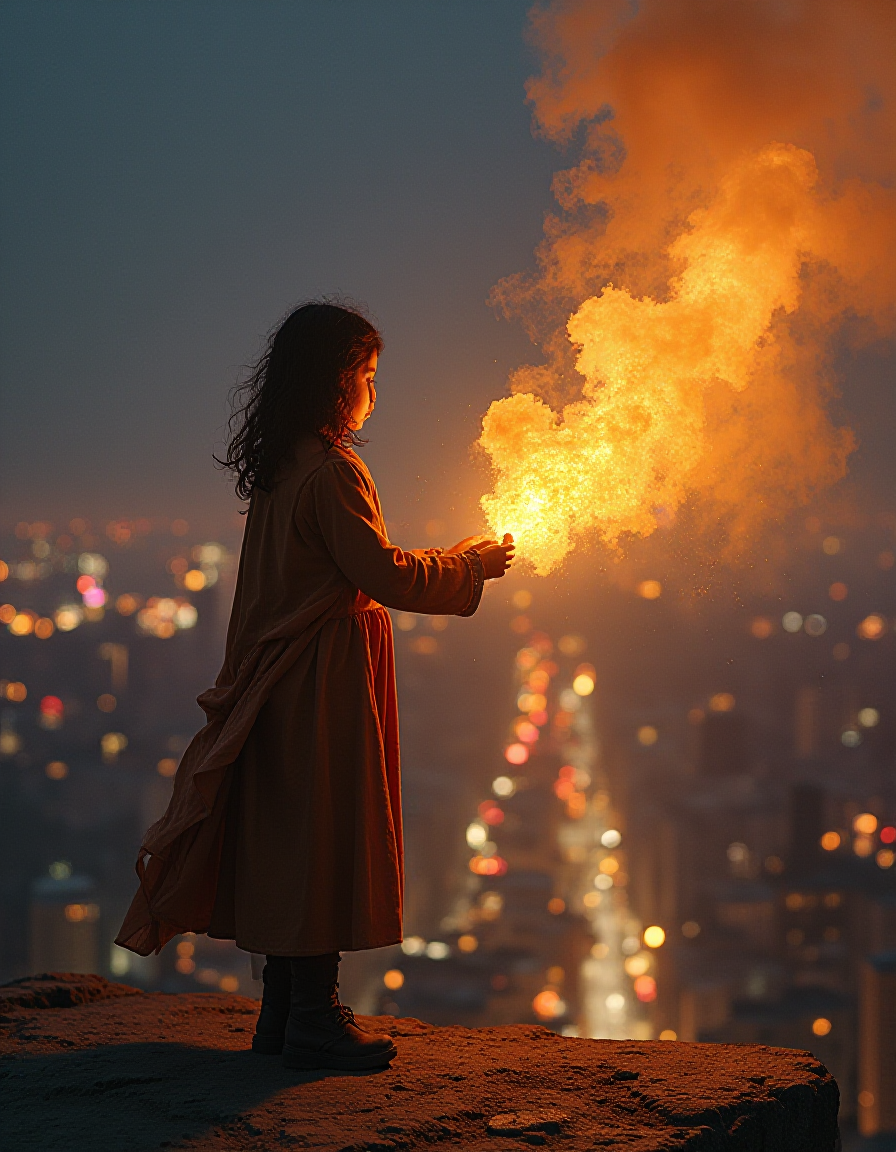
a person in a long brown coat is holding a glowing object in the city at night
CAPTION
The image depicts a person standing on a rocky outcrop at night, holding a glowing object in their hand. The person is dressed in a long, flowing robe, and the background is a cityscape with numerous illuminated buildings and streetlights. The sky is dark, and the person's shadow is cast on the ground, indicating that they are standing on a hill or a similar elevated surface.
MONOLOGUE
An extended mobile of galaxies. A prided installation. The dark, invisible matter of a riot in L.A. Three thousand buildings ripple out flame in the city of Lost Angels. And then an open sky, a banquet of beads after fire hoses roll out the light on any upright surface. Hollywood Hills are alive with the sound of security locks. The CNN anchor-team is too well dressed for the maddening flames, in the sear, ongoing segment of a news flash. In the break, gathered the rain as pure as static, unseen, but imagined whitely and curfew-wide. Along the crippled streets in the blood blare of sirens, night arrived under the guise of the National Guard. Heat rises from the grid of these sidewalks and the spirits of the Indian, afraid enough of death to die, whoop it up around the big campfires. I wake, uncomfortable in the lurk of a dream, and my breath draws up hope like an anchor, lifts my thoughts into the day where I follow. Let us go (you & I) into the glow, hand in hand with Virtual Reality and idly make up war-games. Let us pray that a supreme silence will be down-loaded at last. Moonrise, and a luminant coal sifts through the western grate of the world.
SUMMARY
couple walking down a street at night with a man in a red coat and a woman in a brown coat
CAPTION
The image depicts a couple walking down a cobblestone street at night. The man is dressed in a red military uniform, while the woman is wearing a brown trench coat. They are both carrying backpacks, and the man is holding a rifle.
MONOLOGUE
Perhaps the personal appearance of Dick Compton may go at least a little distance towards the explanation. As he stood kicking his foot against the lower step of the school-house door and listening to the words of petulance which his mistress so plentifully bestowed upon him, it was to be seen that while his coat was a sack of ordinary light summer-stuff, looking civil and homelike enough, his pants and cap were both gray and military, according to the pattern of the Reserves. Under his arm he held a bundle which might very easily have contained the coat necessary to make the uniform complete; and such was, indeed, the composition of the parcel. Dick Compton, never before connected with any military organization, had the night before determined to abandon home and the girl he loved, leave other hands to gather in the fast ripening harvest, intrust his favorite pair of farm-horses to the care of his younger brother and the hands on the farm, and make at least a small part of the response to the urgent call of Governor Curtin. He had been down to the rendezvous, to sign the roll of membership in the Reserves, and to get his uniform, that morning. He was to leave with the regiment for Harrisburgh, that evening, and it was on his way home to the pleasant farm-house lying a couple of miles northward and across the main road leading up from Market street, that he had called at the school-house to make his adieux to Kitty Hood, which seemed to be so ungraciously received.
SUMMARY
Christmas tree in a park at night with lights on.
CAPTION
The image captures a vibrant Christmas tree adorned with numerous lights, standing tall in a snowy park. The tree is the focal point of the scene, its branches reaching upwards towards the sky. The lights, in various colors such as red, green, blue, and yellow, are evenly distributed across the tree, creating a festive atmosphere.
MONOLOGUE
In Kashmir there is also far more variety of colour than there is in Sikkim. And in the spring, with the willows and poplars in freshest green; the almond, pear, apple, apricot, and peach trees in full blossom, white and pink; the fields emerald with young wheat, blue with linseed, or yellow with mustard; and the village-borders purple with iris; or in the autumn when the chenars, the poplars, and apricots are turning to every tint of red and yellow and purple, Kashmir is in a glow of colour. And the famous Valley is all the more beautiful because it is ringed round with a circle of snowy mountains of at least Alpine magnitude, with a glimpse here and there, such as that of Nanga Parbat, of much more stupendous peaks beyond; and because the sky is so blue, the atmosphere so delicate in its hues, and the sunshine so general throughout the year.
SUMMARY
couple walking their dog in a city at night
CAPTION
The image captures a serene evening scene on a city street. The main subjects are a couple, a man and a woman, walking hand in hand on a sidewalk. The man is on the left, holding the woman's hand, while the woman is on the right, holding the man's hand.
MONOLOGUE
Then comes the tableau of the evening, the Prince and Princess walking with aides-de-camp through their Eastern and Western subjects, with an introduction made here and there. The Prince walks in front and the Princess a few steps behind. She seems very pleased and interested, and still, I think, looks under her eye lest she should fail to recognise some one she would wish to notice, and the Prince's expression is so pleasant, quiet, and possessed in repose, and with a very ingratiating smile. He stops and speaks to right and left, to one of our officers, or a native prince. One, a tall grizzled old fellow with gorgeous turban and the eye and air of a hunter, bends very low over the offered hand, and talks a moment, possibly tells how he shot with the King when he was Prince, and how there are tigers and devoted subjects waiting in the north in his state all at the service of the son of the Great White Raj, and as the Prince goes past, the old man follows him with a very kindly expression. I must say that these people's jewels interest me more than their expressions; but this one man's face was exceptional, and he was lean! You see the thing above these people, that is the punkah; when it waggles about it makes a cold draught and you get hot with annoyance.
SUMMARY
woman posing in a snowy forest with a scarf and earrings
CAPTION
The image depicts a woman standing in a snowy forest, wearing a green jacket and a brown scarf. She is looking directly at the camera with a neutral expression. The background is filled with snow-covered trees, creating a serene and picturesque setting.
MONOLOGUE
Chick's Christmas-trees were decorated, and no house in the whole world had one lovelier that morning than the hundreds that were all about him as far as he could see. The dark-green branches of the pines and cedars had held themselves out like arms waiting to be filled, and the snow had been dropped on them in fluffy masses, by a quiet, windless storm. It had been very soft and lovely that way--a world all white and green below, with a sky of wonderful blue that the firs pointed to like steeples. Then, as if that were not decoration enough, another storm had come, and had put on the glitter that was brightest at the edge of the forest where the sun shone on it. The second storm had covered the soft white with dazzling ice. It had swept across the white-barked birch trees and their purple-brown branches, and had left them shining all over. It had dripped icicles from the tips of all the twigs that now shone in the sunlight brighter than candles, and tinkled like little bells, when the breezes clicked them together, in a tune that is called, "Woodland Music after an Ice-Storm."
SUMMARY
The large tree is lit up with colorful lights and is surrounded by people.
CAPTION
The image captures a vibrant nighttime scene featuring a large, intricate tree sculpture made of glowing lights. The tree, which is the central focus of the image, is adorned with a multitude of colors, including blue, green, orange, and purple.
MONOLOGUE
These melodies and symphonies of light in nature are admittedly pleasing or impressive as the case may be, but are they as appealing as music, poetry, painting, or sculpture? The consensus of opinion of a large group of average persons might indicate a negative reply, but the combined opinion of this group is not so valuable as the opinion of a colorist or of an artist who has sensed the wonders of light. The unprejudiced opinion of artists is that light is a powerfully expressive and impressive medium. The psychologist will likely state that the emotive value of light or color is not comparable to the appeal of an excellent dinner or of many other commonplace things. But he has experimented only with single colors or with simple patterns and his subjects are selected more or less at random from the multitude. What would be his conclusion if he examined painters and others who have developed their sensibilities to a deep appreciation of light and color? It is certain that the painter who picks up a purple petal fallen from a rose and places it upon a green leaf is as thrilled by the powerful vibrant color-chord as the musician who hears an exquisite harmony of sounds.
SUMMARY
a three-dimensional, spherical Christmas tree made of numerous small, colorful spheres.
CAPTION
The image presents a three-dimensional representation of a Christmas tree, rendered in a highly detailed and realistic style. The tree is composed of numerous small, spherical objects, each exhibiting a vibrant color palette of red, blue, and yellow. These spheres are arranged in a triangular formation, creating a symmetrical and balanced structure.
MONOLOGUE
In Europe abundant remains of horses are found in the Quaternary and later Tertiary strata as far as the Pliocene formation. But these horses, which are so common in the cave-deposits and in the gravels of Europe, are in all essential respects like existing horses. And that is true of all the horses of the latter part of the Pliocene epoch. But in deposits which belong to the earlier Pliocene and later Miocene epochs, and which occur in Britain, in France, in Germany, in Greece, in India, we find animals which are extremely like horses--which, in fact, are so similar to horses that you may follow descriptions given in works upon the anatomy of the horse upon the skeletons of these animals--but which differ in some important particulars. For example, the structure of their fore and hind limbs is somewhat different. The bones which, in the horse, are represented by two splints, imperfect below, are as long as the middle metacarpal and metatarsal bones; and attached to the extremity of each is a digit with three joints of the same general character as those of the middle digit, only very much smaller. These small digits are so disposed that they could have had but very little functional importance, and they must have been rather of the nature of the dew-claws, such as are to be found in many ruminant animals. The _Hipparion_, as the extinct European three-toed horse is called, in fact, presents a foot similar to that of the American _Protohippus_ (Fig. 9), except that in the _Hipparion_ the smaller digits are situated
SUMMARY
The large tree is lit up with colorful lights and is surrounded by other trees in a park at night.
CAPTION
The image captures a vibrant nighttime scene featuring a large, intricate tree sculpture made up of numerous small, colorful lights. The tree, which is the central focus of the image, is adorned with a multitude of lights that create a mesmerizing display of color and light. The tree is situated in a field, surrounded by other trees that are also illuminated with similar lights, creating a harmonious and festive atmosphere.
MONOLOGUE
This is one of the beautiful islands of Polynesia, in the South Pacific Ocean. It was discovered in the year 1791, and has been since occasionally visited by English and American whalers, and a few other ships, for the purpose of procuring water and a supply of vegetable productions, with which it abounds. It is situated in latitude 12 30' south, and longitude 177 east, and is distant about 260 miles from the nearest island of the Fidji group. It is of a moderate height, densely wooded, and abounding in cocoa-nut trees, and is about from thirty to thirty-five miles in circumference. Its general appearance is beautifully picturesque, verdant hills gradually rising from the sandy beach, giving it a highly fertile appearance. It is surrounded by extensive reefs, on which at low water the natives may be seen busily engaged in procuring shell and other fish, which are abundantly produced on them, and constitute one of their articles of daily food. At night, they fish by torch-light, lighting fires on the beach, by which the fish are attracted to the reefs. The torches are formed of the dried spathe or fronds of the cocoa-nut tree, and enable them to see the fish, which they take with hand-nets. It is by these lights that the fish are attracted, but not so in the opinion of the natives, who say, "they come to the reef at night to eat, then sleep, and leave again in the morning."
SUMMARY
wizard holding a torc and a fire in his hand in a forest.
CAPTION
The image depicts a person dressed in medieval attire, holding a glowing torches in their right hand. The person is wearing a dark cloak adorned with gold and silver embroidery, and their long white beard is visible. The background is a misty forest, with trees and foliage creating a soft, ethereal atmosphere.
MONOLOGUE
The dress corresponded in every detail with that which my brother had described the figure as wearing at Oxford: a long cut-away coat of green cloth with an edge of gold embroidery, a white satin waistcoat with sprigs of embroidered roses, gold-lace at the pocket-holes, buff silk knee-breeches, and low down on the finely modelled neck a full cravat of rich lace. The figure was posed negligently against a fluted stone pedestal or short column on which the left elbow leant, and the right foot was crossed lightly over the left. His shoes were of polished black leather with heavy silver buckles, and the whole costume was very old-fashioned, and such as I had only seen worn at fancy dress balls. On the foot of the pedestal was the painter's name, "BATTONI pinxit, Romæ, 1750." On the top of the pedestal, and under his left elbow, was a long roll apparently of music, of which one end, unfolded, hung over the edge.
SUMMARY
young woman with long wavy hair, wearing a dark coat, looking at the camera, with a blurred background of lights.
CAPTION
The image depicts a woman with long, wavy hair, wearing a dark coat and a brown scarf. She is standing in front of a blurred background, which suggests that she is in a public place, possibly a street or a park. The lighting in the image is warm, with a soft glow that gives the scene a cozy and intimate atmosphere.
MONOLOGUE
"Well," she said, drawing a long breath. "One night about twelve months ago I was at a private dance at the house of a friend in Holland Park, when I was introduced to a young married woman named Cullerton, the wife of a man on the Stock Exchange. I rather liked her, and as she invited me to a small dance which she gave a week later we soon became friends. One day, while we were walking together in Bond Street we met Mr. De Gex, the great financier, to whom she introduced me. His car was standing at the kerb, so he took us back to tea at his house in Stretton Street. While we were at tea a tall, dark Spanish-looking girl came in and was introduced to us as Gabrielle Engledue. As we sat at tea we laughed over the similarity of our names, and she told me that though her mother had been English she had lived all her life in Madrid, and had been over here for the purpose of studying English. She had been staying with a family somewhere in Essex, but was now at an hotel in London, for she was returning to Madrid in a few days. I rather liked her, and as Mr. De Gex was charming to us both, I accepted his invitation to dine there a few days later. I did not tell mother about this, for I feared that being rather old-fashioned she might disapprove of my new friendships. We had a delightful dinner, and Mr. De Gex took us all three to the theatre afterwards, and drove each of us home. I was the first, and he put me down at the corner of Earl's Court Road.
SUMMARY
man with white beard and gray hair wearing black coat and brown vest
CAPTION
The image depicts a man with a long white beard, wearing a black coat and a brown vest over a dark shirt. He is standing in a forest with trees in the background, and the foliage is a mix of green and yellow hues. The man's expression is serious, and he is looking directly at the camera.
MONOLOGUE
A shadow fell among the group, and a man sat down on a bowlder hard by. He, too, had just arrived, being lured to the town by the news of the fire. His slide had been left at the verge of the clearing, and one of the oxen had already lain down; the other, although hampered by the yoke thus diagonally displaced, stood meditatively gazing at the distant blue mountains. Their master nodded a slow, grave salutation to the group, produced a plug of tobacco, gnawed a fragment from it, and restored it to his pocket. He had a pensive face, with an expression which in a man of wider culture we should discriminate as denoting sensibility. He had long yellow hair that hung down to his shoulders, and a tangled yellow beard. There was something at once wistful and searching in his gray eyes, dull enough, too, at times. He lifted them heavily, and they had a drooping lid and lash. There seemed an odd incongruity between this sensitive, weary face and his stalwart physique. He was tall and well proportioned. A leather belt girded his brown jeans coat. His great cowhide boots, were drawn to the knee over his trousers. His pose, as he leaned on the rock, had a muscular picturesque-ness.
SUMMARY
man in a suit with a red tie standing in front of a building with a tree and a street with fallen leaves
CAPTION
The image depicts a man in a gray suit, standing in front of a building with a red door and a sign that reads "SCHOOL." He is wearing a red tie and glasses, and his hair is styled in a neat manner. The background features a tree and a street lamp, with a few fallen leaves on the ground.
MONOLOGUE
The company in question was composed of eight persons, five of whom were Indians of the Seneca tribe;[5] the others--a thin-faced, gaunt, stoop-shouldered man past the middle age--a rather corpulent, masculine looking woman, a few years his junior--a little fair-haired, blue-eyed, pretty-faced girl of six--were white captives. Four of the Indians were seated or partly reclining on the ground, with their guns beside them, ready for instant use if necessary, engaged in roasting slices of deer meat before a fire that had been kindled for the purpose. The fifth savage was pacing to and fro, with his rifle on his arm, performing the double duty of sentinel and guard over the prisoners, who were kept in durance by strong cords some ten paces distant. The old man was secured by a stick passing across his back horizontally, to which both wrists and arms were tightly bound with thongs of deer skin. To prevent the possibility of escape, both legs were fastened together by the same material, and a long, stout rope, encircling his neck, was attached to a tree hard by. This latter precaution, and much of the former, seemed unnecessary; for there was a mild look of resigned dejection on his features, as they bent toward the earth, with his chin resting on his bosom, that appeared strongly at variance with any thing like flight or strife. His female companion was fastened in like manner to the tree, but in other respects only bound by a stout thong around the wrists in front. The third member of the white party, the little girl, was seated
SUMMARY
a young woman in a red shirt stands in front of a Christmas tree with a starry night sky in the background.
CAPTION
The image depicts a person wearing a red shirt, standing in front of a Christmas tree adorned with colorful ornaments. The person is facing away from the viewer, giving the impression of being in a contemplative or reflective state. The background is a night sky with a large, bright yellow sun and a blue sky, creating a serene and peaceful atmosphere.
MONOLOGUE
A fierce thunderstorm next day had failed to clear the air, when we set out again about 9.30 p.m. in an atmosphere of clinging dampness. The whole brigade marched together with our faces turned south towards unfamiliar country, and just before daybreak we arrived at Vieux Berquin, a village of detached farmhouses with gardens full of all manner of fruit and vegetables. Here a dozen crosses with a smaller black cross painted on the wood testified to the presence of the Bavarians last autumn. That night, with the moon about the full, though often obscured by clouds, the brigade made a long and weary march south-west, edging gradually away from the flares and the distant rifle shots. Towards midnight we had a long check at Merville, a placid little town with tree-planted boulevards along the banks of the Lys, while Canadian guns and transport passed us going north from their second great fight at Festubert and Givenchy. Day had broken and the sun was climbing an eastern sky ribbed with red and gold, when we reached our destination, the village of Gonnehem, which boasts an ancient and beautiful church decorated with a quiet simplicity not often found in these parts. No enemy had entered here since the beginning of the war. It stands at the southern limit of the great plain; beyond are the low wooded hills of Artois, and away to the west the great slag heaps of Marles-les-Mines loomed through the thunder clouds like pyramids. That Sunday evening we completed our last stage of 4 miles by daylight, moving south-west again to the large
SUMMARY
person wearing a hat and bandana with a bandana around their neck, standing in front of a city street at night, with a neon sign in the background.
CAPTION
The image depicts a person standing in a dimly lit urban environment, wearing a black hat and a bandana around their neck. The person is dressed in a dark jacket and has long hair. The background is filled with various lights, including red and green lights, creating a vibrant and dynamic atmosphere.
MONOLOGUE
Through the pillars of the Shamiana we could see lines of white helmets of troops, and beyond them the crowds of natives in bright dresses, banked against the houses and in groups in the trees, a kaleidoscope of colour. Past this came a whirl of Indian cavalry with glittering sabres, and the Prince and Princess came on to the dais--more brightly dressed than they were in Oxford Street three weeks ago, the Prince in a white naval uniform with a little gold and a white helmet, an uncommonly becoming dress though so simple; the Princess in the palest pink with a suggestion of darker pink showing through, and a deep rose between hat and hair. A tubby native in frock coat and brown face and little pink turban held a mushroom golden umbrella near the Prince and Princess, not over them, it really was not needed for there were clouds, and the light was just pleasant. The Prince then "laid" the stone--that is, some natives slackened the tackle, and it came down all square--and he and the Princess talked to the Personages in attendance and various City Dignitaries. First, I should have said, the Prince read a speech which seemed to me to cover the ground admirably. I forget what he said now, but you could hear every word. He had notes, but I think he spoke by heart. I made a careful picture of it all; red decorations, green grass, Prince and Princess, and the golden umbrella, but it is gone, lost--gone where pins go, I suppose.
SUMMARY
a woman with long hair is standing in a dark alleyway at night, illuminated by a single streetlight
CAPTION
The image depicts a person with long, wavy hair, standing in a dark, rainy environment. The person is positioned in the center of the frame, facing the camera with a serious expression. The rain is falling heavily, creating a dramatic and intense atmosphere.
MONOLOGUE
At length the trains were off, and the whole army in motion. Our own corps being rear-guard, started at ten o'clock at night. The darkness was intense, and a thunder shower prevailed. Our route for a long time lay through a thick woods, where the branches of the trees, meeting over our heads, shut out the little light that might have penetrated the thunder clouds, and the column was shut in perfect darkness. The road was terribly muddy, and the batteries which were trying to pass over the same route, were frequently stuck in the mire. Our men stumbled over stones and fallen trees, often falling beneath the feet of the horses. Men fell over logs and stones, breaking their legs and arms. Thus we continued the hasty and difficult march, while the rain poured in torrents upon us. Later in the night the road became more open, and the rain ceased. The darkness was not so black, still it was difficult to see the road. We were passing over corduroy; some of the logs were a foot, and others a foot and a half through. They were slippery from the rain, and the men, heavily laden with knapsacks, guns and cartridges, tumbled headlong, many of them going off at the side, and rolling far down the steep embankments. A laugh from the comrades of the luckless ones, while some one would call out, "Have you a pass to go down there?" was the only notice taken of such accidents; and the dark column hurried on, until at three o'clock in the morning, we halted at Potomac creek, where we slept soundly upon the ground until morning.
SUMMARY
The image depicts a bustling cityscape with a river running through the middle, flanked by towering spires and buildings. The sky is filled with a multitude of hot air balloons, adding a whimsical touch to the scene. The water in the river is calm, reflecting the vibrant colors of the cityscape. People are seen walking along the streets, enjoying
CAPTION
The image depicts a vibrant, fantastical scene of a bustling cityscape. The sky is a clear blue, dotted with a multitude of hot air balloons in various colors, including blue, yellow, and red. The city is filled with towering spires and ornate buildings, creating a sense of grandeur and opulence.
MONOLOGUE
In the meanwhile I have seen the Venus, I have seen the divine Raphaels. I have stood by Michael Angelo's tomb in Santa Croce. I have looked at the wonderful Duomo. This cathedral! After all, the elaborate grace of the Pisan cathedral is one thing, and the massive grandeur of this of Florence is another and better thing; it struck me with a sense of the sublime in architecture. At Pisa we say, 'How beautiful!' here we say nothing; it is enough if we can breathe. The mountainous marble masses overcome as we look up--we feel the weight of them on the soul. Tesselated marbles (the green treading its elaborate pattern into the dim yellow, which seems the general hue of the structure) climb against the sky, self-crowned with that prodigy of marble domes. It struck me as a wonder in architecture. I had neither seen nor imagined the like of it in any way. It seemed to carry its theology out with it; it signified more than a mere building. Tell me everything you want to know. I shall like to answer a thousand questions. Florence is beautiful, as I have said before, and must say again and again, most beautiful. The river rushes through the midst of its palaces like a crystal arrow, and it is hard to tell, when you see all by the clear sunset, whether those churches, and houses, and windows, and bridges, and people walking, in the water or out of the water, are the real walls, and windows, and bridges, and people, and churches. The only difference is that, down below, there is a double movement; the movement of the stream besides the movement
SUMMARY
a woman in a dark, wet, and stormy environment, holding a knife, with a cityscape in the background.
CAPTION
The image depicts a woman with wet hair, dressed in a dark, textured garment, standing in a dimly lit, urban environment. She is holding a knife in her right hand, which is close to the camera. The background is filled with various elements, including a building with a large window, a street lamp, and a few other people.
MONOLOGUE
Duke had separated himself from the little group and was swinging his hat to Dorothea; but I could not explain why the two men were not standing nearer together and what was the meaning of the wheeled chair, with the nurse's head rising above the back. The identity of the person in the chair was hidden by a tiny black frilled parasol with a handle bent in the middle so that it could be used for a shield. Did I know that little old-fashioned sunshade? I did! It was the property of some one whose belongings had a certain air of difference from those of other people. She lifted it at last, as we came close to the dock, and I met Ellen Winthrop's affectionate, welcoming glance. Her eyes swam in unshed tears, and mine were so wet I could see only dimly that her beautiful hair was a shade whiter, her face paler and thinner, that she had aged mysteriously in a month, and the hand that was holding the parasol trembled like a leaf. She had been very ill; there was no doubt of that. She had been ordered a voyage, and I felt that she had chosen this one because she knew Clive's wish. That meant she was willing to welcome me into the heart of the family; perhaps even that she wished to help me fit myself to take her own unique place in her brother's life. Oh, what joy to feel that I could not only take freely all that my chief wanted to give me, but that I could be of real service to her!
SUMMARY
The image depicts a nighttime scene with a large truck and a crane in the foreground, with a lightning bolt striking the sky above them.
CAPTION
The image depicts a nighttime scene with a large, dark blue sky filled with numerous raindrops. The sky is illuminated by a bright, white lightning bolt that is positioned in the upper right corner of the image. The scene is set in a city, with a street lined with buildings and construction equipment.
MONOLOGUE
Now for a run on shore. Valetta, or la Valette, in honor of one of the most famous of the Grand Masters, the modern capital of Malta, is a fairly large place, though by no means extensive enough to be styled a City, except out of courtesy. How dingy the buildings and how dusty the pavements from the crumbling masonry. The houses are so lofty that the strip of blue sky can scarcely send its light to the bottom, whilst the upper storeys have such an affectionate leaning towards each other, that the wonder is that any mortar is capable of restraining their eagerness to fall on each other's necks. But all the houses are not like this, and the character of the masonry speedily improves on emerging from the gloomy alleys into the magnificent Strada Reale, more of a roadway than a street, for though there are many grand edifices and numerous shop fronts, yet one may walk to Floriana on the one hand, and to Civita Vecchia on the other, without turning to the right or left.
SUMMARY
woman in red jacket with a serious expression, looking at the camera, in a dimly lit street at night
CAPTION
The image depicts a woman with long, wavy hair, wearing a red jacket, standing in front of a blurred background of street lights and cars. The woman's expression is serious, and her gaze is directed towards the camera. The lighting in the image is soft and even, with no harsh shadows, suggesting that the photo was taken during the day.
MONOLOGUE
The day that he had taken Myrtle Macomber up the river road had been Tuesday. On Wednesday he had risen, sluggish and weary, with an ache in his bones. A half-hearted, spasmodic attempt at work had ended at eleven o'clock. He had called up Myrtle. They went that afternoon to a ball-game. Thursday morning came, bright with promise, and a profitable forenoon was spent in the old hammer-and-tongs manner. By noon he had two orders in his pocket and felt quite exhausted. The heat drank up the very marrow from one's bones. He met Myrtle on the street. They had lunch together. All that afternoon they paddled about in the river and came home with hair wet and nerves sagging. Friday passed, a long dreary day. By the time five o'clock arrived Joe would willingly have sunk down on the cement pavement in some shaded corner, just to take his mind from the grip of the traffic. There was nothing in the selling of motor cars to give his mind anything to bite on. What was it kept him going, he asked himself? The answer suggested itself to him, but he shook it off and mused on. Summer was a dreary time. That night he dragged himself to Lytle Street. He found Miss Macomber waiting for him on the porch. She was wearing a Nile green sports suit of soft flannel, with white facings, and white shoes and stockings and a stiff sailor hat of white straw. As he came up the walk and approached the steps, he heard a scurrying and moving of chairs, and as he gained the porch he caught a glimpse of a scuttling
SUMMARY
a young man in a suit sits on the ground in a forest, looking out at the trees and flowers
CAPTION
The image depicts a young man in a black suit, sitting on the ground in a forest setting. He is facing away from the viewer, with his head slightly tilted to the left. The background is filled with a misty atmosphere, creating a sense of depth and mystery.
MONOLOGUE
Now that I know his end, I see him creating, to use a favourite adjective of his, "marmorean" verse, and believing the most terrible doctrines to keep down his own turbulence. One image of that stay in Dublin is so clear before me that it has blotted out most other images of that time. He is sitting at a lodging-house table, which I have just left at three in the morning, and round him lie or sit in huddled attitudes half-a-dozen men in various states of intoxication: and he is looking straight before him with head erect, and one hand resting upon the table. As I reach the stairs I hear him say, in a clear, unshaken voice, "I believe in nothing but the Holy Roman Catholic Church." He sometimes spoke of drink as something which he could put aside at any moment, and his friends believed, and I think he liked us to believe, that he would shortly enter a monastery. Did he deceive us deliberately? Did he himself already foresee the moment when he would write _The Dark Angel_? I am almost certain that he did, for he had already written _Mystic and Cavalier_, where the historical setting is, I believe, but masquerade.
SUMMARY
man in white shirt and vest making a peace sign in a forest at sunset
CAPTION
The image depicts a man standing in a forest, facing away from the camera, with his right hand raised in a gesture of greeting or farewell. He is dressed in a white shirt and a dark vest, and his attire suggests a casual, perhaps rustic or outdoorsy style. The background is filled with trees and foliage, creating a natural and serene atmosphere.
MONOLOGUE
May all these rest in peace, and all who mourn for them be comforted! Yet thought drifts away to the poor and lowly, whose grief cannot find solace in procuring this costly intercession of the Church for the souls they love. It seems hard that the inequalities of life should thus reach out into death and purgatory. We used, during our sojourn in Granada, to meet many pathetic little processions on "The Way of the Dead." Over this hollow road, almost a ravine, the fortress walls, with their crumbling towers, keep guard on the one side, and the terraced gardens of the _Generalife_, with their grand old cypresses, on the other. And here, almost every hour of the day, is climbing a company of four rough men, carrying on their shoulders a cheap coffin, which perhaps a husband follows, or a white-haired father, or, hand in hand, bewildered orphan boys. The road is so steep that often the bearers set their burden down in the shadow of the bank-side, and fling themselves at full length on the ground beside it, thriftily passing from man to man the slow-burning wax match for their paper cigarettes. I remember more than one such smoking group, with a solitary mourner, hat in hand and eyes on the coffin, yet he, too, with cigarette in mouth, standing patiently by. All who pass make the sign of the cross, and even the rudest peasant uncovers his head. Very shortly the bearers may be seen again, coming down the hill at a merry pace, the empty box, with its loose, rattling lid, tilted over the
SUMMARY
a woman sitting on a rock in a night sky with palm trees
CAPTION
The image depicts a woman sitting on a rock in a secluded, twilight setting. The woman is positioned in the center of the image, facing away from the viewer, with her back to the camera. She is dressed in a black bikini top and has long, curly hair.
MONOLOGUE
The bedroom was over the library, and was the same size and with the same kind of window. Where the bookcase stood in the room below, stood the bed: a double, or even a treble, bed, so very big was it, facing the window past which Vera--it was no use, she couldn't get away from Vera--having slept her appointed number of nights, fell and was finished. But she wasn't finished. If only she had slipped away out of memory, out of imagination, thought Lucy ... but she hadn't, she hadn't--and this was her room, and that intelligent-eyed thin thing had slept in it for years and years, and for years and years the looking-glass had reflected her while she had dressed and undressed, dressed and undressed before it--regularly, day after day, year after year--oh, what a trouble--and her thin long hands had piled up her hair--Lucy could see her sitting there piling it on the top of her small head--sitting at the dressing-table in the window past which she was at last to drop like a stone--horribly--ignominiously--all anyhow--and everything in the room had been hers, every single thing in it had been Vera's, including Ev----
SUMMARY
young woman posing in a forest with her hand on her face.
CAPTION
The image depicts a young woman with long, dark hair, wearing a black sweater. She is standing in a forest, with trees and foliage in the background. The woman's face is turned towards the camera, and she is looking directly at the viewer.
MONOLOGUE
Then, drawing him to her, she threw herself down and hid her shame-stricken face in her hands. He threw himself down beside her, and pressed her passionately to him; she gasped for breath as she lay nervously waiting, and all at once she gave a loud cry as though thunderstruck by the sensation she had invited. It was a long time before they reached the top of the mountain, so fluttered and exhausted was Jeanne, and it was evening when they got to Evisa, and went to the house of Paoli Palabretti, a relation of the guide's. Paoli was a tall man with a slight cough, and the melancholy look of a consumptive; he showed them their room, a miserable-looking chamber built of stone, but which was handsome for this country, where no refinement is known. He was expressing in his Corsican patois (a mixture of French and Italian) his pleasure at receiving them, when a clear voice interrupted him, and a dark little woman, with big black eyes, a sun-kissed skin, and a slender waist, hurried forward, kissed Jeanne, shook Julien by the hand and said: "Good-day, madame; good-day, monsieur; are you quite well?" She took their hats and shawls and arranged everything with one hand, for her other arm was in a sling; then she turned them all out, saying to her husband: "Take them for a walk till dinner is ready."
SUMMARY
young woman with long curly hair, wearing a green shirt, standing in a forest, looking to the side, with sunlight filtering through the trees.
CAPTION
The image depicts a young woman with long, curly hair, wearing a green shirt adorned with a floral pattern. She is standing in a forest, with dense foliage and sunlight filtering through the trees, creating a warm and serene atmosphere. The woman's gaze is directed towards the camera, and her expression appears to be contemplative or introspective.
MONOLOGUE
How well I recollect that warm, balmy March morning! My mother had sent me to Paris about six months before, to read law with an old relative. Of course I was delighted; but that day I felt tired of the dull routine of my life, and longed for the green fields, waving trees, and wild mountain-torrents of my home. I was walking slowly down the street, thinking gloomily of the labors of another day, and she was standing near a school-house door, intently occupied in giving some directions to an old soldier. In my whole life I do not think I ever saw a more beautiful creature. The airiness of the lithe little figure, the playfulness in the nod of the graceful head, the look of joyous innocence on that perfect face, flitted through my mind like a bright ray of sunshine during the entire day. Every morning, for years after, I met that child; and every morning her beaming smile cheered my young life like a glimpse of heaven. I never spoke to her; it was a long time before she even knew of my existence; but by-and-by I noticed a quizzical expression come over the old man's face, and I saw her features warm with a faint flush of recognition. How many dreams I based on that slight fabric! Of course I discovered her name; and of course I learned that her father was very rich; but what was that to me? With what pride did I gaze at his name in huge gilt letters on a great warehouse near us, and what wonderful little gothic cottages did I build on the strength of the "and Son" that would shortly be added to it! The
SUMMARY
The image depicts a forest with a large tree in the center, surrounded by numerous red flowers. The forest is shrouded in mist, creating a mystical atmosphere.
CAPTION
The image is a surreal and dreamlike landscape, rendered in a style reminiscent of a watercolor painting. The central focus is a dense, vibrant field of red flowers, their petals glistening under the soft light. The flowers are scattered throughout the scene, creating a sense of depth and movement.
MONOLOGUE
"Landscape, whether it be considered as the transcript of a spot, or the rich combination of congenial objects, or as the scene of a phenomenon, dates its origin from him:" so of portrait, he says--"He is the father of portrait painting, of resemblance with form, character with dignity, and costume with subordination." The yet wanting charm of art--perfect harmony, was reserved for Correggio. "The harmony and grace of Correggio are proverbial; the medium which, by breadth of gradation, unites two opposite principles, the coalition of light and darkness, by imperceptible transition, are the element of his style." "This unison of a whole predominates in all that remains of him, from the vastness of his cupolas to the smallest of his oil pictures. The harmony of Correggio, though assisted by exquisite hues, was entirely independent of colour; his great organ was chiaroscuro in its most extensive sense--compared with the expanse in which he floats, the effects of Leonardi da Vinci are little more than the dying ray of evening, and the concentrated flash of Giorgione discordant abruptness. The bland, central light of a globe, imperceptibly gliding through lucid demi-tints into rich reflected shades, composes the spell of Correggio, and affects us with the soft emotions of a delicious dream." Here terminates the great, the primal era. Such were the patriarchs of modern art. Here, it may be said, terminated the great discoverers. Mr Fuseli pauses here to observe, that we should consider the characteristic of each of these
SUMMARY
The tree is the focal point of the image, with its silhouette reflected in the water, creating a mirror image. The tree is set against a backdrop of a starry sky, with the sun setting in the distance, casting a warm glow over the scene.
CAPTION
The image depicts a serene sunset scene with a large tree in the foreground, its branches silhouetted against the vibrant sky. The tree is positioned on a reflective surface, possibly a pond or a lake, which is surrounded by a misty atmosphere. The sky is filled with stars, creating a starry night sky.
MONOLOGUE
It would be impossible to detail the exquisite and varied beauty of the way between Kingsley's Pond and Ekoniah Scrub. Through the fair primeval forest we wandered, following the old Alachua Trail, the very name of which enhanced the charm of the present scene by calling up thrilling fancies of the past; for this is the famous Indian war-path from the hunting-grounds of the interior to the settlements on the frontier, and may well be the oldest and the most adventure-fraught thoroughfare in the United States. We could hardly persuade ourselves that we were not passing through some magnificent old estate--of late, perhaps, somewhat fallen into neglect--so perfect was the lawn-like smoothness of the grassy uplands, so rhythmical were the undulations of the slopes, so majestic the natural avenues of enormous oaks, so admirable the diversity of hill and dell, knoll and glade, shrubbery and lawn, forest and park, interspersed with frequent sheets of water--Blue Pond, rivalling the sky in color; Sandhill Pond, deep set among high wooded slopes, with picturesque log mill and house; Magnolia Lake, with its flawless mirror; Crystal, of more than crystal clearness, with gorgeous sunset memories and sweet recollections of kindly hospitalities in the two homes which crown its twin heights; Bedford and Brooklyn Lakes, with log cottages beneath clustering trees; Minnie Lake, and its great alligator sleeping on a log; starry Lily-Pad; and Osceola's Punch-bowl, deep enough, and none too large, to
SUMMARY
The image depicts a large oak tree with a thick trunk and sprawling roots, standing in a grassy field under a foggy sky.
CAPTION
The image depicts a large, ancient oak tree with a thick trunk and sprawling roots. The tree is situated in a lush, green field, surrounded by a dense forest of trees. The sky is overcast, casting a soft, diffused light over the scene.
MONOLOGUE
I wish our way had always lain among woods. Trees are the most civil society. An old oak that has been growing where he stands since before the Reformation, taller than many spires, more stately than the greater part of mountains, and yet a living thing, liable to sicknesses and death, like you and me: is not that in itself a speaking lesson in history? But acres on acres full of such patriarchs contiguously rooted, their green tops billowing in the wind, their stalwart younglings pushing up about their knees: a whole forest, healthy and beautiful, giving colour to the light, giving perfume to the air: what is this but the most imposing piece in nature's repertory? Heine wished to lie like Merlin under the oaks of Broceliande. I should not be satisfied with one tree; but if the wood grew together like a banyan grove, I would be buried under the tap-root of the whole; my parts should circulate from oak to oak; and my consciousness should be diffused abroad in all the forest, and give a common heart to that assembly of green spires, so that it also might rejoice in its own loveliness and dignity. I think I feel a thousand squirrels leaping from bough to bough in my vast mausoleum; and the birds and the winds merrily coursing over its uneven, leafy surface.
SUMMARY
a snowy village with houses and trees
CAPTION
The image depicts a serene winter scene with a snowy landscape. The foreground is dominated by a large, snow-covered field, which is blanketed in a thick layer of white snow. In the middle ground, there are several houses, each with a distinct red roof, suggesting a residential area.
MONOLOGUE
NOTE 12.--_Description of Apartments in Arab Houses._ Most of the descriptions of interior domestic architecture which occur in the present work, I may aptly illustrate by availing myself of observations made in Cairo. In the houses of persons of the higher and middle classes in this city, the different apartments generally resemble each other in several respects, and are similarly furnished. The greater portion of the floor is elevated about half a foot, or somewhat more, above the rest. The higher portion is called "leewán" (a corruption of "el-eewán"), and the lower, "durḳá'ah," from the Persian "dar-gáh." When there is but one leewán, the durḳá'ah occupies the lower end, extending from the door to the opposite wall. In a handsome house, it is usually paved with white and black marble, and little pieces of red tile, inlaid in tasteful and complicated patterns; and if the room is on the ground-floor, and sometimes in other cases, it has, in the centre, a fountain which plays into a small, shallow pool, lined with coloured marbles, &c., like the surrounding pavement. The shoes, or slippers, are left upon the durḳá'ah previously to stepping upon the leewán. The latter is generally paved with common stone, and covered with a mat in summer, and a carpet over this in winter; and a mattress and cushions are placed against each of its three walls, composing what is called a "deewán," or divan. The mattress, which is commonly about three feet wide, and three or four inches thick, is placed either on the floor or
SUMMARY
painting of two people in a boat on a green field with a house in the background
CAPTION
The image depicts a serene scene of a grassy field with a large tree in the foreground, and a house with a red roof and white walls in the background. Two people are seated in a boat on the water, enjoying the peaceful atmosphere. The sky is clear with a few clouds, and the overall mood is calm and tranquil.
MONOLOGUE
Our arrival in the harbour was coincident with the beginning of a feast, which was to continue for a week or so. Two new canoes, decked with most gorgeous banners, flags, and streamers flying from small poles,[40] were launched on the first day, and, to an accompaniment of singing, rowed across to the northern shore to obtain young coconuts for the coming festivity. These joyous occasions the natives call, in imitation of our English custom, "making Christmas"; and over the door of those houses where the gatherings are held they fasten a number of branches.[41] We entered one of the houses thus decorated. Outside were large heaps of green coconuts, and inside other refreshment in the shape of several big jars of toddy; the interior was prepared for dancing. Immense quantities of cotton print, of every pattern and colour imaginable, were hung from rattans crossing the upper portion of the roof to within about 7 feet from the floor; the upper part was a nearly solid mass of cotton. On a framework in the centre of the floor, covered with alternate strips of red and white cotton, so that it seemed to be made of barbers' poles, were suspended a large number of spoons, forks, and soup-ladles. Everything else in the house was pushed back against the walls in order that the floor might be clear, and as the place was rather dark, it was illuminated by a lamp made from half a coconut-shell, containing melted pigs' fat and a strip of rag. The spoons and forks, in which the natives invest nearly all they obtain by the sale of their coconuts, are
SUMMARY
the character is a woman with long blonde hair and is wearing a red cape and a black and red bodysuit. she is standing in a city street and has a serious expression on her face.
CAPTION
The image depicts a female character in a superhero costume, standing in a city street. She is wearing a red cape that flows behind her, and her outfit is predominantly black with red accents. Her hair is long and wavy, and she is looking to the side with a serious expression.
MONOLOGUE
"Would you call her beautiful? I ask myself again and again, trying to put myself behind your eyes. She has nothing, at any rate, in common with the beauties we have down here, or with those my aunt bade me admire in London last May. The face has a strong Italian look, but not Italian of to-day. Do you remember the Ghirlandajo frescoes in Santa Maria Novella, or the side groups in Andrea's frescoes at the Annunziata? Among them, among the beautiful tall women of them, there are, I am sure, noble, freely-poised, suggestive heads like hers--hair, black wavy hair, folded like hers in large simple lines, and faces with the same long, subtle curves. It is a face of the Renaissance, extraordinarily beautiful, as it seems to me, in colour and expression; imperfect in line, as the beauty which marks the meeting point between antique perfection and modern character must always be. It has _morbidezza_--unquiet melancholy charm, then passionate gaiety--everything that is most modern grafted on things Greek and old. I am told that Burne Jones drew her several times while she was in London, with delight. It is the most _artistic_ beauty, having both the harmonies and the dissonances that a full-grown art loves.
SUMMARY
the female superhero is standing on a city street with a red cape and a red and gray bodysuit
CAPTION
The image depicts a woman dressed in a superhero costume, standing on a bustling city street. She is wearing a red and gray suit with a red cape, and her hair is styled in loose waves. The background is filled with various urban elements, including buildings, streetlights, and people walking by.
MONOLOGUE
“As to her own person, she is even still more extravagant. Her hair, esteemed beautiful in proportion to its length, is carefully plaited, and made to fall with seeming negligence over either breast. Her riding hat is stuck full of parti-colored feathers; her robe, fashioned somewhat after that of the whites, is of red, green, and sometimes gray cloth, but always of the finest texture that can be procured. Her leggings and moccasins are of the most beautiful and expensive workman-ship, and fitted neatly to the foot and ankle, which with the Indian woman are generally well formed and delicate. Then as to jewelry: in the way of finger-rings, ear-rings, necklaces, and other female glories, nothing within reach of the trapper’s means is omitted that can tend to impress the beholder with an idea of the lady’s high estate. To finish the whole, she selects from among her blankets of various dyes one of some glowing color, and throwing it over her shoulders with a native grace, vaults into the saddle of her gay, prancing steed, and is ready to follow her mountaineer ‘to the last gasp with love and loyalty.’”
SUMMARY
a female warrior in a red cape and white top holding a sword in a field
CAPTION
The image depicts a woman standing in a field, holding a sword in her right hand. She is dressed in a white and red outfit, with a red cape flowing behind her. The background features a landscape with a town and a tree, suggesting a medieval or fantasy setting.
MONOLOGUE
The convent, they were told, stood on the outskirts of Liege, about a quarter of a mile outside the town, and a little off the great highroad leading through Chaudfontaine and its adjacent villages to Pepinster and Spa. It was at some distance from the hotel; but Madelon repeated that she was not at all tired, and would like a long walk, so they set off together in the mild September evening. To their left lay the old town with its picturesque churches, its quaint old Bishop's palace, its tall chimneys and busy quays, and wharves, and warehouses, stretching along the river banks; but all this they left on one side as they went along the wide, tree-planted boulevards, where carriages were rolling, and lamps lighting, and people walking about in the ruddy glow; and presently these too were passed by, and they came out on the dusty high-road. A few scattered houses were still to their right hand and to their left; but the city, with its cloud of smoke, its kindling lights and ceaseless movement, was behind them now. Of all its restless stir no sound reached them through the soft twilight but the chime of bells from its many towers, which rang out the evening angelus just as they saw, standing on the summit of a gentle slope to their left, a building with steep grey slate roofs and belfry, rising above low white surrounding walls, and knew that they had reached their destination.
SUMMARY
a woman in a green dress is sitting on the street
CAPTION
The image depicts a woman sitting on the ground in a green outfit, which includes a long skirt and a top. She is positioned on a street with buildings in the background, and her attire suggests a casual, yet elegant style. The woman's posture is relaxed, and her hands are gently resting on her knees.
MONOLOGUE
The Maison Vauquer is of three stories, with attic chambers, and a tiny garden at the back. The ground floor consists of a parlour lighted by two windows looking upon the street. Nothing could be more depressing than this chamber, which is used as the sitting-room. It is furnished with chairs, the seats of which are covered with strips of alternate dull and shining horsehair stuff, while in the centre is a round table with a marble top. The room exhales a smell for which there is no name, in any language, except that of _odour de pension_. And yet, if you compare it with the dining-room which adjoins, you will find the sitting-room as elegant and as perfumed as a lady's boudoir. There misery reigns without a redeeming touch of poesie--poverty, penetrating, concentrated, rasping. This room appears at its best when at seven in the morning Madame Vauquer, preceded by her cat, enters it from her sleeping chamber. She wears a tulle cap, under which hangs awry a front of false hair; her gaping slippers flop as she walks across the room. Her features are oldish and flabby; from their midst springs a nose like the beak of a parrot. Her small fat hands, her person plump as a church rat, her bust too full and tremulous, are all in harmony with the room. About fifty years of age, Madame Vauquer looks as most women do who say that they have had misfortunes.
SUMMARY
a woman in a pink dress with long hair and a belt standing in a field of flowers
CAPTION
The image depicts a woman standing in a field, dressed in a pink dress with a floral pattern and a belt. She is holding a sword in her right hand, and her left hand is resting on her hip. The background features a village with houses and trees, and the sky is partly cloudy.
MONOLOGUE
"O, this glorious, sweet-breathed morning, with its birds and flowers, is enough to brighten the most torpid thing into animation!" exclaimed Louise, grasping her friend's hand warmly. "You don't know how I love everything and everybody to-day, Mrs. Stanhope," she continued, in a tone of earnest enthusiasm, as she entered the little parlor, still holding the good woman by one hand, while she extended the other to Miss Pinkerton, who rose from her work to receive her, and drew an old-fashioned, straight-backed rocking-chair, cushioned and lined with gay copperplate, up before the window for her comfort. "I must not sit long," said Louise, assuming the proffered seat, "for I have left my house quite alone; the servants having gone out on errands for themselves. I tried one thing and another to divert myself, but the birds sang so sweetly, the sun was so bright, and everything seemed to say, up and away. So I donned my sun-bonnet and ran over here as the nicest, quietest little nook I could fly to; and where I should be as welcome in my morning-gown as in full dress of ruffles and satins."
SUMMARY
The statue is a person with a long black cloak and a long pointed staff.
CAPTION
The image depicts a person dressed in a black robe with a long flowing cape, standing in a field with tall grass and trees in the background. The person is holding a staff in their right hand, which is adorned with a chain and a pendant. The person's face is obscured by a large, horned headdress, giving the impression of a creature with a humanoid form.
MONOLOGUE
At St. Christoph, which is almost at the top of the Arlberg, we stopped long enough to refresh ourselves with a glass of _Tiroler_ wine, and were taken into a little chapel behind the inn to see a wooden statue of St. Christopher, who seems to be held in peculiar veneration in this region, being painted or carved in many churches and even on the walls of houses. This was a great creature of eight or nine feet, standing in the corner of the chapel, with glaring, beady eyes, glossy black painted hair, and a huge staff, to represent the pine-tree of the sweet old legend, in his hand; while on his shoulder was perched the child Jesus, with a face like a small doll. He was as funny and grotesque a saint as the world can boast, yet our hearts went strongly out to him when we learned what a very little peasant-boy it was who had made him with his pocket-knife out of a block of wood, and particularly when we observed his saintship's legs, never too symmetrical, but now hacked and chipped into utter deformity, and were told the reason. Every child in this neighborhood who must leave his mountain home takes a bit of St. Christopher with him as a talisman against homesickness. Poor little souls! Imagine them coming to say, "Lebewohl zu dem heiligen Christoph," and tearfully hacking away in the region of his patellas and tibias and fibulas, because long ago they have removed the exterior of his stalwart members, and he will soon be dangerously undermined. His shoulders are sufficiently developed to bear considerable cutting down without
SUMMARY
The image depicts a large oak tree with yellow leaves in a field of red flowers.
CAPTION
The image depicts a large, majestic oak tree with a thick trunk and a large, sprawling canopy of yellow leaves. The tree is set against a misty, foggy background, which creates a serene and mystical atmosphere. The ground beneath the tree is covered with vibrant red and orange wildflowers, adding a pop of color to the scene.
MONOLOGUE
WINE was represented by a huge, lusty Silenus, thick-set, and with swollen paunch, a crown of ivy on his brow, a panther’s skin across his shoulder, and in his hand a large gilt goblet, wreathed with flowers. None other than Ninny Moulin, the famous moral and religious writer, could have exhibited to the astonished and delighted spectators an ear of so deep a scarlet, so majestic an abdomen, and a face of such triumphant and majestic fulness. Every moment, Ninny Moulin appeared to empty his cup--after which he burst out laughing in the face of Goodman Cholera. Goodman Cholera, a cadaverous pantaloon, was half-enveloped in a shroud; his mask of greenish cardboard, with red, hollow eyes, seemed every moment to grin as in mockery of death; from beneath his powdered peruke, surmounted by a pyramidical cotton night-cap, appeared his neck and arm, dyed of a bright green color; his lean hand, which shook almost always with a feverish trembling (not feigned, but natural), rested upon a crutch-handled cane; finally, as was becoming in a pantaloon, he wore red stockings, with buckles at the knees, and high slippers of black beaver. This grotesque representative of the cholera was Sleepinbuff.
SUMMARY
a woman in a police uniform is sitting in a car at night. she is looking at the camera with a serious expression.
CAPTION
The image depicts a woman in a police uniform, seated in the driver's seat of a red car, with a blurred background of a city street at night. She is wearing a blue uniform with gold epaulettes and a badge on her chest. Her hair is styled in a high bun, and she is wearing a white shirt underneath the uniform.
MONOLOGUE
and pitched their tents by the stream-bank. Then they rested and ate and drank and slept in security, for they were come to their own country. On the morrow the old woman set Hasan a couch of alabaster, inlaid with pearls and jewels and nuggets of red gold, by the river-side, and he sat down thereon, having first bound his face with a chin-kerchief, that discovered naught of him but his eyes. Then she bade proclaim among the troops that they should all assemble before her tent and put off their clothes and go down into the stream and wash; and this she did that she might parade before him all the girls, so haply his wife should be amongst them and he know her. So the whole army mustered before her and putting off their clothes, went down into the stream, and Hasan seated on his couch watched them washing their white skins and frolicking and making merry, whilst they took no heed of his inspecting them, deeming him to be of the daughters of the Kings. When he beheld them stripped of their clothes, his chord stiffened for that looking at them mother-naked he saw what was between their thighs, and that of all kinds, soft and rounded, plump and cushioned; large-lipped, perfect, redundant and ample,[FN#130] and their faces were as moons and their hair as night upon day, for that they were of the daughters of the Kings. When they were clean, they came up out of the water, stark naked, as the moon on the night of fullness and the old woman questioned Hasan of them, company by company, if his wife were among them; but, as often as she asked him of
SUMMARY
a group of people are dancing in a street at dusk
CAPTION
The image captures a lively scene in a bustling street at dusk. The main subject is a woman, dressed in a gray sweater, who is joyfully embracing a man in a red shirt. The woman's arms are raised in a celebratory gesture, while the man's arms are wrapped around her waist.
MONOLOGUE
Florian had no other design on this Sunday than to attract attention, in which he succeeded brilliantly. Everybody spoke of him,--of his black velvet roundabout with silver buttons, his free rifleman's vest of red and black stripes, and his other glories. The people of a village, as of a city, are grateful to any one who will furnish them with a subject of conversation. The old butcher, Florian's father, drank in the fame of his son from every mouth, and did his best to keep it at the full. He was still rather a handsome man himself, with a rubicund face and bright gray eyes. He walked about in his shirt-sleeves and carried his handkerchief in the armpit of his waistcoat,--which gave him an air of originality. Whenever he met any one, he drew out his snuff-box and offered a pinch of "doppelmops," saying, "My Florian brought it with him: he's a fine fellow, a'n't he? None like him for twenty miles around. His master would give him his daughter in a minute, but the rapscallion won't have her. His master makes more out of hoofs than three Horb butchers do out of beef: he kills eight calves every day and two or three oxen besides. What would you think," he would generally add, taking off his little frontless cap, formed in the resemblance of a cabbage-leaf, and putting it on again, "if I was to go to Strasbourg and marry the girl? If she must have a tall man, why shouldn't the old one be as good as the young? I won't back out for any one yet a while."
SUMMARY
The word "HAPPY" is lit up in red lights in a snowy forest.
CAPTION
The image captures a festive scene of a Christmas tree adorned with red and gold ornaments, illuminated by a string of red and white lights. The tree is set against a backdrop of a snowy forest, with the lights casting a warm glow on the scene. The word "HAPPY" is prominently displayed in the center of the image, with the letters glowing brightly against the dark background.
MONOLOGUE
Glancing from this cabinet, and those that stood upon it, the doctor was aware of a deep and dusty note of red in the room, sounding from carpet and walls, tingling drowsily in the window curtains and in the cushions that lay upon the couches. This was not the crude and cheerful sealing-wax red with which the festive Philistine loves to dye the whiteness of his dining-room walls, cooling its chubby absurdity with panels of that old oak, which is forever new. It was a dim and deep colour, such as a dust-filmed ruby might emit if illuminated by a soft light. And Valentine had shrouded it so adroitly that though it pervaded the entire room, it always seemed distant and remote, a background, vast perhaps, but clouded and shadowed by nearer things. These nearer things were many, for Valentine's original asceticism, which had displayed itself essentially in the slight bareness of his principal sitting-room had apparently been swept away by a tumultuous greed for ornaments. The room was crowded with furniture, chairs, and sofas of the most peculiar shapes, divans and tables, bookstands and settees. One couch was made of wood, carved and painted into the semblance of a woman, between whose outstretched arms was placed the pillow to receive the head of one resting there. Another lay on the bent backs of two grinning Indian boys, whose crouching limbs seemed twined into a knot. Upon the tables and cabinets stood a thousand ornaments, many of them silver toys, sweetmeat-boxes, tiny ivory figures and wriggling atrocities from the
SUMMARY
a woman wearing a hijab is sitting on a chair in a park and reading a book
CAPTION
The image depicts a woman sitting on a chair in a park, engrossed in reading a book. She is dressed in a dark blue dress and is wearing a white headscarf. The background features a large tree with a large, sprawling canopy, and a building with a white facade and a red roof.
MONOLOGUE
Florine’s life was by no means an idle one, or a life to be envied. Many persons, misled by the magnificent pedestal that the stage gives to a woman, suppose her in the midst of a perpetual carnival. In the dark recesses of a porter’s lodge, beneath the tiles of an attic roof, many a poor girl dreams, on returning from the theatre, of pearls and diamonds, gold-embroidered gowns and sumptuous girdles; she fancies herself adored, applauded, courted; but little she knows of that treadmill life, in which the actress is forced to rehearsals under pain of fines, to the reading of new pieces, to the constant study of new roles. At each representation Florine changes her dress at least two or three times; often she comes home exhausted and half-dead; but before she can rest, she must wash off with various cosmetics the white and the red she has applied, and clean all the powder from her hair, if she has played a part from the eighteenth century. She scarcely has time for food. When she plays, an actress can live no life of her own; she can neither dress, nor eat, nor talk. Florine often has no time to sup. On returning from a play, which lasts, in these days, till after midnight, she does not get to bed before two in the morning; but she must rise early to study her part, order her dresses, try them on, breakfast, read her love-letters, answer them, discuss with the leader of the “claque” the place for the plaudits, pay for the triumphs of the last month in solid cash, and bespeak those of the month ahead. In the days of Saint-Genest,
SUMMARY
a long, winding road in a forest at night, with a bright light at the end of the road, casting a pinkish glow on the trees and the road
CAPTION
The image depicts a serene night scene in a mountainous area. The sky is a deep blue, adorned with a few clouds, and the sun is setting, casting a warm glow over the landscape. The path leading into the distance is illuminated by a single, glowing light source, which is positioned on the left side of the image.
MONOLOGUE
_8th._--Rose at sunrise and started with the day. Route north and north-west, over an undulating gravelly plain. A few tholh trees, and one solitary tholh by the road-side, which at a great distance forms a very conspicuous object. A single tree in The Desert always excites more interest in the mind of the reflective traveller than a forest. Solitary palms are often seen near the coast. At noon, reached the well called Beer Mukhanee, after the distinguished traitor, who dug it, but who betrayed and ruined this country. Many a tyrant and traitor has left behind him some monument of utility, to relieve the weight of his infamous name with posterity. The well is very deep and the water good, but we did not take in any, as wells are frequent hereabouts. Continued our course until sunset, a long day, and encamped at the base of a small mountain, called Babān, or "Two Doors," and by others, El-Bab, or "The Door." The Door and the Gate, like the famous "Iron Gate" in Algeria, are frequent names of rocky hills and mountains in this part of Africa. Ghaljeewan, a mountainous district of the south-eastern part of Aheer, is called "the door of Aheer." On the Danube there is a reef of ugly and huge rocks, over which the current of the river dashes furiously. The Turks call this "The Iron Gate" of the Danube.
SUMMARY
The painting depicts a young man with curly hair, wearing a red cloak and holding a white flower. He is standing in a landscape with a tree and a castle in the background.
CAPTION
The image depicts a portrait of a man with curly hair, wearing a red and gold robe. He is holding a white flower in his left hand, which is prominently displayed in the foreground. The background features a landscape with a large tree and a castle, suggesting a rural or historical setting.
MONOLOGUE
Something of a connoisseur in painting, without doubt, in his quality of amateur photographer, much accustomed to criticise a portrait if it was not a perfect likeness, Bernardet found in this picture a startling resemblance to Jacques Dantin; it was the very man himself! He appeared there, his thin face standing out from its greenish-black sombre background; the poise of the head displayed the same vigor as in the original; the clear-cut features looked energetic, and the skin had the same pallor which was characteristic of Dantin's complexion. This head, admirably painted, displayed an astonishing lifelike intensity. It had been done by a master hand, no doubt of that. And although in this portrait Jacques Dantin looked somewhat younger--for instance, the hair and pointed beard showed no silvery streaks in them--the resemblance was so marvelous that Bernardet immediately exclaimed: "It is he!"
SUMMARY
The image depicts a large, ancient oak tree with a vibrant red and pink canopy, standing in a desert landscape with a sunset sky. There are several giraffes in the background, some of which are standing close to the tree, while others are scattered around the area.
CAPTION
The image depicts a vibrant scene of a large, ancient oak tree with a sprawling trunk and a canopy of red and pink leaves. The tree is set against a backdrop of a clear blue sky with scattered clouds, creating a serene and peaceful atmosphere. The sun is positioned high in the sky, casting a warm glow over the scene.
MONOLOGUE
Saturday afternoon, April 5th, the sun, breaking through the mists which drifted away, set in a cloudless sky. The night was clear, calm, and beautiful. General Johnston, tired out with the vigils of the night before, slept quietly in an ambulance-wagon, his staff bivouacking by the camp-fires around him. Some of Hardee's troops having wasted their rations, he and Bragg spent a large part of the night getting up provisions for them. Before the faintest glimmer of dawn, the wide forest was alive with preparations for the mighty contest of the coming day. No bugle-note sounded, and no drum beat the reveill; but men took their hasty morning meal, and looked with sharp attention to the arms that were to decide the fortunes of the fight. The cool, gray dawn found them in motion. Morning opened with all the delicate fragrance and beauty of the season, enhanced by the contrast of the day before. The sky was serene, the air was bracing, the dew lay heavy on the tender green of leaf and herb, and the freshness of early spring was on all around. When the sun rose it was with unclouded brilliancy; and, as it shed its glories over the coverts of the oak-woods, the advancing host, stirred by the splendor of the scene and the enthusiasm of the hour, passed the omen from lip to lip, and welcomed its rising as another "sun of Austerlitz."
SUMMARY
The image depicts a tree with white flowers against a solid green background.
CAPTION
The image presents a detailed illustration of a tree branch, rendered in a realistic style. The branch is composed of numerous small white flowers, each with a yellow center, arranged in a radial pattern. The flowers are evenly spaced along the branch, creating a symmetrical and balanced composition.
MONOLOGUE
The great laurel magnolia is oftenest seen in cultivation as a small tree of pyramidal or conical habit, with stiff, ascending branches, bearing a lustrous mass of leathery oval leaves, five to eight inches long, lined with dull green, or with rusty down, persistent until the second spring. When small these magnolia trees are as conventional as the rubber plants in hotel lobbies, whose foliage resembles theirs. But in the forests of Louisiana, where this tree reaches its greatest perfection, it earns the characterization that Sargent gave it, "the most splendid ornamental tree in the American forests." With a trunk four feet thick, and its head lifted from fifty to eighty feet above the ground and with each leaf cluster holding up a great white flower, waxy as a camellia, seven to eight inches across, the tree is indeed superb. William Bartram likened these flowers to great white roses, distinctly visible from a distance of a mile.
SUMMARY
two people are standing in front of a house with a lightning bolt in the sky.
CAPTION
The image depicts a scene of a stormy night in a rural area. The sky is dark, and the trees are bare, suggesting a cold and wintry season. In the foreground, two people are standing on a dirt path, one of them holding a lantern.
MONOLOGUE
We are in our house after a fashion; without furniture, 'tis true, camping there, like the family after a sale. But the bailiff has not yet appeared; he will probably come after. The place is beautiful beyond dreams; some fifty miles of the Pacific spread in front; deep woods all round; a mountain making in the sky a profile of huge trees upon our left; about us, the little island of our clearing, studded with brave old gentlemen (or ladies, or "the twa o' them") whom we have spared. It is a good place to be in; night and morning, we have Theodore Rousseaus (always a new one) hung to amuse us on the walls of the world; and the moon--this is our good season, we have a moon just now--makes the night a piece of heaven. It amazes me how people can live on in the dirty north; yet if you saw our rainy season (which is really a caulker for wind, wet, and darkness--howling showers, roaring winds, pit-blackness at noon) you might marvel how we could endure that. And we can't. But there's a winter everywhere; only ours is in the summer. Mark my words: there will be a winter in heaven--and in hell. _Cela rentre dans les procds du bon Dieu; et vous verrez!_ There's another very good thing about Vailima, I am away from the little bubble of the literary life. It is not all beer and skittles, is it? By the by, my _Ballads_ seem to have been dam bad; all the crickets sing so in their crickety papers; and I have no ghost of an idea on the point myself: verse is always to me the unknowable. You might tell me how it strikes a professional bard:
SUMMARY
two people are standing in front of a house with a lightning bolt in the sky.
CAPTION
The image depicts a scene of a stormy night in a rural area. The sky is dark, and the trees are bare, suggesting a cold and wintry season. In the foreground, two people are standing on a dirt path, one of them holding a lantern.
MONOLOGUE
It was a dark, stormy night when we landed. Snow was falling. We were a cold, shivering company as we stumbled along up the dock. We were taken into a house, where we soon had a warm supper and were told we could sleep on the floor if we had bedding of our own, as their beds were all full. We made our beds and found it very cold, as doors were opening and shutting until almost morning. We were all put into one large room which was very bare of furniture. Children cried and there was not very much sleep. At the first peep of day most of us were up to take our first look at the Promised Land. At first we tried to look out of the windows, but they were steamed and frosty and we could not see. We then went out of doors. Our first glance was out on the cold, rough water of a little harbor, as they called it, and never shall I forget the lonely feeling that came over me. All was silent but the sound of the waves that washed upon the shore. What little ground was visible where the snow had drifted was all bare white sand. There were many pretty evergreen trees back a short distance from the water. There being few houses visible we were told the houses and farms were farther back in the country. We were called to breakfast, and when it was finished we were told we could go to the King's house, which was pointed out to us, and he would direct us what to do next. "The King's House." What did they mean? We had never heard of any king. They said, "You will soon know. We are ruled by a king who has revelations direct from God. There are twelve apostles to
SUMMARY
a woman in a red dress and a red hat is gazing up at a large oak tree with a starry night sky in the background.
CAPTION
The image depicts a serene night scene in a park. A woman, dressed in a red dress and a red hat, stands in front of a large oak tree, gazing up at a starry sky. The tree, with its large, gnarled branches, is positioned in the foreground, while the woman is positioned slightly to the left of the tree.
MONOLOGUE
There was nothing for it but to meet his mother at the theatre in Madame Ancelin's box. That meant two or three hours to be got through first. Paul dismissed his carriage and ordered Stenne to bring him his dress things at his club. Then he started for a stroll through the city in a faint twilight, while the clipped shrubs of the Tuileries Gardens assumed brighter colours as the sky grew dark around them. It was the mystic hour so precious to people pursuing dreams or making plans. The carriages grow fewer, the shadowy figures hurry by and touch the stroller lightly. There is no interruption to the flow of a man's thoughts. So the ambitious young fellow, who had quite recovered his presence of mind, carried on his reflections clearly. His thoughts were like those of Napoleon at the last hour of the battle of Waterloo: after a long day of success defeat had come with night. What was the reason? What mistake had he made? He replaced the pieces on the chessboard, and looked for the explanation of failure, but in vain. It had perhaps been rash of him to let two days pass without seeing her. But it was the most elementary rule that after such a scene as that in the cemetery a woman should be left to herself to recover. How was he to foresee this sudden flight? Suddenly a hope flashed upon him. He knew that the Princess changed her plan as often as a bird its perch. Perhaps she might not yet have gone; perhaps he should find her in the midst of preparations, unhappy, undecided, asking Herbert's portrait for advice, and should
SUMMARY
The artist, a woman, stands in a park, holding a cane, looking out over a cityscape.
CAPTION
The image depicts a woman standing in a park, holding a walking stick, with a large oak tree in her hand. The background reveals a cityscape with numerous buildings and a clear blue sky. The woman appears to be looking out over the city, possibly contemplating or observing something.
MONOLOGUE
ends. But, at the time, when she was out walking, she simply couldn't make out what he meant by talking about birds in that random, silly sort of way, so unlike him, and they went on, that horrible whistling following them, she looking straight ahead and walking fast, really feeling more huffy and put out than frightened. And when they got to the next stile, she got over and turned round, and "lo and behold," as she says, there was no Uncle Robert to be seen! She felt herself go quite white with alarm, thinking of that whistle, and making sure he'd been spirited away or snatched in some way or another, and she had just screamed out "Robert" like a mad woman, when he came quite slowly round the corner, as cool as a cucumber, holding something in his hand. He said there were some flowers he could never pass, and when aunt saw that he had got a dandelion torn up by the roots, she felt as if her head were going round.'
SUMMARY
a woman with long red hair and a gold dress is surrounded by flowers and is in a circle
CAPTION
The image depicts a woman with long, flowing red hair, wearing a strapless, gold-embellished dress that is adorned with intricate patterns. She is standing in a circular frame, which is set against a backdrop of a blue sky and a tree with orange leaves. The woman's pose suggests she is in a state of transformation or a moment of intense emotion.
MONOLOGUE
SELWICK HALL, NOVEMBER YE VI. Yesterday, the afternoon was so fair and sunshine, that _Edith_ and I (_Mother_ giving us leave) rowed o'er to Saint _Hubert's_ Isle, where _Edith_ sat her down of a great stone, and said she would draw the lake's picture in little. So I, having no list to stand behind and look on, went off to see if I could find aught, such as a squirrel or a pie, to divert me withal. As for _Adam_, which had rowed us o'er, he gathered up his nose and his heels all of a lump on the grass, and in five minutes he was snoring like an owl. For me, I wandered on a while, and went all over the ruins of the hermitage, and could find nought to look at save one robin, that sat on a bough and stared at me. After a while I sat me down, and I reckon I should have been a-snoring like _Adam_ afore long, but I heard a little bruit [noise] that caused me turn mine head, and all suddenly I was aware of a right goodly gentleman, and well clad, that leaned against a tree, and gazed upon me, yet with mighty respect and courtesy. He was something past his youth, yet right comely to look to; of a fair hair and beard, and soft eyes, grey [blue] as the sky. Truly, I was something fluttered, for he ware a brave velvet jerkin, and a gold chain as thick as Master _Mayor's_. And while I meditated if I should speak unto him or no, he spake first. "I pray you, fair my Mistress, or Madam [then restricted to noble ladies and knights' wives] if so be, of your good pleasure, to do a stranger to
SUMMARY
two people stand in front of a large tree with a moon in the sky.
CAPTION
The image presents a serene night scene with a large tree in the foreground, its branches adorned with vibrant orange and red blossoms. The tree is encircled by a stone archway, which is framed by a full moon and a starry sky.
MONOLOGUE
The spring returned at last, and the starry monarch reappeared, but his golden crown was gone, and he himself well-nigh unrecognisable. He was entirely red. The meadows were no longer green, the sky was no longer blue, the Chinese were no longer yellow, all had suddenly changed colour as in a transformation scene. Then, by degrees, from the red that he was he became orange. He might then have been compared to a golden apple in the sky, and so during several years he was seen to pass, and all nature with him, through a thousand magnificent or terrible tints--from orange to yellow, from yellow to green, and from green at length to indigo and pale blue. The meteorologists then recalled the fact, in the year 1883, on the second of September, the sun had appeared in Venezuela the whole day long as blue as the moon. So many colours, so many new decorations of the chameleon-like universe which dazzled the terrified eye, which revived and restored to its primitive sharpness the rejuvenated sensation of the beauties of nature, and strongly stirred the depths of men's souls by renewing the former aspect of things.
SUMMARY
a large christmas tree with red ornaments and lights in a room
CAPTION
The image captures a festive scene of a Christmas tree adorned with red and gold ornaments, set against a dimly lit background. The tree, positioned in the foreground, is the main focus of the image. It is surrounded by a few red chairs, suggesting a cozy indoor setting.
MONOLOGUE
Late in the afternoon, when the slanting beams of the sun began to lose their fierceness, and the heat was tempered by the breeze setting in from the ocean, we descended to the beach, and set out for the eastern side of the island, in accordance with Arthur's suggestion, mentioned at the close of the last chapter. As we made our way across Sea-bird's Point, the clamorous cries of the gannets, raising their harsh voices to the highest pitch, in angry remonstrance against this invasion of their domain, were almost deafening. They might well be alarmed for the safety of their nests--or rather of their eggs, which they lay upon the bare ground, without any attempt at a nest--for they strewed the whole point so thickly that it was no easy matter to pick one's way without treading upon them at every alternate step. In nearly every tree were to be seen the rude nests of the frigate-bird, built of a few coarse sticks; and numbers of the birds themselves, with their singular blood-red pouches inflated to the utmost extent, were flying in from the sea. The large sooty tern, the graceful tropic bird, and the spruce, fierce-looking man-of-war's hawk, with his crimson bill, and black flashing eye, flew familiarly around us, frequently coming so near, that we could easily have knocked them down with our cutlasses, had we been inclined to abuse, so wantonly, the confidence which they seemed to repose in us.
SUMMARY
a woman wearing a red jacket with fur collar and a fur collar on her head. she is standing in front of a street with bokeh lights.
CAPTION
The image depicts a woman standing outdoors, wearing a vibrant red jacket with a fur-lined hood. The woman is facing the camera, and her hair is styled in a way that suggests she is in her early twenties. The background is blurred, indicating that the focus is on the woman and her attire.
MONOLOGUE
"She walked with a rapid step under the shadow of a wall. She was poorly dressed, her age was between forty and fifty; her head was bound with a red-checked handkerchief, from which fell meshes of coarse, uncombed hair. Her face was red, her eyes blurred, and she moved with her eyes bent down to the ground. Her right hand was in her pocket; in the other she held one of the high, narrow tin cans in which milk is carried in Paris, but which now contained petroleum. The street seemed deserted. She stopped and consulted a dirty bit of paper which she held in her hand, paused a moment before the grated entrance to a cellar, and then went on her way steadily, without haste. An hour after, that house was burning to the ground. Sometimes these wretched women led little children by the hand, who were carrying bottles of petroleum. There was a veritable army of these incendiaries, composed mainly of the dregs of society. This army had its chiefs, and each detachment was charged with firing a quarter."
SUMMARY
woman in green dress posing for a photo in a narrow street.
CAPTION
The image depicts a woman standing on a narrow street, facing away from the camera. She is wearing a green dress with a low back and a high slit, which is adorned with intricate embroidery. The woman has long, wavy hair and is wearing a necklace with a pendant.
MONOLOGUE
There were once a man and a woman who had long in vain wished for a child. At length the woman hoped that God was about to grant her desire. These people had a little window at the back of their house from which a splendid garden could be seen, which was full of the most beautiful flowers and herbs. It was, however, surrounded by a high wall, and no one dared to go into it because it belonged to an enchantress, who had great power and was dreaded by all the world. One day the woman was standing by this window and looking down into the garden, when she saw a bed which was planted with the most beautiful rampion (rapunzel), and it looked so fresh and green that she longed for it, and had the greatest desire to eat some. This desire increased every day, and as she knew that she could not get any of it, she quite pined away and looked pale and miserable. Then her husband was alarmed, and asked, "What aileth thee, dear wife?" "Ah," she replied, "if I can't get some of the rampion, which is in the garden behind our house, to eat, I shall die." The man, who loved her, thought, "Sooner than let my wife die, I will bring her some of the rampion myself, let it cost me what it will." In the twilight of evening, he clambered down over the wall into the garden of the enchantress, hastily clutched a handful of rampion, and took it to his wife. She at once made herself a salad of it and ate it with much relish. She, however, liked it so much, so very much, that the next day she longed for it
SUMMARY
woman in yellow coat walking down a dark street at night.
CAPTION
The image depicts a woman standing on a street at night, wearing a bright yellow coat and a matching hat. She is facing the camera, and her gaze is directed towards the right side of the frame. The background is dark, with only a few lights visible, suggesting that the photo was taken in a dimly lit area.
MONOLOGUE
'I did not wait for more of the old captain's reminiscences, but snatching up my hat I hurried down the street, and in less than an hour was closeted with Mr. Samuel Fitzsimon, attorney-at-law, and gravely discussing the steps necessary to be taken for the assumption of my right to a small property, the remains of my Aunt Judy's--a few hundred pounds, renewal fines of lands, that had dropped since my father's death. My next visit was to the little school, which was held in the parlour where poor Aunt Judy used to have her little card parties. The old stuffed macaw--now from dirt and smoke he might have passed for a raven--was still over the fireplace, and there was the old miniature of my father, and on the other side was one which I had not seen before, of Father Donnellan in full robes. All the little old conchologies were there too; and except the black plethoric-looking cat that sat staring fixedly at the fire as if she was grieving over the price of coals, I missed nothing. Miss Sally was a nice modest-looking woman, with an air of better class about her than her humble occupation would seem to imply. I made known my relationship in a few words, and having told her that I had made all arrangements for settling whatever property I possessed upon her, and informed her that Mr. Fitzsimon would act as her guardian, I wished her good-bye and departed. I saw that my life must be passed in occupation of one kind or other--idleness would never do; and with the only fifty I reserved to myself of my little fortune, I started
SUMMARY
couple holding hands in front of a street with red lights
CAPTION
The image captures a romantic moment between a man and a woman on a bustling street at dusk. The man, dressed in a dark suit, is holding the woman's hand, suggesting a deep connection. The woman, adorned in a delicate pink dress, is positioned on the right side of the image, her gaze directed towards the man.
MONOLOGUE
"It was," said Toney. "A few days after the rejection of his suit by the widow, a splendid opportunity, which presented itself, for an amazing display of his gallantry, enabled him to win her heart. On a bright morning in July there was an unusually large congregation assembled in groups in front of the village church, which stands in a grove of fine old trees, affording a delightful shade. While the people were thus awaiting the arrival of their pastor, the widow rode up, accompanied by her eldest son, a boy of twelve years of age. The lad dismounted and led the widow's steed to a big chestnut stump, then used as a horseblock. She attempted to dismount, but just at that moment the horse suddenly started to one side, and she was caught on the pommel, and there hung suspended, like Mohammed's coffin, between heaven and earth. The gawky boy exclaimed, 'Great golly!' and stood holding the horse. The ladies shrieked and put down their veils, and the gentlemen, instead of going to the rescue, turned away as if seized with a sudden panic. In this emergency the remarkable presence of mind of Simon Dobbs was wonderfully demonstrated. Hearing the cries of the distressed lady, he coolly put his hand in his pocket and drew forth a large knife, which he was accustomed to use in his orchard for pruning purposes; then turning his back and opening the blade, he advanced backward until his shoulders almost touched her as she hung in a state of awful suspense; when with a skillful movement of the knife he cut off the end of the dress which
SUMMARY
woman posing in a street with buildings in the background.
CAPTION
The image depicts a woman with curly hair, wearing a yellow off-shoulder top and a red and orange patterned skirt. She is standing in a street with buildings in the background, and her attire suggests a casual, street-style fashion. The woman's expression is serious, and her gaze is directed towards the camera.
MONOLOGUE
The luggage being ready, we went for a stroll in the village. War was of course the one topic of the day. To qualify them for the toils of Mars, the men had duly sacrificed to Bacchus, and their patriotism was none the less fiery for that. Most women were silent. Many had cried their eyes quite red. One day more, and they would be alone with groups of small children. A very young woman, almost a girl, declared with a toss of her light hair: "Bachelors who have but their own body to care for ought to go and fight, that's right, but fathers of a family!..." Her neighbour next door, Mme. Turgau, nodded assent. She had a baby in her arms, and was pensively listening to her husband who, hot with anger, was speechifying not very far off. In his quality of orator, he discoursed not only upon Germans, but upon spies also. In the morning two Germans had been arrested in Laon, and the day before a man who was going to blow up a bridge had been shot. But look! Two strangers appeared at the corner of the street. All faces grew serious, and Turgau, advancing towards the men, demanded their papers. When they refused to show them, the crowd grew nervous, and Turgau thought himself insulted. Cries and bad names filled the air, until the soldiers, astonished at the uproar, took the culprits away to examine their papers.
SUMMARY
young woman posing in a red dress at night with streetlights in the background.
CAPTION
The image depicts a young woman standing in a dimly lit urban area at night. She is wearing a red dress with a floral pattern and has her hair tied up in a bun. The background is filled with numerous illuminated streetlights, creating a vibrant and lively atmosphere.
MONOLOGUE
A somewhat maturer but still youthful age is assigned to the corn-spirit by the appellations of Bride, Oats-bride, and Wheat-bride, which in Germany are sometimes bestowed both on the last sheaf and on the woman who binds it. At wheat-harvest near Müglitz, in Moravia, a small portion of the wheat is left standing after all the rest has been reaped. This remnant is then cut, amid the rejoicing of the reapers, by a young girl who wears a wreath of wheaten ears on her head and goes by the name of the Wheat-bride. It is supposed that she will be a real bride that same year. Near Roslin and Stonehaven, in Scotland, the last handful of corn cut "got the name of 'the bride,' and she was placed over the _bress_ or chimney-piece; she had a ribbon tied below her numerous _ears,_ and another round her waist."
SUMMARY
woman wearing a colorful floral dress with earrings and looking at the camera.
CAPTION
The image depicts a woman standing in front of a blurred background, which appears to be a night scene with streetlights and other people in the distance. The woman is wearing a colorful floral dress and has long dark hair. She is looking to the side, possibly at someone or something off-camera.
MONOLOGUE
_What!_ (reply’d _Miranda_ then) _is Father +Henrick+ a Man of Quality_? _Yes, Madam_, (said _Cornelia_) _and has changed his Name to +Francisco+._ But _Miranda_, fearing to betray the Sentiments of her Heart, by asking any more Questions about him, turned the Discourse; and some Persons of Quality came in to visit her (for her Apartment was about six o’Clock, like the Presence-Chamber of a Queen, always filled with the greatest People): There meet all the _Beaux Esprits_, and all the Beauties. But it was visible _Miranda_ was not so gay as she used to be; but pensive, and answering _mal a propos_ to all that was said to her. She was a thousand times going to speak, against her Will, something of the charming Friar, who was never from her Thoughts; and she imagined, if he could inspire Love in a coarse, grey, ill-made Habit, a shorn Crown, a Hair-cord about his Waist, bare-legg’d, in Sandals instead of Shoes; what must he do, when looking back on Time, she beholds him in a Prospect of Glory, with all that Youth, and illustrious Beauty, set off by the Advantage of Dress and Equipage? She frames an Idea of him all gay and splendid, and looks on his present Habit as some Disguise proper for the Stealths of Love; some feigned put-on Shape, with the more Security to approach a Mistress, and make himself happy; and that the Robe laid by, she has the Lover in his proper Beauty, the same he would have been, if any other Habit (though ever so rich) were put off: In the Bed, the silent gloomy Night, and the
SUMMARY
couple walking down a cobblestone street at night with a man in a white shirt and a woman in a long dress
CAPTION
The image captures a romantic moment between a man and a woman on a cobblestone street at night. The woman, dressed in a sparkling, long-sleeved dress, is holding a bouquet of flowers in her left hand. The man, wearing a crisp white shirt and black pants, is holding her hand with his right hand.
MONOLOGUE
But Fate was not kind, for right before her eyes were a couple of lovers strolling onward, the man's hand through the girl's arm, his head bent low over hers. Claire winced at the sight, but the next moment her interest quickened in a somewhat painful fashion, as the man straightened himself suddenly, and swung apart with a gesture of offence. The lovers were quarrelling! Now the width of the pavement was between them; they strode onward, ostentatiously detached. Claire smiled to herself at the childishness of the display. One moment embracing in the open street, the next flaunting their differences so boldly that every passer-by must realise the position! Surely a grown man or woman ought to have more self-control. Then suddenly the light of a lamp shone on the pair, and she recognised the familiar figures of Mary Rhodes and Major Carew. He wore a long light overcoat. Cecil had evidently slipped out of the house to meet him, for she was attired in her sports coat and knitted cap. Poor Cecil! The interview seemed to be ending in anything but a pleasant fashion.
SUMMARY
couple in a narrow street with colorful buildings and a clear sky
CAPTION
The image captures a serene scene of two individuals standing on a cobblestone street in a quaint European town. The man, dressed in a dark suit and hat, is positioned on the left side of the image, while the woman, wearing a light-colored dress, is on the right. They are facing each other, suggesting a moment of connection or intimacy.
MONOLOGUE
Then, despatching a pilot-engine to clear the way, we began the downward portion of the journey with every available brake on, and frequent shrieks, till after some hours we reached the level plain, and later the city of Denver, where the Man with the Sorrow went his way and left me to journey on to Omaha alone, after one hasty glance at Denver. The pulse of that town was too like the rushing mighty wind in the Rocky Mountain tunnel. It made me tired because complete strangers desired me to do something to mines which were in mountains, and to purchase building blocks upon inaccessible cliffs; and once, a woman urged that I should supply her with strong drinks. I had almost forgotten that such attacks were possible in any land, for the outward and visible signs of public morality in American towns are generally safe-guarded. For that I respect this people. Omaha, Nebraska, was but a halting-place on the road to Chicago, but it revealed to me horrors that I would not willingly have missed. The city to casual investigation seemed to be populated entirely by Germans, Poles, Slavs, Hungarians, Croats, Magyars, and all the scum of the Eastern European States, but it must have been laid out by Americans. No other people would cut the traffic of a main street with two streams of railway lines, each some eight or nine tracks wide, and cheerfully drive tram-cars across the metals. Every now and again they have horrible railway-crossing accidents at Omaha, but nobody seems to think of building an overhead-bridge. That
SUMMARY
man and woman standing in front of a tree at night with a full moon in the background.
CAPTION
The image captures a romantic moment between a man and a woman in a dimly lit forest at night. The man, dressed in a vibrant floral shirt, stands to the right of the woman, who is adorned in a white top. The woman's long hair is flowing in the wind, adding to the ethereal atmosphere of the scene.
MONOLOGUE
7. The association of little people with water as a home is a widespread notion. The Sea-Trows of the Shetlanders inhabit a region of their own at the bottom of the sea. They here respire a peculiar atmosphere, and live in habitations constructed of the choicest submarine productions. They are, however, not always small, but may be of diverse statures, like the Scandinavian Necks. In Germany the Water-Dwarfs are also known. At Seewenheiher, in the Black Forest, a little water-man (_Seemaennlein_) used to come and join the people, work the whole day along with them, and in the evening go back into the lakes.[A] The size of the Breton Korrigs or Korrigan, if we may believe Villemarque in his account of this folk, does not exceed two feet, but their proportions are most exact, and they have long flowing hair, which they comb out with great care. Their only dress is a long white veil, which they wind round their body. Seen at night or in the dusk of the evening, their beauty is great; but in the daylight their eyes appear red, their hair is white, and their faces wrinkled; hence they rarely let themselves be seen by day. They are fond of music, and have fine voices, but are not much given to dancing. Their favourite haunts are the springs, by which they sit and comb their hair.[B] The Maories also have their Water-Pigmies, the Ponaturi, who are, according to Mr. Tregear, elves, little tiny people, mostly dwellers in water, coming ashore to sleep.[C] "The spirits most commonly met with in African
SUMMARY
young woman in black leather jacket with gold embellishments, looking at the camera, with blurred background of lights.
CAPTION
The image depicts a young woman with a serious expression, wearing a black leather jacket adorned with gold and silver embellishments. She is standing in front of a blurred background that appears to be a street scene with various lights and colors, possibly indicating a nighttime setting. The woman's hair is styled in a bun, and she is wearing a necklace with a pendant.
MONOLOGUE
"I would fain have prolonged my visit in the hope of seeing her daughters, but the fear of appearing intrusive prompted me to take my leave. Checking me with a very graceful gesture, she said eagerly, '_Pastoy! Pastoy!_' (Stay, stay!) and clapped her hands several times. At the signal a young girl entered, who, by her mistress's orders, threw open a folding door, and immediately I was silent with surprise and admiration at the brilliant apparition before me. Let the reader imagine the most beautiful sultanas, or 'lights of the harem,' of whom poet and artist have endeavoured to give the presentment, and his conception will still fall far short of the enchanting models on whom my gaze rested. Each of these three was as lovely and as graceful as her companions. Two wore tunics of crimson brocade, embellished in front with broad gold lace. The tunics were open and disclosed beneath them cashmere robes, with very tight sleeves terminating in gold fringes. The youngest was attired in a tunic of azure brocade, with silver ornaments; this was the sole difference between her dress and that of her sisters. All these had superb black hair, which escaped in countless tresses from a fez of silver filagree, set like a diadem over their ivory foreheads; they wore gold embroidered slippers and wide trousers drawn close at the ankle.
SUMMARY
young woman holding a candle in a dimly lit alleyway.
CAPTION
The image depicts a young woman standing on a cobblestone street, holding a lit candle in her right hand. She is dressed in a light-colored off-shoulder top and blue jeans, with a brown belt around her waist. The woman's hair is long and wavy, and she is looking directly at the camera with a serious expression.
MONOLOGUE
The third instance was a recent one, and had come to Mr. Driscoll's ears directly from the lady suffering the loss. She was a woman of uncompromising integrity, who felt it her duty to make known to this gentleman the following facts: She had just left a studio reception, and was standing at the curb waiting for a taxicab to draw up, when a small boy--a street arab--darted toward her from the other side of the street, and thrusting into her hand something small and hard, cried breathlessly as he slipped away, "It's yours, ma'am; you dropped it." Astonished, for she had not been conscious of any loss, she looked down at her treasure trove and found it to be a small medallion which she sometimes wore on a chain at her belt. But she had not worn it that day, nor any day for weeks. Then she remembered. She had worn it a month before to a similar reception at this same studio. A number of young girls had stood about her admiring it--she remembered well who they were; the Inseparables, of course, and to please them she had slipped it from its chain. Then something had happened,--something which diverted her attention entirely,--and she had gone home without the medallion; had, in fact, forgotten it, only to recall its loss now. Placing it in her bag, she looked hastily about her. A crowd was at her back; nothing to be distinguished there. But in front, on the opposite side of the street, stood a club-house, and in one of its windows she perceived a solitary figure looking out. It was that of Miss Driscoll's father. He could
SUMMARY
golden retriever dog sitting in a river with its tongue out.
CAPTION
The image depicts a golden retriever sitting in a shallow body of water, with its tongue out, appearing to be panting. The dog is positioned in the center of the frame, with its head turned slightly to the left, giving a sense of curiosity or alertness. The background is a serene scene of a forest, with trees and foliage visible, suggesting a peaceful and natural setting.
MONOLOGUE
mimosas, and had ridden about four miles, following the tracking dog, when the latter showed me on the clayey bank on which no grass grew the hoofmarks of our mule and the imprints of a jaguar running down to the stream. Not long after, on riding round a projecting clump of shrubs, I noticed in the grass Lasar's mule, and upon it an enormous jaguar, which appeared to be asleep, as its golden-spotted body lay stretched out and motionless. I led Czar back into the bushes, and then crept down the stream nearer to the beast of prey, until I concealed myself within shot in a tuft of old mimosa trees, from which I could survey it. Laying my rifle on a low branch, I aimed at the centre of the brute's back, which was turned toward me, as its head rested on the mule. I fired, the jaguar sprang up, but fell on its side immediately, and while uttering an awful roar, looked about the valley in search of its assailant. It was unable to rise on its hind-legs, and strove to drag itself on its forepaws to the adjacent water. I had reloaded in the meantime, and stepped out of my hiding-place on to the grass plot. The jaguar now saw me, its fury increased with every step I took, and dragging itself toward me it made the hills ring with its savage roars. I walked pretty nearly up to it, and put an end to its life with a bullet through the head; then I went to Lasar's mule, whose belly was slit up, and one of its legs devoured. The jaguar must have caught it up while running, for on its croup I found numerous wounds where the beast had buried its
SUMMARY
a group of people walk down a snow-covered path lined with tall trees and street lamps
CAPTION
The image depicts a serene winter scene in a forest. The path, which is the main focus of the image, is covered in snow and is flanked by tall trees on both sides. The trees are bare, their branches reaching out towards the sky, creating a stark contrast to the snow-covered ground.
MONOLOGUE
Young reader, you have heard of the great banyan of India; that wonderful tree, whose branches, after spreading out from the main trunk, send down roots to the earth, and form fresh stems, until a space of ground is covered with a single tree, under whose shade a whole regiment of cavalry may bivouac, or a great public meeting be held! No doubt, you have read of such a tree, and have seen pictures of one? I need not, therefore, describe the banyan very particularly. Let me say, however, that it is a fig-tree; not the one that produces the eatable fig, of which you are so very fond, but another species of the same genus--the genus _Ficus_. Now, of this genus there are a great many species; as many, perhaps, as there are of any other genus of trees. Some of them are only creeping and climbing plants; adhering to rocks and the trunks of other trees, like vines or ivy. Others, like the banyan, are among the largest trees of the forest. They are chiefly confined to tropical countries, or hot regions lying on the borders of the tropics; and they are found in both hemispheres, that is, both in America and the Old World. Some splendid species belong also to Australia. All of them possess, more or less, the singular habit of throwing out roots from their branches, and forming new stems, like the banyan; and frequently they embrace other trees in such a manner, as to hide the trunks of the latter completely from view!
SUMMARY
The image depicts a man with a long white beard and a laurel wreath on his head, sitting in a garden with flowers and a tree in the background.
CAPTION
The image depicts an elderly man with a white beard and a laurel wreath on his head. He is wearing a beige tunic and a red cloak, and is seated against a backdrop of flowers and foliage. The man's expression is serious, and his gaze is directed towards the camera.
MONOLOGUE
There, on the bench of the marble hemicycle in the north grove, sat a row of graybeards, old men in the costume of the first Revolution, a sort of serene and benignant Areopagus. In the cleared space before them were a crowd of youths and maidens, spectators and participants in the Floral Games which were about to commence; behind the old men stood attendants who bore chaplets of flowers, the prizes in the games. The young men wore short red tunics with copper belts, formerly worn by Roman lads at the ludi, and the girls tunics of white with loosened girdles, leaving their limbs unrestrained for dancing, leaping, or running; their hair was confined only by a fillet about the head. The pipers began to play and the dancers to move in rhythmic measures, with the slow and languid grace of those full of sweet wine and the new joy of the Spring, according to the habits of the Golden Age, which had come again by decree in Paris. This was the beginning of the classic sports, but it is not possible for a modern pen to describe particularly the Floral Games. I remember that the Convention ordered the placing of these hemicycles in the garden, and they were executed from Robespierre's designs; but I suppose I am the only person who ever saw the games played that were expected to be played before them. It was a curious coincidence that the little livid-green man was also there, leaning against a tree and looking on with a half sneer. It seemed to me an odd classic revival, but then Paris has spasms of
SUMMARY
The tree is in the midst of a storm, with numerous rain drops falling from the sky.
CAPTION
The image captures a dramatic scene of a tree in the midst of a rainstorm. The tree, with its vibrant red and blue hues, stands out against the dark blue sky. The raindrops, scattered across the scene, add a sense of movement and dynamism to the image.
MONOLOGUE
This may seem a petty disappointment, in the midst of the overwhelming considerations that might have been expected to engross every thought of my mind. Yet it was borne by me with singular impatience. I was that day uncommonly fatigued. Previously to the time that I mistook, or at least was aware of the mistake of the road, the sky had become black and lowring, and soon after the clouds burst down in sheets of rain. I was in the midst of a heath, without a tree or covering of any sort to shelter me. I was thoroughly drenched in a moment. I pushed on with a sort of sullen determination. By and by the rain gave place to a storm of hail. The hail-stones were large and frequent. I was ill defended by the miserable covering I wore, and they seemed to cut me in a thousand directions. The hail-storm subsided, and was again succeeded by a heavy rain. By this time it was that I had perceived I was wholly out of my road. I could discover neither man nor beast, nor habitation of any kind. I walked on, measuring at every turn the path it would be proper to pursue, but in no instance finding a sufficient reason to reject one or prefer another. My mind was bursting with depression and anguish. I muttered imprecations and murmuring as I passed along. I was full of loathing and abhorrence of life, and all that life carries in its train. After wandering without any certain direction for two hours, I was overtaken by the night. The scene was nearly pathless, and it was vain to think of proceeding any farther.
SUMMARY
woman wearing a denim shirt with a black top underneath, looking at the camera, with a lake in the background, with a sunset sky
CAPTION
The image depicts a woman with blonde hair, wearing a denim jacket over a black top. She is standing in front of a lake, with the water reflecting the sky and trees in the background. The woman's expression is neutral, and she is looking directly at the camera.
MONOLOGUE
Henriette's plan now was to reach Bazeilles by those broad levels that border the Meuse. She was not very clear about it in her mind, however, and continued to hasten onward in obedience to that blind instinct which had originally imparted to her its impulse. She had not gone far before she found herself standing and gazing in dismay at a miniature ocean which barred her further progress in that direction. It was the inundated fields, the low-lying lands that a measure of defense had converted into a lake, which had escaped her memory. For a single moment she thought of turning back; then, at the risk of leaving her shoes behind, she pushed on, hugging the bank, through the water that covered the grass and rose above her ankles. For a hundred yards her way, though difficult, was not impracticable; then she encountered a garden-wall directly in her front; the ground fell off sharply, and where the wall terminated the water was six feet deep. Her path was closed effectually; she clenched her little fists and had to summon up all her resolution to keep from bursting into tears. When the first shock of disappointment had passed over she made her way along the enclosure and found a narrow lane that pursued a tortuous course among the scattered houses. She believed that now her troubles were at an end, for she was acquainted with that labyrinth, that tangled maze of passages, which, to one who had the key to them, ended at the village.
SUMMARY
a lone leafless tree stands alone in a starry night sky
CAPTION
The image depicts a starry night sky with a lone tree standing in the foreground. The tree, devoid of leaves, is positioned centrally in the frame, with its branches reaching out towards the sky. The sky is filled with numerous stars, creating a serene and tranquil atmosphere.
MONOLOGUE
The weather clears, toward dawn, and leaves a brisk pure atmosphere and a sky without a shred of cloud in it--and everything is still, there is not a breath of wind. The dawn breaks and spreads, the news of the storm goes about the house, and the little and the big, in wraps and blankets, flock to the window and press together there, and gaze intently out upon the great white ghost in the grounds, and nobody says a word, nobody stirs. All are waiting; they know what is coming, and they are waiting waiting for the miracle. The minutes drift on and on and on, with not a sound but the ticking of the clock; at last the sun fires a sudden sheaf of rays into the ghostly tree and turns it into a white splendor of glittering diamonds. Everybody catches his breath, and feels a swelling in his throat and a moisture in his eyes-but waits again; for he knows what is coming; there is more yet. The sun climbs higher, and still higher, flooding the tree from its loftiest spread of branches to its lowest, turning it to a glory of white fire; then in a moment, without warning, comes the great miracle, the supreme miracle, the miracle without its fellow in the earth; a gust of wind sets every branch and twig to swaying, and in an instant turns the whole white tree into a spouting and spraying explosion of flashing gems of every conceivable color; and there it stands and sways this way and that, flash! flash! flash! a dancing and glancing world of rubies, emeralds, diamonds, sapphires, the most radiant spectacle, the most blinding spectacle, the
SUMMARY
two women standing in a field with flowers and trees in the background.
CAPTION
The image depicts two women standing in a field, with one woman holding a bouquet of flowers. The scene is bathed in a warm, golden light, creating a serene and intimate atmosphere. The women are positioned in the center of the image, with the one on the left slightly in front of the one on the right.
MONOLOGUE
In the Louvre at Paris is one of the noblest and most famous paintings of modern art, purchased some years ago at a cost of three hundred thousand francs. It is "The Gleaners" from the brush of the French artist Jean Francois Millet. It pictures three peasant women who have gone out into the fields to glean at the end of the harvest. They are picking up the grain left by the reapers, seeking the little that is left on the ground. In the background are the field, the groups of reapers, the loaded wagons and the horses bringing the garnered sheaves to the rick, the farmer on horseback among his men, and the homestead among the trees. The transparent atmosphere of the summer day, the burning rays of the sun, and the short yellow stubble are all as if they were nature and not art. In the foreground are the three gleaners, "heroic types of labor fulfilling its task until 'the night cometh when no man can work.'"
SUMMARY
couple kissing in a rain forest with a forest floor and a tree in the background
CAPTION
The image depicts a romantic scene where a man and a woman are passionately kissing in a rain-soaked environment. The man is dressed in a black shirt, while the woman is wearing a white dress. The background is filled with a dense, wet foliage, suggesting a rainy day.
MONOLOGUE
At the Sarhul festival the marriage of the sun-god and earth-mother is celebrated, and this cannot be done till the _sal_ tree gives the flowers for the ceremony. It takes place about the beginning of April on any day when the tree is in flower. A white cock is taken to represent the sun and a black hen the earth; their marriage is celebrated by marking them with vermilion, and they are sacrificed. The villagers then accompany the Pahan or Baiga, the village priest, to the _sarna_ or sacred grove, a remnant of the old _sal_ forest in which is located Sarna Burhi or 'The old women of the grove.' "To this dryad," writes Colonel Dalton, "who is supposed to have great influence over the rain (a superstition not improbably founded on the importance of trees as cloud-compellers), the party offer five fowls, which are afterwards eaten, and the remainder of the day is spent in feasting. They return laden with the flowers of the _sal_ tree, and next morning with the Baiga pay a visit to every house, carrying the flowers. The women of the village all stand on the threshold of their houses, each holding two leaf-cups; one empty to receive the holy water; the other with rice-beer for the Baiga. His reverence stops at each house, and places flowers over it and in the hair of the women. He sprinkles the holy water on the seeds that have been kept for the new year and showers blessings on every house, saying, 'May your rooms and granary be filled with paddy that the Baiga's name may be great.' When this is accomplished the woman throws a vessel
SUMMARY
The image depicts a serene forest scene with a large tree in the foreground, its branches adorned with pink flowers, creating a vibrant contrast against the dark, misty background. The misty atmosphere adds a mystical and tranquil ambiance to the scene.
CAPTION
The image presents a serene and mystical landscape, bathed in soft pink hues. Dominating the scene is a tree, its branches adorned with vibrant pink flowers, creating a captivating contrast against the backdrop of the misty mountain. The mist, thick and enveloping, adds a sense of depth and mystery to the scene.
MONOLOGUE
ravines, flinging their snowy spray far over the bows of arbutus and mountain-ash that bend across the brinks of their rushing courses; its dark-eyed peasant girls that dance at sunset under the linden-trees like living incarnations of Florian's pastorals; its sultry brilliant summer nights, when all is still, when the birds are sleeping among the ilex-leaves, and the wind barely stirs the tangled boughs of the woodland; when night is down on the mountains, wrapping hill and valley, crag and forest in one soft purple mist, and the silence around is only broken by the mystic music of the rushing waters, the soft whirr of the night-birds' wings, or the distant chime of a village clock faintly tolling through the air:----Caramba, messieurs! I beg your pardon! I don't know why I poetize on Vicq d'Azyr. _I_ went there to slay, not to sketch, with a rifle, not with a stylus, to kill izzards and chamois, not to indite a poem a la mode, with double-barrelled adjectives, no metre, and a "purpose;" nor to add my quota to the luckless loaded walls of the Academy by a pre-Raphaelite landscape of arsenical green, with the effete trammels of perspective gallantry disregarded, and trees like Dr. Syntax's wife, "roundabout and rather squat," with just two-dozen-and-seven leaves apiece for liberal allowance. I went to Vicq d'Azyr, amongst other places, last August, for chamois-hunting with Dunbar, of the Queen's Bays, taking up our abode at the Toison d'Or, whither all artists, tourists, men who come for the sport, women who
SUMMARY
the city street is illuminated by a large pink sun in the sky.
CAPTION
The image presents a stylized cityscape with a prominent pink hue dominating the scene. The sky is a gradient of purple and pink, with clouds scattered throughout, adding depth to the sky. The buildings, predominantly dark in color, stand tall against the sky, their windows reflecting the vibrant hues.
MONOLOGUE
While over a quarter of India's population as well as a third of its area is under native rule, the "beaten track" is subject to English rgime. Hence the visit to Jeypore, the capital of the independent province of Rajputana, is always regarded as a new experience. We found indeed a unique city, situated on a plain, hemmed in by lofty hills, with streets and buildings the color of old rose pink, and with broad, regularly laid out thoroughfares, two long straight streets intersecting each other at right angles near the palace, thus forming four corners. Here is a fountain, and the point is a centre of life and action; crowds of people surge back and forth, almost trodden underfoot by the ever-present, ponderous elephants, camels, and bullocks, drawing the little _ekkas_,--every one disputing the right of way. Proceed in any direction and more unusual street scenes present themselves along a single block than can elsewhere be found, and this in a city less than two centuries old! It is due, however, to the barbaric character of an environment where a gorgeous Maharaja, tigers, leopards, and elephants all figure in the scene, where the crowds always seem happy and life is one large "merry go round."