ship
SUMMARY
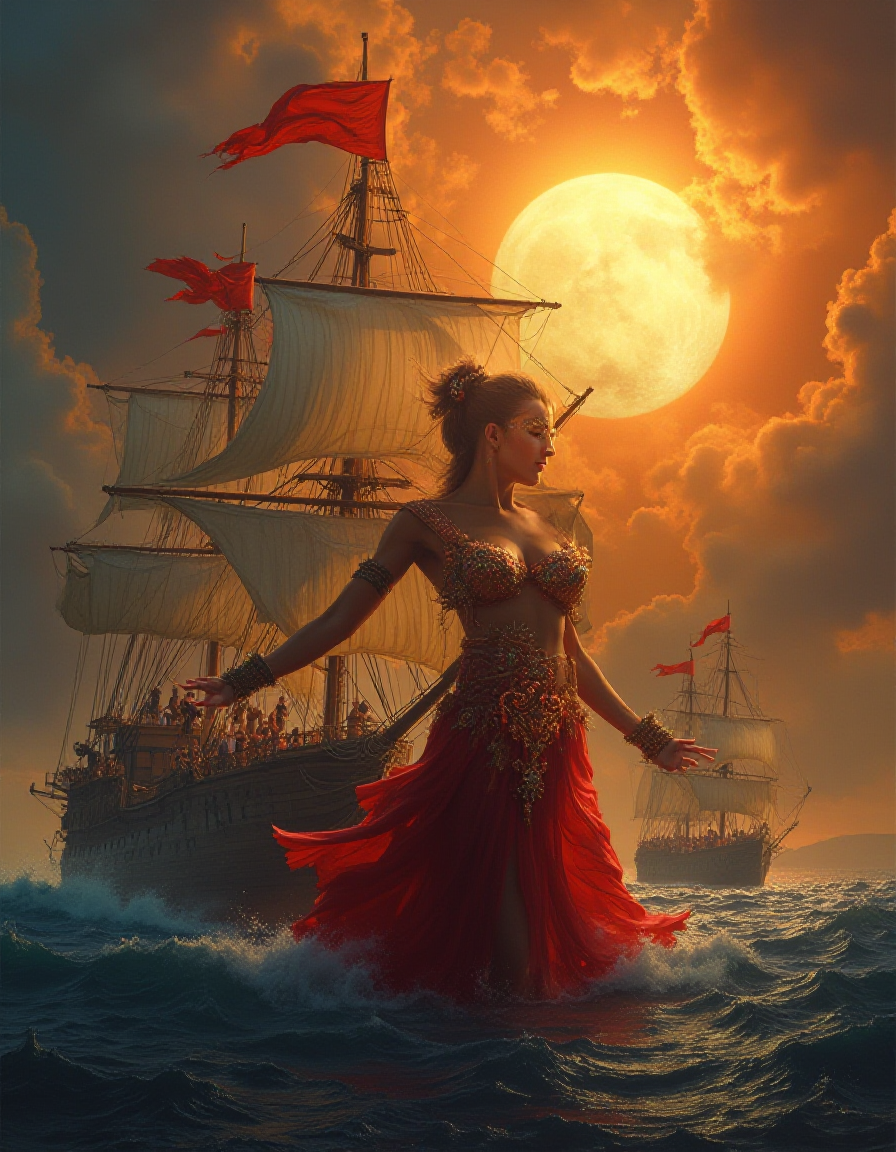
a woman in a red dress is standing on a boat with a large ship in the background.
CAPTION
The image depicts a woman in a red dress standing on a body of water, with a large sailing ship in the background. The ship is adorned with red flags and sails, and the sky is filled with clouds. The woman appears to be in a state of motion, possibly dancing or performing a dance.
MONOLOGUE
The real difficulty in dealing with the question of the boats is to find the explanation of so many of them leaving the ship with comparatively few persons in them. No. 1 certainly left with only 12; this was an emergency boat with a carrying capacity of 40. No. 7 left with only 27, and No. 6 with only 28; these were lifeboats with a carrying capacity of 65 each; and several of the others, according to the evidence, and certainly according to the truth, must have left only partly filled. Many explanations are forthcoming, one being that the passengers were unwilling to leave the ship. When the earlier boats left, and before the _Titanic_ had begun materially to settle down, there was a drop of 65 feet from the boat deck to the water, and the women feared to get into the boats. Many people thought that the risk in the ship was less than the risk in the boats. This explanation is supported by the evidence of Capt. Rostron, of the _Carpathia_. He says that after those who were saved got on board his ship he was told by some of them that when the boats first left the _Titanic_ the people "really would not be put in the boats; they did not want to go in." There was a large body of evidence from the _Titanic_ to the same effect, and I have no doubt that many people, particularly women, refused to leave the deck for the boats. At one time the master appears to have had the intention of putting the people into the boats from the gangway doors in the side of the ship. This was possibly with a view to allay the fears of the
SUMMARY
The image depicts a large sailing ship with its sails engulfed in flames, set against a dramatic sky with dark clouds.
CAPTION
The image depicts a large, historical sailing ship with its sails billowing in the wind, set against a dramatic sky filled with dark clouds. The ship is positioned on the right side of the image, with its bow pointing towards the left. The ship's sails are illuminated by a warm glow, casting a golden hue on the water and the ship itself.
MONOLOGUE
"You will forgive me for forgetting my picture to talk of such things. But we must return. Look back at what I said about the old portrait--the clear, calm, victorious character of the old man's face, and see how all the rest of the picture agrees with it, in a complete harmony. The dress, the scenery, the light and shade, the general 'tone' of colour should all agree with the character of the face--all help to bring our minds into that state in which we may best feel and sympathise with the human beings painted. Now here, because the face is calm and grand, the colour and the outlines are quiet and grand likewise. How different these colours are from that glorious 'Holy Family' of Francia's, next to it on the right; or from that equally glorious 'Bacchus and Ariadne' of Titian's, on the left! Yet all three are right, each for its own subject. Here you have no brilliant reds, no rich warm browns; no luscious greens. The white robe and cap give us the thought of purity and simplicity; the very golden embroidery on them, which marks his rank, is carefully kept back from being too gaudy. Everything is _sober_ here; and the lines of the dress, how simple they all are--no rich curves, no fluttering drapery. They would be quite stiff if it were not for that waving line of round tassels in front, which break the extreme straightness and heaviness of the splendid robe; and all pointing upwards towards that solemn, thin, calm face, with its high white cap, rising like the peak of a snow mountain against the dark, deep, boundless blue
SUMMARY
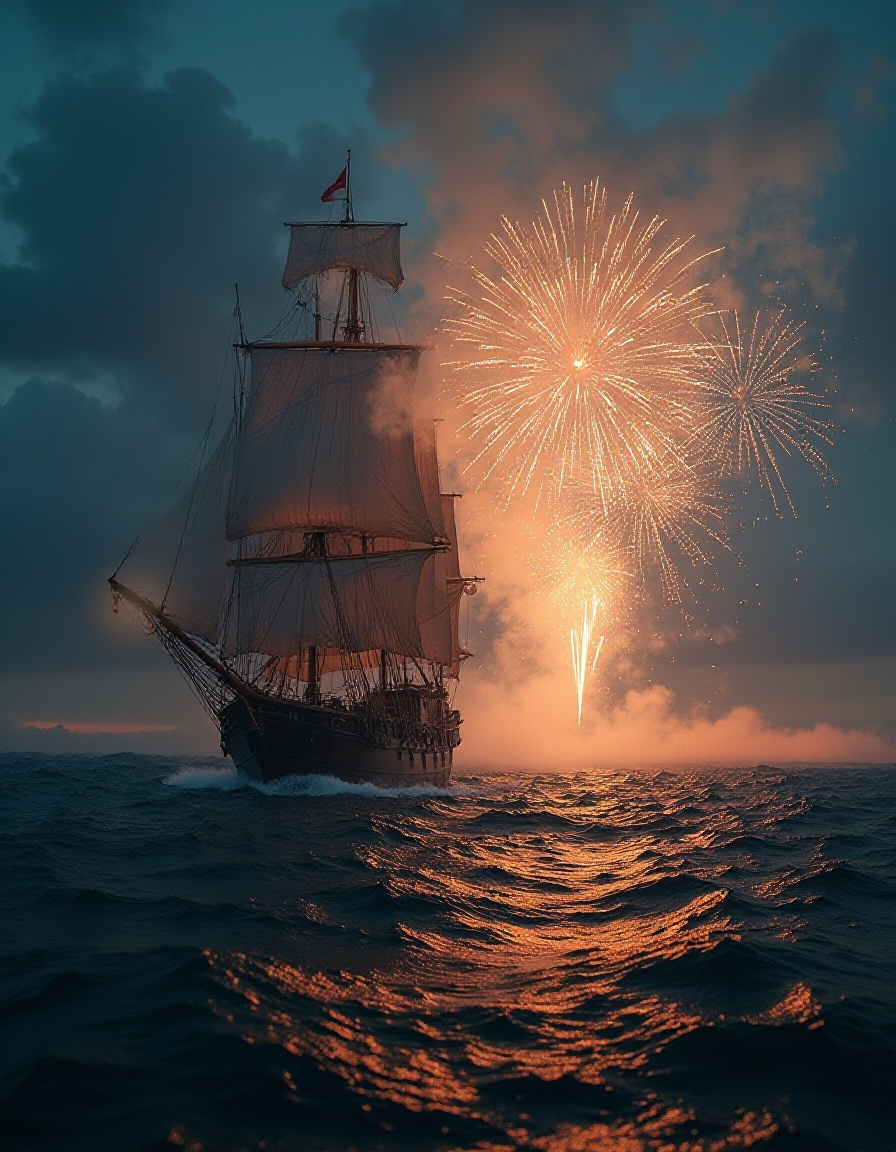
The image depicts a large, wooden sailing ship with a sail that is being blown by fireworks. The ship is moving through the water, creating a dramatic scene.
CAPTION
The image depicts a large, dark-hulled sailing ship with a tall mast and a sail that is billowing in the wind. The ship is moving through the water, creating a dynamic scene with waves and splashes. The sky is filled with fireworks, adding a vibrant and festive atmosphere to the scene.
MONOLOGUE
The pause that preceded the breaking of the storm was unnaturally long. Save for the gleam of an occasional, faintly hissing wave-crest, the waters had grown black. The heart of the storm-cloud seethed in purple, while all the rest of the sky was hung with gray. There came one long moment when the atmosphere sank under a weight of sudden heat. Then the far-distant murmur, which till now had been scarcely audible, rushed upon the silence in a mighty roar, as, up from the south, driven before the gale, came a long line of white waves that rose as they advanced till the very Tritons bent their heads and the nymphs scurried down to greener depths. Now a sudden, zigzag streak of fire shot through the cloud, followed by a crash as of all the bolts of Zeus let off at once. The galley seemed to be scarcely moving. Her sail hung loose upon its mast. Not a soul was to be seen upon the upper deck. Only the oars still creaked in their holes, and the water churned unevenly along the vessel's sides. The wind was nearly upon her. There was a second glare of lightning, a second crash more fearful than the first; and then it was as if the fragile craft, seized by some cyclopean hand, had been lifted entirely from the water to be plunged downward again into the midst of chaos.
SUMMARY
pirate ship with a large red and blue explosion in the background.
CAPTION
The image depicts a large, dark pirate ship with a red and black color scheme, sailing on a choppy sea. The ship is adorned with a large, red flag that is prominently displayed. The ship is moving towards the right side of the image, with a large explosion of fireworks in the background, adding a dramatic and intense atmosphere to the scene.
MONOLOGUE
We were at sea about twenty-two days without falling in with land. It was late one evening when we sighted Woahoo, the largest of the Sandwich Islands, of which Honolulu is the chief port and capital of the kingdom. It was dark by the time we brought up in the roadstead outside the harbour. As I, of course, had read how Captain Cook was killed by the Sandwich Islanders, and had often seen prints in which a number of naked black fellows are hurling their spears and darts at him, I had an idea that I knew all about them, and had pictured to myself exactly what I should see when next morning we went on shore with our boat's crew well-armed to trade with them. The next morning at daybreak the anchor was hove up, and with a light breeze we stood in through a narrow passage in a coral reef, which extends from one point of land to another, and forms the harbour. What was my surprise to see before us, when we dropped our anchor, a neat, pretty-looking town, with a fort on the right side bristling with cannon, a fertile valley extending far into the country on the left, and lofty mountains rising in the distance. Over the fort flew the Hawaian flag. It is formed of the British union-jack, with alternate blue, red, and white stripes. The streets are broad, and run at right angles to each other. There were numerous hotels, some of them really very handsome buildings on an extensive scale, and managed after the American fashion, while in the streets were a number of large and well-furnished shops. There are
SUMMARY
a large pirate ship with a red and black sail is sailing on the ocean with fireworks in the background
CAPTION
The image depicts a dramatic scene of a pirate ship sailing on a stormy sea at night. The ship, with its black hull and sails, is prominently featured in the center of the image. The ship is surrounded by a large explosion of fireworks, adding a sense of excitement and danger to the scene.
MONOLOGUE
After that they rose, and, leaving the Red Lion, went down to the pier, where a boat was in waiting. It conveyed them to a large ship, whose sails were hanging in the loose condition peculiar to a vessel ready to set sail. An hour after that the anchor was raised, and wind and tide carried the ship gently down to the sea. There seemed to Will something very solemn and mysterious in the quiet way in which, during these still and dark hours of the night, the great ship was slowly moved towards her ocean cradle. At length she floated on the sea, and, soon after, the moon arose on the distant horizon, streaming across the rippling surface as if to kiss and welcome an old friend. The wind increased; the ship became submissive to the breeze, obedient to the helm, and ere long moved on the waters like "a thing of life," leaving Old England far behind her.
SUMMARY
The image depicts a large sailing ship with a red flag flying from the mast, sailing on a body of water with waves.
CAPTION
The image depicts a large, historical sailing ship with a prominent red flag flying from the stern. The ship is positioned on the water, with the bow facing towards the left side of the image. The sky is a gradient of orange and pink, with the sun setting behind the ship, casting a warm glow over the scene.
MONOLOGUE
My friend, Dr. Howe, was my companion. We drove up the grand avenue on one of the loveliest mornings that ever surprised December with a bright sun and a warm south wind. Before us, at the distance of a mile, lay a vast mass of architecture, with the centre, falling back between the two projecting wings, the whole crowning a long and gradual ascent, of which the tri-colored flag waving against the sky from the central turrets was the highest point. As we approached, we noticed an occasional flash in the sun, and a stir of bright colors, through the broad deep court between the wings, which, as we advanced nearer, proved to be a body of about two or three thousand lancers and troops of the line under review. The effect was indescribably fine. The gay uniforms, the hundreds of tall lances, each with its red flag flying in the wind, the imposing crescent of architecture in which the array was embraced, the ringing echo of the grand military music from the towers--and all this intoxication for the positive senses fused with the historical atmosphere of the place, the recollection of the king and queen, whose favorite residence it had been (the unfortunate Louis and Marie Antoinette), or the celebrated women who had lived in their separate palaces within its grounds, of the genius and chivalry of Court after Court that had made it, in turn, the scene of their brilliant follies, and, over all, Napoleon, who _must_ have rode through its gilded gates with the thought of pride that he was its
SUMMARY
a large pirate ship with red sails and a red flag is sailing on the ocean
CAPTION
The image presents a vibrant and dynamic scene of a pirate ship, bathed in a fiery glow, set against a backdrop of a starry night sky. The ship, with its red sails and black hull, is the focal point of the image. It is adorned with a large red flag, adding a splash of color to the scene.
MONOLOGUE
By seven o'clock in the evening the _Nrnberg_ was practically "blind," for the flames from the fire that was raging on her had reached her conning tower. A member of her crew hauled down her flag, and the _Kent_, thinking that the fight was over, came close to her. While within a few hundred yards of her, however, she was greeted with new firing from the German cruiser. But this ceased under a raking from the _Kent's_ starboard guns, and once again the flag of the _Nrnberg_, which had been run up on resumption of shooting, was hauled down. Members of her crew then had to jump into the sea to escape death from burning--the fire was quenched only when she went down at half past seven. The overworked engineers and stokers of the _Kent_ were rewarded for their hard work by being permitted to come on deck to watch the _Nrnberg_ go down, and all were soon engaged in helping to save the lives of the German sailors in the water. Just as the red glow of the sinking _Nrnberg_ was dying down a large four-masted sailing ship, with all sails set, came out of the mist, her canvas tinged red by the flames' rays. Silently she went by, disappearing again into the mist, a weird addition to an uncanny scene.
SUMMARY
a pirate ship with a large mast and sails is sailing on a stormy sea with fireworks in the background
CAPTION
The image presents a dramatic scene of a pirate ship sailing on a stormy sea. The ship, with its black hull and red sails, is prominently featured in the center of the image. The ship's sails are billowing in the wind, creating a sense of movement and urgency.
MONOLOGUE
In addition to those fine engravings from Garnery, there are two other French engravings worthy of note, by some one who subscribes himself “H. Durand.” One of them, though not precisely adapted to our present purpose, nevertheless deserves mention on other accounts. It is a quiet noon-scene among the isles of the Pacific; a French whaler anchored, inshore, in a calm, and lazily taking water on board; the loosened sails of the ship, and the long leaves of the palms in the background, both drooping together in the breezeless air. The effect is very fine, when considered with reference to its presenting the hardy fishermen under one of their few aspects of oriental repose. The other engraving is quite a different affair: the ship hove-to upon the open sea, and in the very heart of the Leviathanic life, with a Right Whale alongside; the vessel (in the act of cutting-in) hove over to the monster as if to a quay; and a boat, hurriedly pushing off from this scene of activity, is about giving chase to whales in the distance. The harpoons and lances lie levelled for use; three oarsmen are just setting the mast in its hole; while from a sudden roll of the sea, the little craft stands half-erect out of the water, like a rearing horse. From the ship, the smoke of the torments of the boiling whale is going up like the smoke over a village of smithies; and to windward, a black cloud, rising up with earnest of squalls and rains, seems to quicken the activity of the excited seamen.
SUMMARY
a pirate ship with a large skull on the mast and a man in a red shirt on the deck is battling a giant squid in the ocean
CAPTION
The image depicts a dramatic scene of a pirate ship sailing through stormy waters. The ship, with its black hull and red sails, is prominently featured in the center of the image. The ship is being attacked by a fierce creature with glowing red eyes, which is positioned to the right of the ship.
MONOLOGUE
On board the man-of-war all stand watching her--their eyes at intervals directed towards the strange vessel. From the frigate's forward-deck, the men have an unobstructed view, especially those clustering around the head. Still there is nearly a league between, and with the naked eye this hinders minute observation. They can but see the white-spread sails, and the black hull underneath them. With a glass the flag, now fallen, is just distinguishable from the mast along which it clings closely. They can perceive that its colour is crimson above, with blue and white underneath--the reversed order of the Chilian ensign. Its single star is no longer visible, nor aught of that heraldry, which spoke so appealingly. But if what they see fails to furnish them with details, these are amply supplied by their excited imaginations. Some of them can make out men aboard the barque--scores, hundreds! After all, she may be a pirate, and the upside-down ensign a decoy. On a tack, she might be a swifter sailer than she has shown herself before wind; and, knowing this, has been but "playing possum" with the frigate. If so, God help the cutter's crew?
SUMMARY
The image depicts a pirate ship sailing through a stormy sea at sunset. The ship, with its black hull and sails, is prominently featured in the center of the image. The waves, with their white crests and blue-green depths, are crashing around the ship, adding to the dramatic atmosphere. In the foreground, two figures are seen, one
CAPTION
The image depicts a dramatic scene of a pirate ship sailing through a stormy sea. The ship, with its black hull and sails, is prominently featured in the center of the image. The ship is being tossed by the waves, which are depicted in shades of blue and white, creating a sense of motion and drama. In the foreground, two figures are visible.
MONOLOGUE
This night the wind came up and by morning was blowing stiffly, urging us landward as though back to Spain. The sky became leaden, with a great stormy aspect. The waves mounted, the lookout cried that the _Pinta_ was showing signals of distress. By now all had shortened sail, but the Pinta was taking in everything and presently lay under bare poles. The Santa Maria worked toward her until we were close by. They shouted and we back to them. It was her rudder that was unshipped and injured. Captain Martin Pinzon shouted that he would overcome it, binding it somehow in place, and would overtake us, the _Pinta_ being faster sailer than the Santa Maria or the Nina. But the Admiral would not agree, and we took in all sail and lay tossed by a rough sea until afternoon when the Pinta signaled that the rudder was hung. But by now the sky stretched straight lead, and the water ran white-capped. We made no way till morning, when without a drop of rain all the cloud roof was driven landward and there sprang out a sky so blue that the heart laughed for joy. The violent wind sank, then veered and blowing moderately carried us again southward. All the white sails, white and new, were flung out, and we raced over a rich, green plain. That lasted through most of the day, but an hour before sunset the _Pinta_ again signaled trouble. The rudder was once more worse than useless.
SUMMARY
a large pirate ship with red sails and cannons is on fire in the ocean
CAPTION
The image depicts a large, historic-looking pirate ship sailing on a stormy sea. The ship is prominently featured in the center of the image, with its sails billowing in the wind and flames emanating from the bow. The ship's hull is dark, contrasting with the red sails and the fiery explosions in the background.
MONOLOGUE
It happened one day that a vessel under command of Miguel de Loarcha, [26] having on board father Fray Martin de Herrada, provincial of the Augustinians (who had come to Pangasinan to see the master-of-camp, and was returning to Manila to hold a meeting of his order), met in the island and port of Buliano, seven leagues from the Pagasinan River, as they were going out of the port, a Sangley ship, which was about to enter the port. Thinking it to be a hostile vessel, they bore down upon it, together with another ship in their company. Those aboard the ship were only the said father provincial and five other Spaniards and the sailors. The Sangley ship, seeing them bearing down upon it, tried to take flight; but, the contrary wind not permitting this, as a consequence, the Spanish ships, by means of sail and oar, came within cannon range, and even nearer, in a few moments. On one of the Spanish ships was a Chinese named Sinsay, who had been in Manila many times with merchants, and was very friendly and well known to the Spaniards, and understood their language. When this man saw that the ship was Chinese, and that, from its appearance, it was not a pirate, he requested our men not to fire or do any damage until it was known clearly who its occupants were. He went to the bow of the vessel and hailed them, thus ascertaining that theirs was one of the ships of the fleet sent by their king in search of the pirate Limahon. They had left the fleet behind and put out to sea in order to explore those islands,
SUMMARY
A hand pointing at a fireworks display in the night sky.
CAPTION
The image depicts a dramatic scene of a person's hand pointing upwards towards a large ship on the water. The ship is surrounded by fireworks, creating a vibrant and dynamic atmosphere. The sky is filled with clouds, adding to the overall sense of excitement and celebration.
MONOLOGUE
Whilst the officer was speaking, his companions had suddenly caught a sound in the air which reminded them immediately of the whistling scream of a Lancaster shell. At first they thought the steam was escaping somewhere, but, looking upwards, they saw that the strange noise proceeded from a ball of dazzling brightness, directly over their heads, and evidently falling towards them with tremendous velocity. Too frightened to say a word, they could only see that in its light the whole ship blazed like fireworks, and the whole sea glittered like a silver lake. Quicker than tongue can utter, or mind can conceive, it flashed before their eyes for a second, an enormous bolide set on fire by friction with the atmosphere, and gleaming in its white heat like a stream of molten iron gushing straight from the furnace. For a second only did they catch its flash before their eyes; then striking the bowsprit of the vessel, which it shivered into a thousand pieces, it vanished in the sea in an instant with a hiss, a scream, and a roar, all equally indescribable. For some time the utmost confusion reigned on deck. With eyes too dazzled to see, ears still ringing with the frightful combination of unearthly sounds, faces splashed with floods of sea water, and noses stifled with clouds of scalding steam, the crew of the _Susquehanna_ could hardly realize that their marvellous escape by a few feet from instant and certain destruction was an accomplished fact, not a frightful dream. They were still engaged in trying to open their
SUMMARY
a large black pirate ship with sails is sailing on a body of water with fireworks in the background
CAPTION
The image depicts a large, dark pirate ship sailing on a body of water, with a vibrant green and blue sky in the background. The ship is adorned with multiple sails, and there are fireworks exploding in the sky, adding a festive and celebratory atmosphere to the scene. The ship's hull is illuminated by the ship's lights, creating a dramatic reflection on the water's surface.
MONOLOGUE
The Scale-breasted Paradise Bird (Epimachus magnificus of Cuvier) is now generally placed with the Australian Rifle birds in the genus Ptiloris. Though very beautiful, these birds are less strikingly decorated with accessory plumage than the other species we have been describing, their chief ornament being a more or less developed breastplate of stiff metallic green feathers, and a small tuft of somewhat hairy plumes on the sides of the breast. The back and wings of this species are of an intense velvety black, faintly glossed in certain lights with rich purple. The two broad middle tail feathers are opalescent green-blue with a velvety surface, and the top of the head is covered with feathers resembling scales of burnished steel. A large triangular space covering the chin, throat, and breast, is densely scaled with feathers, having a steel-blue or green lustre, and a silky feel. This is edged below with a narrow band of black, followed by shiny bronzy green, below which the body is covered with hairy feathers of a rich claret colour, deepening to black at the tail. The tufts of side plumes somewhat resemble those of the true Birds of Paradise, but are scanty, about as long as the tail, and of a black colour. The sides of the head are rich violet, and velvety feathers extend on each side of the beak over the nostrils.
SUMMARY
a large pirate ship with a large moon in the sky is being attacked by a large fire and a large explosion
CAPTION
The image depicts a dramatic scene of a large, old-fashioned sailing ship, possibly a pirate ship, navigating through a stormy sea. The ship is prominently featured in the center of the image, with its sails billowing in the wind and waves crashing around it. The ship is surrounded by a large moon and a full moon, casting a glow over the scene.
MONOLOGUE
During a part of the day the wind was contrary, and obliged us to make short tacks in view of the rocky wall; but at four o'clock a change of wind allowed the brig to approach the coast. The sea was like a magnificent basin reflecting in its transparent waters the great calcareous masses that overhung it. It was a fine spectacle; but our captain's serious expression of countenance, and the intentness with which he watched the sails, and directed the manoeuvres, plainly showed that our situation was one of difficulty, if not of danger. A boat was manned and sent off to explore the coast, and as its white sail gleamed at a distance in the sun, it looked like a seabird in search of its nest in the hollow of some rock. The _Little Mary_ imitated all our evolutions, skimming over the waves like a sea swallow. She shortened her trip at every tack, and kept closer and closer to us; and our captain's face grew more and more grave, until all at once to our great surprise the rock opened before us like a scene in a theatre, and afforded us a passage which two vessels could not have entered abreast. Having got fairly through the channel, M. Taitbout was himself again. This entrance he told us is very dangerous in stormy weather, and often impracticable even when the wind is but moderately fresh. The scene, however, on which it opens is extremely beautiful. The port is surrounded with mountains, the highest of which still bear traces of the old Genoese dominion, and in front of the entrance is the pretty Greek
SUMMARY
a modern cruise ship with a curved roof and glass windows is sailing through a stormy sea at sunset
CAPTION
The image captures a modern cruise ship, bathed in the warm glow of the setting sun, as it sails through a turbulent sea. The ship, with its sleek design and glass windows, is prominently featured in the center of the frame. The waves, created by the ship's movement, are captured in motion, adding a dynamic element to the scene.
MONOLOGUE
Deep in the wave is a coral grove, Where the purple mullet and goldfish rove; Where the sea flower spreads its leaves of blue, That never are wet with the falling dew; But in bright and changeful beauty shine, Far down in the green and glassy brine. The floor is of sand, like the mountain's drift, And the pearl shells spangle the flinty snow; From coral rocks the sea plants lift Their boughs, where the tides and billows flow. The water is calm and still below, For the winds and waves are absent there, And the sands are bright as the stars that glow In the motionless fields of upper air. There, with its waving blade of green, The sea flag streams through the silent water, And the crimson leaf of the dulse is seen To blush like a banner bathed in slaughter; There, with a light and easy motion, The fan coral sweeps through the clear, deep sea; And the yellow and scarlet tufts of ocean Are bending like corn on the upland lea: And life in rare and beautiful forms Is sporting amid those bowers of stone, And is safe, when the wrathful spirit of storms Has made the top of the waves his own: And when the ship from his fury flies, When the myriad voices of ocean roar, When the wind god frowns in the murky skies, And demons are waiting the wreck on shore, Then, far below, in the peaceful sea, The purple mullet and goldfish rove, Where the waters murmur tranquilly Through the bending twigs of the coral grove.
SUMMARY
the painting depicts a large sailing ship with three masts and sails unfurled, with a large sun in the sky, and a person on the deck.
CAPTION
The image depicts a large, wooden sailing ship with three masts and sails, positioned on the water. The ship is facing towards the right side of the image, with the sails billowing in the wind. The sky above is filled with clouds, and the sun is setting, casting a warm glow over the scene.
MONOLOGUE
“By the thirteenth of May our ship was ready to sail, and the next day we were out in the open sea, on our way to Ochotsh. The weather was very clear and fine, but so intolerably cold that we were obliged to keep on our fur clothing. For some days we had very little wind; it was not till the nineteenth that a brisk gale from the northwest sprang up. An uncommon large whale, the body of which was larger than the ship itself, lay almost at the surface of the water, but was not perceived by any one on board till the moment when the ship, which was in full sail, was almost upon him, so that it was impossible to prevent its striking against him. We were thus placed in the most imminent danger, as this gigantic creature, setting up its back, raised the ship three feet at least out of the water. The masts reeled, and the sails fell altogether, while we who were below all sprang instantly upon the deck, concluding that we had struck upon some rock; instead of this we saw the monster sailing off with the utmost gravity and solemnity. Captain D’Wolf applied immediately to the pumps to examine whether or not the vessel had received any damage from the shock, but we found that very happily it had escaped entirely uninjured.”
SUMMARY
The image depicts a sailing ship with a crew on board, navigating through the open sea.
CAPTION
The image captures a serene scene of a sailing ship navigating through the open sea. The ship, painted in a light blue color, is adorned with a large sail that is prominently displayed, indicating its readiness for a journey. The ship's crew, dressed in traditional attire, is visible on the deck, their faces illuminated by the sunlight.
MONOLOGUE
A large American ship arrived in harbour from China with a load of coolies for the Cuban plantations. The captain was sick, so he made arrangements with Captain Turner to take his vessel, the Messenger, to New York. Our mate was to take the schooner to Boston, with a cargo of sugar and molasses. We took our cargo on board, boxes of sugar in the hold and hogsheads of molasses for a deck load. I was now going home in earnest. I purchased a lot of guava jelly and tropical preserves, besides a number of presents for my relatives. I wrote to my mother, in New York, telling her of my intentions, giving her the name of the schooner and its port of destination. The fourth day of July, 1860, early in the morning, we sailed out past Morro Castle. Our voyage to Boston had begun. I felt happy with the prospect of soon being back home. We had a very easy time on the schooner, there being nothing to do except to take our turns at steering. On a full-rigged ship it would have been different, as it is invariably the practice to keep the crew continually at work most of the time, most usually aloft, repairing the rigging. We had passed the most dangerous part of our trip, through the Florida Keys; the wind was "wing and wing"--that is, the foresail was out on one side and the main-sail on the other. A good strong breeze was driving us north at a rapid rate. That night it was my turn at the wheel from ten to twelve o'clock. It being cloudy, no stars were visible. For that reason it was more difficult to steer straight. By selecting a
SUMMARY
a large sailing ship with a red flag on the mast is sailing through rough waters
CAPTION
The image depicts a large, ornate sailing ship with three masts and a flag on the top of the mast. The ship is positioned in the center of the image, with the bow facing towards the left side of the frame. The ship is surrounded by a vast expanse of ocean, with waves crashing around it.
MONOLOGUE
Pin velvet on under side, using same method in pinning as that on top of brim. This must be pinned very carefully. Cut off velvet all around edge, leaving a little _less_ than one-fourth inch to turn under. Facings are usually finished at the edge with a wire. Cut a piece of frame wire the exact circumference of the brim, plus one inch for lap. Bend to shape of brim and pin under edge of velvet, beginning at the center back. Roll velvet over wire and bring out to edge. Pin in place all the way around before beginning to sew. Place pins in at right angles to brim. A piece of velvet held in the left hand will prevent finger marks from showing on the velvet. Begin to sew at left of wire joining, while holding underside of brim towards you. Bring needle through from back close under wire. With the head of the needle press velvet along under wire to make a crease or sort of bed for the thread of the next stitch. Take nearly a half-inch stitch by placing needle close under the wire and coming through between the wire and the upper facing. Come back under the wire with a very small back stitch, being careful to adjust the wire as you sew, and to catch a little of the upper covering with each back stitch. When wire joining is reached, treat the lapped ends as one wire. Fasten ends securely by taking several small back stitches. Lace wire, being smaller than frame wire, is sometimes used to finish the edge of facing. It does not look as heavy, but is somewhat more difficult for a beginner to handle.
SUMMARY
a medieval-style sailing ship with a large sail and a figurehead is sailing through a stormy sea
CAPTION
The image depicts a medieval-style sailing ship with a large, orange sail billowing in the wind. The ship is positioned on the left side of the image, with the bow pointing towards the right. The ship is surrounded by a dark, stormy sky, with clouds and lightning bolts visible in the background.
MONOLOGUE
Italy, and had accumulated great wealth. Being desirous of again seeing his native city, he set sail from Taras for Corinth. The sailors in the ship, having seen the large boxes full of money which Arion had brought with him into the ship, made up their minds to kill him and take his gold and silver. So one day when he was sitting on the bow of the ship, and looking down on the dark blue sea, three or four of the sailors came to him and said they were going to kill him. Now Arion knew they said this because they wanted his money; so he promised to give them all he had if they would spare his life. But they would not. Then he asked them to let him jump into the sea. When they had given him leave to do this, Arion took one last look at the bright and sunny sky, and then leaped into the sea, and the sailors saw him no more. But Arion was not drowned in the sea, for a great fish called a dolphin was swimming by the ship when Arion leaped over; and it caught him on its back and swam away with him towards Corinth. So presently the fish came close to the shore and left Arion on the beach, and swam away again into the deep sea.[79:1]
SUMMARY
The ship is sailing in the ocean with a stormy sky.
CAPTION
The image depicts a large, ornate wooden sailing ship with multiple masts and sails. The ship is positioned on the water, with the bow facing towards the left side of the image. The sails are unfurled, and the ship's hull is adorned with intricate carvings and decorations.
MONOLOGUE
"Land! land on the larboard bow!" The cry was uttered in a foreign tongue from the masthead of a corvette of twenty guns, a beautiful long, low, flush-decked craft with dark hull, taunt raking masts, and square yards, which, under all the sails she could carry with a southerly breeze right aft, was gliding rapidly over the now smooth surface of the northern ocean. The haughty flag of old Spain, and the language spoken on board, showed that she belonged to that nation. The crew sat clustered about on the forecastle with their arms folded in a listless, inactive way--some asleep--others smoking cigarillos or playing games of chance between the guns, while a few were disputing on some trivial points with a vehemence which proved the fiery tempers hidden under those calm exteriors. The officers lolled against the bulwarks, sat on the guns, or paced slowly backwards and forwards; but rather more etiquette was kept up on the quarter deck than appeared to be the case among the men forward. The captain walked backwards and forwards with his first lieutenant on the starboard side; they crossed occasionally, and lifted their hands to their eyes to watch the land just sighted as the ship approached and glided by it at the distance of two or three miles. The captain's appearance was in his favour. He was tall and graceful, with the clear olive-complexion, the pointed beard, the thin moustache, and the large pensive eyes, so frequently seen in portraits of high-born Spaniards. Still, though his features were handsome and
SUMMARY
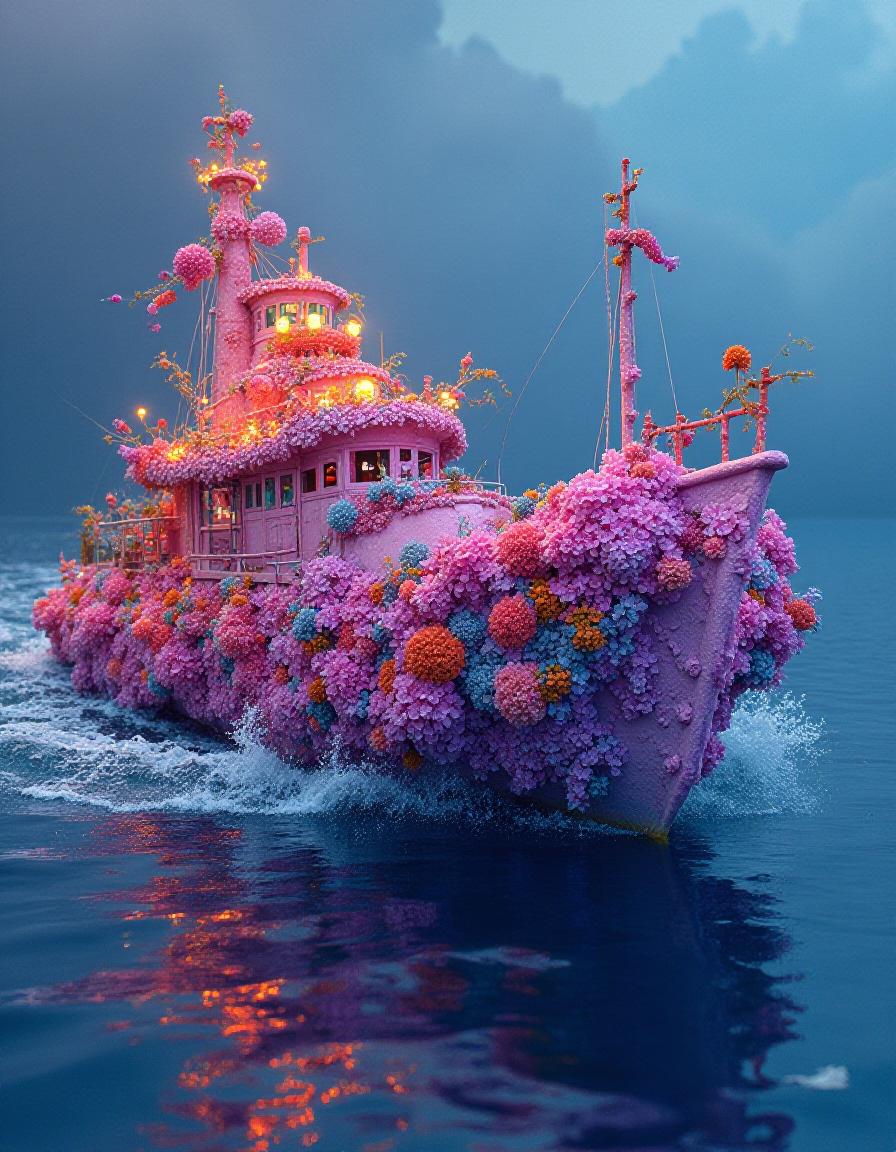
a pink and purple boat with flowers on it is being tossed in the water
CAPTION
The image presents a vibrant, surreal scene of a pink ship adorned with a multitude of flowers and decorations. The ship, which is the central focus of the image, is moving through the water, creating a dynamic and lively atmosphere. The ship's vibrant colors, including pink, purple, and orange, contrast beautifully with the surrounding water, which is a deep blue.
MONOLOGUE
It is really impossible to describe the beauty of the scene before us. Submarine coral forests, of every colour, studded with sea-flowers, anemones, and echinidae, of a brilliancy only to be seen in dreamland, shoals of the brightest and swiftest fish darting and flashing in and out; shells, everyone of which was fit to hold the place of honour in a conchologist's collection, moving slowly along with their living inmates: this is what we saw when we looked down, from the side of the boat, into the depths below. The surface of the water glittered with every imaginable tint, from the palest aquamarine to the brightest emerald, from the pure light blue of the turquoise to the deep dark blue of the sapphire, and was dotted here and there with patches of red, brown, and green coral, rising from the mass below. Before us, on the shore, there spread the rich growth of tropical vegetation, shaded by palms and cocoa-nuts, and enlivened by the presence of native women in red, blue, and green garments, and men in motley costumes, bringing fish, fowls, and bunches of cocoa-nuts, borne, like the grapes brought back from the land of Canaan by the spies, on poles.
SUMMARY
The painting depicts a stormy night with a large boat on the water, with a man standing on the shore.
CAPTION
The image depicts a nighttime scene featuring a large sailing ship on a rough sea. The ship, with its sails unfurled, is positioned on the left side of the image, close to the viewer. The ship is surrounded by a large body of water, with waves crashing against the shore.
MONOLOGUE
noted with wonder that, although he made no movement with his body or tried to swim--which he could have done, as the weather was fair--he floated above water for half a legua. Later, during the last storm, a wave washed off the man who struck him, and he was found drowned on the strand, a most hideous and misshapen mass. During the first gale the ship, at its beginning, because of obeying its helm poorly, was struck head on. The sails pulled with such force on the masts, that, as the captain dared not take them in, they were blown into shreds. The pilots began to throw overboard whatever was above decks, until nothing was left on them. They threw overboard the boat, and the boxes and bales of merchandise On that account the sailors lost their poor possessions, and some of the passengers lost a goodly amount. The ship tossed and rolled frightfully, and dipped below the water on both sides. Consequently it shipped so much water that it was generally half an estado deep above decks. The waves were furious and high, and so great that the fore and after cabins shipped water. One wave carried away a considerable portion of the stern gallery, together with four little slave girls who were in it. In this way they passed one night, almost in despair of seeing the morrow. But day came, and they repaired the ship by binding other sails that were carried for that purpose. After this storm the ship was very crank, and even in fair weather its sides were under water, although it had a high
SUMMARY
woman in red coat standing on the deck of a ship with a ship in the background.
CAPTION
The image depicts a woman standing on the deck of a ship, wearing a black hat and a red coat. She is holding a steering wheel, which is prominently displayed in the foreground. The ship is docked at a pier, and the background reveals a harbor with other ships and a clear sky.
MONOLOGUE
About half-past eight Tibbs rushed into my cabin with a very white face and asked me if I had seen his wife. I answered that I had not. He then ran wildly into the saloon and began groping about for any trace of her, while I followed him, endeavouring vainly to persuade him that his fears were ridiculous. We hunted over the ship for an hour and a half without coming on any sign of the missing woman or child. Poor Tibbs lost his voice completely from calling her name. Even the sailors, who are generally stolid enough, were deeply affected by the sight of him as he roamed bareheaded and dishevelled about the deck, searching with feverish anxiety the most impossible places, and returning to them again and again with a piteous pertinacity. The last time she was seen was about seven o’clock, when she took Doddy on to the poop to give him a breath of fresh air before putting him to bed. There was no one there at the time except the black seaman at the wheel, who denies having seen her at all. The whole affair is wrapped in mystery. My own theory is that while Mrs. Tibbs was holding the child and standing near the bulwarks it gave a spring and fell overboard, and that in her convulsive attempt to catch or save it, she followed it. I cannot account for the double disappearance in any other way. It is quite feasible that such a tragedy should be enacted without the knowledge of the man at the wheel, since it was dark at the time, and the peaked skylights of the saloon screen the greater part of the quarter-deck. Whatever the truth may be
SUMMARY
The woman in the image is wearing a green coat and a hat and is standing in front of a ship.
CAPTION
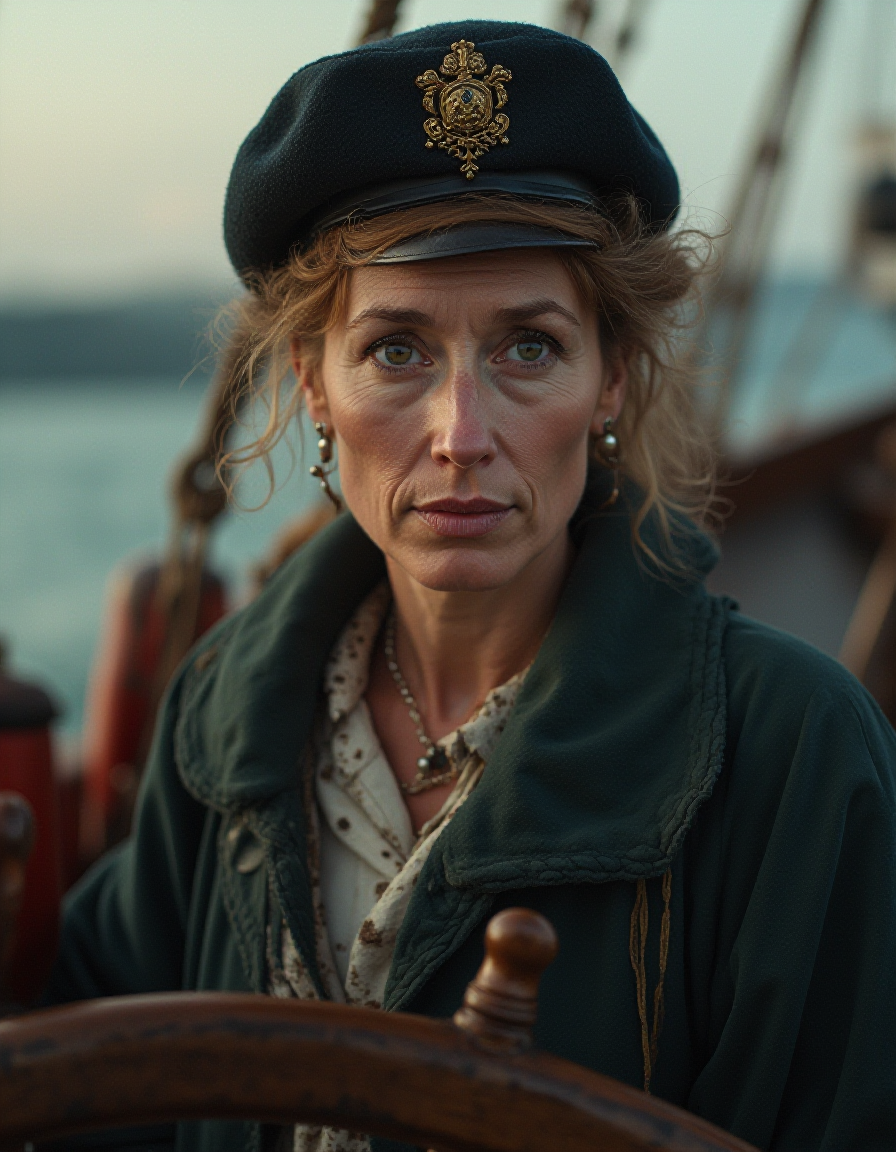
The image depicts a woman standing on a boat, wearing a black hat and a green coat. She is looking to the side, possibly at something in the distance. The background features a large ship with a prominent mast and a large sail, suggesting that she is on a ship.
MONOLOGUE
It was afternoon. All was as still in the Close as a cathedral-green can be between the Sunday services, and the incessant cawing of the rooks was the only sound. Joshua Halborough had finished his ascetic lunch, and had gone into the library, where he stood for a few moments looking out of the large window facing the green. He saw walking slowly across it a man in a fustian coat and a battered white hat with a much-ruffled nap, having upon his arm a tall gipsy-woman wearing long brass earrings. The man was staring quizzically at the west front of the cathedral, and Halborough recognized in him the form and features of his father. Who the woman was he knew not. Almost as soon as Joshua became conscious of these things, the sub-dean, who was also the principal of the college, and of whom the young man stood in more awe than of the Bishop himself, emerged from the gate and entered a path across the Close. The pair met the dignitary, and to Joshua's horror his father turned and addressed the sub-dean.
SUMMARY
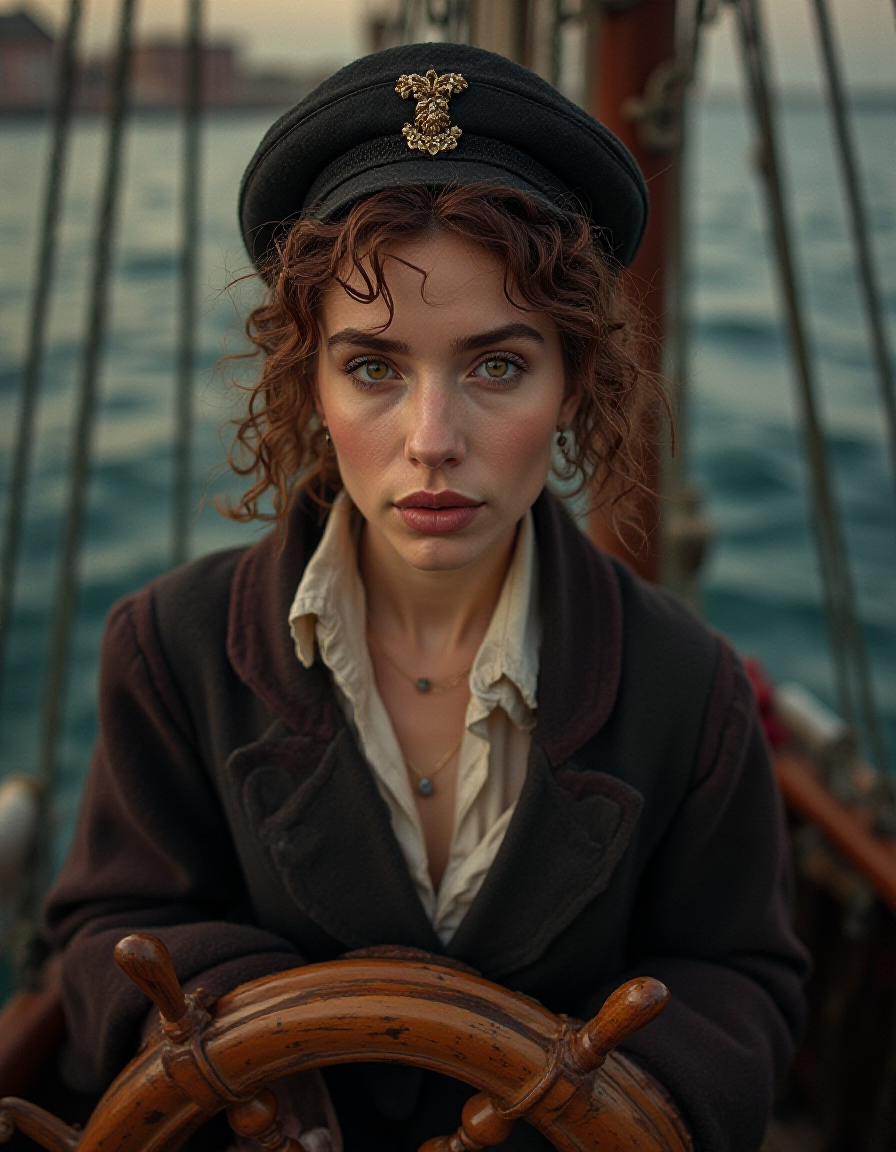
The woman is a young woman with curly hair, wearing a black hat and a black coat, standing in front of a ship's wheel.
CAPTION
The image depicts a woman dressed in a black hat and coat, standing on a ship. She is holding a steering wheel, which is prominently displayed in the foreground. The background of the image shows the sea and the ship's deck, with the ship's stern visible in the distance.
MONOLOGUE
11 P.M.--A misfortune has occurred so unexpected and so horrible that my little escape of the morning dwindles into insignificance. Mrs. Tibbs and her child have disappeared--utterly and entirely disappeared. I can hardly compose myself to write the sad details. About half-past eight Tibbs rushed into my cabin with a very white face and asked me if I had seen his wife. I answered that I had not. He then ran wildly into the saloon and began groping about for any trace of her, while I followed him, endeavouring vainly to persuade him that his fears were ridiculous. We hunted over the ship for an hour and a half without coming on any sign of the missing woman or child. Poor Tibbs lost his voice completely from calling her name. Even the sailors, who are generally stolid enough, were deeply affected by the sight of him as he roamed bareheaded and dishevelled about the deck, searching with feverish anxiety the most impossible places, and returning to them again and again with a piteous pertinacity. The last time she was seen was about seven o'clock, when she took Doddy on to the poop to give him a breath of fresh air before putting him to bed. There was no one there at the time except the black seaman at the wheel, who denies having seen her at all. The whole affair is wrapped in mystery. My own theory is that while Mrs. Tibbs was holding the child and standing near the bulwarks it gave a spring and fell overboard, and that in her convulsive attempt to catch or save it, she followed it. I cannot account for the double disappearance in any
SUMMARY
The woman is standing in front of a ship and looking at the camera.
CAPTION
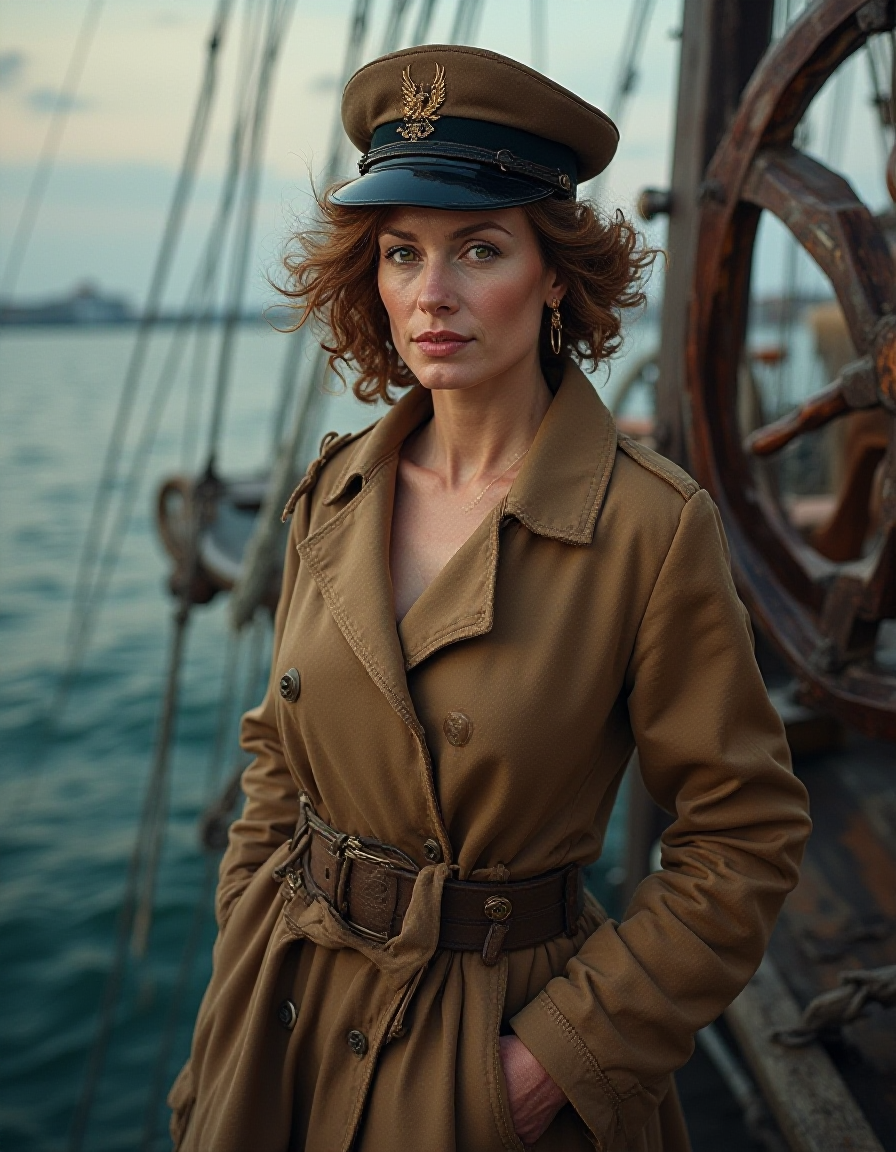
The image depicts a woman standing on the deck of a ship, wearing a brown trench coat and a hat with a badge. She is looking to the side, possibly at the horizon, with her hands in her pockets. The ship's wheel is visible in the background, and the water is calm.
MONOLOGUE
When she first went on board, she gave the boy to one of her women, telling her to tend him and give him food and playthings. But when they had been at sea some time, the woman came to her mistress, and said that the child would neither eat, nor play; that he gave no heed to any one, but stood apart, sullen and silent, looking back over the sea toward Howth. Then Grace, whose quick anger had cooled down in the fresh evening breeze, went to him, laid her hand on his shoulder and spoke his name. He did not start, or answer, but kept his sad, wistful eyes fixed on the distant towers of his father's castle. So she stood over him, watching, and so he stood gazing, till the ship rounded a point which hid the castle from sight. Then, for the first time, the child burst into tears; but, flinging himself on the deck, he covered his face with his hands, as though to conceal his crying, and seemed to try to check the sobs which shook his little breast. So much proud and delicate feeling in one so young--a mere baby--appealed strongly to the Lady Grace. She felt her heart soften and yearn over the noble child, in his grief and loneliness. She knelt at his side and slid her hand under his head, and speaking his name more tenderly than before, she told him not to be afraid, not to grieve any more, and he should go home soon. She made her harsh, commanding voice sound so sweet and motherly that the child turned a little, and clasped that large brown hand, and held it against his lips and his eyes, while he wept and
SUMMARY
woman in black coat standing on a ship with a cityscape in the background.
CAPTION
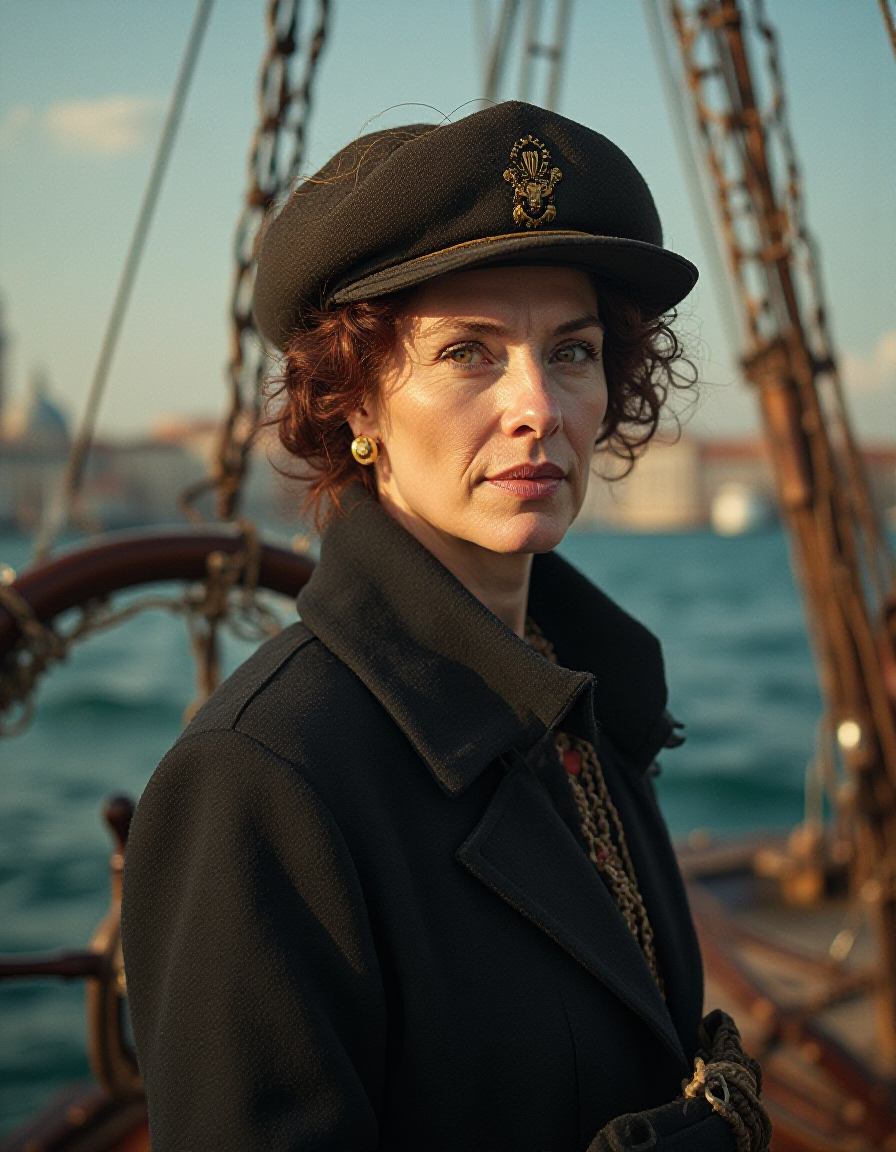
The image depicts a woman standing on a ship, wearing a black coat and a black hat with a gold emblem. She is looking to the side, possibly at the camera, with a calm and serene atmosphere. The ship's deck is visible in the background, with a clear blue sky above.
MONOLOGUE
The day broke gloomily on one certain unfortunate morning; they had not seen the sun for five days, nor did they see it then. No gladsome light flooded the heavens and awoke the sea; the sky was deeply overcast with cold, dull, leaden clouds that hung low and heavy over the mighty ship; a horror of darkness enshrouded the ocean. Away off on the horizon to the northeast the sky was black with great masses of frightful-looking clouds; through the glass the watchful officers saw that rain was falling in torrents from them, while the vivid lightning played incessantly through them. Where the ship was, it had fallen suddenly calm, and she lay gently rolling and rocking in the moderate swell; but they could see the hurricane driving down upon them, coming at lightning speed, standing like a solid wall, and flattening the waves by sheer weight. All hands had been called on deck at once, at the first glimpse of the coming hurricane. Desborough had the trumpet; the alert and eager topmen were sent aloft to strip the ship of the little canvas which the heavy weather and weakened spars had permitted them to show. It was a race between them and the coming storm. The men worked desperately, madly; some of them had not yet reached the deck when the rain and the wind were upon them. By the captain's direction, the colonel had brought Katharine from below, and she was standing on the quarter-deck sheltered by the overhang of the poop above, listlessly watching. Desborough had made no progress in his
SUMMARY
The woman is looking out at the sea and has a serious expression.
CAPTION
The image depicts a woman dressed in a green jacket and a black hat, standing on the deck of a ship. She is looking to the side, possibly observing the sea or the horizon. The ship's rigging and the water in the background are visible, suggesting a maritime setting.
MONOLOGUE
Scene: A ship at sea, south of the Cape of Good Hope. A steamer evidently from her build, though the funnel has been lowered, and a gale of wind is roaring through her rigging, bellying out the few sails she is able to carry till it looks as though the cloth would bust. She is making heavy weather, dipping the ends of her long yards right into the water, and plunging so much, that at times neither her jib-boom nor bows are visible in the foam and spray. She must be shipping tons of water. Looking at her as we are now doing with the eye of imagination, it would seem there could be little else save discomfort on board of her. And the night, too, is closing around her dark and thick. The sea is very troubled, the waves are racing, brawling, foam-crested billows, lightning plays around the ship every now and then, and thunders hurtle in the air, the awful noise appearing to run along over the sea. But let us go on board of her.
SUMMARY
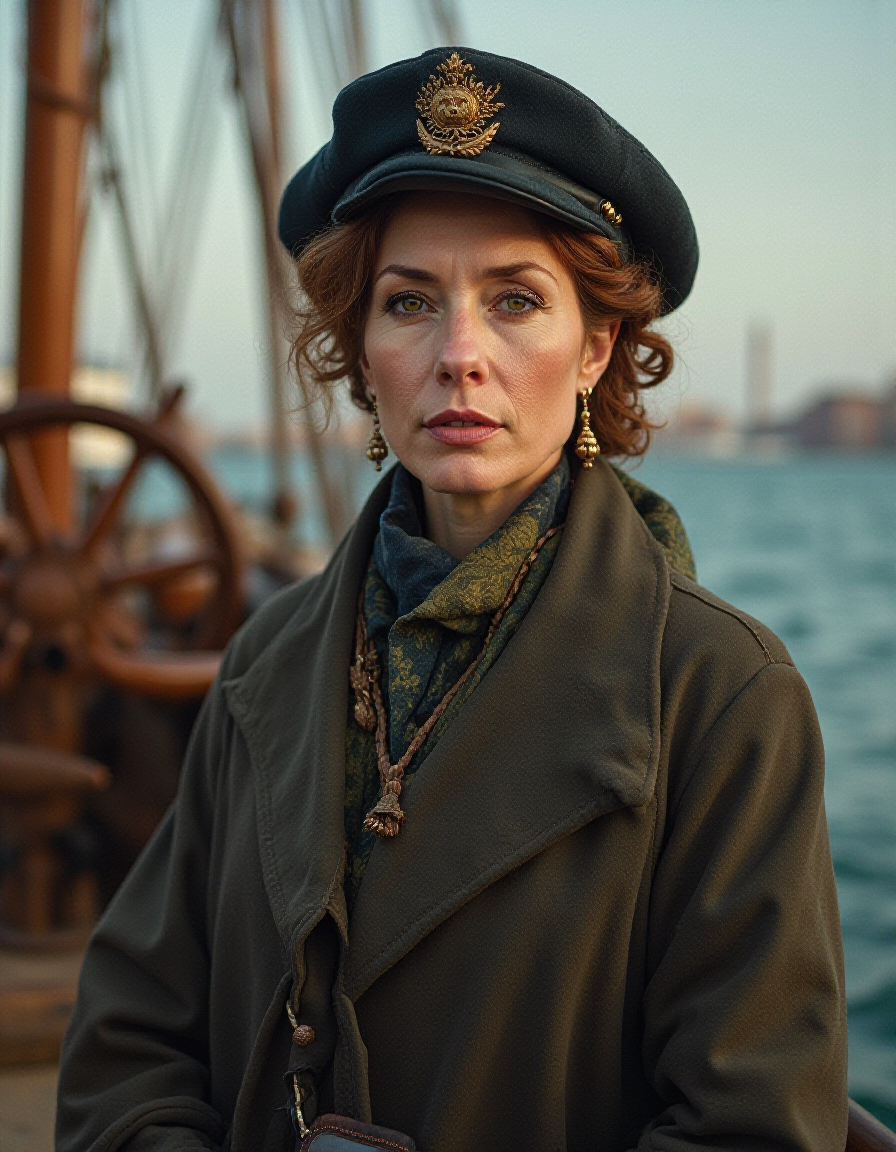
a woman in a blue coat and hat is holding a newspaper
CAPTION
The image depicts a woman dressed in a blue coat and a black hat, holding a newspaper in her hand. She is standing in front of a wooden ship, with the ship's sails visible in the background. The woman's attire includes a white shirt and a blue vest, and she is wearing a gold necklace and earrings.
MONOLOGUE
Not until late in the fall, when Madame Janauschek came to the opera house to play "Macbeth," did Mehronay uncover his intrigue. Then for the first time in his three years' employment on the paper he asked for two show tickets! The entire office lined up at the opera house--most of us paying our own way, not to see the Macbeths, but to see Mehronay's Romeo and Juliet. The office devil, who was late mailing the papers that night, says that about seven o'clock Mehronay came in singing "Jean, Jean, my Bonnie Jean," and that he went to his trunk, took out his celluloid cuffs, a new sky-blue and shell-pink necktie that none of us had seen before, a clean paper collar--and the boy, who probably was mistaken, swears Mehronay also took his white shirt--in a bundle which he proudly tucked under his arm and toddled out of the office whistling a wedding march. An hour later, dressed in this regalia and a new black suit, buttoned primly and exactly in a fashion unknown to Mehronay, he appeared at the opera house with Miss Columbia Merley, spinster, teacher of Greek and Hellenic philosophy at the College. The office force asked in a gasp of wonder: "Who dressed him?" Miss Merley--late in her forties, steel-eyed, thin-chested, flint-faced and with hair knotted so tightly back from her high stony brow that she had to take out two hairpins to wink--Miss Merley might have done it--but she had no kith or kin who could have done it for her, and certainly the hand that smoothed the coat buttoned the vest, and the hand that buttoned the vest put on
SUMMARY
woman in navy blue uniform standing on a ship with a cityscape in the background.
CAPTION
The image depicts a woman standing on the deck of a ship, holding a steering wheel. She is wearing a navy blue blazer and a white shirt underneath. The ship's sails are visible in the background, and the sky is clear with a few clouds.
MONOLOGUE
For some days the wind keeps favourable, and our ship springs forward as if she knew her port, and was eager to reach it. A few more days and we may be in sight of Australia. We begin almost to count the hours. In anticipation of our arrival, the usual testimonial to the captain is set on foot, all being alike ready to bear testimony to his courtesy and seamanship. On deck, the men began to holystone the planks, polish up the brasswork, and make everything shipshape for port. The middies are at work here on the poop, each "with a sharp knife and a clear conscience," cutting away pieces of tarry rope. New ratlines are being fastened up across the shrouds. The standing rigging is re-tarred and shines black. The deck is fresh scraped as well as the mizen-mast, and the white paint-pot has been used freely.
SUMMARY
large ship with a crane on top of it in the ocean.
CAPTION
The image captures a large, imposing ship, likely a naval vessel, sailing through the azure waters of the ocean. The ship is prominently displayed in the center of the frame, with its bow facing towards the left side of the image. The ship's hull is painted in a pristine white, contrasting with the deep blue of the ocean.
MONOLOGUE
The depth of water on the Horseshoe Fall is a subject of speculation with every visitor. It was correctly determined in 1827. In the autumn of that year, the ship _Michigan_, having been condemned as unseaworthy, was purchased by a few persons, and sent over the Falls. Her hull was eighteen feet deep. It filled going down the rapids, and went over the Horseshoe Fall with some water above the deck, indicating that there must have been at least twenty feet of water above the rock. This voyage of the _Michigan_ was an event of the day. A glowing hand-bill, charged with bold type and sensational tropes, announced that "The Pirate _Michigan_, with a cargo of furious animals," would "pass the great rapids and the Falls of Niagara," on the "eighth of September, 1827." She would sail "through the white-tossing and deep-rolling rapids of Niagara, and down its grand precipice into the basin below." Entertainment was promised "for all who may visit the Falls on the present occasion, which will, for its novelty and the remarkable spectacle it will present, be unequaled in the annals of _infernal_ navigation." Considering that the Falls could be reached only by road conveyances, the gathering of people was very large. The voyage was successfully made, and the "cargo of live animals" duly deposited in the "basin below," except a bear which left the ship near the center of the rapids and swam ashore, but was recaptured.
SUMMARY
The image depicts a large wooden sailing ship with sails unfurled, sailing on a body of water with a clear sky and a sun setting in the background.
CAPTION
The image captures a vibrant scene of a historic sailing ship docked at a pier. The ship, with its sails unfurled, is the focal point of the image. The sun, positioned high in the sky, casts a warm glow over the scene, enhancing the colors and creating a sense of depth.
MONOLOGUE
There is also a further consideration which I think Mr. Lowell has altogether omitted to discuss. Whatever may be the _mean_ temperature of Mars, we must take account of the long nights in its polar and high-temperate latitudes, lasting nearly twice as long as ours, with the resulting lowering of temperature by radiation into a constantly clear sky. Even in Siberia, in Lat. 67-1/2 deg.N. a cold of-88 deg.F. has been attained; while over a large portion of N. Asia and America above 60 deg. Lat. the _mean_ January temperature is from-30 deg.F. to-60 deg.F., and the whole subsoil is permanently frozen from a depth of 6 or 7 feet to several hundreds. But the winter temperatures, _over the same latitudes_ in Mars, must be very much lower; and it must require a proportionally larger amount of its feeble sun-heat to raise the surface even to the freezing-point, and an additional very large amount to melt any considerable depth of snow. But this identical area, from a little below 60 deg. to the pole, is that occupied by the snow-caps of Mars, and over the whole of it the winter temperature must be far lower than the earth-minimum of-88 deg.F. Then, as the Martian summer comes on, there is less than half the sun-heat available to raise this low temperature after a winter nearly double the length of ours. And when the summer does come with its scanty sun-heat, that heat is not accumulated as it is by our dense and moisture-laden atmosphere, the marvellous effects of which we have already shown. Yet with all these adverse conditions, each
SUMMARY
two large sailing ships with red sails are sailing in the ocean at sunset.
CAPTION
The image depicts two large sailing ships, one on the left and the other on the right, both with sails billowing in the wind. The sun is setting in the background, casting a warm orange glow over the scene. The ships are positioned on either side of a body of water, with the ship on the left appearing to be closer to the viewer.
MONOLOGUE
So far as Gouda is concerned, Gheraert or Gerard Leeu and early printing are synonymous. He was a native of this place, and established himself here as a printer in 1477 and continued up to 1484, when he removed his presses to Antwerp, where he was printing until the year of his death, 1493. His "Dialogus Creaturarum," the first edition of which appeared in 1480, had run into over a dozen editions, in Latin or Dutch, by the first year of the sixteenth century. Whilst at Gouda Leeu used several marks, of which the smaller, given on p.39, was printed in red and black; at Antwerp he used a much more ambitious example, consisting of the arms of the Castle of Antwerp: abattlement and a turreted gate, with two smaller ones on either side; the two large flags bear the arms of the German Empire and of the Archduke Maximilian of Austria. Nicolas Leeu, who was printing at Antwerp in 1487-8, was possibly the brother of the more famous typographer, and his Mark consists of the lion (apun on his surname, which is equivalent to lion) in a Gothic window holding two shields, with the arms of Antwerp on the left and the monogram of Gheraert Leeu on the right. Like Leeu and so many of the other early Dutch printers, the first Delft typographer, Jacob Jacobzoon Van der Meer, 1477-87, employed the arms of the town in which he printed on his Mark, the right shield in the present instance carrying three water-lily leaves. In 1477 he issued an edition of the Dutch Bible, and three years later the first edition of the Psalter, "Die Duytsche Souter," which had
SUMMARY
the ship is sailing on the water with the sails unfurled and the wind blowing.
CAPTION
The image presents a detailed illustration of a wooden sailing ship with three masts and sails. The ship is depicted in a serene setting, with the ocean and sky in the background. The ship's hull is a rich brown, and the sails are white with a hint of red.
MONOLOGUE
Memorable too are the pleasant boating excursions we had on the calm bosom of the Indian Ocean. Armed boats used to be detached to cruise for three or four weeks at a time in quest of prizes, at the end of which time they were picked up at some place of rendezvous. By day we sailed about the coast and around the small wooded islets, where dhows might lurk, only landing in sheltered nooks to cook and eat our food. Our provisions were ship's, but at times we drove great bargains with the naked natives for fowls and eggs and goats; then would we make delicious soups, rich ragouts, and curries fit for the king of the Cannibal Islands. Fruit too we had in plenty, and the best of oysters for the gathering, with iguana most succulent of lizards, occasionally fried flying-fish, or delicate morsels of shark, skip-jack, or devilled dolphin, with a glass of prime rum to wash the whole down, and three grains of quinine to charm away the fever. There was, too, about these expeditions, an air of gipsying that was quite pleasant. To be sure our beds were a little hard, but we did not mind that; while clad in our blanket-suits, and covered with a boat-sail, we could defy the dew. Sleep, or rather the want of sleep, we seldom had to complain of, for the blue star-lit sky above us, the gentle rising and falling of the anchored boat, the lip-lipping of the water, and the sighing sound of the wind through the great forest near us--all tended to woo us to sweetest slumber.
SUMMARY
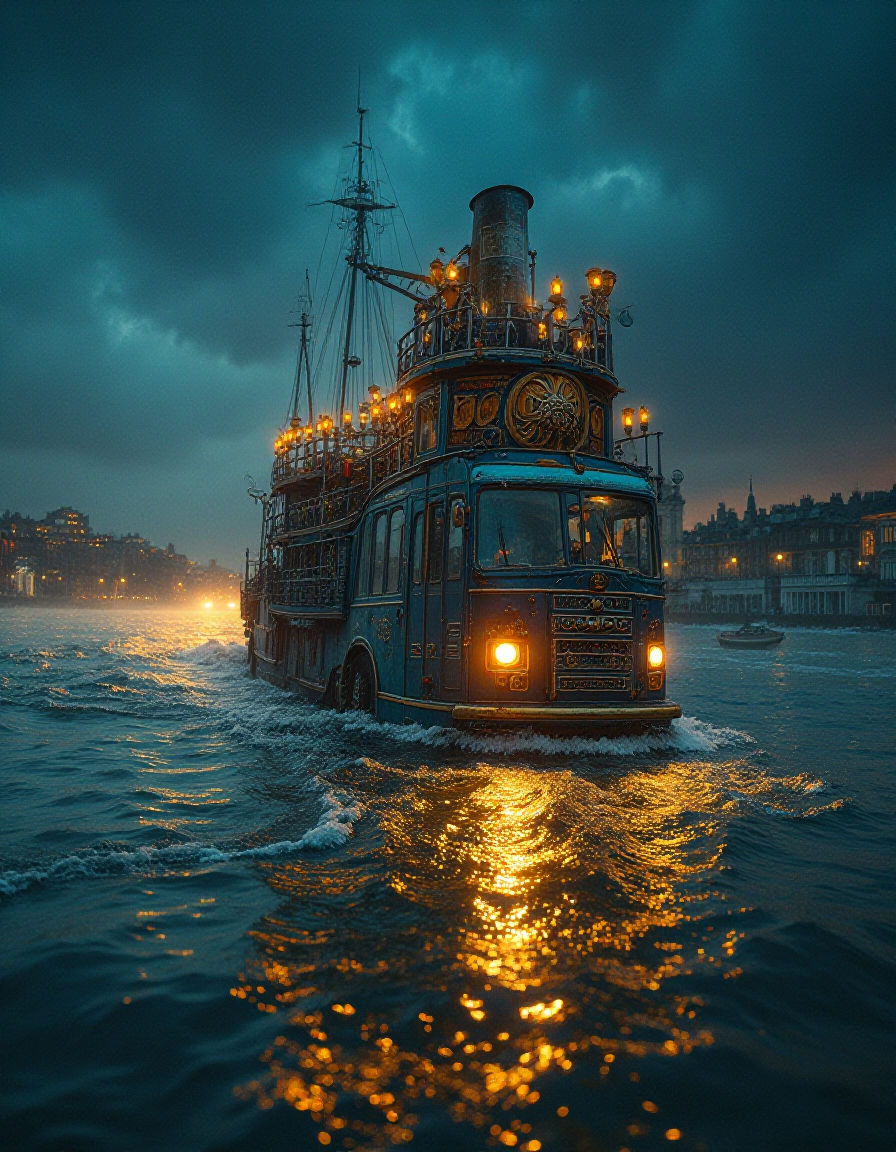
The image depicts a large, ornate, and historic passenger ferry with a prominent smokestack and multiple windows, moving through a body of water at night.
CAPTION
The image captures a nighttime scene on a river, where a large, ornate steamship is navigating through the water. The ship, painted in a dark blue hue, is adorned with intricate details and a prominent smokestack, adding to its grandeur. The ship's lights are on, illuminating the water and creating a shimmering effect.
MONOLOGUE
"And now," he was softly saying, "I take to the road again, holding on southwestwards for many a long and dusty day; till at last I reach the little grey sea town I know so well, that clings along one steep side of the harbour. There through dark doorways you look down flights of stone steps, overhung by great pink tufts of valerian and ending in a patch of sparkling blue water. The little boats that lie tethered to the rings and stanchions of the old sea-wall are gaily painted as those I clambered in and out of in my own childhood; the salmon leap on the flood tide, schools of mackerel flash and play past quay-sides and foreshores, and by the windows the great vessels glide, night and day, up to their moorings or forth to the open sea. There, sooner or later, the ships of all seafaring nations arrive; and there, at its destined hour, the ship of my choice will let go its anchor. I shall take my time, I shall tarry and bide, till at last the right one lies waiting for me, warped out into mid-stream, loaded low, her bowsprit pointing down harbour. I shall slip on board, by boat or along hawser; and then one morning I shall wake to the song and tramp of the sailors, the clink of the capstan, and the rattle of the anchor-chain coming merrily in. We shall break out the jib and the foresail, the white houses on the harbour side will glide slowly past us as she gathers steering-way, and the voyage will have begun! As she forges towards the headland she will clothe herself with canvas; and then,
SUMMARY
the large ship is sailing in the ocean at night
CAPTION
The image depicts a large, dark-hulled ship with two masts, sailing on a body of water under a sky filled with clouds. The ship is positioned centrally in the image, with its sails billowing in the wind. The water beneath the ship is calm, reflecting the blue hues of the sky.
MONOLOGUE
When she had become familiar with the Willamette tongue, she told them that she was the daughter of a chief far away across the great water, who ruled a country as broad as the land of the Wauna and far richer. He had sent her as a bride to the ruler of another land, with a fabulous dowry of jewels and a thousand gifts besides. But the ship that bore her and her splendid treasures had been turned from its course by a terrible storm. Day after day it was driven through a waste of blackness and foam,--the sails rent, the masts swept away, the shattered hulk hurled onward like a straw by the fury of the wind. When the tempest had spent itself, they found themselves in a strange sea under strange stars. Compass and chart were gone; they knew not where they were, and caught in some unknown current, they could only drift blindly on and on. Never sighting land, seeing naught but the everlasting sweep of wave and sky, it began to be whispered in terror that this ocean had no further shore, that they might sail on forever, seeing nothing but the boundless waters. At length, when the superstitious sailors began to talk of throwing their fair charge overboard as an offering to the gods, the blue peaks of the Coast Range rose out of the water, and the ever rain-freshened green of the Oregon forests dawned upon them. Then came the attempt to enter the Columbia, and the wreck on the bar.[1]
SUMMARY
The image depicts a large wooden sailing ship docked at a pier, with a mountainous backdrop and a clear blue sky.
CAPTION
The image depicts a picturesque scene of a wooden sailing ship docked at a pier. The ship, painted in a rich red hue, is adorned with two masts and a sail that is partially unfurled. The ship is positioned on the left side of the image, with the water surrounding it, creating a serene and tranquil atmosphere.
MONOLOGUE
By daylight on the 8th, the boats had left the ship, and were standing to the southward among the islands. Our party consisted of Mr. Helpman, Mr. Fitzmaurice and myself. Passing through the eastern part of Port George the Fourth, we entered Roger Strait, which led into a large sheet of water, forming a beautiful harbour; we landed to obtain a better view of it, on a small island at the southern entrance of this strait. This islet looked truly inviting, being clothed with long rich grass, which to our cost we found concealed boulders of granite; this was the first time we met with this primitive rock, and from the colour of the surrounding heights it was evident we were in an old red sandstone region. Strange to say the attraction on this island rendered our compasses quite useless; we noticed on its North-West side a portion of the wreck of a small vessel. There was a small mangrove inlet in the South-East corner of this harbour, over which the land was low, forming a gap in the neighbouring heights. We now pushed on for an island lying in the entrance of the harbour, bearing West by North 6 miles; our soundings in passing over this part (of what we afterwards called Brecknock Harbour, as Captain King had named the entrance of it Camden Sound, from a distant view he had of it) gave a depth of 7 fathoms, over an even muddy bottom; but towards and in the entrance it increased to 13 fathoms.
SUMMARY
a woman in a long coat walks on the shore of a rough sea with a ship in the distance
CAPTION
The image depicts a scene of a woman standing on the deck of a ship, holding a fishing rod. The woman is dressed in a long, dark coat and is positioned in the foreground, with the ship in the middle ground and the ocean in the background.
MONOLOGUE
Early in the morning, under the guidance of two of the fishermen, we set out to visit the ruins. The island of Mugeres is between four and five mile long, half a mile wide, and four miles distant from the mainland. The ruins were at the north end. For a short distance we kept along the shore, and then struck into a path cut straight across the island. About half way across we came to a santa cruz, or holy cross, set up by the fishermen, at which place we heard distinctly the sound of the breakers on the opposite shore. To the right a faint track was perceptible, which soon disappeared altogether; but our guides knew the direction, and, cutting a way with the machete, we came out upon a high, rocky, perpendicular cliff, which commanded an immense expanse of ocean, and against which the waves, roused by the storm of the night before, were dashing grandly. We followed along the brink of the cliff and around the edges of great perpendicular chasms, the ground being bare of trees and covered with a scrubby plant, called the uba, with gnarled roots, spreading like the branches of a grape-vine. At the point terminating the island, standing boldly upon the sea, was the lonely edifice represented in the engraving opposite. Below, rocking on the waves was a small canoa, with our host then in the act of getting on board a turtle. It was the wildest and grandest scene we had looked upon in our whole journey.
SUMMARY
large ship with sails and a large sun in the sky.
CAPTION
The image captures a serene scene at sunset, featuring a large, historic sailing ship docked at a pier. The ship, painted in a dark hue, is adorned with white sails that billow in the breeze. The water around the ship is calm, reflecting the warm hues of the sunset sky.
MONOLOGUE
Montcalm was not the enemy to let the chance of Loudon's absence from the scene of action pass unimproved. While Loudon is pottering at Halifax, Montcalm marshals his troops to the {249} number of eight thousand, including one thousand Indians at Carillon or Ticonderoga, where Lake George empties into Lake Champlain. Portaging two hundred and fifty flatboats with as many birch canoes up the river, the French invade the mountain wilderness of Lake George. Towards the end of July, Levis leads part of the troops by land up the west shore towards the English post of Fort William Henry. Montcalm advances on the lake with the flatboats and canoes, and the rafts with the heavy artillery. Each night Levis' troops kindle their signal fires on the mountain slope, and each night Montcalm from the lake signals back with torches. It needs artist's brush to paint the picture: the forested mountains green and lonely and silent in the shimmering sunlight of the summer sky; the lake gold as molten metal in the fire of the setting sun; the soldiers in their gay uniforms of white and blue, hoisting tent cloths on oar sweeps for sails as a breeze dimples the waters; the French voyageurs clad in beaded buckskin chanting some ditty of Old-World fame to the rhythmic dip of the Indian paddles; the Indians naked, painted for war, with a glitter in their eyes of a sinister intent which they have no mind to tell Montcalm; and then, at the south of Lake George, nestling between the hills and the water, the little palisaded
SUMMARY
The image depicts a large sailing ship with multiple sails, sailing on the open sea under a clear sky.
CAPTION
The image depicts a large, historical sailing ship with multiple masts and sails, prominently displayed in the center of the frame. The ship is positioned on the water, with its sails billowing in the wind, suggesting a dynamic and active state. The sky above is clear with a few clouds, indicating a sunny day.
MONOLOGUE
It looked as if it would be a long passage. The south-east trades, light and unsteady, were left behind; and then, on the equator and under a low grey sky, the ship, in close heat, floated upon a smooth sea that resembled a sheet of ground glass. Thunder squalls hung on the horizon, circled round the ship, far off and growling angrily, like a troop of wild beasts afraid to charge home. The invisible sun, sweeping above the upright masts, made on the clouds a blurred stain of rayless light, and a similar patch of faded radiance kept pace with it from east to west over the unglittering level of the waters. At night, through the impenetrable darkness of earth and heaven, broad sheets of flame waved noiselessly; and for half a second the becalmed craft stood out with its masts and rigging, with every sail and every rope distinct and black in the centre of a fiery outburst, like a charred ship enclosed in a globe of fire. And, again, for long hours she remained lost in a vast universe of night and silence where gentle sighs wandering here and there like forlorn souls, made the still sails flutter as in sudden fear, and the ripple of a beshrouded ocean whisper its compassion afar—in a voice mournful, immense, and faint....
SUMMARY
The painting depicts a sailboat with a crew of people on board, navigating through a river with a mountainous landscape in the background.
CAPTION
The image depicts a serene scene of a wooden sailing ship on a calm body of water. The ship, with its white sails unfurled, is moving towards the right side of the image. The sky above is a clear blue, dotted with fluffy white clouds, suggesting a sunny day.
MONOLOGUE
The river seemed to threaten the city that had confined it in stone. And George, in the background of his mind, which was obsessed by the tormenting enigma of the girl by his side, also threatened the city. With the uncompromising arrogance of the student who has newly acquired critical ideas, he estimated and judged it. He cursed the Tate Gallery and utterly damned Doulton's works. He sternly approved Lambeth Palace, the Houses of Parliament, Westminster Abbey, Somerset House, Waterloo Bridge, and St. Paul's. He cursed St. Thomas's Hospital and the hotels. He patronized New Scotland Yard. The "Isambard Brunel" penetrated more and more into the heart of the city, fighting for every yard of her progress. Flags stood out straight in the blue sky traversed by swift white clouds. Huge rudder-less barges, each with a dwarf in the stern struggling at a giant's oar, were borne westwards broadside on like straws upon the surface of a hurrying brook. A launch with an orchestra on board flew gaily past. Tugs with a serpentine tail of craft threaded perilously through the increasing traffic. Railway trains, cabs, coloured omnibuses, cyclists, and footfarers mingled in and complicated the scene. Then the first ocean-going steamer appeared, belittling all else. And then the calm, pale beauty of the custom-house at last humbled George, and for an instant made him think that he could never do anything worth doing. His pride leapt up, unconquerable. The ocean-going steamers, as they multiplied on the river, roused in him wild and
SUMMARY
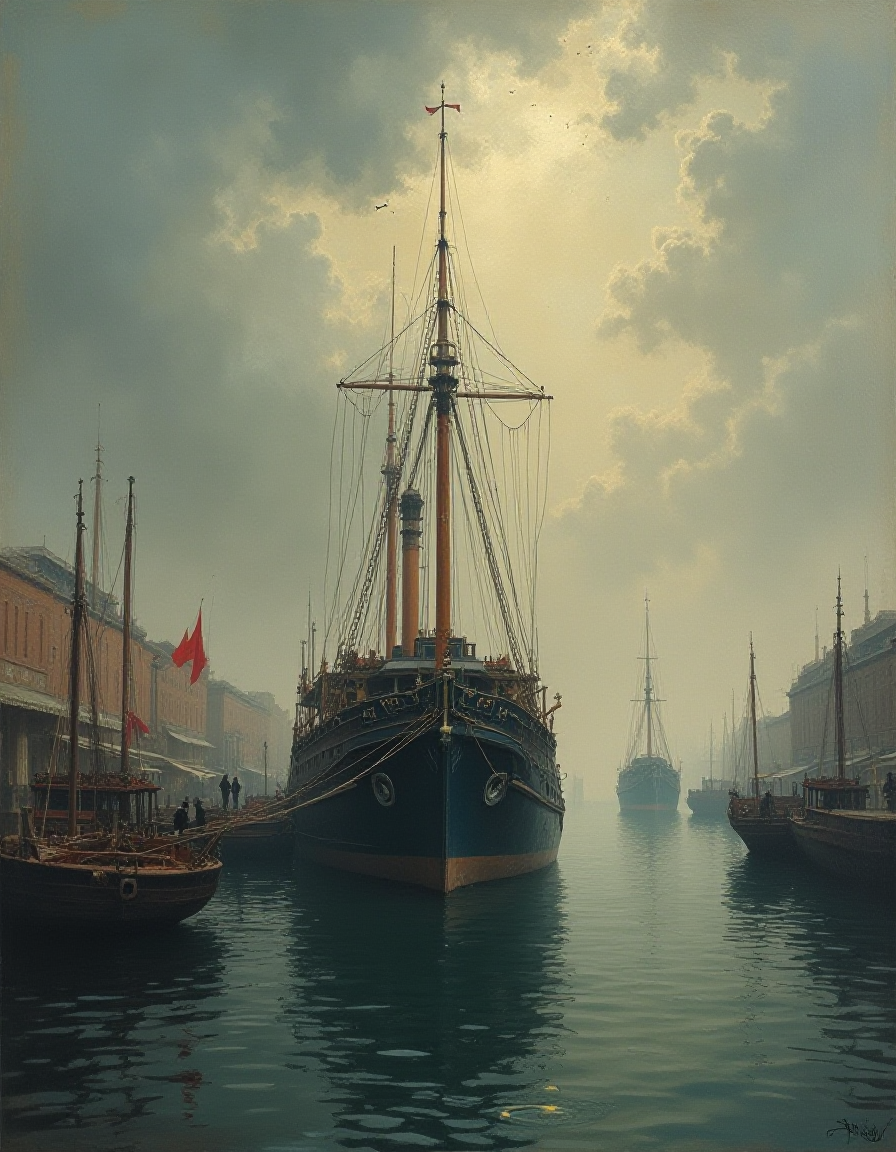
The image depicts a large sailing ship with a tall mast and a flag flying from it, positioned in the middle of a harbor with several smaller boats and buildings in the background.
CAPTION
The image depicts a bustling harbor scene with several large sailing ships docked at the water's edge. The ships are adorned with red flags, adding a vibrant splash of color to the scene. The sky above is overcast, casting a soft, diffused light over the scene.
MONOLOGUE
I looked about among these descendants of the Norwegians, but could not see any thing singular in their physiognomy; and but for the harsh accent of the preacher, I might almost have thought myself in the midst of a country congregation in the United States. They are mostly of a light complexion, with an appearance of health and strength, though of a sparer make than the people of the more southern British isles. After the service was over, we returned to our lodgings, by a way which led to the top of the hill, and made the circuit of the little town. The paths leading into the interior of the island, were full of people returning homeward; the women in their best attire, a few in silks, with wind-tanned faces. We saw them disappearing, one after another, in the hollows, or over the dark bare hill-tops. With a population of less than three thousand souls, Lerwick has four places of worship—a church of the Establishment, a Free church, a church for the Seceders, and one for the Methodists. The road we took commanded a fine view of the harbor, surrounded and sheltered by hills. Within it lay a numerous group of idle fishing-vessels, with one great steamer in the midst; and more formidable in appearance, a Dutch man-of-war, sent to protect the Dutch fisheries, with the flag of Holland flying at the mast-head. Above the town, on tall poles, were floating the flags of four or five different nations, to mark the habitation of their consuls.
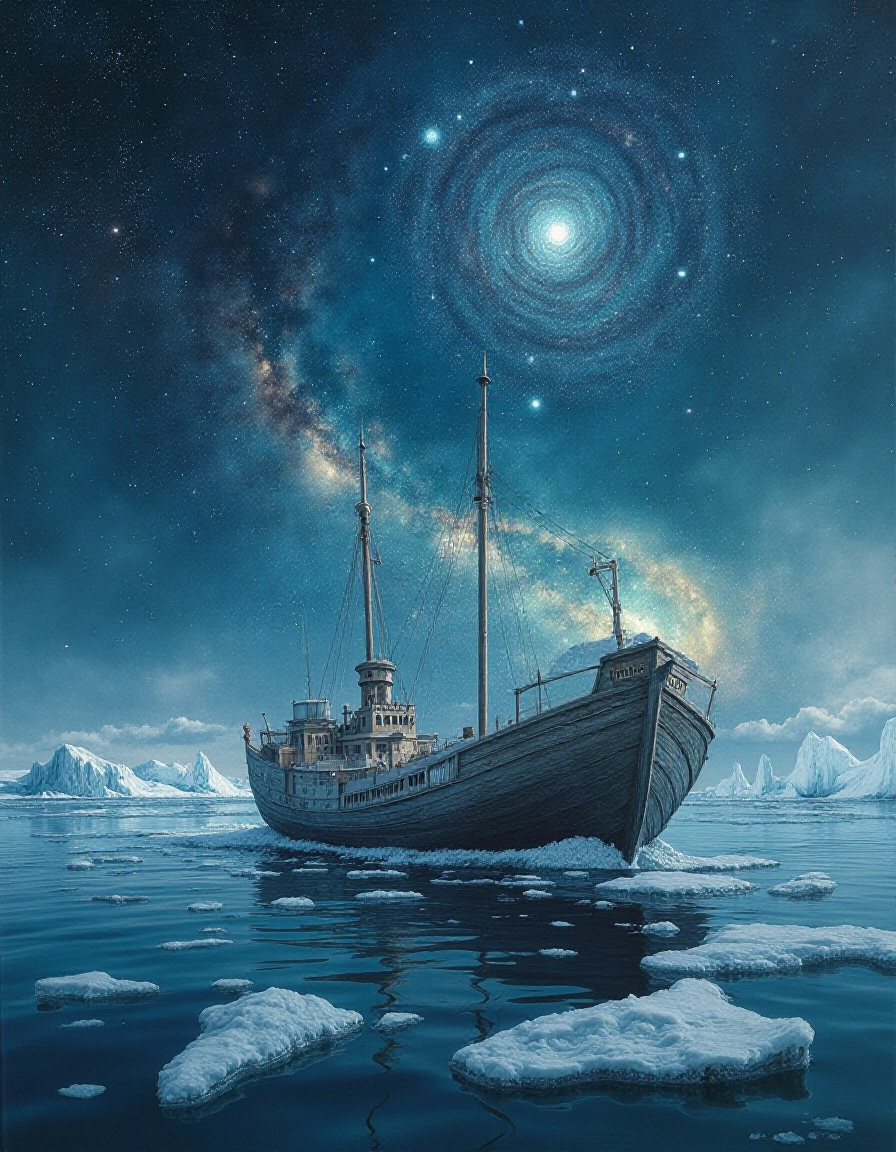
SUMMARY
a large old wooden sailing ship is on a frozen lake with a galaxy in the sky
CAPTION
The image presents a tranquil scene of a vintage wooden sailing ship, prominently displayed in the center, with its bow pointing towards the left side of the frame. The ship is surrounded by a vast expanse of icy waters, with chunks of ice floating in the water, creating a serene and untouched landscape.
MONOLOGUE
Six years after the restoration of the garden, he published a description of it under the title of the Hortus Upsaliensis. At this time, the number of exotic plants which it contained amounted to 1100. A learned traveller, who visited it in 1771, writes as follows:--"An iron gate of excellent workmanship leads to it from the road. At the top of the gate are displayed the Swedish arms, and those of Count Gyllenborg, who so zealously promoted its restitution. Within, a large court presents itself to view; on the right stands the house of Linnaeus, who is the director of the garden, and on the left are some other buildings. A straight avenue leads by another gate to the garden, which is separated from the court by a neat wooden railing. The garden itself is laid out in a superb style. The greater part consists of two large tracts of ground, one of them containing the perennial, the other the annual plants. Each of these tracts is divided into forty-four beds, surrounded with a low hedge and small doors. The plant-house is divided into the greenhouse, the hothouse, and the thriving-house, which form the northern side; the gardener's cottage, which is on the southern; the thriving-bank on the west; and the grass-bank on the east. The sun-house faces the ponds, into which fresh water is conveyed by pipes."
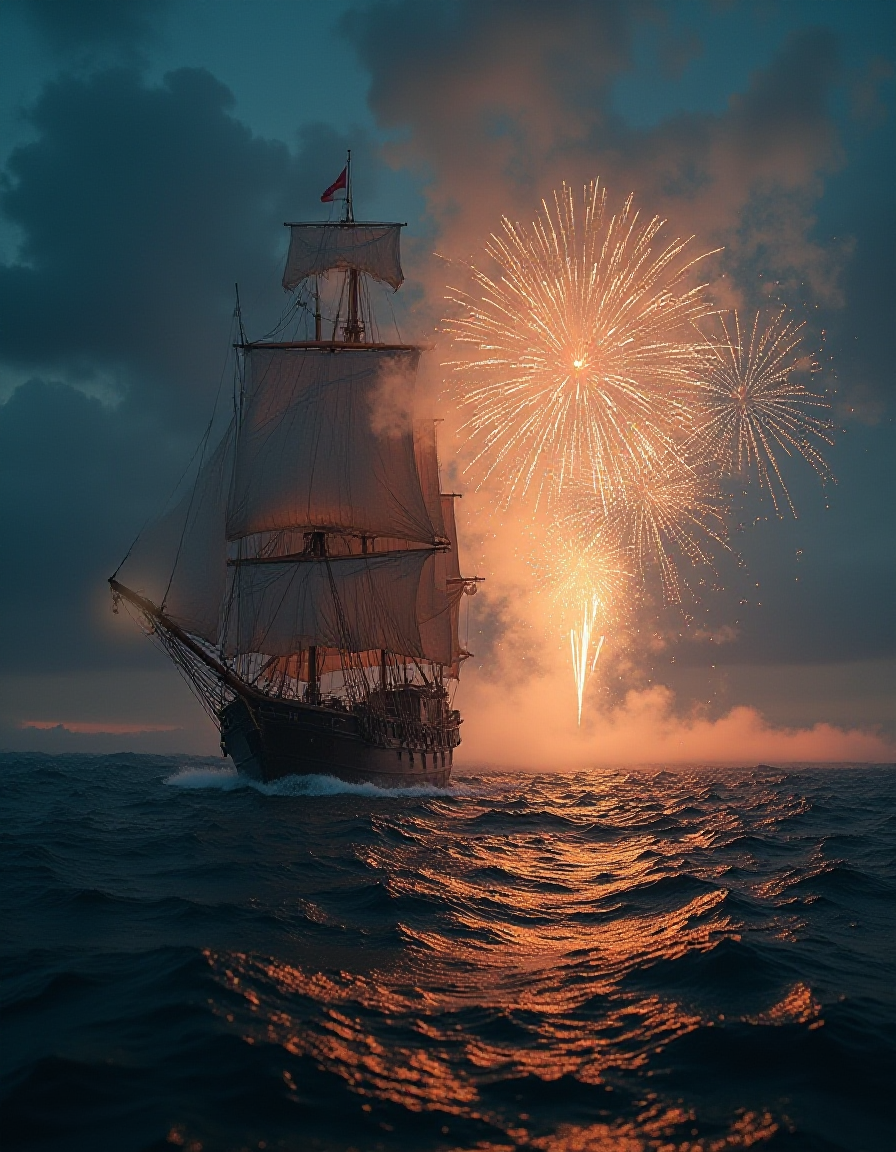
SUMMARY
The image depicts a large sailing ship with a red flag flying from the top of the mast, sailing on a dark blue sea with a dramatic sunset sky in the background.
CAPTION
The image captures a dramatic scene of a large, historic sailing ship, prominently displayed in the foreground, with its sails billowing in the wind. The ship is positioned on the left side of the image, with its bow facing towards the right. The ship is adorned with a red flag, adding a splash of color to the scene. In the background, a fireworks display is taking place.
MONOLOGUE
During the afternoon Ned made a little journey up into the Minories, to the studio of a clever marine artist to whom he had given a commission to paint the portrait of the ship; and when he reached the place he was much gratified to find that not only was the picture finished, but also that it was a capital representation of the _Flying Cloud_ as she would appear at sea under all plain sail upon a taut bowline. Her ensign was shown flying from the peak; the house-flag--a large square white flag, with blue border, blue Saint Andrew's cross, and a large letter B in red in the centre--floated from the main-skysail-mast-head, and her number from the mizen, in response to a signal from another ship seen in the distance. It was a very spirited picture, and as Ned paid down its price, and gave instructions for its immediate despatch to his father's address, he felt that the money had been well laid out.
SUMMARY
a large wooden sailing ship with sails unfurled and a flag flying on the stern is sailing on a rough sea with a dramatic sky and fireworks in the background
CAPTION
The image depicts a large, historic sailing ship with its sails billowing in the wind, set against a dark, stormy sky. The ship is positioned on the left side of the image, with its bow pointing towards the right. The ship's sails are illuminated by a bright, orange glow, which contrasts with the dark sky.
MONOLOGUE
wind. Their flight is rapid, greatly exceeding that of a ship going 10 m. an hour, but gradually decreasing in velocity and not extending beyond a distance of 500 ft. Generally it is longer when the fishes fly against, than with or at an angle to, the wind. Any vertical or horizontal deviation from a straight line is not caused at the will of the fish, but by currents of the air; thus they retain a horizontally straight course when flying with or against the wind, but are carried towards the right or left whenever the direction of the wind is at an angle with that of their flight. However, it sometimes happens that the fish during its flight immerses its caudal fin in the water, and by a stroke of its tail turns towards the right or left. In a calm the line of their flight is always also vertically straight or rather parabolic, like the course of a projectile, but it may become undulated in a rough sea, when they are flying against the course of the waves; they then frequently overtop each wave, being carried over it by the pressure of the disturbed air. Flying-fish often fall on board of vessels, but this never happens during a calm or from the lee side, but during a breeze only and from the weather side. In day time they avoid a ship, flying away from it, but during the night when they are unable to see, they frequently fly against the weather board, where they are caught by the current of the air, and carried upwards to a height of 20 ft. above the surface of the water, whilst under ordinary circumstances they keep
SUMMARY
The image depicts a large sailing ship with a red flag flying from the top of the mast, navigating through rough seas with a large explosion in the background.
CAPTION
The image depicts a dramatic scene of a large, old-fashioned sailing ship, possibly a pirate ship, navigating through rough seas. The ship is prominently featured in the foreground, with its sails billowing in the wind and its hull illuminated by the sun, creating a sense of movement and energy.
MONOLOGUE
The chains designates the small platform outside of the hull, at the base of the large shrouds leading down from the three mast-heads to the bulwarks. At present they seem to be getting out of vogue among merchant-vessels, along with the fine, old-fashioned quarter-galleries, little turret-like ap-purtenances, which, in the days of the old Admirals, set off the angles of an armed ship’s stern. Here a naval officer might lounge away an hour after action, smoking a cigar, to drive out of his whiskers the villainous smoke of the gun-powder. The picturesque, delightful stern-gallery, also, a broad balcony overhanging the sea, and entered from the Captain’s cabin, much as you might enter a bower from a lady’s chamber; this charming balcony, where, sailing over summer seas in the days of the old Peruvian viceroys, the Spanish cavalier Mendanna, of Lima, made love to the Lady Isabella, as they voyaged in quest of the Solomon Islands, the fabulous Ophir, the Grand Cyclades; and the Lady Isabella, at sunset, blushed like the Orient, and gazed down to the gold-fish and silver-hued flying-fish, that wove the woof and warp of their wakes in bright, scaly tartans and plaids underneath where the Lady reclined; this charming balcony—exquisite retreat—has been cut away by Vandalic innovations. Ay, that claw-footed old gallery is no longer in fashion; in Commodore’s eyes, is no longer genteel.
SUMMARY
The image depicts a large, red-hulled sailing ship with a tall mast and sails, sailing on a rough sea at sunset.
CAPTION
The image depicts a large, historical sailing ship with its sails billowing in the wind, set against a dramatic sunset sky. The ship is positioned centrally in the frame, with its bow pointing towards the right side of the image. The ship's sails are prominently displayed, with the red sails catching the light of the setting sun, creating a warm, fiery glow.
MONOLOGUE
After great delay, considering the importance of every day at this time of year, a miserable boat and five men were found, and with some difficulty I stowed away in it such baggage as it was absolutely necessary for me to take, leaving scarcely sitting or sleeping room. The sailing qualities of the boat were highly vaunted, and I was assured that at this season a small one was much more likely to succeed in making the journey. We first coasted along the island, reaching its eastern extremity the following morning (April 11th), and found a strong W. S.W. wind blowing, which just allowed us to lay across to the Matabello Islands, a distance little short of twenty miles. I did not much like the look of the heavy sky and rather rough sea, and my men were very unwilling to make the attempt; but as we could scarcely hope for a better chance, I insisted upon trying. The pitching and jerking of our little boat, soon reduced me to a state of miserable helplessness, and I lay down, resigned to whatever might happen. After three or four hours, I was told we were nearly over; but when I got up, two hours later, just as the sun was setting, I found we were still a good distance from the point, owing to a strong current which had been for some time against us. Night closed in, and the wind drew more ahead, so we had to take in sail. Then came a calm, and we rowed and sailed as occasion offered; and it was four in the morning when we reached the village of Kisslwoi, not having made more than three miles in the last
SUMMARY
The image depicts a large sailing ship with a red flag flying from the top of the mast, sailing on a dark blue sea with a dramatic sunset sky in the background.
CAPTION
The image captures a dramatic scene of a large, historic sailing ship, prominently displayed in the foreground, with its sails billowing in the wind. The ship is positioned on the left side of the image, with its bow facing towards the right. The ship is adorned with a red flag, adding a splash of color to the scene. In the background, a fireworks display is taking place.
MONOLOGUE
The harbour of Maskat is full of life. The deep blue sea is studded with tiny craft: canoes painted red, green, and white, steered by paddles, swarm around the steamer; fishermen paddling themselves about on a plank or two tied together, or swimming astride of a single one, hawk their wares from boat to boat. The oars of the larger boats are generally made with a flat circular piece of wood fastened on to a long pole, and are really more like paddles than oars. In the northern corner lie huddled together large dhows, which, during the north-east monsoons, make the journey to Zanzibar, returning at the change of the season. Most of these belong to Banyan merchants in Maskat, and are manned by Indian sailors. Close to them is the small steamer _Sultanieh_, which was presented by the Sultan of Zanzibar to his cousin Sultan Tourki of Maskat, now a perfectly useless craft, which cannot even venture outside the harbour by reason of the holes in its side. From its mast floats the red banner of Oman, the same flag that Arab boats at Aden fly. It was originally the banner of Yemen, to which place the Arabs who rule in Oman trace their origin; for early in our era, according to Arab tradition, Oman was colonised and taken possession of by descendants of the old Himyarites of Yemen.
SUMMARY
The image depicts a large sailing ship with a sail that is lit up with fireworks, creating a dramatic and festive atmosphere.
CAPTION
The image captures a dramatic scene of a large sailing ship, prominently displayed in the foreground, with its sails billowing in the wind. The ship is positioned on the water, with its bow facing towards the right side of the image. The ship is adorned with a large, colorful fireworks display in the sky, adding a vibrant contrast to the otherwise dark and serene ocean.
MONOLOGUE
prospect was most alarming. On the outward bow was perceived a rugged and precipitous cliff, whose summit was hid in the fog, and the Vessel's head was pointed towards the bottom of a small bay, into which we were rapidly driving. There now seemed to be no probability of escaping shipwreck, being without wind, and having the rudder in its present useless state; the only assistance was that of a boat employed in towing, which had been placed in the water between the ship and the shore, at the imminent risk of its being crushed. The ship again struck in passing over a ledge of rocks, and happily the blow replaced the rudder, which enabled us to take advantage of a light breeze, and to direct the ship's head without the projecting cliff. But the breeze was only momentary, and the ship was a third time driven on shore on the rocky termination of the cliff. Here we remained stationary for some seconds, and with little prospect of being removed from this perilous situation; but we were once more extricated by the swell from this ledge also, and carried still farther along the shore. The coast became now more rugged, and our view of it was terminated by another high projecting point on the starboard bow. Happily, before we had reached it, a light breeze enabled us to turn the ship's head to seaward, and we had the gratification to find, when the sails were trimmed, that she drew off the shore. We had made but little progress, however, when she was violently forced by the current against a large iceberg lying
SUMMARY
a large wooden sailing ship with sails unfurled and a flag flying on the stern is sailing on a rough sea with a dramatic sky and fireworks in the background
CAPTION
The image depicts a large, historical sailing ship with its sails billowing in the wind, set against a dark, stormy sky. The ship is positioned on the left side of the image, with its bow pointing towards the right. The ship's sails are illuminated by a bright, orange glow, which contrasts with the dark sky.
MONOLOGUE
The French, under all sail, keeping close together in line, stood towards the headmost of the enemy's ships, which were somewhat separated from each other. Nigel's being the leading ship of the French squadron, first came up with the headmost one of the enemy's ships. They were sailing, it must be understood, on two sides of an angle, the French before the wind, the Portuguese close hauled. Captain Beauport, the commander of the _Madeline_, immediately hauled his wind and poured in his broadside at close quarters, bringing the enemy's mizenmast, with its large mizen, down on deck. The effect was to make the ship pay off before the wind, and expose her stern to the fire of the _Madeline's_ guns, which had been rapidly reloaded and run out. Captain Beauport then running up on the larboard side of the Portuguese, so as to place himself between her and the rest of the enemy, continued the fight broadside to broadside, while he threw out a signal to his consorts to attack the other ships of the enemy. They, though considerably larger than the French, after exchanging a few shots at a distance, put up their helms and ran off before the wind, leaving the first ship attacked by Captain Beauport to her fate. This was soon settled, for though her guns and crew greatly outnumbered those of the _Madeline_, so many of her people had been killed and wounded, that as the French ship ran alongside for the purpose of boarding the enemy, the crew of the latter hauled down their flag and cried for quarter. This was immediately
SUMMARY
a large sailing ship with a flag on the mast is sailing in the ocean at night
CAPTION
The image captures a dramatic scene of a pirate ship sailing on a dark, stormy sea. The ship, with its sails billowing in the wind, is positioned in the center of the frame, its silhouette stark against the dark sky. The ship's sails are adorned with a vibrant orange and yellow pattern, adding a splash of color to the otherwise monochrome scene.
MONOLOGUE
A helpless plaything was the king of Thessaly. Long ere the dim evening light had made of the shore of his own land a faint, grey line, the white-maned horses of Poseidon, king of the seas, began to rear their heads, and as night fell, a black curtain, blotting out every landmark, and all home-like things, the East Wind rushed across the Ægean Sea, smiting the sea-horses into madness, seizing the sails with cruel grasp and casting them in tatters before it, snapping the mast as though it were but a dry reed by the river. Before so mighty a tempest no oars could be of any avail, and for a little time only the winds and waves gambolled like a half-sated wolf-pack over their helpless prey. With hungry roar the great weight of black water stove in the deck and swept the sailors out of the ship to choke them in its icy depths; and ever it would lift the wounded thing high up on its foaming white crests, as though to toss it to the dark sky, and ever again would suck it down into the blackness, while the shrieking winds drove it onward with howling taunts and mocking laughter. While life stayed in him, Ceyx thought only of Halcyone. He had no fear, only the fear of the grief his death must bring to her who loved him as he loved her, his peerless queen, his Halcyone. His prayers to the gods were prayers for her. For himself he asked one thing only--that the waves might bear his body to her sight, so that her gentle hands might lay him in his tomb. With shout of triumph that they had slain a king,
SUMMARY
the sailboat is moving through the water with the wind behind it.
CAPTION
The image depicts a large sailing ship with multiple masts and sails, positioned on the water. The ship is predominantly white with a brown hull and appears to be in good condition, with no visible damage. The sails are unfurled, and the ship is moving through the water, creating a dynamic scene.
MONOLOGUE
The White Corpuscles or Scavengers of the Blood. As the blood-tubes are not only supply-pipes but sewers and drainage canals as well, it is a good thing to have some kind of tiny animals living and moving about in them, which can act as scavengers and eat up some of the waste and scraps; and hence your microscope will show you another kind of little blood corpuscle, known, from the fact that it is not colored, as the _white corpuscle_. These corpuscles are little cells of the body, which in shape and behavior are almost exactly like an _ameba_--a tiny "bug," seen only under the microscope, that lives in ditch-water. Under the microscope the white corpuscles look like little round disks, about one-third larger than the red corpuscles, and with a large kernel, or _nucleus_, in their centre. They have the same power of changing their shape, of surrounding and swallowing scraps of food, as has the ameba, and are a combination of scavengers and sanitary police. When disease germs get into the blood, they attack and endeavor to eat and digest them; and whenever inflammation, or trouble of any sort, begins in any part of the body, they hurry to the scene in thousands, clog the blood-tubes and squeeze their way out through the walls of the smallest blood-tubes to attack the invaders or repair the damage. This causes the well-known swelling and reddening which accompanies inflammation.
SUMMARY
The image depicts a large sailing ship with a red flag flying from the top of the mast, navigating through rough seas with a large explosion in the background.
CAPTION
The image depicts a dramatic scene of a large, old-fashioned sailing ship, possibly a pirate ship, navigating through rough seas. The ship is prominently featured in the foreground, with its sails billowing in the wind and its hull illuminated by the sun, creating a sense of movement and energy.
MONOLOGUE
The chains designates the small platform outside of the hull, at the base of the large shrouds leading down from the three mast- heads to the bulwarks. At present they seem to be getting out of vogue among merchant-vessels, along with the fine, old-fashioned quarter-galleries, little turret-like ap-purtenances, which, in the days of the old Admirals, set off the angles of an armed ship's stern. Here a naval officer might lounge away an hour after action, smoking a cigar, to drive out of his whiskers the villainous smoke of the gun-powder. The picturesque, delightful stern-gallery, also, a broad balcony overhanging the sea, and entered from the Captain's cabin, much as you might enter a bower from a lady's chamber; this charming balcony, where, sailing over summer seas in the days of the old Peruvian viceroys, the Spanish cavalier Mendanna, of Lima, made love to the Lady Isabella, as they voyaged in quest of the Solomon Islands, the fabulous Ophir, the Grand Cyclades; and the Lady Isabella, at sunset, blushed like the Orient, and gazed down to the gold-fish and silver-hued flying-fish, that wove the woof and warp of their wakes in bright, scaly tartans and plaids underneath where the Lady reclined; this charming balcony--exquisite retreat--has been cut away by Vandalic innovations. Ay, that claw-footed old gallery is no longer in fashion; in Commodore's eyes, is no longer genteel.
SUMMARY
a large sailing ship with a large fire on its mast is sailing through a stormy sea
CAPTION
The image depicts a large, old-fashioned sailing ship with its sails billowing in the wind. The ship is positioned on the right side of the image, with its bow pointing towards the left. The ship is surrounded by a vast expanse of ocean, with waves crashing against its hull.
MONOLOGUE
"Quite right," said I, peering first at the compass card and then away into the opaque darkness which prevented our seeing even the surface of the water alongside. It was manifestly hopeless to think of seeing anything through such impenetrable obscurity as that which surrounded us; and I was just wondering what steps to take, under the circumstances, peering meanwhile in the direction indicated by Pottle, when I caught a momentary glimpse of a tiny spark-like flash--which the ejaculations of my comrades told me they also had observed--and in another instant a glare of ghastly blue-white radiance streamed out over the sea and revealed to us two vessels alongside each other, the canvas of the one--a large lumbering full-rigged ship, gleaming spectrally in the light of the port-fire, whilst the sails of the other--a brigantine, which happened to be on the side next us--stood out black as ebony against the light. They were about two miles off; and even at that distance we could see with the naked eye that a struggle of some sort was going forward on the decks of the larger of the two craft. The nature of the affair was apparent in a moment to every one of us. The big ship was unmistakably an Indiaman, probably a fellow-countryman; at least so we judged by the imperfect view of his canvas which the flickering light of the port-fire afforded us; whilst, if appearances were to go for anything, the brigantine could be nothing else than a French picaroon. At all events our duty was now plain enough, we ought
SUMMARY
The ship is docked at a harbor and is being sailed by a man.
CAPTION
The image captures a serene scene of a historic sailing ship docked at a harbor. The ship, painted in a warm shade of yellow, is adorned with multiple masts and sails, indicating it is a large vessel. The water surrounding the ship is calm, reflecting the clear blue sky above.
MONOLOGUE
As has already been related, one of the seamen on board the flag-ship one night gave some account of the pirate's former doings, and the discovery that the buried gear found at the Careenage--as Cavendish had named the spot where the squadron refitted--was the property of the pirate was proof positive that the scoundrel was still prowling somewhere in those seas. Likewise, it will be remembered, every man in the fleet had sworn to do his utmost to bring the villain to justice. The anxiety, therefore, to catch him was such that officers, even, not infrequently spent hours at the mast-heads in the hope of seeing his topgallantsails showing above the horizon. Old Cary--the man who claimed to possess some knowledge of Leirya--said that when he last sailed in these seas the pirate was cruising in a schooner of unusual length, and lying very low in the water, her hull painted black, with a broad scarlet riband, in which her open gun-ports looked like a number of gaping mouths, having been built very large to enable the broadside guns to be trained almost fore and aft. The craft's masts were, furthermore, said to be of great height, and might be recognised by their remarkable and excessive rake aft; indeed--so asserted Cary--her spars were of such extraordinary length, and the vessel herself lay so very low in the water, that she had the appearance of being perilously overmasted and topheavy. This appearance, however, Cary explained, was altogether deceptive. The vessel sat low in the water indeed, but she
SUMMARY
The ship is docked at a harbor and has a flag flying above it.
CAPTION
The image captures a serene scene of a large, historic sailing ship docked at a harbor. The ship, painted in a deep blue hue, is adorned with a red and gold trim, adding a touch of elegance to its appearance. The ship's sails are unfurled, catching the sunlight, and the rigging is neatly tied down, ensuring the vessel remains stable.
MONOLOGUE
Now and again their passage is barred by the rope-like branches of some uncanny creeper, that come pouring down from above like the tangled rigging of a wrecked ship. You draw back in alarm, lest the strange thing should suddenly come to life, and turn into a chain of angry serpents. To your surprise you perceive one side of it to be literally blazing with flame-coloured orchids, red and orange. In the centre of yonder little open space is a dead tree that some huge parasite has seized upon, dragged out of earth and imprisoned in a woody cage, every bar of which is tapestried with the most exquisite orchids. Yonder growth, which reaches far above your knees, consists of the great wheel-shaped maiden-hair fern, whose fronds are so exquisite and so brittle that you feel remorse at trampling so tender and delicate a carpet under foot. Presently you find yourself ascending a rocky eminence, crowned by half a dozen soaring cabbage palms, and thence you plunge into a shrubbery where the exquisite Tabernæ-montana, or the resplendent Calycophyllum, fills the hot moist air with an overpowering perfume, recalling that of our homely syringa. On and on you go, through groves of palm trees, tied together by entwined lianas, looking, for all the world, like motionless boa constrictors, and on which countless tiny lizards, or harmless little snakes, glisten in the sunlight. Now and then a flying squirrel flashes past, or a monster bat is disturbed, or you form the acquaintance of an ugly old iguana, who winks at you with a
SUMMARY
a large sailing ship with a flag on the mast is sailing in the ocean at night
CAPTION
The image captures a dramatic scene of a pirate ship sailing on a dark, stormy sea. The ship, with its sails billowing in the wind, is positioned in the center of the frame, its silhouette stark against the dark sky. The ship's sails are adorned with a vibrant orange and yellow pattern, adding a splash of color to the otherwise monochrome scene.
MONOLOGUE
I look upon this as one of the noblest sea-pieces which Turner ever produced. It has not his usual fault of over-crowding or over-glitter; the objects in it are few and noble, and the space infinite. The sky is quite one of his best: not violently black, but full of gloom and power; the complicated roundings of its volumes behind the sloop's mast, and downwards to the left, have been rendered by the engraver with notable success; and the dim light entering along the horizon, full of rain, behind the ship of war, is true and grand in the highest degree. By comparing it with the extreme darkness of the skies in the Plymouth, Dover, and Ramsgate, the reader will see how much more majesty there is in moderation than in extravagance, and how much more darkness, as far as sky is concerned, there is in gray than in black. It is not that the Plymouth and Dover skies are false,--such impenetrable forms of thunder-cloud are amongst the commonest phenomena of storm; but they have more of spent flash and past shower in them than the less passionate, but more truly stormy and threatening, volumes of the sky here. The Plymouth storm will very thoroughly wet the sails, and wash the decks, of the ships at anchor, but will send nothing to the bottom. For these pale and lurid masses, there is no saying what evil they may have in their thoughts, or what they may have to answer for before night. The ship of war in the distance is one of many instances of Turner's dislike to draw _complete_ rigging; and this not only because
SUMMARY
a large blue ship with a red flag on top is sailing in the ocean
CAPTION
The image depicts a large blue ship with a red flag flying from the top of the mast, sailing on the ocean. The ship is positioned in the middle of the image, with the ocean waves crashing around it. The sky is clear with a gradient of light blue transitioning to darker blue, suggesting a calm day.
MONOLOGUE
Then from zenith to horizon the sky was cracked with forked lightning, and the wet atmosphere turned to a horrid green. The rain, beginning gently, in dead calm, grew into a deluge of enormous streaming drops. It grew darker and darker, a green darkness, and in the cabin, although it was midday, Wada and the steward lighted lamps. The lightning came closer and closer, until the ship was enveloped in it. The green darkness was continually a-tremble with flame, through which broke greater illuminations of forked lightning. These became more violent as the rain lessened, and, so absolutely were we centred in this electrical maelstrom, there was no connecting any chain or flash or fork of lightning with any particular thunder-clap. The atmosphere all about us paled and flamed. Such a crashing and smashing! We looked every moment for the _Elsinore_ to be struck. And never had I seen such colours in lightning. Although from moment to moment we were dazzled by the greater bolts, there persisted always a tremulous, pulsing lesser play of light, sometimes softly blue, at other times a thin purple that quivered on into a thousand shades of lavender.
SUMMARY
a pirate ship with a large cannon on the stern and a flag flying from the top of the ship is being set on fire by fireworks
CAPTION
The image depicts a historical-looking pirate ship, possibly from the 18th or 19th century, with a large cannon on its side and a flag flying from the top. The ship is positioned in the middle of the ocean, with waves crashing around it, and is surrounded by a dark, stormy sky.
MONOLOGUE
"'Of these two rocks the one reaches heaven and its peak is lost in a dark cloud. This never leaves it, so that the top is never clear not even in summer and early autumn. No man though he had twenty hands and twenty feet could get a foothold on it and climb it, for it runs sheer up, as smooth as though it had been polished. In the middle of it there is a large cavern, looking West and turned towards Erebus; you must take your ship this way, but the cave is so high up that not even the stoutest archer could send an arrow into it. Inside it Scylla sits and yelps with a voice that you might take to be that of a young hound, but in truth she is a dreadful monster and no one--not even a god--could face her without being terror-struck. She has twelve mis-shapen feet, and six necks of the most prodigious length; and at the end of each neck she has a frightful head with three rows of teeth in each, all set very close together, so that they would crunch any one to death in a moment, and she sits deep within her shady cell thrusting out her heads and peering all round the rock, fishing for dolphins or dogfish or any larger monster that she can catch, of the thousands with which Amphitrite teems. No ship ever yet got past her without losing some men, for she shoots out all her heads at once, and carries off a man in each mouth.
SUMMARY
The image depicts a large, old-fashioned sailing ship with a tall mast and a large cannon on its deck, set against a dark, stormy sky with fireworks in the background.
CAPTION
The image captures a dramatic scene of a historic ship, possibly a pirate ship, sailing on the ocean at night. The ship, with its tall mast and multiple cannons, is prominently displayed in the center of the frame. The ship is illuminated by fireworks, adding a vibrant contrast to the dark sky.
MONOLOGUE
To no traveller could one land well be so different from another, as to Gibbie the country was from the town. He had seen bushes and trees before, but only over garden walls, or in one or two of the churchyards. He had looked from the quay across to the bare shore on the other side, with its sandy hills, and its tall lighthouse on the top of the great rocks that bordered the sea; but, so looking, he had beheld space as one looking from this world into the face of the moon, as a child looks upon vastness and possible dangers from his nurse's arms where it cannot come near him; for houses backed the quay all along; the city was behind him, and spread forth her protecting arms. He had, once or twice, run out along the pier, which shot far into the immensity of the sea, like a causeway to another world--a stormy thread of granite, beaten upon both sides by the waves of the German Ocean; but it was with the sea and not the country he then made the small acquaintance--and that not without terror. The sea was as different from the city as the air into which he had looked up at night--too different to compare against it and feel the contrast; on neither could he set foot; in neither could he be required to live and act--as now in this waste of enterable and pervious extent.
SUMMARY
The painting depicts a large sailing ship with a yellow sail being tossed by a large wave in the ocean.
CAPTION
The image depicts a large, dark-colored sailing ship with a yellow sail, positioned in the midst of a rough sea. The ship is being tossed by the waves, with the bow of the ship prominently displayed. The sky above is overcast, and the ship's sails are billowing in the wind.
MONOLOGUE
If he had said that the winds and waves were going to "have a night of it" Baldwin Burr would have been more strictly correct. He had scarcely uttered the words when the captain gave orders to close-reef the top-sails. Our philosopher, springing aloft with his comrades, was out on the top-sail yard in a few seconds. Scarcely had the sails been reefed when the gale burst upon the ship, and almost laid her flat upon the foaming sea. At first the very violence of the wind kept the waves down, but they gradually rose until the ship was tossed on their crests and engulfed in their hollows like a cork. As the force of the gale increased sail was further reduced, until nothing but a mere rag was left and even this at last was split and blown to ribbons. Inky clouds soon obscured the sky, and, as night descended on the wild scene, the darkness became so intense that nothing could be seen except the pale gleam of foaming billows as they flashed past over the bulwarks. In the midst of the turmoil there came a blinding flash of lightning, followed instantly by a terrible crash of thunder. This was succeeded by a sound of rending which was not the result of elemental strife.
SUMMARY
a girl with wings is standing in front of a ship with sails and a flag in the sky. there are butterflies flying around her
CAPTION
The image depicts a fantastical scene with a young girl standing in a field of pink flowers, gazing up at a large, ornate sailing ship with pink sails. The ship is suspended in the sky, surrounded by a multitude of butterflies and other small flying creatures. The girl's wings are outstretched, adding to the magical atmosphere.
MONOLOGUE
[_Rubia._ l. 375. Madder. Four males and one female. This plant is cultivated in very large quantities for dying red. If mixed with the food of young pigs or chickens, it colours their bones red. If they are fed alternate fortnights with a mixture of madder, and with their usual food alone, their bones will consist of concentric circles of white and red. Belchier. Phil. Trans. 1736. Animals fed with madder for the purpose of these experiments were found upon dissection to have thinner gall. Comment. de rebus. Lipsi. This circumstance is worth further attention. The colouring materials of vegetables, like those which serve the purpose of tanning, varnishing, and the various medical purposes, do not seem essential to the life of the plant; but seem given it as a defence against the depredations of insects or other animals, to whom these materials are nauseous or deleterious. To insects and many smaller animals their colours contribute to conceal them from the larger ones which prey upon them. Caterpillars which feed on leaves are generally green; and earth-worms the colour of the earth which they inhabit; Butterflies which frequent flowers, are coloured like them; small birds which frequent hedges have greenish backs like the leaves, and light coloured bellies like the sky, and are hence less visible to the hawk, who passes under them or over them. Those birds which are much amongst flowers, as the gold-finch (Fringilla carduelis), are furnished with vivid colours. The lark, partridge, hare, are the colour of the dry
SUMMARY
a large ship is sailing in the ocean with several spherical objects in the sky above it.
CAPTION
The image captures a serene scene of a large ship sailing on the ocean at dusk. The ship, painted in a dark blue color, is positioned in the center of the frame, with its bow facing towards the left side of the image. The ship is surrounded by a multitude of spherical objects, some of which are floating in the water, while others are suspended in the air.
MONOLOGUE
It has been said that the hull of this celebrated smuggler was low, dark, moulded with exquisite art, and so justly balanced as to ride upon its element like a sea-fowl. For a little distance above the water, it showed a blue that vied with the color of the deep ocean, the use of copper being then unknown; while the more superior parts were of a jet black, delicately relieved by two lines, of a straw-color, that were drawn, with mathematical accuracy, parallel to the plane of her upper works, and consequently converging slightly towards the sea, beneath her counter. Glossy hammock-cloths concealed the persons of those who were on the deck, while the close bulwarks gave the brigantine the air of a vessel equipped for war. Still the eye of Ludlow ran curiously along the whole extent of the two straw-colored lines, seeking in vain some evidence of the weight and force of her armament. If she had ports at all, they were so ingeniously concealed as to escape the keenest of his glances. The nature of the rig has been already described. Partaking of the double character of brig and schooner, the sails and spars of the forward-mast being of the former, while those of the after-mast were of the latter construction, seamen have given to this class of shipping the familiar name of Hermaphrodites. But, though there might be fancied, by this term, some want of the proportions that constitute seemliness, it will be remembered that the departure was only from some former rule of art, and that no violence had been done to those universal and permanent
SUMMARY
painting of a ship with a large sail and a crew
CAPTION
The image depicts a large, three-masted sailing ship with a black hull and white sails. The ship is moving through the water, with the sails billowing in the wind. The sky above is filled with a vibrant, swirling pattern of colors, including shades of orange, pink, and blue.
MONOLOGUE
As I sat on the parapet a beautiful emerald fish some four feet long came sailing beneath my feet in the yellowish water; a little boy shouted with glee, and a brown naked boatman tried to gaff it, then a brilliant butterfly, velvet black and blue, fluttered through the little fleet; and with the colours of the draperies, of peaceful but piratical looking men, the lateen sails, and sunlight and heat, it all felt "truly Oriental." To bring in a touch of the West, one of the "Renown's" white and green launches with brass funnels rushed up and emptied a perfect cargo of young Eastern princes in white muslins, and pink, orange, and green turbans with floating tails to them. They clambered up the stone slip with their bear leader and got into carriages with uniformed drivers, six or more into each carriage quite easily; the basket trick seems nothing to me now--they were such slips of lads--but what colour!
SUMMARY
the large navy ship is moving through the ocean at sunset
CAPTION
The image captures a majestic naval ship, the USS Arizona, sailing on the open sea under a dramatic sunset. The ship, painted in a dark gray hue, is the focal point of the image. It is positioned centrally, with its bow facing towards the left side of the frame.
MONOLOGUE
And Lloyd, I think, had the best of it. I mean that he knew how to derive the most pleasure from the groves. This English use of "quietly," by-the-way, always amused Margaret and myself greatly. Lloyd and Verney were constantly suggesting that we should go here or there "quietly," as though otherwise we should be likely to go with banners, trumpets, and drums. The longer one remains in Mentone, the stronger grows attachment to the olive groves. But they do not seem fit places for the young, whose gay voices resound through their gray aisles; neither are they for the old, who need the cheer and warmth of the sun. But they are for the middle-aged, those who are beyond the joys and have not yet reached the peace of life, the poor, unremembered, hard-worked middle-aged. The olives of Mentone are small, and used only for making oil. We saw them gathered: men were beating the boughs with long poles, while old women and children collected the dark purple berries and placed them in sacks, which the patient donkeys bore to the mill. The oil mills are venerable and picturesque little buildings of stone, placed in the ravines where there is a stream of water. We visited one on the side hill; its only light came from the open door, and its interior made a picture which Gerard Douw might well have painted. The great oil jars, the old hearth and oven, the earthen jugs, hanging lamps with floating wicks, and the figures of the men moving about, made a picturesque scene. The fruit was first crushed by stone rollers, the wheel being turned by water-power;
SUMMARY
The boat is moving through the water, creating a wake behind it.
CAPTION
The image captures a serene scene of a wooden sailing ship moving through the azure waters of the ocean. The ship, with its wooden deck and sails, is moving from the left to the right of the frame. The water is a deep blue, reflecting the clear sky above.
MONOLOGUE
Some men there are who find in nature all Their inspiration, hers the sympathy Which spurs them on to any great endeavor, To them the fields and woods are closest friends, And they hold dear communion with the hills; The voice of waters soothes them with its fall, And the great winds bring healing in their sound. To them a city is a prison house Where pent up human forces labour and strive, Where beauty dwells not, driven forth by man; But where in winter they must live until Summer gives back the spaces of the hills. To me it is not so. I love the earth And all the gifts of her so lavish hand: Sunshine and flowers, rivers and rushing winds, Thick branches swaying in a winter storm, And moonlight playing in a boat's wide wake; But more than these, and much, ah, how much more, I love the very human heart of man. Above me spreads the hot, blue mid-day sky, Far down the hillside lies the sleeping lake Lazily reflecting back the sun, And scarcely ruffled by the little breeze Which wanders idly through the nodding ferns. The blue crest of the distant mountain, tops The green crest of the hill on which I sit; And it is summer, glorious, deep-toned summer, The very crown of nature's changing year When all her surging life is at its full. To me alone it is a time of pause, A void and silent space between two worlds, When inspiration lags, and feeling sleeps, Gathering strength for efforts yet to come. For life alone is creator of life, And closest contact with the human world Is like a lantern shining in the night
SUMMARY
large dark ship with lightning strikes in the sky.
CAPTION
The image captures a dramatic scene of a stormy sea at sunset. Dominating the frame is a large, dark-hulled ship, its sails billowing in the wind. The ship is positioned centrally in the image, with its bow facing towards the left.
MONOLOGUE
Towards sunset, the heat of the day seemed suddenly to increase. A curiously hot wind sprang up from the land, black clouds gathered in the sky, and unusual darkness hung over the land. The air seemed charged with electricity. Every moment it seemed as though the clouds must break and the storm come. The tide came rolling in, no longer with a faint, insistent ripple, but with great powerful waves, throwing their spray far and wide. Deane left his dinner more than once to stand outside on the little knoll and watch. Every moment he expected to see the banks of black clouds riven with lightning, to hear the far-off muttering across the sea grow nearer and nearer. The whole world seemed to be in a state of suspended animation. The seagulls had ceased their screaming, and had taken shelter in some hidden haunt. A little fleet of fishing-boats had furled their sails. Not a soul was to be seen upon the marshes.
SUMMARY
The boat is sailing on the ocean at sunset.
CAPTION
The image depicts a large, wooden sailing ship with a red sail set against a backdrop of a sunset over the ocean. The ship is positioned on the left side of the image, with the bow pointing towards the right. The ship's sails are billowing in the wind, adding to the dynamic atmosphere of the scene.
MONOLOGUE
There is a large class of freights which are not transportable by steam on long ocean voyages under any conditions. We will grant that under the most favorable circumstances, where rich and costly articles are transported in small bulk, that propellers running at a low rate of speed, or just fast enough to anticipate sailing vessels, will make a living. But change the class of these freights into the great average class of those filling the thousands of sailing vessels, and deprive these screw vessels of an immense emigrant passenger traffic, and they would not pay their running expenses by fifty per cent. This style of freights, sailing vessels in their great competition have reduced to the lowest paying figure. The margin left for profit is so small that our ship-owners constantly complain that unless there are changes they must go into other business; and many of them say this honestly, as is shown by the hundreds of ships which of late years we can always find lying up, awaiting improvement in business. Now, let even the slowest and cheapest running screw vessel attempt to carry the same freights, to say nothing of fast side-wheel mail vessels, and we shall see against what odds the screw or other steamer has to contend. In the first place, her engines, boilers, coal, etc., occupy at least forty per cent of her total registered tonnage. Grant that the additional expense of a steamer over a sail, that is, wages for engineers, firemen, coal passers, etc., and finding the same in food