serene








SUMMARY
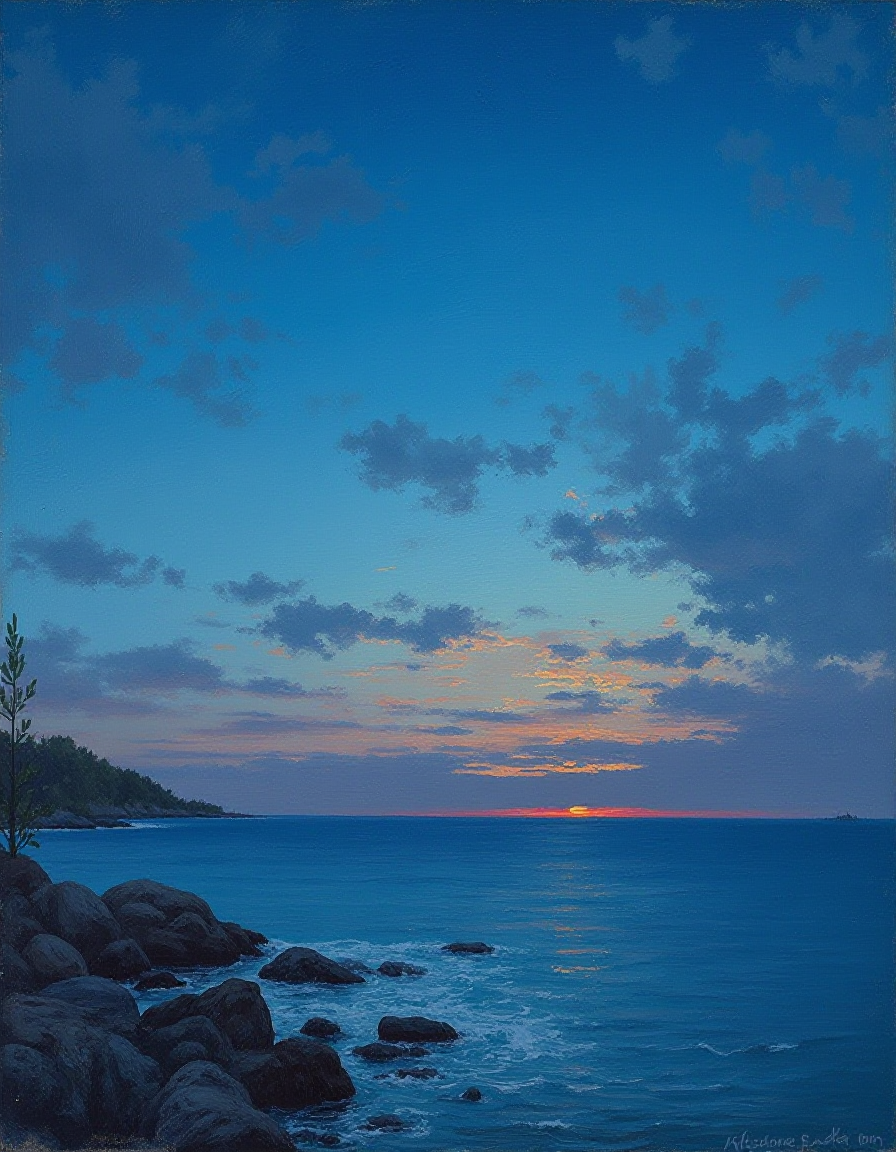
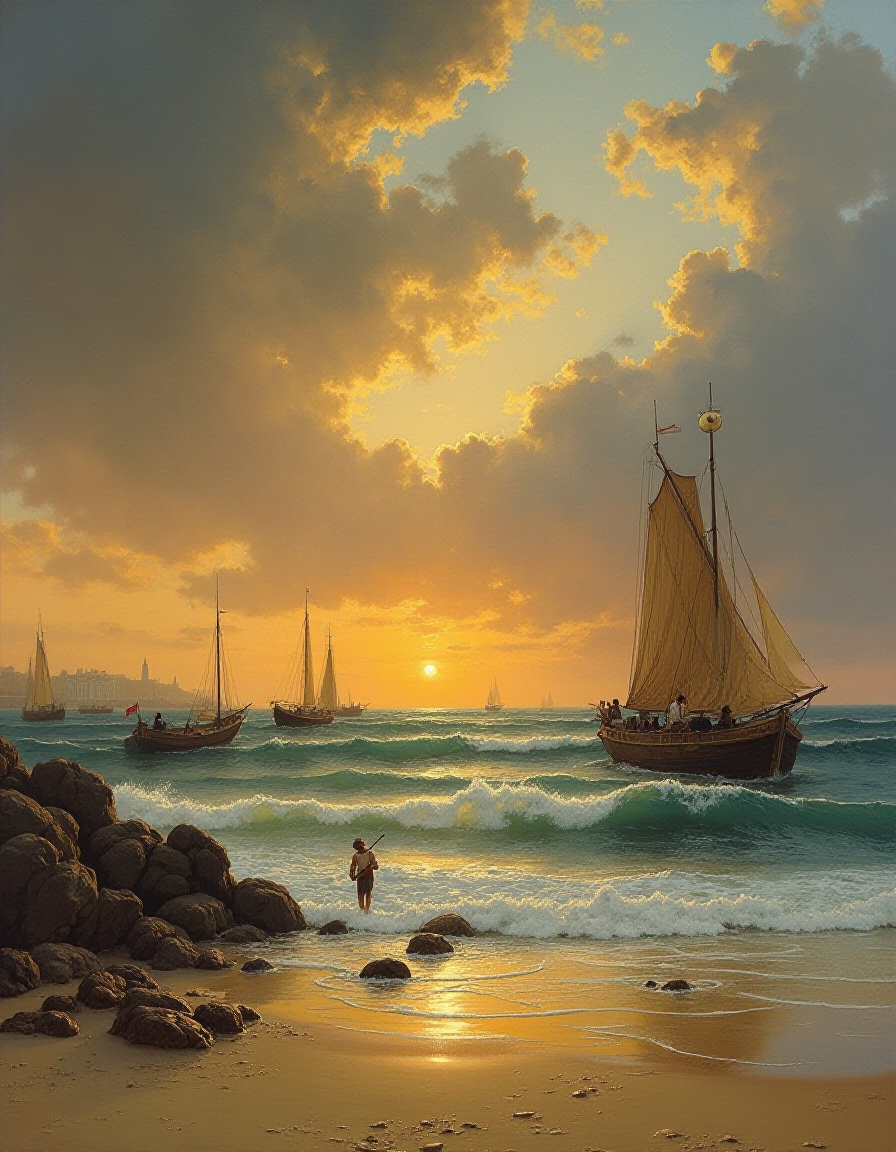
The painting depicts a serene sunset over a body of water, with the sun setting behind a rocky shoreline.
CAPTION
The image depicts a serene coastal scene at sunset. The sky is painted in shades of blue, with a gradient from deep blue at the top to lighter blue at the bottom. The sun is setting on the horizon, casting a warm orange glow over the water.
MONOLOGUE
Christian sat in the sunshine, and thought about Larry, and wondered. She knew now that what she felt for him was no new thing. It had been with her always, not merely since the painting of her portrait, but always, unacknowledged yet implicit, ever since that first day when he had rescued her from Richard. Her intensely criticising, analytic brain refused to surrender to vague emotion. She was resolved to understand herself, to rationalise her overthrow. It was the difference, for which that half-hour of sunset was responsible, in the degree of what she felt, that bewildered her. Yesterday, she told herself, it was a deep, but well-controlled and respectable little stream. To-day it was a flood. "I must keep my feet," she thought; "I must not be swept away!" The thought of him was sometimes overwhelming, like the fire of a summer noon; sometimes meditative, and wound about with memories, like twilight, and the song of the thrush; even at its least, it had been the glow that lives behind the northern horizon in midsummer, witnessing to the hidden glory, during darkness, or the wistful glimmer of stars. Now, while the sun went higher, and all the hum of life rose, and the cries of the water-birds, the buzz of insects over the bright lake, became more insistent, and the blue and lovely morning spread and strengthened round her, criticism and analysis failed. She could only think of him, helplessly, saying to herself what she had once heard a peasant woman say: "My heart'd open when I thinks of him."
SUMMARY
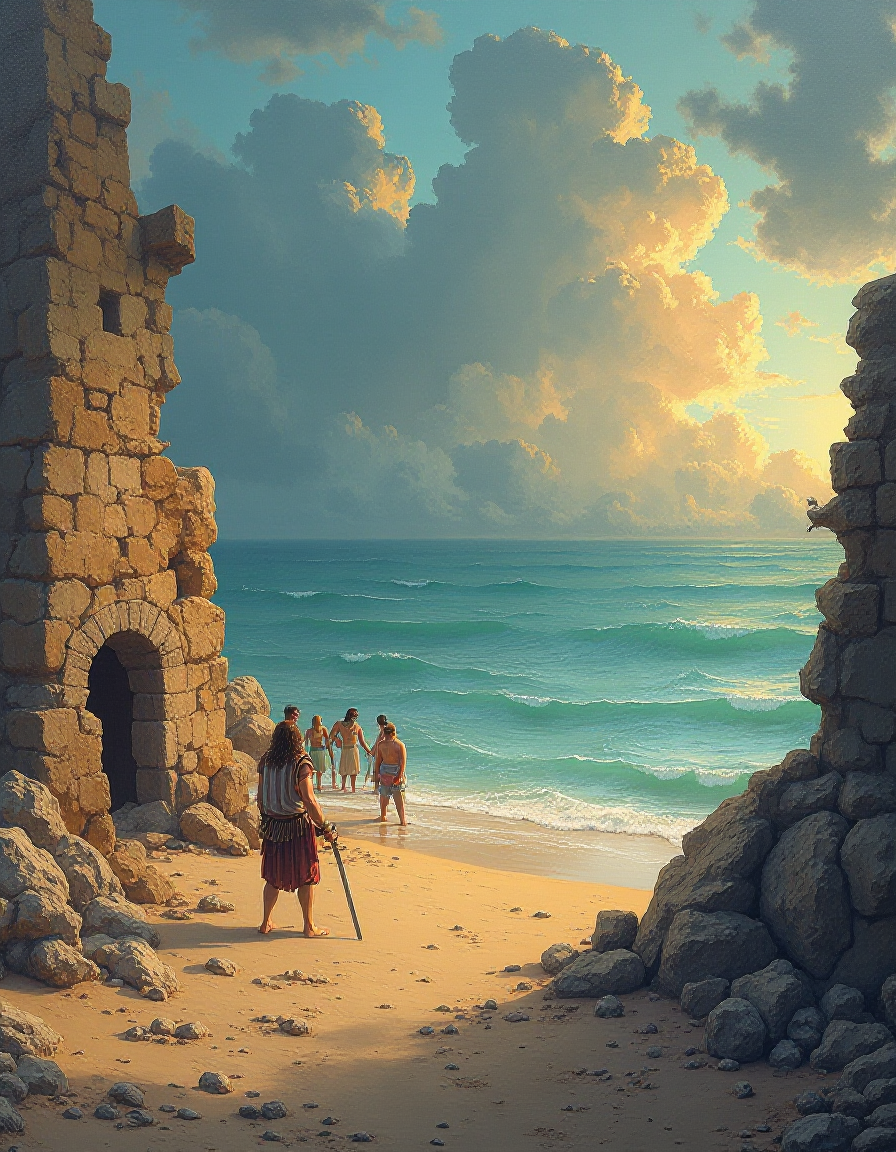
The ancient stone fortress of the ancient people is now a beach with people walking on it.
CAPTION
The image depicts a serene beach scene with a group of people gathered near a stone structure. The sky is filled with fluffy white clouds, casting a soft glow over the scene. The beach is sandy, with the waves gently lapping at the shore.
MONOLOGUE
The moon was at the highest point of the heavens; here and there at wide, clear intervals twinkled a thousand stars. Sometimes the moon rested on a group of clouds which looked like the summit of high mountains crowned with snow: little by little these clouds grew longer, and rolled out into transparent and waving zones of white satin, or transformed themselves into light flakes of froth, into innumerable wandering flocks in the blue plains of the firmament. Another time the arch of heaven seemed changed into a shore on which one could discover horizontal rows, parallel lines such as are made by the regular ebb and flow of the sea; a gust of wind tore this veil again, and everywhere appeared in the sky great banks of dazzlingly white down, so soft to the eye that one seemed to feel their softness and elasticity. The scene on the earth was not less delightful: the silvery and velvety light of the moon floated silently over the top of the forests, and at intervals went down among the trees, casting rays of light even through the deepest shadows. The narrow brook which flowed at my feet, burying itself from time to time among the thickets of oak-, willow-, and sugar-trees, and reappearing a little farther off in the glades, all sparkling with the constellations of the night, seemed like a ribbon of azure silk spotted with diamond stars and striped with black bands. On the other side of the river, in a wide, natural meadow, the moonlight rested quietly on the pastures, where it was spread out like a sheet. Some birch-trees scattered here and there
SUMMARY
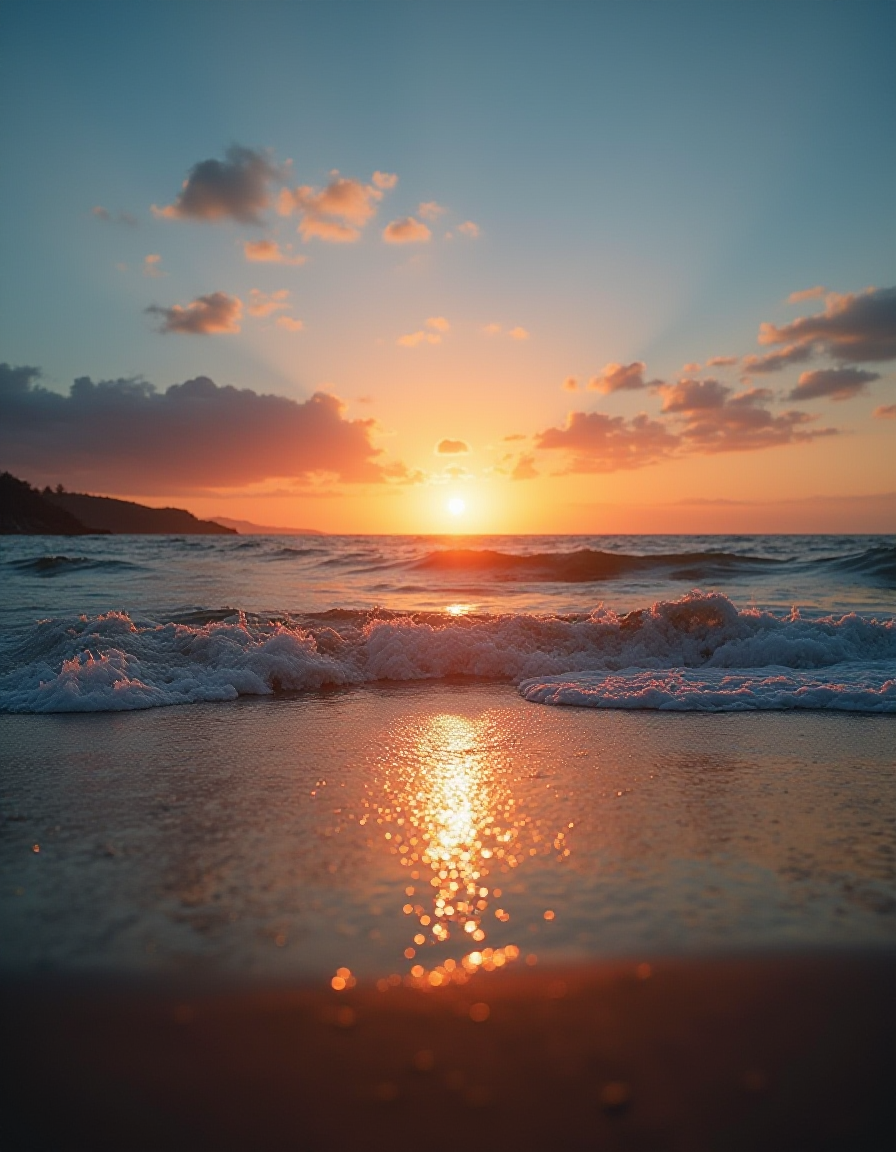
The image depicts a serene beach scene with the sun setting over the ocean. The sky is a gradient of orange and pink, with clouds scattered throughout, creating a beautiful sunset. The waves are gently crashing onto the shore, adding to the peaceful atmosphere.
CAPTION
The image captures a serene beach scene at sunset. The sky is a gradient of orange and pink, with the sun just setting on the horizon. The ocean waves are gently lapping at the shore, creating a mirror-like reflection on the wet sand.
MONOLOGUE
radiance of the stars and nebulous spots. From the 14th to the 19th of March a regular interval of three quarters of an hour occurred between the disappearance of the sun's disk in the ocean and the first manifestation of the zodiacal p 138 light, although the night was already perfectly dark. an hour after sunset it was seen in great briliancy between Aldebaran and the Pleiades; and on the 18th of March it attained an altitude of 39ºdegrees5'minutes. Narrow elongated clouds are scattered over the beautiful deep azure of the distant horizon, flitting past the zodiacal light as before a golden curtain. Above these, other clouds are from time to time reflecting the most brightly variegated colors. It seems a second sunset. On this side of the vault of heaven the lightness of the night appears to increase almost as much as at the first quarter of the moon. Toward 10 o'clock the zodiacal light generally becomes very faint in this part of the Southern Ocean, and at midnight I have scarcely been able to trace a vestige of it. On the 16th of March, when most strongly luminous a faint reflection was visible in the east." In our gloomy so-called "temperate" northern zone, the zodiacal light is only distinctly visible in the beginning of Spring, after the evening twilight, in the western part of the sky, and at the close of Autumn, before the dawn of day, above the eastern horizon.
SUMMARY
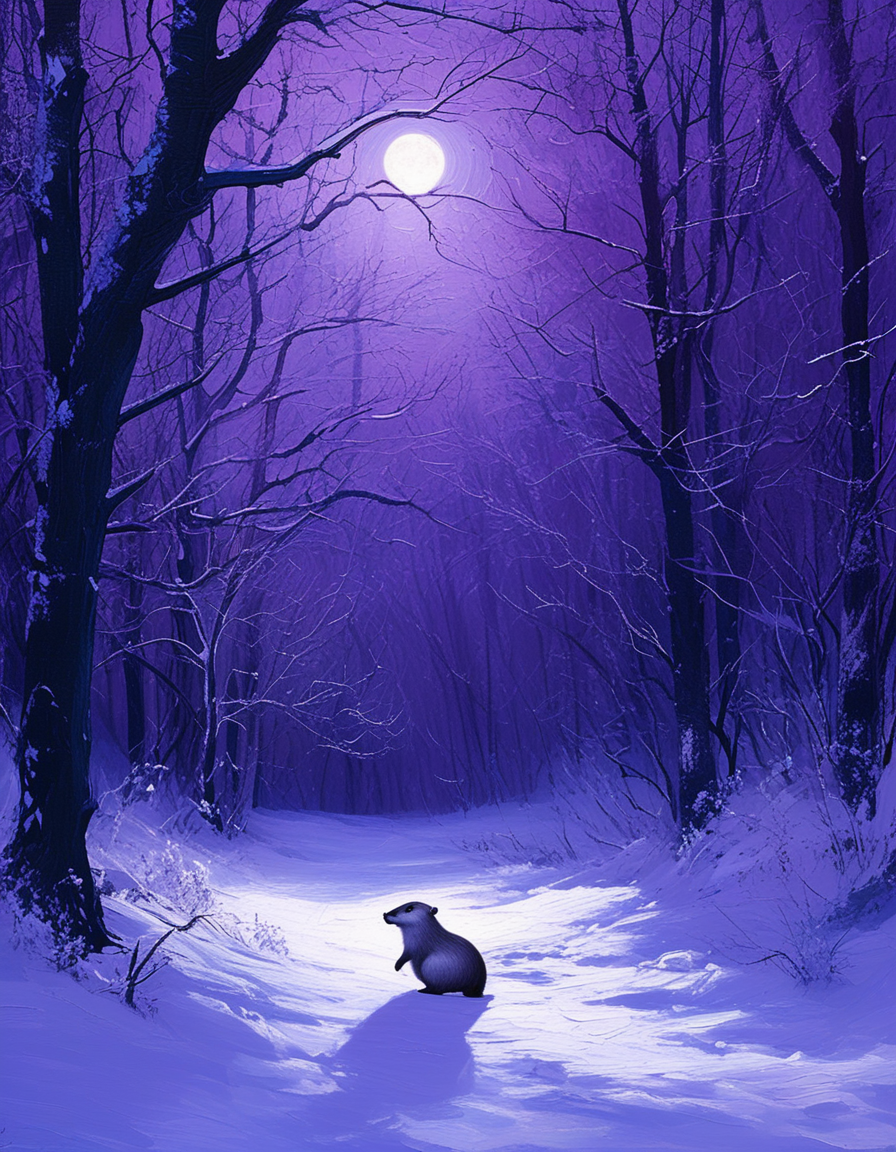
a small gray animal sits in a snowy forest at night, looking up at the moon
CAPTION
The image depicts a serene winter scene in a forest. The dominant color scheme is a deep purple, with the forest floor covered in a thick layer of snow. The trees, bare of leaves, stand tall and twisted, their branches reaching out in all directions.
MONOLOGUE
I shall never forget the view from my chamber windows as I threw open the long double casement at six o'clock in the morning. It was my first view of Monte Rotondo, the loftiest of the Corsican mountains. A long ridge and its crowning peak were capped with snow. The range to the eastward was in deep shade, but with a rich amber hue behind them as the sun rose. I watched its kindling light as it touched the snowy top of Monte Rotondo, and spread a purple light over the sides of the eastern ridge. The night mists had not yet risen from the valley of the Golo. We hastened to descend towards it, after the usual small cup of _café noir_ and a piece of bread. The environs of Bigorno on this side are very beautiful. Groves of olive with their silvery leaves and green berries not yet ripened mingled with vines planted in terraces, the vines festooning and running free, as one sees them in Italy. Gardens full of peach and fig trees filled all the hollows—a charming scene through which the path wound down the hill. Antoine brought us fresh figs from one of the gardens—a relish to the dry remains of our crust. Before the sun had gained much elevation, it became exceedingly warm on a southern exposure; the green lizards darted from crevices in the vineyard walls, all nature was alive and fresh, and the air serene, with a most heavenly sky.
SUMMARY
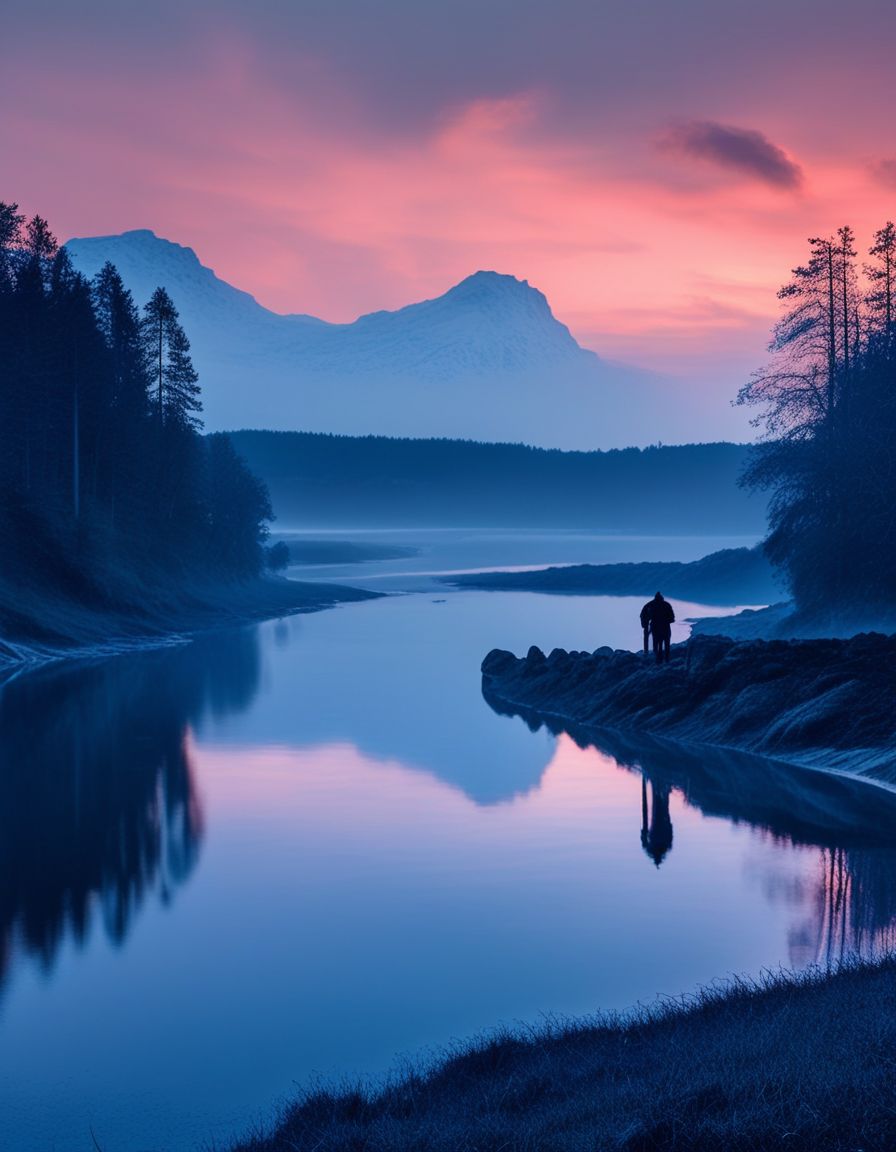
person standing on the edge of a river, looking out at a mountain range, with a mountain range in the background, with a river in the foreground, with a person standing on the edge of a river, looking out at a mountain range, with a mountain range in the background, with a river in the foreground, with a person standing on the
CAPTION
The image depicts a serene lakeside scene bathed in the soft glow of a sunset. The sky is painted in hues of pink and purple, with the sun just setting behind a majestic mountain range. The lake, reflecting the vibrant colors of the sky, is nestled in a tranquil forest.
MONOLOGUE
But all these early works of the artist have been eclipsed by some recent drawings of Switzerland. These latter are not to be described by any words, but they must be noted here not only as presenting records of lake effect on grander scale, and of more imaginative character than any other of his works, but as combining effects of the surface of mist with the surface of water. Two or three of the Lake of Lucerne, seen from above, give the melting of the mountain promontories beneath into the clear depth, and above into the clouds; one of Constance shows the vast lake at evening, seen not as water, but its surface covered with low white mist, lying league beyond league in the twilight like a fallen space of moony cloud; one of Goldau shows the Lake of Zug appearing through the chasm of a thunder-cloud under sunset, its whole surface one blaze of fire, and the promontories of the hills thrown out against it, like spectres; another of Zurich gives the playing of the green waves of the river among white streams of moonlight: two purple sunsets on the Lake of Zug are distinguished for the glow obtained without positive color, the rose and purple tints being in great measure brought by opposition out of browns: finally, a drawing executed in 1845 of the town of Lucerne from the lake is unique for its expression of water surface reflecting the clear green hue of sky at twilight.
SUMMARY
A silhouette of a person raising their arms in the night sky with a starry sky and a sunset.
CAPTION
The image depicts a person standing on a rocky outcrop at night, with a starry sky above them. The person is raising their arms in a triumphant gesture, with the sun setting in the background, casting a warm glow on the scene. The sky is filled with stars, creating a serene and peaceful atmosphere.
MONOLOGUE
When these early morning hours were over, Oscar used to go out of the cottage and wander about beside the sea. The waves murmured to him, and the sun was warm; the seagulls wheeled above his head and screamed with their wild voices; great white clouds built themselves into cities and palaces before his eyes; lights and shadows wavered everywhere, and made the grey rocks and the distant mountains seem alive; winds whispered in the long grass, and sang crooning melodies in the branches of the trees; little insects and animals ran hither and thither, and seemed busy even when they were doing nothing. Sometimes the rain fell, making a secret sound in the leaves, and causing the surface of the clear pools to leap aloft in tiny pyramids; then the green plants stood up and stretched out their stems, taking their wetting gladly, and growing taller after it, though it had made them bob their heads. With the evening, splendid colours came along the sky, though the hand that painted them was not seen: they, too, spoke a kind of language; the glories of the day that was past, and the thoughts and hopes that Oscar had had, seemed to glow in the heavens as they glowed in the boy's memory. They faded at last, and night darkened the world, so that Oscar might not forget the moon and stars. These never slept, and therefore Oscar knew that he might sleep. The rays that came from them found their way silently into his heart, and filled it with the fresh and quiet fancies that afterwards grew into dreams. For his dreams did not come from the world he lived
SUMMARY
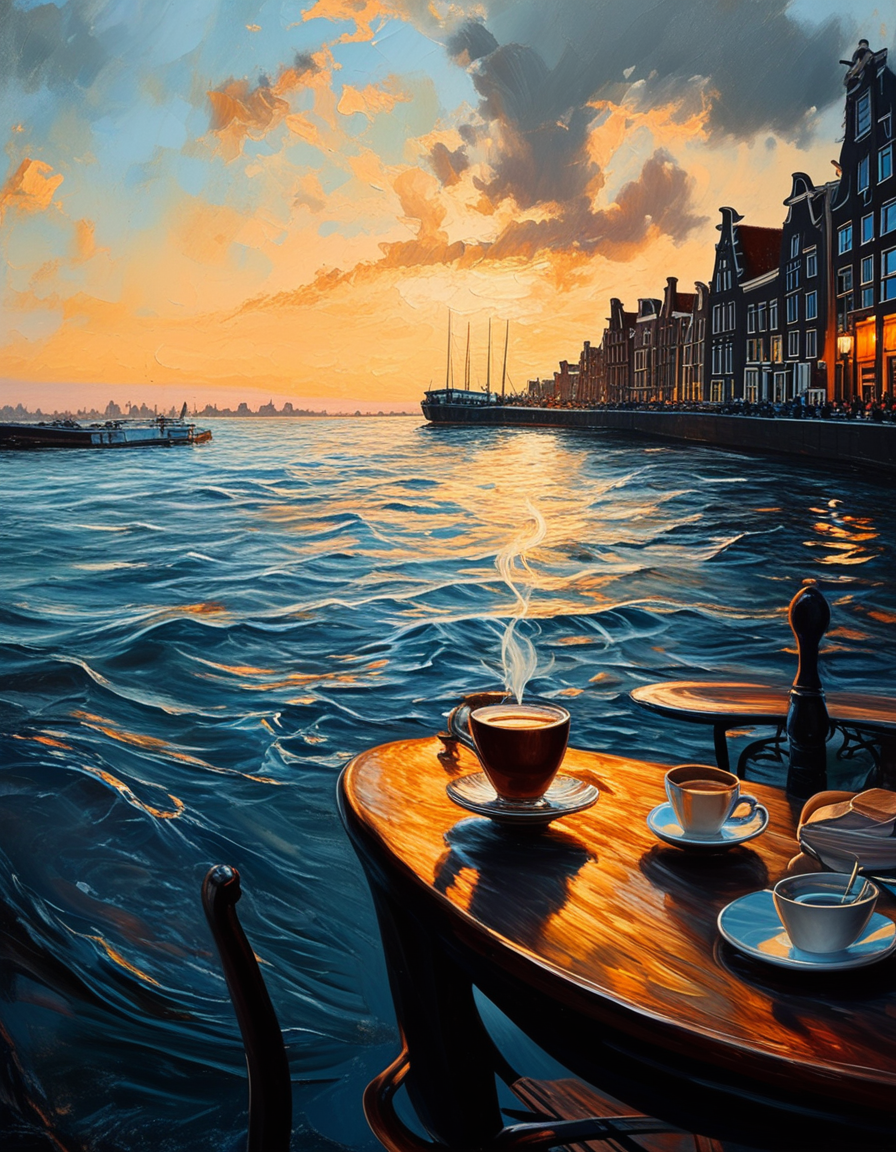
The image depicts a tranquil scene of a river with a wooden table and two cups of coffee on it. The sky is painted in hues of orange and yellow, suggesting a sunset or sunrise. The buildings lining the river are adorned with traditional architectural details, adding to the charm of the scene.
CAPTION
The image depicts a serene scene of a river with a calm water surface reflecting the sky above. The sky is painted in hues of orange and yellow, suggesting a sunset. The riverbank is lined with buildings, including a row of traditional Dutch houses with steep roofs.
MONOLOGUE
Is rather more transparent than ordinary vermilion, with a clear but not bright orange hue. It also washes better, and is for landscape purposes more generally useful. Resembling red-lead in appearance, it is not subject to its changes, being perfectly durable in oil and water. A most powerful tinger of white, its tints are warmer than red-lead's, affording delicate carnations similar to those of Titian and Rubens. This pigment--or, preferably, the succeeding variety--may be employed with excellent results in scumbling of flesh, for which Sir Joshua Reynolds improperly used the so-called red orpiment. It dries in simple linseed oil, but works with best effect in water with a considerable portion of gum. In speaking of sunset and sunrise clouds, Mr. Penley observes--"Orange vermilion if used so thin as to get rid of its opacity, is a fine tone; but it must be remembered that _transparency_ is the character of the sunset or sunrise, and hence arises the difficulty of employing such opaque colour effectively." Before the introduction of cadmium red, this and the following pigment were the best and only unexceptionable orange-reds known. It is probable, however, that the new colour will in a great measure supersede these latter in cases where transparency is sought. Orange vermilion is often a mixture, in which case the yellow employed is apt to separate from the red and float on its surface.
SUMMARY
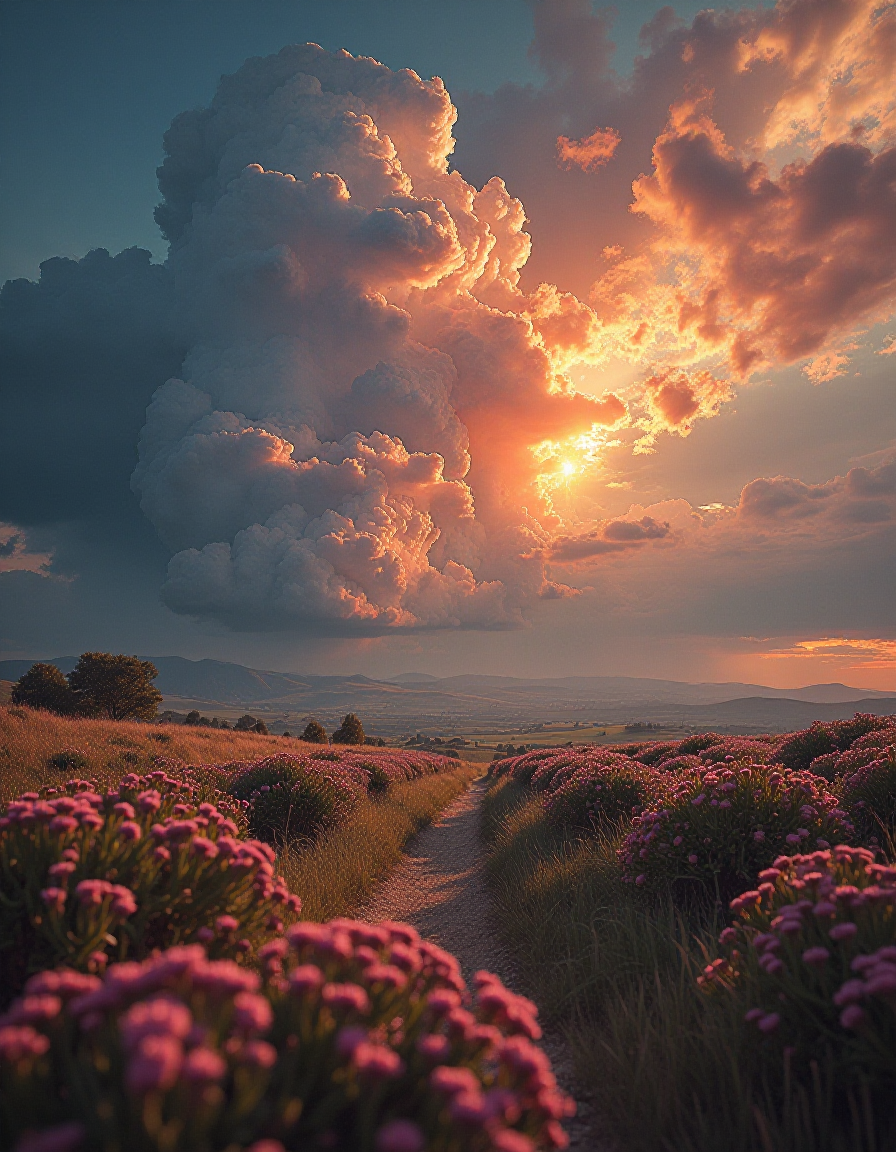
The image depicts a picturesque landscape featuring a winding dirt path surrounded by vibrant pink flowers. The sky above is filled with a large, fluffy, dark cloud, casting a dramatic shadow over the scene.
CAPTION
The image depicts a serene landscape at sunset, featuring a winding dirt path that leads into a field of vibrant pink flowers. The sky is filled with a large, fluffy, orange-hued cloud that dominates the upper half of the image, casting a warm glow over the scene.
MONOLOGUE
The climb from Sedongchen to Gnatong was very steep with a rise of over 5,000 feet in the first 5 miles, and we soon got out of the zone of the leeches and on to the most wonderful zone of flowering rhododendrons. The rhododendrons in the lower forest chiefly consisted of _R. Argenteum_ and _R. Falconeri_. These grew in a great forest of oaks and magnolias, all covered with beautiful ferns among which showed up delightful mauve or white orchids. The lower rhododendrons had already flowered, but as we got higher we found masses of _R. Cinnabarinum_, with flowers showing every shade of orange and red. Then came rhododendrons of every colour--pink, deep crimson, yellow, mauve, white or cream coloured. It was impossible to imagine anything more beautiful, and every yard of the path was a pure delight. Among the smaller flowers were the large pink saxifrage, while the deep reddish-purple primula covered every open space. There was also a very tiny pink primula--the smallest I have ever seen--and another one like a pink primrose, that grew on the banks above the path. We went along quite slowly all the way, botanising and admiring the scenery. The path mostly led along the top of a ridge, and the views and colours of the many-hued rhododendrons in the gullies on either side were very delightful. Gnatong, where we were to spend the night, was a very small and rather dirty village lying in a hollow and surrounded by grassy hills. The fir trees (_Abies Webbiana_) no longer surrounded it, as those anywhere near had been cut
SUMMARY
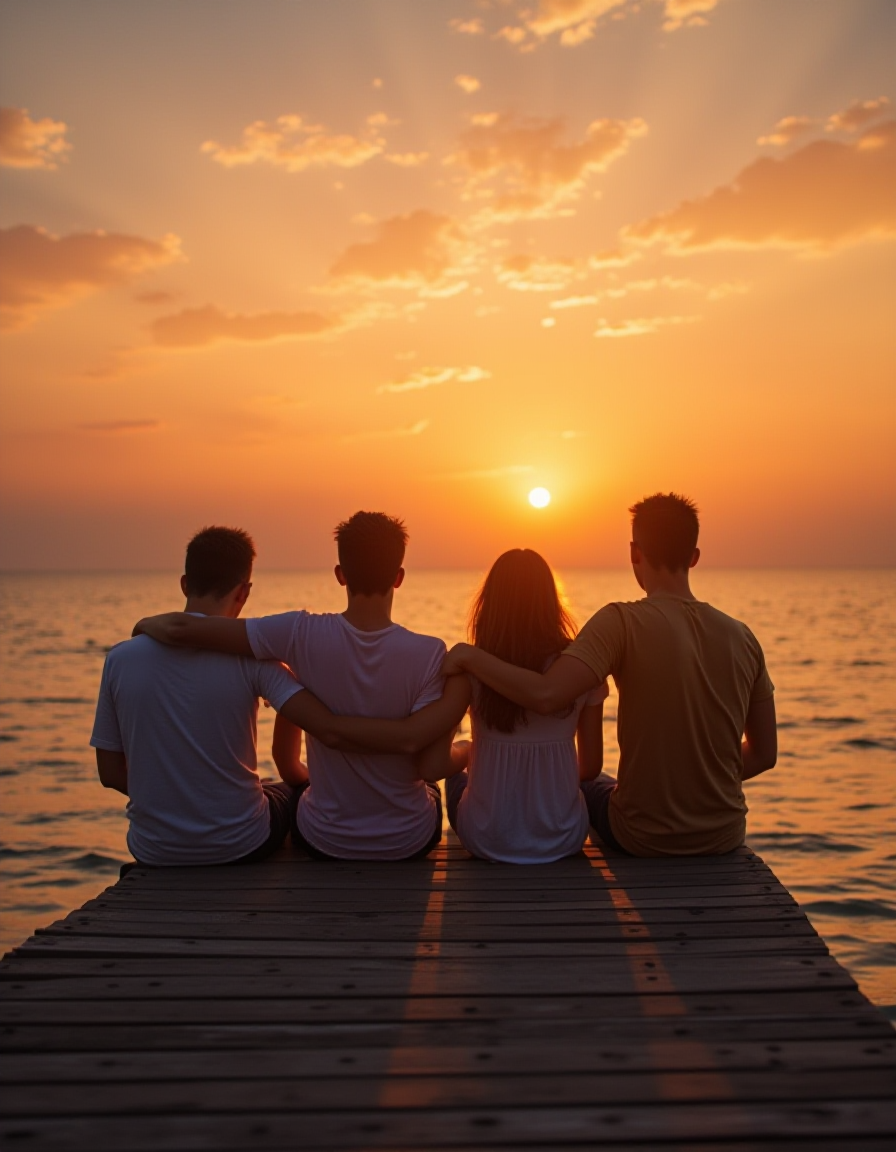
four people sitting on a dock watching the sunset.
CAPTION
The image captures a serene moment of four people sitting on a wooden dock overlooking a body of water. The sun is setting, casting a warm orange glow over the scene. The sky is filled with clouds, adding to the tranquil atmosphere.
MONOLOGUE
Through these wild forsaken regions there are neither roads nor paths, and the enemy has concealed the trace of his footsteps with the utmost precaution. Every bush may mask an ambuscade, and behind every rock some danger lurks. Sometimes the Spaniards--to whom experience has taught many things--may mark the exact position of the rebels by the whirl of the vultures, circling high above it, watching the time when, after the camp has broken up, they may make a descent upon the scanty fragments of victuals left behind, or upon the dead bodies of those who have perished of wounds, of starvation, perchance, or of some malignant fever. Overhead is a brazen black-blue sky, through which the sun darts red-hot rays, or else a black stretch of dense clouds, belching cataracts of water from week's end to week's end, and frequently torn by the most terrific storms of thunder and lightning. The marvel of it is that so many men, and even women, are able to live at all, under such dreadful conditions, more often than not lacking the veriest necessaries of life, and depending for their daily food on their knowledge of the qualities, poisonous or harmless, of the various fruits, berries, and herbs they find about their path. I wonder if it ever occurs to people who talk so glibly of Cuban affairs, over their well-spread tables, that at this very moment there are considerably over a hundred thousand human beings encamped, under these appalling conditions, in various districts of Cuba, not to mention the miserable _reconcentrados_, or men out of
SUMMARY
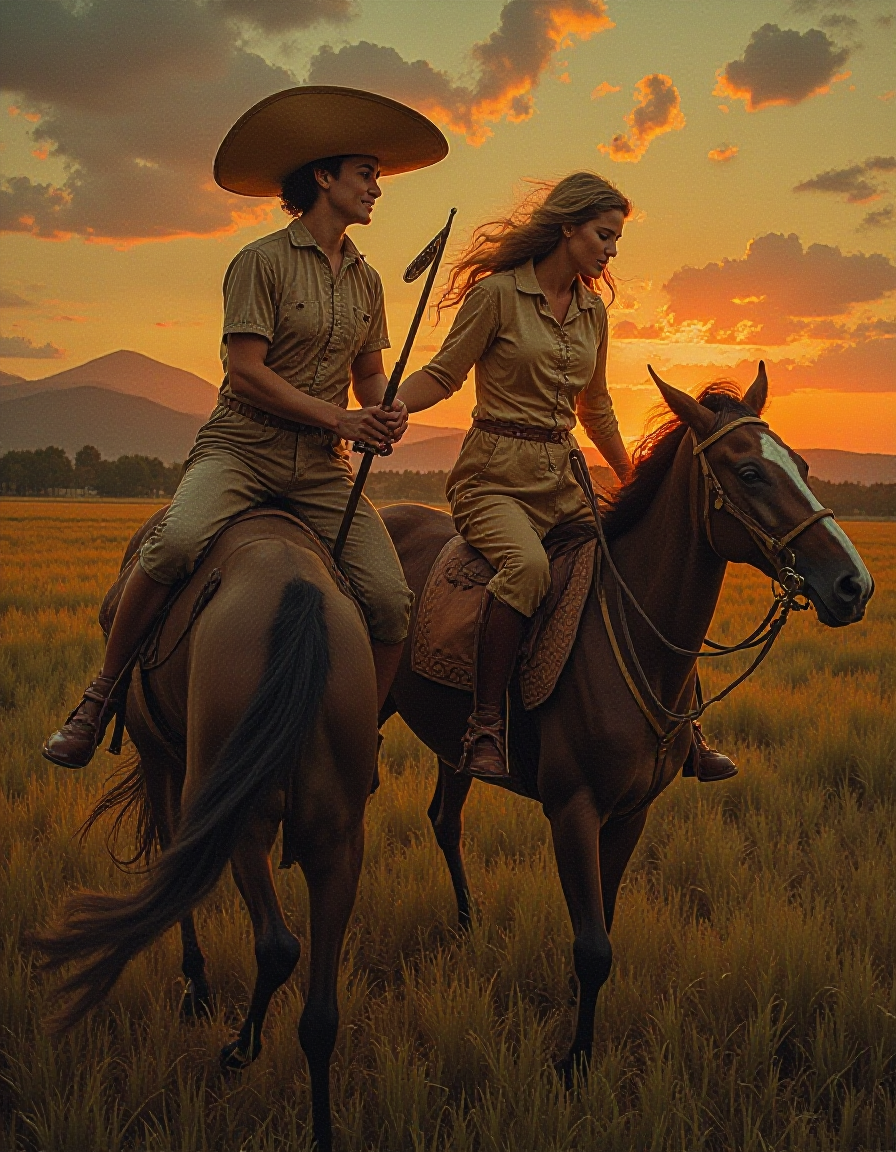
two women riding horses in a field at sunset.
CAPTION
The image depicts two individuals, one in a cowboy hat and the other in a khaki shirt, riding a brown horse in a field during sunset. The sky is a gradient of orange and yellow, with clouds scattered throughout, suggesting a warm and serene atmosphere.
MONOLOGUE
The night had been lovely, the stars were still shining brightly overhead when we awoke. Knowing that it was nearly morning, I proposed that we should breakfast and ride on. There was daylight sufficient to enable us to see our way. Boxer, not content with his plentiful supper, as soon as he saw us moving, started off in the direction of the dead wolf, and when we were on the point of mounting, reappeared with his mouth besmeared with blood, showing how he had been employed. From the way he moved on, I was afraid he had over-eaten himself; he, however, contrived to keep up with our horses. During the night there had not been a breath of wind, but as the sun rose, it began to blow fresh from the east, and soon shifted to the northward, from which quarter a bank of clouds rising rapidly, formed a dark canopy over the sky. On one side the sun shone brightly across the prairie, lighting up its vivid tints of green and brown and yellow, while on the other the whole country wore a wintry aspect. Every instant the wind became stronger and stronger, and the cold increased. Unbuckling our buffalo robes, we put them over our shoulders, drawing down the flaps of our caps to keep our ears warm. Before long it began to rain, but the rain soon changed into snow, which came down thicker and thicker, until, in the course of an hour, the whole face of the country was covered by a sheet of white, making it difficult to distinguish the marks which had hitherto guided our course.
SUMMARY
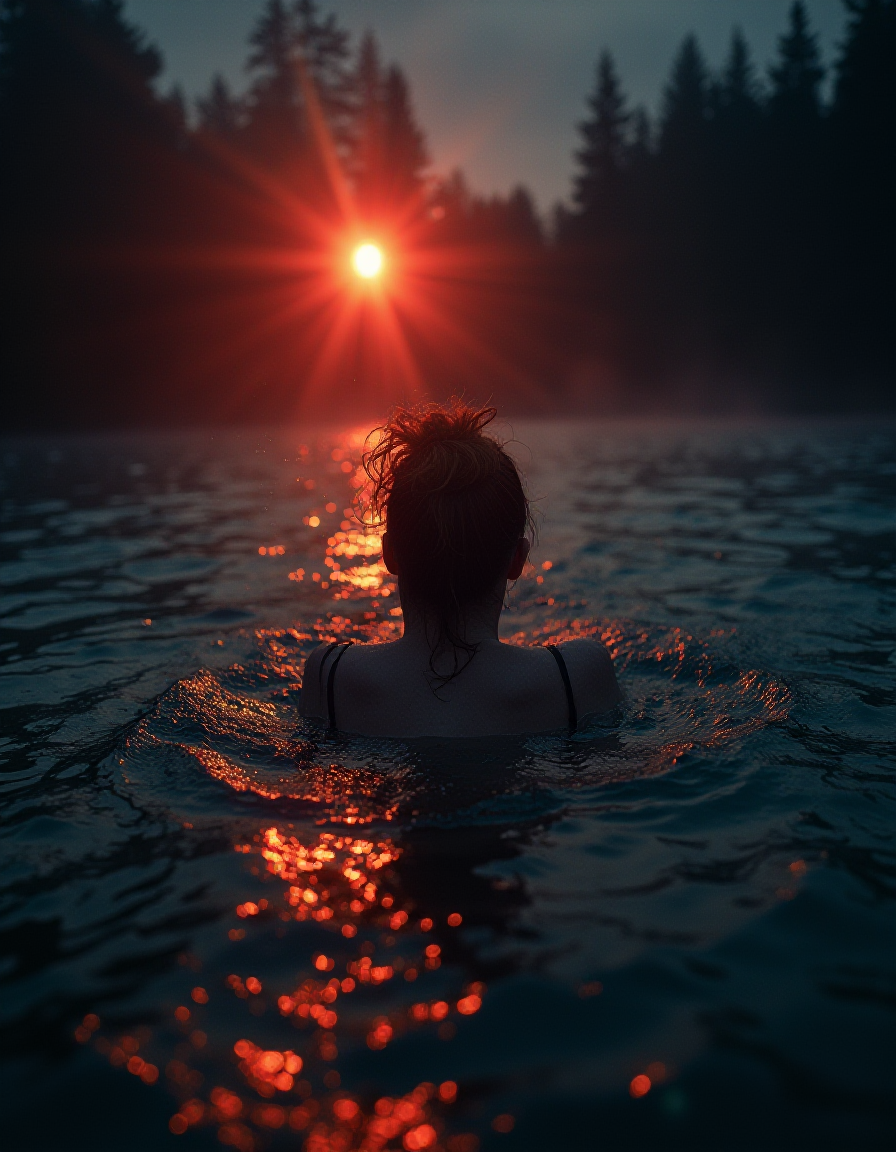
person in a swimming pool with the sun in the background.
CAPTION
The image captures a serene moment of a person swimming in a body of water during sunset. The person is facing away from the camera, their back to us, and is partially submerged in the water. The sun is setting in the background, casting a warm glow over the scene.
MONOLOGUE
The following day brought us back to our summer camp again. Our camp here was beautifully located among the pines and between the camp and bluff there was a pretty little lake which had been made by turning a little mountain stream into the low ground between the camp and the bluff. The officers' tents were in line facing this lake, and at the back ground sloped gradually to the river about a half-mile away. A very interesting "nature feature" of this camp, was the uniformity with which we got a shower of rain every morning during July and August, and we got into the habit of expecting it at eleven o'clock and were seldom disappointed. One day, August 17th, the water from the cloud in passing over became congealed and formed snow-flakes that for size were really astonishing. I was on my way to Loma on my faithful mule Paddy O'Rooney, and when it came it shut out practically everything from sight, a few yards away, and lasted probably twenty or thirty minutes. About four inches of snow fell in that time, then the sun came out bright and warm, and it seemed to go away almost as fast as it came. On my way back to camp the depressions along the way were flooded and by night only the spots protected by ledges of rock or dense foliage were left. With all these pleasant surroundings, and nothing to do but fish and hunt, life became a little monotonous. I sometimes wonder if people will get tired of golden streets and heavenly music.
SUMMARY
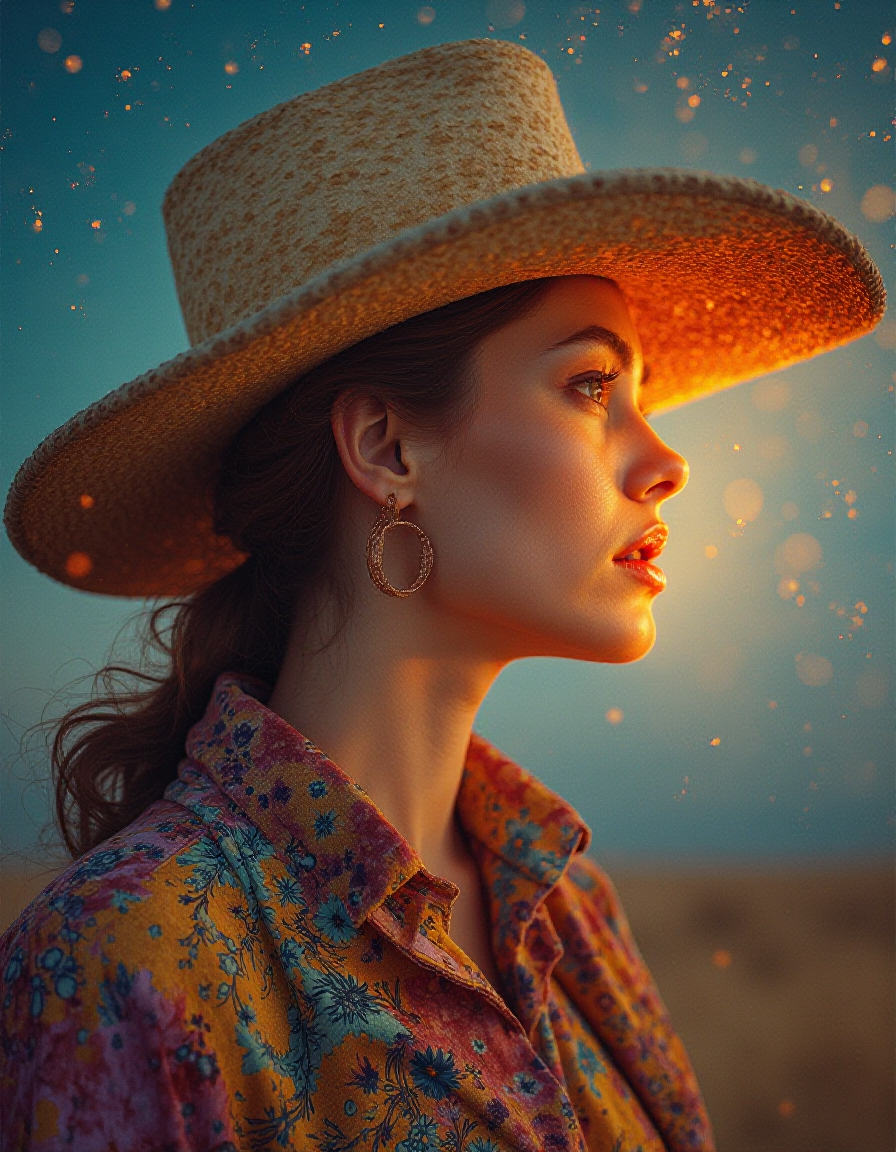
a young woman wearing a wide-brimmed hat and a colorful floral shirt is looking out at the sunset.
CAPTION
The image presents a serene scene of a woman, adorned in a vibrant floral shirt, donned with a straw hat, and gazing into the distance with a serene expression. The backdrop is a picturesque landscape bathed in soft, warm light, suggesting a tranquil setting.
MONOLOGUE
We sat for a long time gazing with silent astonishment upon this delightful little toy village, that looked almost as if it had been made at Nuremberg, and could be picked up and put away when not wanted to play with. It was a bright, still afternoon. The purple light of sunset gave an additional charm of color to the scene. Suddenly the _lumen juvent purpureum_, the purple light of youth, broke upon it. Handsome, well-dressed girls, with a few polygynic young men in the usual island proportion of the sexes, came out of the cottages, and stood in the lanes talking and laughing, or walked to the edge of the bluff to see the sun go down. We rubbed our eyes. Was this real, or were we looking into some showman's box? It seemed like the Petit Trianon adapted to an island in the Atlantic, with Louis XV. and his marquises playing at fishing instead of farming.
SUMMARY
two people walking hand in hand down a path in a forest at night with glowing mushrooms and fireflies
CAPTION
The image depicts a serene nighttime scene in a forest. Two individuals, one in a dark hoodie and the other in a light-colored jacket, are walking hand in hand down a winding path. The path is illuminated by a warm glow, suggesting the presence of a fire or a lantern.
MONOLOGUE
A hollow underneath the oak was my bed. Before I had fed Modestine and arranged my sack, three stars were already brightly shining, and the others were beginning dimly to appear. I slipped down to the river, which looked very black among its rocks, to fill my can; and dined with a good appetite in the dark, for I scrupled to light a lantern while so near a house. The moon, which I had seen a pallid crescent all afternoon, faintly illuminated the summit of the hills, but not a ray fell into the bottom of the glen where I was lying. The oak rose before me like a pillar of darkness; and overhead the heartsome stars were set in the face of the night. No one knows the stars who has not slept, as the French happily put it, _a la belle etoile_. He may know all their names and distances and magnitudes, and yet be ignorant of what alone concerns mankind,--their serene and gladsome influence on the mind. The greater part of poetry is about the stars; and very justly, for they are themselves the most classical of poets. These same far-away worlds, sprinkled like tapers or shaken together like a diamond dust upon the sky, had looked not otherwise to Roland or Cavalier, when, in the words of the latter, they had "no other tent but the sky, and no other bed than my mother earth."
SUMMARY
a young girl with her face lit up by a warm light, with a halo of light around her head
CAPTION
The image presents a young child with a serene expression, set against a backdrop of a serene, natural landscape. The child's hair is styled in loose curls, and the background is a soft, warm color, suggesting a tranquil setting. The child's face is lit with a warm glow, enhancing the sense of warmth and tranquility.
MONOLOGUE
"Why, grandma, I spoke to you just a little while ago," returned Ellen. "You know I saw you just a few minutes before I went down-town." Ellen straightened the child on her knees, and began to try to twist her soft, straight flaxen locks into curls. Andrew lounged in from the kitchen and sat down and regarded Ellen fondly. The girl's cheeks were a splendid color from her walk in the cold wind, her hair around her temples caught the light from the window, and seemed to wreathe her head with a yellow flame. She tossed the child about with lithe young arms, whose every motion suggested reserves of tender strength. Ellen was more beautiful than she had ever been before, and yet something was gone from her face, though only temporarily, since the lines for the vanished meaning was still there. All the introspection and dreaminess and poetry of her face were gone, for the girl was, for the time, overbalanced on the physical side of her life. The joy of existence for itself alone was intoxicating her. The innocent frivolities of her sex had seized her too, and the instincts which had not yet reached her brain nor gone farther than her bounding pulses of youth. "Ellen is getting real fond of dress," Fanny often said to Andrew. He only laughed at that. "Well, pretty birds like pretty feathers, and no wonder," said he. But he did not laugh when Fanny added that Ellen seemed to think more about the boys than she used to. There was scarcely a boy in the high-school who was not Ellen's admirer. It was a curious
SUMMARY
a woman with a wild, glowing aura around her face and hair, wearing a fur coat and holding a glowing object in her hand.
CAPTION
The image depicts a person with a serene and contemplative expression, wearing a brown fur coat and a necklace with a glowing pendant. The person is surrounded by a soft, ethereal glow, suggesting a magical or mystical atmosphere. The background is blurred, emphasizing the person and the glowing elements in the foreground.
MONOLOGUE
Far different, both in person and character, was the neglected Edith, who grew up in the imperial court like a sweet wild-flower, overlooked when the gorgeous exotic is nigh. Her slender girlish figure, with its undeveloped grace; her airy step; her color, coming and going with the varying feelings of her quick sensibility, like the delicate pink clouds at sunset; her soft brown hair, waving around a face of child-like purity and womanly tenderness: and her large gray eye, from whose transparent depths an earnest and loving spirit looked out upon the world--these were not the traits to win admiration in a sensual, splendor-loving court, where all acknowledged the sway of Clotilda. Her father lavished the whole of his affection upon his elder daughter: the latter seldom noticed her, and thought her more fit for a nunnery or for a peasant's cottage, than for the station of a princess. And so Edith grew to womanhood, unspoiled by flattery--that incense was reserved for Clotilda's shrine. Not in that crowd of selfish courtiers and of worldly women, wholly given up to dress and gayety, could the refinement and simplicity of the gentle Edith be appreciated. She was with them, but not of them: hers was the loneliness most felt when in a crowd, the want of congenial companionship. Her unassuming modesty and poor opinion of her own worth, saved her heart from the sharp pangs of envy at the thought of her sister's superiority: and thus, even in the impure atmosphere of the palace, did this artless maiden live on, humbly
SUMMARY
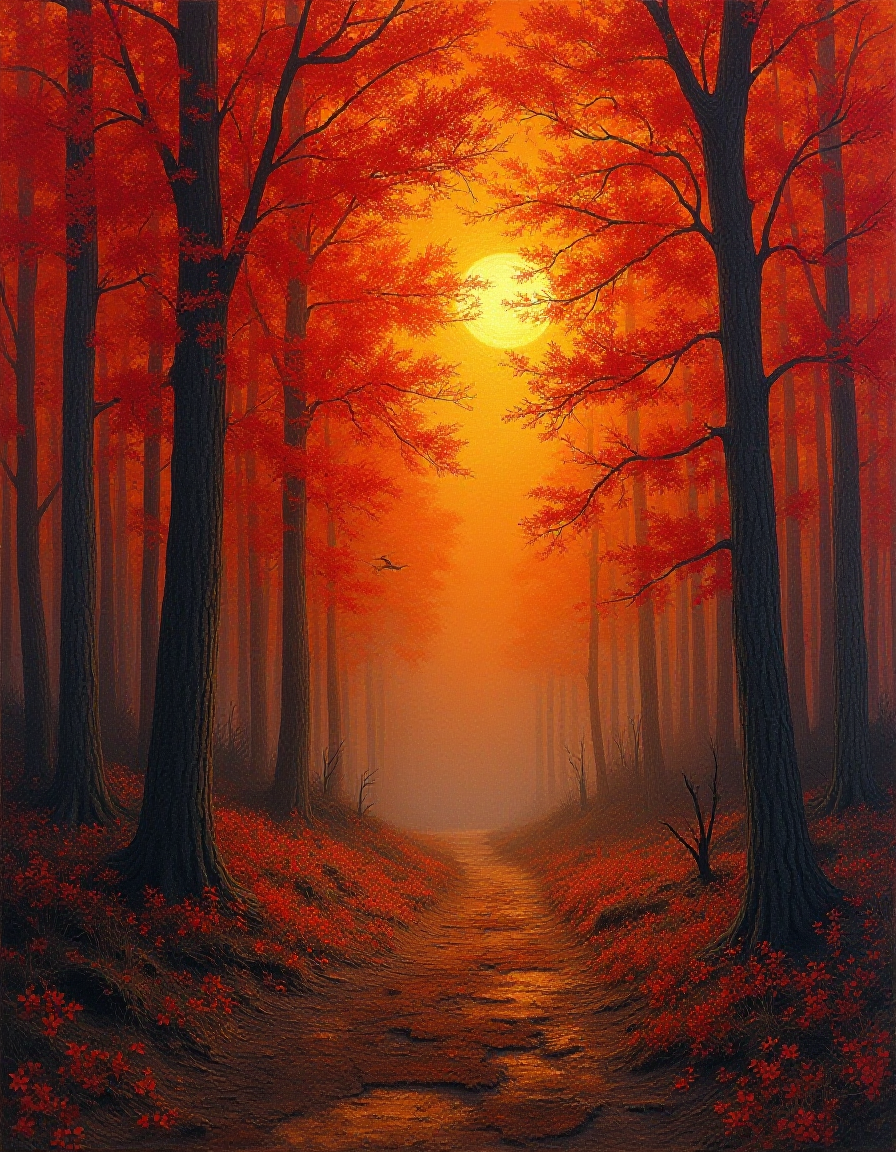
a winding path in a forest with a bright sun in the background
CAPTION
The image depicts a serene autumn forest scene with a winding path leading into the distance. The trees, adorned with vibrant red leaves, create a warm and inviting atmosphere. The sun is partially obscured by the trees, casting a soft glow over the scene.
MONOLOGUE
One morning towards the end of June, Wilhelmine awoke to find the grey dawn creeping in at her window; she rose and opened the casement and leaned out. Her room looked on the formal garden. There was a solemn hush in the air, and she realised that even the birds were asleep. Far in the east, over the top of the one beech-tree which still stood in the garden in spite of M. Lentre, the rising sun was tingeing the horizon with a delicate rosy glow. A bird stirred--twittered--finally a clear note of welcome to the day rang out, and the world was awake. The radiance in the east grew brighter, long streaks of glorious colour invaded the soft grey of dawn. From the distant field roads came the rumble of a peasant's cart. Wilhelmine dressed herself hurriedly and tiptoed down the dark stair to the house door. The broad street, the Graben, was deserted and silent, save for an occasional rattle in the direction of the market-place, where the peasants were arriving from the country with their carts heaped up with fresh fruit and vegetables. She walked up the street, delighting in the coolness and the scent of the morning air after the long days of oppressive heat which she had endured. A fancy took her to wander in the Rothwald, and she walked briskly along, up the dusty country path which led to the wood on the hill. The sun had risen, and even at that early hour the heat was so great that once or twice Wilhelmine almost turned homewards; however, the thought of the cool shade of the beech-trees in the forest drew her, and she pressed onward.
SUMMARY
two people riding horses in a forest at night with a full moon
CAPTION
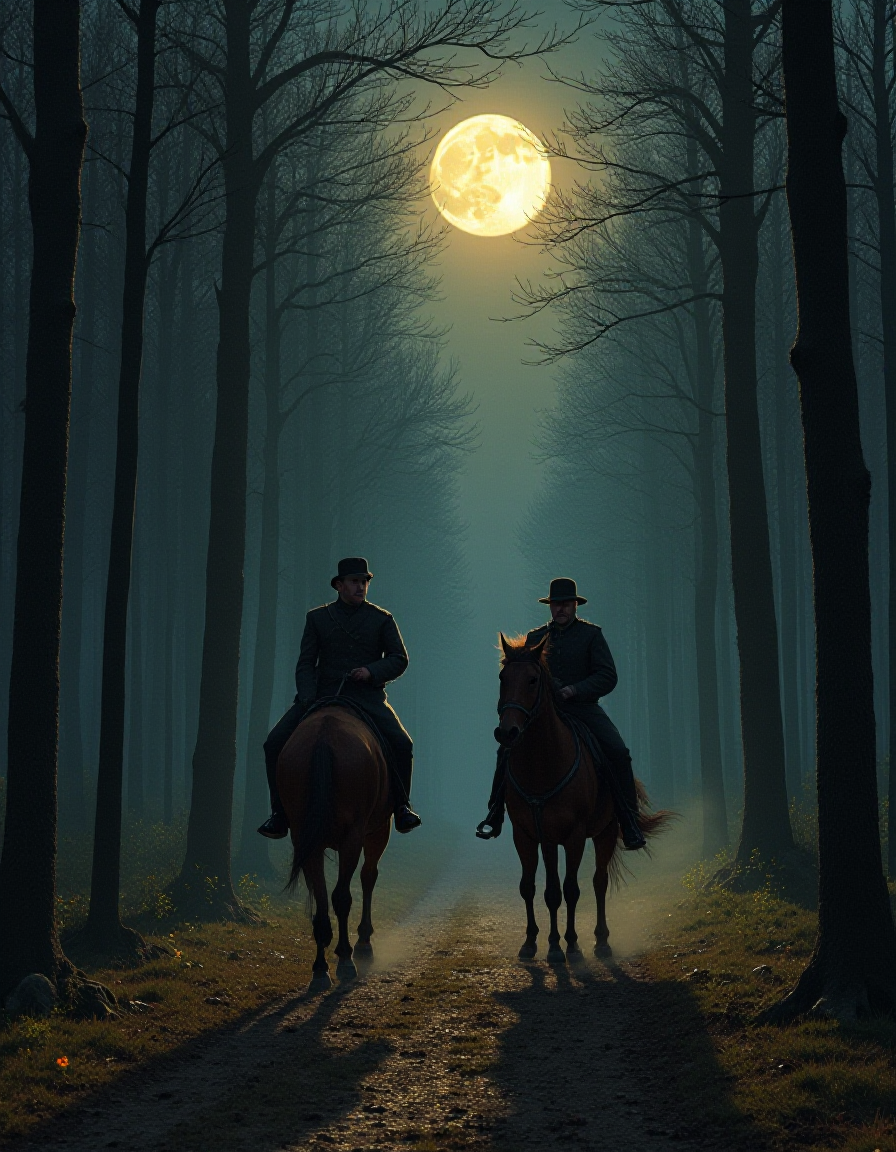
The image depicts a serene nighttime scene in a forest. Two individuals, both dressed in dark attire, are riding horses through the forest. The moon is full and bright, casting a glow over the scene.
MONOLOGUE
Under the cloudless heavens, under the starlit skies, blessing the grateful dew that cools the upland air and moistens the bunch-grass that has been bleaching all day in the fierce rays of the summer sun, a little column of infantry is swinging steadily southward. Long and toilsome has been the march; hot, dusty, and parching the day. Halts have been few and far between, and every man, from the colonel down, is coated with a gray mask of powdered alkali, the contribution of a two hours' tramp through Deadman's Caon just before the sun went down. Now, however, they are climbing the range. The morrow will bring them to the broad and beautiful valley of the Spirit Wolf, and there they must have news. Officers and men are footsore and weary, but no one begs for rest. Colonel Maynard, riding ahead on a sorry hack he picked up at the station two days' long march behind them, is eager to reach the springs at Forest Glade before ordering bivouac for the night. A week agone no one who saw him at Sablon would have thought the colonel fit for a march like this; but he seems rejuvenate. His head is high, his eye as bright, his bearing as full of spirit, as man's could possibly be at sixty, and the whole regiment cheered him when he caught the column at Omaha. A talk with Chester and Armitage seemed to have made a new man of him, and to-night he is full of an energy that inspires the entire command. Though they were farther away than many other troops ordered to the scene, the fact that their station was on the railway and that they
SUMMARY
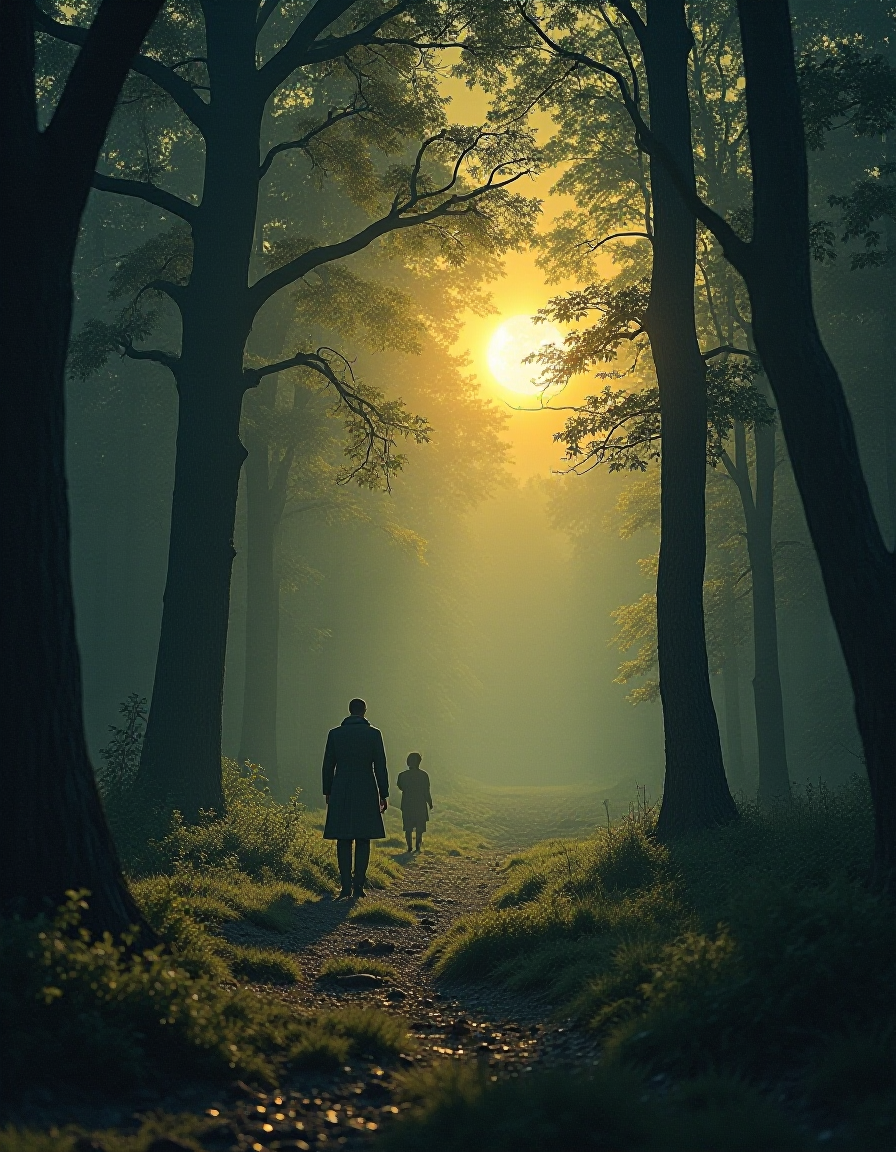
a man and a child walk through a misty forest at sunset
CAPTION
The image depicts a serene forest scene bathed in the warm glow of a setting sun. The sun, positioned in the upper right corner of the image, casts a golden hue over the scene, creating a serene atmosphere. The sun's rays dance across the forest floor, illuminating the path ahead and casting shadows on the trees.
MONOLOGUE
From time to time the highways along which the two friends rode at leisure on their way to Andernach, led them over the crest of some granite hill that was higher than the rest. Thence, through a clearing of the forest or cleft in the rocky barrier, they caught sudden glimpses of the Rhine framed in stone or festooned with vigorous vegetation. The valleys, the forest paths, the trees exhaled that autumnal odor which induced to reverie; the wooded summits were beginning to gild and to take on the warm brown tones significant of age; the leaves were falling, but the skies were still azure and the dry roads lay like yellow lines along the landscape, just then illuminated by the oblique rays of the setting sun. At a mile and a half from Andernach the two friends walked their horses in silence, as if no war were devastating this beautiful land, while they followed a path made for the goats across the lofty walls of bluish granite between which foams the Rhine. Presently they descended by one of the declivities of the gorge, at the foot of which is placed the little town, seated coquettishly on the banks of the river and offering a convenient port to mariners.
SUMMARY
a lone figure is walking down a forest path under a bright sun
CAPTION
The image depicts a serene, misty forest scene with a solitary figure walking down a winding path. The path is covered with fallen leaves, creating a soft, earthy texture. The forest is dense with tall trees, their trunks and branches forming a canopy overhead.
MONOLOGUE
The interior landscape, more particularly of the middle district of the island, is here and there ornamented by fine specimens of the ceiba, or silk-cotton tree, which is often seen a hundred feet in height, with stout and widespread branches, giving the idea of great firmness and stability. It sends up a massive sinewy trunk for some fifty feet, when it divides into branches covered with a dense canopy of leaves, expanded like an umbrella, and forming a perfect shade against the power of the torrid sun. The ceiba is slow of growth, but attains to great age, specimens thriving when Columbus first landed here being, as we were assured, still extant. Next to the royal palm, it is the most remarkable of all the trees which loom up beneath the brilliant purple skies of Cuba. The negroes have a superstition that the ceiba is a magic tree haunted by spirits, a singular notion also shared by the colored people of Nassau, though these two islands are so many hundreds of miles apart and have never had any natural connection. There is certainly something weird in the loneliness and solitary grandeur of the tree. Next to the palm and ceiba in beauty and picturesqueness of effect is the tamarind tree, with its deep green and delicate foliage, presenting a singular and curious aspect when thickly looped on every branch with hanging chocolate-colored pods.
SUMMARY
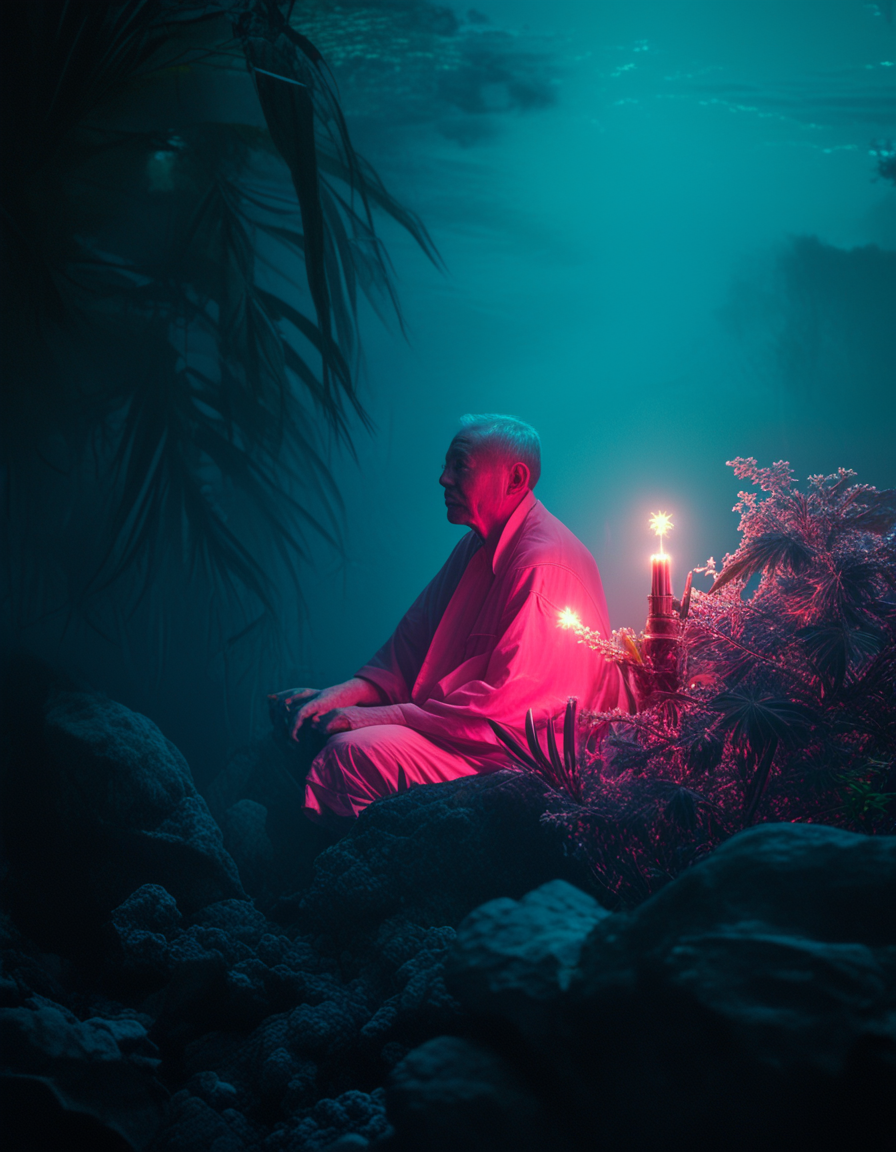
a man in a pink robe sits in a cave with a candle in front of him
CAPTION
The image depicts a serene scene of a man sitting in a meditative pose in a dimly lit underwater environment. The man is dressed in a traditional outfit, possibly a robe or a long garment, and is seated on a rock or a similar piece of land. The lighting in the scene is low, creating a moody atmosphere.
MONOLOGUE
A great slab of rock out-hung from the cliff, forming a shallow cave. In the mouth of this a man was standing, his back towards us. He was clothed in a great cloak, red in colour, and bearing a broad crossed bar down its entire length, while showing below it was a long white garment which seemed to cover him from neck to foot. His movements called to our mind those of our own _izanusi_ when sacrificing cattle to the ghosts of our fathers on solemn occasions; yet not. But this could be no _isanusi_, for he was a white man! Still he must be an _isanusi_ of some sort, for he was undoubtedly engaged in offering sacrifice. In front of him and further in the cave was a great block of stone or a ledge in the rock formation--we could not determine which--and upon it were two little pillars tipped with flame. Moreover, upon this the man's words and actions seemed centred, for upon it was something else, which from there we could not see. But here, if possible, was a more surprising thing. Behind him, bending low, knelt another man--a dark man, one of ourselves, and of the same race, for he wore the ring upon his head, and his other adornments were as ours. He, too, seemed in some way to be assisting the other, for his movements were much the same, and a few words would now and again drop from him as though in reply to the one who was sacrificing. _Hau_! it was wonderful! In rigid wonder we stared, not knowing what was to come next.
SUMMARY
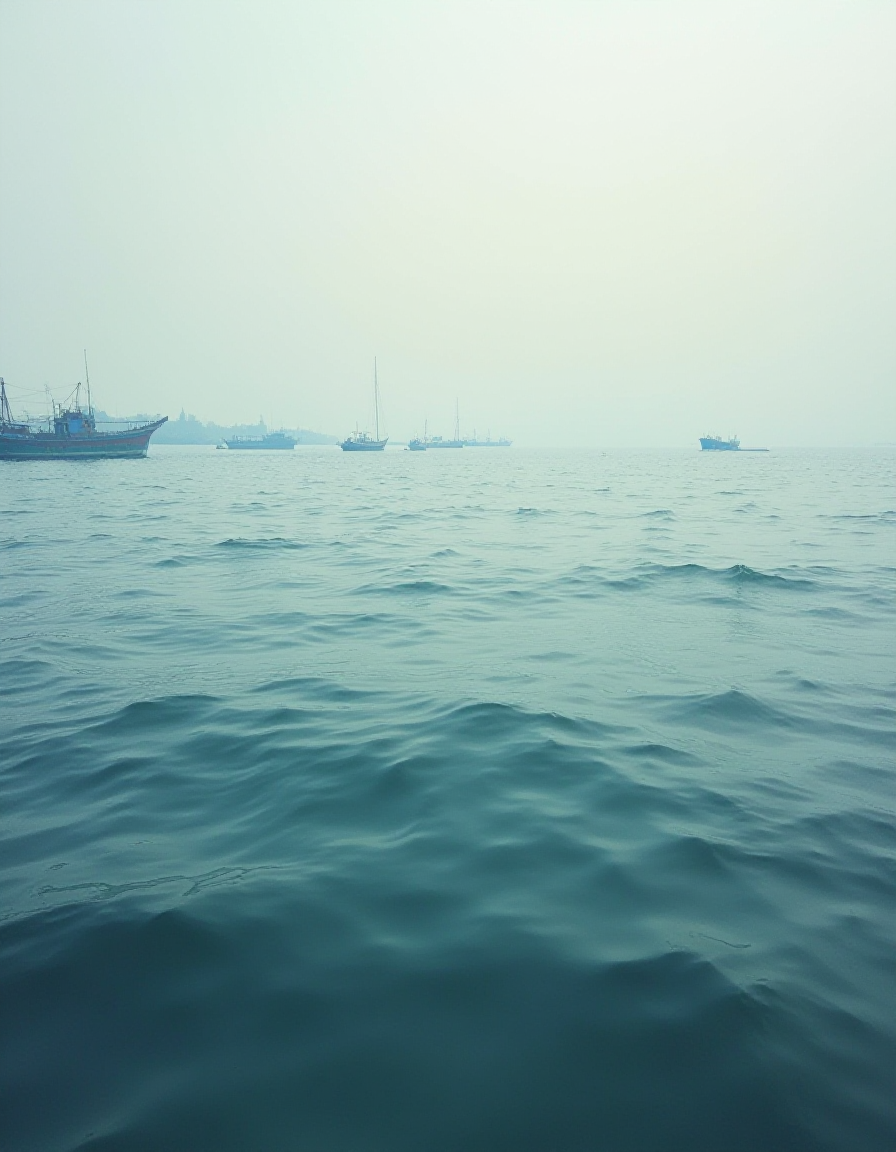
The image depicts a serene view of a large body of water with several boats and ships in the distance.
CAPTION
The image depicts a serene scene of a large body of water, likely a sea or a large lake, with several boats visible in the distance. The boats are scattered across the water, with some closer to the foreground and others further away. The water is calm, with gentle ripples indicating the presence of wind or the movement of the boats.
MONOLOGUE
While the ship Resolution navigated an open lake of water, in the 81st degree of north latitude, during a keen frost and strong north wind, on the 2d of June 1806, a whale appeared, and a boat put off in pursuit. On its second visit to the surface of the sea, it was harpooned. A convulsive heave of the tail, which succeeded the wound, struck the boat at the stern; and by its reaction, projected the boat-steerer overboard. As the line in a moment dragged the boat beyond his reach, the crew threw some of their oars towards him for his support, one of which he fortunately seized. The ship and boats being at a considerable distance, and the fast-boat being rapidly drawn away from him, the harpooner cut the line with the view of rescuing him from his dangerous situation. But no sooner was this act performed, than to their extreme mortification they discovered, that in consequence of some oars being thrown towards their floating comrade, and others being broken or unshipped by the blow from the fish, one oar only remained; with which, owing to the force of the wind, they tried in vain to approach him. A considerable period elapsed, before any boat from the ship could afford him assistance, though the men strained every nerve for the purpose. At length, when they reached him, he was found with his arms stretched over an oar, almost deprived of sensation.--On his arrival at the ship, he was in a deplorable condition. His clothes were frozen like mail, and his hair constituted a helmet of ice. He was immediately conveyed into the
SUMMARY
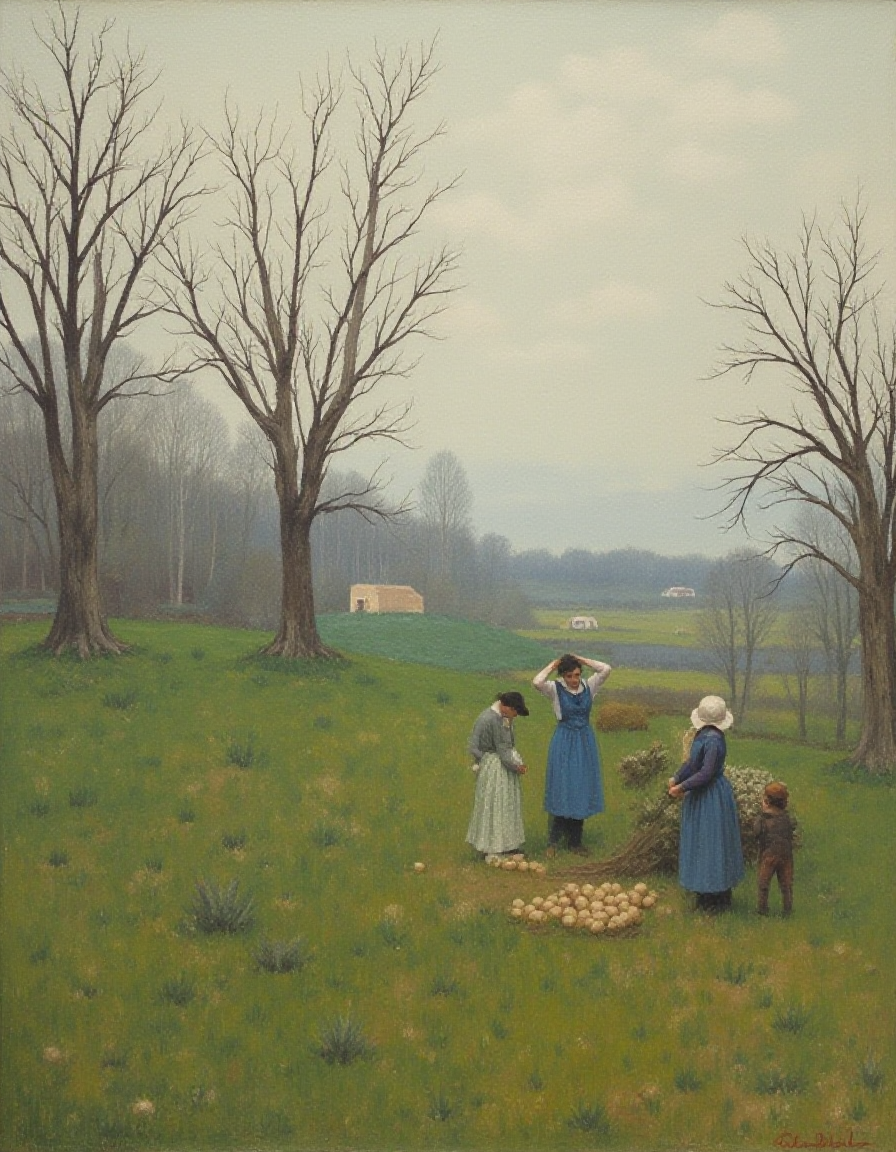
The painting depicts three women in a field, one of whom is bending over to pick up a stone.
CAPTION
The image depicts a serene rural scene with three women in period clothing, engaged in a task. The women are standing in a grassy field, with one woman bending down to pick up stones from the ground. The other two women are standing nearby, observing the activity.
MONOLOGUE
The English type of beauty appears to have especially won his approval. "When she spoke it sounded like the whispering of angels," he says of an Englishwoman, "as pretty as a picture," whom he met. Elsewhere he says, laconically: "On the 24th I arrived at Mainz with the steamer, in company with twenty to thirty English men and women. Next day the number of English increased to fifty. If I ever marry, it must be an English woman." Some years later, however, with the fickleness of genius, he writes about Ernestine, the daughter of a rich Bohemian Baron, "a delightfully innocent, childish soul, tender and pensive, attached to me and to everything artistic by the most sincere love, extremely musical--in short, just the kind of a girl I could wish to marry." He did become engaged to her, but the following year the engagement was dissolved; and soon after this he discovered that his artistic admiration for Clara Wieck had assumed the form of love. Although her father opposed their union several years, on account of Schumann's poverty, the young couple often met, and not only in the music-room. In 1833 he writes to his mother regarding Clara: "The other day, when we went to Connewitz (we take a two or three hours' walk almost daily), I heard her say to herself, 'How happy I am! how happy!' Who would not like to hear that! On this road there are a number of very useless stones in the midst of the footpath. Now, as it happens in conversation that I more frequently look up than down, she always walks behind me and gently pulls my coat
SUMMARY
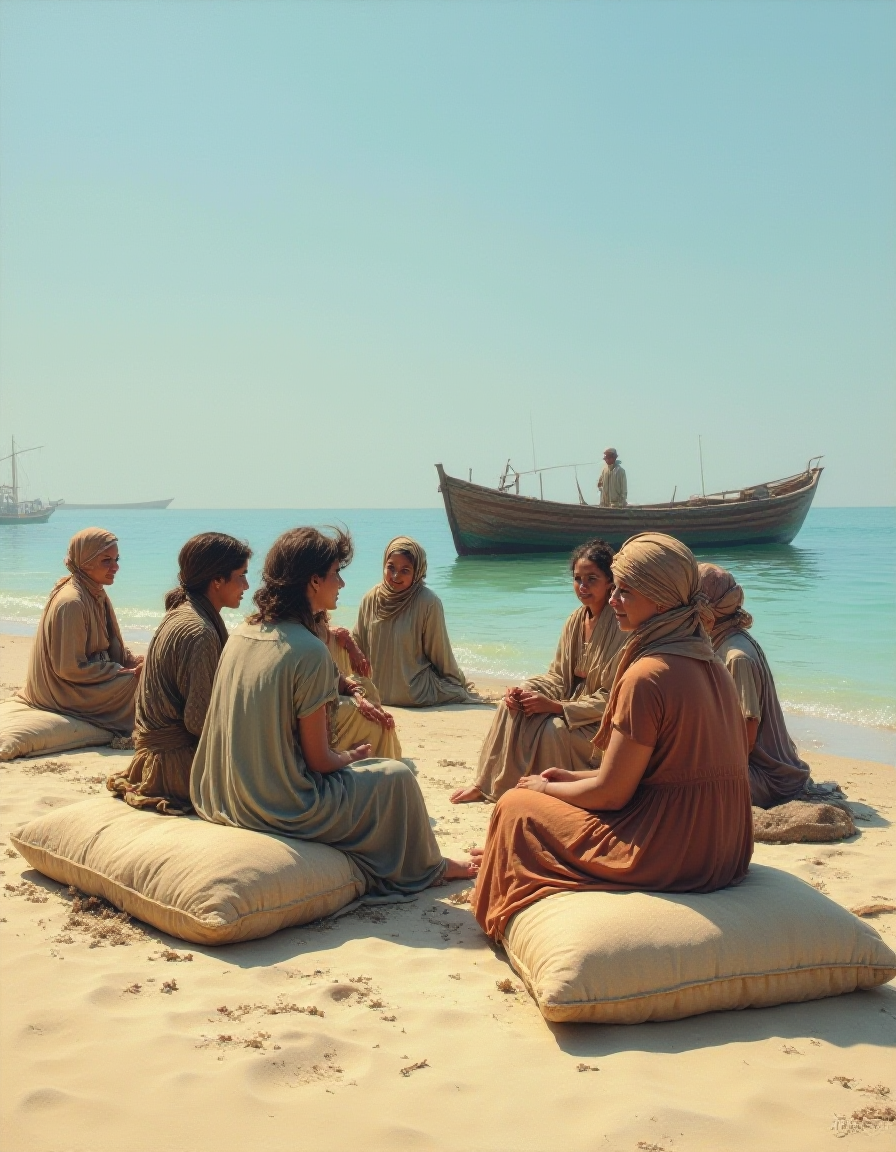
group of people sitting on beach with a boat in the water
CAPTION
The image depicts a serene beach scene with a group of people seated on beige cushions on the sand. The beach is bordered by a calm blue sea, with a small boat visible in the distance. The people are dressed in traditional attire, suggesting a cultural or religious context.
MONOLOGUE
_6th._--ROSE at day-break but did not start until after sun-rise. Continued through the sand. Scenery as yesterday, hills heaped upon heap, group around group, and sometimes a plain of sand, furrowed in pretty tesselated squares like the sands of the sea-shore. I walked about three hours to ease the nagah. The camels continued to flounder in the sand, throwing over their necks their heavy burdens. The ascents extremely difficult: people employed in scooping an inclined path for the animals. But, in the afternoon, about three, we saw through an opening of the shining heaps, a blue and black waste of contiguous desert. I could not help crying out for joy, like a man at the prow who descries the port, after having been buffeted about many a stormy day by contrary winds and currents. Much fatigued with the walking over the sands, and sick with drinking the brackish water of Mislah. Nothing _en route_ to-day except four crows, and a skeleton of a camel. This is the small crow of The Sahara (غراب الصحرا). People pretend it does not drink water. It may live on the flesh of the few camels which drop down and die from exhaustion, and on lizards. There are, however, no vultures and ravenous birds of huge dimensions in this region of Sahara. So that,
SUMMARY
The image depicts a serene beach scene at sunset, with sailboats and people enjoying the tranquil atmosphere.
CAPTION
The image depicts a serene beach scene at sunset. The sky is a gradient of orange and yellow, with the sun just setting on the horizon, casting a warm glow over the scene. The ocean is a deep blue, with waves gently crashing onto the shore.
MONOLOGUE
There were shouts; indeed, there's never a lack of shouts to celebrate a victory, however acquired; but there was also much grinding of teeth, especially amongst the fighting men from town. "Tom has sold us," said they, "sold us to the yokels; who would have thought it?" Then there was fresh grinding of teeth, and scowling brows were turned to the heaven; but what is this? is it possible, does the heaven scowl too? why, only a quarter of an hour ago--but what may not happen in a quarter of an hour? For many weeks the weather had been of the most glorious description, the eventful day, too, had dawned gloriously, and so it had continued till some two hours after noon; the fight was then over; and about that time I looked up--what a glorious sky of deep blue, and what a big, fierce sun swimming high above in the midst of that blue; not a cloud--there had not been one for weeks--not a cloud to be seen, only in the far west, just on the horizon, something like the extremity of a black wing; that was only a quarter of an hour ago, and now the whole northern side of the heaven is occupied by a huge black cloud, and the sun is only occasionally seen amidst masses of driving vapour; what a change! but another fight is at hand, and the pugilists are clearing the outer ring; how their huge whips come crashing upon the heads of the yokels; blood flows, more blood than in the fight: those blows are given with right good-will, those are not sham blows, whether of whip or fist; it is with fist that grim Shelton
SUMMARY
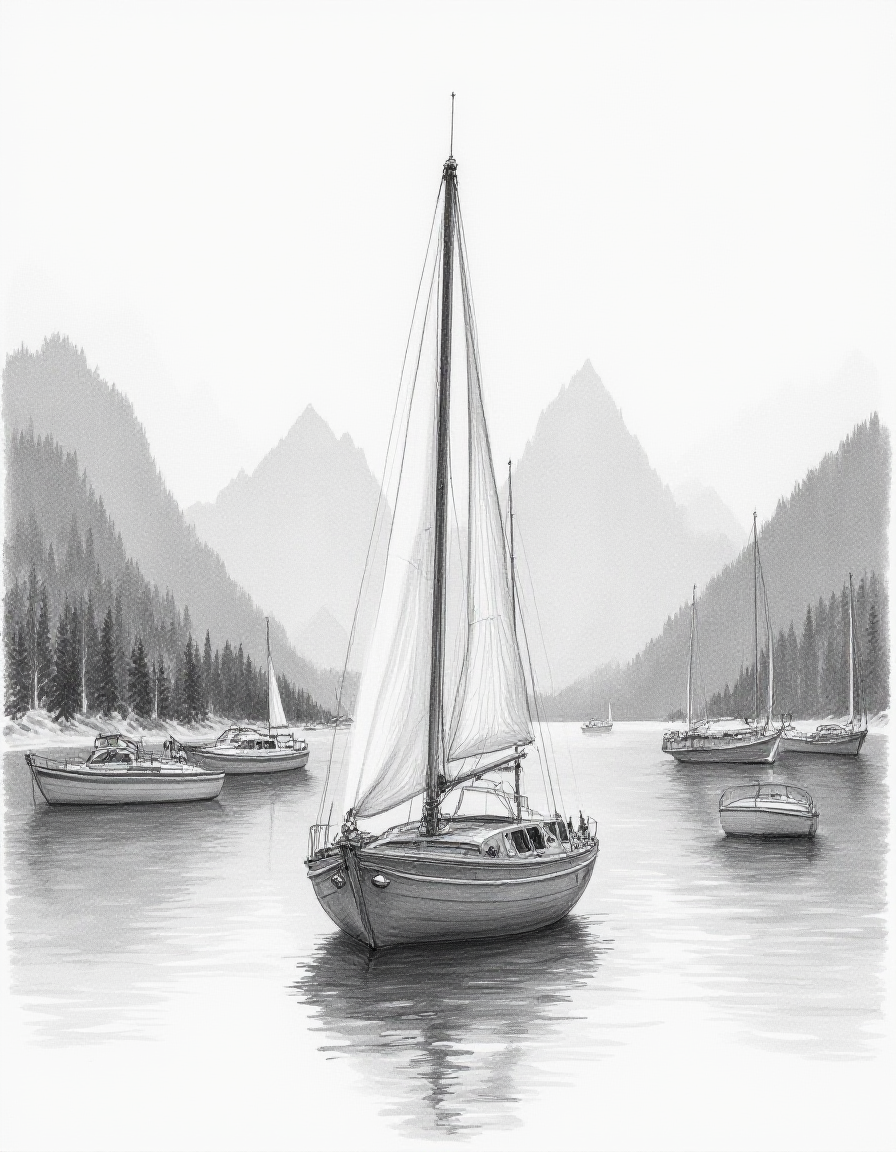
sailboat on lake with mountains in the background.
CAPTION
The image is a black and white pencil sketch of a serene lake scene. The lake is calm, with several sailboats anchored in the water. The sailboats are of varying sizes and designs, with one prominent sailboat in the foreground.
MONOLOGUE
"Beautiful as the European side of the Bosphorus is, the Asiatic is infinitely more striking. It owes nothing to man, but every thing to nature. There is neither a Buyukdere nor a Therapia, nor palaces of ambassadors, nor an Armenian nor Frank city; there is nothing but mountains with glens which separate them; little valleys enameled with green, which lie at the foot of overhanging rocks; torrents which enliven the scene with their foam; forests which darken it by their shade, or dip their boughs in the waves; a variety of forms, of tints, and of foliage, which the pencil of the painter is alike unable to represent or the pen of the poet to describe. A few cottages perched on the summit of projecting rocks, or sheltered in the bosom of a deeply indented bay, alone tell you of the presence of man. The evergreen oaks hang in such masses over the waves that the boatmen glide under their branches, and often sleep cradled in their arms. Such is the character of the coast on the Asiatic side as far as the castle of Mahomet II., which seems to shut it in as closely as any Swiss lake. Beyond that, the character changes; the hills are less rugged, and descend in gentler slopes to the water's edge; charming little plains, checkered with fruit-trees and shaded by planes, frequently open; and the delicious Sweet Waters of Asia exhibit a scene of enchantment equal to any described in the Arabian Nights. Women, children, and black slaves in every variety of costume and colour; veiled ladies from Constantinople; cattle and
SUMMARY
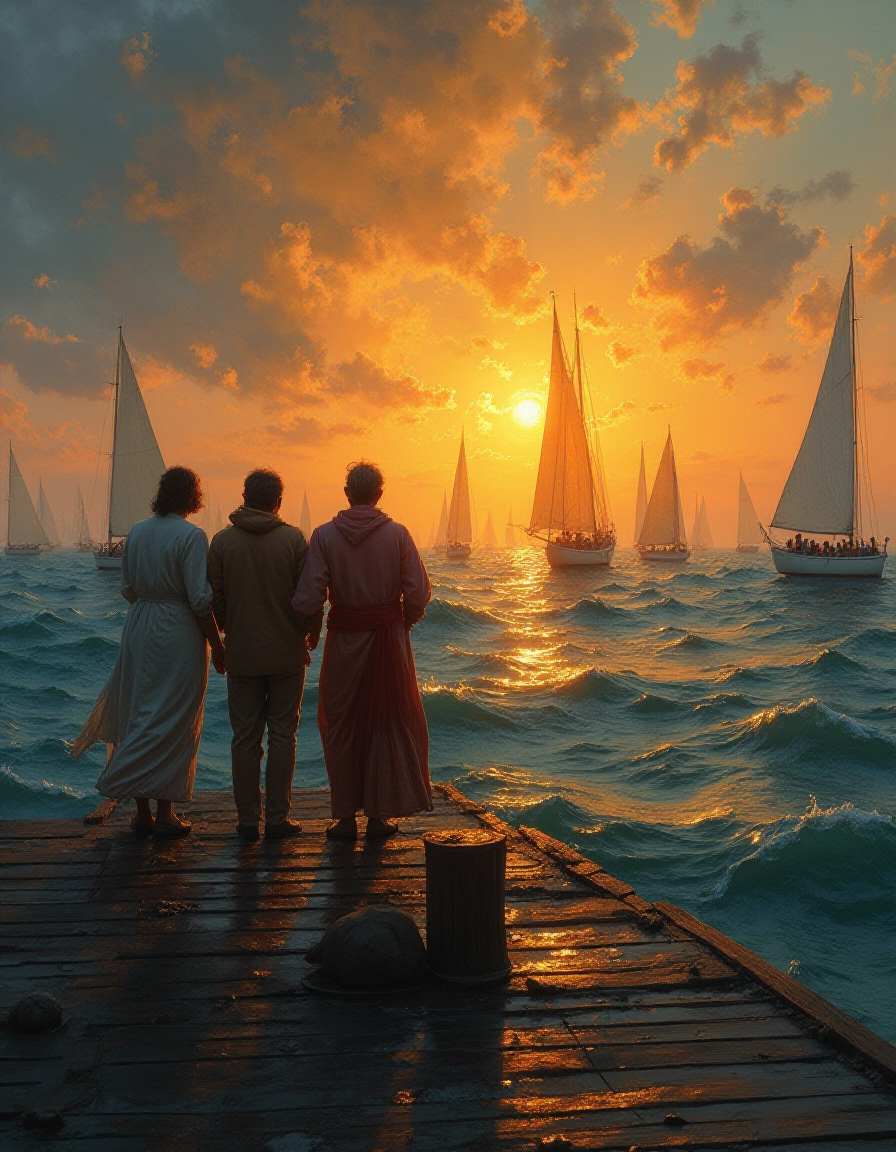
three people walking on a wooden pier at sunset.
CAPTION
The image depicts a serene scene at sunset, where three individuals are walking on a wooden pier. The sky is ablaze with hues of orange and yellow, reflecting the warm glow of the setting sun. Sailboats are scattered across the water, their sails billowing in the breeze.
MONOLOGUE
Next to seeing land, there is no sight which makes one realize more that he is drawing near home, than to see the same heavens, under which he was born, shining at night over his head. The weather was extremely hot, with the usual tropical alternations of a scorching sun and squalls of rain; yet not a word was said in complaint of the heat, for we all remembered that only three or four weeks before we would have given nearly our all to have been where we now were. We had plenty of water, too, which we caught by spreading an awning, with shot thrown in to make hollows. These rain squalls came up in the manner usual between the tropics.--A clear sky; burning, vertical sun; work going lazily on, and men about decks with nothing but duck trowsers, checked shirts, and straw hats; the ship moving as lazily through the water; the man at the helm resting against the wheel, with his hat drawn over his eyes; the captain below, taking an afternoon nap; the passenger leaning over the taffrail, watching a dolphin following slowly in our wake; the sailmaker mending an old topsail on the lee side of the quarter-deck; the carpenter working at his bench, in the waist; the boys making sinnet; the spun-yarn winch whizzing round and round, and the men walking slowly fore and aft with their yarns.--A cloud rises to windward, looking a little black; the sky-sails are brailed down; the captain puts his head out of the companion-way, looks at the cloud, comes up, and begins to walk the deck.--The
SUMMARY
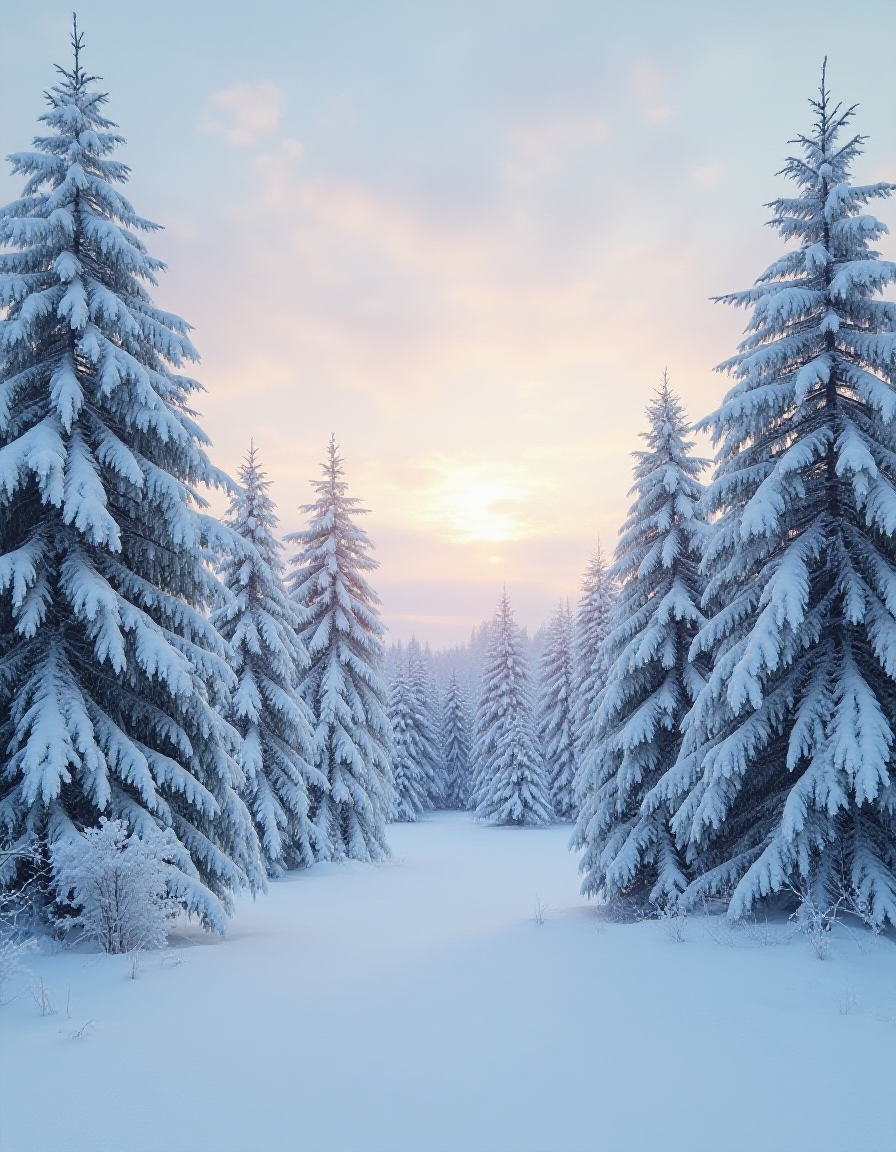
The image depicts a serene winter scene with snow-covered pine trees and a clear sky.
CAPTION
The image depicts a serene winter scene in a forest. The sky is painted in hues of pink and blue, suggesting a sunset. The sun is setting behind a line of tall, snow-covered pine trees, casting a soft glow over the scene.
MONOLOGUE
The following scene occurred at this residence on the morning following that of the arrival of Dagobert, with the daughters of Marshal Simon, in the Rue Brise-Miche. The hour of eight had sounded from the steeple of a neighboring church; a brilliant winter sun arose to brighten a pure blue sky behind the tall leafless trees, which in summer formed a dome of verdure over the summer-house. The door in the vestibule opened, and the rays of the morning sun beamed upon a charming creature, or rather upon two charming creatures, for the second one, though filling a modest place in the scale of creation, was not less distinguished by beauty of its own, which was very striking. In plain terms two individuals, one of them a young girl, and the other a tiny English dog, of great beauty, of that breed of spaniels called King Charles's, made their appearance under the peristyle of the rotunda. The name of the young girl was Georgette; the beautiful little spaniel's was Frisky. Georgette was in her eighteenth year. Never had Florine or Manton, never had a lady's maid of Marivaux, a more mischievous face, an eye more quick, a smile more roguish, teeth more white, cheeks more roseate, figure more coquettish, feet smaller, or form smarter, attractive, and enticing. Though it was yet very early, Georgette was carefully and tastefully dressed. A tiny Valenciennes cap, with flaps and flap-band, of half peasant fashion, decked with rose-colored ribbons, and stuck a little backward upon bands of beautiful
SUMMARY
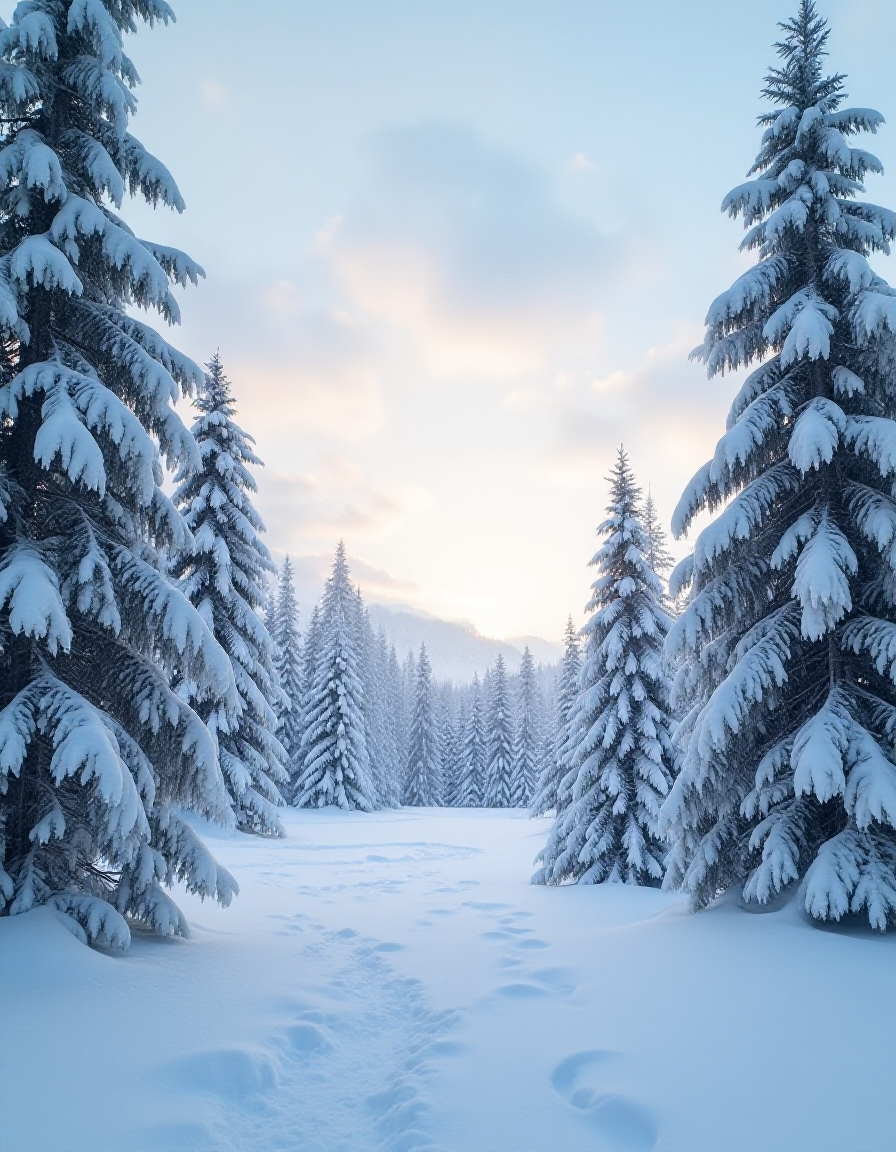
The image depicts a serene winter scene with snow-covered trees and a path leading into the distance.
CAPTION
The image captures a serene winter scene in a forest. The sky is a soft, light blue, suggesting a calm and peaceful atmosphere. Snow-covered pine trees, their branches heavy with snow, frame the scene.
MONOLOGUE
Random meditations of this kind were sent flying through me by the newspaper articles on Tennyson and Mr. Gladstone. The air cleared, and my mind also, as we ran beyond the smoke. The fields were covered deep with snow; a white vapour clung along the ground, the winter sky shining through it soft and blue. The ponds and canals were hard frozen, and men were skating and boys were sliding, and all was brilliant and beautiful. The ladies of the forest, the birch trees beside the line about Farnborough, were hung with jewels of ice, and glittered like a fretwork of purple and silver. It was like escaping out of a nightmare into happy healthy England once more. In the carriage with me were several gentlemen; officers going out to join their regiments; planters who had been at home on business; young sportsmen with rifles and cartridge cases who were hoping to shoot alligators, &c., all bound like myself for the West Indian mail steamer. The elders talked of sugar and of bounties, and of the financial ruin of the islands. I had heard of this before I started, and I learnt little from them which I had not known already; but I had misgivings whether I was not wandering off after all on a fool's errand. I did not want to shoot alligators, I did not understand cane growing or want to understand it, nor was I likely to find a remedy for encumbered and bankrupt landowners. I was at an age too when men grow unfit for roaming, and are expected to stay quietly at home. Plato says that to travel to any profit one should go between
SUMMARY
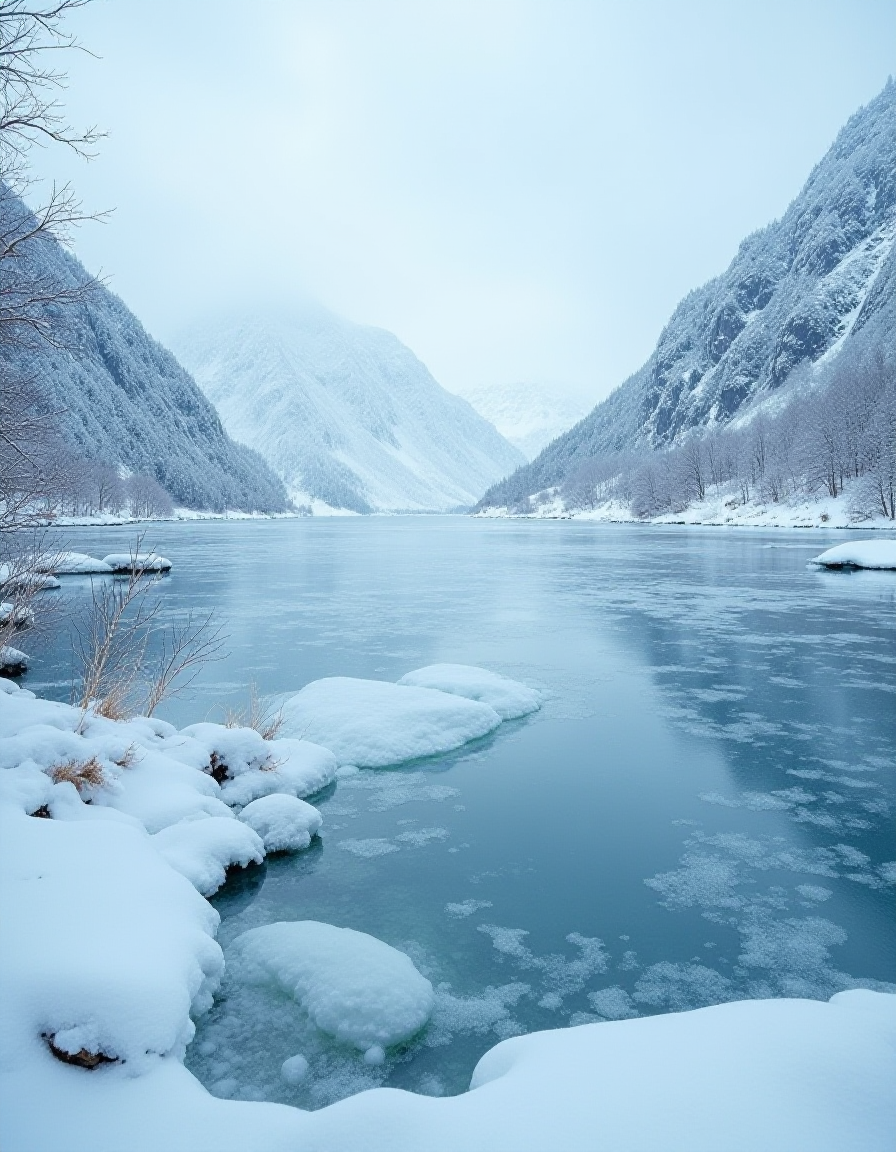
The image depicts a serene winter landscape featuring a frozen lake surrounded by snow-covered mountains.
CAPTION
The image captures a serene winter scene in a mountainous area. The main focus is a frozen lake, blanketed in a thick layer of snow. The lake's surface is a deep blue, reflecting the surrounding mountains and trees.
MONOLOGUE
The weather was very dry, and the ground was a mass of little pitfalls, about two feet deep, which had been made by the feet of the elephants in the wet weather, when this spot was soft mud and evidently the favourite resort of the heavy game. The ground was now baked by the sun as hard as though it were frozen, and the numerous deep ruts made walking very difficult. Several large trees and a few bushes grew upon the surface, but for the most part it was covered by a short though luxuriant grass. One large tree grew within fifty yards of the extreme point of the promontory, and another of the same kind grew at an equal distance from it, but nearer to the main land. Upon both these trees was a coat of thick mud not many hours old. The bark was rubbed completely away, and this appeared to have been used for years as a favourite rubbing-post by some immense elephant. The mud reached full twelve feet up the trunk of the tree, and there were old marks far above this which had been scored by his tusks. There was no doubt that one of these tank rogues of extraordinary size had frequented this spot for years, and still continued to do so, the mud upon the tree being still soft, as though it had been left there that morning. I already coveted him, and having my telescope with me, I took a minute survey of the opposite shore, which was about half a mile distant and was lined with fine open forest to the water's edge. Nothing was visible. I examined the other side of the lake with the same want of success. Although it was such a quiet spot, with
SUMMARY
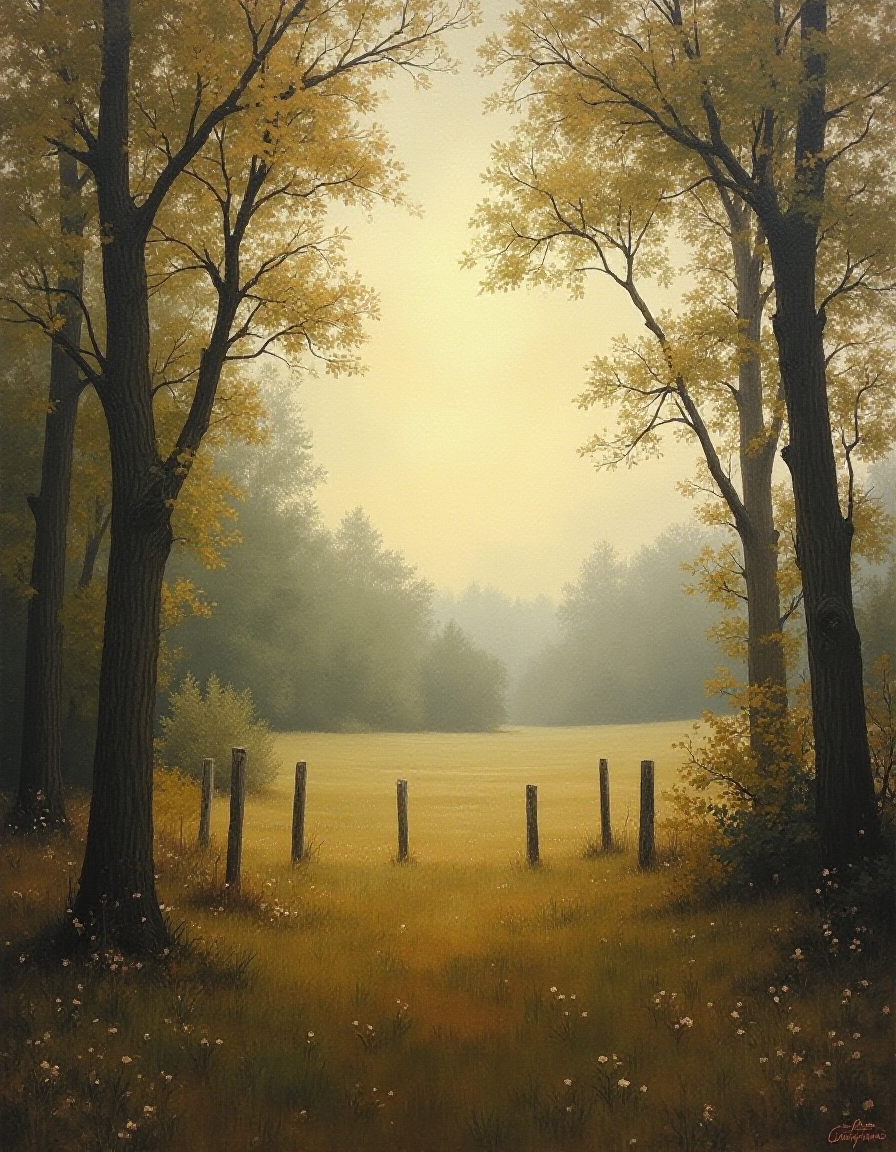
The image depicts a serene rural landscape with a field of tall grass and trees in the foreground. The sky is hazy, adding a sense of tranquility to the scene.
CAPTION
The image depicts a serene rural scene with a misty atmosphere. The foreground is dominated by a grassy field, which is a vibrant yellow, suggesting a warm, sunny day. The field is bordered by a row of wooden posts, which are evenly spaced and appear to be part of a fence or boundary.
MONOLOGUE
I remember such a path, the access to which is from Lovers' Grove, a range of tall old oaks and elms on a high hill-top, whence there is a view of Warwick Castle, and a wide extent of landscape, beautiful, though bedimmed with English mist. This particular foot-path, however, is not a remarkably good specimen of its kind, since it leads into no hollows and seclusions, and soon terminates in a high-road. It connects Leamington by a short cut with the small neighboring village of Lillington, a place which impresses an American observer with its many points of contrast to the rural aspects of his own country. The village consists chiefly of one row of contiguous dwellings, separated only by party-walls, but ill-matched among themselves, being of different heights, and apparently of various ages, though all are of an antiquity which we should call venerable. Some of the windows are leaden-framed lattices, opening on hinges. These houses are mostly built of gray stone; but others, in the same range, are of brick, and one or two are in a very old fashion,--Elizabethan, or still older,--having a ponderous framework of oak, painted black, and filled in with plastered stone or bricks. Judging by the patches of repair, the oak seems to be the more durable part of the structure. Some of the roofs are covered with earthen tiles; others (more decayed and poverty-stricken) with thatch, out of which sprouts a luxurious vegetation of grass, house-leeks, and yellow flowers. What especially strikes an American is the lack of that
SUMMARY
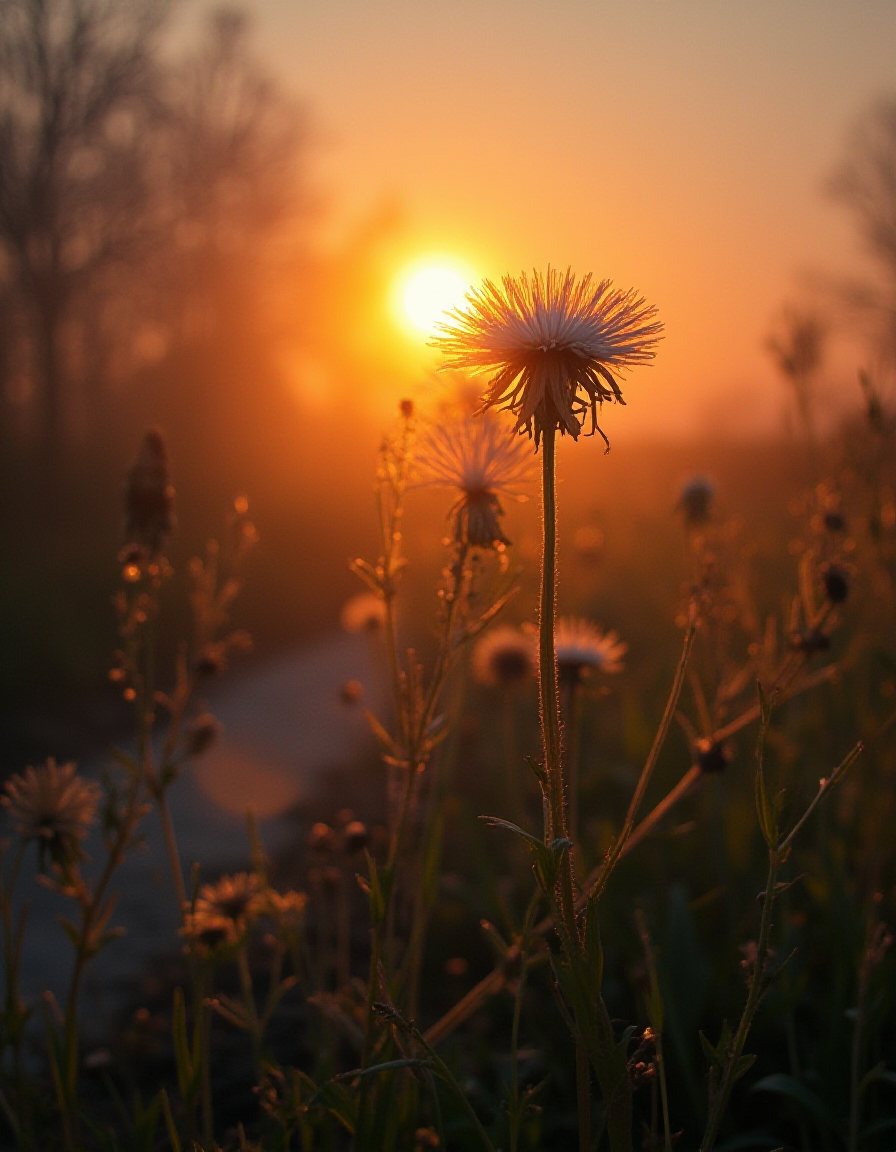
dandelion flower in full bloom with the sun setting in the background.
CAPTION
The image captures a serene scene of a field at sunset. The sun, positioned in the upper right corner of the frame, casts a warm glow over the field. The field is filled with a variety of wildflowers, their petals contrasting with the surrounding greenery.
MONOLOGUE
During the late days of October and the early days of November the long drought of summer had been broken, and it had rained steadily, copiously, refreshingly. Since then there had been day after day of brilliant, cloudless sunshine, and the moist earth, warmed gratefully through to the marrow, stirred and trembled and pushed forth myriads of tender shoots from the seeds that were hidden in its bosom; and the tender shoots themselves looked up to the sun, and, with their roots nestled in sweet, fragrant beds of richness, thought only of growing tall and green, dreamed only of the time when pink pimpernels would bloom between their waving blades, and when tribes of laughing children would come to ramble over the hillsides. The streets of the city were full of the fragrance of violets, for the flower-vendors had great baskets of them over their arms, and every corner tempted the passers-by with the big odorous purple bunches that offered a royal gift of sweetness for every penny invested.
SUMMARY
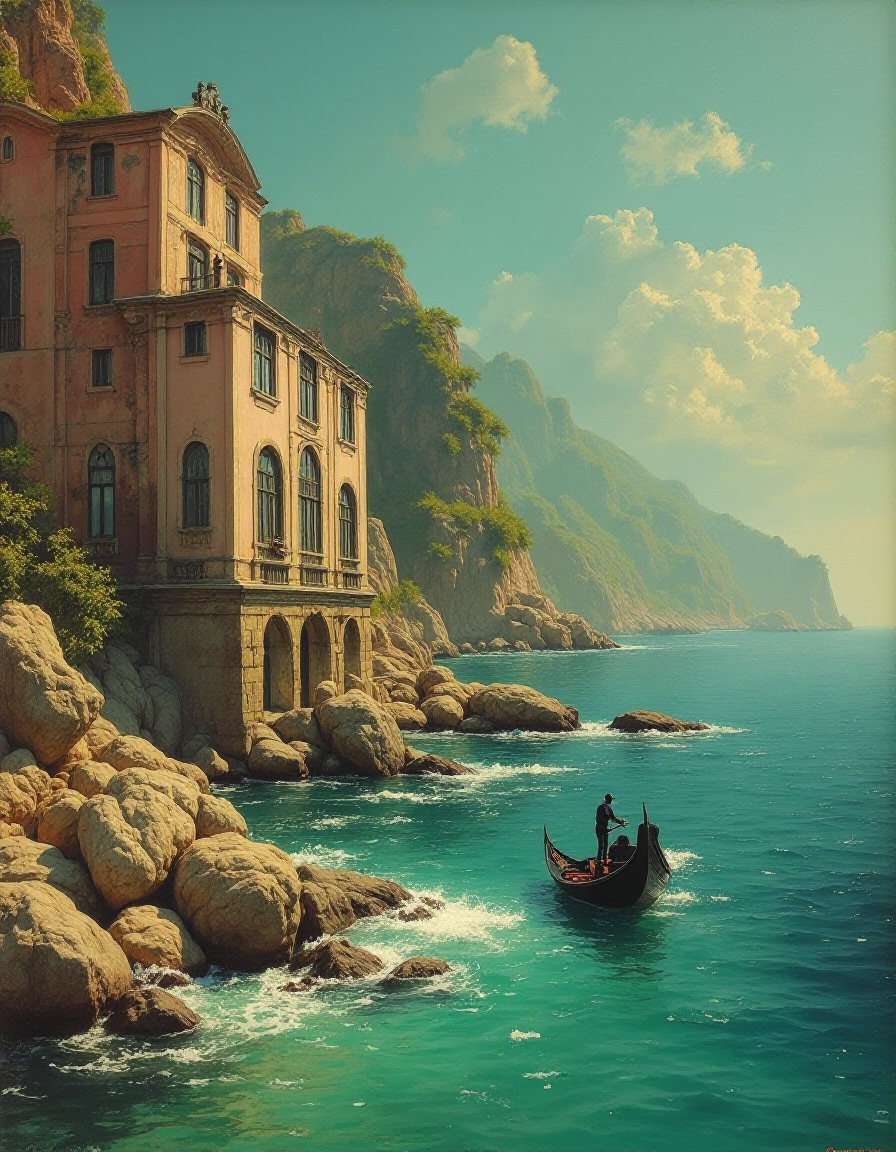
The original image shows a gondolier steering a gondola on a rocky coast with a building on the cliff.
CAPTION
The image depicts a serene coastal scene with a gondola sailing on a turquoise-blue sea. The gondola is being rowed by a person, and the backdrop features a picturesque old town with a pink building and a stone bridge. The sky is clear with a few clouds, and the sea is calm with gentle waves.
MONOLOGUE
About three miles northward of Penrice, upon a mountain called Cum Bryn, near Llanridian, is a table-like monument, or cromlech, {29} called Arthur's stone: it consists of a huge flat stone, supposed to weigh near twenty tons, supported upon six or seven others about five feet in height; the smaller stones are placed in a circle.--A few miles farther, near the mouth of the Loughor, is Webley castle, which was described to me as a place of considerable antique strength, and as being still entire and partially inhabited. The difficulty of access to this castle, and its out-of-the-way situation, prevented our visiting it; similar reasons also prevented our seeing a curiosity at Wormshead point, a bold promontory jutting far into the sea, and divided from the main land at high-water by the sea's overflowing its low isthmus. Near the extremity of the point is a cleft in the ground, in which if dust or sand be thrown, it will be returned back into the air; and a person applying his ear to the crevice will hear a deep noise, like the blowing of a large pair of bellows: this effect is reasonably attributed to the concussions of the waves of the sea in the cavernous hollows of the cliff. An old author, I think Giraldus Cambrensis, speaks of a similar phenomenon in Barry island, near the coast between Cardiff and Cowbridge; but at present no such effect is produced at that place.
SUMMARY
couple standing on a pier at sunset with a suitcase
CAPTION
The image captures a serene moment at sunset on a pier. The sky is a gradient of orange and pink, with the sun just setting on the horizon. The water is calm, reflecting the warm hues of the sky.
MONOLOGUE
_Saturday, December_ 10.--Dead Reckoning 66 deg. 38'. Long. 178 deg. 47'. Made good S. 17 W. 94. C. Crozier 688'. Stayed on deck till midnight. The sun just dipped below the southern horizon. The scene was incomparable. The northern sky was gloriously rosy and reflected in the calm sea between the ice, which varied from burnished copper to salmon pink; bergs and pack to the north had a pale greenish hue with deep purple shadows, the sky shaded to saffron and pale green. We gazed long at these beautiful effects. The ship made through leads during the night; morning found us pretty well at the end of the open water. We stopped to water ship from a nice hummocky floe. We made about 8 tons of water. Rennick took a sounding, 1960 fathoms; the tube brought up two small lumps of volcanic lava with the usual globigerina ooze.
SUMMARY
a night sky with a galaxy and stars in the background, a snow-covered path leading into the distance, and a forest of pine trees on either side
CAPTION
The image depicts a serene winter scene with a winding snow-covered path leading into a snowy forest. The sky above is a vibrant mix of purple and pink hues, with a starry night sky. The path is flanked by tall evergreen trees, their branches heavy with snow.
MONOLOGUE
As early as the sixth century, the sea had already retreated to such a distance from Ravenna that orchards and gardens were cultivated on the spot where once the galleys of the Cæsars rode at anchor. Groves of pines sprang up along the shore, and in their lofty tops the music of the wind moved like the ghost of waves and breakers plunging upon distant sands. This Pinetum stretches along the shore of the Adriatic for about forty miles, forming a belt of variable width between the great marsh and the tumbling sea. From a distance the bare stems and velvet crowns of the pine-trees stand up like palms that cover an oasis on Arabian sands; but at a nearer view the trunks detach themselves from an inferior forest-growth of juniper and thorn and ash and oak, the tall roofs of the stately firs shooting their breadth of sheltering greenery above the lower and less sturdy brushwood. It is hardly possible to imagine a more beautiful and impressive scene than that presented by these long alleys of imperial pines. They grow so thickly one behind another, that we might compare them to the pipes of a great organ, or the pillars of a Gothic church, or the basaltic columns of the Giant's Causeway. Their tops are evergreen and laden with the heavy cones, from which Ravenna draws considerable wealth. Scores of peasants are quartered on the outskirts of the forest, whose business it is to scale the pines and rob them of their fruit at certain seasons of the year. Afterwards they dry the fir-cones in the
SUMMARY
a woman with large hoop earrings and red lipstick is standing in the desert at sunset
CAPTION
The image depicts a person with a serene and contemplative expression, set against a backdrop of a sunset. The individual is wearing large hoop earrings and has a pair of red lipstick on their lips. The setting sun casts a warm glow over the scene, creating a serene atmosphere.
MONOLOGUE
They were approaching the mountains and the country around them was broken into barren, rocky hills. The road grew rougher and the mountains towered above them in jagged peaks of seemingly solid rock. The day was nearly ended and Wellesly remembered enough of the distances along the Las Plumas road to be sure that they ought to be approaching Muletown. But in this stern wilderness of rock and sand, human habitation did not seem possible. He looked back across the desert at the Fernandez mountains, standing out sharply against the red sunset clouds, and it suddenly flashed across his mind that if the sun were setting there they must have been traveling in an easterly direction all the afternoon, which meant that they had been getting farther and farther away from Las Plumas. Enlightened by this idea, he sent a quick, seeing glance along the range of mountains standing out boldly and barrenly in front of them, and he knew it was not the Hermosa range. Haney turned with a jovial remark on his lips and met Wellesly's eyes, two narrow strips of pale gray shining brilliantly from between half-closed lids, and saw that his game had played itself smoothly as far as it would go.
SUMMARY
The image depicts a serene landscape featuring a body of water, possibly a lake or ocean, with a mountainous backdrop. The mountains are covered in snow, adding a sense of tranquility and natural beauty to the scene. The sky above is clear, indicating a bright and sunny day.
CAPTION
The image depicts a serene landscape featuring a vast body of water, possibly a lake or ocean, with a mountainous backdrop. The mountains are covered in snow, and the sky is clear with a few clouds. The water is calm, with small ripples visible on its surface, suggesting gentle waves.
MONOLOGUE
But here is the promised description of it. "Before pursuing our way westward, we would wish to direct the traveller's attention to a sequestered spot of peculiar beauty on the river Foyers. This is a secluded vale, called Killean, which, besides its natural attractions--and these are many--is distinguished as one of the few places where the old practice of resorting to the 'shieling' for summer grazing of cattle is still observed. It is encompassed on all sides by steep mountains; but at the north end there is a small lake, about a mile and a half in length, and from one-third to half a mile in breadth. The remainder of the bottom of the glen is a perfectly level tract, of the same width with the lake, and about two miles and a half in length, covered with the richest herbage, and traversed by a small meandering river flowing through it into the lake. The surface of this flat is bedecked with the little huts or bothies which afford temporary accommodation to the herdsmen and others in charge of the cattle. This portion of the glen is bordered on the west by continuous hills rising abruptly in a uniformly steep acclivity, and passing above into a perpendicular range of precipices, the whole covered with a scanty verdure sprouted with heath. At a bend of the lake near its middle, where it inclines from a northernly course towards the west, a magnificent rounded precipice, which, like the continuous ranges, may be about 1200 feet in height, rises immediately out of the water; and a few
SUMMARY
The image depicts a lush, verdant valley with a winding path leading into the distance. The valley is encircled by towering mountains, their peaks shrouded in mist, adding a mystical atmosphere to the scene. The sky above is a clear blue, with a few clouds scattered across it, suggesting a bright and sunny day. The overall composition of the
CAPTION
The image depicts a serene, mountainous landscape with a winding path leading into the distance. The path is surrounded by lush greenery, including trees and bushes, and is flanked by towering cliffs. The sky above is a clear blue, with a few clouds scattered across it.
MONOLOGUE
Janet loved beautiful things, especially pictures, and she could be sure, at one glance, that these were pictures such as one does not often see. She remembered being taken by her father to a famous gallery to see a landscape so much akin to the one before her that they had undoubtedly been painted by the same artist, a green hillside with sailing clouds above it, on a clear October day, "the sort that makes you feel that you can see a hundred miles," as Janet put it. There was another, a winding white road running up a wind-swept valley with the trees bowing to a storm and a spatter of rain slanting across the hill, there was a portrait of a fierce old lady and another of a man with lace ruffles and a satin coat. There was a long, cool wave, breaking upon a beach where the whiteness of the sun-splashed sand was so vivid as almost to hurt her eyes.
SUMMARY
A lone figure stands on a riverbank, gazing out at a breathtaking sunset over a mountain range. The figure, silhouetted against the vibrant sky, is the focal point of the image. The river, calm and still, reflects the colors of the sunset, adding a sense of depth and dimension to the scene. The mountains, silhouetted
CAPTION
The image depicts a serene scene of a person standing on a body of water, with mountains in the background. The sky is filled with clouds, casting a dramatic effect over the scene. The person appears to be looking out at the water, possibly contemplating the vastness of the landscape.
MONOLOGUE
Newman possessed a remarkable talent for sitting still when it was necessary, and he had an opportunity to use it on his journey to Switzerland. The successive hours of the night brought him no sleep, but he sat motionless in his corner of the railway-carriage, with his eyes closed, and the most observant of his fellow-travelers might have envied him his apparent slumber. Toward morning slumber really came, as an effect of mental rather than of physical fatigue. He slept for a couple of hours, and at last, waking, found his eyes resting upon one of the snow-powdered peaks of the Jura, behind which the sky was just reddening with the dawn. But he saw neither the cold mountain nor the warm sky; his consciousness began to throb again, on the very instant, with a sense of his wrong. He got out of the train half an hour before it reached Geneva, in the cold morning twilight, at the station indicated in Valentin’s telegram. A drowsy station-master was on the platform with a lantern, and the hood of his overcoat over his head, and near him stood a gentleman who advanced to meet Newman. This personage was a man of forty, with a tall lean figure, a sallow face, a dark eye, a neat moustache, and a pair of fresh gloves. He took off his hat, looking very grave, and pronounced Newman’s name. Our hero assented and said, “You are M. de Bellegarde’s friend?”
SUMMARY
The image depicts a serene winter landscape where a river flows through a snowy forest. The sun is setting, casting a warm glow over the scene, enhancing the colors and creating a picturesque atmosphere.
CAPTION
The image captures a serene winter scene, bathed in the warm glow of a setting sun. The foreground is a snowy landscape, blanketed in a layer of snow that contrasts sharply with the vibrant hues of the sky. The snow-covered ground is dotted with patches of bare trees, their branches reaching out towards the sky.
MONOLOGUE
At last we attained a weird country, in which the ground was bare, save where some sheltered and sunny spot showed bunches of very tall violets, hanging over in tufts, rare purple anemones, and here and there a great full iris; yet these patches were so exceptional as to make a strong contrast with the brown soil. But the main features were single oak-trees with pollarded tops and gnarled branches, which stood about all over these lofty slopes, and gave them a melancholy and dilapidated aspect. They showed no mark of spring, no shoot or budding leaf, but the russet brown rags of last year's clothing hung here and there upon the branches. These wintry signs, the gloomy mist, and the insisting rain gave us the feeling of chill October. And yet the weird oaks, with their branches tortured as it were by storm and frost--these crippled limbs, which looked as if the pains of age and disease had laid hold of the sad tenants of this alpine desert--were colored with their own peculiar loveliness. All the stems were clothed with delicate silver-gray lichen, save where great patches of velvety, pale green moss spread a warm mantle about them. This beautiful contrast of gray and yellow-green may be seen upon many of our own oak-trees in the winter, and makes these the most richly colored of all the leafless stems in our frosty landscape. But here there were added among the branches huge tufts of mistletoe, brighter and yellower than the moss, yet of the same grassy hue, though of different texture. And there
SUMMARY
The image depicts a serene landscape featuring a body of water, surrounded by lush greenery and a majestic mountain range. The sky is a clear blue, dotted with fluffy white clouds, and the sun is shining brightly, casting a warm glow over the scene. The water is calm, reflecting the clear sky and the surrounding vegetation. The image is taken from a
CAPTION
The image depicts a serene landscape featuring a body of water, possibly a lake, surrounded by lush greenery and a mountainous backdrop. The sky is clear with a few clouds, and the scene is bathed in natural light, suggesting a sunny day.
MONOLOGUE
We were able to enjoy this delightful variety of esculents for more than a month. Then, the little tubercles of the fern became hollow and horny, and the stems themselves grew as hard as wood; while the nettles, armed with a long white beard, presented only a menacing and awful aspect. Later in the year, when the season was more advanced, the perfumed strawberry of the mountain and the white mushroom of the valley, became invaluable substitutes for fern and nettle. But we had to wait a long time for these luxuries, the cold in these countries being of protracted duration, and the vegetation, of consequence, exceedingly late. Throughout June there is snow still falling, and the wind is so cold that you cannot, without imprudence, throw aside your fur coats. With the first days of July, the warmth of the sun begins to be felt, and the rain falls in heavy showers; no sooner has the sky cleared up, than a warm vapour rises from the earth, in surprising abundance. You see it first skimming the surface of the valleys and the low hills; then it condenses, and oscillates about somewhat above the surface, becoming, by degrees, so thick that it obscures the light of day. When this vapour has ascended high enough in the air to form great clouds, the south wind rises, and the rain again pours down upon the earth. Then the sky becomes clear once more, and once more the vapour rises and rises, and so it goes on. These atmospheric revolutions continue for a fortnight. Meanwhile, the
SUMMARY
young woman with curly hair, wearing a beige scarf, looking to the right, outdoors, with a clear sky in the background.
CAPTION
The image depicts a young person with curly hair, wearing a beige scarf wrapped around their neck. The person is looking directly at the camera, with a serene expression on their face. The background is blurred, suggesting a natural setting, possibly a field or a desert.
MONOLOGUE
For a wicked instant I was tempted to turn away and leave our unrepentant enemy where he was. The impulse passed as quickly as it came, but I am not ashamed to confess that before setting to work to try to extricate the prisoner I threw my arms around Guard's neck and hugged him ecstatically. "It's all right; we're safe!" I whispered in his ear, as if he could understand me--and I am not sure to this day that he could not. Then I began tugging away at the rotten pieces of wood that, fallen in a heap, formed a rough sort of wickiup, under which Mr. Horton reclined at length. It was a pretty hard task, for some of the timbers were heavy enough to tax all my strength; but an opening was made at last, and through it Mr. Horton slowly crawled into the light. He was compelled to advance backward, after the manner of the crawfish, and as he finally got clear of the ruins and staggered to his feet, he was a most disreputable-looking figure. Apart from a good many scratches and bruises, he did not seem to be injured in the least. The timbers had fallen in such a way that their weight did not rest on him. His scowling face, as he turned it to the light, was further disfigured by several long scratches and by a dry coating of blood and dirt. His coat--the coat, again--was torn, his hat gone, and his bushy iron-gray hair stood fiercely upright. The change from the semi-darkness of his place of imprisonment to the full light of day partially blinded him, and he stood, blinking and winking
SUMMARY
The image depicts a serene, mountainous landscape bathed in the warm glow of a setting sun. The sun, positioned high in the sky, casts a golden hue over the landscape, creating a serene and tranquil atmosphere. The foreground is dominated by a winding dirt path, flanked by lush greenery and small bushes, adding a touch of nature's charm to
CAPTION
The image depicts a serene, mountainous landscape bathed in the warm glow of a setting sun. The sun, positioned high in the sky, casts a golden hue over the scene, creating a serene atmosphere. The mountains, covered in lush greenery, rise up from the foreground, their peaks reaching towards the sky.
MONOLOGUE
Down in the valley squirrels were busy climbing the hazel trees; rabbits made bold and ventured from their hiding places to gambol in the autumnal sunshine; weasels sported among the ferns; birds sang and insects buzzed, while nature looked on and smiled. Larch, birch, oak, and sycamore were altogether mingled, and perfect harmony there was in bower and hedgerow. Everybody came to the valley and everybody enjoyed coming, because there was no place like it. There was no color that you could not find there; but if you searched all day and all night too, only one house could you find in all its leafy splendor. Nor was it a large house. Just two stories high, with medium-sized windows below and small dormer windows on top. The roof was made of thatch, and the thatch, from being bleached in the sun, had turned to a golden hue. The walls, no one could tell what they were made of, so well were they covered with ivy and other green creepers. In the garden in front there were roses, pinks, and geraniums; and in the garden behind, nasturtiums, money-musk, and golden feather grew on a rockery made of large stones that were brought from Conlan's Strand, where the children of Lir (before they became swans) used to play and watch the great ships sailing over the seas. It was a beautiful place to live, was this house, and whosoever looked upon it never forgot the house in the valley.
SUMMARY
The cup of tea is placed on a wooden table, surrounded by a woven basket and a blue cloth.
CAPTION
The image depicts a serene scene of a wooden table set with a blue ceramic cup and saucer, surrounded by a woven basket and a blue cloth. The table is situated in a lush, green environment with a bamboo hut in the background. The lighting in the scene is warm, suggesting it is either early morning or late afternoon.
MONOLOGUE
When we rose in the evening, we commenced our day by prayers, after which we took off our fur sleeping-dresses and put on those for travelling; the former being made of camlet, lined with racoon-skin, and the latter of strong blue box-cloth. We made a point of always putting on the same stockings and boots for travelling in, whether they dried during the day or not; and I believe it was only in five or six instances, at the most, that they were not either wet or hard-frozen. This, indeed, was of no consequence, beyond the discomforture of first putting them on in this state, as they were sure to be thoroughly wet in a quarter of an hour after commencing our journey; while, on the other hand, it was of vital importance to keep dry things for sleeping in. Being "rigged" for travelling, we breakfasted upon warm cocoa and biscuit, and, after stowing the things in the boats and on the sledges, so as to secure them as much as possible from wet, we set off on our day's journey, and usually travelled from five to five and a half hours, then stopped an hour to dine, and again travelled four, five, or even six hours, according to circumstances. After this we halted for the night, as we called it, though it was usually early in the morning, selecting the largest surface of ice we happened to be near for hauling the boats on, in order to avoid the danger of its breaking up by coming in contact with other masses, and also to prevent drift as much as possible. The boats were placed close alongside each other, with their
SUMMARY
beach scene with sunset and clouds.
CAPTION
The image captures a serene beach scene bathed in the warm hues of sunset. The sky, a canvas of vibrant orange and pink, is filled with a multitude of clouds, their edges illuminated by the setting sun.
MONOLOGUE
If any artist, I do not say had executed, but had merely conceived in his mind the system of the sun, and the stars, and planets, they not existing, and had painted to us in words, or upon canvas, the spectacle now afforded by the nightly cope of heaven, and illustrated it by the wisdom of astronomy, great would be our admiration. Or had he imagined the scenery of this earth, the mountains, the seas, and the rivers; the grass, and the flowers, and the variety of the forms and masses of the leaves of the woods, and the colours which attend the setting and the rising sun, and the hues of the atmosphere, turbid or serene, these things not before existing, truly we should have been astonished, and it would not have been a vain boast to have said of such a man, "Non merita nome di creatore, se non Iddio ed il Poeta." But now these things are looked on with little wonder, and to be conscious of them with intense delight is esteemed to be the distinguishing mark of a refined and extraordinary person. The multitude of men care not for them. It is thus with Life--that which includes all.