room








SUMMARY
a woman with a crown of flowers on her head sits in a room with blue lighting
CAPTION
The image depicts a woman sitting in a dimly lit room, surrounded by vibrant neon lights. She is dressed in a black bikini top and has long, curly hair. The room is filled with various neon lights, creating a lively and colorful atmosphere.
MONOLOGUE
In the corridor to the left he opened a door, and both went into the "big room," which was at the same time the dining-room and the reception-room of this rich citizen, heir of lands and of the traditions of a long series of ancestors, who had only left the house at Alsheim for the cemetery. Nearly all the picturesque furniture which one still meets with in the old houses of rural Alsace had disappeared from the dwelling of M. Bastian. No more carved cupboards; no more chairs of solid wood, with the backs cut in the shape of hearts; no clock in its painted case; no more little weights at the windows. The few chairs in the big, square, light hall, the table, the cupboard, and the big chest, on the top of which was the cast of a Piet not known to fame, were all of polished walnut. The only thing that was old was the historical stove of faience, bearing the signature of Master Hugelin of Strasburg, and of which M. Bastian was as proud as if it had been a treasure. About two-thirds down the room, between the stove and the table, a woman of about fifty was sitting, dressed in black, rather stout, having regular, thick features, bands of grey hair, the forehead almost without lines, fine long eyebrows, and eyes as dark as if she had come from the south, calm and dignified, which she lifted first to Jean and then to her husband as if to ask, "How does he come here?"
SUMMARY
a person stands in a room with two beds and a bookshelf
CAPTION
The image depicts a dimly lit bedroom with a person standing in the doorway of a room. The room is illuminated by two blue and orange lights, creating a vibrant and dynamic atmosphere. The walls are painted in a cool blue color, while the floor is a warm orange.
MONOLOGUE
Among the most enchanting of the new papers are the black and white ones, fantastic Chinese designs and startling Austrian patterns. Black and white is always a tempting combination to the decorator, and now that Josef Hoffman, the great Austrian decorator, has been working in black and white for a number of years, the more venturesome decorators of France, and England and America have begun to follow his lead, and are using black and white, and black and color, with amazing effect. We have black papers patterned in color, and black velvet carpets, and white coated papers sprinkled with huge black polka dots, and all manner of unusual things. It goes without saying that much of this fad is freakish, but there is also much that is good enough and refreshing enough to last. One can imagine nothing fresher than a black and white scheme in a bedroom, with a saving neutrality of gray or some dull tone for rugs, and a brilliant bit of color in porcelain. There is no hint of the mournful in the decorator's combination of black and white: rather, there is a naïve quality suggestive of smartness in a gown, or chic in a woman. A white walled room with white woodwork and a black and white tiled floor; a black lacquer bed and chest of drawers and chair; glass curtains of white muslin and inside ones of black and white Hoffman chintz; a splash of warm orange-red in an oval rug at the bedside, if it be winter, or a cool green one in summer--doesn't this tempt you?
SUMMARY
woman in a leather jacket with a serious expression, looking to the side, in a dimly lit room with blue and red lights.
CAPTION
The image depicts a woman with long, wavy hair, wearing a black leather jacket, standing in a dimly lit room with blue and red lights in the background. The woman's expression is serious, and she is looking directly at the camera. The lighting in the room is dramatic, with the blue and red lights creating a contrast that highlights the woman's features.
MONOLOGUE
This corner was a wing, set at right angles to the main building, and as she rounded it she found herself at the edge of an inner court. In the opposite wing, looking straight across the court, was a lighted room with a long French window opening directly on the shaven turf, and in the center of this window there sat in a high, carved chair a very old woman. She was carefully dressed in deep black, with pure white ruffles at her neck and around her shrunken wrists, and a lace cap on her thin, white hair. Her feet were on a carved foot-stool, and a quaint silver lamp, set on a slender table at her side, threw a stream of light across the court. Her face, lined with countless wrinkles, was bent upon a large book in her lap; from its pages she read in a low, steady voice--the passionless, almost terrifying voice of great and weary age:
SUMMARY
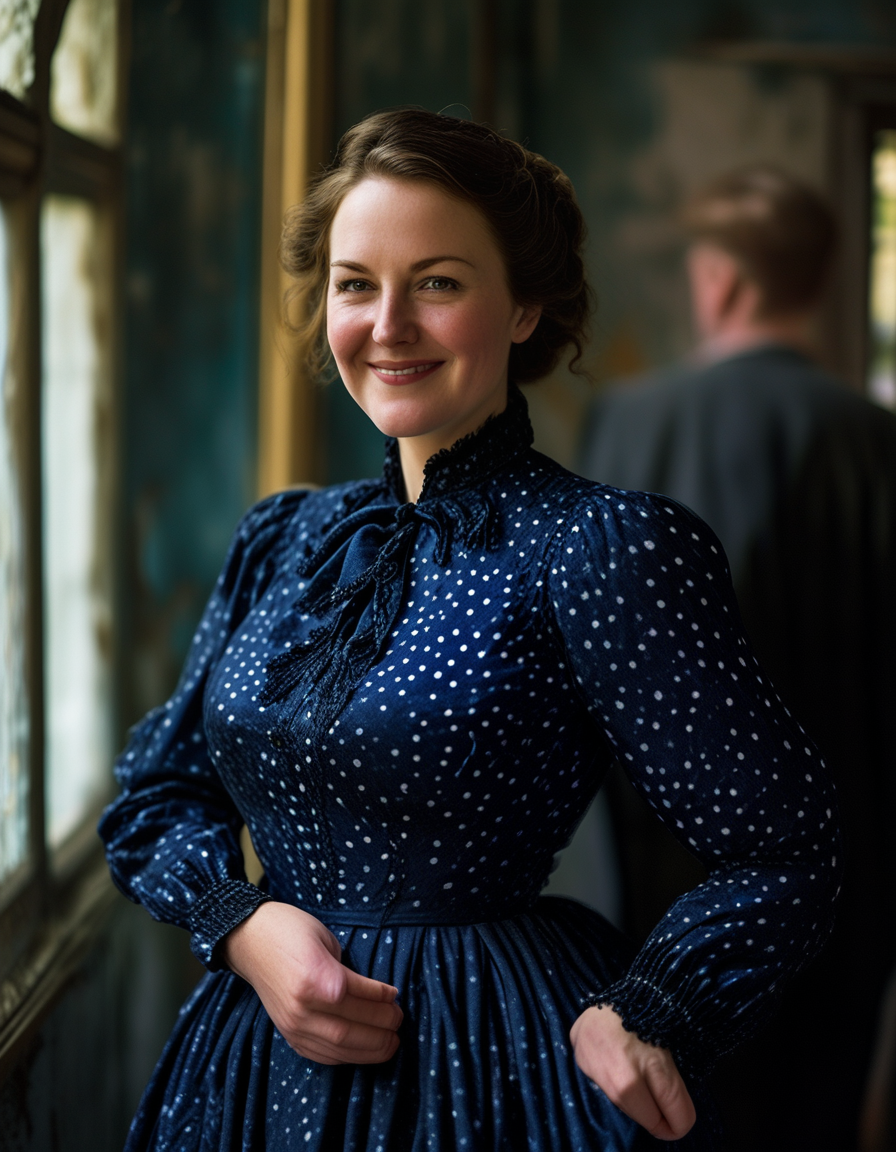
woman in blue dress posing for a photo in a room.
CAPTION
The image depicts a woman standing in a room, wearing a blue dress with white polka dots. She is smiling and appears to be posing for a photograph. The room has a warm, inviting atmosphere, with a window in the background.
MONOLOGUE
It will be observed that one of the points in this curious speculation rests on the green dress of the fairies. I do not call attention to it with any Quixotic purpose of disputing the conclusion it assists; it is far more interesting as one feature of the general subject of fairies' attire. The Welsh fairies are described with details as to colour in costume not commonly met with in fairy tales, a fact to which I have before alluded. In the legend of the Place of Strife, the Tylwyth Teg encountered by the women are called 'the old elves of the blue petticoat.' A connection with the blue of the sky has here been suggested. It has also been pointed out that the sacred Druidical dress was blue. The blue petticoat fancy seems to be local to North Wales. In Cardiganshire, the tradition respecting an encampment called Moyddin, which the fairies frequented, is that they were always in green dresses, and were never seen there but in the vernal month of May. There is a Glamorganshire goblin called the Green Lady of Caerphilly, the colour of whose dress is indicated by her title. She haunts the ruin of Caerphilly Castle at night, wearing a green robe, and has the power of turning herself into ivy and mingling with the ivy growing on the wall. A more ingenious mode of getting rid of a goblin was perhaps never invented. The fairies of Frennifawr, in Pembrokeshire, were on the contrary gorgeous in scarlet, with red caps, and feathers waving in the wind as they danced. But others were in white, and this appears to be the favourite hue of modern Welsh
SUMMARY
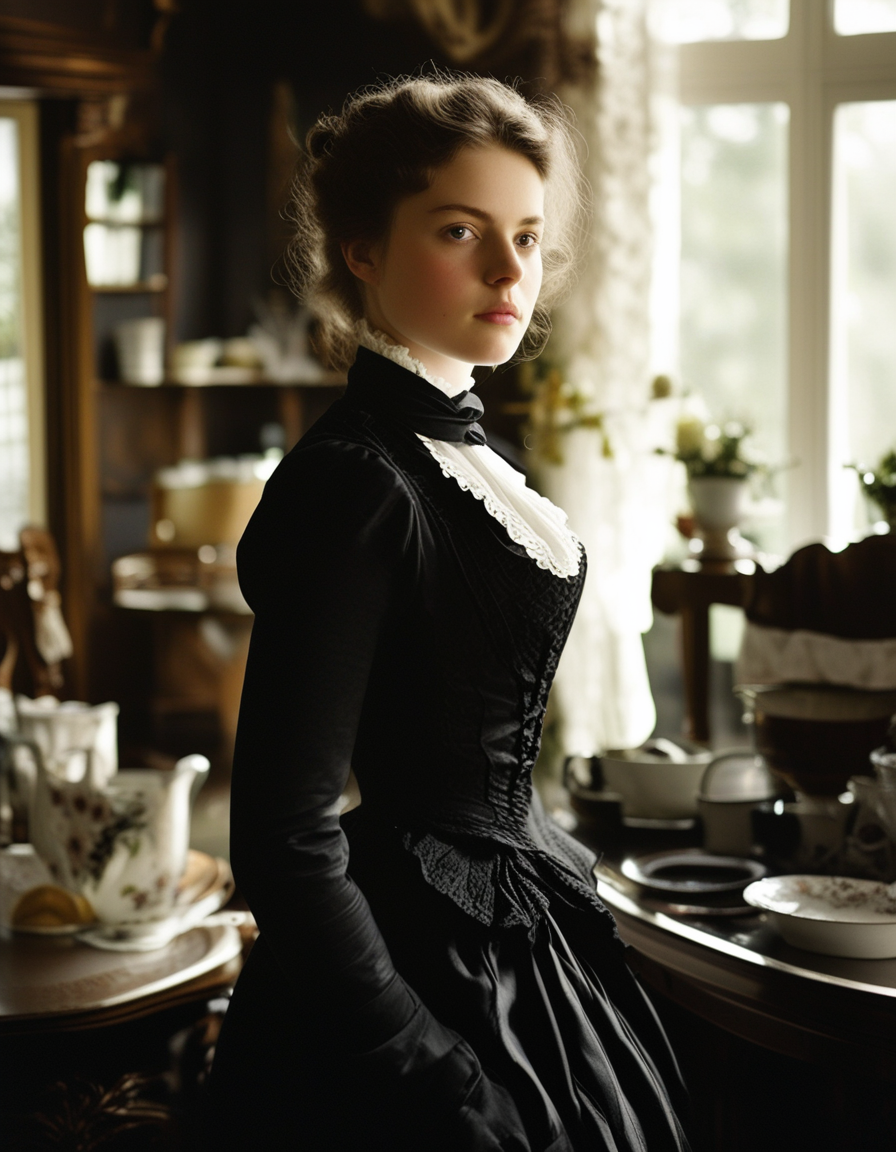
young woman in black dress posing in a room with a window and flowers.
CAPTION
The image depicts a woman dressed in a black dress with a white lace collar, standing in a room with a window in the background. The room is filled with various objects, including a table with a white tablecloth, a vase with flowers, and a pitcher. The woman appears to be looking to the side, possibly at the camera, with her gaze directed towards the right side of the image.
MONOLOGUE
At the same time that Nanna was seated in her room looking towards the large tree near the spring, Carl was rocking in his chair, gazing with his peculiar expression at a brown earthen vase, which was standing upon the table before him. The vase contained two freshly plucked lilacs, one blue and the other white, which emitted a fragrant odor. After Carl had sufficiently regarded these objects, he slowly jerked his chair towards the table, and at each pause his mouth widened into a simple simper. At length he arrived so near the table that by bending forward he could have easily touched the flowers with his nostrils. To accomplish this movement, which was his evident intention, he proceeded with as much gravity and carefulness as he had evinced in approaching the table. He bowed down his head inch by inch, until he could no longer withstand the desire of his senses. With one plunge he thrust his nostrils amidst the fresh leaves of the fragrant flowers.
SUMMARY
two men in suits are looking out of a window at a building with a large arched window.
CAPTION
The image is an oil painting depicting two men in a dimly lit room. The painting is characterized by a warm, golden hue that gives it a vintage feel. The room is furnished with wooden furniture, including a table and a chair, which are positioned in the foreground.
MONOLOGUE
"Now to the cell. The room is situated at the far end of the east wing of the prison, and is entered from the long passage which runs from the head warder's rooms past the convict cells, and terminates at the door which protects Oscar from the common herd, and helps to make him secure. The door is an ordinary prison cell door, possessing spyholes and flaptrap, and large iron bars and locks. The cell itself is about 10 ft. broad, 12 ft. long, and 11 ft. high. The walls are not papered but whitewashed, and the light by which the room is supplied is obtained through an iron-barred window in the wall placed high up and well out of the prisoner's reach. A small fireplace is also fixed securely at the end of the room, but it is seldom lit, as the room is well heated by hot-water pipes. Now to the furniture in the room. Just on the right-hand side of the window is placed a table made of hard, white wood. No cloth covers it, but at the back is placed a looking-glass, whilst on the table itself is a water jug and a Bible. Near the table and almost under the window is an arm-chair, in which Oscar spends most of his time. But more of this anon. In the corner near the fireplace is placed a small camp bedstead, which is so small that it seems almost an impossibility that so massive a form as that of Oscar could recline with any ease upon so small a space. No feather bed is upon the iron supports, and the sleeper is compelled to repose upon hard--probably too hard--mattresses. The bed is supplied with sheets, blankets, and a cover quilt, made up of
SUMMARY
a woman with long red hair is standing in a dimly lit room with a spotlight on her
CAPTION
The image depicts a woman standing in a dimly lit room, her hair flowing in the wind. She is wearing a sleeveless top and has her arms crossed over her chest. The room is filled with vibrant colors, predominantly red and blue, which are accentuated by the light from the stage lights.
MONOLOGUE
bright dahlias and chrysanthemums draggled by the autumn rains--in these there are, do not doubt it, still Nencias: magnificent creatures, fit models for Amazons, only just a trifle too full-blown and matronly; but with real Amazonian limbs, firm and delicate, under their red and purple striped print frocks; creatures with heads set on necks like towers or columns, necks firm in broad, well-fleshed chest as branches in a tree's trunk; great penthouses of reddish yellow or lustreless black crimped hair over the forehead; the forehead, like the cheeks, furrowed a good deal--perhaps we dainty people might say, faded and wrinkled by work in the burning sun and the wind; women whom you see shovelling bread into the heated ovens, or plashing in winter with bare arms in half-frozen streams, or digging up a turnip field in the drizzle; or on a Sunday, standing listless by their door, surrounded by rolling and squalling brats, and who, when they slowly look up at the passer-by, show us, on those monumental faces of theirs, a strange smile, a light of bright eyes and white teeth; a smile which to us sophisticated townspeople is as puzzling as certain sudden looks in some comely animal, but which yet makes us understand instinctively that we have before us a Nencia; and that the husband yonder, though he now swears at his wife, and perhaps occasionally beats her, has nevertheless, in his day, dreamed, argued, raged, and sung to himself just like Lorenzo's Vallera.
SUMMARY
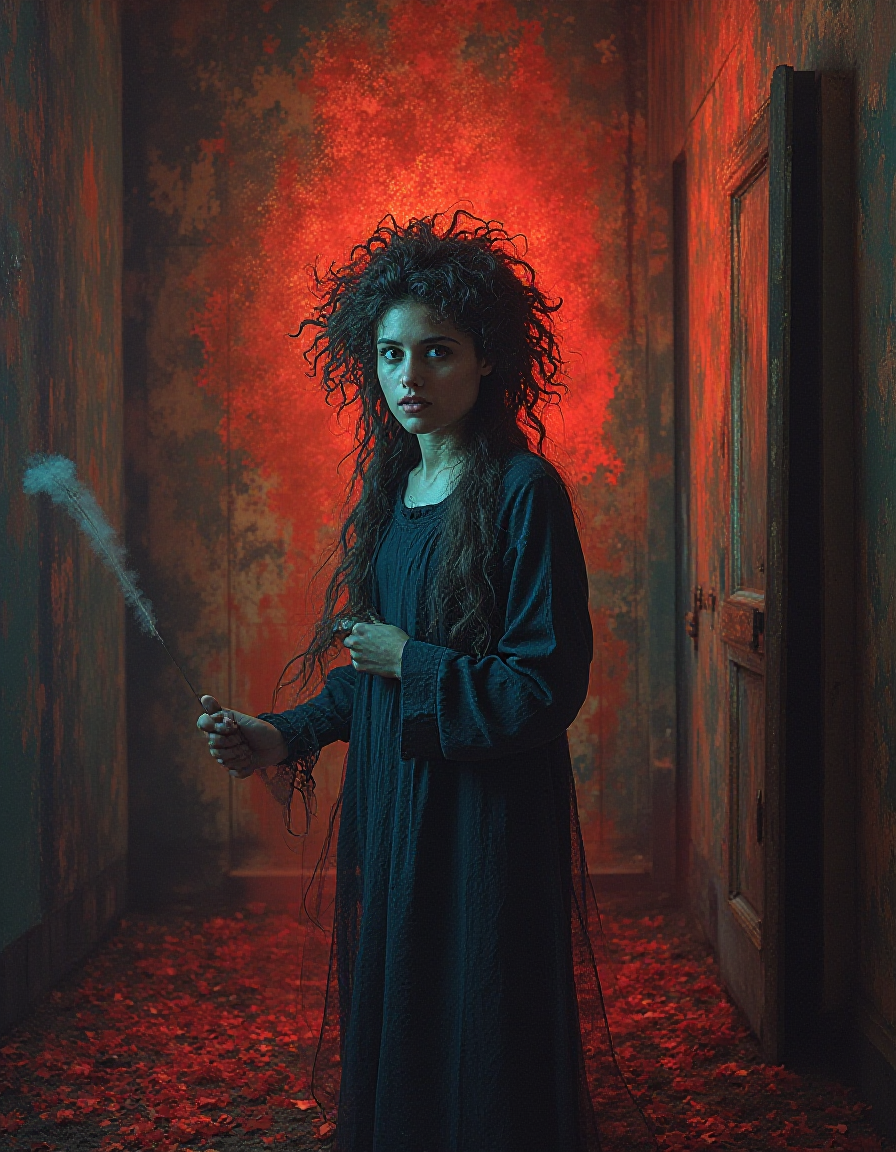
a young woman with curly hair is holding a wand in a dark room
CAPTION
The image depicts a young woman standing in a dimly lit room, holding a wand in her right hand. She is dressed in a dark, long-sleeved dress and has curly hair. The room is filled with red and orange hues, creating a dramatic atmosphere.
MONOLOGUE
But he only replied, "Madame will see!" and struck his flat hand upon the door. It was opened a little way, and a broad face covered with little humps and dents showed, the thick lips parted and muttering quickly. Then the face was withdrawn, the door opened wider, and Hadj beckoned to Domini to go in. After a moment's hesitation she did so, and found herself in a small interior court, with a tiled floor, pillars, and high up a gallery of carved wood, from which, doubtless, dwelling-rooms opened. In the court, upon cushions, were seated four vacant-looking men, with bare arms and legs and long matted hair, before a brazier, from which rose a sharply pungent perfume. Two of these men were very young, with pale, ascetic faces and weary eyes. They looked like young priests of the Sahara. At a short distance, upon a red pillow, sat a tiny boy of about three years old, dressed in yellow and green. When Domini and Hadj came into the court no one looked at them except the child, who stared with slowly-rolling, solemn eyes, slightly shifting on the pillow. Hadj beckoned to Domini to seat herself upon some rugs between the pillars, sat down beside her and began to make a cigarette. Complete silence prevailed. The four men stared at the brazier, holding their nostrils over the incense fumes which rose from it in airy spirals. The child continued to stare at Domini. Hadj lit his cigarette. And time rolled on.
SUMMARY
A man sits at a table in a room with a fireplace, reading a book.
CAPTION
The image depicts a man sitting at a wooden table in a dimly lit room, engrossed in reading a book. The room is characterized by a large window with arched panes, allowing natural light to filter in, casting a soft glow on the scene. The man is seated on a chair, his back to the camera, and appears to be deeply absorbed in his reading.
MONOLOGUE
“Sir Eustace retired about half-past ten. The servants had already gone to their quarters. Only my maid was up, and she had remained in her room at the top of the house until I needed her services. I sat until after eleven in this room, absorbed in a book. Then I walked round to see that all was right before I went upstairs. It was my custom to do this myself, for, as I have explained, Sir Eustace was not always to be trusted. I went into the kitchen, the butler’s pantry, the gun-room, the billiard-room, the drawing-room, and finally the dining-room. As I approached the window, which is covered with thick curtains, I suddenly felt the wind blow upon my face and realized that it was open. I flung the curtain aside and found myself face to face with a broad-shouldered elderly man, who had just stepped into the room. The window is a long French one, which really forms a door leading to the lawn. I held my bedroom candle lit in my hand, and, by its light, behind the first man I saw two others, who were in the act of entering. I stepped back, but the fellow was on me in an instant. He caught me first by the wrist and then by the throat. I opened my mouth to scream, but he struck me a savage blow with his fist over the eye, and felled me to the ground. I must have been unconscious for a few minutes, for when I came to myself, I found that they had torn down the bell-rope, and had secured me tightly to the oaken chair which stands at the head of the dining-table. I was so firmly bound that I could not
SUMMARY
a room with peeling wallpaper and a light hanging from the ceiling
CAPTION
The image depicts a narrow, dimly lit room with peeling wallpaper on the walls. A single light bulb hangs from the ceiling, casting a warm glow over the room. The floor is covered with a patterned rug, adding a touch of color to the otherwise monochromatic space.
MONOLOGUE
Plaster _écorchés_ stood about the room; and here and there, on shelves and tables, lay fragments of classical sculpture-torsos of antique goddesses, worn smooth as though all the years of the centuries that had passed over them had been lovers’ kisses. The walls were covered, from floor to ceiling, with countless sketches in charcoal, red chalk, or pen and ink. Amid the litter and confusion of color boxes, overturned stools, flasks of oil, and essences, there was just room to move so as to reach the illuminated circular space where the easel stood. The light from the window in the roof fell full upon Por-bus’s pale face and on the ivory-tinted forehead of his strange visitor. But in another moment the younger man heeded nothing but a picture that had already become famous even in those stormy days of political and religious revolution, a picture that a few of the zealous worshipers, who have so often kept the sacred fire of art alive in evil days, were wont to go on pilgrimage to see. The beautiful panel represented a Saint Mary of Egypt about to pay her passage across the seas. It was a masterpiece destined for Mary de’ Medici, who sold it in later years of poverty.
SUMMARY
person in dark clothing with a blurred face.
CAPTION
The image depicts a person with a blurred face, likely due to a low-light setting or a camera shake. The person is wearing a dark-colored shirt and appears to be in a room with a dark background. The lighting in the room is insufficient to provide clear details, making it difficult to discern specific features of the person or the room.
MONOLOGUE
TREATMENT. The skin should be kept clean by means of frequent baths. These assist the functional changes which must take place on the surface of the body, permit the stimulating influence of the light and air and facilitate the aeration of the blood, as well as the transpiration of fluids through the innumerable pores of the skin. All exposure to a low temperature, especially in damp weather, and the wearing of an insufficient amount of clothing should be avoided. Then the food should be generous and of the most nourishing character. Steady habits and regular hours for eating and sleep must be observed, if we would restore tone and regularity to the functions of nutrition. Moderate exercise in the open air is essential, in order that the blood may become well oxygenated, that the vital changes may take place. It is no doubt true that the occasion of the prevalence of scrofula among the lower classes may be ascribed to frequent and severe climatic exposures, irregular and poor diet, or want of due cleanliness. Every well-regulated family can avoid such causes and live with a due regard to the conditions of health. The proper treatment of scrofula is important, because we meet with its symptoms on every side, showing its slow actions upon different parts of the body and its influence upon all the organs. After this disease has been existing for an indefinite length of time, certain glands enlarge, slowly inflame, finally suppurate, and are very difficult to heal. These sores are very liable to degenerate into
SUMMARY
A woman is sitting at a table in a room with red and blue lights.
CAPTION
The image depicts a woman sitting at a table in a dimly lit room, engrossed in her work. The room is illuminated by a series of vertical LED lights that create a vibrant and dynamic ambiance. The woman is dressed in a white outfit, and her posture suggests she is focused on her task.
MONOLOGUE
A silence fell upon the gallery so deep that the receding voices and footsteps of Grant and his hostess in the long passage were distinctly heard until they reached the end. Then Fletcher arose with an inarticulate exclamation. Clementina instantly put her finger to her lips, glanced around the gallery, extended her hand to him, and saying "Come," half-led, half-dragged him into the passage. To the right she turned and pushed open the door of a small room that seemed a combination of boudoir and oratory, lit by a French window opening to the garden, and flanked by a large black and white crucifix with a prie Dieu beneath it. Closing the door behind them she turned and faced her companion. But it was no longer the face of the woman who had been sitting in the gallery; it was the face that had looked back at her from the mirror at Tasajara the night that Grant had left her--eager, flushed, material with commonplace excitement!
SUMMARY
The image depicts a young child dressed in a white robe with gold accents, standing in a room with a patterned rug. The child is holding a golden staff in their left hand and appears to be looking up at something off-screen.
CAPTION
The image depicts a young child dressed in a white robe with gold accents, adorned with a crown of feathers and a halo, standing in a room with a patterned rug on the floor. The child is looking up with a serene expression, and the room is bathed in warm, golden light.
MONOLOGUE
A Russian prince condescended to sit in a corner for an hour, and talk with a massive lady, dressed like Hamlet's mother, in black velvet, with a pearl bridle under her chin. A Polish count, aged eighteen, devoted himself to the ladies, who pronounced him "a fascinating dear," and a German Serene Something, having come for the supper alone, roamed vaguely about, seeking what he might devour. Baron Rothschild's private secretary, a large-nosed Jew, in tight boots, affably beamed upon the world, as if his master's name crowned him with a golden halo; a stout Frenchman, who knew the Emperor, came to indulge his mania for dancing, and Lady de Jones, a British matron, adorned the scene with her little family of eight. Of course, there were many light-footed, shrill-voiced American girls, handsome, lifeless-looking English ditto, and a few plain but piquante French demoiselles; likewise the usual set of travelling young gentlemen, who disported themselves gayly, while mammas of all nations lined the walls, and smiled upon them benignly when they danced with their daughters.
SUMMARY
person stands in a dark room with red lighting and a large red curtain behind him
CAPTION
The image depicts a man standing in a dimly lit room with a red hue. The man is positioned in the center of the frame, facing away from the viewer, and is wearing a dark jacket. The room is illuminated by a spotlight, casting a red glow on the walls and floor.
MONOLOGUE
“‘But how to explain that he was not there, that he had already escaped? It passes all imagination!--Nobody under the bed, nobody behind the furniture!--All that we discovered were traces, blood-stained marks of a man’s large hand on the walls and on the door; a big handkerchief red with blood, without any initials, an old cap, and many fresh footmarks of a man on the floor,--footmarks of a man with large feet whose boot-soles had left a sort of sooty impression. How had this man got away? How had he vanished? Don’t forget, monsieur, that there is no chimney in “The Yellow Room”. He could not have escaped by the door, which is narrow, and on the threshold of which the concierge stood with the lamp, while her husband and I searched for him in every corner of the little room, where it is impossible for anyone to hide himself. The door, which had been forced open against the wall, could not conceal anything behind it, as we assured ourselves. By the window, still in every way secured, no flight had been possible. What then?--I began to believe in the Devil.
SUMMARY
silhouette of a woman walking in a red and blue room.
CAPTION
The image depicts a silhouette of a woman walking in a brightly lit room with red and blue lighting. The woman is dressed in a black suit with a high-heeled shoe, and her hair is styled in a ponytail. The room has a modern design with a floor that reflects the light, creating a dynamic and dynamic effect.
MONOLOGUE
“Then she yelled again. Oh, dear, I was never so sorry for a high-born lady in my life, but to encourage her I told her I read of a white woman in Alabama that turned black in a single night, and the niggers would never have anything to say to her, because she was a hoodoo, and wasn't in their class, and then she yelled again and wanted me to send for a doctor, and I told her there wasn't any negro doctor in town, and what she wanted was to send for a scrubwoman, and then I showed her the box of shoe paste and told her she had got in the wrong box, and she laid it to me and shooed me out of the room like I was a hen, and she has been all the forenoon trying to wash that shoe paste off, but it will have to wear off, 'cause it is fast colors, and aunty has got to go to a heathen meeting at the church to-night, and she will have to send regrets. Don't you think women are awful careless about their toilets?” and the boy rubbed his red hair with a piece of sand-paper, because some one had told him sand-paper would take the red out of his hair.
SUMMARY
elegant dining room with a long table set with white plates, gold forks, and clear wine glasses.
CAPTION
The image captures a luxurious dining room, bathed in soft, warm lighting that accentuates the elegance of the setting. Dominating the center of the room is a long table draped in a pristine white tablecloth, adorned with a centerpiece of white and yellow flowers. The flowers are meticulously arranged in a vase, adding a touch of nature to the sophisticated decor.
MONOLOGUE
Marble-topped center-tables are no longer in use. Tables in inlaid woods, or hand-painted, are used for placing books or albums on. A small, airy-looking table, elaborately mounted in gilt, may stand near a window or wall. The mantel mirror, with its beveled edges and small racks arranged on each side, looks very effective when decorated with pretty oddities--ferns, grasses, and pieces of old china. A jardinire filled with living plants and placed near a bay window makes an elegant ornament. Care should be taken in arranging that the room be not over-crowded. There should be a few good pictures or painted plaques mounted in plush hung on the walls; a portrait may be placed on a common easel and draped with a scarf in old gold or peacock-blue, and tiny lambrequins, painted or embroidered, may hang beneath a bracket supporting a bust or flower-vase.
SUMMARY
couple in a room shaking hands, woman smiling, man in suit
CAPTION
The image depicts a man and a woman in a room, presumably a living room, with a woman in a blue dress and a man in a dark suit. The woman is smiling and holding hands with the man, who is looking at her. The room has a warm and inviting atmosphere, with a lamp on the left side of the image and a floral wallpaper in the background.
MONOLOGUE
They were once more delayed. A couple of ladies who had just entered were about to make their way to the drawing-room door, but had been encountered by Miss Price, and a rather heated argument was in progress. The ladies belonged to the old school, and were not acquainted with the intricacies of a fashionable function. The foremost was a fine, stately matron who had been Sarah Raymond's stanch friend ever since the days when they had run barefoot to school together. And while under her sensible black Sabbath bonnet there still remained much warm affection and sympathy with all Sarah's doings, at the same time there was developing not a little impatience with what she termed Sarah's norms. She had just caught sight of the card-players in the library, too, and was righteously indignant that she, an elder's wife, should have been bidden to such a questionable affair. So she had not much patience left to waste on Miss Price when that haughty young lady insisted upon her going upstairs. "We've nothing to take off, young woman," she declared at last; "can't you see that? Do you want us to undress and go to bed?" And with that she brushed Katie aside and proceeded on her way. A dapper little man in a dress-suit, the only man anywhere in sight, popped out from behind a great palm and demanded, "Name, please, madam?" Elizabeth regarded him with awe. He represented the zenith point of Estella's ambition. They always had such a functionary at swell receptions in the city, she had
SUMMARY
a woman in a long dress with a large flower on her head stands in a room with a door in the background.
CAPTION
The image depicts a woman standing in a dimly lit room, her face obscured by a large, ornate headpiece. She is dressed in a flowing, golden gown that contrasts with the dark background. The room is illuminated by a single light source, casting a shadow on the wall behind her.
MONOLOGUE
But with the dark the club's swing-doors opened for his passage into the lighted streets, and till next morning the world knew him no more. It was then that he took revenge for all the hours he wore a mask. He would walk the pavements for miles trying to wear himself out, or in the Park fling himself down on a chair in the deep shadow of the trees, and sit there with his arms folded and his head bowed down. On other nights he would go into some music-hall, and amongst the glaring lights, the vulgar laughter, the scent of painted women, try for a moment to forget the face, the laugh, the scent of that woman for whom he craved. And all the time he was jealous, with a dumb, vague jealousy of he knew not whom; it was not his nature to think impersonally, and he could not believe that a woman would drop him except for another man. Often he went to her Mansions, and walked round and round casting a stealthy stare at her windows. Twice he went up to her door, but came away without ringing the bell. One evening, seeing a light in her sitting-room, he rang, but there came no answer. Then an evil spirit leaped up in him, and he rang again and again. At last he went away to his room--a studio he had taken near--and began to write to her. He was long composing that letter, and many times tore it up; he despised the expression of feelings in writing. He only tried because his heart wanted relief so badly. And this, in the end, was all that he produced:
SUMMARY
two women dancing in a church with a stained glass window.
CAPTION
The image depicts two dancers in a dimly lit room, with a large stained glass window in the background. The dancers are dressed in elaborate costumes, with one dancer wearing a long, flowing dress and the other in a black outfit. The room is illuminated by a warm, orange glow, creating a dramatic and intimate atmosphere.
MONOLOGUE
In a narrow street, opposite to St. Michael's Church, one of the three famous spires of Coventry, you behold a mediaeval edifice, in the basement of which is such a venerable and now deserted kitchen as I have above alluded to, and, on the same level, a cellar, with low stone pillars and intersecting arches, like the crypt of a cathedral. Passing up a well-worn staircase, the oaken balustrade of which is as black as ebony, you enter the fine old hall, some sixty feet in length, and broad and lofty in proportion. It is lighted by six windows of modern stained glass, on one side, and by the immense and magnificent arch of another window at the farther end of the room, its rich and ancient panes constituting a genuine historical piece, in which are represented some of the kingly personages of old times, with their heraldic blazonries. Notwithstanding the colored light thus thrown into the hall, and though it was noonday when I last saw it, the panelling of black oak, and some faded tapestry that hung round the walls, together with the cloudy vault of the roof above, made a gloom which the richness only illuminated into more appreciable effect. The tapestry is wrought with figures in the dress of Henry VI.'s time, (which is the date of the hall,) and is regarded by antiquaries as authentic evidence both for the costume of that epoch, and, I believe, for the actual portraiture of men known in history. They are as colorless as ghosts, however, and vanish drearily into the old stitch-work of their substance, when you try to make them
SUMMARY
two young women in blue dresses dance in a grand hallway with a chandelier in the background.
CAPTION
The image depicts two young women in a grand, ornate room with a blue hue. They are dressed in elegant, flowing blue dresses that drape elegantly around their waists. The room is bathed in a soft, blue light that creates a serene and romantic atmosphere.
MONOLOGUE
card and cavanole tables.[2135] This is a spectacle to be seen, not by the imagination, or through imperfect records, but with our own eyes and on the spot, to comprehend the spirit, the effect and the triumph of monarchical culture. In an elegantly furnished house, the drawing room is the principal room; and never was one more dazzling than this. Suspended from the sculptured ceiling peopled with sporting cupids, descend, by garlands of flowers and foliage, blazing chandeliers, whose splendor is enhanced by the tail mirrors; the light streams down in floods on gilding, diamonds, and beaming, arch physiognomies, on fine busts, and on the capacious, sparkling and garlanded dresses. The skirts of the ladies ranged in a circle, or in tiers on the benches, "form a rich espalier covered with pearls, gold, silver, jewels, spangles, flowers and fruits, with their artificial blossoms, gooseberries, cherries, and strawberries," a gigantic animated bouquet of which the eye can scarcely support the brilliancy. There are no black coats, as nowadays, to disturb the harmony. With the hair powdered and dressed, with buckles and knots, with cravats and ruffles of lace, in silk coats and vests of the hues of fallen leaves, or of a delicate rose tint, or of celestial blue, embellished with gold braid and embroidery, the men are as elegant as the women. Men and women, each is a selection; they all are of the accomplished class, gifted with every grace which good blood, education, fortune, leisure and custom can bestow; they are
SUMMARY
two women in a dance pose in a room with a large arched window.
CAPTION
The image depicts two women in a dimly lit room, engaged in a dance. The room is illuminated by a large arched window with a stained glass design, which casts a blue glow on the scene. The women are dressed in traditional dance attire, consisting of long skirts and leggings, and are barefoot.
MONOLOGUE
We were admitted by a respectable-looking female, to all appearance a housekeeper, who, on being questioned, informed us that the Advocate was at home, and forthwith conducted us to an immense room, or rather library, the walls being covered with books, except in two or three places where hung some fine pictures of the ancient Spanish school. There was a rich mellow light in the apartment, streaming through a window of stained glass, which looked to the west. Behind the table sat the Advocate, on whom I looked with no little interest. His forehead was high and wrinkled, and there was much gravity on his features, which were quite Spanish. He was dressed in a long robe, and might be about sixty. He sat reading behind a large table, and on our entrance half raised himself, and bowed slightly.
SUMMARY
two women in red dresses dancing in a church with stained glass windows
CAPTION
The image depicts two women in a dimly lit room, standing side by side, facing each other, and holding hands. They are dressed in vibrant red dresses that drape elegantly around their waists. The room is bathed in warm, golden light, creating a serene and intimate atmosphere.
MONOLOGUE
AYOT ST. LAWRENCE (21/2 miles N.E. from Wheathampstead Station and about the same distance N.W. from Ayot Station, G.N.R.) has a new and an old church. The former is in Ayot Park, and was designed by Revett in a classical style. Note (1) the _Eastern_ portico, with colonnade on either side; (2) the memorial to Sir Lionel Lyde, Bart. (d. 1791), and to the architect of the church (d. 1804). The earlier structure, still in ruins near the middle of the village, was Dec. of an early period, with several singular features; the tower, however, was Perp. "The Windows ... have been adorn'd with curious Pictures, in stained and painted Glass, beyond many other Churches." The village has at different times been styled Eye, Aiot, Great Aiot, and Ayot St. Lawrence, and was a parcel of the property of Harold Godwin. _Ayot House_, standing in a beautiful park of 200 acres, was once the property and residence of Sir William Parr, brother to Catherine Parr, Queen of Henry VIII. A room in an older building in the rear of the present mansion was once, according to local tradition, the prison of Catherine Parr. There are shoes at Ayot House which belonged to Anne Boleyn and a hat of Henry VIII.
SUMMARY
a woman in a green dress stands in a room with a large arched doorway
CAPTION
The image depicts a woman standing in a grand, ornate room with a large arched doorway in the background. She is dressed in a green dress that extends to her ankles, and her hands are raised in a gesture of greeting or blessing. The room is adorned with intricate gold and green patterns, and the walls are adorned with gold-colored panels.
MONOLOGUE
Carylls is a very old place; a part of it, indeed, was built in 1640, but so well have all the additions and improvements of later years been carried out that the two form a truly artistic whole. Originally belonging to the well-known Roman Catholic family of Caryll, it is mentioned in Pope's poems, several of which he wrote under the old oak trees, and it is considered quite one of the show-places of this part of Sussex. Mrs. Fraser says that it suits her in every way. The air is splendid, the society is good, and she is not far enough away from town to feel out of the world. The conservatory glass door opens into a very large and lofty drawing-room with oak ceilings and great bay windows. It looks more like a foreign than an English room. An immense Indian carpet is spread over the floor, the sea-green walls are hung with many mirrors in black and gold frames, several lovely old cabinets, and plenty of Dresden, Sevres, Chelsea, and Capo de Monti, are to be seen everywhere. Two superb silver _repousse_-work Lucknow bowls are especially attractive; one, containing a many-leafed palm, stands on the grand piano, and in its fellow is a large fern, the delicate fronds drooping over a beautiful alabaster "Magdalen" close by.
SUMMARY
antique room with a round table and chairs.
CAPTION
The image depicts a room with a large round wooden table in the center, surrounded by several chairs. The room is furnished with a fireplace on the right side, and the walls are adorned with a mural depicting a landscape. The floor is covered with a patterned rug, and the ceiling is adorned with wooden beams.
MONOLOGUE
So Leonore and Peter followed Watts’s lead. The room into which they went was rather a curious one. It was at least twenty-five feet square, having four windows, two looking out on Broadway, and two on the side street. It had one other door besides that by which they had entered. Here the ordinary quality ended. Except for the six openings already noted and a large fireplace, the walls were shelved from floor to ceiling (which was not a low one), with dusky oak shelving. The ceiling was panelled in dark oak, and the floor was covered with a smooth surface of the same wood. Yet though the shelves were filled with books, few could be seen, for on every upright of the shelving, were several frames of oak, hinged as one sees them in public galleries occasionally, and these frames contained etchings, engravings, and paintings. Some were folded back against the shelves. Others stood out at right angles to them and showed that the frames were double ones, both sides containing something. Four easy-chairs, three less easy chairs, and a large table desk, likewise of dusky oak were the sole other fittings of the room, if we except two large polar bear skins.
SUMMARY
television set displaying a scenic river and canyon landscape
CAPTION
The image depicts a modern living room with a large flat-screen television mounted on a wooden entertainment center. The television screen displays a vibrant landscape with a river flowing through a canyon, surrounded by lush greenery and rocky cliffs. The room is furnished with a comfortable sofa and a patterned rug, adding to the cozy atmosphere.
MONOLOGUE
The large room, facing the river, twenty-eight feet by sixty-one feet, was available for mess hall, recreation and entertainments. The space, twenty-eight feet by twenty-one feet, was separated by a projecting wall and pillars and contained a victrola and records, a piano, a library (one hundred fifty books furnished by the American Red Cross, exchanged at intervals), a magazine rack, reading table, machine guns and rack, a bulletin board and several comfortable chairs made by convalescents. A portable stage for entertainments was placed in this space when required. A complete set of scenery with flies and curtains was presented by the American Red Cross. In the center of the room a regulation boxing ring could be strung, the benches and tables being so arranged as to form an amphitheatre. The entire room could be cleared for dancing. At one end was a movie screen and in the adjoining room a No. 6 Powers movie machine which was obtained from the American Y. M. C. A. and installed December 5th, 1918.
SUMMARY
woman in red floral dress posing in a room with ornate furniture and chandeliers.
CAPTION
The image depicts a woman standing in a room, dressed in a red floral dress with a plunging neckline and a high slit, paired with high-heeled boots. She is positioned in the center of the room, with her left hand on her hip and her right hand slightly raised, suggesting a confident pose.
MONOLOGUE
Before the fire was a table, with one of its legs fractured, and made of rough boards; these, with a single stool, composed the furniture--if we except a few articles of cooking. A book that, by its size and shape, appeared to be a Bible, was lying on the table unopened. But it was the occupant of the hut in whom Frances was chiefly interested. This was a man, sitting on the stool, with his head leaning on his hand in such a manner as to conceal his features, and deeply occupied in examining some open papers. On the table lay a pair of curiously and richly mounted horseman's pistols, and the handle of a sheathed rapier,[123] of exquisite workmanship, protruded from between the legs of the gentleman, one of whose hands carelessly rested on its guard. The tall stature of this unexpected tenant of the hut, and his form, much more athletic than that of either Harvey or her brother, told Frances, without the aid of his dress, that it was neither of those she sought. A close surtout[124] was buttoned high in the throat of the stranger, and parting at the knees showed breeches of buff, with military boots and spurs. His hair was dressed so as to expose the whole face, and, after the fashion of that day, it was profusely powdered. A round hat was laid on the stones that formed a paved floor to the hut, as if to make room for a large map which, among other papers, occupied the table.
SUMMARY
woman in a suit holding a candle in a room with two other women
CAPTION
The image depicts a woman in a dark suit, holding a candle in her right hand, standing in a room with warm lighting. The room is adorned with two lit candles, one on the left and one on the right, casting a soft glow. The woman appears to be in a contemplative or serious mood, her expression slightly tilted downwards.
MONOLOGUE
"My wife was not in the room. Her bed was empty and I could see through the door, which she had left open behind her, that a large fire was flickering in the kitchen. My wife was busy with something at the hearth and with her was her mother, a sly, wicked old woman, whom all the people hereabouts look upon as a witch. What were they doing there so late at night I asked myself? The younger woman was holding a pan over the fire and the elder was casting into it all sorts of herbs. There was nothing to be afraid of, and yet they were speaking to each other in whispers and peering timorously around. I know not how the thought occurred to me, but I suddenly thrust into my bosom the little suckling lying on the table and carried it off into my own room. There I laid it down upon my bed and put into its hands again its plaything of little bells which it had dropped, whereupon it ceased to cry. Then I returned to watch and see what the two women would do next. The contents of the pan were already frizzling. Now and then it boiled over into the fire and the flames shot up all round it. Then the old woman would skim it carefully with a spoon. And all the time they were muttering together:
SUMMARY
a woman sits on a chair in a room with a lamp and a skull
CAPTION
The image depicts a woman sitting on a beige armchair in a dimly lit room. The room is illuminated by a lamp on the left side of the image, casting a warm glow on the scene. The woman is wearing a pink blouse and blue jeans, and her hair is styled in loose waves.
MONOLOGUE
"Thee's trunk is arrived, and thee's hat-box is smashed by the lout of a boy that brought it," she said; and this is merely a specimen of her manner. It was grating upon me, but I forbore to make remark, as I have no doubt her principle was all that could be desired, although it was faulty in its constructive carrying out. I may safely say that I did not remember there was another lodger besides myself in her house when I retired for the night, and I was sitting at the little table in my room moved by a power of mind to think past many miles, even unto the home of friend Hicks. I saw him sitting by the kitchen-fire that was so warm and large in its dimensions--for it was cold weather now--and on the opposite side of the hearth his daughter on a low chair was busy looking into the flame that lit up the smooth bands of her hair that lay like satin of a soft brown color upon her comely face. Her eyes were bright, her lips were parting as one who jests, and--But I fear me I have run beyond sense again. Suffice it to say that I sat there culpably lost in thought, when a solemn voice like the voice of a prophet of old startled me and made me cold.
SUMMARY
woman in a white dress posing in a restaurant.
CAPTION
The image depicts a woman standing in a large, ornate room with a high ceiling and arched windows. She is wearing a white dress with puffed sleeves and a deep neckline, and she is adorned with a necklace and a bracelet. The room is filled with people, some of whom are seated at tables, suggesting a social or dining atmosphere.
MONOLOGUE
drawing-room. I have been there so often since that I hardly remember my first impression. It was a corner room, high ceiling, big windows, and fine tapestries on the walls; some of them with a pink ground (very unusual), and much envied and admired by all art collectors. Mme. A. told me she found them all rolled up in a bundle in the garret when she married. A tea-table was standing before the sofa, and various people working and having their tea. We were not a large party--Comte and Comtesse de B. (she a daughter of the house) and three or four men, deputies and senators, all political. They counted eight guns. We sat there about half an hour, then there was a general move, and young Mme. A. showed us our rooms, which were most comfortable, fires burning, lamps lighted. She told us dinner was at 7.30; the first bell would ring at seven. I was the only lady besides the family. I told my maid to ask some of the others what their mistresses were going to wear. She said ordinary evening dress, with natural flowers in their hair, and that I would receive a small bouquet, which I did, only as I never wear anything in my hair, I put them on my corsage, which did just as well.
SUMMARY
a woman in a black dress with lace details and tattoos on her arms is walking through a room with red curtains and candles
CAPTION
The image depicts a woman in a black lace dress, standing in a dimly lit room with red curtains and ornate furniture. She is holding a pair of black gloves in her hands, suggesting she might be a performer or a performer in a theatrical or dramatic context. The lighting in the room is warm, creating a sense of intimacy and drama.
MONOLOGUE
As usual, many eyes were turned on her as she entered the restaurant--a radiant figure in white, with black hat and black chiffon boa, and a deep red rose in her bosom. The maître d'hôtel, in the pride of reflected glory, conducted her to a table near the window. Septimus trailed inconclusively behind. When he seated himself he stared at her silently in a mute surmise as the gentlemen in the poem did at the peak in Darien. It was even a wilder adventure than the memorable drive. That was but a caprice of the goddess; this was a sign of her friendship. The newness of their intimacy smote him dumb. He passed his hand through his Struwel Peter hair and wondered. Was it real? There sat the goddess, separated from him by the strip of damask, her gold-flecked eyes smiling frankly and trustfully into his, pulling off her gloves and disclosing, in almost disconcerting intimacy, her warm wrists and hands. Was he dreaming, as he sometimes did, in broad daylight, of a queer heaven in which he was strong like other men and felt the flutter of wings upon his cheek? Something soft was in his hand. Mechanically he began to stuff it up his sleeve. It was his napkin. Zora's laugh brought him to earth--to happy earth.
SUMMARY
a woman in a black dress with lace sleeves and a crown on her head is standing in a grand room with red curtains and gold chairs
CAPTION
The image depicts a woman in a black dress with intricate lace details, standing in a grand room with red curtains and gold trim. She is adorned with a crown and a necklace, adding to her regal appearance. The room is filled with red drapes and gold furniture, creating a luxurious and opulent atmosphere.
MONOLOGUE
My Lady Viscountess's face was daubed with white and red up to the eyes, to which the paint gave an unearthly glare. She had a tower of lace on her head, under which was a bush of black curls--borrowed curls--so that no wonder little Harry Esmond was scared when he was first presented to her, the kind priest acting as master of the ceremonies at that solemn introduction, and he stared at her with eyes almost as great as her own, as he had stared at the player woman who acted the wicked tragedy-queen, when the players came down to Ealing Fair. She sat in a great chair by the fire-corner; in her lap was a spaniel-dog that barked furiously; on a little table by her was her ladyship's snuff-box and her sugar-plum box. She wore a dress of black velvet, and a petticoat of flame-coloured brocade. She had as many rings on her fingers as the old woman of Banbury Cross; and pretty, small feet which she was fond of showing, with great gold clocks to her stockings, and white slippers with red heels; and an odour of musk was shaken out of her garments whenever she moved or quitted the room, leaning on her tortoise-shell stick, little Fury, the dog, barking at her heels, and Mrs. Tusher, the parson's wife, by her side.
SUMMARY
the room is a surreal, dreamlike space with two large paintings on the walls and a large projection screen on the floor.
CAPTION
The image depicts a room with two large, large-scale paintings on the walls. The paintings depict a desert landscape with a large red planet and a blue sky. The room itself is dimly lit, with a spotlight shining on the paintings, creating a dramatic effect.
MONOLOGUE
They shook hands, and he left her alone in the glorious room, among the shining antique marbles. She sat down in the centre of the circle of these presences, regarding them vaguely, resting her eyes on their beautiful blank faces; listening, as it were, to their eternal silence. It is impossible, in Rome at least, to look long at a great company of Greek sculptures without feeling the effect of their noble quietude; which, as with a high door closed for the ceremony, slowly drops on the spirit the large white mantle of peace. I say in Rome especially, because the Roman air is an exquisite medium for such impressions. The golden sunshine mingles with them, the deep stillness of the past, so vivid yet, though it is nothing but a void full of names, seems to throw a solemn spell upon them. The blinds were partly closed in the windows of the Capitol, and a clear, warm shadow rested on the figures and made them more mildly human. Isabel sat there a long time, under the charm of their motionless grace, wondering to what, of their experience, their absent eyes were open, and how, to our ears, their alien lips would sound. The dark red walls of the room threw them into relief; the polished marble floor reflected their beauty. She had seen them all before, but her enjoyment repeated itself, and it was all the greater because she was glad again, for the time, to be alone. At last, however, her attention lapsed, drawn off by a deeper tide of life. An occasional tourist came in, stopped and stared a moment at the
SUMMARY
a young woman is sleeping in bed with her eyes closed and her head resting on a pillow
CAPTION
The image depicts a person lying in bed, with their head resting on a pillow. The person is wearing a white shirt and has their hair tied back. The background is blurred, but it appears to be a room with a window, suggesting that the person is in a room with natural light coming in.
MONOLOGUE
From this time a slow insidious madness worked in Heathcliff. When it was at its height he was not fierce, but strangely silent, scarcely breathing; hushed, as a person who draws his breath to hear some sound only just not heard as yet, as a man who strains his eyes to see the speck on the horizon which will rise the next moment, the next instant, and grow into the ship that brings his treasure home. "When I sat in the house with Hareton, it seemed that on going out I should meet her; when I walked on the moors, I should meet her coming in. When I went from home, I hastened to return; she _must_ be somewhere at the Heights I was certain; and when I slept in her chamber--I was beaten out of that. I couldn't lie there; for the moment I closed my eyes, she was either outside the window, or sliding back the panels, or entering the room, or even resting her darling head on the same pillow, as she did when a child; and I must open my lids to see. And so I opened and closed them a hundred times a night to be always disappointed. It was a strange way of killing, not by inches, but by fractions of hairbreadths, to beguile me with the spectre of a hope through eighteen years." This mania of expectation stretching the nerves to their uttermost strain, relaxed sometimes; and then Heathcliff was dangerous. When filled with the thought of Catharine, the world was indifferent to him; but when this possessing memory abated ever so little, he remembered that the world was his enemy, had cheated him of Catharine. Then avarice, ambition,
SUMMARY
the interior of a dimly lit room with a door that is open and glowing.
CAPTION
The image depicts a dimly lit, industrial-looking room with a large, open doorway. The room is bathed in a warm, orange glow from the interior lights, which are turned on, casting a soft, yellowish light. The walls and floor are covered in a layer of dust and debris, indicating a recent or ongoing cleaning process.
MONOLOGUE
Rooms which are in constant use should be swept and dusted every day. A thorough cleaning of each room in the house will be necessary every week or two, even though the room is swept and kept in order daily. First, all cupboards, drawers, and other receptacles in which articles collect should be cleaned; then all large movable articles should be dusted and moved out of the room; those that are not readily movable should be dusted and covered. The floor should be swept with the windows open; the ceiling and walls should be brushed with a covered broom, and the dust allowed to settle. The floor should then be wiped with a damp cloth on the broom.[A] The woodwork should be cleaned with a damp cloth and a soap that is not too strong. Soda or sapolio should not be used. The furniture should be carefully uncovered, and everything arranged in perfect order.
SUMMARY
a woman in a black dress with gold embroidery and a necklace with a pendant is posing in front of a red velvet chair
CAPTION
The image depicts a woman in a medieval-style dress, standing in a room with a red background. She is facing the camera, and her attire is adorned with intricate gold embroidery. The room is dimly lit, with a spotlight on the woman, creating a dramatic effect.
MONOLOGUE
Pearls and Spanish lace—she herself, with assurance, could see them, and the “full length” too, and also red velvet bows, which, disposed on the lace in a particular manner (she could have placed them with the turn of a hand) were of course to adorn the front of a black brocade that would be like a dress in a picture. However, neither Marguerite nor Lady Agnes nor Haddon nor Fritz nor Gussy was what the wearer of this garment had really come in for. She had come in for Everard—and that was doubtless not his true name either. If our young lady had never taken such jumps before it was simply that she had never before been so affected. She went all the way. Mary and Cissy had been round together, in their single superb person, to see him—he must live round the corner; they had found that, in consequence of something they had come, precisely, to make up for or to have another scene about, he had gone off—gone off just on purpose to make them feel it; on which they had come together to Cocker’s as to the nearest place; where they had put in the three forms partly in order not to put in the one alone. The two others in a manner, covered it, muffled it, passed it off. Oh yes, she went all the way, and this was a specimen of how she often went. She would know the hand again any time. It was as handsome and as everything else as the woman herself. The woman herself had, on learning his flight, pushed past Everard’s servant and into his room; she had written her missive at his table and with his pen. All this,
SUMMARY
a large room with a large window looking out into a forest, a black leather sofa, a coffee table, a rug, a lamp, bookshelves, and a fireplace
CAPTION
The image depicts a cozy, dimly lit room bathed in warm, golden light. The room is furnished with a large, dark-colored sofa, a round coffee table, and a patterned rug. The walls are adorned with bookshelves filled with books, and a large window offers a view of a forest outside.
MONOLOGUE
Rosek had the first floor of an old-time mansion in Russell Square. The smell of incense or some kindred perfume was at once about one; and, on the walls of the dark hall, electric light burned, in jars of alabaster picked up in the East. The whole place was in fact a sanctum of the collector’s spirit. Its owner had a passion for black—the walls, divans, picture-frames, even some of the tilings were black, with glimmerings of gold, ivory, and moonlight. On a round black table there stood a golden bowl filled with moonlight-coloured velvety “palm” and “honesty”; from a black wall gleamed out the ivory mask of a faun’s face; from a dark niche the little silver figure of a dancing girl. It was beautiful, but deathly. And Gyp, though excited always by anything new, keenly alive to every sort of beauty, felt a longing for air and sunlight. It was a relief to get close to one of the black-curtained windows, and see the westering sun shower warmth and light on the trees of the Square gardens. She was introduced to a Mr. and Mrs. Gallant, a dark-faced, cynical-looking man with clever, malicious eyes, and one of those large cornucopias of women with avid blue stares. The little dancer was not there. She had “gone to put on nothing,” Rosek informed them.