petal




SUMMARY
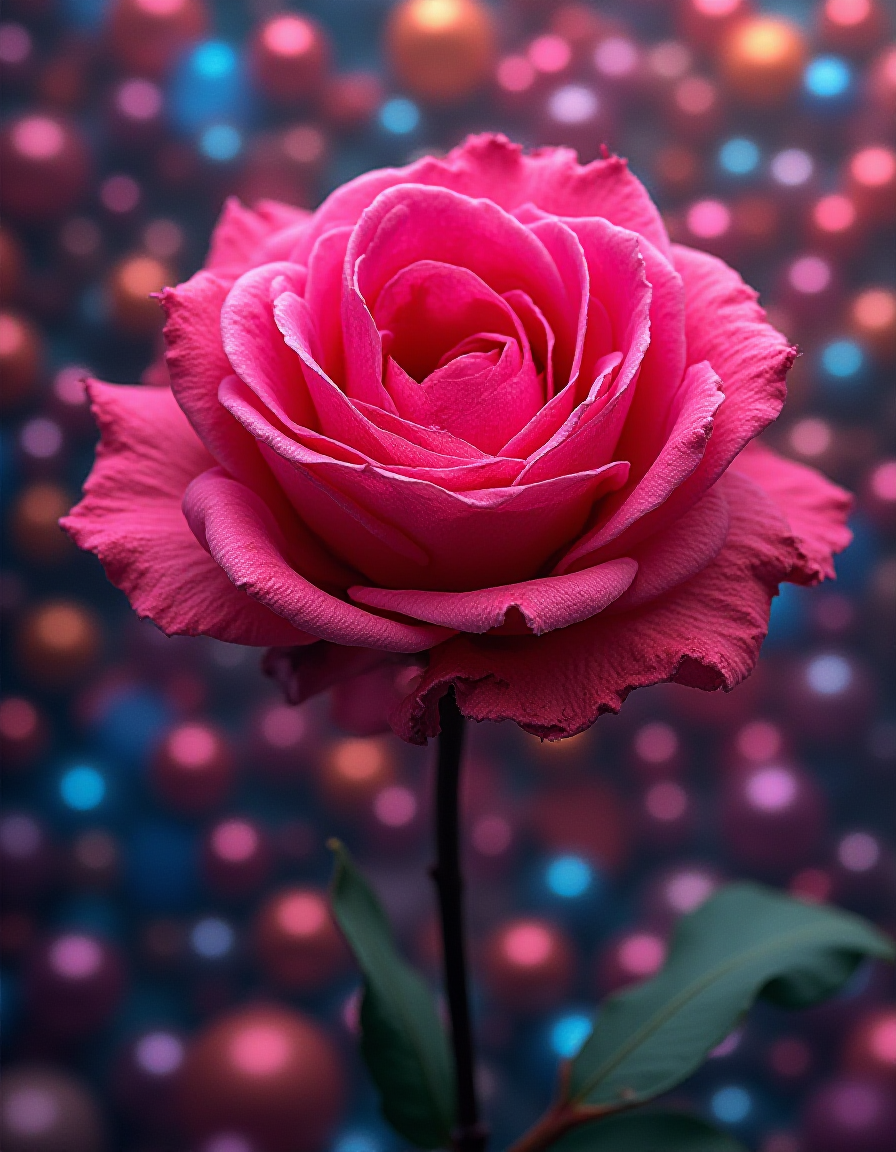
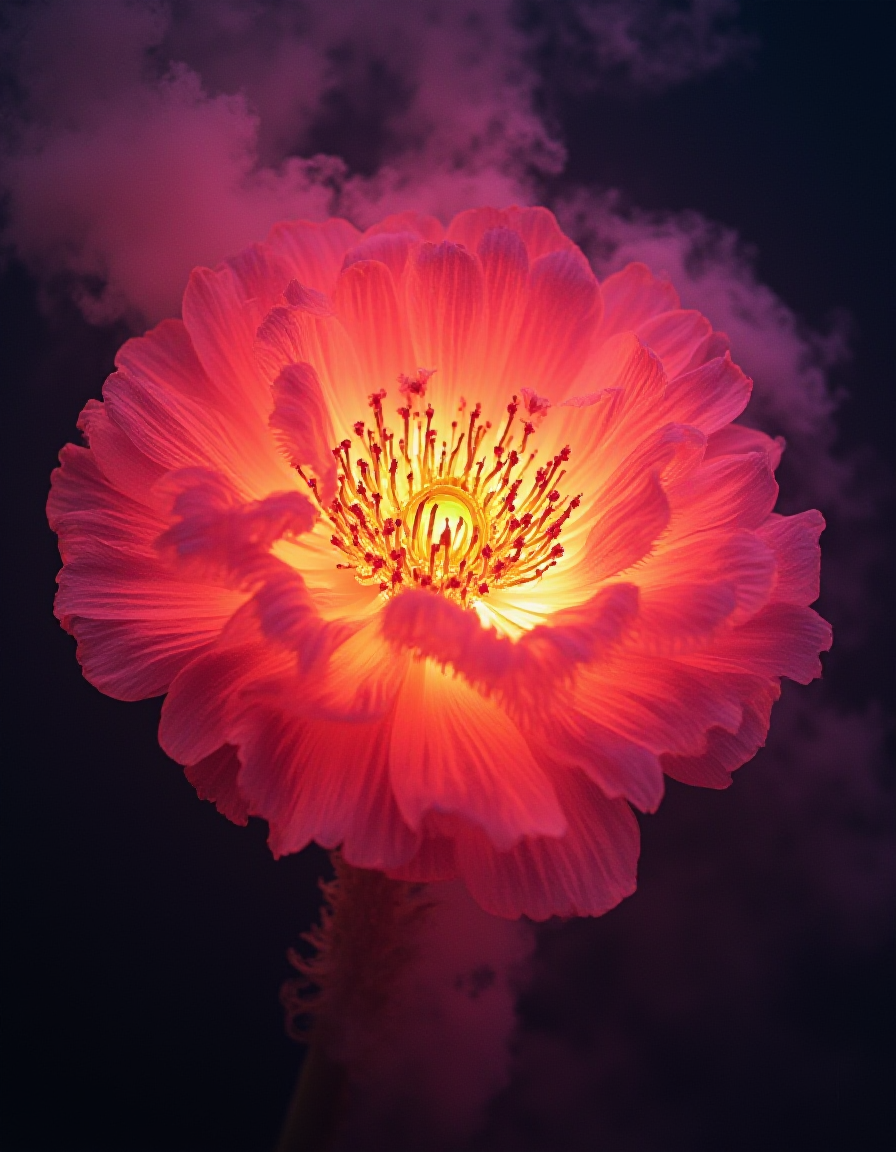
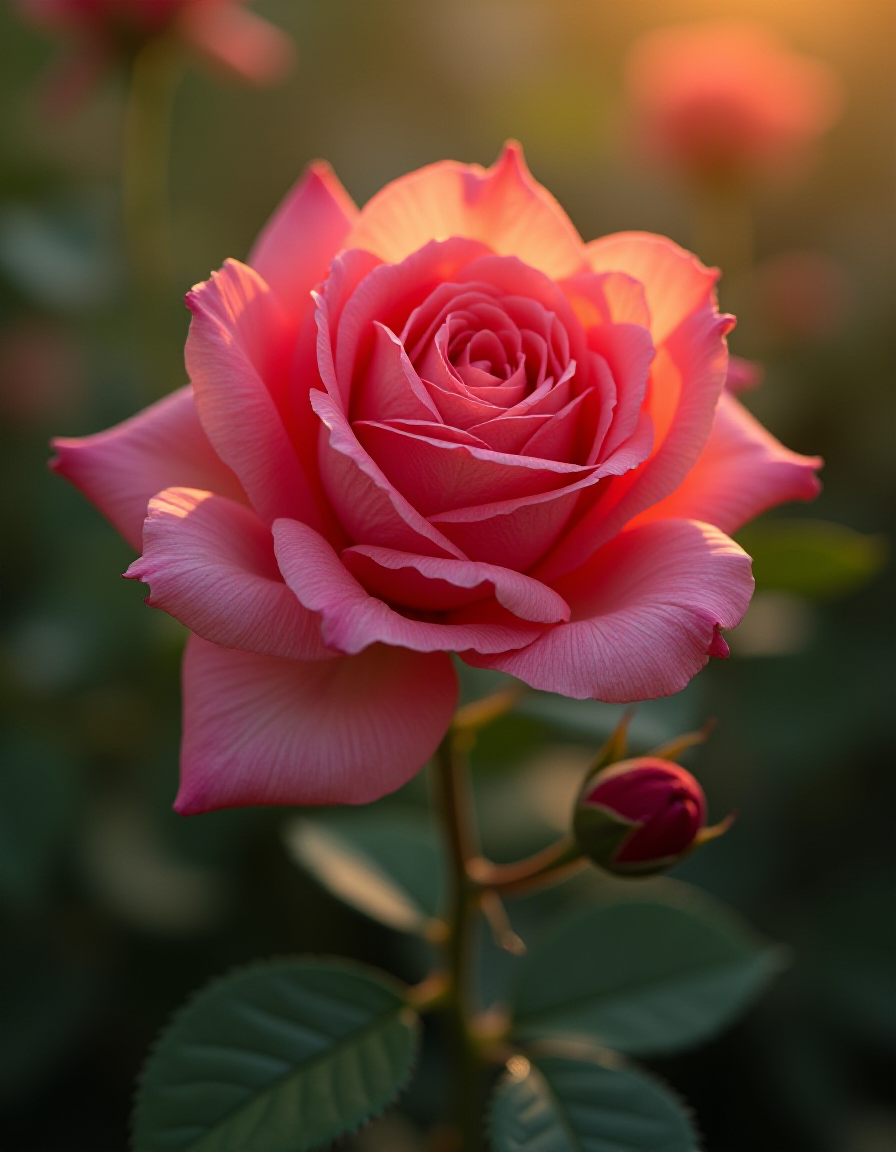
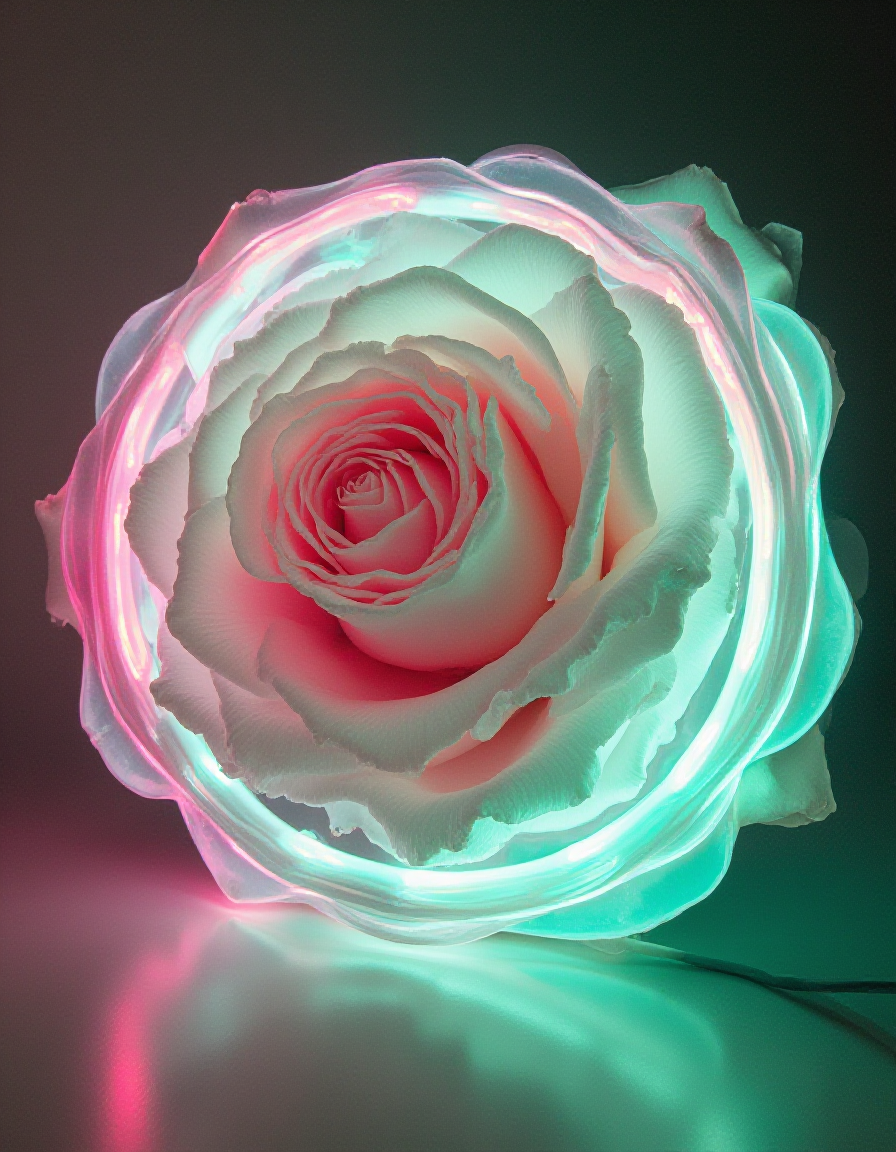
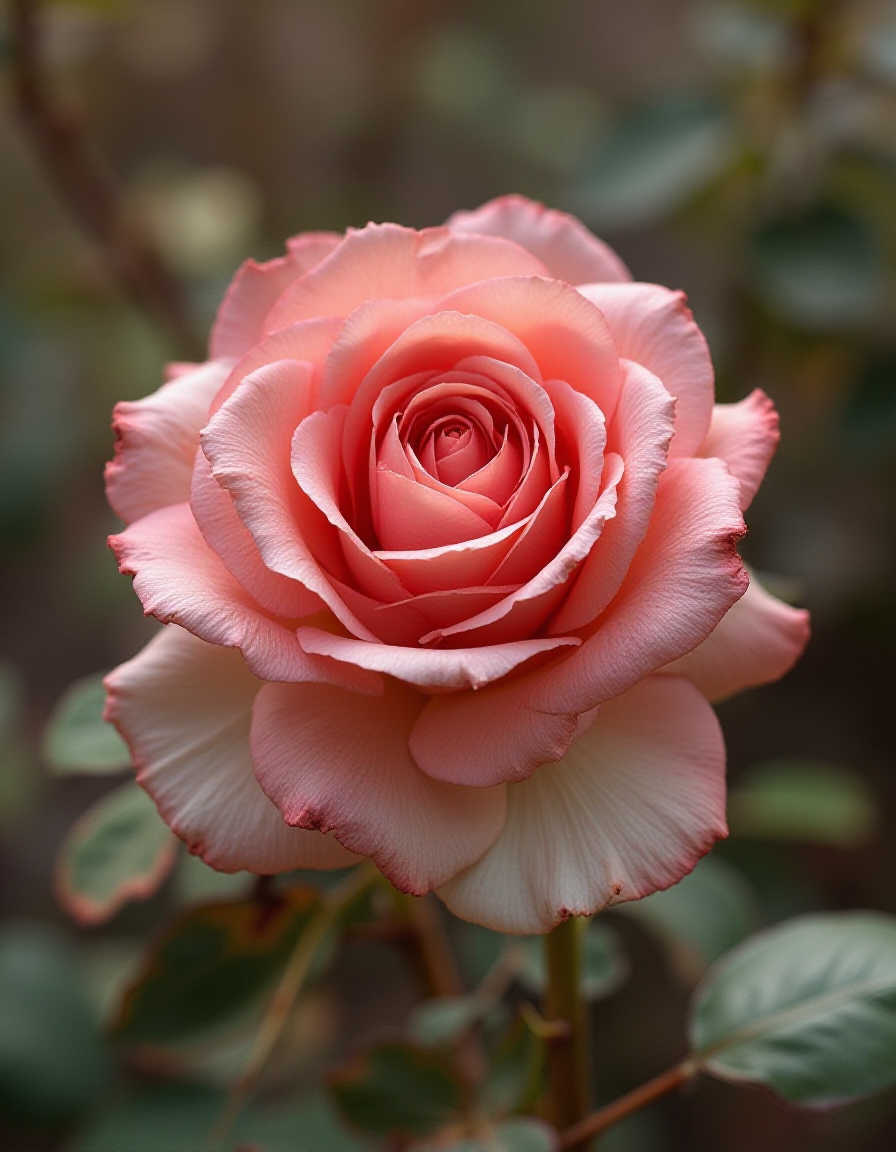
rose with petals fully open, surrounded by colorful lights
CAPTION
The image captures a vibrant pink rose in full bloom against a backdrop of colorful bokeh lights. The rose, with its petals fully spread, is the focal point of the image. The petals are a deep shade of pink, with some areas appearing slightly lighter due to the bokeh lights.
MONOLOGUE
Different indeed is the disposition of the goldenrod, which, though remaining fresh and bright, when called upon to decorate our homes, obstinately refuses to open a petal after it is gathered; and the fairy-like elder, which sullenly resents being touched, gives up the struggle for existence and droops at once; and the cactus, which promptly draws its satin petals together, and stubbornly declines to open again. The loveliest bouquet of late July on the coast of Maine is this, which I give for the pleasure of other flower-lovers, if haply there be any who have not discovered it. Put in a vase a few stalks of completely opened goldenrod, of the variety that divides into long, finger-like stems. Let there be just enough so that when each blossom is spread out full they shall barely cover the space. Have the stems of equal length, so that the effect shall be flat, and not conical. Into this, between the blossoms, carefully stick the stems of a few fully spread lace flowers (or wild carrot), with stems two or three inches longer than you have allowed the goldenrod stems. Each must have full space to display every tiny floweret, and not to hide the golden glory beneath. When prepared, set the vase or bowl on the floor, before a grate or to light up some gloomy corner. Properly done the effect is a marvel and a joy forever, like lace over sunshine, like some fairy creation too dainty for words to picture.
SUMMARY
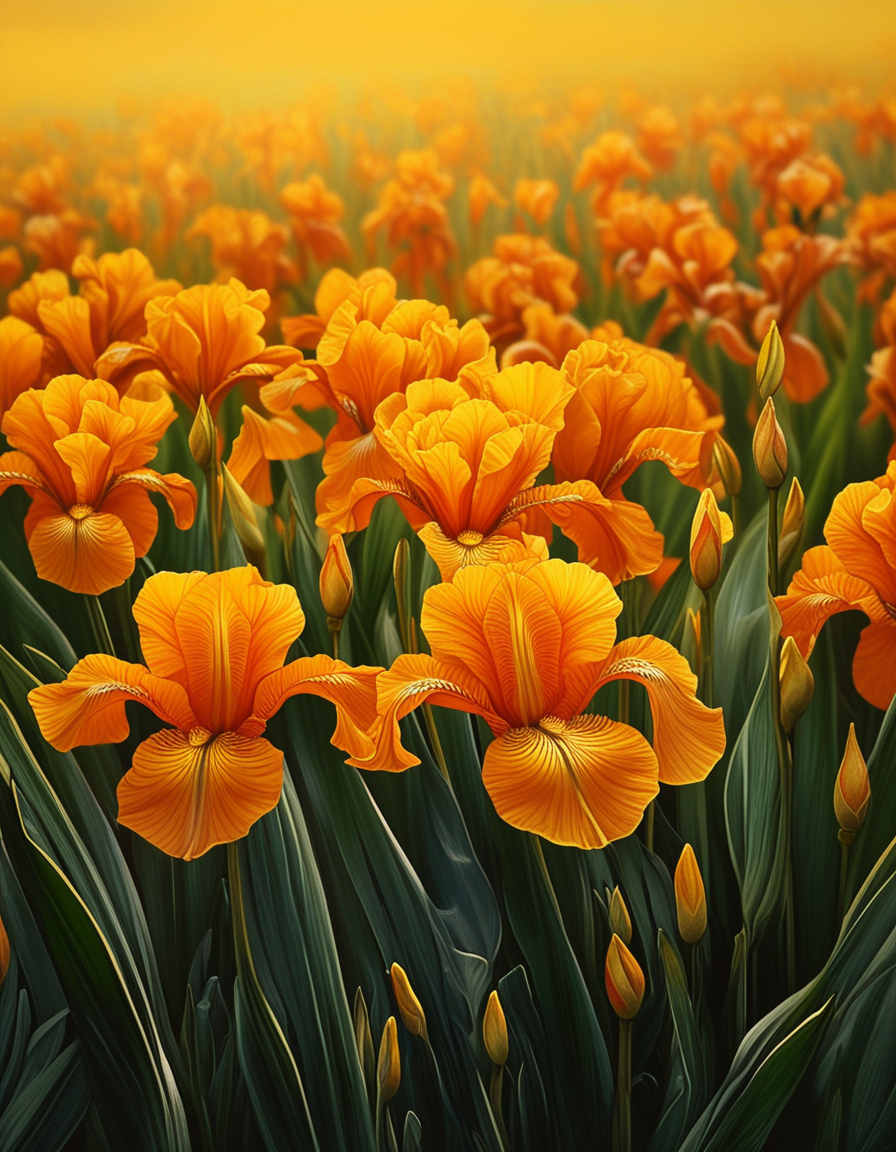
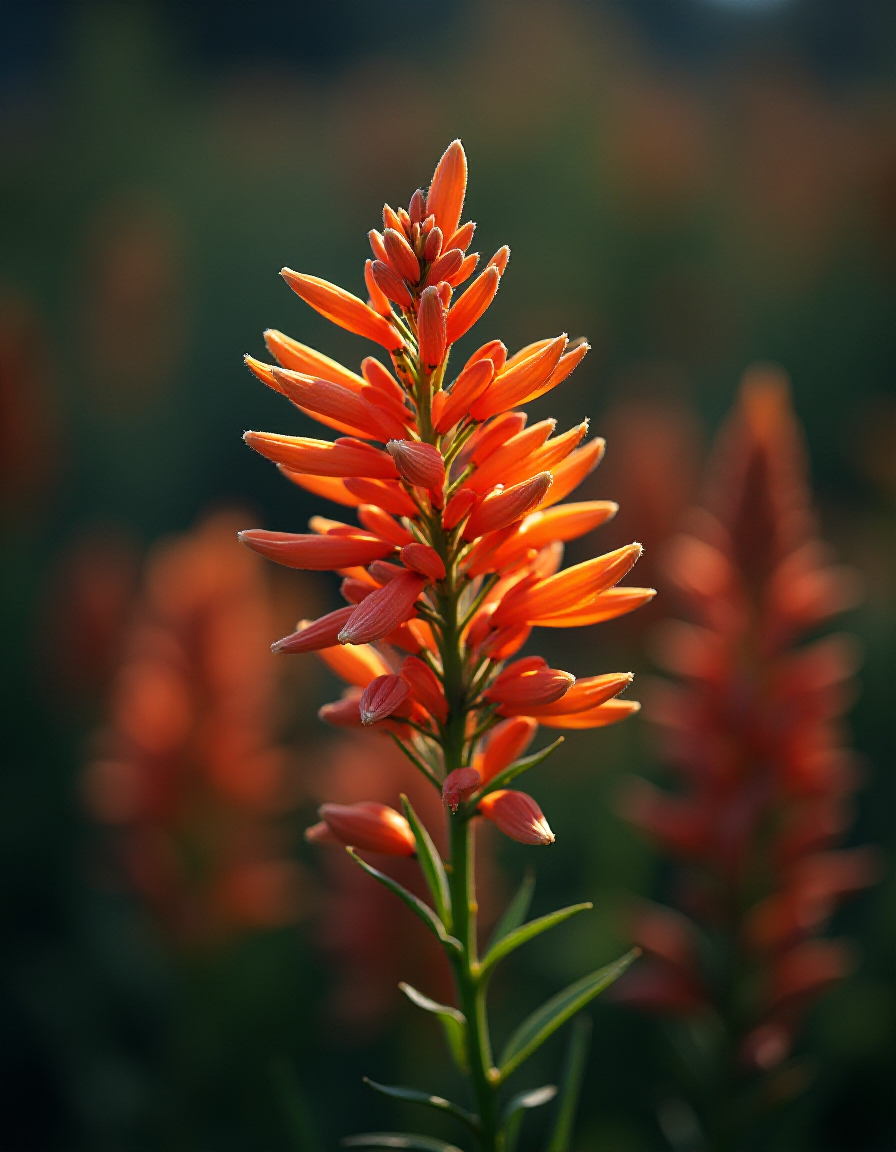
iris flowers in a field of tulips.
CAPTION
The image captures a vibrant scene of a field of tulips, their bright orange petals contrasting with the deep green foliage. The tulips are in full bloom, their petals fully spread, and their stems are green with long, slender leaves. The background is a gradient of warm yellow and orange, creating a warm and inviting atmosphere.
MONOLOGUE
CARPENTERIA CALIFORNICA.--Sierra Nevada, California, 1880. This is undoubtedly one of the most distinct and beautiful of hardy shrubs. That it is perfectly hardy in England and Ireland recently-conducted experiments conclusively prove, as plants have stood unprotected through the past unusually severe winters with which this country has been visited. When in full bloom the pure-white flowers, resembling those of the Japanese Anemone, render it of great beauty, while the light gray leaves are of themselves sufficient to make the shrub one of particular attraction. The Carpenteria is nearly related to the Mock Orange (Philadelphus), grows about 10 feet in height, with lithe and slender branches, and light gray leaves. The flowers, which are pure white with a bunch of yellow stamens, and sweet-scented, are produced usually in fives at the branch-tips, and contrast markedly with the long and light green foliage. It grows and flowers with freedom almost anywhere, but is all the better for wall protection. From cuttings or suckers it is readily increased.
SUMMARY
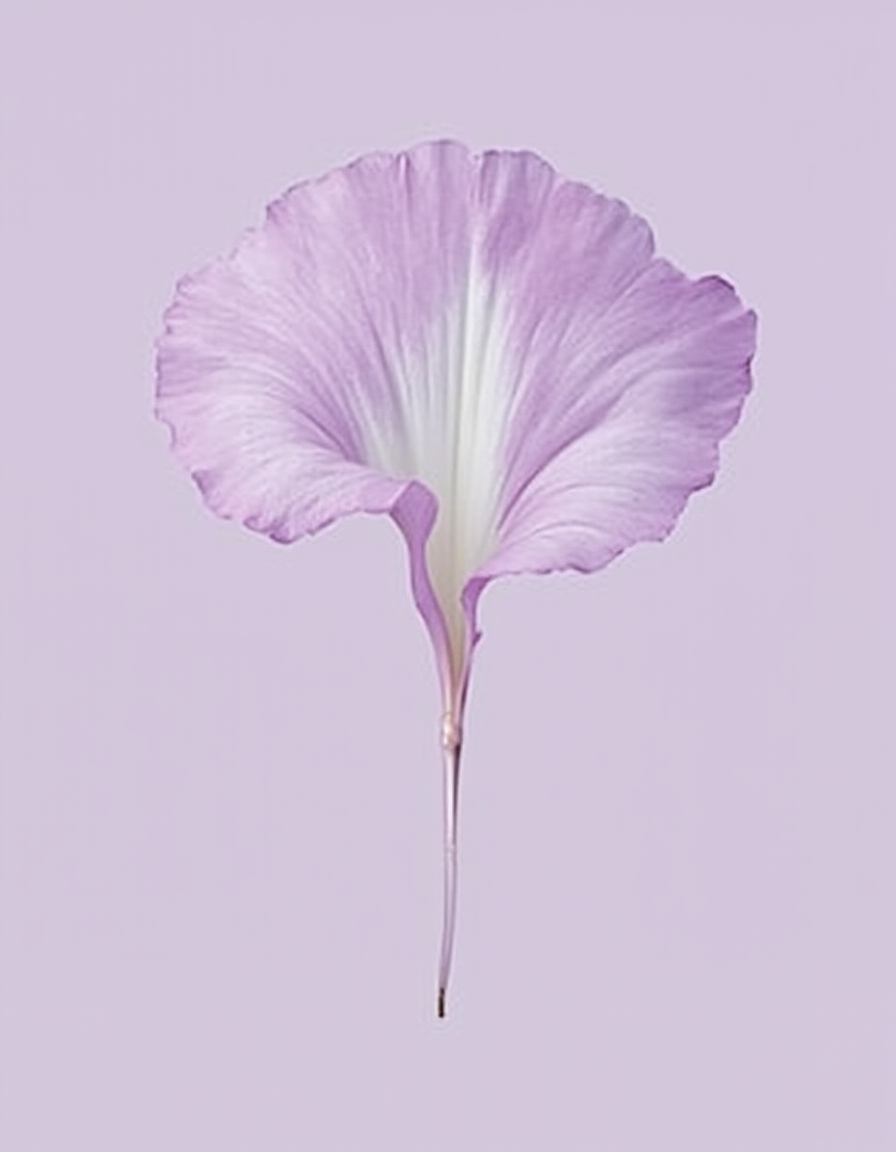
flower with white and purple petals.
CAPTION
The image depicts a single, fully bloomed purple iris flower against a plain, light purple background. The flower is oriented vertically, with its petals spread out in a fan-like shape. The flower's central part is a light purple color, while the edges of the petals are a darker shade of purple.
MONOLOGUE
What next? Above the Cocorites dangle, amid a dozen different kinds of leaves, festoons of a liane, or of two, for one has purple flowers, the other yellow--Bignonias, Bauhinias--what not? And through them a Carat {140a} palm has thrust its thin bending stem, and spread out its flat head of fan-shaped leaves twenty feet long each: while over it, I verily believe, hangs eighty feet aloft the head of the very tree upon whose roots we are sitting. For amid the green cloud you may see sprigs of leaf somewhat like that of a weeping willow; {140b} and there, probably, is the trunk to which they belong, or rather what will be a trunk at last. At present it is like a number of round-edged boards of every size, set on end, and slowly coalescing at their edges. There is a slit down the middle of the trunk, twenty or thirty feet long. You may see the green light of the forest shining through it. Yes. That is probably the fig; or, if not, then something else. For who am I, that I should know the hundredth part of the forms on which we look?--And above all you catch a glimpse of that crimson mass of Norantea which we admired just now; and, black as yew against the blue sky and white cloud, the plumes of one Palmiste, who has climbed toward the light, it may be for centuries, through the green cloud; and now, weary and yet triumphant, rests her dark head among the bright foliage of a Ceiba, and feeds unhindered on the sun.
SUMMARY
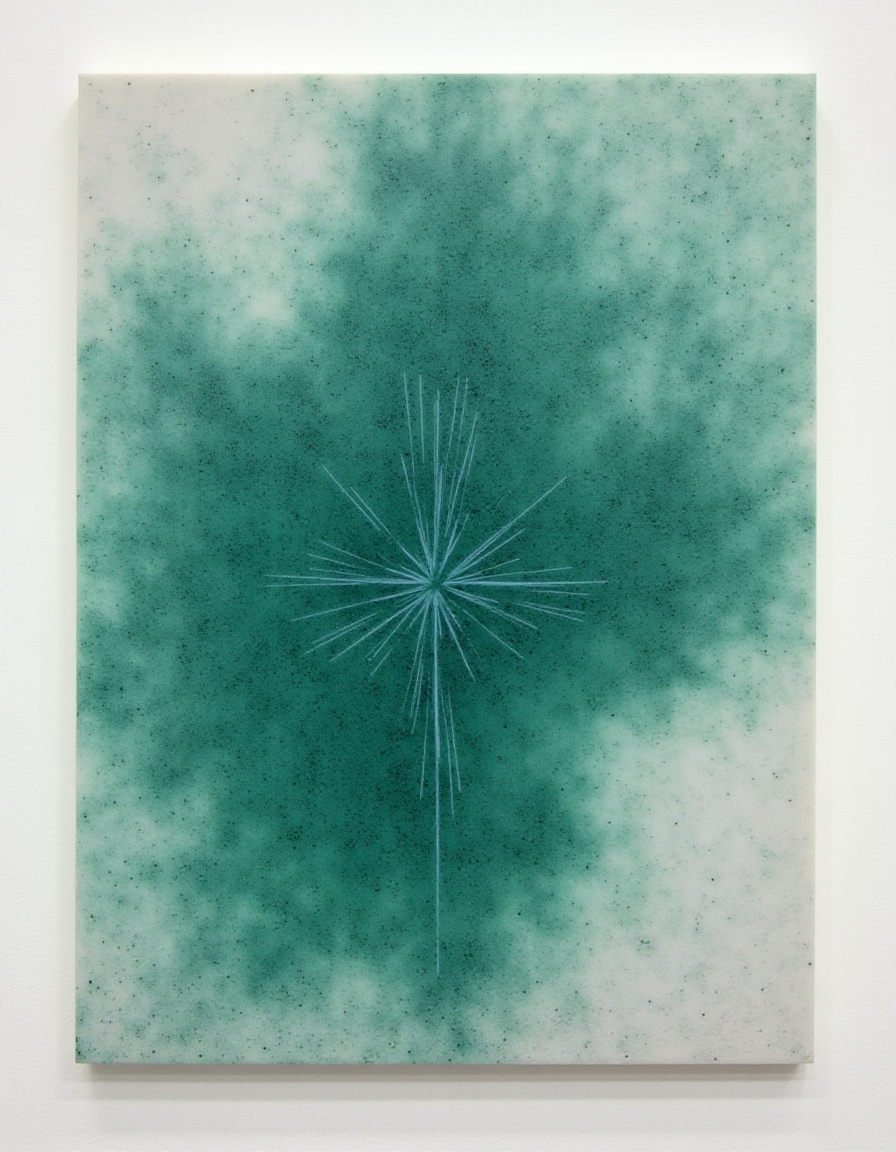
The artwork is a green abstract painting with a white star in the center.
CAPTION
The image depicts a vibrant and abstract painting on a white canvas. The painting features a central, abstract flower-like shape that is composed of multiple petals, each with a unique color and texture. The petals are arranged in a radial pattern, creating a sense of depth and movement within the artwork.
MONOLOGUE
We have sometimes looked in, for a passing moment, at the green-house, its dwelling-place, during the period of flowering,--and then stayed for more than an hour, unable to leave the fascinating scene. After the strange flower-bud has reared its dark head from the placid tank, moving it a little, uneasily, like some imprisoned water-creature, it pauses for a moment in a sort of dumb despair. Then trembling again, and collecting all its powers, it thrusts open, with an indignant jerk, the rough calyx-leaves, and the beautiful disrobing begins. The firm, white, central cone, first so closely infolded, quivers a little, and swiftly, before your eyes, the first of the hundred petals detaches its delicate edges, and springs back, opening towards the water, while its white reflection opens to meet it from below. Many moments of repose follow,--you watch,--another petal trembles, detaches, springs open, and is still. Then another, and another, and another. Each movement is so quiet, yet so decided, so living, so human, that the radiant creature seems a Musidora of the water, and you almost blush with a sense of guilt, in gazing on that peerless privacy. As petal by petal slowly opens, there still stands the central cone of snow, a glacier, an alp, a jungfrau, while each avalanche of whiteness seems the last. Meanwhile, a strange rich odor fills the air, and Nature seems to concentrate all fascinations and claim all senses for this jubilee of her darling.
SUMMARY
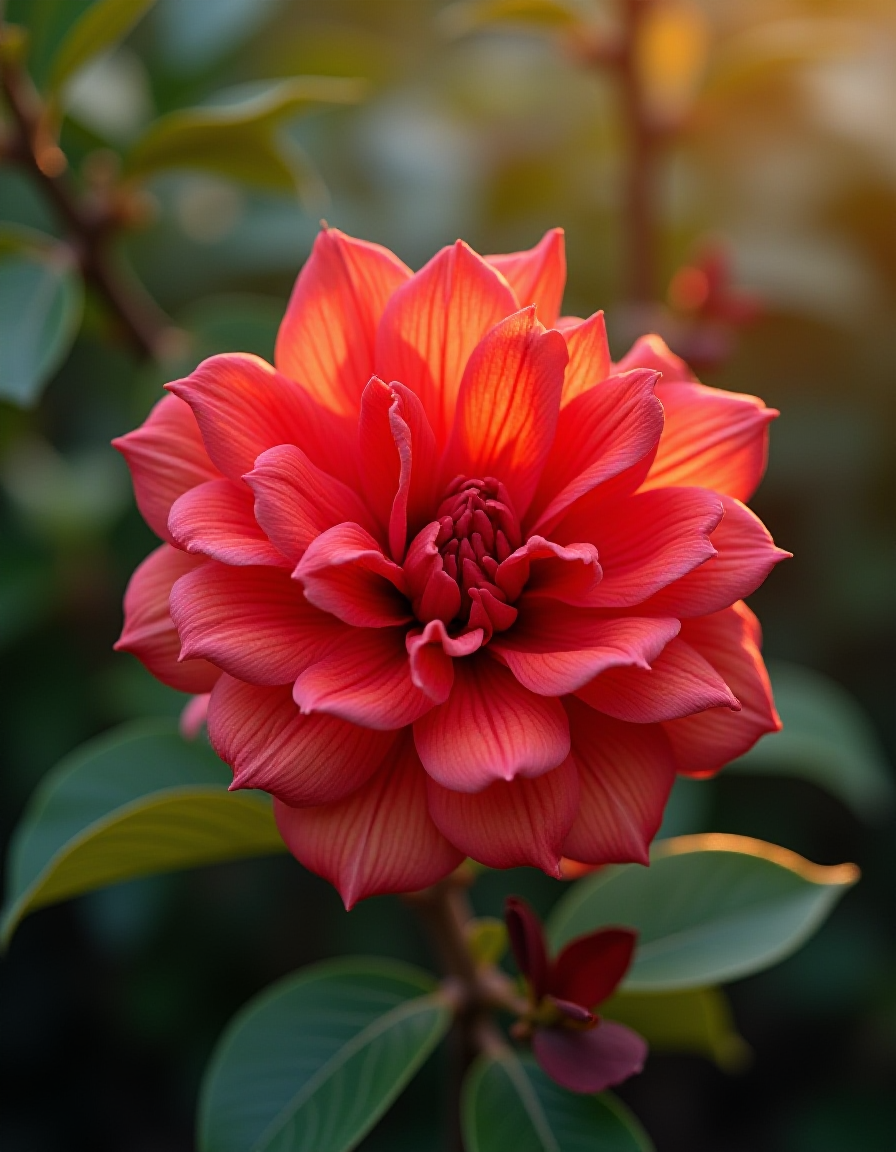
flower with red petals and white tips.
CAPTION
The image is a close-up of a red flower with intricate details. The petals are densely packed, creating a dense and vibrant red color. The edges of the petals are slightly curled, adding a sense of depth to the image.
MONOLOGUE
The only spot about the Chace where the wind-anemones grew was in a small detached copse of ash-poles nearly a mile from the great woods. Between the stoles, which were rather far apart, the ground was quite covered in spring with dark-green vegetation, so that it was impossible to walk there without treading down the leaves of bluebells, anemones, and similar woodland plants. But if you wished to see the anemones in their full beauty it was necessary to visit the copse frequently; for if you forgot it, or delayed a fortnight, very likely upon returning you would find that their fleeting loveliness was over. Their slender red stems rise but a few inches, and are surrounded with three leaves; the six white petals of the cup-shaped flower droop a little and have a golden centre. Under the petal is a tinge of purple, which is sometimes faintly visible through it. The leaves are not only three in number, but are each cut deeply thrice; they are hardy, but the flower extremely delicate.
SUMMARY
flower with orange stamen and black petals.
CAPTION
The image captures a close-up of a flower with a vibrant orange center, surrounded by intricate black petals. The petals are adorned with a pattern of small white dots, adding a touch of contrast to the overall image. The flower is set against a blurred background, which is a mix of green and yellow hues, possibly indicating a natural setting.
MONOLOGUE
E. tubiflorus (tube-flowered).--This species has an orange-shaped stem, about 4 in. high, and divided into about twelve prominent, sharp-angled ridges, along which are tufts of blackish spines, ½ in. long, and set in little cushions of white wool. The flower springs from the side of the stems, where it replaces a tuft of spines, and, as in E. Eyriesii, the tube is remarkably long, whilst the size of the whole flower much exceeds that of the rest of the plant, the length of the tube being about 6 in., and the width of the flower over 4 in. The petals are pure white, recurved, displaying the crown of yellow stamens, arranged in a ring about the rather small, rayed stigma. The tube is uniformly green, except that the scale-like bracts are edged with long, blackish, silky hairs. A native of Mexico; introduced about fifty years ago, when it was figured in the Botanical Magazine and elsewhere as a species of Echinocactus. E. tubiflorus may be placed along with E. Eyriesii and E. oxygonus, as it requires similar treatment. The three kinds here mentioned may be recommended as a trio of very fine-flowered, small-stemmed Cacti, which may be grown successfully in any ordinary greenhouse.
SUMMARY
flower with a central cavity and multiple petals.
CAPTION
The image is a close-up of a sunflower, showcasing its intricate details and vibrant colors. The sunflower is in full bloom, with its petals radiating outwards in a radial pattern. The colors are predominantly orange and yellow, with the petals exhibiting a gradient of orange and yellow hues.
MONOLOGUE
M. pectinata (comb-like); Fig. 67.--Stems globose, from 2 in. to 3 in. in diameter; the rootstock woody; the tubercles arranged in about thirteen spiral rows, swollen at the base, and bearing each a star-like tuft of about twenty-four stiff, brown, radial spines, without a central one; the length varies from in. to 1 in., and they are comb-like in their regular arrangement. When not in flower, this species bears a close resemblance to small plants of Cereus pectinatus. Flowers terminal, solitary, large, their width quite 3 in. when fully expanded; sepals reddish-green; petals rich sulphur-yellow; filaments reddish, very numerous; the flowers open at noon, and close after about two hours, even although the sun be shining full upon them. Flowering season, June to August. Native country, Mexico, on slopes of limestone hills. Although long since known to botanists, this pretty species has only lately found its way into English gardens. It is attractive even when not in flower. It requires warm greenhouse treatment, with exposure to full sunshine; during late autumn it should have plenty of air to ripen the new growth made whilst flowering. In winter it should have a dry position near the glass.
SUMMARY
rose in full bloom with dew drops on petals.
CAPTION
The image captures a close-up of a vibrant red rose, its petals fully open and wet with dew. The rose is set against a blurred background, which is a mix of green and purple hues, possibly indicating leaves or foliage. The focus is sharp, highlighting the intricate details of the rose's petals and the water droplets that cling to them.
MONOLOGUE
Like a jewel gleaming with many facets, each sunny day was stored and treasured. As she went from Mrs. Case's boarding-house forth to her work, the sweet, sharp air of these spring mornings was filled with delicious smells of new things, of new flowers and new grass and tender, new leaves of myriad shades, bronze and crimson, fuzzy white, primrose, and emerald green. And sometimes it seemed as though the pink and white clouds of the little orchards were wafted into swooning scents. She loved best the moment when the Common came in view, when through the rows of elms the lineaments of those old houses rose before her, lineaments seemingly long familiar, as of old and trusted friends, and yet ever stirring new harmonies and new visions. Here, in their midst, she belonged, and here, had the world been otherwise ordained, she might have lived on in one continuous, shining spring. At the corner of the Common, foursquare, ample, painted a straw colour trimmed with white, with its high chimneys and fan-shaped stairway window, its balustraded terrace porch open to the sky, was the eighteenth century mansion occupied by Dr. Ledyard. What was the secret of its flavour? And how account for the sense of harmony inspired by another dwelling, built during the term of the second Adams, set in a frame of maples and shining white in the morning sun? Its curved portico was capped by a wrought-iron railing, its long windows were touched with purple, and its low garret--set like a deckhouse on the wide roof--suggested hidden
SUMMARY
flower petals with water droplets on them.
CAPTION
The image is a close-up of a flower with a vibrant and colorful appearance. The petals are a mix of purple, orange, and blue hues, with the colors radiating outward from the center of the flower. The petals are adorned with numerous water droplets, which are scattered across the surface of the petals, creating a sparkling effect.
MONOLOGUE
(_c._) When you have time, practice the production of mixed tints by interlaced touches of the pure colours out of which they are formed, and use the process at the parts of your sketches where you wish to get rich and luscious effects. Study the works of William Hunt, of the Old Water-colour Society, in this respect, continually, and make frequent memoranda of the variegations in flowers; not painting the flower completely, but laying the ground colour of one petal, and painting the spots on it with studious precision: a series of single petals of lilies, geraniums, tulips, &c., numbered with proper reference to their position in the flower, will be interesting to you on many grounds besides those of art. Be careful to get the _gradated_ distribution of the spots well followed in the calceolarias, foxgloves, and the like; and work out the odd, indefinite hues of the spots themselves with minute grains of pure interlaced colour, otherwise you will never get their richness of bloom. You will be surprised to find, as you do this, first the universality of the law of gradation we have so much insisted upon; secondly, that Nature is just as economical of _her_ fine colours as I have told you to be of yours. You would think, by the way she paints, that her colours cost her something enormous: she will only give you a single pure touch just where the petal turns into light; but down in the bell all is subdued, and under the petal all is subdued, even in the showiest flower. What you thought was bright blue is, when you look
SUMMARY
flower with a bright yellow center and pink petals.
CAPTION
The image depicts a vibrant flower with a striking red and pink hue, set against a backdrop of a dark, cloudy sky. The flower is positioned centrally in the frame, with its petals fully spread out, creating a sense of depth and dimension. The petals are a mix of red and pink, with the red petals being more prominent and the pink petals being slightly smaller.
MONOLOGUE
Farther on are close green tufts of the Corydalis, with its delicate lilac flowers. Then come bushes of Wallflower of the richest red-brown colour--a colour like nothing else, and indeed without a name, that would convey the depth and beauty of the dark tawny hue. What a contrast to the little wild yellow flower, which draws its scanty life from the wall of some grey old castle like that of Conway! Few scents are more delicious than that of Wallflowers. Bacon says of them that they "are very delightful, to be set under a parlour or lower chamber window." It is an old controversy whether the Wallflower and the Gillyflower are the same; but it seems tolerably clear that the latter name was rather loosely used, and meant sometimes the Wallflower, but sometimes also the Stock or the Clove Carnation. The Polyanthus on the borders has done better than those on the separate bed; the pretty _tortoise-shell_ blossoms (to use a good expression of Forbes Watson) are just now in full perfection, and I have also a perfectly white Hose-in-hose Polyanthus, which is really charming. There is a droll passage in one of Sterne's love-letters to his future wife, in which he says--and he means to be sentimental and pathetic--
SUMMARY
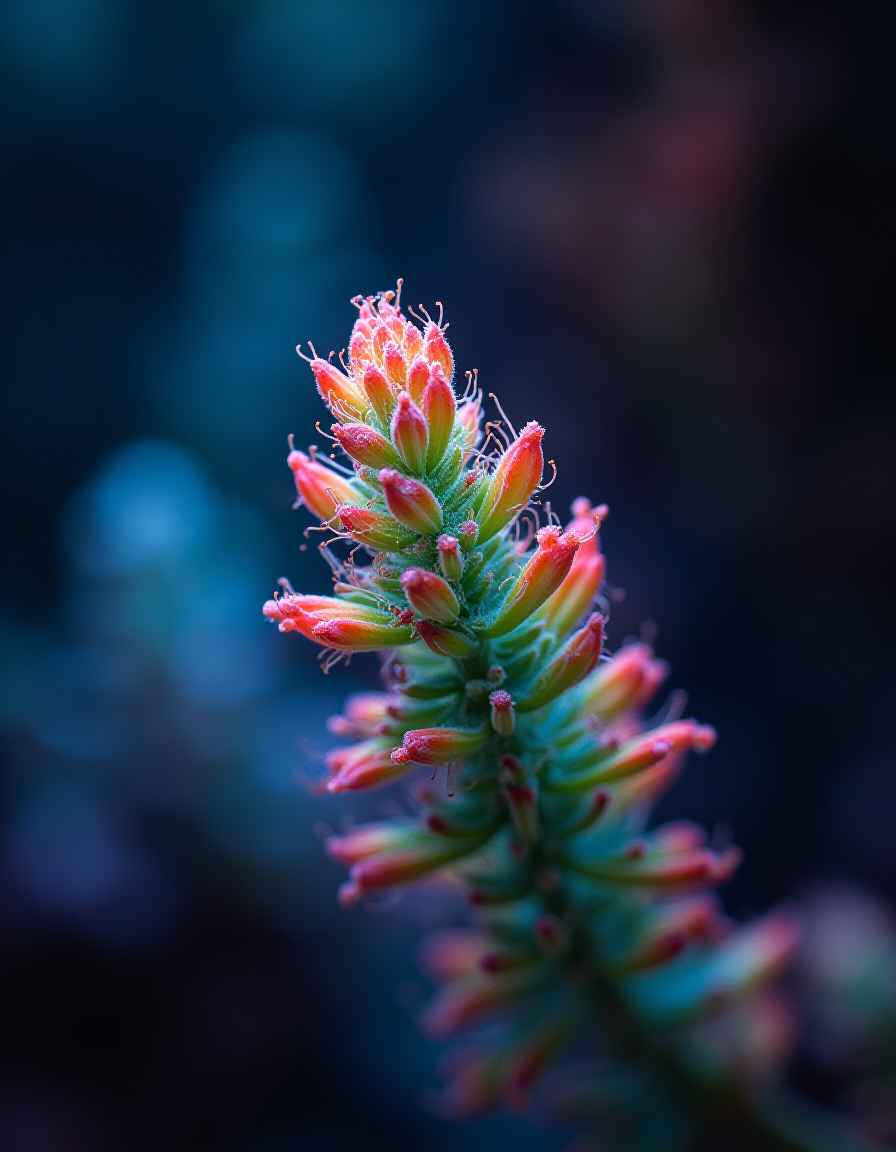
flower with red and green petals and a fuzzy texture.
CAPTION
The image captures a close-up of a flower with vibrant red and green petals. The petals are adorned with a delicate, translucent, and slightly wet appearance, giving them a frosty quality. The background is blurred, drawing focus to the flower, which is set against a dark blue backdrop.
MONOLOGUE
Yet the pastures are so glad with May that it is easy to forget sorrow for the passing old in joy over the surgent beauty of new life. It is easy now to believe what the botanists tell us--that flower and leaf are but slightly differentiated forms of the same impulse of growth, grading almost imperceptibly one into the other. With new leaves half-grown, with blossoms bursting, it is hard to tell without close inspection which is which, so tender and rich are the colors which unfold from all buds. The yellow of the dandelion, the blue of wood violets, and the purple of the wild cranesbill are not more delicate, nor are they so rich as the red of the young leaves of the white oaks, now as large as a mouse's ear, which is the Indian sign for the time to plant corn. The blossoms of the berry bushes are no more flower-like than the young leaves among which they grow. The green-yellow of barberry blooms is not more fervent than the yellow-green of the tender foliage, and the two colors blend into one burning bush of cool flame. I do not wonder the summer yellow-bird loves to build his nest in the barberry bush. Its colors at this season are his own.
SUMMARY
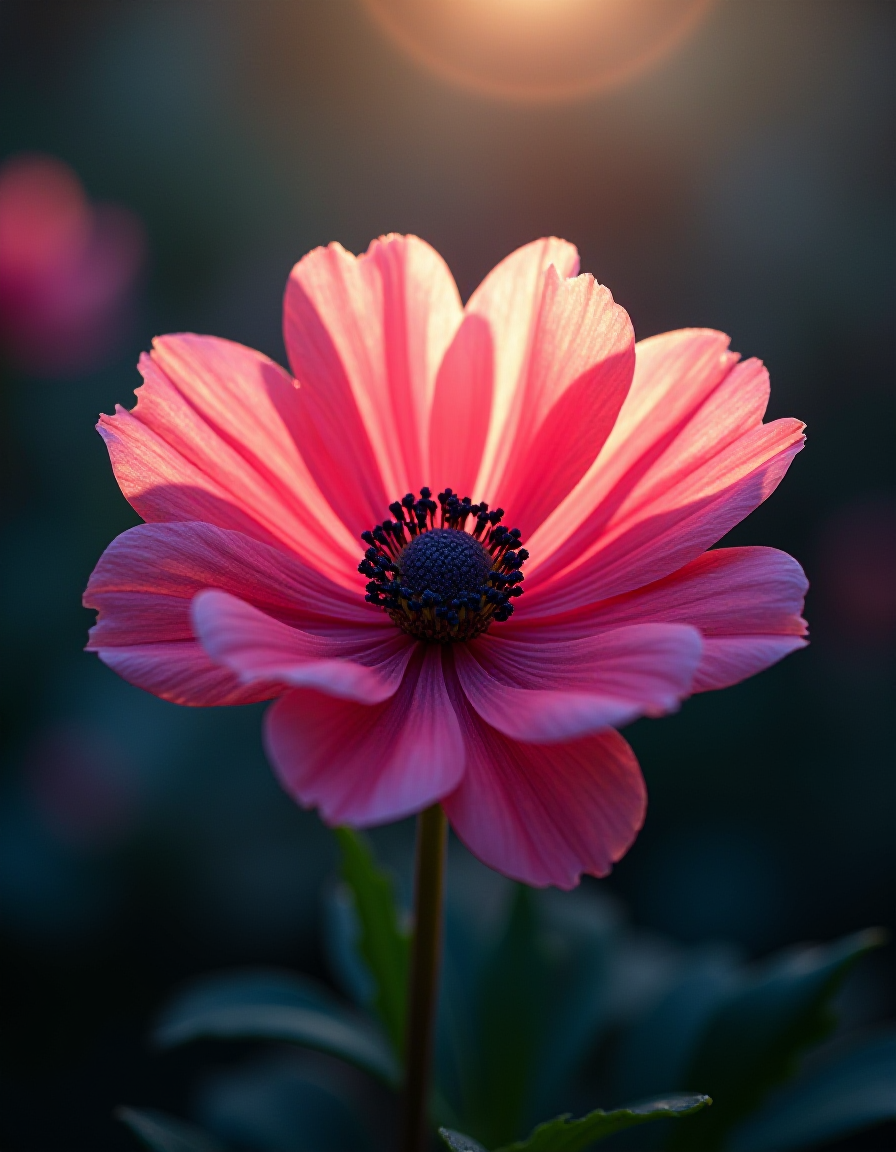
flower with a dark center and pink petals.
CAPTION
The image captures a close-up of a pink poppy flower in full bloom against a blurred background. The flower is in the center of the frame, with its petals fully spread out, showcasing their vibrant pink color. The center of the flower is adorned with a cluster of dark brown seeds, adding a stark contrast to the pink petals.
MONOLOGUE
A glance at the spur of this orchid, one of the handsomest and most striking of its clan, and the heavy perfume of the flower, would seem to indicate that only a moth with a long proboscis could reach the nectar secreted at the base of the thread-like passage. Butterflies, attracted by the conspicuous color, sometimes hover about the showy spikes of bloom, but it is probable that, to secure a sip, all but possibly the very largest of them must go to the smaller purple-fringed orchis, whose shorter spur holds out a certain prospect of reward; for, in these two cases, as in so many others, the flower's welcome for an insect is in exact proportion to the length of its visitor's tongue. Doubtless it is one of the smaller sphinx moths, such as we see at dusk working about the evening primrose and other flowers deep of chalice, and heavily perfumed to guide visitors to their feast, that is the great purple-fringed orchid's benefactor, since the length of its tongue is perfectly adapted to its needs. Attracted by the showy, broad lower petal, his wings ever in rapid motion, the moth proceeds to unroll his proboscis and drain the cup, that is frequently an inch and a half deep. Thrusting in his head, either one or both of his large, projecting eyes are pressed against the sticky button-shaped disks to which the pollen masses are attached by a stalk, and as he raises his head to depart, feeling that he is caught, he gives a little jerk that detaches them, and away he flies with these still fastened to his eyes.
SUMMARY
flower with bright red petals and yellow tips.
CAPTION
The image captures a vibrant red flower with multiple petals, set against a blurred background of green foliage. The flower is in full bloom, with its petals fully spread out, showcasing their bright red color. The background is a mix of green and brown hues, suggesting a natural setting.
MONOLOGUE
"How desolate!" thought Monsieur d'Albon, observing the sombre expression which the ancient building gave to the landscape, gloomy as though a curse were on it. It seemed a fatal spot deserted by man. Ivy had stretched its tortuous muscles, covered by its rich green mantle, everywhere. Brown or green, red or yellow mosses and lichen spread their romantic tints on trees and seats and roofs and stones. The crumbling window-casings were hollowed by rain, defaced by time; the balconies were broken, the terraces demolished. Some of the outside shutters hung from a single hinge. The rotten doors seemed quite unable to resist an assailant. Covered with shining tufts of mistletoe, the branches of the neglected fruit-trees gave no sign of fruit. Grass grew in the paths. Such ruin and desolation cast a weird poesy on the scene, filling the souls of the spectators with dreamy thoughts. A poet would have stood there long, plunged in a melancholy reverie, admiring this disorder so full of harmony, this destruction which was not without its grace. Suddenly, the brown tiles shone, the mosses glittered, fantastic shadows danced upon the meadows and beneath the trees; fading colors revived; striking contrasts developed, the foliage of the trees and shrubs defined itself more clearly in the light. Then--the light went out. The landscape seemed to have spoken, and now was silent, returning to its gloom, or rather to the soft sad tones of an autumnal twilight.
SUMMARY
The image depicts a close-up of a field of pink flowers with a bright sun in the background.
CAPTION
The image captures a vibrant scene of a field of pink flowers, bathed in the warm glow of a setting sun. The sun, positioned in the upper right corner of the image, casts a golden hue over the flowers, creating a serene and picturesque atmosphere. The flowers, with their bright pink petals and yellow centers, are in full bloom, their delicate petals slightly blurred to emphasize their beauty.
MONOLOGUE
The next day we dined at Dr. Almeida's, and in his magnificent garden found several choice specimens of both the _Victoria regia_ and the _Rafflesia Arnoldi_, the two largest flowers in the world, each bloom measuring two feet in diameter. But the rarest of all the doctor's treasures was the night-blooming cereus. There were six blooms in full maturity--four on one stalk and two on another--creamy, waxen flowers of exquisite form, the leaves of the corolla of a pale golden hue and the petals intensely white. The calyx rises from a long, hollow footstalk, which is formed of rough plates overlapping each other like tiles on a roof. From the centre of this footstalk rises a bundle of filaments that encircle the style, stamens springing also from the insertion of the leaves of the corolla, lining it with delicate beauty and waving their slender forms with exquisite grace. But the real charm of the cereus is its wondrous perfume, exhaled just at night-fall, and readily discernible over the circuit of a mile. The peculiar odor cannot be understood by mere description, but partakes largely of that of sweet lilies, violets, the tuberose and vanilla. After the bud appears the growth is very rapid, often two or three inches a day--that is, in the height of the stalk, the flower expanding proportionately. When fully grown it begins to unfold its charms as the twilight deepens into night, and reaches perfect maturity about an hour before midnight: at three o'clock its glory is already beginning to wane, though scarcely perceptibly; but at dawn
SUMMARY
The image depicts a close-up of a flower with multiple petals, set against a blurred background of foliage.
CAPTION
The image captures a close-up of a flower with a vibrant orange hue, featuring a multitude of petals that are slightly curled and ruffled. The petals are arranged in a radial pattern, with the central petal being the largest and the outermost petals being the smallest. The background is blurred, suggesting a focus on the flower itself.
MONOLOGUE
M. phellosperma (corky-seeded).--A pretty plant, resembling M. Grahami in all points except the seed, which, as is denoted by the name, is half enveloped in a corky covering, suggesting acorns. Stems simple, sometimes proliferous at the base, globose when young, afterwards almost cylinder or pear-shaped, 5 in. high, 2 in. in diameter; tubercles in. long, arranged in twelve spiral rows, slightly woolly in axils. Spines radiating, in two rows, about fifty on each tubercle, the three or four central ones being hooked at the tips or sometimes straight; length, in. to 1 in. Flowers (only seen in the dried state) 1 in. long and wide. Native of the dry gravelly hills and sand ridges in California and Colorado, and, therefore, requiring greenhouse treatment. This plant is cultivated in the Kew collection, but it has not been known to flower there. It is one of the most ornamental of the very spinous species, the radial spines being almost white, whilst the central ones are black, and look like tiny fish-hooks. A large proportion of these Mamillarias are far more interesting in the form and arrangement of their tubercles and spines than in any floral character, and it is on this account that so many which are insignificant as flowering plants are included here.
SUMMARY
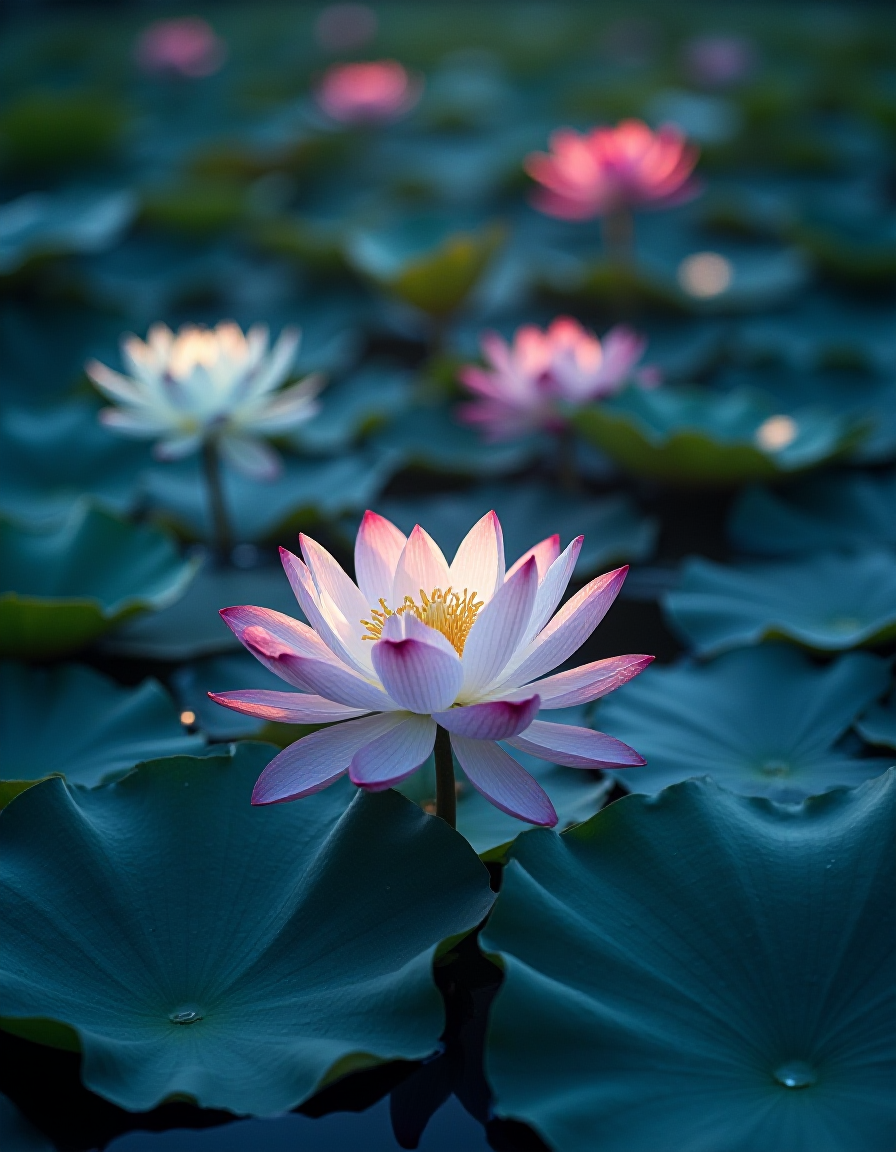
The image depicts a lotus flower with a vibrant pink and white color scheme, surrounded by water lilies.
CAPTION
The image captures a close-up view of a lotus flower, which is the main subject. The flower is predominantly white with a pinkish hue on the edges of its petals. The petals are fully spread, revealing the yellow center of the flower.
MONOLOGUE
The Bolina (Fig 32), like the Pleurobrachia, is slightly oval in form, with a longitudinal split at one end of the body, forming a mouth which opens into a capacious sac or digestive cavity. But it differs from the Pleurobrachia in having the oral end of the body split into two larger lobes (Fig. 31), hanging down from the mouth. These lobes may gape widely, or they may close completely over the mouth so as to hide it from view, and their different aspects under various degrees of expansion or contraction account for the discrepancies in the description of these animals. We have seen that the Pleurobrachia moves with the mouth upward; but the Bolina, on the contrary, usually carries the mouth downward, though it occasionally reverses its position, and in this attitude, with the lobes spread open, it is exceedingly graceful in form, and looks like a white flower with the crown fully expanded. These broad lobes are balanced on the other sides of the body by four smaller appendages, divided in pairs, two on each side (Fig. 32), called auricles. These so-called auricles are in fact organs of the same kind as the larger lobes, though less developed. The rows of locomotive flappers on the Bolina differ in length from each other (Fig. 31), instead of being equal, as in the Pleurobrachia. The four longest ones are opposite each other on those sides of the body where the larger lobes are developed, the four short ones being in pairs on the sides where the auricles are placed. At first sight they all seem to terminate at the margin of the body, but
SUMMARY
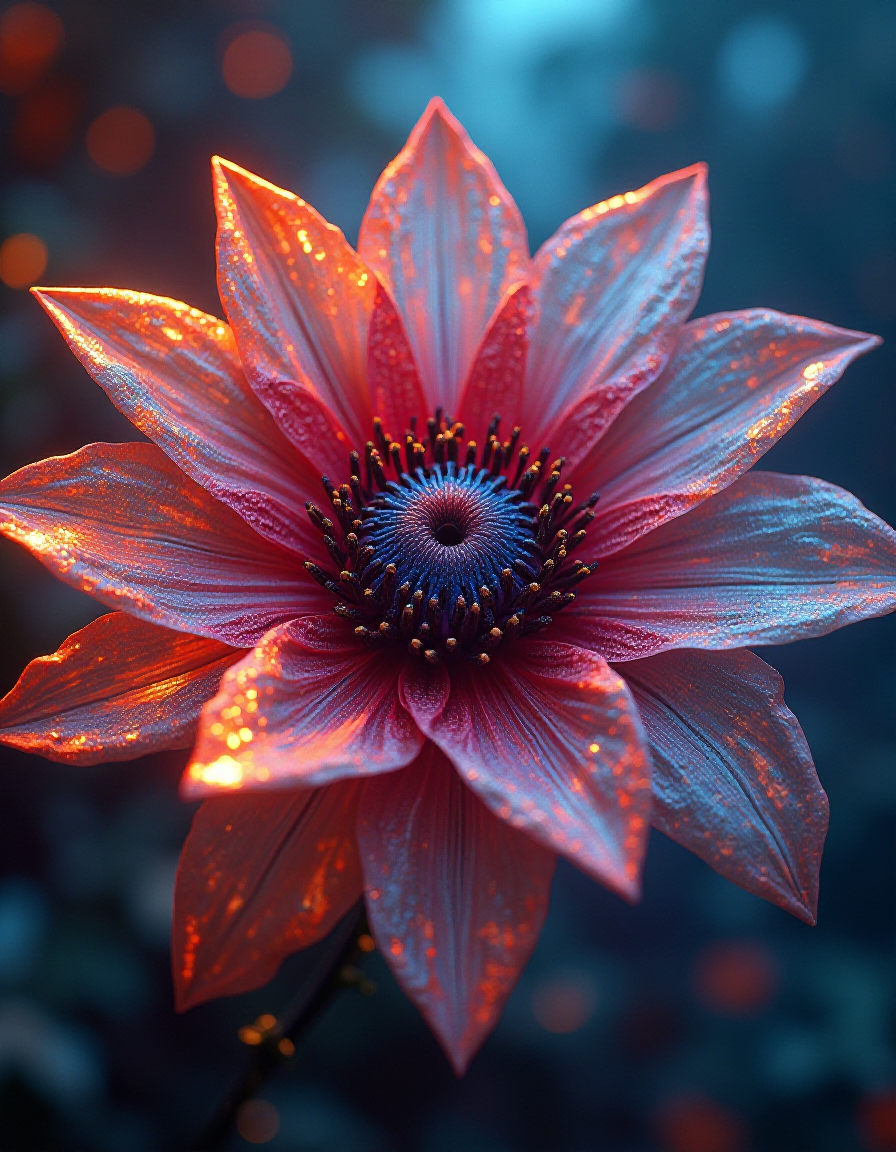
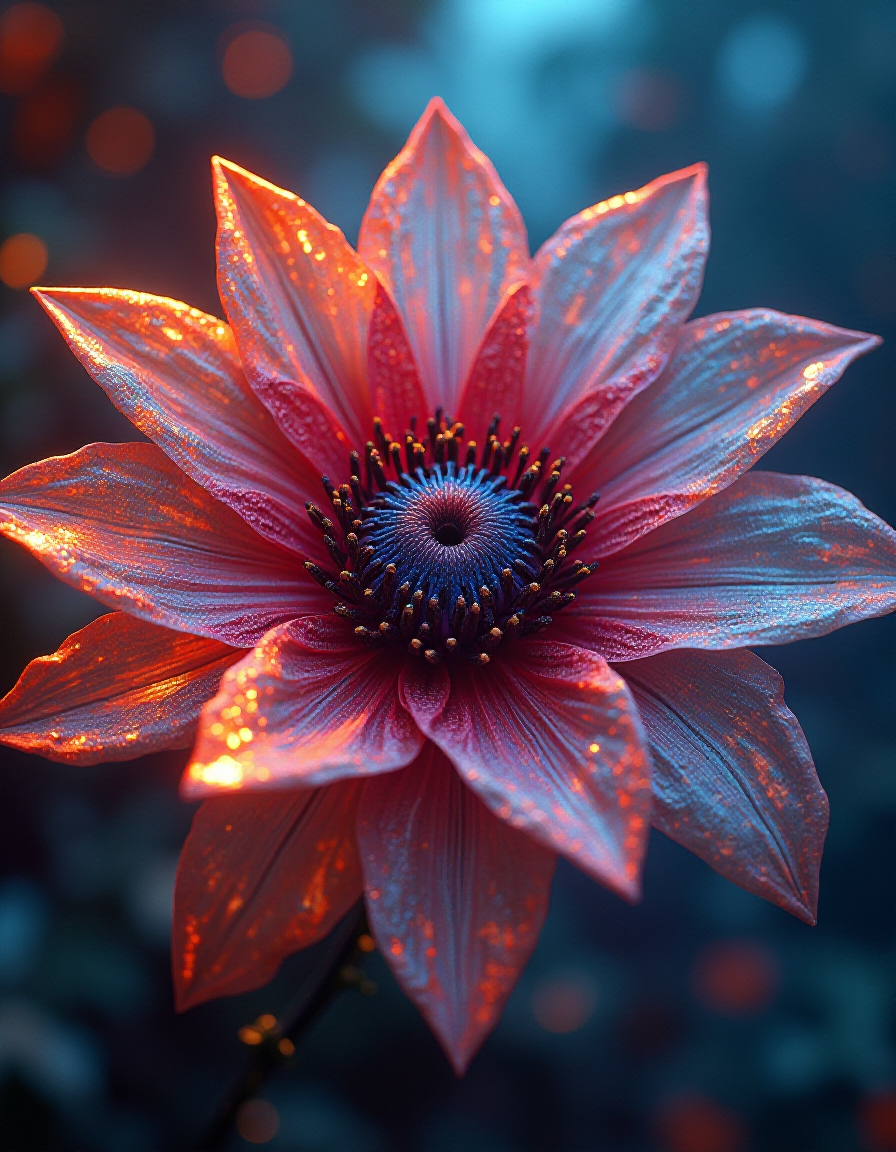
The image depicts a flower with a vibrant pink hue, exhibiting a unique and intricate pattern of petals. The petals are adorned with a sparkling effect, adding a touch of elegance and beauty to the overall composition. The flower is set against a blurred background, which enhances the focus on the flower and its intricate details.
CAPTION
The image captures a close-up of a flower with a vibrant pink and red hue, set against a blurred background that suggests a night sky. The petals of the flower are intricately detailed, with a pattern of tiny dots and lines that add depth and texture to the petals. The center of the flower is a deep blue, surrounded by a ring of yellow stamens.
MONOLOGUE
'What a beautiful flower!' exclaimed the woman, and she kissed the red and yellow petals; but as she kissed them the flower burst open. It was a real tulip, such as one can see any day; but in the middle of the blossom, on the green velvety petals, sat a little girl, quite tiny, trim, and pretty. She was scarcely half a thumb in height; so they called her Thumbelina. An elegant polished walnut-shell served Thumbelina as a cradle, the blue petals of a violet were her mattress, and a rose-leaf her coverlid. There she lay at night, but in the day-time she used to play about on the table; here the woman had put a bowl, surrounded by a ring of flowers, with their stalks in water, in the middle of which floated a great tulip petal, and on this Thumbelina sat, and sailed from one side of the bowl to the other, rowing herself with two white horse-hairs for oars. It was such a pretty sight! She could sing, too, with a voice more soft and sweet than had ever been heard before.
SUMMARY
The image depicts a flower with a vibrant pink hue, exhibiting a unique and intricate pattern of petals. The petals are adorned with a sparkling effect, adding a touch of elegance and beauty to the overall composition. The flower is set against a blurred background, which enhances the focus on the flower and its intricate details.
CAPTION
The image captures a close-up of a flower with a vibrant pink and red hue, set against a blurred background that suggests a night sky. The petals of the flower are intricately detailed, with a pattern of tiny dots and lines that add depth and texture to the petals. The center of the flower is a deep blue, surrounded by a ring of yellow stamens.
MONOLOGUE
The little Cornish port of Pencastle was bright in the early April, when the sun had seemingly come to stay after a long and bitter winter. Boldly and blackly the rock stood out against a background of shaded blue, where the sky fading into mist met the far horizon. The sea was of true Cornish hue--sapphire, save where it became deep emerald green in the fathomless depths under the cliffs, where the seal caves opened their grim jaws. On the slopes the grass was parched and brown. The spikes of furze bushes were ashy grey, but the golden yellow of their flowers streamed along the hillside, dipping out in lines as the rock cropped up, and lessening into patches and dots till finally it died away all together where the sea winds swept round the jutting cliffs and cut short the vegetation as though with an ever-working aerial shears. The whole hillside, with its body of brown and flashes of yellow, was just like a colossal yellow-hammer.
SUMMARY
rose with a bud on the stem.
CAPTION
The image captures a close-up of a pink rose in full bloom, with a single bud on the stem. The rose is set against a blurred background of green foliage, which adds depth to the image. The petals of the rose are a vibrant shade of pink, with the edges of the petals slightly curled, giving the rose a textured appearance.
MONOLOGUE
The stamina are also formed from pink wax: first roll a whip (as in muslin) which produces the anthers, and cut a fringe the third of an inch deep. Wind the same around the previously formed centre, and then brush them out with the dark purple brush that has been applied to the foundation. When thoroughly dry, touch the ends occasionally with green; this must be done with the sable brush. At the back of the pulp first formed, close to the wire, affix the small petals at equal distance, and the large ones, which turn back, in the intervening spaces. When the anemone is in bud, it is surrounded by a calyx, but as it expands it rises and leaves the said calyx at least one inch down the stem; it has a fringed appearance, and is prepared from double green wax. The stem is covered neatly with light green wax.
SUMMARY
flower with bright orange petals and green leaves.
CAPTION
The image captures a close-up of a vibrant orange flower, with the flower in the foreground and the background blurred, emphasizing the flower's details. The flower is in full bloom, with numerous small orange petals that are tightly packed together. The petals are slightly curled at the edges, giving the flower a textured appearance.
MONOLOGUE
The flowers are a light bright blue colour, and 1in. to 1in. across. The corolla is bell-shaped, the five divisions being deeply cut, which allows the flower to expand well; the calyx is neat and smooth, the segments long and awl-shaped; the flower stalks are short, causing the numerous erect branches to be closely furnished with bloom during favourable weather. The leaves of the root are very large and stalked, of irregular shape, but for the most part broadly oval or lance-shaped. The edges are slightly toothed, having minute glands; those of the stems are much smaller, sessile, and long egg-shaped; all the foliage is smooth, and of a dark green colour; the main stems are very stout, and sometimes grow to the height of 7ft. Vigorous plants will send up several of these, from which a great number of small ones issue, all assuming an erect habit; blooming specimens are hardly anything else than a wand-like set of flowered stems, and though it is advisable to stake them, I have seen them bend and wave during high winds without damage.
SUMMARY
flower with petals and a center of stamen.
CAPTION
The image captures a vibrant red flower in full bloom, with its petals fully spread and the center of the flower prominently displayed. The flower is set against a backdrop of green leaves, adding a natural and organic element to the composition. The flower is positioned in the center of the image, drawing the viewer's attention to its beauty and the intricate details of its petals.
MONOLOGUE
Nothing at the south had affected me like the magnolia. Sickness and sorrow, which have separated me from my kind, have requited my loss by making known to me the loveliest dialect of the divine language. "Flowers," it has been truly said, "are the only positive present made us by nature." Man has not been ungrateful, but consecrated the gift to adorn the darkest and brightest hours. If it is ever perverted, it is to be used as a medicine; and even this vexes me. But no matter for that. We have pure intercourse with these purest creations; we love them for their own sake, for their beauty's sake. As we grow beautiful and pure, we understand them better. With me knowledge of them is a circumstance, a habit of my life, rather than a merit. I have lived with them, and with them almost alone, till I have learned to interpret the slightest signs by which they manifest their fair thoughts. There is not a flower in my native region which has not for me a tale, to which every year is adding new incidents; yet the growths of this new climate brought me new and sweet emotions, and, above all others, was the magnolia a revelation. When I first beheld her, a stately tower of verdure, each cup, an imperial vestal, full-displayed to the eye of day, yet guarded from the too hasty touch even of the wind by its graceful decorums of firm, glistening, broad, green leaves, I stood astonished, as might a lover of music, who, after hearing in all his youth only the harp or the bugle, should be saluted, on entering some vast cathedral, by the
SUMMARY
flower with petals and stamen in full bloom.
CAPTION
The image captures a close-up of a vibrant orange flower with a yellow center, set against a blurred background that suggests a sunset or sunrise. The flower is in full bloom, with its petals fully spread, and the light from the setting sun creates a warm, golden hue on the petals. The flower is positioned centrally in the frame, drawing the viewer's attention to its intricate details.
MONOLOGUE
Let me draw your attention, O ancient woman sitting at the end of my life, to the colour of the trees and bushes in this place you once lived in, in autumns that for you are now so far away. Do you remember how it was like flames, and the very air was golden? The hazel-bushes, do you remember them? Along the path that led down from the terrace to the village? How each separate one was like a heap of light? Do you remember how you spent to-day, the 22nd of September, 1919, lying on a rug in the sun close up under one of them, content to stare at the clear yellow leaves against the amazing sky? You ve forgotten, I daresay. You re only thinking of your next meal and being put to bed. But you did spend a day to-day worth remembering. You were very content. You were exactly balanced in the present, without a single oscillation towards either the past, a period you hadn't then learned to regard with the levity for which you are now so remarkable, or to the future, which you at that time, however much the attitude may amuse you now, thought of with doubt and often with fear. Mrs. Barnes let you go to-day, having an appreciation of the privileges due to the dosed, and you took a cushion and a rug--active, weren't you--and there you lay the whole blessed day, the sun warm on your body, enfolded in freshness, thinking of nothing but calm things. Rather like a baby you were; a baby on its back sucking its thumb and placidly contemplating the nursery ceiling. But the ceiling was the great sky, with, two eagles ever so far up curving in
SUMMARY
flower with pink petals and white tips, with a bright sunbeam shining on it, and a blurred background.
CAPTION
The image presents a close-up view of a pink flower with a multitude of delicate, feathery petals. The petals are a vibrant shade of pink, with a subtle gradient from light to dark, creating a sense of depth and texture. The flower is set against a dark background, which contrasts with the bright pink of the petals, making them stand out.
MONOLOGUE
of dry stony earth, and in early summer every little pool of water affords sustenance to coarse-scented white water-lilies, and clumps of the yellow iris that are over-shadowed by masses of tall graceful reeds. These _arundini_, which are to be found near every water-course or pool throughout Italy, are characteristic of the country with their broad grey leaves, their heads of pink feathery bloom, and their mournful whispering answers to the question of every passing breeze; elegant in their growth, they are also beloved by the practical peasant who utilizes their long slender stems for a variety of purposes in his domestic economy. For the reeds, stripped of their foliage, support his tender young vines and make good frame-work whereon to train his peas and tomatoes; the longest canes of all, moreover, serve well as handles for the long feather brushes which are used so extensively in all Italian households. Other floral denizens of the plain are the great rank _porri_, or wild leeks, conspicuous with their bright green curling leaves issuing from globe-like roots above the ground, and of course, the asphodel, the plant of Death. For the asphodel is pre-eminently the flower of Southern Italy and of Sicily, since it presents a fit emblem of a departed grandeur that is still impressive in its decay. How beautiful to the eye appear the dark grey-green sword-like leaves from the centre of which up-shoots the tall branching stem with its clusters of delicate pink-striped blossoms, that show so lovely yet smell
SUMMARY
The image is a close-up of a flower with petals in vibrant colors, creating a kaleidoscope of hues.
CAPTION
The image showcases a vibrant and intricate flower arrangement, which appears to be a kaleidoscope of colors, including shades of pink, orange, yellow, green, and blue. The petals of the flower are arranged in a circular pattern, creating a mesmerizing visual effect. The background is a dark blue, which contrasts with the colorful petals, making the flower stand out.
MONOLOGUE
The few colours used in the rugs of this period have deep, rich tones. Undyed dark brown or blackish wool was occasionally used in the outer edging that surrounded the field or in the narrow border stripes; but more frequently the same colour effect was obtained by the use of corrosive dyes that in time have often eaten the wool almost to the foundation of warp and weft. Wools dyed with corrosive browns are also used in the fields and enhance the effect of designs of contrasting colours, which stand out in bold relief. Other colours, as soft dull yellow and shades of blue, are also seen in the borders. The field is usually richer. In some pieces it is a deep red; in others it is a soft yellow, golden brown or yellowish tan, that shows the effect of time on what were originally several shades of apricot. Dark and light blues, sky blue, and robin's egg blue, as well as jade green and bottle green, are also found in these old pieces. In the metal and silk rugs the glint of silver even though tarnished, adds lustre to colours that have grown deeper and richer with age.
SUMMARY
flower in full bloom with a blurred background.
CAPTION
The image captures a close-up view of a green flower bud, which is the focal point of the image. The bud is in full bloom, with numerous small, thin, and delicate petals that are a vibrant green color. The edges of the petals are slightly curled, giving the flower a textured appearance.
MONOLOGUE
But this very choice, this predilection for the conservatory plants had itself changed under the influence of his mode of thought. Formerly, during his Parisian days, his love for artificiality had led him to abandon real flowers and to use in their place replicas faithfully executed by means of the miracles performed with India rubber and wire, calico and taffeta, paper and silk. He was the possessor of a marvelous collection of tropical plants, the result of the labors of skilful artists who knew how to follow nature and recreate her step by step, taking the flower as a bud, leading it to its full development, even imitating its decline, reaching such a point of perfection as to convey every nuance--the most fugitive expressions of the flower when it opens at dawn and closes at evening, observing the appearance of the petals curled by the wind or rumpled by the rain, applying dew drops of gum on its matutinal corollas; shaping it in full bloom, when the branches bend under the burden of their sap, or showing the dried stem and shrivelled cupules, when calyxes are thrown off and leaves fall to the ground.
SUMMARY
flower with dark purple center and light blue petals.
CAPTION
The image captures a close-up of a blue poppy flower in full bloom against a blurred background. The flower is the focal point of the image, with its petals fully spread and the center of the flower being a dark blue color. The edges of the petals are a lighter shade of blue, creating a contrast with the dark center.
MONOLOGUE
It is a brave companionship to which our tiny adventurer comes, likewise,--a world of opening blossoms, a crowd of shining intimates. There is the Chrysopa, a bright-green thing, with filmy transparent wings wrought like the rarest point-lace, and with eyes redder than rubies are; there is the Rose-Chafer, the little Cetonia of the white rose, with an emerald shield upon its back, and carrying underneath a breastplate of carbuncle; there are the butterflies,--the silver-washed Fritillaries of June,--the Painted Lady, found in every clime, and sometimes out at sea,--the Admiral of the White, peerless in his lofty flight,--the Vanessa Atalanta of August,--the Purple Emperor of the Woods,--the Peacock-tailed butterfly of the autumn; and there are the beautiful, savage dragon-flies, with their gauzy wings of silvery green and blue,--all flying flakes of living splendor, which seem to be only flowers endowed with wings. And in truth the analogies between flowers and insects are noticeable enough, between the egg and the seed, the chrysalis and the bud, the wide-spread wings and the expanded corolla; there is a vital principle enjoyed by both, individuals of both have the power of emitting light, there are ephemera of both; as certain buds always bloom at fixed hours, so certain moths break their coverings to the minute; as there are flowers that part their petals only at dark, so there are insects that fly only by night; there are plants that are miniature barometers, there are insects equally sensitive to every
SUMMARY
flower with petals and a center of stamen.
CAPTION
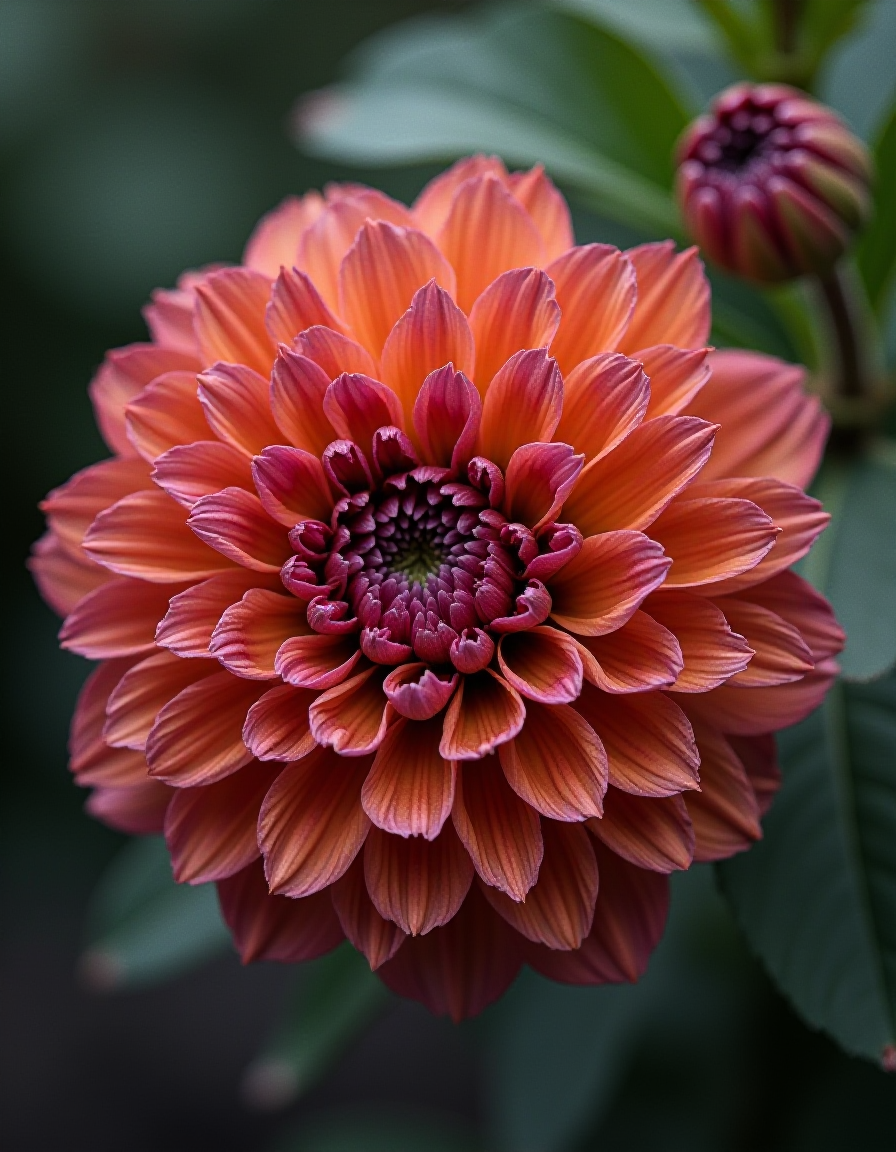
The image captures a close-up view of a vibrant orange and pink dahlia flower. The petals of the flower are fully spread, showcasing their intricate details. The center of the flower is a deep purple, adding a striking contrast to the orange and pink petals.
MONOLOGUE
fig-trees are planted—their tender green foliage contrasting strangely with the sinister soil that makes them flourish. All the roads are black as jet, like paths leading to coal-pits, and the country-folk on mule-back plodding along them look like Arabs on an infernal Sahara. The very lizards which haunt the rocks are swart and smutty. Yet the flora of the district is luxuriant. The gardens round Catania, nestling into cracks and ridges of the stiffened flood, are marvellously brilliant with spurge and fennel and valerian. It is impossible to form a true conception of flower-brightness till one has seen these golden and crimson tints upon their ground of ebony, or to realise the blueness of the Mediterranean except in contrast with the lava where it breaks into the sea. Copses of frail oak and ash, undergrown with ferns of every sort; cactus-hedges, orange-trees grafted with lemons and laden with both fruits; olives of scarce two centuries' growth, and fig-trees knobbed with their sweet produce, overrun the sombre soil, and spread their boughs against the deep blue sea and the translucent amethyst of the Calabrian mountains. Underfoot, a convolvulus with large white blossoms, binding dingy stone to stone, might be compared to a rope of Desdemona's pearls upon the neck of Othello.
SUMMARY
flower with pink petals and yellow center.
CAPTION
The image captures a close-up view of a pink flower with multiple petals, set against a blurred background that suggests a field or meadow. The flower is positioned in the center of the frame, with its stem extending upwards and slightly to the right. The petals are a vibrant shade of pink, with some exhibiting a slight yellow hue, adding a touch of contrast to the overall image.
MONOLOGUE
We yesterday inspected a beautiful collection of wax flowers by Mrs. Peachey, artiste to Her Majesty, now on private view at 35, Rathbone Place. We have seen many specimens of the elegant art of modelling in wax, but without exaggeration we may declare that more magnificent and truthful imitations of nature it has never been our lot to witness. The centre-piece is an immense bouquet of several hundred flowers, of almost every description, and every hue, from the gorgeous scarlet cactus to the virgin-tinted snowdrop, modelled with the closest fidelity, and arranged with exquisite taste. At the foot are models of the glorious water-lily of Guyana, the recently discovered Victoria Regia, in several stages of its development, from the close shut bud with its prickly calyx to the expanded flower. Some idea of the dimensions of this giant bouquet may be formed from the fact that it stands nearly six feet in height, and that the bent plate-glass shade with which it is covered alone cost 200.
SUMMARY
flower with petals and a stem in a field with other flowers.
CAPTION
The image captures a close-up of a pink flower with multiple petals, set against a blurred background that suggests a sunset or sunrise. The petals are slightly curled, adding a sense of depth and texture to the image. The flower is positioned in the center of the frame, drawing the viewer's attention to its vibrant color and intricate details.
MONOLOGUE
they are blazoned with crimson and pale gold; and assuredly in the blue of the rainy sky, in the many tints of morning flowers, in the sunlight on summer foliage and field, there are more sources of mere sensuous color-pleasure than in the single streak of the wan and dying light of sunset. It is not then by nobler form, it is not by positiveness of hue, it is not by intensity of light, that this strange distant apace possesses its attractive power. But there is one thing which it has or suggests, which no other object of sight suggests in an equal degree, and that is--infinity. It is of all visible things the least material, the least finite, the farthest withdrawn from the earth prison-house, the most typical of the nature of God, the most suggestive of the glory of His dwelling place. For the sky of the night, though we may know it is boundless, is dark; it is a studded vault, a roof that shuts us in and down; but the transparent distance of sunrise and sunset has no limit; we feel its infinity as we rejoice in its purity of light. That this has been deeply felt by artists, is evident in their works.
SUMMARY
flower with red petals and black center.
CAPTION
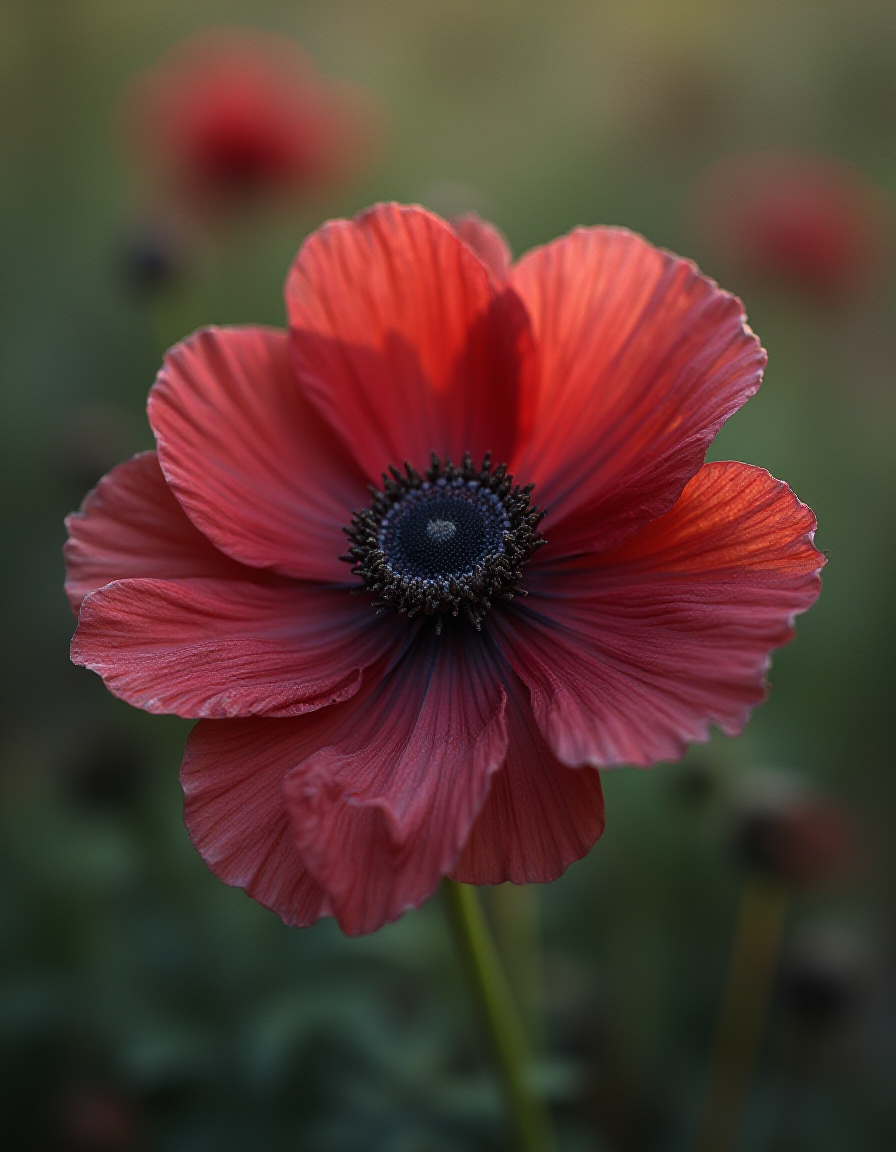
The image captures a close-up view of a red poppy flower in full bloom. The flower is the main subject, with its petals fully spread out, revealing a deep red color. The center of the flower is a dark brown, possibly the seed pod, which is surrounded by a ring of bright red petals.
MONOLOGUE
_December 1st._--The steward when he brought me tea at 6.30 this morning, said "Gib." was in sight. On looking out I could see rocks but not "the rock". But it soon appeared and I got hurriedly into my clothes and quickly swallowed breakfast and was on deck with my glasses. Here was the rock close at hand, a brilliant morning, the sun lighting up the side we were nearing, a big mushroom-shaped cloud floating on and obscuring the summit. This side is bare and black with its acres of concrete rain catchments, the only means of water supply. Last time I saw it it disappointed me, but now we headed straight round its projecting south point towards the harbour and had a glorious view of the razor-backed hill, the point bristling with guns, walls, and forts, and all along the west side buildings in white and ochre, with red roofs, all lit up in bright sunshine; plenty of trees about, palms and others, and green grass which is always a surprise to me after the barren peninsula. At the northern point of what is quite a large bay lies the harbour full of shipping, its one entrance guarded by a most powerful boom. The view all round is not much behind Naples--the rock with its large and beautiful buildings; across the bridge, connecting the rock with the mainland, the Spanish town; to the left the snow-white town of Algeciras, famed for its bull fights. Behind all the great towering, rugged mountains of Spain.
SUMMARY
flower with a bright light in the center.
CAPTION
The image captures a flower with a glowing center, illuminated by a light source that casts a warm glow on the petals. The petals, which are translucent and translucent, are arranged in a radial pattern, creating a radial pattern of light. The light source is positioned above the center of the flower, casting a bright, warm light that illuminates the petals and the center of the flower.
MONOLOGUE
The sun had not yet stood out from the orient, but his precedent light shone through the translucent blue. Yet it was not blue, nor is there any word, nor is a word possible to convey the feeling unless one could be built up of signs and symbols like those in the book of the magician, which glowed and burned to and fro the page. For the blue of the precious sapphire is thick to it, the turquoise dull, these hard surfaces are no more to be compared to it than sand and gravel. They are but stones, hard, cold, pitiful, that which gives them their lustre is the light. Through delicate porcelain sometimes the light comes, and it is not the porcelain, it is the light that is lovely. But porcelain is clay, and the light is shorn, checked, and shrunken. Down through the beauteous azure came the Light itself, pure, unreflected Light, untouched, untarnished even by the dew-sweetened petal of a flower, descending, flowing like a wind, a wind of glory sweeping through the blue. A luminous purple glowing as Love glows in the cheek, so glowed the passion of the heavens.
SUMMARY
The rose is a large pink rose with a long stem and green leaves.
CAPTION
The image presents a vibrant depiction of a rose, rendered in a realistic style. The rose is the central focus, with its petals fully open and facing upwards. The petals are a deep shade of pink, with a hint of red at the base, and they are intricately detailed, showcasing the texture of the petals and the veins within.
MONOLOGUE
Cactus, _cacteæ_, is an order of plants that abounds in all parts of the island. They consist of a calyx adhering to the ovary, the corolla divided into several segments, and the petals variously coloured. The fruit is a succulent seedy berry, in some species of a beautiful red colour. The stems are covered with small tubercles, containing tufts of sharp spines, varying in size. The “Turk’s cap,” _melocactus communis,_ is one of the handsomest of its tribe. It rises in a globular-shaped stem, deeply channelled, of a green colour, and covered with long spines. The top is surmounted by a spherical spinal crest, of a beautiful rose colour, with fleshy seeds of the same glowing tinge. It grows wild in all the sun-dried plains of Antigua, and forms a singular contrast to the withered-looking herbage. The prickly pear is another member of this family; the leaves are thick and oblong, covered with long spines, and filled with a muculent substance. The fruit is in form like an English pear, and of a slightly acid flavour; the rind is thick, and of a red colour, marked near the base with streaks of yellow; the pulpy interior is of the finest crimson, and of the consistence of syrup, which is sometimes used to colour sweetmeats, and affords at times a rich treat to the little negroes. The fruit starts from the leaves without any footstalks, and leaf succeeds to leaf, until it attains the height of from five to six feet. It loves a sandy soil, but on every bank, or in every pasture, it may be met with; while from
SUMMARY
flower with pink petals and green stem.
CAPTION
The image captures a vibrant pink daisy flower in full bloom against a soft, out-of-focus background. The flower is centered in the frame, with its petals fully spread out, showcasing their intricate details. The stem of the flower is green and slightly curved, providing a natural contrast to the pink petals.
MONOLOGUE
"We spread out, R. and I and his merry men, and waded; his butler and cook apparently as keen about shikar as cooking, and promptly three snipe got up, jolly slow flyers, in front of me, and I let off and hit one of the palm tree trunks and the snipe disappeared in the gloom of their shade. I saw R. on my right out in the full blaze of the sun get one of the three, then wisp after wisp got up and we began to bag them and to fear our cartridges would run out. But imagine the difficulty of hitting even those slow waterfowl with an eagle or vulture or a group of them, huge fellows, looking at you from fifteen to twenty yards off from the top of a low palm, or a kingfisher of vivid cerulean quivering in front of your nose, so fixed in its poise and so dazzling in colour that you saw a pink spot for minutes after, and so got in to your waist. And there were many kinds of doves and pigeons, which almost fanned our faces as they swooped past, and hanging weaver birds' nests, that I tried not to look at, and a roller bird I'd defy anyone not to look at--the size of a jay, irridescent pale blue and green all over, with just a touch of brown to set off the blues. I'd fain have shot one but for the bother of skinning and curing. You can imagine how distracting at first was this free run in a natural aviary and botanical garden combined, and how difficult to concentrate on the 'commoner' garden snipe.
SUMMARY
The rose is a pink rose with a long stem and green leaves.
CAPTION
The image presents a stylized representation of a pink rose, rendered in a high-resolution digital art style. The rose is the central focus, with its petals fully open and petals radiating outward from the center. The rose is set against a dark background, which enhances the vividness of the pink hue.
MONOLOGUE
The land was an inverted firmament of flowers. The birds were an innumerable, busy, joy-compelling multitude, darting and fluttering hither and thither, as one might imagine the babes do in heaven. The orange-groves were in blossom; their dark-green boughs seemed snowed upon from a cloud of incense, and a listening ear might catch an incessant, whispered trickle of falling petals, dropping "as the honey-comb." The magnolia was beginning to add to its dark and shining evergreen foliage frequent sprays of pale new leaves and long, slender, buff buds of others yet to come. The oaks, both the bare-armed and the "green-robed senators," the willows, and the plaqueminiers, were putting out their subdued florescence as if they smiled in grave participation with the laughing gardens. The homes that gave perfection to this beauty were those old, large, belvidered colonial villas, of which you may still here and there see one standing, battered into half ruin, high and broad, among foundries, cotton-and tobacco-sheds, junk-yards, and longshoremen's hovels, like one unconquered elephant in a wreck of artillery. In Frowenfeld's day the "smell of their garments was like Lebanon." They were seen by glimpses through chance openings in lofty hedges of Cherokee-rose or bois-d'arc, under boughs of cedar or pride-of-China, above their groves of orange or down their long, overarched avenues of oleander; and the lemon and the pomegranate, the banana, the fig, the shaddock, and at times even the mango and the
SUMMARY
flower with petals and a yellow center.
CAPTION
The image captures a close-up of a flower with vibrant red petals and a yellow center. The flower is set against a dark background, which enhances the colors of the flower and leaves. The petals are slightly curled, adding a sense of texture and depth to the image.
MONOLOGUE
New England’s forget-me-nots are fleet turquoise in the grasses; New England’s arbutus flowers lie flushed pearls among the ancient leaves; but everywhere are the violets of three colors—yellow for the pool’s edge, white among the bog lands, and blue as pervasive as the sunlight on hill slope, road bank, and forest floor. And there are violets of an unfathomable blue, sprinkled with white like wisps of cloud against far mountains. Some grow close to earth, taught by past dismay; others, long-stemmed and sweet, will live and suffer and mend their ways next year. The windflower meets the breeze, a slim princess, incredibly fragile, yet broken less easily than the strong tulip, vaguely touched with rose or white as bloodroot. Tulips dwell not only on the ground; they have parted great, opaque petals at the tops of trees, startling to see in the leafless wood. Watercress glitters in the cold streams where trout, winter-weary, are on patrol for those flies now magnificent in their jeweled dress of spring. The first oak leaves are delicately crimson at the end of the bough. Disregard, amid this pageantry of _la vita nuova_, the outrageous satire of brown skeleton “fingers” that point stiffly up through the shining blades of grass. If they seem to be a chilling cynicism of Nature, who has not found an April dandelion telling a braver story through winter snow?
SUMMARY
flower with petals and a center of pollen.
CAPTION
The image captures a close-up of a flower in full bloom, with its petals unfurling and the center of the flower becoming more prominent. The flower is predominantly green with a hint of yellow at the base, and the edges of the petals are a lighter shade of green. The background is blurred, drawing focus to the flower, which is set against a dark backdrop.
MONOLOGUE
Its stalks are round, perfectly smooth, and run to a very great height; leaves dark green, glossy, perfectly smooth, except on the edges, where they are beset with strong glandular hairs, divided into three large and two small lobes, the middle lobe running out to a considerable length, the footstalks of the leaves are beset with a few hairs thinly scattered, at the base of each leaf is a tendril, and two finely-divided stipulae, edged also with glandular hairs. The Involucrum is composed of three leaves, dividing into capillary segments, each of which terminates in a viscid globule, fetid when bruised; betwixt the involucrum and the blossom is a short peduncle; the pillar which supports the germen is of a bright purple colour, with spots of a darker hue, the germen is smooth and green; Styles green; Stigmata of a dark green; Filaments six in number; Antherae pale yellow green, the former dotted with purple; of Radii, there may be said to be four rows, variegated with white and purple, petals ten, externally greenish, internally red, deeper or paler according to circumstances.
SUMMARY
flower with dew on petals and stem.
CAPTION
The image captures a close-up of a red flower with a blurred background, emphasizing the intricate details of the petals. The petals are wet, reflecting the light, creating a sparkling effect. The flower is positioned on a stem, with the top of the flower facing the viewer.
MONOLOGUE
The petals of this rose require to be cut in thick white wax, coloured three parts down with my lemon powder; shade lightly over this, but not quite to the edge, with a little of my second yellow, and finish off by a light tint of crimson (crimson lake in cake.) The petals are deep and few, and require a great deal of cupping; to assist in producing this rotundity of petal use the head of the ivory pin, commencing to roll from the bottom to about half-way up the petal. Make a foundation of white wax, rather large and cone-shaped; colour it the same as petals; place the latter on singly, and press them forward to meet at the point and conceal the foundation. They are placed on five in a row, and the last two turned back: the seed cup is rather small; the calyx, and the back petals are all deeply coloured with crimson. The stem is also very red.
SUMMARY
The image depicts a triangular sculpture with a central figure and intricate patterns.
CAPTION
The image depicts a triangular sculpture made of orange and yellow petals arranged in a triangular shape against a beige background. The sculpture is intricately designed with a central figure that appears to be a stylized animal, possibly a bird or a mythical creature, set against a backdrop of orange and yellow petals.
MONOLOGUE
this century. Honeysuckle patterns and interlaced lines drawn in pure white on a toned tin-enamel (white on white or _sopra-bianco_ decoration) commonly appear on the sides of the deep wells of the dishes, while in the centre is a single figure, a coat of arms, or a small figure-subject. A similar treatment, without the _sopra-bianco_, was accorded to the fruit-dishes, shallow bowls on low feet, &c., with moulded gadroons or scalloped sides, which are generally attributed to Faenza or Castel Durante. The workshops of Siena were also noted for delicately painted grotesques and arabesques, with a rich brownish-yellow or deep black ground. At Gubbio, too, the "grotesque" decoration was practised with marked success. Other developments of this style are the "_a candelieri_" designs, in which grotesques were symmetrically arranged round some central subject, such as a candelabrum or vase, and "_a trofei_" in which trophies of arms, musical instruments, and other objects were symmetrically disposed, or arranged in studied disarray throughout the design; these patterns are generally associated with the wares of Castel Durante and Deruta. Lovers' gifts, dishes in which the whole space is occupied by a portrait bust of a girl or man, with the name and a complimentary adjective inscribed on a ribbon in the background, were common to Faenza, Castel Durante and many other factories. Elaborate figure-subjects also were attempted early in the century at Faenza and with no little success, as may be seen from a
SUMMARY
The image depicts a vibrant purple flower with a prominent center. The flower is in full bloom, showcasing its intricate details and delicate petals. The background is blurred, drawing focus to the flower, which is the main subject of the image.
CAPTION
The image captures a close-up view of a vibrant purple flower with a prominent center. The flower is in full bloom, with numerous thin, delicate petals radiating outward from the center. The petals are a deep purple color, with some exhibiting a hint of pink at the base.
MONOLOGUE
It was formed by excavating a piece of swamp and damming a small stream which flowed through it. In the distance towards the right the land lies low by the water and gradually rises as it recedes. Opposite us it forms little wooded promontories with grassy stretches between. Where we stand it is higher, and beyond the limits of the picture to the left it forms a high, steep bank rising to the lawn, on the further side of which stands the house. The base of these elevated banks and the promontories opposite are planted with thick masses of rhododendrons, which flourish superbly in the moist, peaty soil, protected, as they are, from drying winds by the trees and high ground. Near the low meadow a long stretch of shore is occupied by thickets of hardy azaleas. Beautiful at all seasons, the pond is most beautiful in June, when the rhododendrons are ablaze with crimson and purple and white, and when the yellow of the azalea-beds--discreetly separated from the rhododendrons by a great clump of low-growing willows--finds delicate continuation in the buttercups which fringe the daisied meadow. The lifted banks then afford particularly fortunate points of view; for as we look down upon the rhododendrons, we see the opposite shore and the water with its rich reflected colors as over the edge of a splendid frame. No accent of artificiality disturbs the eye despite the unwonted profusion of bloom and variety of color. All the plants are suited to their place and in harmony with each other; and all the contours of the shore are gently modulated and
SUMMARY
flower with petals and a yellow center.
CAPTION
The image captures a close-up of a flower with vibrant red petals and a yellow center. The flower is set against a dark background, which enhances the colors of the flower and leaves. The petals are slightly curled, adding a sense of depth to the image.
MONOLOGUE
I am extremely glad I sent the Laburnum (581/2. This refers to the celebrated form known as Cytisus Adami, of which a full account is given in "Variation of Animals and Plants, " Volume I., Edition II., page 413. It has been supposed to be a seminal hybrid or graft-hybrid between C. laburnum and C. purpureus. It is remarkable for bearing "on the same tree tufts of dingy red, bright yellow, and purple flowers, borne on branches having widely different leaves and manner of growth." In a paper by Camuzet in the "Annales de la Societe d'Horticulture de Paris, XIII., 1833, page 196, the author tries to show that Cytisus Adami is a seminal hybrid between C. alpinus and C. laburnum. Fuchs ("Sitz. k. Akad. Wien," Bd. 107) and Beijerinck ("K. Akad. Amsterdam," 1900) have spoken on Cytisus Adami, but throw no light on the origin of the hybrid. See letters to Jenner Weir in the present volume.): the raceme grew in centre of tree, and had a most minute tuft of leaves, which presented no unusual appearance: there is now on one raceme a terminal bilateral [i.e., half yellow, half purple] flower, and on other raceme a single terminal pure yellow and one adjoining bilateral flower. If you would like them I will send them; otherwise I would keep them to see whether the bilateral flowers will seed, for Herbert (581/3. Dean Herbert.) says the yellow ones will. Herbert is wrong in thinking there are no somewhat analogous facts: I can tell you some, when we meet. I know not whether botanists consider each petal and stamen an
SUMMARY
rose with petals and stem in full bloom.
CAPTION
The image captures a close-up of a rose in full bloom, with its petals fully spread and the center of the rose prominently displayed. The rose is set against a dark background, which enhances the delicate details of the rose's petals and the texture of the stem. The rose's color is a soft peach, with the petals exhibiting a slightly lighter hue.
MONOLOGUE
"In weight she might have turned, when well conditioned, nine hundred and fifty pounds. In color she was a dark chestnut, with a velvety depth and soft look about the hair indescribably rich and elegant. Many a time have I heard ladies dispute the shade and hue of her plush-like coat as they ran their white, jeweled fingers through her silken hair. Her body was round in the barrel and perfectly symmetrical. She was wide in the haunches, without projection of the hipbones, upon which the shorter ribs seemed to lap. High in the withers as she was, the line of her back and neck perfectly curved, while her deep, oblique shoulders and long, thick forearm, ridgy with swelling sinews, suggested the perfection of stride and power. Her knees across the pan were wide, the cannon-bone below them short and thin; the pasterns long and sloping; her hoofs round, dark, shiny, and well set on. Her mane was a shade darker than her coat, fine and thin, as a thoroughbred's always is whose blood is without taint or cross. Her ear was thin, sharply pointed, delicately curved, nearly black around the borders, and as tremulous as the leaves of an aspen. Her neck rose from the withers to the head in perfect curvature, hard, devoid of fat, and well cut up under the chops. Her nostrils were full, very full, and thin almost as parchment. The eyes, from which tears might fall or fire flash, were well brought out, soft as a gazelle's, almost human in their intelligence, while over the small bony head, over neck and shoulders, yea, over the whole body and
SUMMARY
a red poppy flower with a black center and a green stem.
CAPTION
The image captures a close-up of a red poppy flower in full bloom against a blurred background. The flower is in the center of the frame, with its petals fully spread out, showcasing the vibrant red color of the petals. The flower is surrounded by a few small green leaves, adding a touch of greenery to the otherwise monochromatic scene.
MONOLOGUE
Dorothy looked sweet as a rose just blowed out. She had on a gown of pale-green satin and shiffon, which looked some the color of fresh, delicate leaves, and her sweet face riz up from it and bloomed out like a flower. It wuz a little low in the neck, which wuz white as snow, and so wuz her round arms. A necklace of big pearls wuz round her neck, not much whiter than the warm, soft flesh they rested on, and she carried a big bunch of white orchids. She looked good enough to frame in gold and hang up in anybody's best parlor, and Robert Strong felt just as I did I knew by his liniment. On such a occasion, I felt my best black silk none too good, and at Dorothy's request I turned down the neck a little in front, mebby a half a finger or so, and wore a piece of lace she gin me over it that come down to my belt. It looked like a cob-web that had ketched in its transparent meshes some voylets and snowdrops. And at her request I did not wear the cameo pin, but a little bunch of posies she fixed for me, fine white posies with a few pale lavender ones. I spoze Dorothy, though she didn't tell me so, for fear it would make me oneasy and nervious, but I spoze she wuz afraid that some bold thief might rob me of that valuable jewel; she knowed that cameo pin fell onto me from Mother Smith and fell onto her from her ma. This rim of memory sot it round and rendered it valuable aside from its intrinsic worth, which wuz great. Why, I hearn that Grandmother Smith paid as high as seven dollars for it, gin five bushels of dried apples and the rest in
SUMMARY
blue flowers with yellow centers on a concrete surface.
CAPTION
The image captures a close-up view of a bouquet of blue flowers, with the flowers prominently displayed and the background blurred, emphasizing the flowers. The flowers are in full bloom, with their petals fully open and vibrant blue in color. The center of the flowers is a bright yellow, adding a striking contrast to the blue petals.
MONOLOGUE
_E. mediterranea._--Of all the taller Heaths this is the one, I think, that deserves to be most freely planted in districts no warmer than the London one. The three preceding species, so beautiful when seen at their best, are more comfortable in the southern and western counties. Of sturdier constitution, _E. mediterranea_ may be planted in large quantities with a view to producing broad effects. At Kew a group 70 feet across, planted three or four years ago, already makes a striking mass of purple each spring. The habit of remaining for a long time in full beauty, which is so marked a characteristic of the Heaths, is possessed to the full extent by this species. It is beautiful from March to May, and is all the more appreciated because the majority of the trees and shrubs that bloom at this season have yellow, pink, or white flowers. In the typical _E. mediterranea_ the flowers are bright rosy red, but there is a charming white-flowered variety (_alba_), another with bluish foliage (_glauca_), and a dwarf one (_nana_). The flowers appear near the ends of the shoots in the axils of the leaves, and are pitcher-shaped. The name _mediterranea_ is misleading, for according to Moggridge, the Mediterranean botanist, it is not a native of that region at all; it is rather of Biscayan origin, and is found in Western France and Spain.
SUMMARY
The painting depicts a large red and yellow flower with a long stem and multiple petals.
CAPTION
The image is a vibrant and detailed painting of a large red and yellow flower. The flower is the central focus, with its petals spread wide, showcasing the intricate details of the petals and the yellow center. The background is a darker shade of blue, providing a contrast to the bright colors of the flower.
MONOLOGUE
P. Hookeri (Hooker's); Bot. Mag. 2692, under Cactus Phyllanthus.--A robust-growing kind, often attaining to the size of a good shrub. Its flowers expand in the evening, and are sweet-scented. They are produced along the margins of the broad, flat, deeply-notched branches, the serratures being rounded instead of angled, as in some of the kinds. The tube of the flower is long and slender, no thicker than a goose quill, and covered with reddish scales; the petals are spreading, and form a cup 6 in. across; they are narrow, pointed, and pure white, the outer whorl, as well as the sepals, being tinged on the under side with a tawny colour. The stamens form a large cluster in the centre, and are bright yellow, the style being red and yellow. It is probable that this plant has been in cultivation for many years, as it was figured in the work quoted above under the name of one of the first introduced kinds of Phyllocactus, from which, however, it is abundantly distinct, as will be seen by a comparison of the descriptions of the two. There are, in the Kew collection, several large plants of P. Hookeri that flower annually during the summer and autumn. Brazil.
SUMMARY
a glowing flower with a pink center and blue petals in a forest with red leaves
CAPTION
The image showcases a glowing flower with a translucent, blue-lit petals, set against a dark background. The petals are illuminated with a soft, blue glow, giving the impression of a glowing flower. The flower is positioned centrally in the image, with its petals spread out, creating a sense of depth and dimensionality.
MONOLOGUE
When the room was dark, lit in winter by the dying fire, or in summer by the stars, he would creep out of bed, make quite sure that Tim was asleep, stand on a chair to reach the key from the top of the big cupboard, and carefully unlock the drawer. He had oiled the wood with butter, so that it was silent. The tissue-paper gleamed dimly pink; the Whiff came out to meet him. He lifted the packet, soft and crackling, and set it on the window-sill; he did not open it; its contents had no interest for him, it was the perfume he was after. And the moment the perfume reached his nostrils there came a trembling over him that he could not understand. He both loved and dreaded it. This manly, wholesome-minded, plucky little boy, the basis of whose steady character was common sense, became the prey of a strange, unreasonable fantasy. A faintness stole upon him; he lost the sense of kneeling on a solid chair; something immense and irresistible came piling up behind him; there was nothing firm he could push against to save himself; he began shuffling with his bare feet, struggling to escape from something that was coming, something that would probably overwhelm him yet must positively be faced and battled with. The Wave was rising. It was the wavy feeling.
SUMMARY
flowers with petals that are blue and purple
CAPTION
The image captures a close-up of a cluster of blue flowers with delicate petals. The flowers are set against a dark background, which enhances their vibrant blue color. The flowers are arranged in a way that their petals are spread out, creating a sense of depth and dimension.
MONOLOGUE
Thread a tapestry needle with the Soutache and draw it into the stuff, and then pass it through from the right side to the wrong at the bottom of one of the petals of the flowers, secure it on the wrong side by two or three stitches and then bring the working thread, which should be of the same colour as the Soutache, out again at the point of the petal, then carry the Soutache back to the bottom of the petal and fasten it down, like the gold threads in fig. 242, by a stitch rather wider than the Soutache, fold the Soutache over again to the starting point, and secure it by a stitch, and so on. In order to give a different character to the flowers, use Soutache of different widths, fold it over more or less closely and lay it down in shorter or longer lengths, as required. The natural irregularity of the petals of a flower can be very faithfully imitated in this manner. Fig. 883 shows the way in which, for the ears of corn, the braid is folded back upon itself and fastened down, whilst in the white flowers the two layers of the braid that form each petal are separated at the bottom.
SUMMARY
three white flowers with yellow centers on a green plant.
CAPTION
The image captures a close-up of three white flowers with yellow centers, set against a blurred background of green foliage. The flowers are in full bloom, with their petals fully open and facing upwards. The leaves surrounding the flowers are vibrant green, providing a stark contrast to the white petals.
MONOLOGUE
This is a hybrid and much improved variety of the well-known evergreen and shrubby Candytuft, often called "Everlasting Candytuft." A more pronounced remove from its parents could hardly be found in any plant or shrub than is this. There are evident improvements in colour, size, and habit, both in foliage and flowers. It is also a robust grower and perfectly hardy, in these respects being very different from _I. Gibraltarica_. None of the shrubby Candytufts can compare with this for usefulness and beauty; it comes into flower in May, and is in its greatest beauty in early June. It remains in fine form for fully four weeks. At first the flowers seem small, but later they form broad masses of dazzling whiteness, the corymbs being the size of a crown piece. Not only is this wholly distinct from its relatives, but it is one of the most useful flowers and evergreen shrubs which can be introduced to a garden. It cannot be planted wrong as regards either soil or situation. It forms a rich surfacing subject, all the year round, to other tall plants, as lilies, &c. It looks well as a front specimen in the shrubbery, makes an effective and neat appearance at the angles of walks, or as an edging it may be cut and trimmed as a substitute for a grass verge; it thrives on sunny or almost sunless outhouse tops, and on rockwork it is superb; moreover, it grows fairly well in reeky towns, and though its white flowers may be soiled the day they open, its bright green leaves and dense habit render it a pleasing object.
SUMMARY
flower with purple petals and green leaves in a close-up shot.
CAPTION
The image captures a close-up of a purple flower with five petals, set against a dark background. The flower is in full bloom, with its petals fully spread out. The petals are a vibrant shade of purple, with a slight gradient towards the edges, giving the flower a three-dimensional appearance.
MONOLOGUE
So, going along the border of that upper stream, which in my ignorance I will call North River. I came upon a great tree that was dead and decayed about the roots, so that it needed but little cutting to make it fall, and that close to the water. This tree was fully three fathoms in girth, and proportionately tall, straight, and fair, decayed only where the humors of the earth had attacked its base, light and very proper in all ways to my use. Wherefore I set to work, and, cutting on that side I wished it to fall, I felled it with no very great difficulty. When it was down I found the upper part sound, as I expected, and not so hard but that with patient labor I succeeded in cutting two lengths each of five fathoms long. These two lengths I set side by side, the thicker end of one against the thinner end of the other; then I got a quantity of those long vines which the Indians call lianas, which are very stringy and tough as good, hemp rope and with this I bound my timbers together in a hundred places, but separately, so that if by chance one broke the rest would still hold. But I must tell you that for the greater convenience of working these huge logs I launched them separately into a shallow before I began to bind them about, which was well, for I could never have moved them else. After that I sought out two slight trees of hard growth that were not more than thirty feet high, and cutting them down, I trimmed them into two poles, each four fathoms long. Then, midway in the length of my logs I made two holes--one in each, and
SUMMARY
The red rose is in full bloom with multiple petals and a deep red color.
CAPTION
The image captures a vibrant red rose in full bloom, set against a dark background. The rose, with its petals fully spread, is the focal point of the image. The petals, exhibiting a deep red hue, are intricately detailed, showcasing the delicate texture of the petals.
MONOLOGUE
Then came magic. Sangre de Cristo, sharp against the eastern sky, began to change its hue. A pink flush came into the gleaming white. It grew deeper, darker, more vivid; it spread, and ran in richer and richer tints along the range. Now it was rose, and now vermilion, and at last a deep and living scarlet, staining the snowy slopes, and flowing like new blood down the gulches and ravines. The foothills caught the color, and the violets became purple and then red; the sand dunes caught it, and their gray-browns were overlaid with crimson; the flats too caught it, and the sagebrush bending low, and the grass quivering in the wind were touched with some reflection of that far-reaching hue. From the green along the river the color swept, indefinable and dim at first, then by degrees intensified upon the flats, across the sand dunes, among the hills until at length it was passionate and deep and indescribable on the Sangre de Cristo peaks.
SUMMARY
three blue flowers with pink centers and red stamens against a blurred background.
CAPTION
The image presents a close-up of three blue and pink flowers with a blurred background. The flowers are in full bloom, with their petals fully open and radiating a soft pink hue. The petals are adorned with delicate pink and blue spots, adding a touch of vibrancy to the otherwise soft colors.
MONOLOGUE
Having thoroughly settled all the differences of Penang to my own great satisfaction, I removed myself to a Chinese theatre set in the open road, and made of sticks and old gunny-bags. The orchestra alone convinced me that there was something radically wrong with the Chinese mind. Once, long ago in Jummu, I heard the infernal clang of the horns used by the Devil-dancers who had come from far beyond Ladakh to do honour to the Prince that day set upon his throne. That was about three thousand miles to the north, but the character of the music was unchanged. A thousand Chinamen stood as close as possible to the horrid din and enjoyed it. Once more, can anything be done to a people without nerves as without digestion, and, if reports speak truly, without morals? But it is not true that they are born with full-sized pigtails. The thing grows, and in its very earliest stages is the prettiest head-dressing imaginable, being soft brown, very fluffy, about three inches long, and dressed as to the end with red silk. An infant pigtail is just like the first tender sprout of a tulip bulb, and would be lovable were not the Chinese baby so very horrible of hue and shape. He isn't as pretty as the pig that Alice nursed in Wonderland, and he lies quite still and never cries. This is because he is afraid of being boiled and eaten. I saw cold boiled babies on a plate being carried through the heart of the town. They said it was only sucking-pig, but I knew better. Dead sucking-pigs don't grin with their eyes open.
SUMMARY
flower with petals and a center of pollen.
CAPTION
The image captures a vibrant red gerbera flower in full bloom, with its petals fully spread and the center of the flower prominently displayed. The flower is set against a blurred background, which is rich in green, suggesting a natural setting. The flower's petals are a deep red, with a yellow center that adds a pop of color to the overall image.
MONOLOGUE
The so-called "street" of the cavalry encampment lay well to the rear. Hardly a sound emanated therefrom save now and then the echo of a step, the jingling of a spur or sabre, and sometimes voices in drowsy talk--perhaps a snatch of song or the thrumming of a guitar. A sort of luminous hush pervaded the atmosphere of the sunny spring afternoon. The shadows slanted long on the lush blue-grass that, despite the trampling to which it had been subjected, sent a revivifying impetus from its thickly interlaced mat of roots and spread a turf like dark rich velvet. The impulse of bloom was rife throughout nature--in a sort of praise offering for the grace of the spring. Humble untoward sprigs of vegetation, nameless, one would think, unnoticed, must needs wear a tiny corolla or offer a chalice full of dew--so minute, so apart from observation, that their very creation seemed a work of supererogation. The dandelions' rich golden glow was instarred along the roadside, and there was a bunch of wood violets in the roots of the maple near Ashley's head, the branches of the tree holding far down their dark garnet blossoms with here and there clusters of flat wing-like seed-pods, striped with green and brown. A few paces distant was a tulip-tree, gloriously aflare with red and yellow blooms through all its boughs to the height of eighty feet, and between was swung Ashley's hammock with Ashley luxuriously disposed therein. His eyes were on the infinite roseate ranges of the Great Smoky Mountains in the amethystine
SUMMARY
The image depicts a large, illuminated rose with a glowing pink and blue light effect.
CAPTION
The image showcases a vibrant and intricate flower, illuminated with a soft glow, which appears to be a rose. The petals of the rose are a mix of pink and white hues, with the petals of the rose being illuminated in a gradient of pink and blue. The background of the image is dark, which contrasts with the bright colors of the rose, making it stand out.
MONOLOGUE
The China aster (_Callistephus chinensis_) is also a member of the order _Compositae_. It is a hardy annual, a native of China, which by cultivation has yielded a great variety of forms. Some of the best for ornamental gardening are the chrysanthemum-flowered, the paeony-flowered, the crown or cockade, the comet, and the globe-quilled. Crown asters have a white centre, and dark crimson or purple circumference, and are very beautiful. The colours range from white and blush through pink and rose to crimson, and from lilac through blue to purple, in various shades. They should be sown early in March in pans, in a gentle heat, the young plants being quickly transferred to a cool pit, and there pricked out in rich soil as soon as large enough, and eventually planted out in the garden in May or June, in soil which has been well worked and copiously manured, where they grow from 8 to 18 in. high, and flower towards the end of summer. They also make handsome pot plants for the conservatory.
SUMMARY
yellow flower with yellow petals and yellow stamen.
CAPTION
The image captures a close-up view of a yellow flower with multiple petals. The flower is set against a blurred background, which is a mix of green and yellow hues, suggesting a natural setting. The flower is positioned in the center of the image, with its petals spread out, and is surrounded by green leaves.
MONOLOGUE
We crept out through the door, underneath a mass of debris, into the gray of the dawn. How sweet the air, how like a benediction the song of birds. Neither of us looked back, and I held her close against me as we moved onward, past the big tree, and down the long slope. It was a wondrous view of peace and beauty, the broad green valley, with the silver thread of water shining in its center--the valley of the Bureau. We followed the faint trail, which wound in and out among small copses of trees; the sun began to brighten the far east and her hand stole into mine. The light was upon her face, and gave me a glimpse of the sadness of her eyes. Beyond a little grove we found some horses browsing in the deep grass; they were those that had brought us from Yellow Banks, and whinnied a greeting as we drew near. Two of them were fit to ride and the others followed, limping along behind.
SUMMARY
white daisy with a yellow center and green leaves.
CAPTION
The image captures a close-up view of a white daisy flower in full bloom. The flower is centered in the frame, with its petals fully spread out, showcasing the intricate details of the white petals and the yellow center. The flower is set against a blurred background of green foliage, which provides a natural contrast to the flower.
MONOLOGUE
The room was very prettily decorated with blossoming boughs, and Japanese lanterns, and set about with long tables covered with white, which contained the articles for sale. In the center of the room was the flower-booth, and that was lovely. It was a circle of green, with oval openings to frame young girl-faces, and on the circular shelf were heaped flowers in brilliant masses. At seven o'clock the fair was in full swing, as far as the wares and saleswomen were concerned. At the flower-booth were four pretty girls: Fanny Dodge, Ellen Dix, Joyce Fulsom and Ethel Mixter. Each stood looking out of her frame of green, and beamed with happiness in her own youth and beauty. They did not, could not share the anxiety of the older women. The more anxious gathered about the cake table. Four pathetically bedizened middle-aged creatures, three too stout, one too thin, put their heads together in conference. One woman was Mrs. Maria Dodge, Fanny's mother, one was Mrs. Amos Dix, one was Mrs. Deacon Whittle, and one was unmarried.
SUMMARY
The image shows a close-up of a white thistle flower with a purple center.
CAPTION
The image captures a close-up view of a white thistle flower, which is the main subject of the image. The flower is in full bloom, with its numerous white petals radiating outwards from a central point. The petals are slightly curled at the edges, giving the flower a textured appearance.
MONOLOGUE
16. And of the families given, he is to note for the common simple characteristic, that they are quatrefoils referred to a more or less elevated position on a central stem, and having, in that relation, the lowermost petal diminished, contrary to the almost universal habit of other flowers to develope in such a position the lower petal chiefly, that it may have its full share of light. You will find nothing but blunder and embarrassment result from any endeavour to enter into further particulars, such as "the relation of the dissepiment with respect to the valves of the capsule," etc., etc., since "in the various species of Veronica almost every kind of dehiscence may be observed" (C. under V. perfoliata, 1936, an Australian species). Sibthorpe gives the entire definition of Veronica with only one epithet added to mine, "Corolla quadrifida, _rotata_, lacini infim angustiore," but I do not know what 'rotata' here means, as there is no appearance of revolved action in the petals, so far as I can see.
SUMMARY
white daisy with yellow center and long white petals.
CAPTION
The image captures a close-up view of a white flower with a yellow center, set against a blurred background. The flower is in full bloom, with numerous thin, white petals radiating outwards from the center. The petals are slightly curled at the edges, giving the flower a delicate and intricate appearance.
MONOLOGUE
Nearer the top of the flower, these calyx lobes are better developed, until, surrounding the corolla, we find them assuming the form and appearance of petals, c (Fig. 2). The corolla is composed of a large number of long strap-shaped pointed petals, very thin and delicate, often beautifully coloured, and generally spreading outwards. Springing from the bases of these petals, we find the stamens, d (Fig. 2), a great number of them, forming a bunch of threads unequal in length, and bearing on their tips the hay-seed-like anthers, which are attached to the threads by one of their points. The style is a long cylindrical body, e (Fig. 2), which stretches from the ovary to the top of the flower, where it splits into a head of spreading linear rays, ½ in. in length. When the flower withers, the seed vessel, f (Fig. 2), remains on the plant and expands into a large succulent fruit, inside which is a mass of pulpy matter, inclosing the numerous, small, black, bony seeds.
SUMMARY
flower with bright red petals and yellow center.
CAPTION
The image captures a vibrant red flower with a yellow center, set against a dark background. The flower is in full bloom, with numerous thin, elongated petals that are spread out in a fan-like shape. The petals are a deep red color, with a hint of yellow at the center, which is the flower's central point.
MONOLOGUE
Proceeding from the coast escarpment inwards, I crossed, in a space of about thirty miles, an elevated undulatory district, with the beds dipping in various directions. The rocks are of many kinds,--white laminated, sometimes siliceous sandstone,--purple and red sandstone, sometimes so highly calcareous as to have a crystalline fracture,--argillaceous limestone,--black calcareous slate-rock, like that so often described at Copiapo and other places,--thinly laminated, fine-grained, greenish, indurated, sedimentary, fusible rocks, approaching in character to the so- called pseudo-honestone of Chile, including thin contemporaneous veins of gypsum,--and lastly, much calcareous, laminated porcelain jasper, of a green colour, with red spots, and of extremely easy fusibility: I noticed one conformable stratum of a freckled-brown, feldspathic lava. I may here mention that I heard of great beds of gypsum in the Cordillera. The only novel point in this formation, is the presence of innumerable thin layers of rock-salt, alternating with the laminated and hard, but sometimes earthy, yellowish, or bright red and ferruginous sandstones. The thickest layer of salt was only two inches, and it thinned out at both ends. On one of these saliferous masses I noticed a stratum about twelve feet thick, of dark-brown, hard brecciated, easily fusible rock, containing grains of quartz and of black oxide of iron, together with numerous imperfect fragments of shells. The problem of the origin of salt is so obscure, that
SUMMARY
flower with bright orange petals and yellow center.
CAPTION
The image captures a vibrant red poppy flower in full bloom against a dark background. The flower is the focal point of the image, with its bright red petals and yellow center contrasting sharply against the dark backdrop. The stem of the flower is green, adding a touch of contrast to the red petals.
MONOLOGUE
The house at which Mr. Schmidt resides in the summer, is charmingly situated on the banks of that picturesque river, the Hudson, seven miles from the town. The pretty dwelling-house, with a veranda all round, covered with passion flowers, honeysuckles, the red trumpet flower, and other beautiful climbing plants, stands on a verdant lawn, shaded by lofty trees, among which we observed the finest kinds of this country, the trunks of which were slender, and straight as pillars. The park extends to the Hudson, where the tall sassafras, tulip, oak, walnut, and other trees, protected us by their shade; while the large steam-boats, rapidly passing on the bright surface of the Hudson, had a very picturesque effect. Mr. Schmidt had the kindness to afford us an admirable view of what is called the island of New York. Near Bloomingdale is a large and very well conducted lunatic asylum, from the lofty roof of which we enjoyed an inexpressibly beautiful, extensive, and interesting prospect of the whole country. From this spot we overlooked the East and North Rivers, the broad bend of the latter, and its high banks towards Albany; to the north, dark forests, with detached dwellings and country seats; and, in all directions, luxuriant green thickets, towns, villages, and handsome country-houses. At our feet, contrasting with that rich and noble view, full of variety and life, we looked down on the buildings and court-yards of the hospital, in which we could observe the patients; while, in another enclosed space, Virginian deer were
SUMMARY
flower with bright orange petals and yellow center.
CAPTION
The image captures a vibrant red poppy flower in full bloom against a dark background. The flower is the focal point of the image, with its bright red petals and yellow center contrasting sharply against the dark backdrop. The stem of the flower is green, adding a touch of contrast to the red petals.
MONOLOGUE
They started next morning cheerfully enough, and for three hours or more paddled easily up the glassy and windless reaches, between two green flower-bespangled walls of forest, gay with innumerable birds and insects; while down from the branches which overhung the stream long trailers hung to the water's edge, and seemed admiring in the clear mirror the images of their own gorgeous flowers. River, trees, flowers, birds, insects,--it was all a fairy-land: but it was a colossal one; and yet the voyagers took little note of it. It was now to them an everyday occurrence, to see trees full two hundred feet high one mass of yellow or purple blossom to the highest twigs, and every branch and stem one hanging garden of crimson and orange orchids or vanillas. Common to them were all the fantastic and enormous shapes with which Nature bedecks her robes beneath the fierce suns and fattening rains of the tropic forest. Common were forms and colors of bird, and fish, and butterfly, more strange and bright than ever opium-eater dreamed. The long processions of monkeys, who kept pace with them along the tree-tops, and proclaimed their wonder in every imaginable whistle, and grunt, and howl, had ceased to move their laughter, as much as the roar of the jaguar and the rustle of the boa had ceased to move their fear; and when a brilliant green and rose-colored fish, flat-bodied like a bream, flab-finned like a salmon, and saw-toothed like a shark, leapt clean on board of the canoe to escape the rush of the huge alligator (whose loathsome snout,
SUMMARY
flower with petals and leaves in a darkened environment.
CAPTION
The image depicts a flower with a vibrant yellow center and green petals. The flower is set against a dark background, which enhances the colors and makes the flower stand out. The petals are fully spread, and the flower is positioned centrally in the frame.
MONOLOGUE
From the diseased leaves and stems the spores of the fungus find their way to the seed heads which at this time are rapidly filling out by the growth of the berries. The compact seed heads readily retain moisture, furnishing most favorable conditions for the germination of any spores that find their way into the center of the head. That this is the usual course of seed head infection is shown by the fact that it is the base of the berry on which the spots start. These spots, of a rusty yellow color, gradually spread all over the seed which finally becomes shriveled and of a dark brown or black color. Spores in abundance are formed on the diseased berries. Affected berries "shell" from the head at the slightest touch. This manifestation of the disease has long been known as "seed blast." If the berries have begun to color the injury from the disease will probably be very slight. The "blasting" of the green berries, however, will undoubtedly reduce or destroy the vitality of the seed. There is a strong probability that the fungus may be carried over in or on the seed.
SUMMARY
blue daisy with purple center and green leaves.
CAPTION
The image captures a close-up view of a blue daisy flower, with its white center and purple petals. The flower is set against a blurred background of green grass, which suggests that the flower is in a field or meadow. The flower is in full bloom, with its petals fully spread out.
MONOLOGUE
I was crossing a spot where the green stretches of pasture were here and there broken by clumps of young trees. Huge oxen with almost white skins were lying in the short grass, motionless, as if plunged in peaceful thought. Hills sloped gently up to the horizon, and their velvety contours seemed to ripple in the bright rays of the moon. For the first time in my life I realized something of the voluptuous beauty and divine effluence of the night. I felt the magic touch of some unknown bliss. It seemed that for the first time in my life I was looking on moon and meadows and hills. I remembered hearing Edmee say that nothing our eyes can behold is more lovely than Nature; and I was astonished that I had never felt this before. Now and them I was on the point of throwing myself on my knees and praying to God: but I feared that I should not know how to speak to Him, and that I might offend Him by praying badly. Shall I confess to you a singular fancy that came upon me, a childish revelation, as it were, of poetic love from out of the chaos of my ignorance? The moon was lighting up everything so plainly that I could distinguish the tiniest flowers in the grass. A little meadow daisy seemed to me so beautiful with its golden calyx full of diamonds of dew and its white collaret fringed with purple, that I plucked it, and covered it with kisses, and cried in a sort of delirious intoxication:
SUMMARY
rose with petals fully bloomed and fully open.
CAPTION
The image captures a close-up view of a pink rose in full bloom. The rose is the central focus, with its petals fully spread and facing upwards. The petals are a delicate shade of pink, with a hint of white at the base.
MONOLOGUE
Even when the flooding sunlight of the tropical morning poured in through the windows, it was difficult for me to realize that I was not in some unreal land. There was a sweet, low sound of music filling the air with its clear, liquid tones. And, joining with the music, was the pleasant ringing of a multitude of little bells, ringing I knew not where. It seemed as if the air was full of them. Close by, on one side, was the palace of a prince, and somewhere in his house or in his courtyard there were people playing upon instruments of music, made of smoothed and hollowed bamboo. But no human hands were busy with the bells. Within a stone's throw of my window rose the shining tower of the most splendid temple in Bangkok. From its broad octagonal base to the tip of its splendid spire it must measure, I should think, a good deal more than two hundred feet, and every inch of its irregular surface glitters with ornament. Curiously wrought into it are forms of men and birds, and grotesque beasts that seem, with outstretched hands or claws, to hold it up. Two thirds of the way from the base, stand, I remember, four white elephants, wrought in shining porcelain, facing one each way toward four points of the compass. From the rounded summit rises, like a needle, a sharp spire. This was the temple tower, and all over the magnificent pile, from the tip of the highest needle to the base, from every prominent angle and projection, there were hanging sweet-toned bells, with little gilded fans attached to their tongues; so swinging
SUMMARY
flower with a dark purple center and multiple petals.
CAPTION
The image captures a close-up view of a purple daisy flower in full bloom. The flower is centered in the frame, with its petals fully spread out, showcasing the intricate details of the petals and the central cluster of stamens. The background is blurred, drawing focus to the flower, which is set against a backdrop of green foliage, adding a natural and serene atmosphere to the image.
MONOLOGUE
The wall of ice (as I call it) that had stood over against the larboard bow was gone, and the seas tumbled with some heaviness of froth and much noise over the ice, past the bows, and washed past the bends on either side in froth rising as high as the channels. I noticed a great quantity of broken ice sinking and rising in the dark green curls of the billows, and big blocks would be hurled on to the schooner's bed and then be swept off, sometimes fetching the bilge such a thump as seemed to swing a bellow through her frame. It was only at intervals, however, that water fell upon the decks, for the ice broke the beat of the moderating surge and forced it to expend its weight in spume, which there was not strength of wind enough to raise and heave. Since the vessel continued to lie head to sea, my passionate hope was that these repeated washings of the waves would in time loosen the ice about her keel, in which case it would not need much of a billow, smiting her full bows fair, to slide her clean down and off her bed and so launch her. There were many clouds in the heavens, but the blue was very pure between. The morning brightening with the rising of the sun, I directed an earnest gaze along the horizon, but there was nothing to see but ice. Some of the bergs, however, and more particularly the distant ones, stole out of the blue atmosphere to the sunshine with so complete a resemblance to the lifting canvas of ships that I would catch myself staring fixedly, my heart beating fast. But there was no dejection in these disappointments; the
SUMMARY
iris flower with yellow center and purple petals.
CAPTION
The image captures a close-up view of a purple iris flower, with its petals fully spread and facing towards the viewer. The flower is set against a blurred background, which is a mix of green and purple hues, possibly indicating a garden setting. The flower's petals are a vibrant shade of purple, with yellow and white markings on the inner edges.
MONOLOGUE
its own value, it rarely consents to "oblige;" the dusky green sepals are margined with yellow, petals white, clouded with pale purple, lip very small, of course, purple, surmounted by a great golden crest.
SUMMARY
flower with petals and a center of pollen.
CAPTION
The image captures a close-up of a vibrant pink dahlia flower, its petals fully open and facing the viewer. The petals are adorned with a delicate network of water droplets, adding a touch of freshness and elegance to the scene. The background is a blur of dark purple leaves, providing a stark contrast to the flower's bright pink hue.
MONOLOGUE
In shale and sandy soil, even in the gravel of hillsides, one finds the narrowly divided, finely cut leaves and the bicolored beardless blossom of the BIRD'S-FOOT VIOLET (V. pedata), pale bluish purple on the lower petals, dark purple on one or two upper ones, and with a heart of gold. The large, velvety, pansy-like blossom and the unusual foliage which rises in rather dense tufts are sufficient to distinguish the plant from its numerous kin. This species produces no cleistogamous or blind flowers. Frequently the bird's-foot violet blooms a second time, in autumn, a delightful eccentricity of this family. The spur of its lower petal is long and very slender, and, as might be expected, the longest-tongued bees and butterflies are its most frequent visitors. These receive the pollen on the base of the proboscis.
SUMMARY
flower with water droplets on petals.
CAPTION
The image captures a close-up of a vibrant red flower with numerous water droplets on its petals. The flower is in full bloom, with the petals fully spread out, showcasing the intricate details of the water droplets. The background is blurred, drawing focus to the flower and its captivating red color.
MONOLOGUE
And it was as if she brought with her an increase of the already tense expectancy, as if her own nervous trouble spread out about her like a deepening of color, like a drop of blood falling into water already tinged with red. It was my own imagination, of course, the excitement of being close upon my quest, and the reaction of silence closing over the interruption of her entrance; but I felt the exertion of breathing, as if I were immersed up to the chin in water. If the atmosphere had been like a weight before, it was now like a deliberately closing vise. In the intervals of the droning hum at the table, the silence took on a quality of brittleness. Little brushings and rustlings ran in waves around the room, and I thought how a breeze runs over a field of tall grass, where each tuft in turn takes up its neighbor's restlessness. It occurred to me suddenly that most of the people here were women; and the sense of crowded presence led me to imagining crowds and throngs of women grouped in pictures or dancing in rows upon the stage. And then I remembered sharply that I could not see Mrs. Tabor and wondered whether my certainty that it was she had any more foundation than these other fantasies. I heard my own breathing, and that of many others. I felt vaguely irritated that all these breathings were not keeping time, and instinctively brought my own into the rhythm of the predominating number.
SUMMARY
flower with water droplets on its petals.
CAPTION
The image captures a vibrant orange flower with water droplets on its petals, set against a blurred background. The flower is the focal point of the image, with its bright orange color contrasting sharply with the dark background. The water droplets on the petals are scattered across the surface, adding a dynamic element to the otherwise still image.
MONOLOGUE
Now put the battery on charge, and charge at a low rate. Do not allow the temperature of any cell to rise above 110 deg.F. Continue the charge until the electrolyte clears up, and its specific gravity stops rising and the plates have a normal color over their entire surface. Fully charged positive plates have a chocolate brown color, and fully charged negative plates have a dark gray color. By holding an electric light directly over a cell, and looking down, the color of both negatives and positives may be determined. Do not take the battery off charge until you have obtained these results, although it may be necessary to continue the charge for two, three, four, or five days. In this preliminary charge it is not necessary to bring the gravity up to 1.280, because the electrolyte is not to be used again, and the plates will become charged completely, regardless of what the gravity is. The essential thing is to charge until the electrolyte becomes perfectly clear, the gravity stops rising, and the plates have the right color. The Cadmium test may be used here to determine when the plates are charged. If the gravity rises above 1.280 during the preliminary charge, adjust it to 1.280 by drawing out some of the electrolyte and adding distilled water. The battery must stay on charge until you have the desired conditions. If one cell does not charge,--that is, if its specific gravity does not rise,--you have probably not freed all the shorts, and must take the element out of the jar again and carefully inspect it for more shorts.
SUMMARY
a blue and orange flower with a stem
CAPTION
The image showcases a close-up of a blue and orange flower with a textured surface. The flower is positioned in the center of the image, with its petals spread out and facing towards the viewer. The texture of the flower is detailed, with tiny dots of blue and orange scattered throughout the petals.
MONOLOGUE
The brothers came forward affectionately to welcome him, and his inauguration was as a Sunday feast. Heaven seemed to him to dwell in the sunshine of the church, and to beam upon him from the holy pictures and from the cross. And when, in the evening, at the sunset hour, he stood in his little cell, and, opening the window, looked out upon old Rome, upon the desolated temples, and the great dead Coliseum--when he saw all this in its spring garb, when the acacias bloomed, and the ivy was fresh, and roses burst forth everywhere, and the citron and orange were in the height of their beauty, and the palm trees waved their branches--then he felt a deeper emotion than had ever yet thrilled through him. The quiet open Campagna spread itself forth towards the blue snow-covered mountains, which seemed to be painted in the air; all the outlines melting into each other, breathing peace and beauty, floating, dreaming--and all appearing like a dream!
SUMMARY
a close-up of a red flower with dew on it
CAPTION
The image captures a close-up of a cluster of red flowers with dew on their petals. The flowers are in full bloom, with water droplets clinging to their surfaces, creating a sparkling effect. The background is blurred, drawing focus to the flowers and their dew-covered petals.
MONOLOGUE
The apparently instantaneous flowering of plants, exhibited a few years ago by M. Herbert to an astonished audience, was, we believe, effected by the heat generated by fragments of quicklime concealed in the mould close to, but not in immediate contact with, the roots. The plants selected by M. Herbert——a group of geraniums and a rose tree——were planted in two rather deep boxes of garden mould, and were covered with glass shades. The operator commenced by pouring over the roots, from a small watering-pot, a liquid which, uniting to the ingredients already in the earth, caused a great heat, as was shown by an intense steam or vapour, which was evolved within the shades, and allowed, to some extent, to escape through a small hole in the top, which at first was kept closed. The effect upon the geraniums was certainly almost instantaneous; the buds beginning to burst in about five or six minutes, and the plants being in full bloom within ten minutes, when the blossoms were gathered by M. Herbert, and distributed amongst the ladies present. With the rose tree the exhibitor was less fortunate. The invention may prove useful where ladies require to decorate their drawing-rooms or boudoirs with the beauties of the floral world somewhat earlier in the season than they can otherwise be obtained. It must not, however, be forgotten that the plants are, as it were, parboiled during the process, and die after a few days.
SUMMARY
a red flower with intricate patterns on its petals and a blue background
CAPTION
The image presents a close-up view of a red flower with intricate, glowing red petals. The petals are detailed and exhibit a pattern of radiating lines, giving the impression of a glowing effect. The flower is set against a backdrop of blue foliage, which is blurred to emphasize the flower's vibrant red petals.
MONOLOGUE
The nineteenth century "Queen Anne" has its merits.[72] It combines simplicity, roominess and comfort, colour, light and shade. Soft colouring to harmonize the new furniture with the tender tints of the faded quaintnesses just restored to society; care in grouping even the commonest objects, so as to give pleasure to the eye; a revived taste for embroidered instead of woven materials, giving scope to the talents of the women of the house;--all these are so much gained in every-day domestic decoration. The poorest and most trivial arrangements are striving to attain to a something artistic and agreeable. This is still confined to the educated classes; but as good and bad alike have to begin on the surface, and gradually filter through to the dregs of society, we may hope that the women who wore the last chignon and the last crinoline may yet solace their sordid lives in flowing or tight woollen garments, adorned with their own needlework; and that the dark-stained floor of the cottage or humble lodging will set off the shining brass kettle, and the flower in a brown or blue pot, consciously selected with a view to the picturesque, and enjoyed accordingly.
SUMMARY
flower with petals in purple and orange colors.
CAPTION
The image is a high-resolution, 3D rendering of a flower, showcasing its intricate petals and intricate patterns. The petals are a vibrant mix of purple, pink, and orange hues, with the colors blending seamlessly to create a visually striking effect. The petals are arranged in a radial pattern, with the central part of the flower being the most prominent.
MONOLOGUE
For his own part, though the writer is neither a very strong nor a very healthy nor a very successful person, though he finds much unattainable and much to regret, yet life presents itself to him more and more with every year as a spectacle of inexhaustible interest, of unfolding and intensifying beauty, and as a splendid field for high attempts and stimulating desires. Yet none the less is it a spectacle shot strangely with pain, with mysterious insufficiencies and cruelties, with pitfalls into anger and regret, with aspects unaccountably sad. Its most exalted moments are most fraught for him with the appeal for endeavour, with the urgency of unsatisfied wants. These shadows and pains and instabilities do not, to his sense at least, darken the whole prospect; it may be indeed that they intensify its splendours to his perceptions; yet all these evil and ugly aspects of life come to him with an effect of challenge, as something not to be ignored but passionately disputed, as an imperative call for whatever effort and courage lurks in his composition. Life and the world are fine, but not as an abiding place; as an arena--yes, an arena gorgeously curtained with sea and sky, mountains and broad prospects, decorated with all the delicate magnificence of leaf tracery and flower petal and feather, soft fur and the shining wonder of living skin, musical with thunder and the singing of birds; but an arena nevertheless, an arena which offers no seats for idle spectators, in which one must will and do, decide, strike and strike
SUMMARY
The image depicts a vibrant red and pink peony flower with a deep red center and a deep blue-green leaf background. The flower is in full bloom, with petals fully spread, and the leaves are arranged in a way that they frame the flower.
CAPTION
The image showcases a vibrant and detailed painting of a red and pink peony flower. The flower is the focal point of the painting, with its petals fully open and facing towards the viewer. The petals are a mix of red and pink hues, with the red petals being more prominent and the pink petals being slightly smaller.
MONOLOGUE
Well-grown specimens have an exceedingly neat habit--the foliage spreads and touches the ground, rounding up to the flower stems (which are about a foot high) in a pleasing manner. The earliest flowers are very large--when fully open quite 11/2in. across--but they are more often seen in the unopen state, when they resemble a nutmeg in shape. Whether open or shut, they are a pure white, and their pendent habit adds not a little to their beauty, as also does the leafy involucre. The leaves are three-parted, the two lower lobes being deeply divided, so that at a first glance the leaves appear to be five-parted; each of the five lobes are three-cleft, and also dentate, downy, and veined; the leaf stalks are radical, red, long, slightly channelled, and wiry; in all respects the leaves of the involucre resemble those of the root, excepting the size, which is smaller, and the stalks are green, like the flower stems.
SUMMARY
The image depicts a close-up of a flower with a prominent yellow center and intricate details of the petals.
CAPTION
The image showcases a close-up of a flower with a prominent yellow center and intricate details. The petals are a deep shade of blue, with a subtle gradient from light to dark, creating a sense of depth and texture. The center of the flower is a bright yellow, contrasting with the blue petals.
MONOLOGUE
Every author who has written on the subject of the Gipsies has, I believe, represented them as all having remarkably dark hair, black eyes, and swarthy complexions. This notion has been carried to such an extent, that Hume, on the criminal laws of Scotland, thinks the black eyes should make part of the evidence in proving an individual to be of the Gipsy race. The Gipsies, in Scotland, of the last century, were of all complexions, varying from light flaxen hair, and blue eyes, and corresponding complexions, to hair of raven black, dark eyes, and swarthy countenances. Many of them had deep-red and light-yellow hair, with very fair complexions. I am convinced that one-half of the Gipsies in Scotland, at the present day, have blue eyes, instead of black ones. According to the statistical account of the parish of Borthwick, Mid-Lothian, (1839,) the Baillies, Wilsons, and Taits, at Middleton, the descendants of the old Tweed-dale Gipsies, are described as, "in general, of a colour rather cadaverous, or of a darkish pale; their cheek-bones high; their eyes small, and light coloured; their hair of a dingy white or red colour, and wiry; and their skin, drier and of a tougher texture than that of the people of this country." This question of colour has been illustrated in my enquiry into the history of the Gipsy language; for the language is the only satisfactory thing by which to test a Gipsy, let his colour be what it may.
SUMMARY
a purple flower with dew drops on its petals is in a pond with lily pads
CAPTION
The image captures a close-up of a purple lotus flower, set against a blurred background that suggests a pond or water body. The flower is in full bloom, with its petals fully spread and dew drops scattered across its surface. The petals are a deep purple, with lighter purple veins running through them, giving the flower a striking contrast.
MONOLOGUE
April 3. Last night the river "went out." We were so used, all winter, to its sleeping whiteness, that it seemed as unlikely to change as the outlines of the hills; then came a tumultuous week, and now it is a brown, strong, full-running stream, with swirls and whirlpools of hastening current all over its wide surface. These are indescribable days. The air is sweet with wet bark and melting snow and newly-uncovered earth. The lesser streams are rushing and roaring through the woods. There are little clear dark foam-topped pools under all the spouts, and bright drops falling from rocks and roofs, where there were icicles so lately; and the roads endure miniature floods, from the torrents of snow-water that gush down their gutters and spread the mud in fan-shapes over them. Wherever you stand, you cannot get away from the rushing and trickling and rilling. The whole frozen strength of winter is breaking up in a wealth of life-giving waters.
SUMMARY
flower with water droplets on petals and a blurred background.
CAPTION
The image captures a close-up of a flower with a vibrant orange center and intricate blue petals. The petals are wet, reflecting the light, creating a sparkling effect. The flower is set against a dark background, which enhances the colors and details of the flower.
MONOLOGUE
Some months later in the war when confined in a little up-country hamlet, many hundreds of miles from the coast and from Johannesburg; with the brunt of the war at that time breaking around us, de Wet having crossed the Orange River and being said to have been within a few miles of us, and the British columns moving hither and thither, I was living in a little house on the outskirts of the village, in a single room, with a stretcher and two packing-cases as furniture, and with my little dog for company. Thirty-six armed African natives were set to guard night and day at the doors and windows of the house; and I was only allowed to go out during certain hours in the middle of the day to fetch water from the fountain, or to buy what I needed, and I was allowed to receive no books, newspapers or magazines. A high barbed wire fence, guarded by armed natives, surrounded the village, through which it would have been death to try to escape. All day the pompoms from the armoured trains, that paraded on the railway line nine miles distant, could be heard at intervals; and at night the talk of the armed natives as they pressed against the windows, and the tramp of the watch with the endless “Who goes there?” as they walked round the wire fence through the long, dark hours, when one was allowed neither to light a candle nor strike a match. When a conflict was fought near by, the dying and wounded were brought in; three men belonging to our little village were led out to execution; death sentences were read in our little market-place; our
SUMMARY
The image is a digital illustration of a flower with a multitude of petals in shades of blue, orange, and purple. The petals are intricately designed, creating a sense of depth and texture.
CAPTION
The image is a digital illustration of a flower, rendered in a vibrant and intricate style. The petals of the flower are a mix of colors, including shades of blue, orange, and purple, creating a visually appealing and dynamic composition. The petals are arranged in a way that suggests movement, with some petals curling and others spreading out, adding depth and texture to the image.
MONOLOGUE
Though this mischance had rather dampened my musical ardor, I did not leave off studying my Rameau, and, by repeated efforts, was at length able to understand it, and to make some little attempts at composition, the success of which encouraged me to proceed. The Count de Bellegarde, son of the Marquis of Antremont, had returned from Dresden after the death of King Augustus. Having long resided at Paris, he was fond of music, and particularly that of Rameau. His brother, the Count of Nangis, played on the violin; the Countess la Tour, their sister, sung tolerably: this rendered music the fashion at Chambery, and a kind of public concert was established there, the direction of which was at first designed for me, but they soon discovered I was not competent to the undertaking, and it was otherwise arranged. Notwithstanding this, I continued writing a number of little pieces, in my own way, and, among others, a cantata, which gained great approbation; it could not, indeed, be called a finished piece, but the airs were written in a style of novelty, and produced a good effect, which was not expected from me. These gentlemen could not believe that, reading music so indifferently, it was possible I should compose any that was passable, and made no doubt that I had taken to myself the credit of some other person’s labors. Monsieur de Nangis, wishing to be assured of this, called on me one morning with a cantata of Clerambault’s which he had transposed as he said, to suit his voice, and to which another bass was necessary,
SUMMARY
flower with dew on petals and a blurred background.
CAPTION
The image captures a close-up of a daisy with a vibrant pink center and purple petals. The petals are adorned with water droplets, giving the flower a glossy appearance. The background is blurred, focusing the viewer's attention on the flower.
MONOLOGUE
Greater attention needs to be given to the conservation of the farmer's wife. Although there are many other justifications for giving more thought to the care and the comfort of the country mother, the single fact of her very close relation to the children growing up in the home, and of her peculiar responsibilities as center of life there, warrant us in devoting a chapter to her interests. Recently, while passing upon a country highway, the author met a funeral procession. A little inquiry revealed a pathetic situation, one that has been repeated thousands of times throughout the length and breadth of this fair country. The deceased was the wife of a young farmer, both of them under thirty-five years of age, hard working and ambitious for success, but thoughtless of their own health and comfort. Their farm was somewhat new and unimproved, there were hundreds of things to do other than the routine affairs of home keeping and crop raising. Worst of all, there was a mortgage to be lifted. After all reasonable improvements were made and the mortgage paid off, then, according to their plans, they were going to take matters easy. But the delicate cord of life suddenly broke in the case of the wife, and left the young husband as overseer of the farm and home and sole caretaker of three little children.
SUMMARY
flower with pink and blue petals and water droplets on them.
CAPTION
The image showcases a close-up of a flower with a vibrant blue and purple hue. The petals of the flower are densely packed, creating a dense, textured surface. The texture of the petals is detailed, with small, delicate droplets of water visible, adding a sense of depth and realism to the image.
MONOLOGUE
Beyond Nebbee Moussa, we came out upon the last heights overlooking the Dead Sea, though several miles of low hills remained to be passed. The head of the sea was visible as far as the Ras-el-Feshka on the west; and the hot fountains of Callirhoë on the eastern shore. Farther than this, all was vapor and darkness. The water was a soft, deep purple hue, brightening into blue. Our road led down what seemed a vast sloping causeway from the mountains, between two ravines, walled by cliffs several hundred feet in height. It gradually flattened into a plain, covered with a white, saline incrustation, and grown with clumps of sour willow, tamarisk, and other shrubs, among which I looked in vain for the osher, or Dead Sea apple. The plants appeared as if smitten with leprosy; but there were some flowers growing almost to the margin of the sea. We reached the shore about 2 P.M. The heat by this time was most severe, and the air so dense as to occasion pains in my ears. The Dead Sea is 1,300 feet below the Mediterranean, and without doubt the lowest part of the earth's surface. I attribute the oppression I felt to this fact and to the sultriness of the day, rather than to any exhalation from the sea itself. François remarked, however, that had the wind--which by this time was veering round to the north-east--blown from the south, we could scarcely have endured it. The sea resembles a great cauldron, sunk between mountains from three to four thousand feet in height; and probably we did
SUMMARY
glowing pink flower with red petals and a glowing light on top.
CAPTION
The image presents a vibrant and dynamic scene of a glowing flower. The flower, which is the central focus of the image, is illuminated by a bright pink light source that illuminates its petals and the surrounding area. The petals, which are a deep pink color, are intricately intertwined with a network of pink and purple strands that extend outward from the flower, creating a sense of depth and movement.
MONOLOGUE
In light of Christians' common veneration of the patriarch Abraham, Europeans visit this city of historical names-in spite of its unfriendly population. When his wife Sarah died, Abraham purchased the double burial cave called Machpela; the Hittite Ephron sold him this grave site. Thus in a burial chamber, she was transformed. Some say that the following famous six are entombed here: Abraham. Isaac, Jacob, Sarah, Rebecca, and Leah. Among the Greek-speaking Jews, some say that the Byzantine Emperor Justinian lies here. Above this spot, a church was once established-which the Muslims converted into a mosque; unfortunately, Christians are not allowed to visit this site. Christians are only permitted to come near the outer perimeter of this shrine. In order to go beyond that limit, one must be a high-level, princely person-especially one that holds a firman, a royal decree from the Ottoman Empire. In this same region, upon Der el Arba'in, one finds the grave of Jesse, King David's father. A half hour from the city stands Abraham's Well, where some claim that this is the scene where once the Oaks of Mamre stood. [ Mamre was the Amorite chief who gave his name to the plain where Abraham dwelt, Genesis 23: 19.] Almost every place in the surrounding area is intertwined with some memory of the patriarchs. So for this reason, it was also a desire of mine to visit Hebron as often as I was in Jerusalem. So it is now. (Photo, 148 KB-Jpg. The Apostles' fountain: on the road between Jerusalem and Bethany, which