pattern






















SUMMARY
abstract painting of a white and blue starburst.
CAPTION
The image is a digital artwork that appears to be a fractal, characterized by its intricate and complex pattern. The artwork is composed of numerous small, white dots scattered across a dark background. These dots are arranged in a circular pattern, creating a mesmerizing visual effect.
MONOLOGUE
In other parts of the world an exactly parallel series of facts have been observed. The Danaid and the Acrid of the Old World tropics form in fact one great group with the Heliconid. They have the same general form, structure, and habits: they possess the same protective odour, and are equally abundant in individuals, although not so varied in colour, blue and white spots on a black ground being the most general pattern. The insects which mimic these are chiefly Papilios, and Diadema, a genus allied to our peacock and tortoiseshell butterflies. In tropical Africa there is a peculiar group of the genus Danais, characterized by dark-brown and bluish-white colours, arranged in bands or stripes. One of these, Danais niavius, is exactly imitated both by Papilio hippocoon and by Diadema anthedon; another, Danais echeria, by Papilio cenea; and in Natal a variety of the Danais is found having a white spot at the tip of wings, accompanied by a variety of the Papilio bearing a corresponding white spot. Acra gea is copied in its very peculiar style of colouration by the female of Papilio cynorta, by Panopa hirce, and by the female of Elymnias phegea. Acra euryta of Calabar has a female variety of Panopea hirce from the same place which exactly copies it; and Mr. Trimen, in his paper on Mimetic Analogies among African Butterflies, published in the Transactions of the Linnan Society for 1868, gives a list of no less than sixteen species and varieties of Diadema and its allies, and ten of Papilio, which in their colour and
SUMMARY
flower with yellow center and pink petals.
CAPTION
The image captures a close-up of a pink flower with a yellow center. The flower is in full bloom, with its petals spread out in a radial pattern. The background is blurred, focusing the viewer's attention on the flower.
MONOLOGUE
The agricultural booth was similar in its construction to the "Corn Hall" of the State building, although different in design. The place assigned this exhibit in the Palace of Agriculture covered a space 35 by 45 feet 6 inches, with aisles on three sides. The facade fronted on the three aisles and in its architectural lines presented a solidity characteristic of the State's exhibits. Cane stalk and corn in red colors were used to form the base of the facade, being put on in transverse sections, which gave at a distance as well as by close inspection a very pleasing effect. It was, however, to the interior decoration and exhibit that great labor and skill were devoted in making it especially attractive. Grains in the native straw, grasses, and clover were worked out in many fantastic shapes and beautiful designs. In the center of the booth, rising to a height of 15 feet, was a large octagonal pyramid, used almost exclusively for the display of grain in the straw; the bright yellow being in strong contrast with a red burlap background, made it naturally attractive. On the south wall or side a like exhibit of grains and grasses was shown; four large display tables, also in pyramid shape, occupied the space surrounding the centerpiece above described. On this table were several hundred glass jars, globes, and bottles for the display of grains and seeds of every description grown in South Dakota. It was, however, to the corn exhibits that special care and attention were given. Twelve large show cases were used
SUMMARY
the golden emblem is suspended in the center of the image by a thin, vertical line, against a background of vibrant colors of blue, orange, and red.
CAPTION
The image presents a vibrant and dynamic artwork that appears to be a stylized representation of a golden object. The object is centrally located and is surrounded by a colorful abstract background that includes shades of blue, orange, and red. The object itself is a geometric shape, possibly a star or a sphere, with intricate patterns and designs that add depth and complexity to the image.
MONOLOGUE
Hers was a face not less vivid than a light. It seemed that in her, the greatest artist of all, abandoning the accepted conventions of beauty, had created an original masterpiece. If she had been too thin, her eyes, tranquil, sea-blue, and shining, must have been too large. Her nose was Phidian Greek; her chin, but for an added youthful tenderness, was almost a replica of Madame Duse's; a long round throat carried nobly a gallant round head, upon which the hair was of three distinct colors. The brown in the Master's workshop had not, it seemed, held out; she had been finished with tones of amber and deep red. The brown was straight, the red waved, the amber rioted in curls and tendrils. Below this exquisite massing of line and color, against a low broad forehead, were set, crookedly, short narrow eyebrows of an intense black; her eyelashes were of the same divine inkiness, very warm and long; a mouth level to the world, resolute, at the corners a little smiling, was scarlet against a smooth field of golden-brown.
SUMMARY
a woman with glowing red eyes and a hooded cloak is looking at the camera
CAPTION
The image depicts a person with a glowing red eye, set against a backdrop of snow. The person's face is partially obscured by a hood, which is adorned with a pattern of small red dots. The hood is also adorned with a pattern of small red dots, adding to the mystical and ethereal atmosphere of the scene.
MONOLOGUE
The next day was Sunday. The chiming of the bells for the early Liturgy did not awaken Lavretzky--he had not closed an eye all night long--but it did remind him of another Sunday, when, at the wish of Liza, he had gone to church. He hastily rose; a certain secret voice told him that he would see her there again to-day. He noiselessly quitted the house, ordered Varvara Pavlovna to be informed that he would return to dinner, and with great strides wended his way thither, whither the monotonously-mournful chiming summoned him. He arrived early: there was hardly any one in the church; a chanter in the choir was reading the Hours; his voice, occasionally broken by a cough, boomed on in measured cadence, now rising, now falling. Lavretzky took up his stand not far from the entrance. The prayerfully inclined arrived one by one, paused, crossed themselves, bowed on all sides; their footsteps resounded in the emptiness and silence, distinctly re-echoing from the arches overhead. A decrepit little old woman, in an ancient hooded cloak, knelt down beside Lavretzky, and began to pray assiduously; her yellow, toothless, wrinkled face expressed intense emotion; her red eyes gazed fixedly upward at the holy picture on the ikonostasis; her bony hand kept incessantly emerging from under her cloak, and slowly but vigorously made a great, sweeping sign of the cross. A peasant, with a thick beard and a surly face, tousled and dishevelled, entered the church, went down at once on both knees, and immediately set
SUMMARY
a woman with a glowing face and eyes, wearing a mask with red and blue designs, with a red background
CAPTION
The image presents a close-up of a person's face, adorned with intricate gold and blue patterns. The patterns are detailed and shimmer, creating a sense of depth and texture. The person's eyes are a striking shade of blue, and their lips are painted a glossy red, adding to the overall aesthetic.
MONOLOGUE
In person, Clement des Lupeaulx had the remains of a handsome man; five feet six inches tall, tolerably stout, complexion flushed with good living, powdered head, delicate spectacles, and a worn-out air; the natural skin blond, as shown by the hand, puffy like that of an old woman, rather too square, and with short nails--the hand of a satrap. His foot was elegant. After five o'clock in the afternoon des Lupeaulx was always to be seen in open-worked silk stockings, low shoes, black trousers, cashmere waistcoat, cambric handkerchief (without perfume), gold chain, blue coat of the shade called "king's blue," with brass buttons and a string of orders. In the morning he wore creaking boots and gray trousers, and the short close surtout coat of the politician. His general appearance early in the day was that of a sharp lawyer rather than that of a ministerial officer. Eyes glazed by the constant use of spectacles made him plainer than he really was, if by chance he took those appendages off. To real judges of character, as well as to upright men who are at ease only with honest natures, des Lupeaulx was intolerable. To them, his gracious manners only draped his lies; his amiable protestations and hackneyed courtesies, new to the foolish and ignorant, too plainly showed their texture to an observing mind. Such minds considered him a rotten plank, on which no foot should trust itself.
SUMMARY
The image depicts a colorful abstract painting with a gradient of colors.
CAPTION
The image is a digital illustration of a colorful abstract pattern. The pattern is composed of various shades of blue, orange, and yellow, with the colors blending together in a swirling motion. The pattern is set against a dark background, which contrasts with the vibrant colors of the pattern.
MONOLOGUE
_Purple._--The ancients had several kinds of purple, purpurissimum, ostrum, hysginum, and various compound colors. Purpurissimum was made from creta argentaria, a fine chalk or clay, steeped in a purple dye, obtained from the murex. In color it ranged between minium and blue, and included every degree in the scale of purple shades. The best sort came from Pozzuoli. Purpurissimum indicum was brought from India. It was of a deep blue, and probably was the same as indigo. Ostrum was a liquid color, to which the proper consistence was given by adding honey. It was produced from the secretion of a fish called ostrum, and differed in tint according to the country from whence it came; being deeper and more violet when brought from the northern, redder when from the southern coasts of the Mediterranean. The Roman ostrum was a compound of red ochre and blue oxide of copper. Hysginum, according to Vitruvius, is a color between scarlet and purple. The celebrated Tyrian dye was a dark, rich purple, of the color of coagulated blood, but, when held against the light, showed a crimson hue. It was produced by a combination of the secretions of the murex and buccinum. In preparing the dye the buccinum was used last, the dye of the murex being necessary to render the colors fast, while the buccinum enlivened by its tint of red the dark hue of the murex. Sir H. Davy, on examining a rose-colored substance, found in the baths of Titus, which in its interior had a lustre approaching to that of carmine,
SUMMARY
red plants with leaves on the ground
CAPTION
The image captures a close-up view of vibrant red leaves of a plant. The leaves are densely packed, creating a dense, textured pattern. The leaves are elongated and have a glossy surface, indicating they are likely to be a type of fern or a similar plant.
MONOLOGUE
There is another point that needs careful attention when plants are coming up. On heavy soil plants are liable to be earth bound; this is quite likely to occur on old beds that have not been mulched and especially in dry seasons. As the Ginseng stalk comes out of the ground doubled (like an inverted U) the plant end is liable to be held fast by the hard soil, causing injury and often loss of plants. A little experience and careful observation will enable one to detect earth bound plants. The remedy is to loosen soil around the plant. A broken fork tine about eight inches long (straightened) and drive small end in a piece of broom handle about four inches long for a handle, flatten large end of tine like a screwdriver; this makes a handy tool for this work. Force it into soil near plant, give a little prying movement, at same time gently pull on plant end of stalk until you feel it loosen, do not try to pull it out, it will take care of itself when loosened. There is not likely to be any trouble, if leaves appear at the surface of soil. This little spud will be very useful to assist in pulling weed roots, such as dandelion, dock, etc.
SUMMARY
The image depicts a humanoid robot with a textured, blue skin and gold-colored spikes covering its head and neck.
CAPTION
The image presents a detailed, three-dimensional rendering of a humanoid figure with a textured, blue-gray skin. The figure's head is adorned with numerous gold-colored spikes or spikes, which are scattered across its forehead, cheeks, and chin. These spikes are arranged in a seemingly random pattern, giving the impression of a natural, organic growth.
MONOLOGUE
There is no part of the body which has been more exposed to the vicissitudes of fashion than the head, both as regards its natural covering of hair, and the artificial covering of caps and bonnets. At one time, we read of sprinkling the hair with gold dust; at another time, the bright brown hair, of the color of the horse-chestnut, so common in Italian pictures, was the fashion. This color, as well as that beautiful light golden tint sometimes seen in Italian pictures of the same period, was frequently the result of art, and receipts for producing both tints are still to be found in old books of "_secreti_." Both these were in their turn discarded, and after a time the real color of the hair was lost in powder and pomatum. The improving taste of the present generation is, perhaps, nowhere more conspicuous than in permitting us to preserve the natural color of the hair, and to wear our own, whether it be black, brown, or gray. There is also a marked improvement in the more natural way in which the hair has been arranged during the last thirty years. We allude, particularly, to its being suffered to retain the direction intended by nature, instead of being combed upright, and turned over a cushion a foot or two in height.
SUMMARY
a close-up of a leaf with water droplets on it, with the light source coming from the top left
CAPTION
The image captures a close-up of a dewdrop on a leaf, illuminated by a warm, orange light source. The dewdrop, with its intricate patterns and reflective surface, is the focal point of the image. The background is blurred, drawing attention to the dewdrop and its unique properties.
MONOLOGUE
We must here digress a moment to draw attention to the three simple diagrams of Fig. 109. The object, O, in each case is assumed to be to the right of the lens. In the topmost diagram the object is so far away from the lens that all rays coming from a single point in it are practically parallel. These converge to a focus at F. If the distance between F and the centre of the lens is six inches, we say that the lens has a six-inch focal length. The focal length of a lens is judged by the distance between lens and image when the object is far away. To avoid confusion, this focal length is known as the _principal_ focus, and is denoted by the symbol f. In the middle diagram the object is quite near the lens, which has to deal with rays striking its nearer surface at an acuter angle than before (reckoning from the centre). As the lens can only deflect their path to a fixed degree, they will not, after passing the lens, come together until they have reached a point, F^1, further from the lens than F. The nearer we approach O to the lens, the further away on the other side is the focal point, until a distance equal to that of F from the lens is reached, when the rays emerge from the glass in a parallel pencil. The rays now come to a focus no longer, and there can be no image. If O be brought nearer than the focal distance, the rays would _diverge_ after passing through the lens.
SUMMARY
the golden moth is in a forest with glowing light in the background
CAPTION
The image presents a detailed, golden-brown insect with intricate wings, resembling a mythical creature. The wings are adorned with glittering, golden spots, adding a touch of magic to the scene. The insect's body is covered in a pattern of small, golden dots, giving it a textured appearance.
MONOLOGUE
These Snout butterflies, of which only two species are now living in North America, are the sole representatives with us of the family _Libytheidae_ or the Long-beaks. Only one of these species occurs to any extent at least north of Texas. It is the curious little creature called the Snout butterfly. It has a strange appearance due to the angular outline of both front and hind wings and the long palpi which project forward from the head in a way to attract attention. The common name is due to these projecting palpi. Even the coloring is primitive, the general tone of the wings being blackish brown, distinctly marked with white and orange spots. The under surface is less primitive in its coloring, being toned in iridescent grayish brown in a way to suggest protective coloring, except in that part of each front wing which is not hidden when the insect is at rest. This shows the white and orange-brown markings.
SUMMARY
a glowing snake pendant with a silver chain.
CAPTION
The image presents a detailed, high-resolution 3D rendering of a glowing, ornate pendant. The pendant is encased in a silver frame with intricate, swirling patterns that add a sense of depth and movement to the image. The pendant itself is a circular pendant with a central image of a serpent, which is illuminated by a blue light that contrasts with the surrounding glow.
MONOLOGUE
The windows darkened momentarily with the coming of the tempest. Through the dim diamond panes the masses of the yew-trees were seen, and their movement was like the stirring of vast black wings. The effigies of the dead men frowned in the deepening gloom, and their young descendant folded his arms, and leaned against the high pew, with a slant gleam of light on his pale Rothwell face. Barbara went restlessly and yet cautiously up and down the central aisle, and paused by the reading-desk to turn the leaves of the great old-fashioned prayer-book which lay there. When its cover was lifted it exhaled a faint odour, as of the dead Sundays of a century and more. While she lingered, lightly conscious of the lapse of vague years, reading petitions for the welfare of "Thy servant _GEORGE_, our most gracious King and Governour," "her Royal Highness the Princess Dowager of _Wales_, and all the Royal Family," the page grew indistinct in the threatening twilight, as if it would withdraw itself from her idle curiosity. She looked up with a shiver, as overhead and around burst the multitudinous noises of the storm, the rain gushing on the leaden roof, the water streaming drearily from the gutters to beat on the earth below, and, in a few moments, the quick, monotonous fall of drops through a leak close by. This lasted for ten minutes or a quarter of an hour. Then the sky grew lighter, the downpour slackened, a sense of overshadowing oppression seemed to pass away, and St. Michael and his dragon brightened cheerfully. Barbara went
SUMMARY
planet jupiter with its rings.
CAPTION
The image depicts a large, oval-shaped planet with a predominantly orange and white striped pattern. The planet is set against a black background, which enhances the contrast and makes the planet stand out. The planet's surface is covered with a series of concentric bands, creating a visually striking pattern.
MONOLOGUE
+Cap+ at first red, then orange, then becoming pale, about 4 inches broad, convex, and then flat, covered with thick fragments of volva; margin when grown slightly marked with lines; flesh white, yellow under the cuticle. +Stem+ white, sometimes yellowish, 2 inches long, torn into scales, at first stuffed, then hollow; the attached base of the volva forms an oval-shaped bulb, which is bordered with concentric scales, that is, having a common centre, as a series of rings one within the other. +Ring+ very soft, torn, even, inserted at the apex of the stem, which is often dilated. +Gills+ free but reaching the stem, decurrent, in the form of lines, crowded, broader in front, white, rarely becoming yellow. It grows in woods from July to November. This mushroom is easily identified by its orange-colored cap, covered with white warts and _pure white stem and gills_. We found several specimens in the woods, all of a most beautiful striking color. (Poisonous.)
SUMMARY
abstract painting with vibrant colors and swirling patterns.
CAPTION
The image is a digital artwork featuring a vibrant and abstract pattern. The pattern is composed of multiple curved lines that create a dynamic and visually appealing effect. The colors used in the pattern are predominantly blue, purple, and red, with some sections featuring orange and yellow hues.
MONOLOGUE
92. While some were making the çobolçà others busied themselves grinding, between stones, large quantities of pigments, coarser than those referred to above, to be used in making the sand pictures or dry paintings of the ceremony. They made five colors: black, of charcoal; white, of white sandstone; red, of red sandstone; yellow, of yellow sandstone; and “blue,” of the black and white, mixed in proper proportions; of course this was a gray, but it was their only cheap substitute for the cerulean tint, and, combined with the other colors on the sanded floor, in the dim light of the lodge, it could not easily be distinguished from a true blue. It may be remarked in passing that the Navajo apply to many things which are gray the term they use for blue (çolíj); thus the gray fox is called màï-çolíj (blue coyote) and a gray sheep is called a blue sheep. Yet that they make a distinction between these colors is, I think, fairly evident from the fact that in painting small articles, such as kethàwns and masks, they use the more costly articles of turquoise, malachite, and indigo. These coarse pigments for the dry paintings were put for convenience on curved pieces of piñon bark. From time to time, during this and the following days, as the heaps of colored powder diminished under the hands of the artists, more stones and charcoal were pulverized to replenish them.
SUMMARY
The image is a digital artwork that uses a combination of colors to create a dynamic and abstract pattern. The artwork is composed of swirling patterns that appear to be in motion, giving the impression of a fluid or flowing substance. The colors used are vibrant and varied, with the main colors being pink, orange, and blue. The artwork is set against a
CAPTION
The image is a digital artwork that appears to be a stylized representation of a chaotic, abstract pattern. The pattern is composed of various shades of blue, pink, and orange, creating a dynamic and visually engaging composition. The colors are vibrant and saturated, contributing to the overall impression of a vibrant and dynamic artwork.
MONOLOGUE
"Now, a resistance founded on an over-statement is constantly tending to reaction. People always have a tendency to begin thinking for themselves; and when they so think, they perceive that a good and wise God would not have framed our bodies with such exquisite care only to corrupt our souls,--that physical beauty, being created in such profuse abundance around us, and we being possessed with such a longing for it, must have its uses, its legitimate sphere of exercise. Even the poor, shrouded nun, as she walks the convent garden, cannot help asking herself why, if the crimson velvet of the rose was made by God, all colors except black and white are sinful for her; and the modest Quaker, after hanging all her house and dressing all her children in drab, cannot but marvel at the sudden outstreaking of blue and yellow and crimson in the tulip-beds under her window, and reflect how very differently the great All-Father arrays the world's housekeeping. The consequence of all this has been, that the reforms based upon these severe and exclusive views have gradually gone backward. The Quaker dress is imperceptibly and gracefully melting away into a refined simplicity of modern costume, which in many cases seems to be the perfection of taste. The obvious reflection, that one color of the rainbow is quite as much of God as another, has led the children of gentle dove-colored mothers to appear in shades of rose-color, blue, and lilac; and wise elders have said, it is not so much the color or the shape that we object to, as giving too much
SUMMARY
abstract painting with swirling colors and dark background
CAPTION
The image is a digital artwork that appears to be abstract, featuring a swirling pattern of colors. The colors are predominantly red, orange, and blue, with hints of purple and green. The pattern is dynamic and fluid, with the colors blending together in a way that suggests movement or energy.
MONOLOGUE
The day after Ferris left me I rode out upon that arrested tide--those silent breakers which for ages have threatened, but never reached, the shore. I tried to fancy it as it must once have been, a sluggish, vitreous flood, filling the great valley, and stiffening as it slowly pushed toward the bases of the hills. It climbed and spread, as dough rises and crawls over the edge of the pan. The Black Lava is always called a sea--that image is inevitable; yet its movement had never in the least the character of water. "This is where hell pops," an old plains-man feelingly described it, and the suggestion is perfect. The colors of the rock are those produced by fire: its texture is that of slag from a furnace. One sees how the lava hardened into a crust, which cracked and sank in places, mingling its tumbled edges with the creeping flood not cooled beneath. After all movement had ceased and the mass was still, time began upon its tortured configurations, crumbled and wore and broke, and sifted a little earth here and there, and sealed the burnt rock with fairy print of lichens, serpent-green and orange and rust-red. The spring rains left shallow pools which the summer dried. Across it, a few dim trails wander a little way and give out, like the water.
SUMMARY
The image depicts a surreal landscape with a winding path that appears to be made of clouds.
CAPTION
The image presents a surreal, abstract landscape with a vibrant, swirling pattern of pink and orange clouds. The clouds are densely packed, creating a sense of depth and movement. The background is a deep blue, providing a stark contrast to the colorful clouds.
MONOLOGUE
The same rivalry which had brought about the competition between Michelangelo and Lionardo in the Council Hall appears again in a series of works which belong to this Florentine period (1501-1505). These are representations of the "Holy Family" in which Michelangelo attempts to solve the same problem of composition as Lionardo and Fra Bartolommeo in placing the figures in a circle. Such are the two circular bas-reliefs, the Madonna and Child of the Museo Nazionale made for Taddeo Taddei and the Holy Family of the Academy of Fine Arts in London made for Bartolommeo Pitti. Chief of them all is the great picture in distemper of the Holy Family of the Uffizi painted for Agnolo Doni--a heroic work filled with the lofty serene life of Olympus and the Parthenon. The painting is the most carefully executed of all Michelangelo's. The colouring, blue, rose, orange and golden brown, has an effect that is rather inharmonious, but young and fresh. The aerial perspective is mediocre and the composition shows as usual Michelangelo's supreme contempt for the sentiment of the subject. He has filled the background with graceful nude figures simply because he considered them to be beautiful--"per mostrare maggiormente l'arte sua essere grandissima," says Vasari, and except for the type of face used for St. Joseph there is nothing religious about the group of the Holy Family. The impression is religious, nevertheless, through its grace, sweetness and proud strength. We feel that Michelangelo desired to contrast the puritan and
SUMMARY
The image is a digital artwork that features a complex pattern of swirling colors and shapes. The colors are vibrant and saturated, creating a sense of depth and energy. The artwork is abstract and does not depict any recognizable objects or characters.
CAPTION
The image is a digital artwork that appears to be a complex, abstract pattern composed of multiple colors and shapes. The colors are vibrant and saturated, creating a visually striking effect. The shapes are abstract and interconnected, giving the impression of a network or web-like structure.
MONOLOGUE
It would seem that image-propositions are more primitive than word-propositions, and may well ante-date language. There is no reason why memory-images, accompanied by that very simple belief-feeling which we decided to be the essence of memory, should not have occurred before language arose; indeed, it would be rash to assert positively that memory of this sort does not occur among the higher animals. Our more elementary beliefs, notably those that are added to sensation to make perception, often remain at the level of images. For example, most of the visual objects in our neighbourhood rouse tactile images: we have a different feeling in looking at a sofa from what we have in looking at a block of marble, and the difference consists chiefly in different stimulation of our tactile imagination. It may be said that the tactile images are merely present, without any accompanying belief; but I think this view, though sometimes correct, derives its plausibility as a general proposition from our thinking of explicit conscious belief only. Most of our beliefs, like most of our wishes, are "unconscious," in the sense that we have never told ourselves that we have them. Such beliefs display themselves when the expectations that they arouse fail in any way. For example, if someone puts tea (without milk) into a glass, and you drink it under the impression that it is going to be beer; or if you walk on what appears to be a tiled floor, and it turns out to be a soft carpet made to look like tiles. The shock of surprise on an occasion of
SUMMARY
a woman with a crown on her head is looking to the side
CAPTION
The image captures a close-up of a person's face, adorned with intricate gold and red patterns that cover their forehead, cheeks, and chin. The background is blurred, drawing focus to the person's face, which is turned to the right. The person's skin is a mix of light and dark tones, with the gold and red patterns adding a vibrant contrast.
MONOLOGUE
"Her pallor was what first struck me by its peculiar tone of white--for there are as many tones of white as of red or blue. On looking at the Countess, the eye seemed to feel that tender skin, where the blood flowed in the blue veins. At the slightest emotion the blood mounted under the surface in rosy flushes like a cloud. When we met, the sunshine, filtering through the light foliage of the acacias, shed on Honorine the pale gold, ambient glory in which Raphael and Titian, alone of all painters, have been able to enwrap the Virgin. Her brown eyes expressed both tenderness and vivacity; their brightness seemed reflected in her face through the long downcast lashes. Merely by lifting her delicate eyelids, Honorine could cast a spell; there was so much feeling, dignity, terror, or contempt in her way of raising or dropping those veils of the soul. She could freeze or give life by a look. Her light-brown hair, carelessly knotted on her head, outlined a poet's brow, high, powerful, and dreamy. The mouth was wholly voluptuous. And to crown all by a grace, rare in France, though common in Italy, all the lines and forms of the head had a stamp of nobleness which would defy the outrages of time.
SUMMARY
swirling vortex of orange, yellow, red, blue, and green paint on a dark background.
CAPTION
The image is a vibrant and abstract painting that showcases a swirling vortex of colors. The colors are predominantly red, orange, yellow, and blue, with the red and orange hues dominating the center of the vortex. The swirling pattern is reminiscent of a whirlpool, with the red and orange colors converging at the center and radiating outward in a spiral pattern.
MONOLOGUE
Before a Cambridge audience it is hardly necessary to refer to the excellent researches of Professor Stokes at the opposite end of the spectrum. The above results constitute a kind of complement to his discoveries. Professor Stokes named the phenomena which he has discovered and investigated _Fluorescence_; for the new phenomena here described I have proposed the term _Calorescence_. He, by the interposition of a proper medium, so lowered the refrangibility of the ultraviolet rays of the spectrum as to render them visible. Here, by the interposition of the platinum foil, the refrangibility of the ultra-red rays is so exalted as to render them visible. Looking through a prism at the incandescent image of the carbon points, the light of the image is decomposed, and a complete spectrum is obtained. The invisible rays of the electric light, remoulded by the atoms of the platinum, shine thus visibly forth; ultra-red rays being converted into red, orange, yellow, green, blue, indigo, violet, and ultraviolet ones. Could we, moreover, raise the original source of rays to a sufficiently high temperature, we might not only obtain from the dark rays of such a source a single incandescent image, but from the dark rays of this image we might obtain a second one, from the dark rays of the second a third, and so on--a series of complete images and spectra being thus extracted from the invisible emission of the primitive source. [Footnote: On investigating the calorescence produced by rays
SUMMARY
The painting is a swirling vortex of pink and black paint, with a white light at the center, creating a sense of depth and movement.
CAPTION
The image is a vibrant and abstract painting that showcases a swirling pattern of pink and black hues. The painting is predominantly dark with a few splashes of pink and black paint scattered throughout, creating a dynamic and energetic effect. The swirling pattern is reminiscent of a whirlpool, with the pink and black colors converging at the center, creating a sense of movement and energy.
MONOLOGUE
The range of brightnesses obtainable by means of light extends from darkness or black throughout the range represented by pigments under equal illumination and beyond these through the enormous range obtainable by unequal illumination of surfaces to the brightnesses of the light-sources themselves. In the matter of purity of colors, light surpasses reflecting media, for it is easy to obtain approximately pure hues by means of light and to obtain pure spectral hues by resorting to the spectrum of light. It is impossible to obtain pure hues by means of pigments or of other reflecting media. These advantages of light are very evident on turning to spectacular lighting effects, and even the lighting of interiors illustrates a potentiality in light superior to other media. For example, in a modern interior in which concealed lighting produces brilliantly illuminated areas above a cornice and dark shadows on the under side, the range in values is often much greater than that represented by black and white, and still there remains the possibility of employing the light-sources themselves in extending the scale of brightness. Superposing color upon the whole it is obvious that the combination of "primary" light with reflected light possesses much greater potentiality than the latter alone. This potentiality of light is best realized if lighting is regarded as "painting with light" in a manner analogous to the decorator's painting with pigments, etc.
SUMMARY
a blue and green patterned fabric with a tropical leaf pattern.
CAPTION
The image presents a vibrant and intricate pattern of green leaves and vines, set against a contrasting blue background. The leaves are rendered in a striking pattern, with each leaf appearing to be a different size and shape, creating a sense of depth and movement. The blue background serves as a stark contrast to the green, making the leaves stand out even more.
MONOLOGUE
Against that view you may set the more fundamental way of approaching this question. You may say if you are to have peace in the world it is not enough merely to provide safeguards against war. You must aim at creating a new international spirit, a new spirit in international affairs; you must build from the very foundations. That is the positive as opposed to the negative way of approaching this question. It is not enough to cast out the war spirit and leave its habitation swept and garnished. You have to replace the war spirit by a spirit of international co-operation. And that is the way of regarding this great movement which some people think can be disposed of by describing it as idealism--a favourite term of abuse, I learn, now, but which seems to me not only good politics and good morality, but common sense as well.
SUMMARY
a green plant with small leaves and a long stem
CAPTION
The image captures a close-up view of a green plant with numerous small, spiky leaves. The leaves are arranged in a fan-like pattern, with the tips of the leaves pointing upwards. The background is blurred, focusing the viewer's attention on the plant.
MONOLOGUE
C. serpentinus (serpent-like); Fig. 16.--When young, the stems of this plant are erect and stout enough to support themselves; but as they lengthen they fall over and grow along the ground, unless supported by a stake or wire; they have numerous ridges, with clusters of hair-like spines, which are usually purplish. Flowers large, handsome, fragrant; tube 6in, long, green; petals and sepals spreading and forming a star 3 in. in diameter, the petals purplish on the outside, and pinkish-white inside; stamens arranged in a sort of cup 1 in. deep. This plant rarely produces aerial roots. Small specimens are ornamental even when not in flower, the bright green, regularly ridged stem, with its numerous little clusters of fine spines, at the base of which are short tufts of a white woolly substance, being both curious and pretty. It flowers freely every summer. South America, 1814.
SUMMARY
plant with small green leaves and buds in the foreground, background is blurred and has a sunset sky
CAPTION
The image captures a close-up view of a plant with green leaves and small buds. The leaves are arranged in a fan-like pattern, with the buds nestled among them. The background is blurred, suggesting that the focus is on the plant itself.
MONOLOGUE
During all this while Ellen Lees is otherwise occupied; her attention partly taken up with the steering, but as much given to the shores on each side--to the green pasture-land, of which, at intervals, she has a view, with the white-faced "Herefords" straying over it, or standing grouped in the shade of some spreading trees, forming pastoral pictures worthy the pencil of a Morland or Cuyp. In clumps, or apart, tower up old poplars, through whose leaves, yet but half unfolded, can be seen the rounded burrs of the mistletoe, looking like nests of rooks. Here and there one overhangs the river's bank, shadowing still deep pools, where the ravenous pike lies in ambush for "salmon pink" and such small fry; while on a bare branch above may be observed another of their persecutors, the kingfisher, its brilliant azure plumage in strong contrast with everything on the earth around, and like a bit of sky fallen from above. At intervals it is seen darting from side to side, or in longer flight following the bend of the stream, and causing scamper among the minnows--itself startled and scared by the intrusion of the boat upon its normally peaceful domain.
SUMMARY
green leaves of a plant in a garden
CAPTION
The image captures a close-up view of a plant with vibrant green leaves. The leaves are broad and have a glossy texture, suggesting they are likely from a species of plant that thrives in shaded environments. The leaves are arranged in a fan-like pattern, with the largest leaf in the center and smaller ones surrounding it.
MONOLOGUE
The charms of a parterre are daily be-rhymed in verse, and vaunted in prose, but the beauties of a vegetable garden seldom meet with the admiration they might claim. If you talk of beets, people fancy them sliced with pepper and vinegar; if you mention carrots, they are seen floating in soup; cabbage figures in the form of cold-slaw, or disguised under drawn-butter; if you refer to corn, it appears to the mind's eye wrapt in a napkin to keep it warm, or cut up with beans in a succatash {sic}. Half the people who see these good things daily spread on the board before them, are only acquainted with vegetables after they have been mutilated and disguised by cookery. They would not know the leaf of a beet from that of the spinach, the green tuft of a carrot from the delicate sprigs of parsley. Now, a bouquet of roses and pinks is certainly a very beautiful object, but a collection of fine vegetables, with the rich variety of shape and colour, in leaf, fruit, and root, such as nature has given them to us, is a noble sight. So thought Uncle Dozie, at least. The rich texture and shading of the common cabbage-leaf was no novelty to him; he had often watched the red, coral-like veins in the glossy green of the beet; the long, waving leaf of the maize, with the silky tassels of its ears, were beautiful in his eyes; and so were the rich, white heads of the cauliflower, delicate as carved ivory, the feathery tuft of the carrot, the purple fruit of the egg-plant, and the brilliant scarlet tomato. He came nearer than
SUMMARY
abstract artwork with glowing blue and red lines.
CAPTION
The image is a digital artwork featuring a dynamic, abstract pattern of light and color. The pattern is composed of multiple layers of light, creating a sense of movement and energy. The colors are vibrant and varied, with shades of pink, blue, and red dominating the scene.
MONOLOGUE
XVIII. 1. Abstract lines. I have not with lines named also shades and colors, for this evident reason, that there are no such things as abstract shadows, irrespective of the forms which exhibit them, and distinguished in their own nature from each other; and that the arrangement of shadows, in greater or less quantity, or in certain harmonical successions, is an affair of treatment, not of selection. And when we use abstract colors, we are in fact using a part of nature herself,--using a quality of her light, correspondent with that of the air, to carry sound; and the arrangement of color in harmonious masses is again a matter of treatment, not selection. Yet even in this separate art of coloring, as referred to architecture, it is very notable that the best tints are always those of natural stones. These can hardly be wrong; I think I never yet saw an offensive introduction of the natural colors of marble and precious stones, unless in small mosaics, and in one or two glaring instances of the resolute determination to produce something ugly at any cost. On the other hand, I have most assuredly never yet seen a painted building, ancient or modern, which seemed to me quite right.
SUMMARY
actor in brown suit with tie and white shirt.
CAPTION
The image depicts a man in a brown suit jacket, standing in front of a blurred background. He is wearing a tie with a pattern that is not clearly visible. The man's expression is serious, and his gaze is directed towards the camera.
MONOLOGUE
And in a moment he appeared at the steps, glanced about him anxiously and diffidently, and stood as though awaiting further instructions. He was a small boy, but he looked hard and healthy. His rather thin face was bronzed by the wind, and the skin on the end of his funny little upturned nose was peeling off, perhaps from the same cause. He didn't look overly clean, but he had rather nice, honest brown eyes and a serious mouth, at one corner of which, just at present, a flake of pilot bread was adhering. He was dressed in a pair of brown trousers, which were neither long nor short but which left off a good three inches above his shoes, a blue-and-white-striped cotton shirt, guiltless of collar or tie, and a jacket, very much too large for him, of a color once blue and now a queer brownish purple. His hands were broad, and brown and scarred--not at all pretty to look at--with broken and blackened nails. On his touseled brown hair he wore a dirty canvas cap. As the Four observed him for a moment in silence, he took off his cap, awkwardly and hesitatingly, and clutched it in his hands.
SUMMARY
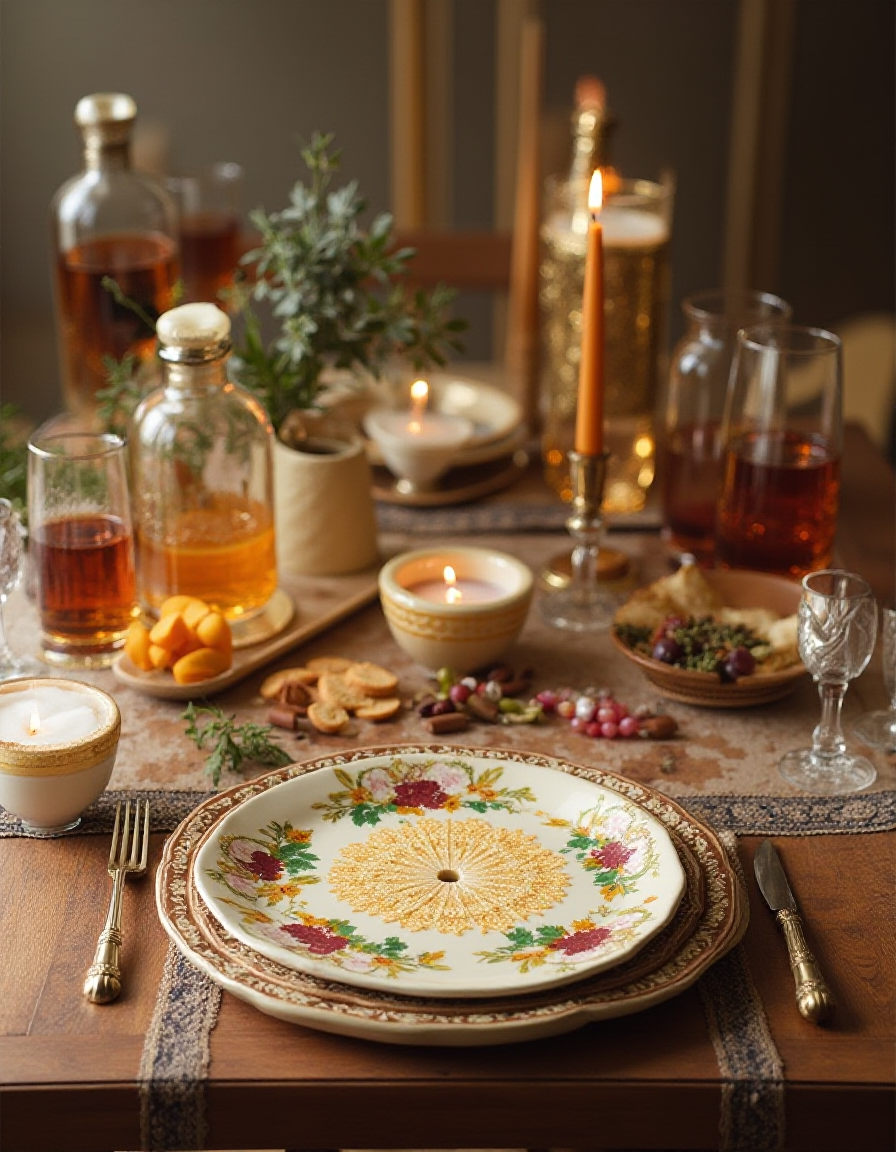
dining table with a plate of food, a candle, a glass of wine, a bottle of wine, a plate of food, a plate of food, a plate of food, a plate of food, a plate of food, a plate of food, a plate of food, a plate of food, a plate of food, a plate of food
CAPTION
The image captures a beautifully set dining table adorned with a floral-patterned plate, a fork, and a knife, all resting on a tablecloth with a blue and white pattern.
MONOLOGUE
It came over her once how different all this was from the house which she had called home all her life. The fine napery, the cut glass and silver, the stately butler! And here was she eating off a stone china plate thick enough for a table top, with a steel knife and fork and a spoon with the silver worn off the bowl. She could not help wondering what her stepmother would have said to the red and white tablecloth, and the green shades at the windows. There was an old sofa covered with carpet in the room, with a flannel patchwork pillow, and a cat cuddled up cosily beside it purring away like a tea-kettle boiling. Somehow, poor as it was, it seemed infinitely more attractive than any room she had ever seen before, and she was charmed with the whole family. Bobbie sat at the other end of the table with his elbows on the table and his round eyes on her. When she smiled at him he winked one eye and grinned and then wriggled down under the table out of sight.
SUMMARY
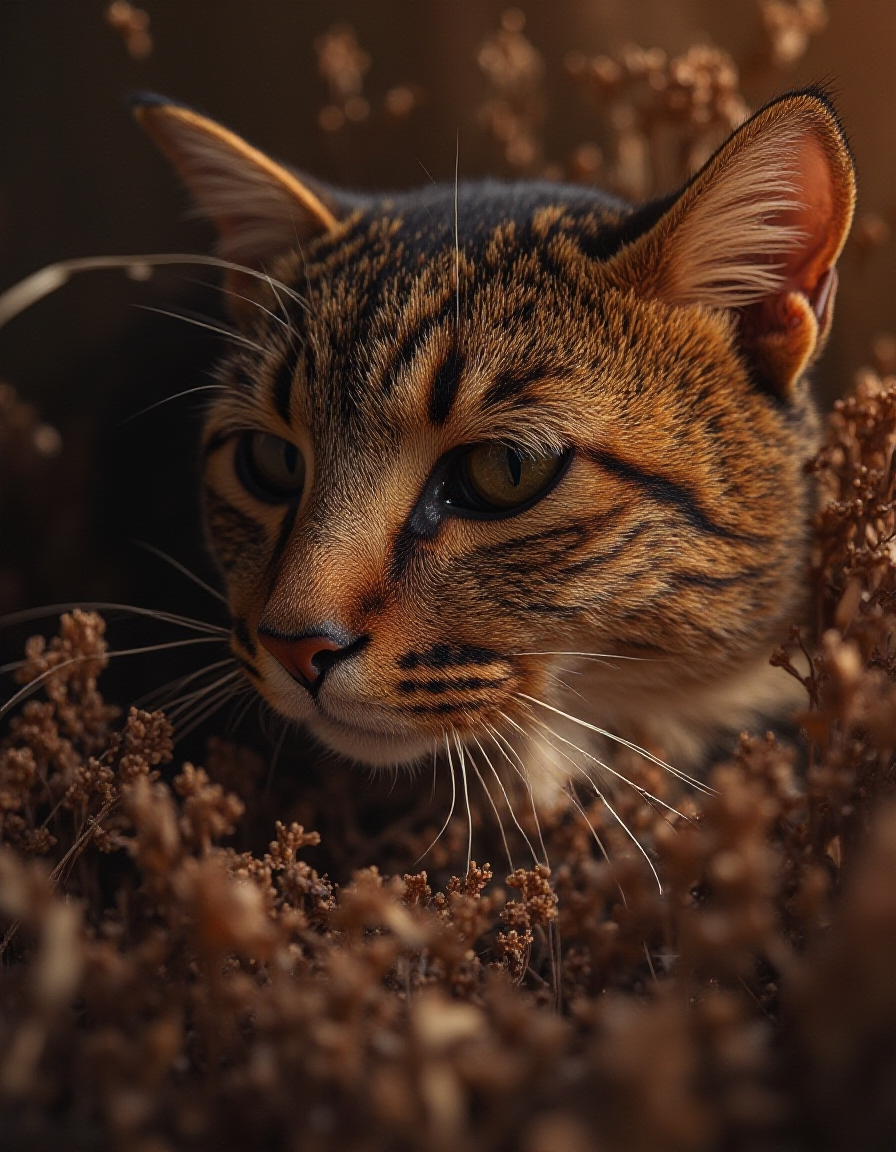
a cat with a brown and black striped face is looking up at the camera
CAPTION
The image captures a close-up of a cat's face, with the cat's eyes and whiskers prominently displayed. The cat's fur is a mix of brown and black, with a distinctive pattern of stripes and spots. The background is blurred, focusing the viewer's attention on the cat's face.
MONOLOGUE
Of our immediate constellation, Sir Richard Maistre was the only member on whom the eye was tempted to linger. The others were obvious--simple equations, soluble 'in the head.' But he called for slate and pencil, offered materials for doubt and speculation, though it would not have been easy to tell wherein they lay. What displayed itself to a cursory inspection was quite unremarkable: simply a decent-looking young Englishman, of medium stature, with square-cut plain features, reddish-brown hair, grey eyes, and clothes and manners of the usual pattern. Yet, showing through this ordinary surface, there was something cryptic. For me, at any rate, it required a constant effort not to stare at him. I felt it from the beginning, and I felt it to the end: a teasing curiosity, a sort of magnetism that drew my eyes in his direction. I was always on my guard to resist it, and that was really the inception of my neglect of him. From I don't know what stupid motive of pride, I was anxious that he shouldn't discern the interest he had excited in me; so I paid less ostensible attention to him than to the others, who excited none at all. I tried to appear unconscious of him as a detached personality, to treat him as merely a part of the group as a whole. Then I improved such occasions as presented themselves to steal glances at him, study him _ la drobe_--groping after the quality, whatever it was, that made him a puzzle--seeking to formulate, to classify him.
SUMMARY
gold sculpture of a woman dancing in a garden with flowers and a moon
CAPTION
The image depicts a gold-colored, intricately designed wall panel. The central figure is a woman, depicted in a dynamic pose, with her arms outstretched and legs bent at the knees. The woman is surrounded by a floral pattern, adding a touch of nature to the artwork.
MONOLOGUE
I was among multitudes of children Dancing at the foot of a mountain. A breeze blew out of the east and swept them as leaves, Driving some up the slopes. . . . All was changed. Here were flying lights, and mystic moons, and dream-music. A cloud fell upon us. When it lifted all was changed. I was now amid multitudes who were wrangling. Then a figure in shimmering gold, and one with a trumpet, And one with a sceptre stood before me. They mocked me and danced a rigadoon and vanished. . . . All was changed again. Out of a bower of poppies A woman bared her breasts and lifted her open mouth to mine. I kissed her. The taste of her lips was like salt. She left blood on my lips. I fell exhausted. I arose and ascended higher, but a mist as from an iceberg Clouded my steps. I was cold and in pain. Then the sun streamed on me again, And I saw the mists below me hiding all below them. And I, bent over my staff, knew myself Silhouetted against the snow. And above me Was the soundless air, pierced by a cone of ice, Over which hung a solitary star! A shudder of ecstasy, a shudder of fear Ran through me. But I could not return to the slopes— Nay, I wished not to return. For the spent waves of the symphony of freedom Lapped the ethereal cliffs about me. Therefore I climbed to the pinnacle. I flung away my staff. I touched that star With my outstretched hand. I vanished utterly. For the mountain delivers to Infinite Truth Whosoever touches the star.
SUMMARY
The image shows a triangular shape in space with a galaxy inside it.
CAPTION
The image presents a vibrant and detailed view of a galaxy, with a triangular shape in the center. The galaxy is filled with a swirling pattern of stars and dust, creating a mesmerizing cosmic scene. The stars are scattered throughout the galaxy, with some appearing closer to the center and others more spread out.
MONOLOGUE
89. =Handwiping with Retroussage.=--Having _wiped the plate with the palm of the hand_, we might _bring it up again (la retrousser)_ by playing over it very lightly with a piece of soft muslin rag rolled together. The muslin draws the ink out of the lines, and spreads it along their edges, so that, in the proof, the space between the lines is filled up by a vigorous tint. But this process can only be used on plates in which the lines are evenly disposed throughout, and, more especially, scattered. To produce the proper effect the _retroussage_ must be general; because, if the rag passes over one passage only, and not over the others, or, if it is brought into play only on the dark parts, and not in the lights, there will be discordance of tone, and consequently want of harmony. In the present case, therefore, _retroussage_ would be unsatisfactory, because the work on your plate, while it is broadly treated in some parts, is so close in others that there is no room left between the furrows. It follows that there is no place for the ink, drawn out of the lines, to spread on; the result would be a muddy tint,--one of those overcharged impressions which bring criticism upon the printer, because he has applied _retroussage_ to a plate which did not need it.
SUMMARY
two women are standing in a field at sunset, one wearing a red dress and the other a floral dress, with a full moon in the background.
CAPTION
The image depicts two women standing side by side in a serene outdoor setting. The woman on the left is wearing a red dress adorned with a floral pattern and a beaded necklace, while the woman on the right is dressed in a vibrant red dress with a floral pattern and a straw hat. They are both adorned with flowers in their hair, adding a touch of nature's beauty to the scene.
MONOLOGUE
CASE 12. Mrs. B--, t. 30, previously treated for various hysterical disturbances, has complained for about eight days of disordered vision, the binocular nature of which was proved as patient had herself observed that on closing one eye she could at once see clearly. Near objects to 15 cm. are seen distinctly. With all this, at the first examination it was impossible to produce diplopia, either with the aid of a red glass or prisms, &c., the images of first one eye, then the other were always seen by turns. A few days later, on repeating the examination, double images were perceived, they were homonymous with slight difference in height (image of the right eye lower), the lateral displacement is corrected by a prism of 28. Micropsia of one image was also perceived. On both sides the outward movement is rather difficult. Full visual acuity on both sides--in the first examination slight myopia - 75 D. is specified, afterwards emmetropia. The visual disturbance was removed by goggles with faintly ground glass on the right side--preparations of iron, bromide salts, shampooing with cold water and electricity were used. In six weeks' time binocular single vision was again restored; the facultative divergence = 0. With red glass and vertically deviating prisms homonymous diplopia corrected by prism 3. Field of vision and sense of colour remained normal throughout.
SUMMARY
a spiral galaxy with a bright center and a halo of stars and dust
CAPTION
The image presents a vibrant and detailed depiction of a galaxy, rendered in a realistic style. The galaxy is centrally positioned in the frame, surrounded by a swirling pattern of stars and dust. The stars, scattered throughout the galaxy, emit a warm glow, adding to the overall cosmic ambiance.
MONOLOGUE
Bessel determined to apply this beautiful instrument to the problem of stellar parallax; and he began by considering carefully the kind of star for which success was most likely. Hitherto the brightest had been most attended to, but Bessel thought that quickness of proper motion would be a still better test of nearness. Not that either criterion is conclusive as to distance, but there was a presumption in favour of either a very bright or an obviously moving star being nearer than a faint or a stationary one; and as the "bright" criterion had already been often applied without result, he decided to try the other. He had already called attention to a record by Piazzi in 1792 of a double star in Cygnus whose proper motion was five seconds of arc every year--a motion which caused this telescopic object, 61 Cygni, to be known as "the flying star." Its motion is not really very perceptible, for it will only have traversed one-third of a lunar diameter in the course of a century; still it was the quickest moving star then known. The position of this interesting double he compared with two other stars which were seen simultaneously in the field of the heliometer, by the method I have described, throughout the whole year 1838; and in the last month of that year he was able to announce with confidence a distinct though very small parallax; substantiating it with a mass of detailed evidence which commanded the assent of astronomers. The amount of it he gave as one-third of a second. We know now that he was very nearly right, though
SUMMARY
The metallic sculpture of a bird with outstretched wings against a dark background.
CAPTION
The image presents a detailed, three-dimensional rendering of a silver-colored angelic figure with outstretched wings. The wings, composed of numerous individual feathers, are spread out in a fan-like pattern, creating a sense of movement and dynamism. The figure itself is rendered in a high-resolution, metallic texture, giving it a lifelike appearance.
MONOLOGUE
The Argus pheasant affords a much more remarkable case. The immensely developed secondary wing-feathers are confined to the male; and each is ornamented with a row of from twenty to twenty-three ocelli, above an inch in diameter. These feathers are also elegantly marked with oblique stripes and rows of spots of a dark colour, like those on the skin of a tiger and leopard combined. These beautiful ornaments are hidden until the male shows himself off before the female. He then erects his tail, and expands his wing-feathers into a great, almost upright, circular fan or shield, which is carried in front of the body. The neck and head are held on one side, so that they are concealed by the fan; but the bird in order to see the female, before whom he is displaying himself, sometimes pushes his head between two of the long wing-feathers (as Mr. Bartlett has seen), and then presents a grotesque appearance. This must be a frequent habit with the bird in a state of nature, for Mr. Bartlett and his son on examining some perfect skins sent from the East, found a place between two of the feathers which was much frayed, as if the head had here frequently been pushed through. Mr. Wood thinks that the male can also peep at the female on one side, beyond the margin of the fan.
SUMMARY
The image depicts a collection of 40 silver spheres suspended in the sky, creating a striking visual effect.
CAPTION
The image presents a surreal scene where a series of metallic spheres are suspended in mid-air against a backdrop of a vast ocean. The spheres, each approximately the size of a basketball, are arranged in a grid-like pattern, with some spheres closer to the foreground and others further back.
MONOLOGUE
One of the great sights on the river is the Tower Bridge. This is not the newest bridge, but it was built later than most of the others. It has two great towers rising one on each side, to the sky, and the bridge lies across low down between these towers. But when a big ship comes and wants to get up the river under the bridge, what is to be done? The bridge is not high enough! Well, what does happen is this, and I hope that every one of you will see it one day, for it is one of the grandest things in all London: a man rings a bell, and the cabs and carriages and carts and people who are on the bridge rush quickly across to the other side, and when the bridge is quite empty then the man in the tower touches some machinery, and slowly the great bridge, which is like a road, remember, rises up into the air in two pieces, just as you might lift your hands while the elbows rested on your knees without moving, and the beautiful ship passes underneath, and the bridge goes back again quite gently into its place. This bridge has been called the Gate of London, and it is a very good name, for it looks like a giant gate over the river. Close to it is the Tower, of which you must often have read in your history books--the grim Tower where so many people who were not wicked at all were imprisoned, and where some of them were beheaded because, in the time when they lived, there were no laws such as there are now safeguarding people's lives. The Tower will have a chapter to itself later on.
SUMMARY
a kaleidoscope of colors and shapes in the center of the image
CAPTION
The image presents a mesmerizing, kaleidoscopic pattern that appears to be a fractal. The pattern is composed of multiple, interconnected shapes that create a sense of depth and complexity. The colors are vibrant and saturated, with hues of blue, orange, and purple dominating the scene.
MONOLOGUE
(14) Flat diagrams showing hues and values, but omitting to define chromas, are as incomplete as would be a map of Switzerland with the mountains left out, or a harbor chart without indications of the depth of water. We find by aid of the measuring instruments that pigments are very unequal in this third dimension,--chroma,--producing mountains and valleys on the color sphere, so that, when the color system is worked out in pigments and charted, some colors must be traced well out beyond the spherical surface (paragraphs 125-127). Indeed, aCOLOR TREE[5] is needed to display by the unequal levels and lengths of its branches the individuality of pigment colors. But, whatever solid or figure is used to illustrate color relations, it must combine the three scales of hue, value, and chroma, and these definite scales furnish a name for every color based upon its intrinsic qualities, and free from terms purloined in other sensations, or caught from the fluctuating colors of natural objects.
SUMMARY
a large, spherical object filled with numerous small, colorful balls floating in a dark, smoky background
CAPTION
The image presents a surreal, abstract representation of a sphere filled with numerous small, spherical objects of varying colors and patterns. The objects are densely packed, creating a sense of depth and volume. The background is shrouded in a thick, swirling mist, adding to the dreamlike quality of the scene.
MONOLOGUE
Color and mass are the painter's medium, his language. The final import of art is the _idea,_ the emotional content of the work. On his way to the expression of his idea the artist avails himself of material to give his feeling concrete actuality and visible or audible realization. He paints a picture, glorious in color and compelling in the concentration of its massing; he carves a statue, noble in form or subtly rhythmic; he weaves a pattern of harmonious sounds. He values objects not for their own sake but for the energies they possess,--their power to rouse his whole being into heightened activity. And they have this power by virtue of their material qualities, as color and form or sound. A landscape is gay in springtime or sad in autumn. The difference in its effect upon us is not due to our knowledge that it is spring or autumn and our consciousness of the associations appropriate to each season. The emotional quality of the scene is largely a matter of its color. Let the spring landscape be shrouded in gray mist sifting down out of gray skies, and we are sad. Let the autumn fields and woodland sparkle and dance in the crisp golden sunlight, and our blood dances with them and we want to shout from full lungs. In music the major key wakens a different emotion from the minor. The note of a violin is virgin in quality; the voice of the 'cello is the voice of experience. The distinctive emotional value of each instrument inheres in the character of its sound. These qualities of objects art uses as its
SUMMARY
The image depicts a complex, abstract pattern of colorful, wavy lines that create a visually striking and dynamic composition. The colors are vibrant and varied, with hues of pink, purple, and blue dominating the scene. The pattern is reminiscent of a fractal, with the lines forming intricate, interconnected shapes that create a sense of depth and complexity. The
CAPTION
The image is a digital artwork that appears to be a fractal, characterized by its intricate and dynamic patterns. The colors are vibrant and saturated, with shades of pink, purple, and blue dominating the scene. The patterns are formed by a series of interconnected lines and shapes that create a sense of movement and complexity.
MONOLOGUE
In Switzerland what fearful ravines and foaming cascades do bridges cross! sometimes so aerial, and overhanging such precipices, as to justify to the imagination the name superstitiously bestowed on more than one, of the Devil's Bridge; while from few is a more lovely effect of near water seen than the "arrowy Rhone," as we gaze down upon its "blue rushing" beneath the bridge at Geneva. Perhaps the varied pictorial effects of bridges, at least in a city, are nowhere more striking than at Venice, whose five hundred, with their mellow tint and association with palatial architecture and streets of water, especially when revealed by the soft and radiant hues of an Italian sunset, present outlines, shapes, colors, and contrasts so harmonious and beautiful as to warm and haunt the imagination while they charm the eye. It is remarkable, as an artistic fact, how graciously these structures adapt themselves to such diverse scenes,--equally, though variously, picturesque amid the sturdy foliage and wild gorges of the Alps, the bustle, fog, and mast-forest of the Thames, and the crystal atmosphere, Byzantine edifices, and silent canals of Venice.
SUMMARY
flower with pink and blue petals and a pink center.
CAPTION
The image is a close-up of a flower with a vibrant blue and pink color scheme. The petals of the flower are intricately detailed, with a radial pattern that creates a sense of depth and movement. The background is blurred, drawing focus to the flower.
MONOLOGUE
In the early days, the first settlers had their flower beds close to the house, probably because they did not then interfere with garden space. The effect was pleasing, for it added to the simple attraction of the early building. It is a good plan, after remodeling a house, to carry out this scheme of our forebears and have a narrow bed following the line of the house. Trees also are always effective; they break the roof line and shut off objectionable views. If you have no trees, by all means plant some. Screens can be devised by planting shrubbery, which makes unnecessary a latticed enclosure and is all the more interesting if the shrubs bear flowers, adding a bright spot to the color scheme. They are very practical as well, since they serve many purposes besides shutting off objectionable portions of the grounds. If rightly planted, they serve as windbreaks and can be arranged to frame a vista. While evergreen is often used for this scheme, yet shrubs such as the lilac, forsythia, bridal wreath, flowering almond, and many others are suitable. Plant these so that there will be a continuation in bloom, and also with reference to a definite color scheme.
SUMMARY
abstract painting with vibrant colors and swirling patterns.
CAPTION
The image is a vibrant and abstract painting that showcases a swirling pattern of vibrant colors. The colors are predominantly red, blue, and yellow, with the red and blue hues dominating the central part of the painting. The swirling pattern is reminiscent of a tornado or a whirlpool, adding a dynamic and energetic element to the artwork.
MONOLOGUE
After this meal the Kōk-kō begin their bodily decorations, with their bodies almost nude. Those of the North are painted yellow; those of the West, blue; those of the South, red; those of the East, white; those of the Heavens, all colors on the body and yellow on the neck and upper arms; those of the Earth, black, with some bits of color. This done, the Sä-lä-mō-bī-ya of the North passes through the village and, going for a short distance to the north, deposits a plume stick, the stick to which the plumes are attached being painted yellow. The Sä-lä-mō-bī-ya of the West, South, and East plant their plumes at their respective cardinal points. Those for the zenith and nadir are planted to the west, on the road to the spirit lake, the stick of each one having the cardinal color decorations. This done, all retire to their kivas.
SUMMARY
The image depicts a complex, swirling pattern of dark, organic shapes that appear to be made of a shiny, reflective material. The shapes are interconnected and form a dynamic, organic structure that seems to be in motion. The lighting in the image creates a sense of depth and dimensionality, enhancing the visual appeal of the intricate pattern.
CAPTION
The image is a high-resolution, 3D rendering of a black, swirling, organic shape that appears to be made of a material that resembles wax or a similar substance. The shape is composed of multiple layers and curves, creating a complex, dynamic, and visually striking pattern.
MONOLOGUE
Not as a single form, however, but as a moving stream of impressions, paid out of the volume in a slender thread as we turn the pages--that is how the book reaches us; or in another image it is a procession that passes before us as we sit to watch. It is hard to think of this lapse and flow, this sequence of figures and scenes, which must be taken in a settled order, one after another, as existing in the condition of an immobile form, like a pile of sculpture. Though we readily talk of the book as a material work of art, our words seem to be crossed by a sense that it is rather a process, a passage of experience, than a thing of size and shape. I find this contradiction dividing all my thought about books; they are objects, yes, completed and detached, but I recall them also as tracts of time, during which Clarissa and Anna moved and lived and endured in my view. Criticism is hampered by the ambiguity; the two books, the two aspects of the same book, blur each other; a critic seems to shift from this one to that, from the thing carved in the stuff of thought to the passing movement of life. And on the whole it is the latter aspect of the two which asserts itself; the first, the novel with its formal outline, appears for a moment, and then the life contained in it breaks out and obscures it.
SUMMARY
a glowing dragonfly with iridescent scales and a long, curved beak
CAPTION
The image showcases a detailed and vibrant illustration of a dragonfly, rendered in a digital art style. The dragonfly is the main subject, with its intricate patterns and glowing blue and orange hues dominating the image. The background is a deep blue, providing a stark contrast to the dragonfly's colorful patterns.
MONOLOGUE
When he came to study the Italian school of engraving he found to his delight that every stroke was made to tell. Nothing blotchy or muddled, no careless cross-hatching, no "lozenges or dots" were admitted, and Blake quickly appreciated the wider range of effects obtainable by this Italian manner, and engrafted its main principles on to his own characteristic style. Of that characteristic style, as we know, the beauty of outline, the care for its preservation whenever possible, was the main principle. And here in the school of Marc Antonio and Bononsoni he found that principle adopted as the basis of beauty in engraving, every other consideration being made subservient to it. The conflict and want of unity of effect, resultant on making compromises with other principles of art,--such as subtlety of modelling, delicate distinctions in values, imitation of textures, intricacy of detail,--had not disturbed the dignity of the Italian school, which consciously sacrificed variety and a wide range of effects in order to keep the work of the burin as broad and simple as possible, the outline always being insisted on as the chief subject of alterations, while the shading and modelling were comprehensively indicated by long curved lines, close together, only crossing and intersecting in the darkest parts. The beauty and freedom of the "Job" engravings are a revelation of the final grace and power achieved by Blake through his appreciation of the legitimate functions of an art pre-eminently concerned with line.
SUMMARY
The image depicts a Native American man with a detailed and realistic face. He is wearing a feathered headdress and has a beard, adding to the cultural and artistic significance of the image.
CAPTION
The image presents a detailed, stylized portrait of a Native American man. The man's face is the focal point, adorned with intricate patterns and designs that blend into the background. His eyes are closed, and his expression is serene, adding a sense of calm to the image.
MONOLOGUE
But if one will withdraw to an inoffensive corner and take a critical view of the assembly, he will presently discover that many of the faces are familiar to him, although he supposed himself to be quite among strangers. The tall figure, with the beautiful, kindly face set in white hair and beard, has surely sat for the familiar portrait of Alfred Russel Wallace. This short, thick-set, robust, business-like figure is that of Sir Norman Lockyer. Yonder frail-seeming scholar, with white beard, is surely Professor Crookes. And this other scholar, with tall, rather angular frame and most kindly gleam of eye, is Sir Michael Foster; and there beyond is the large-seeming though not tall figure, and the round, rosy, youthful-seeming, beautifully benevolent face of Lord Lister. "What! a real lord there?" said a little American girl to whom I enumerated the company after my first visit to the Royal Society. "Then how did he act? Was he very proud and haughty, as if he could not speak to other people?" And I was happy to be able to reply that though Lord Lister, perhaps of all men living, would be most excusable did he carry in his manner the sense of his achievements and honors, yet in point of fact no man could conceivably be more free from any apparent self-consciousness. As one watches him now he is seen to pass from group to group with cordial hand-shake and pleasant word, clearly the most affable of men, lord though he be, and president of the Royal Society, and foremost scientist of his time.
SUMMARY
The image is a digital illustration of a swirling vortex of colors, rendered in a highly stylized and abstract manner.
CAPTION
The image is a high-resolution, 3D rendering of a swirling vortex of colors, predominantly red, blue, and yellow, with intricate patterns and textures. The colors are vibrant and saturated, creating a sense of depth and movement. The image is highly detailed, with each color and shape contributing to the overall composition.
MONOLOGUE
Although, as we learn from the above-mentioned insects and the beaver, a high degree of intelligence is certainly compatible with complex instincts, and although actions, at first learnt voluntarily can soon through habit be performed with the quickness and certainty of a reflex action, yet it is not improbable that there is a certain amount of interference between the development of free intelligence and of instinct,--which latter implies some inherited modification of the brain. Little is known about the functions of the brain, but we can perceive that as the intellectual powers become highly developed, the various parts of the brain must be connected by very intricate channels of the freest intercommunication; and as a consequence each separate part would perhaps tend to be less well fitted to answer to particular sensations or associations in a definite and inherited--that is instinctive--manner. There seems even to exist some relation between a low degree of intelligence and a strong tendency to the formation of fixed, though not inherited habits; for as a sagacious physician remarked to me, persons who are slightly imbecile tend to act in everything by routine or habit; and they are rendered much happier if this is encouraged.
SUMMARY
The image depicts a complex, three-dimensional fractal structure composed of interconnected, swirling patterns of blue and red hues. The fractal appears to be composed of a multitude of interconnected loops and curves, creating a dynamic and intricate pattern that is both visually striking and abstract.
CAPTION
The image is a digital illustration of a complex, abstract fractal pattern. The pattern is composed of multiple layers of interconnected shapes, creating a mesmerizing, swirling effect. The colors are vivid and saturated, with shades of blue, orange, and red dominating the scene.
MONOLOGUE
Macaulay, at any rate, distinctly belongs to the imaginative class of minds, if only in virtue of his instinctive preference of the concrete to the abstract, and his dislike, already noticed, to analysis. He has a thirst for distinct and vivid images. He reasons by examples instead of appealing to formul. There is a characteristic account in Mr. Trevelyan's volumes of his habit of rambling amongst the older parts of London, his fancy teeming with stories attached to the picturesque fragments of antiquity, and carrying on dialogues between imaginary persons as vivid, if not as forcible, as those of Scott's novels. To this habit--rather inverting the order of cause and effect--he attributes his accuracy of detail. We should rather say that the intensity of the impressions generated both the accuracy and the day-dreams. A philosopher would be arguing in his daily rambles where an imaginative mind is creating a series of pictures. But Macaulay's imagination is as definitely limited as his speculation. The genuine poet is also a philosopher. He sees intuitively what the reasoner evolves by argument. The greatest minds in both classes are equally marked by their naturalisation in the lofty regions of thought, inaccessible or uncongenial to men of inferior stamp. It is tempting in some ways to compare Macaulay to Burke. Burke's superiority is marked by this, that he is primarily a philosopher, and therefore instinctively sees the illustration of a general law in every particular fact.
SUMMARY
eye with a bright yellow center and red and blue streaks
CAPTION
The image is a digital artwork that appears to be a close-up of an eye. The eye is depicted in a swirling pattern of blue and red hues, with the iris and pupil being the focal point. The texture of the eye is detailed, with the veins and blood vessels visible, giving it a lifelike appearance.
MONOLOGUE
For some time they galloped side by side in silence, each occupied with his own thoughts, Crusoe keeping close beside his master's horse. The two elder hunters evidently ruminated on the object of their mission and the prospects of success, for their countenances were grave and their eyes cast on the ground. Dick Varley, too, thought upon the Red-men, but his musings were deeply tinged with the bright hues of a _first_ adventure. The mountains, the plains, the Indians, the bears, the buffaloes, and a thousand other objects, danced wildly before his mind's eye, and his blood careered through his veins and flushed his forehead as he thought of what he should see and do, and felt the elastic vigour of youth respond in sympathy to the light spring of his active little steed. He was a lover of nature, too, and his flashing eyes glanced observantly from side to side as they swept along--sometimes through glades of forest trees, sometimes through belts of more open ground and shrubbery; anon by the margin of a stream or along the shores of a little lake, and often over short stretches of flowering prairie-land--while the firm, elastic turf sent up a muffled sound from the tramp of their mettlesome chargers. It was a scene of wild, luxuriant beauty, that might almost (one could fancy) have drawn involuntary homage to its bountiful Creator from the lips even of an infidel.
SUMMARY
abstract painting with swirling patterns of blue, purple, and pink.
CAPTION
The image is a digital artwork that appears to be abstract, featuring a swirling pattern of colors and shapes. The colors are predominantly purple, blue, and pink, with some areas displaying a mix of these hues. The shapes are fluid and organic, with no distinct outlines or sharp edges.
MONOLOGUE
There are creatures in the world that have shapes like ours, but are hairy, and want language and reason. There are naturals amongst us that have perfectly our shape, but want reason, and some of them language too. There are creatures, as it is said, (sit fides penes authorem, but there appears no contradiction that there should be such,) that, with language and reason and a shape in other things agreeing with ours, have hairy tails; others where the males have no beards, and others where the females have. If it be asked whether these be all men or no, all of human species? it is plain, the question refers only to the nominal essence: for those of them to whom the definition of the word man, or the complex idea signified by that name, agrees, are men, and the other not. But if the inquiry be made concerning the supposed real essence; and whether the internal constitution and frame of these several creatures be specifically different, it is wholly impossible for us to answer, no part of that going into our specific idea: only we have reason to think, that where the faculties or outward frame so much differs, the internal constitution is not exactly the same. But what difference in the real internal constitution makes a specific difference it is in vain to inquire; whilst our measures of species be, as they are, only our abstract ideas, which we know; and not that internal constitution, which makes no part of them. Shall the difference of hair only on the skin be a mark of a different internal specific constitution
SUMMARY
The subject of the image is a woman wearing a traditional Japanese kimono with a floral pattern. She is standing in front of a floral background, and her pose is one of contemplation or meditation.
CAPTION
The image depicts a person wearing a traditional Japanese kimono, with a floral pattern and a red flower in their hair. The kimono is predominantly black with intricate designs and patterns, featuring a white collar and a red obi. The person's hair is styled in a bun, and they are wearing a white obi with a red obi tied around their waist.
MONOLOGUE
We had barely found our moorings when five natives came in a canoe, the middle one vigorously baling the water out of the craft. As they drew nearer we observed that they were all women, one standing up at the prow, whose red hair came down to her waist. She was white as regards colour, beautifully shaped, the face aquiline and handsome, rather freckled and rosy, the eyes black and gracious, the forehead and eyebrows good, the nose, mouth, and lips well-proportioned, with the teeth well-ordered and white. Being rich in so many parts and graces she would be judged to be a very beautiful woman, and at first sight she stole away my heart. On arriving alongside she climbed aboard with amazing agility, and without the least sign of fear, from which I conjectured that Europeans were not unknown to her. As her eyes swept us her glance halted when it rested upon me, and, without embarrassment, she made signs for me to approach her.
SUMMARY
the face of a woman is illuminated with a vibrant, glowing effect, creating a surreal and dreamlike atmosphere.
CAPTION
The image depicts a close-up of a human face, which is illuminated with a vibrant, glowing effect. The face is set against a backdrop of a colorful, abstract pattern that includes shades of blue, red, and purple. The pattern appears to be made up of small, interconnected dots that give the impression of a network or a web-like structure.
MONOLOGUE
The outline of the building was clearly silhouetted against the glowing west, but since they were looking at the east face the detail was all in shadow. But, dim as it was, the sight was enough to give Dickson the surprise of his life. He had expected something old and baronial. But this was new, raw and new, not twenty years built. Some madness had prompted its creator to set up a replica of a Tudor house in a countryside where the thing was unheard of. All the tricks were there--oriel windows, lozenged panes, high twisted chimney stacks; the very stone was red, as if to imitate the mellow brick of some ancient Kentish manor. It was new, but it was also decaying. The creepers had fallen from the walls, the pilasters on the terrace were tumbling down, lichen and moss were on the doorsteps. Shuttered, silent, abandoned, it stood like a harsh memento mori of human hopes.
SUMMARY
abstract painting of swirling blue waves.
CAPTION
The image is a digital artwork that appears to be abstract, featuring a swirling pattern of blue and white hues. The colors are vibrant and saturated, giving the image a dynamic and energetic feel. The pattern is reminiscent of ocean waves, with the blue hues representing the deep blue of the ocean and the white representing the foamy waves.
MONOLOGUE
Now, as much of this kind of richness of tone is always given by Turner as is compatible with truth of aerial effect; but he will not sacrifice the higher truths of his landscape to mere pitch of color as Titian does. He infinitely prefers having the power of giving extension of space, and fulness of form, to that of giving deep melodies of tone; he feels too much the incapacity of art, with its feeble means of light, to give the abundance of nature's gradations; and therefore it is, that taking pure white for his highest expression of light, that even pure yellow may give him one more step in the scale of shade, he becomes necessarily inferior in richness of effect to the old masters of tone, (who always used a golden highest light,) but gains by the sacrifice a thousand more essential truths. For, though we all know how much more like light, in the abstract, a finely-toned warm hue will be to the feelings than white, yet it is utterly impossible to mark the same number of gradations between such a sobered high light and the deepest shadow, which we can between this and white; and as these gradations are absolutely necessary to give the facts of form and distance, which, as we have above shown, are more important than any truths of tone,[17] Turner sacrifices the richness of his picture to its completeness--the manner of the statement to its matter. And not only is he right in doing this for the sake of space, but he is right also in the abstract question of color; for as we observed above (Sect. 14,) it is only the
SUMMARY
The image depicts a diamond-shaped artwork with a black center, surrounded by a multitude of blue and gold diamonds. The diamonds are arranged in a symmetrical pattern, creating a visually striking and intricate design.
CAPTION
The image is a captivating abstract painting that showcases a mesmerizing geometric pattern. Dominating the center of the canvas is a large diamond-shaped structure, its facets radiating outward in a radial pattern. The diamond is set against a dark background, which is speckled with a lighter, almost translucent, pattern.
MONOLOGUE
This mineral is a species of crystal, or crystalline alumina--an almost pure anhydrous alumina, Al_{2}O_{3}--in many varieties, both of shape and colour. The chief stone is the ruby, considered, when large, to be of even more importance and value than the diamond. There are many other red stones in this group; sapphires, also, are a species of corundum, both the blue and the colourless varieties, as are also the aquamarine, the emerald, the amethyst, the topaz, and others, all of widely differing colour, as well as the star-shaped, or "aster" ruby, called the "ruby" cat's-eye. All these vary more in colour than in their chemical properties. Still another variety, greyish-black and generally associated with hmatite iron ore, is called emery, and, when ground in different degrees of fineness, is so well known by its general use as a polishing medium as to need no description. It should, however, be mentioned that amongst the more coarsely ground emery it is no uncommon thing to find minute sapphires, taking sapphires in their broad, commercial meaning, as signifying any variety of corundum, except the red and the emery. The surfaces of crystals of corundum are often clouded or dull, whilst its classification of lustre is vitreous. It is double refracting and has no cleavage. It is found in China, India, Burma, Ceylon, South Africa, America, and in many other places, having a wide distribution.