orange

















































































SUMMARY
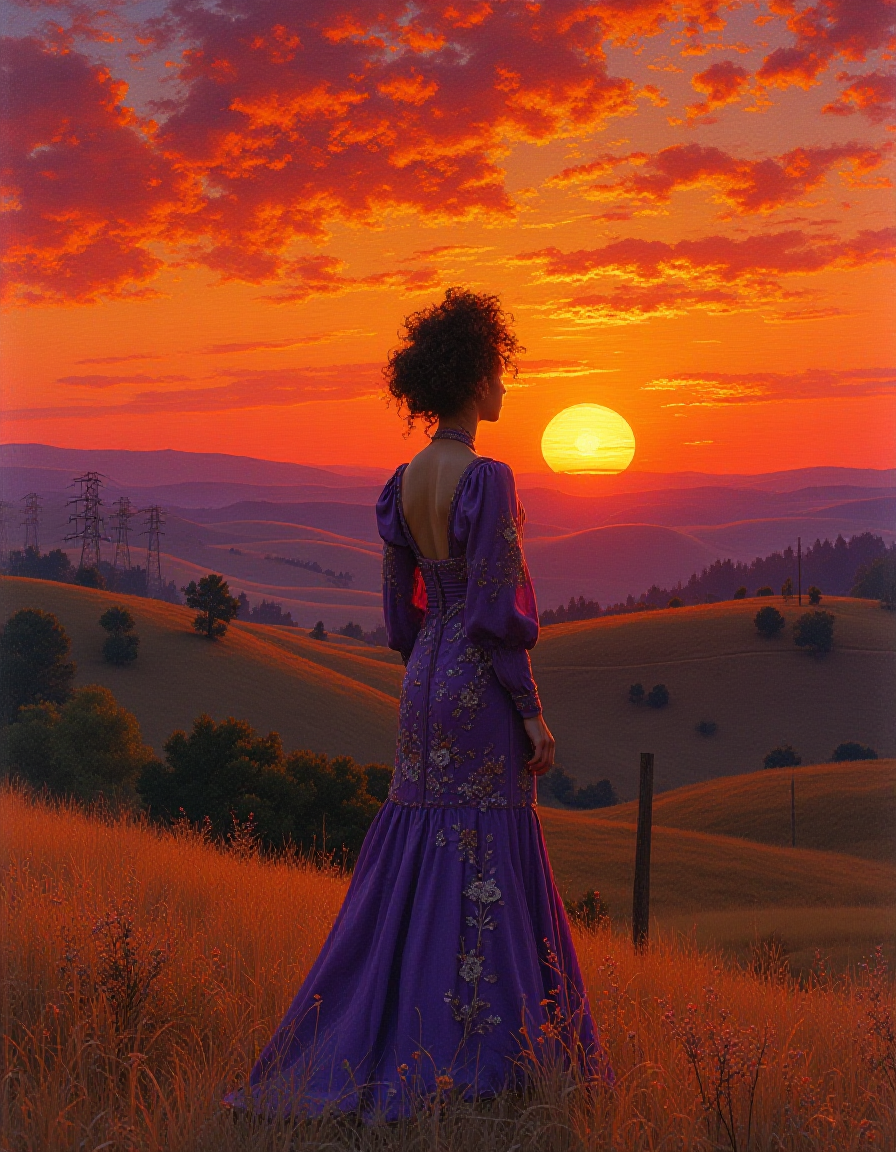
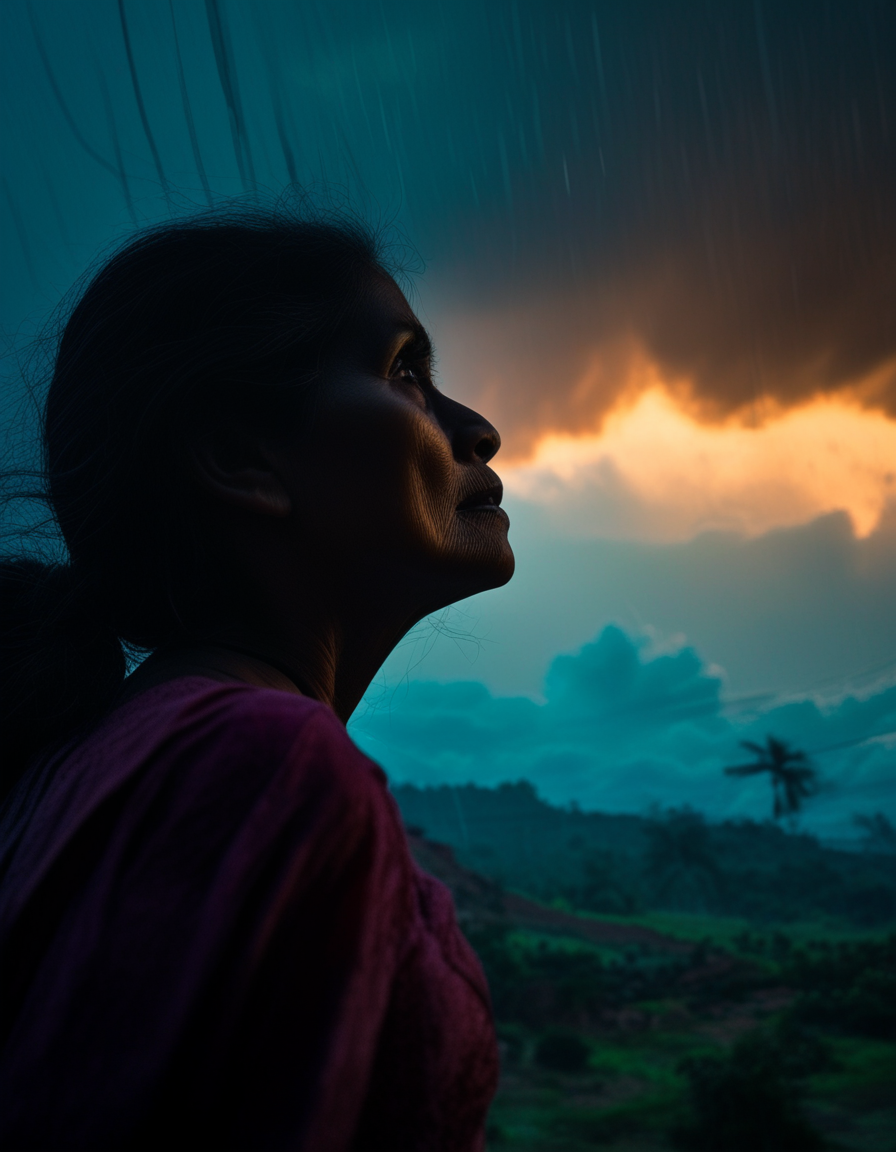
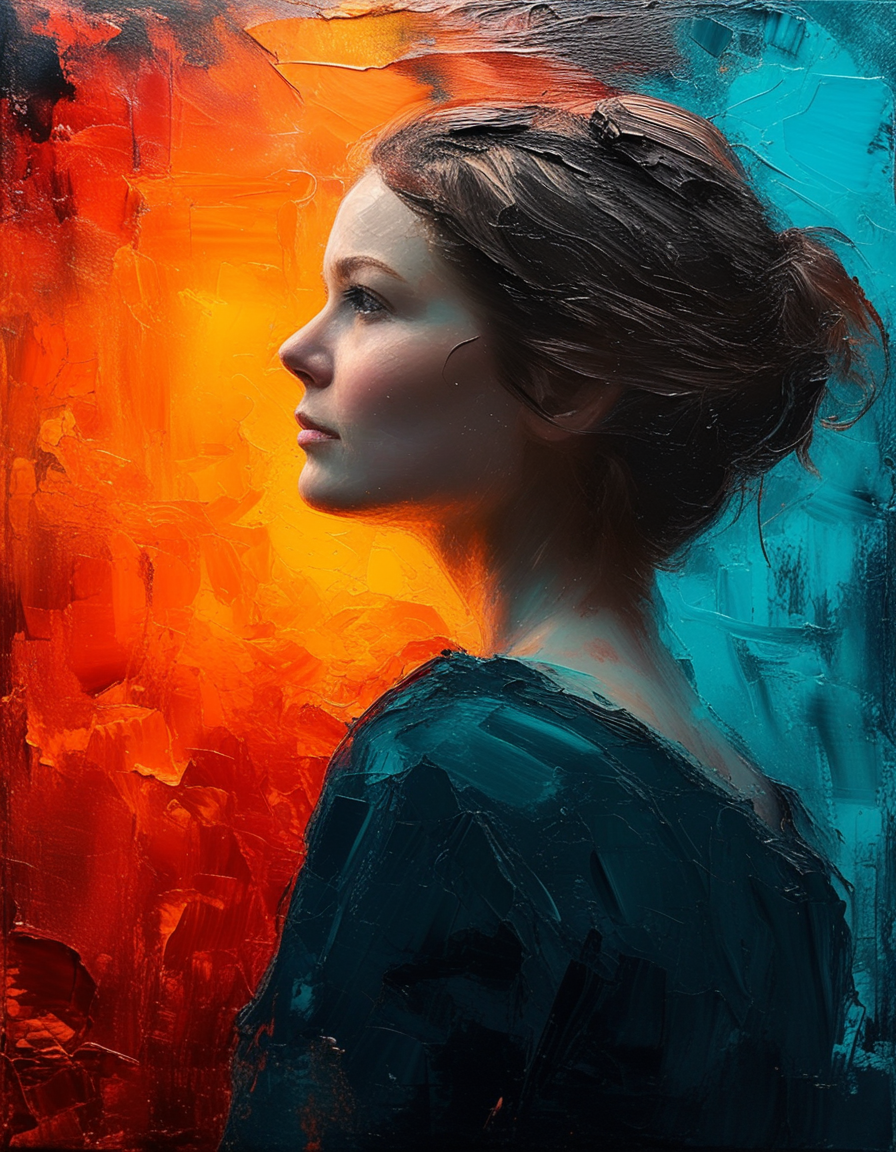
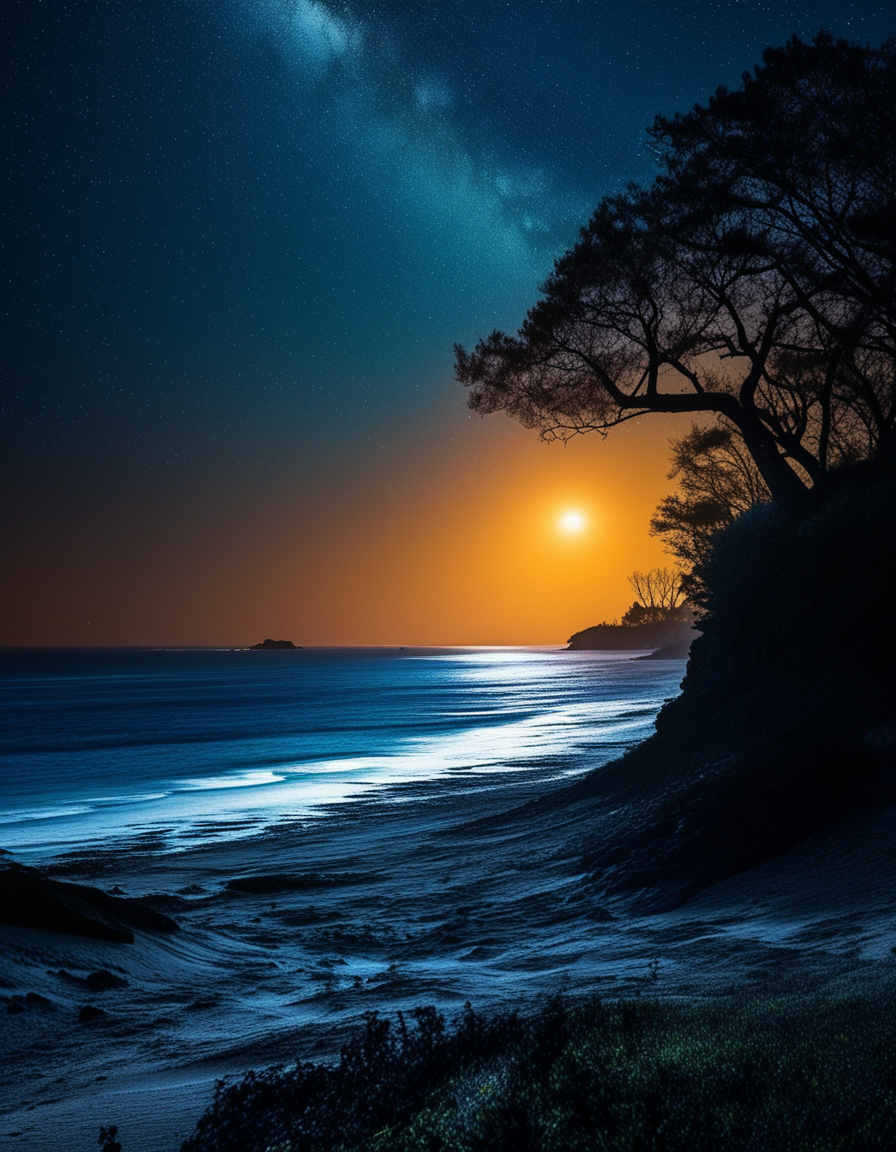
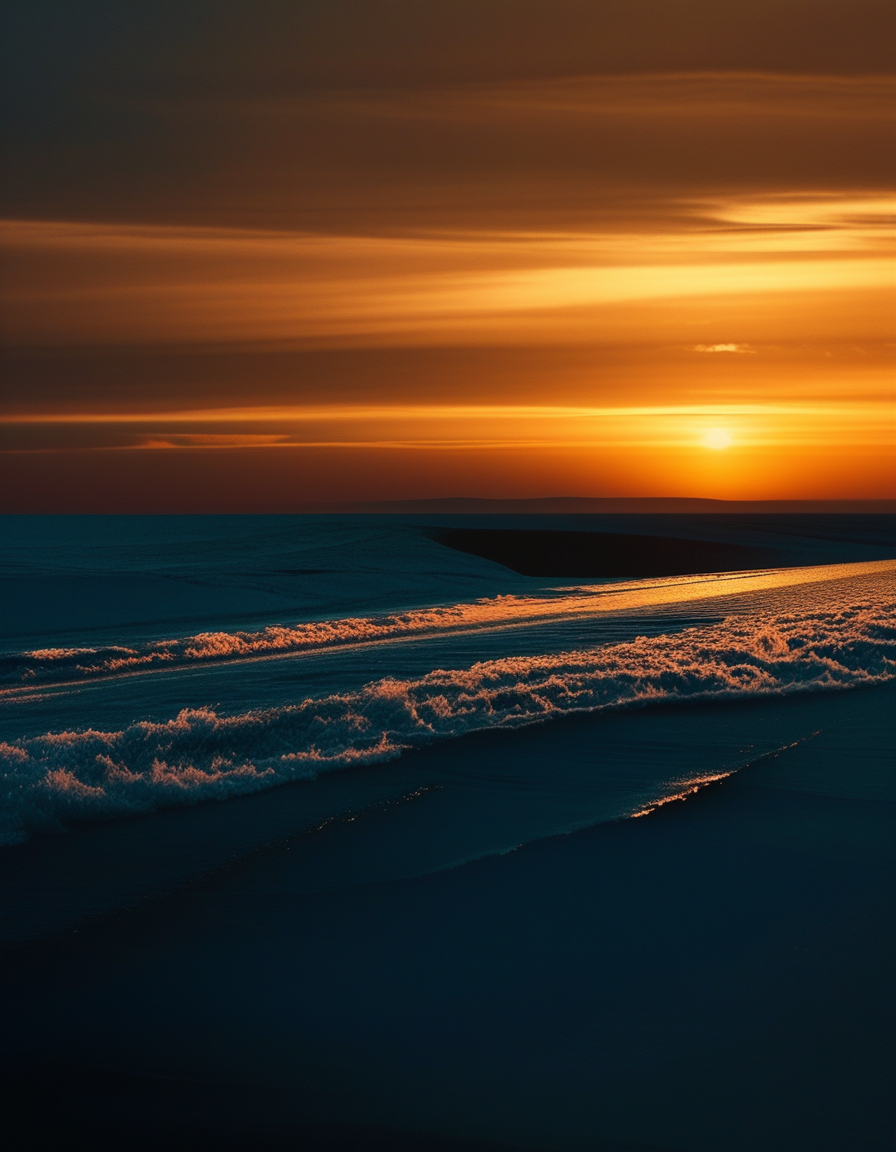
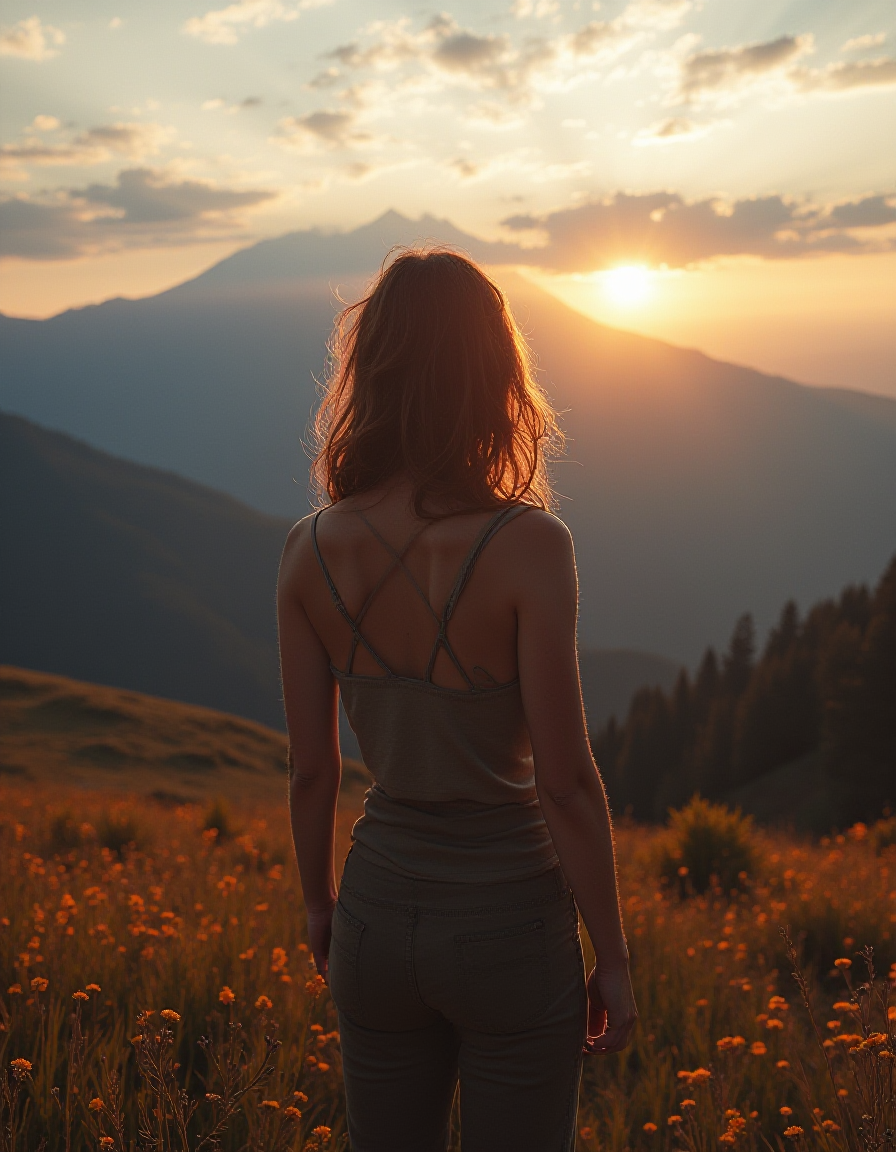
a woman in a purple dress stands in a field at sunset, gazing out at the sky
CAPTION
The image depicts a woman standing in a field of tall grass, gazing out at a sunset. The sky is ablaze with hues of orange and pink, with the sun just beginning to set. The woman is dressed in a purple dress with intricate floral patterns, adding a touch of elegance to the scene.
MONOLOGUE
The sun was nearly down, and the mountains just below him were of a deep purple hue, while those that ran out to the eastward wore the most aerial shade of blue. A few scattered clouds, floating above, soon put on the sunset robe of orange and a band of the same soft color encircled the western horizon. It did not reach half way to the zenith, however; the sky above was blue, of such a depth and transparency, that to gaze upward was like looking into eternity. Then how softly and soothingly the twilight came on! How deep a hush sank on the chesnut glades, broken only by the song of the cicada, chirping its "good-night carol!" The mountains, too, how majestic they stood in their deep purple outlines! Sweet, sweet Italy! I can feel now how the soul may cling to thee, since thou canst thus gratify its insatiable thirst for the Beautiful. Even thy plainest scene is clothed in hues that seem borrowed of heaven! In the twilight, more radiant than light, and the stillness, more eloquent than music, which sink down over the sunny beauty of thy shores, there is a silent, intense poetry that stirs the soul through all its impassioned depths. With warm, blissful tears filling the eyes and a heart overflowing with its own bright fancies, I wander in the solitude and calm of such a time, and love thee as if I were a child of thy soil!
SUMMARY
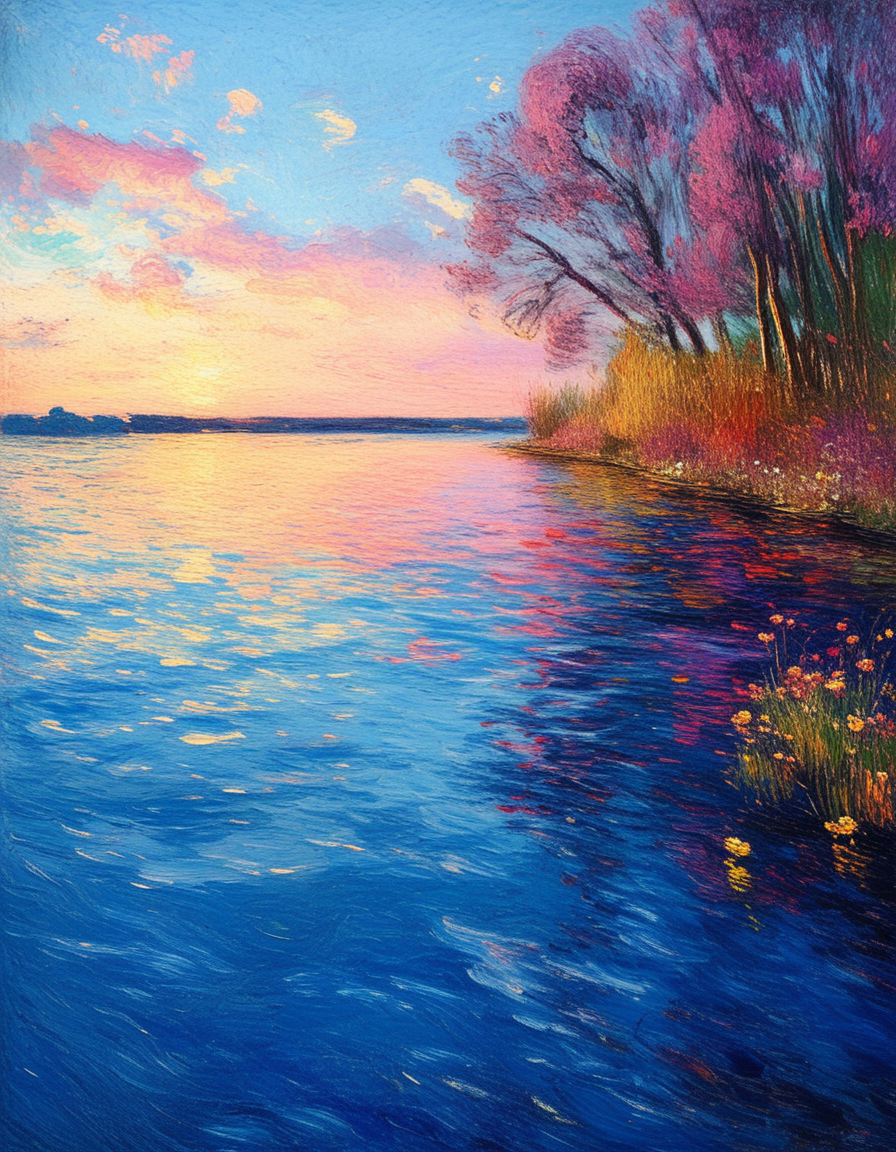
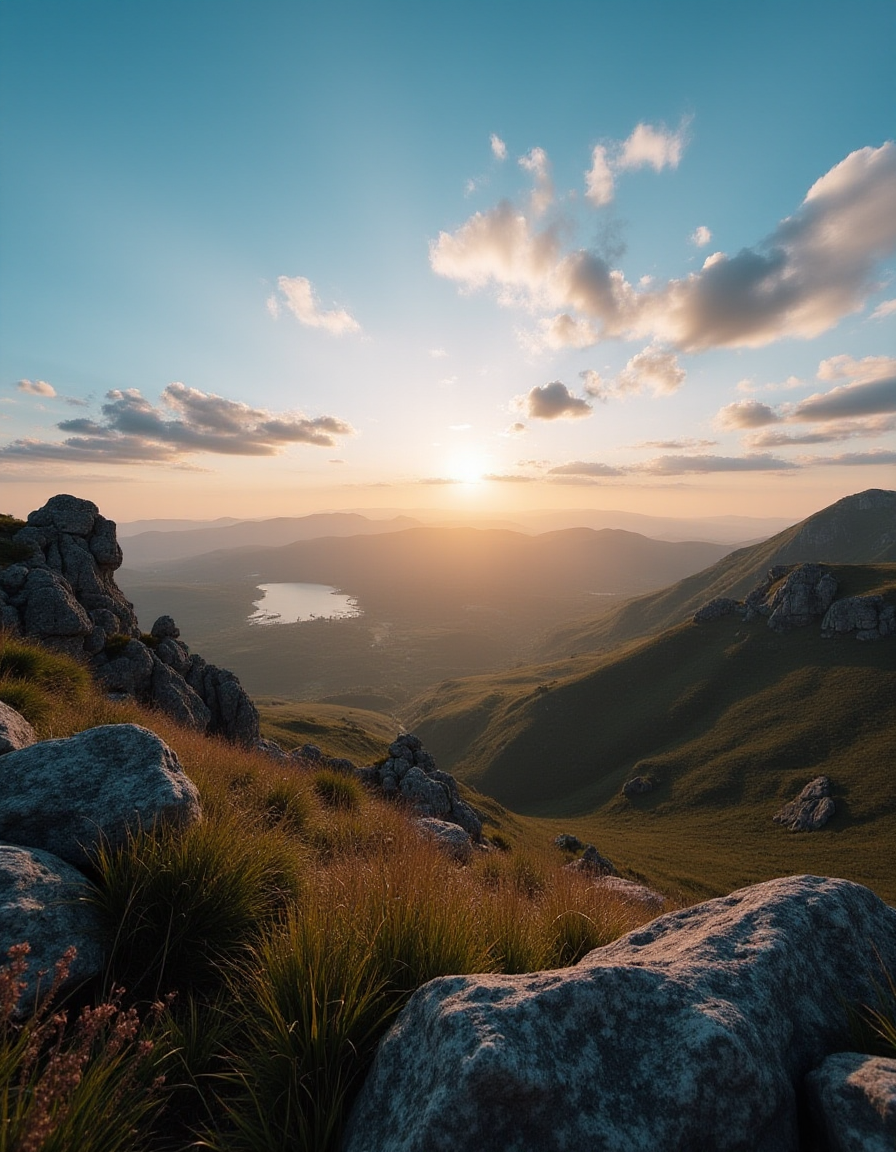
The painting depicts a serene lake at sunset, with the sky painted in hues of pink and orange. The lake is bordered by a tree and a grassy bank, creating a picturesque scene.
CAPTION
The image depicts a serene lakeside scene with a tranquil lake reflecting the vibrant colors of the sky. The sky is painted in a palette of pink, orange, and blue hues, with the sun setting in the distance, casting a warm glow over the scene.
MONOLOGUE
A rapid journey, and a tranquil passage over the sixty miles that lie between Wales and Ireland, gave me what an old Roman would regard as an omen of the peacefulness of my mission. On the dawn of one of the finest mornings of the year, I came within sight of the Irish coast, and was struck, as all travellers have been, by the beauty of the bold and picturesque coast which rose from the waters before me. In front was a province of mountains, touched by all the variety of colours, which are painted in such richness by the summer sun, on groups of pinnacles and cones, forest hills, and the fine diversities of woodland and mountain scenery. On one side the eye glanced over a vast sheet of water, shut in by headlands, and as blue and bright as a lake under a serene sky. At the extremity of this noble estuary, a cloud, unchanging and unmoving, showed where a city sent up the smoke of its ten thousand fires; beyond this, all was purple confusion. My official rank threw open all the _lite_ of Irish society to me at my first step; and I found it, as it has been found by every one else, animated, graceful, and hospitable. The nature of its government tended to those qualifications. While the grave business of the state was done in London, the lighter business of show was sedulously sustained in the Irish capital. The lord-lieutenant was generally a nobleman, selected more for his rank and his wealth than for his statesmanship. A rich, showy, and good-humoured peer was the true man for the head of affairs in Ireland. It was of more importance that he
SUMMARY
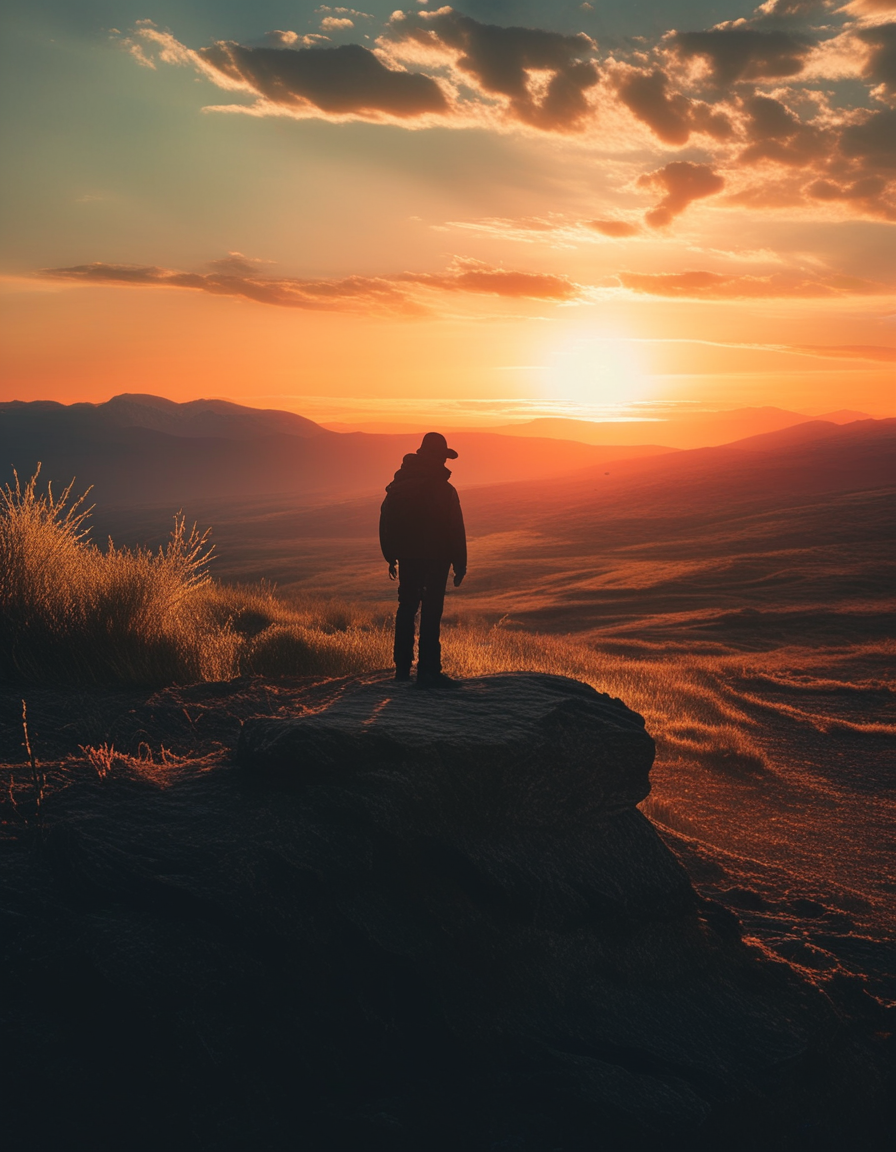
A lone backpacker stands on a rocky outcrop at sunset, gazing out at the vibrant orange and pink hues of the sky.
CAPTION
The image captures a solitary figure standing on a rocky outcrop, gazing out at a breathtaking sunset. The sky is ablaze with hues of orange and pink, casting a warm glow over the landscape. The figure, clad in a backpack, is positioned on the left side of the image, their silhouette stark against the vibrant backdrop.
MONOLOGUE
About five o'clock we were ready; everything was made snug and tight on the boats, nothing being left out of the cabins but a camp kettle in each standing-room for bailing, and we cast off. Each man had his life-preserver where he could get it quickly, and the Major put his on, for with only one arm he could not do this readily in case of necessity. The current was swift. We were carried rapidly down to where the gorge narrowed up with walls vertical on each side for a height of fifty to one hundred feet. We soon dashed through a small rough rapid. A splash of water over our bow dampened my clothes and made the air feel chilly. The canyon was growing dim with the evening light. High above our heads some lazy clouds were flecked with the sunset glow. Not far below the small rapid we saw before us a complicated situation at the prevailing stage of water, and immediately landed on the left, where there was footing to reconnoitre. A considerable fall was divided by a rocky island, a low mass that would be submerged with two or three feet more water, and the river plunging down on each side boiled against the cliffs. Between us and the island the stream was studded by immense boulders which had dropped from the cliffs and almost like pinnacles stood above the surface. One view was enough to show that on this stage of water we could not safely run either side of the cataract; indeed destruction would surely have rewarded any attempt. The right-hand channel from the foot of the island swept powerfully across to meet the
SUMMARY
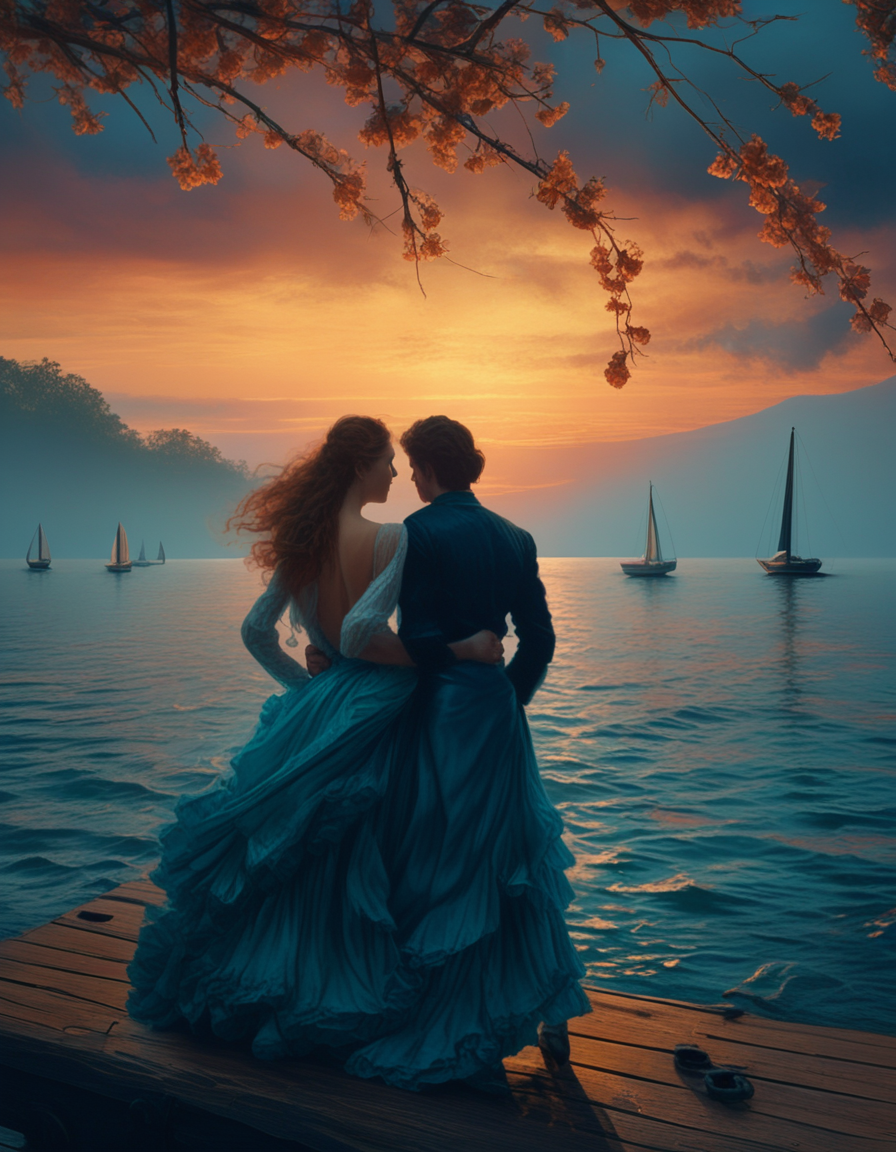
couple on a wooden dock with sailboats in the background.
CAPTION
The image depicts a serene scene of two people standing on a wooden dock overlooking a body of water. The sky is painted in hues of orange and pink, suggesting a sunset. The water is calm, reflecting the colors of the sky.
MONOLOGUE
For a moment no one spoke on board the boat. Every one watched that sea and sky, either with some presentiment of danger, or because they felt the influence of the religious melancholy that takes possession of nearly all of us at the close of the day, the hour of prayer, when all nature is hushed save for the voices of the bells. The sea gleamed pale and wan, but its hues changed, and the surface took all the colors of steel. The sky was almost overspread with livid gray, but down in the west there were long narrow bars like streaks of blood; while lines of bright light in the eastern sky, sharp and clean as if drawn by the tip of a brush, were separated by folds of cloud, like the wrinkles on an old man's brow. The whole scene made a background of ashen grays and half-tints, in strong contrast to the bale-fires of the sunset. If written language might borrow of spoken language some of the bold figures of speech invented by the people, it might be said with the soldier that "the weather has been routed," or, as the peasant would say, "the sky glowered like an executioner." Suddenly a wind arose from the quarter of the sunset, and the skipper, who never took his eyes off the sea, saw the swell on the horizon line, and cried:
SUMMARY
a cluster of orange maple leaves floating in a body of water
CAPTION
The image depicts a serene scene of autumn foliage floating on a body of water. The leaves, predominantly orange and yellow, are scattered across the surface of the water, creating a vibrant contrast against the deep blue of the water. The water itself is calm, with ripples and small waves adding to the overall tranquility of the scene.
MONOLOGUE
Thus passed over weeks and months. The summer glided into the mellow autumn, and the autumn itself grew cold and chill, with grayish skies and sighing winds that swept the leaves along the dark walks and moaned sadly among the tall beech-trees. The still, calm waters of the little lake, that reflected the bright foliage and the deep blue sky motionless as in a mirror, was now ruffled by the passing breeze, and surged with a low, sad sound against its rocky sides; and as I watched these changes, I sorrowed less for the departing season than that every trace of her I loved was fading from before me. The bare and skeleton branches now threw their gaunt shadows where I had seen her walk at noonday enveloped in deep shade. Dark, watery clouds were hurrying across the surface of the stream where I had seen her fair form mirrored. The cold winds of coming winter swept along the princely terrace where not a zephyr rustled her dress as she moved. And somehow, I could not help connecting these changes with my own sensations, and feeling that a gloomy winter was approaching to my own most cherished hopes.
SUMMARY
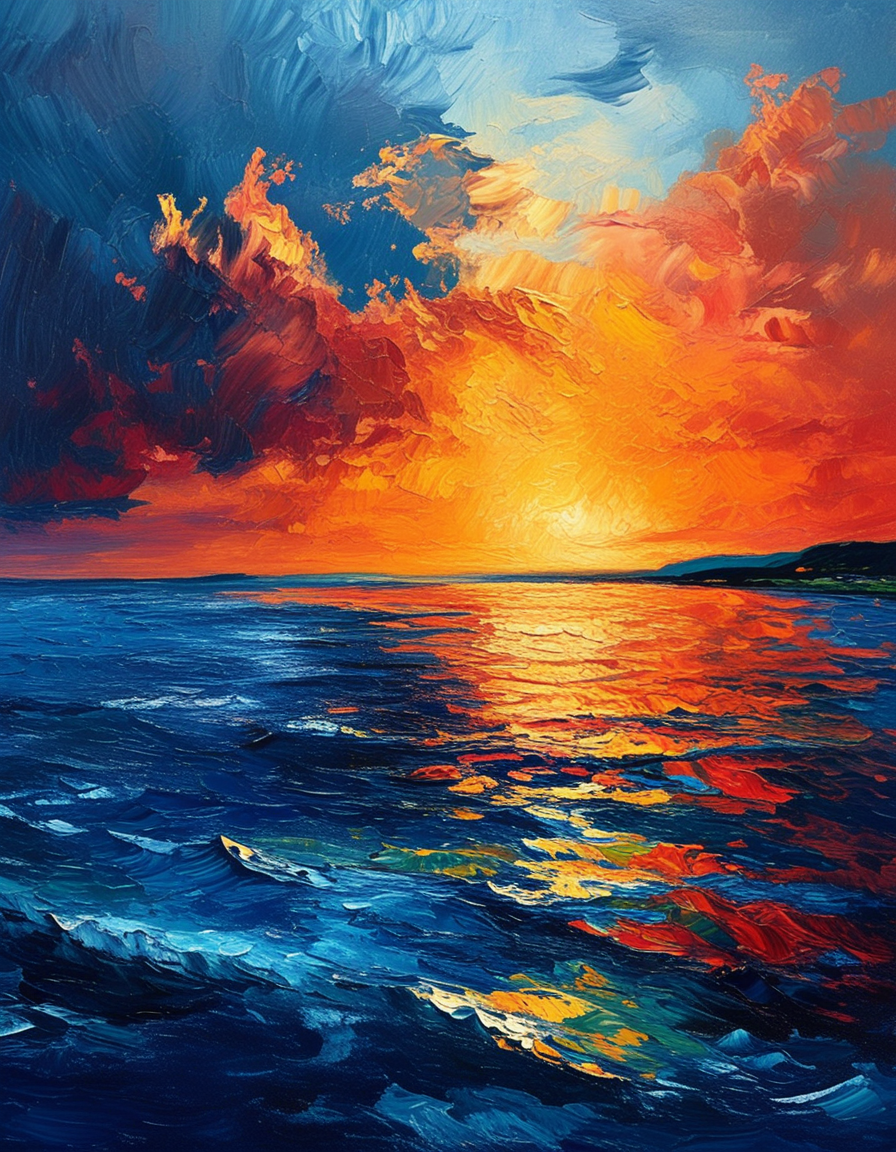
The painting depicts a sunset over the ocean with a dramatic sky filled with clouds.
CAPTION
The image is a vibrant and dynamic painting of a sunset over the ocean. The sky is a kaleidoscope of colors, with hues of orange, red, and blue dominating the scene. The clouds, painted in shades of orange and red, are scattered across the sky, creating a sense of depth and movement.
MONOLOGUE
The sun was nearing the horizon. The scene was one of unsurpassed loveliness. Behind lay the central and southern portions of the island, hushed as if their primaeval rocks were still tenantless. The outlines of the isles of Herm and Jethou were visible, but already sinking into the shades of evening. On the left the bold bluffs of L'Eree and Lihou, on the right the rugged masses of the Grandes and the Grosses Rocques, the Gros Commet, the Grande and Petite Fourque, lay in sharpened outline, the lapping waves already assuming a grey tint. These masses formed the framework of a picture which embraced a boundless wealth of colour, an infinite depth of softness. Straight from the sun shot out across Cobo Bay a joyous river of gold, so bright that eye could ill bear to face its glow; here and there in its course stood out quaintly-shaped rocks, some drenched with the fulness of the glorious bath, others catching now and again a sprinkling shower. On each side of the river the sea, clear to its depths where alternate sand and rock made a tangle of capriciously mingled light and shade; its surface, here blue as the still waters of the Grotta Azzurra, there green as the olive, here again red-brown as Carthaginian marble, lay waveless, as with a sense that the beauty was too perfect to be disturbed. Suddenly the scene was changed; the lustrous outflow was swiftly drawn in and absorbed; a grey hue swept over the darkening surface; in the distance the round, blood-coloured, orb hung above the expectant ocean.
SUMMARY
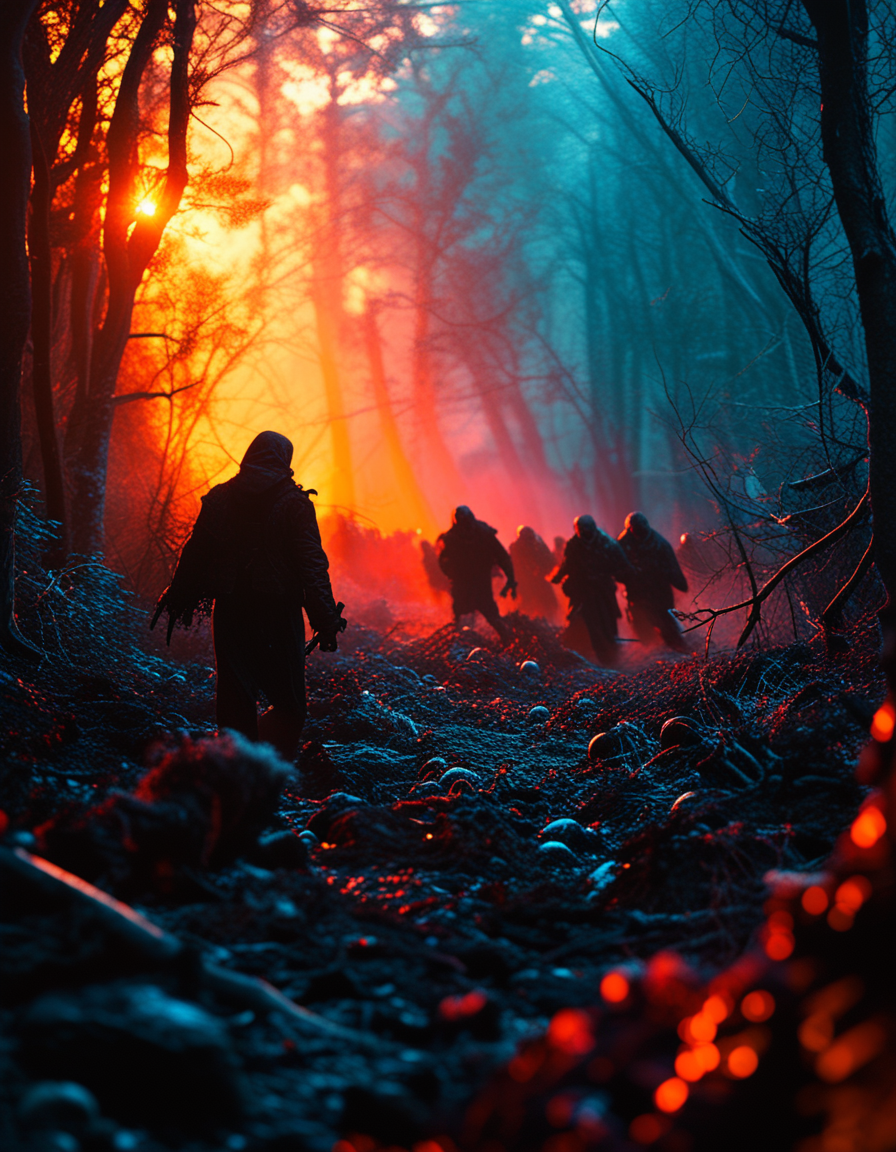
group of people in a forest at sunset.
CAPTION
The image depicts a group of people walking through a dense forest at sunset. The scene is bathed in warm hues of orange and red, creating a dramatic and eerie atmosphere. The people are dressed in dark clothing, adding to the somber mood of the scene.
MONOLOGUE
pulsatilla, with its violet petals opening for the golden stamens; affecting image of my pure idol alone in her valley:--be it great sheets of water, where nature casts those spots of greenery, a species of transition between the plant and animal, where life makes haste to come in flowers and insects, floating there like worlds in ether:--be it a cottage with its garden of cabbages, its vineyards, its hedges overhanging a bog, surrounded by a few sparse fields of rye; true image of many humble existences:--be it a forest path like some cathedral nave, where the trees are columns and their branches arch the roof, at the far end of which a light breaks through, mingled with shadows or tinted with sunset reds athwart the leaves which gleam like the colored windows of a chancel:--then, leaving these woods so cool and branchy, behold a chalk-land lying fallow, where among the warm and cavernous mosses adders glide to their lairs, or lift their proud slim heads. Cast upon all these pictures torrents of sunlight like beneficent waters, or the shadow of gray clouds drawn in lines like the wrinkles of an old man’s brow, or the cool tones of a sky faintly orange and streaked with lines of a paler tint; then listen--you will hear indefinable harmonies amid a silence which blends them all.
SUMMARY
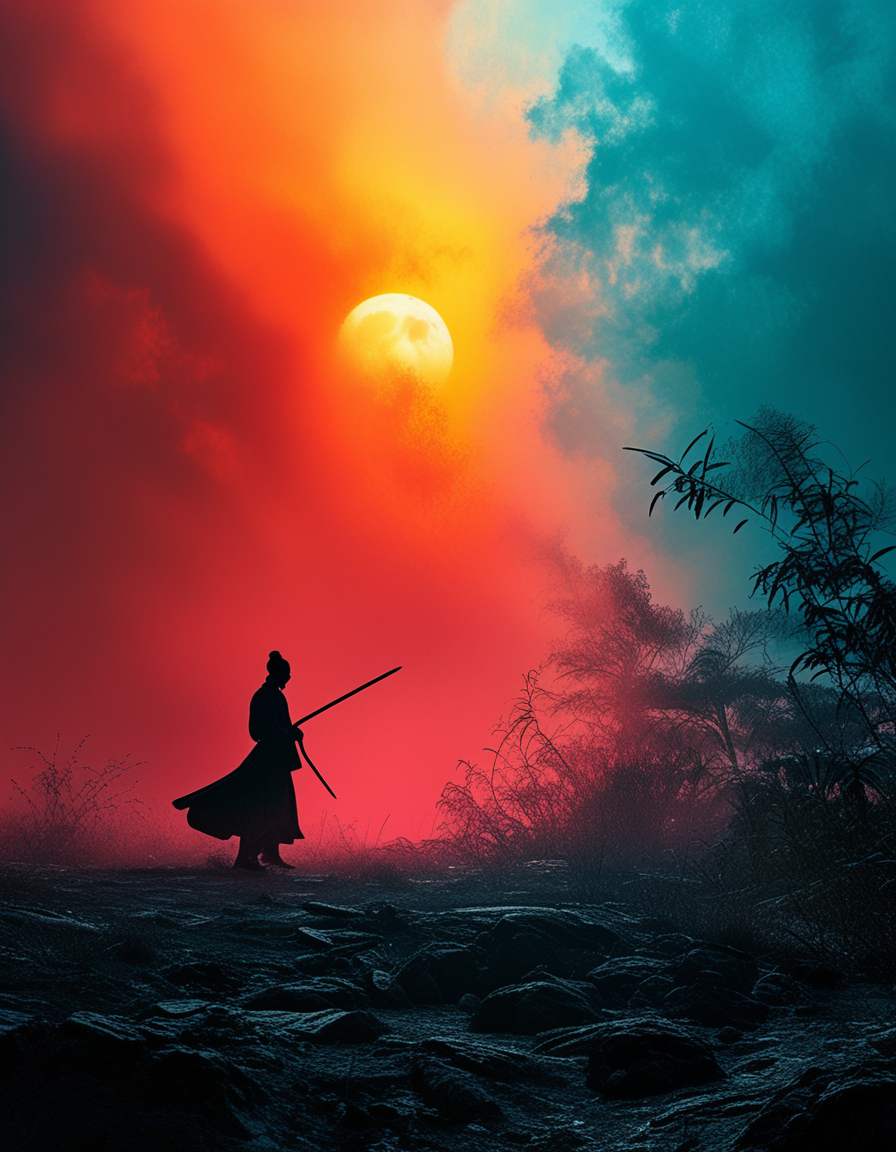
a silhouette of a person holding a staff in a field at sunset
CAPTION
The image depicts a silhouette of a person walking through a landscape bathed in vibrant hues of red and orange. The person is holding a staff, which is prominently displayed in the foreground. The sky above is filled with a dramatic sunset, casting a warm glow over the scene.
MONOLOGUE
The last hues of sunset lingered in the mists that sprung from the base of the Falls with a mournful, tremulous grace, and a movement weird as the play of the northern lights. They were touched with the most delicate purples and crimsons, that darkened to deep red, and then faded from them at a second look, and they flew upward, swiftly upward, like troops of pale, transparent ghosts; while a perfectly clear radiance, better than any other for local color, dwelt upon the scene. Far under the bridge the river smoothly swam, the undercurrents forever unfolding themselves upon the surface with a vast rose-like evolution, edged all round with faint lines of white, where the air that filled the water freed itself in foam. What had been clear green on the face of the cataract was here more like rich verd-antique, and had a look of firmness almost like that of the stone itself. So it showed beneath the bridge, and down the river till the curving shores hid it. These, springing abruptly from the water's brink, and shagged with pine and cedar, displayed the tender verdure of grass and bushes intermingled with the dark evergreens that comb from ledge to ledge, till they point their speary tops above the crest of bluffs. In front, where tumbled rocks and expanses of caked clay varied the gloomier and gayer green, sprung those spectral mists; and through them loomed out, in its manifold majesty, Niagara, with the seemingly immovable white Gothic screen of the American Fall, and the green massive curve of the
SUMMARY
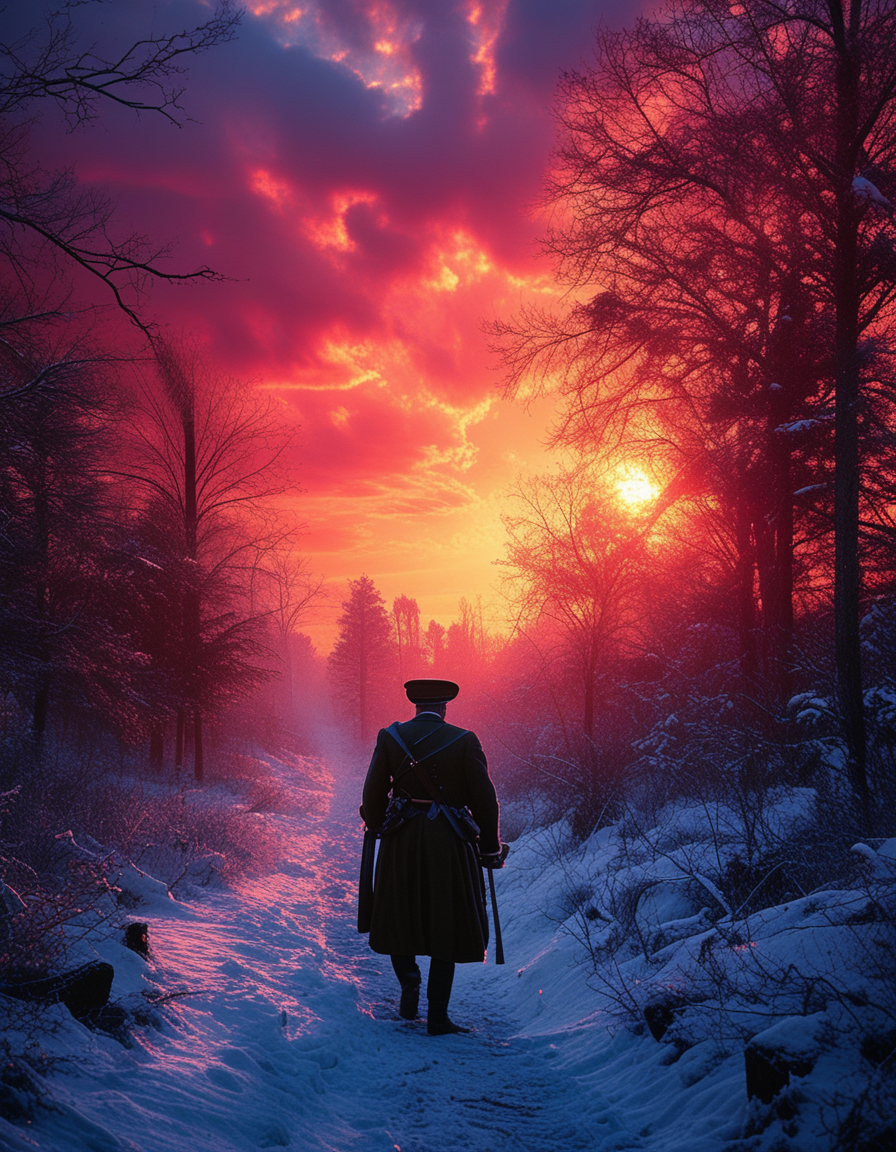
a man in a long coat walks through a snowy forest at sunset
CAPTION
The image depicts a person walking down a snowy path in a forest, illuminated by a dramatic sunset. The sky is a vivid mix of red and orange hues, with the sun positioned high in the sky, casting a warm glow over the scene.
MONOLOGUE
When you have wearied of the valiant spires of this County Town, Of its wide white streets and glistening museums, and black monastic walls, Of its red motors and lumbering trains, and self-sufficient people, I will take you walking with me to a place you have not seen - Half town and half country--the land of the Canal. It is dearer to me than the antique town: I love it more than the rounded hills: Straightest, sublimest of rivers is the long Canal. I have observed great storms and trembled: I have wept for fear of the dark. But nothing makes me so afraid as the clear water of this idle canal on a summer s noon. Do you see the great telegraph poles down in the water, how every wire is distinct? If a body fell into the canal it would rest entangled in those wires for ever, between earth and air. For the water is as deep as the stars are high. One day I was thinking how if a man fell from that lofty pole He would rush through the water toward me till his image was scattered by his splash, When suddenly a train rushed by: the brazen dome of the engine flashed: the long white carriages roared; The sun veiled himself for a moment, and the signals loomed in fog; A savage woman screamed at me from a barge: little children began to cry; The untidy landscape rose to life: a sawmill started; A cart rattled down to the wharf, and workmen clanged over the iron footbridge; A beautiful old man nodded from the first story window of a square red house, And a pretty girl came out to hang up clothes in a small delightful
SUMMARY
abstract painting with vibrant colors and dynamic shapes.
CAPTION
The image is a vibrant and abstract representation of a swirling vortex of colors, predominantly red, orange, and yellow, with hints of blue and green. The colors are distributed in a way that creates a dynamic and dynamic pattern, with the red and orange hues dominating the center and the blue and green hues surrounding it.
MONOLOGUE
The principles connected with coloring should be understood if one desires to produce the most pleasing and harmonious effects in painting. The three colors, red, yellow, and blue, with the white of the paper, are equal in theory to all the requirements of art in its true relation to color. Red, yellow and blue are called primary colors; that is, we cannot produce these colors from the combination of any others. Orange, purple and green are called secondary colors, and are produced by the combination of the primary colors. By the mixture of red and yellow we obtain orange, from red and blue, purple, from yellow and blue, green. The tertiary colors--broken green, gray and brown--are produced by the mixture of the secondary colors. From orange and purple we obtain brown, from orange and green, broken green, and from purple and green, gray. The three primary colors must always be present in a picture to produce harmony. Colors are divided into what are called warm and cold colors, the yellow and red being termed warm, and the blue cold. Yellow and red produce light and warmth, and it is impossible to produce coolness without the use of blue. In painting we use the three terms, light, shade and color, because they best express the qualities of color. Light is expressed by yellow, shade by blue, and color by red. While red is particularly designated as color, we must not forget the claims of yellow and blue, as they, together with red, complete the primary scale of colors. It is by placing these
SUMMARY
a person is standing in a ring of glowing mushrooms and is surrounded by fire and light
CAPTION
The image presents a surreal scene where a person stands in the center of a large, intricately woven tree-like structure. The tree, which is the main focus of the image, is a vibrant mix of red, orange, and yellow hues, with a glowing light emanating from the center.
MONOLOGUE
The next morning, at eight o'clock, we found ourselves entering Charleston harbor; Sullivan's Island, with Fort Moultrie, breathing recollections of the revolution, on our right; James Island on our left; in front, the stately dwellings of the town, and all around, on the land side, the horizon bounded by an apparent belt of evergreens--the live-oak, the water-oak, the palmetto, the pine, and, planted about the dwellings, the magnolia and the wild orange--giving to the scene a summer aspect. The city of Charleston strikes the visitor from the north most agreeably. He perceives at once that he is in a different climate. The spacious houses are surrounded with broad piazzas, often a piazza to each story, for the sake of shade and coolness, and each house generally stands by itself in a garden planted with trees and shrubs, many of which preserve their verdure through the winter. We saw early flowers already opening; the peach and plum-tree were in full bloom; and the wild orange, as they call the cherry-laurel, was just putting forth its blossoms. The buildings--some with stuccoed walls, some built of large dark-red bricks, and some of wood--are not kept fresh with paint like ours, but are allowed to become weather-stained by the humid climate, like those of the European towns. The streets are broad and quiet, unpaved in some parts, but in none, as with us, offensive both to sight and smell. The public buildings are numerous for the size of the city, and well-built in general, with
SUMMARY
a soldier stands on a rocky outcropping overlooking a river, holding a rifle and looking out over the water.
CAPTION
The image depicts a person standing on a rocky outcrop, holding a rifle, with a river flowing in the background. The person is dressed in a green and black outfit, and there are several bats flying around them. The sky is a gradient of orange and yellow, suggesting either sunrise or sunset.
MONOLOGUE
Halung is a very prosperous-looking village with well-built houses. The villagers soon had three tents pitched for us on a grassy field between the village and the river; cushions, cooking pots and fuel were also brought out for us. Here we camped for the night in reasonable comfort. On the following morning the loads were all carried by hand across a fragile bridge over the glacier stream, while the yaks and the ponies were driven across it. We then rode for a mile down the green and well-watered valley, and afterwards turned up into another valley where every flat space was green with barley-fields intermixed with brilliant patches of yellow from the fields of mustard. A small glacier stream fed this valley and supplied plenty of water for irrigation. After passing several small villages we rode across a spur also covered with barley-fields to Rebu, where we had to change our transport. This was quite a picturesque village situated on a rocky knoll, part of the village being on one side and part on the other of the river. Along the various irrigation canals were wild flowers of all kinds. Monkshood grew there, also black and yellow clematis, rhubarb, ranunculus and primulas of different kinds. By ten o'clock our transport was changed and we were given ponies instead of yaks: they travel much quicker and we had apparently a long way to go yet before we could reach the next village. We were expecting all the time to get to Kharta that evening, but where distances are concerned all Tibetans are liars, and after doing 26 miles
SUMMARY
A couple is embracing in a sunset sky with a full moon behind them.
CAPTION
The image presents a surreal scene of two figures, one in a long, flowing gown and the other in a short, sleeveless dress, standing side by side against a backdrop of a vibrant, fiery sunset. The sky is a deep orange, with a large, glowing moon in the center, casting a warm, golden light over the scene.
MONOLOGUE
We next proceeded to the kitchen--and a den-like retreat it was--dark and gloomy from the partial light let in by the few remnants of glass, it seemed well calculated to harbour felon thoughts. The room itself was moderate enough in size--a good fire, and an excellent grate, containing a copper of boiling water, always kept full by a pipe conveyed to it from a cask raised on one side of the fire-place, was all that we could see that approached to anything like luxury or comfort. Beneath this cask lay a heap of coke and coal, and a coal-heaver's shovel leaned against the wall, at the service of any one who loved a cheerful hearth. The floor and walls did not differ much in colour, the former being of a dusky hue, that knew of no other purifier save the birchen broom; and the latter, a dirty red--a daub long since and clumsily made. A cuckoo-clock ticked on one side of an old cupboard, and before the window was spread a large deal table, at which sat the landlord playing at cards with a couple of ruffian-like fellows. A small table (whose old-fashioned, crooked, mahogany legs, showed that it had once been in a more honoured place; but the rough deal covering with which it had been repaired, denoted that it was now only fit for _cadger's plate_)--stood at the other end of the room, behind the door. A man, in a decent but faded suit of clothes, sat on one side--his arms were stretched over the table, and his head half-buried within them--he was, apparently, asleep. The white apron,
SUMMARY
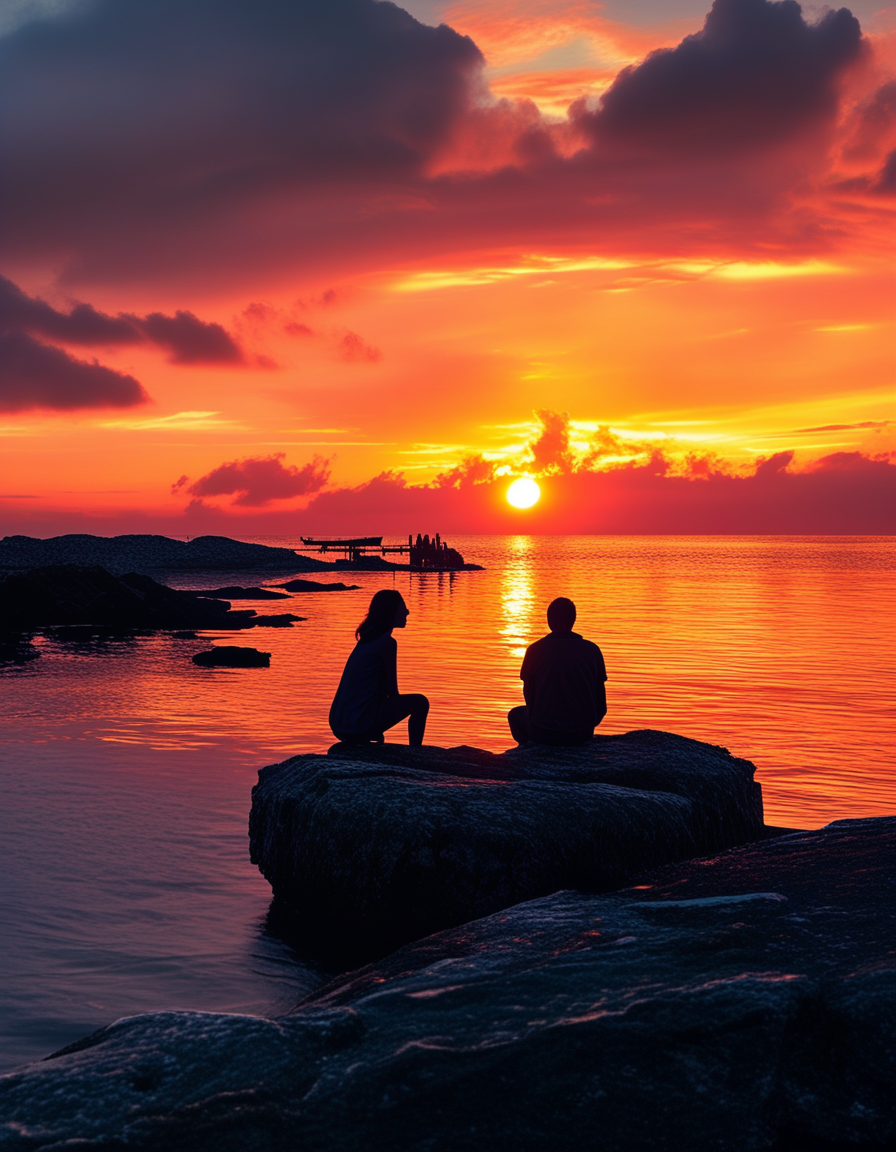
two people sitting on a rock at sunset with the sun setting over the ocean.
CAPTION
The image captures a serene sunset scene where two individuals are seated on a rock, facing each other, with the sun setting in the background. The sky is ablaze with vibrant hues of orange and pink, creating a dramatic contrast with the dark blue of the water below. The individuals are silhouetted against the sky, their silhouettes adding depth to the image.
MONOLOGUE
Yet he paused to make one more cast, over a black pool where there was a fallen log, and bubbles floating on the surface. His arm had grown tired swinging the heavy green rod and his aim was poor. The flies struck a little twig and hung there, dangling in the air. A twitch and they were free and had dropped to the surface of the water. Yet barely to reach it. For in that instant a wave rolled up and divided--a great black-and-gold shape made a porpoise leap into the air. The lower fly disappeared, and an instant later Frank was gripping the tough green rod with both hands, while the water and trees and sky blended and swam before him in the intensity of the struggle to hold and to keep holding that black-and-gold monster at the other end of the tackle--to keep him from getting back under that log--from twisting the line around a limb--in a word, to prevent him from regaining freedom. It would be lunacy to drag this fish ashore by force. The line or the fly would certainly give way, even if the rod would stand. Indeed, when he tried to work his capture a little nearer, it held so like a rock that he believed for a moment the line was already fast. But then came a sudden rush to the right and another stand, and to the left--with a plunge for depth--and with each of these rushes Frank's heart stood still, for he felt that against the power of this monster his tackle could not hold. Every nerve and fiber in his body seemed to concentrate on the slow-moving point of dark line where the tense strand touched the water.
SUMMARY
a large black bear with glowing eyes and a glowing nose is walking on a rocky planet with a full moon in the background.
CAPTION
The image presents a fantastical scene set against a backdrop of a fiery, starry night sky. Dominating the center of the image is a large, dark-colored, furry creature, possibly a bear, with glowing orange eyes that seem to be staring directly at the viewer.
MONOLOGUE
He was a great, dark man, his skin darkly brown from exposure; his straight hair showed almost coal black in spite of the fact that it had but recently been clipped close; his eyebrows were similarly black; and black hairs spread down his hands almost to the finger nails and cropped up from his chest at his open throat. It was a mighty, deep, full chest, the chest of a runner and a fighter, sustained by a strong, flat abdomen and by powerful, sturdy legs. Yet physical might and development were not all of Ben Kinney. The image conveyed was never one of sheer brutality. For all their black hair, the large, brawny hands were well-shaped and sensitive; he had a healthy, good-humored mouth that could evidently, on occasion, be the seat of a most pleasant, boyish smile. He had a straight, good nose, rather high cheek bones, and a broad, brown forehead, straight rather than sloping swiftly like that of the negro opposite. But none of his features, nor yet his brawny form, caught and held the attention as did his vivid, dark-gray eyes. They were deeply dark, even against his deeply tanned face, yet now and then one caught distinct surface lights, denoting the presence of unmeasured animal spirits, and perhaps, too, the surprising health and vitality of the engine of his life. They were keen eyes, alert, fiery with a zealot's fire: evidently the eyes of a steadfast, headstrong, purposeful man. Some complexity of lines about them, hard to trace, indicated a recklessness, too; a willingness to risk all that he had for
SUMMARY
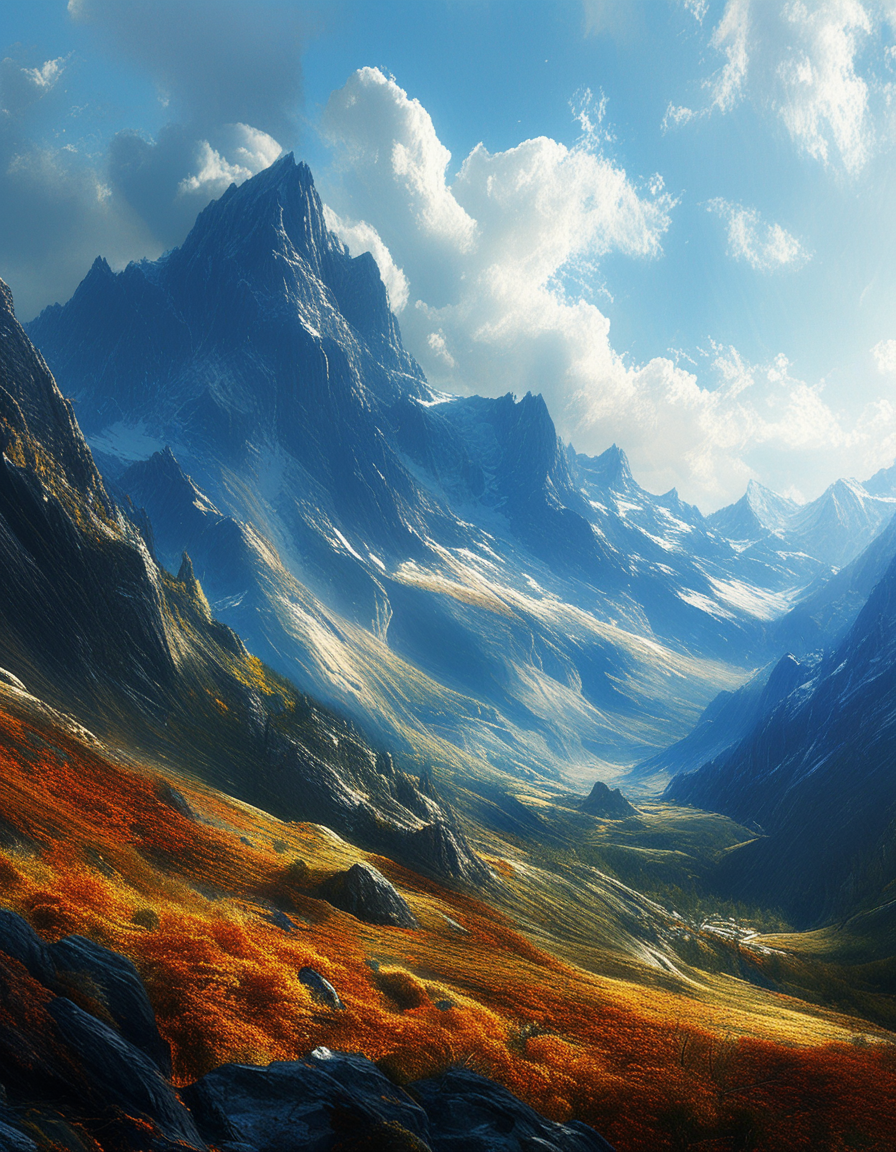
The painting depicts a mountainous landscape with a valley in the foreground, surrounded by a range of snow-capped peaks. The sky is a clear blue with a few clouds, and the colors are vibrant with shades of green, blue, and orange. The painting is done in a realistic style, with attention to detail in the textures of the rocks and
CAPTION
The image depicts a breathtaking landscape of a mountainous region. The mountains are a striking blue, with snow-capped peaks that stand out against the clear blue sky. The valley floor is a vibrant orange, indicating the presence of a rich, fertile soil.
MONOLOGUE
In contrast with these rainy days nothing can be more perfect than clear moonlight nights. There is a terrace upon the roof of the inn at Courmayeur where one may spend hours in the silent watches, when all the world has gone to sleep beneath. The Mont Chétif and the Mont de la Saxe form a gigantic portal not unworthy of the pile that lies beyond. For Mont Blanc resembles a vast cathedral; its countless spires are scattered over a mass like that of the Duomo at Milan, rising into one tower at the end. By night the glaciers glitter in the steady moon; domes, pinnacles, and buttresses stand 15clear of clouds. Needles of every height and most fantastic shapes rise from the central ridge, some solitary, like sharp arrows shot against the sky, some clustering into sheaves. On every horn of snow and bank of grassy hill stars sparkle, rising, setting, rolling round through the long silent night. Moonlight simplifies and softens the landscape. Colours become scarcely distinguishable, and forms, deprived of half their detail, gain in majesty and size. The mountains seem greater far by night than day—higher heights and deeper depths, more snowy pyramids, more beetling crags, softer meadows, and darker pines. The whole valley is hushed, but for the torrent and the chirping grasshopper and the striking of the village clocks. The black tower and the houses of Courmayeur in the foreground gleam beneath the moon until she reaches the edge of the Cramont, and then sinks quietly away, once more to
SUMMARY
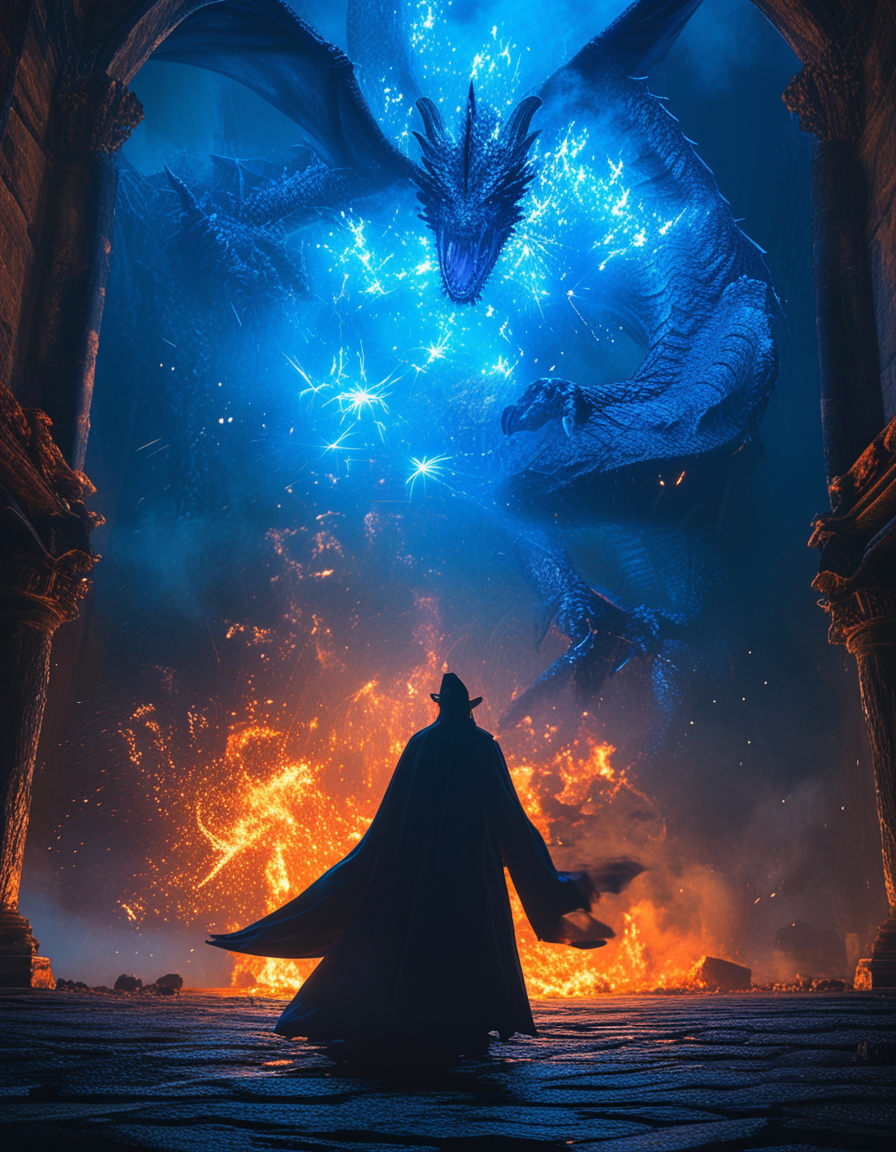
a person in a cape is standing in front of a large dragon with glowing blue eyes and a glowing blue aura. the person is looking up at the dragon, who is in the distance.
CAPTION
The image depicts a scene where a person, dressed in a dark cape, stands in the center of a dimly lit, fiery environment. The person appears to be facing towards the right side of the image, with their back to the viewer. The background is filled with a multitude of glowing blue and orange lights, creating a sense of intensity and energy.
MONOLOGUE
To Monsignor Masterman the scene was simply overwhelming. There was hardly a detail that was not new and unfamiliar. From where he stood on the upper deck, grasping the rail before him, his eyes looked out over a luminous city as lovely as fairyland. There were no chimneys, of course (these, he had just learnt, had altogether disappeared more than fifty years ago), but spires and towers and pinnacles rose before him like a dream, glowing against the dark sky, lit by the soft radiance of the streets beneath. To the right, not a hundred yards away, rose Saint Edward's tower, mellowed now to clear orange by the lapse of three-quarters of a century; to the left a flight of buildings, of an architectural design which he did not understand, but which gave him a sense of extreme satisfaction; in front towered the masses of Buckingham Palace as he seemed always to have known it.
SUMMARY
The image depicts a vast, starry landscape with a rocky terrain and a river flowing through it. The sky is filled with stars, and the sun is shining brightly, casting a warm glow over the scene. The river is a vibrant mix of blue and orange hues, reflecting the colors of the sky.
CAPTION
The image is a digital painting depicting a vast, mountainous landscape bathed in hues of purple and orange. The sky is filled with stars, creating a starry night sky. The mountains, covered in snow, are adorned with rocky outcrops and jagged peaks.
MONOLOGUE
Red-shawled women pattered down the trail from the hillside pueblo of Laguna, or marched back up from the yellow pools of the San Jos River, jars of water on their heads; figures in bronze, they might have been, or women of the Ganges. Then, the morning light strikes the steeples of the twin-towered Spanish mission on the crest of the hill; and the dull steeples of the adobe church glow pure mercury. And the light broods over the stagnant pools of the yellow San Jose; and the turgid, muddy river flows pure gold. And the light bathes the sandy, parched mesas and the purple mountains girding the plains around in yellow walls flat topped as if leveled by a trowel, with here and there in the distant sky-line the opal gleam as of a snow peak immeasurably far away. It dawns on you suddenly--this is a realm of pure light. How J. W. M. Turner would have gone wild with joy over it--light, pure light, split by the shimmering prism of the dusty air into rainbow colors, transforming the sand-charged atmosphere into an unearthly morning gleam shot with gold dust. You know now that the big globe cactus shines with the glow of a Burma ruby here when it is dull in the Eastern conservatory, because here is of the very essence of the sun. The wild poppies shine on the desert sands like stars because, like the stars, they draw their life from the sun. And the blue forget-me-nots are like bits of heaven, because their faces shine with the light of an unclouded sky from dawn to dark.
SUMMARY
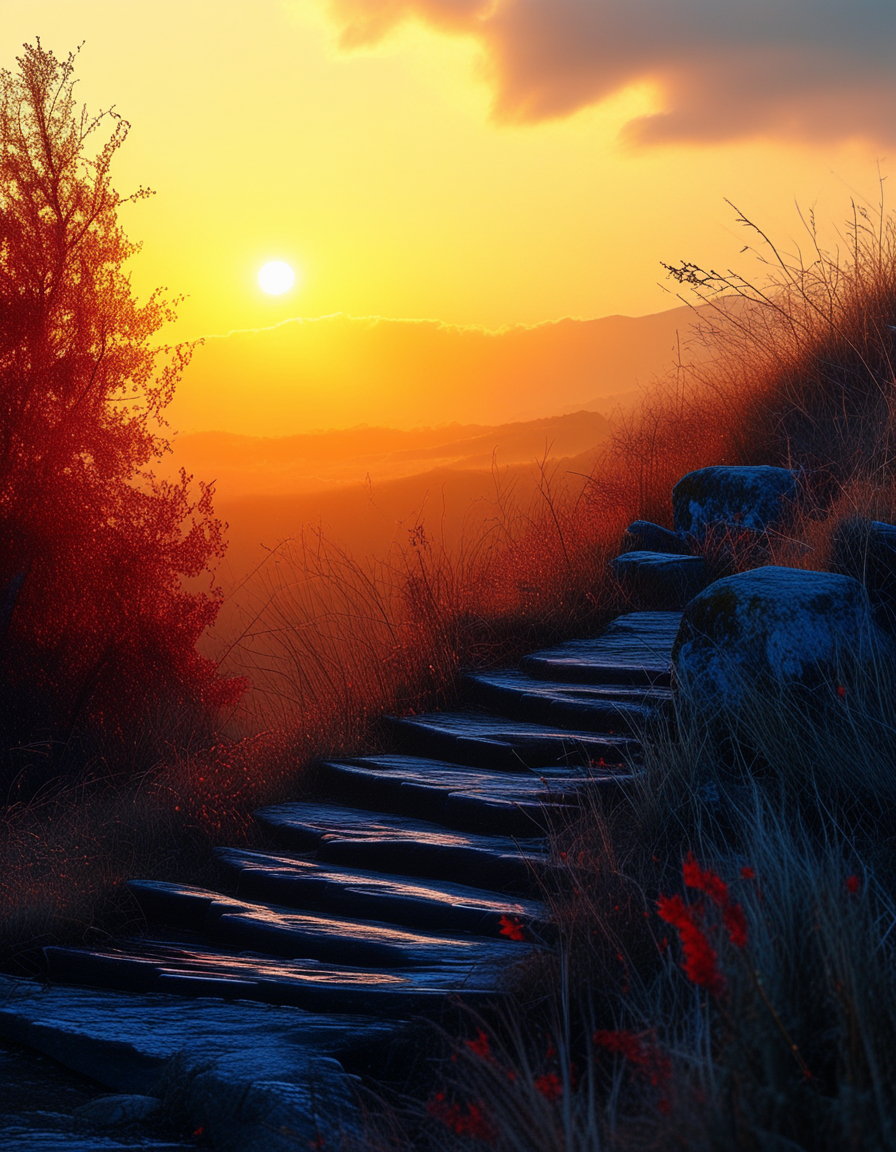
a stone pathway with a sunset in the background.
CAPTION
The image depicts a serene landscape at sunset. The sun is setting on the left side of the image, casting a warm orange glow over the scene. The sky is a gradient of orange and yellow, with the sun positioned in the upper left corner.
MONOLOGUE
rural English landscape. This Street of the Dead in the City of the Dead is in truth a solemn and a soothing spot; nor can we find its precincts melancholy, when we stand in the midst of such glorious scenery. For Monte Sant’ Angelo towers to our left against the mellow evening sky, flecked with lines of peach-blossom cloud, whilst in front of us the dark form of Capri seems to float in a golden haze between firmament and ocean. Behind us the dark mass of the Mountain with its breath of ascending smoke seems like an eternal funeral pyre in honour of the Dead, who were spared the horrors of that fearful disaster which overwhelmed the living. Upon the broken tombs and altars the light from the setting sun falls with warm cheerful radiance, flushing stone and brick-work with a ruddy glow like jasper; whilst, high in the heavens above the cypress tops, the crescent moon prepares to turn to gold from silver.
SUMMARY
a bird is flying over a river with a flock of birds flying in the sky
CAPTION
The image presents a serene winter scene with a dramatic sunset. The sky is a vivid mix of orange and red hues, with the sun just setting on the horizon. The clouds are scattered across the sky, creating a sense of depth and atmosphere.
MONOLOGUE
"Well, then, I will forgive you if you promise never to do it again. And do you know any more about birds than you do about love, you poor dear? Look at that one flying over the river. Why do they always cross the stream in a slanting direction? Why do they never fly straight across? And why do birds sing so seldom in the depths of the forest? And is it true that none of the singing birds were here till the settlers came? It is said that they came with the settlers. I've heard many persons state that as a fact. But how does anybody know? Did any bird say so? Those paroquets could tell if they would; but they never will. They only chatter to scold one another. Just listen! I am sure they could tell lots of things if they liked. They are not so green as they look--not half so green as you, my dear. I shall have to ask Mr. Audubon if there were any birds here before the settlers came. He will know; he doesn't go round all the time with his head in the clouds, as you do. You don't even know how old a snow-goose has to be before it turns from gray to white. And you really ought to know that, because you are a goose yourself. I saw a pure white snow-goose the other day on the pond back of Cedar House, and when the snow-goose comes, then winter is here, and it isn't long till Christmas."
SUMMARY
The image depicts a serene landscape featuring a winding path in the foreground, bordered by tall grass and reeds, with a body of water in the background. The sky is filled with clouds, casting a warm glow over the scene, and the sun is setting, casting a golden light over the landscape.
CAPTION
The image captures a serene landscape at sunset. The sky is a vibrant mix of orange and yellow hues, with dark clouds scattered across the top. The sun is setting on the horizon, casting a warm glow over the scene.
MONOLOGUE
When, after a long drought, the genial season of rain arrives, the scene suddenly changes. The deep azure of the hitherto cloudless sky assumes a lighter hue. Scarcely can the dark space in the constellation of the Southern Cross be distinguished at night. The mild phosphorescence of the Magellanic clouds fades away. Like some distant mountain, a single cloud is seen rising perpendicularly on the southern horizon. Misty vapors collect and gradually overspread the heavens, while distant thunder proclaims the approach of the vivifying rain. Scarcely is the surface of the earth moistened before the teeming steppe becomes covered with a variety of grasses. Excited by the power of light, the herbaceous mimosa unfolds its dormant, drooping leaves, hailing, as it were, the rising sun in chorus with the matin song of the birds and the opening flowers of aquatic plants. Horses and oxen, buoyant with life and enjoyment, roam over and crop the plains. The luxuriant grass hides the beautifully spotted jaguar, who, lurking in safe concealment, and carefully measuring the extent of his leap, darts, like the Asiatic tiger, with a cat-like bound upon his passing prey. At times, according to the accounts of the natives, the humid clay on the banks of the morasses is seen to rise slowly in broad flakes. Accompanied with a violent noise, as on the eruption of a small mud-volcano, the upheaved earth is hurled high into the air. Those who are familiar with the phenomenon fly from it; for a colossal water-snake, or a mailed and
SUMMARY
a woman with long hair wearing a headdress of leaves and flowers in autumn
CAPTION
The image depicts a woman with long, curly hair adorned with a headdress of red and orange leaves. The woman is facing away from the viewer, giving a sense of depth and perspective. The background is blurred, with a warm, golden hue that suggests a sunset or sunrise.
MONOLOGUE
"I think I caught, as I say, a distant vision of that Night which excels the Day in its splendour. It began with the eyes turned away from the sunset, with lips that refused kisses. Then there came a command to the heart to cease from longing for the dear land of Gwent, to cease from that aching desire that had never died for so many years for the sight of the old land and those hills and woods of most sweet and anguished memory. I remember once, when I was a great lout of sixteen, I went to see the Lupton Fair. I always liked the great booths and caravans and merry-go-rounds, all a blaze of barbaric green and red and gold, flaming and glowing in the middle of the trampled, sodden field against a background of Lupton and wet, grey autumn sky. There were country folk then who wore smock-frocks and looked like men in them, too. One saw scores of these brave fellows at the Fair: dull, good Jutes with flaxen hair that was almost white, and with broad pink faces. I liked to see them in the white robe and the curious embroidery; they were a note of wholesomeness, an embassage from the old English village life to our filthy 'industrial centre.' It was odd to see how they stared about them; they wondered, I think, at the beastliness of the place, and yet, poor fellows, they felt bound to admire the evidence of so much money. Yes, they were of Old England; they savoured of the long, bending, broad village street, the gable ends, the grave fronts of old mellow bricks, the thatched roofs here and there, the bulging window of the 'village
SUMMARY
The image depicts a vast, open landscape with a mountain range in the background. The sky is filled with clouds, casting a warm glow over the scene. The ground is covered with rocks and grass, creating a sense of ruggedness and isolation. The overall atmosphere is one of tranquility and natural beauty.
CAPTION
The image depicts a vast, open landscape bathed in warm hues of orange and yellow, suggesting a sunset. The sky is filled with fluffy clouds, adding to the serene atmosphere. The foreground is dominated by a rocky terrain, with patches of grass and shrubs scattered throughout.
MONOLOGUE
During the construction of this wonderful mountain railway, it is said that the sum spent upon blasting-powder alone amounted to a million dollars. At 8 o'clock, the door of our compartment was thrown open, and the conductor called out, "Cape Horn!" when all the passengers jumped up immediately and looked intently out of window, for the train was travelling slowly along the very edge of a precipice, 2,450 feet in height; a point from which an extensive landscape of great beauty could be seen extending far and wide. After leaving "Cape Horn," we crossed a timber bridge, erected over a portion of the valley, proceeded to "Emigrant's Gap," thence to Colfax, and afterwards descended the mountain with a rush, further on into California, where the weather was warm, and the country looked most beautiful, the trees being covered with foliage, and the ground highly cultivated everywhere. For many miles we passed rich meadow land, and numbers of large trees; the fields were covered with grass, intermingled with brilliant masses of wild flowers; lupines, eschcoltzias, wild roses, geraniums, etc., were flourishing in many places, and millions of Californian poppies of an intense yellow, deepening into orange colour, outshone all the rest. An American gentleman once said: "I never saw flowers till I saw them in California." At half past 10 we arrived at Sacramento, and, after remaining there an hour, travelled all day through a beautiful part of the country, favoured with fine summer weather. In the course of the
SUMMARY
the image depicts the great sphinx of greece, which is a large stone statue of a lion with a human head, sitting in the desert at sunset.
CAPTION
The image captures the iconic image of the Great Sphinx of Giza, a colossal limestone statue of a lion with a human head, situated in the desert landscape. The sky above is painted in hues of orange and red, suggesting a sunset. The sun is setting, casting a warm glow over the scene.
MONOLOGUE
You have been walking away from the sea, with your back to the harbor, and here is another, but minute, harbor nestling under a great fortress wall above which, in a garden, some young soldiers are idly leaning and laughing under trees with leaves of gold and red-brown. Brightly painted vessels, closely packed together, lie on the blue-green water. Beyond them are the trees of Blazekovic Park. And just beneath you, on your right, is the great, yellow stone Porta di Terra Ferma, with its winged lion of St. Mark. Beyond, over the narrow exit from the harbor, the landlocked Canale di Zara, which sometimes, especially at evening, reminded me of the Venice lagoons, lies glittering in the sun. And a Venetian fort on the peak of Ugljan shows like a strange and determined shadow against the blue of the sky.
SUMMARY
a futuristic, glowing, circular object floating on the ocean with a sunset in the background
CAPTION
The image depicts a futuristic landscape at sunset. The sky is a gradient of orange and pink, with the sun setting on the left side of the image. The ocean is a deep blue, reflecting the vibrant colors of the sky.
MONOLOGUE
"You see Nature does nothing for Man except what she enables him to do for himself. In this way she has made a man of him; she has given him his resources and then thrown him upon them. Beyond that she cares nothing, does nothing, provides, arranges nothing. I used to think, for instance, that the greenness of the earth was intended for his eyes--all the loveliness of spring. On the contrary, she merely gave him an eye which has adapted itself to get pleasure out of the greenness. The beauty of spring would have been the same, year after year, century after century, had he never existed. And the blue of the sky--I used to think it was hung about the earth for his sake; and the colors of the clouds, the great sunsets. But the blueness of the sky is nothing but the dust of the planet floating deep around it, too light to sink through the atmosphere, but reflecting the rays of the sun. These rays fall on the clouds and color them. It would all have been so, had Man never been born. The earth's springs of drinking water, refreshing showers, the rainbow on the cloud,--they would have been the same, had no human being ever stood on this planet to claim them for ages as the signs of providence and of covenant."
SUMMARY
man in black coat with a mustache and beard, looking to the side, with a red background
CAPTION
The image depicts a man standing against a vibrant orange background. The man is dressed in a dark jacket and has a beard. His expression is serious, and he is looking directly at the viewer.
MONOLOGUE
The two newcomers were both above medium height, of solid build and ruddy-faced; but here their similarity of appearance ceased. One of them looked the image of social refinement and elegance, while the clothes and general aspect of the other bespoke a citified, prosperous peasant. His rough top-boots, the red woolen belt round his coat and the rather coarse tint of his florid complexion, like his full Russian beard, proclaimed the son of the unenlightened classes. He was taller than his companion and remarkably well-built, with a shock of dark brown hair thrown back from a high prominent forehead and regular features. He was introduced to the gathering as Zachar. He and the stylish-looking man by his side whose revolutionary nickname was "My Lord," conveyed the effect of a bright, shrewd tradesman and a high-class lawyer bent on some legal business.
SUMMARY
field of yellow flowers with a city in the distance.
CAPTION
The image captures a breathtaking sunset over a lush green hillside dotted with yellow wildflowers. The sky is ablaze with vibrant hues of orange, pink, and red, creating a dramatic contrast against the clear blue sky. The sun is setting, casting long shadows and adding depth to the scene.
MONOLOGUE
John Black, the Presbyterian 'apostle of the Red River,' preached special sermons on Sunday for the miners. And on a beautiful June afternoon the Overlanders headed towards the setting sun in a procession of almost a hundred ox-carts; and the fort waved them farewell. One wonders whether, as the last ox-cart creaked into the distance, the fur-traders realized that the miner heralded the settler, and that the settler would fence off the hunter's game preserve into farms and cities. A rare glamour lay over the plains {58} that June, not the less rare because hope beckoned the travellers. The unfenced prairie billowed to the horizon a sea of green, diversified by the sky-blue waters of slough and lake, and decked with the hues of gorgeous flowers--the prairie rose, fragrant, tender, elusive, and fragile as the English primrose; the blood-red tiger-lily; the brown windflower with its corn-tassel; the heavy wax cups of the sedgy water-lily, growing where wild duck flackered unafraid. Game was superabundant. Prairie chickens nestled along the single-file trail. Deer bounded from the poplar thickets and shy coyotes barked all night in the offing. Night in June on the northern prairie is but the shadowy twilight between two long days. The sun sets between nine and ten, and rises between three and four, and the moonlight is clear enough on cloudless nights for campers to see the time on their watches.
SUMMARY
abstract painting with swirling patterns of blue, purple, and pink.
CAPTION
The image is a digital artwork that appears to be abstract, characterized by a swirling pattern of colors and shapes. The colors are predominantly shades of blue, purple, and pink, with hints of orange and yellow. The shapes are fluid and interconnected, creating a sense of movement and energy.
MONOLOGUE
9. But although this would cause a somewhat painful shock even to a modern mind, it would be as nothing when compared with the pain occasioned by absence of color to a medival one. We have been trained, by our ingenious principles of Renaissance architecture, to think that meal-color and ash-color are the properest colors of all; and that the most aristocratic harmonies are to be deduced out of grey mortar and creamy stucco. Any of our modern classical architects would delightedly "face" a heathery hill with Roman cement; and any Italian sacristan would, but for the cost of it, at once whitewash the Cheviots. But the medivals had not arrived at these abstract principles of taste. They liked fresco better than whitewash; and, on the whole, thought that Nature was in the right in painting her flowers yellow, pink, and blue;--not grey. Accordingly, this absence of color from rocks, as compared with meadows and trees, was in their eyes an unredeemable defect; nor did it matter to them whether its place was supplied by the grey neutral tint, or the iron-colored stain; for both colors, grey and brown, were, to them, hues of distress, despair, and mortification, hence adopted always for the dresses of monks; only the word "brown" bore, in their color vocabulary, a still gloomier sense than with us. I was for some time embarrassed by Dante's use of it with respect to dark skies and water. Thus, in describing a simple twilight--not a Hades twilight, but an ordinarily fair evening--(Inf. ii. 1.) he
SUMMARY
The image depicts a medieval battle scene with a group of soldiers on horseback, engaged in combat. The soldiers are armed with swords and shields, and the scene is illuminated by a dramatic sunset.
CAPTION
The image depicts a chaotic scene from a medieval battle. The sky is filled with dark clouds, suggesting an impending storm. The sun is setting, casting a warm orange glow over the battlefield.
MONOLOGUE
During this hour rifle fire grew less and less, artillery firing ceased. High above the battlefield some crested larks were singing, even as they sing on a quiet evening over the trenches in France, as they sing over the fields at home. A few green and bronze bee-eaters hovered almost like hawks over the sand-dunes, and a cloud of sandgrouse were swinging and swerving across the open ground that divided Highlander from Turk. The wind had died quite away, and a scent of alyssum filled the air. There was no movement among the troops, there was none even among the slender wild grasses of the plain. The sun, that had been blazing all through the day, now hung low in the western sky. The sound of battle was dying, even as the day was dying. "The world was like a nun, breathless in adoration." And we soldiers, absorbed in this remote corner of the world war, intent on the hour immediately before us, lay there breathless in expectancy. Suddenly our 18-pounders opened gun fire. With rare precision shrapnel burst all along the enemy trenches, and at 6-30, as the shelling slackened in intensity, the Highlanders rose as one man, their bayonets gleaming in the setting sun, and, with the Gurkhas on their left, rushed across the open. There was little work for the bayonet. The Turk fled as our men closed, and the position so long and hardly fought for was won.
SUMMARY
The image depicts a serene lakeside scene with a solitary boat floating on the calm water, reflecting the vibrant colors of the sunset. The sky is painted in hues of orange and pink, with clouds scattered across the horizon, creating a picturesque and tranquil atmosphere. The boat, positioned centrally in the image, is the focal point, drawing the viewer's attention
CAPTION
The image presents a serene landscape dominated by a body of water, possibly a lake or a river, reflecting the vibrant colors of the sky. The sky is painted in hues of orange and pink, suggesting a sunset. The water is a deep blue, mirroring the sky's colors, and is dotted with a few trees and shrubs.
MONOLOGUE
Through these celestial changes we glide into a landscape fit for Francia and the early Umbrian painters. Low hills to right and left; suavely modelled heights in the far distance; a very quiet width of plain, with slender trees ascending into the pellucid air; and down in the mystery of the middle distance a glimpse of heaven-reflecting water. The magic of the moon and stars lends enchantment to this scene. No painting could convey their influences. Sometimes both luminaries tremble, all dispersed and broken, on the swirling river. Sometimes they sleep above the calm cool reaches of a rush-grown mere. And here and there a ruined turret, with a broken window and a tuft of shrubs upon the rifted battlement, gives value to the fading pallor of the West. The last phase in the sunset is a change to blue-grey monochrome, faintly silvered with starlight; hills, Tiber, fields and woods, all floating in arial twilight. There is no definition of outline now. The daffodil of the horizon has faded into scarcely perceptible pale greenish yellow.
SUMMARY
a person in a martial arts pose with a vibrant background
CAPTION
The image depicts a dynamic scene of a person performing a martial arts move. The individual is dressed in a dark outfit, which contrasts with the vibrant colors of the background. The background is a mix of red, orange, and purple hues, with splashes of yellow and pink adding to the visual impact.
MONOLOGUE
Concerning the sense of color among these Indians, I found that my informant at least possessed it to only a very limited degree. Black and white were clear to his sight, and for these he had appropriate names Also for brown, which was to him a "yellow black," and for gray, which was a "white black." For some other colors his perception was distinct and the names he used proper. But a name for blue he applied to many other colors, shading from violet to green. A name for red followed a succession of colors all the way from scarlet to pink. A name for yellow he applied to dark orange and thence to a list of colors through to yellow's lightest and most delicate tint. I thought that at one time I had found him making a clear distinction between green and blue, but as I examined further I was never certain that he would not exchange the names when asked about one or the other color.
SUMMARY
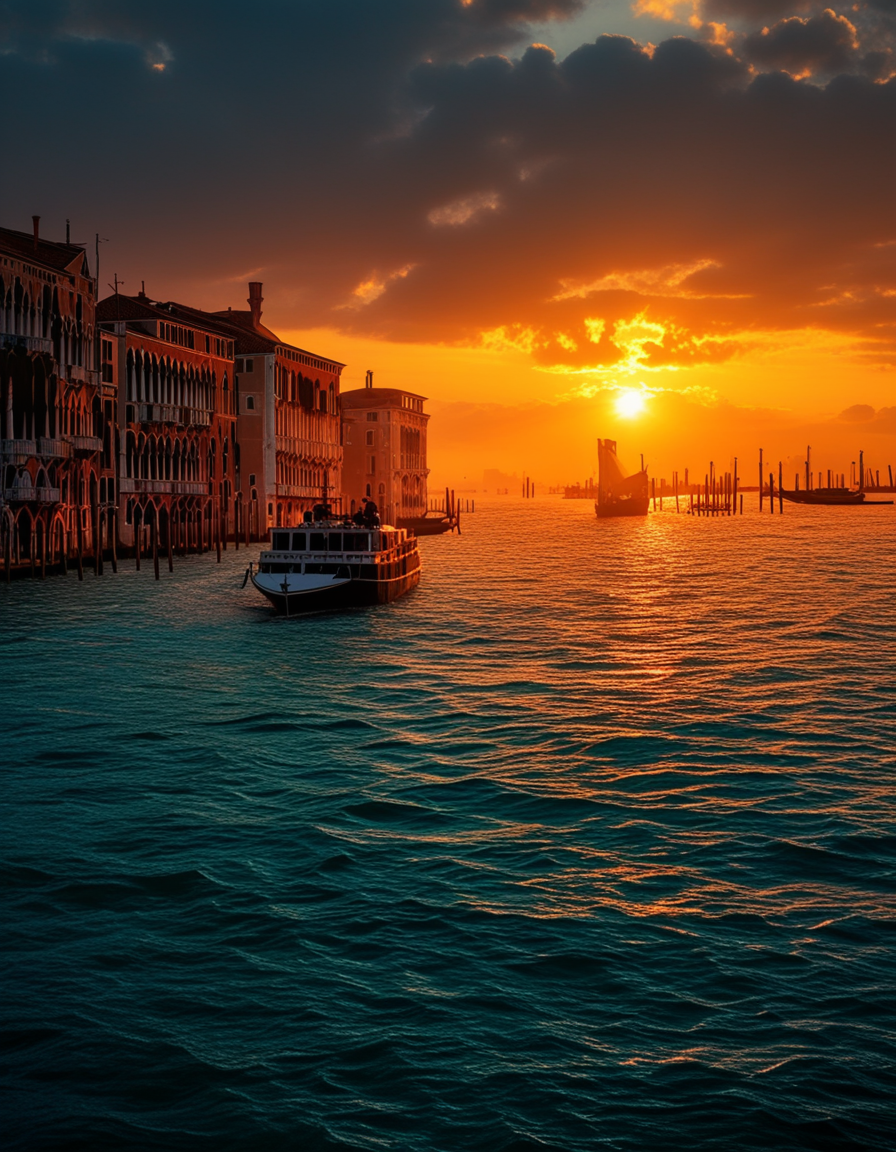
The image depicts a sunset over Venice, Italy. The sun is setting over the city, casting a warm orange glow over the water and buildings. A boat is visible in the foreground, adding a sense of movement to the scene.
CAPTION
The image captures a serene sunset over the Venetian lagoon in Venice, Italy. The sky is ablaze with hues of orange and pink, with the sun just beginning to set. The water, a deep blue, reflects the warm colors of the sky, creating a beautiful contrast.
MONOLOGUE
On a certain cloudy afternoon, some ten days later, a fishing-boat, with a patched orange sail, might have been seen scudding under a light northwesterly breeze through the channels which connect the island of San Francesco with the more easterly stretches of the Venetian lagoon. The boat presently neared the shore of one of the cultivated <i>lidi</i>--islands formed out of the silt of many rivers by the travail of centuries, some of them still mere sand or mud banks, others covered by vineyards and fruit orchards--which, with the <i>murazzi</i> or sea-walls of Venice, stand sentinel between the city and the sea. On the <i>lido</i> along which the boat was coasting, the vintage was long since over and the fruit gathered; the last yellow and purple leaves in the orchards, "a pestilent-stricken multitude," were to-day falling fast to earth, under the sighing, importunate wind. The air was warm; November was at its mildest. But all color and light were drowned in floating mists, and darkness lay over the distant city. It was one of those drear and ghostly days which may well have breathed into the soul of Shelley that superb vision of the dead generations of Venice, rising, a phantom host from the bosom of the sunset, and sweeping in "a rapid mask of death" over the shadowed waters that saw the birth and may yet furnish the tomb of so vast a fame.
SUMMARY
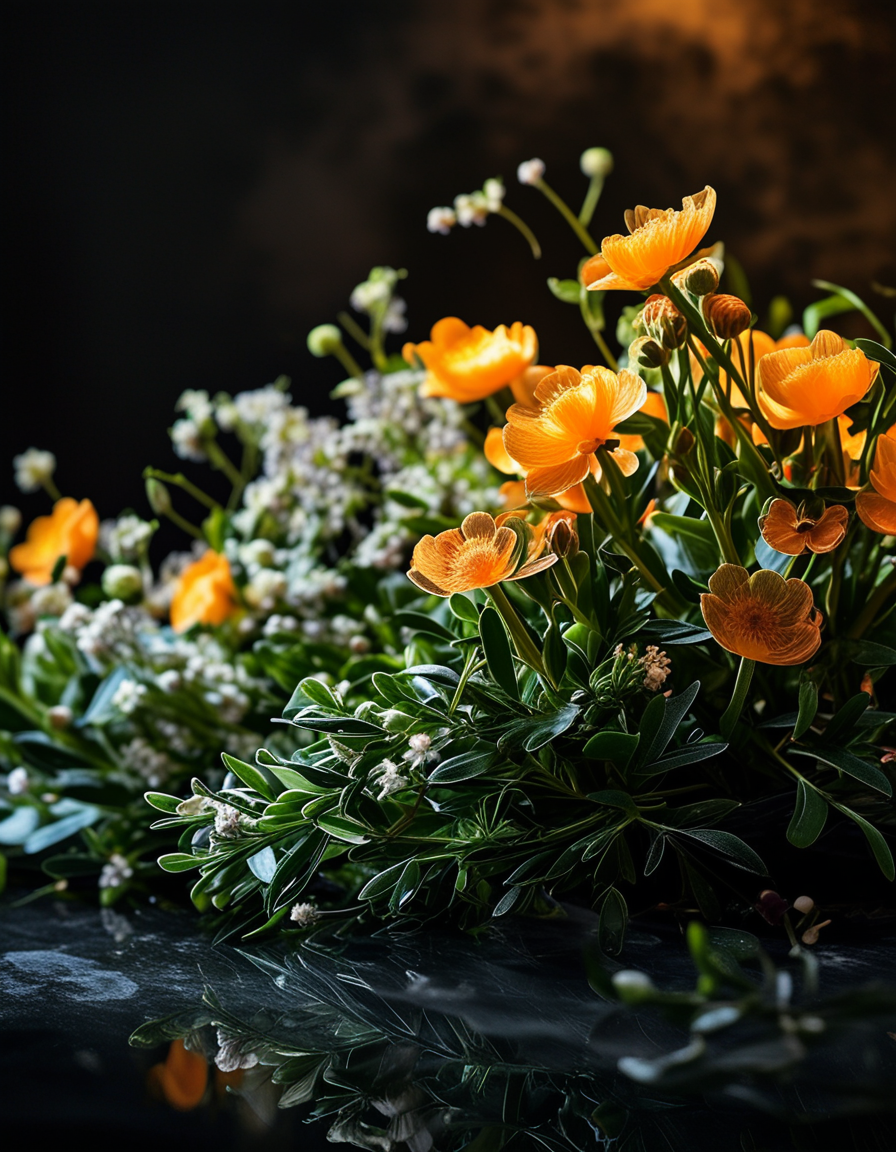
vase of flowers with white and orange flowers and green leaves on a dark background.
CAPTION
The image captures a vibrant bouquet of orange and white flowers, meticulously arranged on a reflective black surface. The flowers, with their bright colors and delicate petals, are the focal point of the image. They are arranged in a way that showcases their beauty, with some flowers slightly overlapping each other.
MONOLOGUE
Branches are given off from the main stem, arising at the point where the leaves join the stem (axils of the leaves), and these may in turn branch. All the branches terminate finally in an elongated inflorescence, and the separate flowers are attached to the main axis of the inflorescence by short stalks. This form of inflorescence is known technically as a "raceme." Each flower is really a short branch from which the floral leaves arise in precisely the same way as the foliage leaves do from the ordinary branches. There are five sets of floral leaves: I. four outer perigone leaves (sepals) (_F_), small, green, pointed leaves traversed by three simple veins, and together forming the calyx; II. four larger, white, inner perigone leaves (petals) (_G_), broad and slightly notched at the end, and tapering to the point of attachment. The petals collectively are known as the "corolla." The veins of the petals fork once; III. and IV. two sets of stamens (_E_), the outer containing two short, and the inner, four longer ones arranged in pairs. Each stamen has a slender filament (_H_, _f_) and a two-lobed anther (_an._). The innermost set consists of two carpels united into a compound pistil. The ovary is oblong, slightly flattened so as to be oval in section, and divided into two chambers. The style is very short and tipped by a round, flattened stigma.
SUMMARY
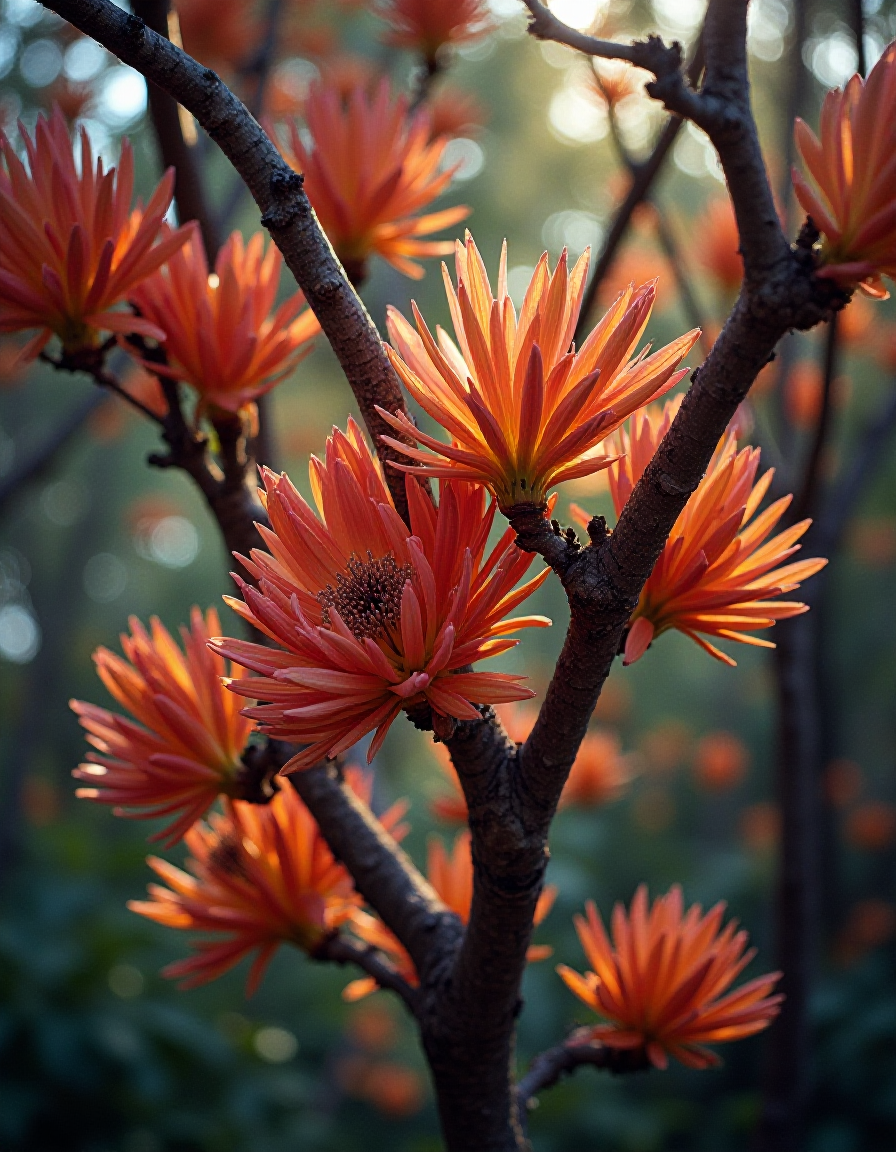
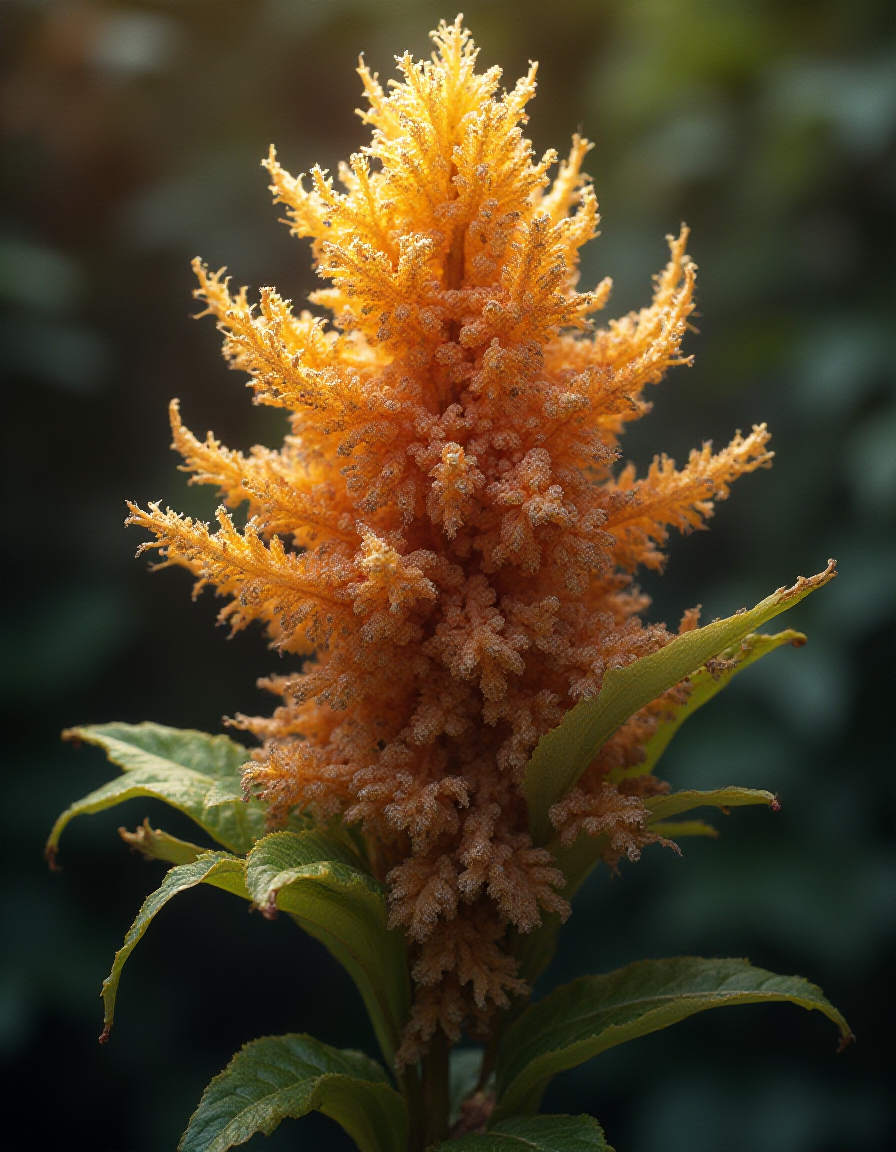
flower with orange petals and yellow center.
CAPTION
The image captures a vibrant scene of a tree branch adorned with numerous orange flowers. The flowers, with their bright orange petals and dark centers, are clustered together, creating a dense and colorful display. The branch, which is the main subject of the image, is positioned in the center, with the flowers extending outwards in a radial pattern.
MONOLOGUE
Its flowers are produced in branched heads, dense and numerous, on stems a foot or more high; each flower is 1in. or 1in. across, the five petals being of a transparent golden yellow, distinctly veined with orange; they are broad, and overlap each other; calyx small, and of a dark olive-green colour; segments finely pointed. The leaves are 2in. or more in length, lanced, but inclining to spoon shape; sessile, stout, smooth, entire, and glaucous. Through the summer new stems are quickly grown, which, in their turn, become topped with clusters of bloom, and so a succession of flowers is kept up until autumn. On rockwork it is effective, the situation, to some extent, meeting the requirements of its somewhat tender constitution; it may also be grown well in beds or borders, but they should be of a sandy character, and raised, unless it is intended to take up the plants for the winter; in such positions four or five specimens form a charming group, and nothing can be finer than the effect of other Flaxes, of a tall and spray-like character, grown near and amongst this golden yellow, such, for instance, as _L. Narbonnense_ and _L. perenne_.
SUMMARY
a woman with long hair in a strapless orange dress is posing in front of a spotlight
CAPTION
The image depicts a woman with long, wavy hair, wearing an orange strapless dress, standing in front of a bokeh background of warm, orange lights. The woman's expression is serious, and she is looking directly at the camera.
MONOLOGUE
After dinner his mother played; she seemed to play all the things he liked best, and he sat with one knee clasped, and his hair standing up where his fingers had run through it. He gazed at his mother while she played, but he saw Fleur--Fleur in the moonlit orchard, Fleur in the sunlit gravel-pit, Fleur in that fancy dress, swaying, whispering, stooping, kissing his forehead. Once, while he listened, he forgot himself and glanced at his father in that other easy chair. What was Dad looking like that for? The expression on his face was so sad and puzzling. It filled him with a sort of remorse, so that he got up and went and sat on the arm of his father's chair. From there he could not see his face; and again he saw Fleur--in his mother's hands, slim and white on the keys, in the profile of her face and her powdery hair; and down the long room in the open window where the May night walked outside.
SUMMARY
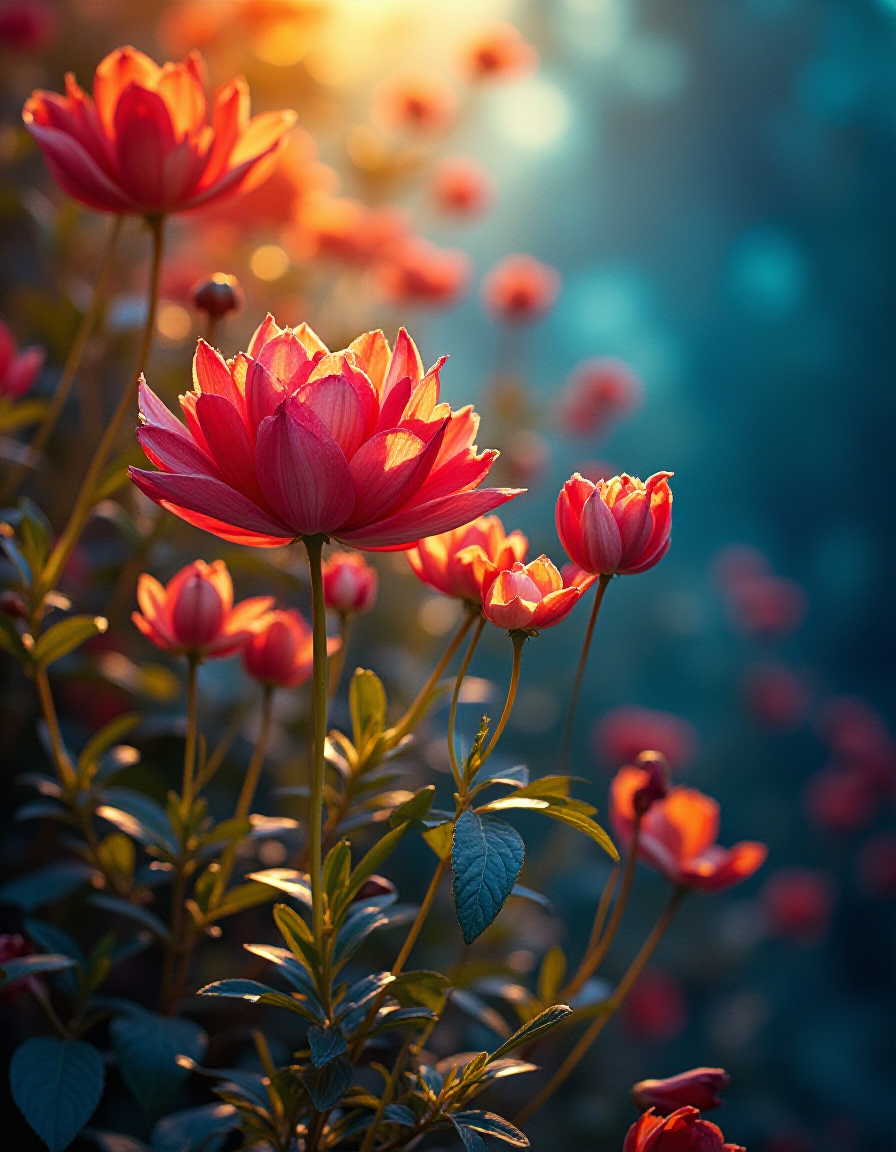
The image depicts a vibrant display of pink and orange flowers in full bloom against a blurred background.
CAPTION
The image captures a vibrant scene of a garden filled with pink and orange flowers. The flowers are in full bloom, their petals radiating a warm, golden hue. The background is a blur of green foliage, adding depth to the image.
MONOLOGUE
Who loves a garden, loves a greenhouse too. Unconscious of a less propitious clime There blooms exotic beauty, warm and snug, While the winds whistle and the snows descend. The spiry myrtle with unwithering leaf Shines there and flourishes. The golden boast Of Portugal and Western India there, The ruddier orange and the paler lime, Peep through their polished foliage at the storm, And seem to smile at what they need not fear. The amomum there with intermingling flowers And cherries hangs her twigs. Geranium boasts Her crimson honours, and the spangled beau, Ficoides, glitters bright the winter long, All plants, of every leaf, that can endure The winter's frown if screened from his shrewd bite, Live there and prosper. Those Ausonia claims, Levantine regions these; the Azores send Their jessamine; her jessamine remote Caffraria: foreigners from many lands, They form one social shade, as if convened By magic summons of the Orphean lyre. Yet such arrangement, rarely brought to pass But by a master's hand, disposing well The gay diversities of leaf and flower, Must lend its aid to illustrate all their charms, And dress the regular yet various scene. Plant behind plant aspiring, in the van The dwarfish, in the rear retired, but still Sublime above the rest, the statelier stand. So once were ranged the sons of ancient Rome, A noble show, while Roscius trod the stage; And so, while Garrick, as renowned as he, The sons of Albion, fearing each to lose Some note of Nature's music from his lips,
SUMMARY
a flower with bright orange petals and a yellow center
CAPTION
The image captures a vibrant orange flower in full bloom against a blurred background. The flower is the focal point of the image, with its petals fully spread out, showcasing their bright orange color. The background is a soft blur, suggesting a natural setting, possibly a garden or a field.
MONOLOGUE
They are probably the only short-tempered things in the Summer Islands, where time is so long that if you lose your patience you easily find it again. Sweetness, if not light, seems to be the prevailing human quality, and a good share of it belongs to such of the natives as are in no wise light. Our poor brethren of a different pigment are in the large majority, and they have been seventy years out of slavery, with the full enjoyment of all their civil rights, without lifting themselves from their old inferiority. They do the hard work, in their own easy way, and possibly do not find life the burden they make it for the white man, whom here, as in our own country, they load up with the conundrum which their existence involves for him. They are not very gay, and do not rise to a joke with that flashing eagerness which they show for it at home. If you have them against a background of banana-stems, or low palms, or feathery canes, nothing could be more acceptably characteristic of the air and sky; nor are they out of place on the box of the little victorias, where visitors of the more inquisitive sex put them to constant question. Such visitors spare no islander of any color. Once, in the pretty Public Garden which the multiple had claimed for its private property, three unmerciful American women suddenly descended from the heavens and began to question the multiple’s gardener, who was peacefully digging at the rate of a spadeful every five minutes. Presently he sat down on his
SUMMARY
The image depicts a serene scene of two people on a yellow and blue boat, enjoying the sunset over the ocean.
CAPTION
The image captures a serene scene of a boat on the ocean at sunset. The boat, painted in a vibrant yellow and blue color, is moving through the water, with the sun setting in the background. The sky is a gradient of orange and blue, with clouds scattered throughout, adding to the overall ambiance of the scene.
MONOLOGUE
Now, since the appearances at twilight depend on the condition of the sky, it follows that our weather-wisdom, drawn from such appearances, is based upon a philosophical foundation. When there is a blue sky, and after sunset a slight purple in the west, we have reason for expecting fine weather. After rain, detached clouds, colored red and tolerably bright, may rejoice those who anticipate a pic-nic party. If the twilight show a partiality for whitish yellow in its dress, we say that very likely there will be some rain next day; the more that whitish yellow spreads over the sky, the more the chance of water out of it. When the sun is brilliantly white, and sets in a white light, we think of storms; especially so when light high clouds that dull the whole sky become deeper near the horizon. When the color of the twilight is a grayish red, with portions of deep red passing into gray that hide the sun, then be prepared, we say, for wind and rain. The morning signs are different. When it is very red, we expect rain; a gray dawn means fine weather. The difference between a gray dawn and a gray twilight is this--in the morning, grayness depends usually upon low clouds, which melt before the rising sun; but in the evening grayness is caused by high clouds, which continue to grow denser through the night. But if in the morning there be so much vapor as to make a red dawn, it is most probable that thick clouds will be formed out of it in the course of the operations of the coming day.
SUMMARY
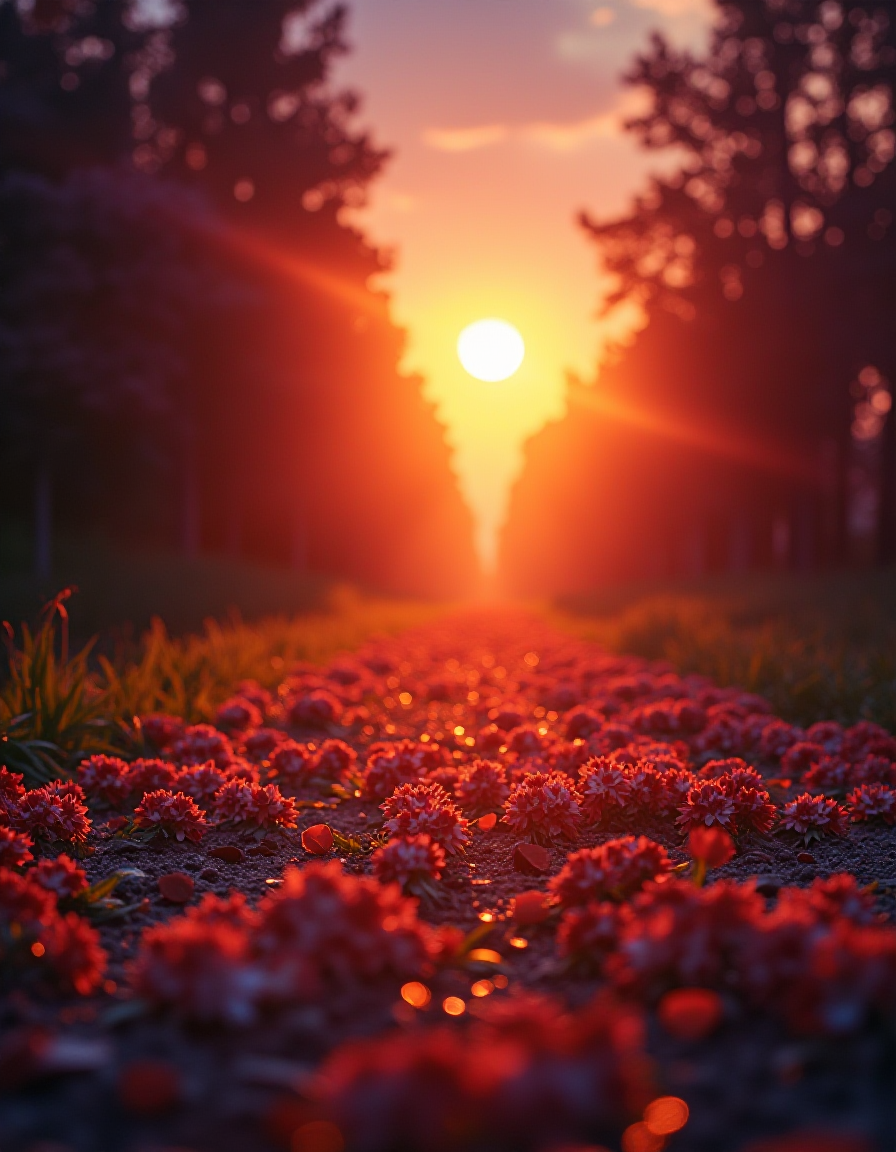
a field of red flowers under a setting sun
CAPTION
The image captures a serene sunset scene in a park. The sun, positioned in the upper right corner of the frame, is setting behind a line of trees. The sky is a gradient of orange and pink, with the sun casting a warm glow on the ground.
MONOLOGUE
Our house at Wittemberg is small. From the upper windows we look over the city walls, across the heath, to the Elbe, which gleams and sparkles between its willows and dwarf oaks. Behind the house is a plot of neglected ground, which Christopher is busy at his leisure hours trenching and spading into an herb-garden. We are to have a few flowers on the borders of the straight walk which intersects it,--daffodils, pansies, roses, and sweet violets and gilliflowers, and wallflowers. At the end of the garden are two apple trees and a pear tree, which had shed their blossoms just before we arrived, in a carpet of pink and white petals. Under the shade of these I carry my embroidery frame, when the house work is finished; and sometimes little Thekla comes and prattles to me, and sometimes Eva reads and sings to me. I cannot help regretting that lately Eva is so absorbed with that "Theologia Germanica." I cannot understand it as well as I do the Latin hymns when once she has translated them to me; for these speak of Jesus the Saviour, who left the heavenly home and sat weary by the way seeking for us; or of Mary his dear mother; and although sometimes they tell of wrath and judgment, at all events I know what it means. But this other book is all to me one dazzling haze, without sun, or moon, or stars, or heaven, or earth, or seas, or anything distinct,--but all a blaze of indistinguishable glory, which is God; the One who is all--a kind of ocean of goodness, in which, in some mysterious way, we ought to be
SUMMARY
a woman in a red robe is looking up at the sky with her eyes closed
CAPTION
The image presents a serene scene of a woman, presumably a young woman, with her head tilted upwards, gazing into the distance. She is dressed in a vibrant red robe, which contrasts with the soft, warm tones of the background. The background is a blur of red and orange hues, suggesting a sunset or a sunset-like setting.
MONOLOGUE
By force of habit Margaret had stopped beside the closed piano, and had seated herself on the old-fashioned stool to have her coffee. Lady Maud stood beside her, leaning against the corner of the instrument, her cup in her hand, and the two young women exchanged rather idle observations about the lovely day that was over, and the perfect weather. Both were preoccupied and they did not look at each other; Margaret's eyes watched Logotheti, who was half-way down the long room, before a portrait by Sir Peter Lely, of which he was apparently pointing out the beauties to the elderly wife of the scientific peer. Lady Maud was looking out at the light in the sunset sky above the trees beyond the flower-beds and the great lawn, for the piano stood near an open window. From time to time she turned her head quickly and glanced towards Van Torp, who was talking with her father at some distance; then she looked out of the window again.
SUMMARY
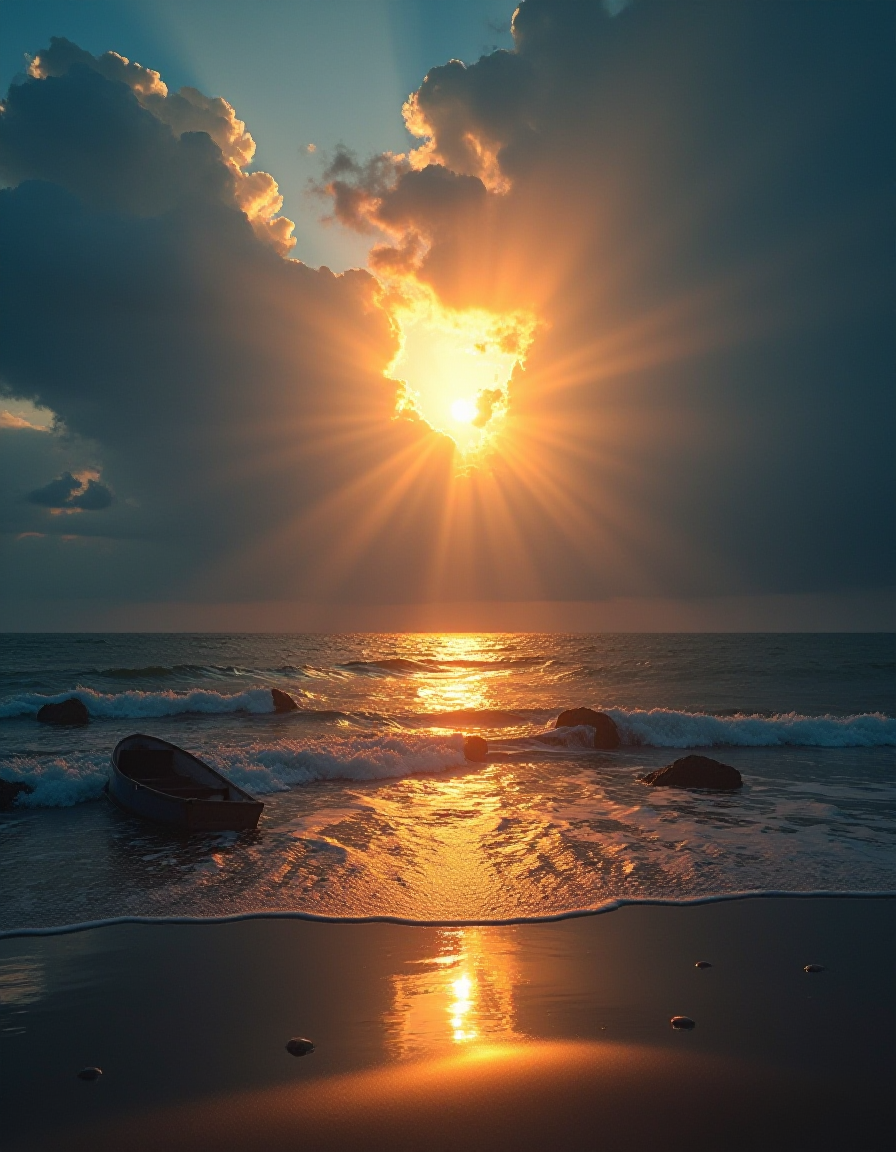
The image depicts a serene beach scene with a large sun setting over the ocean, creating a dramatic and picturesque sunset. The sun is positioned in the center of the image, casting a warm glow over the water and sky. The waves are gently crashing onto the shore, adding to the tranquil atmosphere of the scene. The sand is wet, reflecting the light
CAPTION
The image captures a serene beach scene at sunset. The sun, positioned in the upper right corner of the frame, is a vivid orange and yellow orb, casting a warm glow over the scene. The sun is surrounded by a halo of clouds, adding a sense of depth and atmosphere to the image.
MONOLOGUE
I mentioned in my last, that having abandoned my fishing-rod as an unprofitable implement, I crossed over the open downs which divided me from the margin of the Solway. When I reached the banks of the great estuary, which are here very bare and exposed, the waters had receded from the large and level space of sand, through which a stream, now feeble and fordable, found its way to the ocean. The whole was illuminated by the beams of the low and setting sun, who showed his ruddy front, like a warrior prepared for defence, over a huge battlemented and turreted wall of crimson and black clouds, which appeared like an immense Gothic fortress, into which the lord of day was descending. His setting rays glimmered bright upon the wet surface of the sands, and the numberless pools of water by which it was covered, where the inequality of the ground had occasioned their being left by the tide.
SUMMARY
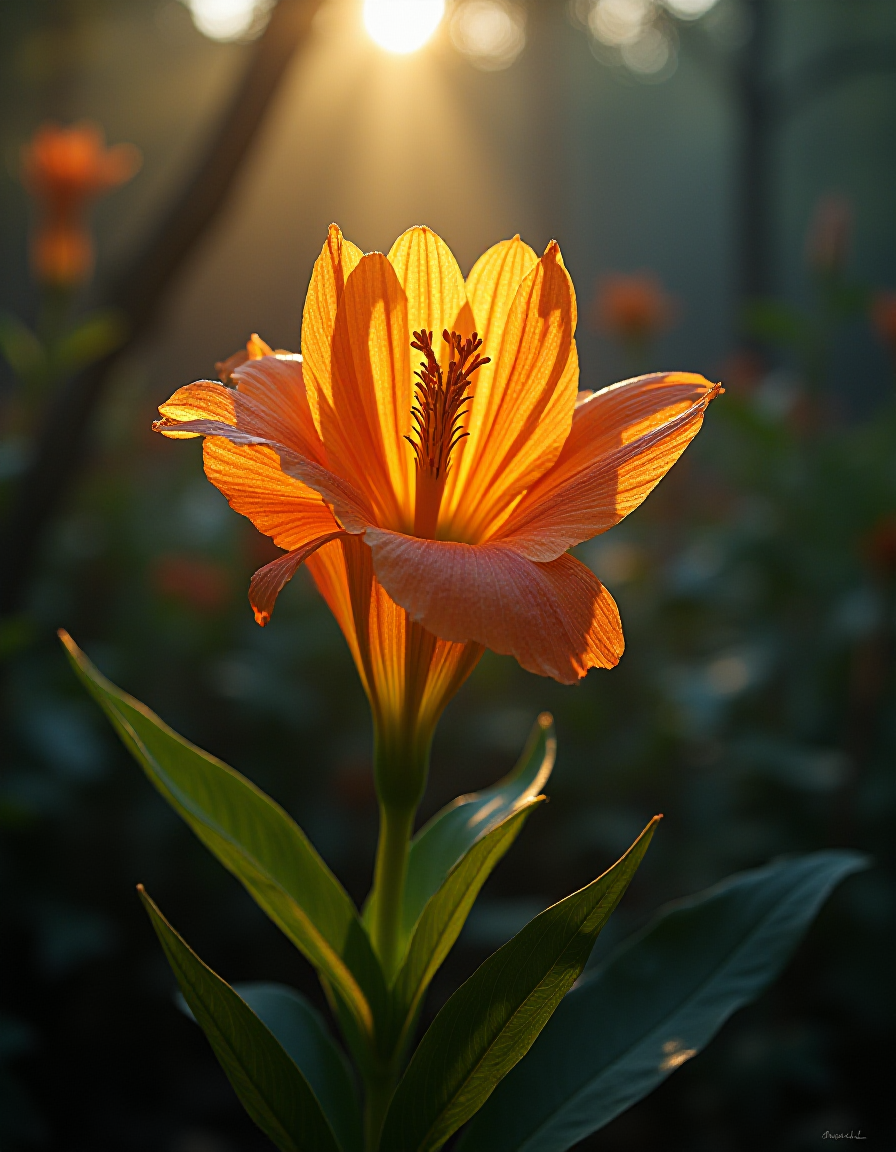
flower with bright orange petals and yellow center.
CAPTION
The image captures a vibrant orange flower in full bloom, with its petals fully spread, showcasing the intricate details of the flower's structure. The flower is set against a blurred background, which is rich in green foliage, adding depth to the image. The sun is positioned in the top right corner of the image, casting a warm glow that enhances the colors of the flower.
MONOLOGUE
Come away, Puck, while the dew is sweet; Come to the dingle where fairies meet. Know that the lilies have spread their bells O'er all the pools in our mossy dells; Stilly and lightly their vases rest On the quivering sleep of the waters' breast, Catching the sunshine thro' leaves that throw To their scented bosoms an emerald glow; And a star from the depth of each pearly cup, A golden star! unto heaven looks up, As if seeking its kindred, where bright they lie, Set in the blue of the summer sky. .... under arching leaves we'll float, .... with reeds o'er the fairy moat, .... forth wild music both sweet and low. It shall seem from the rich flower's heart, As if 'twere a breeze, with a flute's faint sigh. Cone, Puck, for the midsummer sun uproars strong, And the life of the Lily may not be long.--MAB.
SUMMARY
The boat is sailing in the ocean at sunset.
CAPTION
The image captures a serene scene of a wooden sailboat at sunset. The boat, with its sails unfurled, is positioned centrally in the frame, facing towards the right side of the image. The sky above is painted in hues of orange and pink, with the sun just setting, casting a warm glow over the scene.
MONOLOGUE
"Lord Almighty! I wish I could draw!" said the Political Economist. It was not so much an exclamation as a reverent entreaty. His eyes narrowed sketchily across the vision that haunted him. "If I could draw," he persisted, "I'd make a picture that would hit the world like a knuckled fist straight between its selfish old eyes. And I'd call that picture 'Talent.' I'd make an ocean chopping white and squally, with _black_ clouds scudding like fury across the sky, and no land in sight except rocks. And I'd fill that ocean full of sharks and things--not showing too much, you know, but just an occasional shimmer of fins through the foam. And I'd make a sailboat scooting along, tipped 'way over on her side toward you, with just a slip of an eager-faced girl in it. And I'd wedge her in there, wind-blown, spray-dashed, foot and back braced to the death, with the tiller in one hand and the sheet in the other, and weather-almighty roaring all around her. And I'd make the riskiest little leak in the bottom of that boat rammed desperately with a box of chocolates, and a bunch of violets, and a large paper compliment in a man's handwriting reading: 'Oh, how _clever_ you are.' And I'd have that girl's face haggard with hunger, starved for sleep, tense with fear, ravished with excitement. But I'd have her chin _up_, and her eyes _open_, and the tiniest tilt of a quizzical smile hounding you like mad across the snug, gilt frame. Maybe, too, I'd have a woman's magazine blowing around telling in chaste language how to keep the hair 'smooth'
SUMMARY
a woman in a white dress is standing in a surreal landscape with a large, glowing, pink and orange cloud formation behind her.
CAPTION
The image depicts a surreal scene where a person is standing in a vast, open space filled with a multitude of glowing, spherical objects that resemble clouds. The person is facing away from the viewer, creating a sense of distance and isolation. The environment is bathed in a warm, orange glow, suggesting a setting that could be a sunset or a similar celestial event.
MONOLOGUE
Millicent too had been swift. He had thought to overtake her before he emerged from the woods into the more open space where the hotel stood. In this quarter the cloud-break had been greater. Toward the west a fading amber glow still lingered in long horizontal bars upon the opaque gray sky. The white mountains opposite were hung with purple shadows borrowed from a glimpse of sunset somewhere far away over the valley of East Tennessee; one distant lofty range was drawn in elusive snowy suggestions, rather than lines, against a green space of intense yet pale tint. The moon, now nearing the full, hung over the wooded valley, and aided the ice and the crust of snow to show its bleak, wan, wintry aspect; a tiny spark glowed in its depths from some open door of an isolated home. Over it all a mist was rising from the east, drawing its fleecy but opaque curtain. Already it had climbed the mountain-side and advanced, windless, soundless, overwhelming, annihilating all before and beneath it. The old hotel had disappeared, save that here and there a gaunt gable protruded and was withdrawn, showed once more, and once more was submerged.
SUMMARY
The image depicts a colorful abstract painting with a gradient of colors. The painting features a diagonal stripe that cuts across the image, creating a sense of movement and depth. The colors used in the painting are vibrant and varied, with shades of pink, orange, and purple dominating the palette. The stripes are not uniform, but rather vary in size and shape
CAPTION
The image is a digital representation of a gradient background with a gradient of colors. The colors transition from a bright orange at the top to a deep purple at the bottom, creating a visually appealing and dynamic effect. The gradient is not uniform, with the colors blending smoothly into each other, giving the image a sense of depth and dimension.
MONOLOGUE
There are a few cases, however, where top lights may be used, such as large drawing-or music-rooms, rooms in which formal entertaining is to be done. Crystal ceiling lights are then best to use, or chandeliers with crystal drops or pendants. If these rooms are Italian Renaissance in style, the center lights must naturally harmonize in period. Large halls with marble stairs and wrought-iron balustrade can have this elaborate kind of light, but the average hall demands a simpler chandelier. If one is to be used there are some very good copies of old Colonial lights and lanterns, but personally I prefer wall brackets and a dignified lamp, or a floor lamp. Torchres or lacquered floor lamps may be used in pairs if the hall is large enough to have them placed properly. In a long, narrow hall they would look a bit like lamp posts. Rather close fitting round shades, nearly the same size at top and bottom, made of painted parchment give a decorative touch and sufficient light. As one does not need an especially bright light in a hall, a beautiful lamp can be made of one of the fine old alabaster vases which many people have by dropping an electric bulb in it. Placed on a consol table before a mirror it makes a delightful spot in the hall. These lamps may also be used in other rooms where a light is needed for effect and not for use. In placing lamps the charm and utility of a reflection in a mirror must not be overlooked.
SUMMARY
beach scene with sunset and waves.
CAPTION
The image captures a serene beach scene at sunset. The sky is a gradient of orange and pink, with the sun just setting on the horizon. The ocean waves are gently lapping at the shore, creating a reflective surface that mirrors the colors of the sky.
MONOLOGUE
The marble silence is suddenly broken by the rush of an avalanche, that tears away the superincumbent masses, rolling them into the sea; and the ponderous block, laid open to the light, finds itself on the bleak shore of a desert island of the northern Scottish archipelago, with a wintry scene of snow-covered peaks behind, and an ice-mottled ocean before. The winter passes, the cold severe spring comes on, and day after day the field-ice goes floating by,--now gray in shadow, now bright in the sun. At length vegetation, long repressed, bursts forth, but in no profuse luxuriance. A few dwarf birches unfold their leaves amid the rocks; a few sub-arctic willows hang out their catkins beside the swampy runnels; the golden potentilla opens its bright flowers on slopes where the evergreen _Empetrum nigrum_ slowly ripens its glossy crow-berries; and from where the sea-spray dashes at full tide along the beach, to where the snow gleams at midsummer on the mountain-summits, the thin short sward is dotted by the minute cruciform stars of the scurvy-grass, and the crimson blossoms of the sea-pink. Not a few of the plants of our existing sea-shores and of our loftier hill-tops are still identical in species; but wide zones of rich herbage, with many a fertile field and many a stately tree, intervene between the bare marine belts and the bleak insulated eminences; and thus the alpine, notwithstanding its identity with the littoral flora, has been long divorced from it; but in this early time the divorce had not yet taken place, nor for ages
SUMMARY
street scene at sunset with a bridge and buildings in the background.
CAPTION
The image captures a serene cityscape at sunset. The sky, painted in hues of orange and pink, is ablaze with color, casting a warm glow over the scene. The sun, just below the horizon, is partially obscured by clouds, adding to the dramatic effect.
MONOLOGUE
"Before I passed the limits of the borough, a parachute, containing an animal, was dropped, which descended fast and steady, and, just as it reached the earth, my rial ship entered a dense black body of clouds. Ten minutes were consumed in penetrating this dismal ocean of rainy vapor, occasionally meeting with great chasms, ravines, and defiles, of different shades of light and darkness. When I emerged from this ocean of clouds, a new and wonderfully magnificent scene greeted my eyes. A faint sunshine shed its warmth and luster over the surface of this vast cloud sea. The balloon rose more rapidly after it got above it. Viewing it from an elevation above the surface, I discovered it to present the same shape of the earth beneath, developing mountains and valleys, corresponding to those on the earth's surface. The profile of the cloud-surface was more depressed than that on the earth, and, in the distance of the cloud-valley a magnificent sight presented itself. Pyramids and castles, rocks and reefs, icebergs and ships, towers and domes--every thing belonging to the grand and magnificent could be seen in this distant harbor; the half-obscured sun shedding his mellow light upon it, gave it a rich and dazzling luster. They were really "castles in the air," formed of the clouds. Casting my eyes upward, I was astonished in beholding another cloud-stratum, far above the lower one; it was what is commonly termed a "mackerel sky," the sun faintly shining through it. The balloon seemed to be stationary; the clouds above and below
SUMMARY
beach scene with a large sun setting over the ocean.
CAPTION
The image captures a serene beach scene at sunset. The sun, positioned in the upper right corner of the frame, is a vibrant orange, casting a warm glow over the scene. The ocean, with its gentle waves, is bathed in the same warm orange hue, reflecting the light of the setting sun.
MONOLOGUE
I lodged at a little village inn between Wakefield and Leeds, after a day of the most enjoyable walk that I had made. Never before, between sun and sun, had I passed over such a section of above- ground and under-ground industry and wealth. The next morning I continued northward, and noticed still more striking combinations of natural productions and human industries than on the preceding day. One small, rural area in which these were blended impressed me greatly, and I stopped to photograph the scene on my mind. In a circle hardly a third of a mile in diameter, there was the heaviest crop of oats growing that I had yet seen in England; in another part of the same field there was a large brick-kiln; in another, an extensive quarry and machinery for sawing the stone into all sizes and shapes; then a furnace for casting iron, and lastly, a coal mine; and all these departments of labor and production were in full operation. It is quite possible that not one of the hundred laborers on and under this ten-acre patch ever thought it an extraordinary focus of production. Perhaps even the proprietors and managers of the five different enterprises worked on the small space had taken its rich and diversified fertilities as a matter of course, as we take the rain, light and heat of summer; but to a traveller "taking stock" of a country's resources, it could not but be a point of view exciting admiration. I left it behind me deeply impressed with the conviction that I had seen the most productive
SUMMARY
a woman in an orange dress is dancing in the sun
CAPTION
The image captures a serene moment of a woman standing in a field, her arms raised in the air as if reaching for the sky. She is dressed in an orange bikini top and shorts, adding a vibrant contrast to the natural setting. The field she stands in is dotted with tall grass, and the sky above is a warm orange, suggesting a sunset.
MONOLOGUE
Anne, standing straight again, surveyed the garland in silence. Then she changed its position once or twice, studying the effect. Her figure, poised on the round of the ladder, high in the air, was, although unsupported, firm. With her arms raised above her head in a position which few women could have endured for more than a moment, she appeared as unconcerned, and strong, and sure of her footing, as though she had been standing on the floor. There was vigor about her and elasticity, combined unexpectedly with the soft curves and dimples of a child. Viewed from the floor, this was a young Diana, or a Greek maiden, as we imagine Greek maidens to have been. The rounded arms, visible through the close sleeves of the dark woollen dress, the finely moulded wrists below the heavy wreath, the lithe, natural waist, all belonged to a young goddess. But when Anne Douglas came down from her height, and turned toward you, the idea vanished. Here was no goddess, no Greek; only an American girl, with a skin like a peach. Anne Douglas's eyes were violet-blue, wide open, and frank. She had not yet learned that there was any reason why she should not look at everything with the calm directness of childhood. Equally like a child was the unconsciousness of her mouth, but the full lips were exquisitely curved. Her brown hair was braided in a heavy knot at the back of her head; but little rings and roughened curly ends stood up round her forehead and on her temples, as though defying restraint. This unwritten face, with its direct gaze, so
SUMMARY
iris flower with yellow and orange petals and a purple bud.
CAPTION
The image captures a close-up view of a flower with a vibrant orange and white iris. The flower is in full bloom, with its petals fully spread and exhibiting a unique pattern of orange and white stripes. The flower is set against a blurred background, which suggests that the flower is in a natural setting, possibly a garden or a field.
MONOLOGUE
Iris.--The Iris is the orchid of the flower garden; its blossoms are the most rich and varied in colour of hardy plants. For cutting, for vases, table decoration, etc., it is exceedingly useful, as it is very free-flowering, and lasts a long time in water. It thrives in almost any soil, though a sandy one suits it best, and is strikingly effective when planted in clumps. It soon increases if left undisturbed. The English Iris blooms in June and July, bearing large and magnificent flowers ranging in colour from white to deep purple, some being self-colours, while others are prettily marbled. The German Iris is especially suitable for town gardens. The Spanish Iris blooms a fortnight before the English. Its flowers, however, are smaller, and the combinations of colours very different. The Leopard Iris (_Pardanthus Chinensis_)is very showy, its orange-yellow flowers, spotted purple-brown, appearing in June and July. They are quite hardy. The best time for planting them is October or November, selecting a sunny position. Height, 1-1/2 ft.
SUMMARY
The man is wearing a bright orange hoodie and has a beard. He is sitting on a red chair and has his hand on his face.
CAPTION
The image depicts a person with long, curly hair, wearing an orange hoodie and a gold chain necklace. The individual is seated on a red chair, with their hands clasped together in front of them. The background is a vibrant turquoise color, providing a striking contrast to the person's attire.
MONOLOGUE
Peter Courtlandt tapped the arm of his chair nervously as he regarded the man who sat opposite in front of the fire. The two men were in striking contrast. Courtlandt seemed a component part of the room in which they sat, a room which with its dull, velvety mahogany, its costly Eastern rugs, its rare old portraits and book-lined walls, proclaimed generations of ancestors who had been born to purple and fine linen. He was spare and tall. His features might have served as the model for the portrait of Nelson in the Metropolitan Museum. His eyes were darkly luminous, the eyes of a dreamer; his white hair curled in soft rings over his head; his hands were long and patrician. Glamorgan was built on the Colossus plan, large head, heavy features into which the elements had ground a dull color, a huge body without the least trace of fat. Only his eyes were small. They looked as though they had been forgotten until the last moment, as though the designer had then hastily poked holes beneath the Websterian brows to insert two brilliant green beads. He was a handsome man in a clean-souled, massive way; moreover he looked to be a person who would crash through obstacles and win out by sheer persistence.
SUMMARY
a flower with a green stem and orange petals sits on a bed of pebbles
CAPTION
The image captures a close-up of a small, round, green bud with a vibrant orange flower at its center. The bud is nestled on a bed of small, dark pebbles, with a blurred background that suggests a natural setting. The orange flower is surrounded by the green leaves of the bud, adding to the overall composition of the image.
MONOLOGUE
E. multiflorus (many-flowered); Bot. Mag. 4181.--A well-named Cactus, as its small stem (seldom more than 5 in. high, and the same in width) often bears a large cap-like cluster of beautiful white flowers, except for a slight tinge of brown on the tips of the petals. Each flower is composed of a green, scaly tube, and several rows of reflexed petals, which form a shallow cup 2 in. across. The stamens are tipped with orange-coloured anthers, and the stigma is rayed and snow-white. The stem is ridged with rows of fleshy mammae or tubercles, which are curiously humped, and each bears a cluster of spreading, brown spines, 1 in. long. The number of flowers this little plant annually produces seems more than could be possible without proving fatal to its health; but we have seen it blossom year after year, and in no way has its health appeared impaired. It may be grown on a shelf in a warm greenhouse, or in the window of a heated dwelling-room. Introduced, probably from Mexico, in 1845. This, like all the small, globular-stemmed kinds, may be grafted on the stem of a Cereus of suitable thickness. Some cultivators believe that grafting causes the plants to flower more freely, but we have not observed any difference in this respect between grafted and ungrafted plants.
SUMMARY
The image depicts a serene, autumn-themed landscape featuring a tranquil river flowing through a rocky canyon. The river, reflecting the vibrant colors of the autumn foliage, is surrounded by towering cliffs and trees, creating a picturesque scene. The sky above is painted in hues of orange and pink, adding to the overall ambiance of the image.
CAPTION
The image depicts a serene, mountainous landscape bathed in warm hues of orange and red. The sky is a deep, vibrant orange, suggesting either sunrise or sunset. The river, which is the main focus of the image, is a tranquil body of water reflecting the colors of the sky.
MONOLOGUE
If it were not for thoughts like these, no one, I suppose, would take the trouble to drive for two hours out of Parma to the little village of Fornovo—a score of bare grey hovels on the margin of a pebbly river-bed beneath the Apennines. The fields on either side, as far as eye can see, are beautiful indeed in May sunlight, painted here with flax, like shallow sheets of water reflecting a pale sky, and there with clover red as blood. Scarce unfolded leaves sparkle like flamelets of bright green upon the knotted vines, and the young corn is bending all one way beneath a western breeze. But not less beautiful than this is the whole broad plain of Lombardy; nor are the nightingales louder here than in the acacia trees around Pavia. As we drive, the fields become less fertile, and the hills 183encroach upon the level, sending down their spurs upon that waveless plain like blunt rocks jutting out into a tranquil sea. When we reach the bed of the Taro, these hills begin to narrow on either hand, and the road rises. Soon they open out again with gradual curving lines, forming a kind of amphitheatre filled up from flank to flank with the _ghiara_ or pebbly bottom of the Taro. The Taro is not less wasteful than any other of the brotherhood of streams that pour from Alp or Apennine to swell the Po. It wanders, an impatient rivulet, through a wilderness of boulders, uncertain of its aim, shifting its course with the season of the year, unless the jaws of some deep-cloven gully hold it tight and show how insignificant it
SUMMARY
The image depicts a winding dirt road that leads to a serene lake, framed by majestic mountains under a vibrant sunset.
CAPTION
The image depicts a serene landscape at sunset, with a winding dirt path leading towards a body of water. The sky is a vibrant mix of orange and yellow hues, with the sun positioned high in the sky, casting a warm glow over the scene. The mountains in the background are silhouetted against the sky, their peaks and valleys creating a sense of depth and grandeur.
MONOLOGUE
Three carriages, with postillions, bring Othomar, Herman and the others along the broad, winding, switchback road to Castel Vaza. It is five o'clock in the afternoon; the weather is mild and sunny, but not warm: a fresh breeze is blowing. The landscape is wide and noble; with each turn of the road come changes in the panorama of snow-clad mountains. The country is luxuriantly beautiful. The little villages through which they drive look prosperous: they are the duke's property. Between Vaza and the castle the land has been spared by the water: the overflowing of the Zanthos has inundated rather the eastern district. It is difficult here to think constantly of that dreadful flood and of the condition of Lipara yonder, which the emperor has proclaimed in state of siege. It is so beautiful here, so full of spring life; and the sunset after a fine, summery day is here devoid of sadness. The chestnut-trees waft their fresh green fans; and the sky is still like mother-of-pearl, though a dust of twilight is beginning to hover over it. A lively conversation is in progress between the princes, Ducardi and Von Fest, who sit in the first carriage: they talk with animation, laugh and are amused because the villagers sometimes, of course, salute them, as visitors to the castle, with a touch of the cap or a kindly nod, but do not know who they are. Prince Herman nods to a handsome young peasant-girl, who stays staring after them open-mouthed, and recalls the delightful big-game hunt last year when he was the duke's guest, together with the emperor
SUMMARY
The woman in the image is wearing a floral dress and has long, wavy red hair.
CAPTION
The image depicts a woman with long, bright orange hair, adorned with a flower crown. She is wearing a colorful floral dress and a choker necklace. The background is blurred, suggesting an outdoor setting, possibly a garden or a park.
MONOLOGUE
V. 3, 4. _Whose adorning, let it not be outward, in braiding of the hair, and wearing of gold, and putting on of apparel, but of the hidden man of the heart, in that which is incorruptible, a meek and quiet spirit, which in God's sight is precious._ This treasure, which is internal, should be possessed not only by the wife, but by the husband. But here possibly some one might ask whether that which St. Peter here says of ornament is commanded or not. We read of Esther, that she wore a golden crown and precious ornaments, decking herself as a queen. So also of Judith. But near by it is recorded, that she despised the ornament and wore it from necessity. So that we say this much, that a woman should be so disposed as not to care for this adorning; yet, inasmuch as people convinced on the subject of ornament, cease not from the use of it, such is their habit and nature,--a christian wife should despise it. But if the husband requires it, or there is a reasonable cause for her adorning herself, it may well be done. But in such a way should she be adorned, as St. Peter here says, as to be inwardly attired in a meek and quiet spirit. You are vainly enough adorned when you are adorned for your husband; Christ will not suffer it that you should be adorned to please others, and that you should be called a vain harlot. Therefore you are to see to it, that you wear about in your heart the hidden treasure and precious adorning, in that which is incorruptible, as St. Peter says, and lead a pure, merciful, temperate life.[1]
SUMMARY
the artist has created a portrait of a man with curly hair and a beard, wearing a red and gold robe, sitting in a chair with his hands clasped together.
CAPTION
The image depicts a portrait of a man with curly hair, wearing an orange robe adorned with gold and silver accents. He is seated in a chair, his hands clasped together in front of him, suggesting a moment of contemplation or deep thought. The background is a solid yellow color, providing a stark contrast to the man's vibrant attire.
MONOLOGUE
Entering the house one March evening, when it was unusually still, I had reached the front hall, when masculine tones struck my ears. I opened the parlor door softly, and saw Ben Somers in an easy-chair, basking before a glowing fire, his luminous face set toward Veronica, who was near him, holding a small screen between her and the fire. "She is always ready," I thought, contemplating her as I would a picture. Her ruby-colored merino dress absorbed the light; she was a mass of deep red, except her face and hair, above which her silver crescent comb shone. Her slender feet were tapping the rug. She wore boots the color of her dress; Ben was looking at them. Mother was there, and in the background Aunt Merce and Fanny figured. I pushed the door wide; as the stream of cold air reached them, they looked toward it, and cried--"Cassandra!" Ben started up with extended hands.
SUMMARY
a man in a red robe sits on a stone ledge overlooking the ocean at sunset
CAPTION
The image depicts a man in traditional attire, seated on a stone ledge overlooking a body of water. He is dressed in a vibrant orange robe adorned with intricate patterns and a necklace, which is prominently displayed in the image. The man's face is turned towards the viewer, and he appears to be engaged in conversation or contemplation.
MONOLOGUE
One day, having repaired thither with her nymphs, she handed her javelin, her quiver, and her bow to one, her robe to another, while a third unbound the sandals from her feet. Then Crocale, the most skilful of them, arranged her hair, and Nephele, Hyale, and the rest drew water in capacious urns. While the goddess was thus employed in the labors of the toilet, behold, Actaeon, having quitted his companions, and rambling without any especial object, came to the place, led thither by his destiny. As he presented himself at the entrance of the cave, the nymphs, seeing a man, screamed and rushed towards the goddess to hide her with their bodies. But she was taller than the rest, and overtopped them all by a head. Such a color as tinges the clouds at sunset or at dawn came over the countenance of Diana thus taken by surprise. Surrounded as she was by her nymphs, she yet turned half away, and sought with a sudden impulse for her arrows. As they were not at hand, she dashed the water into the face of the intruder, adding these words: "Now go and tell, if you can, that you have seen Diana unapparelled." Immediately a pair of branching stag's horns grew out of his head, his neck gained in length, his ears grew sharp-pointed, his hands became feet, his arms long legs, his body was covered with a hairy spotted hide. Fear took the place of his former boldness, and the hero fled. He could not but admire his own speed; but when he saw his horns in the water, "Ah, wretched me!: he would have said, but no sound
SUMMARY
The artist has created a portrait of a young woman with a tattoo on her arm. She is wearing a red dress and has her hair styled in a bun. The background is a gradient of orange and blue, with a white cloud-like shape in the top left corner.
CAPTION
The image depicts a woman with a serene expression, wearing a red dress with a white collar and a gold necklace. She has a tattoo on her right arm, which appears to be a dragon design. The background is a gradient of orange and blue, with the orange at the top and the blue at the bottom, creating a warm and inviting atmosphere.
MONOLOGUE
Persephone stood framed in the doorway: she was all in white, very slim and tall; in among her hair she had a wreath of green Egyptian stones called feridets, of which many remained in the treasuries of Winchester, because they were soft and of so little value that the visitors of the monasteries had left them there. And she had these green feridets, cut like leaves, worked into the white lawn, over her breasts. In her left arm there lay a cornucopia filled with gold coins, and in her right a silver coronet of olive leaves. She moved in a slow measure to the music, bending her knees to right and to left, and drawing her long dress into white lines and curves, until she stood in the centre of the green path. She smiled patiently and with a rapt expression as if she had come out of a dream. The wreath of olive leaves, she said, the gods sent to their most virtuous, most beauteous Queen, who had brought peace in England; the cornucopia filled with gold was the offering of Plutus to the noble and benevolent King of these parts. Her words could hardly be heard for the voices of the theologians in the hall before her.
SUMMARY
a person is walking down a path in a forest at night
CAPTION
The image depicts a serene, misty forest scene. The main focus is a person standing in the center of the frame, illuminated by a warm, orange glow that emanates from the ground. The person is facing away from the camera, creating a sense of depth and perspective.
MONOLOGUE
On passing through the gates, the children found themselves on a very broad terrace, which ran along on that side of the garden. The surface of the terrace was gravelled for a walk, and it was very smooth and beautiful. While standing on, or walking upon it, you could look on one side, through the palisade, and see the carriages in the street, and on the other side you could look over a low wall down into the garden, which was several feet below. The descent into the garden was by a flight of stone steps. The children, after staying a little time upon the terrace, went down the steps. They came out upon a very broad avenue, or alley, which formed the side of the garden. This alley was very broad indeed, so broad that it was divided into three by orange trees, which extended up and down in long rows parallel to the street, almost as far as you could see, and forming beautiful vistas in each direction. These orange trees, though very large, were not set in the ground, but were planted in monstrous boxes, painted green and set on rollers. The reason of this was, so that they could be moved away in the winter, and put in a building where they could be kept warm.
SUMMARY
a long, straight path of trees with orange and red leaves on the ground and a bright light in the distance
CAPTION
The image depicts a serene autumn scene in a park. The central focus is a long, straight path that runs through the middle of the scene, flanked by tall trees on both sides. The trees are adorned with vibrant orange and yellow leaves, creating a warm and inviting atmosphere.
MONOLOGUE
One of our usual walks, during our stay at Bethlehem, was up or down the banks of the Mauch Chunk canal. This canal is divided from the Lecha by a dam, on which grow many fine plants, about which numbers of humming-birds were fluttering. In my whole journey through North America, I nowhere found these pretty birds so numerous as here. They hummed about the yellow flowers of the broad-leaved tree primrose (_Oenothera_), of the violet _Asclepias incarnata_ (swallow wort), of the _Impatiens fulva_, with its deep orange-coloured flowers, &c., and we shot many of these little creatures, among ten of which we found, at the most, one male, with deep red throat. The dam was bordered with stones at the sides; and among them were numbers of the striped ground squirrel. Tall thistles are the constant resort of the goldfinches, which picked the woolly seeds from the flower heads. At some mills, on an island near the road, there was a grove of tall trees, the dark shades of which were animated by many interesting birds, especially the beautiful Baltimore bird and the flycatcher (_Muscicapa ruticilla_), which is distinguished by the same colours, and is frequent here. Under the old stems, and from the roots of the trees on the bank, the great bull-frogs leaped into the water, however softly and cautiously we approached. Their deep, hollow note was not heard so much in this season, as in the spring and the beginning of the summer. I nowhere saw these frogs so numerous as here in Pennsylvania.
SUMMARY
a young woman with curly hair is standing in front of a large sun with a floral dress
CAPTION
The image depicts a person with curly hair, wearing a floral dress, standing in a field of orange flowers. The person is facing towards the right side of the image, with the sun in the background, which is a large, bright orange circle. The sky is a gradient of blue and orange, with the sun positioned in the center.
MONOLOGUE
She thought that she and her sister were standing at their usual corner of the market-place, their posies of flowers and large bunches of autumn leaves carefully arranged before them on the rough wooden table, the tin canister in the middle and a little heap of the leaves displayed in front of it. It seemed very early, there were scarcely any people about. Suddenly up came a small old woman, a stranger and what Linde would have called "a foreigner," for her dress was either that of another country or of a date already quite passed out of fashion. She glanced at the flowers, and appeared to be passing on, when she caught sight of the little heap of dried leaves, on which she stopped short and Linde felt a pair of bright eyes fixed on her. Then the stranger smiled and nodded, and, bending towards the child, murmured in her ear the mysterious words: "Three times, and then ask the robin."
SUMMARY
a young girl in a floral dress is walking through a stream with fallen leaves on the ground, holding a small orange fruit
CAPTION
The image depicts a young child in a colorful floral dress, standing in a shallow stream surrounded by tall grass and wildflowers. The child is holding a small orange object, possibly a toy, and appears to be looking at the camera. The background features a serene landscape with mountains and a clear sky, suggesting a peaceful and natural setting.
MONOLOGUE
This morning, we set off, as usual, at six, and only made out in five hours a distance of 16 miles, arriving at the small town of Tarrare, which is beautifully situated in the bosom of the hills. This difficulty in travelling is occasioned by the road being extremely precipitous. It winds, however, for several miles very beautifully through the valley, by the banks of a clear stream; and the hills which rise on each side, are in many places cultivated to the top, while others are richly wooded: towards the bases they slope into meadows, which are now as green as in the middle of summer, and where the cows are grazing by the water-side. The air is warm and pleasant, the sky unclouded, and the light of a glorious sun renders every object gay and beautiful. This valley is, I think, much more beautiful than any part of France we have yet seen. Through the passes in the hills, we have had some very fine peeps at the country to which we are travelling. Every inch of the ground on these mountains is turned to good account; as the grass, from the soil and exposure, is very scanty, the peasants make use of the same method of irrigating as at St Helena. Where there is found a spring of water, they form large reservoirs into which it is received, and from these reservoirs they lead off small channels, which overflow the field, and give an artificial moisture to the soil. The houses of the peasants are still excellent, but there appears a great want of cattle. The fields are ploughed with oxen, very small and lean; we had two of them
SUMMARY
three people are standing on a wooden pier at sunset with sailboats in the water.
CAPTION
The image depicts a serene sunset over a wooden pier. The sky is ablaze with hues of orange and pink, creating a breathtaking scene. Sailboats are scattered across the water, their sails billowing in the wind.
MONOLOGUE
Lucerne is a charming place. It begins at the water's edge, with a fringe of hotels, and scrambles up and spreads itself over two or three sharp hills in a crowded, disorderly, but picturesque way, offering to the eye a heaped-up confusion of red roofs, quaint gables, dormer windows, toothpick steeples, with here and there a bit of ancient embattled wall bending itself over the ridges, worm-fashion, and here and there an old square tower of heavy masonry. And also here and there a town clock with only one hand--a hand which stretches across the dial and has no joint in it; such a clock helps out the picture, but you cannot tell the time of day by it. Between the curving line of hotels and the lake is a broad avenue with lamps and a double rank of low shade trees. The lake-front is walled with masonry like a pier, and has a railing, to keep people from walking overboard. All day long the vehicles dash along the avenue, and nurses, children, and tourists sit in the shade of the trees, or lean on the railing and watch the schools of fishes darting about in the clear water, or gaze out over the lake at the stately border of snow-hooded mountains peaks. Little pleasure steamers, black with people, are coming and going all the time; and everywhere one sees young girls and young men paddling about in fanciful rowboats, or skimming along by the help of sails when there is any wind. The front rooms of the hotels have little railed balconies, where one may take his private luncheon in calm,
SUMMARY
The image depicts a serene autumn scene with a tranquil river flowing through a lush, vibrant forest. The sky is painted in hues of orange and yellow, reflecting the warm colors of the trees and the surrounding foliage. The trees, adorned with vibrant orange and red leaves, sway gently in the breeze, creating a sense of movement and life in the otherwise still
CAPTION
The image presents a serene autumn scene, where a tranquil river flows through a lush, vibrant forest. The sky above is painted in hues of orange and yellow, suggesting a sunset. The trees, adorned with vibrant orange and red leaves, line the riverbanks, their branches heavy with the weight of the season.
MONOLOGUE
Nearly every season I note what I call the bridal day of summer--a white, lucid, shining day, with a delicate veil of mist softening all outlines. How the river dances and sparkles; how the new leaves of all the trees shine under the sun; the air has a soft lustre; there is a haze, it is not blue, but a kind of shining, diffused nimbus. No clouds, the sky a bluish white, very soft and delicate. It is the nuptial day of the season; the sun fairly takes the earth to be his own, for better or for worse, on such a day, and what marriages there are going on all about us: the marriages of the flowers, of the bees, of the birds. Everything suggests life, love, fruition. These bridal days are often repeated; the serenity and equipoise of the elements combine. They were such days as these that the poet Lowell had in mind when he exclaimed, "What is so rare as a day in June?" Here is the record of such a day, June 1, 1883: "Day perfect in temper, in mood, in everything. Foliage all out except on button-balls and celtis, and putting on its dark green summer color, solid shadows under the trees, and stretching down the slopes. A few indolent summer clouds here and there. A day of gently rustling and curtsying leaves, when the breeze almost seems to blow upward. The fields of full-grown, nodding rye slowly stir and sway like vast assemblages of people. How the chimney swallows chipper as they sweep past! The vireo's cheerful warble echoes in the leafy maples; the branches of the Norway spruce and the hemlocks have gotten themselves new light green
SUMMARY
girl in a colorful dress with flowers on her head standing in a field with a river in the background.
CAPTION
The image captures a young girl in a vibrant orange dress, standing in a field of tall grass, with a serene lake and mountains in the background. The girl is smiling, her face lit up with joy, and her eyes are closed, perhaps in a moment of contemplation or happiness.
MONOLOGUE
But Vane shook his head with a laugh. "Cross my palm with silver, pretty lady, and the old gipsy will tell your fortune. . . . I see a girl in grey surrounded by men-servants and maid-servants, and encased in costly furs and sparkling gems. Standing at the door outside is a large and expensive Limousine into which she steps. The door is shut, and the car glides off, threading its way through the London traffic. At last the road becomes clearer, the speed increases, until after an hour's run the car swings in between some old lodge gates. Without a sound it sweeps up the drive, and the girl sees the first glint of the lake through the trees. There is a weeping willow too, and as her eyes rest on it she smiles a little, and then she sighs. The next moment the car is at the front door, and she is in the arms of a man who has come out to meet her. She calls him 'Dad,' and there's a boy just behind him, with his hands in his pockets, who has eyes for nothing except the car. Because it's 'some' car. . . . She spends the day there, and when she's leaving, the man she calls 'Dad' puts his hand on her arm. He just looks at her--that's all, and she smiles back at him. For there's no worry now on his face, no business trouble to cut lines on his brow. But sometimes--he wonders; and then she just smiles at him, and his doubts vanish. They never put it into words those two, and perhaps it is as well. . . . A smile is so easy, it conceals so much. Not that there's much to hide on her part. With her eyes wide open she made her choice,
SUMMARY
sailboat with sails down on the beach at sunset.
CAPTION
The image depicts a serene beach scene at sunset. The sky is a gradient of orange and yellow hues, with the sun just setting on the horizon. The sun is positioned to the left of the image, casting a warm glow over the scene.
MONOLOGUE
All that day--the 23rd May--we struggled slowly up the incline of snow, lying down from time to time to rest. A strange gaunt crew we must have looked, while, laden as we were, we dragged our weary feet over the dazzling plain, glaring round us with hungry eyes. Not that there was much use in glaring, for we could see nothing to eat. We did not accomplish more than seven miles that day. Just before sunset we found ourselves exactly under the nipple of Sheba's left Breast, which towered thousands of feet into the air, a vast smooth hillock of frozen snow. Weak as we were, we could not but appreciate the wonderful scene, made even more splendid by the flying rays of light from the setting sun, which here and there stained the snow blood-red, and crowned the great dome above us with a diadem of glory.
SUMMARY
a slug with two antennae and two eyes is on a leaf
CAPTION
The image captures a close-up view of a slug, which is the main subject. The slug is predominantly orange with a shiny, smooth texture, and it has two large, white, tentacle-like appendages on its head. The background is blurred, but it appears to be a natural setting, possibly a forest floor, with a hint of green and brown hues.
MONOLOGUE
But the sun gets low. Following this broad green drive, it leads us past vistas of endless glades, going no man knows where, into shadow and gloom; past grand old oaks; past places where the edge of a veritable wilderness comes up to the trees--a wilderness of gnarled hawthorn trunks of unknown ages, of holly with shining metallic-green leaves, and hazel-bushes. Past tall trees bearing the edible chestnut in prickly clusters; past maples which in a little while will be painted in crimson and gold, with the deer peeping out of the fern everywhere, and once, perhaps, catching a glimpse of a shy, beautiful, milk-white doe. Past a huge hollow trunk in the midst of a greensward, where merry picnic parties under the 'King Oak' tread the social quadrille, or whirl waltzes to the harp and flute. For there are certain spots even in this grand solitude consecrated to Cytherea and Bacchus, as he is now worshipped in champagne. And where can graceful forms look finer, happy eyes more bright, than in this natural ballroom, under its incomparable roof of blue, supported upon living columns of stately trees? Still onward, into a gravel carriage-road now, returning by degrees to civilization, and here, with happy judgment, the hand of man has aided Nature. Far as the eye can see extends an avenue of beech, passing right through the forest. The tall, smooth trunks rise up to a great height, and then branch overhead, looking like the roof of a Gothic cathedral. The growth is so regular and so perfect that the
SUMMARY
a man and a child embrace each other in a warm, intimate moment.
CAPTION
The image depicts a man and a child, both dressed in traditional attire, with the man holding the child close. The man is wearing a patterned shirt with orange and blue colors, while the child is dressed in a red sweater with gold accents. The background is a gradient of yellow and orange, creating a warm and inviting atmosphere.
MONOLOGUE
dragon type, lades them with the wares of Novgorod, and sails out into the open sea, via the river Volkhoff, Lake Ladoga, and the Neva. After a while the ships stand still and will not stir, though the waves dash and the breeze whistles through the sails. Sadko arrives at the conclusion that the Sea King demands tribute, as they have now been sailing the seas for twelve years, and have paid none. They cast into the waves casks of red gold, pure silver, and fair round pearls; but still the ships move not. Sadko then proposes that each man on board shall prepare for himself a lot, and cast it into the sea, and the man whose lot sinks shall consider himself the sacrifice which the Sea King requires. Sadko's lot persists in sinking, whether he makes it of hop-flowers or of blue damaskeened steel, four hundred pounds in weight; and all the other lots swim, whether heavy or light. Accordingly Sadko perceives that he is the destined victim, and taking his harp, a holy image of St. Nicholas (the patron of travelers), and bowls of precious things with him, he has himself abandoned on an oaken plank, while his ships sailed off, and "flew as they had been black ravens." He sinks to the bottom, and finds himself in the palace of the Sea King, who makes him play, while he, the fair sea-maidens, and the other sea-folk dance violently. But the Tzaritza warns Sadko to break his harp, for it is the waves dancing on the shore, and creating terrible havoc. The Tzar Morskoy then requests Sadko to select a wife; and guided again by the Tzaritza's
SUMMARY
a portrait of a woman with a face that is covered in swirling patterns of red, orange, yellow, and blue.
CAPTION
The image is a digital painting that depicts a person's face with a vibrant and abstract style. The face is characterized by a multitude of swirling patterns and hues, predominantly red, orange, and yellow, which create a sense of movement and energy. The person's eyes are closed, and their lips are slightly parted, adding to the dynamic and expressive nature of the artwork.
MONOLOGUE
Jean-Francois Tascheron, then twenty-five years of age, was small but well-made. His wiry, crinkled hair, growing low on his forehead, indicated energy. His eyes, of a clear and luminous yellow, were too near the root of the nose,--a defect which gave him some resemblance to birds of prey. The face was round, of the warm brown coloring which marks the inhabitants of middle France. One feature of his physiognomy confirmed an assertion of Lavater as to persons who are destined to commit murder; his front teeth lapped each other. Nevertheless his face bore all the characteristics of integrity and a sweet and artless moral nature; there was nothing surprising in the fact that a woman had loved him passionately. His fresh mouth with its dazzling teeth was charming, but the vermilion of the lips was of the red-lead tint which indicates repressed ferocity, and, in many human beings, a free abandonment to pleasure. His demeanor showed none of the low habits of a workman. In the eyes of the women who were present at the trial it seemed evident that one of their sex had softened those muscles used to toil, had ennobled the countenance of the rustic, and given grace to his person. Women can always detect the traces of love in a man, just as men can see in a woman whether, as the saying is, love has passed that way.
SUMMARY
a young child in an orange robe is holding a black toy gun
CAPTION
The image depicts a young child dressed in an orange robe, holding a black handgun in their right hand. The child's hair is styled in curls, and they are positioned against a backdrop of a textured, brownish-orange wall. The child's expression is serious, and they seem to be in a moment of contemplation or preparation for action.
MONOLOGUE
He that spoke was a young man, whose face, pallid in the extreme, was full of the noblest expression. His blond hair, his light-blue eyes, his thinness, the delicacy of his frame, made him at first sight seem younger than he was; but his thoughtful and earnest countenance indicated that mental superiority and that precocious maturity of soul which are developed by deep study in youth, combined with natural energy of character. He was attired wholly in black, with a short cloak in the fashion of the day, and carried under his left arm a roll of documents, which, when speaking, he would take in the right hand and grasp convulsively, as a warrior in his anger grasps the pommel of his sword. At one moment it seemed as if he were about to unfurl the scroll, and from it hurl lightning upon those whom he pursued with looks of fiery indignation--three Capuchins and a Franciscan, who had just passed.
SUMMARY
a child is being attacked by a large orange sea creature with a long tail and a large mouth
CAPTION
The image presents a surreal underwater scene where a child is being held by a large, orange sea creature with a fish-like head. The creature's head is adorned with a crown-like structure, and it has a fish-like body with a long, flowing tail.
MONOLOGUE
"There was originally at Babylon a multitude of men of foreign race who had colonized Chaldea, and they lived without order, like animals. But in the first year" (meaning the first year of the new order of things, the new dispensation) "there appeared, from out of the Erythrean Sea (the ancient Greek name for the Persian Gulf) where it borders upon Babylonia, an animal endowed with reason, who was called OANNES. The whole body of the animal was that of a fish, but under the fish's head he had another head, and also feet below, growing out of his fish's tail, similar to those of a man; also human speech, and his image is preserved to this day. This being used to spend the whole day amidst men, without taking any food, and he gave them an insight into letters, and sciences, and every kind of art; he taught them how to found cities, to construct temples, to introduce laws and to measure land; he showed them how to sow seeds and gather in crops; in short, he instructed them in everything that softens manners and makes up civilization, so that from that time no one has invented anything new. Then, when the sun went down, this monstrous Oannes used to plunge back into the sea and spend the night in the midst of the boundless waves, for he was amphibious."
SUMMARY
a young boy in a military uniform holding a machine gun
CAPTION
The image depicts a young child dressed in a green military uniform, complete with a helmet and a backpack. The child is holding a weapon, possibly a rifle, in their right hand. The background is blurred, suggesting a war-torn or industrial setting, with a large number of glowing orange lights in the distance.
MONOLOGUE
What the Government has actually done has been to do a little bit of taxation, much more than anybody else, but still a little bit when compared with the total cost of the war; a great deal of borrowing, and a great deal of inflation. By this last-named method it produces the result required, that of diverting to itself a large part of the industrial output of the country, by the very worst possible means. It still, by its failure to tax, leaves buying power in the hands of a large number of people who see no reason why they should not live very much as usual; that is to say, why they should not demand for their own purposes a proportion of the nation's energy which they have no real right to require at such a time of crisis. But in order to check their demands, and to provide its own needs, the Government, by setting the bankers to work to provide it with book credits, gives itself an enormous amount of new buying power with which, by the process of competition, it secures for itself what is needed for the war. There is thus throughout the country this unwholesome process of competition between the Government on one hand and unpatriotic spenders on the other, who, between them, put up prices against the Government and against all those unfortunate, defenceless people who, being in possession of fixed salaries, or of fixed incomes, have no remedy against rising prices and rising taxation. All that could possibly have been spent on the war in this country was the total income of the people, less what was required for maintaining the
SUMMARY
a man wearing a hat and holding a staff in front of a sunset
CAPTION
The image depicts a man dressed in traditional attire, holding a staff in his right hand. He is wearing a hat with a feather, a colorful floral dress, and a beaded necklace. The background is a gradient of orange and yellow, with a large sun at the center, casting a warm glow over the scene.
MONOLOGUE
Our hero was about half way home when he overtook a thin, lank old man, who was a rather important character in the eyes of the ignorant people at the period of which we write. He was tall, and so bare of flesh, that when asleep he might pass for the skeleton of a corpse. His eyes were red, cunning, and sinister-looking; his lips thin, and from under the upper one projected a single tooth, long and yellow as saffron. His face was of unusual length, and his parchment cheeks formed two inward curves, occasioned by the want of his back teeth. His breeches were open at the knees; his polar legs were without stockings; but his old brogues were foddered, as it is called, with a wisp of straw, to keep his feet warm. His arms were long, even in proportion to his body, and his bony fingers resembled claws rather than anything! else we can now remember. They (the claws): were black as ebony, and resembled in length and sharpness those of a cat when she is stretching herself after rising from the! hearth. He wore an old _barrad_ of the day, the greasy top of which fell down upon the collar of his old cloak, and over his shoulder was a bag which, from its appearance, must have contained something not very weighty, as he walked on without seeming to travel as a man who carried a burden. He had a huge staff in his right hand, the left having a hold of his bag. Woodward at first mistook him for a mendicant, but upon looking at him more closely, he perceived nothing of that watchful and whining cant for alms which marks the character of the professional
SUMMARY
The image depicts a spiral galaxy with a bright center and numerous stars scattered throughout.
CAPTION
The image presents a vibrant and detailed view of a galaxy, characterized by a bright, swirling center that is surrounded by a halo of orange and red gas. The galaxy is set against a backdrop of a dark, star-filled sky, with numerous stars scattered throughout the image. The image is a high-resolution photograph, showcasing the intricate details of the galaxy's structure and the surrounding space.
MONOLOGUE
Wishing to see some of the neighbouring villages, I set off one fine day on a walking expedition. I chose Sunday, because on that day one can see to best advantage the costume of the peasants. Hammersdorf is a pretty enough village, "fair with orchard lawns," but not so charming as Heltau, which, standing on high ground, commands an extensive view of the whole plain, with the old "Red Town" in the foreground of the picture. The church in this village is a very fine specimen of the fortified churches, which are a unique feature of the Transylvanian border-land. The origin of this form of architecture is very obvious; it was necessary to have a defence against the incursions of the Tartars and Turks, who for centuries troubled the peace of this fair land. In every village of the Saxons in the south and east of Transylvania the church is also a fortified place, fitted to maintain a siege if necessary. The construction of these buildings varies according to circumstances: the general character is that the sacred edifice is surrounded, or forms part of a strong wall with its watch-towers; not unfrequently a second and even a third wall surround the place. In every case a considerable space of ground is enclosed around the church, sufficient to provide accommodation for the villagers; in fact every family with a house outside had a corresponding hut within the fortified walls. Here, too, was a granary, and some of the larger places had also their school-tower attached to the church. It happened not unfrequently
SUMMARY
a woman with a large head and a large headpiece made of orange and red crystals and pearls, with a large headpiece made of orange and red crystals and pearls, with a large headpiece made of orange and red crystals and pearls, with a large headpiece made of orange and red crystals and pearls, with a large headpiece made of orange
CAPTION
The image presents a surreal and intricate depiction of a woman, rendered in a vibrant orange hue. Her face is adorned with intricate orange and red patterns, resembling a flower or a butterfly, and her hair is also adorned with similar patterns. The woman's body is covered in a network of orange and red tentacles, which seem to be part of a larger, organic structure.
MONOLOGUE
There was a peculiarity in the manner of the hunter that attracted the notice of the young female, who had been a close and interested observer of his appearance and equipments, from the moment he came into view. He was tall, and so meagre as to make him seem above even the six feet that he actually stood in his stockings. On his head, which was thinly covered with lank, sandy hair, he wore a cap made of fox-skin, resembling in shape the one we have already described, although much inferior in finish and ornaments. His face was skinny and thin al most to emaciation; but yet it bore no signs of disease on the contrary, it had every indication of the most robust and enduring health. The cold and exposure had, together, given it a color of uniform red. His gray eyes were glancing under a pair of shaggy brows, that over hung them in long hairs of gray mingled with their natural hue; his scraggy neck was bare, and burnt to the same tint with his face; though a small part of a shirt-collar, made of the country check, was to be seen above the overdress he wore. A kind of coat, made of dressed deer-skin, with the hair on, was belted close to his lank body by a girdle of colored worsted. On his feet were deer- skin moccasins, ornamented with porcupines quills, after the manner of the Indians, and his limbs were guarded with long leggings of the same material as the moccasins, which, gartering over the knees of his tarnished buckskin breeches, had obtained for him among the settlers
SUMMARY
spiral galaxy with bright center and red and blue colors.
CAPTION
The image presents a breathtaking view of a galaxy, captured in a high-resolution 3D rendering. The galaxy, which is the central focus of the image, is a swirling vortex of red and orange hues, with a bright center that emits a radiant glow. The galaxy is surrounded by a vast expanse of space, filled with stars and other galaxies, creating a sense of depth and scale.
MONOLOGUE
In the cabin on Kon Klayu she accomplished much. With newspapers and magazines found in the box of books from Add-'em-up Sam's collection, she papered the rooms. At the new windows which framed a wide expanse of ever-changing sea, giving a sense of space and freedom to the living-room, she hung cheese-cloth curtains. The folds of these draped a book shelf beside the window, supporting few books but holding in its empty space the gold-scale, unused as yet on Kon Klayu, and glinting newly as it caught the light on its polished surface. In a corner of the room the bed was gay with Indian blankets and bright cushions. The homely cheer of a red tablecloth was reflected in the bright nickel of the shaded lamp on the table, and on the white, sand-scoured floor a long strip of rag carpet from Ellen's old home in the States, made a note of old-fashioned, comforting cleanliness. On the Yukon stove the kettle sang cheerily to the pots and pans hanging in a shining row on the wall behind and the room was pervaded by the faint, clean smell from the woodbox piled high with newly-split wood that had lain long in the sea.
SUMMARY
a rocket with intricate patterns and a bright sun in the sky is surrounded by flowers and birds
CAPTION
The image presents a fantastical scene set in a desert landscape. Dominating the center of the image is a large, intricately designed rocket, painted in vibrant hues of red, orange, and yellow. The rocket's body is adorned with intricate patterns and designs, adding a sense of depth and complexity to the scene.
MONOLOGUE
Nothing could be a greater novelty to both the young travellers than the scene by which they were now surrounded; trumpets were sounding--bells ringing--children crying--sailors, passengers, carriages, dogs, and baggage all hurrying on board pell-mell, while a jet of steam came bellowing forth from the waste-pipe, as if it were struggling to get rid of the huge column of black smoke vomited forth by the chimney. Below stairs they were still more astonished to find a large cabin, covered with gilding, red damask, and mirrors, where crowds of strange-looking people, more than half sick, and very cross, were scolding and bustling about, bawling for their carpet bags, and trying to be of as much consequence as possible, while they ate and drank trash, to keep off sea-sickness, that might have made any one sick on shore--sipping brandy and water, or eating peppermint drops, according as the case required. Among those in the ladies' cabin, Laura and Harry were amused to discover Miss Perceval, who had hastened into bed already, in case of being ill, and was talking unceasingly to any one who would listen, besides ordering and scolding a poor sick maid, scarcely able to stand. Her head was enveloped in a most singular night-cap, ornamented with old ribbons and artificial flowers--she wore a bright yellow shawl, and had taken into the berth beside her, a little Blenheim spaniel--a parrot--and a cage of canary birds, the noisy inhabitants of which sung at the full pitch of their voices till the very latest hour of the
SUMMARY
a woman in a dress stands in front of a wall with a vase of flowers
CAPTION
The image depicts a person standing in front of an orange wall. The person is dressed in a long, flowing dress with a floral pattern and is holding a bouquet of flowers. The flowers are prominently displayed in the foreground, with one flower positioned close to the center of the image and the others scattered around the person.
MONOLOGUE
The Patriarch Raimondo della Torre (who died in 1299) built the chapel of SS. Ambrogio and Margherita, which was used as the sepulchral chapel of the family. It opens to the nave, with two pointed arches with an oculus above. In the middle of the side wall, between two sarcophagi of white marble, is that of Allegranza di Rho, second wife of Moschino della Torre and mother of the Patriarch Gastone. She died July 23, 1300, and her sarcophagus is the only one of the five in the chapel inscribed. On the front are reliefs, and on the sloping cover her effigy. One of those at her side has a figure of a person in subdeacon's dress, with a key, no doubt Rainaldo della Torre, treasurer to the church and brother of Gastone. His will of March 31, 1332, gives a precise description of the monument he wished to have erected to him. There was to be an archivolt over it, but if it was erected it must have fallen in the earthquake of 1348, as there are no traces of it. One of red marble, with a patriarch fully robed, with pallium and mitre, standing on a dragon between a processional cross and a crozier, with censing angels on each side of the head, is that of either Raimondo or Pagano. It also bears a relief of the Annunciation. On the front of another are three circular plaques with the Agnus Dei in the centre and crosses in the others; in the spaces between are flatly treated towers, the arms of the family. In the north transept a sarcophagus front, or altar, stands against the wall supported on pillars. It has five ogee trefoil niches
SUMMARY
The image shows a large spiral galaxy with a bright center and numerous stars scattered throughout.
CAPTION
The image showcases a captivating view of a galaxy, which is the central focus of the image. The galaxy is predominantly gold and orange in color, with a bright center that stands out against the surrounding dark background. The galaxy is surrounded by a halo of dark matter, which is scattered throughout the image.
MONOLOGUE
B. called my attention to a figure squatting in the middle of the _cour_ with his broad back against one of the more miserable trees. This figure was clothed in a remarkably picturesque manner: it wore a dark sombrero-like hat with a large drooping brim, a bright red gipsy shirt of some remarkably fine material with huge sleeves loosely falling, and baggy corduroy trousers whence escaped two brown, shapely, naked feet. On moving a little I discovered a face--perhaps the handsomest face that I have ever seen, of a gold brown color, framed in an amazingly large and beautiful black beard. The features were finely formed and almost fluent, the eyes soft and extraordinarily sensitive, the mouth delicate and firm beneath a black moustache which fused with the silky and wonderful darkness falling upon the breast. The face contained a beauty and dignity which, as I first saw it, annihilated the surrounding tumult without an effort. Around the carefully formed nostrils there was something almost of contempt. The cheeks had known suns of which I might not think. The feet had travelled nakedly in countries not easily imagined. Seated gravely in the mud and noise of the _cour_, under the pitiful and scraggly _pommier_ ... behind the eyes lived a world of complete strangeness and silence. The composure of the body was graceful and Jovelike. This being might have been a prophet come out of a country nearer to the sun. Perhaps a god who had lost his road and allowed himself to be taken prisoner by _le gouvernement franais_. At least a
SUMMARY
The image depicts a group of sailboats racing against a stormy sky.
CAPTION
The image depicts a scene of a stormy sea with sailboats. The sky is filled with dark clouds, and the sun is setting, casting a warm orange glow over the scene. The sailboats are in motion, with one boat in the foreground and several others in the background.
MONOLOGUE
labourer may find his rest and food there, with no greater share of discontent than falls to most of us--than falls, perhaps, to the compassionate inspector himself. We have sometimes endeavoured to picture to ourselves what would be the result if the tables were turned, and a commission of agricultural labourers were sent into the city to make report of the sort of lives led there, not by poor citizens or the lowest order of tradesmen, but by the very class who are occupied in preparing largo folio reports of their own distressful condition. Suppose they were to enter into the chambers of the student of law--of the conveyancer, for example. They make their way through obscure labyrinths into a room not quite so dark, it must be allowed, nor quite so dirty as the interior of a coal-mine, and there they find an unhappy man who, they are given to understand, sits in that gloomy apartment, in a state of solitary confinement, from nine o'clock in the morning till six or seven in the evening. They learn that, for several months in the year, this man never sees the sun; that in the cheerful season when the plough is going through the earth, or the sickle is glittering in the corn, and the winds are blowing the great clouds along the sky, this pale prisoner is condemned to pore over title-deeds which secure the "quiet enjoyment" of the land to others; and if they imitate the oratory of their superiors, they will remark upon the strange injustice, that he should be bound down a slave to musty papers, which give to others those
SUMMARY
planet with a brownish and orange surface.
CAPTION
The image showcases a planet with a predominantly orange and brown surface, characterized by large, irregularly shaped landmasses and a prominent ring-like feature. The planet is set against a black background, which contrasts sharply with the planet's vibrant colors. The image does not contain any discernible text or additional objects.
MONOLOGUE
No intellectual operation is here of any avail. There is not any reasoning by which the evidences of depravity are to be traced in movements of muscle or forms of feature; there is not any knowledge, nor experience, nor diligence of comparison that can be of avail. Here, as throughout the operation of the theoretic faculty, the perception is altogether moral, an instinctive love and clinging to the lines of light. Nothing but love can read the letters, nothing but sympathy catch the sound, there is no pure passion that can be understood or painted except by pureness of heart; the foul or blunt feeling will see itself in everything, and set down blasphemies; it will see Beelzebub in the casting out of devils, it will find its god of flies in every alabaster box of precious ointment. The indignation of zeal towards God (nemesis) it will take for anger against man, faith and veneration it will miss of, as not comprehending, charity it will turn into lust, compassion into pride, every virtue it will go over against, like Shimei, casting dust. But the right Christian mind will in like manner find its own image wherever it exists, it will seek for what it loves, and draw it out of all dens and caves, and it will believe in its being, often when it cannot see it, and always turn away its eyes from beholding vanity; and so it will lie lovingly over all the faults and rough places of the human heart, as the snow from heaven does over the hard, and black, and broken mountain rocks, following their forms truly, and yet catching
SUMMARY
The image depicts a group of sailboats navigating through a stormy sea. The boats are equipped with sails and are moving in the same direction, creating a sense of urgency and movement. The sky is filled with clouds, suggesting a turbulent weather condition.
CAPTION
The image depicts a scene of a group of sailboats navigating through choppy waters under a dramatic sunset. The sky is painted in hues of orange and yellow, with the sun setting behind the horizon, casting a warm glow over the scene. The boats, each with their sails unfurled, are moving in the same direction, with one boat in the foreground and others in the background.
MONOLOGUE
A heavy bank of cloud was piled up in the west, through which stole long bars of sunshine, gilding the leaden waves. The "Lotus" bent lovingly to the gale. Some of us went into the cabin, and tried to brace ourselves in comfortable and secure corners--item--there are no comfortable or secure seats at sea, and there will be none until there is a revolution in ship-building. Our yachting afforded us an infinite variety of experience in a very short time; we had a taste of the British Channel as soon as we were clear of the end of the wharf. It was like rounding Gibraltar to weather Alcatraz, and, as we skimmed over the smooth flood in Raccoon Straits, I could think of nothing but the little end of the Golden Horn. Why not? The very name of our yacht was suggestive of the Orient. The sun was setting; the sky deeply flushed; the distance highly idealized; homeward hastened a couple of Italian fishing boats, with their lateen sails looking like triangular slices cut out of the full moon; this sort of thing was very soothing. We all lighted our cigarettes, and lapsed into dreamy silence, broken only by the plash of ripples under our bow and the frequent sputter of matches quite necessary to the complete consumption of our tobacco.
SUMMARY
the image is a painting of a galaxy with a bright center and swirling clouds of gas and dust.
CAPTION
The image is a digital artwork depicting a cosmic scene. The central focus is a bright, circular object that resembles a sun, surrounded by a swirling mass of red and orange hues. The background is a dark, starry sky, filled with numerous small, white stars scattered across the canvas.
MONOLOGUE
The first object of passing interest was Kornah, reputed among the Arabs to be the site of the Garden of Eden, a tongue of land at the junction of the Tigris and Euphrates. The "Garden of Eden" contains a village, and bright fires burned in front of the mat-and-mud houses. Women in red and white, and turbaned men in brown, flitted across the firelight; there was a mass of vegetation, chiefly palms with a number of native vessels moored to their stems, and a leaning minaret. A frosty moonlight glorified the broad, turbid waters, Kornah and the Euphrates were left in shadow, and we turned up the glittering waterway of the Tigris. The night was too keenly frosty for any dreams of Paradise, even in this classic Chaldaea, and under a sky blazing down to the level horizon with the countless stars which were not to outnumber the children of "Faithful Abraham."
SUMMARY
The image depicts a serene landscape featuring a winding river, surrounded by a lush meadow filled with vibrant yellow flowers. The sun is setting, casting a warm glow over the scene, enhancing the overall tranquility and beauty of the setting.
CAPTION
The image captures a serene rural landscape at sunset. The sky is a gradient of orange and pink, with the sun just setting on the horizon. The sun is positioned to the right of the image, casting a warm glow over the scene.
MONOLOGUE
We had a remarkable sunset one day last November. I was walking in a meadow, the source of a small brook, when the sun at last, just before setting, after a cold grey day, reached a clear stratum in the horizon, and the softest, brightest morning sunlight fell on the dry grass and on the stems of the trees in the opposite horizon and on the leaves of the shrub-oaks on the hillside, while our shadows stretched long over the meadow eastward, as if we were the only motes in its beams. It was such a light as we could not have imagined a moment before, and the air also was so warm and serene that nothing was wanting to make a paradise of that meadow. When we reflected that this was not a solitary phenomenon, never to happen again, but that it would happen forever and ever, an infinite number of evenings, and cheer and reassure the latest child that walked there, it was more glorious still.
SUMMARY
The image depicts a serene landscape featuring a river, a meadow, and a mountain range. The sky is painted in hues of orange and pink, indicating the setting sun. The river, which is the main focus of the image, is surrounded by a meadow filled with yellow flowers, adding a touch of color to the scene. The mountains in the background
CAPTION
The image captures a serene landscape at sunset. The sky is a vibrant mix of orange and pink hues, with the sun just beginning to set on the horizon. The sun is positioned to the right of the image, casting a warm glow over the scene. In the foreground, a river meanders through a lush green valley.
MONOLOGUE
But we soon left the river, and journeyed on through the enchanting inland vales. To give an idea of the glorious enjoyment of traveling through such scenes, let me copy a leaf out of my journal, written as we rested at noon on the top of a lofty hill:--"Here, while the delightful mountain breeze that comes fresh from the Alps cools my forehead, and the pines around are sighing their eternal anthem, I seize a few moments to tell what a paradise is around me. I have felt an elevation of mind and spirit, a perfect rapture from morning till night, since we left Vienna. It is the brightest and balmiest June weather; an ever fresh breeze sings through the trees and waves the ripening grain on the verdant meadows and hill-slopes. The air is filled with bird-music. The larks sing above us out of sight, the bullfinch wakes his notes in the grove, and at eve the nightingale pours forth her thrilling strain. The meadows are literally covered with flowers--beautiful purple salvias, pinks such as we have at home in our gardens and glowing buttercups, color the banks of every stream. I never saw richer or more luxuriant foliage. Magnificent forests clothe the hills, and the villages are imbedded in fruit trees, shrubbery and flowers. Sometimes we go for miles through some enchanting valley, lying like a paradise between the mountains, while the distant, white Alps look on it from afar; sometimes over swelling ranges of hills, where we can see to the right the valley of the Danube, threaded by his silver current and dotted with white
SUMMARY
a colorful nebula with a bright center and numerous stars scattered throughout the image
CAPTION
The image showcases a breathtaking view of a galaxy, rendered in a vivid and dynamic manner. The galaxy is depicted as a swirling mass of stars, gas, and dust, with a bright, fiery center that stands out against the surrounding darkness. The colors of the galaxy are predominantly red, orange, and blue, with the red and orange hues dominating the center and the blue hues surrounding it.
MONOLOGUE
yourself, create for you a view you never held, and then furiously fall on you for holding it. These, at least, are my two favourites, and both are loud, copious intolerant talkers. This argues that I myself am in the same category; for if we love talking at all, we love a bright, fierce adversary, who will hold his ground, foot by foot, in much our own manner, sell his attention dearly, and give us our full measure of the dust and exertion of battle. Both these men can be beat from a position, but it takes six hours to do it; a high and hard adventure, worth attempting. With both you can pass days in an enchanted country of the mind, with people, scenery and manners of its own; live a life apart, more arduous, active and glowing than any real existence; and come forth again when the talk is over, as out of a theatre or a dream, to find the east wind still blowing and the chimney-pots of the old battered city still around you. Jack has the far finer mind, Burly the far more honest; Jack gives us the animated poetry, Burly the romantic prose, of similar themes; the one glances high like a meteor and makes a light in darkness; the other, with many changing hues of fire, burns at the sea-level, like a conflagration; but both have the same humour and artistic interests, the same unquenched ardour in pursuit, the same gusts of talk and thunderclaps of contradiction.
SUMMARY
The image is a high-resolution, 3D rendered image of a galaxy.
CAPTION
The image showcases a vibrant and detailed view of a galaxy, with a bright center surrounded by a swirling cloud of red and orange gas. The galaxy is set against a backdrop of stars, creating a cosmic scene.
MONOLOGUE
A warning had been received during the course of the night that an enemy attack was imminent, and the order was given to "stand to" well before dawn. At "stand to" all was perfectly quiet. The expected attack had not developed. The men stood down and a normal day was anticipated. At breakfast time there sounded a heavy barrage a mile or two to the north, and afterwards shells began to fall in the village. Large gas shells were creating a cloud near by, and a rumour came that the Germans had broken through at the Birdcage. The troops had such confidence in the other battalions in the Brigade that the rumour was not believed. Later a message came from Headquarters that the line further north had broken. Lempire must be held at all costs, and the Battalion was ordered to dig a line running east and west on the high ground to the north of the village, so as to command the ground as far as Holt's Bank. This was then in the possession of the Germans, who were within a few hundred yards of Epehy, and if this latter place had fallen the Battalion would have been in great danger of being surrounded. The men dug in under shell fire, and in full view of the enemy, while a large squadron of enemy aeroplanes circled overhead, and turned their machine guns on the men as they were digging. Fortunately few casualties were incurred. In the afternoon one company was sent to form a defensive flank at Priel Bank, and another to reinforce the 6th Liverpool Rifles at Cruciform Post. On the 2nd December the Battalion
SUMMARY
underwater coral reef with fish swimming in the water
CAPTION
The image presents a vibrant underwater scene, teeming with life and color. The dominant hues are shades of orange and pink, creating a striking contrast against the deep blue of the water. The coral formations, which are the main focus of the image, are a riot of color, with their intricate branching structures and delicate polyps adding to the visual spectacle.
MONOLOGUE
Venice is sad and silent now, to what she was in his time; the canals are choked gradually one by one, and the foul water laps more and more sluggishly against the rent foundations; but even yet, could I but place the reader at the early morning on the quay below the Rialto, when the market boats, full laden, float into groups of golden color, and let him watch the dashing of the water about their glittering steely heads, and under the shadows of the vine leaves, and show him the purple of the grapes and the figs, and the glowing of the scarlet gourds carried away in long streams upon the waves, and among them, the crimson fish baskets, plashing and sparkling, and flaming as the morning sun falls on their wet tawny sides, and above, the painted sails of the fishing boats, orange and white, scarlet and blue, and better than all such florid color, the naked, bronzed, burning limbs of the seamen, the last of the old Venetian race, who yet keep the right Giorgione color on their brows and bosoms, in strange contrast with the sallow sensual degradation of the creatures that live in the cafs of the Piazza, he would not be merciful to Canaletto any more.
SUMMARY
the painting depicts a sunset over a forest with a large pyramid in the center.
CAPTION
The image is a vibrant and dynamic painting that captures the essence of a sunset. Dominating the center of the painting is a pyramid-shaped structure, its base glowing with a warm orange hue, and its apex reaching towards the sky. The pyramid is set against a backdrop of a night sky, illuminated by a full moon that casts a soft glow over the scene.
MONOLOGUE
I leave them soon, and make my way up the stone steps to the "corn chamber," where tranquillity is crowned. In the whitewashed room the corn lies in drifts and ridges, three to four feet deep, all silvery-dun, like some remote sand desert, lifeless beneath the moon. Here it lies, and into it, staggering under the sacks, George-the-Gaul and Jim-the-Early Saxon tramp up to their knees, spill the sacks over their heads, and out again; and above where their feet have plunged the patient surface closes again, smooth. And as I stand there in the doorway, looking at that silvery corn drift, I think of the whole process, from seed sown to the last sieving into this tranquil resting-place. I think of the slow, dogged ploughman, with the crows above him on the wind; of the swing of the sower's arm, dark up against grey sky on the steep field. I think of the seed snug-burrowing for safety, and its mysterious ferment under the warm Spring rain, of the soft green shoots tapering up so shyly toward the first sun, and hardening in air to thin wiry stalk. I think of the unnumerable tiny beasts that have jangled in that pale forest; of the winged blue jewels of butterfly risen from it to hover on the wild-rustling blades; of that continual music played there by the wind; of the chicory and poppy flowers that have been its lights-o' love, as it grew tawny and full of life, before the appointed date when it should return to its captivity. I think of that slow-travelling hum and swish which laid it low, of the gathering to stack, and the long waiting
SUMMARY
A galaxy filled with stars and nebulae in a deep space.
CAPTION
The image presents a vibrant and detailed view of a galaxy, bathed in a spectrum of colors. The galaxy is centrally located, surrounded by a multitude of stars that are scattered throughout the image. The colors of the galaxy are predominantly blue and orange, with hints of red and purple adding to the overall vibrancy.
MONOLOGUE
Lacking perfume only to be a perfectly satisfying flower, the COMMON, PURPLE, MEADOW, or HOODED BLUE VIOLET (V. obliqua; V. cucullata of Gray) has nevertheless established itself in the hearts of the people from the Arctic to the Gulf as no sweet-scented, showy, hothouse exotic has ever done. Royal in color as in lavish profusion, it blossoms everywhere - in woods, waysides, meadows, and marshes, but always in finer form in cool, shady dells; with longer flowering scapes in meadow bogs; and with longer leaves than wide in swampy woodlands. The heart-shaped, saw-edged leaves, folded toward the center when newly put forth, and the five-petalled, bluish-purple, golden-hearted blossom are too familiar for more detailed description. From the three-cornered stars of the elastic capsules, the seeds are scattered abroad.
SUMMARY
abstract painting with swirling colors and patterns.
CAPTION
The image is a digital artwork that appears to be abstract. It is a swirling pattern of colors, with hues ranging from blue to red, orange, and yellow. The colors are not in a specific order but seem to flow together in a dynamic and chaotic manner.
MONOLOGUE
Have you ever noticed how cities sometimes seem to have their own especial colors? Paris is white and green--even more so, I think, than Washington. Chicago is gray; so is London usually, though I have seen it buff at the beginning of a heavy fog. New York used to be a brown sandstone city, but is now turning to one of cream-colored brick and tile; Naples is brilliant with pink and blue and green and white and yellow; while as for Baltimore, her old houses and her new are, as Baedeker puts it, of "cheerful red brick"--not always, of course, but often enough to establish the color of red brick as the city's predominating hue. And with the red-brick houses--particularly the older ones--go clean white marble steps, on the bottom one of which, at the side, may usually be found an old-fashioned iron "scraper," doubtless left over from the time (not very long ago) when the city pavements had not reached their present excellence.
SUMMARY
a person in a long robe is walking down a path in the sky
CAPTION
The image depicts a person standing on a wooden bridge, looking up at a radiant, glowing sun that is centrally located in the sky. The sun is surrounded by a halo of light, and the sky is filled with clouds that are predominantly yellow and orange. The person appears to be in a contemplative or spiritual state, as they are facing upwards towards the sun.
MONOLOGUE
Suddenly they came out from the shade into a narrow lane of light, where some one of the former time, with an eye and a soul, had cleared a passage among the trees, so that one standing at the inner end and looking outwards could see the whole Glen, while the outstretched branches of the beeches shaded his eyes. Morning in the summer-time about five o'clock was a favourable hour, because one might see the last mists lift, and the sun light up the face of Ben Urtach, and evening-tide was better, because the Glen showed wonderfully tender in the soft light, and the Grampians were covered with glory. But it was best to take your first view towards noon, for then you could trace the Tochty upwards as it appeared and reappeared, till it was lost in woods at the foot of Glen Urtach, with every spot of interest on either side. Below the kirk it ran broad and shallow, with a bank of brushwood on one side and a meadow on the other, fringed with low bushes from behind which it was possible to drop a fly with some prospects of success, while in quite unprotected situations the Drumtochty fish laughed at the tempter, and departed with contemptuous whisks of the tail. Above the haughs was a little mill, where flax was once spun and its lade still remained, running between the Tochty and the steep banks down which the glen descended to the river. Opposite this mill the Tochty ran with strength, escaping from the narrows of the bridge, and there it was that Weelum MacLure drove across Sir George in safety, because
SUMMARY
The image depicts a field of colorful wildflowers, with the flowers in various shades of pink, orange, and yellow, creating a vibrant and lively scene.
CAPTION
The image captures a vibrant display of colorful wildflowers, with the majority of the flowers in shades of pink, orange, and yellow. The flowers are densely packed, creating a dense and lush appearance. The background is blurred, drawing focus to the flowers, which are positioned in the center of the image.
MONOLOGUE
Smart as these beaux are, the fair sex make a much greater display. Their favourite colours are pink, blue, and bright yellow, and of these their dresses are generally composed; but the manner in which these several shades are arranged defies all description. For example—a dress of white gauze or net, over a yellow slip, is profusely decorated with quillings of blue ribbon, interspersed with red flowers; or perhaps a blue dress is ornamented with green trimmings. Of course these dresses are made in the height of the fashion, very long skirts with flounces, and tight sleeves, with lace ruffles, and streamers of varied tints, while the long kid or lace gloves, are drawn up the arm to the exact point at which such articles are worn. Among the bijouterie displayed upon these _gala_ nights, may be distinguished a diversity of brass bracelets, two or three encircling the same arm; numberless rings, in which the “lively diamond,” the ruby’s “deepening glow,” the sapphire’s “solid ether,” the “purple amethyst,” the yellow topaz, and the green emerald, are wonderfully imitated in coloured _glass_; these _choice gems_ are liberally bestowed upon every finger, and I am not quite sure that the _thumb_ is exempted. Splendid brass chains also encircle their (not) _swan-like_ necks, long pendants gleam from their ears, and very pink silk stockings, with red, blue, or yellow shoes, are called in, to astonish with their brilliancy of hue, the eyes of their attendant youths. But notwithstanding all this
SUMMARY
galaxy with a bright center surrounded by a ring of orange and blue.
CAPTION
The image showcases a mesmerizing view of a galaxy, captured in a high-resolution photograph. The galaxy, which is the central focus of the image, is a swirling mass of blue and orange hues. The blue hues dominate the galaxy, while the orange hues are scattered throughout, creating a dynamic interplay of colors.
MONOLOGUE
'Cross the calm lake's blue shades the cliffs aspire, 175 With towers and woods, a "prospect all on fire"; [N] While [51] coves and secret hollows, through a ray Of fainter gold, a purple gleam betray. Each slip of lawn the broken rocks between Shines in the light with more than earthly green: [52] 180 Deep yellow beams the scattered stems [53] illume, Far in the level forest's central gloom: Waving his hat, the shepherd, from [54] the vale, Directs his winding dog the cliffs to scale,-- The dog, loud barking, 'mid the glittering rocks, 185 Hunts, where his master points, the intercepted flocks. [55] Where oaks o'erhang the road the radiance shoots On tawny earth, wild weeds, and twisted roots; The druid-stones a brightened ring unfold; [56] And all the babbling brooks are liquid gold; 190 Sunk to a curve, the day-star lessens still, Gives one bright glance, and drops [57] behind the hill. [P]
SUMMARY
The image depicts a human head with a textured, rust-like surface, which is covered in various colors and shapes, giving it a surreal and artistic appearance.
CAPTION
The image presents a detailed, textured portrait of a human head, rendered in a vibrant, abstract style. The head is adorned with a multitude of colorful, organic shapes, adding a sense of depth and complexity to the image. The colors are predominantly red, orange, and blue, with some areas exhibiting a mix of these hues.
MONOLOGUE
Species, but be diluted, and by adding more and more white it will be diluted more and more perpetually. Lastly, If red and violet be mingled, there will be generated according to their various Proportions various Purples, such as are not like in appearance to the Colour of any homogeneal Light, and of these Purples mix'd with yellow and blue may be made other new Colours.
SUMMARY
flower with orange petals against a fiery background.
CAPTION
The image captures a vibrant scene of a flowering plant against a backdrop of a fiery orange and yellow sky. The plant, with its numerous orange flowers, is the focal point of the image. The flowers are arranged in a cluster, with some flowers slightly overlapping each other.
MONOLOGUE
M. pycnacantha (densely spined); Bot. Mag. 3972.--The name for this kind is rather misleading, the spines being both fewer and less conspicuous than in many other species of Mamillaria. Stem about 6 in. high, nearly globose; tubercles--rather large, swollen, with tufts of short white wool in their axils, and stellate clusters of spines springing from disks of white wool on the top. The spines are ½ in. long, slightly recurved, flattened, and pale brown. Flowers large, clustered on the top of the stem, about half a dozen opening together; width 2 in.; petals numerous, narrow, toothed at the tips, spreading; colour a deep sulphur-yellow, anthers orange. Native of Oaxaca, Mexico. Flowering season, July. Introduced 1840. This is a beautiful flowering plant, more like an Echinocactus than a Mamillaria. It should be grown in a warm greenhouse all the year round. Old stems develop offsets from the base, by which the species may be multiplied.
SUMMARY
a group of autumn leaves floating in a body of water with the sun shining through the water
CAPTION
The image captures a serene scene of autumn leaves floating on a body of water. The leaves, exhibiting a mix of orange and yellow hues, are scattered across the water's surface. The water itself is a deep blue, reflecting the warm tones of the leaves.
MONOLOGUE
delicate and more luminous aspect, it shows the divine power of sympathy. Affection expresses itself in all shades of crimson and rose; a full clear carmine means a strong healthy affection of normal type; if stained heavily with brown-grey, a selfish and grasping feeling is indicated, while pure pale rose marks that absolutely unselfish love which is possible only to high natures; it passes from the dull crimson of animal love to the most exquisite shades of delicate rose, like the early flushes of the dawning, as the love becomes purified from all selfish elements, and flows out in wider and wider circles of generous impersonal tenderness and compassion to all who are in need. With a touch of the blue of devotion in it, this may express a strong realisation of the universal brotherhood of humanity. Deep orange imports pride or ambition, and the various shades of yellow denote intellect or intellectual gratification, dull yellow ochre implying the direction of such faculty to selfish purposes, while clear gamboge shows a distinctly higher type, and pale luminous primrose yellow is a sign of the highest and most unselfish use of intellectual power, the pure reason directed to spiritual ends. The different shades of blue all indicate religious feeling, and range through all hues from the dark brown-blue of selfish devotion, or the pallid grey-blue of fetish-worship tinged with fear, up to the rich deep clear colour of heartfelt adoration, and the beautiful pale azure of that highest form
SUMMARY
three people standing on a stone pier at sunset with sailboats in the background.
CAPTION
The image captures a serene sunset scene at a beach. Three individuals are standing on a stone pier, gazing out at the ocean. The sky is ablaze with hues of orange and yellow, creating a breathtaking sunset.
MONOLOGUE
Any degree of skill in these varied feats makes golf a delightful game, if the opponents are well matched. Nor are the charms of scenery wanting at St. Andrews, the headquarters of the sport. There is no more picturesque town in Scotland than the little university city. From the plain of the estuary of the river Eden, across the long leagues of marsh land and the stretches of golden sand and brown, the towers of St. Andrews--for it is a town of many towers--are seen breaking the sky-line. Built on a windy headland, running out to the grey northern sea, it reaches the water with an ancient pier of rugged stone. Immediately above is the site of a chapel of immemorial age, and above that again are the ruins of the cathedral--gaunt spires with broken tracery, standing where once the burnished roof of copper flashed far across the deep. The high street winds from the cathedral precinct past an old house of Queen Mary Stuart, past ruined chapels of St. Leonard's, and the university chapel with its lovely spire, down to the shores of the bay; and along the bay run the famous "links," where the royal and ancient game has its cradle and home. Other links, as Prestwick, or North Berwick, may vie with those of St. Andrews in extent, or in the smoothness of the putting greens, or in the number and hardness of the "hazards," or difficult places; but none offer so wide and varied an extent of scenery, from the melancholy stretch of the parallel sands to the hills in the west, the golden glitter of the beach, beneath the faint aerial blue of the still
SUMMARY
a winding road in a forest at sunset with a bright sun in the sky
CAPTION
The image captures a serene, twilight scene in a forest. The sky is ablaze with hues of orange and red, suggesting a sunset. The sun, positioned high in the sky, casts a warm glow over the landscape.
MONOLOGUE
Three weeks had elapsed since Darrell came to The Pines. August had given place to September, but the languorous days brought no cessation of the fearful heat, no cooling rain to the panting earth, no promise of renewed life to the drought-smitten vegetation. The timber on the ranges had been reduced to masses of charred and smouldering embers, among which the low flames still crept and crawled, winding their way up and down the mountains. The pall of smoke overhanging the city grew more and more dense, until there came a morning when, as the sun looked over the distant ranges, the landscape was suffused with a dull red glare which steadily deepened until all objects assumed a blood-red hue. Two or three hours passed, and then a lurid light illumined the strange scene, brightening moment by moment, till earth and sky glowed like a mass of molten copper. The heat seemed to concentrate upon that part of the earth's surface, the air grew oppressive, and an ominous silence reigned, in which even the birds were hushed and the dumb brutes cowered beside their masters.
SUMMARY
a woman with a glowing face and a glowing eye is set against a swirling orange and yellow background
CAPTION
The image presents a stylized, high-contrast portrait of a person with a glowing, star-like eye and a halo of light around their head. The background is a vibrant, swirling pattern of orange and yellow hues, creating a sense of depth and energy. The person's skin is a deep, dark blue, and their hair is a lighter shade, adding to the overall dramatic effect.
MONOLOGUE
Old Cayce's log-cabin rose up presently, dark and drear against the high and snowy slopes behind it. The drifts still lay thatch-like on the roof; the eaves were fringed with icicles. The overhanging trees were cased in glittering icy mail. The blackened corn-stalks, left standing in the field as is the habit until next spring's ploughing should begin, were writhen and bent, and bore gaunt witness to the devastation of the winter wind. The smoke was curling briskly from the chimney, and as the door opened to his knock, the great fire of hickory and ash, sending up yellow and blue flames all tipped with vivid scarlet, cast a genial flare upon the snowy landscape, slowly darkening without. He experienced a sudden surprise as his eye fell upon old man Cayce, the central figure of the group, having heard stories of the moonshiner's deep depression, consequent upon the disastrous raid, and of the apathy into which he had fallen. They hardly seemed true. He sat erect in his chair, his supple frame alert, his eye intent, every fibre charged with energy, his face deeply flushed. He looked expectant, eager. His stalwart sons sat with him in a semicircle about the wide, warm hearth. All their pipes were freshly alight, for the evening meal was just concluded. They, too, wore an aspect of repressed excitement.
SUMMARY
woman sits on a wooden bench overlooking the ocean at sunset.
CAPTION
The image depicts a serene scene of a woman sitting on a wooden bench on a beach, overlooking a vast ocean. The sky is painted in hues of orange and yellow, suggesting a sunset. The sun is positioned high in the sky, casting a warm glow over the scene.
MONOLOGUE
We are in the lower church of S. Francesco. High mass is being sung, with orchestra and organ and a choir of many voices. Candles are lighted on the altar, over-canopied with Giotto's allegories. From the low southern windows slants the sun, in narrow bands, upon the many-coloured gloom and embrowned glory of these painted aisles. Women in bright kerchiefs kneel upon the stones, and shaggy men from the mountains stand or lean against the wooden benches. There is no moving from point to point. Where we have taken our station, at the north-western angle of the transept, there we stay till mass be over. The whole low-vaulted building glows duskily; the frescoed roof, the stained windows, the figure-crowded pavements blending their rich but subdued colours, like hues upon some marvellous moth's wings, or like a deep-toned rainbow mist discerned in twilight dreams, or like such tapestry as Eastern queens, in ancient days, wrought for the pavilion of an empress. Forth from this maze of mingling tints, indefinite in shade and sunbeams, lean earnest, saintly faces--ineffably pure--adoring, pitying, pleading; raising their eyes in ecstasy to heaven, or turning them in ruth toward earth. Men and women of whom the world was not worthy--at the hands of those old painters they have received the divine grace, the dovelike simplicity, whereof Italians in the fourteenth century possessed the irrecoverable secret. Each face is a poem; the counterpart in painting to a chapter from the Fioretti di San Francesco. Over the whole scene--in the architecture,
SUMMARY
a silhouette of a man and a dog in a cave with a large rock formation in the background
CAPTION
The image is a surreal and abstract painting that appears to be a landscape. The central figure is a silhouette of a human head, which is rendered in shades of blue and orange. The head is facing towards the right side of the image, and the figure is positioned on a rocky outcrop.
MONOLOGUE
On entering the house from the terrace, we found ourselves in its kitchen, which strongly resembled a cavern made habitable. It was hewn out of the rock on which the dwelling stood; and it only required the presence of the black man and the old woman who figure in Gil Blas's story to give, to the life, the cooking-department of the robbers' cave there. As we ascended a rude stone staircase that led from it, we heard the lowing of cows; and, turning, we saw two of these animals comfortably stalled in a side recess, not far from the rocky ledge on which the culinary apparatus for dressing the food of the establishment was deposited. Mounting into the parlor, we discovered a good-sized apartment, its windows looking out through the foliage of the ilexes over the sea, skirted by the extensive coast view. Behind was the dining-room; on each side were the brothers' bedrooms; and leading from a small entrance-hall at the back was a large billiard-room. This opened on a small garden nook, in which were orange-trees and camellias, full of bud and blossom,--from which some of the flowers were gathered for us by the Italian brethren, on our taking leave and thanking them for the unusual treat we had had in going over their curious abode.
SUMMARY
a silhouette of a person on a rock in a cave with golden light.
CAPTION
The image depicts a person suspended in mid-air against a backdrop of a glowing, fiery landscape. The person is dressed in a striped shirt and appears to be in a dynamic pose, with their arms outstretched and one leg extended. The background is a vibrant mix of orange and yellow hues, creating a sense of depth and energy.
MONOLOGUE
When I again became conscious, I found myself half kneeling, half lying across the bed, my arms stretched out in front of me, my face buried in the clothes. Body and mind were alike numbed. A smarting pain in my left hand, a dreadful terror in my heart, were at first the only sensations of which I was aware. Slowly, very slowly, sense and memory returned to me, and with them a more vivid intensity of mental anguish, as detail by detail I recalled the weird horror of the night. Had it really happened,--was the thing still there,--or was it all a ghastly nightmare? It was some minutes before I dared either to move or look up, and then fearfully I raised my head. Before me stretched the smooth white coverlet, faintly bright with yellow sunshine. Weak and giddy, I struggled to my feet, and, steadying myself against the foot of the bed, with clenched teeth and bursting heart, forced my gaze round to the other end. The pillow lay there, bare and unmarked save for what might well have been the pressure of my own head. My breath came more freely, and I turned to the window. The sun had just risen, the golden tree-tops were touched with light, faint threads of mist hung here and there across the sky, and the twittering of birds sounded clearly through the crisp autumn air.
SUMMARY
abstract painting with a gradient of colors.
CAPTION
The image is a vibrant abstract painting with a gradient of colors. The colors are predominantly blue, orange, and yellow, creating a dynamic and visually appealing pattern. The painting has a smooth, fluid texture, giving it a sense of movement and energy.
MONOLOGUE
It is well known that the artist, decorator, and others speak of warm and cold colors, and these effects have a firm psychological foundation. For example, if a certain room be illuminated by means of blue light, it does seem colder. A theater illuminated by means of bluish light seems considerably cooler to the audience than is indicated by the thermometer. If this lighting is resorted to in the summer time the theater will be more inviting and, after all, in such a case it makes little difference what the thermometer indicates. The "cold" light has produced an illusion of coolness. Similarly "warm" light, such as yellow or orange, is responsible for the opposite feeling and it is easily demonstrated that an illusion of higher temperature may be produced by its use. As already stated, color-schemes in the decorations and furnishings produce similar effects but in general they are more powerful when the primary light is colored. In the latter case no object is overlooked for even the hands and faces of the beings in the room are colored by the light. In the case of color-schemes not all objects are tinged with the desired "warm" or "cold" color.
SUMMARY
rock in the foreground with a sunset in the background.
CAPTION
The image captures a serene beach scene at sunset. The sky is ablaze with hues of orange and pink, creating a dramatic contrast with the dark blue of the ocean. The sun, just below the horizon, is partially obscured by clouds, casting a warm glow over the scene.
MONOLOGUE
_Thursday, August 11th._--A kind and courteous and most courtly old Mr. M---- called upon us, to entreat that we would dine with him during our stay in Weymouth; but it is really impossible, with all our hard work, to do society duty too, so I begged permission to decline. After he was gone we walked down to the pier, and took boat and rowed to Portland. The sky was cloudless, and the sea without a wave, and through its dark-blue transparent roofing we saw clearly the bottom, one forest of soft, undulating weeds, which, catching the sunlight through the crystal-clear water, looked like golden woods of some enchanted world within its depths; and it looks just as weird and lovely when folks go drowning down there, only they don't see it. I sang Mrs. Hemans's "What hid'st thou in thy treasure-caves and cells?" and sang and sang till, after rowing for an hour over the hardly heaving, smooth surface, we reached the foot of the barren stone called Portland. We landed, and Dall remained on the beach while my father and I toiled up the steep ascent. The sun's rays fell perpendicularly on our heads, the short, close grass which clothed the burning, stony soil was as slippery as glass with the heat, and I have seldom had a harder piece of exercise than climbing that rock, from the summit of which one wide expanse of dazzling water and glaring white cliffs, that scorched one's eyeballs, was all we had for our reward. To be sure, exertion is a pleasure in itself, and when one's strength serves
SUMMARY
a woman in a purple shirt is gazing out at a sunset with a palm tree in the distance.
CAPTION
The image depicts a person standing in front of a sunset. The person is facing away from the viewer, with their head turned slightly to the right. The sky is filled with a dramatic sunset, with hues of orange and purple dominating the scene.
MONOLOGUE
I witnessed the scene. I had heard of the surrender of the camp and that the garrison was on its way to the arsenal. I had seen the troops start out in the morning and had wished them success. I now determined to go to the arsenal and await their arrival and congratulate them. I stepped on a car standing at the corner of 4th and Pine streets, and saw a crowd of people standing quietly in front of the head-quarters, who were there for the purpose of hauling down the flag. There were squads of other people at intervals down the street. They too were quiet but filled with suppressed rage, and muttered their resentment at the insult to, what they called, "their" flag. Before the car I was in had started, a dapper little fellow--he would be called a dude at this day --stepped in. He was in a great state of excitement and used adjectives freely to express his contempt for the Union and for those who had just perpetrated such an outrage upon the rights of a free people. There was only one other passenger in the car besides myself when this young man entered. He evidently expected to find nothing but sympathy when he got away from the "mud sills" engaged in compelling a "free people" to pull down a flag they adored. He turned to me saying: "Things have come to a ---- pretty pass when a free people can't choose their own flag. Where I came from if a man dares to say a word in favor of the Union we hang him to a limb of the first tree we come to." I replied that "after all we were not so intolerant in St. Louis as we might be; I had not
SUMMARY
a woman in a dark blue shirt is looking to the right of the frame, with a bright orange background
CAPTION
The image is a digital painting of a woman, rendered in a vibrant and abstract style. The woman is depicted from the side, her face turned slightly to the left, and her hair is styled in a bun. The background is a gradient of orange and blue, with the orange at the top and the blue at the bottom, creating a sense of depth and dimension.
MONOLOGUE
Margaret's little chamber in the cottage was always kept ready for her, much in the condition she had left it. She might come back at any time, and be a girl again. Here were many of the things which she had cherished; indeed everything in the room spoke of the simple days of her maidenhood. It was here that Miss Forsythe sat in her loneliness the morning after she received the letter, by the window with the muslin curtain, looking out through the shrubbery to the blue hills. She must be here; she could stay nowhere else in the house, for here the little Margaret came back to her. Ah, and when she turned, would she hear the quick steps and see the smiling face, and would she put back the tangled hair and lift her up and kiss her? There in that closet still hung articles of her clothing-dresses that had been laid aside when she became a woman--kept with the sacred sentiment of New England thrift. How each one, as Miss Forsythe took them down, recalled the girl! In the inner closet was a pile of paper boxes. I do not know what impulse it was that led the heavy-hearted woman to take them down one by one, and indulge her grief in the memories enshrined in them. In one was a little bonnet, a spring bonnet; Margaret had worn it on the Easter Sunday when she took her first communion. The little thing was out of fashion now; the ribbons were all faded, but the spray of moss rose-buds on the side was almost as fresh as ever. How well she remembered it, and the girl's delight in the nodding roses!
SUMMARY
night scene of a beach with a tree and a starry sky.
CAPTION
The image captures a serene night scene at a beach. The sky is a deep blue, dotted with numerous stars, creating a starry night sky. The sun is setting, casting a warm orange glow over the scene.
MONOLOGUE
In the day the scene was one of calm and tranquil beauty. It would have seemed impossible to connect it with war and battle. The glorious city, rising in terraces of palaces, lay reflected in the mirror-like waters of the bay, blue as the deep sky above them. The orange trees, loaded with golden fruit, shed their perfume over marble fountains, amid gardens of every varied hue; bands of military music were heard from the public promenades; all the signs of joy and festivity which betoken a happy and pleasure-seeking population. But at night the "red artillery" again flashed forth, and the wild cries of strife and battle rose through the beleaguered city. The English spies reported that a famine and a dreadful fever were raging within the walls, and that all Massena's efforts were needed to repress an open mutiny of the garrison; but the mere aspect of the "proud city" seemed to refute the assertion. The gay caroling of church bells vied with the lively strains of martial music, and the imposing pomp of military array, which could be seen from the walls, bespoke a joyous confidence, the very reverse of this depression.
SUMMARY
beach at sunset with waves and a sun.
CAPTION
The image captures a serene beach scene at sunset. The sky is a gradient of orange and yellow hues, with the sun just setting on the horizon. The ocean, a deep blue, is gently lapping at the shore, creating a rhythmic pattern of waves.
MONOLOGUE
After having turned the point, the settlers saw a long beach washed by the open sea. It was then eight o’clock in the morning. The sky was very clear, as it often is after prolonged cold; but warmed by their walk, neither Harding nor his companions felt the sharpness of the atmosphere too severely. Besides there was no wind, which made it much more bearable. A brilliant sun, but without any calorific action, was just issuing from the ocean. The sea was as tranquil and blue as that of a Mediterranean gulf, when the sky is clear. Claw Cape, bent in the form of a yataghan, tapered away nearly four miles to the southeast. To the left the edge of the marsh was abruptly ended by a little point. Certainly, in this part of Union Bay, which nothing sheltered from the open sea, not even a sandbank, ships beaten by the east winds would have found no shelter. They perceived by the tranquillity of the sea, in which no shallows troubled the waters, by its uniform color, which was stained by no yellow shades, by the absence of even a reef, that the coast was steep and that the ocean there covered a deep abyss. Behind in the west, but at a distance of four miles, rose the first trees of the forests of the Far West. They might have believed themselves to be on the desolate coast of some island in the Antarctic regions which the ice had invaded. The colonists halted at this place for breakfast. A fire of brushwood and dried seaweed was lighted, and Neb prepared the breakfast of cold meat, to which he added some cups of Oswego tea.
SUMMARY
The image depicts a dramatic landscape with a vibrant sunset sky. The sky is filled with hues of orange and red, creating a breathtaking scene. The mountains in the background are silhouetted against the sky, adding depth and dimension to the image. The foreground is a mix of green and brown, suggesting a natural landscape with vegetation.
CAPTION
The image depicts a breathtaking landscape with a dramatic sky filled with vibrant hues of red and orange. The sky is set against a backdrop of rugged mountains, their peaks reaching towards the sky. The mountains are covered in a mix of green and brown vegetation, adding a sense of depth and life to the scene.
MONOLOGUE
On close examination the Lofodens were found to consist of a maze of irregular mountain-peaks and precipices, often between two and three thousand feet in height, the passage between them being very tortuous, winding amid straits interspersed with hundreds of small rocky islets which were the home of large flocks of sea-birds. "It seemed," as was expressively remarked by a lady passenger, "like sailing through Switzerland." Dwarf-trees, small patches of green grass and moss grew near the water's edge, and carpeted here and there a few acres of level soil; but the high ridges were bleak and bare rock, covered in spots with never-melting snow and ice. Most of the coast of Norway is composed of metamorphic rock; but these islands are of granite, and for marvellous peaks and oddly-pointed shapes, deep, far-reaching gulches and canyons, are unequalled elsewhere. It seemed to us marvellous that a steamer could be safely navigated through such narrow passages and among such myriads of sunken rocks. These elevations from beneath the sea varied from mere turtle-backs, as the sailors called them, just visible above the water, to mountains with sky-kissing peaks. For a vessel to run upon one of the low hummocks would be simply destruction, the water alongside being rarely less than two or three hundred fathoms in depth. Fortunately the sea is mostly quite smooth within the shelter of the archipelago, otherwise steam-vessels would rarely enter it. The compass is brought but little into use. The pilots distinguish
SUMMARY
The subject of the image is a man with a serious expression, looking directly at the camera, and is surrounded by orange flowers.
CAPTION
The image depicts a person with a serious expression, positioned in front of a cluster of orange flowers. The person is shirtless, and the flowers are arranged around their head and neck. The background is dark, with a gradient of orange and yellow hues, creating a dramatic effect.
MONOLOGUE
Have you ever heard that there was a time when huge animals, larger than the largest elephant, lived and walked about on earth, not only in hot countries, but in England, too? If man lived at all in those days he must have been a poor, frightened, trembling little creature going in peril of his life from all the monsters who were around him. In England the river Thames was surrounded by a thick jungle, with mighty trees and creeping plants, like the jungles in India; and the climate was hot and steamy like the inside of a greenhouse. Here lived enormous elephants called mammoths. As we enter the gallery we see one in front of us, a monstrous creature, who makes the ordinary elephant put behind him to compare with him seem small. But larger still is the head of another behind that again. Can you even imagine a beast that could carry tusks about twelve feet long? That is to say, if two of the tallest men were laid end to end they would be as long as that elephant's tusks, and the thickness of the tusks was as great as a man's thigh. Think of all this weight! And it was resting on the head and neck of the elephant! His strength must have been like the strength of an engine. You would have been less to him than a mouse is to us. It is not only guessing that makes us say these animals lived in England, for here are the real skulls and skeletons actually found buried in the earth. Further on is what is called a sea-cow, a great fat beast weighing an enormous amount, which floated in the sea. And at the end of the room is one of the
SUMMARY
couple embracing in a dimly lit venue with a spotlight on them
CAPTION
The image captures a romantic moment between two individuals, illuminated by a warm orange glow from a spotlight. The person on the left is dressed in a green shirt, while the person on the right is wearing a sleeveless top. Their faces are close together, suggesting a deep emotional connection.
MONOLOGUE
I was speaking to a young lady in the inquiry-room some time ago, and she was in great distress of mind. She seemed really anxious to be saved, and I could not find out what was the trouble between God and her. I saw there was something that was keeping her back. I quoted promise after promise, but she didn't seem to take hold on any of them. Then we got down on our knees, but still there was no light. Finally I said: "Is there anyone against whom you have bitter feelings?" "Yes; there's a young lady on the other side of the room, talking to your wife, whom I can't forgive." "Ah I've got it now; that's why the blessing won't come to you." "Do you mean to tell me," said the young lady, looking up in my face, "that I can't be saved until I forgive her?" "No you can't! and, if there are any others whom you hate, you must forgive them also." She paused a moment, and then she said: "I will go." It seems that my wife and the other young lady had been going over the same ground, and just at that time the other young lady had resolved to come to ask this one's forgiveness. So they met in the middle of the room, both saying at once: "Will you forgive me?" Oh, what a meeting it was! They knelt together, and joy beamed on their souls, and their difficulties vanished. In a little while they went out of the room with their arms around each other, and their faces lit up with a heavenly glow.
SUMMARY
The image depicts a sunset over a body of water, with the sun setting behind a cliff.
CAPTION
The image presents a breathtaking sunset over a vast body of water, with a dramatic cliff rising in the background. The sky is ablaze with hues of orange and pink, reflecting off the water's surface, creating a mesmerizing display of light and color.
MONOLOGUE
Let us take an instance or two by way of illustration of all these points; and as I have given instances of summer in the introduction, we will take those of winter. It is January of an "old fashioned winter;" the snow is about three feet deep in Canada, about one foot in Southern New York, and a few inches in Philadelphia, and so extends west to the Alleghanies at least. For several days the sky has been clear, the thermometer rising in the day-time, in the vicinity of New York to about 25 deg. Fahrenheit, falling at night to about 6 deg., with light airs from the N. W. during the middle and latter part of the day; the counter-trade and the barometer both running high; cold but pleasant, steady, winter weather. There is a warm south-east rain and thaw coming, as one or more such almost invariably occur in January. How coming? The sun is far south, and shines aslant, but through a pure and windless atmosphere; he has tried for several days to melt the snow from the roof; a few icicles are pendant from the eaves; but the body of the snow is still there. How can a thaw come? not from the sun, surely. No, indeed, not from the action of the sun directly, upon our country, nor from the Atlantic or the Gulf Stream which is off our coast. But a portion of the current of counter-trade is coming, heated by his rays and the warm water in the South Atlantic, in an intense magneto-electric state, capable of inducing an electro-thermal change in the surface atmosphere which it approaches, and of being reciprocally
SUMMARY
mountain landscape at sunset with a dramatic sky and a snow-covered mountain in the foreground.
CAPTION
The image captures a breathtaking view of a mountain range under a dramatic sky. The sky is a vibrant mix of purple, pink, and orange hues, with clouds scattered across the expanse. The mountains, shrouded in mist, are silhouetted against the sky, their peaks reaching towards the heavens.
MONOLOGUE
And we rowed to a high point at a small distance, covered with spruce and fir trees, and put up our tents on the lee side of it, so as to be sheltered from the wind as well as the rain. This was the work of only ten minutes; but before we had finished, the deep voice of the thunder came rolling over the forest, and we could see the storm rising over the hills, in a long black line, all across the Western sky. The lightning darted down towards the earth, or across from cloud to cloud, and the thunder boomed and rolled along the heavens, its deep rumble shaking the ground like an earthquake. Presently, the hills were hidden from our view, we heard the rush of the storm in the forest on the other side of the river, then the splash of the big drops on the water, and then the wind and the rain were upon us. For a few minutes, I thought our tents would have been lifted bodily from the ground, but the skill of our pioneer had provided against the blast, and they remained standing safely over us. In a short time the wind passed on, leaving the heavy rain to pour down in torrents, and the deep voiced thunder to come crashing down to the earth, or go rolling solemnly and heavily along the sky. It rained for an hour as it can do only among these mountain regions. The clouds and the rain at length swept on, and the bow of promise spanned the rear of the retiring storm; a new joy seemed to take possession of the wild things, and gladness and merriment sounded from every direction in the old woods; a thin and shadowy mist hung like a veil over the water,
SUMMARY
a young woman with long red hair is looking down at a group of butterflies in a dark forest
CAPTION
The image depicts a person with long, wavy red hair, set against a dark, textured background. The person is positioned in profile, with their face and head slightly tilted to the left. The background is filled with a multitude of orange and yellow butterflies, adding a vibrant and whimsical touch to the scene.
MONOLOGUE
Even now I was uncertain how to find Cynthia. But recollecting that Amroth had warned me that I had gained new powers which I might exercise, I set myself to use them. I concentrated myself upon the thought of Cynthia; and in a moment, just as the hand of a man in a dark room, feeling for some familiar object, encounters and closes upon the thing he is seeking, I seemed to touch and embrace the thought of Cynthia. I directed myself thither. The breeze fanned my hair, and as I opened my eyes I saw that I was in an unfamiliar place--not the forest where I had left Cynthia, but in a terraced garden, under a great hill, wooded to the peak. Stone steps ran up through the terraces, the topmost of which was crowned by a long irregular building, very quaintly designed. I went up the steps, and, looking about me, caught sight of two figures seated on a wooden seat at a little distance from me, overlooking the valley. One of these was Cynthia. The other was a young and beautiful woman; the two were talking earnestly together. Suddenly Cynthia turned and saw me, and rising quickly, came to me and caught me in her arms.
SUMMARY
The painting depicts a mountainous landscape with vibrant red flowers and a cloudy sky.
CAPTION
The image is a digital painting depicting a mountainous landscape with a dramatic sky. The sky is painted in a gradient of blue and orange hues, with clouds scattered across the sky. The mountains are rendered in a dark blue hue, with a prominent peak in the center of the image.
MONOLOGUE
This valley, two or three miles broad, stretches unbroken between low hills, softly undulating, crowned with oaks, maples, and birches. Although strewn with wild-flowers in the spring, it looks severe, grave, and sometimes even sad. The green grass imparts to it a monotony like that of stagnant water. Even on fine days one is conscious of a hard, cold climate. The sky seems more genial than the earth. It beams upon it with a tearful smile; it constitutes all the movement, the grace, the exquisite charm of this delicate tranquil landscape. Then when winter comes the sky merges with the earth in a kind of chaos. Fogs come down thick and clinging. The white light mists, which in summer veil the bottom of the valley, give place to thick clouds and dark moving mountains, but slowly scattered by a red, cold sun. Wanderers ranging the uplands in the early morning might dream with the mystics in their ecstasy that they are walking on clouds.
SUMMARY
The artist has created a portrait of a man with a serious expression, wearing a black suit and white shirt, set against a vibrant red background.
CAPTION
The image depicts a man with a serious expression, wearing a black suit jacket, standing against a vibrant red and orange abstract painting. The painting's texture and color palette are highly detailed, with the red and orange hues dominating the background.
MONOLOGUE
Without dipping so far into the future, we may illustrate the course which thought has hitherto run by likening it to a web woven of three different threads--the black thread of magic, the red thread of religion, and the white thread of science, if under science we may include those simple truths, drawn from observation of nature, of which men in all ages have possessed a store. Could we then survey the web of thought from the beginning, we should probably perceive it to be at first a chequer of black and white, a patchwork of true and false notions, hardly tinged as yet by the red thread of religion. But carry your eye farther along the fabric and you will remark that, while the black and white chequer still runs through it, there rests on the middle portion of the web, where religion has entered most deeply into its texture, a dark crimson stain, which shades off insensibly into a lighter tint as the white thread of science is woven more and more into the tissue. To a web thus chequered and stained, thus shot with threads of diverse hues, but gradually changing colour the farther it is unrolled, the state of modern thought, with all its divergent aims and conflicting tendencies, may be compared. Will the great movement which for centuries has been slowly altering the complexion of thought be continued in the near future? or will a reaction set in which may arrest progress and even undo much that has been done? To keep up our parable, what will be the colour of the web which the Fates are
SUMMARY
a soldier in a black outfit with a helmet and backpack is standing in front of a red sky
CAPTION
The image depicts a person dressed in a black tactical outfit, standing in front of a red and orange sky. The individual is equipped with a helmet and a backpack, suggesting they are in a military or law enforcement context. The person is facing away from the camera, giving a sense of depth and perspective to the scene.
MONOLOGUE
Some poets, not weak in poetic imagination, yet use it chiefly for secondary purposes, that is, for beautifying the dress, the externals of poetry. Minds with some breadth but with little depth are not thoroughly original. Their sense of the beautiful busies itself necessarily with that for which they have the readiest gifts; and their readiest gifts being words more than ideas, versification more than thought, form more than substance, they turn out verse, chiefly narrative, which captivates through its easy flow, its smooth sensuousness of diction, its gloss. Take a poet so celebrated, in some respects so admirable, as Tennyson. Tennyson's verse is apt to be too richly dressed, too perfumed. The clothing is costlier than the thoughts can pay for. Hence at every re-reading of him he parts with some of his strength, so that after three or four repetitions he has little left for you. From a similar cause this is the case too with Byron, through whose pen to common sentiment and opinion a glow is imparted by the animal heat of the man, heightened by poetic tints from a keen sense of the beautiful. But this is not the case with Keats or Shelley or Coleridge or Wordsworth, and of course therefore not with Milton or Shakespeare. All these keep fresh, at every contact giving you strength and losing none. As freely and freshly as the sun's beams through a transparent, upspringing Gothic spire, intellect and feeling play, ever undimmed, through Shelley's "Sky-Lark." Not so through Tennyson's "Dream of Fair Women." After a time these
SUMMARY
The image depicts a dynamic and abstract painting with a dark background and vibrant colors. The painting features a figure with a flowing, abstract form that seems to be moving or dancing.
CAPTION
The image is a digital painting that appears to be abstract in nature. The artwork is characterized by a vibrant and dynamic color palette, predominantly dominated by shades of red, orange, and purple. The brushstrokes are thick and expressive, giving the painting a textured and three-dimensional appearance.
MONOLOGUE
of color over the rocky land bring the background into delicate harmony with the richly tinted figure of the tiger with the effect of variety in unity sought for and obtained by the masters of painting. The weight and roundness of the tiger's body is brought out by the firm broad outline which Barye's contemporary Daumier is so fond of using in his paintings, the interior modeling having none of the emphasis on form that one looks for in a sculptor's work. In his paintings indeed, even more than in his sculpture, Barye shows his interest in the psychological side of his problem. Here if ever he sees his subject whole, in all its relations to life. The vast sweep of woodland or desert in which he places his wild creatures, the deep repose commingled with the potential ferocity of these creatures, their separateness from man in their inarticulate emotions, their inhuman passions, their withdrawn powerfully realized lives, their self-sufficiency, their part in nature--all this becomes vivid to us as we look at his paintings and we are aware that the portrayal of animal life went far deeper with Barye than a mere anatomical grasp of his subject. Corot did not find his tigers sufficiently poetic and altered, it is said, the tiger drawn for one of his own paintings until he succeeded in giving it a more romantic aspect. Barye's poetry, however, was the unalterable poetry of life. He found his inspiration in realities but that is not to say that his realities were external ones. He excluded nothing belonging to the
SUMMARY
The painting depicts a winter scene with a sailboat on a snowy landscape, with the sun setting in the background.
CAPTION
The image depicts a serene winter landscape with a sailboat on a snowy field. The sky is painted in hues of orange and pink, suggesting a sunset. The sun is positioned high in the sky, casting a warm glow over the scene.
MONOLOGUE
=Emotional Harmony in Setting.=--A new and very interesting attitude toward landscape setting was disclosed by Rousseau in the "Nouvelle Héloise" and developed by his numerous followers in early nineteenth-century romance. The writers who advocated a "return to nature" spelled nature with a capital N and considered it usually as an anthropomorphic presence. As a result of this, when they developed a natural background for their stories, they established a sympathetic interchange of mood between the characters and the landscape, and imagined (to use the famous phrase of Leibnitz) a "pre-established harmony" between the shifting moods of nature and of man. Thus the setting was employed no longer merely to subserve the needs of action or to give a greater vividness of visual appeal, but was used rather to symbolize and represent the human emotions evoked in the characters at significant moments of the plot. When the hero was suffering with sadness, the sky was hung with heavy clouds; and when his mind grew illumined with a glimmering of hope, the sun broke through a cloud-rift, casting light over the land.
SUMMARY
a man in an orange jacket is sitting on a couch and drinking from a cup
CAPTION
The image depicts a man seated on a red armchair, holding a cup of coffee in his hand. He is dressed in an orange jacket and a scarf, and there is a small table in front of him with a bowl of food and a glass of water.
MONOLOGUE
On the night arranged I turned up about eight, and found the leader sitting alone in almost total darkness in a small back room. He was dressed in a black gown, like an inquisitor’s dress in an old drawing, that left nothing of him visible: except his eyes, which peered out through two small round holes. Upon the table in front of him was a brass dish of burning herbs, a large bowl, a skull covered with painted symbols, two crossed daggers, and certain implements shaped like quern stones, which were used to control the elemental powers in some fashion I did not discover. I also put on a black gown, and remember that it did not fit perfectly, and that it interfered with my movements considerably. The sorcerer then took a black cock out of a basket, and cut its throat with one of the daggers, letting the blood fall into the large bowl. He opened a book and began an invocation, which was certainly not English, and had a deep guttural sound. Before he had finished, another of the sorcerers, a man of about twenty-five, came in, and having put on a black gown also, seated himself at my left band. I had the invoker directly in front of me, and soon began to find his eyes, which glittered through the small holes in his hood, affecting me in a curious way. I struggled hard against their influence, and my head began to ache. The invocation continued, and nothing happened for the first few minutes. Then the invoker got up and extinguished the light in the hall, so that no glimmer might come
SUMMARY
The image depicts a serene view of the Louvre Museum in Paris, France, with a large glass pyramid in the foreground and a river in the foreground. The sky is filled with clouds, and the sun is setting, casting a warm glow over the scene. People are walking along the riverbanks, adding to the tranquil atmosphere.
CAPTION
The image captures a serene scene at the Louvre Museum in Paris, France. The sky is painted in hues of pink and orange, suggesting a sunset. The Louvre, a prominent landmark, is centrally positioned in the image, with its iconic glass pyramid dominating the foreground.
MONOLOGUE
The swarthiness, the darkness of the colour--a brownish grey--is to be insisted upon; yet to none but a careless eye does the lower Thames seem all brown and grey. The dull hues are shot with one single prevailing colour--red. Innumerable red-tiled roofs are seen as the turn of the river shows their dusky sides; iron sheds are ruddled with the red that signs flocks of country sheep; shutters are red over warehouse windows (this is a Sunday view), and everywhere are the red sails of Venice, dyed in the selfsame dye, only differently lighted. Even when there is a difficulty in fixing the place of this negroid blush, it is perceptibly there. It is latent, even when no red sail rises between grey water and grey sky; it lurks in hollows and inlets so darkly as to be almost black. Then suddenly the scarlet of a huge black and scarlet steamer comes along and gives you the colour without a shred of mystery, without charm, and with the most definite division. Besides the red, there is nothing that is coloured except a stack of timber now and then--raw wood with precisely the colours of a wheatfield in August--and the piled-up hay of a red-sailed barge loaded down to the water. These are not many on the Sunday river, but Sunday clears the colours by clearing the air. There is exceedingly little smoke; its sign is upon the whole river-side, it has re-drawn everything in black, as a child might go over a water-colour with his black pencils, but between you and the natural clouds there is nothing but fresh air,
SUMMARY
woman in orange blouse and pants standing in field of flowers
CAPTION
The image depicts a woman standing in a field of tall, orange flowers. She is wearing a vibrant orange blouse and matching pants, which are also adorned with a silver necklace. The background of the image is a clear sky with fluffy white clouds, providing a serene and natural setting.
MONOLOGUE
Within the room the vivacity died in the woman's eyes, the whimsicalities drew back in sudden panic at the beast look on the governor's face; the swing was gone from the strumming music, the rhythm from the swaying dance. At once the festive room was a pit of slime, the smiling faces but mocking masks, and the dark shadow of a vulture descended like a suffocating gas. Like a flash the wall dissolved to show a long, clean trail, winding from Yesterday into Tomorrow; restful glades and creeks of shining sands, windswept prairies and a clear, blue sky; verdant glades and miles of flowers--and a tall, dark youth with smiling face, who worshiped reverently with tender eyes. She drew herself up as white streaks crossed her crimson cheeks like some darting rapier blade, and, bowing coldly to the pompous governor, stood rigidly erect and stared for a full half-minute into his astonished eyes, and made them fall. Deliberately and with unutterable scorn and loathing she turned from him to her father and her uncle, who forthwith shattered the absurd rules of pomp by showing him their broad backs and leaving at once. The room hushed as they walked toward the door, but no man stayed them, for on their faces there blazed the sign of Death.
SUMMARY
a woman in an orange sari is raising her hand in celebration
CAPTION
The image captures a vibrant scene of a festive celebration. A woman, adorned in an orange sari, is the central figure. She is raising her hand in a gesture of joy, her face lit up with a warm smile.
MONOLOGUE
The mock King’s cheeks were flushed with excitement, his eyes were flashing, his senses swam in a delirium of pleasure. At this point, just as he was raising his hand to fling another rich largess, he caught sight of a pale, astounded face, which was strained forward out of the second rank of the crowd, its intense eyes riveted upon him. A sickening consternation struck through him; he recognised his mother! and up flew his hand, palm outward, before his eyes--that old involuntary gesture, born of a forgotten episode, and perpetuated by habit. In an instant more she had torn her way out of the press, and past the guards, and was at his side. She embraced his leg, she covered it with kisses, she cried, “O my child, my darling!” lifting toward him a face that was transfigured with joy and love. The same instant an officer of the King’s Guard snatched her away with a curse, and sent her reeling back whence she came with a vigorous impulse from his strong arm. The words “I do not know you, woman!” were falling from Tom Canty’s lips when this piteous thing occurred; but it smote him to the heart to see her treated so; and as she turned for a last glimpse of him, whilst the crowd was swallowing her from his sight, she seemed so wounded, so broken-hearted, that a shame fell upon him which consumed his pride to ashes, and withered his stolen royalty. His grandeurs were stricken valueless: they seemed to fall away from him like rotten rags.
SUMMARY
a family of six is gathered around a table at a dinner table with a chandelier in the background
CAPTION
The image captures a cozy family dinner scene in a warmly lit room. The table, adorned with a centerpiece of a bouquet of flowers, is the focal point of the scene. The flowers, in shades of orange and yellow, add a touch of color and warmth to the setting.
MONOLOGUE
Glorious; but it wasn't said. Instead, once a month, he got into his dinner-jacket, brushed his hair very sleekly, walked six blocks, said good-evening to his uncle's butler, and went on back to the library, where, in a room rich with costly bindings, and smelling pleasantly of leather, and warmly yellow with the light of two shaded lamps, he would find his uncle reading before a crackling wood fire. What followed was almost a formula, an exquisite presentation of stately manners, an exquisite avoidance of any topic which might cause a real discussion. The dinner was invariably gentle, persuasive, a thoughtful gastronomic achievement. Heaven might become confused about its weather, and about wars, and things like that, but Mr. McCain never became confused about his menus. He had a habit of commending wine. "Try this claret, my dear fellow, I want your opinion.... A drop of this Napoleonic brandy won't hurt you a bit." He even sniffed the bouquet before each sip; passed, that is, the glass under his nose and then drank. But Adrian, with a preconceived image of the personality back of this, and the memory of too many offences busy in his mind, saw nothing quaint or amusing. His gorge rose. Damn his uncle's wines, and his mushrooms, and his soft-footed servants, and his house of nuances and evasions, and his white grapes, large and outwardly perfect, and inwardly sentimental as the generation whose especial fruit they were. As for himself, he had a recollection of ten years of poverty after leaving college; a
SUMMARY
The image depicts a serene mountain landscape with a winding path leading into the distance, flanked by vibrant pink flowers and lush green vegetation. The sky above is a gradient of orange and pink, suggesting a sunset or sunrise.
CAPTION
The image depicts a serene, mountainous landscape bathed in warm hues of orange and pink. The sky is filled with fluffy clouds, casting a soft glow over the scene. A winding path, flanked by vibrant pink flowers, leads the viewer's eye into the distance.
MONOLOGUE
Everybody who comes here rides or drives round the "Kloof." That may be; but what I maintain is that very few do it so delightfully as I did this sunny afternoon with a companion who knew and loved every turn of the romantic road, who could tell me the name of every bush or flower, of every distant stretch of hills, and helped me to make a map in my head of the stretching landscape and curving bay. Ah! how delicious it was, the winding, climbing road, at whose every angle a fresh fair landscape fell away from beneath our feet or a shining stretch of sea, whose transparent green and purple shadows broke in a fringe of feathery spray at the foot of bold, rocky cliffs, or crept up to a smooth expanse of silver sand in a soft curling line of foam! "Kloof" means simply cleft, and is the pass between the Table Mountain and the Lion's Head, The road first rises, rises, rises, until one seems half-way up the great mountain, and the little straight--roofed white houses, the green velts or fields and the parallel lines of the vineyards have sunk below one's feet far, far away. The mountain gains in grandeur as one approaches it, for the undulating spurs which run from it down to the sea-shore take away from the height looking upward. But when these are left beneath, the perpendicular Walls of granite, rising sheer and straight up to the bold sky-line, and the rugged, massive strength of the buttress-like cliffs, begin to gain something of their true value to the stranger's eye. The most beautiful
SUMMARY
The image depicts a train traveling along a railway track in a mountainous landscape. The train is moving towards the viewer, with the sun setting behind it, casting a warm glow over the scene.
CAPTION
The image captures a serene lakeside scene bathed in the warm hues of sunset. The sky, painted in hues of orange and pink, is dotted with fluffy clouds, casting a soft glow over the landscape. The lake, a deep blue, reflects the vibrant colors of the sky, creating a mirror-like effect.
MONOLOGUE
He mounted rapidly through the dripping leaves towards the foot of the low mountain that rose behind the hotel. A trail went up there to the top, and he struck into it, going at a great pace. His sense of injury began dying away; he no longer wanted to be ill. The rain had stopped, the sun came out; he went on, up and up. He would get to the top quicker than anyone ever had! It was something he could do better than that young beast. The pine-trees gave way to stunted larches, and these to pine scrub and bare scree, up which he scrambled, clutching at the tough bushes, terribly out of breath, his heart pumping, the sweat streaming into his eyes. He had no feeling now but wonder whether he would get to the top before he dropped, exhausted. He thought he would die of the beating of his heart; but it was better to die than to stop and be beaten by a few yards. He stumbled up at last on to the little plateau at the top. For full ten minutes he lay there on his face without moving, then rolled over. His heart had given up that terrific thumping; he breathed luxuriously, stretched out his arms along the steaming grass--felt happy. It was wonderful up here, with the sun burning hot in a sky clear-blue already. How tiny everything looked below--hotel, trees, village, chalets--little toy things! He had never before felt the sheer joy of being high up. The rain-clouds, torn and driven in huge white shapes along the mountains to the South, were like an army of giants with chariots and white horses hurrying away. He thought suddenly: "Suppose I
SUMMARY
a large sailing ship with a red flag is sailing through a stormy sea with a dramatic sunset in the background
CAPTION
The image depicts a dramatic scene of a stormy sea with two large sailing ships, one in the foreground and the other in the background, both with their sails down. The sky is filled with thick, dark clouds, and the sun is setting, casting a warm orange glow over the scene.
MONOLOGUE
Well, if Stephan was gone there was the more need for me to show energy. My plans were quickly taken, but they were comprehensive. All that day (Saturday) I passed down the Cornish coast and round Land's End, getting two steamers on the way. I had learned from Stephan's fate that it was better to torpedo the large craft, but I was aware that the auxiliary cruisers of the British Government were all over ten thousand tons, so that for all ships under that size it was safe to use my gun. Both these craft, the _Yelland_ and the _Playboy_--the latter an American ship--were perfectly harmless, so I came up within a hundred yards of them and speedily sank them, after allowing their people to get into boats. Some other steamers lay farther out, but I was so eager to make my new arrangements that I did not go out of my course to molest them. Just before sunset, however, so magnificent a prey came within my radius of action that I could not possibly refuse her. No sailor could fail to recognize that glorious monarch of the sea, with her four cream funnels tipped with black, her huge black sides, her red bilges, and her high white top-hamper, roaring up Channel at twenty-three knots, and carrying her forty-five thousand tons as lightly as if she were a five-ton motor- boat. It was the queenly _Olympic_, of the White Star--once the largest and still the comeliest of liners. What a picture she made, with the blue Cornish sea creaming round her giant fore-foot, and the pink western
SUMMARY
two autumn leaves floating in a pond with sunlight reflecting off the water.
CAPTION
The image captures a serene scene of autumn leaves floating on a body of water. The leaves, exhibiting a vibrant orange hue, are scattered across the surface of the water, creating a dynamic pattern of ripples and reflections. The water itself is a deep blue, reflecting the surrounding environment and adding depth to the image.
MONOLOGUE
"The canvass-back is known in natural history as _Anas valisneria_, and this specific name is given to it because it feeds upon the roots of an aquatic plant, a species of `tape-grass,' or `eel-grass;' but botanically called `_Valisneria_,' after the Italian botanist, Antonio Valisneri. This grass grows in slow-flowing streams, and also on shoals by the seaside--where the water, from the influx of rivers, is only brackish. The water where it grows is usually three to five feet in depth, and the plant itself rises above the surface to the height of two feet or more, with grass-like leaves of a deep green colour. Its roots are white and succulent, and bear some resemblance to celery--hence the plant is known among the duck-hunters as `wild celery.' It is upon these roots the canvass-back almost exclusively feeds, and they give to the flesh of these birds its peculiar and pleasant flavour. Wherever the valisneria grows in quantity, as in the Chesapeake Bay and some rivers, like the Hudson, there the canvass-backs resort, and are rarely seen elsewhere. They do not eat the leaves but only the white soft roots, which they dive for and pluck up with great dexterity. The leaves when stripped of the root are suffered to float off upon the surface of the water; and where the ducks have been feeding, large quantities of them, under the name of `grass wrack,' are thrown by the wind and tide upon the adjacent shores.
SUMMARY
The image depicts a muscular man with a beard, holding a flaming torch in his right hand. He is positioned in front of a background filled with fire, creating a dramatic and intense atmosphere.
CAPTION
The image depicts a muscular man with a beard, holding a flaming torch in his right hand. The man is adorned with a necklace and has a serious expression. The background is filled with glowing orange and yellow lights, creating a dramatic and intense atmosphere.
MONOLOGUE
of excitement, and if the play needed more than that, they could always do something stupid. They could go out and hoist a flag as they do at the end of _Little Eyolf_. One only understands that this manner, deliberately adopted one doubts not, had gone into his soul and filled it with dust, when one has noticed that he could no longer create a man of genius. The happiest writers are those that, knowing this form of play to be slight and passing, keep to the surface, never showing anything but the arguments and the persiflage of daily observation, or now and then, instead of the expression of passion, a stage picture, a man holding a woman's hand or sitting with his head in his hands in dim light by the red glow of a fire. It was certainly an understanding of the slightness of the form, of its incapacity for the expression of the deeper sorts of passion, that made the French invent the play with a thesis, for where there is a thesis people can grow hot in argument, almost the only kind of passion that displays itself in our daily life. The novel of contemporary educated life is upon the other hand a permanent form because having the power of psychological description it can follow the thought of a man who is looking into the grate.
SUMMARY
a galaxy with a bright center and a ring of dust and gas
CAPTION
The image showcases a mesmerizing view of a galaxy, captured in a high-resolution 3D rendering. The galaxy, which is the central focus of the image, is a vast, swirling structure of stars, gas, and dust. It is predominantly white with hints of orange and red, suggesting the presence of various elements within the galaxy.
MONOLOGUE
Wide digressions differentiate them still further from the parent stock by landing them amid different ethnic and social groups, by contact with whom they are inevitably modified. The Namaqua Hottentots, living on the southern margin of the Hottentot country near the frontier of the European settlements in Cape Colony, acquired some elements of civilization, together with a strain of Boer and English blood, and in some cases even the Dutch vernacular. They were therefore differentiated from their nomadic and warlike kinsmen in the grasslands north of the Orange River, which formed the center of the Hottentot area.[220] A view of the ancient Germans during the first five or six centuries after Christ reveals differentiation by various contacts in process along all the ragged borders of the Germanic area. The offshoots who pushed westward across the Rhine into Belgian Gaul were rapidly Celticized, abandoning their semi-nomadic life for sedentary agriculture, assimilating the superior civilization which they found there, and steadily merging with the native population. They became _Belgae_, though still conscious of their Teutonic origin.[221] The Batavians, an offshoot of the ancient Chatti living near the Thuringian Forest, appropriated the river island between the Rhine and the Waal. There in the seclusion of their swamps, they became a distinct national unit, retaining their backward German culture and primitive type of German speech, which the Chatti themselves lost by contact with the High
SUMMARY
painting of a boat on a red road with a house in the distance
CAPTION
The image is a painting depicting a serene landscape. The dominant color scheme is warm, with a deep orange hue dominating the upper half of the painting. This color is accentuated by a smaller, lighter orange circle in the center, which is surrounded by a ring of darker orange.
MONOLOGUE
Soon after dinner upon the first day of November, Betsy, evading Aunt Dilsey's watchful eyes, called Jock, the old house-dog who was dozing in the south porch, and set off for a ramble. The balmy air and the brisk walk refreshed her, and by the time she reached the bars separating the upper from the lower woods, she felt lighter hearted than she had for a long time. Her eyes glowed with exercise, a bright tinge showed in her cheeks, and her red cloak and brown quilted bonnet lined with crimson made a warm bit of color in the landscape, and blended harmoniously with the rich shades of the trees. Nature was steeped in that tender, dreamy haze peculiar to Indian Summer, and the air held a pleasing odor like that of burning leaves. The songbirds had gone away to winter homes in the South, and the stillness of the forest was broken only by the dropping of nuts from the hickory-trees.
SUMMARY
The image depicts a serene lake at dusk, with a large tree standing tall on the left side of the frame. The tree's branches are bare, and the sky above is a gradient of orange and yellow, suggesting a sunset. The lake reflects the sky's colors, creating a mirror-like effect.
CAPTION
The image depicts a serene lakeside scene bathed in the soft glow of a setting sun. The sky is painted in hues of orange and yellow, casting a warm, golden light over the landscape. The lake, calm and still, reflects the vibrant colors of the sky, creating a mirror-like effect.
MONOLOGUE
While Fritzing was losing his temper in this manner at the agent's, Priscilla sat up in the churchyard in the sun. The Symford churchyard, its church, and the pair of coveted cottages, are on a little eminence rising like an island out of the valley. Sitting under the trees of this island Priscilla amused herself taking in the quiet scene at her feet and letting her thoughts wander down happy paths. The valley was already in shadow, but the tops of the hills on the west side of it were golden in the late afternoon sunshine. From the cottage chimneys smoke went up straight and blue into the soft sky, rooks came and settled over her head in the branches of the elms, and every now and then a yellow leaf would fall slowly at her feet. Priscilla's heart was filled with peace. She was going to be so good, she was going to lead such a clean and beautiful life, so quiet, so helpful to the poor, so hidden, so cleared of all confusions. Never again would she need to pose; never again be forced into conflict with her soul. She had chosen the better part; she had given up everything and followed after wisdom; and her life would be her justification. Who but knows the inward peace that descends upon him who makes good resolutions and abides with him till he suddenly discovers they have all been broken? And what does the breaking of them matter, since it is their making that is so wholesome, so bracing to the soul, bringing with it moments of such extreme blessedness that he misses much who gives it
SUMMARY
a candle is on a rock in a forest with a fire burning in it
CAPTION
The image captures a serene scene of a candle being lit in a natural setting. The candle, which is white and cylindrical, is placed on a rock in the center of the image. The flame, which is orange and yellow, is actively burning, casting a warm glow on the surrounding environment.
MONOLOGUE
It was now high noon, but the mid-day sun was scarcely visible, or not visible at all; as it struggled through the masses of yellow vapour it looked red as blood. Bands of workmen were demolishing houses on the western side of Fleet Ditch, and casting the rubbish into the muddy sluice before them, by which means it was confidently but vainly hoped that the progress of the fire would be checked. Shaping their course along the opposite side of the ditch, and crossing to Fleet Bridge, Leonard and his companion passed through Salisbury-court to Whitefriars, and taking a boat, directed the waterman to land them at Puddle Dock. The river was still covered with craft of every description laden with goods, and Baynard's Castle, an embattled stone structure of great strength and solidity, built at the beginning of the fifteenth century on the site of another castle as old as the Conquest, being now wrapped in flames from foundation to turret, offered a magnificent spectacle. From this point the four ascents leading to the cathedral, namely, Addle-hill, Saint Bennet's-hill, Saint Peter's-hill, and Lambert-hill, with all their throng of habitations, were burning--the black lines of ruined walls standing in bold relief against the white sheet of flame. Billows of fire rolled upwards every moment towards Saint Paul's, and threatened it with destruction.
SUMMARY
wildflowers in a field at sunset.
CAPTION
The image captures a serene scene of a field at sunset. The sun, positioned in the upper right corner of the frame, casts a warm orange glow over the field. The field is filled with white and yellow wildflowers, their petals contrasting beautifully with the orange hue of the sun.
MONOLOGUE
The dawn was breaking in the east when I came on deck in the morning. The Blue Mountains were hanging over us on our right hand, the peaks buried in white mist which the unrisen sun was faintly tinting with orange. We had passed Morant Bay, the scene of Gordon's rash attempt to imitate Toussaint l'Ouverture. As so often in the Antilles, a level plain stretched between the sea and the base of the hills, formed by the debris washed down by the rivers in the rainy season. Among cane fields and cocoa-nut groves we saw houses and the chimneys of the sugar factories; and, as we came nearer, we saw men and horses going to their early work. Presently Kingston itself came in sight, and Up Park Camp, and the white barracks high up on the mountain side, of which one had read and heard so much. Here was actually Tom Cringle's Kingston, and between us and the town was the long sand spit which incloses the lagoon at the head of which Kingston is built. How this natural breakwater had been deposited I could find no one to tell me. It is eight miles long, rising but a few feet above the water-line, in places not more than thirty yards across--nowhere, except at the extremity, more than sixty or a hundred.
SUMMARY
The image depicts a spiral galaxy with a bright center and a dark band of dust and gas surrounding it.
CAPTION
The image showcases a vibrant and detailed view of a galaxy, with a bright center surrounded by a swirling halo of orange and blue hues. The galaxy is set against a backdrop of stars scattered across the image, creating a sense of depth and vastness.
MONOLOGUE
The sole end in view of marriage is charm, either that of sentiment or that of the senses, and its sole object is the exchange of two fancies. As the oath of fidelity is either a stupidity or a degradation, can anything more opposed to common sense, and a more absolute ignorance of all that is noble and great, be imagined than the effort mankind is making, against all the chances of destruction by which he is surrounded, to affirm, in face of all that changes, his will and intention to continue? We all remember the heart-rending lamentation of Diderot: "The first promises made between two creatures of flesh," he says, "were made at the foot of a rock crumbling to dust. They called on Heaven to be a witness of their constancy, but the skies in the Heaven above them were never the same for an instant. Everything was changing, both within them and around them, and they believed that their heart would know no change. Oh, what children, what children always!" Ah, not children, but what men rather! We know these fluctuations in our affections. And it is because we are afraid of our own fragility that we call to our aid the protection of laws, to which submission is no slavery, as it is voluntary submission. Nature does not know these laws, but it is by them that we distinguish ourselves from Nature and that we rise above it. The rock on which we tread crumbles to dust, the sky above our heads is never the same an instant, but, in the depth of our hearts, there is the moral law--and that never changes!
SUMMARY
The image depicts a spiky flower with a green stem and orange petals, set against a blurred background of other flowers.
CAPTION
The image captures a close-up of a spiky flower, likely a thistle, with a vibrant orange hue. The flower is in full bloom, with numerous small buds emerging from its center. The background is blurred, suggesting a natural setting, possibly a meadow or a field.
MONOLOGUE
The size and condition of the flowers are entirely dependent on the weather. The flowers are sometimes very small, very fragrant, and very numerous; while at other times, when the weather is not hot and dry, they are very large, but not so numerous. Both sets of flowers mentioned above "set fruit," as it is called; but at times, especially in a very dry season, they bear flowers that are few in number, small, and imperfectly formed, the petals frequently being green instead of white. These flowers do not set fruit. The flowers that open on a dry sunny day show a greater yield of fruit than those that open on a wet day, as the first mentioned have a better chance of being pollinated by the insects and the wind. The beauty of a coffee estate in flower is of a very fleeting character. One day it is a snowy expanse of fragrant white blossoms for miles and miles, as far as the eye can see, and two days later it reminds one of the lines from Villon's _Des Dames du Temps Jadis_.
SUMMARY
a person in a red robe is holding a glowing orb in the desert
CAPTION
The image depicts a scene of a person standing in a vast, barren landscape. The person is dressed in a long, flowing red robe and is holding a staff in their right hand. The background is filled with a multitude of red and orange fireballs, creating a dramatic and intense atmosphere.
MONOLOGUE
He took the key, opened the massive oak door, and entered the hall, pronouncing the words "With the help of God." His three attendants, whose curiosity overcame their fears, or who, perhaps, were ashamed to desert their sovereign, followed him. The hall was lighted by an innumerable number of torches. A black hanging had replaced the old tapestry. The benches round the hall were occupied by a multitude, all dressed in black; their faces were so dazzlingly bright that the four spectators of this scene were unable to distinguish one among them. On an elevated throne, from which the king was accustomed to address the assembly, sat a bloody corpse, as if wounded in several parts, and covered with the ensigns of royalty; on his right stood a child, a crown on his head, and a sceptre in his hand; at his left an old man leant on the throne; he was dressed in the mantle formerly worn by the administrators of Sweden, before it became a kingdom under Gustavus Vasa. Before the throne were seated several grave, austere looking personages, in long black robes. Between the throne and the benches of the assembly was a block covered with black crape; an ax lay beside it. No one in the vast assembly appeared conscious of the presence of Charles and his companions. On their entrance they heard nothing but a confused murmur, in which they could distinguish no words. Then the most venerable of the judges in the black robes, he who seemed to be their president, rose, and struck his hand five times on a folio volume
SUMMARY
The image depicts a serene mountain landscape with a large, glowing sun in the sky. The sun is positioned in the upper right corner of the image, casting a warm glow over the scene. The mountains in the background are covered in snow, while the trees in the foreground are adorned with vibrant autumn leaves. The lake in the foreground is calm and reflective
CAPTION
The image presents a breathtaking landscape of a mountain range, with a prominent snow-capped peak in the center. The sky above is a vibrant mix of orange and pink hues, suggesting a sunset or sunrise. The mountains are adorned with lush green foliage, adding a touch of nature's vibrancy to the scene.
MONOLOGUE
The sketch I have given of the physical character of South Africa will doubtless have conveyed to the reader that the country offers comparatively little to attract the lover of natural scenery. This impression is true if the sort of landscape we have learned to enjoy in Europe and in the eastern part of the United States be taken as the type of scenery which gives most pleasure. Variety of form, boldness of outline, the presence of water in lakes and running streams, and, above all, foliage and verdure, are the main elements of beauty in those landscapes; while if any one desires something of more imposing grandeur, he finds it in snow-capped mountains like the Alps or the Cascade Range, or in majestic crags such as those which tower over the fiords of Norway. But the scenery of South Africa is wholly unlike that of Europe or of most parts of America. It is, above all things, a dry land, a parched and thirsty land, where no clear brooks murmur through the meadow, no cascade sparkles from the cliff, where mountain and plain alike are brown and dusty except during the short season of the rains. And being a dry land, it is also a bare land. Few are the favoured spots in which a veritable forest can be seen; for though many tracts are wooded, the trees are almost always thin and stunted. In Matabililand, for instance, though a great part of the surface is covered with wood, you see no trees forty feet high, and few reaching thirty; while in the wilderness of the Kalahari Desert and Damaraland nothing larger than a
SUMMARY
couple embracing in a forest at night with a glowing umbrella
CAPTION
The image depicts a romantic scene where a man and a woman are embracing each other in a forest. The man is dressed in a dark suit, while the woman is wearing an orange dress adorned with flowers. They are both holding umbrellas, one orange and one yellow, which are prominently displayed in the image.
MONOLOGUE
_Sunday, 28th._--Mr. Pennell had kindly fixed to-day for giving us a party in the country, and accordingly some of our young people were to go and assist in putting up tents, &c.; but a miscalculation of tide and time, and a mistake as to the practicability of landing on part of the beach beyond the light-house, occasioned a variety of adventures and accidents, without which I have always heard no fête champêtre could be perfect. However that may be, our party was a pleasant one. Instead of the tents, we made use of a country-house called the Roça, where beauty of situation, and neatness in itself and garden, made up for whatever we might have thought romantic in the tents, had they been erected. It is the fashion to pave the courts of the country-houses here with dark pebbles, and to form in the pavement a sort of mosaic with milk-white shells. The gardens are laid out in alleys, something in the oriental taste. The millions of ants, which often in the course of a single night leave the best-clothed orange-tree bare both of leaves and flowers, render it necessary to surround each tree with a little stucco wall, or rather canal, in which there is water, till they are strong enough to recover if attacked by the ants. In the garden at Roça, every shrub of value, either for fruit or beauty, was so fenced, and there were seats, and water channels, and porcelain flower-pots, that made me almost think myself in the East. But there is a newness in every thing here, a want of interest on account of what has been, that is most sensibly felt. At
SUMMARY
a grotesque figure with a skull for a head and a large halo of orange rays stands in a field of flowers
CAPTION
The image depicts a surreal and eerie scene. The central figure is a grotesque, skeletal figure with a large, spiky head and a mouth full of sharp teeth. The figure is surrounded by a field of vibrant flowers, which are predominantly red, orange, and yellow, with some appearing to be in motion.
MONOLOGUE
Let us now proceed to examine the other objects in the museum. A wide shelf, elevated about four feet above the floor, extends entirely around the room, and on this the specimens are mounted. On one side of the door stands a tall, majestic elk, with his head thrown forward, and his wide-spreading antlers lowered, as if he meant to dispute our entrance. On the opposite side is a large black fox, which stands with one foot raised and his ears thrown forward, as if listening to some strange sound. This is the same fox which so long held possession of Reynard's Island; and the young naturalist and his cousin were the ones who succeeded in capturing him. The next two scenes are what Frank calls his "masterpieces." The first is a large buck, running for dear life, closely followed by a pack of gaunt, hungry wolves, five in number, with their sharp-pointed ears laid back close to their heads, their tongues hanging out of their mouths, and their lips spotted with foam The flanks of the buck are dripping with blood from wounds made by their long teeth. In the next scene the buck is at bay. Almost tired out, or, perhaps, too closely pressed by his pursuers, he has at length turned furiously upon them, to sell his life as dearly as possible. Two of the wolves are lying a little distance off, where they have been tossed by the powerful buck, one dead, the other disabled; and the buck's sharp antlers are buried deep in the side of another, which had attempted to seize him.
SUMMARY
two sailboats with sails on a river at sunset with a galaxy in the sky.
CAPTION
The image depicts a serene night scene with two sailboats on a river. The sky is filled with a vibrant mix of colors, including shades of blue, orange, and pink, creating a cosmic backdrop. The sun is setting, casting a warm glow over the scene.
MONOLOGUE
The night scene all about me, how different it was from those to which I had been accustomed on Earth! Out of a pink sky flakes of frozen dew were gently falling, starching the arid, verdureless soil with a glistening coat of evanescent white. Along the river bank, tall, slender, lightly-rooted trees reached far up into the breathless air, but there was never the movement of a bough or the rustle of a leaf, except from the flutter of birds. Jungles of spindling reeds also towered from waste marshes, in testimony to the easy struggle which vegetable sap had been able to accomplish over a weak gravity. Everything was eloquent with the reminder that I was on a different world; but yet, when I looked up at the starry heavens, they were the same. All the familiar constellations, changing their positions through the night with the same stately dignity, were there. The Pleiades, Orion, the Great Bear, with his nose constantly pointed at the Pole Star, made me feel that, at least in the heavens, I was at home! Only the colour of the night, the two little moons, and the planets looked different. Great Jupiter, king of the Martian night, whose brilliancy, if not his size, outrivalled the pale moons; Saturn, with his tilted ring, was visible to the naked eye; and yon pearly blue star, just rising to announce the morning, was Earth. Earth, which I had so unwillingly left, would I ever see her again as anything but a Sun-attending star? Would I ever walk her familiar paths, and know my brother creatures there again?
SUMMARY
a lone figure sits on a rock in a futuristic city with tall buildings and glowing lights
CAPTION
The image depicts a serene scene of a person sitting on a rock in a futuristic cityscape. The person is dressed in an orange robe, which contrasts with the dark, metallic structures that dominate the background. The city is illuminated by a soft glow, suggesting a magical or mystical atmosphere.
MONOLOGUE
Mr. Peale remained in Venice, only sufficiently long to make a rapid survey of the works of art which it contains, especially the masterpieces of Titian, Paul Veronese, and Tintoretto, which are found in its palaces and churches. Though the necessity of passing generally along the canals, and the narrowness of the streets which do traverse the city to a much greater extent than is supposed, give a gloominess to Venice, yet the place and arcades of St. Mark offer a gay scene not often surpassed. The leisure and excitement of a Sunday afternoon especially, make them lively with the fashion and curiosity of the city; among which the gay modes of Paris are less to be admired than the fine features and rich complexions of the descendants of those men and women, who have served as models for the glowing pencils of the masters we have named. In the evening, the crowd may he seen still to increase, enjoying the soft mildness of the sea atmosphere, and basking in the blaze of the patent lamplight which attracts them round the coffee-houses; whilst a fine band of military music, stationed in the centre of the place, with music-books and lamps, greatly increases the popular enjoyment at the expense of the government. The grand canal, in length two miles, presents on each side a great number of elegant palaces, intermingled with some ordinary buildings, all in a degree blackened and injured by age and neglect. Some of the palaces of the ancient noble families are in a grand style of architecture, enriched with a profusion of bold
SUMMARY
the image is a photograph of a galaxy with a bright center and spiral arms.
CAPTION
The image showcases a captivating view of a spiral galaxy, rendered in a realistic style. The galaxy is predominantly blue and orange, with a bright center that emits a radiant glow. Surrounding the galaxy are numerous stars scattered across the vast expanse of space, creating a sense of depth and scale.
MONOLOGUE
The road they were pursuing was a gradual long ascent, which brought them in sight of the sea and of a vast expanse of rolling heath and woodland. When they reached the top of the hill they breathed their horses a few minutes and admired the view, then struck into a bridle-track across the heath, and regained the high-road about a mile from Beechhurst. Scudding along in front of them was the familiar figure of Miss Wort in her work-a-day costume--a drab cloak and poke bonnet, her back up, and limp petticoats dragging in the dust. She turned swiftly in at the neat garden-gate that had a green space before it, where numerous boles of trees, lopt of their branches, lay about in picturesque confusion. A wheelwright's shed and yard adjoined the cottage, and Mr. Carnegie, halting without dismounting, whistled loud and shrill to call attention. A wiry, gray-headed man appeared from the shed, and came forward with a rueful, humorous twinkle in his shrewd blue eyes.
SUMMARY
The image depicts a chaotic, abstract painting with a vibrant mix of red, orange, and black hues. The painting is abstract, with no discernible objects or figures, and is filled with swirling patterns and splatters of paint.
CAPTION
The image presents a vibrant and abstract painting that appears to be a mix of red, orange, and black hues. The painting is characterized by a swirling pattern that seems to be made up of various shapes and lines, giving it a dynamic and energetic feel. The colors are bold and saturated, contributing to the overall impression of a lively and dynamic artwork.
MONOLOGUE
Having removed the objections brought against the opinion of Vasari, I must add a few words in regard to a passage where he seems to have forgotten what he had said in the life of Angiol Gaddi, but which will in fact throw further light upon the question. He is giving an account of the paintings and writings of Andrea Cennini, a scholar of Angelo. This person, in 1437, that is, long before the arrival of Domenico, composed a work on painting, which is preserved in MS. in the library of S. Lorenzo. He there treated, says Vasari, of grinding colours with oil, for making red, blue, and green grounds; and various new methods and sizes for gilding, but not figures. Baldinucci examined the same manuscript, and found these words in the 89th chapter:--"I wish to teach thee how to paint in oil on walls, or on panel, as practised by many Germans;" and on consulting the manuscript, I find, after that passage, "and by the same method on iron and on marble; but I shall first treat of painting on walls." In the succeeding chapters he says, that this must be accomplished "by boiling linseed oil." This appears not to accord with the assertion of Vasari, that John of Bruges, after many experiments, "discovered that linseed oil and nut oil were the most drying. When boiled with his other ingredients they formed the varnish so long sought after by him and all other painters." On weighing the evidence, we should, in my opinion, take three circumstances into consideration: The first is, that Vasari does not deny that oil was
SUMMARY
the image shows a galaxy with a bright center and a ring of dust and gas
CAPTION
The image showcases a captivating view of a galaxy, rendered in a high-resolution 3D rendering. The galaxy is centrally located, surrounded by a vast expanse of space filled with stars. The galaxy's core is a striking contrast of red and orange hues, with a bright, central star visible at its center.
MONOLOGUE
Against this view, it may be urged that if the inertia of the medium is so small, as is supposed, and its elasticity so great, there can be no condensation by centrifugal force of rotation. It is true that when we say the ether is condensed by this force, we speak incorrectly. If in an infinite space of imponderable fluid a vortex is generated, the central parts are rarefied, and the exterior parts are unchanged. But in all finite vortices there must be a limit, outside of which the motion is null, or perhaps contrary. In this case there may be a cylindrical ring, where the medium will be somewhat denser than outside. Just as in water, every little vortex is surrounded by a circular wave, visible by reflection. As the density of the planet Neptune appears, from present indications, to be a little denser than Uranus, and Uranus is denser than Saturn, we may conceive that there is such a wave in the solar vortex, near which rides this last magnificent planet, whose ring would thus be an appropriate emblem of the peculiar position occupied by Saturn. This may be the case, although the probability is, that the density of Saturn is much greater than it appears, as we shall presently explain.
SUMMARY
a spiral galaxy with a bright center and a halo of stars and dust
CAPTION
The image presents a breathtaking view of a galaxy, showcasing a swirling mass of stars, gas, and dust. The galaxy is predominantly orange and red, with a bright center that stands out against the surrounding darkness. The stars scattered throughout the image are of varying sizes and brightness, creating a sense of depth and scale.
MONOLOGUE
We find an interesting triple in psi, the magnitudes of the larger components being four and a half and eight and a half, distance 30". The smaller star has a nine-and-a-half-magnitude companion, distance 3". A more beautiful triple is iota, magnitudes four, seven, and eight, distances 2", p. 256 deg., and 7.5", p. 112 deg.. Cassiopeia contains many star clusters, three of which are indicated in the map. Of these 392 is perhaps the most interesting, as it includes stars of many magnitudes, among which are a red one of the eighth magnitude, and a ninth-magnitude double whose components are 8" apart. Not far from the star kappa we find the spot where the most brilliant temporary star on record made its appearance on November 11, 1572. Tycho Brahe studied this phenomenon during the entire period of its visibility, which lasted until March, 1574. It burst out suddenly with overpowering splendor, far outshining every fixed star, and even equaling Venus at her brightest. In a very short time it began to fade, regularly diminishing in brightness, and at the same time undergoing changes of color, ending in red, until it disappeared. It has never been seen since, and the suspicion once entertained that it was a variable with a period considerably exceeding three hundred years has not been confirmed. There is a tenth-magnitude star near the place given by Tycho as that occupied by the stranger. Many other faint stars are scattered about, however, and Tycho's measures were not sufficiently exact to enable us to identify the
SUMMARY
a galaxy with a bright center and a triangular shape is in space
CAPTION
The image captures a mesmerizing view of a galaxy, viewed from a distance. The galaxy, a vibrant mix of orange and blue hues, is centrally positioned in the frame. It is surrounded by a halo of stars, creating a sense of depth and scale.
MONOLOGUE
"From both the illustrious authors of his race The child was named; nor was it hard to trace Both the bright parents through the infant's face. When fifteen years, in Ida's cool retreat, The boy had told, he left his native seat, And sought fresh fountains in a foreign soil: The pleasure lessened the attending toil. With eager steps the Lycian fields he crossed, And fields that border on the Lycian coast; A river here he viewed so lovely bright, It showed the bottom in a fairer light, Nor kept a sand concealed from human sight. The fruitful banks with cheerful verdure crowned, And kept the spring eternal on the ground. A nymph presides, nor practised in the chase, Nor skilful at the bow, nor at the race; Of all the blue-eyed daughters of the main, The only stranger to Diana's train; Her sisters often, as 'tis said, would cry 'Fye, Salmaeis, what always idle! fye; Or take the quiver, or the arrows seize And mix the toils of hunting with thy ease.' Nor quivers she, nor arrows e'er would seize, Nor mix the toils of hunting with her ease; But oft would bathe her in the crystal tide, Oft with a comb her dewy locks divide; Now in the limped streams she views her face, And dressed her image in the floating glass: On beds of leaves she now reposed her limbs, Now gathered flowers that grew about her streams, And there by chance was gathering as she stood To view the boy--"
SUMMARY
a silhouette of a person with curly hair, standing in front of a street with cars and buildings, with the sun setting in the background.
CAPTION
The image depicts a silhouette of a person standing on a street at sunset. The person is facing away from the camera, with their head turned slightly to the left. The background is filled with a warm orange and yellow glow, suggesting the setting sun.
MONOLOGUE
He had arranged to meet Sally on Saturday in the National Gallery. She was to come there as soon as she was released from the shop and had agreed to lunch with him. Two days had passed since he had seen her, and his exultation had not left him for a moment. It was because he rejoiced in the feeling that he had not attempted to see her. He had repeated to himself exactly what he would say to her and how he should say it. Now his impatience was unbearable. He had written to Doctor South and had in his pocket a telegram from him received that morning: "Sacking the mumpish fool. When will you come?" Philip walked along Parliament Street. It was a fine day, and there was a bright, frosty sun which made the light dance in the street. It was crowded. There was a tenuous mist in the distance, and it softened exquisitely the noble lines of the buildings. He crossed Trafalgar Square. Suddenly his heart gave a sort of twist in his body; he saw a woman in front of him who he thought was Mildred. She had the same figure, and she walked with that slight dragging of the feet which was so characteristic of her. Without thinking, but with a beating heart, he hurried till he came alongside, and then, when the woman turned, he saw it was someone unknown to him. It was the face of a much older person, with a lined, yellow skin. He slackened his pace. He was infinitely relieved, but it was not only relief that he felt; it was disappointment too; he was seized with horror of himself. Would he never be free from that passion?
SUMMARY
two people standing on a rocky shore by a lake with a mountain in the background.
CAPTION
The image captures a serene landscape at sunset. The sky is ablaze with hues of orange and pink, casting a warm glow over the scene. The sun is setting on a mountain range, its peaks silhouetted against the vibrant sky.
MONOLOGUE
Although absolutely necessary for their health, and that of their families, it is rather expensive for government employes, or civil servants, as they are called in India, to keep up two establishments, one in Simla and one in Calcutta. But they get the benefit of the stimulating atmosphere of the hills and escape the perpetual Turkish bath that is called summer in Calcutta. Many of the higher officials, merchants, bankers, society people and others have bungalows at Simla furnished like our summer cottages at home. They extend over a long ridge, with beautiful grounds around them. It is fully six miles from one end of the town to the other, and the principal street is more than five miles long. The houses are built upon terraces up and down the slope, with one of the most beautiful panoramas of mountain scenery that can be imagined spread out before them. Deep valleys, rocky ravines and gorges break the mountainsides, which are clothed with forests of oak and other beautiful trees, while the background is a crescent of snowy peaks rising range above range against the azure sky. Many people live in tents, particularly the military families, and make themselves exceedingly comfortable. Simla is quite cold in winter, being 7,084 feet above the sea and situated on the thirty-second parallel of north latitude, about the same as Charleston, S. C., but in summer the climate is very fine.
SUMMARY
woman in a green t-shirt with a flower design and yellow pants holding a walking stick in a field at sunset.
CAPTION
The image depicts a person standing in a field at sunset, holding a walking stick. The individual is wearing a green t-shirt with a colorful graphic design on the front, paired with yellow pants and black gloves. The person is positioned in the foreground, with the sun setting in the background, casting a warm orange glow over the scene.
MONOLOGUE
They turned up the drive, and walked slowly, towards this remnant of old days. It was a large straggling house, with curved wings at either end, and behind a series of irregular roofs and projections, showing that the place had been added to at divers dates; the two wings were roofed in cupola fashion, and at one side, as they came nearer, they could see a stable-yard, and a clock turret with a bell, and the dark masses of gloomy cedars. Amidst all the lineaments of dissolution, there was but one note of contrast: the sun was setting beyond the elm-trees, and all the west and the south were in flames, and on the upper windows of the house the glow shone reflected, and it seemed as if blood and fire were mingled. Before the yellow front of the mansion, stained, as Dyson had remarked, with gangrenous patches, green and blackening, stretched what once had been, no doubt, a well-kept lawn, but it was now rough and ragged, and nettles and great docks, and all manner of coarse weeds, struggled in the places of the flower-beds. The urns had fallen from their pillars beside the walk, and lay broken in shards upon the ground, and everywhere from grass-plot and path a fungoid growth had sprung up and multiplied, and lay dank and slimy like a festering sore upon the earth. In the middle of the rank grass of the lawn was a desolate fountain; the rim of the basin was crumbling and pulverized with decay, and within, the water stood stagnant, with green scum for the lilies that had once bloomed there; and rust had eaten into the bronze flesh of
SUMMARY
person on a sailboat at night with a full moon and lights in the distance
CAPTION
The image captures a serene nighttime scene of a sailboat on the water. The sailboat, painted in a striking shade of orange, is anchored in the water, with its sail billowing in the wind. The boat is occupied by a person, who is seated and facing away from the camera.
MONOLOGUE
For four days we continued to make good progress, taking advantage of every fair wind by night as well as by day. Here, as on the St. John's River, the same scene of desolation as far as human beings were concerned was presented. We passed a few deserted cabins, around which we were able to obtain a few cocoanuts and watermelons, a most welcome addition to our slim commissariat. Unfortunately, oranges were not in season. Whenever the breeze left us the heat was almost suffocating; there was no escape for it. If we landed, and sought any shade, the mosquitos would drive us at once to the glare of the sun. When sleeping on shore, the best protection was to bury ourselves in the sand, with cap drawn down over the head (my buckskin gauntlets proved invaluable); if in the boat, to wrap the sail or tarpaulin around us. Besides this plague, sand-flies, gnats, swamp-flies, ants, and other insects abounded. The little black ant is especially bold and warlike. If, in making our beds in the sand, we disturbed one of their hives, they would rally in thousands to the attack, and the only safety was in a hasty shake and change of residence. Passing Indian River inlet, the river broadens, and there is a thirty-mile straight-away course to Gilbert's Bar, or Old Inlet, now closed; then begin the Jupiter Narrows, where the channel is crooked, narrow, and often almost closed by the dense growth of mangroves, juniper, saw-grass, etc., making a jungle that only a water-snake could penetrate. Several times we lost our reckoning, and
SUMMARY
two women posing for a picture in a restaurant.
CAPTION
The image depicts two individuals standing in a crowded indoor setting, likely a restaurant or a similar venue. The person on the left is wearing a sleeveless orange dress, while the person on the right is dressed in a blue blazer over a plaid shirt. Both individuals are looking directly at the camera, suggesting a moment of interaction or engagement.
MONOLOGUE
From Korosko to this point we had already passed the Bedouins, Bishareens, Hadendowas, Hallongas, until we had entered the Shookeriyahs. On the west of our present position were the Jalyns, and to the south near Sofi were the Dabainas. Many of the tribes claim a right to the title of Bedouins, as descended from that race. The customs of all the Arabs are nearly similar, and the distinction in appearance is confined to a peculiarity in dressing the hair. This is a matter of great importance among both men and women. It would be tedious to describe the minutiae of the various coiffures, but the great desire with all tribes, except the Jalyn, is to have a vast quantity of hair arranged in their own peculiar fashion, and not only smeared, but covered with as much fat as can be made to adhere. Thus, should a man wish to get himself up as a great dandy, he would put at least half a pound of butter or other fat upon his head. This would be worked up with his coarse locks by a friend, until it somewhat resembled a cauliflower. He would then arrange his tope or plaid of thick cotton cloth, and throw one end over his left shoulder, while slung from the same shoulder his circular shield would hang upon his back; suspended by a strap over the right shoulder would hang his long two-edged broadsword.
SUMMARY
woman in a tank top standing in a field of flowers at sunset.
CAPTION
The image depicts a woman standing in a field of wildflowers, with the sun setting behind her. The woman is facing away from the camera, her back to us, and her hair is flowing in the wind. The field of flowers is vibrant with orange and yellow blooms, and the sky is a gradient of orange and pink, suggesting a sunset.
MONOLOGUE
The door falls to. Five flights up, another opens upon a bare attic room which a patient little woman is setting to rights. There are only three chairs, a box, and a bedstead in the room, but they take a deal of careful arranging. The bed hides the broken plaster in the wall through which the wind came in; each chair-leg stands over a rat-hole, at once to hide it and to keep the rats out. One is left; the box is for that. The plaster of the ceiling is held up with pasteboard patches. I know the story of that attic. It is one of cruel desertion. The woman's husband is even now living in plenty with the creature for whom he forsook her, not a dozen blocks away, while she "keeps the home together for the childer." She sought justice, but the lawyer demanded a retainer; so she gave it up, and went back to her little ones. For this room that barely keeps the winter wind out she pays four dollars a month, and is behind with the rent. There is scarce bread in the house; but the spirit of Christmas has found her attic. Against a broken wall is tacked a hemlock branch, the leavings of the corner grocer's fitting-block; pink string from the packing-counter hangs on it in festoons. A tallow dip on the box furnishes the illumination. The children sit up in bed, and watch it with shining eyes.
SUMMARY
couple in a romantic pose against a sunset.
CAPTION
The image depicts a man and a woman standing side by side against a backdrop of a large, glowing orange circle. The man, positioned on the left, is wearing a dark polo shirt, while the woman, on the right, is dressed in a white t-shirt. Both individuals are facing the same direction, with the man's face illuminated by the orange glow, creating a dramatic effect.
MONOLOGUE
He turned back in the direction of Chatham Square, while Quong resumed his tortoiselike perambulation toward Ah Fong's. Pell and Doyers Streets were deserted save for an Italian woman carrying a baby, and were pervaded by an unnatural and suspicious silence. Most of the shutters on the lower windows were down. Ah Fong's subsequent story of what happened was simple, and briefly to the effect that Quong, having entered his shop and priced various litchi nuts and pickled starfruit, had purchased some powdered lizard and, with the package in his left hand, had opened the door to go out. As he stood there with his right hand upon the knob and facing the afternoon sun four shadows fell aslant the window and a man whom he positively identified as Sui Sing emptied a bag of powder--afterward proved to be red pepper--upon Quong's face; then another, Long Get, made a thrust at him with a knife, the effect of which he did not observe, as almost at the same instant Mock Hen felled him with a blow upon the head with an iron bar, while a fourth, Mock Ding, fired four shots at his crumpling body with a revolver one of which glanced off and fractured a very costly Chien Lung vase and ruined four boxes of mandarin-blossom tea. In his excitement he ducked behind the counter, and when sufficiently revived he crawled forth to find what had once been Quong lying across the threshold, the murderers gone, and the Italian woman prostrate and shrieking with a hip splintered by a stray bullet. On the sidewalk outside the window lay the remnants of the
SUMMARY
a cartoon cat is sleeping in a circle of water with other cartoon fish
CAPTION
The image depicts a watercolor painting of a cat sleeping in a circular pool of water. The cat, with its white and orange fur, is lying down comfortably, with its head resting on its paws. The cat's eyes are closed, and it appears to be in a state of deep sleep.
MONOLOGUE
Sandy was almost the most wonderful spot in the world. It was, as most swimming holes are, on the down-stream side of a bridge. The little river widened out, on its way through the meadows, here and there into swimming holes of greater or less desirability. There was Lob's Pond, by the mill, and Deep Pool, and Musk Rat, and Little Sandy. But Sandy was the best of them all. It was shaded on one side by great trees, and the banks were hidden from the road by alder screens. At one end there was a shelving bottom, of clean sand, where the "little kids" who couldn't swim sported in safety. Under the opposite bank the water ran deep for diving. And in mid-stream the pool was so very deep that nobody had ever been able to find bottom there. In the other holes, you could hold your hands over your head and go down till your feet touched, without wetting your fingers. But not the longest fish-line had ever been long enough to plumb Sandy's depths. Indeed, it was popularly believed that there was _no_ bottom in Sandy, and a mythical horn pout, of gigantic proportions, was supposed to inhabit its dark, watery abysses.
SUMMARY
The image depicts a serene landscape featuring a vast expanse of green hills and a body of water, with a clear sky and a sunset sky.
CAPTION
The image captures a breathtaking landscape at sunset. The sky is a gradient of orange and yellow, with the sun just setting on the horizon. The sun is positioned in the upper right corner of the image, casting a warm glow over the scene.
MONOLOGUE
The sun had just sunk as Tancred quitted the garden: a crimson glow, shifting, as he proceeded, into rich tints of purple and of gold, suffused the stern Judan hills, and lent an almost supernatural lustre to the landscape; lighting up the wild gorges, gilding the distant glens, and still kindling the superior elevations with its living blaze. The air, yet fervid, was freshened by a slight breeze that came over the wilderness from the Jordan, and the big round stars that were already floating in the skies were the brilliant heralds of the splendour of a Syrian night. The beauteous hour and the sacred scene were alike in unison with the heart of Tancred, softened and serious. He mused in fascinated reverie over the dazzling incident of the day. Who was this lady of Bethany, who seemed not unworthy to have followed Him who had made her abiding place so memorable? Her beauty might have baffled the most ideal painter of the fair Hebrew saints. Raffaelle himself could not have designed a brow of more delicate supremacy. Her lofty but gracious bearing, the vigour of her clear, frank mind, her earnestness, free from all ecstasy and flimsy enthusiasm, but founded in knowledge and deep thought, and ever sustained by exact expression and ready argument, her sweet witty voice, the great and all-engaging theme on which she was so content to discourse, and which seemed by right to belong to her: all these were circumstances which wonderfully affected the imagination of Tancred.
SUMMARY
the image is a high-resolution, 3D rendering of a galaxy with a bright center and a swirling ring of dust and gas.
CAPTION
The image is a high-resolution, 3D rendering of a galaxy, showcasing its intricate spiral structure and vibrant colors. The galaxy is centered in the image, with a bright, circular center that is surrounded by a swirling pattern of orange and brown hues. The galaxy is set against a backdrop of a starry night sky, with numerous stars scattered throughout the image.
MONOLOGUE
States. Secretary and Treasurer Hewley's lay on his strong-box immediately behind him. The Governor's was a light one, and always hung in the arm hole of his waistcoat. The graveyard of Boise City this year had twenty-seven tenants, two brought there by meningitis, and twenty-five by difference of opinion. Many denizens of the Territory were miners, and the unsettling element of gold-dust hung in the air, breeding argument. The early, thin, bright morning steadily mellowed against the windows distant from the stove; the panes melted clear until they ran, steamed faintly, and dried, this fresh May day, after the night's untimely cold; while still the Legislature sat in its shirt-sleeves, and several statesmen had removed their boots. Even had appearances counted, the session was invisible from the street. Unlike a good number of houses in the town, the State-House (as they called it from old habit) was not all on the ground-floor for outsiders to stare into, but up a flight of wood steps to a wood gallery. From this, to be sure, the interior could be watched from several windows on both sides; but the journey up the steps was precisely enough to disincline the idle, and this was counted a sensible thing by the law-makers. They took the ground that shaping any government for a raw wilderness community needed seclusion, and they set a high value upon unworried privacy.
SUMMARY
two people stand on a desert planet with a galaxy in the background.
CAPTION
The image presents a breathtaking view of a galaxy, captured in a night sky filled with stars. The galaxy, a swirling mass of orange and blue hues, dominates the center of the image. It is surrounded by a halo of stars that stretch across the entire background.
MONOLOGUE
So with a stately swiftness, in the profoundest silence, the solar system fell from me as it had been a garment, until the sun was a mere star amid the multitude of stars, with its eddy of planet-specks lost in the confused glittering of the remoter light. I was no longer a denizen of the solar system: I had come to the outer Universe, I seemed to grasp and comprehend the whole world of matter. Ever more swiftly the stars closed in about the spot where Antares and Vega had vanished in a phosphorescent haze, until that part of the sky had the semblance of a whirling mass of nebulae, and ever before me yawned vaster gaps of vacant blackness, and the stars shone fewer and fewer. It seemed as if I moved towards a point between Orion's belt and sword; and the void about that region opened vaster and vaster every second, an incredible gulf of nothingness into which I was falling. Faster and ever faster the universe rushed by, a hurry of whirling motes at last, speeding silently into the void. Stars glowing brighter and brighter, with their circling planets catching the light in a ghostly fashion as I neared them, shone out and vanished again into inexistence; faint comets, clusters of meteorites, winking specks of matter, eddying light-points, whizzed past, some perhaps a hundred millions of miles or so from me at most, few nearer, travelling with unimaginable rapidity, shooting constellations, momentary darts of fire, through that black, enormous night. More than anything else it was like a
SUMMARY
a flower with a bright orange color and a fuzzy texture
CAPTION
The image captures a vibrant orange flower with a textured, frosted appearance. The flower is set against a blurred background, which is rich in green foliage, suggesting a natural setting. The flower is positioned centrally in the frame, drawing the viewer's attention.
MONOLOGUE
It was about two o'clock when she went down the steps of 43 Stacpole Terrace in weather fit for a lovers' meeting. Great swan-white clouds breasted the deepening azure of May skies. The streets were dazzlingly wet with the night's rain, and every puddle was as blue as a river. In front gardens tulips burned with their fiery jets of color and the lime tree buds were breaking into vivid green fans through every paling, while in the baskets of flower-women cowslips fresh from chalky pastures lay close as woven wool. Every blade of grass in the dingy squares of Camden Town was of emerald, and gardeners were strewing the paths with bright orange gravel. Children were running against the wind, pink balloons floating in their wake. Children solemnly holding paper windmills to catch the breeze were wheeled along in mail-carts and perambulators. Surely of all the lovers that went to keep a May-day tryst, none ever went more sweet and gay than Jenny.
SUMMARY
a man wearing a cowboy hat and a brown jacket with gold chains and a necklace.
CAPTION
The image depicts a man wearing a brown cowboy hat and an orange jacket, standing against a backdrop of a large orange sun. He is wearing multiple necklaces, including a large gold pendant, and has long, wavy hair. The man's expression is serious, and he appears to be looking off to the side.
MONOLOGUE
Several days passed, and not a clue was gained as to what had become of the young princess. One evening, when the men had knocked off work, as I was sitting under an awning on deck, I saw a large canoe entering the harbour. It struck me that it might contain the old chief come to claim his bride; so, as it was not my watch, I jumped into a boat and went on shore to see what would happen. As the canoe drew near, however, I saw that instead of her deck being crowded with tattooed, naked, and painted warriors, dancing, and shouting, and sounding conch-shells, all the people on board were well clothed, while in the after part stood a venerable-looking man with long white hair escaping from under his broad-brimmed hat, and by his side a young lady, both evidently Europeans. I at once naturally walked towards the part of the beach where they would land, and waited for them. No sooner did the canoe touch the shore than several natives from the crowd rushed forward, and lifting the strangers on their shoulders, bore them, with every demonstration of respect, to dry ground. I at once went forward and addressed them in English, and was warmly greeted in return. The old man said he came from a station about fifty miles off. The young lady was his daughter. They had come over on a periodical visit to the Christian converts of this island, and were much concerned to hear that Vihala and the young princess had disappeared.
SUMMARY
a misty forest with trees and a path
CAPTION
The image depicts a serene autumn forest scene with a path leading into the distance. The trees, predominantly in shades of orange and red, are tall and slender, with their branches reaching out towards the sky. The ground is covered with a carpet of fallen leaves, creating a soft, hazy atmosphere.
MONOLOGUE
The hunt became more and more profitable and enjoyable, as spring animated everything. In the morning at the break of day the forest was full of voices, strange and undiscernible to the inhabitant of the town. There the heathcock clucked and sang his song of love, as he sat on the top branches of the cedar and admired the grey hen scratching in the fallen leaves below. It was very easy to approach this full-feathered Caruso and with a shot to bring him down from his more poetic to his more utilitarian duties. His going out was an euthanasia, for he was in love and heard nothing. Out in the clearing the blackcocks with their wide-spread spotted tails were fighting, while the hens strutting near, craning and chattering, probably some gossip about their fighting swains, watched and were delighted with them. From the distance flowed in a stern and deep roar, yet full of tenderness and love, the mating call of the deer; while from the crags above came down the short and broken voice of the mountain buck. Among the bushes frolicked the hares and often near them a red fox lay flattened to the ground watching his chance. I never heard any wolves and they are usually not found in the Siberian regions covered with mountains and forest.
SUMMARY
The image depicts a person walking through a misty forest, surrounded by tall trees with orange leaves.
CAPTION
The image depicts a serene autumn forest scene with a person walking through the trees. The trees are tall and slender, with orange leaves that contrast beautifully with the surrounding foliage. The person is walking towards the center of the image, creating a sense of depth and perspective.
MONOLOGUE
Now we have reached the trees,--the beautiful trees! never so beautiful as to-day. Imagine the effect of a straight and regular double avenue of oaks, nearly a mile long, arching overhead, and closing into perspective like the roof and columns of a cathedral, every tree and branch incrusted with the bright and delicate congelation of hoar-frost, white and pure as snow, delicate and defined as carved ivory. How beautiful it is, how uniform, how various, how filling, how satiating to the eye and to the mind--above all, how melancholy! There is a thrilling awfulness, an intense feeling of simple power in that naked and colourless beauty, which falls on the earth like the thoughts of death--death pure, and glorious, and smiling,--but still death. Sculpture has always the same effect on my imagination, and painting never. Colour is life.--We are now at the end of this magnificent avenue, and at the top of a steep eminence commanding a wide view over four counties--a landscape of snow. A deep lane leads abruptly down the hill; a mere narrow cart-track, sinking between high banks clothed with fern and furze and low broom, crowned with luxuriant hedgerows, and famous for their summer smell of thyme. How lovely these banks are now--the tall weeds and the gorse fixed and stiffened in the hoar-frost, which fringes round the bright prickly holly, the pendent foliage of the bramble, and the deep orange leaves of the pollard oaks! Oh, this is rime in its loveliest form! And there is still a berry here and there on the holly, 'blushing in its
SUMMARY
sunset sky with clouds and a silhouette of a tree.
CAPTION
The image captures a serene sunset scene with a gradient of colors from deep blue to orange and pink hues. The sky is filled with fluffy clouds, their shapes and colors varying in hues of orange, pink, and blue. The clouds are scattered across the sky, creating a sense of depth and depth.
MONOLOGUE
The first world-sound that fell upon my ear Was that of the great winds along the coast Crushing the deep-sea beryl on the rocks-- The distant breakers' sullen cannonade. Against the spires and gables of the town The white fog drifted, catching here and there At overleaning cornice or peaked roof, And hung--weird gonfalons. The garden walks Were choked with leaves, and on their ragged biers Lay dead the sweets of summer--damask rose, Clove-pink, old-fashioned, loved New England flowers Only keen salt-sea odors filled the air. Sea-sounds, sea-odors--these were all my world. Hence is it that life languishes with me Inland; the valleys stifle me with gloom And pent-up prospect; in their narrow bound Imagination flutters futile wings. Vainly I seek the sloping pearl-white sand And the mirage's phantom citadels Miraculous, a moment seen, then gone. Among the mountains I am ill at ease, Missing the stretched horizon's level line And the illimitable restless blue. The crag-torn sky is not the sky I love, But one unbroken sapphire spanning all; And nobler than the branches of a pine Aslant upon a precipice's edge Are the strained spars of some great battle-ship Plowing across the sunset. No bird's lilt So takes me as the whistling of the gale Among the shrouds. My cradle-song was this, Strange inarticulate sorrows of the sea, Blithe rhythms upgathered from the Sirens' caves. Perchance of earthly voices the last voice That shall an instant my freed spirit stay On this world's verge, will be some message blown
SUMMARY
a blue and orange insect with a long proboscis is on a blue and orange flower
CAPTION
The image showcases a close-up of a blue and orange caterpillar, which appears to be in a state of rest. The caterpillar's body is predominantly blue with orange spots, and its antennae are a darker blue. The background is blurred, focusing the viewer's attention on the caterpillar.
MONOLOGUE
_Vegetating Insects_ (Vol. iii., p. 166.).--As the Query of MR. MANLEY in No. 70. has not been answered, I beg to say that Vegetating Insects are not uncommon both in New South Wales and New Zealand. The insect is the caterpillar of a large brown moth, and in New South Wales is sometimes found six inches long, buried in the ground, and the plant above ground about the same length: the top, expanded like a flower, has a brown velvety texture. In New Zealand the _plant_ is different, being a single stem from six to ten inches high: its apex, when in a state of fructification, resembles the club-headed bulrush in miniature. When newly dug up, and divided longitudinally, the intestinal canal is distinctly visible, and frequently the hairs, legs, and mandibles. Vegetation invariably proceeds from the nape of the neck; from which it may be inferred, that the insect, in crawling to the place where it inhumes itself, prior to its metamorphosis, while burrowing in the light vegetable soil, gets some of the minute seeds of the fungus between the scales of its neck, from which in its sickening state it is unable to free itself, and which consequently, being nourished by the warmth and moisture of the insect's body then lying motionless, vegetates, and not only impedes the process of change in the chrysalis, but likewise occasions the death of the insect. The New South Wales specimen is called "Sphæria Innominata," that of New Zealand "Sphæria Robertsii;" both named, I believe, by Sir W. J. Hooker. In some specimens of the New
SUMMARY
flower with bright orange stamens in green leaves.
CAPTION
The image captures a close-up of a plant with vibrant orange flowers. The flowers are clustered together, with some of them slightly overlapping each other. The leaves surrounding the flowers are a deep green color, providing a stark contrast to the bright orange of the flowers.
MONOLOGUE
Deep planting is the first safeguard, and this is rendered still more effectual by ridging up the rows. Cutting the spikes as soon as the first flowers open is a great advantage, lessening the weight of the tops and diminishing its resistance to the wind, besides relieving the plant of the burden of nourishing the blooms. If the flowers are not wanted, the spikes can be cut as soon as they are high enough to escape the foliage, and this is still better. When the gladiolus is grown as a field crop, there are so many tops together that they support each other to some extent. When grown in small areas, it is a good plan to stretch wires along the rows about a foot from the ground, and tie the stalks to them. When the plants are scattered irregularly over the bed, they may be supported by tying each one to a short, inconspicuous stake sharpened and driven into the ground so that the top is fifteen to eighteen inches high. The same stakes may be used year after year, and it improves the appearance of the bed to have them painted green.
SUMMARY
The painting is a vibrant and dynamic depiction of a flower, with its petals in various shades of red, orange, and yellow, and the background in dark blue. The painting is done in a realistic style, with the artist's brushstrokes clearly visible.
CAPTION
The image is a vibrant and abstract painting of a flower. The flower is composed of multiple layers of colors, with the petals and leaves radiating outward from the center. The colors are predominantly red, orange, and yellow, with hints of blue and purple adding depth to the composition.
MONOLOGUE
a child near them, is of the most exquisite workmanship. It is formed of very small pieces of glass, of the most beautiful colors, and of various shades. The hair, the small leaves which ornament the masks, and the eyebrows, are most delicately expressed. What enhances the value of this mosaic is the name of the artist who worked in it--Dioscorides of Samos. Another mosaic found at Pompeii is the beautiful one of Acratus on a Panther. The subjects represented in mosaics are in endless variety, and generally are derived from mythology or heroic myths. Landscapes and ornaments in borders, in frets, in compartments, intermingled with tritons, nereides, centaurs, are to be found on them. The principal subject is in the center, the rest serves as a bordering or framework. In the Greek tessellated pavement found at Halicarnassus, the mosaic is of very fine workmanship, being composed of small cubes of white, black and red marble.
SUMMARY
flower with water droplets and orange centers.
CAPTION
The image is a close-up of a flower with a vibrant blue and orange hue. The petals are intricately detailed, with a pattern of orange and purple hues that create a mesmerizing visual effect. The center of the flower is a bright orange, surrounded by a ring of orange and purple stamens.
MONOLOGUE
The long summer day wears slowly away. Gerôme, like a true Russian, hunts up a samovar in the village, and consoles himself with innumerable glasses of tea and cigarettes, while the medicine-chest is brought into requisition, and I bathe the swollen limb unceasingly for three or four hours with Goulard's extract and water, surrounded by a ring of admiring and very dirty natives. But my efforts are in vain, for the following morning the pain is as severe, the leg as swollen as ever. Gerôme is all for applying a blister, which he says will "bring the poison out"! Another miserable day breaks, and finds me still helpless. I do not think I ever realized before how slowly time can pass, for I had not a single book, with the exception of "Propos d'Exil," by Pierre Loti, and even that delightful work is apt to pall after three complete perusals in the space of as many weeks. From sunrise to sunset I lay, prone on my back, staring up at the cobwebby, smoke-blackened rafters, while the shadows shortened and lengthened in the bright sunlit yard, the monotonous silence broken only by the deep regular snores of my companion, whose capacity for sleep was something marvellous, the clucking of poultry, and the occasional stamp or snort of a horse in the stable below. Now and again a rat would crawl out, and, emboldened by the stillness, creep close up to me, darting back into its hole with a jump and a squeal as I waved it off with hand or foot. My visitors from the village did not return to-day, which was
SUMMARY
The image depicts a tranquil coastal scene with a large tree in the foreground, creating a sense of depth and perspective. The sky is painted in hues of orange and yellow, suggesting a sunset, and the waves are gently lapping at the shore, adding a sense of calm and serenity to the scene.
CAPTION
The image depicts a serene coastal scene bathed in warm hues of orange and yellow. The sky is filled with a multitude of clouds, their colors blending into a vibrant sunset. The ocean, a deep blue, is churned up by the waves, creating a dynamic and lively atmosphere.
MONOLOGUE
If it were not for this eternal scene-shifting, the monotony of the sea might be oppressive. But every change of the wind, and every drifting cloud across the sky, gives a new blending of color and tone. If to-morrow the south wind shall blow, or a gale come piping down from the north, the face of the deep will have been created anew, as much so, in an aesthetic view, as if it had been poured out for the first time on the surface of the globe. Is there not a perpetual series of creations on both sea and land? The waters are taken up in the clouds, and poured out again. Mountains are disintegrated, and go down to the valleys, but other mountains are lifted up out of the sea and out of the arid plains. Climbing a hill, more than four hundred feet above the surface of the water, and five miles inland from the present shore line, one may find thousands of marine shells, many of mollusks not yet extinct as species, and read on the face of this conglomerate, as in open volume, the record of a physical creation, whether by the subsidence of the sea or the elevation of the land, as fresh, geologically, as if all this had occurred but a century ago. This world of waters creates no sense of isolation. Observe, too, that whoever has been born and bred by the shore will evermore look out on the sea and be glad. A sail is better than a horse, and the breaking of the waves hath more majesty and a diviner music than any organ touched by human hands. _Mem._: the man who has gone over the rocks, and is filling his pockets with mussels in a
SUMMARY
a small yellow flower with a red center is in the grass
CAPTION
The image captures a close-up of a goldenrod plant in full bloom, with its delicate petals and stamens prominently displayed. The plant is set against a blurred background, which suggests a natural setting. The goldenrod is the main subject of the image, with its vibrant yellow and orange color contrasting beautifully with the surrounding greenery.
MONOLOGUE
She was so absorbed in her own thoughts that she did not notice the unusual abstraction of the child. With one chubby fist grasping her forefinger and the other trailing, head downward, a big yellow chrysanthemum, he trudged silently by her side, his red fez making a spot of bright color against her white dress. He was wondering why he had no mamma. Many times he had talked the matter over with Marguerite, but she had never been able to explain it to his entire satisfaction. He accepted her statements when she made them, but as they did not seem to him to justify the fact, she had to make them all over again the next time he thought of the subject. That day he had visited a little playmate who had both a big sister and a mamma, and as he walked across the mesa with Marguerite his small brain was busy with the problem and his childish heart was full of longing. He lifted his serious, puzzled face, with its big, blue, childishly earnest eyes to his sister, who was as absorbed in her problem as was he in his.
SUMMARY
abstract painting of a blue and red wave.
CAPTION
The image is a digital artwork that appears to be abstract. It features a series of curved lines that create a sense of movement and energy. The colors are vibrant and varied, with blues, purples, and oranges dominating the palette.
MONOLOGUE
Outside the limits of the visible spectrum, however, there are waves still longer and shorter, incapable of arousing the retina, though the very long waves, beyond the red, arouse the sensation of warmth from the skin, and the very short waves, beyond the violet, though arousing none of the senses, do effect the photographic plate. Newton distinguished seven colors in the visible spectrum, red, orange, yellow, green, blue, indigo and violet; but there is nothing specially scientific about this list, since physically there are not seven but an unlimited number of wave-lengths included in the spectrum, varying continuously from the longest at the red end to the shortest at the violet; while psychologically the number of distinguishable colors in the spectrum, though not unlimited, is at least much larger than seven. Between red and orange, for instance, there are quite a number of distinguishable orange-reds and reddish oranges.
SUMMARY
orchid flower with bright orange petals and yellow center.
CAPTION
The image captures a close-up of a vibrant orange orchid flower with a blurred background. The flower is in full bloom, with its petals fully spread and the stamen prominently displayed. The background is a soft blur, suggesting a shallow depth of field, which emphasizes the flower and its details.
MONOLOGUE
As she spoke, May turned a pair of bright hazel eyes full on the young gentleman in question, and smiled. The admixture of Dobbs blood with the noble strain of Cheffington had certainly not produced any physical deterioration of the race. Yet the dowager had been discontented with her grand-daughter's appearance, and had particularly lamented the absence of the Cheffington profile. Now the Cheffington profile was handsome enough in its way, in certain subjects and at a certain time of life; but with advancing years it was apt to resemble the profile of an owl: the nose being beaky, and the orbit of the eyes very large, with eyebrows nearly semi-circular; while the chin tended to disappear in hanging folds and creases of throat. The Cheffingtons, moreover, were sallow and dark-haired. May inherited her mother's fair skin and soft brown hair. Her slender young figure, not yet fully grown, was rather below than above the middle height. She had the healthy, though delicate, freshness of a field-flower; but, like the field-flower, she might easily pass unnoticed. There was nothing of high or dazzling beauty about May Cheffington, but she had that subtle attraction which does not always belong to beauty. A great many persons, however, thought she did not bear comparison with Constance Hadlow, her friend and schoolfellow. Besides a firm faith in her own beauty--which is a more powerful assistance to its recognition by others than is generally supposed--Miss Hadlow possessed a pair of fine dark eyes and eyebrows, a
SUMMARY
The image is a surreal landscape featuring a bright sun in the center, surrounded by a vast expanse of water that mirrors the sky.
CAPTION
The image presents a surreal landscape where the horizon is a mirror reflecting the vibrant colors of the sky. The sky is a gradient of orange and pink, with clouds scattered throughout, creating a sense of depth and perspective. The sun, positioned in the center of the image, is a bright yellow orb, casting a warm glow over the scene.
MONOLOGUE
took rather more than an hour. Mr. W. gave out half-way up, declaring he should faint. The pungent sulphur-smoke came sweeping down the hill-side, choking and blinding one. Eyes were smarting, lungs loaded, throat burnt, mouth dry and nostrils choked. On we struggled till the very ground gave forth curling clouds of smoke from every cranny. A few more steps and we were on the summit, at the very edge of the crater, which yawned into perdition within a few inches of one's foot. It is an immense glen, surrounded by a chain of heights, with tremendously precipitous sides, bright yellow in the depths, whence rises continually the cloud of smoke. The whole scene is exactly like Dor's illustrations of the Inferno.... The sun rose over Italy as we sat with our heads wrapped up and handkerchiefs in our mouths; but there was no view at all, the height is too stupendous. The {37} horror of the whole place cannot be depicted. We were delighted to get back to the Casa Inglese, where we remounted our mules and crept away.
SUMMARY
The image depicts a vast landscape at sunset, with the sun setting behind a mountain range. The sky is filled with clouds, casting a dramatic orange glow over the scene. The foreground is a rugged, rocky terrain, with a winding river running through it. The overall composition of the image suggests a serene and picturesque setting.
CAPTION
The image captures a breathtaking sunset over a vast landscape. The sky is ablaze with hues of orange and yellow, as the sun begins to set on the horizon. The clouds, a mix of dark and light, are scattered across the sky, their edges glowing with a soft light.
MONOLOGUE
When vertical, horizontal, or diagonal lines are referred to, it must not be assumed that one means in all cases naked lines. There is no pure vertical line in a stone pine or cypress tree, nor pure horizontal line in a stretch of country, but the whole swing of their lines is vertical or horizontal. And in the same way, when one speaks of a composition being hung upon a diagonal, it is seldom that a naked diagonal line exists in the composition, but the general swing is across the panel in harmony with one or other diagonal. And when this is so, there is a unity set up between the design and its boundaries. A good instance of vertical, horizontal, and diagonal lines to unite a picture is Velazquez's "The Surrender of Breda," here reproduced. Note the vertical chord in the spears on the left, continued in the leg of the horse and front leg of the figure receiving the key, and the horizontal line made by the dark mass of distant city, to be continued by the gun carried over the shoulder of the figure with the slouch hat behind the principal group. Velazquez has gone out of his way to get this line, as it could hardly have been the fashion to carry a gun in this position, pointing straight at the head of the man behind. Horizontal lines also occur in the sky and distant landscape, one running right through the group of spears. The use of the diagonal is another remarkable thing in the lines of this picture. If you place a ruler on the slanting line of the flag behind the horse's head to the right, you find it is exactly
SUMMARY
a man with a beard is looking out at the sun with his hand on his chin
CAPTION
The image captures a man's profile, his face illuminated by the warm glow of a fire. The man's hair is dark and curly, and he is wearing a gray scarf. The background is filled with orange and yellow hues, suggesting a sunset or sunrise.
MONOLOGUE
On such occasions she would watch him anxiously as he painted swiftly, his brush making great splashes on the canvas, his dark features wearing a scowl, his chin on his breast, a deep frown upon his forehead, on which the hair grew low. It was evident that at such times he had no thought of pleasing her. Little did she suspect that he was saying to himself: "Fool that I am!--A man of my age to take pleasure in seeing that little head filled with follies and fancies of which I am the object. But can one--let one be ever so old--always act--or think reasonably? You are mad, Marien! A child of fourteen! Bah!--they make her out to be fourteen--but she is fifteen--and was not that the age of Juliet? But, you old graybeard, you are not Romeo!--'Ma foi'! I am in a pretty scrape. It ought to teach me not to play with fire at my age."
SUMMARY
The image depicts a breathtaking sunset over a rugged coastline. The sun is setting behind the cliffs, casting a warm glow over the water and creating a dramatic contrast between the bright orange and yellow hues and the deep blue of the sea. The waves are gently lapping against the shore, adding to the serene atmosphere of the scene. The cliffs, covered in
CAPTION
The image depicts a breathtaking landscape at sunset. The sky is ablaze with hues of orange and yellow, casting a warm glow over the scene. The sun is setting on a rugged coastline, with the waves gently lapping against the rocky shore.
MONOLOGUE
In the solitudes of the hills we find her, and yet we may come on her unawares in the din of a noisy city. She will answer us where the waves are lashing themselves against the rugged cliffs of our own British coast, or we may find her where the great yellow pillars of fallen temples lie hot in the sun close to the vivid blue water of the African sea. At nightfall, on the lonely northern moors, she mimics the cry of a wailing bird that calls for its mate, but it is she who prolongs the roll of the great organ in a vast cathedral, she who repeats the rattle and crack and boom of the guns, no matter in what land the war may be raging. In the desolate Australian bush she makes the crash of the falling limb of a dead gum tree go on and on, and tortures the human being who is lost, hopelessly lost, and facing a cruel death, by repeating his despairing calls for help. Through the night, in old country-houses, she sports at will and gives new life to sad old tales of the restless dead who restlessly walk. But she echoes the children's voices as they play by the seashore or pick primroses in the woods in spring, and when they greet her with laughter, she laughs in merry response. They may fear her when the sun has gone down, and when they are left all alone they begin to dread her mockery. Yet the nymph who sought for love and failed to gain what she sought must surely find some comfort on those bright days of summer and of spring when she gives the little children happiness and they give her their love.
SUMMARY
The image is a high-resolution photograph of a frozen lake in the mountains, captured during sunset. The sky is a vibrant mix of orange and pink, with scattered clouds adding depth to the scene. The lake is frozen, reflecting the colors of the sky and the surrounding mountains. The perspective of the photo is from the shore, looking out towards the
CAPTION
The image captures a breathtaking view of a serene landscape at sunset. The sky, painted in hues of orange and pink, is dotted with fluffy white clouds. The sun, just below the horizon, casts a warm glow over the scene, illuminating the water and the rocky cliffs that line the shore.
MONOLOGUE
Wearily our voyage had continued for many weeks, yet we felt that having been preserved from so many dangers, it would be sinful to complain. No one was actually sick, not a life had been lost, and by great economy our provisions and water had hitherto been sufficient for our necessities. A flight of birds had passed over our heads, directing their course to the north-east. We saw our chief watching them, and he at once ordered the canoe to be steered in the same direction. All day we stood on. Just as the sun was setting, we thought we saw a faint blue peak rising out of the water, but even the most practised eye could not determine whether it was land or a light cloud. We continued the same course during the night. For several hours I watched, then, overcome by fatigue, I fell asleep. "See! see!" I heard Jerry exclaim. I jumped up. There appeared before us the lofty and rugged peaks of a line of mountains. Of great height they seemed, after the low land to which our eyes had been so long accustomed. Their sides were clothed with verdure, pleasant and refreshing to the sight; and at their bases were groves, and fields, and sparkling streams, with heat pretty-looking cottages scattered about. There was a slight swell. When the canoe rose to the top of it, we could see a yellow beach, with a circle of bright, blue, calm water around it, and outside a line of white foaming breakers, the guardians of the shore. "Otaheite! Otaheite!" exclaimed the chief and his followers; and we thus knew that we were on the coast
SUMMARY
a close-up of a plant with red flowers in the desert at sunset
CAPTION
The image captures a serene winter scene at sunset. The sun, a vivid orange orb, is just beginning to set on the horizon, casting a warm glow over the landscape. The sky, painted in hues of orange and pink, is dotted with clouds that add depth to the scene. In the foreground, a cluster of red-hued grass stands out against the backdrop of the sky.
MONOLOGUE
"It was still ten versts to the nearest station; but the great, dark, purple cloud which had collected, God knows whence, without the smallest breeze, was moving swiftly upon us. The sun, which is not yet hidden by the clouds, brightly illumines its dark form, and the gray streaks which extend from it to the very horizon. From time to time, the lightning flashes in the distance; and a faint, dull roar is audible, which gradually increases in volume, approaches, and changes into broken peals which embrace the whole heavens. Vasili stands upon the box, and raises the cover of the britchka. The coachmen put on their armyaks, and, at every clap of thunder, remove their hats and cross themselves. The horses prick up their ears, puff out their nostrils as if smelling the fresh air which is wafted from the approaching thunder-cloud, and the britchka rolls faster along the dusty road. I feel oppressed, and am conscious that the blood courses more rapidly through my veins. But the advance guard of the clouds already begins to conceal the sun; now it has peeped forth for the last time, has illumined the terribly dark portion of the horizon, and vanished. The entire landscape suddenly undergoes a change, and assumes a gloomy character. The ash woods quiver; the leaves take on a kind of dull whitish hue, and stand out against the purple background of cloud, and rustle and flutter; the crowns of the great birches begin to rock, and tufts of dry grass fly across the road. The water and white-breasted swallows circle
SUMMARY
abstract painting with vibrant colors and dynamic movement.
CAPTION
The image is a high-resolution, abstract painting with a vibrant and dynamic color palette. The painting features a series of swirling, fluid shapes that seem to be moving across the canvas. The colors are predominantly pink, orange, and purple, with hints of red and white.
MONOLOGUE
The forest into whose depths Grm now led the way was in reality a survival from a previous age, into which the forms, both vegetable and animal, of contemporary life had been gradually infiltrating. The soil, of incredible fertility, still poured forth those gigantic tree grasses, and colossal, sappy ferns and psuedo-palms, which had flourished chiefly in the carboniferous period. But here they were mingled with the more enduring hard-wood growths of the later tropical forests; and only these were strong enough to support the massive, strangling coils of the cable-like lianas, which wound their way up the huge trunks and reached out in arial, swaying bridges from tree-top to tree-top. On every side, high or low, the deep-green gloom was splashed with color from the gorgeous orchids and other epiphytes, which flowered out into grotesque or monstrous wing-petaled shapes of vermilion and purple and orange and rose and white, eyed with velvet black or streaked with iridescent bronze.
SUMMARY
abstract painting of a multitude of colorful, translucent, and fluid shapes.
CAPTION
The image is a digital artwork that appears to be abstract. It is composed of a multitude of overlapping, swirling shapes in shades of red, orange, and blue. The shapes are arranged in a seemingly random pattern, creating a sense of movement and energy.
MONOLOGUE
Exactly where Wagner got the idea from I cannot say. Of course, in one shape or another the legend exists in every European literature; and probably he had been familiar with it for years. Praeger's story of Wagner getting hold of Gottfried von Strassburg's interminable version in the summer of 1855 and conceiving the thing in a flash might very well be true; only, unluckily for Praeger, the letter to Liszt in the previous year shows it to be in another sense a story. By September 1857 the poem was done, and Wagner at once set to work on the music. He had sketched the first act by the end of the same year, and in the early part of '59 the whole opera was complete. We have just seen one reason for pressing forward "this poor work ... in such a business-like manner"; but even without the pecuniary inducement I fancy he would have composed quickly. _Tristan_ is one of those works, like Carlyle's _French Revolution_, which one feels had either to be written rapidly or not at all. The music seems to have welled forth in a red-hot torrent, and his pen could not choose but fly over the paper. None the less we are compelled to marvel at the industry, the concentrated and continuous and patient energy of the man; for the _Tristan_ score is as complicated as any ever written, and the mere number of notes to be set down might well have appalled him. Handel could write a _Messiah_ in three weeks and Mozart a _Don Giovanni_ overture in a few hours; but their scores are mere skeletons compared
SUMMARY
The image is a digital painting of a colorful abstract landscape. The painting is composed of a multitude of swirling, fluid shapes in shades of blue, pink, and orange, creating a sense of movement and energy. The colors are vibrant and saturated, with the blues and oranges dominating the scene, while the blues and purples are interspersed throughout. The painting
CAPTION
The image is a digital illustration of a vibrant, abstract painting. The colors are predominantly shades of blue, pink, and orange, with the blue dominating the background and the pink and orange hues filling in the spaces between the blue. The painting appears to be a blend of different shapes and forms, with the blue and pink hues creating a sense of depth and dimension.
MONOLOGUE
This is a beauty dependent on reverie, fancy, and objectified emotion. The promiscuous natural landscape cannot be enjoyed in any other way. It has no real unity, and therefore requires to have some form or other supplied by the fancy; which can be the more readily done, in that the possible forms are many, and the constant changes in the object offer varying suggestions to the eye. In fact, psychologically speaking, there is no such thing as a landscape; what we call such is an infinity of different scraps and glimpses given in succession. Even a painted landscape, although it tends to select and emphasize some parts of the field, is composed by adding together a multitude of views. When this painting is observed in its turn, it is surveyed as a real landscape would be, and apperceived partially and piecemeal; although, of course, it offers much less wealth of material than its living original, and is therefore vastly inferior.
SUMMARY
The image depicts a breathtaking sunset over a rocky coastline. The sun is setting behind the cliffs, casting a warm glow over the ocean and creating a dramatic contrast between the bright light and the deep blues of the ocean. The waves are crashing against the rocks, adding to the sense of movement and energy in the scene.
CAPTION
The image captures a breathtaking sunset over a rugged coastline. The sky is ablaze with hues of orange and pink, with the sun just beginning to set on the horizon. The ocean, a deep blue, mirrors the colors of the sky, creating a stunning contrast.
MONOLOGUE
19.[12] Although there are few districts of Northern Europe, however apparently dull or tame, in which I cannot find pleasure; though the whole of Northern France (except Champagne), dull as it seems to most travellers, is to me a perpetual paradise; and, putting Lincolnshire, Leicestershire, and one or two such other perfectly flat districts aside, there is not an English county which I should not find entertainment in exploring the cross-roads of, foot by foot,--yet all my best enjoyment would be owing to the imagination of the hills, colouring with their far-away memories every lowland stone and herb. The pleasant French coteau, green in the sunshine, delights me either by what real mountain character it has in itself, (for in extent and succession of promontory, the flanks of the French valleys have quite the sublimity of true mountain distances,) or by its broken ground and rugged steps among the vines, and rise of the leafage above against the blue sky, as it might rise at Vevay or Como. There is not a wave of the Seine, but is associated in my mind with the first rise of the sandstones and forest pines of Fontainebleau; and with the hope of the Alps, as one leaves Paris, with the horses' heads to the southwest, the morning sun flashing on the bright waves at Charenton. If there be no hope or association of this kind, and if I cannot deceive myself into fancying that perhaps at the next rise of the road there may be the film of a blue hill in the gleam of sky at the horizon, the
SUMMARY
a woman with long hair and a nose ring is looking to the side with her eyes closed
CAPTION
The image presents a close-up of a person's face, rendered in a vibrant, neon-like color scheme. The person's eyes are the focal point, with a deep blue hue dominating the scene. The skin tones of the person's face are a mix of red and orange, creating a striking contrast.
MONOLOGUE
and exposure--as has often happened to arctic travellers. The thoughts flew off far afield, and pictured the exact contrast of the immediate surroundings. I saw a brilliantly lighted street with long rows of flaming lamps. The windows of the clubhouses shone out as great red and orange squares and oblongs. Carriages dashed by, cabs oscillated down the roads. Elegantly attired youths about to commence their wakeful period (why are men who only know the seamy side of life called "men of the world"? Is it so bad a world, my masters?) were strolling off to places of entertainment. A feeble, ragged creature crept along in the shadows. A worn, bright-eyed girl, just free from work which had begun at early dawn, dragged her aching limbs homewards, but stopped a moment to glance with envy at a mamma and two fair daughters crossing the pavement to their carriage; light, life, bustle, crowding everywhere. Faster and faster follow the shifting scenes till the visions jostle and become confused----A crack, a distant sound of a falling shower of stones, a hiss as they fall on to the snow slopes below. The eyes open, but the mind only half awakes, and almost immediately dreams again, with changed visions of comfortable rooms, in which the flickering light of a coal fire now throws up, now half conceals the close-drawn curtains, or the familiar form of books and pictures; visions of some formless individual with slippered feet disposed at judicious distance from the blazing coals, of soft carpets and deep
SUMMARY
The image depicts a breathtaking mountain landscape with a solitary tree standing in the foreground. The sky is filled with clouds, casting a dramatic light on the scene.
CAPTION
The image captures a breathtaking mountain landscape at sunset. The sky is a vibrant mix of orange and pink hues, with clouds scattered across the sky. The sun is setting, casting a warm glow over the scene.
MONOLOGUE
Slowly the light crept up the eastern sky, a little line of pearl, then a band of pink, broadening, stretching, spreading, until it shot its warm colour across the heavens, tinging the edges of the drifting clouds. Over the woodlands lay a thin gray vapour, the tops of the high oaks jutting out like dim islands from the sea of haze. Gradually as the light increased the mist shredded off into little ragged wisps, which thinned and drifted away, until at last, as the sun pushed its glowing edge over the eastern forests, it gleamed upon the reds and oranges and purples of the fading leaves, and upon the broad blue river which curled away to the northward. De Catinat, as he stood at the window looking out, was breathing in the healthy resinous scent of the trees, mingled with the damp heavy odour of the wet earth, when suddenly his eyes fell upon a dark spot upon the river to the north of them. "There is a canoe coming down!" he cried. In an instant they had all rushed to the opening, but Du Lhut sprang after them, and pulled them angrily towards the door.
SUMMARY
The image depicts a breathtaking landscape featuring a river flowing through a valley, with mountains in the background. The sun is setting, casting a warm glow over the scene.
CAPTION
The image captures a breathtaking view of a valley nestled between towering mountains. The sky is painted in hues of orange and pink, suggesting the setting sun. The sun is positioned high in the sky, casting a warm glow over the landscape.
MONOLOGUE
The sun had gone down; the clouds lowered themselves into the Rhone valley--between the high mountains; the wind blew from the south over the mountains--an African wind, a Foehn,--which tore the clouds asunder. When the wind had passed, all was still for an instant; the parted clouds hung in fantastic forms between the forest-grown mountains. Over the hastening Rhone, their shapes resembled sea-monsters of the primeval world, soaring eagles of the air and leaping frogs of the ditches--they seemed to sink into the rapid stream and to sail on the river, yet they still floated in the air. The stream carried away a pine tree, torn up by the roots; and the water sent whirlpools ahead; this was Vertigo, with her attendants, and they danced in circles on the foaming stream. The moon shone on the snow of the mountain-peaks; it lighted up the dark forest and the singular white clouds; the peasants of the mountain, saw through their window panes, the nightly apparitions and the spirits of the powers of nature, as they sailed before the Ice-Maiden. She came from her glacier castle, she sat in a frail bark, a felled fir-tree; the water of the glaciers carried her up the stream out to the main sea.
SUMMARY
a woman with red lipstick and a striped scarf is looking at the camera
CAPTION
The image depicts a close-up of a person's face, with the focus on the upper half of the face. The person's face is adorned with a vibrant orange and yellow striped fabric, which is the main subject of the image. The person's eyes are closed, and their lips are slightly parted, suggesting a sense of intimacy or contemplation.
MONOLOGUE
On another occasion he came across her in the afternoon at Mrs. Stuart's. The conversation turned upon his sister, Madame de Châteauvieux, for whom Mrs. Stuart had a warm but very respectful admiration. They had met two or three times in London, and Madame de Châteauvieux's personal distinction, her refinement, her information, her sweet urbanity of manner, had made a great impression upon the lively little woman, who, from the lower level of her own more commonplace and conventional success in society, felt an awe-struck sympathy for anything so rare, so unlike the ordinary type. Her intimacy with Miss Bretherton had not gone far before the subject of 'Mr. Kendal's interesting sister' had been introduced, and on this particular afternoon, as Kendal entered her drawing-room, his ear was caught at once by the sound of Marie's name. Miss Bretherton drew him impulsively into the conversation, and he found himself describing his sister's mode of life, her interests, her world, her belongings, with a readiness such as he was not very apt to show in the public discussion of any subject connected with himself. But Isabel Bretherton's frank curiosity, her kindling eyes and sweet parted lips, and that strain of romance in her which made her so quickly responsive to anything which touched her imagination, were not easy to resist. She was delightful to his eye and sense, and he was as conscious as he had ever been of her delicate personal charm. Besides, it was pleasant to him to talk of that Parisian world, in which he was himself vitally interested,
SUMMARY
The image depicts a serene lake with a clear blue water, surrounded by a mountainous landscape with trees displaying autumn colors. The sky is a clear blue with a few clouds, and the overall atmosphere is calm and peaceful.
CAPTION
The image depicts a serene, mountainous landscape with a clear blue sky and a body of water. The water is a vibrant shade of blue, reflecting the surrounding greenery. The mountains in the background are covered in lush green foliage, with some trees displaying a mix of yellow and orange hues, indicating the onset of autumn.
MONOLOGUE
On several occasions I enjoyed some short but most pleasant excursions in the neighbouring country. One day I went to the Botanic Garden, where many plants, well known for their great utility, might be seen growing. The leaves of the camphor, pepper, cinnamon, and clove trees were delightfully aromatic; and the bread-fruit, the jaca, and the mango, vied with each other in the magnificence of their foliage. The landscape in the neighbourhood of Bahia almost takes its character from the two latter trees. Before seeing them, I had no idea that any trees could cast so black a shade on the ground. Both of them bear to the evergreen vegetation of these climates the same kind of relation which laurels and hollies in England do to the lighter green of the deciduous trees. It may be observed that the houses within the tropics are surrounded by the most beautiful forms of vegetation, because many of them are at the same time most useful to man. Who can doubt that these qualities are united in the banana, the cocoa-nut, the many kinds of palm, the orange, and the bread-fruit tree?
SUMMARY
a man with long hair and a beard is looking at the camera with a serious expression.
CAPTION
The image depicts a man with long, wavy hair, wearing a blue shirt. The man's eyes are blue, and he has a beard. The background is blurred, but it appears to be a sunset or a sunset-like scene, with warm hues of orange and yellow.
MONOLOGUE
I spent the whole of the morning with Freiligrath, the poet, who was lately banished from Germany on account of the liberal principles his last volume contains. He lives in a pleasant country-house on the Meyerberg, an eminence near Rapperschwyl, overlooking a glorious prospect. On leaving Frankfort, R.S. Willis gave me a letter to him, and I was glad to meet with a man personally whom I admired so much through his writings, and whose boldness in speaking out against the tyranny which his country suffers, forms such a noble contrast to the cautious slowness of his countrymen. He received me kindly and conversed much upon American literature. He is a warm admirer of Bryant and Longfellow, and has translated many of their poems into German. He said he had received a warm invitation from a colony of Germans in Wisconsin, to join them and enjoy that freedom which his native land denies, but that his circumstances would not allow it at present. He is perhaps thirty-five years of age. His brow is high and noble, and his eyes, which are large and of a clear gray, beam with serious, saddened thought. His long chesnut hair, uniting with a handsome beard and moustache, gives a lion-like dignity to his energetic countenance. His talented wife, Ida Freiligrath, who shares his literary labors, and an amiable sister, are with him in exile, and he is happier in their faithfulness than when he enjoyed the favors of a corrupt king.
SUMMARY
a man with a beard is looking out over a cliff at the sunset
CAPTION
The image depicts a person with long hair, wearing a beard, standing on a rocky cliff overlooking a body of water. The person is facing away from the viewer, with their head turned slightly to the left. The background is filled with vibrant autumn foliage, with orange and red leaves scattered across the landscape.
MONOLOGUE
Over two fences, across lots, down a steep, rocky hill, and he was at the little landing where the Cloud canoe usually anchored. But Leslie and her boat were gone. No glimpse of bright hair either up or down stream gave hint of which she had taken, no ripple in the water even to show where she had passed. But he knew pretty well her favorite haunts up-stream where the hemlocks bowed and bent to the water, and made dark shadows under which to slip. The silence and the beauty called her as they had always called him. He was sure he would find her there rather than down-stream where the crowds of inn people played around, and the tennis courts overflowed into canoes and dawdled about with ukeleles and cameras. He looked about for a means of transport. There was only one canoe, well-chained to its rest. He examined the padlock for a moment, then put forth his strong young arm and jerked up the rest from its firm setting in the earth. It was the work of a second to shoot the boat into the water, fling the chains, boat-rest and all into the bow, and spring after. Long, strong, steady strokes, and he shot out into the stream and away up beyond the willows; around the turn where the chestnut grove bloomed in good promise for the autumn; beyond the railroad bridge and the rocks; past the first dipping hemlocks; around the curve; below the old camp where they had had so many delightful picnics and watched the sunset from the rocks; and on, up above the rapids. The current was swift to-day.
SUMMARY
The painting depicts a lone figure in the foreground, gazing out at a vast, tumultuous sky filled with swirling clouds. The sky is a vibrant mix of orange and blue hues, with the clouds adding a dynamic element to the scene. The figure, silhouetted against the sky, appears to be lost in thought, perhaps contemplating the vastness of the
CAPTION
The image is a digital painting depicting a dramatic landscape. The sky is filled with a mix of blue and orange hues, suggesting a sunset or sunrise. The clouds are predominantly dark blue and orange, with some lighter blue and white streaks adding depth to the scene.
MONOLOGUE
"Saturday, January 27th. The days are turning distinctly lighter now. We can just see to read Verdens Gang [45] about midday. At that time to-day Sverdrup thought he saw land far astern; it was dark and irregular, in some places high; he fancied that it might be only an appearance of clouds. When I returned from a walk, about 1 o'clock, I went up to look, but saw only piled-up ice. Perhaps this was the same as he saw, or possibly I was too late. (It turned out next day to be only an optical illusion.) Severe pressure has been going on this evening. It began at 7.30 astern in the opening, and went on steadily for two hours. It sounded as if a roaring waterfall were rushing down upon us with a force that nothing could resist. One heard the big floes crashing and breaking against each other. They were flung and pressed up into high walls, which must now stretch along the whole opening east and west, for one hears the roar the whole way. It is coming nearer just now; the ship is getting violent shocks; it is like waves in the ice. They come on us from behind, and move forward. We stare out into the night, but can see nothing, for it is pitch-dark. Now I hear cracking and shifting in the hummock on the starboard quarter; it gets louder and stronger, and extends steadily. At last the waterfall roar abates a little. It becomes more unequal; there is a longer interval between each shock. I am so cold that I creep below.
SUMMARY
The painting depicts a forest at night with a bright orange sky and a dark blue sky.
CAPTION
The image is a painting depicting a dramatic scene of a forest at night. The sky is filled with a vibrant mix of orange and blue hues, suggesting a sunset or sunrise. The trees, bathed in the warm glow of the sunset, are silhouetted against the sky.
MONOLOGUE
A golden pallor of voluptuous light Filled the warm Southern night: The moon, clear orbed, above the sylvan scene Moved like a stately queen. So rife with conscious beauty all the while, What could she do but smile At her own perfect loveliness below, Glassed in the tranquil flow Of crystal fountains and unruffled streams? Half lost in waking dreams, As down the loneliest forest-dell I strayed, Lo! from a neighboring glade, Flashed through the drifts of moonshine, swiftly came A fairy shape of flame. It rose in dazzling spirals overhead, Whence, to wild sweetness wed, Poured marvellous melodies, silvery trill on trill: The very leaves grew still On the charmed trees to hearken; while for me, Heart-thrilled to ecstasy, I followed--followed the bright shape that flew, Still circling up the blue, Till as a fountain that has reached its height Falls back, in sprays of light Slowly dissolved, so that enrapturing lay Divinely melts away Through tremulous spaces to a music-mist, Soon by the fitful breeze How gently kissed Into remote and tender silences.
SUMMARY
The painting depicts a serene landscape with a river flowing through a valley. The sky is painted in a vibrant mix of red and orange hues, creating a dramatic and dynamic atmosphere. The river, with its calm waters, is the main focus of the painting, reflecting the colors of the sky.
CAPTION
The image is a painting depicting a serene landscape. The sky is painted in a vibrant mix of red and orange hues, suggesting a sunset or sunrise. The foreground is dominated by a body of water, which is a deep blue color, reflecting the warm tones of the sky.
MONOLOGUE
Claude Lorraine is generally esteemed the prince of landscape painters, and his compositions are indeed, of all others, the richest and the most studied. A short time suffices to run through a landscape of Poussin or Rosa from one end to the other, when compared with Claude, though on a much smaller surface. His landscapes present to the spectator an endless variety; so many views of land and water, so many interesting objects, that like an astonished traveller, the eye is obliged to pause to measure the extent of the prospect, and his distances of mountains or of sea are so illusive, that the spectator feels, as it were, fatigued by gazing. The edifices and temples, which so finely round off his compositions, the lakes peopled with aquatic birds, the foliage diversified in conformity to the different kinds of trees,[82] all is nature in him; every object arrests the attention of an amateur, every thing furnishes instruction to a professor; particularly when he painted with care, as in the pictures of the Altieri, Colonna, and other palaces of Rome. There is not an effect of light, or a reflection in the water, or in the sky itself, which he has not imitated; and the various changes of the day are no where better represented than in Claude. In a word, he is truly the painter, who in depicting the three regions of air, earth, and water, has embraced the whole universe. His atmosphere almost always bears the impress of the sky of Rome, whose horizon is, from its situation, rosy, dewy, and warm. He did not possess any peculiar merit
SUMMARY
The painting depicts a person's mouth with a wide open smile.
CAPTION
The image is a close-up painting of a person's face, characterized by a vibrant and expressive style. The face is depicted with a mix of red and orange hues, giving it a lively and dynamic appearance. The lips are open, revealing a white tongue and a few teeth, adding to the overall sense of movement and emotion.
MONOLOGUE
Another road through this chaos is provided by the physiology of speech. The organs of language are the same in all mankind, and are only capable of uttering a certain number of sounds. Every man has tongue, teeth, lips, palate, throat, mouth, which he may close or open, and adapt in various ways; making, first, vowels and consonants; and secondly, other classes of letters. The elements of all speech, like the elements of the musical scale, are few and simple, though admitting of infinite gradations and combinations. Whatever slight differences exist in the use or formation of these organs, owing to climate or the sense of euphony or other causes, they are as nothing compared with their agreement. Here then is a real basis of unity in the study of philology, unlike that imaginary abstract unity of which we were just now speaking.
SUMMARY
The painting depicts a silhouette of a person standing on a hill, holding a stick, against a vibrant sunset sky.
CAPTION
The image is a digital painting that depicts a silhouette of a person standing on a hilltop. The person is holding a stick in their hand, and the background is filled with vibrant colors that include shades of orange, yellow, and blue. The painting has a surreal and abstract quality, with the person and the background elements blending together in a way that creates a sense of depth and movement.
MONOLOGUE
“Ah, thy instincts are fine, Esther; and thou knowest I lean upon them in doubtful cases where good or bad is to be pronounced of a person standing before thee as he stood this morning. But—but”—his voice rose and hardened—“these limbs upon which I cannot stand—this body drawn and beaten out of human shape—they are not all I bring him of myself. Oh no, no! I bring him a soul which has triumphed over torture and Roman malice keener than any torture—I bring him a mind which has eyes to see gold at a distance farther than the ships of Solomon sailed, and power to bring it to hand—ay, Esther, into my palm here for the fingers to grip and keep lest it take wings at some other’s word—a mind skilled at scheming”—he stopped and laughed—“Why, Esther, before the new moon which in the courts of the Temple on the Holy Hill they are this moment celebrating passes into its next quartering I could ring the world so as to startle even Cæsar; for know you, child, I have that faculty which is better than any one sense, better than a perfect body, better than courage and will, better than experience, ordinarily the best product of the longest lives—the faculty divinest of men, but which”—he stopped, and laughed again, not bitterly, but with real zest—“but which even the great do not sufficiently account, while with the herd it is a non-existent—the faculty of drawing men to my purpose and holding them faithfully to its achievement, by which, as against things to be done, I multiply myself into hundreds and thousands. So the captains of my
SUMMARY
The image depicts a serene view of Venice at sunset, with the sky painted in hues of orange and pink. The water reflects the vibrant colors of the sky, creating a beautiful contrast. The buildings lining the waterfront are adorned with domes and arches, adding to the architectural charm of the city.
CAPTION
The image captures a serene Venetian sunset, bathed in the warm hues of orange and pink. The sky, painted in a gradient of orange and pink, is dotted with clouds that add depth to the scene. The sun, just below the horizon, casts a golden glow over the water, creating a beautiful reflection on the surface.
MONOLOGUE
The attitude and appearance of the man, were that of devotion and expectancy. His body was bent forward, his hands clasped, and his eyes intently fastened on the eastern sky, along the horizon of which layers of clouds, a moment before of a leaden hue were now assuming deeper and deeper crimson tints. As the clouds flushed up into brighter colors his countenance kindled with excitement. His form seemed to dilate, his eyes to flash, his hands unclasped themselves, and he stretched out his arms, as if to welcome a long expected friend. But presently the rays of the sun began to stream over the swelling upland and light up the surface of the river, and fainter and fainter shone the clouds, until they gradually melted into the blue depth away. It was then a shade of disappointment, as it seemed, passed over the face of the man. Its rapt expression faded, he cast a look almost of reproach to heaven, and his feelings found vent in words.
SUMMARY
A man sits at a wooden table in a sunset setting, reading a book.
CAPTION
The image depicts a man seated on a wooden bench, engrossed in reading a book. The setting is a quaint, two-story house with a large porch and a garden in the background. The sky is painted in hues of orange and yellow, suggesting a sunset.
MONOLOGUE
It was a large room in which they were sitting, a sort of garden-hall, furnished very simply and in an old-fashioned style, with two birchen corner-cupboards, which in our grandmother's time served the purpose of the present elegant buffets, and which, instead of costly majolica, displayed painted and gold-rimmed cups behind their glass doors; with a large sofa, whose black horse-hair covering never for a moment suggested the possibility of soft luxurious repose; with six simply-constructed cane-seated chairs grouped about the large table, and finally, with several dubious family portraits, among which especially to be noted was the pastel portrait of a youthful fair-haired beauty, whose impossibly small mouth wore an embarrassed smile as if to say: "I beg you to believe that I did not really look so silly as this!" And over all this bright orange-colored curtains shed a peculiarly unpleasant light.
SUMMARY
The sun is setting on a rocky cliff, casting a warm orange glow over the landscape. The sky is a gradient of orange and pink, with the sun positioned in the upper right corner. The cliff is covered in sparse vegetation, with a few trees standing out against the rocky terrain. The overall scene is one of tranquility and beauty, with the sun
CAPTION
The image depicts a serene landscape at sunset. The sun is setting on the left side of the image, casting a warm orange glow over the scene. The sky is a gradient of orange and pink, with the sun positioned in the upper right corner.
MONOLOGUE
Soon after daybreak Higson shoved off from the side of the corvette, calling on board the brig for the remainder of the party. Then making sail, they stood away up the harbour. The city was soon left astern as they glided over the calm waters. In the far distance could be seen the curiously-shaped Organ mountains, while on either hand rose conical hills amidst forests of lofty trees of every variety. Cocoa-nuts and orange groves, palms, and mangroves, and others, bearing a variety of nuts or blossoms of gorgeous hue, scarlet, orange, yellow, pink, and white. Gaily-plumaged birds, and beautifully-tinted butterflies, of wonderful size, flitted through the air. The party, though well accustomed to the rich vegetation of the West Indies, agreed that few scenes in the tropics could surpass this in beauty.
SUMMARY
The image depicts a stylized human face with a glowing, abstract, and colorful design. The face is positioned in the center of the image, and the background is dark, creating a contrast that highlights the intricate patterns and colors of the face.
CAPTION
The image presents a surreal, abstract representation of a human face, rendered in a vibrant, swirling pattern of orange and blue hues. The face is oriented to the left, with the left side of the face prominently displayed. The background is a deep blue, providing a stark contrast to the colorful face.
MONOLOGUE
_Art as a Language of Aesthetic Ideas_.--The development of aesthetic ideas and aesthetic representations has kept pace with progress in other phases of civilization. The notion of beauty as entertained by the savage is crude, and its representation is grotesque. Its first expression is observed in the adornment of the body, either by paint, tattooing, or by ornaments. The coarse, glaring colors placed upon the face or body, with no regard for the harmony of color, may attract attention, but has little expression of beauty from a modern standard. The first adornment in many savage tribes consisted in tattooing the body, an art which was finally rendered {131} useless after clothing was fully adopted, except as a totemic design representing the unity of the tribe. This custom was followed by the use of rude jewelry for arms, neck, ears, nose, or lips. Other objects of clothing and ornament were added from time to time, the bright colors nearly always prevailing. There must have been in all tribes a certain standard of artistic taste, yet so low in many instances as to suggest only the grotesque. The taste displayed in the costumes of savages within the range of our own observation is remarkable for its variety. It ranges all the way from a small piece of cloth to the elaborate robes made of highly colored cotton and woollen goods. The Celts were noted for their highly colored garments and the artistic arrangement of the same. The Greeks displayed a grace and simplicity in dress never yet
SUMMARY
The image depicts a person with a crown on their head, which is made of a dark blue and orange material. The person is wearing a necklace with a pendant that is also made of the same material. The background is a dark blue color, and the person is positioned in the center of the image.
CAPTION
The image presents a detailed, high-resolution digital illustration of a woman's face. The face is adorned with a crown that is a vibrant mix of orange and blue hues, adding a dynamic and ethereal touch to the scene.
MONOLOGUE
From those tall hemlocks proceeds a very fine insect-like warble, and occasionally I see a spray _teeter_, or catch the flit of a wing. I watch and watch till my head grows dizzy and my neck is in danger of permanent displacement, and still do not get a good view. Presently the bird darts, or, as it seems, falls down a few feet in pursuit of a fly or moth, and I see the whole of it, but in the dim light am undecided. It is for such emergencies that I have brought this gun. A bird in the hand is worth half a dozen in the bush, even for ornithological purposes; and no sure and rapid progress can be made in the study without taking life, without procuring specimens. This bird is a Warbler, plainly enough, from his habits and manner; but what kind of Warbler? Look on him and name him: a deep orange or flame-colored throat and breast; the same color showing also in a line over the eye and in his crown; back variegated black and white. The female is less marked and brilliant. The Orange-throated Warbler would seem to be his right name, his characteristic cognomen; but no, he is doomed to wear the name of some discoverer, perhaps the first who robbed his nest or rifled him of his mate,--Blackburn; hence, Blackburnian Warbler. The _burn_ seems appropriate enough, for in these dark evergreens his throat and breast show like flame. He has a very fine warble, suggesting that of the Redstart, but not especially musical. I find him in no other woods in this vicinity.
SUMMARY
a rat with large ears and a long tail sits on a rock in a dimly lit room with red lighting
CAPTION
The image depicts a rat sitting on a rock in a dimly lit, red-lit environment. The rat appears to be in a relaxed posture, with its ears perked up and its whiskers visible. The background is filled with red and orange hues, creating a dramatic and intense atmosphere.
MONOLOGUE
The Lammermoor range, that "dusky continent of barren heath-hills," as Thomas Carlyle calls it, runs down into the sea at St. Abb's Head. For the greater part of its length it divides Berwickshire from East Lothian; but at its seaward end there is one Berwickshire parish lying to the north of it--the parish of Cockburnspath. The land in this parish slopes down to the Firth of Forth; it is rich and well cultivated, and is divided into large farms, each of which has its group of red-roofed buildings, its substantial farmhouse, and its long tail of hinds' cottages. The seaward views are very fine, and include the whole of the rugged line of coast from Fast Castle on the east to Tantallon and North Berwick Law on the west. In the middle distance are the tower of Dunbar Church, the Bass Rock, and the Isle of May; and farther off is the coast of Fife, with Largo Law and the Lomonds in the background. The land is mostly bare of trees, but there is a notable exception to this in the profound ravines which come down from the hills to the sea, and whose banks are thickly clothed with fine natural wood.
SUMMARY
aerial view of a sunset over a cliff with a large body of water in the foreground.
CAPTION
The image captures a breathtaking sunset over a coastal landscape. The sky is ablaze with hues of orange and pink, creating a dramatic contrast with the deep blue of the ocean. The sun, just below the horizon, is partially obscured by clouds, adding to the sense of depth and drama.
MONOLOGUE
October 3rd--About midnight the wind, for which we had long been waiting, sprang up; the men weighed anchor, and we were soon fairly embarked on the Amazons. I rose long before sunrise to see the great river by moonlight. There was a spanking breeze, and the vessel was bounding gaily over the waters. The channel along which we were sailing was only a narrow arm of the river, about two miles in width: the total breadth at this point is more than twenty miles, but the stream is divided into three parts by a series of large islands. The river, notwithstanding this limitation of its breadth, had a most majestic appearance. It did not present that lake-like aspect which the waters of the Para and Tocantins affect, but had all the swing, so to speak, of a vast flowing stream. The ochre-coloured turbid waters offered also a great contrast to the rivers belonging to the Para system. The channel formed a splendid reach, sweeping from southwest to northeast, with a horizon of water and sky both upstream and down. At 11 a.m. we arrived at Gurupa, a small village situated on a rocky bank thirty or forty feet high. Here we landed, and I had an opportunity of rambling in the neighbouring woods, which are intersected by numerous pathways, and carpeted with Lycopodia growing to a height of eight or ten inches, and enlivened by numbers of glossy blue butterflies of the Theclidae or hairstreak family. At 5 p.m. we were again under way. Soon after sunset, as we were crossing the mouth of the Xingu, the first of the great