moon





SUMMARY
a person in a yellow robe with horns is driving an antique car in a moonlit forest
CAPTION
The image depicts a person in a medieval-style outfit, seated in a vintage car, with a full moon in the background. The person is adorned with ornate headgear and a flowing robe, and the car is adorned with intricate details. The setting appears to be a nighttime scene, with the moon casting a warm glow over the scene.
MONOLOGUE
"'Bhishma said, "The fowler, O king, happened to see that pair while seated on their celestial car. Beholding the couple he became filled with sorrow (at the thought of his own misfortune) and began to reflect upon the means of obtaining the same end. And he said to himself, 'I must, by austerities like those of the pigeon, attain to such a high end!' Having formed this resolution, the fowler, who had lived by the slaughter of birds, set out on an unreturning journey. Without any endeavour (for obtaining food) and living upon air alone, he cast off all affections from desire of acquiring heaven. After he had proceeded for some distance, he saw an extensive and delightful lake full of cool and pure water, and adorned with lotuses and teeming with diverse kinds of water-fowl. Without doubt, the very sight of such a lake is capable of slaking the desire for drink of a thirsty person. Emaciated with fasts, the fowler, however, O king, without casting his eyes upon it, gladly penetrated a forest inhabited by beasts of prey, having ascertained previously its wide extent. After he had entered the forest he became much afflicted by sharp pointed thorns. Lacerated and torn by prickles, and covered all over with blood, he began to wander in that forest destitute of men but abounding with animals of diverse species. Sometime after, in consequence of the friction of some mighty trees caused by a powerful wind, a widespread bush fire arose. The raging element, displaying a splendour like to what it assumes at the end of the Yuga,
SUMMARY
a full moon rising over a beach at sunset
CAPTION
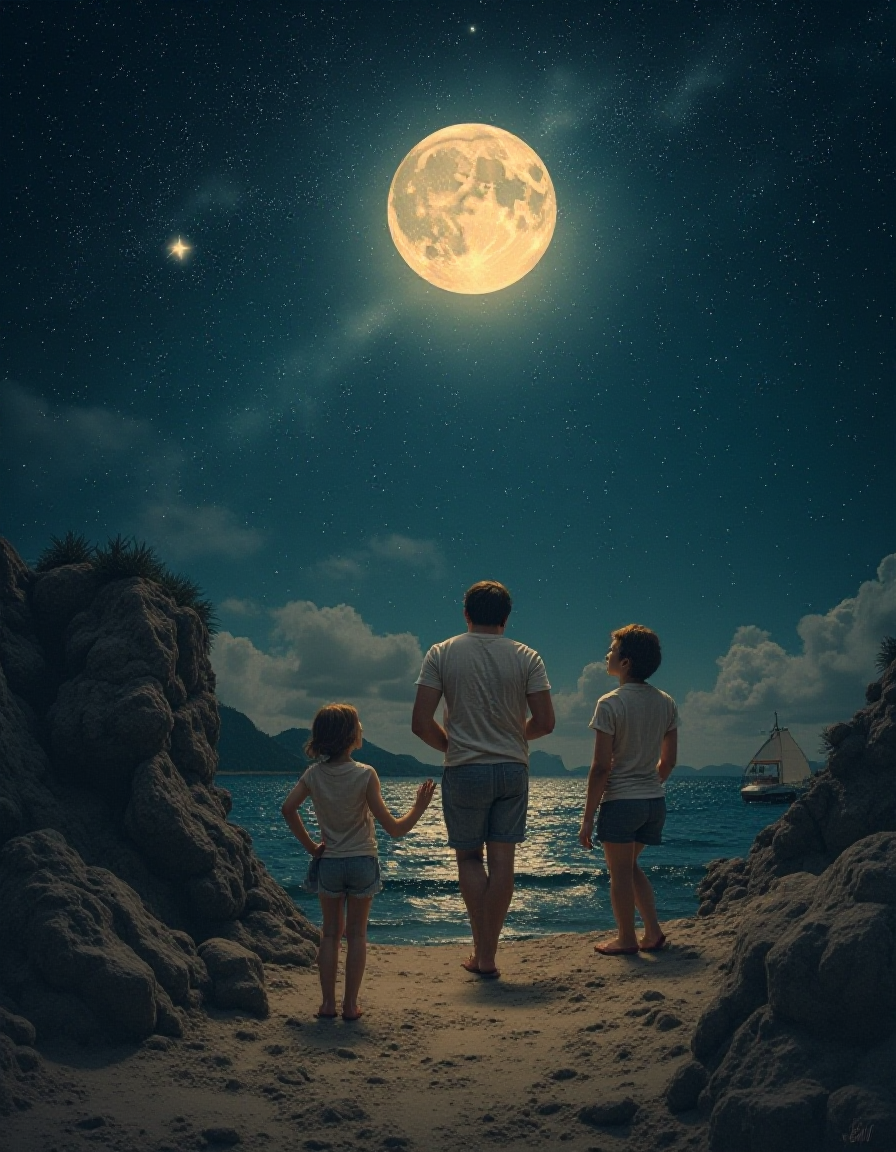
The image depicts a serene beach scene bathed in the warm glow of a full moon. The moon, positioned centrally in the sky, casts a golden hue over the ocean, creating a dramatic contrast with the dark blue of the water. The waves, gently lapping at the shore, are illuminated by the moonlight, reflecting off the wet sand and creating a mesmerizing pattern.
MONOLOGUE
It was not until the powerful rays of the sun blazed on the eyes of the youth that he awoke, so tired had he been with the anxiety and fatigue of the preceding day, and the sleepless harrowing night which had introduced it. He rose and seated himself upon his sea-chest: how different was the scene from that of yesterday! Again the ocean slept, the sky was serene, and not a cloud to be distinguished throughout the whole firmament; the horizontal line was clear, even, and well defined: a soft breeze just rippled over the dark blue sea, which now had retired to its former boundary, and left the sand-bank as extended as when first Francisco had been put on shore. But here the beauty of the landscape terminated: the foreground was horrible to look upon; the whole of the beach was covered with the timbers of the wreck, with water-casks and other articles, in some parts heaped and thrown up one upon another; and among them lay jammed and mangled the bodies of the many who had perished. In other parts there were corpses thrown up high and dry, or still rolling and turning to the rippling wave; it was a scene of desolation and of death.
SUMMARY
The image depicts a serene night scene featuring a large, glowing moon in the sky, casting a warm glow over a tranquil river. The moon is positioned in the upper right corner of the image, while the river flows towards the bottom left. The surrounding landscape is dominated by snow-capped mountains, adding a sense of depth and grandeur to the scene
CAPTION
The image depicts a serene night scene in a mountainous area. The sky is filled with a full moon, casting a golden glow over the landscape. The moon is positioned in the upper right corner of the image, with its bright light reflecting off the water below.
MONOLOGUE
“Now I rested awhile, then went to the mouth of the cave and looked out. The sun was sinking: all the depth of the forest was black, but the light still shone on the face of the stone woman who sits forever on the mountain. Here, then, I must bide this night, for, though the moon shone white and full in the sky, I dared not wend towards the plains alone with the wolves and the ghosts. And if I dared not go alone, how much less should I dare to go bearing with me him who sat in the cleft of the rock! Nay, here I must bide, so I went out of the cave to the spring which flows from the rock on the right yonder and washed my wounds and drank. Then I came back and sat in the mouth of the cave, and watched the light die away from the face of the world. While it was dying there was silence, but when it was dead the forest awoke. A wind sprang up and tossed it till the green of its boughs waved like troubled water on which the moon shines faintly. From the heart of it, too, came howlings of ghosts and wolves, that were answered by howls from the rocks above—hearken, Umslopogaas, such howlings as we hear to-night!
SUMMARY
a lone figure stands on a rocky mountain, gazing out at a breathtaking view of a celestial body in the sky. the figure is silhouetted against the vibrant hues of the sky, with the moon and stars adding to the surreal atmosphere.
CAPTION
The image depicts a surreal landscape with a large, glowing moon in the sky, casting a pinkish hue over the scene. The moon is positioned in the upper left corner of the image, and the sky is filled with clouds in shades of pink and purple. The ground is a dark, rocky terrain, with a figure standing on it, silhouetted against the moonlit backdrop.
MONOLOGUE
The fields were beginning to wear the deeper and richer hues of approaching autumn, and it was a perpetual pleasure to watch the rippling motion of the golden grain waving in the breeze, or the rapid changes of light and shade on the fields and woods, as the clouds passed swiftly over the sky. To watch these were their morning pleasures; but better still, perhaps, they loved the quiet sunset hours, when the glowing tints of the sky seemed to clothe the landscape in an unearthly glory, and then gradually each bright hue would fade out from the sky and from the land below, leaving the scene to the solemn repose of the shadowy evening, broken only by the flitting fireflies, or to the flood of silver light shed by the rising moon. But Amy was never to be allowed to be out in the night air, so that their rambles had to be over before the damp night dews. They generally found Mrs. Browne standing at the gate, awaiting their return, anxious lest her charge should have ventured to remain out too long.
SUMMARY
the planet is a crescent moon with a glowing green and yellow atmosphere and a starry sky. the landscape is a rocky terrain with a large crater and a mountain range in the background.
CAPTION
The image presents a surreal landscape dominated by a large, glowing moon in the top left corner, which appears to be a crescent shape. The moon is set against a vibrant, fiery backdrop of orange and red hues, with clouds of smoke and fire drifting across the sky.
MONOLOGUE
They had camped among the red firs where the Desert crossed the State Line and merged from cut rocks to broken timber. It was seven weeks since they had set out from the Upper Mesas of the Rim Rocks, four weeks since they had left the saline pool. Man and beast, fagged to the point of utter exhaustion, retraced steps slower than fresh hunters on an untried trail. Also, going down, they had followed hard wherever fugitives led. Coming back, they struck across to the Western Desert road, and travelled from belt to belt of the irrigation farms, with their orange-green cottonwood groves and bluish-green alfalfa fields and little match box houses stuck out of sight among peach orchards. The parched-earth, burnt-oil smell gave place to the minty odor of hay in wind rows, with the cool water tang of the big irrigation ditch flowing liquid gold in the yellow August light. One evening, Matthews looked back to the looming heat waving and writhing above the orange sands beneath a sky of lilac and topaz round a sunset flowing from a dull red ball of fire. Far ahead, the edges of forested mountain cut the heat haze with opal winged light above what might have been peaks or clouds.
SUMMARY
a silhouette of a person holding a staff in front of a full moon.
CAPTION
The image depicts a silhouette of a person holding a staff in a field at night. The person is positioned in the foreground, facing away from the viewer, and is surrounded by tall grass and a large, glowing moon in the background. The moon is a vivid pink color, and the sky is a deep blue, creating a dramatic and mystical atmosphere.
MONOLOGUE
"Tuesday, September 26th. Beautiful weather. The sun stands much lower now; it was 9° above the horizon at midday. Winter is rapidly approaching; there are 14 1/2° of frost this evening, but we do not feel it cold. To-day's observations unfortunately show no particular drift northward; according to them we are still in 78° 50' north latitude. I wandered about over the floe towards evening. Nothing more wonderfully beautiful can exist than the Arctic night. It is dreamland, painted in the imagination's most delicate tints; it is color etherealized. One shade melts into the other, so that you cannot tell where one ends and the other begins, and yet they are all there. No forms--it is all faint, dreamy color music, a far-away, long-drawn-out melody on muted strings. Is not all life's beauty high, and delicate, and pure like this night? Give it brighter colors, and it is no longer so beautiful. The sky is like an enormous cupola, blue at the zenith, shading down into green, and then into lilac and violet at the edges. Over the ice-fields there are cold violet-blue shadows, with lighter pink tints where a ridge here and there catches the last reflection of the vanished day. Up in the blue of the cupola shine the stars, speaking peace, as they always do, those unchanging friends. In the south stands a large red-yellow moon, encircled by a yellow ring and light golden clouds floating on the blue background. Presently the aurora borealis shakes over the vault of heaven its veil of glittering
SUMMARY
a night scene with a large moon and a factory with smoke coming out of the smokestack
CAPTION
The image depicts a nighttime scene with a large, full moon in the sky, casting a warm glow over the scene. The moon is positioned in the upper left corner of the image, and the sky is filled with clouds. In the foreground, a body of water is seen, reflecting the moonlight and creating a mirror-like effect.
MONOLOGUE
had heard of the position in front of us. "It's a Gibraltar," said an officer who was there in the early days of the war. "The enemy will fight his hardest for the Messines Ridge," said another officer, whose opinion has weight. "He has stacks of guns against us." Such thoughts made one shiver, though the night was warm, so warm and moist that wafts of scent came up from the earth and bushes. A full moon had risen, veiled by vapours until they drifted by and revealed all her pale light in a sky that was still faintly blue, with here and there a star. The moon through all her ages never looked down upon such fires of man-made hell as those which lashed out when the bombardment quickened. That was just before three o'clock. For two hours before that fires had been lighted in the German lines by British shell-fire--big rose-coloured smoke-clouds with hearts of flame--and all round the salient and the Messines Ridge our guns flashed redly as they fired, and their shell-bursts scattered light against which the trees were etched sharply. I could hear the rattle of gun-wagons along the distant roads, and the tuff-tuff of an engine driving very close up to the firing-lines, and above the great loudness of our gun-fire the savage whine of German shrapnel coming over in quick volleys. The drone of a night-flying aeroplane passed overhead. The sky lightened a little, and showed black smudges like ink-blots on blue silk cloth where our kite-balloons rose in clusters to spy out the first news of the coming
SUMMARY
two figures in dark cloaks are walking on a rocky terrain with a large moon in the sky.
CAPTION
The image depicts a dramatic scene set in a mountainous landscape. The sky is a deep blue, adorned with a large, glowing moon that casts a bright, ethereal light over the scene. The moon is positioned in the upper right corner of the image, creating a sense of depth and distance. In the foreground, two figures are seen walking towards the viewer.
MONOLOGUE
Another great charm of mountain districts is the richness of colour. "Consider,[38] first, the difference produced in the whole tone of landscape colour by the introductions of purple, violet, and deep ultra-marine blue which we owe to mountains. In an ordinary lowland landscape we have the blue of the sky; the green of the grass, which I will suppose (and this is an unnecessary concession to the lowlands) entirely fresh and bright; the green of trees; and certain elements of purple, far more rich and beautiful than we generally should think, in their bark and shadows (bare hedges and thickets, or tops of trees, in subdued afternoon sunshine, are nearly perfect purple and of an exquisite tone), as well as in ploughed fields, and dark ground in general. But among mountains, in addition to all this, large unbroken spaces of pure violet and purple are introduced in their distances; and even near, by films of cloud passing over the darkness of ravines or forests, blues are produced of the most subtle tenderness; these azures and purples passing into rose colour of otherwise wholly unattainable delicacy among the upper summits, the blue of the sky being at the same time purer and deeper than in the plains. Nay, in some sense, a person who has never seen the rose colour of the rays of dawn crossing a blue mountain twelve or fifteen miles away can hardly be said to know what tenderness in colour means at all; bright tenderness he may, indeed, see in the sky or in a flower, but this grave tenderness of the far-away
SUMMARY
The silhouette of a person is standing in front of a tree, with a full moon in the sky, creating a surreal and dreamlike atmosphere.
CAPTION
The image presents a surreal scene of a night sky filled with vibrant hues of purple, pink, and blue. Dominating the sky is a large, glowing moon, its surface reflecting the colors of the sky. In the foreground, two silhouetted figures are captured mid-stride, their silhouettes contrasting with the moon's glow.
MONOLOGUE
An old writer {27c} describes the air as being “crass, and full of rotten harrs”; and Drayton, in his “Polyolbion” {28a} speaks of the “unwholesome ayre, and more unwholesome soyle”; but that condition of things has long ago passed away. Another charming effect of these distant prospects is the glorious sunsets. Kingsley, in his “Hereward the Wake,” truly says, the “vastness gives such cloudlands, such sunrises, such sunsets, as can be seen nowhere else in these isles.” A writer, whom I have already quoted, says, “I am inclined to think the sky scenery, if I may be allowed the term, the finest and most wonderful in the world.” As to “its gorgeous sunsets, you look upon an atmosphere saturated with colour, so that it becomes opalesque; and the sinking sun, seen through the vibrating air, is magnificent. From the slopes of far California I have looked down upon the sun dipping into the wide Pacific, amid a riot of colour, but nothing like this.” {28b} Nor is this any exaggeration. The visitor to Woodhall may see it for himself, and the writer has often gazed upon it. Towards evening the soft blue of the distance becomes gradually lit up by the lowering sun with the most gorgeous and varied shades of purple, gold, and ruby, until he sinks below the horizon in a blaze of crimson glory. Then follow, softer, more mellowed tints of violet, pink, emerald green, exquisite greys, and varying hues of the most delicate kinds, until they slowly fade away into the shades of night, or the silvery sheen of the moon.
SUMMARY
the night sky is filled with a full moon and a large alien spaceship. the landscape is a dark, rocky terrain with a river running through it, and there are several large, alien structures in the background. there are several people scattered throughout the landscape, some of whom are standing on the riverbank.
CAPTION
The image is a digital painting depicting a fantastical, post-apocalyptic landscape. The sky is a deep blue, with a full moon casting an eerie glow. The moon is positioned in the upper left corner of the image, and a large, glowing red eye is visible on the moon's surface. In the foreground, a large, dark, and ominous structure dominates the scene.
MONOLOGUE
No matter. M. Chauchard acquired pictures and left them to the French Nation, and they are now on view for ever (always excepting the fatal Continental Mondays) for all to rejoice in. The first really compellingly beautiful work as one enters--the first picture to touch the emotions--is Rousseau's "La Charrette". It was painted in 1862, five years before the painter's death, which left the villagers of Barbizon the richer by a studio-chapel. It is a mere trifle and it is as wonderful as a summer day: a forest glade, in the midst of which a tiny wagon and white horse with blue trappings are seen beneath a burning sky, such a picture as ought to have a wall if not a room to itself: such a picture as I should like to see placed above an altar. It is the same subject--a forest wagon--that provided what in some ways is the best or most attractive Corot here. His "La Charrette" is a large easy landscape lit by the gracious light of which he alone had the secret. In the foreground is a deep sandy road with the charrette labouring through it. But before we came to this we had stood before one of the finest of the seven Daubignys, "La Seine Bezons," a river scene of almost terrible calm, with Mont Valerien in the distance and geese and boats on the near shore, and implicit in it the sincerity, strength and humility of this great man.
SUMMARY
couple walking on a river at sunset with a dog.
CAPTION
The image presents a serene night scene with a couple walking along a riverbank. The sky is a deep blue, adorned with a full moon and a few stars scattered across it. The moon is positioned in the upper right corner, casting a soft glow over the scene.
MONOLOGUE
And now the sickening horrors of sentiment overtook him, for now he had time to reflect upon what had occurred. The figure of the riderless horse flying with its dead burden before the wind had fixed itself on his imagination; and while the darkness was concealing the physical surroundings, it was revealing the phantasm in the glimmering outlines of every rock and tree. Look where he would, peering long and deep into the blackness of a night without moon or stars, without cloud or sky, with only a blank density around and about, Ralph seemed to see in fitful flashes that came and went--now on the right and now on the left of him, now in front and now behind, now on the earth at his feet and now in the dumb vapor floating above him--the spectre of that riderless horse. Sometimes he would stop and listen, thinking he heard a horse canter close past him; but no, it was the noise of a hidden river as its waters leapt over the stones. Sometimes he thought he heard the neigh of a horse in the distance; but no, it was only the whinny of the wind. His dog had followed close behind him when he fled from the pass, and it was still at his heels. Sometimes Laddie would dart away and be lost for a few minutes in the darkness. Then the dog's muffled bark would be heard, and Ralph's blood would seem to stand still with a dread apprehension that dared not to take the name of hope. No; it was only a sheep that had strayed from its fold, and had taken shelter from wind and rain beneath a stone in a narrow
SUMMARY
the character is standing in a field of tall grass and is looking up at the moon.
CAPTION
The image depicts a character standing in a field of tall grass under a full moon. The character is dressed in a red coat and has white hair. The moon is positioned in the upper left corner of the image, casting a glow over the scene.
MONOLOGUE
Beneath Edwin and Rosa is, first, an allegorical female figure, looking at a placard, headed ‘LOST,’ on a door. Under that again, is a girl in a garden-chair; a young man, whiskerless, with wavy hair, kneels and kisses her hand. She looks rather unimpassioned. I conceive the man to be Landless, taking leave of Rosa after urging his hopeless suit for which Helena, we learn, ‘seems to compassionate him.’ He has avowed his passion, early in the story, to Crisparkle. Below, the opium hag is smoking. On the other side, under the figures of Jasper and the choir, the young man who kneels to the girl is seen bounding up a spiral staircase. His left hand is on the iron railing; he stoops over it, looking down at others who follow him. His right hand, the index finger protruded, points upward, and, by chance or design, points straight at Jasper in the vignette above. Beneath this man (clearly Landless) follows a tall man in a ‘bowler’ hat, a ‘cut-away’ coat, and trousers which show an inch of white stocking above the low shoes. His profile is hid by the wall of the spiral staircase: he might be Grewgious of the shoes, white stockings, and short trousers, but he may be Tartar: he takes two steps at a stride. Beneath him a youngish man, in a low, soft, clerical hat and a black pea-coat, ascends, looking downwards and backwards. This is clearly Crisparkle. A Chinaman is smoking opium beneath.
SUMMARY
a lone figure stands in a dark, misty landscape at night, holding a staff, looking up at a full moon in the sky.
CAPTION
The image depicts a night scene with a figure standing in the foreground, holding a staff. The figure is dressed in dark clothing and is positioned on the left side of the image. The background is dominated by a large moon and a mountain range, with the moon casting a glow over the landscape.
MONOLOGUE
Both of the young men arose. One threw his arm around the neck of the other, and thus they left the noisy room. I followed, and saw them enter a dark chamber, where the one by mistake, instead of the window, threw open the door of a large wardrobe, and both, standing before it with outstretched arms, expressing poetic rapture, spoke alternately. "Ye breezes of darkening night," cried the first, "how ye cool and revive my cheeks! How sweetly ye play amid my fluttering locks! I stand on the cloudy peak of the mountain; far below me lie the sleeping cities of men, and blue waters gleam. List! far below in the valley rustle the fir-trees! Far above yonder hills sweep in misty forms the spirits of our fathers. Oh, that I could hunt with ye on your cloud-steeds through the stormy night, over the rolling sea, upwards to the stars! Alas! I am laden with grief, and my soul is sad!" Meanwhile, the other had also stretched out _his_ arms toward the wardrobe, while tears fell from his eyes as he cried to a pair of yellow leather pantaloons which he mistook for the moon, "Fair art thou, daughter of heaven! Lovely and blessed is the calm of thy countenance. Thou walkest in loveliness! The stars follow thy blue path in the east! At thy glance the clouds rejoice, and their dark forms gleam with light. Who is like unto thee in heaven, thou the night-born? The stars are ashamed before thee, and turn away their sparkling eyes. Whither, ah, whither, when morning pales thy face, dost thou flee from thy path? Hast thou, like me, thy Halle? Dwellest thou
SUMMARY
a silhouette of a woman standing on a mountain with a large moon in the background.
CAPTION
The image depicts a dramatic scene featuring a large, dark figure with a fierce expression, standing on a rocky outcrop. The figure is positioned in the foreground, facing the viewer, and is illuminated by a bright, glowing moon that is positioned in the background. The moon is a vivid, full moon with a reddish hue, and it casts a warm glow over the scene.
MONOLOGUE
The attitude was full of nobleness and simplicity. The head looked white and luminous, standing out from a dark gray sky, marbled at the horizon by purple clouds, upon which were visible the bluish summits of distant hills, in deep shadow. The arrangement of the picture, as well as the warm tints of the foreground, contrasting strongly with these distant objects, showed that the woman was placed upon an eminence, from which she could view the whole horizon. The countenance was deeply pensive and desponding. There was an expression of supplicating and resigned grief, particularly in her look, half raised to heaven, which one would have thought impossible to picture. On the left side of the fireplace was the other portrait, painted with like vigor. It represented a man, between thirty and thirty-five years of age, of tall stature. A large brown cloak, which hung round him in graceful folds, did not quite conceal a black doublet, buttoned up to the neck, over which fell a square white collar. The handsome and expressive head was marked with stern powerful lines, which did not exclude an admirable air of suffering, resignation, and ineffable goodness. The hair, as well as the beard and eyebrows, was black; and the latter, by some singular caprice of nature, instead of being separated and forming two distinct arches, extended from one temple to the other, in a single bow, and seemed to mark the forehead of this man with a black line.
SUMMARY
the figure is a woman with wings and horns, standing in front of a full moon and a dark sky with clouds. she is wearing a dress and has long hair.
CAPTION
The image depicts a figure with a crescent moon headdress and wings, standing in a dramatic, cosmic setting. The figure is dressed in a flowing, blue dress that extends to the ground, and is adorned with intricate, white and silver jewelry. The background is a vibrant mix of pink and purple hues, with a large, glowing moon in the top left corner, adding to the mystical atmosphere.
MONOLOGUE
Sometimes the figure was dressed in royal robes with long purple mantle and gilded crown upon the head; on Good Friday it lay in a white shroud as if in death; on Easter day it was arrayed in flowing white robes and was brought from the cemetery into town and borne at the head of a great parade. Those who could afford to do so would set up a special shrine in front of their homes, adorned with flowers and household images. The priest would, as a special favor, have special services before these shrines, and the more money spent on these shrines and the more paid to the priest the more distinguished the citizen. For days before the natives were busy making long candles out of carabao tallow. Some of these candles, huge and crude, would weigh four or five pounds. None of the so-called common people or the poor class would take part in any of these wonderful parades unless they were able to wear good clothes and have long trains to their dresses. I never saw any one in these processions who was at all poor; the poor simply stand by the roadside and look on. I asked my Filipino woman why she did not join; she said she would just as soon as she could get a dress with a train. It was not many weeks before she was in the procession, having earned the train by laundry work for the officers and soldiers. For the men, it was their joy to be able to purchase a derby hat. I never knew there could be so many kinds of derbies as I saw on the heads of these natives. It was said that a ship-load of them was brought over once, and they so charmed
SUMMARY
cactus and moon in a desert landscape at sunset.
CAPTION
The image depicts a surreal landscape with a large, glowing full moon in the center, casting a warm orange glow over the scene. The moon is positioned in the upper right corner of the image, with its bright light illuminating the surrounding area. In the foreground, there is a cactus with a prominent, pointed top, standing tall and relatively small in the image.
MONOLOGUE
The lower part of every Cuban hotel is used as a caf and restaurant, and stands open to the four winds of heaven. It begins to fill immediately after sunset, and in warm weather is never empty until four o'clock in the morning. In the middle of the caf is the kitchen, and in the centre of the kitchen will be found an indispensable retreat which does not add to the sanitary advantages of the establishment. Otherwise, a Cuban kitchen affords much interest and amusement to those in search of the picturesque. Round it are arranged little open charcoal stoves, above which are suspended an endless number of copper saucepans. Sometimes, up in a corner, is an image of our Lady of Guadaloupe, blessing, apparently, from the interior of her glass case, the motley gathering of cooks of all ages and colours, who are intently busy doing nothing. Here on the floor sits a little darkie shelling peas, and near him another small sable urchin howls because his ears have just been boxed for licking his fingers. Yonder is a group of chattering mulatresses whipping a cream, and there "Madame" herself roars at the top of her voice at the chief cook, standing frying chicken livers, strung on a skewer, over one of the innumerable charcoal fires, whose fumes would suffocate the whole noisy party, if this weird kitchen were not, but for its ceiling, quite an open air arrangement, for there are no glass windows anywhere in the house, the only protection against a storm being the green venetian blinds.
SUMMARY
a man in a long coat is standing on a rocky cliff holding a sword in a fantasy setting.
CAPTION
The image depicts a scene of a man standing in a dark, rocky landscape under a full moon. The man, dressed in a long black coat, is holding a sword in his right hand. The moon, a vivid pinkish-pink color, is positioned in the upper right corner of the image, casting a glow over the scene.
MONOLOGUE
And yet, on this dismal evening, the landscape was enlivened by two human figures. They were mounted on a rude sledge, drawn by four large dogs, that now, as the evening began to darken, were urging their way at full speed across one of the wider bays of the lake. The keen, penetrating wind blew right ahead, so intensely chill that it felt to the naked hand like a stream of ice; and the travellers, who were seated, with their backs to the blast, on the front part of the car, and who from time to time half turned their heads to direct the course of the dogs, drew closer and closer together as they felt their limbs stiffening, and a drowsy torpor stealing over all their faculties, under the deadening influence of the cold. They were dressed from head to foot in the skins of wild animals, with hoods, like those worn by the Esquimaux, projecting over their faces, and long strips of some thick, coarse fur wrapped in a spiral fashion round their limbs. One of them--a robust, dark-complexioned young man, rather above the middle size--had an Indian blanket bound round his shoulders; the other--who, though tall and well-made, was of a rather slighter form, and much less deeply bronzed by the climate--was closely enveloped in the folds of a Scottish plaid.
SUMMARY
painting of a red moon in the sky over a body of water
CAPTION
The image depicts a vibrant and dramatic landscape painting. Dominating the scene is a large, fiery red moon, positioned in the upper center of the image. The moon is set against a backdrop of a deep blue sky, which is filled with a multitude of clouds.
MONOLOGUE
87. The first man who entirely broke through the conventionality of his time, and painted pure landscape, was Masaccio, but he died too young to effect the revolution of which his genius was capable. It was left for other men to accomplish, namely, for Correggio and Titian. These two painters were the first who relieved the foregrounds of their landscape from the grotesque, quaint, and crowded formalism of the early painters; and gave a close approximation to the forms of nature in all things; retaining, however, thus much of the old system, that the distances were for the most part painted in deep ultramarine blue, the foregrounds in rich green and brown; there were no effects of sunshine and shadow, but a generally quiet glow over the whole scene; and the clouds, though now rolling in irregular masses, and sometimes richly involved among the hills, were never varied in conception, or studied from nature. There were no changes of weather in them, no rain clouds or fair-weather clouds, nothing but various shapes of the cumulus or cirrus, introduced for the sake of light on the deep blue sky. Tintoret and Bonifazio introduced more natural effects into this monotonous landscape: in their works we meet with showers of rain, with rainbows, sunsets, bright reflections in water, and so on; but still very subordinate, and carelessly worked out, so as not to justify us in considering their landscape as forming a class by itself.
SUMMARY
The image depicts a night scene with a starry sky, a crescent moon, and a full moon. The main subject is a man and a woman, both dressed in traditional clothing, sitting under a thatched roof. The man is holding a lantern, and the woman is holding a child. The scene is set in a desert landscape with mountains in
CAPTION
The image depicts a serene nighttime scene with a starry sky and a full moon. The sky is filled with numerous stars, creating a starry night sky. The moon is positioned in the upper right corner of the image, casting a bright light that illuminates the scene. In the foreground, a group of people is gathered around a small hut.
MONOLOGUE
The late Theophile de Bock was an interpreter of nature and his brush-work was fat and rich. His work is well known in America and gains in value every day (he died in 1904). There are fourteen specimens here of his best period. The Emile Bretons are early and therefore different from his commercial productions. Of the Corots, twelve in number, we did not see an insignificant one, not a weak one. The famous Early Morning and View at Villeneuve-les-Avignon are hung. The first depicts a group of trees; to the right a narrow stream in which is reflected a cloudless sky. In the centre two women in white caps. The second is more elaborate in composition. The middle distance is occupied by picturesque buildings dating probably from the Middle Ages. In the foreground four persons are under the shadow of some trees. An unusual scheme for Corot. His well-known characteristics are present in the dozen; the tremulous leafage, the bright, pure light, the Italian softness. And what do you say to a half-dozen Courbets, all of his strong period, landscapes, still-life, a nude study, a dead roe, a sunlit path, and a lake scene! Good Courbets are not numerous, and these are good. The nude is a woman recumbent upon draperies. The _pate_ is heavy but vital, the flesh tones glowing, and the silhouette firm, yet delicate. The portrait of the artist by himself is massive. It was probably painted in Ste. Pelagie.
SUMMARY
The image depicts a night scene with a group of people gathered around a bonfire in a mountainous area.
CAPTION
The image depicts a serene scene of a night sky with a full moon and a starry night sky. The sky is filled with clouds, and the moon is positioned in the upper right corner, casting a soft glow over the scene. In the foreground, a small hut is nestled in the center, with a group of people gathered around it.
MONOLOGUE
The calm that had now fallen upon us lasted unbroken for five full days, during which we sweltered, day and night, in the melting heat of the tropics, with the blazing sun right overhead every day at noon, and a waning moon soaring into the heavens later and still later each night to render the hours of darkness magical with the witchery of her beauty and mystery. And during the whole of this time we never shifted our position by so much as a single mile a day. At length, however, on the sixth day, a few cat's-paws came playing at intervals over the surface of the glass-smooth water, momentarily ruffling it into little evanescent patches of tender blue, and causing a transient ripple to play over the stagnant cloths of our canvas. As the day wore on the cat's-paws increased in frequency, in area, and in strength; and shortly before sundown a gentle, dainty little air of wind came stealing softly up from the eastward, to woo which we joyfully spread every rag of canvas we could show to it: and oh! how ineffably pleasant and delightful was the sound of the first faint liquid tinkling ripple that broke from our cutwater, and gushed gently past the bends in a stream of tiny bursting air-bells, as the beautifully moulded hull yielded to the faint impulse of the soft breathing and began to move under it with the languorous motion of a sleeping swan! Then, as the soft, warm, star-spangled darkness of the tropics closed down upon us and wrapped us within its impalpable folds, the breeze gathered strength and weight by
SUMMARY
The image depicts a vast ocean under a purple sky, with the sun setting in the distance. The waves are rippling, creating a dynamic and serene scene.
CAPTION
The image depicts a serene night sky with a full moon and a dark purple hue. The moon is positioned in the upper right corner of the image, casting a soft glow on the surrounding clouds and the ocean below. The ocean is depicted with waves, creating a sense of movement and dynamism.
MONOLOGUE
Several days passed rapidly. This strange companionship revealed to the Provenal the sublime beauties of the desert. The alternations of hope and fear, the sufficiency of food, the presence of a creature who occupied his thoughts,--all this kept his mind alert, yet free: it was a life full of strange contrasts. Solitude revealed to him her secrets, and wrapped him with her charm. In the rising and the setting of the sun he saw splendors unknown to the world of men. He quivered as he listened to the soft whirring of the wings of a bird,--rare visitant!--or watched the blending of the fleeting clouds,--those changeful and many-tinted voyagers. In the waking hours of the night he studied the play of the moon upon the sandy ocean, where the strong simoom had rippled the surface into waves and ever-varying undulations. He lived in the Eastern day; he worshiped its marvelous glory. He rejoiced in the grandeur of the storms when they rolled across the vast plain, and tossed the sand upward till it looked like a dry red fog or a solid death-dealing vapor; and as the night came on he welcomed it with ecstasy, grateful for the blessed coolness of the light of the stars. His ears listened to the music of the skies. Solitude taught him the treasures of meditation. He spent hours in recalling trifles, and in comparing his past life with the weird present.
SUMMARY
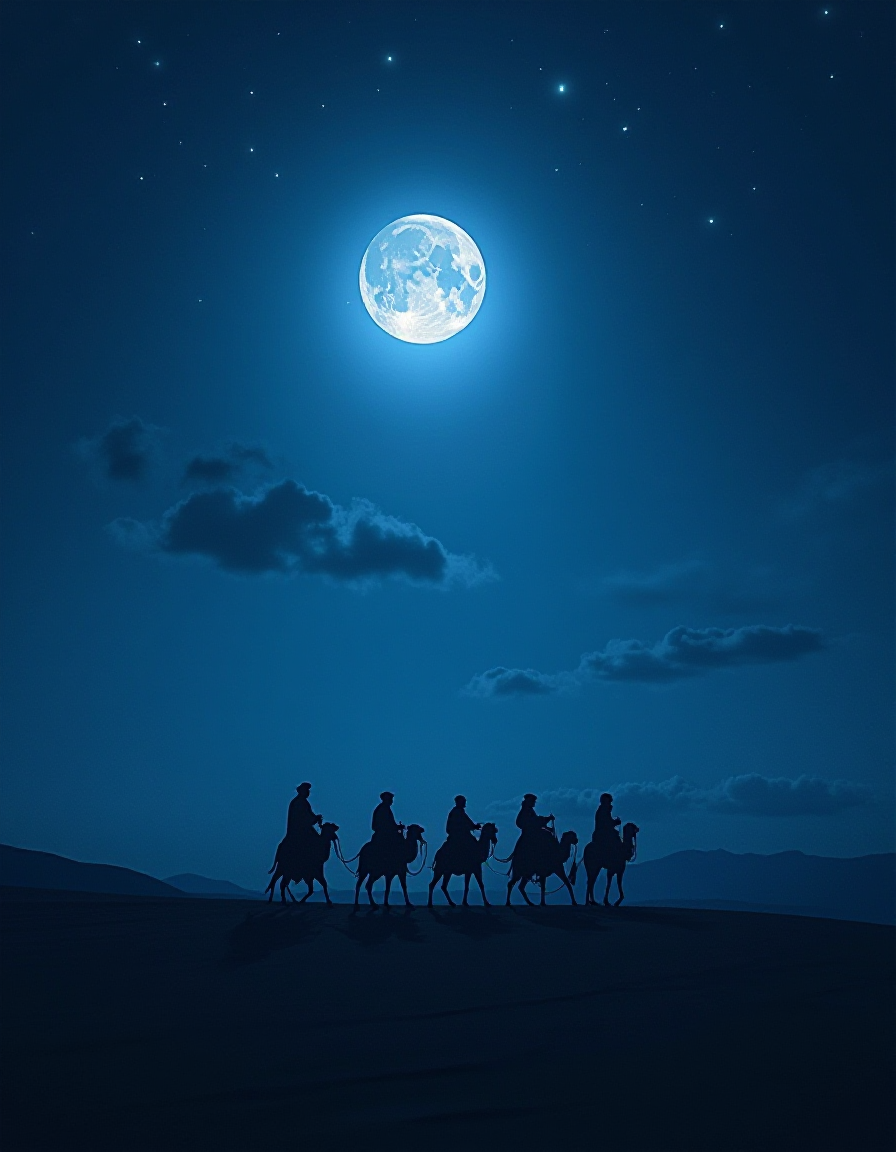
The silhouette of four camels and their riders is captured in a night sky with a full moon.
CAPTION
The image depicts a night scene with a full moon in the sky, casting a bright light over the landscape. The moon is positioned centrally, with a few stars scattered around it. The sky is dark blue, and the moon is illuminated, making it appear as if it is glowing. In the foreground, there are four silhouetted figures riding camels.
MONOLOGUE
The moon shines coldly out of an intense blue sky where a few stars glisten faint as mica. Shadow fills half the street, etching a silhouette of roofs and chimneypots and cornices on the cobblestones, leaving the rest very white with moonlight. The facades of the houses, with their blank windows, might be carved out of ice. In the dark of a doorway a woman sits hunched under a brown shawl. Her head nods, but still she jerks a tune that sways and dances through the silent street out of the accordion on her lap. A little saucer for pennies is on the step beside her. In the next doorway two guttersnipes are huddled together asleep. The moonlight points out with mocking interest their skinny dirt-crusted feet and legs stretched out over the icy pavement, and the filthy rags that barely cover their bodies. Two men stumble out of a wineshop arm in arm, poor men in corduroy, who walk along unsteadily in their worn canvas shoes, making grandiloquent gestures of pity, tearing down the cold hard facades with drunken generous phrases, buoyed up by the warmth of the wine in their veins.
SUMMARY
full moon rising over the ocean at night.
CAPTION
The image captures a serene night scene featuring a full moon in the center of the frame, casting a soft glow on the dark blue ocean. The moon is positioned in the upper center of the image, with the ocean stretching out below it, creating a sense of depth and tranquility. The moon's reflection is visible on the surface of the water, adding a touch of light to the otherwise dark scene.
MONOLOGUE
Any pretext to seek to quit the place before the definite arrangements of his negotiation were consummated seemed even to him, despite his eagerness to be off, too tenuous, too transparent, to be essayed, although he devised several as he sat meditative and silent amongst the group about the still. The prospect grew less and less inviting as the lingering day waned, and the evening shadows, dank and chill, perceptibly approached. The brown and green recesses of the grotto were at once murkier, and yet more distinctly visible, for the glow of the fire, flickering through the crevices of the metal door of the furnace, had begun to assert its luminous quality, which was hardly perceptible in the full light of day, and brought out the depth of the shadows. The figures and faces of the moonshiners showed against the deepening gloom. The sunset clouds were still red without; a vague roseate suffusion was visible through the falling water. The sun itself had not yet sunk, for an oblique and almost level ray, piercing the cataract, painted a series of faint prismatic tints on one side of the rugged arch. But while the outer world was still in touch with the clear-eyed day, night was presently here, with mystery and doubt and dark presage. The voice of Hoho-hebee Falls seemed to him louder, full of strange, uncomprehended meanings, and insistent iteration. Vague echoes were elicited. Sometimes in a seeming pause he could catch their lisping sibilant tones repeating, repeating--what? As the darkness encroached yet more heavily
SUMMARY
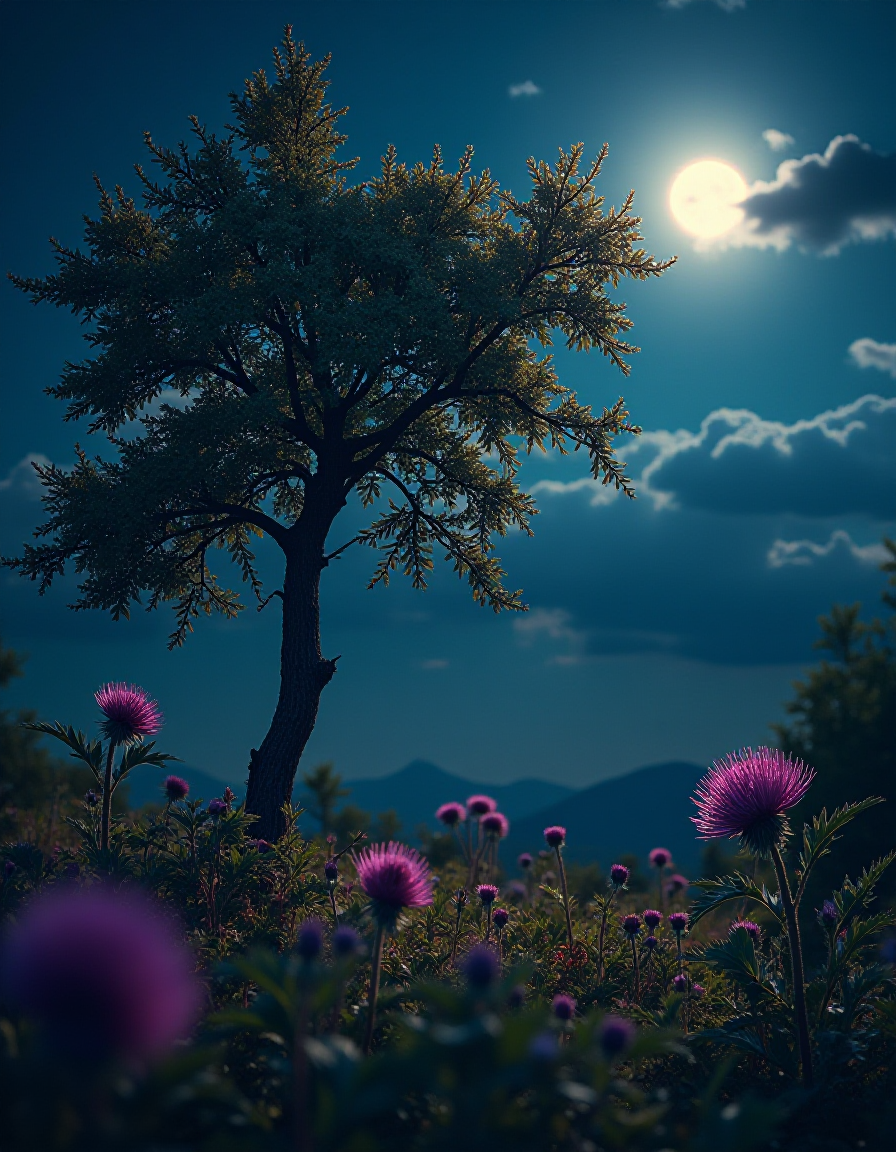
The image depicts a night scene with a large tree in the foreground, surrounded by a field of purple flowers and a mountain range in the background.
CAPTION
The image captures a serene night scene in a mountainous landscape. The sky is a deep blue, dotted with fluffy white clouds, suggesting a clear and calm night. A full moon is visible in the upper right corner, casting a soft glow over the scene. In the foreground, a large tree stands tall, its branches reaching out towards the moon.
MONOLOGUE
For many hours after the coasts of Calabria had faded into the night, and even after the snowy dome of Etna was lost to view, our ship steamed through the open sea, with no land in sight; but we were told that early in the morning, at the very break of dawn, the coasts of Greece would be visible. So, while others slept, I started up at half-past three, eager to get the earliest possible sight of the land which still occupies so large a place in our thoughts. It was a soft gray morning; the sky was covered with light, broken clouds; the deck was wet with a passing shower, of which the last drops were still flying in the air; and before us, some ten miles away, the coasts and promontories of the Peloponnesus were reaching southward into the quiet sea. These long serrated ridges did not look lofty, in spite of their snow-clad peaks, nor did they look inhospitable, in spite of their rough outline, but were all toned in harmonious color—a deep purple blue, with here and there, on the far Arcadian peaks, and on the ridge of Mount Taygetus, patches of pure snow. In contrast to the large sweeps of the Italian coast, its open seas, its long waves of mountain, all was here broken, and rugged, and varied. The sea was studded with rocky islands, and the land indented with deep, narrow bays. I can never forget the strong and peculiar impression of that first sight of Greece; nor can I cease to wonder at the strange likeness which rose in my mind, and which made me think of the bays and rocky coasts of the west and
SUMMARY
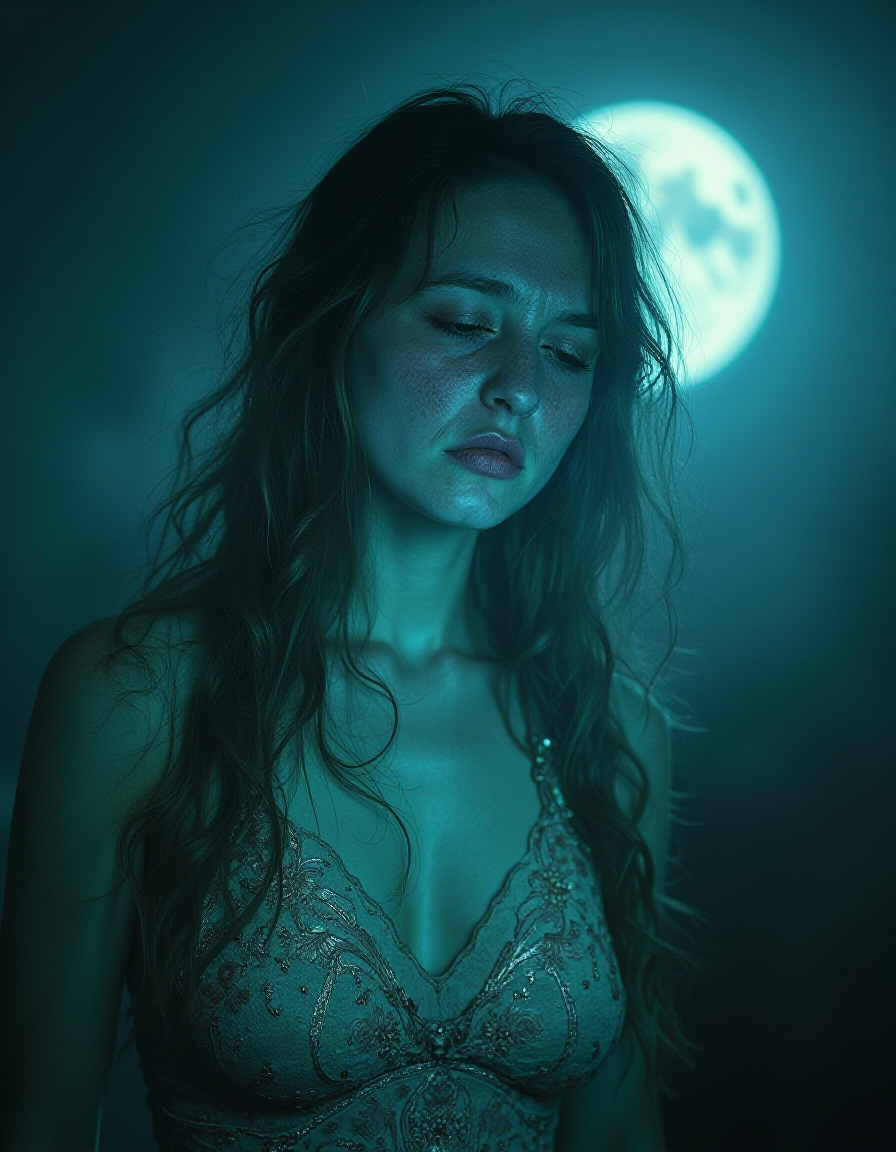
a woman with long hair is looking at the moon in a dark room
CAPTION
The image depicts a woman with long, wavy hair, wearing a lace bra, standing in front of a full moon. The woman's expression is serious, and she is looking directly at the camera. The background is dark, with a glowing blue hue that contrasts with the moon's light.
MONOLOGUE
But I confess that I was attracted to the Place de la Concorde more by the historical associations connected with it, than by its present magnificence. Leaning upon the parapet of the bridge and looking down upon the Seine, a pleasant July morning was present to my imagination, and a crowd was gathered upon the place to witness an execution. The slight form of a beautiful woman passes up yonder winding steps to the block. Her hair is dark--not so dark, though, as her genius-lighted eyes -and her forehead is white and nobly pure. She kneels, bows down her head to the block, and is forever dead. It was Charlotte Corday, the enthusiast, who assassinated Marat in his bath. I have seen the place where she killed him--have looked at the very threshold where she waited so long before she gained admittance. The house is standing yet, and the room where Marat lay in his bath writing--where he looked up from his manuscript at Charlotte Corday and promised death to some of her dearest friends in a provincial town--where she plunged her dagger to the center of his black heart!
SUMMARY
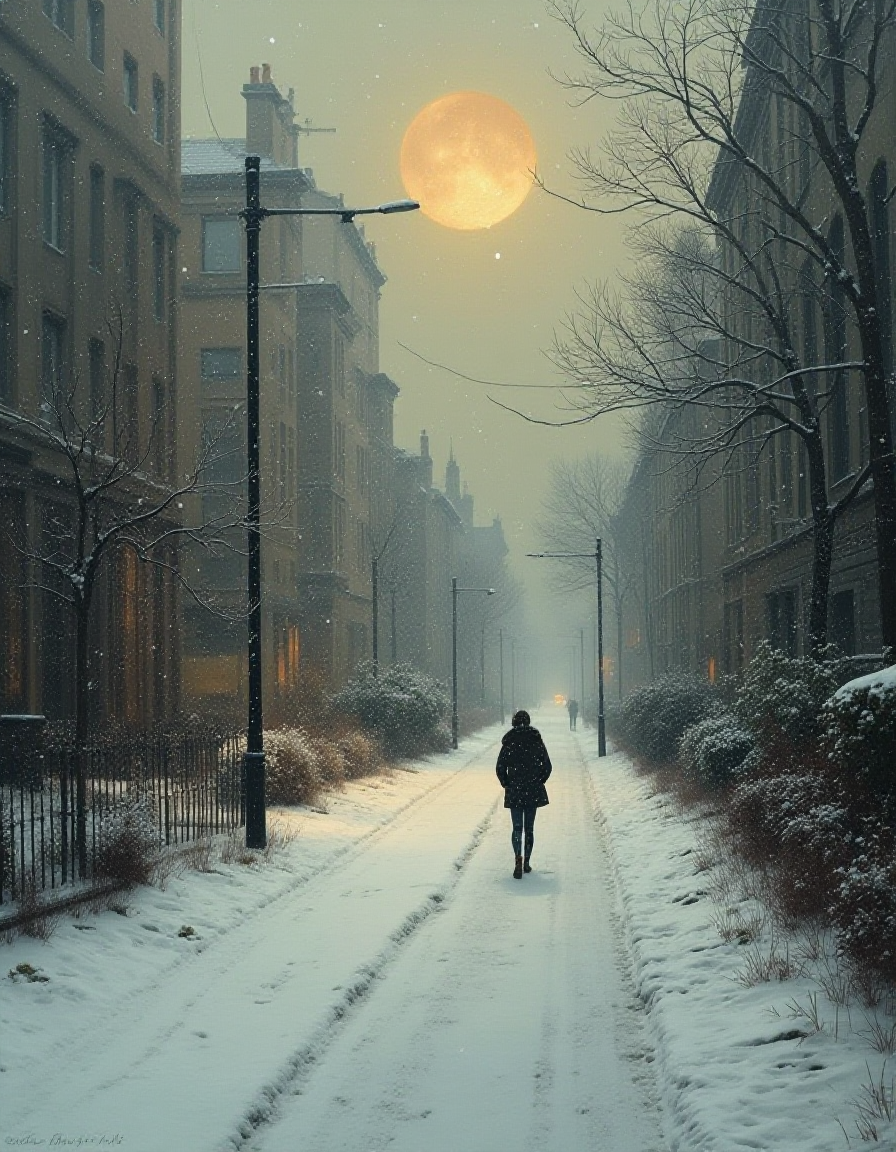
The night scene depicts a solitary figure in a long black coat walking down a snow-covered street, illuminated by the moon, while the houses on either side are illuminated by street lamps.
CAPTION
The image depicts a serene winter night scene in a European town. The sky is a deep, dark blue, with a full moon shining brightly in the center, casting a warm glow over the scene. The moon is positioned slightly to the right of the center of the image, and it is surrounded by a halo of light.
MONOLOGUE
Those years of expectation in Bergen were busy years. Every now and then he would become homesick. In winter time he would go by the railway from Bergen to Voss, [14] thence on ski over the mountains to Christiania, down the Stalheim road,1 with its sinuous twists and bends, on through Nrdal, noted for its earth slips, on by the swift Lerdals river fretting and fuming on one side, and a perpendicular mountain wall on the other. And here he would sit to rest in that narrow gorge where avalanches are of constant occurrence. Let them come! he must rest awhile and eat. A solitary wayfarer hurries by on his sleigh as fast as his horse will go. "Take care!" shouts the traveller as he passes by; and Nansen looks up, gathers his things together, and proceeds on his journey through the valley. It was Sauekilen, the most dangerous spot in Lerdals, where he was resting. Then the night falls, the moon shines brightly overhead, and the creaking sound of his footsteps follows him over the desert waste, and his dark-blue shadow stays close beside him. And he, the man possessed of ineffable pride and indomitable resolution, feels how utterly insignificant he is in that lonely wilderness of snow--naught but an insect under the powerful microscope of the starlit sky, for the far-seeing eye of the Almighty is piercing through his inmost soul. Here it avails not to seek to hide aught from that gaze. So he pours out his thoughts to Him who alone has the right to search them. That midnight pilgrimage over the snowy waste was like a divine
SUMMARY
a person in a long robe stands in a field of red flowers with a large moon in the sky
CAPTION
The image depicts a person standing in a field of red flowers, with a large, glowing moon in the sky above them. The moon is orange and appears to be in the process of rising, casting a warm glow over the scene. The person is dressed in a long, hooded robe, and their face is not visible.
MONOLOGUE
Returning home our route was changed, and Quash the boatman took us all the way round by water to Hampton. I should have told you that our exit was as wild as our entrance to this estate and was made through a broken wooden fence, which we had to climb partly over and partly under, with some risk and some obloquy, in spite of our dexterity, as I tore my dress, and very nearly fell flat on my face in the process. Our row home was perfectly enchanting; for though the morning's wind and (I suppose) the state of the tide had roughened the waters of the great river, and our passage was not as smooth as it might have been, the wind had died away, the evening air was deliciously still, and mild, and soft. A young slip of a moon glimmered just above the horizon, and 'the stars climbed up the sapphire steps of heaven,' while we made our way over the rolling, rushing, foaming waves, and saw to right and left the marsh fires burning in the swampy meadows, adding another coloured light in the landscape to the amber-tinted lower sky and the violet arch above, and giving wild picturesqueness to the whole scene by throwing long flickering rays of flame upon the distant waters.
SUMMARY
a woman wearing a cowboy hat and a denim jacket is standing in front of a large moon
CAPTION
The image depicts a woman standing in front of a large, glowing moon. She is wearing a black cowboy hat and a denim jacket, and her long hair is flowing down her back. The moon is positioned behind her, casting a warm glow over her.
MONOLOGUE
combing it, she plaited and rolled it up, in a great big rouleau behind, then washing her hands, she drew out the bidet, poured water into it, and then divested herself of her shift. She was standing in front of the dressing-table, with two candles shining on her, so that when she lifted her shift over her head; I had a well-lighted full view of her wonderfully covered belly. She was all over hair; it was as black as coal, and shone as if polished in all its beautiful curls. I am now an old man, but never have I seen the equal to that dear woman in a hairy belly. It was quite up to her navel, and several inches down the inside of her thighs, besides running thickly in the chinks of her bottom, and with two bunches where the beautiful back dimple is usually situated, as thick, and even thicker than ordinary women have in on their mounts. In addition to this, there was a beautiful little line of curls that ran up her belly, as far as between her bubbies, to say nothing of the very hairy thighs, legs, and arms. I never saw a more deliciously hairy woman, and she was all that such excessive growth of hair denoted--passionate and lecherous to a degree, when once she had confidence in her companion, to let her feelings have vent. Of course, I am now describing my after-experience; at the moment I was only dazzled by the extraordinary richness and quantity of that exquisite ornament--hair--not only in splendid quantity on the head, but in a profusion such as I had never then and have not since witnessed. I was
SUMMARY
a woman wearing a hat and a dress is standing in front of a large moon
CAPTION
The image depicts a woman standing in front of a large, glowing moon. The woman is dressed in a cowboy hat and a long, flowing dress. The background is a dark, textured wall, which contrasts with the bright moon and the woman's attire.
MONOLOGUE
When we were at Black river I was on picket one night about a mile or so from camp, at a point on an old country road. Some time shortly after midnight, while I was curled up asleep in a corner of the old worm fence by the side of the road, I was suddenly awakened by an energetic shake, accompanied by the loud calling of my name. I sprang to my feet at once, thinking maybe some trouble was afoot, and, to my surprise, saw Capt. Keeley standing in front of me, with some other gentleman. "Stillwell," said Keeley, "here's an old friend of yours. He wanted to see you, and being pressed for time, his only chance for a little visit was to come to you on the picket line." My caller stood still, and said nothing. I saw that he was an officer, for his shoulder straps were plainly visible, but I could not be sure of his rank, for there was no moon, and the night was dark. He was wearing an old "sugar-loaf" hat, seemingly much decayed, his blouse was covered with dust, and, in general, he looked tough. His face was covered with a thick, scraggy beard, and under all these circumstances it was impossible for me to recognize him. I was very anxious to do so in view of the trouble the officer had taken to come away out on the picket line, in the middle of the night, to see me, but I just couldn't, and began to stammer a sort of apology about the darkness of the night hindering a prompt recognition, when the "unknown" gave his head a slant to one side, and, in his never forgettable voice, spoke thus to
SUMMARY
a person in a denim jacket is looking at a large moon in the night sky
CAPTION
The image depicts a person standing in front of a large, glowing orange moon. The person is facing away from the viewer, with their head turned slightly to the left. The moon is positioned in the upper right corner of the image, and the person's silhouette is clearly visible against the moon's bright glow.
MONOLOGUE
The book fell open of its own accord at the Palinodia at Tyndaridem. On the stained and fingered leaf facing the ode I could still decipher the plan of Lukstein Castle, and as I gazed, that blurred outline filled until it became a picture. I looked into the book as into a magician's crystal. The great angle of the building, the level row of windows, the red roofs of the turrets, the terrace, and the little pinewood pavilion, all were clearly limned before my eyes, and were overswept by changing waves of colour. I saw the Castle as on the first occasion of my coming, hung disconsolately on a hillside in a far-away corner of the Tyrol, a black stain upon a sloping wilderness of snow; I saw it again under a waning moon in the stern silence of a frosty night, as each window grew angry with a tossing glare of links; but chiefly I saw it as when I rode thither on my last memorable visit, sleeping peacefully above the cornfields in the droning sabbath of a summer afternoon. I turned my eyes to the ode. The score of my pencil was visible against the last verse:
SUMMARY
a man in a cowboy hat and jeans is standing in front of a full moon in the night sky
CAPTION
The image depicts a person standing on a hill, gazing up at a large, glowing moon. The person is dressed in a cowboy hat and a long-sleeved shirt, and is holding a rifle. The moon is a vivid blue-green color, and the sky is dark, suggesting it is either early morning or late evening.
MONOLOGUE
In the hot days of summer, over against the dark forest the bright green of our little patch of Indian corn rippled in the wind. And towards night I would often sit watching the deep blue of the mountain wall and dream of the mysteries of the land that lay beyond. And by chance, one evening as I sat thus, my father reading in the twilight, a man stood before us. So silently had he come up the path leading from the brook that we had not heard him. Presently my father looked up from his book, but did not rise. As for me, I had been staring for some time in astonishment, for he was a better-looking man than I had ever seen. He wore a deerskin hunting shirt dyed black, but, in place of a coonskin cap with the tail hanging down, a hat. His long rifle rested on the ground, and he held a roan horse by the bridle.
SUMMARY
a full moon rising over a beach at night
CAPTION
The image depicts a serene beach scene bathed in the warm glow of a full moon. The moon, positioned centrally in the image, casts a radiant light on the wet sand, creating a mirror-like effect that reflects the surrounding lights. The beach is dotted with a few buildings, their silhouettes faintly visible against the moonlit backdrop.
MONOLOGUE
The death of Evans affected the three survivors more or less during the remainder of the day; they were all very silent and thoughtful, and turned in early to sleep. About midnight Roger awoke with a vague sense of some impending evil. He turned and turned again upon his hard couch, but found it impossible to sleep. After a time he began to feel that there was a something missing to which he had been accustomed. He racked his brain over and over again, vainly trying to remember what it was, but for some time without success. Then it came suddenly upon him that the usual faint reflection of the glow which the big fire at the beach had been wont to throw round the hut was absent. Quickly getting into a few clothes, he stepped out of the hut, and saw that the moon in her first quarter was rising high in the heavens, giving just sufficient light for him to distinguish objects faintly. He therefore did not take the lantern with him, but at once walked away down to the beach, where he found the fire out and cold. They had forgotten to replenish it before turning in for the night. He took out his tinder-box, in order to get a light, when he happened to look up, and to seaward. And there, before his astonished gaze, he saw a vessel riding at anchor about two miles from the shore. In the first paroxysm of his joy, Roger was about to call aloud, imagining the craft to be one of the vessels of Cavendish's squadron; but on looking again, and studying the craft more closely, he saw that she was altogether different from any of the
SUMMARY
The night sky is filled with a full moon and a city skyline.
CAPTION
The image depicts a night scene with a full moon in the sky, casting a soft glow over the landscape. The moon is positioned in the upper right corner of the image, and the sky is a deep blue, with the moon's light reflecting off the surface of the water in the foreground.
MONOLOGUE
It was a still, lovely, starlight night. The moon had risen over the hills, and was shining brightly on the roofs and towers of the city, and on the masts and spars of the vessels which were riding in the harbour. There was not a ripple on the water, and stars and city, towers and ships, stood inverted on the surface pointing downward as into a second infinity. The charm was unfortunately interfered with by odours worse than Coleridge found at Cologne and cursed in rhyme. The drains of Havana, like orange blossom, give off their most fragrant vapours in the dark hours. I could well believe Don G----'s saying, that but for the natural healthiness of the place, they would all die of it like poisoned flies. We had to cut our adieus short, for the mouth of some horrid sewer was close to us. In the boat I did not escape; the water smelt horribly as it was stirred by the oars, charged as it was with three centuries of pollution, and the phosphorescent light shone with a sickly, sulphur-like brilliance. One could have fancied that one was in Charon's boat and was crossing Acheron. When I reached the steamer I watched from the deck the same ghost-like phenomenon which is described by Tom Cringle. A fathom deep, in the ship's shadow, some shark or other monster sailed slowly by in an envelope of spectral lustre. When he stopped his figure disappeared, when he moved on again it was like the movement of a streak of blue flame. Such a creature did not seem as if it could belong to our familiar sunlit ocean.
SUMMARY
a lone rider on a horse rides through a desert landscape at night, with a full moon in the sky and stars scattered throughout the sky
CAPTION
The image depicts a serene desert landscape at night, with a full moon and stars in the sky. The moon is positioned in the upper right corner, casting a soft glow over the scene. The sky is filled with stars, creating a starry night sky.
MONOLOGUE
In contrast with these rainy days nothing can be more perfect than clear moonlight nights. There is a terrace upon the roof of the inn at Courmayeur where one may spend hours in the silent watches, when all the world has gone to sleep beneath. The Mont Chtif and the Mont de la Saxe form a gigantic portal not unworthy of the pile that lies beyond. For Mont Blanc resembles a vast cathedral; its countless spires are scattered over a mass like that of the Duomo at Milan, rising into one tower at the end. By night the glaciers glitter in the steady moon; domes, pinnacles, and buttresses stand clear of clouds. Needles of every height and most fantastic shapes rise from the central ridge, some solitary, like sharp arrows shot against the sky, some clustering into sheaves. On every horn of snow and bank of grassy hill stars sparkle, rising, setting, rolling round through the long silent night. Moonlight simplifies and softens the landscape. Colours become scarcely distinguishable, and forms, deprived of half their detail, gain in majesty and size. The mountains seem greater far by night than day--higher heights and deeper depths, more snowy pyramids, more beetling crags, softer meadows, and darker pines. The whole valley is hushed, but for the torrent and the chirping grasshopper and the striking of the village clocks. The black tower and the houses of Courmayeur in the foreground gleam beneath the moon until she reaches the edge of the Cramont, and then sinks quietly away, once more
SUMMARY
a large moon in the night sky with a sailboat on the water
CAPTION
The image depicts a large, fiery moon in the night sky, with a sailboat sailing on the ocean. The moon is a vivid orange, and the ocean is a deep blue with white waves. The sailboat is a dark brown, and there are several people on board, some of whom are standing and others sitting.
MONOLOGUE
and at length the desired haven, a sheltered nook, with fine cliffs, seaweed-covered rocks, and deep, clear water, was reached, and a dozen strong lines, with heavy sinkers, put out. The sea was bountiful: in a couple of hours enough fish were caught to furnish a capital lunch for all. A camp was formed on the beach, a large fire of driftwood lighted, and sundry hampers unpacked, from which the necks of bottles had protruded suspiciously. It was an _al fresco_ picnic by the seaside. The sky was blue, the weather was delightful, “and all went merry as a marriage bell.” Later, while some wandered to a distance and bathed and swam, others clambered over the hills, among the flowers and waving wild oats for which the country is celebrated. Then, as evening drew on, preparations were made for a return to the city, and “All aboard” was the signal, for the wind was freshening. All remained on deck, for there was an abundance of overcoats and rugs, and shortly the passing schooners and yachts could hear the strains of minstrelsy from a not altogether incompetent choir, several of the ladies on board being musically inclined. The sea gives rise to thoughts of the sea. The reader may be sure that “The Bay of Biscay,” “The Larboard Watch,” “The Minute Gun,” and “What are the Wild Waves saying?” came among a score of others. Meantime, the wind kept freshening, but all of the number being well accustomed to the sea, heeded it not. Suddenly, in the midst of one of the gayest songs, a squall struck
SUMMARY
The image depicts a woman with curly hair, wearing a dress, and looking to the right.
CAPTION
The image depicts a serene, stylized portrait of a woman with a large, glowing moon in the background. The woman is facing to the left, her face turned towards the viewer, and her hair is styled in a bun. The moon is positioned in the upper right corner of the image, casting a warm glow over the scene.
MONOLOGUE
Every conversation in the library stopped. Twenty amazed persons turned to look. They beheld a slim girl in white at the far end of the large room struggling with a gray terrier puppy which she held under her left arm, and turning appealing eyes towards Lady Grosville. The dog, half frightened, half fierce, was barking furiously. Lady Kitty's voice could hardly be heard through the din, and she was crimson with the effort to control her charge. Her lips laughed; her eyes implored. And to add to the effect of the apparition, a marked strangeness of dress was at once perceived by all the English eyes turned upon her. Lady Kitty was robed in the extreme of French fashion, which at that moment was a fashion of flounces; she was much _dcollete;_ and her fair, abundant hair, carried to a great height, and arranged with a certain calculated wildness around her small face, was surmounted by a large scarlet butterfly which shone defiantly against the dark background of books.
SUMMARY
The image depicts a surreal and vibrant scene featuring a large, glowing moon and a figure in a blue robe. The moon, with its bright yellow and orange hues, is positioned in the upper right corner of the image, while the figure, with its flowing robes and a crown, is situated in the center. The figure is surrounded by a multitude of
CAPTION
The image is a vibrant and intricate painting that showcases a surreal and fantastical scene. Dominating the center of the painting is a large, glowing moon, its surface adorned with a multitude of flowers and foliage. The moon, bathed in hues of orange and yellow, is set against a backdrop of a deep blue sky.
MONOLOGUE
#Myeloma.#--A myeloma is composed of large multinuclear giant cells surrounded by round and spindle cells. The cut surface of the tumour presents a deep red or maroon colour. While occasionally met with in tendon sheaths and bursae, and is then of an orange-yellow colour, the myeloma occurs most frequently in the cancellous tissue at the ends of the long bones, its favourite site being the upper end of the tibia. Although formerly classified as a sarcoma, it is the exception for it to present malignant features, and it can usually be extirpated by local measures without fear of recurrence. The diagnosis, X-ray appearances, and the method of removal are considered with the diseases of bone. Sometimes the myeloma is met with in multiple form in the skeleton, in association with an unusual form of protein in the urine (Bence Jones).
SUMMARY
A lone figure in a hat and coat stands on a rocky outcrop, holding a glowing sword that points upwards, as a large, fiery sun looms in the background.
CAPTION
The image depicts a person standing on a rocky outcrop, holding a glowing sword in their right hand. The person is dressed in a long coat and a hat, and is positioned in front of a large, fiery moon. The moon is positioned in the upper right corner of the image, casting a bright glow over the scene.
MONOLOGUE
has been considerably improved by the removal of a floor which had been inserted just above the lower arches, thus opening it to the great lantern, bringing into view a series of beautiful colonnades and arches, for many years hidden, except to those who explored the upper portions, besides relieving it of the weight of a large quantity of stone and materials.[27] The tops of the four fine arches which originally supported the Tower can now be partially seen; they were spacious openings, but are contracted by interior arches in a different style, which were inserted in the early part of the fifteenth century, for the purpose of strengthening the building. The beautiful painted ceiling of the Tower was designed, and all its essential parts executed, with a rare union of artistic skill and archological knowledge, by H.S. le Strange, Esq., of Hunstanton Hall, Norfolk, at the expense of H.R. Evans, Esq., then Registrar to the Dean and Chapter; the centre contains a figure of the Saviour in an aureole: He is represented as holding a globe in His left hand, and is surrounded by the sun, moon, and stars; on either side are Cherubim and Seraphim bearing scrolls containing the words "Holy! Holy! Lord God of Sabaoth." The eastern centre contains a shield on which is the _dextra Domini_, the "right hand of the Lord," as an emblem of the Creator; the corners are enriched with foliage, and the whole is surrounded by a border containing the words "Thou art worthy, O Lord, to receive glory, and honour, and power; for Thou hast created all
SUMMARY
a woman wearing a cowboy hat and a red dress with white flowers is gazing at the sun
CAPTION
The image depicts a woman standing in front of a large, glowing moon, with the moon positioned to the left of the woman. The woman is wearing a wide-brimmed hat and a red dress adorned with white floral patterns. She is also wearing large earrings and a necklace.
MONOLOGUE
Through the small room of deserted hen-roosts, through the door which was wide open on the other side, he saw the sunny space of the yard beyond. All the fowls were gathered in an open place that had been shovelled between heaps of hard-packed snow. There were the bright tufts of cocks' tails and the glossy backs of hens brown and yellow; there were white ducks, and ducks that were green and black, and great gray geese of slender make that were evidently descended from the wild goose of the region. On the snow-heaps pigeons were standing--flitting and constantly alighting--with all the soft dove-colours in their dress. In front of the large feathered party was a young woman who stood, basin in hand, scattering corn, now on one side, now on another, with fitful caprice. She made game of the work of feeding them, coquettishly pretending to throw the boon where she did not throw it, laughing the while and talking to the birds, as if she and they led the same life and talked the same language. Caius could not hear what she said, but he felt assured that the birds could understand.
SUMMARY
a woman wearing a cowboy hat and a floral shirt is standing in front of a full moon.
CAPTION
The image depicts a woman standing in front of a full moon, wearing a cowboy hat. The woman is dressed in a red floral shirt and has long, dark hair. The moon is positioned behind her, casting a warm glow over the scene.
MONOLOGUE
At the beginning of the village street stood the corner grocery; a wooden awning in front, some men loafing at the door, who looked up as the sound of Bressant's passing struck their ears; within, an indistinct vision of barrels of produce, hams pendent from the dusky ceiling, some brooms in a corner, and a big cheese upon the counter. Next succeeded the series of adjoining shop-fronts, with their various windows, signs, and styles; all wooden and clap-boarded, however, except the fire-engine house, of red brick, with its wide central door and boarded slope to the street. Bressant's steps echoed closely back from between the buildings; once he clattered sharply over a stretch of brick sidewalk; once dodged aside to avoid overrunning a dark-figured man. The village was left behind; yonder stood the boarding-house, dimly white and irregular of outline; he remembered it from the glimpse he had had in passing on his way from the depot. In a few quick moments more he stood before the door, glowing warm, from head to foot, drawing his deep breath easily, his blood flowing in full, steady beats through heart and veins. He took off his hat, passed his handkerchief over forehead and face, and then pulled the tinkling door-bell. A fat Irish girl presently appeared, and ushered him in with a stare and a grin, wiping her hands upon her apron.
SUMMARY
a woman wearing a hat and scarf is looking at the moon
CAPTION
The image depicts a woman with a wide-brimmed hat, wearing a red scarf, standing in front of a large, glowing moon. The moon is a deep orange color, and the background is a gradient of warm orange and red, creating a dramatic and mystical atmosphere. The woman's expression is serious, and her gaze is directed towards the viewer.
MONOLOGUE
Continuing their course westward, when about one thousand five hundred and ten leagues from the coast of Peru, they saw a large double canoe standing towards them. On this a gun was fired to make her heave to. The people in her not understanding the meaning of the signal, naturally made off as fast as they could. On this the Dutch sent their boat with ten musketeers, who fired a volley at her. On seeing the boat approach, some of the savages leapt overboard, but the rest surrendered without resistance, on which the Dutch used them kindly, dressing the wounds of those who were hurt, and saving the lives of some who had leapt into the sea. Besides the men, there were eight women and several children,--in all twenty-three persons. They were cleanly looking, of a reddish colour, and almost naked, wearing only the usual cloth, hung to a belt in front.
SUMMARY
a woman wearing a cowboy hat and a colorful dress with a large moon behind her
CAPTION
The image depicts a woman standing in front of a large, glowing moon. She is wearing a vibrant, colorful outfit that includes a green and gold dress, a black cowboy hat, and a necklace with a large pendant. Her long, wavy hair is styled in loose waves, and she is looking off to the side, possibly gazing at the moon.
MONOLOGUE
He who delivered this harangue was a tall and sturdy personage, with a florid black-bearded face, and bold restless dark eyes, who leaned, with crossed legs and arms akimbo, against the wall of the house; and seemed in the eyes of the schoolboy a very magnifico, some prince or duke at least. He was dressed (contrary to all sumptuary laws of the time) in a suit of crimson velvet, a little the worse, perhaps, for wear; by his side were a long Spanish rapier and a brace of daggers, gaudy enough about the hilts; his fingers sparkled with rings; he had two or three gold chains about his neck, and large earrings in his ears, behind one of which a red rose was stuck jauntily enough among the glossy black curls; on his head was a broad velvet Spanish hat, in which instead of a feather was fastened with a great gold clasp a whole Quezal bird, whose gorgeous plumage of fretted golden green shone like one entire precious stone. As he finished his speech, he took off the said hat, and looking at the bird in it--
SUMMARY
a woman wearing a cowboy hat and a red shirt is gazing at a large moon in the night sky.
CAPTION
The image depicts a woman gazing at a large, glowing moon in the night sky. The moon is a vivid orange color, and the woman's hat is brown. The background is a dark, starry sky with a few stars scattered across the sky.
MONOLOGUE
And he felt with a sort of horror that he must begin his struggle over again. He got up, and threw open the window. The sky was dark above the river; the wind had risen. That restless murmuration, and the width of the night with its scattered stars, seemed to come rushing at his face. He withdrew from it, and leaning on the sill looked down at her. What flower-like delicacy she had! There flashed across him the memory of a drooping blossom, which, in the Spring, he had seen her throw into the flames; with the words: "I can't bear flowers to fade, I always want to burn them." He could see again those waxen petals yield to the fierce clutch of the little red creeping sparks, and the slender stalk quivering, and glowing, and writhing to blackness like a live thing. And, distraught, he began:
SUMMARY
a woman wearing a hat and a floral dress is standing in front of a full moon
CAPTION
The image depicts a woman standing in a field, facing away from the camera, with a full moon in the background. The woman is wearing a white hat and a floral dress, and her hair is long and flowing. The moon is large and bright, casting a warm glow over the scene.
MONOLOGUE
The odour of the dining room was different, but no better than that of the office. There was evidently a closer contact with the bad cooking and less of the warm rubber. There advanced to meet us across the black and white tile floor a tall and majestic young lady with pyramidal yellow hair and a black satin gown which fitted her most snugly. She billowed up to us, turned upon her high patent leather heels, and undulated over to a long table, her hips swinging like an Oriental water carrier's. Meekly we trailed after her and sat where she indicated. Just above our heads, a large wooden-propeller kept a swarm of flies pleasantly agitated. On the table in front of my seat were a coffee stain, a jar of wooden toothpicks, and a large wire fly-trap full of prisoners buzzing over their misfortune. The Hebe-like personage withdrew, to reappear with two very thick glasses filled to overflowing with pale yellow ice water. These she casually spilled at each of our places and added a dirty and grease-stained card containing an itemized list of all the things the mind of man had as yet been able to conceive as edible at breakfast. Seven varieties of tea alone were enumerated, including many that had a novel sound. The lady disappeared and left us to our emotions in tranquillity.
SUMMARY
a young woman with curly hair is posing in front of a full moon
CAPTION
The image depicts a person with curly hair, wearing a white shirt, standing against a backdrop of a large moon. The moon is depicted in a gradient of red and green hues, creating a striking visual effect. The person's gaze is directed towards the left side of the image, and their expression appears serious.
MONOLOGUE
The appearance of the river above St. Louis did not differ from that already described. The red-bud (_Cercis Canadensis_) appeared as underwood in the forests, covered with dark red blossoms before the appearance of the leaves, which form red stripes along the shore, and make a pleasing contrast with the young, bright green leaves of the willows. At noon, Reaumur's thermometer on board was at +17. We had soon passed the 16 miles to the mouth of the Missouri,[177] but before we entered it, we lay to, on the Illinois side, to take in wood. The Yellow Stone entered [pg. 113] the Missouri, which, at its mouth, is about the same breadth as the Mississippi at this place. In the afternoon we reached, on the S. W. side, Belle Fontaine, a rather decayed building belonging to the military station established, in 1803, against the Indians, but which was subsequently abandoned. The current of the river runs here at the rate of five miles an hour; on the left bank there is a chain of calcareous hills with the same singular forms of towers, &c. as on the Mississippi. The bushes of wild plums were covered with snow-white blossoms, and those of the _Cercis Canadensis_, with their red flowers; and I could not help remarking that, in this country, most of the trees and bushes have their flowers before their leaves. On the beach the inhabitants had fixed fishing rods, which they examined, from time to time, and we saw them take up a large cat-fish. Towards evening the lofty plane trees, with their white branches, were beautifully tinged with the setting
SUMMARY
a woman in a red dress with a flower crown and earrings stands in front of a full moon in the night sky
CAPTION
The image depicts a woman with dark hair, adorned with a flower crown, standing in front of a large, glowing orange moon. The moon is positioned in the upper right corner of the image, casting a warm, golden light over the scene. The woman is facing to the left, her gaze directed towards the moon.
MONOLOGUE
We were delighted with Sliper. At the station were two houses, the station's and another. We stayed at the other. We had actually ordered the horse, meaning to go on, when a beautiful Norwegian woman beckoned to us from her doorway in the other house. She invited us to warm ourselves while we were waiting, and gladly we climbed up the twenty-five steps leading to her large room. The flap table was painted bright red, as were the benches, and the few pieces of furniture were carved and painted wood. The brilliant colours were mellowed by time and perhaps by smoke from the wood fire, which burnt in a round open grate in a corner. An immense cauldron was suspended from a chain in the chimney. In it was stewing a savoury mess of mutton and potatoes. In front sat a pale little girl, the only living child of the beautiful hostess. The latter had the most perfect teeth I have ever seen, and waving masses of golden hair. At either end of the big room was a small bedchamber. One the family used, and the other was kept for the possible guest. I believe that, as the station house had room for us, we were quite wrong in staying with the neighbour; but I think the station people were not very energetic--they did not object so much as they had the right to do. In any case, there we stayed for three days, living and eating in the big room with mother and child. With the exception of our supper on the first night, we had no meat. We lived contentedly on potatoes and eggs, fruit and cream, and abominable butter. It is strange how far
SUMMARY
a woman in a red dress with a flower in her hair is looking at a large sun
CAPTION
The image depicts a woman with long dark hair, wearing a red floral dress, standing in front of a glowing yellow moon. The moon is positioned to her right, casting a warm glow over the scene. The woman's gaze is directed towards the moon, creating a sense of connection or contemplation.
MONOLOGUE
It was nice to have on everything fresh; to have got her feet into rosetted slippers instead of heavy balmoral boots; to feel the lightness and grace of her own movement as she went downstairs and along the halls in floating folds of delicate barge, after wearing the close, uncomfortable traveling-dress, with the sense of dust and fatigue that clung about it; to have a little flutter of bright ribbon in her hair, that she knew was, as Elinor said, "the prettiest part of her." It was pleasant to see Mrs. Linceford looked pleased, as she opened her door to her, and to have her say, "You always do get on exactly the right thing!" There was a fresh feeling of pleasure even in looking over at Washington, sun-lighted and shadowed in his miles of heights and depths, as she sat by the cool east window, feeling quite her dainty self again. Dress is but the outside thing, as beauty is but "skin deep;" but there is a deal of inevitable skin-sensation, pleasurable or uncomfortable, and Leslie had a good right to be thoroughly comfortable now.
SUMMARY
a woman wearing a hat and a dress with a large moon behind her.
CAPTION
The image depicts a woman standing in front of a large, glowing moon. She is wearing a wide-brimmed hat and a long, flowing dress that is adorned with intricate jewelry. The woman's gaze is directed towards the moon, which is positioned in the upper right corner of the image.
MONOLOGUE
A cannon-shot, the echo of which was still booming along the shores, had just announced one of these arrivals, and a frigate, with a light breeze, was doubling the Point under a cloud of canvas. From the esplanade of Trbron a man, wrapped in a pilot-cloth cape and wearing a narrow-brimmed glazed hat, under which it might be seen that his locks were turning grey, was looking at the noble vessel as she glided along in the distance, between the azure of the sea and of the sky. It was obvious that the keeper of the lazaretto (for he it was) gave but casual attention to the sight, with which his long residence at Trbron had familiarized him. His look, for a moment resting carelessly upon the frigate which had begun to brail up her upper sails, soon reverted to his more immediate neighbourhood, and settled itself at the foot of the pathway, that led from the esplanade to the sea, upon a group which appeared more decidedly to interest him. And in truth the object of this rivetted gaze was of that sort which might have attracted the least attentive eye. A pupil of Phidias would have traced in it the germ of one of those antique bas-reliefs, of which the marble has become more precious than gold.
SUMMARY
a woman with glowing blue and pink hair is standing in front of a large moon with a fiery sky behind her
CAPTION
The image depicts a woman standing in a desert-like landscape, with a large, fiery moon in the background. The moon is depicted with a glowing, multicolored surface, and the woman's hair is adorned with glowing, blue and pink particles that seem to be floating around her head. The woman's face is turned to the left, and she appears to be gazing at the moon.
MONOLOGUE
A lovelier vision in the moonlight stands, Than Bard e'er woo'd in fairy lands, Or Faith with tranced eye adored, Floating around our dying Lord. Her silent face is saintly-pale, And sadness shades it like a veil: A consecrated nun she seems, Whose waking thoughts are deep as dreams, And in her hush'd and dim abode For ever dwell upon her God, Though the still fount of tears and sighs And human sensibilities! Well may the Moon delight to shed Her softest radiance round that head, And mellow the cool ocean-air That lifts by fits her sable hair. These mild and melancholy eyes Are dear unto the starry skies, As the dim effusion of their rays Blends with the glimmering light that plays O'er the blue heavens, and snowy clouds, The cloud-like sails, and radiant shrouds. Fair creature! Thou dost seem to be Some wandering spirit of the sea, That dearly loves the gleam of sails, And o'er them breathes propitious gales. Hither thou comest, for one wild hour, With him thy sinless paramour, To gaze, while the wearied sailors sleep, On this beautiful phantom of the deep, That seem'd to rise with the rising Moon. --But the Queen of Night will be sinking soon, Then will you, like two breaking waves, Sink softly to your coral caves, Or, noiseless as the falling dew, Melt into Heaven's delicious blue.
SUMMARY
woman wearing cowboy hat and denim jacket looking at the moon
CAPTION
The image depicts a woman standing in front of a large, glowing full moon. She is wearing a cowboy hat and a denim jacket adorned with colorful floral patterns. The woman's gaze is directed towards the moon, which is positioned in the upper right corner of the image.
MONOLOGUE
The next day he set off. He took with him one of his few possessions, a little silver coin that a parson hard by had given him. He went his way quickly among the pleasant fields, making towards the great bulk of Blackdown beacon, where the hills swelled up into a steep bluff, with a white road, cut in the chalk, winding steeply up their green smooth sides. It was a fresh morning with a few white clouds racing merrily overhead, the shadows of which fell every now and then upon the down and ran swiftly over it, like a flood of shade leaping down the sides. There were few people to be seen anywhere; the fields were full of grass, with large daisies and high red sorrel. By midday he was beneath the front of Blackdown, and here he asked at a cottage of a good-natured woman, that was bustling in and out, the way to the well. She answered him very kindly and described the path--it was not many yards away--and then asked where he came from, saying briskly, "And what would you wish for? I should have thought you had all you could desire." "Why, I hardly know," said Paul, smiling. "It seems that I desire a thousand things, and can scarcely give a name to one." "That is ever the way," said the woman, "but the day will come when you will be content with one." Paul did not understand what she meant, but thanked her and went on his way; and wondered that she stood so long looking after him.
SUMMARY
a woman wearing a cowboy hat and a denim jacket is standing in front of a full moon. she is looking to the side and has long hair.
CAPTION
The image depicts a woman standing in front of a full moon, wearing a cowboy hat and a denim jacket. The moon is large and bright, casting a warm glow over the scene. The woman's face is turned to the left, and she appears to be gazing at the moon.
MONOLOGUE
"Come on," and we walked after him out into the limitless blackness, nothing doubting. We went what seemed a long way, following this brigand-looking stranger, without seeing any sign of life or hearing any sound save the roar of wind and water, but on turning a fence corner, we came in sight of a large two-story house, with a bright light streaming out through many windows, and a wide open door. There was a large stone barn on the other side of the road, and to this our conductor turned, saying to us: "Go on to the house." This we did, and were met at the open door by a middle-aged woman, shading with one hand the candle held in the other. This threw a strong light on her face, which instantly reminded me of an eagle. She wore a double-bordered white cap over her black hair, and looked suspiciously at us through her small keen, black eyes, but kindly bade us come in to a low wainscoted hall, with broad stairway and many open doors. Through one of these and a second door we saw a great fire of logs, and I should have liked to sit by it, but she led us into a square wainscoted room on the opposite side, in which blazed a coal fire almost as large as the log heap in the kitchen.
SUMMARY
a woman wearing a cowboy hat and a denim shirt is standing in front of a full moon. she is looking to the side and has a necklace on.
CAPTION
The image depicts a woman standing in front of a large, glowing moon. She is wearing a wide-brimmed hat and a beige shirt, which contrasts with the moon's bright orange hue. The moon is positioned behind her, casting a warm glow over her.
MONOLOGUE
Immediately after the early dinner the little cavalcade set out for the hermitage of Pre Michaux, which was on an island of its own at some distance from the village island; to reach it they journeyed over the ice. The boys' sled went first, Andr riding, the other two drawing: they were to take turns. Then came old Antoine and his dogs, wise-looking, sedate creatures with wide-spread, awkward legs, big paws, and toes turned in. Ren and Lebeau were the leaders; they were dogs of age and character, and as they guided the sledge they also kept an eye to the younger dogs behind. The team was a local one; it was not employed in carrying the mails, but was used by the villagers when they crossed to the various islands, the fishing grounds, or the Indian villages on the mainland. Old Antoine walked behind with Anne by his side: she preferred to walk. Snugly ensconced in the sledge in a warm nest of furs was Tita, nothing visible of her small self save her dark eyes, which were, however, most of the time closed: here there was nothing to watch. The bells on the dogs sounded out merrily in the clear air: the boys had also adorned themselves with bells, and pranced along like colts. The sunshine was intensely bright, the blue heavens seemed full of its shafts, the ice below glittered in shining lines; on the north and south the dark evergreens of the mainland rose above the white, but toward the east and west the fields of ice extended unbroken over the edge of the horizon. Here they were smooth, covered with snow;
SUMMARY
a person wearing a hat and a hat is standing in front of a full moon in the night sky
CAPTION
The image depicts a person standing in a vast, starry sky, gazing upwards at a full moon. The person is wearing a hat and a patterned shirt, and their hair is long and wavy. The moon is large and bright, casting a warm glow over the scene.
MONOLOGUE
Beyond the woods we came out into a comparatively open field, in which we saw on all sides through the trees the Xlap-pahk, or old walls, now grown so familiar, a collection of vast remains and of many buildings. We worked our way to all within sight. The facades were not so much ornamented as some we had seen, but the stones were more massive, and the style of architecture was simple, severe, and grand. Nearly every house had fallen, and one long ornamented front lay on the ground cracked and doubled up as if shaken off by the vibrations of an earthquake, and still struggling to retain its upright position, the whole presenting a most picturesque and imposing scene of ruins, and conveying to the mind a strong image of the besom of destruction sweeping over a city. Night came upon us while gazing at a mysterious painting, and we returned to the casa real to sleep.
SUMMARY
a woman in a cowboy hat and white shirt stands in front of a full moon.
CAPTION
The image depicts a woman standing in a desert landscape, wearing a cowboy hat and a white shirt. The background is filled with a large, glowing moon, which is positioned in the upper right corner of the image. The woman's gaze is directed towards the moon, creating a sense of anticipation or contemplation.
MONOLOGUE
As the white mass of silk pushed along the white-painted corridor, the sense of ceremony that had till then oppressed it, evaporated in the fumes of the blazing gas, and something like a battle began in the blue drawing-room. Heat and fatigue soon put an end to all coquetting between the sexes. The beautiful silks were hidden by the crowd; only the shoulders remained, and, to appease their terrible ennui, the men gazed down the backs of the women's dresses. Shoulders were there, of all tints and shapes. Indeed, it was like a vast rosary, alive with white, pink, and cream-coloured flowers; of Maréchal Niels, Souvenir de Malmaisons, Mademoiselle Eugène Verdiers, Aimée Vibert Scandens. Sweetly turned, adolescent shoulders, blush-white, smooth and even as the petals of a Marquise Mortemarle; the strong, commonly turned shoulders, abundant and free as the fresh rosy pink of the Anna Alinuff; the drooping white shoulders, full of falling contours as a pale Madame Lacharme; the chlorotic shoulders, deadly white, of the almost greenish shade that is found in a Princess Clementine; the pert, the dainty little shoulders, filled with warm pink shadows, pretty and compact as Countess Cécile de Chabrillant; the large heavy shoulders full of vulgar madder tints, coarse, strawberry-colour, enormous as a Paul Neron; clustering white shoulders, grouped like the blossoms of an Aimée Vibert Scandens, and, just in front of me, under my eyes, the flowery, the voluptuous, the statuesque shoulders of a tall blonde woman of thirty,
SUMMARY
The image depicts a woman in a red dress, standing in front of a large moon. She is holding a red cloth in her hands, and her hair is styled in a bun.
CAPTION
The image depicts a woman standing in front of a large, glowing moon. The woman is dressed in a white dress with a red sash, and she is holding a red cloth in her hands. The moon is positioned behind her, casting a warm glow on her face and the surrounding area.
MONOLOGUE
And then Perry saw Betty. She was standing in front of a booth talking to a group of clowns, comic policemen and ringmasters. She was dressed in the costume of an Egyptian snake charmer, a costume carried out to the smallest detail. Her tawny hair was braided and drawn through brass rings, the effect crowned with a glittering Oriental tiara. Her fair face was stained to a warm olive glow and on her bare arms and the half moon of her back writhed painted serpents with single eyes of venomous green. Her feet were in sandals and her skirt was slit to the knees, so that when she walked one caught a glimpse of other slim serpents painted just above her bare ankles. Wound about her neck was a huge, glittering, cotton-stuffed cobra, and her bracelets were in the form of tiny garter snakes. Altogether a very charming and beautiful costume--one that made the more nervous among the older women shrink away from her when she passed, and the more troublesome ones to make great talk about "shouldn't be allowed" and "perfectly disgraceful."
SUMMARY
a woman in a cowboy hat and a long orange dress is holding a revolver in a field
CAPTION
The image depicts a woman dressed in a cowboy hat and a long orange dress, standing in a field of tall, golden wheat under a large, orange moon. She is holding a revolver in her right hand, which is pointed towards the sky. The moon is positioned in the upper right corner of the image, casting a warm glow over the scene.
MONOLOGUE
Presently he saw a skiff turn the corner at the top of the Kennington reach, and, resolving in his mind to get to Sandford before the new comer, paid for his beer, and betook himself again to his tub. He got pretty well off, and, the island shutting out his unconscious rival from his view, worked away at first under the pleasing delusion that he was holding his own. But he was soon undeceived, for in monstrously short time the pursuing skiff showed around the corner and bore down on him. He never relaxed his efforts, but could not help watching the enemy as he came up with him hand over hand, and envying the perfect ease with which he seemed to be pulling his long steady stroke and the precision with which he steered, scarcely ever casting a look over his shoulder. He was hugging the Berkshire side himself, as the other skiff passed him, and thought he heard the sculler say something about keeping out, and minding the small lasher; but the noise of the waters and his own desperate efforts prevented his heeding, or, indeed, hearing the warning plainly. In another minute, however, he heard plainly enough most energetic shouts behind him and, turning his head over his right shoulder, saw the man who had just passed him backing his skiff rapidly up stream towards him. The next moment he felt the bows of his boat whirl round, the old tub grounded for a moment, and then, turning over on her side, shot him out on to the planking of the steep descent into the small lasher. He grasped at the boards, but they were too
SUMMARY
The moon is full and bright, casting a golden glow over the dark water. A few boats are anchored in the foreground, while others are scattered in the background.
CAPTION
The image depicts a nighttime scene with a full moon in the sky, casting a golden glow over the water. The moon is positioned centrally, with the sun on the left side of the image, creating a symmetrical composition. The moon is surrounded by a dark sky filled with clouds, which are scattered across the sky.
MONOLOGUE
"Oh shame! that ye are met, To mock me, like old memories, that yet Break in upon the golden dream I knew, While she--_she_ lived: and I have said adieu To that fair one, and to her sister Peace, That lieth in her grave. When wilt thou cease To feed upon my quiet!--thou Despair! That art the mad usurper, and the heir, Of this heart's heritage! Go, go--return, And bring me back oblivion, and an urn! And ye, pale stars, may look, and only find, The wreck of a proud tree, that lets the wind Count o'er its blighted boughs; for such was he That loved, and loves, the silent Agathe!" And he hath left the sanctuary, like one That knew not his own purpose--The red sun Rose early over incense of bright mist, That girdled a pure sky of amethyst. And who was he? A monk. And those who knew Yclept him Julio; but they were few: And others named him as a nameless one,-- A dark, sad-hearted being, who had none But bitter feelings, and a cast of sadness, That fed the wildest of all curses--madness!
SUMMARY
The painting depicts a full moon on a dark background with colorful, irregularly shaped objects scattered around it.
CAPTION
The image showcases a vibrant and dynamic artwork that appears to be a painting. The central focus is a large, glowing moon, which is positioned centrally in the image. The moon is surrounded by a colorful mosaic of various shapes and sizes, including red, orange, blue, and yellow circles.
MONOLOGUE
The Villa Pandolfini stood directly upon a small grass-grown piazza, on the top of a hill which sloped straight from one of the gates of Florence. It offered to the outer world a long, rather low facade, colored a dull, dark yellow, and pierced with windows of various sizes, no one of which, save those on the ground floor, was on the same level with any other. Within, it had a great, cool, gray cortile, with high, light arches around it, heavily-corniced doors, of majestic altitude, opening out of it, and a beautiful mediaeval well on one side of it. Mrs. Hudson's rooms opened into a small garden supported on immense substructions, which were planted on the farther side of the hill, as it sloped steeply away. This garden was a charming place. Its south wall was curtained with a dense orange vine, a dozen fig-trees offered you their large-leaved shade, and over the low parapet the soft, grave Tuscan landscape kept you company. The rooms themselves were as high as chapels and as cool as royal sepulchres. Silence, peace, and security seemed to abide in the ancient house and make it an ideal refuge for aching hearts. Mrs. Hudson had a stunted, brown-faced Maddalena, who wore a crimson handkerchief passed over her coarse, black locks and tied under her sharp, pertinacious chin, and a smile which was as brilliant as a prolonged flash of lightning. She smiled at everything in life, especially the things she did n't like and which kept her talent for mendacity in healthy exercise. A glance, a word, a motion was sufficient
SUMMARY
The image depicts a large sailboat sailing on a rough sea with a large mountain in the background.
CAPTION
The image depicts a serene nighttime scene of a large, dark mountain range under a full moon. The moon is positioned in the upper right corner of the image, casting a soft glow over the landscape. The mountain range is silhouetted against the moonlight, creating a dramatic and mystical atmosphere. In the foreground, a large sailing ship is visible, its sails billowing in the wind.
MONOLOGUE
In the year 1646, a new ship, containing a valuable cargo, and having several distinguished persons on board as passengers, put to sea from New Haven in the month of January, bound to England. The vessels that came over the ensuing spring brought no tidings of her arrival in the mother-country. The pious colonists were earnest and instant in their prayers that intelligence might be received of the missing vessel. In the month of June, 1648, "a great thunder-storm arose out of the north-west; after which (the hemisphere being serene), about an hour before sunset, a ship of like dimensions with the aforesaid, with her canvas and colors abroad (although the wind was northerly), appeared in the air, coming up from the harbor's mouth, which lies southward from the town,--seemingly with her sails filled under a fresh gale, holding her course north, and continuing under observation, sailing against the wind for the space of half an hour." The phantom-ship was borne along, until, to the excited imaginations of the spectators, she seemed to have approached so near that they could throw a stone into her. Her main-topmast then disappeared, then her mizzen-topmast; then her masts were entirely carried away; and, finally, her hull fell off, and vanished from sight,--leaving a dull and smoke-colored cloud, which soon dissolved, and the whole atmosphere became clear. All affirmed that the airy vision was a precise copy and image of the missing vessel, and that it was sent to announce and describe her
SUMMARY
a woman with antlers and a glowing moon in the sky.
CAPTION
The image depicts a woman standing in a field of tall grass, with a large, glowing moon in the background. The moon is positioned behind her, casting a warm, golden light over the scene. The woman is adorned in a flowing, white dress that contrasts with the dark background.
MONOLOGUE
The sun was now approaching the distant mountains in the west, the sky gradually turned red and at last stretched out over them like a stream of fire, from which their ice-clad peaks stood out like gleaming flames, the whole boundless landscape around us was suffused with a warm red light, and the peaks in the east had changed their brilliant white into a dark transparent carmine. We stood in silent admiration and saw the last beams of the glowing sun disappear behind the mountains; ere long the gloom of nightfall spread over the earth. The eastern sky was covered with the nocturnal dark purple blue, and the still illumined snow peaks alone looked down on us, like the last gleam of departing day. An icy cold wind reminded us that it was time to look for a resting-place, and without long consideration we went toward the mountains and reached a group of scattered rocks, between which we found a species of moss and dry hard grass, which offered us a softer couch than the bare stones.
SUMMARY
a woman in a black dress stands in a forest at night with a full moon in the background.
CAPTION
The image depicts a woman standing in a forest, her back to the viewer, with a large full moon in the background. The moon is positioned in the upper right corner of the image, casting a reddish hue over the scene. The woman is wearing a black dress and has long, wavy hair.
MONOLOGUE
"Hansei, I'm not used to begging and, if it were day, I'd rather starve than ask you for anything. But now, you've a good heart and are doing well; give me something, or lend it to me. I'll give it back to you again." She spoke so persuasively that Hansei trembled. Her hand still rested upon him; he was about to feel in his pocket for the crown thaler he had saved from the priest, when he suddenly pushed her hand from his shoulder, and said: "I'll give you something another time." He then ran off toward home. Her shrill laughter rang in his ears, and it sounded as if hundreds of voices were answering from the rocks. His hair stood on end and he felt, by turns, as if shivering with cold and burning with fever. She must surely have been one of the forest demons, who had merely assumed the form of Black Esther. And there really were such beings, for the old forest inspector had, on his deathbed, confessed to having seen one. They wander about when the moon is at its full. Instead of wearing clothes, they merely wind their long hair about their bodies, and on such a night as this, when the mother is away from her child, they can--
SUMMARY
The image depicts a large, glowing moon in the night sky, with several people riding horses in the foreground.
CAPTION
The image depicts a nighttime scene with a large, glowing moon in the sky. The moon is a vivid yellow, almost glowing, and it dominates the upper half of the image. Below the moon, there are three riders on horseback.
MONOLOGUE
_4th, Wednesday._ We slept for the night in our old place. In the morning the horses were harnessed to the wagon for the purpose of carrying us to the city, and bringing back some medicines which had arrived for him (Jaques) from Holland in our ship. We breakfasted to our full, and rode first to the bay, where we had left our travelling bag. Seeing there was nothing to be accomplished with our Jan Theunissen, all his great promises having vanished without the least result, though they had cost us dearly enough, we let that rest quiet, and taking our leave, rode on to the Vlacke Bos, a village situated about an hour and a half's distance from there, upon the same plain, which is very large. This village seems to have better farms than the bay, and yields full as much revenue. Riding through it, we came to the woods and the hills, which are very stony and uncomfortable to ride over. We rode over them, and passed through the village of Breukelen to the ferry, and leaving the wagon there, we crossed over the river and arrived at home at noon, where we were able to rest a little, and where our old people were glad to see us. We sent back to Jaques half of our tincture Calaminaris, and half of our balsam Sulpherus and some other things.[132] He had been of service to us in several respects, as he promised to be, and that with perfect willingness.
SUMMARY
a person is walking down a snow-covered street at night
CAPTION
The image depicts a winter scene with a large, glowing moon in the sky, casting a warm glow over the scene. The moon is positioned in the upper right corner of the image, and the sky is filled with falling snow, indicating a cold and wintry atmosphere.
MONOLOGUE
On this table-land the heat is softened, though not entirely, by the elevation of the soil. After violent storms in the spring, no cloud darkens the sky from May to September; the atmosphere is peculiarly dry and clear, and through the fine air can be seen, bright and sharp, the outlines of the mountains and the whole country, while at night the star-lit sky almost replaces the light of day. The changes in temperature are sudden and severe. From cold, snow-covered terraces, 8000 feet in height, we suddenly descend to the glowing heat of the plains, lying barely 2000 feet above the sea. In the north-east oppressive heat alternates with great cold; the north suffers from a severe winter, with heavy falls of snow and icy storms, blowing over the Caspian Sea and the broad steppes; in the south the air is filled with the dust of the desert, here extraordinarily fine, and the hot winds give the heaps of sand the appearance of changing waves, and roll masses of it to the sky.[1]
SUMMARY
a woman with long hair and a ponytail is standing in front of a full moon with a starry sky and two birds flying in the sky.
CAPTION
The image depicts a woman standing in a field at sunset, with a large full moon behind her. The moon is a vivid yellow, casting a warm glow over the scene. The sky is a gradient of orange and blue, with clouds scattered throughout.
MONOLOGUE
generation lovers might come and, looking on this strength and beauty, feel in their veins the sap of the world. Here the laborer and his master, hearing the wind in the branches and the water murmuring down, might for a brief minute grasp the land's unchangeable wild majesty. And on the far side of that little stream was a field of moon-colored flowers that had for Nedda a strange fascination. Once the boy jumped across and brought her back a handkerchief full. They were of two kinds: close to the water's edge the marsh orchis, and farther back, a small marguerite. Out of this they made a crown of the alternate flowers, and a girdle for her waist. That was an evening of rare beauty, and warm enough already for an early chafer to go blooming in the dusk. An evening when they wandered with their arms round each other a long time, silent, stopping to listen to an owl; stopping to point out each star coming so shyly up in the gray-violet of the sky. And that was the evening when they had a strange little quarrel, sudden as a white squall on a blue sea, or the tiff of two birds shooting up in a swift spiral of attack and then—all over. Would he come to-morrow to see her milking? He could not. Why? He could not; he would be out. Ah! he never told her where he went; he never let her come with him among the laborers like Sheila.
SUMMARY
a figure in a cloak is walking through a night sky with a full moon in the background.
CAPTION
The image depicts a nighttime scene with a figure in a dark cloak walking through a wet, dark landscape. The figure is illuminated by a full moon, casting a soft glow over the scene. The moon is positioned in the upper left corner of the image, and the figure is in the center, walking towards the right side of the image.
MONOLOGUE
The crowd divided as I came up, and closed again behind me as I stood in the front rank before the old chief, motionless; and, as in duty bound, trying to look the image of mute despair: which I flatter myself I did, to the satisfaction of all parties. The old man I saw at once was at his last hour. He had dwindled to a mere skeleton. No food of any kind had been prepared for or offered to him for three days: as he was dying it was of course considered unnecessary. At his right side lay his spear, tomahawk, and musket. (I never saw him with the musket in his hand all the time I knew him.) Over him was hanging his greenstone _mere_, and at his left side, close, and touching him, sat a stout, athletic savage, with a countenance disgustingly expressive of cunning and ferocity; and who, as he stealthily marked me from the corner of his eye, I recognized as one of those limbs of Satan, a Maori _tohunga_. The old man was propped up in a reclining position, his face towards the assembled tribe, who were all there waiting to catch his last words. I stood before him and I thought I perceived he recognized me. Still all was silence, and for a full half hour we all stood there, waiting patiently for the closing scene. Once or twice the _tohunga_ said to him in a very loud voice, "The tribe are assembled, you won't die silent?"
SUMMARY
a figure in a cloak is walking through a night sky with a full moon in the background.
CAPTION
The image depicts a nighttime scene with a figure in a dark cloak walking through a wet, dark landscape. The figure is illuminated by a full moon, casting a soft glow over the scene. The moon is positioned in the upper left corner of the image, and the figure is in the center, walking towards the right side of the image.
MONOLOGUE
When vertical, horizontal, or diagonal lines are referred to, it must not be assumed that one means in all cases naked lines. There is no pure vertical line in a stone pine or cypress tree, nor pure horizontal line in a stretch of country, but the whole swing of their lines is vertical or horizontal. And in the same way, when one speaks of a composition being hung upon a diagonal, it is seldom that a naked diagonal line exists in the composition, but the general swing is across the panel in harmony with one or other diagonal. And when this is so, there is a unity set up between the design and its boundaries. A good instance of vertical, horizontal, and diagonal lines to unite a picture is Velázquez's "The Surrender of Breda," here reproduced. Note the vertical chord in the spears on the left, continued in the leg of the horse and front leg of the figure receiving the key, and the horizontal line made by the dark mass of distant city, to be continued by the gun carried over the shoulder of the figure with the slouch hat behind the principal group. Velázquez has gone out of his way to get this line, as it could hardly have been the fashion to carry a gun in this position, pointing straight at the head of the man behind. Horizontal lines also occur in the sky and distant landscape, one running right through the group of spears. The use of the diagonal is another remarkable thing in the lines of this picture. If you place a ruler on the slanting line of the flag behind the horse's head to the right, you find it is exactly
SUMMARY
a knight in armor is walking through a night sky with a full moon and a large fire in the distance.
CAPTION
The image depicts a figure in dark armor, holding a sword, walking through a misty landscape at night. The figure is illuminated by a full moon, casting a warm glow over the scene. The moon is positioned in the upper right corner of the image, and the figure is positioned in the center, facing away from the viewer.
MONOLOGUE
"The first thing I can remember in my short life," said the little shoe, "was being taken from a large box in which there were many of my kind thrown together in great confusion. I found myself tied with a slender cord to a little mate, a shoe so very like me that you could not have told us apart. We two were taken and put in a large window in the midst of many grown-up shoes, and we had nothing to do but gaze out of the window all day long into the wide, busy street. That was a very pleasant life. Sometimes the sunbeams would dance through the window-panes and play at hide-and-seek all over me and my little mate; they would kiss and caress us, and we learned to love them very much--they were so warm and gentle and merrisome. Sometimes the raindrops would patter against the window-panes, singing wild songs to us, and clamoring to break through and destroy us with their eagerness. When night came, we could see stars away up in the dark sky winking at us, and very often the old mother moon stole out from behind a cloud to give us a kindly smile. The wind used to sing us lullabies, and in one corner of our window there was a little open space where the mice gave a grand ball every night to the music of the crickets and a blind frog. Altogether we had a merry time."
SUMMARY
a lone figure in a dark cloak stands in a moonlit landscape, holding a sword, with a full moon in the background, and a cityscape with buildings and fires in the distance.
CAPTION
The image depicts a nighttime scene with a large, full moon in the upper left corner, casting a glow over the scene. The moon is surrounded by a starry sky, and there are numerous small, glowing particles scattered throughout the scene, creating a sense of motion and energy. In the foreground, a figure stands, illuminated by the moonlight.
MONOLOGUE
_24th May, 1871._--The market is a busy scene--everyone is in dead earnest--little time is lost in friendly greetings; vendors of fish run about with potsherds full of snails or small fishes or young _Clarias capensis_ smoke-dried and spitted on twigs, or other relishes to exchange for cassava roots dried after being steeped about three days in water--potatoes, vegetables, or grain, bananas, flour, palm-oil, fowls, salt, pepper; each is intensely eager to barter food for relishes, and makes strong assertions as to the goodness or badness of everything: the sweat stands in beads on their faces--cocks crow briskly, even when slung over the shoulder with their heads hanging down, and pigs squeal. Iron knobs, drawn out at each end to show the goodness of the metal, are exchanged for cloth of the Muabe palm. They have a large funnel of basket-work below the vessel holding the wares, and slip the goods down if they are not to be seen. They deal fairly, and when differences arise they are easily settled by the men interfering or pointing to me: they appeal to each other, and have a strong sense of natural justice. With so much food changing hands amongst the three thousand attendants much benefit is derived; some come from twenty to twenty-five miles. The men flaunt about in gaudy-coloured lambas of many folded kilts--the women work hardest--the potters slap and ring their earthenware all round, to show that there is not a single flaw in them. I bought two finely shaped earthen bottles of porous earthenware, to hold a gallon each, for one
SUMMARY
night scene with moon and stars, city lights, and a large moon in the sky.
CAPTION
The image depicts a nighttime scene with a large moon in the sky, surrounded by a multitude of stars and glowing lights. The moon is positioned in the upper center of the image, casting a soft glow over the scene. The stars are scattered throughout the sky, creating a starry night sky.
MONOLOGUE
It is evident, too, that our observer would enjoy the spectacle of a starry firmament incomparably more splendid than that which we behold. Only about three thousand stars are visible to our unassisted eyes at once on any clear night, and of those only a few are conspicuous, and two thirds are so faint that they require some attention in order to be distinguished. But the spectator at the center of the Hercules cluster would behold some seven thousand stars at once, the faintest of which would be five times as brilliant as the brightest star in our sky, while the brighter ones would blaze like nearing suns. One effect of this flood of starlight would be to shut out from our observer's eyes all the stars of the outside universe. They would be effaced in the blaze of his sky, and he would be, in a manner, shut up within his own little star-system, knowing nothing of the greater universe beyond, in which we behold his multitude of luminaries, diminished and blended by distance into a faintly shining speck, floating like a silvery mote in a sunbeam.
SUMMARY
a woman with long curly hair is holding a small object in her hand. she is standing in front of a full moon
CAPTION
The image depicts a woman standing in front of a full moon, her hair flowing in the wind. She is dressed in a dark blue dress that contrasts with the moon's golden hue. The woman's face is serene, her eyes closed and her gaze directed upwards, suggesting a moment of contemplation or prayer.
MONOLOGUE
The woman's dress, the common linsey gown worn by her class, was still wet, and her short, kinky, brown hair fell in matted folds around her head. One arm hung loosely by her side; the other was clasped tightly around her child, which lay as if asleep on her bosom. One of its small hands clung to its mother's breast, and around its little lips played a smile. But how shall I describe the pale, sweet beauty of the face of the drowned girl, as she lay there, her eyes closed, and her lips parted, as in prayer? Never but once have I seen on human features the strange radiance that shone upon it, or the mingled expression of hope and peace and resignation that rested there, and that was in the long-gone time when, standing by her bedside, I watched the passing away of one who is now an angel in heaven!
SUMMARY
a woman wearing a black dress and a crown is standing in front of a large moon
CAPTION
The image depicts a woman dressed in a black dress with a crown on her head, standing in front of a large, glowing moon. The moon is positioned in the center of the image, surrounded by a halo of light. The woman's hands are raised in a gesture of power or protection, and she is looking directly at the viewer.
MONOLOGUE
_October 18th._--This must be posted to-day before we lionise this place, so I shall reserve all I have to say about Washington till my next, and shall fill up this page with a description of a real live "Topsy" slave, with whom we have made acquaintance here. She is fourteen, the property of an old Miss D. We noticed her yesterday standing about in the passage, and asked her if she belonged to the hotel, and she said no, that she belonged to Miss D. We said, quite seriously, as we now always do to blacks and whites of the lower orders, "Where were you raised?" The creature answered us quietly, "In Virginny." She is a full, well grown girl, with a large bushy crop of wool on her head; a pleasant, large, round intelligent face, that is almost pretty. The young niggers have very little of the real negro cast of countenance, and the little boys and girls about the streets are really pretty, and almost loveable looking; while the elders, especially the females, are hideous to behold, and are only to be tolerated, in point of looks, when they wear coloured turbans. When I see one adorned in a bonnet at the back of her head, with a profusion, inside, of the brightest artificial flowers, a bright vulgar shawl and dress, and an enormous hoop, with very narrow petticoats, I always wish to rush home, light a large bonfire, and throw into the flames every article of ornamental dress that I possess.
SUMMARY
The image depicts a tree with branches and leaves, set against a night sky with a full moon.
CAPTION
The image is a black and white illustration depicting a tree with a large moon in the background. The tree is depicted with bare branches and twisted trunks, creating a sense of decay and abandonment. The moon, positioned in the center of the image, is surrounded by a halo of light, adding a mystical and otherworldly quality to the scene.
MONOLOGUE
It had been a very wet afternoon. The clouds had parted towards nightfall, and the moon rose with unusual splendor, rendering every object in his path as distinctly visible as at noonday. The beauty of the night only seemed to increase the gloom of Anthony Hurdlestone's spirit. He strode on at a rapid pace, as if to outspeed the quick succession of melancholy thoughts, that were hurrying him on to commit a deed of desperation. He entered the great avenue that led up to the back of the Hall, and past the miser's miserable domicile, and had traversed about half the extent of the darkly shaded path, when his attention was aroused by a tall figure leaning against the trunk of a large elm tree. A blasted oak, bare of foliage, on the opposite side the road, let in a flood of light through its leafless branches, which shone full upon the face of the stranger, and Anthony, with a shudder, recognised William Mathews.
SUMMARY
a child is standing in a field at night with a full moon in the background.
CAPTION
The image depicts a serene nighttime scene featuring a full moon in the sky. The moon is positioned centrally, casting a bright, glowing light that illuminates the surrounding area. The sky is dark, with the moon being the only source of illumination.
MONOLOGUE
But Lucius had hardly calculated on the extreme difficulty of carrying out his plan of tracking the thieves. At first, indeed, it was comparatively easy to do so, as they pursued a beaten track, and a kind of hedge of prickly pear, which divided the Englishman from the robbers, afforded the former an effectual screen. But the Spaniards soon diverged from the highway and took their course across open country, so that Lucius could scarcely keep them in sight without incurring great risk of himself being seen. It was a strange chase, where the hunter was in greater danger than the quarry whom he was stalking! The moonlight was now only too bright for the safety of Lucius, to whom detection would have been almost certain death. It was well for him that the night was windy, and the sky dotted with many a cloud that was drifted on by the gale. Lucius followed the rifleman's practice when secretly approaching a foe: many times, when the moonlight was clear, the young man lay almost flat on the ground, when the nature of that ground afforded no cover. Then, if a cloud was borne across the face of the moon, Lucius took advantage of the temporary darkness to follow with what speed he might in the direction which the robbers had taken. Since the pursuer could not then trace their dark forms against the horizon, he would listen intently for the slight sound made by the hoofs of their mule. Whenever the brightening edge of the cloud-veil showed that the moon was emerging again to bathe the landscape in light, Lucius would resume his
SUMMARY
The image depicts a surreal and vibrant depiction of the moon, with a large, full moon in the center, surrounded by swirling clouds and abstract patterns.
CAPTION
The image is a vibrant and abstract painting that features a large, full moon in the center, surrounded by swirling clouds and abstract patterns. The moon is depicted in a bright yellow hue, while the clouds are a mix of blue and orange, creating a dynamic and colorful effect. The painting is done in a watercolor style, with a textured background that adds depth and dimension to the artwork.
MONOLOGUE
For properly observing these objects, a power of not less than 300 on telescopes of large aperture is needed; and in studying their minute and delicate details, we are perhaps more dependent on atmospheric conditions than in following up any other branch of observational astronomy. Few indeed are the nights, in our climate at any rate, when the rough, irregular character of the steep interior of even the coarser examples of these immense chasms can be steadily seen. We can only hope to obtain a more perfect insight into their actual structural peculiarities when they are scrutinised under more perfect climatic circumstances than they have been hitherto. When observing the Hyginus cleft, Dr. Klein noticed that at one place the declivities of the interior displayed decided differences of tint. At many points the reflected sunlight was of a distinctly yellow hue, while in other places it was white, as if the cliffs were covered with snow. He compares this portion of the rill to the Rhine valley between Bingen and Coblentz, but adds that the latter, if viewed from the moon, would probably not present so fresh an appearance, and would, of course, be frequently obscured by clouds.
SUMMARY
a person in a cloak sits on a rock in front of a full moon. the person is looking down at the moon.
CAPTION
The image depicts a person sitting on a rocky outcrop, with a large, glowing moon in the background. The person is dressed in dark clothing, and their hair is tied back. The moon is orange and appears to be full, casting a warm glow over the scene.
MONOLOGUE
"Yea. As the olive branches crossing the moon's light throw shadows over thy shoulders, so doth fear ofttimes coming across my faith, throw shadows on my heart. As I stood by the wall looking down the pathway thou dost often tread, the words of our servant Eli came to me, and fear for thy safety like a burden fell upon me. At other times the continual changing, maketh my heart sick and my soul to long for that which changeth not. To-night thou, Jesus, and I, Mary, sit beneath the olive shade. Strong is thy step and in thy voice is mastery. Abundant is my hair and dark, and my body is supple and full of life. Yet will Time make of thy strength, weakness, and the frost of many winters will thin my hair and whiten it. In that day the keepers will tremble, the silver cord be loosened and the pitcher be broken at the fountain. Strange feet will tread the paths of Olivet and strange eyes look back on Jerusalem. Yet to-night we are here, thou, Jesus, and I, Mary. To-morrow--and then we shall be no more. Like feet ever fearful of the way and reaching for the solid rock, so the heart reaches for that which changeth not. Ever thou teachest 'God is love.' Doth love change?"
SUMMARY
The image depicts a vast, starry night sky with a large, glowing moon in the center, surrounded by a rocky landscape with a castle-like structure in the distance.
CAPTION
The image presents a breathtaking scene of a vast, starry night sky, dominated by a large, glowing moon and a towering, majestic mountain range. The moon, positioned in the upper left corner of the image, casts a warm, golden glow over the landscape. The mountain range, stretching across the center of the image, is a dark silhouette against the starry sky.
MONOLOGUE
like this, with the forest trees which were then upon it left standing, would now be an invaluable addition to the town, and would enable us to boast of having the most beautiful city in America. We cannot help but wonder that the early inhabitants of the city should have permitted those in authority to commit this gross outrage upon taste and propriety. Had this slip continued in reserve, how beautiful might it now have become! As taste, aided by wealth, began to have its hold among the citizens, it would have been upon the fronts of this great artery that those beautiful churches, public buildings and dwellings, now scattered over so large a space, would have been erected. Here for a distance of more than a mile would have been placed a continuous range of palace-like structures; and here, under the shade of trees "the growth of quite a century" would the gay, the brave and the fair have sat, walked or rode. What a picture would have been presented here on a midsummer night, or at the close of an autumn day! Groups of merry children disporting around, gaily dressed ladies and dashing beaux, a throng of proud equipages and horsemen, the sound of the infant's prattle, girlhood's ringing laugh, the mingling of joyous voices, and above all and beyond all the tall and sombre forms of majestic trees raised in relief against the sky, the green carpeted earth and smiling little flowers, and all this in the very heart of a great city--all forms a picture upon which the fancy loves to dwell, and a
SUMMARY
The moon is large and full, with a starry night sky and waves crashing against the shore.
CAPTION
The image presents a night scene dominated by a large, full moon, positioned centrally in the frame, with a starry sky above it. The moon is illuminated by a bright light, casting a glow on the surrounding landscape. The moon's surface is textured with craters and mountains, adding depth to the scene.
MONOLOGUE
All night the signal-fires kept blazing along the mountains, rousing and animating the whole country. The morning sun rose over the lofty summit of Bentomiz on a scene of martial splendor. As its rays glanced down the mountain they lighted up the white tents of the Christian cavaliers cresting its lower prominences, their pennons and ensigns fluttering in the morning breeze. The sumptuous pavilions of the king, with the holy standard of the cross and the royal banners of Castile and Aragon, dominated the encampment. Beyond lay the city, its lofty castle and numerous towers glistening with arms, while above all, and just on the profile of the height, in the full blaze of the rising sun, were descried the tents of the Moor, his troops clustering about them and his infidel banners floating against the sky. Columns of smoke rose where the night-fires had blazed, and the clash of the Moorish cymbal, the bray of trumpet, and the neigh of steed were faintly heard from the airy heights. So pure and transparent is the atmosphere in this region that every object can be distinctly seen at a great distance, and the Christians were able to behold the formidable hosts of fires gathering on the summits of the surrounding mountains.
SUMMARY
a mystical landscape with a large moon and stars in the sky
CAPTION
The image presents a breathtaking landscape, bathed in the soft glow of a starry sky. Dominating the scene is a large, glowing blue moon, its surface speckled with stars, casting a serene and mystical ambiance. The moon is positioned centrally, drawing the viewer's attention.
MONOLOGUE
"All these various kinds of pleasure at length become associated with the form of the mother's breast, which the infant embraces with its hands, presses with its lips, and watches with its eyes; and thus acquires more accurate ideas of the form of its mother's bosom than of the odor, flavor, and warmth which it perceives by its other senses. And hence at our maturer years, when any object of vision is presented to us which by its wavy or spiral lines bears any similitude to the form of the female bosom, whether it be found in a landscape with soft gradations of raising and descending surface, or in the forms of some antique vases, or in other works of the pencil or the chisel, we feel a general glow of delight which seems to influence all our senses; and if the object be not too large we experience an attraction to embrace it with our lips as we did in our early infancy the bosom of our mothers." (E. Darwin, _Zoönomia_, 1800, vol. i, p. 174.)
SUMMARY
a painting of a mountain with a large red moon in the sky
CAPTION
The image is a digital painting depicting a celestial scene. Dominating the center of the image is a large, fiery red moon, its surface illuminated by a bright light source that casts a glow across the entire scene. The moon is set against a backdrop of a starry night sky, with numerous small, glowing stars scattered throughout the canvas.
MONOLOGUE
The midshipmen, whose eyes were not so well accustomed to pierce the gloom of night as were old Jacob's, had at first some difficulty in distinguishing the three ships, though they saw the bright lights he pointed out. Gradually the frigate drew near, and the tall masts and widespread canvas of the strangers appeared clearly enough against the sky, like large phantoms stalking across the waters. Still the private signal remained unanswered. There could be no longer any doubt that the largest ship was an enemy, and that she had captured one or both of the others. Notwithstanding her apparent superiority, Captain Shortland did not hesitate about attacking her. Sail was shortened, and the frigate stood on with topsails, jib, and spanker set, so as to be thoroughly under command. It was no longer necessary to keep the ports closed. The order to open them and to run out the guns was given, and at the same time the crews of the guns were cautioned not to fire a shot till they heard the word of command. The hearts of the coolest beat quicker than usual when about midnight the _Falcon_ drew within a mile of the enemy. The lights from the fighting lanterns of the latter, which exhibited two rows of ports, with only a small space between them, gave her a most formidable appearance. She evidently carried many more guns than the English frigate.
SUMMARY
two wolves with floral patterns on their fur are standing on a rocky hill at night, looking up at a full moon.
CAPTION
The image depicts two wolves, one with a floral pattern on its fur, standing on a rocky outcrop at night. The wolf on the left is facing the moon, its head tilted upwards, as if it is listening to the moon's voice. The moon is large and full, with a dark blue hue and a glowing center, casting a soft light on the scene.
MONOLOGUE
Bruce tells the following story of the impudence of the striped hyna. "One night in Maitsha, being very intent on observation, I heard something pass behind me towards the bed, but upon looking round could perceive nothing. Having finished what I was then about, I went out of my tent, resolving directly to return, which I immediately did, when I perceived large blue eyes glaring at me in the dark. I called upon my servant with a light; and there was the hyna standing nigh the head of the bed, with two or three large bunches of candles in his mouth. To have fired at him, I was in danger of breaking my quadrant or other furniture; and he seemed, by keeping the candles steadily in his mouth, to wish for no other prey at that time. As his mouth was full, and he had no claws to tear with, I was not afraid of him, but with a pike struck him as near the heart as I could judge. It was not till then he showed any sign. of fierceness; but, upon feeling his wound, he let drop the candles, and endeavoured to run up the shaft of the spear to arrive at me; so that, in self-defence, I was obliged to draw out a pistol from my girdle and shoot him, and nearly at the same time my servant cleft his skull with a battle-axe. In a word, the hyna was the plague of our lives, the terror of our night-walks, the destruction of our mules and asses, which above all others are his favourite food."
SUMMARY
the female character is standing in front of a large red moon and is wearing a red dress and has long dark hair.
CAPTION
The image depicts a woman with long, wavy, dark hair, wearing a red dress with a corset and a high slit, standing in front of a large red moon. She is holding a sword in her right hand, which is extended towards the viewer. The background is a dark, stormy sky with a large red moon in the center, creating a dramatic and intense atmosphere.
MONOLOGUE
Behind him a woman walked, bowed by the weight of an immense sack. She wore boots to the knees, many full short skirts, and a yellow and red silk head-kerchief. By her head-covering we knew her to be a married woman. They were a farmer and his wife! Among the Magyars the man is very decidedly the peacock; the woman is the pack-horse. On market days he lounges in the sunshine, wrapped in his long sheepskin cape, and smokes, while she plies the trade. In the farmers' homes of southern Hungary where we passed some time, we, as Americans, sat at table with the men of the house, while wife and daughter served. There was one large dish of food in the centre, into which every one dipped! The women of the peasant class never sit at table with their men; they serve them and eat afterwards, and they always address them in the second person as, "Will your graciousness have a cup of coffee?" Also they always walk behind the men. At country dances we have seen young girls in bright, very full skirts, with many ribbons braided into the hair, cluster shyly at a short distance from the dancing platform in the fair grounds, waiting to be beckoned or whistled to by one of the sturdy youths with skin-tight trousers, tucked into high boots, who by right of might, has stationed himself on the platform. When they have danced, generally a czardas, the girl goes back to the group of women, leaving the man on the platform in command of the situation! Yet already in 1897 women were being admitted to the University of Buda Pest. There in Hungary one
SUMMARY
the female character is standing in front of a full moon and is wearing a blue and gold outfit. she is posing with her arms outstretched and has long, wavy hair.
CAPTION
The image depicts a woman standing in front of a full moon, dressed in a blue and gold superhero costume. She is positioned with her left hand on her hip and her right hand extended outward, as if she is posing for a photograph. The full moon is positioned behind her, casting a glow on her figure.
MONOLOGUE
As the beggar approached the parapet of the well, to drink from one of the buckets which reposed upon its edge, he became first aware of the presence of another human being. Half-concealed behind one of the twisted columns that supported the Gothic pavilion above, sat upon the parapet a female figure, dressed in a black garb of such a form and nature, that, without being the exact costume of any known religious order, it bore a monastic character. Her face, as she sat with her head bent down over her clasped hands, in an attitude of mournful humiliation, was fully concealed by a black hood. But when, upon the approach of the beggar, she started up hastily, as if impelled by feelings of horror and disgust, the moon shone full upon her, and revealed the features of a woman of an advanced period of life, who formerly might have possessed much beauty, although now so washed out by tears, and furrowed by sorrow, that the whole character of her face was changed. Her years, too, were probably very much fewer than her appearance denoted, for the signs of age upon her face bore less the marks of time than of mental suffering. The symptoms of aversion which her manner displayed upon the beggar's approach, although instinctive and involuntary, and almost immediately restrained, had not escaped his eye. His features expressed the bitter resentment of his heart at this insult, and worked with ill-repressed feelings of anger and spite.
SUMMARY
two sailboats on a lake with a full moon in the background.
CAPTION
The image depicts two sailboats on a calm body of water, with a large moon in the sky. The boats are positioned side by side, with the one on the left slightly closer to the viewer. The moon is positioned in the upper right corner of the image, casting a soft glow over the scene.
MONOLOGUE
The unintelligible groom walked foremost with a lantern, and led us across the great quadrangle of the Khan, to his particular domain. It was a right good stable, comfortable and clean, and in which a horse might rejoice himself. It was full of horses, and asses, and camels--for which last species of animal a stable is only an occasional luxury. Generally, the track of these hardy brutes lies where there is no stable to be found, and they are wont to travel in such numbers as to defy any ordinary bounds of habitation. Here they seemed to be quiet neighbours, and not at all offensive to the smaller quadrupeds. Once on the spot, we managed to get over the difficulty of the halters, and as the time of feeding was approaching, we led our steeds out to water. The poor shoeless one was sensibly the worse for his journey, and stuck out his off fore-leg in a manner that boded ill for the morrow. However, they all took their corn well, so we bade them good-night, and hoped for the best. As we were out, we pursued our peregrinations awhile, and inspected the domestic economy of the establishment. The building occupied a large square, with the court open in the middle. The stables and other offices occupied most of the ground floor, though some little room was left for public apartments. The gallery, on one side of which we were lodged, extended round the court, and was throughout divided into separate guest chambers. These were all, like ours, solid, square cells, affording the accommodation of four walls, and a pan for fire.
SUMMARY
a woman in a red dress with a large moon behind her.
CAPTION
The image depicts a woman standing in front of a large, glowing moon. She is dressed in a flowing, red and gold dress that drapes around her body, and her hair is styled in a bun atop her head. The moon is positioned behind her, casting a warm glow over the scene.
MONOLOGUE
Aye, such was the hatred, the disgust, the horror, the dread inspired in Gaul by those two names--Fredegonde and Brunhild--that large numbers of people found it impossible to resist the curiosity of knowing and seeing what was to be the issue of the capture of Brunhild by Fredegonde's son. The multitude, accordingly, moved in the direction of the village of Ryonne. Fifty horsemen in arms headed the march and cleared the way. Behind them rode Constable Herpon armed cap-a-pie, and closely after him, riding between two other warriors on horseback who held her palfrey by the bridle appeared Brunhild. The old Queen's arms were pinioned behind her back and she was bound upon her saddle. Her long, gold-embroidered purple robe was dusty and mud-bespattered, and hung in tatters from her body. The indomitable woman had offered a desperate resistance when she was finally overtaken by the constable and his men. One of her sleeves, together with half her corsage, was torn off, and left bare her neck and shoulders and one of her arms, all of which were covered with livid, bluish bruises, partly hidden under her long, grey, tangled and tumbled hair to which fragments of dung and ordure, that the people had flung at her while whelming her with insults, were still seen to cling. From time to time, the fettered lioness gave her head a convulsive shake in the effort to disengage her face from the disheveled locks before it--at such times, glimpses were obtained of her hideous, horrible visage. Before being finally caught, the woman had defended
SUMMARY
three white flowers on a blue cloth with a full moon in the background.
CAPTION
The image depicts a serene nighttime scene with a full moon in the sky. The moon is large and bright, casting a warm glow over the scene. The moon is positioned in the upper right corner of the image, with a few clouds scattered across the sky. In the foreground, there are three white flowers with yellow centers, which are positioned on a blue cloth.
MONOLOGUE
The hotel has been much improved during these last two years; the kitchen has been taken downstairs and the old one thrown into the dining-room, which has been newly decorated after a happily-conceived and tastefully-executed scheme. The visitor is to suppose himself seated in a large open belvedere upon the roof of the house, over which a light iron trellis-work has been thrown and gracefully festooned with a profusion of brilliant flowers. In the sky, which is of unclouded blue, birds of lustrous plumage are engaged in carrying a wreath, presumably for the brow of one of the visitors. The lower part of the heavens is studded with commodious hat pegs, two or three doors, the windows, and a substantial fire-place. The gorgeous parrot of the establishment has chosen the point where the sky unites with the right-hand corner of the chimney-piece as the most convenient spot to perch on, and his presence there gives life and nature to the scene. We were struck with the wise reticence of the painter in not putting another parrot at the opposite corner; there is a verisimilitude about one bird which would have been lost with two, for few houses have more than one parrot. The effect of the whole is singularly gay and pleasing. For an English household I admit that there is nothing to compare with Mr. Morris’s wall-papers—except, of course, his poetry—but there is an over-the-garden-walliness, if the expression may be pardoned, about these Italian decorations, a frank meretriciousness, both of design and colour,
SUMMARY
A man stands in front of a full moon, his silhouette illuminated by the moonlight.
CAPTION
The image depicts a person standing in front of a large, glowing moon. The moon is the central focus of the image, taking up a significant portion of the frame. The person, who appears to be a man with a beard, is positioned to the left of the moon, facing towards it.
MONOLOGUE
Those who have never attempted to secure photographs and measurements or other details of the physique of Indians, in short, any reliable statistics of individuals or bands, can hardly realize the obstacles to be overcome. The American Indian is extremely superstitious, and every attempt to take his picture is rendered difficult if not entirely frustrated by his deeply-rooted belief that the process places some portion of himself in the power of the white man, and his suspicion that such control may be used to his injury. No prescribed regulations for the taking of photographs, therefore, are likely to be fully carried out. As a rule, front and profile views have been secured whenever practicable. Usually it is only when an Indian is subjected to confinement that those measurements of his person which are suitable for anthropological purposes can be secured. In most cases the Indian will not allow his person to be handled at all, nor submit to any inconvenience whatever. Much tact and perseverance are required to overcome his superstitious notions, and in many cases, even of the most noted chiefs of several tribes, no portrait can be obtained by any inducement whatever. If, therefore, the collection fails to meet the full requirements of the anthropologist, it must be remembered that the obstacles in the way of realizing his ideal of a perfect collection are insurmountable.
SUMMARY
The woman in the image is looking to the right with her hair blowing in the wind.
CAPTION
The image depicts a woman with long, wavy hair, wearing a black top, set against a backdrop of a large moon. The moon is positioned behind her, casting a warm glow on her face and hair. The woman's gaze is directed to the right, and her expression is serious.
MONOLOGUE
There was dancing again that night--more couples this time, and a violin beside the piano; and she had on a black frock. He had never seen her in black. Her face and neck were powdered over their sunburn. The first sight of that powder gave him a faint shock. He had not somehow thought that ladies ever put on powder. But if SHE did--then it must be right! And his eyes never left her. He saw the young German violinist hovering round her, even dancing with her twice; watched her dancing with others, but all without jealousy, without troubling; all in a sort of dream. What was it? Had he been bewitched into that queer state, bewitched by the gift of that flower in his coat? What was it, when he danced with her, that kept him happy in her silence and his own? There was no expectation in him of anything that she would say, or do--no expectation, no desire. Even when he wandered out with her on to the terrace, even when they went down the bank and sat on a bench above the fields where the peasants had been scything, he had still no feeling but that quiet, dreamy adoration. The night was black and dreamy too, for the moon was still well down behind the mountains. The little band was playing the next waltz; but he sat, not moving, not thinking, as if all power of action and thought had been stolen out of him. And the scent of the flower in his coat rose, for there was no wind. Suddenly his heart stopped beating. She had leaned against him, he felt her shoulder press his arm, her hair touch his cheek. He closed his eyes then, and turned
SUMMARY
a large ram with horns stands on a rock in front of a full moon
CAPTION
The image presents a fantastical scene featuring a large, horned goat-like creature standing on a rocky outcrop. The creature is illuminated by a full moon, casting a warm glow over the scene. The moon is positioned in the upper right corner of the image, and the background is filled with a dark sky, adding to the mystical atmosphere.
MONOLOGUE
Going south-east from this place towards Kathay, we come to the famous city of Cinguy[2], situated in a province of the same name, which is tributary to the great khan, and is contained in the kingdom of Tangut. Some of the people are Christians, some of them Mahometans, and others are idolaters. In this country there are certain wild cattle, nearly as large as elephants, with black and white hair, which is short all over the body, except on the shoulders, where it is three spans long, exceedingly fine, pure white, and in many respects more beautiful than silk. I brought some of this hair to Venice as a rarity. Many of these oxen are tamed and broke in for labour, for which they are better adapted, by their strength, than any other creatures, as they bear very heavy burdens, and when yoked in the plough will do twice the work of others. The best musk in the world is found in this province, and is procured from a beautiful animal, the size of a goat, having hair like a stag, the feet and tail resembling an antelope, but has no horns; it has two teeth in the upper jaw, above three inches long, as white as the finest ivory[3]. When the moon is at the full, a tumor, or imposthume, grows on the belly of this animal, resembling a bladder filled with blood, and at this time people go to hunt this animal for the sake of this bag or swelling, which they dry in the sun, and sell at a high price, as it is the best of musk. The flesh also of the animal is good for eating. I, Marco, brought the head and feet of one of these
SUMMARY
a large blue semi truck is driving on a road at night with a full moon in the sky
CAPTION
The image depicts a large, blue semi-truck with a prominent trailer, parked on a road at night. The truck is positioned in the center of the frame, facing towards the right side of the image. The moon, a large, full moon, is prominently displayed in the background, casting a bright light on the scene.
MONOLOGUE
The royal garden of Tezcuco was an extensive piece of ground, fenced, on three sides, by the palace and its dependencies, and bounded on the fourth, by the waters of the lake, from which it was divided by a low wall, long since broken down by the Conquerors, by certain shadowy buildings, and by clumps of noble cypresses and other trees. The moon, not yet near her full, shone westward of the meridian, in a sky intensely azure and almost cloudless; and her beams could be traced, through the wall of cypresses, glittering and dancing on the light waves, as they rippled up merrily to the night-breeze. What taste was displayed in the plan and cultivation of the garden, could not be determined, at this hour, and in this insufficient, though beautiful, light. One could behold, indeed, obscurely, flower-beds and shrubberies, winding alleys and hanging groves, little still pools and even, here and there, a jetting fountain, scattered about in a manner which the imagination might believe was designed and judicious; but it seemed, at night, rather a wilderness, in which the nostrils had greater reason to be gratified than the eyes. A thousand odours fell from the trees, a thousand scents rose from the flowers, as the heads of the one and the petals of the other were shaken by the flitting gusts. It was a scene calculated at least to soothe exasperated feelings, and induce sentiment and melancholy in the breast of the contemplative.
SUMMARY
a family of three is standing on a beach at night, gazing up at the moon
CAPTION
The image depicts a serene nighttime scene on a beach. The moon, a large, full moon, is prominently displayed in the upper right corner of the image, casting a warm glow over the scene. The moon is surrounded by a starry sky, adding to the mystical ambiance of the setting. In the foreground, three individuals are standing on the beach.
MONOLOGUE
The Palazzo Piccolomini, standing at the right hand of the Duomo, is a vast square edifice. The walls are flat and even, pierced at regular intervals with windows, except upon the south-west side, where the rectangular design is broken by a noble double Loggiata, gallery rising above gallery—serene curves of arches, grandly proportioned columns, massive balustrades, a spacious corridor, a roomy vaulting—opening out upon the palace garden, and offering fair prospect over the wooded heights of Castiglione and Rocca d' Orcia, up to Radicofani and shadowy Amiata. It was in these double tiers of galleries, in the garden beneath and in the open inner square of the palazzo, that the great life of Italian aristocracy displayed itself. Four centuries ago these spaces, now so desolate in their immensity, echoed to the tread of serving-men, the songs of pages; horse-hooves struck upon the pavement 107 of the court; spurs jingled on the staircases; the brocaded trains of ladies sweeping from their chambers rustled on the marbles of the loggia; knights let their hawks fly from the garden parapets; cardinals and abbreviators gathered round the doors from which the Pope would issue, when he rose from his siesta to take the cool of evening in those airy colonnades. How impossible it is to realise that scene amid this solitude! The palazzo still belongs to the Piccolomini family. But it has fallen into something worse than ruin—the squalor of half-starved existence, shorn of all that justified its grand
SUMMARY
a boat on the shore with a large moon in the sky.
CAPTION
The image depicts a serene scene at night, with a full moon in the sky. The moon is positioned in the upper left corner, casting a soft glow over the scene. The moonlight illuminates the water, creating a shimmering effect.
MONOLOGUE
Even after the removal of the capital from New York the city was still the scene of unabated gaiety. Elizabeth Southgate, who became the wife of Walter Bowne, mayor of the metropolis, left among her letters the following bits of helpful description of the city pastimes and fashionable life: "Last night we were at the play--'The Way to Get Married.' Mr. Hodgkinson in _Tangen_ is inimitable. Mrs. Johnson, a sweet, interesting actress, in _Julia_, and Jefferson, a great comic player, were all that were particularly pleasing.... I have been to two of the gardens: Columbia, near the Battery--a most romantic, beautiful place--'tis enclosed in a circular form and little rooms and boxes all around--with tables and chairs--these full of company.... They have a fine orchestra, and have concerts here sometimes.... We went on to the Battery--this is a large promonade by the shore of the North River--very extensive; rows and clusters of trees in every part, and a large walk along the shore, almost over the water.... Here too, they have music playing on the water in boats of a moonlight night. Last night we went to a garden a little out of town--Mount Vernon Garden. This, too, is surrounded by boxes of the same kind, with a walk on top of them--you can see the gardens all below--but 'tis a summer play-house--pit and boxes, stage and all, but open on top."
SUMMARY
a boat on the shore with a large moon in the sky and a hut in the background
CAPTION
The image depicts a serene scene at night, with a full moon in the sky. The moon is positioned in the upper left corner, casting a soft glow over the scene. The moonlight illuminates the water, creating a shimmering effect.
MONOLOGUE
when, guided by our good genius and our brightest star, we suddenly saw him sitting asleep in all his state, within gunshot, in a bay of the moonlight Loch! We had nearly fainted--died on the very spot--and why were we not entitled to have died as well as any other passionate spirit, whom joy ever divorced from life? We blew his black bill into pieces--not a feather on his head but was touched; and like a little white-sailed pleasure-boat caught in a whirlwind, the wild swan spun round, and then lay motionless on the water, as if all her masts had gone by the board. We were all alone that night--not even Fro was with us; we had reasons for being alone, for we wished not that there should be any footfall but our own round that mountain-hut. Could we swim? Ay, like the wild swan himself, through surge or breaker. But now the loch was still as the sky, and twenty strokes carried us close to the glorious creature, which, grasped by both hands, and supporting us as it was trailed beneath our breast, while we floated rather than swam ashore, we felt to be in verity our--Prey! We trembled with a sort of fear, to behold him lying indeed dead on the sward. The moon--the many stars, here and there one wondrously large and lustrous--the hushed glittering loch--the hills, though somewhat dimmed, green all winter through, with here and there a patch of snow on their summits in the blue sky, on which lay a few fleecy clouds--the mighty foreign bird, whose plumage we had never hoped to touch but in a dream, lying like the
SUMMARY
A couple is standing in a forest at night, surrounded by a glowing moon and trees.
CAPTION
The image depicts a romantic scene set in a forest at night. The moon, a large, glowing full moon, is centrally positioned in the sky, casting a warm glow over the scene. The couple, a man and a woman, are standing in the foreground, facing each other, with the man on the left and the woman on the right.
MONOLOGUE
Claude became excited. Faith in himself revived amidst the glow of common hopes. His worry of the morning had only left a vague numbness behind, and he now once more began to discuss his picture with Sandoz and Mahoudeau, swearing, it is true, that he would destroy it the next day. Jory, who was very short-sighted, stared at all the elderly ladies he met, and aired his theories on artistic work. A man ought to give his full measure at once in the first spurt of inspiration; as for himself, he never corrected anything. And, still discussing, the four friends went on down the boulevard, which, with its comparative solitude, and its endless rows of fine trees, seemed to have been expressly designed as an arena for their disputations. When they reached the Esplanade, the wrangling became so violent that they stopped in the middle of that large open space. Beside himself, Claude called Jory a numskull; was it not better to destroy one’s work than to launch a mediocre performance upon the world? Truckling to trade was really disgusting. Mahoudeau and Sandoz, on their side, shouted both together at the same time. Some passers-by, feeling uneasy, turned round to look, and at last gathered round these furious young fellows, who seemed bent on swallowing each other. But they went off vexed, thinking that some practical joke had been played upon them, when they suddenly saw the quartette, all good friends again, go into raptures over a wet-nurse, dressed in light colours, with long cherry-tinted ribbons streaming from her cap. There,
SUMMARY
two people standing in front of a large moon in a night sky.
CAPTION
The image depicts a surreal nighttime scene featuring a large, glowing moon in the center of the frame, surrounded by a circular archway. The moon is illuminated by a bright light, casting a warm glow over the scene. The archway, which is intricately designed with a floral pattern, is positioned in the foreground, creating a sense of depth and perspective.
MONOLOGUE
Then to my morning work. First I take an axe and pail and go in search of water if that be not a dream. After a cold and snowy night it needed a divining rod to find it. Every winter the liquid and trembling surface of the pond, which was so sensitive to every breath, and reflected every light and shadow, becomes solid to the depth of a foot or a foot and a half, so that it will support the heaviest teams, and perchance the snow covers it to an equal depth, and it is not to be distinguished from any level field. Like the marmots in the surrounding hills, it closes its eyelids and becomes dormant for three months or more. Standing on the snow-covered plain, as if in a pasture amid the hills, I cut my way first through a foot of snow, and then a foot of ice, and open a window under my feet, where, kneeling to drink, I look down into the quiet parlor of the fishes, pervaded by a softened light as through a window of ground glass, with its bright sanded floor the same as in summer; there a perennial waveless serenity reigns as in the amber twilight sky, corresponding to the cool and even temperament of the inhabitants. Heaven is under our feet as well as over our heads.
SUMMARY
a woman in a flowing red dress dances in a room with a large moon in the background
CAPTION
The image depicts a woman in a flowing red dress, standing in a grand, arched room with a large moon in the background. The moon is depicted as a full moon with a dark, glowing face, and it is surrounded by a halo of red and orange light.
MONOLOGUE
If I grew weary of this double part, And self-imposed deception caused my heart Sometimes to shrink, I needed but to gaze On Helen’s face: that wore a look ethereal, As if she dwelt above the things material And held communion with the angels. So I fed my strength and courage through the days. What time the harvest moon rose full and clear And cast its ling’ring radiance on the earth, We made a feast; and called from far and near, Our friends, who came to share the scene of mirth. Fair forms and faces flitted to and fro; But none more sweet than Helen’s. Robed in white, She floated like a vision through the dance. So frailly fragile and so phantom fair, She seemed like some stray spirit of the air, And was pursued by many an anxious glance That looked to see her fading from the sight Like figures that a dreamer sees at night. And noble men and gallants graced the scene: Yet none more noble or more grand of mien Than Vivian—broad of chest and shoulder, tall And finely formed, as any Grecian god Whose high-arched foot on Mount Olympus trod. His clear-cut face was beardless; and, like those Same Grecian statues, when in calm repose, Was it in hue and feature. Framed in hair Dark and abundant; lighted by large eyes That could be cold as steel in winter air, Or warm and sunny as Italian skies.
SUMMARY
a man stands on a rocky cliff overlooking a vast ocean at night, gazing up at a full moon.
CAPTION
The image depicts a person standing on a rocky shore at night, gazing up at a full moon. The moon is large and bright, casting a warm glow over the scene. The person is dressed in a brown jacket and blue jeans, and their stance suggests contemplation or introspection.
MONOLOGUE
"'After some time, when I awoke, a man, from among them came to me, and began to show me [by signs] the road; I plucked up some more of the _graum_, and followed the road [he pointed out]. A great level plain appeared before me, vast as the plain of the day of judgment. [347] I proceeded, eating the _graum_ as I went; after four days, I perceived a fort; when I went near it, then I saw it was a very high fort, all built of stone, and each side of which was two _kos_ in length, and the door was cut out of a single stone, and had a large lock attached; but I could see no trace of any human being. I proceeded on from thence and saw a hillock, the earth of which was in colour black as _surma_; [348] when I passed over the hillock, I saw a large city, surrounded with a rampart with bastions at regular intervals; and a river of great width flowed on one side of the city. Proceeding on, I reached a gate, and invoking God, I entered it. I saw a person who was dressed in the garment of the people of Europe, and seated on a chair; the moment he saw I was a foreign traveller, and heard me invoke God, he desired me to advance. I went up to him, and made him a _salam_; he returned my salutation with great kindness, and laid on the table instantly some bread and butter, and a roast fowl and wine, and said, "Eat thy belly full." I ate a little, and drank [some of the wine], and fell sound asleep. When the night came, I opened my eyes, and washed my hands and face; he gave me again something to eat, and said,
SUMMARY
a woman wearing a large hat and a gold bodysuit with a necklace and a large moon behind her
CAPTION
The image depicts a woman with long, wavy hair, wearing a large, wide-brimmed hat and a gold dress with intricate floral patterns. She is standing against a backdrop of a large, glowing moon, which is positioned in the upper right corner of the image. The moon is illuminated by a warm, golden light, casting a soft glow over the scene.
MONOLOGUE
Leaning back in her chair now, in an attitude of meditative ease, her hands knitted behind the soft masses of her sheeny hair, the curving lines of her figure, gowned in cool white, revealed to a sensuous advantage that was wholly unstudied and unconscious, her large grey eyes dilated between their thick lashes, accentuated by the sun-kissed tinge of brown in her clear complexion, the girl made a beautiful picture. In and out beneath the green leaves of the trellised vine which verandahed the stoep, long-waisted hornets winged their way, the winnowing draught of their flight fanning her face; but to such she paid no heed. Her wide gaze was fixed on nothing, but wandered afar--beyond the green and gold of the rolling, _spek-boem_ clad ridges. What was _he_ doing on this heavenly morning? If only he would come over, moved by some afterthought? Why not? Surely a few words need not open so wide a gulf--a few words between men, and one of them angry. But with a sigh she recognised, young as she was, that a few words might open a wider gulf than even a few deeds. If only he would!
SUMMARY
moon with craters and a reflective surface.
CAPTION
The image presents a detailed view of a large, spherical celestial body, likely a moon, with a reddish hue. The surface of the moon is covered in a variety of small, white and brown patches, suggesting a rocky or dusty texture. The lighting in the image is soft and diffused, giving the moon a warm, golden appearance.
MONOLOGUE
At 7.10 a.m. left our bivouac, steering north 120 degrees east magnetic towards a high sandstone cliff, which, after a ride of three-quarters of an hour through thickets of acacia, we ascended; but the view was not satisfactory, as thickets and scrubs extended over the whole of the country. We therefore returned to the river, and followed it downwards to the south-west by south. At 11.30 found some fresh water in a small waterhole in the bed of the river; halted till 1.50 p.m. to refresh the horses. The river turned south, and at 2.27 was joined by a small gully from the west, and coming from a grassy valley. As it had run during the last winter, it quite altered the character of the river for quarter of a mile, filling the pools with water, and giving the grass and trees a freshness which formed a most striking contrast with the brown and parched appearance of the rest of the valley. At 3.55 altered the course to 210 degrees magnetic; the country improved, many patches of grassy land appearing in the valley, and the country became more rocky. At 5.30 crossed to the left bank, and found the river running with many large pools of water, some more than a half a mile long and 80 to 100 yards wide. The water was slightly brackish, being this year supplied principally by springs, taking their rise in the new red sandstone formation. We then followed the winding course of the river south-west amongst high hills of sandstone, many of which were covered with excellent grass, though the country was not generally good. At 6.20
SUMMARY
couple standing in front of a full moon with a dark blue sky
CAPTION
The image depicts a romantic scene featuring a man and a woman standing side by side against a backdrop of a full moon. The man is dressed in a dark suit with a patterned tie, while the woman is wearing a red dress. They are positioned on a dark, moonlit landscape, with the full moon in the background.
MONOLOGUE
Richard Herrick was a young man with a gentle disposition, much money, and no sense of humor. His object in life was to marry Miss Catherweight. For three years she had tried to persuade him this could not be, and finally, in order to convince him, married some one else. When the woman he loves marries another man, the rejected one is popularly supposed to take to drink or to foreign travel. Statistics show that, instead, he instantly falls in love with the best friend of the girl who refused him. But, as Herrick truly loved Miss Catherweight, he could not worship any other woman, and so he became a lover of nature. Nature, he assured his men friends, does not disappoint you. The more thought, care, affection you give to nature, the more she gives you in return, and while, so he admitted, in wooing nature there are no great moments, there are no heart-aches. Jackson, one of the men friends, and of a frivolous disposition, said that he also could admire a landscape, but he would rather look at the beautiful eyes of a girl he knew than at the Lakes of Killarney, with a full moon, a setting sun, and the aurora borealis for a background. Herrick suggested that, while the beautiful eyes might seek those of another man, the Lakes of Killarney would always remain where you could find them. Herrick pursued his new love in Connecticut on an abandoned farm which he converted into a “model” one. On it he established model dairies and model incubators. He laid out old-fashioned gardens, sunken gardens, Italian gardens,
SUMMARY
a young woman wearing a purple jacket and white sneakers stands in front of a full moon
CAPTION
The image depicts a young woman standing on a wet street at night, with a large full moon in the background. She is wearing a purple jacket, a white t-shirt with a graphic design, and purple pants. The moon is positioned behind her, casting a bright light on the scene.
MONOLOGUE
the sea and see what is therein and behold the sun, moon, stars and sky, as it were on the surface of earth; and this irketh us naught. Know also that there be many peoples in the main and various forms and creatures of all kinds that are on the land, and that all that is on the land compared with that which is in the main is but a very small matter.” And the King marvelled at her words. Then she pulled out from her bosom two bits of Comorin lign-aloes and, kindling fire in a chafing-dish, chose somewhat of them and threw it in, then she whistled a loud whistle and spake words none understood. Thereupon arose a great smoke and she said to the King, who was looking on, “O my lord, arise and hide thyself in a closet, that I may show thee my brother and mother and family, whilst they see thee not; for I design to bring them hither, and thou shalt presently espy a wondrous thing and shalt marvel at the several creatures and strange shapes which Almighty Allah hath created.” So he arose without stay or delay and entering a closet, fell a-watching what she should do. She continued her fumigations and conjurations till the sea foamed and frothed turbid and there rose from it a handsome young man of a bright favour, as he were the moon at its full, with brow flower-white, cheeks of ruddy light and teeth like the marguerite. He was the likest of all creatures to his sister and the tongue of the case spoke in his praise these two couplets,
SUMMARY
A couple is standing in front of a full moon, holding hands and looking at each other.
CAPTION
The image depicts a romantic scene at sunset, where a man and a woman are standing in a field, holding hands and gazing at the moon. The moon is a large, glowing orange orb, and the sky is filled with a multitude of small, white butterflies. The man is wearing a white shirt and dark pants, while the woman is dressed in a white dress.
MONOLOGUE
_April_ 8_th_, 1832.—Our party amounted to seven. The first stage was very interesting. The day was powerfully hot, and as we passed through the woods, everything was motionless, excepting the large and brilliant butterflies, which lazily fluttered about. The view seen when crossing the hills behind Praia Grande was most beautiful; the colours were intense, and the prevailing tint a dark blue; the sky and the calm waters of the bay vied with each other in splendour. After passing through some cultivated country, we entered a forest which in the grandeur of all its parts could not be exceeded. We arrived by midday at Ithacaia; this small village is situated on a plain, and round the central house are the huts of the negroes. These, from their regular form and position, reminded me of the drawings of the Hottentot habitations in Southern Africa. As the moon rose early, we determined to start the same evening for our sleeping-place at the Lagoa Marica. As it was growing dark we passed under one of the massive, bare, and steep hills of granite which are so common in this country. This spot is notorious from having been, for a long time, the residence of some runaway slaves, who, by cultivating a little ground near the top, contrived to eke out a subsistence. At length they were discovered, and a party of soldiers being sent, the whole were seized with the exception of one old woman, who, sooner than again be led into slavery, dashed herself to pieces from the summit of the mountain. In a Roman
SUMMARY
man in suit posing in front of a full moon.
CAPTION
The image depicts a man standing in front of a large, full moon. The man is dressed in a dark blue suit and has long hair. He is facing the moon, which is positioned in the center of the image.
MONOLOGUE
Professor Roentgen entered hurriedly, something like an amiable gust of wind. He is a tall, slender, and loose-limbed man, whose whole appearance bespeaks enthusiasm and energy. He wore a dark blue sack suit, and his long, dark hair stood straight up from his forehead, as if he were permanently electrified by his own enthusiasm. His voice is full and deep, he speaks rapidly, and, altogether, he seems clearly a man who, once upon the track of a mystery which appealed to him, would pursue it with unremitting vigor. His eyes are kind, quick, and penetrating; and there is no doubt that he much prefers gazing at a Crookes tube to beholding a visitor, visitors at present robbing him of much valued time. The meeting was by appointment, however, and his greeting was cordial and hearty. In addition to his own language he speaks French well and English scientifically, which is different from speaking it popularly. These three tongues being more or less within the equipment of his visitor, the conversation proceeded on an international or polyglot basis, so to speak, varying at necessity's demand.
SUMMARY
a woman in a red dress is standing in a field at night with a large moon behind her
CAPTION
The image depicts a woman standing in a field at night, with a large red moon in the background. The woman is wearing a long red dress with a black belt and is facing away from the camera. The moon is positioned in the upper right corner of the image, casting a bright light on the woman.
MONOLOGUE
He thought of the horrors of Naples, of the things that happen “behind the shutter,” of the lives led by some men and women, some boys and girls of the great city beneath the watching volcano. He thought of evenings he had spent in the Galleria. He saw before him an old woman about whom he had often wondered. Always at night, and often in the afternoon, she walked in the Galleria. She was invariably alone. The first time he had seen her he had noticed her because she had a slightly humped back. Her hair was snow white, and was drawn away from her long, pale face and carefully arranged under a modest bonnet. She carried a small umbrella and a tiny bag. Glancing at her casually, he had supposed her to be a respectable widow of the borghese class. But then he had seen her again and again, and by degrees he had come to believe that she was something very different. And then one night in late spring he had seen her in a new light dress with white thread gloves. And she had noticed him watching her, and had cast upon him a look that was unmistakable, a look from the world “behind the shutter”; and he had understood. Then she had followed him persistently. When he sat before the “Gran caffe” sipping his coffee and listening to the orchestra of women that plays on the platform outside the caffe, she had passed and repassed, always casting upon him that glance of sinister understanding, of invitation, of dreary wickedness that sought for, and believed that it had found, an answering wickedness in him.
SUMMARY
a large moon in the night sky with a mountain in the foreground and a starry sky
CAPTION
The image presents a night scene featuring a large, full moon and a mountain range under a starry sky. The moon is positioned centrally, casting a bright glow on the mountain range. The mountain range is composed of dark, jagged peaks, with the tallest peak prominently displayed in the foreground.
MONOLOGUE
On Epomeo's topmost cone a chapel dedicated to S. Niccolo da Bari, the Italian patron of seamen, has been hollowed from the rock. Attached to it is the dwelling of two hermits, subterranean, with long dark corridors and windows opening on the western seas. Church and hermitage alike are scooped, with slight expenditure of mason's skill, from solid mountain. The windows are but loopholes, leaning from which the town of Forio is seen, 2500 feet below; and the jagged precipices of the menacing Falange toss their contorted horror forth to sea and sky. Through gallery and grotto we wound in twilight under a monk's guidance, and came at length upon the face of the crags above Casamicciola. A few steps upward, cut like a ladder in the stone, brought us to the topmost peak--a slender spire of soft, yellowish tufa. It reminded me (with differences) of the way one climbs the spire at Strasburg, and stands upon that temple's final crocket, with nothing but a lightning conductor to steady swimming senses. Different indeed are the views unrolled beneath the peak of Epomeo and the pinnacle of Strasburg! Vesuvius, with the broken lines of Procida, Miseno, and Lago Fusaro for foreground; the sculpturesque beauty of Capri, buttressed in everlasting calm upon the waves; the Phlegran plains and champaign of Volturno, stretching between smooth seas and shadowy hills; the mighty sweep of Naples' bay; all merged in blue; arial, translucent, exquisitely frail. In this ethereal fabric of azure the most real of realities, the most solid of
SUMMARY
man standing in front of a full moon at night, wearing a black leather jacket, looking up at the moon
CAPTION
The image depicts a man standing on a pier at night, gazing up at the moon. The man is wearing a black leather jacket and has a beard. The moon is large and appears to be in the upper right corner of the image, with a bright, glowing effect around it.
MONOLOGUE
I was in St. Peter's to-day, where the grand solemnities called the absolutions have begun for the Pope, and which last till Tuesday, when the Cardinals assemble in conclave. The building surpasses all powers of description. It appears to me like some great work of nature, a forest, a mass of rocks, or something similar; for I never can realize the idea that it is the work of man. You strive to distinguish the ceiling as little as the canopy of heaven. You lose your way in St. Peter's, you take a walk in it, and ramble till you are quite tired; when divine service is performed and chanted there, you are not aware of it till you come quite close. The angels in the Baptistery are monstrous giants; the doves, colossal birds of prey; you lose all idea of measurement with the eye, or proportion; and yet who does not feel his heart expand, when standing under the dome, and gazing up at it? At present a monstrous catafalque has been erected in the nave in this shape.[10] The coffin is placed in the centre under the pillars; the thing is totally devoid of taste, and yet it has a wondrous effect. The upper circle is thickly studded with lights, so are all the ornaments; the lower circle is lighted in the same way, and over the coffin hangs a burning lamp, and innumerable lights are blazing under the statues. The whole structure is more than a hundred feet high, and stands exactly opposite the entrance. The guards of honour, and the Swiss, march about in the quadrangle; in every corner sits a Cardinal in deep mourning, attended by his
SUMMARY
a muscular man with horns stands on a mountain at night with a full moon in the background.
CAPTION
The image depicts a muscular man standing on a rocky hill, facing the viewer, with a large, glowing full moon behind him. The man is shirtless, and his body is prominently displayed against the moon's bright light. The moon is positioned in the upper right corner of the image, casting a warm glow over the scene.
MONOLOGUE
They hastened yet higher and looked out, just as a single living ray darted upon the world, as out of an eye, from behind the mountains; around the old Alban mountain smoked a hundred glowing clouds, as if his cold crater was again bringing forth a flame-day, and the eagles with golden wings baptized in the sun flew slowly along over the clouds. All at once the sun-god stood upon the fair ridge; he stood erect in heaven, and rent away the network of night from the covered earth; then burned the Obelisks and the Colosseum and Rome from hill to hill, and on the solitary Campagna sparkled in manifold windings the yellow giant snake of the world, the Tiber,--all clouds dissipated themselves into the depths of heaven, and golden light ran from Tusculum and from Tivoli, and from the vine-hills into the many-colored plains, over the scattered villas and cottages, into the citron and oak groves; low in the far west the sea was again as at evening, when the hot god visits it, full of splendor, ever kindled by him, and became his eternal dew.[86]
SUMMARY
silhouette of a man in front of a full moon.
CAPTION
The image depicts a silhouette of a man standing in front of a large, glowing moon. The moon is positioned in the center of the image, and the man is positioned to the left of it. The man's silhouette is very clear, and the moon's glow is bright and intense, creating a dramatic effect.
MONOLOGUE
Under the impression that he was recalling these things to his memory, Frederick was really dreaming again. Suddenly he started up, cuffing Hans Fuellenberg furiously and saying: "I'll box your ears." Shortly afterward he was in the smoking-room delivering a crushing sermon for the third or fourth time, morally felling to the ground the man who had desecrated his sacred relation to Ingigerd. But the captain came in, and said they had to bury the stoker. There was a dead man on board. When Frederick stepped from the smoking-room, he saw the corpse lying in the coffin. It was not Zickelmann, the stoker, but Angele, his suffering, neglected wife, in one of her hysterical attacks in which she lay in a trance. And it was not at the entrance to the smoking-room, but in Plassenberg in the Heuscheuer, in front of his comfortable house. Captain von Kessel was standing in the garden clipping a privet hedge. It was at night, but a full moon was shining bright as day over the lonely valley meadows in front of his house. Angele arose and Frederick went to lead her into the house. She resisted. Now the consciousness of his spiritual separation from her filled him with infinite sadness, a sadness more bitter and profound than any that had ever inspired him in his waking moments.
SUMMARY
a woman in a red dress stands in a desert with a large red moon behind her
CAPTION
The image depicts a woman standing in a vast desert landscape, wearing a flowing red dress. The backdrop is a large, fiery red moon, which is positioned in the upper right corner of the image. The woman is facing away from the viewer, her gaze directed towards the moon.
MONOLOGUE
The three brides-elect were sitting in the drawing-room with Mrs Wiseman when the party arrived. Stella had retired into a corner, where she sat in the shadow. When the door opened she saw the unmistakable face of Mr Bloxam radiant in the fore, and the pale, dejected visage of Mr Wardley, who was taller than either of his companions, bringing up the rear. After the formal introduction, some attempts were made at conversation, in the middle of which Mr and Mrs Wiseman, as was expected of them, left the room. Then Mr Bloxam came to the front in his _role_ of man of the world. His self-confidence had for the moment given way under the stress of his emotions, but now he was his own Bloxam again, and skilfully piloted the company over the troubled sea of restraint in which they had been drifting to a haven of disembarrassment. His conversation was mainly directed towards the two elder ladies, but he now and then addressed a remark to Stella, who maintained her seat in the corner. She and Mr Wardley exchanged one or two fleeting glances, each of which was followed by a painful blush. Mr Winterton, from the first, directed furtive attentions towards Matilda, and once, when the discreet cheek of that damsel flushed faintly under a glance of more than usually intent scrutiny, he turned a fiery red, coughed nervously, and looked away in confusion.
SUMMARY
a woman in a red dress and silver armor is holding a sword in a night sky
CAPTION
The image depicts a woman standing in front of a full moon, holding a sword in her right hand. She is dressed in a red dress and a silver armor, with a helmet on her head. The woman is positioned on a rocky surface, with the moon in the background.
MONOLOGUE
A silver half-moon was shining in the sky; there were many stars. Lipa had no idea how long she sat by the pond, but when she got up and walked on everybody was asleep in the little village, and there was not a single light. It was probably about nine miles’ walk home, but she had not the strength, she had not the power to think how to go: the moon gleamed now in front, now on the right, and the same cuckoo kept calling in a voice grown husky, with a chuckle as though gibing at her: “Oy, look out, you’ll lose your way!” Lipa walked rapidly; she lost the kerchief from her head... she looked at the sky and wondered where her baby’s soul was now: was it following her, or floating aloft yonder among the stars and thinking nothing now of his mother? Oh, how lonely it was in the open country at night, in the midst of that singing when one cannot sing oneself; in the midst of the incessant cries of joy when one cannot oneself be joyful, when the moon, which cares not whether it is spring or winter, whether men are alive or dead, looks down as lonely, too.... When there is grief in the heart it is hard to be without people. If only her mother, Praskovya, had been with her, or Crutch, or the cook, or some peasant!
SUMMARY
The night scene of a large full moon in the sky, surrounded by a crowd of people, with a tent and a few people walking on the ground, with a mountain in the background.
CAPTION
The image depicts a nighttime scene in a mountainous area, with a large, full moon dominating the sky. The moon is positioned centrally, casting a bright, glowing light that illuminates the surrounding landscape. The sky is dark, with a few stars scattered throughout, and the moon is surrounded by a halo of light.
MONOLOGUE
One starless night we were guided to the kiln of "Bertram the lime-burner" which Hawthorne visited with Mr. Leach,--one of several kilns high up on the steep slope without the town, where the marble of the mountain is converted into snow-white lime. The graphic imagery of the tale may all be realized here upon the spot where it is laid. Amid the darkness, the iron door which encloses the glowing limestone apparently opens into the mountain-side, and seems a veritable entrance to the infernal regions whose lurid flames escape by every crevice. The dark and silent figure, revealed to us by the weird light, sitting and musing before the kiln, is surely "Ethan Brand" on his solitary vigil, intent on perilous thoughts as he looks into the flame, or mutely listening to the fiend he has evoked from the fire to tell him of the Unpardonable Sin; or it is the same Brand returned to the foot of Graylock after eighteen years of weary searching abroad, to find the Sin in his own heart and to burn that heart into snowy whiteness and purity in the kiln he had watched so long. As we ponder the scene we would scarce be surprised to witness the approach of the village rabble led by Joe, the old Jew exhibiting his "peep-show" at the foot of the kiln, and the self-pursuing cur violently chasing his own shortened tail, or to hear the demoniac laughter of Brand which scattered the terror-stricken rabble in the surrounding darkness. Certain it is that, thirteen years before he wrote the tale, Hawthorne saw here, at a kiln on the foot-hill
SUMMARY
The man is wearing a hat and a denim jacket and is standing in front of a large moon.
CAPTION
The image depicts a man wearing a hat and a denim jacket, standing against a backdrop of a large, orange moon. The man's gaze is directed towards the camera, and his expression is serious. The moon is positioned behind the man, creating a sense of depth and perspective.
MONOLOGUE
Let us look at the picture, for it is one worthy of regard. Shakespeare sits beneath the ample chimney, his table is before him, strewed with papers. He leans back in his chair; a divine expression, a sweet smile is on his bearded face. Opposite to him is his patron, Lord Southampton, his chin resting upon the hilt of his sheathed rapier, his eyes and ears intent upon the subject Shakespeare is speaking of. Beside Shakespeare, leaning his cheek upon his hand, his elbow upon the table, sits the magnificent Essex; he also is intently regarding the poet, admiration in his gaze. Standing somewhat behind Lord Southampton, his back against the carved chimney, is the poet Spenser. Raleigh sits within the embayment of the window; his plumed hat is carelessly thrown down beside him, and his quick, restless glance is ever and anon turned from the poet towards the different craft which pass and repass upon the Thames below. Beside these, _lite_ of the company, there is Tarleton, the comedian and Court fool, who, under cover of his folly, shoots his bolts upon all the party. One more addition, and the party is completed; and it is made up by the dissolute friend of the poet, the fat and jovial Froth.
SUMMARY
a young woman with long hair and a dog is walking a white dog in a field at night with a full moon in the sky.
CAPTION
The image depicts a serene nighttime scene with a full moon in the sky. A young woman, dressed in a yellow dress, is standing in a field of yellow flowers. She is holding a stick in her hand, which appears to be a dandelion, and is looking up at the moon.
MONOLOGUE
In the light of the foregoing discussion the Egyptian tradition of Busiris admits of a consistent and fairly probable explanation. Osiris, the corn-spirit, was annually represented at harvest by a stranger, whose red hair made him a suitable representative of the ripe corn. This man, in his representative character, was slain on the harvest-field, and mourned by the reapers, who prayed at the same time that the corn-spirit might revive and return (_mââ-ne-rha,_ Maneros) with renewed vigour in the following year. Finally, the victim, or some part of him, was burned, and the ashes scattered by winnowing-fans over the fields to fertilise them. Here the choice of the victim on the ground of his resemblance to the corn which he was to represent agrees with the Mexican and African customs already described. Similarly the woman who died in the character of the Corn-mother at the Mexican midsummer sacrifice had her face painted red and yellow in token of the colours of the corn, and she wore a pasteboard mitre surmounted by waving plumes in imitation of the tassel of the maize. On the other hand, at the festival of the Goddess of the White Maize the Mexicans sacrificed lepers. The Romans sacrificed red-haired puppies in spring to avert the supposed blighting influence of the Dog-star, believing that the crops would thus grow ripe and ruddy. The heathen of Harran offered to the sun, moon, and planets human victims who were chosen on the ground of their supposed resemblance to the heavenly bodies to which
SUMMARY
A man in a black hat and coat stands on a rocky shore at night, gazing out at a body of water, with a full moon in the sky.
CAPTION
The image depicts a nighttime scene with a large full moon in the sky, casting a golden glow over the water. A man stands on a rocky shore, facing the moon, with a cityscape in the background. The man is dressed in a black coat and hat, and he appears to be holding a cane.
MONOLOGUE
They thought that the soul of man could be separated for a time from the body during life without causing immediate death. Thus, like many other peoples, they explained dreams by the supposed absence of the soul during slumber. We are told that "they put great confidence in dreams, and suppose in sleep the soul leaves the body under the care of the guardian angel, and moves at large through the regions of spirits. Thus they say, My soul was such a night in such a place, and saw such a spirit. When a person dies, they say his soul is fled away, _h[=a]rre p[=o]_, gone to night."[170] But they also believed that a man's soul or spirit could be conjured out of his body by magic art or demoniacal agency. Thus, when people had been robbed, they would sometimes call in the help of a priest to ascertain the thief. In such a case the priest, after offering prayers to his demon, would direct them to dig a hole in the floor of the house and to fill it with water; then, taking a young plantain in his hand, he would stand over the hole and pray to the god, whom he invoked, and who, if he were propitious, was supposed to conduct the spirit of the thief to the house and to place it over the water. The image of the spirit, which they believed to resemble the person of the man, was, according to their account, reflected in the water and perceived by the priest, who was thus able to identify the thief, alleging that the god had shown him the reflection of the culprit in the water.[171] From this it appears that in the opinion of the Society
SUMMARY
A man sits on a rock in front of a full moon, looking up at an owl perched on his shoulder.
CAPTION
The image depicts a serene scene of a person sitting on a rock, with a large, full moon in the background. The moon is positioned to the right of the person, and the sky is a deep blue, suggesting a twilight or early evening setting.
MONOLOGUE
Why should they have chanced here, to drive away first love--to show him that he was going to be no better than a common seducer? What right had Stella, with her fair, shy beauty, to make him know for certain that he would never marry Megan; and, tarnishing it all, bring him such bitterness of regretful longing and such pity? Megan would be back by now, worn out by her miserable seeking--poor little thing!--expecting, perhaps, to find him there when she reached home. Ashurst bit at his sleeve, to stifle a groan of remorseful longing. He went to dinner glum and silent, and his mood threw a dinge even over the children. It was a melancholy, rather ill tempered evening, for they were all tired; several times he caught Stella looking at him with a hurt, puzzled expression, and this pleased his evil mood. He slept miserably; got up quite early, and wandered out. He went down to the beach. Alone there with the serene, the blue, the sunlit sea, his heart relaxed a little. Conceited fool--to think that Megan would take it so hard! In a week or two she would almost have forgotten! And he well, he would have the reward of virtue! A good young man! If Stella knew, she would give him her blessing for resisting that devil she believed in; and he uttered a hard laugh. But slowly the peace and beauty of sea and sky, the flight of the lonely seagulls, made him feel ashamed. He bathed, and turned homewards.
SUMMARY
a woman stands in front of a full moon with a dress and a necklace
CAPTION
The image depicts a woman standing in front of a large, glowing moon. The moon is depicted as a full moon with a halo of light surrounding it, casting a warm glow over the scene. The woman is dressed in a white lace top and light blue pants, adding a touch of elegance to the setting.
MONOLOGUE
It was the queen--no one but the queen who was entering the hall! It was her slim, fine figure, it was her fresh, voting, rosy countenance, with the fair, charming oval of her delicately-tinted cheeks; it was her finely-cut mouth, with the full, lower lips; there were her large, grayish-blue eyes; her high forehead; her beautiful, chestnut-brown hair, arranged in exactly the manner that Leonard, the queen's hair-dresser, was accustomed to dress hers. The rest of her toilet, also, was precisely like that of the queen when she appeared in the gardens of Versailles and dispensed with court etiquette. A bright dress of light linen flowed down in long, broad folds over her beautiful figure; her chest and the full shoulders were covered by a short white robe a l'enfant, and on the loftily dressed hair lay a white cap, trimmed with lace.
SUMMARY
a woman wearing a dress and a witch hat is flying on a broomstick in the night sky
CAPTION
The image depicts a woman dressed in a flowing purple dress, holding a broomstick in her right hand, set against a backdrop of a full moon and a dark, cloudy sky. The moon is large and appears to be in the background, while the woman is positioned in the foreground, slightly to the right.
MONOLOGUE
The travellers had set to the last verse of the Journey-Song more lustily than ever, when of a sudden one of these eagles, crested, and bronze in the torchlight, swooped so close in its anger of the voices that it swept off Thumb's wool hat. In his haste he heedlessly struck at the shining bird with his staff or cudgel. Its scream rose sudden and piercing as it soared, dizzily wheeling in its anger, at evens with the glassy peak of Kush. Too late the Men of the Mountains cried out on Thumb to beware. In an instant the night was astir, the air forked with wings. From every peak the eagles swooped upon the Mulgars. And soon the travellers were fighting wildly to beat them off. They hastily laid poor Thimble down in his sling and covered up his eyes from the tumult with a shadow-blanket. And with sticks and staves and flaring torches they turned on the fierce birds that came sweeping and swirling out of the dark upon them on bristling feathers, with ravening beaks and talons. But against Thumb the eagles fought most angrily for his insult to their Prince, hovering with piercing battle-cry, their huge wings beating a dreadful wind upon his cowering head. Nod, while he himself was buffeting, ducking and dodging, could hear Thumb breathing and coughing and raining blows with his great cudgel. The moon was now sliding towards the mouth of Solmi's Valley, and her beams streamed aslant on the hosts of the birds. Wherever Nod looked, the air was aflock with eagles. His hand was torn and bleeding, a great piece of his
SUMMARY
a beach at night with a full moon and a lighthouse
CAPTION
The image captures a serene beach scene bathed in the soft glow of a full moon. The moon, a vivid yellow, is positioned high in the sky, casting a warm, golden light over the landscape. The beach, a vibrant red, is dotted with small waves that gently lap against the shore.
MONOLOGUE
creeping up for a moment, kisses them. All the landscape lies in slumber. But on high, everything is breathing with life, everything is marvelous, everything is solemnly triumphant. And in the soul there is something illimitable and wondrous, and throngs of silvery visions make their way into its depths. Night divine! Enchanting night! And all of a sudden, everything has become instinct with life; forests, pools, and steppes. The magnificent thunder of the Ukrana nightingale becomes audible, and one fancies that the moon, in the midst of the sky, has paused to listen to it.... As though enchanted, the hamlet dreams upon the heights. The mass of the cottages gleams still whiter, still more agreeably under the light of the moon; still more dazzlingly do their lowly walls stand out against the darkness. The songs have ceased. Everything is still. Pious people are all asleep. Only here and there are the small windows still a-glow. In front of the threshold of a few cottages only is a belated family eating its late supper."
SUMMARY
a person is walking on a wet road at night with a full moon in the sky
CAPTION
The image depicts a nighttime scene with a full moon in the sky. The moon is large and bright, casting a glow on the ground and the surrounding area. The moon is positioned in the upper right corner of the image, and the sky is dark blue, with a few clouds scattered throughout. In the foreground, a person is walking on a wet road, illuminated by the moonlight.
MONOLOGUE
"Oh, my bastwick," she exclaimed. "I was nearly forgetting my bastwick," and up-stairs again she climbed to the cupboard, in one dark corner of which she had hidden it. Luckily it was still there; no one had touched it; so feeling herself quite equipped for the journey, Hoodie walked out of the front door, crossed the gravel drive, and made her way down a little path with a rustic gate at the end leading straight out on to the high road. When she got there she stood still and looked about her. Which way should she go? It had turned out a beautiful afternoon, though the morning had been so stormy. The road was nearly dry already, the sky overhead was blue, save here and there where little feathery clouds were flying about in some agitation; it might rain again before night, for though not exactly cold, there was no summer glow as yet, and the sunshine, though bright, had a very April feeling about it.
SUMMARY
a woman in a dress is standing in front of a full moon with stars in the sky. she is looking up at the moon
CAPTION
The image depicts a woman standing in front of a full moon, with her hair flowing in the wind. The moon is positioned in the upper right corner of the image, casting a bright light on the woman. The woman is facing away from the viewer, her gaze directed towards the moon.
MONOLOGUE
"Yes, we walk in the sea and see what is therein and behold the sun, moon, stars and sky, as it were on the surface of earth; and this irketh us naught. Know also that there be many peoples in the main and various forms and creatures of all kinds that are on the land, and that all that is on the land compared with that which is in the main is but a very small matter." And the King marvelled at her words. Then she pulled out from her bosom two bits of Comorin lign-aloes and, kindling fire in a chafing-dish, chose somewhat of them and threw it in, then she whistled a loud whistle and spake words none understood. Thereupon arose a great smoke and she said to the King, who was looking on, "O my lord, arise and hide thyself in a closet, that I may show thee my brother and mother and family, whilst they see thee not; for I design to bring them hither, and thou shalt presently espy a wondrous thing and shalt marvel at the several creatures and strange shapes which Almighty Allah hath created." So he arose without stay or delay and entering a closet, fell a-watching what she should do. She continued her fumigations and conjurations till the sea foamed and frothed turbid and there rose from it a handsome young man of a bright favour, as he were the moon at its full, with brow flower-white, cheeks of ruddy light and teeth like the marguerite. He was the likest of all creatures to his sister and the tongue of the case spoke in his praise these two couplets,
SUMMARY
The woman in the painting is gazing at the moon.
CAPTION
The image depicts a woman with curly hair, wearing a black dress with a white lace collar, standing in front of a night sky with a full moon. The moon is positioned to the left of the woman, casting a warm glow over her. The background features a dark, cloudy sky with a mountain range in the distance.
MONOLOGUE
The field of Saratoga is won. Six thousand British troops have laid down their arms, and the fears of Northern invasion are ended. In the Schuyler mansion at Albany, fair Mistress Margery is helping her mother fitly entertain General Burgoyne and the paroled British officers, thus returning good for evil to the man who, but a few weeks before, had burned to the ground her father's beautiful country-house at Saratoga. Along the fair river, from the Colonie Gate to the peaks of the Katzbergs, the early autumn frosts are painting the forest leaves with gorgeous tints, and to-day, the first of November, 1777, the children are joyously celebrating the thirteenth birthday of the boy patroon in the big manor-house by the creek. For, in Albany, a hundred years ago, a children's birthday party really meant a _children's_ party. The "grown-folk" left home on that day, and the children had free range of the house for their plays and rejoicing. So, through the ample rooms and the broad halls of the Van Rensselaer mansion the children's voices ring merrily, until, tired of romp and frolic, the little folks gather on the great staircase for rest and gossip. And here the fresh-faced little host, in a sky-blue silk coat lined with yellow, a white satin vest broidered with gold lace, white silk knee-breeches, and stockings tied with pink ribbons, pumps, ruffles, and frills, is listening intently while Mistress Margery, radiant in her tight-sleeved satin dress, peaked-toed and bespangled shoes, and wonderfully arranged hair, is telling the group of
SUMMARY
a night scene with a full moon and a dark blue sky with stars and clouds.
CAPTION
The image depicts a serene night scene with a full moon and a starry sky. The moon is positioned in the upper right corner of the image, casting a bright glow on the dark blue sky. The moon is surrounded by a multitude of clouds, which are scattered across the sky.
MONOLOGUE
this charming ground since first I saw it. What an admirable scene of peace and plenty! What a delicious air breathes over the heath, blows the cloud-shadows across it, and murmurs through the full-clad trees! Can the world show a land fairer, richer, more cheerful? I see a portion of it when I look up from the window at which I write. But fair scene, green woods, bright terraces gleaming in sunshine, and purple clouds swollen with summer rain--nay, the very pages over which my head bends--disappear from before my eyes. They are looking backwards, back into forty years off, into a dark room, into a little house hard by on the Common here, in the Bartlemytide holidays. The parents have gone to town for two days: the house is all his own, his own and a grim old maid-servant's, and a little boy is seated at night in the lonely drawing-room, poring over "Manfroni, or the One-handed Monk," so frightened that he scarcely dares to turn round.
SUMMARY
The night sky is filled with a full moon, casting a warm glow over the landscape. The moonlight illuminates the snow-covered mountains and the trees, creating a serene and mystical atmosphere. The river, frozen and frozen in time, reflects the moonlight, adding to the tranquil ambiance.
CAPTION
The image depicts a serene night scene in a mountainous landscape. The sky is a deep blue, adorned with a full moon that casts a soft glow over the scene. The moon is positioned in the upper right corner of the image, illuminating the surrounding area. In the foreground, a river flows through the valley, its surface shimmering with a soft light.
MONOLOGUE
The morning of the 24th was clear and calm: we rose with the sun, refreshed and strong, and crossed the Grimsel pass at an early hour. The view from the summit of the pass was lovely in the extreme; the sky a deep blue, the surrounding summits all enamelled with the newly-fallen snow, which gleamed with dazzling whiteness in the sunlight. It was Sunday, and the scene was itself a Sabbath, with no sound to disturb its perfect rest. In a lake which we passed the mountains were mirrored without distortion, for there was no motion of the air to ruffle its surface. From the summit of the Mayenwand we looked down upon the Rhone glacier, and a noble object it seemed,--I hardly know a finer of its kind in the Alps. Forcing itself through the narrow gorge which holds the ice cascade in its jaws, and where it is greatly riven and dislocated, it spreads out in the valley below in such a manner as clearly to reveal to the mind's eye the nature of the forces to which it is subjected. Longfellow's figure is quite correct; the glacier resembles a vast gauntlet, of which the gorge represents the wrist; while the lower glacier, cleft by its fissures into finger-like ridges, is typified by the hand.