landscape








SUMMARY
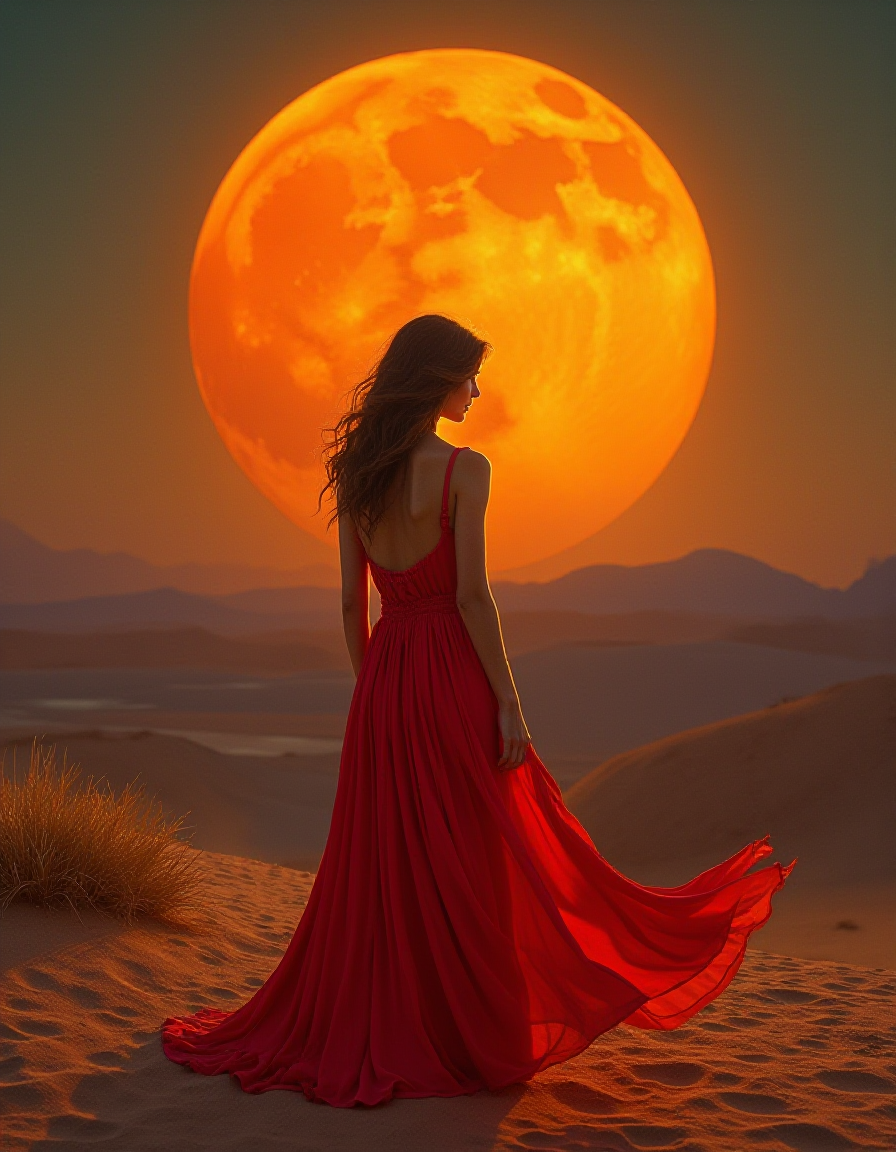
a woman in a red dress is standing in a desert with a large moon behind her
CAPTION
The image depicts a woman standing in a desert landscape, facing away from the viewer, with a large, glowing moon in the background. The woman is wearing a long, flowing red dress and is positioned on the left side of the image. The moon is positioned in the center of the image, with its bright orange hue contrasting with the surrounding desert landscape.
MONOLOGUE
"The music ceased, but it died in cadences so soft that I stood with lips apart, half in doubt whether the spirit-sound I yet heard were the effect of imagination or not. Reluctantly I was compelled to believe myself deceived, and then turned to look upon the landscape. I never remember of seeing a lovelier night. It was now nine o'clock, and the sounds of business were hushed on the harbor, but boats, filled with gay revelers, glided ever the sparkling surface of the water, whose laugh and song added interest and life to the scene. Nearly opposite to us, upon the other side of the bay, were the extensive barracks, hospital, and the long line of the Marino, their white stuccoed walls glowing in the moonlight. On our left the beautiful city rose like an amphitheatre around the head of the bay; the hum of the populace, and the rumbling of wheels sounding faintly in the distance. Behind the town the blue conical peaks of the mountains melted into the sky. On our right was the roadstead and open sea, the moon's wake thereon glittering like a street in heaven, and reaching far away to other lands. All around us grew a wilderness of palm, orange, cocoa, and magnolia trees, vocal with the thousand strange noises of a tropical night. Directly below us, but a cable length from the overhanging palms which fringed the shore, lay a heavy English corvette in the deep shade of the land; but the arms of the sentry on her forecastle glinted in the moonbeams as he paced his lonely watch, and sung out, as the bell struck twice, his accustomed
SUMMARY
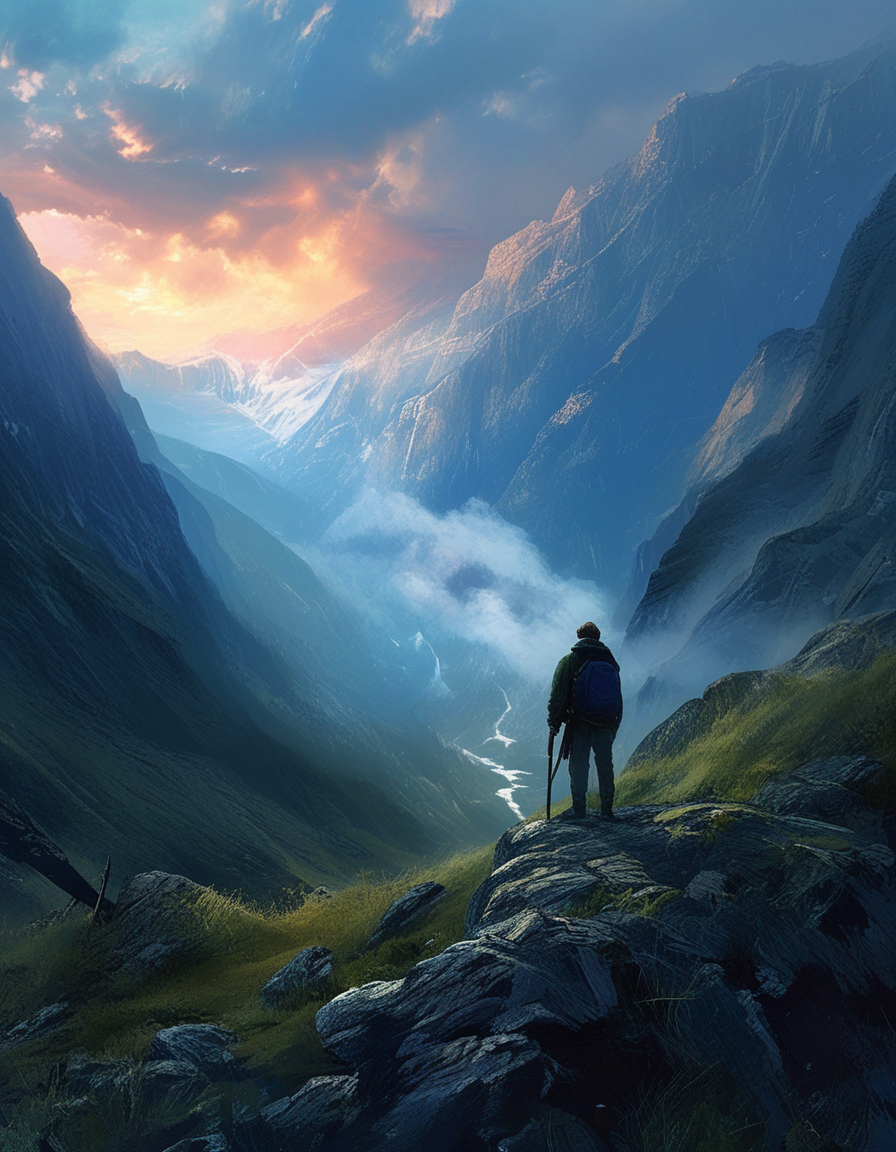
a lone hiker stands on a rocky outcrop overlooking a valley with a river running through it. the hiker is wearing a backpack and carrying a walking stick. the valley is shrouded in mist and the sky is a gradient of orange and pink.
CAPTION
The image depicts a person standing on a rocky outcrop, gazing out at a breathtaking landscape. The person is dressed in a green jacket and a backpack, suggesting they are trekking or hiking. The landscape is a mix of green and brown, with a river running through the valley and a mountain range in the background.
MONOLOGUE
It was, indeed, a glorious country which the Blackfeet had wrested from their southern enemies. Here nature has reared great mountains and spread out broad prairies. Along the western border of this region, the Rocky Mountains lift their snow-clad peaks above the clouds. Here and there, from north to south, and from east to west, lie minor ranges, black with pine forests if seen near at hand, or in the distance mere gray silhouettes against a sky of blue. Between these mountain ranges lies everywhere the great prairie; a monotonous waste to the stranger's eye, but not without its charm. It is brown and bare; for, except during a few short weeks in spring, the sparse bunch-grass is sear and yellow, and the silver gray of the wormwood lends an added dreariness to the landscape. Yet this seemingly desert waste has a beauty of its own. At intervals it is marked with green winding river valleys, and everywhere it is gashed with deep ravines, their sides painted in strange colors of red and gray and brown, and their perpendicular walls crowned with fantastic columns and figures of stone or clay, carved out by the winds and the rains of ages. Here and there, rising out of the plain, are curious sharp ridges, or square-topped buttes with vertical sides, sometimes bare, and sometimes dotted with pines,--short, sturdy trees, whose gnarled trunks and thick, knotted branches have been twisted and wrung into curious forms by the winds which blow unceasingly, hour after hour, day after day, and month after month, over mountain range
SUMMARY
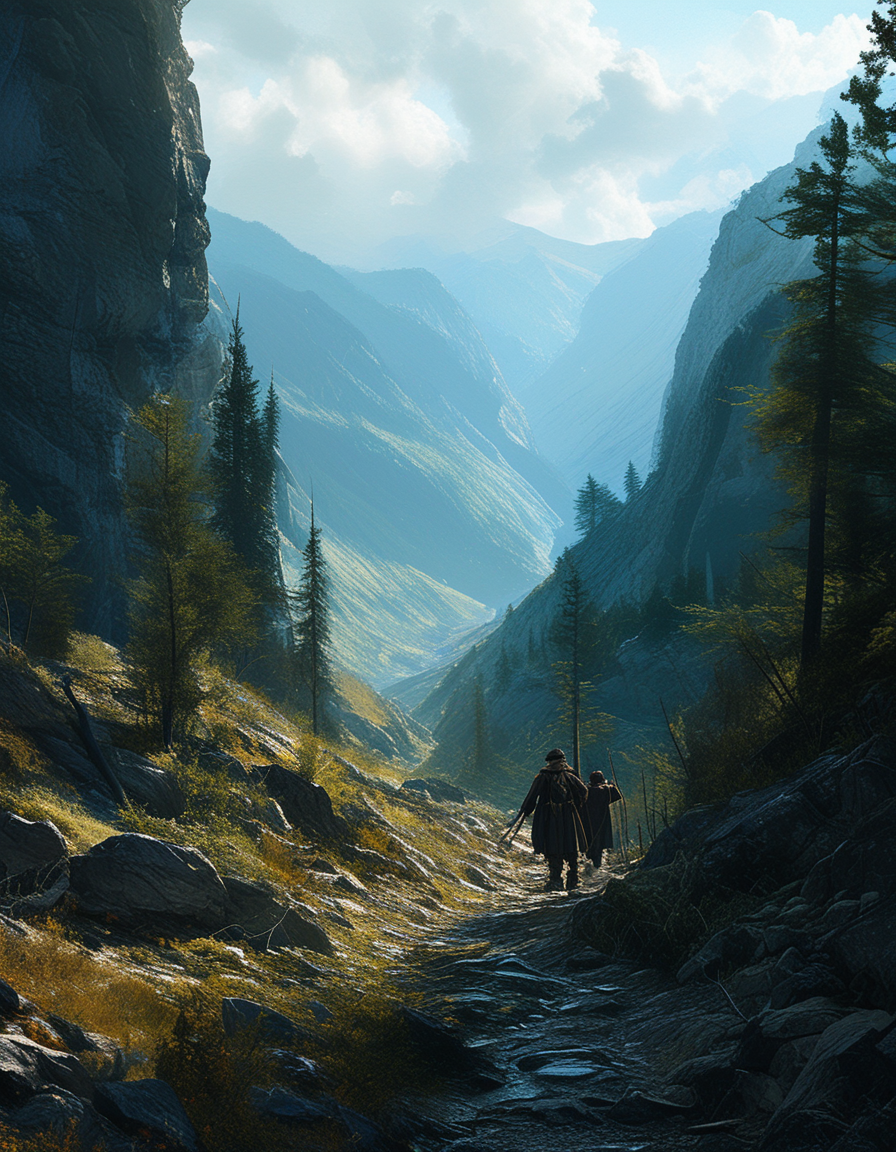
A lone figure walks through a mountainous landscape, carrying a backpack, with a clear blue sky above and a mountain range in the distance.
CAPTION
The image depicts a person walking through a mountainous landscape. The person is dressed in dark clothing and is carrying a backpack. The terrain is rugged with steep cliffs and rocky outcrops, and the sky is overcast with a few clouds.
MONOLOGUE
It is not uncommon to observe an effect quite contrary to the one given in the last two examples, the high summits of mountains being frequently concealed by heavy clouds of mist, while at a very short distance below them the air is clear and pure. In ascending to the Port of Venasque, one of the mountain passes of the Pyrenees, Mr. Murray found the mists so dense that he despaired of getting above them, or of their clearing away. But fortunately the wind freshened, and the mist, broken by it, “came sweeping,” he says, “over our heads, sometimes enveloping us in darkness, sometimes exposing the blue sky, and a part of the mountains. Section after section of the bald and towering masses which rose above the path were displayed to us, one after another, as if the whole had been a sight too great for us to look upon. Sometimes the clouds opened, and the snows, sparkling in the sun-beams, were before us; at others, an enormous peak of the mountain would shoot its dark head through the mist, and, without visible support, seem as if it were about to fall upon us. Again, when we imagined ourselves hemmed in on all sides by the mountains, and within a few feet of their rugged sides, a passing breeze would disclose the dark waters of the lakes hundreds of feet beneath us.
SUMMARY
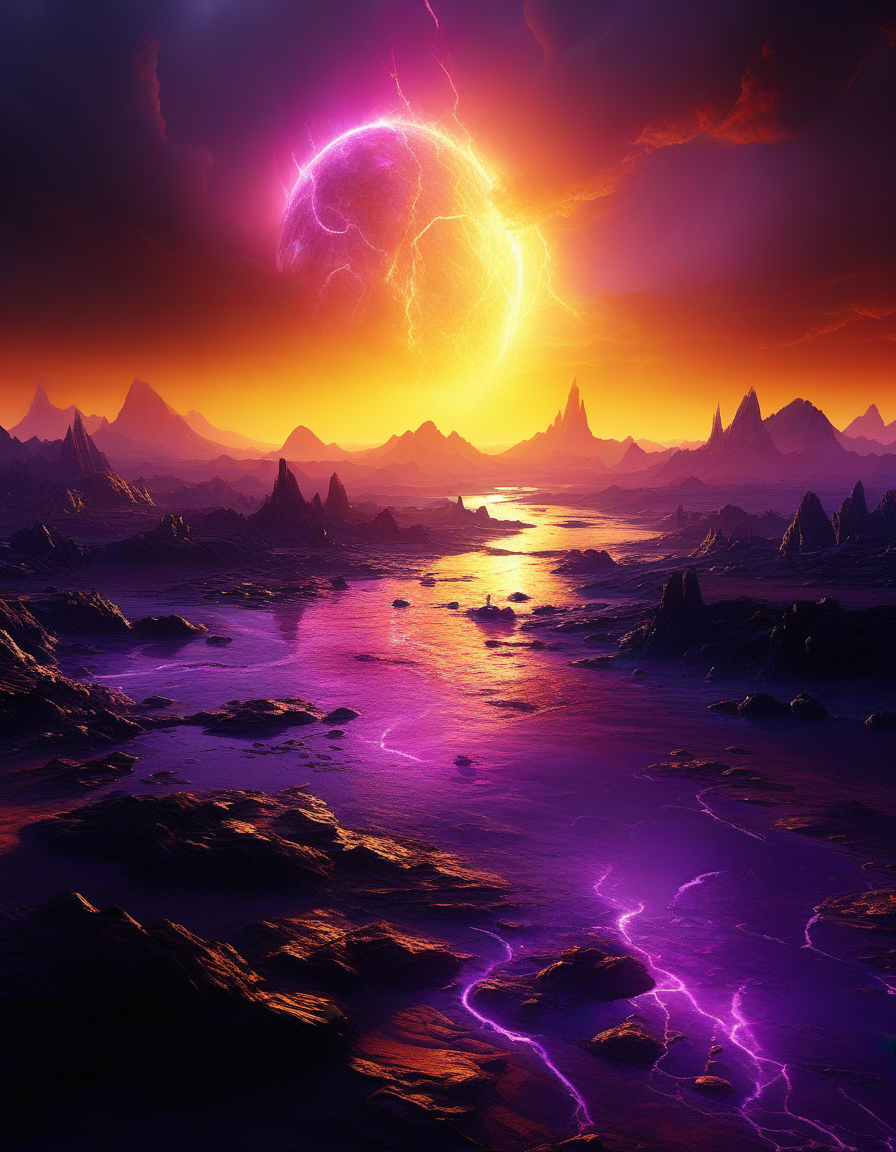
the image depicts a fantastical landscape with a river flowing through the center, surrounded by rocky terrain and glowing purple lightning.
CAPTION
The image presents a breathtaking fantasy landscape bathed in vibrant hues of purple and orange. Dominating the scene is a large, glowing, and dynamic crystal, which seems to be the source of the intense light. The crystal is positioned centrally, casting a radiant glow that illuminates the surrounding landscape.
MONOLOGUE
Apparently, he had attained about the age of puberty. His stature, however, was rather tall for his age, but exquisitely moulded and proportioned. Very fair, his somewhat round cheeks were tinted with a rich but delicate glow, like the rose of twilight, and lighted by dimples that twinkled like stars. His large and deep-blue eyes sparkled with exultation, and an air of ill-suppressed mockery quivered round his pouting lips. His light auburn hair, braided off his white forehead, clustered in massy curls on each side of his face, and fell in sunny torrents down his neck. And from the back of the beautiful youth there fluttered forth two wings, the tremulous plumage of which seemed to have been bathed in a sunset: so various, so radiant, and so novel were its shifting and wondrous tints; purple, and crimson, and gold; streaks of azure, dashes of orange and glossy black; now a single feather, whiter than light, and sparkling like the frost, stars of emerald and carbuncle, and then the prismatic blaze of an enormous brilliant! A quiver hung at the side of the beautiful youth, and he leant upon a bow.
SUMMARY
a large number of Easter eggs are scattered on the ground in a forest at night
CAPTION
The image depicts a night scene in a fantasy-themed landscape. The sky is painted in hues of purple and pink, with stars scattered across it, creating a starry night sky. The landscape is dominated by a rocky cliff, which is covered in a variety of flowers and plants, adding a touch of greenery to the scene.
MONOLOGUE
The fleet sailed rapidly before the fresh breeze across the broad expanse, and then entered a narrow passage. There was a gentle declivity on each side of the fjord, which was covered, as far as the eye could see, with pines. Droebak, on the right, is a village of one street, on the side of the hill. The houses are mostly of one story, painted yellow, with roofs covered with red tile. Before noon the passage began to widen, and the fleet entered another broad expanse of water, filled with rocky islands, at the head of which stood the city of Christiania. Some of the islets were pretty and picturesque, in some instances having a single cottage upon them, with a little garden. The rocks were often of curious formation, and the shore of one island was as regular and smooth as though it had been a piece of masonry. After rounding a point of rocks, the fleet came into full view of Christiania. The city and its environs are spread out on the southern slope of a series of hills, and presents a beautiful landscape to the eye. On the left the country was covered with villas, prominent among which was Oscarshal, a summer palace of the late king. On the right was the castle of Agershuus, rising abruptly from the water. At a little distance from the town was a kind of hotel, built on a picturesque island, with its pretty landing-place, not unlike some similar establishments near the head of Narragansett Bay. At the wharf in front of the city, and lying in the bay, was a considerable number of steamers, some of them quite large. The fleet ran up to the
SUMMARY
The image depicts a breathtaking mountain range under a dramatic sunset. The sky is painted in hues of pink and orange, with the sun setting behind the mountains, casting a warm glow over the landscape. The mountains, covered in snow, are dotted with trees and other vegetation, adding a touch of life to the otherwise serene scene.
CAPTION
The image depicts a breathtaking landscape of a mountainous region under a dramatic sky. The sky is painted in hues of pink and orange, with the sun setting behind the mountains, casting a warm glow over the scene. The mountains, covered in snow, are adorned with vibrant red and pink trees, adding a touch of color to the otherwise monochromatic landscape.
MONOLOGUE
Nights. It is then that it is beautiful to walk in the forest at the Hague at sunset, treading on the hardened snow, which crackles under one's feet like powdered marble, in the avenues of large, white, leafless beech trees, which look like one gigantic crystallization, and cast blue and violet shadows, dotted with myriads of points which glisten like diamonds in the paths dyed pink by the setting sun. But nothing compares with the sight of the Dutch country seen from the top of a steeple at morning after a heavy fall of snow. Beneath the gray and lowering sky one looks over that vast white plain, from which, roads, houses, and canals have disappeared, and nothing is seen but elevations and depressions, which, like the folds of a sheet, give a vague idea of the forms of hidden houses. The boundless white is unstained save by the clouds of smoke that rise almost timidly from the distant dwellings, as if to assure the spectator that beneath the desert of snow human hearts are still beating.
SUMMARY
The image depicts a breathtaking view of a mountainous landscape from an airplane window.
CAPTION
The image presents a breathtaking view of a mountainous landscape, captured from an airplane window. The perspective is from the side, looking up towards the peaks of the mountains. The sky is a clear blue, dotted with fluffy white clouds, and the sun is shining brightly, casting a warm glow on the landscape.
MONOLOGUE
They left the town, and were soon walking in meadows through which ran a clear river, shining and speedy in the morning sun. Its banks were largely used for bleaching, and the long lines of white in the lovely green of the natural grass were pleasant both to eye and mind. All about, the rooks were feeding in peace, knowing their freedom that day from the persecution to which, like all other doers of good, they are in general exposed. Beyond the stream lay a level plain stretching towards the sea, divided into numberless fields, and dotted with farmhouses and hamlets. On the side where the friends were walking, the ground was more broken, rising in places into small hills, many of them wooded. Half a mile away was one of a conical shape, on whose top towered a castle. Old and gray and sullen, it lifted itself from the foliage around it like a great rock from a summer sea, and stood out against the clear blue sky of the June morning. The hill was covered with wood, mostly rather young, but at the bottom were some ancient firs and beeches. At the top, round the base of the castle, the trees were chiefly delicate birches with moonlight skin, and feathery larches not thriving over well.
SUMMARY
The image depicts a picturesque landscape featuring a river flowing through a lush green field. The sky above is painted in hues of red and orange, suggesting a vibrant sunset. The field is dotted with yellow flowers, adding a pop of color to the scene.
CAPTION
The image captures a serene landscape at sunset. The sky, painted in hues of red and orange, is ablaze with color, reflecting the vibrant sunset. The sun, positioned high in the sky, casts a warm glow over the landscape below.
MONOLOGUE
The color-beauty about Shadow Lake during the Indian summer is much richer than one could hope to find in so young and so glacial a wilderness. Almost every leaf is tinted then, and the golden-rods are in bloom; but most of the color is given by the ripe grasses, willows, and aspens. At the foot of the lake you stand in a trembling aspen grove, every leaf painted like a butterfly, and away to right and left round the shores sweeps a curving ribbon of meadow, red and brown dotted with pale yellow, shading off here and there into hazy purple. The walls, too, are dashed with bits of bright color that gleam out on the neutral granite gray. But neither the walls, nor the margin meadow, nor yet the gay, fluttering grove in which you stand, nor the lake itself, flashing with spangles, can long hold your attention; for at the head of the lake there is a gorgeous mass of orange-yellow, belonging to the main aspen belt of the basin, which seems the very fountain whence all the color below it had flowed, and here your eye is filled and fixed. This glorious mass is about thirty feet high, and extends across the basin nearly from wall to wall. Rich bosses of willow flame in front of it, and from the base of these the brown meadow comes forward to the water’s edge, the whole being relieved against the unyielding green of the coniferae, while thick sun-gold is poured over all.
SUMMARY
The image depicts a serene landscape featuring a winding river, lush green fields, and a vibrant sunset sky. The sun is setting, casting a warm glow over the scene, and the colors are predominantly orange and red, with the sky being a deep blue. The river is flowing through the fields, and the fields are dotted with wildflowers, adding a touch
CAPTION
The image depicts a serene landscape at sunset. The sky is ablaze with vibrant hues of orange, red, and yellow, creating a dramatic and picturesque scene. The sun is setting on a lush green valley, casting a warm glow over the landscape.
MONOLOGUE
Released from ice are brook and river By the quickening glance of the gracious Spring; The colors of hope to the valley cling, And weak old Winter himself must shiver, Withdrawn to the mountains, a crownless king: Whence, ever retreating, he sends again Impotent showers of sleet that darkle In belts across the green o’ the plain. But the sun will permit no white to sparkle; Everywhere form in development moveth; He will brighten the world with the tints he loveth, And, lacking blossoms, blue, yellow, and red, He takes these gaudy people instead. Turn thee about, and from this height Back on the town direct thy sight. Out of the hollow, gloomy gate, The motley throngs come forth elate: Each will the joy of the sunshine hoard, To honor the Day of the Risen Lord! They feel, themselves, their resurrection: From the low, dark rooms, scarce habitable; From the bonds of Work, from Trade’s restriction; From the pressing weight of roof and gable; From the narrow, crushing streets and alleys; From the churches’ solemn and reverend night, All come forth to the cheerful light. How lively, see! the multitude sallies, Scattering through gardens and fields remote, While over the river, that broadly dallies, Dances so many a festive boat; And overladen, nigh to sinking, The last full wherry takes the stream. Yonder afar, from the hill-paths blinking, Their clothes are colors that softly gleam. I hear the noise of the village, even; Here is the People’s proper Heaven; Here high and low contented see!
SUMMARY
A couple stands on the edge of a river in a mountainous landscape at sunset.
CAPTION
The image depicts a serene landscape at sunset, with a dramatic sky filled with vibrant hues of red and orange. The sun is setting on a mountain range, casting a warm glow over the landscape. The mountains are silhouetted against the sky, with the peaks and valleys creating a sense of depth.
MONOLOGUE
We proceeded west-north-west, in order to enter the real Rocky Mountains, and see the Spanish peaks, the highest in this range, which lie to the south of the Arkansas, from which river we were now no great distance. The weather favoured us; it was warm in the day, and the young grass was sprouting in the valleys. During these days we generally ascended and crossed a number of small streams that flowed from these mountains to the Arkansas, and always found good provender for our cattle on their banks. The mountains in the west continually rose, and the snow-clad Spanish peaks, of which three were much higher than the rest, stood out more and more distinctly against the blue sky. We reached a mountain saddle, and on its plateau, a rather frequented path, which appeared to have been originally made by buffaloes, though we noticed old horse-tracks upon it. As it trended to the north, we followed it, as it must certainly lead to the banks of the Arkansas. The path became very fatiguing for our cattle, as it was covered with flinty boulders, some of which had very sharp edges, and injured the hoofs. At the same time we found but little food for them on this bleak elevation, and noticed with sorrow that they were losing both flesh and strength.
SUMMARY
four people riding camels in the desert at night with a full moon in the sky.
CAPTION
The image depicts a night scene with a full moon in the sky, casting a bright glow on the landscape below. The moon is positioned centrally, with stars scattered throughout the sky. The scene features a group of four people riding camels in a desert-like landscape.
MONOLOGUE
On one hand lay the town of Natchez, sunk in repose; the moon at full, was sleeping over it, in as pure a sky as ever poet drank joy and inspiration from; far below, wrapt in shade, lay the scene of my almost dream, the line of houses denoted by a few scattered lights, and in its front was the mighty Mississippi; rolling on in its majesty through a dominion created by itself, through regions of wilderness born of its waters and still subject to its laws; I could distinctly hear the continuous rush of the strong current; it was the only sound that moved the air. I hearkened intently to this rushing; it had indeed an absolute fascination for the ear: it was not like the hoarse roar of the ocean, now breaking along a line of beach, then again lulled as though gathering breath for a renewed effort; it was a sound monotonous and low, but which filled the ear and awed the very heart. I felt that I was listening to a voice coeval with creation, and that ceased not either by night or day! which the blast of winter could not rouse, or the breath of summer hush; a voice which the buzz and bustle of noon might drive from the ear, but which the uplifting of the foundations of the world alone could silence.
SUMMARY
The image depicts a serene landscape with a large sun setting in the sky, casting a warm orange glow over the mountains and valley below. The sun is surrounded by a cloud of red and orange clouds, creating a dramatic and picturesque scene.
CAPTION
The image depicts a serene mountain landscape bathed in the warm hues of a setting sun. The sky is a vibrant mix of orange and red, with the sun positioned centrally, casting a golden glow over the landscape. The sun is surrounded by a cloud of clouds, which are scattered across the sky, adding depth and dimension to the scene.
MONOLOGUE
The heath or moorland plateau of Mals lies wide--spread, silent, and deserted where the lofty head of the Grossortler towers up, and overlooks it in eternal calm. It is five centuries ago--a mere moment in that world of everlasting snows; the keen autumn wind, as at this day, is rushing through the grey halms of the charlock, woodrush and heathgrasses, that have caught a doubtful, golden gleam reflected from the glaciers which are bathed in the glow of the sinking sun; as at this day, the gale packs the driving white clouds together in the still highland valley, as though to rest for the night. They heave and roll noiselessly, spreading a white, misty sheet over the withered heathgrass. The mirror-surface of the moorland tarn lies lead-coloured and dull, wrinkled by the night-breeze, and its icy waters trickle in tiny rills over the bare plain and down to the valley. All is the same as it is to this day! Only life is wanting, life warm and busy, which in these days is stirring in the villages and homesteads that dot the plain, and that have brought the dead moorland into tilth and fertility. Profound silence reigns over the immeasurable level, throughout its length and breadth no living thing stirs; it is as if this were indeed the neutral space between Heaven and Hell--a vast, eternal void! Only the monotonous murmur of the Etsch--that cold artery of the desolate heath--and the roar of the winds that sweep at night across the plateau; these are the eerie voices of this realm of death.
SUMMARY
The image depicts a breathtaking landscape with a winding river running through the valley, surrounded by lush green hills and mountains under a dramatic sunset sky.
CAPTION
The image depicts a breathtaking landscape at sunset, with a vibrant sky filled with red and orange clouds. The sun is setting behind a mountain range, casting a warm glow over the landscape. The foreground is dominated by a winding river, flanked by lush green hills and trees, with a small stream running through the middle.
MONOLOGUE
For three weeks, they knew no roads other than those lonely, mountain trails. At times, they walked under dark pines where the ground was thickly carpeted with the dead, brown needles and the air was redolent with the odor of the majestic trees; or made their camps at night, feeding their blazing fires with the pitchy knots and cones. At other times, they found their way through thickets of manzanita and buckthorn, along the mountain's flank; or, winding zigzag down some narrow canyon wall, made themselves at home under the slender, small-trunked alders; and added to the stores that Croesus packed, many a lusty trout from the tumbling, icy torrent. Again, high up on some wind-swept granite ridge or peak, where the pines were twisted and battered and torn by the warring elements, they looked far down upon the rolling sea of clouds that hid the world below; or, in the shelter of some mighty cliff, built their fires; and, when the night was clear, saw, miles away and below, the thousands of twinkling star-like lights of the world they had left behind. Or, again, they halted in some forest and hill encircled glen; where the lush grass in the cienaga grew almost as high as Croesus' back, and the lilies even higher; and where, through the dark green brakes, the timid deer come down to drink at the beginning of some mountain stream. At last, their wanderings carried them close under the snowy heights of San Gorgonio--the loftiest of all the peaks. That night, they camped at timber-line and in the
SUMMARY
a lone rider is walking through a desert landscape at sunset
CAPTION
The image depicts a vast desert landscape at sunset, with the sun setting behind a mountain range. The sky is filled with a mix of orange and yellow hues, indicating the warm colors of the sunset. The sun is positioned in the upper right corner of the image, casting a golden glow over the landscape. In the foreground, there are two figures walking towards the center of the image.
MONOLOGUE
Leaving Tirano, and once more passing through the poplars by Madonna, we descended the valley all along the vineyards of Villa and the vast district of Sassella. Here and there, at wayside inns, we stopped to drink a glass of some particular vintage; and everywhere it seemed as though god Bacchus were at home. The whole valley on the right side of the Adda is one gigantic vineyard, climbing the hills in tiers 63and terraces, which justify its Italian epithet of _Teatro di Bacco_. The rock is a greyish granite, assuming sullen brown and orange tints where exposed to sun and weather. The vines are grown on stakes, not trellised over trees or carried across boulders, as is the fashion at Chiavenna or Terlan. Yet every advantage of the mountain is adroitly used; nooks and crannies being specially preferred, where the sun's rays are deflected from hanging cliffs. The soil seems deep, and is of a dull yellow tone. When the vines end, brushwood takes up the growth, which expires at last in crag and snow. Some alps and chalets, dimly traced against the sky, are evidences that a pastoral life prevails above the vineyards. Pan there stretches the pine-thyrsus down to vine-garlanded Dionysos.
SUMMARY
The image depicts a vast canyon with a river running through it, illuminated by a bright orange sun in the sky.
CAPTION
The image depicts a vast, mountainous landscape bathed in the warm glow of a full moon. The moon, a large, orange orb, is centrally positioned in the sky, casting a radiant light over the landscape. The mountains, rugged and rocky, are covered in a mix of brown and green vegetation, adding a sense of depth and wilderness to the scene.
MONOLOGUE
"Once upon a time, long before there were any people on the earth and perhaps before there were any animals or birds or reptiles here, the world was covered with an immense, luxuriant growth of vegetation. How do we know it? The geologists tell us so. They have dug deep into the earth and they have examined what they found, and they have long ago determined that this condition is true. It would seem that in those ages of long ago the world must have been very different from what it is now, for the seas flowed over vast areas which are now solid ground. Immense trees grew in those times, and the great ferns and palms and tropical plants grew in portions where now they cannot grow because it is too cold. I want to draw some trees and bushes to represent this great growth. [Draw trees and bushes of Fig. 72 in green.] And also the bright warm sun which, together with the abundance of water, caused them to grow so profusely. [Draw the sun in orange, completing Fig. 72.] Then, the geologists tell us, there came a great change. There were awful volcanic disturbances which caused the sea to overflow great areas of these trees and bushes and ferns, and they were buried from sight by a vast expanse of water. Gradually, though, another change came. The waters receded into lesser areas and the ground arose from beneath the waves. But the trees and the bushes and the ferns were gone. Where? They had been buried deep beneath the mud and sand and stones which the waters had washed over them. Then,
SUMMARY
a person riding a horse in a forest at night with a full moon in the sky
CAPTION
The image depicts a serene night scene with a full moon in the sky, casting a warm glow over the landscape. The moon is positioned centrally, with the sun to the left and the horizon to the right. The sky is filled with clouds, and the ground is covered in a thick layer of snow, creating a stark contrast with the warm colors of the moon and the surrounding landscape.
MONOLOGUE
It was a wild scene. Battle was raging furiously. Shot, shell, and ball exploded and whistled. Hundreds of wounded were being carried off, while the ground was strewn with dead. Dense thickets of small pines covered much of the field, further obscured by clouds of smoke. The first troops encountered were D.H. Hill's, and, making way through these, I came upon Winder's, moving across the front from right to left. Then succeeded Elzey's of Ewell's division, and, across the road leading to Gaines's Mill, my own. Mangled and bleeding, as were all of Ewell's, it was holding the ground it had won close to the enemy's line, but unable to advance. The sun was setting as I joined, and at the moment cheers came up from our left, raised by Winder's command, which had turned and was sweeping the Federal right, while Lawton's Georgians, fresh and eager, attacked in our front. The enemy gave way, and, under cover of the night, retired over the Chickahominy. Firing continued for two hours, though darkness concealed everything.
SUMMARY
A couple stands on the bank of a river, gazing at the sunset.
CAPTION
The image depicts a serene landscape at sunset, with a river flowing through the center, flanked by towering mountains on either side. The sky is ablaze with vibrant hues of red and orange, creating a dramatic and picturesque scene. The sun is setting, casting a warm glow over the landscape, and the mountains are silhouetted against the sky.
MONOLOGUE
The next two days are noted in my diary as two of the pleasantest days of the whole journey--two of the pleasantest days I ever spent anywhere, I think. A clear, cloudless sky, brilliant sunshine, white mountain peaks all about us, gave picture after picture, and the warm, balmy air made travelling a delight. There are few greater pleasures than that of penetrating into a new country, with continually changing views of beauty, under kindly conditions of weather and trail. In the yellow rays of the early sun, the spruce on the river bank looked like a screen of carved bronze, while the slender stems of birches in front of the spruce looked like an inlaying of old ivory upon the bronze, the whole set upon its pedestal of marble-like snow. The second day we took a portage of nine or ten miles across a barren flat and struck the river again just below a remarkable stretch of bank a mile or so in length, with never a tree or a bush or so much as the smallest shrub growing on it. Thick timber above suddenly ceased, thick timber below suddenly began again, and this bare bank reached back through open, barren flat to a low pass in the mountains. It was a bank of solid ice, so we were told later, and I remembered to have heard of ice bluffs on the Kobuk, and wished that the portage had struck the river above this spot instead of below it, that there might have been opportunity to examine it.
SUMMARY
field of yellow flowers with a river in the distance and a sunset sky
CAPTION
The image captures a serene landscape at sunset. The sky is a vibrant mix of orange and pink hues, with the sun just beginning to set on the horizon. The sun is positioned in the upper right corner of the image, casting a warm glow over the landscape. In the foreground, a field of yellow flowers is in full bloom, their bright color contrasting with the surrounding greenery.
MONOLOGUE
In the far western wilds of North America, over which the untutored red-skinned savage roams at liberty, engaged throughout life in war or the chase, by the side of a broad stream which made its way towards a distant lake, an old man and a boy reclined at length beneath a wigwam, roughly formed of sheets of birch-bark placed against several poles stuck in the ground in a circular form, and fastened together at the top. The sun was just rising above a wood, composed of maple, birch, poplar, and willow, fringing the opposite bank of the river; while rocky hills of no great elevation formed the sides of the valley, through which the stream made its way. Snow rested on the surrounding heights, and the ground was crisp with frost. The foliage which still clung to the deciduous trees exhibited the most gorgeous colours, the brightest red, pink, yellow, and purple tints contrasting with the sombre hues of the pines covering the lower slopes of the hills.
SUMMARY
The image depicts a serene landscape featuring a river flowing through a valley surrounded by lush green hills and trees. The sun is setting, casting a warm orange glow over the scene, creating a picturesque and tranquil atmosphere.
CAPTION
The image captures a serene landscape at sunset, with the sun just setting over a valley. The sky is a vibrant mix of orange and pink hues, with clouds scattered across the sky. The sun is positioned in the upper right corner of the image, casting a warm glow over the landscape.
MONOLOGUE
My excursions to the Irurá had always a picnic character. A few rude huts are scattered through the valley, but they are tenanted only for a few days in the year, when their owners come to gather and roast the mandioca of their small clearings. We used generally to take with us two boys—one negro, the other Indian—to carry our provisions for the day; a few pounds of beef or dried fish, farinha and bananas, with plates, and a kettle for cooking. José carried the guns, ammunition and game-bags, and I the apparatus for entomologising—the insect net, a large leathern bag with compartments for corked boxes, phials, glass tubes, and so forth. It was our custom to start soon after sunrise, when the walk over the campos was cool and pleasant, the sky without a cloud, and the grass wet with dew. The paths are mere faint tracks; in our early excursions it was difficult to avoid missing our way. We were once completely lost, and wandered about for several hours over the scorching soil without recovering the road. A fine view is obtained of the country from the rising ground about half way across the waste. Thence to the bottom of the valley is a long, gentle, grassy slope, bare of trees. The strangely-shaped hills; the forest at their feet, richly varied with palms; the bay of Mapirí on the right, with the dark waters of the Tapajos and its white glistening shores, are all spread out before one, as if depicted on canvas. The extreme transparency of the atmosphere gives to all parts of the landscape such clearness of
SUMMARY
The view from a window shows a vast, arid landscape with a clear blue sky and a bright sun.
CAPTION
The image captures a breathtaking view of a vast, arid landscape. Dominating the scene is a rugged, rocky terrain, punctuated by patches of green vegetation. The sky above is a clear blue, with the sun shining brightly, casting a warm glow over the landscape.
MONOLOGUE
But how could these doubts of Sheila's sincerity last? He sat opposite her in the wagonette, and the perfect truth of her face, of her frank eyes and of her ready smile met him at every moment, whether he talked to her or to Ingram, or listened to old Mackenzie, who turned from time to time from the driving of the horses to inform the stranger of what he saw around him. It was the most brilliant of mornings. The sun burned on the white road, on the green moorland, on the gray-lichened rocks with their crimson patches of heather. As they drove by the curious convolutions of this rugged coast, the sea that lay beyond these recurring bays and points was of a windy green, with here and there a streak of white, and the fresh breeze blowing across to them tempered the fierce heat of the sun. How cool, too, were those little fresh-water lakes they passed, the clear blue and white of them stirred into wavelets that moved the reeds and left air-bubbles about the half-submerged stones! Were not those wild-geese over there, flapping in the water with their huge wings and taking no notice of the passing strangers? Lavender had never seen this lonely coast in times of gloom, with those little lakes become sombre pools, and the outline of the rocks beyond lost in the driving mist of the sea and the rain. It was altogether a bright and beautiful world he had got into, and there was in it but one woman, beautiful beyond his dreams. To doubt her was to doubt all women. When he looked at her he forgot the caution and
SUMMARY
desert landscape at sunset with cacti and a sunset sky.
CAPTION
The image captures a serene desert landscape at sunset. The sky is ablaze with vibrant hues of orange, pink, and purple, creating a breathtaking display of nature's palette. The sun, just beginning to set, casts a warm glow over the scene, illuminating the desert floor and cacti that dot the landscape.
MONOLOGUE
During his absence she watched the scene around her with animation. The spotless day, if one might so call it, when the sky and the turf and the whole world looked as though washed clean, and nature, seen in the warm sunlight, seemed to palpitate and flutter in the wind that gently stirred ends of ribbon or tips of plumes, and set the fragrance of the country air astir. Back of the lady the tribune was like a floral display: here and there a corner red as roses, there a mass of lily-white dresses enlivened by pink and blue parasols, and the green _pesage_ stretched between the spectators and the race-track in bands of emerald, whilst across it promenaded or stood in groups those interested in the races. Mrs. Falconer acknowledged a friend here and there, glanced affectionately over to where Molly and the Marquis, seated near, fixed their attention on the race-course, where the winner, flying his blue ribbon, cantered triumphantly around the track.
SUMMARY
The image depicts a vibrant landscape featuring a dense forest with a variety of flowers in the foreground. The sky is painted in hues of pink and orange, suggesting a sunset or sunrise. The clouds are scattered across the sky, adding depth and texture to the scene.
CAPTION
The image captures a breathtaking view of a mountainous landscape at sunset. The sky is ablaze with vibrant hues of pink, orange, and purple, creating a dramatic contrast with the deep green of the forested hills. The sun is setting, casting long shadows across the landscape, and the clouds are lightly streaked with pink, adding to the overall magical atmosphere.
MONOLOGUE
We left Rome in clear sunset light. The Alban Hills defined themselves like a cameo of amethyst upon a pale blue distance; and over the Sabine Mountains soared immeasurable moulded domes of alabaster thunderclouds, casting deep shadows, purple and violet, across the slopes of Tivoli. To westward the whole sky was lucid, like some half-transparent topaz, flooded with slowly yellowing sunbeams. The Campagna has often been called a garden of wild-flowers. Just now poppy and aster, gladiolus and thistle, embroider it with patterns infinite and intricate beyond the power of art. They have already mown the hay in part; and the billowy tracts of greyish green, where no flowers are now in bloom, supply a restful groundwork to those brilliant patches of diapered _fioriture_. These are like praying-carpets spread for devotees upon the pavement of a mosque whose roof is heaven. In the level light the scythes of the mowers flash as we move past. From their bronzed foreheads the men toss masses of dark curls. Their muscular flanks and shoulders sway sideways from firm yet pliant reins. On one hill, fronting the sunset, there stands a herd of some thirty huge grey oxen, feeding and raising their heads to look at us, with just a flush of crimson on their horns and dewlaps. This is the scale of Mason's and of Costa's colouring. This is the breadth and magnitude of Rome.
SUMMARY
The image depicts a vast, dark landscape with a bright sun in the background. The sun is positioned in the upper right corner of the image, casting a warm glow over the scene. The landscape is dominated by dark, rocky terrain, with a river running through the middle of the image. The river is surrounded by a variety of rocks and boulders,
CAPTION
The image depicts a vast, fiery landscape with a large sun setting in the background. The sun is positioned in the upper right corner of the image, casting a warm glow over the scene. The landscape is dominated by dark, rocky terrain, with the sun's rays reflecting off the surface, creating a mesmerizing display of light and shadow.
MONOLOGUE
Never were people gladder to reach any place than Mr. and Mrs. March and Nelly and Rob were to reach Denver. They were so tired that they went right to bed as soon as they entered the hotel. They did not want any supper. The next morning, however, they were up early, all rested and ready to look at every thing. The first thing they saw as they walked out of the hotel door, was a long range of high mountains to the south. They looked down the street on which the hotel stood, and saw these mountains rising up like a great wall across the end of the street. They were covered with snow two-thirds of the way down. The lower part which was not covered with snow was of a very dark blue color; and the upper part, where the snow lay, shone in the sun so dazzling bright that it made their eyes ache to look at it. The sky was as blue as blue could be, and had not a cloud in it; and some of the sharp peaks of the mountains looked as if they were really cutting through the sky. Mr. and Mrs. March and Nelly and Rob all stood still in the middle of the street looking at the beautiful sight. Several carriages and wagons came very near running over them, but they hardly observed it. No one of them spoke for some minutes: even Rob was overawed by the grandeur of the mountains. But his overawed silence did not last long. In a few minutes, he broke out with:--
SUMMARY
a large, spherical moon is in the foreground of a vast, barren landscape with a river running through it
CAPTION
The image presents a surreal landscape dominated by a large, spherical moon or planet in the center, surrounded by a vast, barren landscape. The moon is illuminated by a bright light source, casting a glow on the surrounding terrain. The sky is filled with clouds, adding to the sense of depth and mystery.
MONOLOGUE
At that time of the evening when, by looking steadily, we could discover a few pale stars in the sky, we saw upon an eminence, the bound of our horizon, though very near to us, and facing the bright yellow clouds of the west, a group of figures that made us feel how much we wanted in not being painters. Two herdsmen, with a dog beside them, were sitting on the hill, overlooking a herd of cattle scattered over a large meadow by the river-side. Their forms, looked at through a fading light, and backed by the bright west, were exceedingly distinct, a beautiful picture in the quiet of a Sabbath evening, exciting thoughts and images of almost patriarchal simplicity and grace. We were much pleased with the situation of our inn, where we arrived between eight and nine o'clock. The river was at the distance of a broad field from the door; we could see it from the upper windows and hear its murmuring; the moon shone, enlivening the large corn fields with cheerful light. We had a bad supper, and the next morning they made us an unreasonable charge; and the servant was uncivil, because, forsooth! we had no wine.
SUMMARY
The image depicts a vast, dark landscape with numerous rocky formations. The mountains are shrouded in mist, adding a mystical and mysterious atmosphere to the scene.
CAPTION
The image is a high-resolution, 3D-rendered landscape featuring a vast, rugged mountain range. The mountains are rendered in a dark, almost black color, with the peaks and valleys illuminated by a bright light source in the top right corner, casting a dramatic glow on the landscape.
MONOLOGUE
The night was clear and bright. The mountain peaks glistened in the full gold of the sunset and the lower ridges were bathed in a rosy blue. A gray mist rose from the valleys which suddenly glistened when it swept up into the higher regions, and then like a cloud-sea rolled heavenwards. The whole color-play reflected itself in the gently agitated breast of the dark lake from whose shores the mountains seemed to rise and fall, so that only the tops of the trees and the peaks of the church steeples and the rising smoke from the houses defined the limits which separated the reality of the world from its reflection. My glance, however, rested upon only one spot--the old castle--where a presentiment told me I should find her again. No light could be seen in the windows, no footstep broke the silence of the night. Had my presentiment deceived me? I passed slowly through the outer gateway and up the steps until I stood at the fore-court of the castle. Here I saw a sentinel pacing back and forwards, and I hastened to the soldier to inquire who was in the castle. "The Countess and her attendants are here," was the brief reply, and in an instant I stood at the main portal and had even pulled the bell. Then, for the first time, my action occurred to me. No one knew me. I neither could nor dare say who I was. I had wandered for weeks about the mountains, and looked like a beggar. What should I say? For whom should I ask? There was little time for consideration, however, for the door opened and a
SUMMARY
The night sky is filled with a full moon, casting a glow over the tranquil waters of a secluded beach. The beach is dotted with pink flowers, adding a touch of color to the otherwise monochrome landscape. The waves gently lap against the shore, creating a soothing rhythm that contrasts with the serene beauty of the night sky.
CAPTION
The image presents a tranquil night scene in a mountainous landscape. The sky is a deep blue, adorned with a full moon that casts a serene glow over the landscape. The moonlight illuminates the mountains, creating a dramatic contrast with the dark blue of the sky.
MONOLOGUE
"My Darling Fern: Noblest, purest and most beautiful of women! Like the rose to the sunlight, like the needle to the pole, my heart turns in adoration to you. My own true love! My peerless one! My guiding star in love's azure sky! My soul swells and sings with its full tide of joy, as willing fingers attempt to put in words the thoughts born of my great love for you. What miracle have you wrought for me, my precious one, that I am so happy? The earth, the sky, the verdant woods, the grand mountains, the green meadows, the shady nooks, the babbling brooks;--all thrill my innermost being with a thousand new charms! The bees, the birds, the flowers and trees as they bend or sigh to the passing breeze; the solemn stillness of majestic night; the deep blue sea, overarched by nature's matchless crown of diamonds, a countless multitude of brilliant stars, in the silvery moonlight of love--how eloquent their song! All things in nature speak to me; they bless you for loving me! In the halo of that blessing, as I think of you, I am transfigured by a newly-born ecstacy! To breathe, to exist, is to realize the superlative degree of my exquisite happiness! Hidden away from the clouds and storms of life, by the golden mist which veils the measureless sea of love, infinite love, I sail serene and confident upon its heaving tide. Gently rocked by the lapping lullaby of the rythmical waves of paradise, I fearlessly float. I care not for time nor tide, nor distant port of a future destiny! Entranced by the music of love's beautiful sea, I dream love's
SUMMARY
a woman in a long dress stands on a rocky moon with a glowing, circular light in the center of her back.
CAPTION
The image depicts a surreal scene of a person standing on a rocky moon-like landscape. The person is dressed in a flowing, golden dress and is facing away from the viewer, creating a sense of mystery and isolation. The landscape is bathed in a warm, golden light, suggesting a celestial or mystical setting.
MONOLOGUE
A night for love it was. The great sun at setting had looked with steadfast eye at the convent standing lonely on its wide landscape, and had then thrown his final glance across the world towards the east; and the moon had quickly risen and hung about it the long silvery twilight of her heavenly watchfulness. The summer, too, which had been moving southward, now came slowly back, borne on warm airs that fanned the convent walls and sighed to its chaste lattices with the poetry of dead flowers and vanished songsters. But sighed in vain. With many a prayer, with many a cross on pure brow and shoulder and breast, with many a pious kiss of crucifix, the convent slept. Only some little novice, lying like a flushed figure of Sleep on a couch of snow, may have stirred to draw one sigh, as those zephyrs, toying with her warm hair, broke some earthly dream of too much tenderness. Or they may merely have cooled the feverish feet of a withered nun, who clasped her dry hands in ecstasy, as on her cavernous eyes there dawned a vision of the glories and rewards of Paradise. But no, not all slept. At an open window on the eastern side of the convent stood the sleepless one looking out into the largeness of the night like one who is lost in the largeness of her sorrow.
SUMMARY
The image depicts a sunset over a mountain range, with a large tree in the foreground and a body of water reflecting the sky. The sun is setting, casting a warm glow over the landscape.
CAPTION
The image depicts a serene landscape at sunset. The sky is a gradient of warm orange and yellow hues, with the sun just beginning to set on the horizon. The sun is positioned to the left of the frame, casting a golden glow over the landscape. In the foreground, a large tree with a gnarled trunk and branches stands tall on the right side of the image.
MONOLOGUE
“Your ignorance astonishes me, Philip, but I suppose that there are some people who can live for years in a place and yet imbibe nothing of its traditions. Perhaps you know that the monks were driven out of these ruins by Henry VIII. Well, on the spot where that tree now stands there grew a still greater oak, a giant tree, its trunk measured sixteen loads of timber; which had, as tradition said, been planted by the first prior of the Abbey when England was still Saxon. The night the monks left a great gale raged over England. It was in October, when the trees were full of leaf, and its fiercest gust tore the great oak from its roothold, and flung it into the lake. Look! do you see that rise in the sand, there, by the edge of the deep pool, in the eight foot water? That is there it is supposed to lie. Well, the whole country-side said that it was a sign that the monks had gone for ever from Bratham Abbey, and the country-side was right. But when your ancestor, old yeoman Caresfoot, bought this place and came to live here, in a year when there was a great black frost that set the waters of the lake like one of the new-fangled roads, he asked his neighbours, ay, and his labouring folk, to come and dine with him and drink to the success of his purchase. It was a proud day for him, and when dinner was done and they were all mellow with strong ale, he bade them step down to the borders of the lake, as he would have them be witness to a ceremony. When they reached the spot they saw a curious sight, for
SUMMARY
The image depicts a serene, mountainous landscape at sunset. The sun is setting behind the mountains, casting a warm glow over the scene. The sky is filled with clouds, adding to the dramatic atmosphere. The river, which is the main focus of the image, is flowing through the valley, reflecting the colors of the sunset. The rocks and vegetation in
CAPTION
The image depicts a serene mountain landscape at sunset. The sky is a gradient of orange and pink hues, with the sun just setting behind the mountains. The sun is positioned to the left of the image, casting a warm glow over the landscape.
MONOLOGUE
A gentle snow-slope brought us to the base of a precipice of brown rocks, round which we wound; the snow was in excellent order, and the chasms were so firmly bridged by the frozen mass that no caution was necessary in crossing them. Surmounting a weathered cliff to our left, we paused upon the summit to look upon the scene around us. The snow gliding insensibly from the mountains, or discharged in avalanches from the precipices which it overhung, filled the higher valleys with pure white glaciers, which were rifted and broken here and there, exposing chasms and precipices from which gleamed the delicate blue of the half-formed ice. Sometimes, however, the "névés" spread over wide spaces without a rupture or wrinkle to break the smoothness of the superficial snow. The sky was now, for the most part, overcast, but through the residual blue spaces the sun at intervals poured light over the rounded bosses of the mountain.
SUMMARY
The image depicts a breathtaking landscape with a vibrant sunset over a mountain range. The sky is ablaze with hues of pink, orange, and yellow, creating a stunning visual spectacle. The sun is setting, casting a warm glow over the landscape, which is dotted with pink and purple flowers. The mountains in the background are shrouded in mist, adding
CAPTION
The image depicts a breathtaking landscape at sunset. The sky is ablaze with vibrant hues of pink, orange, and yellow, creating a dramatic and awe-inspiring scene. The sun, positioned in the upper right corner of the image, is setting, casting a golden glow over the landscape.
MONOLOGUE
snow's feathery drapery that fell like a benediction over them. Mountains, radiant in their ever-changing hues of yellow and green, of purple and gold; mountains, whose breath was fragrant with the delicate perfume from their carpet of a thousand species of wild flowers; mountains, kissed by pearly rain drops, glowing with morning sun baths, draped in slumber-robes of silvery moon-beams--glorious, sunlit, sky-communing mountains, standing in their grandeur, silent, proud, eternal.
SUMMARY
a man in a loincloth is walking through a rocky canyon with a group of people in the background.
CAPTION
The image depicts a scene of a group of people, likely soldiers, marching in a desert-like landscape. The individuals are dressed in traditional attire, with some wearing helmets and others in full armor. They are carrying spears and shields, indicating a sense of readiness for battle.
MONOLOGUE
Kao-Tan-Dze, with its robber assailants and its pauper population, was to us an inexplicable place. We could not conceive how men should make up their minds to inhabit a detestably ugly country like this, sterile, waterless, remote from any other inhabited place, and desolated by the constant inroad of brigands. What could be their object? What possible advantage could be their inducement? We turned the matter over in all ways; we framed all sorts of suppositions; but we could achieve no likely solution of the problem. During the first watch of the night, we conversed with the innkeeper, who seemed a frank, open sort of man enough. He related to us infinite anecdotes of brigands, full of battle, murder, and fire. “But,” said we, “why don’t you leave this detestable country?” “Oh,” replied he, “we are not free men; the inhabitants of Kao-Tan-Dze are all exiles, who are only excused from going to Ili on the condition that we remain here for the purpose of supplying with water the Mandarins and soldiers who pass through the place, escorting exiles. We are bound to furnish water gratuitously to all the government officers who come to the village.” When we found that we were among exiles, we were somewhat reassured, and began to think that, after all, these people were not in collusion with the brigands; for we learned that a petty Mandarin lived in the village to superintend the population. We conceived a hope that we might find some Christians at Kao-Tan-Dze, but the innkeeper informed us that there were none, for that all exiles on
SUMMARY
The image depicts a group of mounted warriors on horseback, with a large herd of buffaloes in the background.
CAPTION
The image depicts a scene from a medieval battle, with a group of soldiers on horseback and foot soldiers in the foreground. The soldiers are armed with spears and shields, and the ground is covered with rocks and sparse vegetation. The background features a mountainous landscape with snow-capped peaks, suggesting a cold climate.
MONOLOGUE
Before them extended a wide, but mountainous landscape: after the small and very rugged plain on the brink of which they were posted, many hilly ridges, finally a lofty range. The general character of the scene was severe and savage; the contiguous rocks were black and riven, the hills barren and stony, the granite peaks of the more eminent heights uncovered, except occasionally by the snow. Yet, notwithstanding the general aridity of its appearance, the country itself was not unfruitful. The concealed vegetation of the valleys was not inconsiderable, and was highly cherished; the less precipitous cliffs, too, were cut into terraces, and covered with artificial soil. The numerous villages intimated that the country was well populated. The inhabitants produced sufficient wine and corn for their own use, were clothed in garments woven by themselves, and possessed some command over the products of other countries by the gums, the bees'-wax, and the goats' wool which they could offer in exchange.
SUMMARY
a sunset in a foggy landscape with a winding path
CAPTION
The image depicts a serene landscape bathed in the warm hues of a sunset. The sky is painted in a vibrant shade of red, with the sun just beginning to set, casting a golden glow over the scene. The landscape is dominated by a large tree, its branches reaching out towards the sky, and a winding path that cuts through the vegetation.
MONOLOGUE
Riccabocca could not confine himself to the precincts within the walls to which he condemned Violante. Resuming his spectacles, and wrapped in his cloak, he occasionally sallied forth upon a kind of outwatch or reconnoitring expedition—restricting himself, however, to the immediate neighborhood, and never going quite out of sight of his house. His favorite walk was to the summit of a hillock overgrown with stunted brushwood. Here he would seat himself musingly, often till the hoofs of Randal’s horse rang on the winding road, as the sun set, over fading herbage, red and vaporous, in autumnal skies. Just below the hillock, and not two hundred yards from his own house, was the only other habitation in view—a charming, thoroughly English cottage, though somewhat imitated from the Swiss—with gable ends, thatched roof, and pretty projecting casements, opening through creepers and climbing roses. From his height he commanded the gardens of this cottage, and his eye of artist was pleased, from the first sight, with the beauty which some exquisite taste had given to the ground. Even in that cheerless season of the year, the garden wore a summer smile; the evergreens were so bright and various, and the few flowers still left, so hardy and so healthful. Facing the south, a colonnade, or covered gallery, of rustic woodwork had been formed, and creeping plants, lately set, were already beginning to clothe its columns. Opposite to this colonnade there was a fountain which reminded Riccabocca
SUMMARY
aerial view of a landscape with purple clouds and a mountain range
CAPTION
The image is a high-resolution, stylized aerial view of a vast, purple landscape. The sky is a deep purple, while the land below is a lighter shade of purple, creating a striking contrast. The clouds are scattered throughout the landscape, adding depth and dimension to the image.
MONOLOGUE
But the chances against this are enormous, because denudation is always going on, and the rocks we now find at the earth's surface are only a small fragment of those which were originally laid down. The alternations of marine and freshwater deposits, and the frequent unconformability of strata with those which overlie them, tell us plainly of repeated elevations and depressions of the surface, and of denudation on an enormous scale. Almost every mountain range, with its peaks, ridges, and valleys, is but the remnant of some vast plateau eaten away by sub-aerial agencies; every range of sea-cliffs tell us of long slopes of land destroyed by the waves; while almost all the older rocks which now form the surface of the earth have been once covered with newer deposits which have long since disappeared. Nowhere are the evidences of this denudation more apparent than in North and South America, where granitic or metamorphic rocks cover an area hardly less than that of all Europe. The same rocks are largely developed in Central Africa and Eastern Asia; while, besides those portions that appear exposed on the surface, areas of unknown extent are buried under strata which rest on them uncomformably, and could not, therefore, constitute the original capping under which the whole of these rocks must once have been deeply buried; because granite can only be formed, and metamorphism can only go on, deep down in the crust of the earth. What an overwhelming idea does this give us of the destruction of whole piles
SUMMARY
The silhouette of a tall, dark, and ominous-looking tower stands in the center of a dark, rocky landscape. The tower is illuminated by a bright, fiery light that casts a warm glow over the scene, creating a dramatic and foreboding atmosphere. The landscape is dominated by dark, rocky cliffs that rise up from the water, adding
CAPTION
The image depicts a dramatic scene of a rocky landscape at sunset. The sky is a deep blue, transitioning into a lighter blue near the horizon, where the sun is setting. The sun is positioned in the upper right corner of the image, casting a warm glow over the landscape. In the foreground, a large, dark-colored fountain is prominently displayed.
MONOLOGUE
We journeyed on in a most sweltering atmosphere over the ascending hills, the valley of the Upper Jordan lying deep on our right. In a shallow hollow, under one of the highest peaks, there stands a large deserted khan; over a well of very cold; sweet water, called _Bir Youssuf_ by the Arabs. Somewhere near it, according to tradition, is the field where Joseph was sold by his brethren; and the well is, no doubt, looked upon by many as the identical pit into which he was thrown. A stately Turk of Damascus, with four servants behind him, came riding up as we were resting in the gateway of the khan, and, in answer to my question, informed me that the well was so named from Nebbee Youssuf (the Prophet Joseph), and not from Sultan Joseph Saladin. He took us for his countrymen, accosting me first in Turkish, and, even after I had talked with him some time in bad Arabic, asked me whether I had been making a pilgrimage to the tombs of certain holy Moslem saints, in the neighborhood of Jaffa. He joined company with us, however, and shared his pipe with me, as we continued our journey. We rode for two hours more over hills bare of trees, but covered thick with grass and herbs, and finally lost our way. Franois went ahead, dashing through the fields of barley and lentils, and we reached the path again, as the Waters of Merom came in sight. We then descended into the Valley of the Upper Jordan, and encamped opposite the lake, at Ain el-Mellaha (the Fountain of the Salt-Works), the first source of the
SUMMARY
The image depicts a mountainous landscape with a sunset. The sky is a gradient of pink and purple, with the sun setting behind the mountains. The foreground is filled with purple vegetation, adding a touch of color to the scene.
CAPTION
The image depicts a serene landscape at sunset. The sky is painted in hues of pink and purple, with the sun just beginning to set on the horizon. The sun is positioned in the upper right corner of the image, casting a warm glow over the landscape. In the foreground, a rocky outcropping is visible, covered in a variety of purple and pink flowers.
MONOLOGUE
He began to walk again. The sun had sunk yonder behind the mountain tops, which were still purple with the reflection from the sky, but the depths of the valley were becoming gray, and suddenly the young man felt frightened. It seemed to him as if the silence, the cold, the solitude, the winter death of these mountains were taking possession of him, were going to stop and to freeze his blood, to make his limbs grow stiff and to turn him into a motionless and frozen object, and he set off running, fleeing toward his dwelling. The old man, he thought, would have returned during his absence. He had taken another road; he would, no doubt, be sitting before the fire, with a dead chamois at his feet. He soon came in sight of the inn, but no smoke rose from it. Ulrich walked faster and opened the door. Sam ran up to him to greet him, but Gaspard Hari had not returned. Kunsi, in his alarm, turned round suddenly, as if he had expected to find his comrade hidden in a corner. Then he relighted the fire and made the soup, hoping every moment to see the old man come in. From time to time he went out to see if he were not coming. It was quite night now, that wan, livid night of the mountains, lighted by a thin, yellow crescent moon, just disappearing behind the mountain tops.
SUMMARY
a person stands on a cliff overlooking a mountain range at night with a full moon in the sky
CAPTION
The image depicts a serene night scene in a mountainous area. The moon, a large, full moon, is prominently displayed in the upper left corner of the image, casting a soft glow over the landscape. The moon is surrounded by a starry sky, adding to the mystical atmosphere. In the foreground, a person stands on a cliff, gazing out at the vast landscape.
MONOLOGUE
Now the duties of these Native Commissioners were multifarious, if ill-defined. They involved the collection of hut tax; the keeping of a vigilant eye upon the people at large; the carrying out of the disarmament programme; the settlement of all local disputes that were potient of settlement; and of about half a hundred other questions that might arise from day to day. These officials were expected to act the part of benevolent uncle all round, to the natives under their charge; and in order to effect this thoroughly, they had to be continually on the move, keeping up a constant system of patrol in order to become acquainted with every nook and corner of their somewhat vast area, and see that things were going on all right in general; and bearing in mind the extent of that area, it will be seen that this alone constituted a very laborious and responsible side of their duties. For it was no case of progressing in a fairly comfortable conveyance: neither the natural formation of the country nor the not very munificent travelling allowance granted by their government would admit of that. It meant real downright roughing it. Day after day of long rides on horseback, over mountain and plain and low-lying fever belt in all weathers, and a camp under rock or tree at night; and when it is remembered that such peregrinations amounted in the aggregate to about half the year, it follows that the faculties both physical and mental, of these useful public servants were not likely to stagnate for lack of use.
SUMMARY
The image depicts a vast, open landscape with a dramatic sky filled with dark clouds. The ground is covered in dry grass and shrubs, creating a sense of isolation and tranquility. The sky is a deep blue, contrasting with the lighter tones of the landscape. The overall mood of the image is one of serenity and natural beauty.
CAPTION
The image depicts a vast, open landscape with a mix of rocky terrain and sparse vegetation. The sky is filled with dramatic clouds, suggesting a stormy weather condition. The sunlight is casting a warm glow on the landscape, enhancing the colors and creating a sense of depth and atmosphere.
MONOLOGUE
Gubbio ranks among the most ancient of Italian hill-towns. With its back set firm against the spine of central Apennines, and piled, house over house, upon the rising slope, it commands a rich tract of upland champaign, bounded southward toward Perugia and Foligno by peaked and rolling ridges. This amphitheatre, which forms its source of wealth and independence, is admirably protected by a chain of natural defences; and Gubbio wears a singularly old-world aspect of antiquity and isolation. Houses climb right to the crests of gaunt bare peaks; and the brown mediæval walls with square towers which protected them upon the mountain side, following the inequalities of the ground, are still a marked feature in the landscape. It is a town of steep streets and staircases, with quaintly framed prospects, and solemn vistas opening at every turn across the lowland. One of these views might be selected for especial notice. In front, irregular buildings losing themselves in country as they straggle by the roadside; then the open post-road with a cypress to the right; afterwards, the rich green fields, and on a bit of rising ground an ancient farmhouse with its brown dependencies; lastly, the blue hills above Fossato, and far away a wrack of tumbling clouds. All this enclosed by the heavy archway of the Porta Romana, where sunlight and shadow chequer the mellow tones of a dim fresco, indistinct with age, but beautiful.
SUMMARY
The image is a digital painting depicting a dramatic landscape with a river running through the center, surrounded by towering mountains and a fiery sky.
CAPTION
The image is a digital painting depicting a dramatic landscape at sunset. The sky is a vibrant mix of red and orange hues, with clouds scattered across the sky. The sun is setting, casting a warm glow over the landscape.
MONOLOGUE
On the northern branch of the river of the Cherokees, the most numerous and powerful tribe of the south, there are two high mountains nearly covered with mossy rocks, and lofty cedars, and pines. These mountains, rugged and terrible to behold, are made yet more fearful to the mind of the red man of the forest, who sees the Great Being in the clouds, and hears him in the winds, and fancies a spirit in every thing that moves, by the horrid sights and awful sounds which proceed from them. Often, as the sun sinks behind those mountains, persons who have their eyes intently fixed upon them will see lofty forms whose heads stretch far into the sky, standing upon their summits, or oftener leaping from one mountain to the other clean across the wide valley which separates them. Those shapes we can see wear the shape of man, yet their actions do not seem to belong to a race of mortals, and we deem them spirits--giant spirits, which never had the sinews, and bones, and muscle, and flesh, of men. And often, in the midnight hour, the listener hears sounds proceeding from those mountains--the whispers of love, the loud tones of strife, or the merry ones of joy--laughing and weeping--wooing and strife--expressing all the various passions and emotions which find a place in the bosoms of mortals. With these mighty spirits no mortal hath had communication, for they never leave the mountain--and who shall dare approach their villages? No one has heard their story, no one knows their creator, nor when they were born, nor when they shall die, if death be
SUMMARY
man in suit looking at mountains at sunset
CAPTION
A man in a suit is standing on a rocky outcropping overlooking a mountainous landscape. The sky is painted in hues of orange and pink, suggesting a sunset. The man is facing away from the viewer, looking out over the landscape.
MONOLOGUE
As hours went by and the old man did not return, a search party was sent out, and guides familiar with the mountain paths went up Lafayette to seek for him. It was nearly night when they at last found him, and the grand old mountains had put on those robes of royal purple which they sometimes assume at eventide. At the foot of a mass of rock, which looked like amethyst or wine-red agate in that marvellous evening light, the old man was lying, and Dash was with him. From the few faint words Jimmy could then gasp out, the truth was gathered. He had missed the boys, leaving the path by which they had returned, and while stumbling along in search of them, feeble and weary, he had heard far below a sound of distress. Looking down over a steep, rocky ledge, he had seen his friend and fishing comrade, old Dash, in sore trouble. Poor Dash! He never dreamed of harming his old friend, for he had a kind heart. But he was a sad coward in some matters, and a very baby when frightened and away from master and friends. So I fear he may have assumed the role of wounded sufferer when in reality he was but scared and lonesome. He never owned this afterward, and you may be sure we never let him know, by word or look, the evil he had done. Jimmy saw him holding up one paw helplessly, and looking at him with wistful, imploring brown eyes, heard his pitiful whimpering cry for aid, and never doubted his great distress and peril. Was Dash not a fisherman? And fishermen, in Fishin' Jimmy's category, were