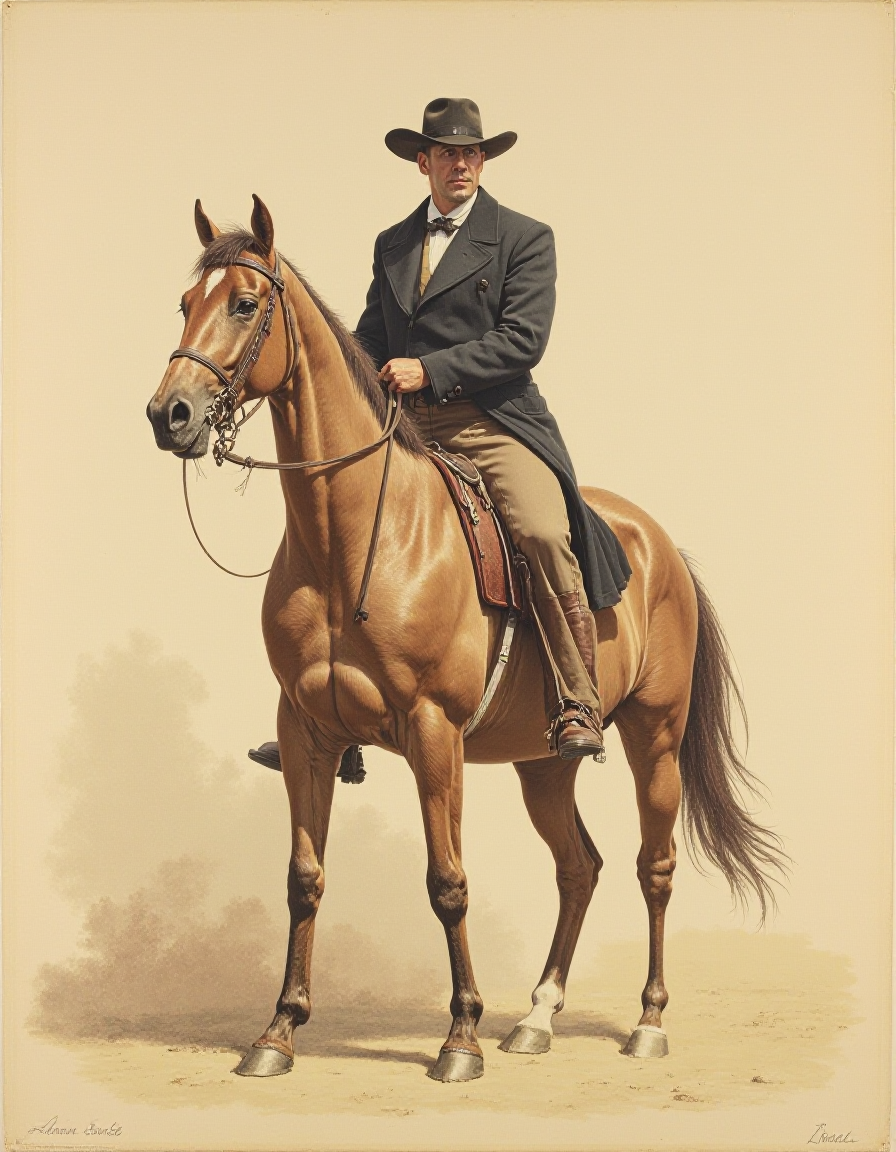
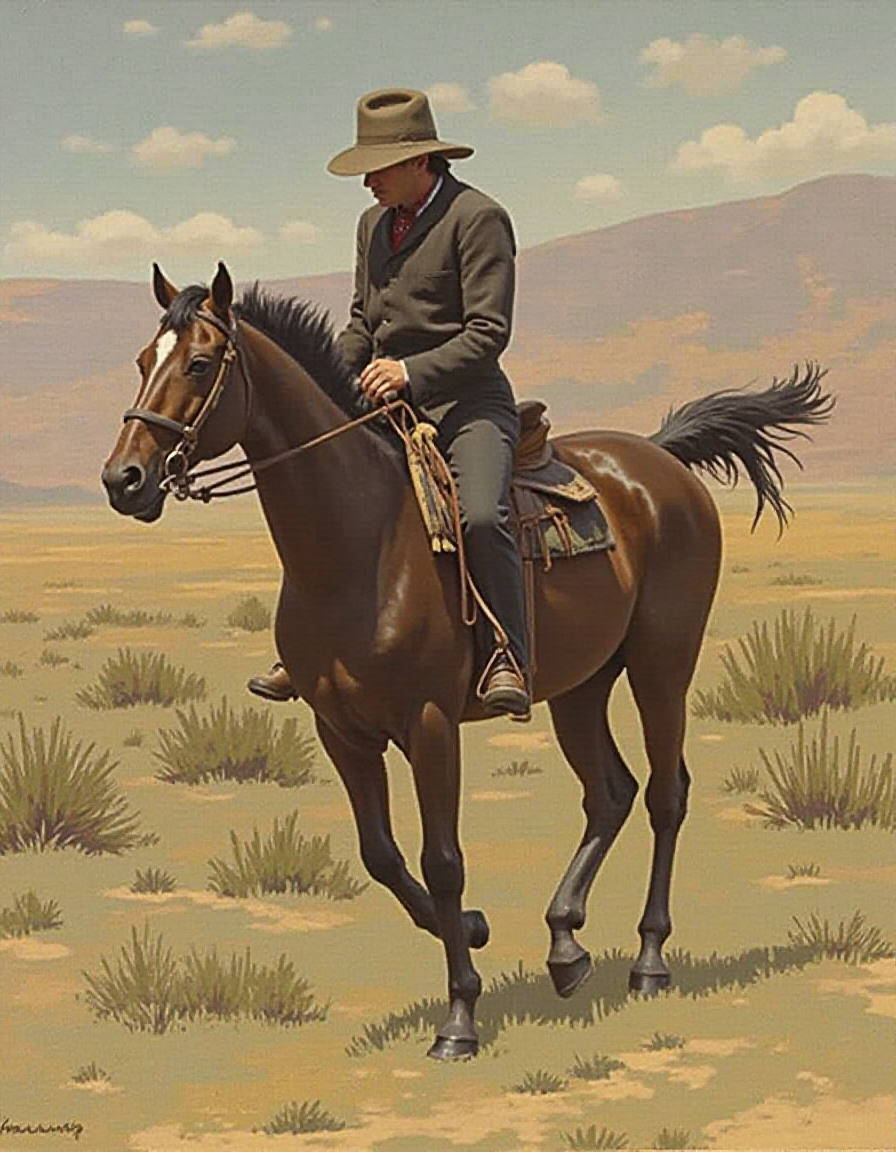
horse
SUMMARY
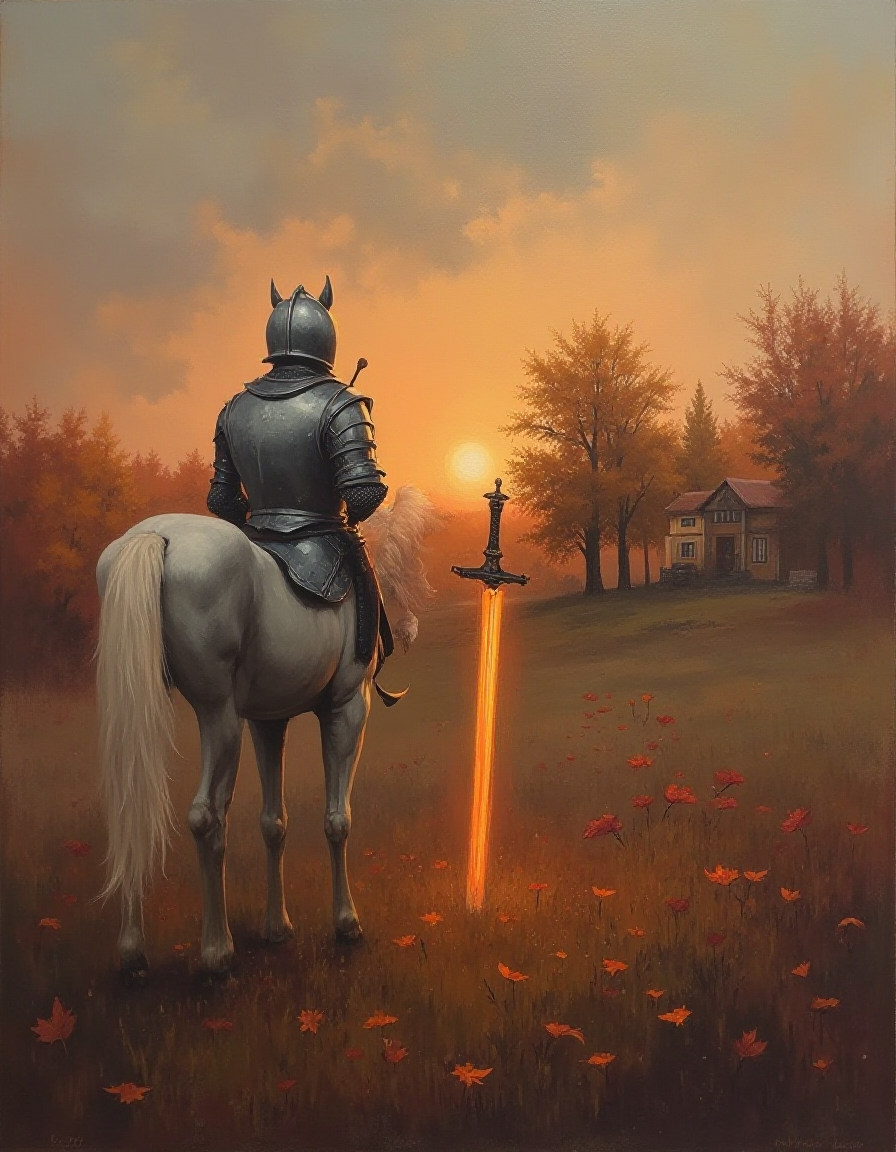
knight on a white horse facing a burning house with a glowing fire in the distance.
CAPTION
The image depicts a medieval knight on a white horse, facing a large, glowing fire that is positioned in the center of the scene. The knight is dressed in full armor, including a helmet with a visor, and is holding a sword in his right hand. The horse, with its mane flowing in the wind, is standing on a grassy field with a few trees in the background.
MONOLOGUE
All the Ambassadors and men of the Corps Diplomatique faced us--the English women were upstairs. About 2.30 (we had been there since 1.30) we heard a trumpet call, and all the company stood up. We women dropped our cloaks, and the Prince took his place standing on the dais. Presently appeared the Garter King-at-Arms and various officers of the household. The Duke of Portland stood on the right of the Throne holding a Royal crown on a cushion. Lord Salisbury (Premier) carried a large sword with a double handle, and then came the Queen followed by Princess Beatrice and Princes Eddie and George of Wales. The Queen was dressed in black satin with a long train, lined and trimmed with ermine, quantities of diamonds on her neck and corsage, the blue ribbon of the Garter, and a regular closed crown of diamonds, and white veil. As she came in the Prince of Wales advanced, touched the ground with one knee, kissed her hand, and led her to the Throne. He did his part most easily and gracefully, and didn't look at all shy. The Queen's train was carried by Sir Henry Ponsonby and two pages in red and gold. Princess Beatrice and the Duchess of Buccleuch (Mistress of the Robes) stood behind the Queen on her right, Princes Eddie and George on her left, Lord Salisbury, Halsbury, Lathom, and some others were also on the dais. As soon as the Queen was settled on her Throne she bowed to us all right and left. We made deep curtseys, and then she made a sign that we were to sit down. There was a few moments' silence while they went to summon the Commons.
SUMMARY
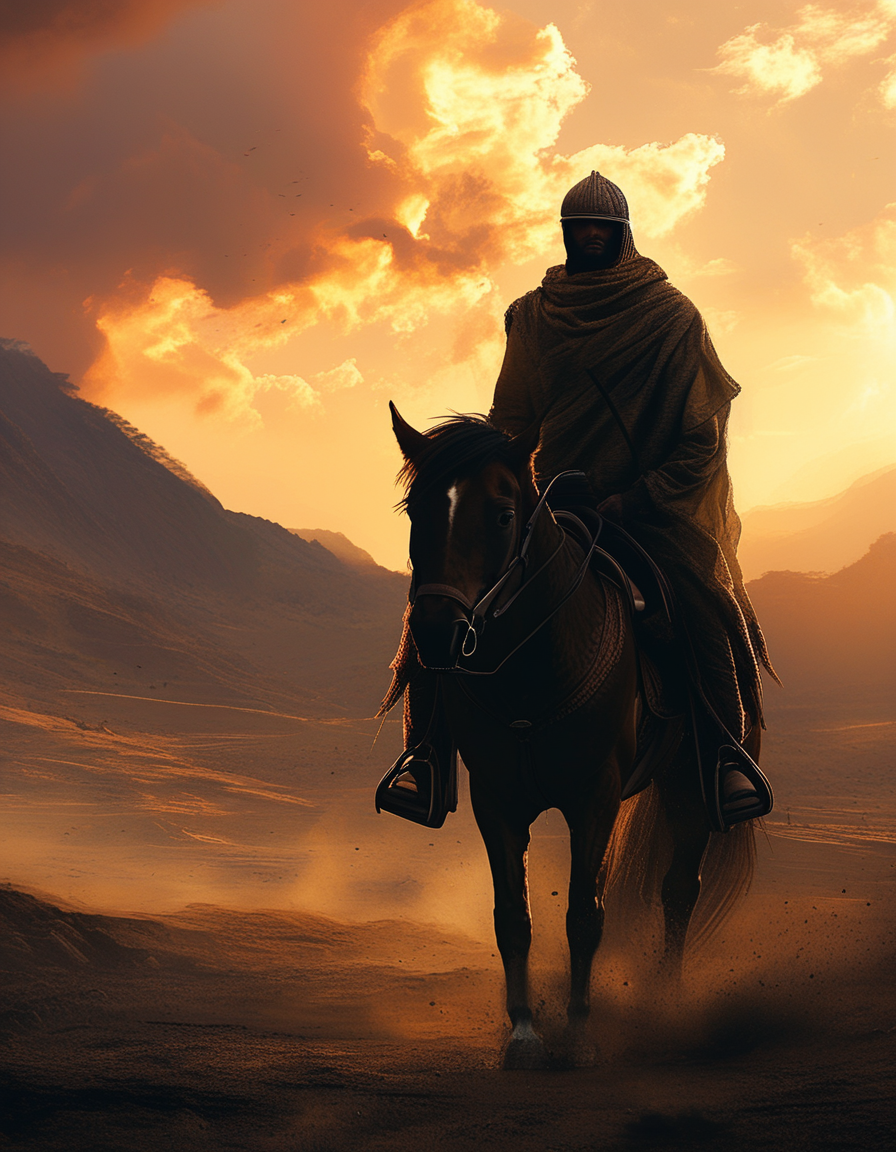
A lone rider on a horse in a desert landscape at sunset.
CAPTION
The image depicts a person riding a horse in a desert landscape. The person is dressed in a dark cloak and a knitted hat, suggesting a cold climate. The horse, which appears to be a dark brown color, is being ridden by the person.
MONOLOGUE
You read in books of travels and romances, of Barbs and Arabs galloping in the desert--and well doth Sir Walter speak of Saladin at the head of the Saracenic chivalry; but take our word for it, great part of all such descriptions are mere falsehood or fudge. Why in the devil's name should dwellers in the desert always be going at full speed? And how can that full speed be anything more than a slow heavy hand-gallop at the best, the Barbs being up to the belly at every stroke? They are always, it is said, in high condition--but we, who know something about horse-flesh, give that assertion the lie. They have seldom anything either to eat or drink; are lean as church-mice; and covered with, clammy sweat before they have ambled a league from the tent. And then such a set of absurd riders, with knees up to their noses, like so many tailors riding to Brentford, _via_ the deserts of Arabia! Such bits, such bridles, and such saddles! But the whole set-out, rider and ridden, accoutrements and all, is too much for one's gravity, and must occasion a frequent laugh to the wild ass as he goes braying unharnessed by. But look there! Arabian blood, and British bone! Not bred in and in to the death of all the fine strong animal spirits--but blood intermingled and interfused by twenty crosses, nature exulting in each successive produce, till her power can no further go, and in yonder glorious grey,
SUMMARY
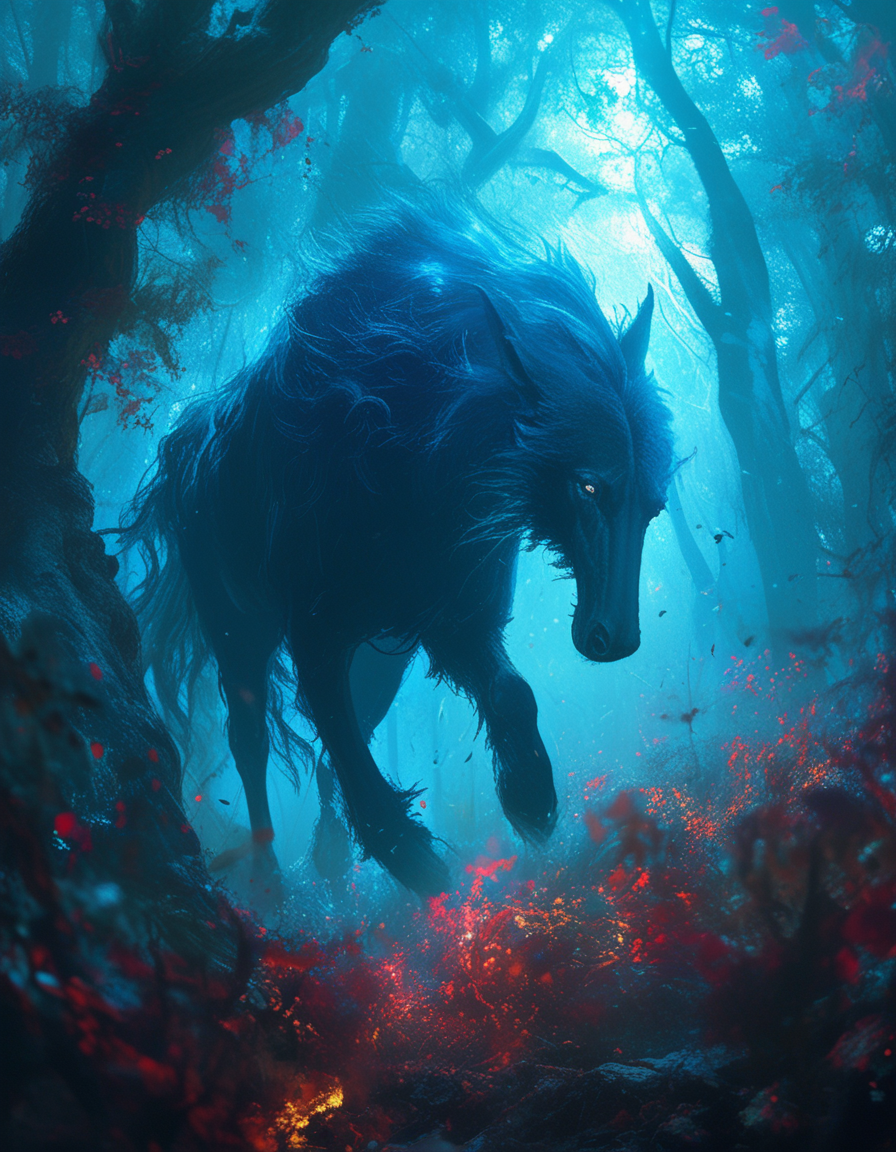
a dark blue horse with a long tail and a long mane is in a forest with red flowers
CAPTION
The image depicts a dark, mystical scene featuring a large, dark blue horse with a long, flowing mane and tail, moving through a dense, misty forest. The horse is positioned centrally in the frame, with its head turned to the left, as if it is looking towards the viewer. The forest is shrouded in a thick layer of mist, creating an ethereal atmosphere.
MONOLOGUE
noble old sycamores, or on the grass, or on the river's brink, and moving among them were Turks cleanly dressed, with trays of refreshments, ices, and sherbet. There was an unusual collection of Greek and Smyrniote women, and an extraordinary display of beauty; none of them wore hats, but the Greek women a light gauze turban, and the Smyrniotes a small piece of red cloth, worked with gold, secured on the top of the head by the folds of the hair, with a long tassel hanging down from it. Opposite, and in striking contrast, the great Turkish burying-ground, with its thick grove of gloomy cypress, approached the bank of the river. I crossed over and entered the burying-ground, and penetrated the grove of funereal trees; all around were the graves of the dead; thousands and tens of thousands who but yesterday were like the gay crowd I saw flitting through the trees, were sleeping under my feet. Over some of the graves the earth was still fresh, and they who lay in them were already forgotten; but no, they were not forgotten; woman's love still remembered them, for Turkish women, with long white shawls wrapped around their faces, were planting over them myrtle and flowers, believing that they were paying an acceptable tribute to the souls of the dead. I left the burying-ground and plunged once more among the crowd. It may be that memory paints these scenes brighter than they were; but, if that does not deceive me, I never saw at Paris or Vienna so gay and beautiful a scene, so rich in landscape and scenery, in
SUMMARY
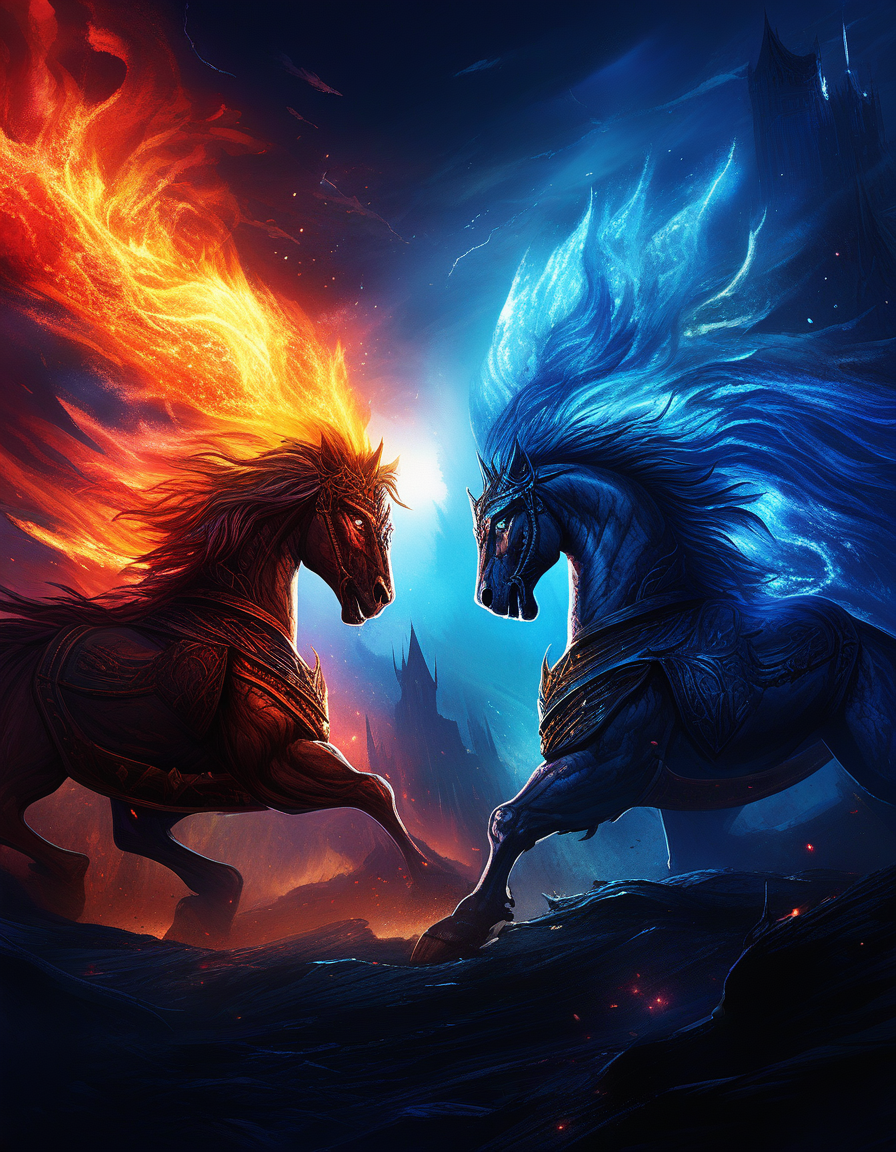
two powerful horses facing each other in a fiery landscape.
CAPTION
The image presents a dynamic scene of two powerful, armored horses facing each other in a dramatic landscape. The horse on the left is predominantly red, while the horse on the right is blue. Both horses are adorned with intricate, flowing manes and tails, adding to the sense of grandeur.
MONOLOGUE
One squad climbed nimbly up the ridge to the left. The horses scrambled up the steep ground, dislodging stones and clods of earth. They struggled with straining hocks hard to get up, and seemed to challenge each other for a race to the top. Their riders, in extended order, showed as patches of red and blue against the grey stubble. Up they went, further and further, and then disappeared over the crest. Only one was still visible, but this one was my guarantee that I had good eyes, keen and alert, on my left. Should any danger threaten from that quarter I knew well that he would pass on to me the signal received from his corporal, and I should only have to gallop to the top to judge of the situation myself. I could see the man against the blue sky, the whole outline of his body and that of his horse; the equipment and harness, the curved sword, the graceful neck, the sinewy legs, the heavy pack. I recognised the rider and knew the name of his horse. They were both of the right sort. Yes, I felt quite easy about my left.
SUMMARY
a black horse with intricate patterns on its body is running in front of a fiery background
CAPTION
The image depicts a fantastical scene featuring a dark, armored horse with intricate patterns on its body. The horse is in motion, galloping across a rocky terrain, with its head turned to the left, as if looking at something off-screen. The background is a vibrant mix of purple and pink hues, with flames and smoke adding to the dramatic atmosphere.
MONOLOGUE
Opening his eyes, Ruan turned his head a little on the pillow, so that he could watch the changing square of sky. A ragged curtain of cloud, blurred and wet-looking at the edge, hung almost to the hill-top, but between ran a streak of molten pallor, and against it the hedge of wilted thorns that crowned the hill stood out black and contorted. One great ploughed field stretched from the garden to the hill-crest; in the middle of its curve a tall grey granite monolith reared up, dark where its top came against the sky, but at its base hardly distinguishable from the bare earth around, which was charmed by the hour to a warm purple hue; when Ruan's eyes left the gleam in the sky they could find out the subdued green of the nearer hedge-row. For the last time, he told himself; then, as the gleam faded from the sky and was gone, he swallowed hard upon the knowledge that never again, for him, would the daylight live behind the clouds. He rubbed his finger up and down the sheet, that he might still feel a tangible sensation at will; then, lifting his bare forearm, he looked closely and curiously at it, noting the way the brown hairs lay across the back, and the finer texture of skin down the inside of elbow and wrist. He, his living self, was in that arm--he could still make the fingers contract and straighten, could still pinch the flesh gently till it whitened--could still call it part of himself. He was not thirsty, but he laboriously lifted the glass of water at his side and drank, because the fancy took him to feel one of
SUMMARY
a knight on a horse in a fiery sky
CAPTION
The image depicts a person dressed in a dark blue robe, riding a black horse with a red mane and tail. The rider is positioned in the center of the image, with the horse in motion, suggesting a dynamic and powerful action. The background is a vibrant mix of red and blue hues, with clouds and fire elements adding to the dramatic atmosphere.
MONOLOGUE
A clear, cold December morning, stars winking frostily in a cloudless sky, and a waning moon casting sharp black shadows over the whitened ground, saw him out of Dumfries, and well on his homeward road. And, as he blew on his fingers, and beat his unoccupied hand briskly against his thigh, to warm himself withal, M'Fadyen chuckled to think how cleverly and quietly he had slipped unnoticed from the inn and through the town. They must be up early indeed who would weather on _him_! And so, ruminating somewhat vain-gloriously, he pushed on over the ringing ground, his horse snorting frosty breaths on the chill air, and inclined to hump his back and squeal on the smallest excuse. Mile after mile slipped easily behind him, and the sun began to show a blood-red face over the hill; a "hare limped trembling through the frozen grass," and crows cawed hungrily as they flew past on sluggish, blue-black wing, questing for food. The world was awake now, and M'Fadyen reckoned that by a couple of hours after noon he should be safe home with his money. Only--who was that on the road ahead of him? A soldier by his coat, surely, with his servant riding behind. Well, so much the better; that would be company for him over the loneliest part of his ride, across the moor which bore an evil name. So M'Fadyen pressed on, and soon he caught up the two riders, first the servant, "mounted upon ane dark grey horse" and armed with a "long gun"; then the master, also riding a dark grey horse, and dressed in a scarlet coat with gold-thread buttons. A tall
SUMMARY
a lone rider on a horse is walking down a forest path at night with a full moon in the background.
CAPTION
The image depicts a serene nighttime scene in a forest. The main subject is a person riding a horse, positioned centrally in the frame. The rider is dressed in a dark cloak, and the horse is adorned with a saddle and bridle.
MONOLOGUE
Walking is sometimes recommended and the example of the camel is pointed out, the camel being a creature that can walk for days and days. But, as has been said by some thinking person, who in thunder wants to be a camel? The subject of horseback riding is also brought up frequently in this connection. It is one of the commonest delusions among fat men that horseback riding will bring them down and make them sylphlike and willowy. I have several fat men among my lists of acquaintances who labor under this fallacy. None of them was ever a natural-born horseback rider; none of them ever will be. I like to go out of a bright morning and take a comfortable seat on a park bench--one park bench is plenty roomy enough if nobody else is using it--and sit there and watch these unhappy persons passing single file along the bridle-path. I sit there and gloat until by rights I ought to be required to take out a gloater's license.
SUMMARY
A man wearing a hat and a suit is riding a horse on a beach at sunset.
CAPTION
The image depicts a man riding a horse on a beach at sunset. The man is dressed in a black suit and hat, and the horse is adorned with a brown saddle and bridle. The horse is positioned on the left side of the image, facing the right, with its head turned towards the man.
MONOLOGUE
When I turned the corner I saw a strange figure only a few yards distant--a strange figure most strangely accoutred--a tall, thin, loose-jointed man, who had made himself appear taller still by wearing a high-peaked hat, the pinnacle of which was surmounted by a wire framework, in which half a dozen bells were suspended, ringing with every motion of the head. He had on a long linen duster, which flapped about his gaunt shanks encased in tight, black trousers. Between his legs he had a pair of cymbals, fastened one to each knee. Upon his back was strapped a small bass-drum, on which there was painted the announcement that the performer was "Prof. Theophilus Briggs, the Solo Orchestra." A drumstick was attached to each side of the drum and connected with a cord that ran down his legs to his feet, so that by beating time with his toes he could make the drum take part in his concert. The Pan-pipes that I had heard were fastened to his breast just at the height of his chin, so that he could easily blow into them by the slightest inclination of his head. In his left hand he held a fiddle, and in his right hand he had a fiddle-bow. Just as I came in sight, he tapped the fiddle with the bow, as though to call the attention of the orchestra. Then he raised the fiddle; not to his chin, for the Pan-pipes made this impossible, but to the other position, not infrequent among street musicians, just below the shoulder. Evidently I had just arrived in time.
SUMMARY
A man in a suit and hat rides a horse in a desert.
CAPTION
The image depicts a man riding a horse in a desert-like setting. The man is dressed in a black suit and hat, and the horse is adorned with a saddle and bridle. The horse is standing on a sandy ground, with a hazy, yellowish sky in the background.
MONOLOGUE
Walter Ryder, when he passed through the window, sprang from the veranda, and dashed into the garden. A voice called to him to stand in the name of the law, and a revolver bullet clipped his shoulder, but he ran on until the thick growth of trees and shrubbery quite covered him, then, turning sharply to the left, he hid in the hollow of an old gum-tree, the creeper overgrowing which offered a perfect screen. From here he uttered the mopoke's call, repeating it twice. He had made himself familiar with all the advantages the garden and orchard offered a hunted man ere he had been a week at Boobyalla. Ryder remained in this hiding-place for some time. He heard the thunder of Galah's hoofs and the cries of the troopers. Yarra had timed his break from cover to a second. When the sound of the chase died out in the distance, Solo walked quietly to the corner of the orchard opposite to that from which the black boy had started, where a horse was standing. This was Wallaroo. The saddle had been hastily thrown on to the entire's back, and the bridle was looped over a post. Ryder fastened the girths, buckled the bridle securely, and, mounting the horse, walked him to the slip panels, keeping well under cover of the trees. When about a quarter of a mile off, he stirred Wallaroo to a canter, but kept to the track thickly seared with new hoof-prints, so that it should be impossible for any but a clever tracker to follow him. After riding for about three miles, he bore to the right along the course of a small creek, and made his way into the ranges up a
SUMMARY
A man wearing a cowboy hat and a brown jacket rides a horse in a field of tall grass.
CAPTION
The image depicts a man riding a horse in a field of tall grass under a bright yellow sky. The man is dressed in a brown cowboy hat, a brown jacket, and a brown vest, and he is holding the reins of the horse. The horse, which is brown with a white stripe on its forehead, is being ridden by the man.
MONOLOGUE
I went over to have lunch with the Depon's representative. His family were all dressed up very smartly for the occasion, the women folk wearing their best head-dresses of turquoises, coral and pearls. He gave us rice and raisins as an _hors d'[oe]uvre_, and an _entree_ of junket, followed by some pickled turnips, which I thought very nasty, after which we had the usual macaroni and mince. He had been very friendly and kindly to us the whole time that we were at Tingri, and had always supplied us with everything we asked for. On July 22 we saw a very fine solar halo with well-marked rings of yellow, brown, green and white, but the rain continued steadily nearly all the time. The day before we were to leave Tingri I sent away my orderly, together with two coolies who had been sick, and whom the doctor had recommended that we should send back to Darjeeling. They were given sufficient food to take them back to Darjeeling and an extra fifteen days' pay, the orderly also being given a horse to ride. Towards evening the weather improved and we had some lovely views of Mount Everest and that great group of snow peaks of which Cho-Uyo is the highest. They all looked very white under their new coating of snow, which lies thickly down to 16,000 feet.
SUMMARY
man riding horse in desert with mountains in the background
CAPTION
The image depicts a man riding a horse in a desert-like landscape. The man is dressed in a dark jacket and hat, and is holding the reins of the horse. The horse, which is brown, is walking on a sandy terrain with sparse vegetation.
MONOLOGUE
My second stroll toward St. Augustine carried me perhaps three miles,--say one sixty-sixth of the entire distance,--and none of my subsequent excursions took me any farther; and having just now commended a negro for his candor, I am moved to acknowledge that, between the sand underfoot and the sun overhead, I found the six miles, which I spent at least four hours in accomplishing, more fatiguing than twice that distance would have been over New Hampshire hills. If I were to settle in that country, I should probably fall into the way of riding more, and walking less. I remember thinking how comfortable a certain ponderous black mammy looked, whom I met on one of these same sunny and sandy tramps. She sat in the very middle of a tipcart, with an old and truly picturesque man's hat on her head (quite in the fashion, feminine readers will notice), driving a one-horned ox with a pair of clothes-line reins. She was traveling slowly, just as I like to travel; and, as I say, I was impressed by her comfortable appearance. Why would not an equipage like that be just the thing for a naturalistic idler?
SUMMARY
A man is riding a horse in a desert.
CAPTION
The image depicts a man riding a horse in a desert-like setting. The man is dressed in a cowboy hat, a brown jacket, and a gray vest. He is holding the reins of the horse, which is brown and has a saddle on its back.
MONOLOGUE
A rifle-shot forced instant action. Jim whirled away from the camp-fire and saddle-bags and sprang toward the horses, while Johnson, leaping up with the agile twist of an athlete, gained his feet running. Jim headed grimly for Pat, but Johnson reached him a breath in advance. Snatching up the reins and mounting, he dug Pat viciously with his huge rowels. At that Pat balked. The man swore and cursed and spurred again; but the horse remained obdurate. Seeing this, Johnson stopped spurring. Thereupon Pat flung forward, dragging his tether clear of its stake, and crowded close beside the gray. Jim was mounted on the gray, bending low in the saddle, racing in frantic pursuit of Glover. Mounted on the sorrel, Glover was well in the lead, speeding straight into the west, riding at right angles to the ridge, galloping hard for the open desert. The echo of the shot reverberated again faintly, and around them closed a tense silence.
SUMMARY
a man in a cowboy hat and jacket rides a horse in a foggy field
CAPTION
The image depicts a man dressed in a brown leather jacket and a hat, riding a horse in a field. The horse, which appears to be a dark brown color, is being ridden by the man. The man is positioned in the center of the image, with the horse positioned to his right.
MONOLOGUE
I have told you that Isabel had a mind of her own; she showed it very plainly by falling in love in a most unorthodox, unfilial, enthusiastic sort of way--with whom? You will be so shocked, my daughters, that I almost dread to tell you. If she had waited, like a dutiful child, till her father had told her she _might_ love, it would have been another thing! But this headstrong girl seemed to think she had as good a right to be happy in her own way as a peasant! True, the man of her choice was not a reprobate: he was not even a low-born, unmannerly churl: Don Fernando de Velasquez stood foremost among the young cavaliers of Spain, in gallantry and in that nobility of mind which, should ever accompany gentle birth. But yet it was in that very gentle birth that all the offence lay, for Fernando's ancestors had long been at enmity with the house of Alcantra, and this ancient feud had been embittered by years. But, sometimes, there appears to be a fate in the affairs of men, especially when a woman, and a pretty woman, is in question: so it happened that Don Fernando was, one day, riding at some distance from his home, when his good fortune enabled him to rescue a lady, whose horse, frightened by some object in the road, reared and plunged in a most alarming manner. It was Dona Isabel, who had out-ridden her attendants, and who now felt that she owed her life to this very handsome, polite, and noble-looking cavalier. Could he do less than soothe her fluttered nerves, guide her horse, and make himself as
SUMMARY
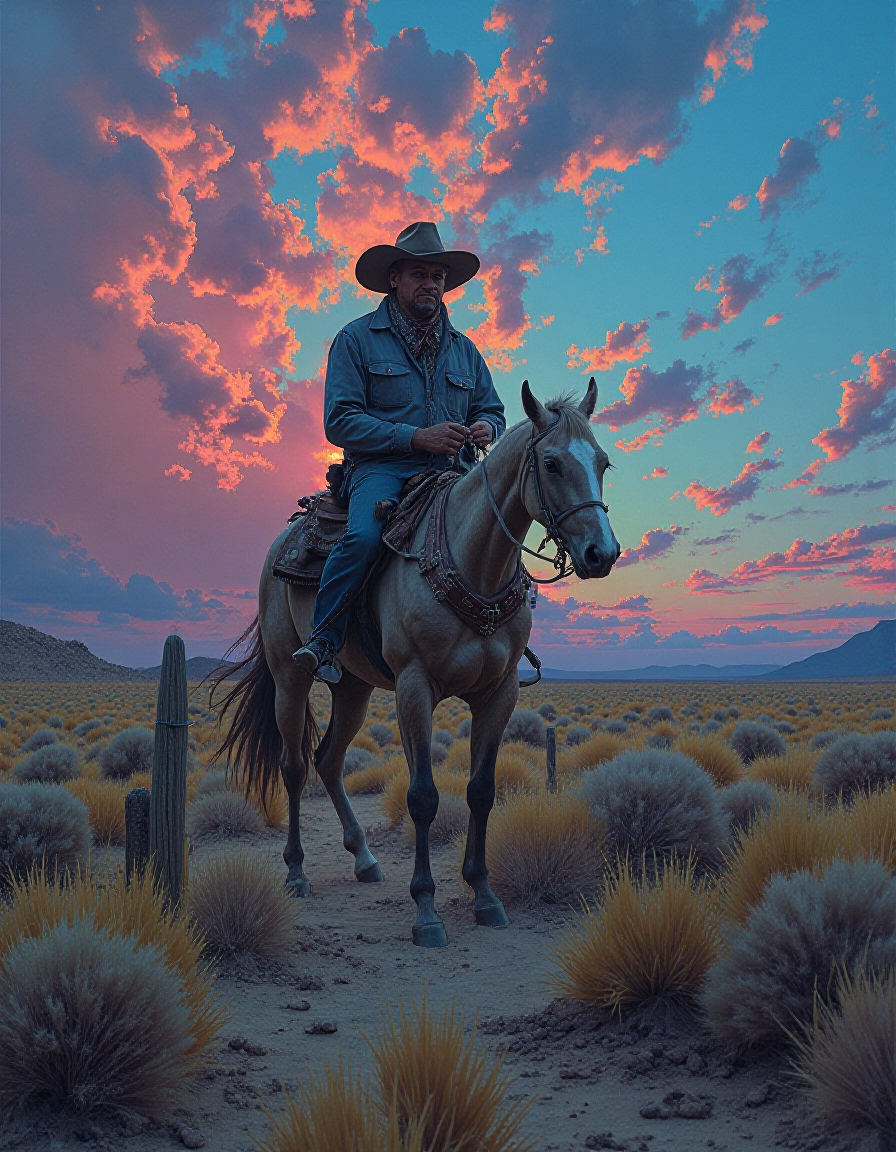
a man wearing a cowboy hat and a brown vest is riding a horse in a field at sunset
CAPTION
The image depicts a man riding a horse in a field during sunset. The man is dressed in a brown cowboy hat, a brown vest, and a red bandana around his neck. He is holding the reins of the horse, which is brown with a white stripe on its forehead.
MONOLOGUE
She harnessed the pony to the cart, and stowed her baskets safely under the seat. She was dressed in a purple merino skirt, kilted thickly, a black mantle, with a bead fringe, and an antiquated straw bonnet. Round her neck she had folded a man's linen handkerchief, and she had elastic-sided boots on her feet. She locked the door, and put the keys in her linen pocket tied round her waist under her skirt, and climbing up by means of the wheel, seated herself on the board which did duty as a seat, and took the reins. "Go on, Polly!" she said, and the pony, with a good deal of tossing of head and tail, set off obediently towards the high road. The clacking of its feet as it trotted on the hard road overwhelmed all other sounds. At the corner of the roads an old woman tending a cow nodded to her, and one or two field labourers raised themselves to see who was going past, remaining upright and staring longer than was necessary to satisfy their curiosity. At an open field-gate she had to wait until two heavy wagons, their wheels a mass of red, soft earth, had emerged, and turned in the direction of the town. She passed them, and for some time met no one. An advancing cart soon came in sight, accompanied by a great jangling of cans--a milk-cart returning from the station, having sent off its supplies to the town, now bringing back its empty cans. It was driven by a man whom Anne knew, and, instead of drawing to one side to pass, he reined in his horse as if to speak. "Good morning, Miss Hilton," he said. Anne checked her
SUMMARY
man riding horse in a field at sunset
CAPTION
The image depicts a man riding a horse in a vast, open landscape under a dramatic sunset. The man, dressed in a cowboy hat and a dark jacket, is positioned in the center of the image, holding the reins of the horse. The horse, with its mane flowing in the wind, is positioned to the right of the man.
MONOLOGUE
(3) _Character of the Biblical Cosmogony, and general Views of Nature which it Contains or to which it Leads._--Much of what appertains to the character of the revelation of origins has been anticipated under previous heads. We have only to read the Song of Creation, as given in the last chapter, to understand its power and influence as a beginning of religious doctrine. The revelation was written for plain men in the infancy of the world. Imagine Chaldean or Hebrew shepherd listening to these majestic lines from the lips of some ancient patriarch, and receiving them as truly the words of God. What a grand opening to him of both the seen and unseen worlds! Henceforth he has no superstitious dread of the stars above, or of the lightning and thunder, or of the dark woods and flowing waters beneath. They are all the works of the one Creator, the same Creator who is his own Maker, in whose image and shadow he is made. He can look up now to the heavens or around upon the earth, and see in all the handiwork of God, and can worship God through all. He can see that the power that cares for the birds and the flowers of the field cares for him. He is no longer the slave and sport of unknown and dreadful powers; they are God's workmanship and under his control--nay, God has given him a mission to subdue and rule over them. So these noble words raise him to a new manhood, and emancipate him from the torture of endless fears, and open to him vast new fields of thought and inquiry, which may enrich him with boundless treasures of new
SUMMARY
The image depicts a group of mounted soldiers riding horses in a field.
CAPTION
The image depicts a group of soldiers in period-appropriate attire, riding horses in a field. The soldiers are dressed in dark green uniforms with brown belts and hats, and they are equipped with rifles. The horses are brown and appear to be well-maintained, with a saddle and bridle.
MONOLOGUE
At the head of the column rode a squadron of gendarmes--the policemen of the army--gorgeous in uniforms of bottle-green and silver and mounted on sleek and shining horses. After them came the infantry: solid columns of grey-clad figures with the silhouettes of the mounted officers rising at intervals above the forest of spike- crowned helmets. After the infantry came the field artillery, the big guns rattling and rumbling over the cobblestones, the cannoneers sitting with folded arms and heels drawn in, and wooden faces, like servants on the box of a carriage. These were the same guns that had been in almost constant action for the preceding fortnight and that for forty hours had poured death and destruction into the city, yet both men and horses were in the very pink of condition, as keen as razors, and as hard as nails; the blankets, the buckets, the knapsacks, the intrenching tools were all strapped in their appointed places, and the brown leather harness was polished like a lady's tan shoes. After the field batteries came the horse artillery and after the horse artillery the pom-poms--each drawn by a pair of sturdy draught horses driven with web reins by a soldier sitting on the limber--and after the pom-poms an interminable line of machine- guns, until one wondered where Krupp's found the time and the steel to make them all. Then, heralded by a blare of trumpets and a crash of kettledrums, came the cavalry; cuirassiers with their steel helmets and breastplates covered with grey linen, hussars in
SUMMARY
a man riding a horse in a field with flowers
CAPTION
The image depicts a serene landscape with a person riding a black horse. The rider, dressed in a brown leather jacket and a hat, is holding a small object in their hand. The horse, with a bridle and reins, is galloping across a field of vibrant flowers, including pink and orange flowers, and is positioned in the center of the image.
MONOLOGUE
On that memorable evening the poet dressed to outshine every man present. Mme. de Senonches had spoken of him as the hero of the hour, and a first interview between two estranged lovers is the kind of scene that provincials particularly love. Lucien had come to be the lion of the evening; he was said to be so handsome, so much changed, so wonderful, that every well-born woman in Angouleme was curious to see him again. Following the fashion of the transition period between the eighteenth century small clothes and the vulgar costume of the present day, he wore tight-fitting black trousers. Men still showed their figures in those days, to the utter despair of lean, clumsily-made mortals; and Lucien was an Apollo. The open-work gray silk stockings, the neat shoes, and the black satin waistcoat were scrupulously drawn over his person, and seemed to cling to him. His forehead looked the whiter by contrast with the thick, bright curls that rose above it with studied grace. The proud eyes were radiant. The hands, small as a woman's, never showed to better advantage than when gloved. He had modeled himself upon de Marsay, the famous Parisian dandy, holding his hat and cane in one hand, and keeping the other free for the very occasional gestures which illustrated his talk.
SUMMARY
A man riding a horse in a desert landscape with mountains in the background.
CAPTION
The image depicts a pastoral scene with a solitary figure riding a horse in a vast, open field. The sky is a warm, golden hue, suggesting either sunrise or sunset. The figure is dressed in a long coat and a hat, and the horse is adorned with a saddle and bridle.
MONOLOGUE
As far as the Shalford crossing Sir John rode by Nigel's arm, and many were the last injunctions which he gave him concerning woodcraft, and great his anxiety lest he confuse a spay with a brocket, or either with a hind. At last when they came to the reedy edge of the Wey the old knight and his daughter reined up their horses. Nigel looked back at them ere he entered the dark Chantry woods, and saw them still gazing after him and waving their hands. Then the path wound amongst the trees and they were lost to sight; but long afterwards when a clearing exposed once more the Shalford meadows Nigel saw that the old man upon the gray cob was riding slowly toward Saint Catharine's Hill, but that the girl was still where he had seen her last, leaning forward in her saddle and straining her eyes to pierce the dark forest which screened her lover from her view. It was but a fleeting glance through a break in the foliage, and yet in after days of stress and toil in far distant lands it was that one little picture--the green meadow, the reeds, the slow blue-winding river, and the eager bending graceful figure upon the white horse--which was the clearest and the dearest image of that England which he had left behind him.
SUMMARY
A man in a cowboy hat and long coat rides a horse in a desert landscape.
CAPTION
The image depicts a person riding a horse in a desert landscape. The person is dressed in a cowboy hat and a long coat, and the horse is adorned with a saddle and bridle. The background features a vast desert landscape with rocky formations and a clear sky filled with clouds.
MONOLOGUE
"If I miss him, jump off to the right," he cried; and in a moment, before Margaret could answer or prevent him, he had got over the dashboard, and was in mid-air, a strange figure, in his long frock-coat and shiny hat. With a bold leap--and the Countess shivered as she saw him flying in front of her--he alighted on the back of the off horse, almost on his face, but well across the beast for all that. Light and wiry, a mere bundle of nerves dressed up, Mr. Barker was not to be shaken off, and, while the animal was still plunging, he had caught the flying bits of bridle, and was sawing away, right and left, with the energy of despair. Between its terror at being suddenly mounted by some one out of a clear sky, so to say, and the violent wrenching it was getting from Barker's bony little hands, the beast decided to stop at last, and its companion, who was coming in for some of the pulling too, stopped by sympathy, with a series of snorts and plunges. Barker still clung to the broken rein, leaning far over the horse's neck so as to wind it round his wrist; and he shouted to Margaret to get out, which she immediately did; but, instead of fainting away, she came to the horses' heads and stood before them, a commanding figure that even a dumb animal would not dare to slight--too much excited to speak yet, but ready to face anything.
SUMMARY
A woman in a pink dress is riding a horse in a field at sunset.
CAPTION
The image depicts a woman in a pink dress riding a white horse in a field at sunset. The woman is holding a sparkler in her right hand, which is glowing brightly, and is positioned in the center of the image. The horse, which is galloping, is in the foreground, with its head turned towards the woman.
MONOLOGUE
The old woman's life was in the greatest peril, when a strange and unaccountable, but at the same time irresistible impulse, moved Antonio to go to her rescue. He was forcing his way through the crowd with this intention, when the object of the popular fury turned her head towards him. Her veil was for a moment partially drawn aside, affording a glimpse of her features in profile; and Antonio, still the slave of his diseased imagination, fancied that her yellow shriveled features had been metamorphosed into a countenance of regular beauty; such a countenance, in short, as befitted the graceful and symmetrical form to which it belonged. Confused and bewildered, the naturally weak and undecided youth stood deliberating and uncertain whether he should attempt the rescue, which would have been by no means difficult to accomplish by the display of a little boldness and promptitude. Whilst he was thus hesitating, there suddenly broke through the crowd a young man, attired like himself in a black dress, and holding a naked rapier in his hand. The new comer had probably lost his mask in the tumult and confusion, for his features were uncovered, and Antonio saw, to his inexpressible consternation and astonishment, that they were the exact counterpart of his own. Before he could recover from this new shock, the stranger, by the aid of his fierce and determined demeanour, and the rapid play of his weapon, had made his way to the mysterious old woman, whose back was turned towards him, and seizing
SUMMARY
a man riding a horse in a desert landscape at sunset
CAPTION
The image depicts a man riding a horse in a desert landscape at sunset. The man is dressed in a cowboy hat and a denim jacket, and he is holding the reins of the horse. The horse, which is a light brown color, is adorned with a saddle and bridle.
MONOLOGUE
He drew saddle and bridle from the animal he had been riding and turned it loose. Then coiling his rope as he went, he came up to Comet's high-lifted head. With much evident distaste but with what looked like too much pride to struggle in an encounter in which he knew that he was to be overcome, the big grey accepted the hard Spanish bit. He allowed, too, the saddle to be thrown on him, only a quick little quivering of the tense flanks and a twitching of the skin upon his back showing that he felt and resented. And then with his master's weight upon him, his master's softened voice in his ear, a hard hand very gently stroking the hot shoulder, Comet shook his head, a great sigh expanded the deep lungs, and he was the perfect saddle horse with too much sense to rebel further at the knowledge that after all he is a horse and the man who bestrides him is a man. And Buck Thornton, because he knew this animal and loved him, slackened the reins a little, sensed the tensing of the powerful muscles slipping like pliant steel through satin sheaths, turned the proud head toward the south and felt the rush of air whipping back his hat brim, stinging his face as they shot out across the rolling hills.
SUMMARY
a man riding a horse in a field with flowers
CAPTION
The image depicts a dynamic scene of a person riding a horse in a field. The rider, dressed in a hat and a long coat, is positioned in the center of the image, holding the reins of the horse. The horse, with its mane flowing in the wind, is captured mid-gallop, showcasing its powerful stride.
MONOLOGUE
A sound was heard like the rapid galloping of a horse, not loud and distinct as on a road, but dull and heavy as if upon a grass sward, nearer and nearer it came, and the man, starting up, rushed out of the tent, and looked around anxiously. I arose from the stool upon which I had been seated, and just at that moment, amidst a crashing of boughs and sticks, a man on horseback bounded over the hedge into the lane at a few yards' distance from where we were; from the impetus of the leap the horse was nearly down on his knees; the rider, however, by dint of vigorous handling of the reins, prevented him from falling, and then rode up to the tent. ''Tis Nat,' said the man; 'what brings him here?' The new comer was a stout, burly fellow, about the middle age; he had a savage, determined look, and his face was nearly covered over with carbuncles; he wore a broad slouching hat, and was dressed in a grey coat, cut in a fashion which I afterwards learnt to be the genuine Newmarket cut, the skirts being exceedingly short; his waistcoat was of red plush, and he wore broad corduroy breeches and white top-boots. The steed which carried him was of iron grey, spirited and powerful, but covered with sweat and foam. The fellow glanced fiercely and suspiciously around, and said something to the man of the tent in a harsh and rapid voice. A short and hurried conversation ensued in the strange tongue. I could not take my eyes off this new comer. Oh, that half-jockey half-bruiser countenance, I never forgot it! More than
SUMMARY
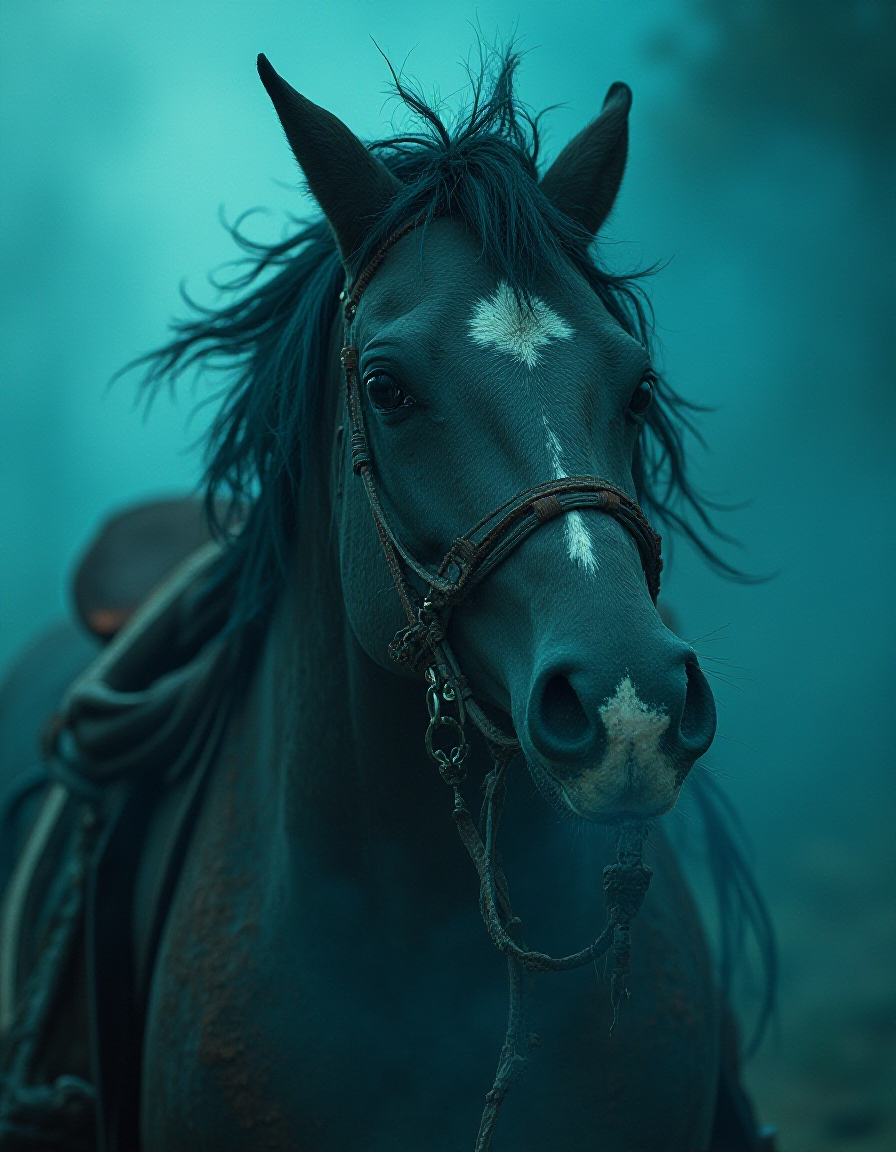
a horse with a white marking on its face is being ridden by a rider
CAPTION
The image depicts a horse with a white marking on its forehead, standing in a dimly lit environment. The horse is facing the camera, and its mane is flowing in the wind. The background is a dark, murky blue, which contrasts with the horse's dark coat and the light source illuminating the horse.
MONOLOGUE
Over that ample forehead white The thousandth year returneth. Still, on its commanding height, With a fierce and blood-red light, The fiery token burneth. Wheresoe'er that mystic star Blazeth in the van of war, Back recoil before its ray Shield and banner, bow and spear, Maddened horses break away From the trembling charioteer. The fear of that stern king doth lie On all that live beneath the sky: All shrink before the mark of his despair, The seal of that great curse which he alone can bear. Blazing in pearls and diamonds' sheen. Tirzah, the young Ahirad's bride, Of humankind the destined queen, Sits by her great forefather's side. The jetty curls, the forehead high, The swan like neck, the eagle face, The glowing cheek, the rich dark eye, Proclaim her of the elder race. With flowing locks of auburn hue, And features smooth, and eye of blue, Timid in love as brave in arms, The gentle heir of Seth askance Snatches a bashful, ardent glance At her majestic charms; Blest when across that brow high musing flashes A deeper tint of rose, Thrice blest when from beneath the silken lashes Of her proud eye she throws The smile of blended fondness and disdain Which marks the daughters of the house of Cain.
SUMMARY
a woman wearing a cowboy hat and a shirt is riding a horse in the desert
CAPTION
The image depicts a woman riding a horse in a desert landscape. The woman is dressed in a cowboy hat and a light-colored shirt, and she is holding the reins of the horse. The horse, which is brown, is adorned with a saddle and bridle, and it is moving forward, suggesting a journey or a ride.
MONOLOGUE
As Nils was crossing the dry creek he heard the restive tramp of a horse coming toward him down the hill. Instantly he flashed out of the road and stood behind a thicket of wild plum bushes that grew in the sandy bed. Peering through the dusk, he saw a light horse, under tight rein, descending the hill at a sharp walk. The rider was a slender woman--barely visible against the dark hillside--wearing an old-fashioned derby hat and a long riding skirt. She sat lightly in the saddle, with her chin high, and seemed to be looking into the distance. As she passed the plum thicket her horse snuffed the air and shied. She struck him, pulling him in sharply, with an angry exclamation, _"Blazne!"_ in Bohemian. Once in the main road, she let him out into a lope, and they soon emerged upon the crest of high land, where they moved along the skyline, silhouetted against the band of faint colour that lingered in the west. This horse and rider, with their free, rhythmical gallop, were the only moving things to be seen on the face of the flat country. They seemed, in the last sad light of evening, not to be there accidentally, but as an inevitable detail of the landscape.
SUMMARY
a woman in a yellow dress is walking away from the camera in a field with horses
CAPTION
The image depicts a woman in a vibrant yellow dress, standing in a field with a group of people riding horses in the background. The woman is facing away from the camera, and the horses are positioned in the distance, with some of them closer to the foreground and others further back. The sky is a warm, golden hue, suggesting a time of day when the sun is setting.
MONOLOGUE
"No," said David, a little non-plussed at evidences of his dissolute past and this unexpected fatherhood assumed on his account. "I haven't more luggage than what is contained in my bicycle bag. But don't let that concern you. I'll go over to Swansea one day or some nearer town and buy what may be necessary, and I'll stay with you all my holidays, tell you all my plans, and even after I go back to London I'll always come down here when I can get away. For the present I'm going simply to enjoy myself for the first time in my life. The last four years we'll look on as a horrid dream. What a paradise you live in." His eye ranged over the two-storeyed, soundly-built stone house facing south, with mountains behind and the western sun throwing shafts of warm yellow green over the lawn and the flower beds; over clumps of elms in the middle, southern distance, that might have been planted by the Romans (who loved this part of Wales). Bees, butterflies and swallows were in the air; the distant lowing of kine, the scent of the roses, the clatter in the kitchen where Nannie aided by another female servant was preparing supper, even the barking of a watch dog; aware that something unusual was going on, completed the impression of the blissful countryside. "What a paradise you live in! How _could_ I have left it?"
SUMMARY
a woman wearing a hat and a shirt is riding a horse in a field
CAPTION
The image depicts a woman riding a white horse in a field. The woman is dressed in a floral-patterned blouse and jeans, and she is wearing a wide-brimmed hat. The horse, which is the main focus of the image, is adorned with a blue bridle and a brown saddle.
MONOLOGUE
Hiram nodded, and thoughts of pink-and-white little Lucy Dalles and her ambitions were far in the background of his mind. Jerkline Jo was a beautiful girl--as different in her beauty from Lucy Dalles as is day from night. Her hair was dark and heavy, and crowned a low, broad brow. Her skin was now tanned a rich mahogany, but was clear and flawless, and her bare arms were round and brown. Her confident poise, her sturdy shoulders, showed character and strength far above the ordinary. She was a man's woman, was Jerkline Jo Modock, and only a man among men might hope to become her mate. She wore a broad-brimmed Stetson with a horsehair band, a blue-flannel man's shirt, worn leather chaps for comfort, and riding boots. A holstered six-shooter hung close at hand, the ivory-handled butt of the big weapon ready to her grasp. Here was a wonderful woman, and Hiram Hooker knew it, and knew, too, that here at last was the adventure girl who, in his dreams up there on Wild-cat Hill in the big woods of the North had been beckoning him to come and work for her, to fight for her--to die for her if fate should so decree.
SUMMARY
two people riding horses in a snowy forest at sunset
CAPTION
The image captures a serene winter scene where two individuals are riding a white horse in a snowy landscape. The horse, with its white coat and brown mane, is being ridden by the person on the left, who is dressed in a light-colored jacket and a hat.
MONOLOGUE
I must observe to the reader that I was not dressed in jacket and trousers. The money I earned was more than sufficient to supply all my expenses, and I had fitted on what are called at sea, and on the river, _long togs_. I was dressed as most people are on shore. The servant evidently took me for a gentleman; and perhaps, as far as dress went, I was entitled to that distinction. Many people are received as such in this world with less claims than I had. I gave my name; the man left me at the door, and soon returned, requesting that I would follow him. I must say that I was rather astonished; where were Mr Mortimer and the two men in flaunting liveries, and long cotton epaulettes with things like little marline-spikes hanging to the ends of them? Even the livery was changed, being a plain brown coat, with light blue collar and cuffs. I was, however, soon made acquainted with what had taken place on my entering the apartment of Mr Turnbull--his study, as Mrs T called it, although Mr Turnbull insisted upon calling it his cabin, a name certainly more appropriate, as it contained but two small shelves of books, the remainder of the space being filled up with favourite harpoons, porpoise skulls, sharks' jaws, corals, several bears' skins, brown and white, and one or two models of the vessels which had belonged to his brother and himself, and which had been employed in the Greenland fishery. It was, in fact, a sort of museum of all he had collected during his voyages. Esquimaux implements, ornaments and dresses, were
SUMMARY
a young girl riding a horse in a desert with a full moon in the sky.
CAPTION
The image depicts a person riding a horse in a desert landscape. The person, dressed in a brown jacket and blue jeans, is holding the reins of the horse, which is adorned with a purple saddle and a pink bridle. The horse is positioned on the left side of the image, facing the right, with its head turned slightly towards the person.
MONOLOGUE
It is the groom's duty, when the rider approaches, to gather up the reins with his left hand, smoothly and evenly, the curb rein between, and somewhat tighter than the bridoon, properly dividing them with his fore-finger. The lady advancing, on the near side of the horse, to the saddle, receives them a little more forward than the point of the horse's shoulder, with her right hand, which still retains and passes the whip over the saddle to the _off_ or right side. On taking the bridle in this manner, her fore-finger is placed between the reins: the groom then removes his hand, and the lady draws her own back, suffering the reins to glide gently and evenly through her fingers, until she reaches the near crutch of the saddle, which she takes with her right hand, still holding the whip and reins, and places herself close to the near side of the horse, with her back almost turned towards him. The groom now quits his former post, and prepares to assist her to mount. The horse being thus left to the lady's government, it is proper, that, in passing her hand through the reins she should not have suffered them to become so loose as to prevent her, when her hand is on the crutch, from having a light, but steady bearing on the bit, and thus keeping the horse to his position during the process of mounting. She next places her left foot firmly in the right hand of the groom, or gentleman, in attendance, who stoops to receive it. The lady then puts her left hand on his right shoulder; and, straightening her left knee, bears her
SUMMARY
The image depicts a man riding a horse in a bustling street, surrounded by other people and horses.
CAPTION
The image depicts a man riding a horse in a bustling street scene. The man is dressed in a vibrant green coat and a black top hat, complete with a gold chain and a red scarf. He is holding the reins of the horse, which is adorned with a richly decorated saddle and bridle.
MONOLOGUE
The equipages on the Corso here are very numerous, in proportion to the size of the city, and excessively showy: the horses are long-tailed, heavy, and for the most part black, with high rising forehands, while the sinking of the back is artfully concealed by the harness of red Morocco leather richly ornamented, and white reins. To this magnificence much is added by large leopard, panther, or tyger skins, beautifully striped or spotted by Nature's hand, and held fast on the horses by heavy shining tassels of gold, coloured lace, &c. wonderfully handsome; while the driver, clothed in a bright scarlet dress, adorned and trimmed with bear's skin, makes a noble figure on the box at this season upon days of gala. The carnival, however, exhibits a variety unspeakable; boats and barges painted of a thousand colours, drawn upon wheels, and filled with masks and merry-makers, who throw sugar-plums at each other, to the infinite delight of the town, whose populousness that show evinces to perfection, for every window and balcony is crowded to excess; the streets are fuller than one can express of gazers, and general mirth and gaiety prevail. When the flashing season is over, and you are no longer to be dazzled with finery or stunned with noise, the nobility of Milan--for gentry there are none--fairly slip a check case over the hammock, as we do to our best chairs in England, clap a coarse leather cover on the carriage top, the coachman wearing a vast brown great coat, which he spreads on each side him over the corners of his
SUMMARY
a woman riding a horse in a field at sunset
CAPTION
The image depicts a scene of a woman riding a horse in a misty, rural landscape. The horse, which is a dark grey, is galloping towards the right side of the image, with its mane and tail flowing in the wind. The woman, dressed in a black hat and a long black coat, is holding the reins tightly.
MONOLOGUE
Having occasion, on a pleasant August morning, to visit her neighbor, Mrs. Powers mounted a Narraganset, hastened away, and reached the place of destination long before noon. Early in the after part of the day a fearful thunderstorm came up, and continued for several hours. Just at sunset the clouds began to break away, and Mrs. Powers immediately started on her return. She did not reach the river until some time after dark; and coming to the ford, she found the bank full and the water--as a narrator of the incident has it--"pressing on it with great rapidity." Added to this alarming circumstance, the wind had shifted and rolled the clouds up the sky again, so that the rain was descending in torrents, and drowning the threatening voice of the waves. Trusting to the experienced animal to keep the ford, and giving a slack rein, without realizing the danger, the courageous woman plunged into the black stream. The steed almost instantly lost its foothold, and "rolling in the waves at a full swim," made for the opposite shore. Missing the ford, and striking a forefoot on a rock in the bed of the stream, the animal was raised momentarily half way out of the water. Then plunging forward, it sank so deep that Mrs. Powers was raised from the pommel; but seizing the horse's mane as it rose, she held her grasp till they were safely on shore. The faithful animal soon found the right track, and in a brief hour Mrs. Powers was under the shelter of her cabin.
SUMMARY
rider on a white horse in a rodeo arena at night
CAPTION
The image captures a dynamic scene of a woman riding a white horse in a rodeo arena. The woman, dressed in a blue jacket adorned with a floral pattern, is in the midst of a powerful leap, her body angled towards the ground as she rides the horse.
MONOLOGUE
Nothing can yield more readily to superstitious influence than the Irish temperament. While the educated classes attempt to resist it, the ignorant are an easy prey to signs and indications. Billie felt that she herself might easily absorb some of it, if she lingered in the land for any length of time. It was a strange coincidence, however, the Duke's tumbling downstairs the very night the old bell had broken from its fastenings and fallen to the ground! But of course the corrosion of time,--goodness only knows how many centuries,--had loosened the stones in the tower, and the great storm had finished the work of destruction. You couldn't expect an old ruin to stand forever, and Billie was later to find that half the tower had blown down with the bell. As for the Duke, perhaps he wasn't as badly injured as Bridget had said. She was glad he wanted little Arthur at last. Here Billie's thoughts gave a flying leap across a broad gulf of conjecture and landed safely on the other side. In fact, her methods of reasoning and arriving at conclusions were very much like a rider on a fast horse leaping hurdles. While she dressed, suspicions that for weeks had lurked in the dark corners of her mind became convictions, and by the time she was ready to join her friends at breakfast, she had arrived at a determination.
SUMMARY
a person riding a horse in a desert with a starry night sky in the background
CAPTION
The image depicts a person riding a horse in a vast, open field under a starry night sky. The person, dressed in a cowboy hat and a plaid shirt, is positioned in the center of the image, with the horse positioned to the right of the person.
MONOLOGUE
in all our amazed breasts; and Laocoön, men say, hath fulfilled his crime's desert, in piercing the consecrated wood and hurling his guilty spear into its body. All cry out that the image must be drawn to its home and supplication made to her deity. . . . We sunder the walls, and lay open the inner city. All set to the work; they fix rolling wheels under its feet, and tie hempen bands on its neck. The fated engine climbs our walls, big with arms. Around it boys and unwedded girls chant hymns and joyfully lay their hand on the rope. It moves up, and glides menacing into the middle of the town. O native land! O Ilium, house of gods, and Dardanian city renowned in war! four times in the very gateway did it come to a stand, and four times armour rang in its womb. Yet we urge it on, mindless and infatuate, and plant the ill-ominous thing in our hallowed citadel. Even then Cassandra opens her lips to the coming doom, lips at a god's bidding never believed by the Trojans. We, the wretched people, to whom that day was our last, hang the shrines of the gods with festal boughs throughout the city. Meanwhile the heavens wheel on, and night rises from the sea, wrapping in her vast shadow earth and sky and the wiles of the Myrmidons; about the town the Teucrians are stretched in silence; slumber laps their tired limbs.
SUMMARY
A cowboy is riding a horse in a field at sunset.
CAPTION
The image depicts a person riding a horse in a vast, open field. The person is dressed in a blue shirt and a brown hat, and the horse is black. The sky is a vibrant mix of orange and yellow, with a large, glowing sun in the center, creating a dramatic and surreal atmosphere.
MONOLOGUE
Mr. Spokesly took the cap, a size too large for him, which he had got on credit at Stein's Oriental Store, and went out. He was feeling very bitter. No man feels he is doing himself justice in clothes that are too large for him. Mr. Spokesly wanted to go away and hide until he could get rid of his enormous golf-cap and the coat which hung on him, as he himself put it, like a bosun's shirt on a capstan-bar. He went downstairs into the street. The sun had forced its way through vast banks of blue-black and gray-white clouds and brought out unsuspected tones in the roadway ankle-deep in bright yellow mud, in the green uniform of a Russian soldier who was carrying a polished copper kettle, and in the black-green waters of the Gulf crested with silver plumes. Without analyzing the causes of the change, Mr. Spokesly felt more cheerful. He would go to the paymaster commander, who was in the Olympos Palace Hotel, and get the price of a drink anyway. He put his hands in his pockets and whistled. His hand had closed over the ring. He thought of Archy, the shiningly successful one, the paladin of pilferers, the financial genius, down among the crawfish and awaiting those things he saw on a stall just over there, eight-armed horrors with enormous bald heads and bulging eyes and hooked beaks. And as he came to the corner of the Place de la Liberte, he encountered a gentleman in the uniform of a lieutenant of reserve. He was an elderly person, with the subdued air of those men who have somehow attained to a command without ever making any
SUMMARY
A cowboy on a white horse is riding through a field at sunset.
CAPTION
The image depicts a person riding a white horse in a field during sunset. The person is dressed in a cowboy hat and a light-colored shirt, and is holding the reins of the horse. The horse is galloping, showcasing its powerful movement and the rider's skill.
MONOLOGUE
The death of Lannes threw Napoleon back on the Duke of Rivoli, who for the time became his confidant and right-hand man. It was Massna who commanded at Lobau and made all the arrangements for the crossing before Wagram. The Emperor and his lieutenant were indefatigable in the care with which they made their preparations. On one occasion, wishing to inspect the Austrian position, dressed in sergeants' greatcoats, attended by a single aide-de-camp in the kit of a private, they went alone up the north bank of the island and took their coats off as if they wanted to bathe. The Austrian sentinels, seeing, as they thought, two French soldiers enjoying a wash, took no notice of them, and thus the Emperor and the Marshal were able to determine the exact spot for launching the bridges. On another occasion, while they were riding round the island, the Marshal's horse put its foot into a hole and fell, and injured the rider's leg so that he could not mount again. This unfortunate accident happened a few days before the battle of Wagram, so the Duke of Rivoli went into battle lying in a light calche, drawn by four white horses, with his doctor beside him changing the compresses on his injured leg every two hours. During the battle Massna's corps formed the left of the line. While Davout was carrying out his great turning movement, it was the Duke of Rivoli who had to endure the full fury of the Austrians' attack. In the pursuit after the battle he pressed the enemy with his wonted activity. At the last encounter at
SUMMARY
a shirtless man riding a white horse in the ocean
CAPTION
The image depicts a muscular man riding a white horse on a beach. The man is shirtless, wearing a red and white patterned cloth around his waist, and is holding the reins of the horse with both hands. The horse is galloping towards the right side of the image, with its mane and tail flowing in the wind.
MONOLOGUE
Malie, the supreme chief of the district, was indeed, as Raymond said, one of the most renowned fighters, not only on Upoln, but in all Samoa, and Frewen, as he shook hands with him, thought he had never seen so noble and imposing a figure. He was a man of about sixty years of age, with closely-cropped white hair and thick moustache, but so youthful was he in his carriage, and so smooth was the bright copper-red of his skin, that he seemed more like a man of thirty whose hair and moustache had become prematurely blanched. The upper portion of his huge but yet beautifully proportioned and muscular figure was bare to the waist, around which was wrapped many folds of tappa cloth bleached to a snowy whiteness, which accentuated the startling contrast of the bright blue tattooing which reached from his waist to his knees. Depending from his neck, and falling in a long loop across a broad chest scarred by many wounds, was a simple yet beautiful ornament consisting of some hundreds of discs of gleaming pearl-shell, perforated at the sides, and strung together by a thin cord of human hair. In his right hand he carried a _fui_, or fly-wisp, made of coco-nut fibre, and Frewen noticed during the conversation that followed that he used this with the dainty grace that characterises a Spanish lady with her fan.
SUMMARY
A man wearing a hat and a white shirt is riding a white horse in a field.
CAPTION
The image depicts a person riding a white horse in a field, with the sun setting behind them. The person is wearing a hat and a white shirt, and the horse is adorned with a saddle and bridle. The sky is a gradient of orange and yellow, with clouds scattered throughout, suggesting a sunset.
MONOLOGUE
Now they are all ready for the start,--great excitement in the crowd. Jackals shuffle and shriek; even the hyaena, that has hitherto appeared asleep, wakes up and gives an hysterical laugh; the vultures and eagles, from the top of their grand stand high up in the clouds, have a capital view, wheeling slowly round, in readiness either to gorge the flesh of the buffalo or pollute that of the white hunter. The hoofs of the horse striking on the ground act the part of starting-bell; the hunter's approach is thus discovered; the buffalo whirls his tail, and the Umlungo bends in his saddle; and "They're off!" would be the remark were any there to make it. But no, not a living soul is seen; all is earth, sky, and wild animals. One white man is the only thing bearing God's image that is now within ten miles, and he is employed in fulfilling the ordinance that "over every beast of the field shalt thou have dominion." The Bushman, on the distant rocky mountain, sees the race plainly without the aid of a telescope, and watches intently what is so intelligible to his experienced eyes, but what would be to some of our highly scientific savants' visions like two indistinct specks. The fight weight takes the lead at a rattling pace, and leaves the eleven stone far behind; he trusts to his speed, but still thinks it may be necessary to keep those rocky mountains under his lee, in which to retreat, as a sort of nest-egg. Away they go; flowering geraniums and candelabra-shaped amaryllis are trodden down as though the veriest weeds
SUMMARY
a woman wearing a hat and a dress is riding a horse in a field
CAPTION
The image depicts a woman riding a horse in a vast, open landscape. The woman is dressed in a vibrant green dress adorned with intricate patterns and a matching hat, suggesting a traditional or cultural attire. She is holding the reins of the horse, which is adorned with a bridle and a saddle, indicating that she is a rider.
MONOLOGUE
Part of the British force at the ford on this morning was a rifle corps commanded by Major Patrick Ferguson, a young Scotchman recently arrived in America, and subsequently killed in the sanguinary fight on King's Mountain. In a letter describing the Brandywine battle he says his men were lying concealed in a skirt of woods when "a rebel officer in a huzzar dress" passed in front, followed by another in dark green and blue "mounted on a good bay horse and wearing a remarkably high cocked hat." Ferguson ordered three men to steal near and fire upon them, but believing that they would surely be killed, so near were they riding, he felt the act to be murder and recalled his men. Again, having first passed to some distance, the officer on the bay horse returned, and rode within easy shooting distance, but Ferguson again restrained himself. The next day he learned from wounded Americans who fell into the hands of the British "that General Washington was all the morning with the light troops, and attended only by a French officer in a huzzar dress, he himself mounted and dressed in every respect as above described."
SUMMARY
a man riding a horse in a dark field with a full moon in the sky.
CAPTION
The image depicts a scene of a person riding a horse in a dark, foggy landscape. The rider, dressed in a cowboy hat and a dark jacket, is positioned on the left side of the image, facing the right. The horse, which appears to be a light-colored horse, is in motion, moving from the left to the right of the image.
MONOLOGUE
Madame de Morinval, seated on the opposite side of the box, was dressed with equal taste and simplicity; Morinval, a fair and very handsome young man, of elegant appearance, was behind the two ladies. M. de Montbron was expected to arrive every moment. The reader will please to recollect that the stage-box to the right of the audience, opposite Adrienne's, had remained till then quite empty. The stage represented one of the gigantic forests of India. In the background, tall exotic trees rose in spiral or spreading forms, among rugged masses of perpendicular rocks, with here and there glimpses of a tropical sky. The side-scenes formed tufts of trees, interspersed with rocks; and at the side which was immediately beneath Adrienne's box appeared the irregular opening of a deep and gloomy cavern, round which were heaped huge blocks of granite, as if thrown together by some convulsion of nature. This scenery, full of a wild and savage grandeur, was wonderfully "built up," so as to make the illusion as complete as possible; the footlights were lowered, and being covered with a purple shade, threw over this landscape a subdued reddish light, which increased the gloomy and startling effect of the whole. Adrienne, leaning forward from the box, with cheeks slightly flushed, sparkling eyes, and throbbing heart, sought to trace in this scene the solitary forest described by the traveller who had eulogized Djalma's generosity and courage, when he threw himself upon a ferocious tigress to save the life of a poor black
SUMMARY
A woman in a pink dress and hat rides a black bull in a foggy field.
CAPTION
The image depicts a woman riding a black horse in a field. The woman is dressed in a pink dress and a wide-brimmed hat, and she is holding the reins of the horse with one hand. The horse is galloping, and the background is a field with a few trees and a cloudy sky.
MONOLOGUE
There was inspiration for a hundred pictures in the way that horse was ridden. No flashes of daylight between saddle and rider in the jolting, Eastern fashion, but the long, easy sweep that covers ground imperceptibly and is a delight to the eye. It needed but the solitary figure to signify the infinitude of space in the background. In all that great, wide world the only hint of life was the galloping horseman, the only sound the rhythmical ring of the nearing hoofs. The rider, now close enough for Miss Carmichael to distinguish the features, was a thorough dandy of the saddle. No slouching garb of exigence and comfort this, but a pretty display of doeskin gaiter, varnished boot, and smart riding-breeches. The lad--he could not have been, Miss Carmichael thought, more than twenty--was tanned a splendid color not unlike the bloomy shading on a nasturtium. And when the doughty horseman made out the girl standing in the doorway, he smiled with a lack of formality not suggested by the town-cut of his trappings. Throwing the reins over the neck of the horse with the real Western fling, he slid from the saddle in a trice, and--Mary Carmichael experienced something of the gasping horror of a shocked old lady as she made out two splendid braids of thick, black hair. Her doughty cavalier was no cavalier at all, but a surprisingly handsome young woman.
SUMMARY
a woman riding a horse in the desert
CAPTION
The image depicts a person riding a horse in a desert landscape. The person is dressed in a cowboy hat and a light-colored shirt, and is holding the reins of the horse. The horse is adorned with a saddle and bridle, and is moving forward, with the rider's legs visible in the foreground.
MONOLOGUE
He headed up stream, following the shore of the swollen river, muttering, cursing, plotting as he rode. And so he came to the high bluff that overlooked the mouth of a broad coulee. He paused on the rim of the bluff and stared out over the raging flood. Something directly below him caught his eye, and he glanced downward. A water-logged craft, which he recognized as Long Bill Kearney's ferry boat, lay grounded against the narrow strip of sloping beach that lay between the foot of the bluff and the river. At the same instant an object lying part way up the slope caught his eye and instinctively he jerked his horse back, swung to the ground and, crawling to the rim of the bluff looked cautiously over the edge. For a long time he stared downward at the motionless form of a woman. Her face was not visible but he could see that she wore a riding costume, and a hat of approved cowboy pattern. In vain his eyes searched the beach, and the bluff, and even the river. "Crossin' on Long Bill's ferry an' the cable busted," he muttered, "but, it's a cinch she wasn't crossin' alone--an' it's a cinch they ain't no one else around--onless they're up the coulee. Maybe whoever was along got drownded--anyhow, I'm goin' to find out--an' if she's all alone--" the man grinned--"maybe she won't be so damned uppity as McWhorter's gal." He sprang into the saddle, and, after a careful survey of the bluff and the surrounding bench, headed away from the river and came to the coulee a half-mile back from its mouth at a point where the sides
SUMMARY
a lone rider on a horse is riding through a desert landscape at sunset
CAPTION
The image depicts a scene of a person riding a horse in a desert landscape. The person, dressed in a dark outfit, is positioned on the left side of the image, facing towards the right. The horse, a light brown color, is being ridden by the rider.
MONOLOGUE
Hyde gave the orders to left face and forward, and the Maine men marched out in front of a Vermont regiment which lay beside them. Then, facing to the front, they crossed a sunken road, which was so filled with dead and wounded Confederates that Hyde's horse had to step on them to get over. Once across, they stopped for a moment in the trampled corn to straighten the line, and then charged toward the right of the barns. On they went, at the double-quick, fifteen skirmishers ahead, under Lieutenant Butler, Major Hyde on the light, on his Virginia thoroughbred, and Adjutant Haskell to the left, on a big white horse. The latter was shot down at once, as was his horse, and Hyde rode round in front of the regiment just in time to see a long line of men in gray rise from behind the stone wall of the Hagerstown pike, which was to their right, and pour in a volley: but it mostly went over their heads. He then ordered his men to left oblique. Just as they were abreast a hill to the right of the barns, Hyde, being some twenty feet ahead, looked over its top and saw several regiments of Confederates, jammed close together, and waiting at the ready; so he gave the order left flank, and, still at the double-quick, took his column past the barns and buildings towards an orchard on the hither side, hoping that he could get his men back before they were cut off, for they were faced by ten times their number. By going through the orchard he expected to be able to take advantage of a hollow, and partially escape the destructive
SUMMARY
A man riding a horse in a field at night with a large sun in the sky.
CAPTION
The image depicts a scene of a person riding a horse in a field at night. The person, dressed in a cowboy hat and a blue shirt, is holding the reins of the horse, which is galloping across the field. The horse is positioned in the center of the image, with the person slightly to the left.
MONOLOGUE
We must now leave the sergeant holding watch and ward over his vanquished foes, and shift our scene to Musgrove's Mill. The family of Allen Musgrove were in a state of great disquietude. Horse Shoe Robinson had disappeared before daylight; and when the miller and his nephew left their beds, a little after the dawn, the only intelligence they had of the departure of their guest was inferred from finding the stable door open and the sergeant's horse absent. This fact was explained when Mary met them at breakfast. Horse Shoe had set out for Ramsay's to learn some tidings of John, and to enlist him in an effort to liberate Butler. He had departed under cover of darkness to avoid molestation from Innis's scouts, and she, Mary Musgrove, had placed the key of the stable, the night before, in a place where Horse Shoe might find it. Such was the extent of the maiden's information. The day passed wearily upon her hand: she was anxious to hear something of Butler--something of Horse Shoe--and something, we suppose, of John Ramsay. Frequently during the morning she and Christopher Shaw held secret conferences: they spoke in whispers: suspense, care, and doubt were pictured upon her face; and as the rain pattered against the windows she oftentimes stood before them, and looked out upon the distant road, and across the wide fields, and then upwards to the clouded sky. The sun at length appeared, and his rays seemed to shoot a glimpse of joy into the breast of the maiden, as she walked forth to
SUMMARY
a woman wearing a cowboy hat and a blue dress is riding a horse in the sky
CAPTION
The image depicts a person riding a horse in a field, with a large, fiery orange sun in the background. The person is dressed in a blue and red outfit, complete with a large, pointed hat and a red feather in their hair. The horse is adorned with a saddle and bridle, and the rider is holding a long, flowing cape.
MONOLOGUE
Garrick was one of the first of our English actors to realize how much the success of a piece depended upon appropriate costume, and, on his taking the management of Drury Lane Theatre in 1747, at once turned his attention to this important branch of dramatic art. He refused to tolerate the absurdity of a heterogeneous mixture of the foreign and ancient modes, which had hitherto debased tragedies by representing, for instance, Greek soldiers in full-bottomed wigs, and the King of an Oriental Nation in trunk hose. The improvement, however, must have been very gradual, for Garrick is said to have played the part of Macbeth ten years later in a gold-laced suit of sky blue and scarlet; while Mrs. Yates as Lady Macbeth appeared in a hooped court petticoat of enormous dimensions, with tight-fitting pointed bodice and elbow sleeves, and her powdered hair dressed over a high cushion. Garrick's suits for the characters of King Lear and Hamlet also followed the fashions of the 18th century, though he played Richard III. in a fancy dress designed with some regard to correctness of detail. Even during the present century, an equally absurd anachronism may be recorded. The late Mr. Charles Mathews made his first appearance in public, at the Theatre Royal, Richmond, as Richmond in Richard III., wearing the helmet and jacket of a modern light horse soldier.
SUMMARY
a woman riding a horse in a field with a full moon in the background
CAPTION
The image depicts a person riding a horse in a desert landscape. The person is dressed in a cowboy hat and a brown jacket, and the horse is adorned with a saddle and bridle. The background features a large, orange moon and a distant mountain range, creating a sense of vastness and isolation.
MONOLOGUE
As I have ventured to point out a pleasing alteration of conventional dress in the hunting field, I trust I may be pardoned for describing what appeared to me an equally consistent innovation in summer costume for the saddle. Last summer I saw four young ladies taking an early morning canter over a breezy down in this neighbourhood. The weather was sultry. Three of the ladies wore habits of different shades of grey, according to their respective complexions, the fabric evidently very thin. Their equipment was completed by felt hats of different shapes, exceedingly becoming. The fourth lady, who was very fair, wore a perfectly white habit, made, I presume, of linen; the jacket edged with a narrow light blue cord; her headdress was a yachting hat of Tuscan straw, encircled by and also fastened under her chin with light blue ribbon. In the front of her jacket she wore a moss rosebud. She was riding an Arab-like blood horse, and being, like her companions, not only well mounted, but a first-rate horsewoman, the effect was not only pleasing to the eye and full of "dash," but, I am sure, most conducive to the comfort of the fair riders themselves. Fashion apart, I may fairly ask, would not these four ladies have looked equally well, and felt as much at their ease, in Rotten Row as on the springy Leicestershire turf? I devoutly hope yet to see some of the leaders of fashion in the gay London season inaugurate some such change as I venture to suggest; and certain I am if they did so, Rotten Row in the
SUMMARY
a man riding a horse in front of a large moon
CAPTION
The image depicts a scene of a man riding a horse in front of a large, orange moon. The man is dressed in a cowboy hat and a dark jacket, and the horse is adorned with a saddle and bridle. The moon is positioned in the background, with a gradient of orange and yellow hues, suggesting a sunset or sunrise.
MONOLOGUE
The two men were both busy with their bicycle still, but now from among the trees emerged the massive bulk of a ‘Marlborough Club’ tandem, ridden by a slender woman in grey and a burly man in a Norfolk jacket. Following close upon this came lank black figure in a piebald straw hat, riding a tricycle of antiquated pattern with two large wheels in front. The man in grey remained bowed over the bicycle, with his stomach resting on the saddle, but his companion stood up and addressed some remark to the tricycle riders. Then it seemed as if he pointed up hill to where Mr. Hoopdriver and his companion stood side by side. A still odder thing followed; the lady in grey took out her handkerchief, appeared to wave it for a moment, and then at a hasty motion from her companion the white signal vanished.
SUMMARY
a young man riding a horse in the night sky with stars and a galaxy in the background.
CAPTION
The image depicts a scene of a person riding a horse in a starry sky. The rider, dressed in a cowboy hat and a shirt, is holding the reins of the horse, which is adorned with wings. The horse is galloping, with its mane and tail flowing in the wind.
MONOLOGUE
For awhile he occupied that road alone; but in the end I saw another traveller a long way behind--a man on horseback, who spurred out from London and rode with the speed of the wind. For a little I watched that rider, curious only to discern how far he travelled, and whether he would pass Dick Parmiter; then, as I saw him drawing nearer and nearer, devouring the miles which lay between, it came upon me slowly that he was riding not to pass but to overtake; and at once the fancy flashed across me that this was Clutterbuck. I gazed at my map upon the table as one might gaze into a magician's globe. It was no longer a map; it was the road itself imprisoned in hedges, sunlit, and chequered with the shadows of trees. I could see the horseman, I could see the dust spirting up from beneath his horse's hoofs like smoke from a gun-barrel. Only his hat was pushed down upon his brows because of the wind made by the speed of his galloping, so that I could not see his face. But it was Clutterbuck I had no doubt. Whither had he gone from his lodging? Now I was convinced that I knew. There had been no need of my night's wanderings from tavern to tavern, had I but looked at my map before. It was Clutterbuck without a doubt. At some bend of the road he would turn in his saddle to look backwards, and I should recognise his face. It was Lieutenant Clutterbuck, taking the good air into his lungs with a vengeance. He vanished into a forest, but beyond the forest the road dipped down a bank of grass and lay
SUMMARY
a young girl riding a horse in a field with a large moon in the sky
CAPTION
The image depicts a young girl riding a horse in a field. The girl is wearing a white shirt and blue jeans, and she is holding the reins of the horse. The horse, which is brown, has a white mane and tail, and it is galloping across the field.
MONOLOGUE
"Talking of Arabs," she broke in, "I will tell you a curious story. Once when I was a little girl, eight or nine years of age--it was just before that kind of awakening of which I have spoken to you--I was playing in Kensington Gardens, for we lived in London at the time, in the charge of my nurse-governess. She was talking to some young man who she said was her cousin, and told me to run about with my hoop and not to bother. I drove the hoop across the grass to some elm trees. From behind one of the trees came out two tall men dressed in white robes and turbans, who looked to me like scriptural characters in a picture-book. One was an elderly man with flashing, black eyes, hooked nose, and a long grey beard. The other was much younger, but I do not remember him so well. They were both brown in colour, but otherwise almost like white men; not Negroes by any means. My hoop hit the elder man, and I stood still, not knowing what to say. He bowed politely and picked it up, but did not offer to return it to me. They talked together rapidly, and one of them pointed to the moon-shaped birthmark which you see I have upon my neck, for it was hot weather, and I was wearing a low-cut frock. It was because of this mark that my father named me Luna. The elder of the two said in broken English:
SUMMARY
knight on a horse with a glowing sword and lightning in the air.
CAPTION
The image depicts a knight in full armor, riding a majestic black horse. The knight is adorned with a helmet and a breastplate, and is equipped with a sword and a shield. The horse, with its flowing mane and tail, is positioned in a dynamic pose, suggesting movement and action.
MONOLOGUE
It is possible that the Kaiser took his idea of "a place in the sun" from a wonderful old copper engraving by the greatest of all German artists, Albrecht Drer. The engraving was made in 1513 and represents a German knight in full armor mounted upon a fine war horse, riding into a dark and narrow defile between cliffs, to reach a beautiful castle standing in the sun on a hill beyond. A narrow path runs down from the castle, which the knight can reach only by passing through the gloomy and dangerous defile between the rocks. If he would reach his desired place in the sun, he must be afraid of nothing, even though human skulls and lizards are under his horse's feet and death and the devil travel by his side. His horse and his dog are evidently afraid, but the knight himself shows no fear as he rides forward with his "good German sword" at his side and his long spear over his shoulder. A recent German writer has said about this picture, "Every German heart will comprehend the knight who persists in spite of death and the devil in the course on which he has entered. Such a man of resolute action is not tormented by subtle doubts."
SUMMARY
A knight rides a horse through a forest at night, holding a flag and glowing with a light.
CAPTION
The image depicts a scene of a person riding a horse in a forest at night. The person, dressed in a purple robe and a red hat, is holding a flag and a lantern. The horse, which is black, is moving through the forest, creating a path for the person.
MONOLOGUE
Dim drums throbbing, in the hills half heard, Where only on a nameless throne a crownless prince has stirred, Where, risen from a doubtful seat and half attainted stall, The last knight of Europe takes weapons from the wall, The last and lingering troubadour to whom the bird has sung, That once went singing southward when all the world was young. In that enormous silence, tiny and unafraid, Comes up along a winding road the noise of the Crusade. Strong gongs groaning as the guns boom far, Don John of Austria is going to the war, Stiff flags straining in the night-blasts cold In the gloom black-purple, in the glint old-gold, Torchlight crimson on the copper kettle-drums, Then the tuckets, then the trumpets, then the cannon, and he comes. Don John laughing in the brave beard curled, Spurning of his stirrups like the thrones of all the world, Holding his head up for a flag of all the free. Love-light of Spain--hurrah! Death-light of Africa! Don John of Austria Is riding to the sea.
SUMMARY
a person riding a white horse with wings and a hat
CAPTION
The image depicts a person riding a white horse with large, outstretched wings. The rider is dressed in a red and gold outfit, and the horse is adorned with a golden bridle. The background is a misty forest with a few trees visible, and the sky is a light blue color.
MONOLOGUE
The two girls went to the end of the garden, where the meadow begins, and sat down on a bench. They were a trifle pale and shivered as they huddled together, but Billy sat quite erect none the less, her eyes large and wakeful, her lips as if ready for an excited smile. She still felt all the grateful solemnity of that sadness, which was after all wonderfully beautiful. The mists on the meadow became transparent, the sky turned almost white, a magpie began to chatter in the thicket, and a crow flew through the glassy twilight, very black and heavy. A dream-world, and Billy felt that surrender which we have in dreams, for dreams give us all possible miracles even without our aid. Then came color, a string of rose-red cloudlets laid themselves on the sky, over the black tops of the forest trees there came a shower of red, and then suddenly everything was full of the commotion of a purple and golden light. "Ah, there it is," said Billy, and the two girls stared motionless and as if stupefied at the rising sun. But as the sun rose higher, and the colors all drowned in the uniform yellow light, Billy's face again grew serious and lined with care, for here was another day with its responsibilities and decisions. "Come," said Billy to Marion, and they again crept into the house and up into her room.
SUMMARY
a young boy riding a white horse with golden wings and a golden sword in his hand.
CAPTION
The image depicts a young child riding a white horse with large, outstretched wings. The child, dressed in a simple white tunic, holds a golden sword in their right hand, which is raised high in the air. The horse, with its mane flowing in the wind, is positioned on a rocky terrain with a cloudy sky in the background.
MONOLOGUE
"That Archangel, now," Miriam continued; "how fair he looks, with his unruffled wings, with his unhacked sword, and clad in his bright armor, and that exquisitely fitting sky-blue tunic, cut in the latest Paradisiacal mode! What a dainty air of the first celestial society! With what half-scornful delicacy he sets his prettily sandalled foot on the head of his prostrate foe! But, is it thus that virtue looks the moment after its death struggle with evil? No, no; I could have told Guido better. A full third of the Archangel's feathers should have been torn from his wings; the rest all ruffled, till they looked like Satan's own! His sword should be streaming with blood, and perhaps broken halfway to the hilt; his armor crushed, his robes rent, his breast gory; a bleeding gash on his brow, cutting right across the stern scowl of battle! He should press his foot hard down upon the old serpent, as if his very soul depended upon it, feeling him squirm mightily, and doubting whether the fight were half over yet, and how the victory might turn! And, with all this fierceness, this grimness, this unutterable horror, there should still be something high, tender, and holy in Michael's eyes, and around his mouth. But the battle never was such a child's play as Guido's dapper Archangel seems to have found it."
SUMMARY
a child in a dress and a horse with wings is flying in the sky
CAPTION
The image depicts a child in a white dress and a golden crown, riding a white horse with outstretched wings. The child is holding a gun in their right hand, suggesting a moment of action or adventure. The horse, with its wings spread wide, is flying through a sky filled with clouds, creating a sense of movement and freedom.
MONOLOGUE
Once the mental shock of moving unsupported through the air was over, his sensations ceased to be unpleasant, became very speedily pleasurable. He had been warned of air sickness. But he found the pulsating movement of the monoplane as it drove up the faint south-west breeze was very little in excess of the pitching of a boat head on to broad rollers in a moderate gale, and he was constitutionally a good sailor. And the keenness of the more rarefied air into which they ascended produced a sense of lightness and exhilaration. He looked up and saw the blue sky above fretted with cirrus clouds. His eye came cautiously down through the ribs and bars to a shining flight of white birds that hung in the lower sky. For a space he watched these. Then going lower and less apprehensively, he saw the slender figure of the Wind-Vane keeper's crow's nest shining golden in the sunlight and growing smaller every moment. As his eye fell with more confidence now, there came a blue line of hills, and then London, already to leeward, an intricate space of roofing. Its near edge came sharp and clear, and banished his last apprehensions in a shock of surprise. For the boundary of London was like a wall, like a cliff, a steep fall of three or four hundred feet, a frontage broken only by terraces here and there, a complex decorative faade.
SUMMARY
a woman riding a white horse in a forest
CAPTION
The image depicts a fantastical scene in a dense forest, where a woman with wings is riding a white horse. The woman is dressed in a traditional outfit, adorned with intricate jewelry, and is holding a staff in her hand. The horse, with its mane flowing in the wind, is galloping through the dense foliage, creating a sense of movement and adventure.
MONOLOGUE
The dawn of each day that swept her further from her week in wonderland had ushered in the matchless spring weather of California,--the brilliant sunshine, the fleecy clouds, the gentle wind with just a tang in it from the distant mountains; and as the stage rolled slowly northward through beautiful valleys, bright with yellow poppies and silver-white lupines, every turn of the road varied her view of the hills lying under an enchantment unlike that of any other land. Yet strange and full of interest as every mile of the river country should have been to a girl accustomed to the great forest of the Sierras, she had gazed upon it for the most part with unseeing eyes, while her thoughts turned, magnet-like, backward to the delights and the bewilderment of the old Mexican town. So now, as the pursuing horseman swept rapidly nearer, each swinging stride of the powerful horse, each rhythmic movement of the graceful rider brought nearer and more vivid the vision of a handsome _picador_ holding off with his lance a thoroughly maddened bull until the crowd roared forth its appreciation.
SUMMARY
a young woman riding a white horse with wings in the sky
CAPTION
The image depicts a young woman riding a white horse with wings, set against a backdrop of a clear blue sky and a field of tall grass. The woman is dressed in an orange outfit and is holding a rifle, suggesting she might be a warrior or hunter. The horse, with its wings spread wide, appears to be in motion, possibly galloping or running.
MONOLOGUE
So it happened that the very day after Lloyd's had shut down, when every man out of employment felt poorer than he did later when he had grown accustomed to the sensation of no money coming in, Andrew Brewster hired a horse and double sleigh, and took Ellen, her mother, grandmother, and aunt out sleigh-riding. Ellen sat on the back seat of the sleigh, full of that radiant happiness felt by a child whose pleasures have not been repeated often enough for satiety. The sleigh slid over the blue levels of snow followed by long creaks like wakes of sound, when the livery-stable horse shook his head proudly and set his bells in a flurry. Ellen drew a long breath of rapture. These unaccustomed sounds held harmonies of happiness which would echo through her future, for no one can estimate the immortality of some little delight of a child. In all her life, Ellen never forgot that sleigh-ride. It was a very cold day, and the virgin snow did not melt at all; the wind blew a soft, steady pressure from the west, and its wings were evident from the glistening crystals which were lifted and borne along. The trees held their shining boughs against the blue of the sky, and burned and blazed here and there as with lamps of diamonds. The child looked at them, and they lit her soul. Her little face, between the swan's-down puffs of her hood, deepened in color like a rose; her blue eyes shone; she laughed and dimpled silently; she was in too much bliss to speak. The others kept looking at her, then at one
SUMMARY
a young girl in a red dress is riding a white unicorn in a field
CAPTION
The image depicts a young girl in a vibrant red dress, riding a white horse with wings, set against a backdrop of a mountainous landscape. The girl, with her hair flowing in the wind, is positioned in the center of the image, while the horse, adorned with a bridle and reins, is positioned to her right.
MONOLOGUE
Joyce went with her on Washington as far as the White Bachelor's. Lloyd was not accustomed to a cross saddle, or to guiding a horse by the pressure of the bridle-reins against its neck, so they rode slowly at first. When they were almost opposite the camp at Lee's ranch, Joyce saw a familiar little figure trudging along the road, and wished with sisterly solicitude that they could avert a meeting. It was Mary on her way home from school, dusty and dishevelled, as usual at such times, one hair-ribbon lost, and the braid it had bound hanging loose and limp over her ear. Joyce was not near enough to see, but she felt sure that her shoe-laces were dangling, that there was ink on her hands and maybe her face, and that at least one button, if not more, had burst loose from the back of her dress. She knew that the child would be overwhelmed with mortification if she should come face to face with the Princess Winsome in such a condition, when she had set her heart upon appearing before her in her white dress and rosebud sash.
SUMMARY
a young girl in a yellow dress and pink skirt is riding a white horse with wings on its back.
CAPTION
The image depicts a young girl riding a white horse with wings. The girl, dressed in a yellow dress and a pink skirt, is holding the reins of the horse, which is adorned with a golden bridle and a brown saddle. The horse's wings are spread wide, adding a sense of movement and freedom to the scene.
MONOLOGUE
Swinging around to the south from the course of the Truckee River on to the Lake, the railway deposits the traveler at Tahoe Tavern, preeminently the chief resort for those who demand luxurious comfort in all its varied manifestations. Yet at the outset let it be clearly understood that it is not a fashionable resort, in the sense that every one, men and women alike, must dress in fashionable garb to be welcomed and made at home. It is a place of common sense and rational freedom. If one comes in from a hunting or fishing trip at dinner time, he is expected to enter the dining room as he is. If one has taken a walk in his white flannels he is as welcome to a dance in the Casino, the dining-room, or the social-hall as if he wore the most conventional evening dress. Indeed, visitors are urged to bring their old clothes that they may indulge to the full their _penchants_ for mountain-climbing, riding, rowing, fishing, horse-back-riding, botanizing in the woods, or any other out-of-door occupation where old clothes are the only suitable ones.
SUMMARY
a young boy in a red cape and blue tunic is riding a white horse with a golden mane and tail, holding a red leaf in his hand, in a landscape with a cloudy sky and a dirt path
CAPTION
The image depicts a young child dressed in medieval attire, holding a red leaf in their right hand, riding a white horse with a golden mane and tail. The child is positioned on the left side of the image, with the horse's head turned to the right, suggesting a dynamic movement.
MONOLOGUE
protection, and set out, on the 2nd of February, very cheerfully. When they had made about two leagues, they observed at a distance a post-chaise, and a man on horseback, coming down the hill of Credi, and whipping the horses very much; and at the descent unfortunately the wheel-horse fell down, and the postilion was thrown off; whereupon the horseman who followed the chaise, advanced to take up the boy, in which moment, when he had got down, we perceived the wild beast so often described make a jump towards the horses, and on the footman's raising his right hand to draw a cutlass and strike the creature, it pricked up its ears, stood on its hind feet, and, showing its teeth full of froth, turned round and gave the fellow a most violent blow with the swing of its tail. The man's face was all over blood; and then the monster, seeing the gentleman in the chaise present a blunderbuss at its neck, crept on its forehead to the chaise-step, keeping its head almost under its forelegs, and getting close to the door, reared upright, vaulted into the inside, broke through the other side-glass, and ran at a great rate to the adjoining wood. The blunderbuss missed fire, or it is possible this had been the last day this brute-disturber had moved. The stench left in the carriage was past description, and no cure of burning frankincense, nor any other method removed, but rather increased the stink, so that it was sold for two louis; and though burned to ashes, the cinders were obliged, by order of a commissary, to be buried without
SUMMARY
a young girl with curly hair is holding a white horse with wings on its back in a field of tall grass
CAPTION
The image depicts a young girl with curly hair, wearing a white dress adorned with a sparkling tiara, and a white horse with wings. The girl is smiling and holding the horse's reins, which are adorned with gold chains. The horse is standing in a field of tall grass, with the sky visible in the background, suggesting a sunny day.
MONOLOGUE
From time to time one heard the crack of a whip behind the hedge; then the gates opened, a chaise entered. Galloping up to the foot of the steps, it stopped short and emptied its load. They got down from all sides, rubbing knees and stretching arms. The ladies, wearing bonnets, had on dresses in the town fashion, gold watch chains, pelerines with the ends tucked into belts, or little coloured fichus fastened down behind with a pin, and that left the back of the neck bare. The lads, dressed like their papas, seemed uncomfortable in their new clothes (many that day hand-sewed their first pair of boots), and by their sides, speaking never a work, wearing the white dress of their first communion lengthened for the occasion were some big girls of fourteen or sixteen, cousins or elder sisters no doubt, rubicund, bewildered, their hair greasy with rose pomade, and very much afraid of dirtying their gloves. As there were not enough stable-boys to unharness all the carriages, the gentlemen turned up their sleeves and set about it themselves. According to their different social positions they wore tail-coats, overcoats, shooting jackets, cutaway-coats; fine tail-coats, redolent of family respectability, that only came out of the wardrobe on state occasions; overcoats with long tails flapping in the wind and round capes and pockets like sacks; shooting jackets of coarse cloth, generally worn with a cap with a brass-bound peak; very short cutaway-coats with two small buttons in the back, close together like
SUMMARY
The angelic figure of the young child is riding a white horse in a landscape with a castle in the background.
CAPTION
The image depicts a scene from the Renaissance era, featuring a cherubic child with wings, riding a majestic white horse. The child is dressed in a red cloak and is holding the reins of the horse, which is adorned with a golden bridle. The horse is galloping across a landscape with a river and a castle in the background.
MONOLOGUE
The sun had scarcely shed its first beams on the majestic trees of the park and the lofty turrets of the castle, when the young king, who had been awake more than two hours, possessed by the sleeplessness of love, opened his shutters himself, and cast an inquiring look into the courts of the sleeping palace. He saw that it was the hour agreed upon: the great court clock pointed to a quarter past four. He did not disturb his valet de chambre, who was sleeping soundly at some distance; he dressed himself, and the valet, in a great fright, sprang up, thinking he had been deficient in his duty; but the king sent him back again, commanding him to preserve the most absolute silence. He then descended the little staircase, went out at a lateral door, and perceived at the end of the wall a mounted horseman, holding another horse by the bridle. This horseman could not be recognized in his cloak and slouched hat. As to the horse, saddled like that of a rich citizen, it offered nothing remarkable to the most experienced eye. Louis took the bridle: the officer held the stirrup without dismounting, and asked his majesty’s orders in a low voice.
SUMMARY
a person riding a white horse with large white wings in a field with flowers
CAPTION
The image depicts a scene with three figures, each holding a white horse. The person in the center is riding the horse, while the two figures on either side are holding the reins. The horse is galloping across a field, with the sky above them filled with clouds.
MONOLOGUE
The canopy of Deir el Bahari was made for the Princess Isiemkheb, daughter of the High Priest Masahirti, wife of the High Priest Menkheperra, and mother of the High Priest Pinotem III. The centrepiece, in shape an oblong square, is divided into three bands of sky-blue leather, now faded to pearl-grey. The two side-pieces are sprinkled with yellow stars. Upon the middle piece are rows of vultures, whose outspread wings protect the mummy. Four other pieces covered with red and green chequers are attached to the ends and sides. The longer pieces which hung over the sides are united to the centre-piece by an ornamental bordering. On the right, scarabaei with extended wings alternate with the cartouches of King Pinotem II., and are surmounted by a lance-head frieze. On the left side, the pattern is more complicated (fig. 273). In the centre we see a bunch of lotus lilies flanked by royal cartouches. Next come two antelopes, each kneeling upon a basket; then two bouquets of papyrus; then two more scarabaei, similar to those upon the other border. The lance-head frieze finishes it above, as on the opposite side. The technical process is very curious. The hieroglyphs and figures were cut out from large pieces of leather; then, under the open spaces thus left, were sewn thongs of leather of whatever colour was required for those ornaments or hieroglyphs. Finally, in order to hide the patchwork effect presented at the back, the whole was lined with long strips of white, or light yellow, leather. Despite the difficulties of
SUMMARY
a shirtless man is fighting a white horse with wings in a forest
CAPTION
The image depicts a man in a shirt and shorts, engaged in a boxing match with a white horse. The horse, with its mane and tail flowing in the wind, is running towards the man, who is in the midst of throwing a punch. The background is a serene forest scene with trees and a clear sky, creating a sense of tranquility.
MONOLOGUE
The day had been unusually hot, to start with; and about noon the sky, which had been clear during the earlier part of the day, had gradually become veiled by a thick haze through which the sun revealed himself with ever-increasing difficulty merely as a shapeless blotch of whiteness in the midst of the haze before vanishing altogether. Then the wind fell, the atmosphere became so oppressively close that the mere act of breathing became difficult, and a great silence fell upon the scene, for the insects and birds, warned by instinct of what was impending, sought shelter in the deepest recesses of the forest, while the Indians, unable or unwilling to labour in the enervating heat, and also knowing from past experience what was coming, retired to their huts and resigned themselves to the overpowering languor which oppressed them. Of all the inhabitants of the village, Dick and Phil were the only two who resisted the enervating influence of the hour, for Dick was away hunting, as usual, while Phil, having set himself a certain task to perform, was not the sort of man who would allow himself to be deterred from its execution by such a trifle as mere oppressiveness of weather.
SUMMARY
person riding horse in snowy landscape at sunset
CAPTION
The image depicts a person riding a horse in a snowy landscape at sunset. The person is dressed in a red jacket and a cowboy hat, and is holding the reins of the horse. The horse, which appears to be a dark brown color, is standing still in the snow, with its head turned slightly to the left.
MONOLOGUE
"You must not think that all this had lasted a long time. She had taken fright at our behaviour and turned to the captain pitifully. `What is it you are concealing from me?' A straight question--eh? I don't know what answer the captain would have made. Before he could even raise his eyes to her she cried out `Ah! Here's papa!' in a sharp tone of relief, but directly afterwards she looked to me as if she were holding her breath with apprehension. I was so interested in her that, how shall I say it, her exclamation made no connection in my brain at first. I also noticed that she had sidled up a little nearer to Captain Anthony, before it occurred to me to turn my head. I can tell you my neck stiffened in the twisted position from the shock of actually seeing that old man! He had dared! I suppose you think I ought to have looked upon him as mad. But I couldn't. It would have been certainly easier. But I could _not_. You should have seen him. First of all he was completely dressed with his very cap still on his head just as when he left me on deck two hours before, saying in his soft voice: `The moment has come to go to bed'--while he meant to go and do that thing and hide in his dark cabin, and watch the stuff do its work. A cold shudder ran down my back. He had his hands in the pockets of his jacket, his arms were pressed close to his thin, upright body, and he shuffled across the cabin with his short steps. There was a red patch on each of his old soft cheeks as if somebody had been pinching them. He drooped his head
SUMMARY
a young woman in a red dress is riding a horse in a field at sunset
CAPTION
The image depicts a serene scene of a young woman riding a horse in a field during sunset. The woman, dressed in a red dress, is positioned on the left side of the image, with her right hand on the reins and her left hand on the horse's back. The horse, with its head turned towards the woman, is positioned on the right side of the image, facing the viewer.
MONOLOGUE
Now here was a dilemma. If in face of this curt response I proceeded to follow him, my hand was revealed at once; yet the circumstances would admit of no other course. I determined to compromise matters by pretending to take the right hand road till he was out of sight, when I would return and follow him swiftly upon the left. Accordingly I reined my horse to the right, and for some fifteen minutes galloped slowly away towards the north; but another fifteen saw me facing the west, and riding with a force and fury of which I had not thought the old mare they had given me capable, till I put her to the test. It was not long before I saw my fine gentleman trotting in front of me up a long but gentle slope that rose in the distance; and slackening my own rein, I withdrew into the forest at the side of the road, till he had passed its summit and disappeared, when I again galloped forward.
SUMMARY
cowboy rider on a horse with a large sun behind him.
CAPTION
The image depicts a man riding a horse in a vibrant, surreal landscape. The man, dressed in a white shirt and a cowboy hat, is holding the reins of the horse, which is adorned with a black saddle and bridle. The horse's mane is flowing in the wind, and the background is filled with a swirling, fiery sky that suggests a celestial or cosmic setting.
MONOLOGUE
Now the sun smiles upon the landscape and earth smiles back again upon the sky. Frequent now are the travellers. The toll-gatherer's practised ear can distinguish the weight of every vehicle, the number of its wheels and how many horses beat the resounding timbers with their iron tramp. Here, in a substantial family chaise, setting forth betimes to take advantage of the dewy road, come a gentleman and his wife with their rosy-cheeked little girl sitting gladsomely between them. The bottom of the chaise is heaped with multifarious bandboxes and carpet-bags, and beneath the axle swings a leathern trunk dusty with yesterday's journey. Next appears a four-wheeled carryall peopled with a round half dozen of pretty girls, all drawn by a single horse and driven by a single gentleman. Luckless wight doomed through a whole summer day to be the butt of mirth and mischief among the frolicsome maidens! Bolt upright in a sulky rides a thin, sour-visaged man who as he pays his toll hands the toll-gatherer a printed card to stick upon the wall. The vinegar-faced traveller proves to be a manufacturer of pickles. Now paces slowly from timber to timber a horseman clad in black, with a meditative brow, as of one who, whithersoever his steed might bear him, would still journey through a mist of brooding thought. He is a country preacher going to labor at a protracted meeting. The next object passing townward is a butcher's cart canopied with its arch of snow-white cotton. Behind comes a "sauceman" driving a wagon full of new potatoes, green ears of corn,
SUMMARY
A person riding a horse in a field at sunset.
CAPTION
The image depicts a person riding a horse in a field during sunset. The person is wearing a wide-brimmed hat and a long-sleeved shirt, and the horse is adorned with a saddle and bridle. The sky is a vibrant mix of orange and yellow, with the sun setting behind the horizon, casting a warm glow over the scene.
MONOLOGUE
About 3 A.M. there suddenly sprang up from behind the Median mountains the morning star, shedding a light such as no star ever gave in these northern climes of ours,--a light that almost outshone the moon. An hour later it began to pale in the first faint flush of yellowish light that spread over the eastern heaven; and first the rocky masses above us, then Little Ararat, throwing behind him a gigantic shadow, then the long lines of mountains beyond the Araxes, became revealed, while the wide Araxes plain still lay dim and shadowy below. One by one the stars died out as the yellow turned to a deeper glow that shot forth in long streamers, the rosy fingers of the dawn, from the horizon to the zenith. Cold and ghostly lay the snows on the mighty cone; till at last there came upon their topmost slope, six thousand feet above us, a sudden blush of pink. Swiftly it floated down the eastern face, and touched and kindled the rocks just above us. Then the sun flamed out, and in a moment the Araxes valley and all the hollows of the savage ridges we were crossing were flooded with overpowering light.
SUMMARY
a woman in a dress with a horse in front of a full moon
CAPTION
The image depicts a woman in a vibrant orange dress with intricate floral patterns, standing next to a horse. The woman is positioned in the foreground, with the horse positioned behind her, and both are facing the viewer. The background is a warm, golden hue, suggesting a sunset or sunrise.
MONOLOGUE
I could not think clearly about it. I suppose that the subject of our tragedy, written in spiritual terms, was that in Kitty he had turned from the type of woman that makes the body conqueror of the soul and in me the type that mediates between the soul and the body and makes them run even and unhasty like a well-matched pair of carriage horses, and had given himself to a woman whose bleak habit it was to champion the soul against the body. But I saw it just as a fantastic act of cruelty that I could think of only as a conjunction of calamitous images. I think of it happening somewhere behind the front, at the end of a straight road that runs by a line of ragged poplars between mud flats made steel-bright with floods pitted by the soft, slow rain. There, past a church that lacks its tower, stand a score of houses, each hideous with patches of bare bricks that show like sores through the ripped-off plaster and uncovered rafters that stick out like broken bones. There are people still living here. A slouchy woman sits at the door of a filthy cottage, counting some dirty linen and waving her bare arm at some passing soldiers. And at another house there is a general store with strings of orange onions and bunches of herbs hanging from the roof, a brown gloom rich with garlic and humming with the flies that live all the year round in French village shops, a black cat rubbing her sleepiness against the lintel. It is in there that Chris is standing, facing across the counter an old man in a blouse, with a scar running
SUMMARY
a woman riding a horse in a field with a starry sky in the background
CAPTION
The image depicts a woman riding a horse in a field, with a starry sky in the background. The woman is dressed in a cowboy hat and a white shirt, and she is holding the reins of the horse. The horse, which is brown, is adorned with a saddle and bridle, and it is moving towards the right side of the image.
MONOLOGUE
Bria Rocca led his horse to the river to drink. The noble animal had been moving about quickly the whole day and was very thirsty; but as soon as it bent its head towards the water it retreated and galloped to its master, shaking all over; then, tossing its mane from side to side, it broke into a violent snorting. The king thought that the horse had smelt an alligator in the stream, and conducted it to another part; but she manifested the old signs of aversion. "There is blood in the water, Bria Rocca, woman's blood; your horse dreads it, and that is why he refuses to drink." It was now midnight, but still a light seemed to shine from the forest. "Look how soon it gets light now!" said the Indians, awaking from their dreams. "It is not daybreak, nor is it the flames of a burning forest." The king's town was in flames, and beneath that spot where the sky seemed brightest blazed the royal palace. The strangers had set it on fire! Towards daybreak there was great commotion in the grove. At first a few crying children rushed thither and awoke the slumbering camp. These informed his majesty that the white strangers had disturbed their dreams and made fire on the roofs of their homes, and that those who could not run away were slain. Then came other messengers to Bria Rocca, and the heads of slaughtered women and children could be seen floating down the river. These could not speak to the king, but sufficient could be gathered from their silent communication.
SUMMARY
A man in a red jacket and hat rides a horse through a snowy forest at sunset.
CAPTION
The image depicts a serene winter scene where a person is riding a horse in a snowy landscape. The person is dressed in a red jacket and a cowboy hat, suggesting a rural or frontier setting. The horse, a brown horse with a white blaze on its forehead, is being ridden by the person.
MONOLOGUE
He had seen many a ball in progress, but never had he seen dancing as he saw it here, where grace rubbed shoulders with absolute _gaucherie_, and wild hilarity mingled unashamed with a curious seriousness--one had almost said iciness--of demeanor. The women, who formed the definite interest of the picture, were for the most part young, with a youth that lent slimness and suppleness to the figure and permeated through the freely used paint and powder like some unpurchasable essence. Among this crowd of women some were fair, some brown, a few red-haired, but the vast majority belonged to the type that was to become familiar to Max as the true _Montmartroise_--the girl possessed of the dead white face, the red, sensual lips, the imperfectly chiselled nose, attractive in its very imperfection, and the eyes--black, brown, or gray--that see in a single glance to the bottom of a man's soul. Richness of apparel was not conspicuous among them, but all wore their clothes with the sense of fitness that possesses the _Parisienne_. Each head was held at the angle that best displayed the well-dressed hair and cleverly trimmed hat; each light skirt was held waist-high with a dexterity that allowed the elaborate petticoat to sweep out from the neat ankles in a whirl of lace.
SUMMARY
a woman riding a horse in the desert at sunset
CAPTION
The image depicts a serene scene of a person riding a horse in a desert landscape. The person, dressed in a white dress, is holding the reins of the horse, which is adorned with a floral pattern. The horse, with its mane flowing in the wind, is positioned in the foreground, facing the viewer.
MONOLOGUE
At last, one beautiful evening in January, which is our hottest month, we steamed past the coast of Natal, expecting to make Durban Point by sunset. It is a lovely coast all along from East London, with its red sandhills and wide sweeps of vivid green, dotted here and there with Kafir kraals, and bordered by a ribbon of white surf, which spouts up in pillars of foam where it hits the rocks. But just before you come to Durban there is a peculiar richness about the landscape. There are the sheer kloofs cut in the hills by the rushing rains of centuries, down which the rivers sparkle; there is the deepest green of the bush, growing as God planted it, and the other greens of the mealie gardens and the sugar patches, while now and again a white house, smiling out at the placid sea, puts a finish and gives an air of homeliness to the scene. For to my mind, however beautiful a view may be, it requires the presence of man to make it complete, but perhaps that is because I have lived so much in the wilderness, and therefore know the value of civilisation, though to be sure it drives away the game. The Garden of Eden, no doubt, looked fair before man was, but I always think that it must have been fairer when Eve adorned it.
SUMMARY
A cowboy on a horse rides through a field at night, with a large sun in the sky.
CAPTION
The image depicts a scene of a person riding a horse in a field at sunset. The person, dressed in a cowboy hat and a long-sleeved shirt, is holding the reins of the horse, which is adorned with a saddle and a bridle. The horse is galloping across the field, with the sun in the background, which is a large, fiery orb.
MONOLOGUE
Now drawing went on with new vigour under the eye of her master. And many things beside. John took a great deal of pains with her in various ways. He made her read to him; he helped her and Alice with their French; he went with them to Mrs. Vawse's; and even Mr. Humphreys went there too, one afternoon to tea. How much Ellen enjoyed that afternoon! They took with them a great basket of provisions, for Mrs. Vawse could not be expected to entertain so large a party; and borrowed Jenny Hitchcock's pony, which, with old John and Sharp, mounted three of the company; they took turns in walking. Nobody minded that. The fine weather, the beautiful mountain-top, the general pleasure, Mr. Humphreys' uncommon spirits and talkableness, the oddity of their way of travelling, and of a tea-party up on the "Cat's Back," and, furthermore, the fact that Nancy stayed at home and behaved very well the whole time, all together filled Ellen's cup of happiness, for the time, as full as it could hold. She never forgot that afternoon. And the ride home was the best of all. The sun was low by the time they reached the plain; long shadows lay across their road; the soft air just stirred the leaves on the branches; stillness and loveliness were over all things; and down the mountain and along the roads, through the open country, the whole way, John walked at her bridle; so kind in his care of her, so pleasant in his talk to her, teaching her how to sit in the saddle, and hold the reins and whip, and much more important things, too, that Ellen thought
SUMMARY
a woman in a red dress is riding a horse in a field at sunset
CAPTION
The image depicts a woman riding a horse in a field during sunset. The woman is dressed in a vibrant red dress and is holding the reins of the horse, which is adorned with a bridle. The horse is positioned in the center of the image, with the woman positioned slightly to the left, and the sun is setting in the background, casting a warm orange glow over the scene.
MONOLOGUE
The company had been on the road for nearly a week. Six of them, including the lieutenant, were riding at the head, and the remainder were in the rear of the ambulance. Corporal Hugg was holding the reins of his horse, who was stepping along with his heavy, ponderous tread, while the driver was drowsy and indolent from the long, monotonous ride in which he had been engaged for so many days, and for so many hours during this last day. It was near the middle of the afternoon, and Ned Chadmund was the only one of the company that seemed to be full of life and spirits. He had run along by the side of the vehicle, until he was pretty well jaded; he had crawled in again, and was chatting away to the corporal in a fashion that left no room for his giving way to drowsiness. The men sat like statues upon their horses, indifferent and silent, and wishing, in a general way, that the day were over and the time had come for going into camp, where they might stretch out their legs and smoke their pipes to their hearts' content.
SUMMARY
a man riding a horse in the desert at sunset
CAPTION
The image depicts a man riding a horse in a desert landscape. The man is dressed in a white shirt and jeans, and he is holding the reins of the horse. The horse, which is white, is galloping across the desert, with the man's horse in motion.
MONOLOGUE
About the time that Colonel May was finishing breakfast, consisting this particular morning of strawberries raised in his own greenhouse, calf's brains, omelet, fried apples and bacon, fried sweet potatoes, beaten biscuits, rice cakes, and coffee, Bob Hart was riding across the open country toward Arden. His right arm hung limberly down in a graceful perpendicular, unaffected by the galloping motion of his horse, and his fingers were clasped about the lock of a repeating rifle, pointed muzzle to the ground. On his face was stamped a look of stern absorption that relaxed only as he neared occasional fences, but when these had been hurdled and his mount had again caught its stride, the preoccupation returned. Although his eyes were lowered, he did not see the ground, nor the mild surprise of grazing Jerseys past which he dashed. He saw nothing now beyond a most unpleasant picture which circumstance was holding up to him.
SUMMARY
A cowboy on a horse is riding through a field of wheat at sunset.
CAPTION
The image depicts a scene of a person riding a horse in a vast, golden wheat field under a setting sun. The person, dressed in a cowboy hat and a blue shirt, is positioned on the left side of the image, with the horse in the center.
MONOLOGUE
On the first morning after my arrival, I walked out along the Val Lucerna southward. Flowers and fruit in rich profusion covered every spot of ground under the eye, from the banks of the stream to the skirts of the mist that veiled the mountains. The fields, which were covered with the various cultivation of wheat, maize, orchards, and vineyards, were fenced with neatly dressed hedge-rows. The vine-stocks were magnificently large, and their leaves had already acquired the fine golden yellow which autumn imparts. At a little distance, on a low hill, deeply embosomed in foliage, was the church of San Giovanni, looking as brilliantly white as if it had been a piece of marble fresh from the chisel. Hard by, peeping out amidst fruit-bearing trees, was the village of Lucerna. On the right rose the mighty wall of the Alps; on the left the valley opened out into the plain of the Po, bounded by a range of blue-tinted hills, which stretched away to the south-west, mingling in the distant horizon with the mightier masses of the Alps. The sun now broke through the haze; and his rays, falling on the luxuriant beauty of the valley, and on the more varied but not less rich covering of the hill-side,--the pasturages, the winding belts of planting, the white chalets,--lighted up a picture which a painter might have exhibited as a relic of an unfallen world, or a reminiscence of that garden from which transgression drove man forth.
SUMMARY
a man riding a horse in front of a large sun
CAPTION
The image depicts a man riding a horse in a desert landscape. The man is dressed in a cowboy hat and a blue shirt, and the horse is adorned with a saddle and bridle. The background features a large orange sun and a mountain range, creating a dramatic and vibrant scene.
MONOLOGUE
We had now passed through the ancient provinces of Cilicia, Cappadocia, and Lycaonia, and reached the confines of Phrygia--a rude mountain region, which was never wholly penetrated by the light of Grecian civilization. It is still comparatively a wilderness, pierced but by a single high-road, and almost unvisited by travellers, yet inclosing in its depths many curious relics of antiquity. Leaving Bolawaduen in the morning, we ascended a long, treeless mountain-slope, and in three or four hours reached the dividing ridge---the watershed of Asia Minor, dividing the affluents of the Mediterranean and the central lakes from the streams that flow to the Black Sea. Looking back, Sultan Dagh, along whose base we had travelled the previous day, lay high and blue in the background, streaked with shining snow, and far away behind it arose a still higher peak, hoary with the lingering winter. We descended into a grassy plain, shut in by a range of broken mountains, covered to their summits with dark-green shrubbery, through which the strata of marble rock gleamed like patches of snow. The hills in front were scarred with old quarries, once worked for the celebrated Phrygian marble. There was neither a habitation nor a human being to be seen, and the landscape had a singularly wild, lonely, and picturesque air.
SUMMARY
A cowboy on a horse is gazing up at the sun.
CAPTION
The image depicts a serene scene of a person riding a horse in a vast, golden field. The person, dressed in a cowboy hat and a green shirt, is positioned on the left side of the image, facing the right. The horse, with a saddle and bridle, is positioned in the center of the image, facing the person.
MONOLOGUE
Turning to the right, I entered a park or wood consisting of enormous trees, occupying the foot, sides, and top of a hill which rose behind the town; there were multitudes of people among the trees, diverting themselves in various ways. Coming to the top of the hill, I was presently stopped by a lofty wall, along which I walked, till, coming to a small gate, I passed through, and found myself on an extensive green plain, on one side bounded in part by the wall of the park, and on the others, in the distance, by extensive ranges of houses; to the south-east was a lofty eminence, partially clothed with wood. The plain exhibited an animated scene, a kind of continuation of the fair below; there were multitudes of people upon it, many tents, and shows; there was also horse- racing, and much noise and shouting, the sun shining brightly overhead. After gazing at the horse-racing for a little time, feeling myself somewhat tired, I went up to one of the tents, and laid myself down on the grass. There was much noise in the tent. "Who will stand me?" said a voice with a slight tendency to lisp. "Will you, my lord?" "Yes," said another voice. Then there was a sound as of a piece of money banging on a table. "Lost! lost! lost!" cried several voices; and then the banging down of the money, and the "Lost! lost! lost!" were frequently repeated; at last the second voice exclaimed, "I will try no more; you have cheated me." "Never cheated any one in my life, my lord--all fair--all chance. Them that finds, wins--them that can't
SUMMARY
a man riding a horse in the night sky with a large red moon in the background.
CAPTION
The image depicts a scene of a person riding a horse in a desert landscape under a large, fiery red moon. The person is dressed in a cowboy hat and a long-sleeved shirt, and the horse is adorned with a saddle and bridle. The moon is positioned in the upper right corner of the image, casting a warm glow over the scene.
MONOLOGUE
The following day the glow above the horizon became more brilliant, and towards noon the sun rose slowly above the snow; but only about half of its body made its appearance. It was of a fiery red. Then it gradually sank. The third day the whole of the sun appeared above the horizon, then in a short time sank below. As it disappeared I imagined the sun saying to me: "Day after day I will rise higher and higher in the sky and shine a longer time. I bring with me joy and happiness. I will gradually transform 'The Land of the Long Night' into a land of sunshine and brightness. I will bring the spring; with me flowers will appear, the trees will be adorned with leaves, grass will grow, the land will be green; I will make gentle winds to blow, the rivers will be free and roll their crystal waters, the birds will come and sing. Man will be happy and gather the harvest that grows under my rays and husband it for the days of winter."
SUMMARY
a person riding a horse in a field with a starry sky in the background
CAPTION
The image depicts a scene of a person riding a horse in a field at sunset. The horse, which is the central figure in the image, is a striking shade of blue and is adorned with a saddle and bridle. The rider, who is positioned on the horse's back, is dressed in a light-colored outfit and is holding the reins.
MONOLOGUE
We have had all the difficulties to contend with resulting from inexperienced riders and untrained horses. No one who has not beheld the scene, can imagine the awkward appearance of a troop of recruits mounted on horses unaccustomed to the saddle. The sight is one of the most laughable that can be witnessed. We have seen the attempt made to put such a troop into a gallop across a field. Fifty horses and fifty men instantly became actuated by a hundred different wills, and dispersed in all directions--some of the riders hanging on to the pommels, with their feet out of the stirrups, others tugging away at the bridles, and not a few sprawling on the ground. After a few months' drills, however, a different scene is presented, and an old troop horse becomes so habituated to his exercises that not only will he perform all the evolutions without guidance, but will even refuse to leave the ranks, though under the most vigorous incitements of whip and spur. An officer friend was once acting as cavalier to a party of ladies on horseback at a review, when, unfortunately, the troop in which his horse belonged happening to pass by, the animal bolted from the group of ladies, and took his accustomed place in the ranks, nor could all the efforts of his rider disengage him. Finally, our friend was obliged to dismount, and, holding the horse by the bit, _back_ him out of the troop to his station with the party of ladies--a feat performed amid much provoking laughter.
SUMMARY
two white horses galloping in a desert with a yellow background
CAPTION
The image presents a dynamic scene of two white horses galloping in a desert-like environment. The horses, both facing the same direction, are captured mid-stride, their manes and tails flowing in the wind. The horses are positioned side by side, with the horse on the left slightly ahead of the one on the right.
MONOLOGUE
The prairie upon which the mares were browsing was more then a mile in width, and, like those we had been passing through, it was surrounded by the low chapparal forest--although there were avenues that communicated with other openings of a similar kind. Near its centre was the manada. Some of the mares were quietly browsing upon the grass, while others were frisking and playing about, now rearing up as if in combat, now rushing in wild gallop, their tossed manes and full tails flung loosely upon the wind. Even in the distance we could trace the full rounded development of their bodies; and their smooth coats glistening under the sun denoted their fair condition. They were of all colours known to the horse, for in this the race of the Spanish horse is somewhat peculiar. There were bays, and blacks, and whites--the last being most numerous. There were greys, both iron and roan, and duns with white manes and tails, and some of a mole colour, and not a few of the kind known in Mexico as _pintados_ (piebalds)--for spotted horses are not uncommon among the mustangs--all of course with full manes and tails, since the mutilating shears of the jockey had never curtailed their flowing glories.
SUMMARY
A family of four is riding in a sleigh on a snowy road, with Santa Claus in the sleigh.
CAPTION
The image depicts a serene winter scene with four people riding white horses on a snow-covered path. The riders are dressed in warm winter clothing, including hats and coats, and are positioned in a line, with the person in the center slightly ahead of the others. The horses are harnessed and appear to be in good condition, with their hooves clearly visible.
MONOLOGUE
A couple of Yakute sleighs sufficed for ourselves and entire outfit. I rode with de Clinchamp in the leading vehicle, while Harding and the bulk of the stores followed in the other. At first sight, the Yakute sleigh appears to be a clumsy but comfortable contrivance, but very few miles had been covered before I discovered its unlimited powers of inflicting pain. For this machine does not glide like a well-behaved sleigh, but advances by leaps and bounds that strain every nerve and muscle in the body. In anything like deep, soft snow it generally comes to a standstill, and the combined efforts of men and horses are required to set it going again. However, for the first three or four days, good progress was made at the rate of about 200 versts[6] in the twenty-four hours, for we travelled night and day. There was no incentive to pass the night in the post-houses, which were generally of a filthy description, although luxurious compared to the Yakute Yurtas and Tchuktchi huts awaiting us up North. On the Lena post-road, stages were only from fifteen to thirty miles apart, and with a fresh _troika_ (three horses harnessed abreast) at such short intervals, our rate of speed for the first week was very satisfactory. Between Irkutsk and the river Lena part of the road lies through dense forests, which are generally infested with runaway convicts, so we kept a sharp look-out and revolvers handy. Only a week before we passed through this region a mail-cart had been held up and its driver murdered, but I fancy news had
SUMMARY
The image depicts a detailed, intricately carved sculpture of a horse with a golden hue. The sculpture is adorned with various patterns and designs, including floral motifs and geometric shapes, giving it a rich and ornate appearance.
CAPTION
The image showcases a detailed and intricate sculpture of a horse, rendered in a golden hue with a rich, textured texture. The horse's head is adorned with a variety of patterns and designs, including floral motifs, geometric shapes, and what appears to be a central medallion. The sculpture is set against a dark background, which enhances the golden tones of the horse's body and head.
MONOLOGUE
The animals found on this little spot are sea-lions, sea-bears, a variety of oceanic, and some land-birds. The sea-lion is pretty well described by Pernety, though those we saw here have not such fore-feet or fins as that he has given a plate of, but such fins as that which he calls the sea-wolf. Nor did we see any of the size he speaks of; the largest not being more than twelve or fourteen feet in length, and perhaps eight or ten in circumference. They are not of that kind described under the same name by Lord Anson; but, for aught I know, these would more properly deserve that appellation: The long hair, with which the back of the head, the neck and shoulders, are covered, giving them greatly the air and appearance of a lion. The other part of the body is covered with short hair, little longer than that of a cow or a horse, and the whole is a dark-brown. The female is not half so big as the male, and is covered with a short hair of an ash or light-dun colour. They live, as it were, in herds, on the rocks, and near the sea-shore. As this was the time for engendering as well as bringing forth their young, we have seen a male with twenty or thirty females about him, and always very attentive to keep them all to himself, and beating off every other male who attempted to come into his flock. Others again had a less number; some no more than one or two; and here and there we have seen one lying growling in a retired, place, alone, and suffering neither males nor females to approach him: We judged these
SUMMARY
two riders on horseback ride down a foggy forest path.
CAPTION
The image depicts two individuals riding horses through a misty forest. The riders are dressed in dark clothing, and the horses are adorned with saddles and bridles. The forest is dense with tall trees, creating a sense of depth and mystery.
MONOLOGUE
Passing through a gateway of rock, so narrow that we were often obliged to ride in the bed of the stream, we reached a little meadow, beyond which was a small hamlet, almost hidden in the leaves. Here the mountains again approached each other, and from the side of that on the right hand, the main body of the Barrada, or Pharpar, gushed forth in one full stream. The fountain is nearly double the volume of that of the Jordan at Banias, and much more beautiful. The foundations of an ancient building, probably a temple, overhang it, and tall poplars and sycamores cover it with impenetrable shade. From the low aperture, where it bursts into the light, its waters, white with foam, bound away flashing in the chance rays of sunshine, until they are lost to sight in the dense, dark foliage. We sat an hour on the ruined walls, listening to the roar and rush of the flood, and enjoying the shade of the walnuts and sycamores. Soon after leaving, our path crossed a small stream, which comes down to the Barrada from the upper valleys of the Anti-Lebanon, and entered a wild pass, faced with cliffs of perpendicular rock. An old bridge, of one arch, spanned the chasm, out of which we climbed to a tract of high meadow land. In the pass there were some fragments of ancient columns, traces of an aqueduct, and inscriptions on the rocks, among which Mr. H. found the name of Antoninus. The place is not mentioned in any book of travel I have seen, as it is not on the usual road from Damascus to Baalbec.
SUMMARY
a young woman riding a horse in a field at sunset
CAPTION
The image depicts a woman riding a brown horse in a grassy field during the day. The woman is wearing a green sweater and light-colored pants, and she is holding the reins of the horse. The horse is galloping, showcasing its powerful movement and the rider's skill in controlling it.
MONOLOGUE
Arthur Abbott was the agent in Boston through whom this London finery and flummery was delivered to Madam Symonds in safety; and it is an amusing side-light upon social life in the colony to know that in 1675 Abbott’s wife was “presented before the court” for wearing a silk hood above her station, and her husband paid the fine. Knowing womankind, and knowing the skill and cunning in needlework of women of that day, I cannot resist building up a little imaginative story around this “presentment” and fine. I believe that the pretty young woman could not put aside the fascination of all the beautiful London hoods consigned to her husband for the old lady at Ipswich; I suspect she tried all the finery on, and that she copied one hood for herself so successfully and with such telling effect that its air of high fashion at once caught the eye and met with the reproof of the severe Boston magistrates. She was the last woman, I believe, to be fined under the colonial sumptuary laws of Massachusetts.
SUMMARY
The artist has created a surreal painting of a man riding a horse in a desert landscape.
CAPTION
The image depicts a surreal landscape at night, where a figure is riding a horse. The figure is dressed in a long white robe and a hat, and is holding a staff. The horse is adorned with a saddle and bridle, and is positioned in the foreground.
MONOLOGUE
I led the horse back, past where the disabled Confederate lay, pausing an instant to look down on the dim figure. He groaned, and turned partially over on one side, evidence that consciousness was returning. The man was not badly hurt, and I felt no deep regret at his condition. I could distinguish the narrow bridle path by my feet, and knew I would be less conspicuous out of the saddle. However, nothing opposed our progress, and we even succeeded in crossing the road without being observed. Here a long slope, rutted, and partially covered with low bushes, led directly down to the river, and we pushed through the tangle, keeping well hidden. Once on the bank of the stream all above was concealed from view, but I listened in vain for any sound indicative of pursuit. The night was mysteriously still, unbroken, even the air motionless. Obsessed now by the one controlling impulse to get away safely, I drove the horse into the water, and as he reached swimming depth, grasped a stirrup leather, and compelled him to strike out for the opposite shore. It was not a hard struggle, nor were we long at it, although the current was swift enough to bear us down a hundred feet, or more, before we struck bottom, wading out at the mouth of a small creek, the low banks offering some slight concealment. I looked back through the darkness, across the dim water, and up the shrouded hill on the opposite side. Lights were winking here and there like fire-flies. I stared at them, light-hearted, confident I had every advantage; then I
SUMMARY
a pink horse with a long mane and tail is in a misty environment.
CAPTION
The image presents a stylized representation of a horse with a pink hue, set against a backdrop of a purple and pink gradient. The horse, with its mane and tail in a swirling pattern, is positioned in the center of the image, facing the viewer. The background is filled with a soft, ethereal light that enhances the vibrant colors of the horse and the gradient.
MONOLOGUE
It was a beautiful sight to look upon, as the long jet, curving like the tail of a horse, plunged into the foaming pool below; and then rising with its millions of globules of snowy spray, glittered under the sunbeam with all the colours of the rainbow. It was, indeed, a beautiful sight; but our eyes did not dwell long upon it, for other objects were before them that filled us with wonder. Away below--far below where we were--lay a lovely valley, smiling in all the luxuriance of bright vegetation. It was of nearly an oval shape, bounded upon all sides by a frowning precipice, that rose around it like a wall. Its length could not have been less than ten miles, and its greatest breadth about half of its length. We were at its upper end, and of course viewed it lengthwise. Along the face of the precipice there were trees hanging out horizontally, and some of them even growing with their tops downward. These trees were cedars and pines; and we could perceive also the knotted limbs of huge cacti protruding from the crevices of the rocks. We could see the mezcal, or wild maguey plant, growing against the cliff--its scarlet leaves contrasting finely with the dark foliage of the cedars and cacti. Some of these plants stood out on the very brow of the overhanging precipice, and their long curving blades gave a singular character to the landscape. Along the face of the dark cliffs all was rough, and gloomy, and picturesque. How different was the scene below! Here everything looked soft, and smiling, and beautiful. There
SUMMARY
a woman riding a white horse in a desert with a cloudy sky
CAPTION
The image depicts a scene of a person riding a white horse in a desert-like landscape. The rider, dressed in a flowing, golden-brown robe, is positioned in the center of the image, holding the reins of the horse. The horse, with its mane and tail flowing in the wind, is captured mid-stride, suggesting a sense of motion and freedom.
MONOLOGUE
My friend Tom is a fine specimen of the genus. He is about fifteen hands high, rising thirty, herring-bowelled, small head, large ears, close mane, broad chest, and legs la parentheses ( ). His dress is a long brown-holland jacket, covering the protuberance known in Bavaria by the name of _pudo_, and in England by that of _bustle_. His breeches are of cord about an inch in width, and of such capacious dimensions, that a truss of hay, or a quarter of oats, might be stowed away in them with perfect convenience: not that we mean to insinuate they are ever thus employed, for when we have seen them, they have been in a collapsed state, hanging (like the skin of an elephant) in graceful festoons about the mid-person of the wearer. These necessaries are confined at the knee by a transverse row of pearl buttons crossing the _genu patella_. The _pars pendula_ is about twelve inches wide, and supplies, during conversation or rumination, a resting-place for the thumbs or little fingers. His legs are encased either in white ribbed cotton stockings, or that peculiar kind of gaiter 'yclept _kicksies_. His feet know only one pattern shoe, the _ancle-jack_ (or _highlow_ as it is sometimes called), resplendent with "Day and Martin," or the no less brilliant "Warren." Genius of propriety, we have described his tail before that index of the mind, that idol of phrenologists, his pimple!--we beg pardon, we mean his head. Round, and rosy as a pippin, it stands alone in its native loveliness, on the heap of
SUMMARY
a group of men riding horses in a dusty field
CAPTION
The image depicts a group of people riding horses in a dusty, open area. The riders are dressed in traditional attire, with the man in the foreground wearing a white shirt and a brown hat, while the others are dressed in various colors. The horses are brown and appear to be in motion, suggesting a journey or a race.
MONOLOGUE
The following morning, July 6, 1849, the expedition resumed its advance up the valley, and soon reached the "upper village," of which an interesting account is given in the journal. It "contained about two hundred and fifty souls. They were in the act of breaking up their encampment, being obliged to move farther up the river to obtain fresh grass for their animals. A more curious, animated, and novel scene I never witnessed. Squaws, papooses, dogs, puppies, mules, and ponies, all in busy motion, while the lordly, lazy men lounged about with an air of listless indifference, too proud to render the slightest aid to their faithful drudges. Before the lodge of each brave was erected a tripod of thin slender poles about ten feet in length, upon which was suspended his round white shield, with some device painted upon it, his spear, and a buckskin sack containing his 'medicine' bag.... We continued our journey, accompanied for several miles by the people of both villages. The whole scene was unique in the highest degree. The road was strewn for miles with the most motley assemblage I ever beheld, each lodge moving off from the village as soon as its inhabitants were ready, without waiting for the others. The means of transportation were horses, mules, and dogs. Four or five lodge-poles are fastened on each side of the animal, the ends of which trail on the ground behind, like the shafts of a truck or dray. On these, behind the horse, is fastened a light framework, the outside of which consists of a strong hoop bent
SUMMARY
A lone cowboy rides a horse through a desert landscape at sunset.
CAPTION
The image depicts a serene scene of a person riding a horse in a vast, arid landscape. The person, dressed in a cowboy hat and a long-sleeved shirt, is positioned on the left side of the image, facing away from the camera. The horse, a dark brown color, is being ridden by the rider, who is positioned in the center of the image.
MONOLOGUE
Any New York boy who has never caught a trout should go down to Fulton Market at the opening of the trout season, when trout are gathered there from all parts of the country. He will see "rainbow" trout from the Rocky Mountains, their sides iridescent, and stained as if marked by a bloody finger. These are being introduced into Eastern waters. He will find trout in the blackest of mourning robes and others gayly dressed in silver tinsel. Sometimes the vermilion spots on the side shine like fire; again they are as dull as if the fire had gone out and left only gray ashes. For there are several varieties of trout known to naturalists and traveled fishermen, and even the brook trout, called by the formidable name of _Salmo fontinalis_, varies greatly in color and shape in different localities. In Arizona, I have caught trout which were fairly black. In Dublin Lake in New Hampshire, the trout look like bars of polished silver as they are drawn up through the water. I never saw a more sharply marked contrast than that between the trout of two little Maine lakes, near the head-waters of the Androscoggin River. In one, the trout were long, and as thin as race-horses, and their flesh was of a salmon-pink hue; in the other, not half a mile away, the trout were short, thick, and almost hump-backed, with darker skins and lighter flesh. The first lake had a sandy, gravelly bottom, and the water was clear as crystal; the bottom of the second was muddy, and the water dark and turbid. This explained the
SUMMARY
a man riding a horse in a field of red flowers
CAPTION
The image depicts a man riding a horse in a field of red flowers. The man is dressed in a black leather jacket, black pants, and a hat, and is holding the reins of the horse. The horse, which is brown with a white mane and tail, is galloping through the field, creating a sense of motion and energy.
MONOLOGUE
Great in action as by the council board, the finest horseman and knightliest figure of his time, he seemed designed by nature to lead in those bold strokes which needs must come when the battle lies with a single man--those critical moments of the campaign or the strife when, if the mind hesitates or a nerve flinches, all is lost. We can never forget the passage of the Delaware that black December night, amidst shrieking winds and great upheaving blocks of ice which would have petrified a leader of less hardy mold, and then the fell swoop at Trenton. We behold him as when at Monmouth he turns back the retreating lines, and galloping his white charger along the ranks until he falls, leaps on his Arabian bay, and shouts to his men: "Stand fast, my boys, the Southern troops are coming to support you!" And we hear Lafayette exclaim, "Never did I behold so superb a man!" We see him again at Princeton dashing through a storm of shot to rally the wavering troops; he reins his horse between the contending lines, and cries: "Will you leave your general to the foe?" then bolts into the thickest fray. Colonel Fitzgerald, his aid, drops his reins and pulls his hat down over his eyes that he may not see his chieftain fall, when, through the smoke he reappears waving his hat, cheering on his men, and shouting: "Away, dear Colonel, and bring up the troops; the day is ours." "Coeur de Lion" might have doffed his plume to such a chief, for a great knight was he, who met his foes full tilt in the shock of battle and hurled
SUMMARY
a man riding a white horse in the desert at sunset
CAPTION
The image depicts a person riding a white horse in a desert landscape at sunset. The rider, dressed in a light-colored jacket and a hat, is positioned in the center of the image, with the horse's head turned towards the left side of the frame. The horse, with its mane and tail flowing in the wind, is captured mid-stride, showcasing its powerful movement.
MONOLOGUE
Through the whole of the next morning we were moving forward, among the hills. On the following day the heights gathered around us, and the passage of the mountains began in earnest. Before the village left its camping ground, I set forward in company with the Eagle-Feather, a man of powerful frame, but of bad and sinister face. His son, a light-limbed boy, rode with us, and another Indian, named the Panther, was also of the party. Leaving the village out of sight behind us, we rode together up a rocky defile. After a while, however, the Eagle-Feather discovered in the distance some appearance of game, and set off with his son in pursuit of it, while I went forward with the Panther. This was a mere NOM DE GUERRE; for, like many Indians, he concealed his real name out of some superstitious notion. He was a very noble looking fellow. As he suffered his ornamented buffalo robe to fall into folds about his loins, his stately and graceful figure was fully displayed; and while he sat his horse in an easy attitude, the long feathers of the prairie cock fluttering from the crown of his head, he seemed the very model of a wild prairie-rider. He had not the same features as those of other Indians. Unless his handsome face greatly belied him, he was free from the jealousy, suspicion, and malignant cunning of his people. For the most part, a civilized white man can discover but very few points of sympathy between his own nature and that of an Indian. With every disposition to do justice to their good qualities, he must be conscious
SUMMARY
a man riding a horse in a desert landscape
CAPTION
The image depicts a man riding a horse in a desert landscape. The man is dressed in a blue shirt and a wide-brimmed hat, and is holding the reins of the horse. The horse, with a brown coat and a saddle, is positioned in the foreground, facing the left side of the image.
MONOLOGUE
If you should want to lead your colt by the side of another horse, as is often the case, I would advise you to take your horse into the stable, attach a second strap to the colt's halter, and lead your horse up alongside of him. Then get on the broke horse and take one strap around his breast, under his martingale, (if he has any on,) holding it in your left hand. This will prevent the colt from getting back too far; besides, you will have more power to hold him, with the strap pulling against the horse's breast. The other strap take up in your right hand to prevent him from running ahead; then turn him about a few times in the stable, and if the door is wide enough, ride out with him in that position; if not, take the broke horse out first, and stand his breast up against the door, then lead the colt to the same spot, and take the straps as before directed, one on each side of his neck, then let some one start the colt out, and as he comes out, turn your horse to the left, and you will have them all right. This is the best way to lead a colt; you can manage any kind of a colt in this way, without any trouble; for, if he tries to run ahead, or pull back, the two straps will bring the horses facing each other, so that you can easily follow up his movements without doing much holding, and as soon as he stops running backward you are right with him, and all ready to go ahead. And if he gets stubborn and does not want to go, you can remove all his stubbornness by riding your horse against his neck, thus
SUMMARY
A woman is riding a horse in a field with flowers.
CAPTION
The image depicts a serene scene of a person riding a horse in a field. The rider, dressed in a light-colored shirt and pants, is positioned on the left side of the horse, which is adorned with a bridle and a saddle. The horse, with its mane flowing in the wind, is positioned in the center of the image, facing towards the right.
MONOLOGUE
After they had taken this prisoner the enemy stopped, and presently one of our men called out to Howling Wolf, saying, "Look, look, there is your wife! They have taken her prisoner!" Howling Wolf said, "Can that be?" and then as he looked he threw down his empty gun, calling out, "Someone pick up that gun." He drew his bow and strung it, and alone charged back on the man who had his wife. The Utes had gathered in a little group about this woman, and Howling Wolf rode straight for this crowd, shooting right and left with his arrows, when he got close to them. He ran against one man, and his horse knocked down horse and rider. He passed through the crowd up to the man who had his wife as prisoner, and shot an arrow through him, and then shot another man who tried to lead off the horse the woman was riding. A third ran up to take the bridle and he shot an arrow through his head. Then all the Utes made a rush at Howling Wolf and his wife. Their horses were separated, and the woman pushed off to one side. All the Utes were shooting at Howling Wolf, and he fought until all his arrows were gone, and then he was pushed off further, and rode to us. We never knew how many of the Utes were wounded. Howling Wolf was not hurt, but his horse was shot through the mane with an arrow.
SUMMARY
a girl riding a horse in a field with a large moon in the sky
CAPTION
The image depicts a scene where a young girl, dressed in a flowing yellow dress and a brown belt, is riding a black horse. The girl is holding a sword in her right hand and appears to be in motion, with the horse's head turned to the left.
MONOLOGUE
A good soldier in an enemy's country should everywhere and at all times be on the alert. It has been one of the rules of my life, and if I have lived to wear grey hairs it is because I have observed it. And yet upon that night I was as careless as a foolish young recruit who fears lest he should be thought to be afraid. My pistols I had left behind in my hurry. My sword was at my belt, but it is not always the most convenient of weapons. I lay back in my seat in the gondola, lulled by the gentle swish of the water and the steady creaking of the oar. Our way lay through a network of narrow canals with high houses towering on either side and a thin slit of star-spangled sky above us. Here and there, on the bridges which spanned the canal, there was the dim glimmer of an oil lamp, and sometimes there came a gleam from some niche where a candle burned before the image of a saint. But save for this it was all black, and one could only see the water by the white fringe which curled round the long black nose of our boat. It was a place and a time for dreaming. I thought of my own past life, of all the great deeds in which I had been concerned, of the horses that I had handled, and of the women that I had loved. Then I thought also of my dear mother, and I fancied her joy when she heard the folk in the village talking about the fame of her son. Of the Emperor also I thought, and of France, the dear fatherland, the sunny France, mother of beautiful daughters and of gallant sons. My heart glowed within me as I thought of how we had brought her colours
SUMMARY
a silhouette of a person on a horse in the middle of a field at sunset
CAPTION
The image depicts a silhouette of a person riding a horse in a field at sunset. The person is dressed in a hat and is positioned in the center of the image, with the horse facing away from the viewer. The sky is filled with clouds, casting a warm glow over the scene.
MONOLOGUE
At any other time this praise would have greatly delighted me, but to-day all my thoughts were fixed on the person to whom my heart clung, and I could not shake off the idea that she was now enduring an unpleasant scene. I went up to my chamber in the tower and paced restlessly to and fro within its four walls, like a wild beast in a cage. Sometimes I went to the window and looked down into the court-yard without knowing what I expected to see there. An hour probably passed in this way, then a groom led Cousin Kasimir's horse to the foot of the steps and, directly after, he himself appeared, accompanied by the master of the house. He was very much excited, he had cocked his hat defiantly over his left eye, and was lashing his high boots violently with his riding-whip. I heard his disagreeable laugh, which now sounded angry and malignant. He shook the baron's hand and, with a wrathful smile, said a few words I did not understand, which brought a sullen look to his companion's face. Then he swung himself into the saddle, driving his spurs into the flanks of his noble horse so cruelly that it reared high in the air, and then darted like an arrow down the elm avenue with its savage rider.
SUMMARY
A lone figure rides a horse through a foggy landscape, carrying a large cloud of smoke behind them.
CAPTION
The image depicts a dramatic scene of a person riding a horse in a foggy, misty environment. The rider, dressed in a dark cloak, is positioned in the center of the image, with the horse's head turned to the left. The horse, with its mane and tail flowing in the wind, is the main focus of the image.
MONOLOGUE
Down from the north charged a brown, a dirty brown horse, and it was comparatively fresh. It gained steadily, silently, and its gains were measured in yards to each minute it ran, since it was coming at a sharp angle. Astride of it and lying along its neck was a man whose spurs and quirt urged it to its uttermost effort. Soon the man straightened up in his saddle, the horse braced its legs and slid to a stand as a rifle arose to the rider's shoulder, and at the shot the animal leaped forward at its top speed. A puff of smoke flashed past the marksman's head to mingle with the dust cloud in his wake, and the nearest brave, who was the last in the crescent, dropped sprawlingly to the ground and rolled rapidly several times. His horse, freed of its burden, ran off at an angle and was soon left behind. The excitement of the chase and the noise of the hoofbeats of their own horses and of the reports of their own rifles effectually lost the report of the shot and soon another, and nearest, Apache also plunged to the plain. This time the freed horse shot ahead and ranged alongside the wearer of the head-dress, who turned in his saddle and looked back. His eyesight was good, but not good enough to see the .50 caliber slug which passed through his abdomen and tore the ear of another warrior's horse.
SUMMARY
A man riding a horse in a field with a dramatic sky behind him.
CAPTION
The image depicts a man riding a horse in a field, with a dramatic sky above. The man is dressed in a hat and a jacket, and the horse is brown. The sky is filled with clouds, and the man appears to be in motion, suggesting a journey or a ride.
MONOLOGUE
DAVID DITSON was and is the great Almanac man, calculating the signs and wonders in the heavens, and furnishing the astronomical matter with which those very useful annuals abound. In former years it was his custom, in all his almanacs, to utter sage predictions as to the weather, at given periods in the course of the revolving year. Thus he would say, 'About--this--time--look--out--for--a--change--of--weather; and by stretching such a prophecy half-way down the page, he would make very sure that in some one of the days included, the event foretold would come to pass. He got cured of this spirit of prophecy, in a very remarkable manner. One summer day, clear and calm as a day could be, he was riding on horseback; it was before railroads were in vogue, and being on a journey some distance from home, and wishing to know how far it was to the town he was going to visit, he stopped at the roadside and inquired of a farmer at work in the field. The farmer told him it was six miles; "but," he added, "you must ride sharp, or you will get a wet jacket before you reach it."
SUMMARY
a woman riding a white horse in a foggy field
CAPTION
The image depicts a serene scene of a woman riding a white horse in a field of tall, dry grass. The woman, dressed in a white dress and a straw hat, is positioned in the center of the image, with the horse positioned to her right. The horse, with its white coat and flowing mane, is moving forward, suggesting a sense of motion and freedom.
MONOLOGUE
It was so exciting and confusing that I scarcely understood at first what was happening, but Sir Lionel tore off his coat as he ran, and flung it round the woman from the other car. She had not been on fire when she jumped out, but the grass and bushes close by the road had already begun to blaze, and her dress had caught in the flame. She was tall and big, but Sir Lionel lifted her up as if she'd been a child, and, wrapped in his coat, laid her down at a little distance on the grass, where he rolled her over, and put out the fire. Then, when she was on her feet again, panting and sobbing a little, he and the other men began stamping out the flames playing among the low bushes, lest they spread along the moor. As for the car, Sir Lionel said afterward it was hopeless trying to save her, as there were gallons and gallons of petrol to burn (it was her brakes that had got on fire, and ignited the rest), and no sand or anything of that sort to throw on. But while we were staring at the strange scene, the flames died down, having drunk up all the petrol; and whether some part of the mechanism which held the red-hot brakes in place gave way suddenly, I don't know. All I do know is, that the car quivered, moved forward, began running down the tremendous hill, faster and faster, until, with a wild bound, she disappeared from our sight over a precipice.
SUMMARY
person in black hoodie and black cloak is petting a white horse in a field.
CAPTION
A person in a black hooded cloak is standing in a field with a white horse. The person is facing the horse, who is standing calmly in the field. The person is holding the horse's reins, which are attached to a halter.
MONOLOGUE
"You show it to be an upcrop of that primitive Evil which legend has embodied in the person of Lucifer. Has it occurred to you that the insidious process of corruption which you have followed step by step through the art, the music, the literature, the religion and the sociology of Germany may have been directed by _someone_? If you are the mouthpiece of the White, who is the mouthpiece of the Black? It is difficult to visualise such a personality, of course. We cannot imagine Pythagoras in his bath or even Shakespeare having his hair cut, and if What's-his-name revisited earth to-morrow I don't suppose anybody would know him. I often find it hard to realise that _you_, the old Paul with the foul briar pipe and the threadbare Norfolk, really wrote _The Gates_, not to mention _Francesca_. But you did, and I have been wondering if the Other Fellow--the Field-Marshal of the Powers of Darkness--is equally disappointing to look at--I mean, without halos, or, in his case, blue fire. In short, I have been wondering if, meeting him, one would recognise him? I have tried to imagine a sort of sinister Whisperer standing at the elbows of Germany's philosophers, scientists, artists and men of letters; one who was paving the way for a war that should lay religion in ashes. And now, Paul, forgive me if I seem to rave, but conditions here are not conducive to the production of really good literature--I wonder if you will divine where this line of reflection led me? The Whisperer, upon the ruins of the old creeds,
SUMMARY
a lone rider on a horse is riding through a foggy forest at night
CAPTION
The image depicts a scene of a horse-drawn carriage moving through a misty forest at night. The carriage is being pulled by two horses, one of which is a man riding on the back, while the other is a woman. The horses are moving along a winding path, which is surrounded by a dense forest.
MONOLOGUE
The end of Brutus was this. The men of Veii and the men of Tarquinii gathered together their armies and marched against Rome, that they might bring back King Tarquin. And the Romans came forth to meet them, Valerius having command of the foot soldiers and Brutus riding before with the horsemen. In the host of the enemy also the horsemen had the first place, their leaders being Aruns son of King Tarquin. And the lictors told Aruns, while they were yet far off, "See there is Brutus the Consul," who himself also, when the armies were now near together, knew the face of the man. Then he cried aloud in great wrath, "Lo, there is the man that hath driven us forth into banishment. See how proudly he goeth, bearing the honours that by good right are ours. Now may the gods that avenge the wrongs of kings be with me that I may slay him." So he struck spurs into his horse, and when Brutus saw that Aruns came against him he made haste to meet him. (In those days they that led armies into battle held it to be to their honour themselves to do battle.) And so full of fury were these two that neither took any thought how he might defend himself, but each smote the other through the body with his spear, so that they fell dying both of them from their horses.
SUMMARY
a woman in a red dress and hat rides a horse on a beach
CAPTION
The image depicts a woman dressed in a vibrant red dress and a large, ornate hat adorned with pink and purple flowers, riding a brown horse on a sandy beach. The horse, with its white mane and tail, is positioned in the foreground, while the woman is in the middle of the image, facing the camera.
MONOLOGUE
Grande, a short way further up the stream, the black lady was sitting astride an old dun horse, short both of mane and tail in the middle of a large pool, with a fishing rod in her hand, apparently intent on fishing. Of clothes she had none. Such garments as she possessed lay in a heap on the bank by the water. Her black skin fairly shone and glistened in the sunshine. On her head was an old black silk top hat, which also reflected the rays of light. It had doubtless been a gift to her departed husband from one of the young Englishmen who might have been staying at the Cerro, presumably with no idea, however, that it would be put to its present use. The lady saw me pass, but did not appear in the least to mind. She simply gave a broad grin, and leaving her to pursue her peaceful occupation, I passed on my way. Not very long afterwards someone who had known her husband asked her to go and keep an eye on quite a small lot of sheep, and also to act as "lavandera," or washer-woman, as well. So I persuaded her not to lose the opportunity of changing her abode, and gladly sent a cart to move such belongings as she had. Indeed, I was glad to have the puesto empty, for it was in the direct route along which soldiers would pass coming from the town of Colla, and going north, and it seemed better that they should have the road clear in front of them. Rumour in time of revolution was always busy, and it was said that the Colorados intended for some reason best known to themselves to fall back before very long from the province of
SUMMARY
a woman riding a horse in the ocean
CAPTION
The image depicts a woman riding a horse on a beach, with the horse's hooves kicking up a large wave. The woman is dressed in a green dress and is holding the reins of the horse. The horse is galloping, and the background features a cloudy sky with a hint of sunlight peeking through the clouds.
MONOLOGUE
Now, the water pushing through the entrance to this cavern becomes a whirlpool; then, as it belches forth in a refluent wave, it is hurled into a white column. Watching until the water began to whirl and suck, Oponui sprang from the rocks, dragging his daughter with him. She struggled for a moment, believing that his intention was to drown her. There was a rush and a roar; then, buffeted, breathless, she arose on the tide, and in a few seconds felt a beach beneath her feet. Oponui dragged her out of reach of the wave, and as soon as her eyes grew accustomed to the dimness she found herself to be in a large, chill cavern. Crabs were clattering over the stones, and rays and eels could be seen writhing shadowy, in pools. The brawling of the ocean came smothered, faint, but portentous, and in the green light that mounted through the submerged door the grotto seemed a place of dreams,--a dank nightmare.
SUMMARY
A woman in a green dress rides a horse in a dusty field.
CAPTION
The image depicts a historical scene with a woman riding a horse in a dusty, open field. The woman is dressed in a green dress and a hat, and she is holding the reins of the horse. The horse, which is brown, is being led by a man in a brown coat and hat.
MONOLOGUE
brown. I was vexed that the woman of the party wore a dress evidently of French fashion: it spoiled the unity of the groupe. She was mounted behind the principal man, on one of the small active horses of the country; several sumpter horses followed, laden with household goods and other things in exchange for their provisions: cloths, both woollen and cotton, coarse crockery, and other manufactured articles, especially knives, are what they chiefly take in barter; though I saw some furniture, with pretensions to elegance, among the stuff of the family I met. After the horses came a groupe of men, some walking and keeping pace with the amble of the beasts; others riding and carrying the children; the procession being closed by a very stout good-looking man, smoking as he went along, and distinguished by a pair of green baize trowsers.
SUMMARY
A woman in a yellow dress and red headpiece is riding a brown horse in a dusty field.
CAPTION
The image depicts a woman riding a horse in a dusty, open field. The woman is dressed in a vibrant yellow dress with a red sash and a white headpiece, and she is holding the reins of the horse. The horse, which is brown, is galloping with its mane and tail flowing in the wind.
MONOLOGUE
The lodge poles inclose an oblong circle some 18 by 22 feet at the base, converging to a point, at least 30 feet high, covered with buffalo-hides dressed without hair except a part of the tail switch, which floats outside like, and mingled with human scalps. The different skins are neatly fitted and sewed together with sinew, and all painted in seven alternate horizontal stripes of brown and yellow, decorated with various lifelike war scenes. Over the small entrance is a large bright cross, the upright being a large stuffed white wolf-skin upon his war lance, and the cross-bar of bright scarlet flannel, containing the quiver of bow and arrows, which nearly all warriors still carry, even when armed with repeating rifles. As the cross is not a pagan but a Christian (which Long Horse was not either by profession or practice) emblem, it was probably placed there by the influence of some of his white friends. I entered, finding Long Horse buried Indian fashion, in full war dress, paint and feathers, in a rude coffin, upon a platform about breast high, decorated with weapons, scalps, and ornaments. A large opening and wind-flap at the top favored ventilation, and though he had lain there in an open coffin a full month, some of which was hot weather, there was but little effluvia; in fact, I have seldom found much in a burial-teepee, and when this mode of burial is thus performed it is less repulsive than natural to suppose.
SUMMARY
The original image is a painting of a house with horses in a field, while the second image is a photograph of the same scene.
CAPTION
The image depicts a serene scene of a large, two-story brick house with a grey roof and a chimney. The house is surrounded by a lush green lawn and a variety of flowers, including red and pink flowers, and yellow flowers. There are also several horses grazing in the field, with one horse positioned closer to the house and the others spread out around it.
MONOLOGUE
We entered TREDEGAR PARK in succession, a very ancient seat of the Morgan family. This park is laid out in the obsolete style of groves and avenues; but possesses great room for modern taste, in the variety of swell and hollow composing its surface, the remarkable size and beauty of the oaks and Spanish chesnuts with which it is decorated, and the picturesque course of the rapid Ebwy, whose red rocky banks form a striking contrast to the surrounding verdure. The turnpike road passes through the park, and within a few hundred yards of the mansion, a huge quadrangular brick building, of the date of Charles the Second's reign, with a high shelving roof, in which are two or three tiers of windows, similar to the weighing-house at Amsterdam. Internally, the house is convenient and well arranged, with state and domestic apartments, several of which are preserved in their original character. The most remarkable is the oak room; the flooring of which, forty-two feet by twenty-seven, was furnished by a single oak; and the wainscoting, formed of the same material, is much admired for its antique carving. A large collection of pictures, chiefly family portraits, is distributed through the house; but few of them are valuable as specimens of art. Among the extensive offices are several remains of the ancient castellated mansion, described by Leland as "a very fair place of stone."
SUMMARY
a realistic 3d rendering of a horse's face
CAPTION
The image captures a close-up of a horse's face, with the horse's head turned to the left, revealing its nose and mouth. The horse's coat is a mix of brown and black, with a subtle pattern of white and orange hues. The background is blurred, creating a sense of depth and focus on the horse's face.
MONOLOGUE
The skin white; the cheeks rosy--almost a peculiarity of this variety; the hair of a nut-brown, running on the one hand to yellow, on the other into black, soft, long, and undulating; the head symmetrical, rather globular; the forehead moderately expanded; the cheek-bones narrow, not prominent; the alveolar edge round, the front teeth of each jaw placed perpendicularly. The face oval and pretty straight; its features moderately distinct; the nose narrow and slightly aquiline, the bridge of it rather prominent; the mouth small; the lips, especially the lower, gently turned out; the chin full and round. This variety comprehends all Europeans, except the Laplander and the rest of the Finnish race; the Western Asiatics as far as the Obi, the Caspian, and the Ganges; and the people of the North of Africa.
SUMMARY
The horse is lying down in a field, looking directly at the camera with a calm expression.
CAPTION
The image depicts a brown horse with a white blaze on its forehead, lying down in a field. The horse is facing the camera, with its head slightly tilted to the left. The background is a clear blue sky with fluffy white clouds, and there are some trees and bushes in the distance.
MONOLOGUE
For some distance our road led up a canon. Reaching its head, we gained the pass at two o'clock. A wonderful sight here presented itself. Above us was a brilliant blue sky--cloudless; every detail of the rock crest upon which we stood was clear. Forested to its summit, the ridge formed the half of a magnificent amphitheatre, whose slopes had been vertically furrowed at a hundred points by torrents; to the left a spur projected, the crest of which sloped gently downward, forming an enclosing wall upon that side. Before us, beyond the valley, was a boundary line of mountain masses, sharply outlined against the sky. Lower ridges, nearer to us, paralleled this distant rampart. The only apparent outlet from this valley was around the spur to our left. Looking down upon this magnificent valley, we saw it occupied by a sea of clouds, the level surface of which looked like a lake of water flecked here and there with whitecaps. The higher hills within the valley rose like islands from the water; to the left a mighty river seemed to flow around the spur, out into a boundless sea of cloud beyond. The level surface of this lake, river, and sea of clouds was hundreds of feet below us.
SUMMARY
jockey riding horse in rain with water splashing around.
CAPTION
The image depicts a jockey in action, riding a horse in a dynamic and intense moment. The jockey is dressed in a black helmet and black leather outfit, and is holding the reins tightly. The horse, which is the main focus of the image, is a striking shade of brown with a white blaze on its forehead.
MONOLOGUE
But to return to the Jews at Minsk. As usual, they gathered around us before we were out of our kibitka, laid hold of our baggage, and in Hebrew, Lithuanian, and Polish, were clamorous in offers of service. They were spare in figure, dressed in high fur caps and long black muslin gowns, shining and glossy from long use and tied around the waist with a sash; and here I remarked what has often been remarked by other travellers, when the features were at rest, a style of face and expression resembling the pictures of the Saviour in the galleries in Italy. While my companion was arranging for posthorses and dinner, I strolled through the town alone, that is, with a dozen Israelites at my heels and on my return I found an accession of the stiff-necked and unbelieving race, one of whom arrested my attention by thrusting before me a silver coin. It was not an antique, but it had in my eyes a greater value than if it had been dug from the ruins of a buried city, and bore the image of Julius Csar. On the breaking out of the late revolution, one of the first acts of sovereignty exercised by the provincial government was to issue a national coin stamped with the arms of the old kingdom of Poland, the white eagle and the armed cavalier, with an inscription around the rim, "God protect Poland." When the revolution was crushed, with the view of destroying in the minds of the Poles every memento of their brief but glorious moment of liberty, this coin was called in and suppressed, and another substituted in its place, with
SUMMARY
a person on a horse is looking out at a sunset in the mountains
CAPTION
The image depicts a person riding a horse in a mountainous landscape. The person is dressed in a dark jacket and pants, and is positioned on the left side of the image. The horse, which appears to be a light brown color, is facing away from the viewer, suggesting it is in motion.
MONOLOGUE
Our quarters were just as we had left them but with the added feeling of desolation, and from that time we frequently discussed the question of leaving the service. It being then well toward winter we deferred it until spring, and we spent the time until then performing our duties in a perfunctory way, and planning and rejecting plans as we made them, being undecided where to locate. I spent a part of the time in hunting with more or less success, but more as a recreation than as a matter of interest. On one of these trips I killed three antelopes with two shots, being the only ones seen that day. I managed to get in good range and when the first one fell the other two ran together and stood looking at the fallen one. They stood so that a shot through the flank of one would hit the other just back of the shoulder. I dressed the first one and got it on the horse and found the second some two hundred yards away, but by the time I had it on the horse it was too dark to track the third. Next morning I went out and found only the bones and some pieces of the hide, the wolves having cared for the rest of it. On another occasion I took an orderly with me to care for my horse in case I found occasion to stalk any game, but when we got into a valley which was the customary route for Indians from the White mountains on the east, to the Magdalenas west of the river, some horsemen came in at the head of the valley, and set up a yell and at that distance we took them for Indians and did not wait for a closer acquaintance but made for the post with
SUMMARY
a person riding a horse through a jungle with a red sky
CAPTION
The image depicts a serene, mystical forest scene with a solitary figure riding a horse through the dense foliage. The sky is painted in hues of pink and orange, creating a dramatic and ethereal atmosphere. The figure, clad in a dark cloak, is positioned centrally in the frame, with the horse leading the way.
MONOLOGUE
But the track was now flat and straight, and putting his horse into a trot Scarlett covered the ground rapidly. After some ten miles of riding, he came to a ford where the track crossed the river, and entered rougher country. As he drew rein at the verge of the water to let his horse drink, he noticed that the heavens had suddenly become dark. Looking at the strip of sky revealed by the treeless stretch above the waters, he saw a phenomenon in the upper air. Across the tranquil blue expanse advanced a mighty thunder-cloud; its unbroken face approaching at immense speed, though not a leaf of the forest stirred, nor the frond of a fern moved. It was like the oncoming of a mighty army, sweeping across the still country, and leaving devastation in its track. Then the low rumble of the thunder, like the sound of cannon in the distant hills, heralded the commencement of the storm. A flash broke from the inky black cloud, and simultaneously a deafening thunder-clap burst upon the solitary traveller. Then followed an ominous silence, broken by the rushing of the wind among the tree-tops, and the high heads of the forest giants bent before the storm. The rain came down in a deluge, and shut from sight both hill and valley; so that instead of wandering through a leafy paradise, where birds sang and the sunshine glittered on a million leaves, Scarlett groped his way as in a maze, dark and impenetrable; his horse dejected, himself drenched and cold.