field














SUMMARY
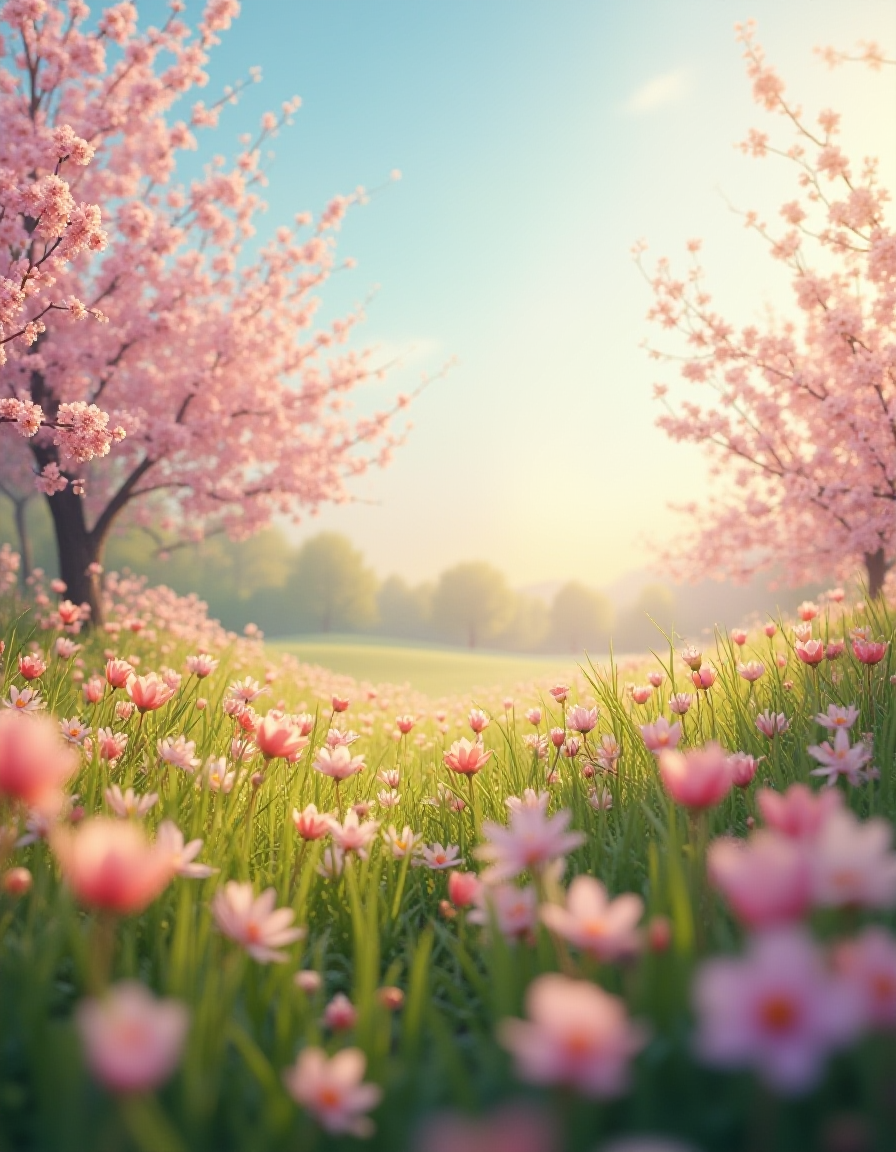
The image depicts a field of wildflowers with a variety of colors, including pink, white, and purple, creating a vibrant and lively scene.
CAPTION
The image depicts a field of flowers, predominantly featuring pink and white flowers, with a soft, hazy background. The flowers are scattered throughout the field, with some flowers closer to the foreground and others further back. The colors of the flowers vary, with some being more vibrant and others appearing more muted.
MONOLOGUE
In early March many and lovely are the flowering bulbs, and among them a wealth of blue, the more precious that it is the colour least frequent among flowers. The blue of _Scilla sibirica_, like all blues that have in them a suspicion of green, has a curiously penetrating quality; the blue of _Scilla bifolia_ does not attack the eye so smartly. _Chionodoxa sardensis_ is of a full and satisfying colour, that is enhanced by the small space of clear white throat. A bed of it shows very little variation in colour. _Chionodoxa Lucilli_, on the other hand, varies greatly; one may pick out light and dark blue, and light and dark of almost lilac colour. The variety _C. gigantea_ is a fine plant. There are some pretty kinds of _Scilla bifolia_ that were raised by the Rev. J. G. Nelson of Aldborough, among them a tender flesh-colour and a good pink. _Leucojum vernum_, with its clear white flowers and polished dark-green leaves, is one of the gems of early March; and, flowering at the same time, no flower of the whole year can show a more splendid and sumptuous colour than the purple of _Iris reticulata_. Varieties have been raised, some larger, some nearer blue, and some reddish purple, but the type remains the best garden flower. _Iris stylosa_, in sheltered nooks open to the sun, when well established, gives flower from November till April, the strongest rush of bloom being about the third week in March. It is a precious plant in our southern counties, delicately scented, of a tender and yet full lilac-blue. The long ribbon-like
SUMMARY
A lone figure stands in the middle of a field, facing a large, glowing moon. The figure is dressed in a dark coat and hat, and is illuminated by the moonlight, which casts a dramatic and mysterious glow over the scene.
CAPTION
The image depicts a silhouette of a person standing in a field, facing away from the viewer. The person is dressed in a dark coat and hat, and is positioned in the center of the image. The field is filled with tall grass and shrubs, creating a sense of depth and distance.
MONOLOGUE
At ten o'clock that night, when Becky had gone heavily to her room, wondering perhaps why Chris had given her so hard a hug, Ned Cilley knocked at the back door. He had brought a light cart on which there stood a large wicker hamper. Ned and Chris lifted it into the kitchen while Mr. Wicker drew the curtains and then held a candle high. The candlelight flickered and flapped like a trapped bird at the corners of the room, and sharp bird-wing shadows cut across Mr. Wicker's tall dark figure. Yet to Chris, who was to hold the scene ever after in his memory, the kitchen by the light of that one candle, and the figure of his master standing in its center, moved Chris as he had never been touched before. Amos stood near the basket, looking first into its square depth filled with shadow, and then up enquiringly at Mr. Wicker, but he did not speak.
SUMMARY
silhouette of a man in a hat walking through a field of tall grass under a bright yellow sky.
CAPTION
The image depicts a silhouette of a person walking through a field of tall grass under a bright yellow sky. The person is dressed in a long coat and a hat, and they are carrying a rifle. The field is dotted with numerous small, sparkling water droplets, which are scattered throughout the scene.
MONOLOGUE
As Martin grew in years and strength, his age being now about seven, his rambles began to extend beyond the waste grounds outside of the fenced orchard and gate. These waste grounds were a wilderness of weeds: here were the sunflowers that Martin liked best; the wild cock's-comb, flaunting great crimson tufts; the yellow flowering mustard, taller than the tallest man; giant thistle, and wild pumpkin with spotted leaves; the huge hairy fox-gloves with yellow bells; feathery fennel, and the big grey-green thorn-apples, with prickly burs full of bright red seed, and long white wax-like flowers, that bloomed only in the evening. He could never get high enough on anything to see over the tops of these plants; but at last he found his way through them, and discovered on their further side a wide grassy plain with scarcely a tree on it, stretching away into the blue distance. On this vast plain he gazed with wonderment and delight. Behind the orchard and weedy waste the ground sloped down to a stream of running water, full of tall rushes with dark green polished stems, and yellow water-lilies. All along the moist banks grew other flowers that were never seen in the dry ground above--the blue star, and scarlet and white verbenas; and sweet-peas of all colours; and the delicate red vinegar flower, and angel's hair, and the small fragrant lilies called Mary's-tears, and tall scattered flags, flaunting their yellow blossoms high above the meadow grass.
SUMMARY
a field of orange and pink flowers with a bright sun in the background
CAPTION
The image captures a vibrant scene of a field of orange and pink flowers under a setting sun. The flowers, with their petals fully open, are scattered across the field, creating a sense of depth and movement. The sun, positioned in the background, casts a warm glow over the scene, enhancing the colors and creating a sense of tranquility.
MONOLOGUE
As I go across a meadow directly toward a low rising ground this bright afternoon, I see, some fifty rods off toward the sun, the top of a Maple swamp just appearing over the sheeny russet edge of the hill, a stripe apparently twenty rods long by ten feet deep, of the most intensely brilliant scarlet, orange, and yellow, equal to any flowers or fruits, or any tints ever painted. As I advance, lowering the edge of the hill which makes the firm foreground or lower frame of the picture, the depth of the brilliant grove revealed steadily increases, suggesting that the whole of the inclosed valley is filled with such color. One wonders that the tithing-men and fathers of the town are not out to see what the trees mean by their high colors and exuberance of spirits, fearing that some mischief is brewing. I do not see what the Puritans did at this season, when the Maples blaze out in scarlet. They certainly could not have worshipped in groves then. Perhaps that is what they built meeting-houses and fenced them round with horse-sheds for.
SUMMARY
field of blue flowers with a mountain in the background at sunset.
CAPTION
The image captures a vibrant scene of a field of blue flowers, bathed in the warm glow of a setting sun. The flowers, densely packed and in full bloom, are the main focus of the image. They are scattered across the field, their delicate petals contrasting beautifully with the surrounding greenery.
MONOLOGUE
When Phoebe, seeing no one on the road, turned to look how near the sun might be to its setting, she saw it, as Wordsworth saw it of old, dropping between the peaks of those 'twin brethren' which to the northwest close in the green bareness of the vale. Between the two pikes the blaze lingered, enthroned; the far winding of the valley, hemmed in also by blue and craggy fells, was pierced by rays of sunset; on the broad side of the pikes the stream of Dungeon Ghyll shone full-fed and white; the sheep, with their new-born lambs beside them, studded the green pastures of the valley; and sounds of water came from the fell-sides. Everywhere lines of broad and flowing harmony, moulded by some subtle union of rock and climate and immemorial age into a mountain beauty which is the peculiar possession of Westmoreland and Cumberland. Neither awful, nor yet trivial; neither too soft for dignity, nor too rugged for delight. The Westmoreland hills are the remains of an infinitely older world--giants decayed, but of a great race and ancestry; they have the finish, the delicate or noble loveliness--one might almost say the _manner_--that comes of long and gentle companionship with those chief forces that make for natural beauty, with air and water, with temperate suns and too abundant rains. Beside them the Alps are inhuman; the Apennines mere forest-grown heaps--mountains in the making; while all that Scotland gains from the easy enveloping glory of its heather, Westmoreland, which is almost heatherless, must owe
SUMMARY
The image depicts a field of red flowers with a clear sky in the background.
CAPTION
The image captures a vibrant scene of a field of red flowers, bathed in a soft, warm light. The flowers, with their bright red petals, are scattered across the field, creating a sense of depth and texture. The background is a soft, hazy light that adds to the overall atmosphere of the image.
MONOLOGUE
Balmily and beautiful the evening fell, as Eric, not without toil, made his way along the road towards Ayrton, which was ten miles off. The road wound through the valley, across the low hills that encircled it, sometimes spanning or running parallel to the bright stream that had been the delight of Eric's innocent childhood. There was something enjoyable at first to the poor boy's eyes, so long accustomed to the barren sea, in resting once more on the soft undulating green of the summer fields, which were intertissued with white and yellow flowers, like a broidery of pearls and gold. The whole scene was bathed in the exquisite light, and rich with the delicate perfumes of a glorious evening, which filled the sky over his head with every perfect gradation of rose and amber and amethyst, and breathed over the quiet landscape a sensation of unbroken peace. But peace did not remain long in Eric's heart; each well-remembered landmark filled his soul with recollections of the days when he had returned from school, oh! how differently; and of the last time when he had come home with Vernon by his side. "O Verny, Verny, dear little Verny, would to God that I were with you now! But you are resting, Verny, in the green grave by Russell's side, and I--O God, be merciful to me now!"
SUMMARY
woman in floral dress holding a gun in a field at sunset
CAPTION
The image depicts a woman standing in a field at sunset, holding a gun. She is wearing a floral dress and appears to be in a contemplative or defensive stance. The background is a serene landscape with a field of tall grass and a distant horizon, suggesting a peaceful and tranquil setting.
MONOLOGUE
Standing by the road-side was a lonely house, the abode of some poor peasant, whose lean acres extended up the mountainside in the rear. The man had been unwilling to leave the little field that was his all and had remained, for to go away would have been to him like parting with life. He could be seen within the low-ceiled room, sitting stupidly on a bench, watching with dull, lack-luster eyes the passing of the troops whose retreat would give his ripe grain over to be the spoil of the enemy. Standing beside him was his wife, still a young woman, holding in her arms a child, while another was hanging by her skirts; all three were weeping bitterly. Suddenly the door was thrown open with violence and in its enframement appeared the grandmother, a very old woman, tall and lean of form, with bare, sinewy arms like knotted cords that she raised above her head and shook with frantic gestures. Her gray, scanty locks had escaped from her cap and were floating about her skinny face, and such was her fury that the words she shouted choked her utterance and came from her lips almost unintelligible.
SUMMARY
woman in a gray coat with a crown of flowers on her head.
CAPTION
The image depicts a woman standing in a field, wearing a gray outfit with a high collar. She is facing the camera with a serious expression, and her hair is styled in a bun. The background is a blurred field with a few figures in the distance, suggesting a rural or semi-rural setting.
MONOLOGUE
I sat behind her in the little country church; and when I had studied her profile for a few moments, I was glad of a chance to rise and sing the Doxology. She was a woman of fifty-odd, a typical Vermonter, with the angular frame and features peculiar to her class. Her mouth was large, her cheek-bones high; her thin, dark hair, streaked with gray, was drawn smoothly down behind her ears. But her expression!--that gave her away. Not flagrantly, of course. To discover her one had to be temperamentally on the watch for her. Apparently, like all the rest of us, she was looking at the flowers before the pulpit; but I was sure that her wide blue eyes were really intent on something behind and beyond. Her mouth brooded, her forehead dreamed, her whole face pondered grave and delectable matters. I am afraid that I did not hear much of the sermon that morning.
SUMMARY
A young woman stands in a field of red and white flowers, wearing a blue dress and a red scarf, and looking up at the sky.
CAPTION
The image depicts a serene rural scene with a young woman standing in a field of wildflowers. The woman is dressed in a blue dress and a beige scarf, and she is holding a bouquet of flowers. The field is lush with red and white flowers, and the background features a red house with a thatched roof and a chimney.
MONOLOGUE
And so the inquiring pair, who had this lady’s address inscribed in her husband’s hand on a card, descended from the verandah of the big hotel and took their way, according to direction, along a large straight road, past a series of fresh-looking villas, embosomed in shrubs and flowers and enclosed in an ingenious variety of wooden palings. The morning shone and fluttered, the villas stood up bravely in their smartness, and the walk of the young travellers turned all to confidence. Everything looked as if it had received a coat of fresh paint the day before—the red roofs, the green shutters, the clean bright browns and buffs of the house-fronts. The flower-beds on the little lawns sparkled in the radiant air and the gravel in the short carriage-sweeps flashed and twinkled. Along the road came a hundred little basket-phaetons in which, almost always, a couple of ladies were sitting—ladies in white dresses and long white gloves, holding the reins and looking at the two Englishmen, whose nationality was not elusive, through fine blue veils, tied tightly about their faces as if to guard their complexions. At last the visitors came within sight of the sea again, and then, having interrogated a gardener over the paling of a villa, turned into an open gate. Here they found themselves face to face with the ocean and with a many-pointed much-balconied structure, resembling a magnified chalet, perched on a green embankment just above it. The house had a verandah of extraordinary width all round, and a great many doors and windows
SUMMARY
field of blue flowers with a sunset in the background.
CAPTION
The image captures a serene scene of a field of blue flowers under a setting sun. The flowers, densely packed and in full bloom, are the main focus of the image. They are scattered along a dirt path that runs through the middle of the field, creating a sense of depth and perspective.
MONOLOGUE
Now a few yards farther, and I reach the bank. Ah! I smell them already--their exquisite perfume steams and lingers in this moist, heavy air. Through this little gate, and along the green south bank of this green wheat-field, and they burst upon me, the lovely violets, in tenfold loveliness. The ground is covered with them, white and purple, enamelling the short dewy grass, looking but the more vividly coloured under the dull, leaden sky. There they lie by hundreds, by thousands. In former years I have been used to watch them from the tiny green bud, till one or two stole into bloom. They never came on me before in such a sudden and luxuriant glory of simple beauty,--and I do really owe one pure and genuine pleasure to feverish London! How beautifully they are placed too, on this sloping bank, with the palm branches waving over them, full of early bees, and mixing their honeyed scent with the more delicate violet odour! How transparent and smooth and lusty are the branches, full of sap and life! And there, just by the old mossy root, is a superb tuft of primroses, with a yellow butterfly hovering over them, like a flower floating on the air. What happiness to sit on this tufty knoll, and fill my basket with the blossoms! What a renewal of heart and mind! To inhabit such a scene of peace and sweetness is again to be fearless, gay, and gentle as a child. Then it is that thought becomes poetry, and feeling religion. Then it is that we are happy and good. Oh, that my whole life could pass so, floating on blissful and
SUMMARY
A person stands in a field at night, surrounded by fireworks that are exploding in the sky.
CAPTION
The image captures a serene night scene featuring a person standing in a field, illuminated by the glow of fireworks. The person, dressed in a dark jacket, is facing away from the camera, creating a sense of distance. The field is dotted with tall grass, and the sky is dark, suggesting it is either early morning or late evening.
MONOLOGUE
Early the next morning, the body of Forby Sutherland, one of our seamen, who died the evening before, was buried near the watering-place; and from this incident I called the south point of this bay _Sutherland Point_. This day we resolved to make an excursion into the country. Mr Banks, Dr Solander, myself, and seven others, properly accoutred for the expedition, set out, and repaired first to the huts, near the watering-place, whither some of the natives continued every day to resort; and though the little presents which we had left there before had not yet been taken away, we left others of somewhat more value, consisting of cloth, looking-glasses, combs, and beads, and then went up into the country. We found the soil to be either swamp or light sand, and the face of the country finely diversified by wood and lawn. The trees are tall, straight, and without underwood, standing at such a distance from each other, that the whole country, at least where the swamps do not render it incapable of cultivation, might be cultivated without cutting down one of them: Between the trees the ground is covered with grass, of which there is great abundance, growing in tufts about as big as can well be grasped in the hand, which stand very close to each other. We saw many houses of the inhabitants, and places where they had slept upon the grass without any shelter; but we saw only one of the people, who the moment he discovered us ran away. At all these places we left presents, hoping that at length they might produce
SUMMARY
a woman in a yellow dress is standing in a field of red flowers.
CAPTION
The image depicts a woman standing in a field of red poppies, with her gaze directed towards the camera. The field is densely populated with the vibrant flowers, creating a sense of depth and scale. The woman's attire is a light-colored dress, adding a touch of elegance to the scene.
MONOLOGUE
Charles W. Hawthorne has pictures in Chicago and New York that imply the Intimate-and-friendly Photoplay. The Trousseau in the Metropolitan Museum shows a gentle girl, an unfashionable home-body with a sweetly sheltered air. Behind her glimmers the patient mother's face. The older woman is busy about fitting the dress. The picture is a tribute to the qualities of many unknown gentlewomen. Such an illumination as this, on faces so innocently eloquent, is the light that should shine on the countenance of the photoplay actress who really desires greatness in the field of the Intimate Motion Picture. There is in Chicago, Hawthorne's painting of Sylvia: a little girl standing with her back to a mirror, a few blossoms in one hand and a vase of flowers on the mirror shelf. It is as sound a composition as Hawthorne ever produced. The painting of the child is another tribute to the physical-spiritual textures from which humanity is made. Ah, you producer who have grown squeaky whipping your people into what you called action, consider the dynamics of these figures that would be almost motionless in real life. Remember there must be a spirit-action under the other, or all is dead.
SUMMARY
a woman wearing a large red hat and a red dress with flowers on it is standing in a field at night
CAPTION
The image depicts a woman in a vibrant red dress, adorned with a large red hat and a flower crown, standing in a field of red flowers under a night sky. The woman is facing away from the viewer, giving a sense of depth and perspective. The field of flowers is lush and full of red blooms, with a few scattered clouds in the sky.
MONOLOGUE
It was at this period, however, that Claude resumed work a little. The winter was drawing to a close; he did not know how to spend the bright sunny mornings, since Christine could no longer go out before mid-day on account of Jacques, whom they had named thus after his maternal grandfather, though they neglected to have him christened. Claude worked in the garden, at first, in a random way: made a rough sketch of the lines of apricot trees, roughed out the giant rose-bushes, composed some bits of 'still life,' out of four apples, a bottle, and a stoneware jar, disposed on a table-napkin. This was only to pass his time. But afterwards he warmed to his work; the idea of painting a figure in the full sunlight ended by haunting him; and from that moment his wife became his victim, she herself agreeable enough, offering herself, feeling happy at affording him pleasure, without as yet understanding what a terrible rival she was giving herself in art. He painted her a score of times, dressed in white, in red, amidst the verdure, standing, walking, or reclining on the grass, wearing a wide-brimmed straw hat, or bare-headed, under a parasol, the cherry-tinted silk of which steeped her features in a pinky glow. He never felt wholly satisfied; he scratched out the canvases after two or three sittings, and at once began them afresh, obstinately sticking to the same subject. Only a few studies, incomplete, but charmingly indicated in a vigorous style, were saved from the palette-knife, and
SUMMARY
a woman in a green dress is dancing in a green field
CAPTION
The image depicts a person in a green dress and hat, standing in a field with a green background. The person is facing away from the viewer, with their arms outstretched, suggesting a sense of freedom or movement. The field appears to be a natural landscape, possibly a meadow or a field of grass, with patches of yellow and brown indicating the presence of vegetation.
MONOLOGUE
With that, he left the woman standing in the street, and hurried away. Very soon he was walking swiftly along the London Road. The one thought in his mind was that he was on the track of his child at last. He passed the wayside cottage where the woman lived who had seen Marian go by, and went on until, moved by a sudden impulse, he paused to rest his arms upon the top of a five-barred gate, and look upon the field into which it led. Then he uttered a cry, and, tearing open the gate, strode into the field. Lying amidst the grass was a little shoe. It was one of Marian's without a doubt. Had he not made it himself? He picked it up and hid it away in the pocket of his coat. Marian had evidently wandered that way, and was lost in the large wood which lay on the other side of the field. To reach the wood was the work of a few moments. Plunging amongst the trees, he soon came upon a pool, near the margin of which were some prostrate tree trunks. Near one of these the ground was littered with shreds of what might have been articles of clothing; and amongst them was a long strip of print, which had a familiar look. He picked it up and examined it closely. Then the truth flashed upon him. It was one of the strings of Marian's sun-bonnet! Holding it loosely between his finger and thumb, he gazed upon the foul green waters of the pond. Did they cover the body of his child? He had no further thought of searching the wood. With a shudder he turned away, and hurried home.
SUMMARY
The painting depicts a person standing in a field at night, looking up at a bright sun.
CAPTION
The image is a painting depicting a scene of a person standing in a field at sunset. The sky is filled with a swirling pattern of orange and yellow hues, creating a vibrant and dynamic atmosphere. The person, dressed in a long red cloak, stands in the center of the field, facing towards the right side of the painting.
MONOLOGUE
The first department in the field which Newton explored with characteristic success was the study of optics. Philosophers were busy with inquiries into the nature of light. It had been long believed that every colored ray is equally refracted when passing through a lens. Newton determined to analyze the prismatic hues. He made a hole in a window-shutter, and darkening the room, let in a portion of light, which he passed through a prism. The _white_ sunbeam formed a circular image on the opposite wall, but the _prismatic colors_ formed an image five times as long as it was broad. He was curious to know how this came to pass. Satisfied that the length of the image in the latter case did not arise from any irregularity in his glass, or from any differences in the incidence of light from different parts of the sun's disk, or from any curvature in the direction of the rays, he concluded, after thorough reflection, that light is not _homogeneous_, but that it consists of rays of diverse refrangibility. The red hue he saw was less refracted than the orange, the orange less refracted than the yellow, and the violet more than any of the rest. These important conclusions he applied in the construction of the first reflecting telescope ever used in the survey of the heavens, and an instrument is preserved in Trinity College Library bearing the inscription, "Invented by Sir Isaac Newton, and made with his own hands, 1671."
SUMMARY
a young girl with blonde hair and a floral dress is standing in a field at sunset
CAPTION
The image captures a young girl in a field, her hair blowing in the wind, and her gaze directed towards the camera. She is dressed in a vibrant orange dress adorned with a floral pattern, and her hair is adorned with a red flower accessory. The background is blurred, suggesting a natural setting, possibly a field or meadow.
MONOLOGUE
She had never noticed it before, and what was her surprise to behold an exact reproduction of the one where she was standing, the gilded roof, the red and black pillars, and all the beauteous drapery about the doors. She would have been able to read the inscription upon the tablets, had they not been reversed. But what surprised her more than all was to see, leaning on the balcony, a figure which, if it had not come from the other side of the lake, she would have taken for her own reflection. It was the mirrored image of Tchin-Sing. At first she took it for the reflection of a girl, as he was dressed in robes according to the fashion of the time. As the heat was intense, he had thrown off his student's cap, and his hair fell about his fresh, beardless face. But soon Ju-Kiouan recognized, from the violent beating of her heart, that the reflection in the water was not that of a young girl.
SUMMARY
a woman in a white dress holding a large red flower in her hand.
CAPTION
The image depicts a serene scene of a woman standing in a field of tall grass, holding a large red flower in her hand. The woman is dressed in a flowing white dress, and her hair is blowing in the wind. The field is dotted with red flowers, and the sky above is a deep blue, suggesting a clear and sunny day.
MONOLOGUE
By the blue heaven, by the rolling sun bursting through untrodden space, a new ocean of ether every day unveiled. By the fresh and wandering air encompassing the world; by the sea sounding on the shore--the green sea white-flecked at the margin and the deep ocean; by the strong earth under me. Then, returning, I prayed by the sweet thyme, whose little flowers I touched with my hand; by the slender grass; by the crumble of dry chalky earth I took up and let fall through my fingers. Touching the crumble of earth, the blade of grass, the thyme flower, breathing the earth-encircling air, thinking of the sea and the sky, holding out my hand for the sunbeams to touch it, prone on the sward in token of deep reverence, thus I prayed that I might touch to the unutterable existence infinitely higher than deity.
SUMMARY
a woman in a floral dress is kissing the sun
CAPTION
The image depicts a woman standing in a field, facing towards the right side of the frame. She is wearing a colorful floral dress and has her hair tied back in a bun. The background is a field of tall grass, with a large, glowing orange sun in the sky, which is partially obscured by the woman's head and shoulders.
MONOLOGUE
Imagine a woman who suggests at the same time Sarah Bernhardt and Mrs. Brown-Potter, without being really like either; she is small, exuberantly blonde, her head is surrounded by masses of loosely twisted blonde hair; she has large grey eyes, that can be grave, or mocking, or passionate, or cruel, or watchful; a large nose, an intent, eloquent mouth. She wears a trailing dress that follows the lines of the figure vaguely, supple to every movement. When she sings, she has an old, high-backed chair in which she can sit, or on which she can lean. When I heard her, there was a mirror on the other side of the room, opposite to her; she saw no one else in the room, once she had surrendered herself to the possession of the song, but she was always conscious of that image of herself which came back to her out of the mirror: it was herself watching herself, in a kind of delight at the beauty which she was evoking out of words, notes, and expressive movement. Her voice is strong and rich, imperfectly trained, but the voice of a born singer; her acting is even more the acting of a born actress; but it is the temperament of the woman that flames into her voice and gestures, and sets her whole being violently and delicately before you. She makes a drama of each song, and she re-creates that drama over again, in her rendering of the intentions of the words and of the music. It is as much with her eyes and her hands, as with her voice, that she evokes the melody of a picture; it is a picture that sings, and that sings in all
SUMMARY
painting of a field with a horse in the distance
CAPTION
The image depicts a pastoral scene with a large field of wildflowers in vibrant colors, including red, yellow, and pink flowers. The field stretches out towards a distant horizon, where a horse can be seen grazing. The sky above is a clear blue with a few scattered clouds, and the overall scene is painted in a realistic style with a focus on the natural beauty of the landscape.
MONOLOGUE
color of the stone itself is seen more frequently; altered, if at all, only into a little chiller grey than when it is freshly broken. So that a limestone landscape is apt to be dull, and cold in general tone, with some aspect even of barrenness. The sandstones are much richer in vegetation: there are, perhaps, no scenes in our own island more interesting than the wooded dingles which traverse them, the red rocks growing out on either side, and shelving down into the pools of their deep brown rivers, as at Jedburgh and Langholme; the steep oak copses climbing the banks, the paler plumes of birch shaking themselves free into the light of the sky above, and the few arches of the monastery where the fields in the glen are greenest, or the stones of the border tower where its cliffs are steepest, rendering both field and cliff a thousandfold more dear to the heart and sight. But deprived of associations, and compared in their mere natural beauty with the ravines of the central ranges, there can be no question but that even the loveliest passages of such scenery are imperfect and poor in foreground color. And at first there would seem to be an unfairness in this, unlike the usual system of compensation which so often manifests itself throughout nature. The higher mountains have their scenes of power and vastness, their blue precipices and cloud-like snows: why should they also have the best and fairest colors given to their foreground rocks, and overburden the human mind with wonder; while the less majestic
SUMMARY
a young woman holding a sword in a forest at sunset
CAPTION
The image depicts a young woman standing in a field, holding a sword with a flame at the end. She is wearing a colorful floral-patterned robe and has a necklace with a pendant. The background is a gradient of blue and green, suggesting a natural setting, possibly a forest or a field.
MONOLOGUE
The setting is the field where the old Woman placed the Ox and where she spun, the wood from which the animals came, and the peasant home. The characters are two poor people who need food and clothing and seek to secure both; and the animals of the forest. The peasants need the Bear for a coat, the Wolf for a fur cap, the Fox for a fur collar, and the Hare for mittens. This human need produces an emotional appeal so that we wish to see the animals caught. But when the plot unties itself, the plight of the animals appeals to us equally and we want just as much to see them win their freedom. Each animal works out his own salvation by offering the old people a worthy substitute. Each animal is true to his nature in the substitute he offers, he promises what is only natural for him to procure, and what he himself likes best. The conclusion is satisfying because in the end everybody is happy: the old people who have all they need; and the animals who have life and freedom. The distinct pictures offered to the imagination are the capture of the four animals and their return with their life-substitutes. The form of the tale is a good example of folk-story style, with its vivid words, direct language, and repetition. This is one of the tales which is finer than at first appears because it has a strong sense of life. It touches the present-day problem: "How can the inhuman slaughter of animals for man's use be avoided?" Its underlying message is: Self-help is a good way out of a difficulty.--_The Straw
SUMMARY
young woman in a green jacket posing in a field with a foggy background.
CAPTION
The image depicts a young woman standing in a field, her hair blowing in the wind. She is wearing a green jacket, which contrasts with her blonde hair. The background is blurred, but it appears to be a field with tall grass and a body of water in the distance.
MONOLOGUE
I looked. She was standing almost immediately beneath the place where I had climbed over; my boot must have grazed her. She was what old women call a slip of a girl, in a cotton gown, white, figured with fine sprigs of green sadly faded, for it was not new. The wind whipped her red hair into her eyes. Her face was very much freckled; properly speaking, it was one freckle from brow to chin. She wore, besides, as I remember, a little muslin tucker (I think the garment is so named) and a little frilled muslin apron; and these articles, together with her old print frock, were washed, starched, and ironed to a degree it hath not entered into the mind of man to conceive. I took off my hat; and something about this young woman moved me thereafter hastily to adjust my cravat and shirt-ruffle. I believe these signs of perturbation (which were entirely genuine) pleased her in some subtle way, like a tribute, for she stopped to inquire: "You want to cut through here to the highroad? I'm very sorry, but I really cannot allow it. I've had a great deal of trouble keeping the village boys away from this tree. These are fine apples and good winter keepers--that is, I think they are----" she added a little tentatively, searching my face. "You didn't see the sign, I suppose?"
SUMMARY
a woman with a large head of red flowers on her head, surrounded by a field of red flowers
CAPTION
The image depicts a surreal and vibrant scene of a woman with a head full of red flowers. The woman is positioned in the center of the image, facing to the right, and is surrounded by a field of red flowers. The flowers are scattered throughout the field, creating a sense of depth and texture.
MONOLOGUE
As an example of his manner, when treating of a subject not technically described, we may present his account of the plant to which he gave the name of Andromeda: "This most choice and beautiful virgin gracefully erects her long and shining neck (the peduncle), her face with its rosy lips (the corolla) far excelling the best pigment. She kneels on the ground with her feet bound (the lower part of the stem incumbent), surrounded with water, and fixed to a rock (a projecting clod), exposed to frightful dragons (frogs and newts). She bends her sorrowful face (the flower) towards the earth, stretches up her innocent arms (the branches) toward heaven, worthy of a better place and happier fate, until the welcome Perseus (summer), after conquering the monster, draws her out of the water and renders her a fruitful mother, when she raises her head (the fruit) erect." The analogy that gave rise to this fanciful description, which is contained in the Flora Lapponica, suggested itself to Linnaeus on his Lapland journey. "The Chamaedaphne of Buxbaum," says he, "was at this time in its highest beauty, decorating the marshy grounds in a most agreeable manner. The flowers are quite blood-red before they expand, but when full grown the corolla is of a flesh-colour. Scarcely any painter's art can so happily imitate the beauty of a fine female complexion; still less could any artificial colour upon the face itself bear a comparison with this lovely blossom. As I contemplated it, I could not help thinking of Andromeda as
SUMMARY
woman posing in a field with trees in the background.
CAPTION
The image depicts a woman standing in a field, wearing a black and white outfit. She is positioned in the center of the image, with her arms outstretched to the sides, and her head tilted slightly to the right. The background is a blurred field with trees and bushes, creating a sense of depth and distance.
MONOLOGUE
"Julia, girl," said Sadie Corn, "ever since the world began there's been hookers and hooked. And there always will be. I was born a hooker. So were you. Time was when I used to cry out against it too. But shucks! I know better now. I wouldn't change places. Being a hooker gives you such an all-round experience like of mankind. The hooked only get a front view. They only see faces and arms and chests. But the hookers--they see the necks and shoulderblades of this world, as well as faces. It's mighty broadening--being a hooker. It's the hookers that keep this world together, Julia, and fastened up right. It wouldn't amount to much if it had to depend on such as that!" She nodded her head in the direction the cerise figure had taken. "The height of her ambition is to get the cuticle of her nails trained back so perfectly that it won't have to be cut; and she don't feel decently dressed to be seen in public unless she's wearing one of those breastplates of orchids. Envy her! Why, Julia, don't you know that as you were standing here in your black dress as she passed she was envying you!"
SUMMARY
a young girl in a blue dress is standing in a field of blue flowers and looking at the camera
CAPTION
The image depicts a young girl standing in a field of blue flowers, with her hands raised in a gesture of surprise or joy. She is wearing a blue dress and appears to be in a field of blue flowers, surrounded by the vibrant blooms. The background is filled with more flowers, creating a dense and colorful scene.
MONOLOGUE
At the river he rode up-stream, looking still across it. Old Gabe Bunch halloed to him from the doorway of the mill, as he splashed through the creek, and Isom's thin face peered through a breach in the logs. At the ford beyond, he checked his horse with a short oath of pleased surprise. Across the water, a scarlet dress was moving slowly past a brown field of corn. The figure was bonneted, but he knew the girl's walk and the poise of her head that far away. Just who she was, however, he did not know, and he sat irresolute. He had seen her first a month since, paddling along the other shore, erect, and with bonnet off and hair down; she had taken the Lewallen path up the mountain. Afterward, he saw her going at a gallop on young Jasper's gray horse, bareheaded again, and with her hair loose to the wind, and he knew she was one of his enemies. He thought her the girl people said young Jasper was going to marry, and he had watched her the more closely. From the canoe she seemed never to notice him; but he guessed, from the quickened sweep of her paddle, that she knew he was looking at her, and once, when he halted on his way home up the mountain, she half turned in her saddle and looked across at him. This happened again, and then she waved her bonnet at him. It was bad enough, any Stetson seeking any Lewallen for a wife, and for him to court young Jasper's sweetheart-it was a thought to laugh at. But the mischief was done. The gesture thrilled him, whether it meant defiance or good-will, and the mere deviltry of such a
SUMMARY
A man in a blue uniform is walking through a field of colorful flowers. He is looking at a brown dog walking in the field.
CAPTION
The image depicts a serene pastoral scene with a man in a blue uniform standing in a field filled with colorful flowers. The man is facing away from the viewer, and the field is dotted with various flowers of different colors, including red, yellow, and white.
MONOLOGUE
_Monday, August 27th._--Went to Boston last Wednesday. Remarkables:--An author at the American Stationers' Company, slapping his hand on his manuscript, and crying, "I'm going to publish."--An excursion aboard a steamboat to Thompson's Island, to visit the Manual Labor School for boys. Aboard the steamboat several poets and various other authors; a Commodore,--Colton, a small, dark brown, sickly man, with a good deal of roughness in his address; Mr. Waterston, talking poetry and philosophy. Examination and exhibition of the boys, little tanned agriculturists. After examination, a stroll round the island, examining the products, as wheat in sheaves on the stubble-field; oats, somewhat blighted and spoiled; great pumpkins elsewhere; pastures; mowing ground;--all cultivated by the boys. Their residence, a great brick building, painted green, and standing on the summit of a rising ground, exposed to the winds of the bay. Vessels flitting past; great ships, with intricacy of rigging and various sails; schooners, sloops, with their one or two broad sheets of canvas: going on different tacks, so that the spectator might think that there was a different wind for each vessel, or that they scudded across the sea spontaneously, whither their own wills led them. The farm boys remain insulated, looking at the passing show, within sight of the city, yet having nothing to do with it; beholding their fellow-creatures skimming by them in winged machines, and steamboats snorting and puffing through the waves. Methinks an island
SUMMARY
a man and a woman are sitting on a bench in a field with dogs
CAPTION
The image depicts a pastoral scene with a man and a woman in a field. The man is holding a stick, possibly a walking stick, and the woman is holding a dog. They are surrounded by a group of dogs, some of which are walking around the field.
MONOLOGUE
It is in this neighborhood that one finds the kangaroo in his wild state; but a good local guide is necessary to insure success in the search for these animals. Though the kangaroo, like everything else aboriginal, is gradually disappearing in Australia, the onslaught and ceaseless war which is waged against the wild dog, the only enemy except man which the kangaroo has to fear, leaves the latter a chance even for increase in some districts, as we found to be the case in Queensland. It is calculated that one kangaroo eats as much grass and consumes as much food generally as do five sheep, and consequently he is looked upon as an enemy, to be hunted with the one idea of exterminating him altogether. In roaming the woods one is almost sure to fall in with more or less of these animals. They are usually found sitting upright in circles of a dozen or more, as grave as though engaged in holding a formal council. Their short fore-paws hang limp before them, while their restless heads and delicate ears turn hither and thither in watchful care against surprise. Notwithstanding their huge paunch, big hind-quarters, and immense tail, there is something graceful and attractive about these creatures, even with all their proverbial awkwardness. When they are young they are as playful as kittens. Even when running away from pursuit,--a process performed by enormous leaps, often covering a rod at each flying jump,--there is a certain airy grace and harmony of movement attending their motions. Dogs and horses have
SUMMARY
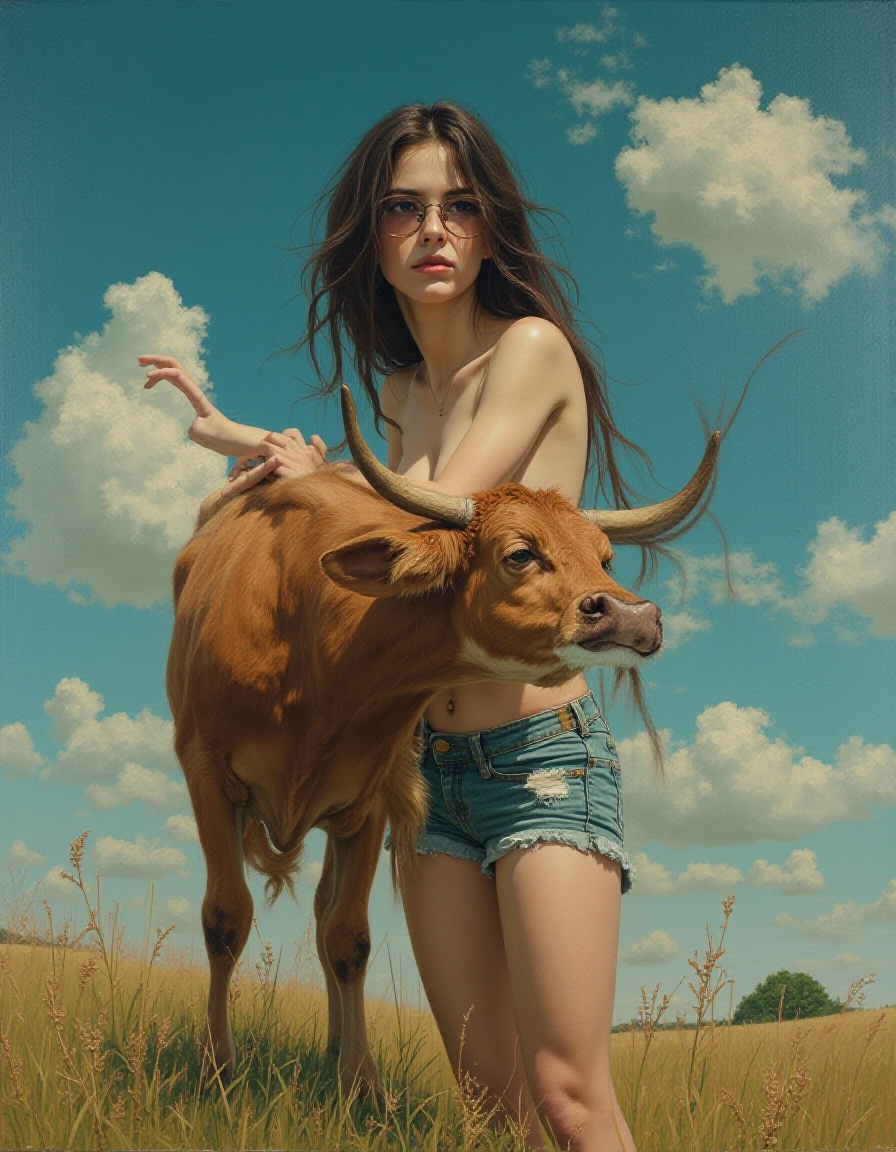
a young woman is holding a brown bull in her arms in a field
CAPTION
The image depicts a young woman standing in a field, holding a large brown bull by its horns. She is wearing denim shorts and has long, wavy hair. The background is a clear blue sky with fluffy white clouds, and the field is lush with tall grass.
MONOLOGUE
To his surprise, however, the young girl, following the path to the lilacs, began leisurely to ascend the hill, swaying from side to side with a youthful movement, and swinging the long stalk of a lily at her side. In another moment he would be discovered! Dick was frightened; his confidence of the moment before had all gone; he would fly,--and yet, an exquisite and fearful joy kept him motionless. She was approaching him, full and clear in the moonlight. He could see the grace of her delicate figure in the simple white frock drawn at the waist with broad satin ribbon, and its love-knots of pale blue ribbons on her shoulders; he could see the coils of her brown hair, the pale, olive tint of her oval cheek, the delicate, swelling nostril of her straight, clear-cut nose; he could even smell the lily she carried in her little hand. Then, suddenly, she lifted her long lashes, and her large gray eyes met his.
SUMMARY
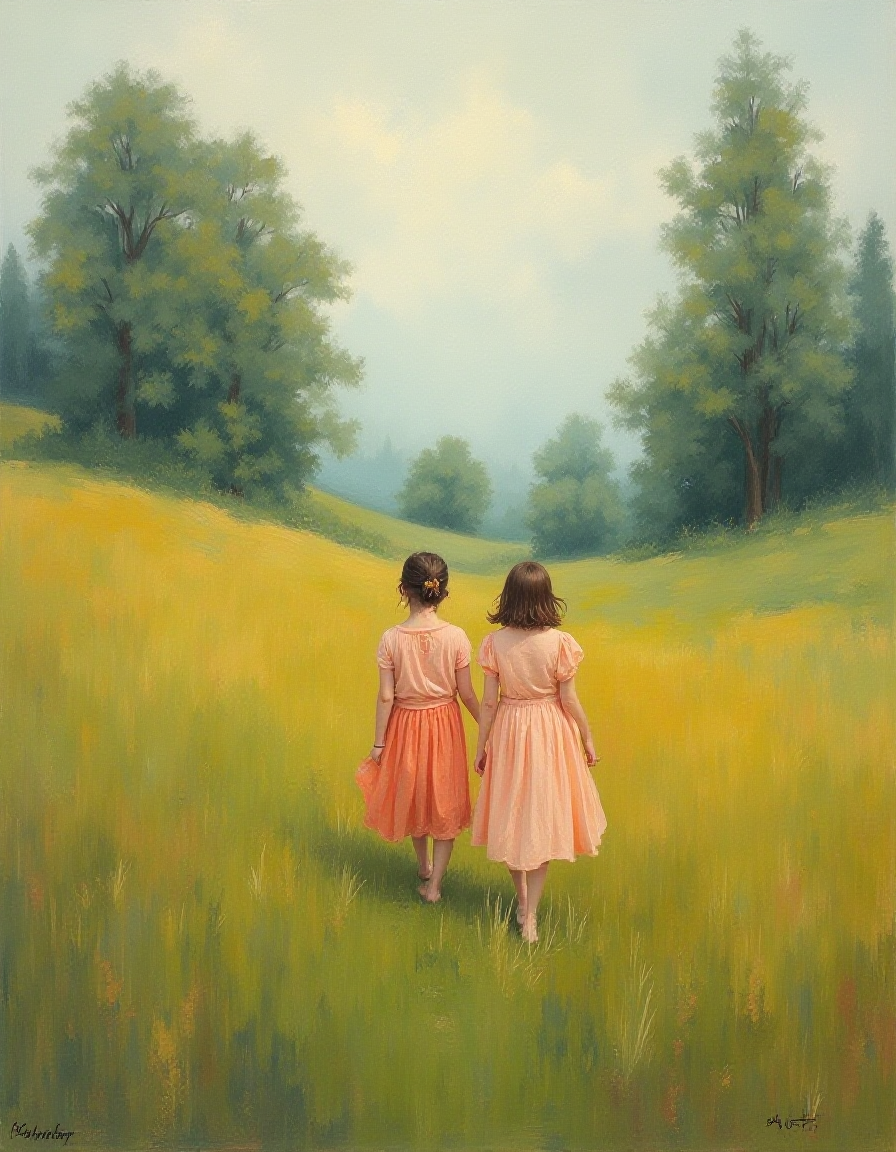
two girls walking in a field of tall grass with trees in the background
CAPTION
The image depicts two young girls walking through a lush green field. The girls are dressed in matching pink dresses, and they are walking away from the viewer. The field is filled with tall grass and trees, creating a serene and peaceful atmosphere.
MONOLOGUE
The Turtle Dove is found in all the southern countries of Europe, in Palestine, and many other parts of Asia, including the islands south of China. In England it is a visitor in the southern and midland counties only, arriving in spring and remaining with us until the end of September. Its favourite places of resort are groves, belts of trees, and tall hedgerows in cultivated districts. Here it builds its unsubstantial nest of a few sticks, and lays two eggs. Its food consists of seeds of various kinds, and it has the discredit of resorting to fields of green wheat for the sake of feeding on the milky grain. I am doubtful whether this charge can be sustained. Often enough when walking through a cornfield one may see two or three Turtle Doves rise suddenly from the thick corn with a rustle and low cry of alarm, rapidly dart away in the direction of the nearest grove, disappearing in the shade, all but a white segment of a circle, formed by the tips of their tail-feathers; but on examining the spot from which they rose, I have been unable to detect any ears of corn rifled of their contents, though the ground was thickly matted with weeds, which might have furnished them food. I am informed by a young friend that he has often shot them while in the act of rising from such situations and has invariably found their crops distended with the green seed-vessels of a weed common in corn-fields, the corn-spurrey (_Sprgula arvensis_). This being the case, the Turtle Dove is more a friend than an enemy to the farmer, even if it sometimes regales on
SUMMARY
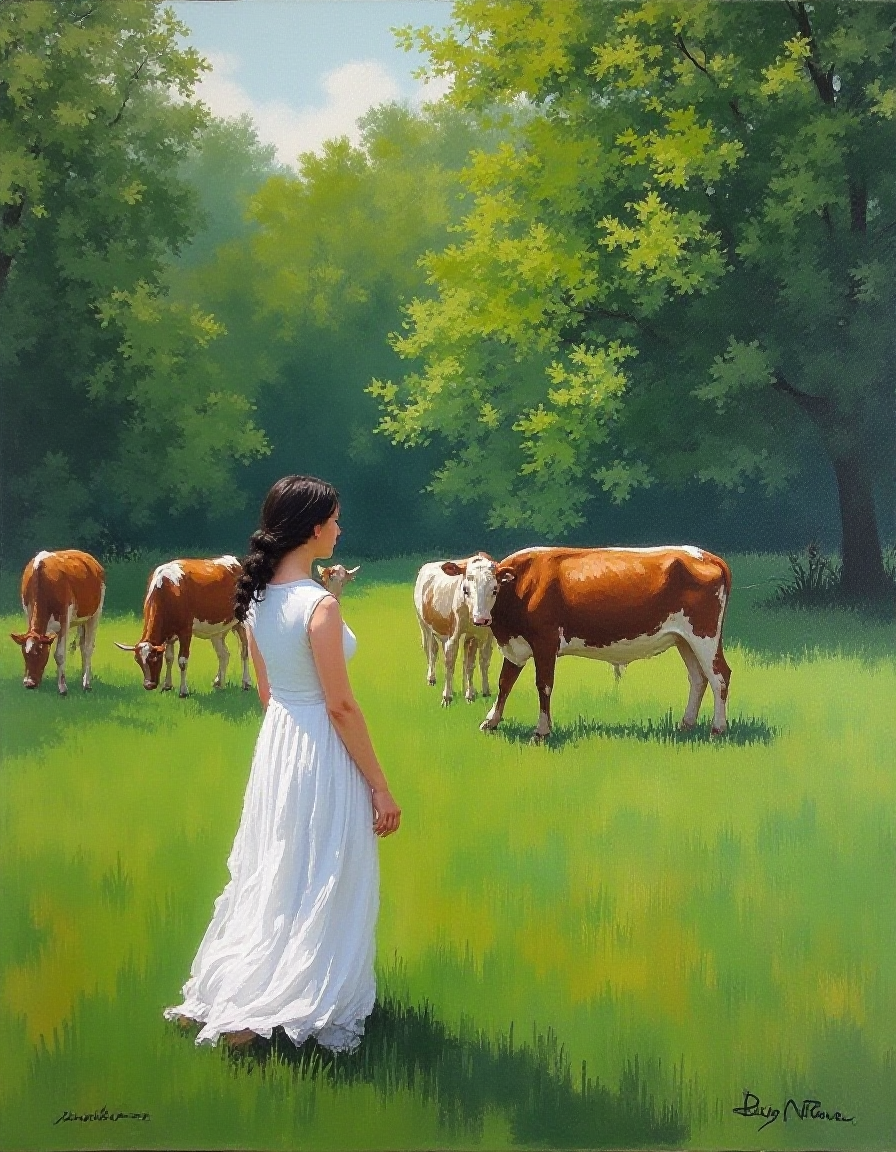
a woman in a white dress is standing in a field of cows
CAPTION
The image depicts a serene pastoral scene featuring a woman standing in a lush green field. The woman is dressed in a white dress and is facing towards the right side of the image. She appears to be engaged in a moment of contemplation or interaction with the cows in the field.
MONOLOGUE
Then she heard footsteps distinct from the echo of her own and she stood still. Two women were coming towards her through the gloom. She waited near her own door, supposing that they would pass her. As they came near, she saw that the one was a nun, habited in the plain gray robe and black and white head-dress of the order. The other was a lady dressed, like herself, in black. The light burned so badly that as the two stopped and stood for a moment conversing together, Unorna could not clearly distinguish their faces. Then the lady entered one of the rooms, the third or the fourth from Unorna’s, and the nun remained standing outside, apparently hesitating whether to turn to the right or to the left, or asking herself in which direction her occupations called her. Unorna made a movement, and at the sound of her foot the nun came towards her.
SUMMARY
woman in a green jacket standing in a field with trees in the background.
CAPTION
The image depicts a woman standing in a field, wearing a green jacket. She has long hair and is looking directly at the camera. The background is a field with tall grass and trees, creating a natural and serene atmosphere.
MONOLOGUE
"Awe, little Ephum! _awe_ little E-phum! ef you don' come 'long heah, boy, an' rock dis chile, I'll buss you haid open!" screamed the high-pitched voice of a woman, breaking the stillness of the summer evening. She had just come to the door of the little cabin, where she was now standing, anxiously scanning the space before her, while a baby's plaintive wail rose and fell within with wearying monotony. The log cabin, set in a gall in the middle of an old field all grown up in sassafras, was not a very inviting-looking place; a few hens loitering about the new hen-house, a brood of half-grown chickens picking in the grass and watching the door, and a runty pig tied to a "stob," were the only signs of thrift; yet the face of the woman cleared up as she gazed about her and afar off, where the gleam of green made a pleasant spot, where the corn grew in the river bottom; for it was her home, and the best of all was she thought it belonged to them.
SUMMARY
The man is standing in a field of wheat and looking to the right.
CAPTION
The image depicts a man standing in a field, wearing a traditional Greek outfit. The man is facing the camera, and his attire is adorned with gold and beaded elements. The background features a field of wheat, with a distant mountain range visible in the distance.
MONOLOGUE
It is the great good fortune of the Alps, beyond all other snowy ranges, to possess both the region of utterly untamed nature above, and a larger area of humanly modified land below. A normal Alpine view includes parts of both regions. Looking up from beneath, you have the gardened world for foreground and the wild world for distance. Looking down from above the reverse is the case. The contrast is always charming. What more beautiful setting for a snow mountain can be conceived than that which surrounds the Jungfrau as beheld from near Interlaken? How pleasant it is, when resting at some fine noontide hour on the summit of a lofty peak, to look abroad over the peopled Italian plain, or down into some deep valley, dotted with farms and villages, with here and there a white church standing in the midst of chalets. It is only the works of modern man, his huge caravanserais, his railway stations, and his accurately engineered roads, that are wholly hateful--blots on the landscape defiling and degrading it. Let us hope that these hideous intruders are not destined to a long existence. It is not likely, much though we may desire it, that in our time the tide of touristdom will abandon the Alps. It has come to stay. It will increase rather than diminish. But with the advance of civilisation perhaps its manners and tastes will improve, and it may, at some far distant time, come to demand a kind of housing that will not utterly destroy the very beauty which it blindly travels to seek.
SUMMARY
two children are standing in a field with a bright light in the center of the image, surrounded by a multitude of small fireflies.
CAPTION
The image depicts two young girls standing in a field, facing each other, with a radiant light source in the center, creating a magical atmosphere. The girls are dressed in matching outfits of light pink dresses, and they are holding hands. The field is filled with wildflowers and scattered small, glowing particles that resemble fireflies.
MONOLOGUE
We talk and laugh with our companions, who are dressed in a light gauze, and whose tresses are adorned with flowers; we press them to partake of exquisite sherbets, differently prepared. The hour of supper being arrived, we repair to rooms illuminated with the lustre of a thousand tapers fragrant with amber. The supper-room is surrounded by three vast galleries, in which are placed musicians, whose various instruments fill the mind with the most pleasurable and the softest emotions. The young girls are seated at table with us, and, towards the conclusion of the repast, they sing songs, which are hymns in honour of the God who has endowed us with senses which shed such a charm over existence, and which promise us new pleasure from every fresh exercise of them. After the repast is ended, we return to the dance, and, when the hour of repose arrives, we draw from a kind of lottery, in which every one is sure of a prize; that is, a young girl as his companion for the night. They are allotted thus by chance, in order to avoid jealousy, and to prevent exclusive attachments. Thus ends the day, and gives place to a night of delights, which we sanctify by enjoying with due relish that sweetest of all pleasures, which Faraki has so wisely attached to the reproduction of our species. We reverently admire the wisdom and the goodness of Faraki, who, desiring to secure to the world a continued population, has implanted in the sexes an invincible mutual attraction, which constantly draws them towards each other. Fecundity is the end he proposes, and he
SUMMARY
a field of pink flowers with cherry blossoms in the background
CAPTION
The image depicts a serene scene of a field of pink flowers under a clear blue sky. The field is lush with vibrant pink flowers, creating a vibrant contrast against the green grass. The sky is a clear blue, with a few clouds scattered in the distance.
MONOLOGUE
Day after day the sun, with a lurid glare spread far and wide over the cloudless sky, rises above the arid plains, drawing up every particle of moisture, and withering with the intense heat of his rays every blade of grass and green leaf, till it seems as if the whole region were doomed to eternal desolation. At length, however, a wonderful change takes place over the hitherto arid waste. A thick veil of mist is drawn across the blue sky. A low bank of clouds appears on the horizon. Gradually it rises, assuming the form of distant mountain-chains above the plain. Onwards it advances, increasing in density, while vivid flashes of lightning dart forth; the thunder is heard rolling in the distance, and now loud crashing peals burst from the clouds, which rapidly spreading across the vault of heaven, plenteous showers rush downwards on the parched earth, filling up the dry cracks in the marshes, replenishing the pools, and swelling the streams. The grass springs up on every long-dry spot, the leaves burst forth, while thousands of flowers of every tint and hue enamel the plain; and, as if by magic, the whole face of nature is in a few hours changed. In a short time the thorny bushes of the delicate and feathery-foliaged mimosas are loaded with masses of canary-coloured blossoms, from their summits down to the lowest branches, sending forth an almost overpowering perfume; while the fronds of the beautiful mauritias--the palm of the Llanos--rising to the height of one hundred feet above the
SUMMARY
The painting depicts a serene landscape with a large tree in the foreground and a field of grass in the background.
CAPTION
The image depicts a serene landscape with a large, open field stretching out towards a distant horizon. The field is a vibrant green, dotted with white flowers, and is bordered by a line of trees on the left side. The sky above is a clear blue, with fluffy white clouds scattered throughout.
MONOLOGUE
A bare hill-side sloping to the sea, with here and there straggling acres of cultivated land. A few wooden houses nestling in the bends and gullies, where small streamlets ran. Uplands, bare of trees and hedge growth, stretching away inland in a smooth coat of waving grass. Grass, grass, grass--a sheep fank--a patch of stony hill-side--a solitary hut, with blue smoke curling above--a misty sky-line--lowering clouds, and the setting sun breaking through in fleeting patches. Port William! A quiet place for anchorage after our stormy times! No ships riding with us under the lee of the land! No sign of human life or movement in the lonely bay! No noise! Quiet! Only the plaintive cries of sea-birds that circled and wheeled about us, and the distant _baa-ing_ of sheep on the green hill-side!
SUMMARY
A person stands on a grassy field by a small stream, gazing out at a vast, arid landscape with towering mountains in the distance.
CAPTION
The image depicts a serene landscape with a person standing on a grassy field, gazing at a small stream that reflects the sky above. The person is wearing a hat and appears to be in a contemplative or reflective mood. The field is dotted with various flowers, including pink and yellow blooms, adding a touch of color to the scene.
MONOLOGUE
The sweeping hills were dotted with shocks of rye and wheat or were covered with standing grain, and their acres shone like gold in the level rays of the morning sun. Far and near the farmers worked in their fields of corn and other grain, giving vent to their joy by short snatches of song or loud, clear whistling, as full and flute-like as the notes of the red birds that sang in the trees which bordered them. The drought and extreme heat had forced grain into premature ripeness and the yield thereby was somewhat diminished. We passed men and boys on the road going to some distant grainfield. They bade us good morning with pleasant smiles. In like spirit we went to reap our harvest. Theirs would feed the hungry, and they could at least make out its value as so many bushels worth so many dollars and cents. They saw in their vast yellow acres not the hungry their grain could feed, but only a very small pile of gold. Watching the mellow colors of the broadening landscape as we climbed the long waves of earth we saw the yellow bundles of grain gleaming like heaps of gold, and we seemed to hear Ruth singing as she gleaned in the fields of Boaz and the lark carolling in the sky above as sweetly as when we listened enraptured along the lovely meadows of the Meuse or on the battle grounds of Waterloo. The value of our harvest only Eternity may gauge.
SUMMARY
woman wearing orange jacket standing in a field of red flowers.
CAPTION
The image depicts a woman standing in a field of red flowers, wearing an orange jacket and a white sweater. She is looking directly at the camera, with her hair styled in a bun. The background is a clear blue sky with a few clouds, and the flowers in the field are predominantly red with some white flowers scattered throughout.
MONOLOGUE
But visions of Lampton's sister were to be dismissed. She would be good-looking, of course, because Freddy's sister could scarcely be anything else; his blue eyes, clear colouring and sunlit hair would be beautiful in a girl. But Michael Amory had no desire to encourage any thoughts which gave woman a place in his mind. The very visualizing of Lampton as a girl, comical as it had been, had forced before his eyes another face and another form which he had been striving to forget. Whenever he was idle, and too often when he was busy over some piece of work which ought to have engrossed his entire thoughts, her haunting charm and beauty would suddenly become more real and vivid than the bright blues and greens and reds of the pigments on the white walls of the tomb upon which he was at work. With well-practised mind-control he had learned to pull down a blind on her vision, to blot it out from his thoughts. On this morning, when he was hurrying through his dressing so as to be in time for breakfast, always a matter of difficulty with him, even though he had many hours in which to put on his few clothes, he shrank from thinking about the arrival of the girl who was coming to live with her brother in this strange valley, which had been the underground cemetery for countless centuries of the tomb-builders of Egypt.
SUMMARY
lone solitary tree in a field of tall grass.
CAPTION
The image depicts a serene rural landscape featuring a solitary tree in the center of a grassy field. The field is expansive and lush, with tall grass and wildflowers scattered throughout. The sky is overcast, casting a soft, diffused light over the scene.
MONOLOGUE
Leaving my books I went out into the open. The sky was overcast, yet the day by no means gloomy, for a soft, diffused light oozed through the clouds and turned all things warm and almost summery. But I saw the grounds now in their nakedness because I understood. Hate means strife, and the two together weave the robe that terror wears. Having no so-called religious beliefs myself, nor belonging to any set of dogmas called a creed, I could stand outside these feelings and observe. Yet they soaked into me sufficiently for me to grasp sympathetically what others, with more cabined souls (I flattered myself), might feel. That picture in the dining room stalked everywhere, hid behind every tree, peered down upon me from the peaked ugliness of the bourgeois towers, and left the impress of its powerful hand upon every bed of flowers. "You must not do this, you must not do that," went past me through the air. "You must not leave these narrow paths," said the rigid iron railings of black. "You shall not walk here," was written on the lawns. "Keep to the steps," "Don't pick the flowers; make no noise of laughter, singing, dancing," was placarded all over the rose-garden, and "Trespassers will be--not prosecuted but--destroyed" hung from the crest of monkey tree and holly. Guarding the ends of each artificial terrace stood gaunt, implacable policemen, warders, jailers. "Come with us," they chanted, "or be damned eternally."
SUMMARY
The image depicts a field of pink flowers with a large flower in the center, surrounded by other flowers and plants. The sky is filled with clouds, and the field is set against a backdrop of mountains.
CAPTION
The image depicts a field of tall, pink flowers with a variety of different types of flowers scattered throughout. The flowers are arranged in a way that suggests they are in a field, possibly in a meadow or a similar natural setting. The sky is overcast, with a few clouds visible, suggesting a cloudy day.
MONOLOGUE
As the country about Delaware Gap was highly interesting to me, we remained here on the following day, the 24th of August. We were early in motion, when the rising sun beautifully illumined the mountains. Our guide, Whler, had accompanied young Broadhead on a shooting excursion in the woods; the rest of us went different ways, each with his gun, till breakfast time. Near the village, a small stream, the Cherry Creek, meandered through the thickets and meadows, where numbers of birds came to drink, while the report of the fowling-pieces of our sportsmen [pg. 35] echoed from the neighbouring wood. After our return, I accompanied old Dutot to see his house and his family. He himself had nearly forgotten his native language, and his family knew nothing of it. We found in this house a delightful view into the ravine of the Delaware below, and afterwards took the way to the romantic wild tract which we passed through on the preceding evening. Several plants were here pointed out to me, to the roots of which the inhabitants of the country ascribe great medicinal virtues; for instance, the snake root, perhaps _Aristolochia serpentaria_, which is said immediately to stanch the most violent bleeding of any wound; and, above all, the lion's heart (_Prenanthes rubicunda_), which is commended as a sovereign remedy against the bite of serpents. Old Dutot related a number of successful cures which he had performed with this root. This plant has a tall flower stem with many flowers, and large arrow-shaped leaves; its root is partly tuberous, partly long,
SUMMARY
a young girl in a red dress stands in a field looking up at a large tree with a starry sky in the background.
CAPTION
The image depicts a serene scene of a young girl standing in a field, gazing up at a large oak tree with a starry night sky above. The girl is dressed in a red dress and a red hat, and she is holding a cane. The field is lush with green grass and various flowers, and there are buildings in the background.
MONOLOGUE
So he stole into the valley, keeping himself carefully hidden in copse or hedgerow, and very soon met with an adventure; for, peeping through a screen of leaves, he saw before him a green lawn where stood a charming maiden, fresh as the spring, and beautiful to look upon. Around her upon the grass lay her young companions, as if they had thrown themselves down to rest after some merry game. Beyond them flowed a little brook, into which a waterfall leapt from a high rock, filling the air with its pleasant sound, and making a coolness even in the sultry noontide. The sight of the maiden so pleased the gnome that, for the first time, he wished himself a mortal; and, longing for a better view of the gay company, he changed himself into a raven and perched upon an oak-tree which overhung the brook. But he soon found that this was not at all a good plan. He could only see with a raven's eyes, and feel as a raven feels; and a nest of field-mice at the foot of the tree interested him far more than the sport of the maidens. When he understood this he flew down again in a great hurry into the thicket, and took the form of a handsome young man--that was the best way--and he fell in love with the girl then and there. The fair maiden was the daughter of the king of the country, and she often wandered in the forest with her play fellows gathering the wild flowers and fruits, till the midday heat drove the merry band to the shady lawn by the brook to rest, or to bathe in the cool waters. On this particular
SUMMARY
wildflowers in a field at sunset.
CAPTION
The image captures a serene scene of a field at sunset. The sun, positioned in the upper right corner of the frame, casts a warm glow over the field. The field is filled with a variety of wildflowers, their white petals contrasting with the dark green of the grass.
MONOLOGUE
One afternoon the great street of the town was all alive with business and bustle, though the sun now gilded only the upper half of the church-spire, having left the housetops and loftiest trees in shadow. The scene was cheerful and animated in spite of the sombre shade between the high brick buildings. Here were pompous merchants in white wigs and laced velvet, the bronzed faces of sea-captains, the foreign garb and air of Spanish Creoles, and the disdainful port of natives of Old England, all contrasted with the rough aspect of one or two back-settlers negotiating sales of timber from forests where axe had never sounded. Sometimes a lady passed, swelling roundly forth in an embroidered petticoat, balancing her steps in high-heeled shoes and courtesying with lofty grace to the punctilious obeisances of the gentlemen. The life of the town seemed to have its very centre not far from an old mansion that stood somewhat back from the pavement, surrounded by neglected grass, with a strange air of loneliness rather deepened than dispelled by the throng so near it. Its site would have been suitably occupied by a magnificent Exchange or a brick block lettered all over with various signs, or the large house itself might have made a noble tavern with the "King's Arms" swinging before it and guests in every chamber, instead of the present solitude. But, owing to some dispute about the right of inheritance, the mansion had been long without a tenant, decaying from year to year and throwing the
SUMMARY
two men in red cloaks are holding a glowing blue and red starburst in the air.
CAPTION
The image depicts two figures standing in a field, one holding a glowing object that emits a bright light. The sky in the background is filled with a vibrant mix of red and blue hues, creating a striking contrast against the dark sky. The figures are dressed in dark robes, and the scene is set against a backdrop of a field and a tree line.
MONOLOGUE
The palace of Teheran is, seen from the outside, a shapeless, ramshackle structure. The outside walls are whitewashed, and covered with gaudy red and blue pictures of men and horses, the former in modern military tunics and shakos, the latter painted a bright red. The figures, rudely drawn, remind one of a charity schoolboy's artistic efforts on a slate, but are somewhat out of place on the walls of a royal residence. The interior of the "Ark," as it is called, is a pleasant contrast to the outside, although even here, in the museum, which contains some of the finest gems and _objets d'art_ in the world, the various objects are placed with singular disregard of order, not to say good taste. One sees, for instance, a tawdrily dressed mechanical doll from Paris standing next to a case containing the "Darai Nor," or "Sea of Light," a magnificent diamond obtained in India, and said to be the largest yet discovered, though somewhat inferior in quality to the "Koh-i-noor." A cheap and somewhat dilapidated cuckoo-clock and toy velocipede flank the famous globe of the world in diamonds and precious stones. This, the most costly and beautiful piece of workmanship in the place, is about eighteen inches in diameter, and is said to have cost eight millions of francs. The different countries are marked out with surprising accuracy and detail,--Persia being represented by turquoises, England by diamonds, Africa by rubies, and so on, the sea being of emeralds.
SUMMARY
a tall blue and purple plant with multiple flowers and leaves in a field
CAPTION
The image presents a vibrant and detailed illustration of a field of blue flowers, rendered in a realistic style. The flowers, with their long, slender stems and clusters of small, delicate blooms, are arranged in a dense, clustered formation. The background is a soft, gradient of blue, suggesting a depth of field that brings the flowers into sharp focus.
MONOLOGUE
The fruits given in the illustration (natural size) are a fine feature, but, considering the uncertainty of their production, they can hardly be claimed for outside decoration. They are of a transparent, wax-like substance, and the tooth-like divisions glisten like miniature icicles; they hang in small clusters on lateral shoots from the more ripened stems, and have a charming effect, contrasting finely with the black stems and dark green foliage. The leaves are small (1/4in. to 3/4in. across) somewhat fiddle-shaped, of good substance, and having slender stalks; they are alternate and distantly arranged on the long trailing and climbing stems. The habit is dense and diffuse, and though it loses many leaves in winter, I have never seen it entirely bare; it is therefore entitled to be called evergreen with outdoor treatment. The distinct form and colour of its foliage, together with the graceful shape of the spray-like branches, render this subject of great value for cutting purposes. Seen in company, and used sparingly with white flowers for epergne work, the effect is unique; and I ask those who possess it to try it in that or a similar way.
SUMMARY
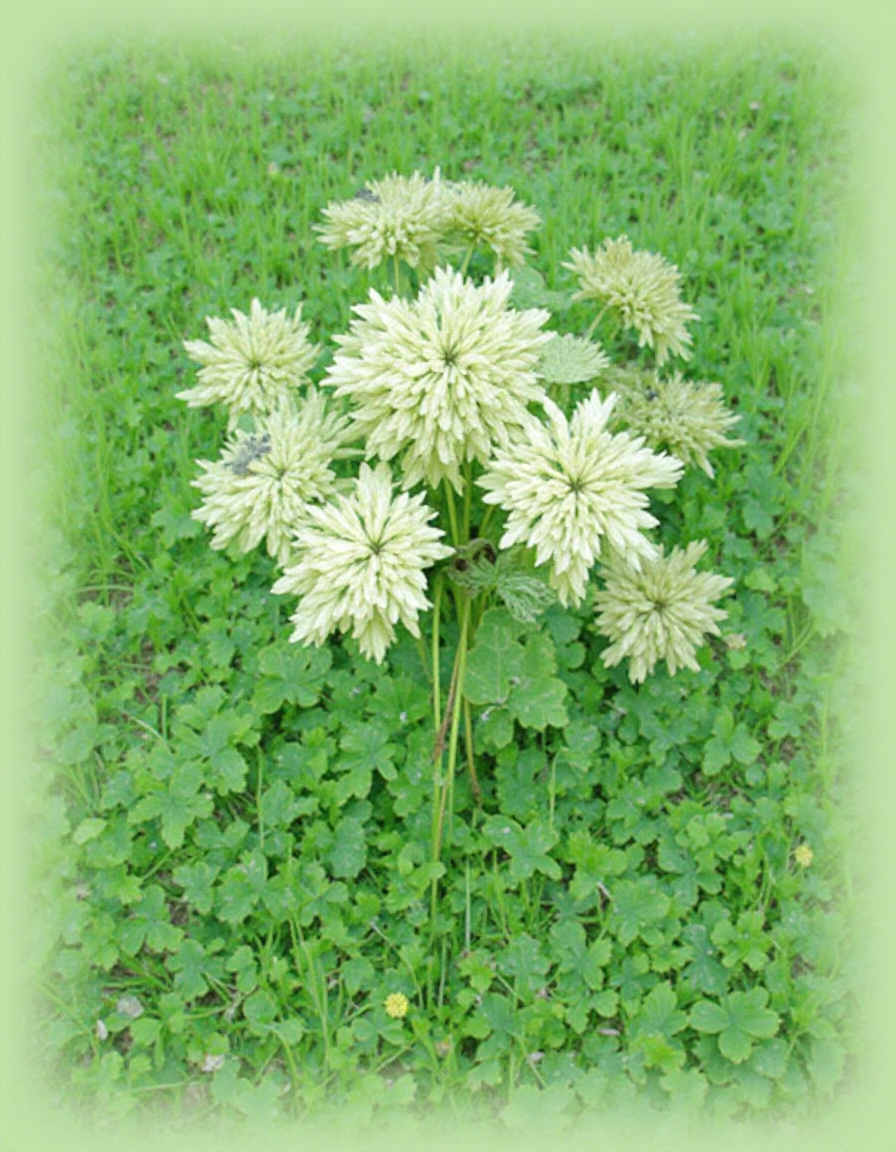
flower with white petals and green leaves.
CAPTION
The image depicts a cluster of white flowers with multiple florets, likely daisies, growing in a grassy field. The flowers are arranged in a circular pattern, with the central flower being the largest and the others surrounding it. The background is a lush green field, providing a natural and serene setting for the flowers.
MONOLOGUE
_Double Flowers._—When the stamens are converted into petals, the plant becomes on the male side sterile; when both stamens and pistils are thus changed, the plant becomes completely barren. Symmetrical flowers having numerous stamens and petals are the most liable to become double, as perhaps follows from all multiple organs being the most subject to variability. But flowers furnished with only a few stamens, and others which are asymmetrical in structure, sometimes become double, as we see with the double gorse or Ulex, and Antirrhinum. The Compositæ bear what are called double flowers by the abnormal development of the corolla of their central florets. Doubleness is sometimes connected with prolification,[96] or the continued growth of the axis of the flower. Doubleness is strongly inherited. No one has produced, as Lindley remarks,[97] double flowers by promoting the perfect health of the plant. On the contrary, unnatural conditions of life favour their production. There is some reason to believe that seeds kept during many years, and seeds believed to be imperfectly fertilised, yield double flowers more freely than fresh and perfectly fertilised seed.[98] Long-continued cultivation in rich soil seems to be the commonest exciting cause. A double narcissus and a double _Anthemis nobilis,_ transplanted into very poor soil, has been observed to become single;[99] and I have seen a completely double white primrose rendered permanently single by being divided and transplanted
SUMMARY
a person in a red dress holding a sword in the desert at sunset
CAPTION
The image depicts a person in a red dress, holding a sword in their right hand, standing in a field with a large sun in the background. The person is positioned in the center of the image, with the sun to the right and the field stretching out to the left. The person's body is angled towards the sun, creating a dynamic and dramatic effect.
MONOLOGUE
On the 27th of June the whole fleet left Suez with the wind at N.W. and before night cast anchor at a place called _Korondol_, 60 miles from Suez; at which place Moses divided the sea by stretching out his rod, and Pharaoh was drowned with all his host. At this place, which may be considered the commencement of the Red Sea, we had 12 fathoms water, and lay at anchor all night. Leaving Korondol on the 28th, we sailed 33 leagues to the S.E. and cast anchor two hours before night at a place called _Tor_, where there are many Fransciscan friars who supplied the fleet with water. This place is a days journey and a half from Mount _Sinai_, where is the church and monastery of St Catharine, in which the body of that saint is reposited. We remained five days at Tor, in five fathoms water. We departed from Tor on the 3d of July, and came behind a dry sand bank about a mile from the shore and 40 miles from Tor, where we cast anchor in 12 fathoms water at a place named _Kharas_, where we remained two days to inspect the two ships which carried the stores. Leaving Kharas on the 5th, we came to an island named _Soridan_ 40 miles from the coast, the whole days course from sunrise to sunset being 100 miles. Continuing our voyage all night to the S.E. we found ourselves at sunrise of the 6th to windward of a mountain on the right hand shore, named _Marzoan_, 100 miles beyond Soridan. Proceeding forward on the 6th, and still sailing S.E. we advanced 100 miles by sunrise, and saw land on the right towards _Kabisa_[216]. We sailed 90 miles on the 7th
SUMMARY
a woman in a pink dress is walking on a field at night
CAPTION
The image captures a woman walking on a field at night, her back turned to the camera. She is wearing a white dress that is partially visible, and her hair is flowing in the wind. The field is illuminated by a red light, possibly from a stadium or a sports arena, and there are several lights in the background, including a tall light pole and a street lamp.
MONOLOGUE
A terrific gust struck the rain-doors. They bent and cracked before the force of the gale. The vivid white of lightning showed that one door had been forced from its groove. Iemon rose and replaced it. As he turned away suddenly the room was plunged in darkness. Said the voice of O'Hana--"The light of the _andon_ has gone out. Oya! Oya! The lights in the Butsudan (altar) are lit. And yet this Hana extinguished them." Grumbled Iemon--"The wind has blown out the light in the _andon_. Doubtless a spark was left in the wick of the altar light. Fire is to be dreaded; great care should be taken in extinguishing the light." As he relit the light in the night lamp, O'Hana went up to the Butsudan to extinguish the lights there. She put her hand out to take one. A sharp scream, and she fell back in confusion and fright. "An _aodaisho[u]_ in the Butsudan! Help! Aid this Hana!" As she fled the snake with a thud fell on the _tatami_. Unrolling its six feet of length, it started in pursuit. Iemon stepped behind it and caught it by the tail. A sharp rap behind the head stunned it. It hung limp in his hand. "Hana, please open the _amado_."--"No, no: this Hana cannot; move she will not."--"Coward!" said Iemon. "Time comes when Hana, for generations in the future existence, will wander hill and dale in such form."--"Ara!" The woman was properly shocked at this speech, wicked and brutal as an imprecation. "Has the life of Hana been so foul as to deserve such punishment in a future life? Surely 'tis not the priest of Reigan who
SUMMARY
a woman with long hair and a black shirt is playing a guitar in a field
CAPTION
The image depicts a group of four women standing in a field, each holding a guitar. The women are dressed in casual clothing, including t-shirts, jeans, and boots, and are positioned in a line facing the camera. The background is a field with a fire burning in the distance, adding a dramatic element to the scene.
MONOLOGUE
On these occasions the natives came and made friends with the voyagers, and subsequently these Tchuktches welcomed the foreigners. The description given of the natives and their dwellings is curious. They live in large tents, which enclose sleeping-places or a kind of inner chambers, heated and lighted by an oil lamp. In these inner rooms the native women sit, with very little clothing on. In summer a fire is kept burning in the centre of the hut, and the smoke goes up through a hole in the roof. In winter there is no fire, and presumably the hut is closed against the outer air. The Greenlanders and Tchuktches use similar household articles: they trade for needles, knives and tools, linen shirts, etcetera, and especially brandy. Everyone smokes tobacco when he or she can obtain it. When it cannot be had, some herbs are chewed and smoked, after being dried behind the ears. Men and women seldom wear head coverings; they have tunics and trousers of reindeer skin, mocassins or shoes of bear-skin or walrus hide; the women plait their hair, and wear it long. The men cut theirs except the outer margin, which is combed down in a "fringe." The faces are painted or "tattooed" by both sexes.
SUMMARY
a woman in a red cardigan and white dress is standing in a field of red flowers
CAPTION
The image depicts a woman standing in a field of red flowers, with the sun setting in the background. The woman is positioned in the center of the image, and she is wearing a red cardigan over a white dress. The field of flowers is dense and vibrant, with the red color dominating the scene.
MONOLOGUE
In the dim light the statue assumed a lifelike semblance that was at once startling and wonderful. Color flies with the sun, and the white marble did not depend now on tint alone to differentiate it from flesh and blood. Seen thus indistinctly, it might almost be a graceful and nearly nude woman standing there, and some display of will power on the girl's part was called for before she approached nearer and stifled the first breath of apprehension. Then, delighted by the vague beauty of the scene, with senses soothed by the soft plash of the cascade, she decided to walk around the lake to the spot where Trenholme must have been hidden when he painted that astonishingly vivid picture. Its bold treatment and simplicity of note rendered it an easy subject to carry in the mind's eye, and Sylvia thought it would be rather nice to conjure up the same effect in the prevailing conditions of semi-darkness and mystery. She need not risk tearing her dress among the briers which clung to the hillside. Knowing every inch of the ground, she could follow the shore of the lake until nearly opposite the statue, and then climb a few feet among the bushes at a point where a zigzag path, seldom used and nearly obliterated by undergrowth, led to the clump of cedars.
SUMMARY
a woman with long red hair wearing a red coat and a beige dress is standing in a field of red flowers
CAPTION
The image depicts a woman standing in a field of red flowers, wearing a red coat and a beige dress. The background is a vibrant red field, with a clear sky above. The woman's hair is long and wavy, and she is looking directly at the camera.
MONOLOGUE
Was this the influence of Madam Carroll? But Owen could not long think this. Miss Carroll was not a person to be easily influenced or led. She was not yielding; whatever course she might follow, one could at least be sure that, good or bad, it was her own. Her interest showed itself guardedly; so much so that no one had observed it. The clergyman felt sure that he was the only discoverer, and his own discovery he owed to a rare chance. He was coming down Chillawassee on horseback, and in bending to gather a flower from a bush, as he passed, he had lost a small note-book from the breast pocket of his coat; dismounting to look for it, he found that it was lying on a ledge not far below the road, and that he could get it by a little climbing. He made his way down to the ledge, and secured the book. Then he saw, a little farther down, one of the isolated rocks called chimneys, and was seized with the fancy to have a look from its top. He obeyed this fancy. And from its top he found himself looking directly down into a small field on the edge of Carroll Farms; here, standing together under a tree, were two figures which he instantly recognized--they were the figures of Sara Carroll and Dupont. This field was separated from the road by a hedge so high that no one could look over it, and from the other fields and the orchard of the Farms by a thicket of chincapins. The two were therefore well hidden; they were safe from discovery save for the remote chance that some one had climbed the chimney above them. And this one remote chance
SUMMARY
a woman in a light yellow blouse and blue skirt is standing in a field of wildflowers at sunset
CAPTION
The image depicts a serene scene of a person standing in a field of wildflowers, with the sun setting behind them. The person is facing away from the camera, with their back to the viewer, and their head is turned slightly to the right. The field is filled with tall, fluffy flowers, and the person is wearing a light-colored blouse and a blue skirt.
MONOLOGUE
The great amusement of the evening,--which I suppose was owing to its being carnival--was the breaking of eggs filled with cologne, or other essences, upon the heads of the company. One end of the egg is broken and the inside taken out, then it is partly filled with cologne, and the whole sealed up. The women bring a great number of these secretly about them, and the amusement is to break one upon the head of a gentleman when his back is turned. He is bound in gallantry to find out the lady and return the compliment, though it must not be done if the person sees you. A tall, stately Don, with immense grey whiskers, and a look of great importance, was standing before me, when I felt a light hand on my shoulder, and turning round, saw Donna Angustia, (whom we all knew, as she had been up to Monterey, and down again, in the Alert,) with her finger upon her lip, motioning me gently aside. I stepped back a little, when she went up behind the Don, and with one hand knocked off his huge sombrero, and at the same instant, with the other, broke the egg upon his head, and springing behind me, was out of sight in a moment. The Don turned slowly round, the cologne, running down his face, and over his clothes, and a loud laugh breaking out from every quarter. He looked round in vain, for some time, until the direction of so many laughing eyes showed him the fair offender. She was his niece, and a great favorite with him, so old Don Domingo had to join in the laugh. A great many such tricks were played, and many a
SUMMARY
A silhouette of a person standing in front of a sunset.
CAPTION
The image depicts a silhouette of a person standing in a field at sunset. The person is facing away from the viewer, with their back to the camera. The field they stand in is filled with tall grass, and the sky is a vibrant orange, suggesting a sunset.
MONOLOGUE
But they were soon brought together again by the alarm that another British force was coming up, and was only two miles away. The rattle of their drums and the screech of their fifes could be heard shaking and piercing the sultry air. It was Breyman's force of German veterans. Early in the fight, Baum had sent an express to hasten Breyman's advance, which had been delayed by the violent rainstorm of the preceding day, and the consequent wretched condition of the roads, now continuous wallows of mire; but they were close at hand, and the scattered militiamen were ill-prepared to oppose them. Fortunately, the remnant of Warner's regiment, from Manchester, just then came up, led by Lieutenant-Colonel Safford. There were only 140 of them, but they were a host in steadfast valor, and they took a position in front, forming a rallying point for the militia which now came hurrying in. The Americans fell back slowly before Breyman, who advanced up the road, firing his field-pieces with more noise than effect, till a body of militia of sufficient strength to make a stand was collected. Then the Germans were attacked in front and flank, the deadliest fire raining upon them from a wooded hill on their left. The engagement was hotly maintained till after sunset, when, having lost many men and his artillery horses, Breyman abandoned his cannon and beat a precipitate retreat. Stark pushed the pursuit till it was impossible to aim a gun or distinguish friend from foe in the gathering gloom, and then withdrew
SUMMARY
a large bird is flying in the sky with a tower in the foreground.
CAPTION
The image captures a breathtaking sunset over a field. The sky is ablaze with hues of orange, pink, and blue, creating a stunning contrast against the dark field. The sun, positioned in the upper right corner of the image, is partially obscured by the clouds, adding a sense of depth to the scene.
MONOLOGUE
In a few minutes we had crossed some twenty paces of this awful bridge, which got narrower at every step, and then all of a sudden a great gust came tearing along the gorge. I saw Ayesha lean herself against it, but the strong draught got under her dark cloak, and tore it from her, and away it went down the wind flapping like a wounded bird. It was dreadful to see it go, till it was lost in the blackness. I clung to the saddle of rock, and looked round, while, like a living thing, the great spur vibrated with a humming sound beneath us. The sight was a truly awesome one. There we were poised in the gloom between earth and heaven. Beneath us were hundreds upon hundreds of feet of emptiness that gradually grew darker, till at last it was absolutely black, and at what depth it ended is more than I can guess. Above was space upon space of giddy air, and far, far away a line of blue sky. And down this vast gulf upon which we were pinnacled the great draught dashed and roared, driving clouds and misty wreaths of vapour before it, till we were nearly blinded, and utterly confused.
SUMMARY
a man stands in front of a large metallic sphere in the desert
CAPTION
In the image, a man stands in the middle of a vast, open field under a clear blue sky. The man is dressed in a gray t-shirt and dark pants, and he is facing away from the camera, looking towards the horizon. The field is expansive and barren, with no other objects or people visible in the scene.
MONOLOGUE
Five months’ imprisonment for her son! Why? Very much disturbed, she arrived at last, her ears singing, at the top of the staircase, where different inscriptions--“Tribune of the Senate, of the Diplomatic Body, of the Deputies”--stood above little doors like boxes in a theatre. She entered, and without seeing anything at first except four or five rows of seats filled with people, and opposite, very far off, separated from her by a vast clear space, other galleries similarly filled. She leaned up against the wall, astonished to be there, exhausted, almost ashamed. A current of hot air which came to her face, a chatter of rising voices, drew her towards the slope of the gallery, towards the kind of gulf open in the middle where her son must be. Oh! how she would like to see him. So squeezing herself in, and using her elbows, pointed and hard as her spindle, she glided and slipped between the wall and the seats, taking no notice of the anger she aroused or the contempt of the well-dressed women whose lace and fresh toilettes she crushed; for the assembly was elegant and fashionable. Mme. Jansoulet recognised, by his stiff shirt-front and aristocratic nose, the marquis who had visited them at Saint-Romans, who so well suited his name, but he did not look at her. She was stopped farther progress by the back of a man sitting down, an enormous back which barred everything and forbade her go farther. Happily, she could see nearly all the hall from here by leaning forward a little; and these semi-circular benches filled with deputies, the
SUMMARY
The panoramic view of a vast green field with a blue sky and white clouds.
CAPTION
The image captures a serene landscape dominated by a vast expanse of green fields stretching out towards the horizon. The sky above is a clear blue, dotted with fluffy white clouds that add a touch of whimsy to the scene. The fields are interspersed with patches of brown, suggesting the presence of trees or shrubs.
MONOLOGUE
The view from the hurricane deck, though there are no striking varieties, is too novel to be monotonous. The level plains of Chalda, only a few feet higher than the Tigris, stretch away to the distant horizon, unbroken until to-day, when low hills, white with the first snows of winter, are softly painted on a pure blue sky, very far away. The plains are buff and brown, with an occasional splash, near villages as buff and brown as the soil out of which they rise, of the dark-green of date gardens, or the vivid green of winter wheat. With the exception of these gardens, which are rarely seen, the vast expanse is unbroken by a tree. A few miserable shrubs there are, the _mimosa agrestis_ or St. John's bread, and a scrubby tamarisk, while liquorice, wormwood, capers, and some alkaline plants which camels love, are recognisable even in their withered condition.
SUMMARY
a girl in denim shorts is walking through a field of colorful wildflowers at sunset
CAPTION
The image depicts a young girl in a blue denim shorts, walking through a field of colorful wildflowers. The girl is in the foreground, with her back to the camera, and her long blonde hair flowing behind her. The field is filled with various flowers, including red, yellow, and white ones, creating a vibrant and lively scene.
MONOLOGUE
Perhaps it seemed thus to the tall young girl who now stood upon its long gallery, her tangle of high-rolled, red-brown hair held back by the hand which half shaded her eyes as she looked out discontentedly over the familiar scene. Miss Lady--for thus she was christened by the Big House servants; and she bore well the title--frowned now as she tapped a little foot upon the gallery floor. Perhaps it was not so much what she saw as what she did not see that made Miss Lady discontented, for this white rim of the forest bounded the world for her; yet after all, youth and the morning do not conspire with discontent. A moment more, light, fleet of foot, Miss Lady fled down the gallery steps, through the gate and out along the garden walk. Beyond the yard fence she was greeted riotously by a score of dogs and puppies, long since her friends and devoted admirers; as, indeed, were all dwellers, dumb or human, thereabout.
SUMMARY
a young man wearing a denim jacket and brown pants stands in front of a starry night sky. he is looking off into the distance with a contemplative expression.
CAPTION
The image depicts a young man standing in a field, gazing out at a starry night sky. He is dressed in a denim jacket and a brown leather belt, with a backpack slung over his shoulder. The sky is a deep blue, dotted with numerous stars, and the field is a vibrant green, with a few trees visible in the distance.
MONOLOGUE
It was half-past six when I awoke and went to the window, relieved to find that the sun had scattered my morbid fancies with the darkness; and I speculated, as I dressed, whether the thing called conscience were not, after all, a matter of nerves. I went downstairs through the tobacco-stale atmosphere of the lobby into the fresh air and sparkly sunlight of the mild February morning, and leaving the business district I reached the residence portion of the little town. The front steps of some of the comfortable houses were being swept by industrious servant girls, and out of the chimneys twisted, fantastically, rich blue smoke; the bare branches of the trees were silver-grey against the sky; gaining at last an old-fashioned, wooden bridge, I stood for awhile gazing at the river, over the shallows of which the spendthrift hand of nature had flung a shower of diamonds. And I reflected that the world was for the strong, for him who dared reach out his hand and take what it offered. It was not money we coveted, we Americans, but power, the self-expression conferred by power. A single experience such as I had had the night before would since to convince any sane man that democracy was a failure, that the world-old principle of aristocracy would assert itself, that the attempt of our ancestors to curtail political power had merely resulted in the growth of another and greater economic power that bade fair to be limitless. As I walked slowly back into town I felt a reluctance to return to the noisy hotel, and finding myself in front of
SUMMARY
three ballerinas in tutus perform a ballet pose in front of a windmill.
CAPTION
The image depicts a scene of three ballerinas in a field, with a backdrop of wind turbines. The ballerinas are dressed in white tutus and are performing a ballet routine. The sky is filled with clouds, and the field is dotted with tall grass.
MONOLOGUE
When we opened our door the next day, the whole village was in commotion, preparatory to the august ceremony of installing the new alcaldes. The Indians had slept off the debauch of the Newyear, and in clean dresses thronged the plaza; the great steps ascending to the church and the platform in front were filled with Indian women dressed in white, and near the door was a group of ladies, with mantas and veils, and the costume of the senoras in the capital. The morning air was fresh and invigorating; there were no threatening clouds in the sky, and the sun was pouring its early beams upon the scene of rejoicing. It was a great triumph of principle, and the humble mules which trod their daily circle with the beam of the noria, had red ribands round their necks, hung with half dollar and two shilling pieces, in token of rejoicing at the change of the alcaldes of the wells.
SUMMARY
lavender field with sun setting in the background.
CAPTION
The image captures a vibrant scene of a field of purple flowers under a sunset. The sky is a gradient of orange and pink, with the sun just setting, casting a warm glow over the field. The flowers, in various stages of bloom, are scattered across the field, their colors a mix of deep purple and pink.
MONOLOGUE
enclosure walls or towers. The prickly pear runs riot in and out among the hedges and upon the walls, diversifying the colours of the landscape with its strange grey-green masses and unwieldy fans. In spring, when peach and almond trees are in blossom, and when the roadside is starred with asphodels, this country is most beautiful in its gladness. The macchi blaze with cistus flowers of red and silver. Golden broom mixes with the dark purple of the great French lavender, and over the whole mass of blossom wave plumes of Mediterranean heath and sweet-scented yellow coronilla. Under the stems of the ilex peep cyclamens, pink and sweet; the hedgerows are a tangle of vetches, convolvuluses, lupines, orchises, and alliums, with here and there a purple iris. It would be difficult to describe all the rare and lovely plants which are found here in a profusion that surpasses even the flower-gardens of the Cornice, and reminds one of the most favoured Alpine valleys in their early spring.
SUMMARY
a woman in a long dress is walking through a field during a thunderstorm
CAPTION
The image depicts a person standing in a field under a stormy sky. The person is holding a sword and appears to be in a defensive stance, possibly preparing to defend themselves against a lightning strike. The person is positioned in the center of the image, with the field stretching out behind them.
MONOLOGUE
Nothing, however, could be more tedious and trifling in the record than these struggles over the small person of the child-king. But the story quickens when the long-desired occasion arrived, and the two rulers, rivals yet partners in power, found opportunity to strike the blow upon which they had decided, and crush the great family which threatened to dominate Scotland, and which was so contemptuous of their own sway. The great Earl, Duke of Touraine, almost prince at home, the son of that Douglas whose valour had moved England, and indeed Christendom, to admiration, though he never won a battle--died in the midst of his years, leaving behind him two young sons much under age as the representatives of his name. It is extraordinary to us to realise the place held by youth in those times, when one would suppose a man's strength peculiarly necessary for the holding of an even nominal position. Mr. Church has just shown in his Life of Henry V how that prince at sixteen led armies and governed provinces; and it is clear that this was by no means exceptional, and that the right of boys to rule themselves and their possessions was universally acknowledged and permitted. The young William, Earl of Douglas, is said to have been only about fourteen at his father's death. He was but eighteen at the time of his execution, and between these dates he appears to have exercised all the rights of independent authority without tutor or guardian. The position into which he entered at this early age was unequalled in