dres






SUMMARY
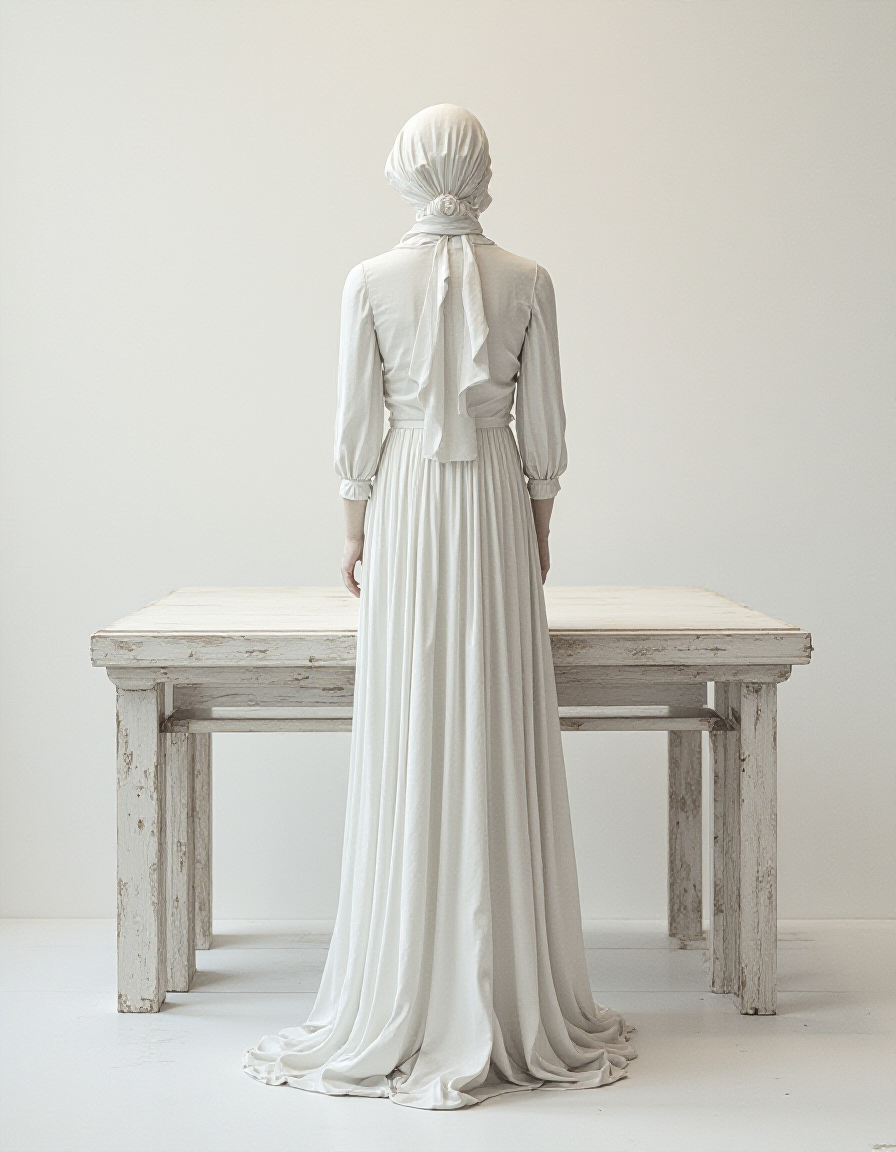
The image depicts a person wearing a white dress, standing in front of a table.
CAPTION
The image depicts a person standing in front of a white table. The person is wearing a white dress with a high neckline and a bow at the back. The dress is long and flows down to the floor, creating a sense of movement.
MONOLOGUE
Arethusa was wearing a white dress on this Occasion, but it was a glorified White Dress, of such beauty, that some other name would surely have to be found for Miss Letitia's loving effort; it would be clearly impossible to speak of them both as "white dresses." Her hair was piled high on her head in a way that Timothy had never seen her wear it, and that he vaguely did not like, because it made her look so much older. And in her low-necked gown and wearing the flowers another man had sent her, she seemed to Timothy more than ever of a world apart. She was like an Arethusa met for the first time. He wished intensely that he could gather her up and carry her back to the country where he considered she so indisputably belonged, to be the old Arethusa once more. He looked gloomily down the length of the library, which had been cleared for dancing of all its furniture, and that presented an expanse of shining floor on which the firelight danced and gleamed enticingly, and wished another wish. He wished that he himself had stayed at home. Why had he gone contrary to the dictates of his common sense and come in answer to that telegram? Arethusa did not really want him; did not really care, now that he was here. She was altogether changed; and, thought Timothy, rather soberly, his head resting on one hand as he leaned against the mantel-shelf and stared down into the fire, it was not at all for the better.
SUMMARY
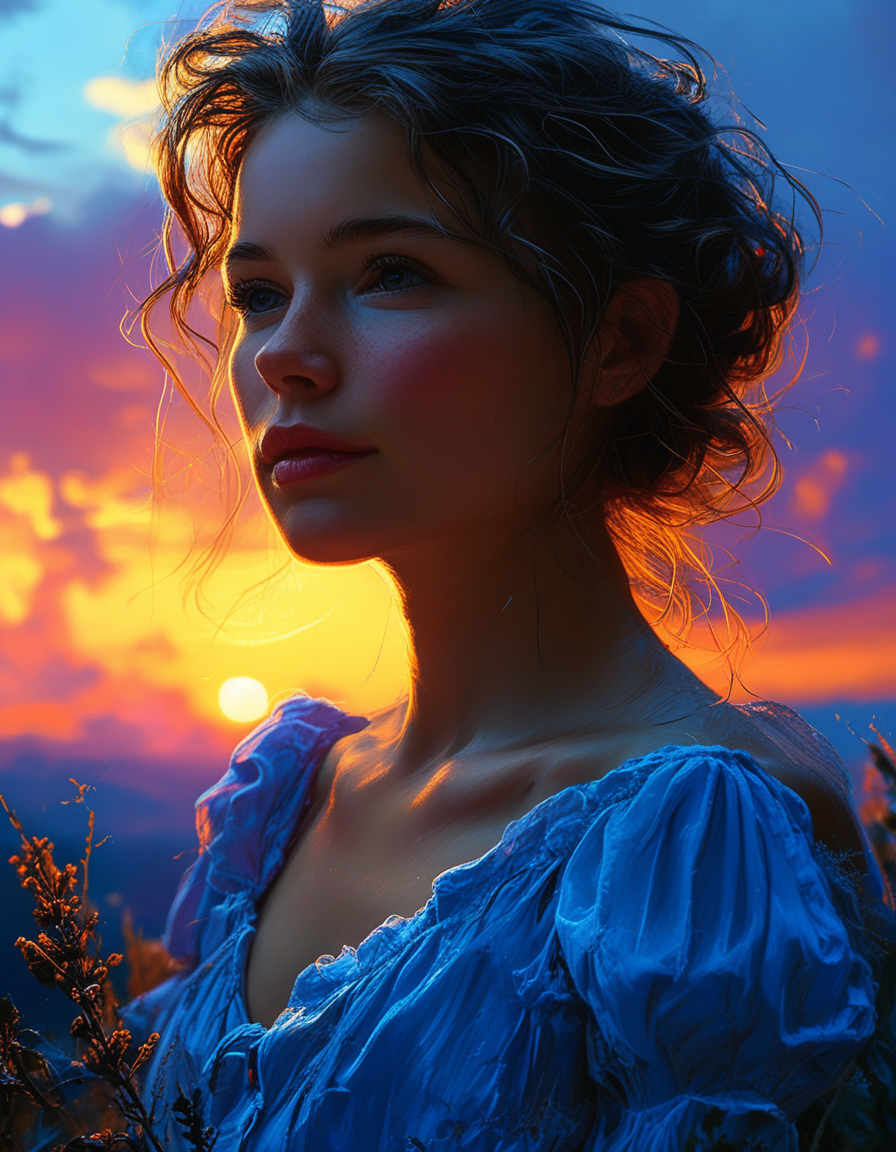
a young woman with curly hair is standing in front of a sunset with her face turned to the side and her eyes looking to the side. she is wearing a blue dress with puffed sleeves and has a serene expression on her face.
CAPTION
The image depicts a young woman with curly hair, wearing a blue dress with a sweetheart neckline, standing in front of a sunset. The sky is a vibrant mix of orange and pink hues, with the sun setting behind her. The woman's face is lit by the warm glow of the sunset, casting long shadows on her face and dress.
MONOLOGUE
"It is just like a pink rose," she said to herself, her eyes wandering from the walls, delicately tinted a soft rose colour, to the sofa and chairs upholstered in a deeper shade of the same colour, and the carpet, whose darker tint of rose harmonised with the paler hues. Every table seemed to the girl to overflow with books and magazines; bowls of flowers, vases of flowers, pots of flowers, stood on every available shelf, and in every possible corner. The windows were draped with rose-coloured silk curtains, that made even the grey sky beyond them look less grey, and the pictures on the walls drew a gasp of delight from Christina's lips. They were mainly landscapes, and in almost every case they represented wide spaces, open tracts of country, that gave one a sense of life and freshness. Here was an expanse of sea, blue and smiling as the sky that stooped to meet it; there, long green rollers swept up a sandy beach, whilst clouds lit up by a rift of sunshine, lay on the horizon. On this side was a moorland, purple with heather, bathed in the glory of the setting sun; on that side, a plain, far-reaching as the sea itself, soft and green and misty, bounded by mountains, whose snow-crowned summits stood out in serried stateliness against the faint blue sky. In a looking-glass hanging on the wall, Christina caught sight of her own reflection, and a shamed consciousness of her white face and shabby clothes, gave her a sense of the incongruousness between her own appearance, and the loveliness
SUMMARY
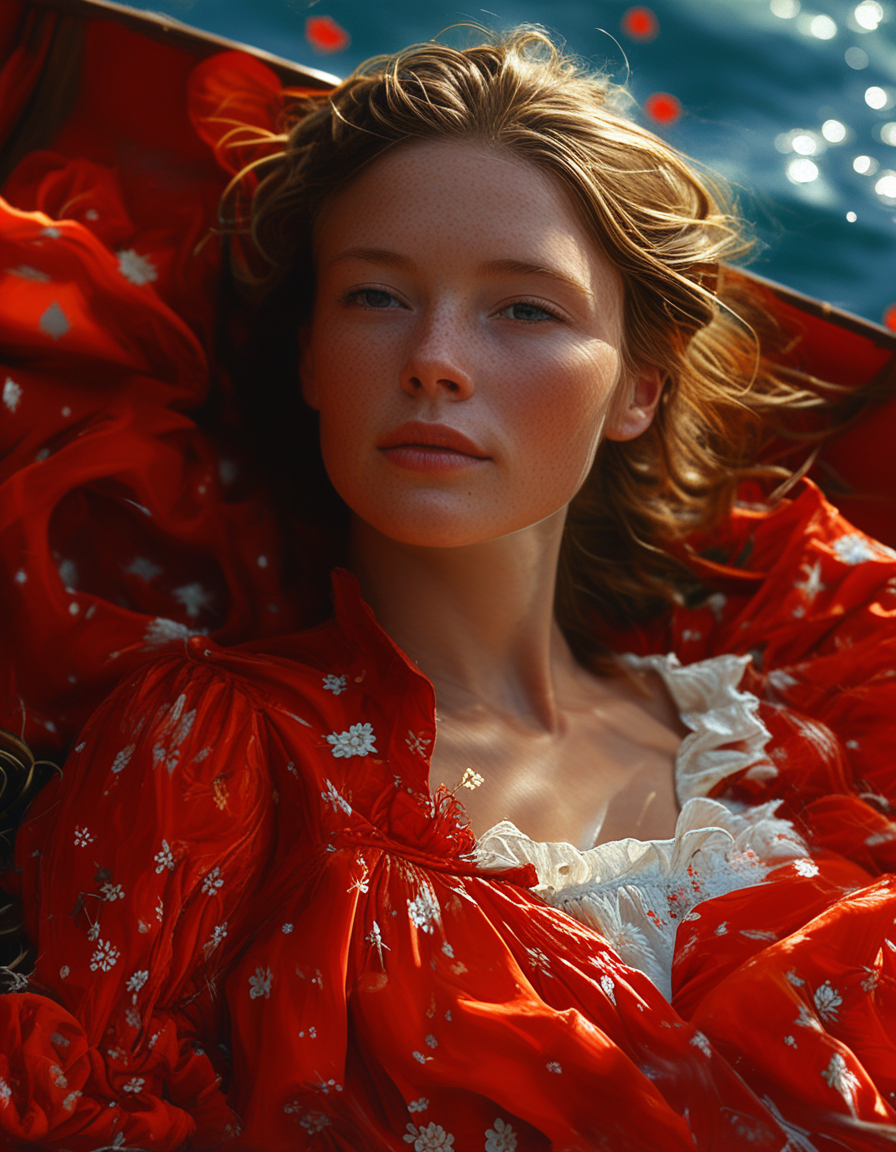
young woman in red dress with white lace overlay, looking to the side, with a blurred background.
CAPTION
The image depicts a young woman with long, wavy hair, wearing a red, floral-patterned dress. The dress has a white, ruffled collar and is adorned with white flowers. The woman's expression is serious, and her gaze is directed towards the camera.
MONOLOGUE
We saw Frederika Bremer at an evening assemblage, and she was so judiciously attired, that her personal defects did not prevent her from looking really well. Over a rich black satin dress, she wore a long loose sacque of black lace, lined with grey silk. From beneath the short sleeves of her sacque, came down long wide sleeves of white lace, confined with bracelets round her fair and delicate little hands. Her throat was covered closely with a handsome collar of French embroidered muslin, and her beautiful and becoming cap was of white lace, white flowers, and white satin ribbon--her light hair being simply parted on her broad and intellectual forehead. With her lively blue eyes, and the bright and pleasant expression of her countenance, no one seemed to notice the faults of her nose, mouth, and complexion--and those of her figure were so well concealed as to be scarcely apparent. And then her lady-like ease, and the total absence of all affectation, rendered her graceful and prepossessing. True it is, that with a good heart and a good mind no woman can be ugly; at least, they soon cease to be so considered, even if nature has been unkind to them in feature, figure, and complexion. An intelligent eye, and a good humoured mouth, are excellent substitutes for the want of regular beauty. Physiognomists say that the eye denotes the mind, and the mouth indicates the heart.
SUMMARY
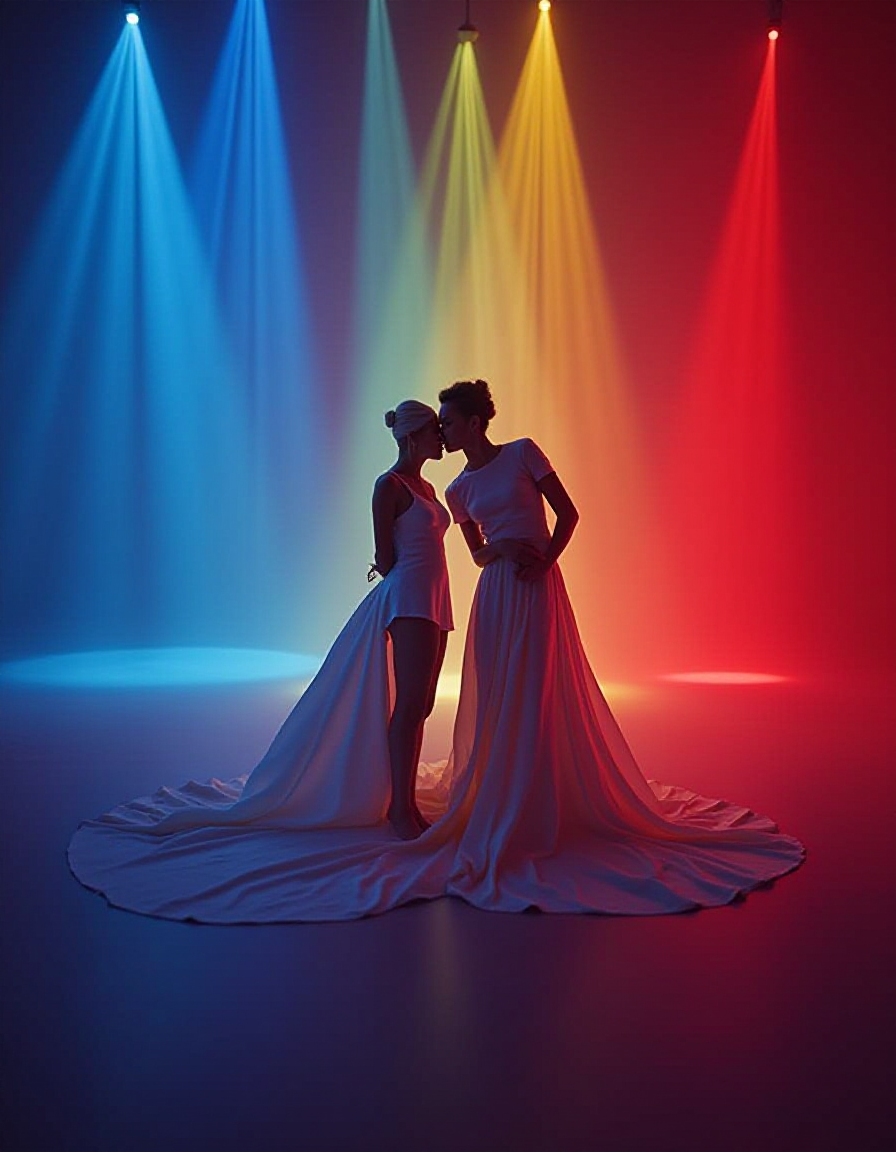
two women in white dresses are dancing in a spotlight.
CAPTION
The image depicts two women standing in a dimly lit room with colorful stage lights. The woman on the left is wearing a white dress with a flowing skirt, while the woman on the right is dressed in a white dress with a long train. Both women are facing each other, suggesting a moment of interaction or engagement.
MONOLOGUE
Some of them have their hair of a great length; while others suffer a long tress to fall behind, and the rest is cut so short as to expose their ears, but no other attention whatever is paid to it. The beards of some of the old men were long, and the rest had them pulled out by the roots so that not a hair could be seen on their chins. The men have two double lines, either black or blue, tattooed upon each cheek, from the ear to the nose. The gristle of the latter is perforated so as to admit a goose-quill or a small piece of wood to be passed through the orifice. Their clothing is made of the dressed skins of the rein or moose-deer, though more commonly of the former. These they prepare in the hair for winter, and make shirts of both, which reach to the middle of their thighs. Some of them are decorated with an embroidery of very neat workmanship with porcupine quills and the hair of the moose, coloured red, black, yellow, and white. Their upper garments are sufficiently large to cover the whole body, with a fringe round the bottom, and are used both sleeping and awake. Their leggins come half way up the thigh, and are sewed to their shoes: they are embroidered round the ancle, and upon every seam. The dress of the women is the same as that of the men. The former have no covering on their private parts, except a tassel of leather which dangles from a small cord, as it appears, to keep off the flies, which would otherwise be very troublesome. Whether circumcision be practised among them, I cannot
SUMMARY
a woman wearing a black dress with intricate lace patterns and a large flower on her head.
CAPTION
The image depicts a woman with long, dark hair styled in a bun, wearing a black dress with intricate lace patterns. She is facing away from the camera, giving a sense of depth and perspective to the image. The background is dark, creating a contrast that highlights the woman's attire and the intricate details of her dress.
MONOLOGUE
She was a lovely woman--Mrs. Amos Barton, a large, fair, gentle Madonna, with thick, close, chestnut curls beside her well-rounded cheeks, and with large, tender, short-sighted eyes. The flowing lines of her tall figure made the limpest dress look graceful, and her old frayed black silk seemed to repose on her bust and limbs with a placid elegance and sense of distinction, in strong contrast with the uneasy sense of being no fit, that seemed to express itself in the rustling of Mrs. Farquhar’s _gros de Naples_. The caps she wore would have been pronounced, when off her head, utterly heavy and hideous--for in those days even fashionable caps were large and floppy; but surmounting her long arched neck, and mingling their borders of cheap lace and ribbon with her chestnut curls, they seemed miracles of successful millinery. Among strangers she was shy and tremulous as a girl of fifteen; she blushed crimson if any one appealed to her opinion; yet that tall, graceful, substantial presence was so imposing in its mildness, that men spoke to her with an agreeable sensation of timidity.
SUMMARY
a statue of a cherub with wings and a red light on its wings.
CAPTION
The image presents a detailed and realistic depiction of a cherubic figure, rendered in a soft, pastel palette. The cherub, with its head tilted slightly to the left, is adorned with a flowing white dress that drapes over its shoulders. The dress is adorned with a delicate pink ribbon that adds a touch of elegance to the figure.
MONOLOGUE
Mrs. Nevill Tyson--she was an illusion and a distraction from head to foot; her beauty made a promise to the senses and broke it to the intellect. Coil upon coil, and curl upon curl of dark hair, the dark eyes of some ruminant animal, a little frivolous curve in an intelligent nose, a lower jaw like a boy's, the full white throat of a woman, and the mouth and cheeks of a child just waked from sleep. Tyson had escaped one misfortune that had been prophesied for him. His wife was not vulgar. She sat at her ease (much more at her ease than Miss Batchelor), and chattered away about her honeymoon, her bad French, the places she had been to, the people she had seen, and all without any consciousness of her delightful self. Now it was a continuous stream of minute talk, growing shallower and shallower as it spread over a larger surface; and now her mind had hardly settled on its subject before it was off and away again like a butterfly. There was one advantage in this excessive lightness of touch, that it left great things as it found them, for great things lay lightly on her soul. She told everybody she had been to Rome; but imagination simply, refused to picture Mrs. Nevill Tyson in Rome. Her presence in the Eternal City seemed something less than her footprint in its dust or her shadow on its walls. Nothing is more irritating than to have your dream of a place destroyed by the light-hearted gabble of some idiot who has seen it; but Mrs. Nevill Tyson spared your dreams. The most delicate ideal would have been undisturbed by the soft sweep of her
SUMMARY
a woman in a colorful dress is standing in front of a colorful light display
CAPTION
The image depicts a woman with long, wavy hair, dressed in a vibrant red dress with a floral pattern. The dress has a ruffled hem and is adorned with a necklace. The woman is facing away from the camera, giving a sense of depth and perspective to the image.
MONOLOGUE
The autumn afternoon was fading into evening. It had been cloudy weather, but the clouds had softened and broken up. Now they were lost in slowly darkening blue. The sea was perfectly and utterly still. It seemed to sleep, but in its sleep it still waxed with the rising tide. The eye could not mark its slow increase, but Beatrice, standing upon the farthest point of the Dog Rocks, idly noted that the long brown weeds which clung about their sides began to lift as the water took their weight, till at last the delicate pattern floated out and lay like a woman's hair upon the green depth of sea. Meanwhile a mist was growing dense and soft upon the quiet waters. It was not blown up from the west, it simply grew like the twilight, making the silence yet more silent and blotting away the outlines of the land. Beatrice gave up studying the seaweed and watched the gathering of these fleecy hosts.
SUMMARY
a young woman in a pink dress with floral patterns is posing in a forest
CAPTION
The image depicts a young woman with long, wavy hair, wearing a pink dress with floral patterns. She is standing in a forest, with the foliage in the background creating a warm, orange hue. The lighting in the image is soft and natural, casting a gentle glow on the woman's face and dress.
MONOLOGUE
On the other hand, all the girls go with the fisher-folk in their love of the Madonna. "Ah yes, signore," laughs a maiden whose Greek face might have served Pheidias for a model, "San Costanzo is our protector, but he is old and the Madonna is young, so young and so pretty, signore, and she is _my_ protectress." A fisherman backs up the feminine logic by a gird at the silver image which is evidently the strong point of the opposite party. The little commune is said to have borrowed a sum of money on the security of this work of art, and the fisherman is correspondingly scornful. "San Costanzo owes much, many danari, signore; and it is said," he whispers roguishly, "that if they don't pay pretty soon his creditors at Naples will send him to prison for the debt of the Municipio." But the Madonna has her troubles as well as the Saint. Her hair which has been dyed for the occasion has unhappily turned salmon colour by mistake; but the blunder has no sort of effect on the enthusiasm of her worshippers; on the canons who follow her in stiff copes, shouting lustily, or on the maidens and matrons who bring up the rear. Slowly the procession winds its way through the little town, now lengthening into a line of twinkling tapers as it passes through the narrow alleys which serve for streets, now widening out again on the hill-sides where the orange kerchiefs and silver ornaments of the Caprese women glow and flash into a grand background of colour in the sun. And then comes evening and benediction, and the fireworks, without
SUMMARY
a woman holding a baby in a field of flowers
CAPTION
The image captures a serene moment between a woman and a child in a lush, green forest. The woman, adorned in a white dress with red floral patterns, is holding the child, who is dressed in a red dress with white polka dots. The woman's hair is tied back, and she is wearing a necklace.
MONOLOGUE
In the hands of the woman who was spinning the thread broke and the song died in the white throat of the girl who stood in the doorway. For a moment the two gazed with widening eyes into the green September world without the cabin; then the woman sprang to her feet, tore from the wall a horn, and, running to the door, wound it lustily. The echoes from the hills had not died when a man and a boy, the one bearing a musket, the other an axe, burst from the shadow of the forest, and at a run crossed the greensward and the field of maize between them and the women. The child let fall her pine cones and pebbles, and fled to her mother, to cling to her skirts, and look with brown, frightened eyes for the wonder that should follow the winding of the horn. Only twice could she remember that clear summons for her father: once when it was winter and snow was on the ground, and a great wolf, gaunt and bold, had fallen upon their sheep; and once when a drunken trader from Germanna, with a Pamunkey who had tasted of the trader’s rum, had not waited for an invitation before entering the cabin. It was not winter now, and there was no sign of the red-faced trader or of the dreadful, capering Indian. There was only a sound in the air, a strange noise coming to them from the pass between the hills over which rose the sun.
SUMMARY
a woman with long blonde hair is posing in a red sequined dress with a choker necklace. she is looking directly at the camera with a serious expression.
CAPTION
The image depicts a woman with long, wavy blonde hair, wearing a sparkling, sequined dress. The dress is detailed with intricate patterns and has a plunging neckline. The woman is positioned in front of a vibrant, red and blue background, which is illuminated by a spotlight.
MONOLOGUE
In a detailed and well-documented thesis, Alwin Schultz describes the characteristics of the beautiful woman as she appealed to the German authors of the twelfth and thirteenth centuries. She must be of medium height and slender. Her hair must be fair, like gold; long, bright, and curly; a man's must only reach to his shoulders. Dark hair is seldom mentioned and was not admired. The parting of the hair must be white, but not too broad. The forehead must be white and bright and rounded, without wrinkles. The eyebrows must be darker than the hair, arched, and not too broad, as though drawn with a pencil, the space between them not too broad. The eyes must be bright, clear, and sparkling, not too large or too small; nothing definite was said of the color, but they were evidently usually blue. The nose must be of medium size, straight, and not curved. The cheeks must be white, tinged with red; if the red was absent by nature women used rouge. The mouth must be small; the lips full and red. The teeth must be small, white, and even. The chin must be white, rounded, lovable, dimpled; the ears small and beautiful; the neck of medium size, soft, white, and spotless; the arm small; the hands and fingers long; the joints small, the nails white and bright and well cared for. The bosom must be white and large; the breasts high and rounded, like apples or pears, small and soft. The body generally must be slender and active. The lower parts of the body are very seldom mentioned, and many poets are even too modest to mention
SUMMARY
a woman wearing a blue dress with a hat and a necklace with a red pendant.
CAPTION
The image depicts a woman standing in a field of red poppies, wearing a blue dress adorned with gold and red embellishments. She is adorned with a black hat and a large necklace, adding to her elaborate attire. The background is a field of red poppies, creating a stark contrast with the woman's blue dress.
MONOLOGUE
She spoke like an Englishwoman, yet there was a faint roll of the "r" suggestive of foreign birth or education. Mary had never seen any one like her before. She was unusually tall, as tall as a man of good height, and her figure was magnificent. Evidently she was not ashamed of her stature, for her large black hat had upstanding white wings, and her heels were high. Her navy blue cloth dress braided with black that had threads of gold here and there was made to show her form to the best advantage. Mary had not known that hair could be as black as the heavy waves which melted into the black velvet of the hat. The level brows over the long eyes were equally black, and so were the thick short lashes. Between these inky lines the eyes themselves were as coldly gray and empty as a northern sea, yet they were attractive, if only by an almost sinister contrast. The skin was extraordinarily white, and it did not occur to Mary that Nature alone had not whitened it, or reddened the large scarlet mouth. Women did not paint at the convent, nor did Lady MacMillan's guests. Mary did not know anything about paint. She thought the newcomer very handsome, yet somehow formidable.
SUMMARY
a woman in a blue dress is dancing in a field
CAPTION
The image depicts a woman in a blue dress, walking through a field of tall grass. She is adorned with a flower crown on her head and is holding a bouquet of flowers in her hands. The dress is flowing with water droplets, creating a dynamic and lively scene.
MONOLOGUE
It was a ripe sweet day in the latter part of September--clear, but hazy and dreamful--a prelude to the Indian summer. I stood before the glass in my room at 'Squire Jones's, where I boarded, and very carefully arranged my bright blue neck-tie. Then I combed my hair. I never have got thoroughly familiar with my hair. I cannot, even now, comb it, while looking in a glass, without cringing for fear of burning my fingers. The long, wavy red locks flow through the comb like flames, and underneath is a gleam of live coals and red hot ashes. Ben Crane said he believed my head had set his hay stacks a-fire. Maybe it did. I wished that a stray flash from the same source would kindle the heart of Susie Adair and heat it until it lay under her Cytherean breasts a puddle of molten love. I put my silk hat carefully upon my head and wriggled my hands into a pair of kid gloves; then, walking-stick in hand, I set out to know my fate at the hands of Susie. My way was across a stubble field in which the young clover, sown in the spring, displayed itself in a variety of fantastic modes. Have you ever noticed how much grass is like water? Some one, Hawthorne, perhaps, has spoken of "a gush of violets," and Swinburne, going into one of his musical frenzies, cries:
SUMMARY
a woman in a red dress with a hat and a red background
CAPTION
The image depicts a woman in a vibrant red dress, standing in front of a red background. She is wearing a hat and has her hair blowing in the wind. The dress is detailed with intricate beadwork and sequins, adding a touch of elegance to her attire.
MONOLOGUE
Without a second's delay, despite her twenty-seven years, she has sprung forwards to obey the summons; and Jim has the sense to make no further effort to rejoin her. By the time that their circuit is finished, and they have again reached the front of the church, vespers are ended, and there is a movement outwards among the worshippers. They stream--not very numerous--out on the little terrace. The priests follow, tonsured, but--which looks strange--with beards and whiskers. The acolytes, in their red chasubles, carry a black and white pall, and lay it over the memorial stone below the cross. On either hand stand a band of decently clad youths--sons of drowned seamen--playing on brass instruments. It is a poor little music, doubtfully in tune; but surely no rolling organ, no papal choir, could touch the heart so much as this simple ceremonial. The little Latin cross standing sheer out against the sea; the black pall thrown over the stone that commemorates the sea's innumerable dead; the red-clad acolytes, standing with eyes cast down, holding aloft their high tapers, whose flickering flame the sea-wind soon puffs out; and the sons of the drowned sailors, making their homely music to the accompaniment of the salt breeze. The little service is brief and those who have taken part in it are soon dispersing. As they do so, Jim once more finds himself for a moment close to Elizabeth.
SUMMARY
a woman in a pink dress is dancing in the desert at night
CAPTION
The image depicts a woman in a pink dress, standing in a desert landscape with a full moon in the background. The woman is facing away from the viewer, her body angled slightly to the right. She is wearing a pink hat and a pink dress with a ruffled hem.
MONOLOGUE
_Night, in the garden of NAAMAN at Damascus. At the left the palace, with softly gleaming lights and music coming from the open latticed windows. The garden is full of oleanders, roses, pomegranates, abundance of crimson flowers; the air is heavy with their fragrance: a fountain at the right is plashing gently: behind it is an arbour covered with vines. Near the centre of the garden stands a small, hideous image of the god Rimmon. Beyond the arbour rises the lofty square tower of the House of Rimmon, which casts a shadow from the moon across the garden. The background is a wide, hilly landscape, with the snow-clad summit of Mount Herman in the distance. Enter by the palace door, the lady TSARPI, robed in red and gold, and followed by her maids, KHAMMA and NUBTA. She remains on the terrace: they go down into the garden, looking about, and returning to her._
SUMMARY
The painting depicts a woman in a flowing white dress, standing in a garden with flowers and trees in the background.
CAPTION
The image depicts a woman standing in a garden, adorned with a sheer, light-colored dress that drapes over her shoulders and extends down her legs. The dress is adorned with a gold brooch at the neckline, adding a touch of elegance to her attire.
MONOLOGUE
THE first part of my dress is a pair of drawers, very full that reach to my shoes, and conceal the legs more modestly than your petticoats. They are of a thin rose-coloured damask, brocaded with silver flowers. My shoes are of white kid leather, embroidered with gold. Over this hangs my smock, of a fine white silk gauze, edged with embroidery. This smock has wide sleeves hanging half way down the arm, and is closed at the neck with a diamond button; but the shape and colour of the bosom is very well to be distinguished through it.--The _antery_ is a waistcoat, made close to the shape, of white and gold damask, with very long sleeves falling back, and fringed with deep gold fringe, and should have diamond or pearl buttons. My _caftan_, of the same stuff with my drawers, is a robe exactly fitted to my shape, and reaching to my feet, with very long strait falling sleeves. Over this is my girdle, of about four fingers broad, which, all that can afford it, have entirely of diamonds or other precious stones; those who will not be at that expence, have it of exquisite embroidery on sattin (sic); but it must be fastened before with a clasp of diamonds.--The _curdee_ is a loose robe they throw off, or put on, according to the weather, being of a rich brocade (mine is green and gold) either lined with ermine or sables; the sleeves reach very little below the shoulders. The head dress is composed of a cap, called _talpock_, which is, in winter, of fine velvet embroidered with pearls or diamonds, and in summer, of a light
SUMMARY
a woman wearing a long orange dress is standing in the water
CAPTION
The image depicts a woman standing in a body of water, wearing a vibrant orange dress that extends to her feet. The dress is loose and flows freely around her, adding a sense of movement to the scene. The woman's arms are outstretched, reaching towards the water, and her head is tilted slightly upwards, creating a dynamic and expressive pose.
MONOLOGUE
The names connected with the next incident are suppressed, out of regard for the feelings of surviving friends. It is given as a warning to future visitors to Niagara not to attempt any mirthful experiments around the Falls. A party of ladies, gentlemen, and children were on Luna Island, near a small beech tree, since destroyed, called "the Parasol." A young girl of ten was standing near her mother, just on the brink of the water, when a young man of twenty-two stepped up beside her and seized her playfully by the arms, saying, "Now, Nannie, I am going to throw you in," and swung her out over the water. Taken by surprise and frightened, she struggled, twisted herself out of his grasp, and fell into the rapid within twenty feet of the brink of the precipice. Instantly the young man plunged in after her, seized hold of her dress, and swung her around toward her half-distracted mother, who almost reached her as she slipped by and went over the Fall, immediately followed by the young man. The young girl was found some days afterward, lying on her back, on a large rock, holding her open parasol above her head, as though she had lain down to rest. A few weeks afterward the father of the young man was coming up the river, on the _Maid of the Mist_, from the lower landing. A body was discovered floating in the water, and, by the aid of a small boat, was brought on board the steamer. It was that of his son.
SUMMARY
The woman is holding two pieces of paper in her hands and is wearing a dress.
CAPTION
The image depicts a woman dressed in a green dress with a sheer overlay, holding two fans in each hand. The dress has a fitted bodice and a flowing skirt, and she is adorned with a necklace and bracelets. The background is a plain green wall, which contrasts with the vibrant colors of the dress and the fans.
MONOLOGUE
The skull was inclined slightly towards the left shoulder and towards an exquisite little doll, carved of oak, which was lying on the scapula, or shoulder-blade. On each side of the head were gold earrings with pearl drops. Mingled with the vertebrae of the neck and back were a gold necklace, woven as a chain, with thirty-seven pendants of green jasper, and a brooch with an amethyst intaglio of Greek workmanship, representing the fight of a griffin and a deer. Where the left hand had been lying, we found four rings of solid gold. One is an engagement-ring, with an engraving in red jasper representing two hands clasped together. The second has the name PHILETVS engraved on the stone; the third and fourth are plain gold bands. Proceeding further with our exploration, we discovered, close to the right hip, a box containing toilet articles. The box was made of thin pieces of hard wood, inlaid _alla Certosina_, with lines, squares, circles, triangles, and diamonds, of bone, ivory, and wood of various kinds and colors. The box, however, had been completely disjointed by the action of the water. Inside there were two fine combs in excellent preservation, with the teeth larger on one side than on the other: a small mirror of polished steel, a silver box for cosmetics, an amber hairpin, an oblong piece of soft leather, and a few fragments of a sponge.[140] The most impressive discovery was made after the removal of the water, and the drying of the coffin. The woman had been buried in a shroud of fine white linen, pieces of which
SUMMARY
a woman wearing a cowboy hat and a long dress stands in front of a full moon.
CAPTION
The image depicts a woman standing on a rocky moon-like landscape, facing away from the viewer. She is wearing a long, flowing dress that is predominantly dark in color, with intricate lace details and a wide belt. The dress is adorned with a large, glowing pink moon in the background, which is positioned to the left of the woman.
MONOLOGUE
A peculiar and distinctive feature of the cowboy's costume was his "chaps" (_chaparejos_). The chaps were two very wide and full-length trouser-legs made of heavy calfskin and connected by a narrow belt or strap. They were cut away entirely at front and back so that they covered only the thigh and lower legs and did not heat the body as a complete leather garment would. They were intended solely as a protection against branches, thorns, briers, and the like, but they were prized in cold or wet weather. Sometimes there was seen, more often on the southern range, a cowboy wearing chaps made of skins tanned with the hair on; for the cowboy of the Southwest early learned that goatskin left with the hair on would turn the cactus thorns better than any other material. Later, the chaps became a sort of affectation on the part of new men on the range; but the old-time cowboy wore them for use, not as a uniform. In hot weather he laid them off.
SUMMARY
a young woman wearing a pink hat and a pink dress with lace details.
CAPTION
The image depicts a woman wearing a pink hat and a pink dress, standing outdoors at sunset. The woman is positioned in the center of the frame, with the sun setting behind her, casting a warm glow over the scene. The dress has a floral pattern, adding a touch of elegance to the overall composition.
MONOLOGUE
"I should smile to remark," Weary assented emphatically. "Sun-up sure sees us on the road, Cadwolloper--and yuh want to be sure and wear that new pink silk handkerchief, that matches the roses in your cheeks so nice. My schoolma'am's got a friend visiting her, and she's been hearing a lot about yuh. She's plumb wild to meet yuh. Chip drawed your picture and I sent it over in my last letter, and the little friend has gone plumb batty over your dimples (Chip drawed yuh with a sweet smile drifting, like a rose-leaf with the dew on it, across your countenance, and your hat pushed back so the curls would show) and it sure done the business for Little Friend. Schoolma'am says she's a good-looker, herself, and that Joe Meeker has took to parting his hair on the dead center and wearing a four-inch, celluloid collar week days. But he's all to the bad--she just looks at your picture and smiles sad and longing."
SUMMARY
a woman wearing a white cowboy hat and a blue dress sits on a snowy hill with a full moon in the background.
CAPTION
The image depicts a woman dressed in a blue dress with a white cowboy hat, set against a night sky with a full moon. The woman is seated on a snowy ground, her hand resting on her knee. The dress is adorned with intricate beadwork and a large, ornate belt.
MONOLOGUE
Now recommenced the reign of rest and affection and stillness. Day with its burden and heat had departed, and twilight descending Brought back the evening star to the sky, and the herds to the homestead. Pawing the ground they came, and resting their necks on each other, And with their nostrils distended inhaling the freshness of evening. Foremost, bearing the bell, Evangeline's beautiful heifer, Proud of her snow-white hide, and the ribbon that waved from her collar, Quietly paced and slow, as if conscious of human affection. Then came the shepherd back with his bleating flocks from the seaside, Where was their favorite pasture. Behind them followed the watch-dog, Patient, full of importance, and grand in the pride of his instinct, Walking from side to side with a lordly air, and superbly Waving his bushy tail, and urging forward the stragglers; Regent of flocks was he when the shepherd slept; their protector, When from the forest at night, through the starry silence, the wolves howled. Late, with the rising moon, returned the wains from the marshes, Laden with briny hay, that filled the air with its odor, Cheerily neighed the steeds, with dew on their manes and their fetlocks, While aloft on their shoulders the wooden and ponderous saddles, Painted with brilliant dyes, and adorned with tassels of crimson, Nodded in bright array, like hollyhocks heavy with blossoms. Patiently stood the cows meanwhile, and yielded their udders Unto the milkmaid's hand; whilst loud and in regular cadence
SUMMARY
a woman wearing a hat and a dress with flowers and a white hat
CAPTION
The image depicts a woman wearing a wide-brimmed hat and a colorful dress. The dress is adorned with a floral pattern and has a white collar. The woman's face is turned to the left, and she is looking towards the right side of the image.
MONOLOGUE
Next morning mother was feeling fine, the world was lovely, Miss Amelia was gone, May was home to help, so she began housecleaning by washing all the curtains. She had been in the kitchen to show Candace how. I had all my work done, and was making friends with a robin brooding in my very own catalpa tree, when Mr. Pryor rode up, tied his horse, and started toward the gate. I knew he and father had quarrelled; that is, father had told him he couldn't say "God was a myth" in this house, and he'd gone home mad as hops; so I knew it would be something mighty important that was bringing him back. I slid from the tree, ran and opened the gate, and led the way up the walk. I opened the front door and asked him in, and then I did the wrong thing. I should have taken his hat, told him to be seated, and said I would see if I could find father; I knew what to do, and how to do it, but because of that about God, I was so excited I made a mistake. I never took his hat, or offered him a chair; I just bolted into the dining-room, looking for father or mother, and left the door wide open, so he thought that wasn't the place to sit, because I didn't give him a chair, and he followed me. The instant I saw mother's face, I knew what I had done. The dining-room was no place for particular company like him, and bringing him in that way didn't give her time to smooth her hair, pull shut her dress band at the neck, put on her collar, and shiny goldstone pin, her white apron, and rub her little flannel rag, with rice flour
SUMMARY
a woman in a dark blue dress with flowers on her chest and head, standing in a field at night, looking up at the moon
CAPTION
The image depicts a woman standing in a field at night, illuminated by a full moon. She is dressed in a flowing, dark blue dress adorned with intricate floral patterns and sequins, which are prominently displayed on her shoulders and neck. The dress is detailed with a high collar and a deep neckline, adding to the dramatic effect of the scene.
MONOLOGUE
They are in that beautiful field filled with flowers, near the woods in Verrieres, upon a fine June afternoon when the sun is low. She has made a magnificent bouquet of field flowers. She stops at intervals to add a cornflower, and he follows, carrying her mantle and umbrella. How beautiful is summer and how sweet it is to love! They are a little tired; for during the whole of this bright Sunday they have wandered through the meadows. It is the hour for dinner, and here is a little tavern under some lindens, where the whiteness of the napkins rivals the blossoming thickets. They choose a table and order their repast of a moustached youth. While waiting for their soup, Lucie, rosy from being out all day in the open air and silent from hunger, amuses herself in looking at the blue designs on the plates, which represented battles in Africa. What a joyous dinner! There were mushrooms in the omelet, mushrooms in the stewed kidneys, mushrooms in the filet. But so much the better! They are very fond of them. And the good wine! The dear child is almost intoxicated at dessert! She takes it into her head to squeeze a cherry-stone between her thumb and first finger and makes it pop-slap! into her husband's face! And the naughty creature laughs! But he will have his revenge--wait a little! He rises, and leaning over the table buries two fingers between her collar and her neck, and the mischievous creature draws her head down into her shoulders as far as she can, begging him, with a nervous laugh, "No, no, I beseech you!" for she is
SUMMARY
The painting depicts a woman in a yellow dress with a red flower in her hair, seated against a dark blue background.
CAPTION
The image depicts a woman dressed in a vibrant yellow dress with intricate lace details and a red flower in her hair. She is seated against a dark blue background, which contrasts with the bright colors of her dress. The woman's expression is serious, and her gaze is directed towards the viewer.
MONOLOGUE
When the overseer had gone, a silence fell upon the company gathered in the master's room. The Governor paced to and fro, perplexity in his face; the Colonel knit his grizzled brows and studied the floor; Dr. Anthony Nash brought the writing materials displayed upon the table, closer to him, and held a quill ready poised for dipping into the ink horn, while the Surveyor-General with a carefully composed countenance toyed with a pink which he took from the bowl of flowers before him. Sir Charles leaned back in his seat and looked at Patricia who, seated between him and her father, stared before her with hard, bright eyes. Her lips were like a scarlet flower against the absolute pallor of her face; her hair was a crown of pale gold. In the great chair, her white arms resting upon the dark wood, her feet upon a carved footstool, she looked a queen, and the knot of brilliantly dressed gentlemen her attendant council.
SUMMARY
a woman in a flowing dress is dancing in a swirling vortex of colors and light
CAPTION
The image is a digital illustration of a woman in a flowing dress, set against a swirling vortex of colors. The woman is depicted in a dynamic pose, her arms outstretched, and her dress is a deep shade of blue. The vortex around her is a kaleidoscope of colors, with hues of orange, yellow, and blue swirling around her.
MONOLOGUE
I followed Louis' advice. I looked around at the people with an interest which grew rather than abated, and for which I could not at first account. Soon, however, I began to realize that although this was, at first appearance, merely a crowd of fashionably dressed men and women, yet they differed from the ordinary restaurant crowd in that there was something a little out of the common in the faces of nearly every one of them. The loiterers through life seemed absent. These people were relaxing freely enough,--laughing, talking, and making love,--but behind it all there seemed a note of seriousness, an intentness in their faces which seemed to speak of a career, of things to be done in the future, or something accomplished in the past. The woman who sat at the opposite table to me--tall, with yellow hair, and face as pale as alabaster--was a striking personality anywhere. Her blue eyes were deep-set, and she seemed to have made no effort to conceal the dark rings underneath, which only increased their luminosity. A magnificent string of turquoises hung from her bare neck, a curious star shone in her hair. Her dress was of the newest mode. Her voice, languid but elegant, had in it that hidden quality which makes it one of a woman's most attractive gifts. By her side was a great black-moustached giant, a pale-faced man, with little puffs of flesh underneath his eyes, whose dress was a little too perfect and his jewelry a little too obvious.
SUMMARY
Two women are kissing in a forest at sunset.
CAPTION
The image captures two young women in a serene outdoor setting, sharing a tender moment of affection. The woman on the left is adorned in a pink dress, while the woman on the right is dressed in a white dress. Both women are positioned close to each other, their bodies intertwined in a passionate embrace.
MONOLOGUE
FIG. 2. COSTUME FOR A YOUNG LADY.--A dress of white _barege_ trimmed with three deep vandyked flounces put on close to each other; high body, formed of worked inlet, finished with a stand-up row round the throat; the sleeves descend as low as the elbow, where they are finished with two deep frillings, vandyked similar to the flounces. Half-long gloves of straw-colored kid, surmounted with a bracelet of black velvet. Drawn _capote_ of white _crape_, adorned with clusters of the _rose de mott_ both in the interior and exterior. _Pardessus_ of pink _glace_ silk, trimmed with three frillings of the same, edged with a narrow silk fringe, which also forms a heading to the same; over each hip is a trimming _en tablier_ formed of the fringe; short sleeves, trimmed with one fulling edged with fringe; these sleeves are of the same piece as the cape, not cut separate; the trimming over the top of the arms being similar to that under, and formed also of fringe; this _pardessus_ is perfectly round in its form, and only closes just upon the front of the waist.
SUMMARY
three girls in colorful dresses walk through a park with cherry blossoms and a bright sun in the background.
CAPTION
The image depicts a serene park scene with three children walking together in a lush, green field. The children are dressed in vibrant summer dresses, with one child in a red dress, another in a yellow dress, and the third in a blue dress. They are walking in a line, with the child in the red dress leading the way.
MONOLOGUE
On the lake shore, a short distance north of Lincoln Park, Mr. Pfeifer had a charming little villa where he spent the summer months in idyllic drowsiness, exhibiting a spasmodic interest in the culture of European grapes. Here I found myself one Saturday evening in the middle of June, having accepted the owner's invitation to stay over Sunday with him. I rang the door-bell, and inquired for Mr. Pfeifer. He had unexpectedly been called in to town, the servant informed me, but would return presently; the young lady I would probably find in the garden. As I was not averse to a _tete-a-tete_ with Miss Hildegard just then, I threaded my way carefully among the flower-beds, whose gorgeous medley of colors gleamed indistinctly through the twilight. A long bar of deep crimson traced itself along the western horizon, and here and there a star was struggling out from the faint, blue, nocturnal dimness. Green and red and yellow lights dotted the surface of the lake, and the waves beat, with a slow, gurgling rhythm, against the strand beneath the garden fence; now and then the irrational shrieks of some shrill-voiced little steamer broke in upon the stillness like an inappropriately lively remark upon a solemn conversation. I had half forgotten my purpose, and was walking aimlessly on, when suddenly I was startled by the sound of human voices, issuing apparently from a dense arbor of grape-vines at the lower end of the walk.
SUMMARY
two women in fantasy costumes are fighting in a cave.
CAPTION
The image depicts two women in a fantasy setting, each holding a sword and walking down a stone staircase. The woman on the left is dressed in a vibrant red dress with gold accents, while the woman on the right is wearing a blue dress with a flowing skirt. They are both adorned with gold bracelets and necklaces, and their hair is styled in loose waves.
MONOLOGUE
The barricades in the streets constructed during the last revolution of two or three weeks back had not yet been removed, but an opening at one side allowed men and horses to get past. Carriages had to go round, an easy matter in a city built as this is in squares like a chess-board. The barricades mount two guns each, and as the streets are quite straight they can sweep them in both directions, to the whole length of their range. As in Turin, you can look backward and forward along the straight streets from every part of the city, and see mountains at each end. The suburbs of the city are quite as repulsive as our first glimpse of them led us to expect; and, as far as one could judge by the appearance of the half-caste inhabitants, it is not good to go there alone after dark. Here is the end of the aqueduct of Chapultepec, the Salto del Agua; and—crowded round it—a thoroughly characteristic group of women and water-carriers, filling their great earthen jars with water, which they carry about from house to house. The women are simply and cheaply dressed, and though not generally pretty, are very graceful in their movements. Their dress consists of a white cotton under-dress, a coloured cotton skirt, generally blue, brown, or grey, with some small pattern upon it, but never brilliant in colour, and a rebozo, which is a small sober-coloured cotton shawl, long and narrow. This rebozo passes over the back of the head, where it is somehow fixed to a back hair-comb, and the two ends hang down over the shoulders in front;
SUMMARY
Two women are standing in front of a full moon, gazing at each other.
CAPTION
The image depicts two women standing side by side in a serene, twilight setting. The woman on the left is dressed in a white dress, while the woman on the right is wearing a light-colored dress. Both women are gazing at the moon, which is prominently displayed in the background.
MONOLOGUE
There are three other "Portraits of Himself," "A Head of a Boy," "A Young Man Laughing," and a "St Peter," all painted about that time; but of more importance are two small subject-pictures. The first, signed R.H., but not dated, "Christ at Emmaus," in the possession of Madame Andr[e']-Jacquemart of Paris, is the earliest example of that presentment of a group of figures lighted by artificial light, to which Rembrandt was so partial. Here, as in most cases, the source of the light is hidden, as it stands on a table, on the right of the picture, in front of which Christ is seated, in profile to the left, his silhouette sharply cut against the radiance. At his feet one of the disciples kneels. The second, seated in the centre, on the further side of the table, lifts up his hands in amazement. On the left, in the background, the secondary softer illumination, so frequently introduced in similar effects by Rembrandt, is provided by the glow of firelight on two women engaged in cooking. The other is "The Presentation in the Temple," in the collection of Consul Weber at Hamburg. Like the last, it is signed, with the full name Rembrandt however, but is not dated, and the effect is to some extent marred by the harshness of the contrasts of light and shade, his later complete grasp of subtle transitions being still imperfectly developed.
SUMMARY
two young women in period clothing are seated in a car, one of them is making a gesture with her hand.
CAPTION
The image depicts two young women seated in a car, engaged in a conversation. The woman on the left is wearing a vibrant orange dress adorned with gold accents, while the woman on the right is dressed in a white dress with gold accents. Both women are adorned with gold jewelry, including necklaces and bracelets.
MONOLOGUE
In the left-hand stage-box were gathered a little group of his own, old circle, about the empty chair which had been reserved, in case--faintly possible--the erratic one should suddenly appear. Kashkine, Laroche, Ostrovsky, and Ivan's passionate young admirer Rimsky-Korsakow, sat there in silence, all of them thinking the same half-bitter, half-resentful thoughts. In their own minds they were persuaded that the success of the symphony meant more to them than to any other persons either in the audience or in the city. But they were oddly wrong. Near them were seated two women, one in a box, amid a little group of people of the extreme of fashion; the other by herself, in a stall in the parquet. Both of them were secretly and nervously afire. Both looked anxiously for Ivan's appearance, longing eagerly for a sight of his face. And the two of them were at opposite ends of the feminine world; for one was the Princess Nathalie Fodoreff; the other, a white-faced, worn-looking, plainly dressed woman, seemingly of the lower middle-class, was Irina Petrovna; finished, now, with the active degradations of her life; living in a great silence, upon the scanty savings of her years of mad extravagance. For her, this was to have been a day of days: a daring expense, to be paid for by the sacrifice of luncheon and supper, little missed in the joys of anticipation and memory. Her worn-out emotions had fired again at the dream of meeting the one man who had for years remained the unshattered idol of her
SUMMARY
a woman wearing a cowboy hat and a red dress with a white collar and a red and white striped shirt.
CAPTION
The image depicts a woman wearing a wide-brimmed hat, which is adorned with intricate patterns, and a red dress. The woman is positioned in front of a backdrop that includes a bright orange and yellow sun, suggesting a cosmic or celestial setting. The sun's rays are emanating from behind her, casting a warm glow on her face and the dress.
MONOLOGUE
From the terrace in front of the caves a fine panorama greets the eye. Below commences the wide plain which creeps northwards to the rugged hills comprising the weird couch-shaped summit of Ramsej and the solitary cone of the Chambhar Hill, embosoming the great Jain caves of the 12th century. Beyond the Chambhar cone climb heavenwards the castellated pinnacles of the Chandor range, mist-shrouded in this monsoon season. In the nearer distance the primeval Brahman settlement of Govardhan sleeps amid her mango-groves, and opposite to it the modern Christian village of Sharanpur marks the threshold of that tract of fair woodland and fairer garden which is Nasik's pride. Here and there a red roof catches the sun's rays and shews a splash of orange amid the green; but save for this the picture has but two tints, the warm green of the plain country in the foreground and the grey of the mighty mountain-range which stands sentinel behind it. Your feet rest upon soil hallowed by the memories of two thousand years, upon ground which bears the sign-manual of early and late Buddhist, of Jain and lastly of Maratha, who used the hill as a muster-ground of warriors and bored holes in the graven images for the tethering of his cattle and steeds. By some divine decree "the imperial banditti" kept their impious hands from the famous inscriptions which are the real glory of these caves and form the connecting-link between ourselves and that great king whose face was "as the sun-kissed lotus, whose army drank the waters of three oceans," Shri
SUMMARY
a woman in a red dress holding a sword in front of a large moon
CAPTION
The image depicts a woman in a flowing orange dress, holding a sword in her right hand, with a large, glowing orange moon in the background. The moon is positioned behind her, casting a warm glow over the scene. The woman's hair is long and wavy, and she is wearing a hat that matches the color of her dress.
MONOLOGUE
“It's the very last scream,” Lise was saying. “And say, if I owned a ball dress like that I'd be somebody's Lulu all right! Can I have the pleasure of the next maxixe, Miss Bumpus?” With deft and rapid fingers she lead parted her hair far on the right side and pulled it down over the left eyebrow, twisted it over her ear and tightly around her head, inserting here and there a hairpin, seizing the hand mirror with the cracked back, and holding it up behind her. Finally, when the operation was finished to her satisfaction she exclaimed, evidently to the paragon in the picture, “I get you!” Whereupon, from the wardrobe, she produced a hat. “You sure had my number when you guessed the feathers on that other would get draggled,” she observed in high good humour, generously ignoring their former unpleasantness on the subject. When she had pinned it on she bent mockingly over her sister, who sat on the bed. “How d'you like my new toque? Peekaboo! That's the way the guys rubberneck to see if you're good lookin'.”
SUMMARY
a woman wearing a cowboy hat and a colorful dress with a rope around her neck.
CAPTION
The image depicts a woman wearing a brown cowboy hat and a colorful floral dress, standing in front of a sunset. The dress has a pattern of red, orange, and yellow flowers, and the woman's hair is styled in a braid. She is facing away from the camera, giving a sense of distance and perspective.
MONOLOGUE
"No, you wouldn't," said Patty with the pessimism of a woman of ninety, as she stole an admiring glance at her sister. Patty's own face, irregular, piquant, tantalizing, had its peculiar charm, and her brilliant skin and hair so dazzled the masculine beholder that he took note of no small defects; but Waitstill was beautiful; beautiful even in her working dress of purple calico. Her single braid of hair, the Foxwell hair, that in her was bronze and in Patty pale auburn, was wound once around her fine head and made to stand a little as it went across the front. It was a simple, easy, unconscious fashion of her own, quite different from anything done by other women in her time and place, and it just suited her dignity and serenity. It looked like a coronet, but it was the way she carried her head that gave you the fancy, there was such spirit and pride in the poise of it on the long graceful neck. Her eyes were as clear as mountain pools shaded by rushes, and the strength of the face was softened by the sweetness of the mouth.
SUMMARY
a woman in a blue dress with a red skirt is dancing in a field of tall grass
CAPTION
The image depicts a woman standing in a field of tall grass, her body angled towards the right side of the frame. She is wearing a long, flowing dress that is predominantly red, with a blue top underneath. The dress has a ruffled hem and is adorned with a beaded belt at the waist.
MONOLOGUE
Palestine and Syria standing in the strongest contrast to the plain, simple and often scanty garments of the Egyptians (fig. 5). While the common Semite wore a short skirt, often with tassels and sometimes with an upper tunic, the more important had an elaborate scarf (extending from waist to knee) wound over the long tunic, or a longer and close-fitting variety coloured blue and red and generally adorned with rich embroidery. A significant feature is the kind of cape which covers the shoulders, it would not and no doubt was not intended to leave play for the arms; it was the dress of the leisured classes, and a typical scene depicts the chiefs of Lebanon thus arrayed submissively felling cedars for Seti I. (about 1300 B.C.).
SUMMARY
The painting depicts a woman in a brown dress with gold embroidery, wearing a large hat and holding her hands together in front of her.
CAPTION
The image depicts a woman dressed in a traditional outfit, standing against a dark background. She is wearing a large, ornate hat and a long, flowing dress that is predominantly orange with intricate gold embroidery. The dress is adorned with various patterns and embellishments, adding to the overall aesthetic of the scene.
MONOLOGUE
A few weeks later they went to dinner at the Chartersons’, and then she gave a dinner, which was arranged very skilfully by Sir Isaac and Snagsby and the cook-housekeeper, with a little outside help, and then came a big party reception at Lady Barleypound’s, a multitudinous miscellaneous assembly in which the obviously wealthy rubbed shoulders with the obviously virtuous and the not quite so obviously clever. It was a great orgy of standing about and seeing the various Blenkers and the Cramptons and the Weston Massinghays and the Daytons and Mrs. Millingham with her quivering lorgnette and her last tame genius and Lewis, and indeed all the Tapirs and Tadpoles of Liberalism, being tremendously active and influential and important throughout the evening. The house struck Ellen as being very splendid, the great staircase particularly so, and never before had she seen a great multitude of people in evening dress. Lady Barleypound in the golden parlour at the head of the stairs shook hands automatically, lest it would seem in some amiable dream, Mrs. Blapton and a daughter rustled across the gathering in a hasty vindictive manner and vanished, and a number of handsome, glittering, dark-eyed, splendidly dressed women kept together in groups and were tremendously but occultly amused. The various Blenkers seemed everywhere, Horatio in particular with his large fluent person and his luminous tenor was like a shop-walker taking customers to the departments: one felt he was weaving all these
SUMMARY
woman in yellow dress standing in train station with other people in the background.
CAPTION
The image depicts a woman in a yellow dress standing in a train station, with a man in a uniform standing in the background. The woman is facing the camera, and her attire is a vibrant yellow dress with a floral pattern. She has a serious expression on her face, and her hair is styled in a bun.
MONOLOGUE
"Oh, I could have--but I am so glad you came!" said Dosia. She leaned against the window, with closed eyes, to rest--her wan face, her dress, crumpled and stained, the negligence of her hair, which she had been unable to arrange properly, and her air of fatigue making a pitiful contrast to the girl who had started out so gayly on her travels in her trim attire two days before. Now, as in many another moment of silence, she felt once more the hurtling fall, the pressure of darkness, and the ravages of the rain and wind; the nightmare horror of the wreck was upon her; only the remembered clasp of a hand held her reason firm. She had spent half the day in thinking of that unknown friend, and the thought seemed to put her under some obligation of high and pure living, in a cloistered gratitude. A girl who had been saved in that way ought to be worthy of it. Some day or other--some day--it must be meant that she should meet him again and tell him what his help had been to her. She imagined herself engaged in some errand of mercy--supporting the tottering footsteps of an old woman as she crossed a crowded street, or carrying a little sick child, or kneeling by a fever-touched bedside in a tenement-house, or encouraging a terror-stricken creature through smoke and fire. She would meet him thus, and when he said, "How good and brave you are!" she might look up and say: "I learned it from you. Do you remember the girl you helped the night the train was wrecked? I am she." And when he asked, "How did you know it was I?" she would answer:
SUMMARY
A woman in a pink dress is swimming underwater with cherry blossoms in the background.
CAPTION
The image depicts a woman in a pink dress, floating gracefully underwater. She is surrounded by a lush, pink-hued tree with branches adorned with delicate pink flowers. The water around her is clear, allowing for a detailed view of her dress and the tree.
MONOLOGUE
She drew up at the little creek that came tumbling out of the woods, and peered, half fearfully, half expectantly, among the tree-trunks. "It isn't dark yet. And, it's only a little way," she thought, and dismounting, tied the buckskin to a low hanging limb, and plunged into the woods. "Here are the cherry blossoms, the same as a year ago, and yes, there is the big rock!" She stepped around the boulder, and stood upon the edge of the tiny glade. "A year ago," she breathed, with a catch at her throat, "and it seems like yesterday! He stood there with his cheek resting against his horse's neck, staring out over his beloved range--and, then he told me that Win hadn't killed Purdy. Right here on this spot at that moment I was the happiest woman in the world--and I've been the happiest woman in the world ever since, until--until--" The words faltered, and she stamped her foot angrily: "Oh, why does he have to drink? And today, of all days!" Her eyes rested upon the little prairie flowers that carpeted the glade and stooping, she picked a huge bouquet as the darkness gathered and when she stood erect with her hands full of blossoms the big rock at the edge of the glade was hardly distinguishable in the dusk. With a little cry, half surprise, half fright, she hastened toward it. The woods were darker than the glade and for a moment she stood peering into the thicket through which she must pass to reach her horse, while foolish terrors of the dark crowded her mind and caused little creepy chills to tickle the roots of her hair.
SUMMARY
The image depicts a woman in a long, flowing dress, standing in a field of flowers, illuminated by a multitude of lights, creating a magical and enchanting scene.
CAPTION
The image captures a serene night scene featuring two figures, one in a flowing yellow dress and the other in a white dress, standing in a field of tall purple and blue flowers. The figures are illuminated by a multitude of glowing lights, creating a magical and enchanting atmosphere. The night sky is visible in the background, dotted with stars, adding to the dreamy ambiance of the scene.
MONOLOGUE
"Here"--Mother Bab turned the bundle upside down and fingered the scraps with that loving way of those who are dreaming of long departed days and touching a relic of those cherished hours--"this white calico with the little pink dots was the first dress any one gave me. Grandmother Hoerner made it for me, all by hand. Funny, wasn't it, the way they used to put colored dresses on wee babies! See, here are pink calico ones and white with red figures and a few blue ones. I wore all these when I was a baby. Then when I grew older these; they are much prettier. This red delaine I wore to a spelling bee when I was about sixteen and I got a book for a prize for standing up next to last. This red and black checked debaige I can see yet. It had an overskirt on it trimmed with little ruffles. This purple cashmere with the yellow sprigs in it I had all trimmed with narrow black velvet ribbon. I'll never forget that dress--I wore it the day I met David's father."
SUMMARY
woman posing in front of a wall with peeling paint
CAPTION
The image depicts a woman standing against a textured wall. She is wearing a vibrant red and blue patterned dress that is draped over her shoulders and hips. The dress has a high neckline and a low back, giving it a relaxed and casual appearance.
MONOLOGUE
The elder lady, whom Sandy insisted had come to Edinburgh to marry me, was an intentional female, with much hair, much rouge, and a pallor heightened by rice-powder, which gave her a very floury and unclean appearance. Her eyes were an indescribable color, resembling the pulp of a grape, and near-set, a thing which I have never been able to abide in man, woman, or child. Her nose was long and peaked, and her mouth dropped at the corners. But it was the strange set of her whole figure which struck my notice again and again. For she was, to use a lumbering expression, all in front of her spine, with neither backward curve to her head, nor her shoulders nor hips, which gave her a peculiarly unpliable appearance. Her voice was high and of a singular penetrating quality, and she had an over-civil manner to us, as of one who has something to gain. Her gown, of blue, had many strange kinds of trimming which seemed both needless and inexpressive, and what with the rouge and the chains and hangings around her neck, she reminded me of nothing so much as a grotesque figure for a Christmas-tree decoration.
SUMMARY
The artist has used a variety of techniques to create a surreal and dreamlike image of a young woman. The woman is depicted in a pink dress with a feathered headpiece, which adds a touch of fantasy to the scene. The background is a plain gray, which contrasts with the pink dress and headpiece, drawing the viewer's attention to the woman
CAPTION
The image depicts a young woman with long, wavy, reddish-brown hair, wearing a pink, off-the-shoulder dress. The dress has a ruffled texture and appears to be made of a sheer fabric. The woman's face is turned slightly to the right, giving a sense of depth to the image.
MONOLOGUE
The picture represented simply a female head; a very youthful, girlish, perfectly beautiful face, enveloped in white drapery, from beneath which strayed a lock or two of what seemed a rich, though hidden luxuriance of auburn hair. The eyes were large and brown, and met those of the spectator, but evidently with a strange, ineffectual effort to escape. There was a little redness about the eyes, very slightly indicated, so that you would question whether or no the girl had been weeping. The whole face was quiet; there was no distortion or disturbance of any single feature; nor was it easy to see why the expression was not cheerful, or why a single touch of the artist's pencil should not brighten it into joyousness. But, in fact, it was the very saddest picture ever painted or conceived; it involved an unfathomable depth of sorrow, the sense of which came to the observer by a sort of intuition. It was a sorrow that removed this beautiful girl out of the sphere of humanity, and set her in a far-off region, the remoteness of which--while yet her face is so close before us--makes us shiver as at a spectre.
SUMMARY
a woman in a blue dress is walking through a forest
CAPTION
The image depicts a woman in a dark blue dress, standing in a dense forest. She is facing away from the camera, her back to us, and her head is turned slightly to the left. The dress has long sleeves and a high neckline, and she is holding a handbag in her right hand.
MONOLOGUE
With a growing feeling of helplessness she stood on one foot in the snow in the pose which she always assumed when thinking deeply, and considered what she should do next. Should she keep on walking and climbing all the hills until she finally came to the right one; should she go all the way back to the station and sit there until the name came back to her, or should she walk boldly up to one of the hospitable looking doors she had passed, confide her plight and ask to be taken in for the night? Katherine was trying to decide between the first two, leaving the third as the extreme alternative in case she neither found the right hill nor succeeded in remembering Nyoda’s name before bedtime, when suddenly something occurred which sent a chill of ice into her blood and left her standing petrified in her one-legged pose, like a frozen stork. From the dark and empty house before her came the sound of a song, ringing clear and distinct through the frosty air. It was the voice of a woman, or a girl. Beginning softly, the tone swelled out in volume till it seemed to Katherine’s ears to fill the whole house and to come pouring out of all the doors and windows. Then it subsided until it came very faintly, like the merest ghost of a song. Katherine felt the hair rising on her head; she gave an odd little dry gasp. Wild terror assailed her and she would have fled, but fear chained her limbs and she could not move hand or foot. She stood riveted to the spot, staring fascinated at the dark,
SUMMARY
a woman in a red dress is holding a bunch of holly berries and sitting on a red couch
CAPTION
The image depicts a woman seated on a red couch, holding a bouquet of red holly leaves and berries. The woman is dressed in a red dress, and the background is a white, possibly floral, pattern. The painting has a high level of detail, with the woman's hair and dress being particularly well-rendered.
MONOLOGUE
Everything is dependent upon the river:--the soil, the produce of the soil, the species of animals it bears, the birds which it feeds: and hence it was the Egyptians placed the river among their gods. They personified it as a man with regular features, and a vigorous and portly body, such as befits the rich of high lineage. His breasts, fully developed like those of a woman, though less firm, hang heavily upon a wide bosom where the fat lies in folds. A narrow girdle, whose ends fall free about the thighs, supports his spacious abdomen, and his attire is completed by sandals, and a close-fitting head-dress, generally surmounted with a crown of water-plants. Sometimes water springs from his breast; sometimes he presents a frog, or libation vases; or holds a bundle of the cruces ansato, as symbols of life; or bears a flat tray, full of offerings--bunches of flowers, ears of corn, heaps of fish, and geese tied together by the feet. The inscriptions call him, "Hapi, father of the gods, lord of sustenance, who maketh food to be, and covereth the two lands of Egypt with his products; who giveth life, banisheth want, and filleth the granaries to overflowing." He is evolved into two personages, one being sometimes coloured red, and the other blue. The former, who wears a cluster of lotus-flowers upon his head, presides over the Egypt of the south; the latter has a bunch of papyrus for his head-dress, and watches over the Delta.[**]
SUMMARY
The image depicts a young woman with long, wavy brown hair, wearing a purple dress with gold embellishments and a necklace. She is standing against a dark background, and her expression is serious.
CAPTION
The image depicts a woman with long, wavy brown hair, wearing a purple dress with gold accents and a necklace. She is standing against a dark background, which contrasts with the vibrant purple of her dress. The woman's expression is serious, and she is looking directly at the camera.
MONOLOGUE
The lovely vision we have mentioned was, as the acute reader may have supposed, a young lady; and, as she descended from the litter, leaning on the gentleman's arm, her figure was perceived to be rather above the ordinary height of her countrywomen, but slender, and most gracefully formed; her face, as we have said, was beautiful, and very fair, with light brown ringlets escaping from under the blue hood of her travelling dress. In those days, the fashion of wearing bonnets had not been introduced even among the highest ranks; the hood or veil, thrown over the head, being considered sufficient protection; and certainly, a more elegant covering than the head-dresses worn in France or England at the same period. Indeed, an out-of-doors dress was scarcely required, as ladies seldom appeared abroad, except in their carriages or chairs: even in the present day, were they to take more exercise than they are in the habit of doing, their youthful promise of beauty would not be so sadly unrealised, as it too frequently is. As soon as the young lady had alighted, and had been ushered into the inn, the other litters drew up, from the first of which descended a respectable-looking old dame, with spectacles on nose, a parrot on a stand, two bird-cages, and a sleek, long-haired Angola cat. From the appearance of the old lady, she was the _Ama_, the nurse, or governess to the fair girl. A damsel followed her out of the litter, with sundry packages and baskets of eatables. Two other waiting women got out of the third litter, short, dark, and
SUMMARY
a woman in a blue dress and hat is holding a stick and walking in a field with a child
CAPTION
The image depicts a serene scene of a woman and a child in a lush green field. The woman, dressed in a blue dress and a straw hat, is holding a walking stick. The child, dressed in a pink dress, is also holding a walking stick.
MONOLOGUE
It was now observed that the Count (this was the title, it seems, of Allamistakeo) had a slight fit of shivering—no doubt from the cold. The Doctor immediately repaired to his wardrobe, and soon returned with a black dress coat, made in Jennings’ best manner, a pair of sky-blue plaid pantaloons with straps, a pink gingham chemise, a flapped vest of brocade, a white sack overcoat, a walking cane with a hook, a hat with no brim, patent-leather boots, straw-colored kid gloves, an eye-glass, a pair of whiskers, and a waterfall cravat. Owing to the disparity of size between the Count and the doctor (the proportion being as two to one), there was some little difficulty in adjusting these habiliments upon the person of the Egyptian; but when all was arranged, he might have been said to be dressed. Mr. Gliddon, therefore, gave him his arm, and led him to a comfortable chair by the fire, while the Doctor rang the bell upon the spot and ordered a supply of cigars and wine.
SUMMARY
The woman is standing in front of a pink wall and is wearing a pink dress.
CAPTION
The image depicts a woman standing against a pink wall, wearing a pink dress with a lace bodice and a pleated skirt. The dress has a bow detail at the waist. The woman is facing away from the camera, giving a sense of depth to the image.
MONOLOGUE
Once Zaidos had read a highly colored account of a man who had felt the extremest depth of horror. The book said that he had felt as though his bones were turning to water, and Zaidos had sneered at the description. It flashed into his mind when he looked into the wild, chalky countenance of the man against the wall. He glanced down the line of soldiers. A stupid blankness seemed to envelop them. Pale as death they stared at the shaking creature before them. There was a terrible silence that sounded as loud and beat as fiercely in their ears as the boom of cannon. Things moved with frightful deliberation. It seemed that they stood for hours staring at the doomed man. It seemed to take hours of physical, dragging effort to obey the next command and move directly in front of that ghastly face. Then more moments, hours, or ages, ticked off endlessly with the dull beating of their hearts. In the face opposite a dull despair dawned slowly. Expression died out. A fearful understanding of things washed away all earthly hope. He stared at the file of men in front of him as dumbly as the ox approaching the butcher. He had deserted, he had been caught, he was to die; that was all. All the little simplicities of his life lay behind him. His wife--his little _girl_-wife, the tiny baby, the warm hut, the friendly wildness of the trackless mountains. They were back of him; he could no longer turn to them. Back-to-the-wall he stood, this untrained, undisciplined creature, facing a line of muskets that wavered in the shaking hands of the
SUMMARY
a woman in a red dress holding a basket and a stick
CAPTION
The image depicts a person dressed in a vibrant red dress, holding a basket in their right hand. The person is standing against a dark background, which contrasts with the bright red of the dress. The person's hair is long and dark, and they have a beard.
MONOLOGUE
Beside the fence stretched long, narrow, rounded hillocks, free from trees, bushes, and flowers: this was the cucumber patch. They had grown finely; with their great, spreading leaves they covered the beds as with a wrinkled carpet. Amid them walked a girl, dressed in white, sinking up to her knees in the May greenery; stepping down from the beds into the furrows, she seemed not to walk but to swim over the leaves and to bathe in their bright colour. Her head was shaded with a straw hat, from her brow there waved two pink ribbons and some tresses of bright, loose hair; in her hands she held a basket, and her eyes were lowered; her right hand was raised as if to pluck something: as a little girl when bathing tries to catch the fishes that sport with her tiny feet, so she at every instant bent down with her hands and her basket to gather the cucumbers against which she brushed with her foot, or of which her eye caught sight.
SUMMARY
woman posing for a photo in front of a cityscape.
CAPTION
The image depicts a woman standing in front of a body of water, likely a lake or a river, with a city skyline in the background. She is wearing a light-colored, intricately embroidered dress that is embellished with gold and silver thread, giving it a luxurious appearance. The dress has a deep neckline and a fitted bodice, suggesting a sense of elegance and sophistication.
MONOLOGUE
Ali was forced to promise that he would not inquire further. He hastened to buy a beautiful guitar, and impatiently awaited the hour which should again reveal to him his earthly Paradise. It arrived. He entered the garden, and was led to the arbour as he had been the day before, though Maria did not go away, but remained at the entrance. Gulhyndi met him much more splendidly attired than on the previous day. According to the fashion of Persia, she appeared in a light gay velvet garment, which hung loosely around her body, and was not confined by a bodice. Her beautiful face was encircled with strings of genuine pearls and precious stones; on her fingers she wore diamonds set in silver, the Orientals not being permitted to wear gold rings. She had green stockings, which showed the symmetry of her ancles, and on her small feet were shoes embroidered with gold. Smiling, she said: “Do not think, dear Ali, that I have chosen this dress from vanity. My father, who loves pomp, has been with me, and I have not had time to change it as I expected. I will leave you for a moment, and will be with you immediately, for this attire is not sociable. I can scarcely turn my head with the weight of these jewels, nor move my fingers with these rings.”
SUMMARY
Two women are kissing in a forest at sunset.
CAPTION
The image depicts two women, one in an orange dress and the other in a green dress, engaged in a romantic kiss. They are standing in a forest, with a large tree in the background. The woman in the orange dress is holding an orange umbrella with a lace pattern, which is open and reflects the light.
MONOLOGUE
As he came within sound of the sunset bugles, he struck a narrower trail which led to the fort, through an oasis of oaks and cottonwoods and a small stream or “branch,” which afterwards lost itself in the dusty plain. He had already passed a few settler's cabins, a sutler's shop, and other buildings that had sprung up around this armed nucleus of civilization--which, in due season, was to become a frontier town. But as yet the brief wood was wild and secluded; frequented only by the women and children of the fort, within whose protecting bounds it stood, and to whose formal “parade,” and trim white and green cottage “quarters,” it afforded an agreeable relief. As he rode abstractedly forward under the low cottonwood vault he felt a strange influence stealing over him, an influence that was not only a present experience but at the same time a far-off memory. The concave vault above deepened; the sunset light from the level horizon beyond streamed through the leaves as through the chequers of stained glass windows; through the two shafts before him stretched the pillared aisles of Ashley Church! He was riding as in a dream, and when a figure suddenly slipped across his pathway from a column-like tree trunk, he woke with the disturbance and sense of unreality of a dream. For he saw Lady Elfrida standing before him!
SUMMARY
dancer in a yellow dress with long hair and arms raised in a dance pose.
CAPTION
The image depicts a dancer in a vibrant yellow dress, performing a dance routine. The dancer is positioned in a dynamic pose, with her arms raised high above her head and her body twisted to the right. Her attire consists of a yellow dress that extends to her feet, and she is barefoot.
MONOLOGUE
A hole was dug in the ground, and upon a bed of green tree-trunks were heaped hemp, pitch, faggots, and clarified butter, to form the funeral pyre. The dead body, anointed, bathed, and dressed in new clothes, was then laid upon the heap, which was some two feet high. Shobhani prayed that as long as fourteen Indras reign, or as many years as there are hairs in her head, she might abide in heaven with her husband, and be waited upon by the heavenly dancers. She then presented her ornaments and little gifts of corn to her friends, tied some cotton round both wrists, put two new combs in her hair, painted her forehead, and tied up in the end of her body-cloth clean parched rice[112] and cowrie-shells. These she gave to the bystanders, as she walked seven times round the funeral pyre, upon which lay the body. She then ascended the heap of wood, sat down upon it, and taking the thief’s head in her lap, without cords or levers or upper layer or faggots, she ordered the pile to be lighted. The crowd standing around set fire to it in several places, drummed their drums, blew their conchs, and raised a loud cry of “Hari bol! Hari bol! [113]” Straw was thrown on, and pitch and clarified butter were freely poured out. But Shobhani’s was a Sahamaran, a blessed easy death: no part of her body was seen to move after the pyre was lighted--in fact, she seemed to die before the flame touched her.
SUMMARY
dancer in a colorful dress with flowers and sparkles on the floor.
CAPTION
The image depicts a woman dressed in a vibrant, colorful dress that resembles a sunflower, performing on a stage. The dress is adorned with numerous small, glowing lights that add a magical and enchanting atmosphere to the scene. The woman's arms are raised in a graceful pose, and her face is turned towards the camera, creating a sense of movement and energy.
MONOLOGUE
By-and-by, feeling very tired, he sat down to rest, and just where he sat grew a plant with long white flowers like tall thin goblets in shape. Sitting on the grass he could see right into one of the flower-tubes, and presently he noticed a little, old, grey, shrivelled woman in it, very, very small, for she was not longer than the nail of his little finger. She wore a grey shawl that dragged behind her, and kept getting under her feet and tripping her up. She was most active, whisking about this way and that inside the flower; and at intervals she turned to stare at Martin, who kept getting nearer and nearer to watch her until his face nearly touched the flower; and whenever she looked at him she wore an exceedingly severe expression on her small dried-up countenance. It seemed to Martin that she was very angry with him for some reason. Then she would turn her back on him, and tumble about in the tube of the flower, and gathering up the ends of her shawl in her arms begin dusting with great energy; then hurrying out once more she would shake the dust from her big, funny shawl in his eyes. At last he carefully raised a hand and was just going to take hold of the queer, little, old dame with his forefinger and thumb when up she flew. It was only a small, grey, twilight moth!
SUMMARY
The subject of the photograph is a young woman with short dark hair, wearing a green dress with a floral pattern, and a necklace.
CAPTION
The image depicts a young woman with short, dark hair, wearing a green dress with intricate floral patterns. She is turned to the side, with her face and upper body facing the left side of the frame. The background is a solid green color, which contrasts with the woman's dress and enhances the overall color scheme of the image.
MONOLOGUE
Miss Anastasia was a little surprised and a good deal gratified, Fleda saw, by her coming, and played the hostess with great benignity. The quilting-frame was stretched in an upper room, not in the long kitchen, to Fleda's joy; most of the company were already seated at it, and she had to go through a long string of introductions before she was permitted to take her place. First of all, Earl Douglass's wife, who rose up, and taking both Fleda's hands, squeezed and shook them heartily, giving her, with eye and lip, a most genial welcome. This lady had every look of being a very clever woman "a manager," she was said to be; and, indeed, her very nose had a little pinch, which prepared one for nothing superfluous about her. Even her dress could not have wanted another breadth from the skirt, and had no fullness to spare about the body neat as a pin, though; and a well-to-do look through it all. Miss Quackenboss Fleda recognised as an old friend, gilt beads and all. Catherine Douglass had grown up to a pretty girl during the five years since Fleda had left Queechy, and gave her a greeting, half-smiling, half-shy. There was a little more affluence about the flow of her drapery, and the pink ribbon round her neck was confined by a little dainty Jew's-harp of a brooch; she had her mother's pinch of the nose too. Then there were two other young ladies Miss Letitia Ann Thornton, a tall-grown girl in pantalettes, evidently a would-be aristocrat, from the air of her head and lip, with a well-looking face, and looking well knowing of the
SUMMARY
a woman with wings and a dress is flying in the sky
CAPTION
The image depicts a woman with long, curly hair, wearing a flowing, light-colored dress that is adorned with intricate lace details. The dress is adorned with a large, ornate brooch at the center of the bodice. The woman's wings are outstretched, and she is positioned in a dynamic pose, with her arms raised and her body slightly tilted to the side.
MONOLOGUE
That was all Emma needed to reduce her to absolute befuddlement. When food and drink were placed before her, she partook of both, mechanically. If one spoke to her, she stared like a large black owl. And when Peter had driven away in the taxi, leaving her for the time being in the care of a highly respectable colored family, whose children, born and raised in New York, looked upon the old South Carolina woman as they might have looked upon a visitor from Mars, Emma shut and locked her door, took the cat out of his cage, cuddled him in her arms, tried to projeck,--and couldn't. The feel of Satan's soft, warm body comforted her inexpressibly. He, at least, was real in a shifting universe. She began to rock herself, slowly, rhythmically, back and forth. Then the New York negroes heard a shrill, sweet, wailing voice upraised in one of those speretuals in which Africa concentrates her ages of anguish into a half-articulate cry. In it were the voices of their fathers long gone, come back from the rice-fields and the cane-brakes and the cotton-rows, voices so sweet and plaintive that they were haunted.
SUMMARY
a woman in a pink dress is swimming in a pool of red water
CAPTION
The image depicts a woman in a pink dress floating in a pool of red water. She is lying on her back, her arms and legs extended outward, and her head is tilted upwards. The water is a vibrant shade of red, creating a striking contrast with the woman's pink dress.
MONOLOGUE
Kalashnikov tuned the balalaika and began playing it, but Yergunov could not make out what sort of song he was singing, and whether it was gay or melancholy, because at one moment it was so mournful he wanted to cry, and at the next it would be merry. Merik suddenly jumped up and began tapping with his heels on the same spot, then, brandishing his arms, he moved on his heels from the table to the stove, from the stove to the chest, then he bounded up as though he had been stung, clicked the heels of his boots together in the air, and began going round and round in a crouching position. Lyubka waved both her arms, uttered a desperate shriek, and followed him. At first she moved sideways, like a snake, as though she wanted to steal up to someone and strike him from behind. She tapped rapidly with her bare heels as Merik had done with the heels of his boots, then she turned round and round like a top and crouched down, and her red dress was blown out like a bell. Merik, looking angrily at her, and showing his teeth in a grin, flew towards her in the same crouching posture as though he wanted to crush her with his terrible legs, while she jumped up, flung back her head, and waving her arms as a big bird does its wings, floated across the room scarcely touching the floor. . . .
SUMMARY
a girl in an orange dress floats in a pond with orange flowers floating on the water
CAPTION
The image depicts a young girl in a vibrant orange dress floating in a body of water. The water is a greenish-blue color, and the girl is positioned in the center of the image, with her arms and legs extended outward. The girl's dress is adorned with a red flower on her head, adding a touch of color to the scene.
MONOLOGUE
However, after that speech, there was no further talk of their parting for good: indeed, Dulcie would do her part; and slave at these "mugs and pigs" to any extent; and all for a look of his painting before he quitted the easel of nights; a walk, hanging upon his arm, up Primrose Hill; a seat by his side on the Sundays in the city church where he worshipped. Dulcie did not care to trouble her friends at home with the matter: instead, she had a proud vision of surprising them with the sight of--her husband. "They would be for waiting till they could spare money to buy more clothes, or perhaps a chest of drawers; they could not afford it; no more could Will find means to fly up and down the country. Father dear will be pleased to see him so temperate: he cannot drink more than a glass of orange-wine, or a sip of cherry-brandy; he says it makes his head ache: he prefers the clear, cold water, or at most a dish of chocolate. Mother may jeer at him as unmanly; she has a fine spirit, mother: and she may think I might have done better; but mother has grown a little mercenary, and forgotten that she was once young herself, and would have liked to have served a great genius with such a loving heart and such blue eyes as Will's. Ah! the girls will all envy me, when they get a glance from Will's blue eyes: and let them, for he is too good a fellow to look at anybody but his poor ordinary silly wife, and if he did, the odds are that he would not see them: could not see whether their hair were black or red. Ah me! I am not sure whether Will always
SUMMARY
Two women are kissing each other in a forest at sunset.
CAPTION
The image captures two women in a romantic embrace, each holding an orange umbrella with a lace pattern. The woman on the left is dressed in a sleeveless orange dress, while the woman on the right is wearing a green dress. The background is a blurred forest scene, with a few scattered lights that add a touch of mystery to the scene.
MONOLOGUE
I wish to discuss with you briefly a very commonplace and oft-repeated theme,--a theme that has been handled and handled until its once-glorious raiment is now quite threadbare; a theme so full of pitfalls and dangers for one who would attempt its discussion that I have hesitated long before making a choice. I know of no other theme that lends itself so readily to a superficial treatment--of no theme upon which one could find so easily at hand all of the proverbs and platitudes and maxims that one might desire. And so I cannot be expected to say anything upon this topic that has not been said before in a far better manner. But, after all, very few of our thoughts--even of those that we consider to be the most original and worth while--are really new to the world. Most of our thoughts have been thought before. They are like dolls that are passed on from age to age to be dressed up and decorated to suit the taste or the fashion or the fancy of each succeeding generation. But even a new dress may add a touch of newness to an old doll; and a new phrase or a new setting may, for a moment, rejuvenate an old truth.
SUMMARY
two women in romantic poses in a forest with flowers and a red umbrella.
CAPTION
The image depicts two women in a forest setting, each holding an orange umbrella. The woman on the left is wearing a red dress, while the woman on the right is dressed in a light gray dress. They are positioned close to each other, with the woman on the left holding the umbrella over the shoulder of the woman on the right.
MONOLOGUE
First, we may travel to a part of eastern Europe where the log ceremonies are found in their most elaborate form. Among the Serbs and Croats on Christmas Eve two or three young oaks are felled for every house, and, as twilight comes on, are brought in and laid on the fire. (Sometimes there is one for each male |252| member of the family, but one large log is the centre of the ritual.) The felling takes place in some districts before sunrise, corn being thrown upon the trees with the words, "Good morning, Christmas!" At Risano and other places in Lower Dalmatia the women and girls wind red silk and gold wire round the oak trunks, and adorn them with leaves and flowers. While they are being carried into the house lighted tapers are held on either side of the door. As the house-father crosses the threshold in the twilight with the first log, corn--or in some places wine--is thrown over him by one of the family. The log or _badnjak_ is then placed on the fire. At Ragusa the house-father sprinkles corn and wine upon the _badnjak_, saying, as the flame shoots up, "Goodly be thy birth!" In the mountains above Risano he not only pours corn and wine but afterwards takes a bowl of corn, an orange, and a ploughshare, and places them on the upper end of the log in order that the corn may grow well and the beasts be healthy during the year. In Montenegro, instead of throwing corn, he more usually breaks a piece of unleavened bread, places it upon the log, and pours over it a libation of wine.{1}
SUMMARY
two women are dancing in a room with stained glass windows
CAPTION
The image depicts two women dancing in a room with a large stained glass window in the background. The women are dressed in traditional dance attire, with one woman wearing a long, flowing yellow dress and the other in a shorter, darker dress. They are positioned side by side, with the woman in the yellow dress facing the woman in the dark dress, suggesting a moment of synchronized movement.
MONOLOGUE
Childerbridge Manor is certainly one of the finest mansions in the County of Midlandshire. It stands in a finely-timbered park of about two hundred acres, which rises behind the house to a considerable elevation. The building itself dates back to the reign of Good Queen Bess, and is declared by competent authorities to be an excellent example of the architecture of that period. It is large, and presents a most imposing appearance as one approaches it by the carriage drive. The interior is picturesque in the extreme; the hall is large and square, panelled with oak, and having a massive staircase of the same wood leading from it to a music gallery above. There are other staircases in various parts of the building, curious corkscrew affairs, in ascending which one is in continual danger of knocking one's head against the ceiling and corners. There are long, and somewhat dark corridors, down which it would be almost possible to drive the proverbial coach and four, whilst there are also numerous secret passages, and a private chapel, with stained glass windows connected with the house by means of a short tunnel. That such a mansion should be provided with a family ghost, goes without saying. Indeed, Childerbridge Manor is reputed to possess a small army of them. Elderly gentlemen who carry their heads under their arms; beautiful women who glide down the corridors, weeping as they go; and last but not least, a deformity, invariably dressed in black, who is much given to sitting on the foot rails of beds, and pointing, with the first finger
SUMMARY
a woman in a red dress dances in a room with a red arched doorway
CAPTION
The image depicts a woman in a red dress dancing in a dimly lit room. The room is illuminated by a red light, creating a warm and vibrant atmosphere. The woman is positioned in the center of the image, facing towards the right side, and is dressed in a flowing red dress that extends to her ankles.
MONOLOGUE
But look at these two coming, they can dance! They came out from a side-room, a good-looking beardless cavalry lieutenant and a tall.... Josephine! She was in red silk trimmed with black, her firm neck, her rounded arms with their warm colouring, her luxuriant hair fastened in the usual knot, her wild-looking eyes, for they were wild, and that figure--truly, she was queen of the ball! How she danced! It was now the strength and natural suppleness of her body showed itself. And now the Irish blood in her came out strongly. Her brother pressed forward, almost breathless. And it seemed to him, that all stood staring at these two, who swung round now to the right, then to the left, then twirled round on the same spot, then dashing right round the room. No fresh couples joined them, all were looking on, and little by little many stopped who were dancing; they wished to look on too. There was this drawback about the cavalry officer, that he was no taller than his partner, but he was a strong, manly-looking fellow who danced splendidly. For these two thoroughly healthy people dancing was a passion and intoxication; or it had that appearance. And it intoxicated others. Kallem could not resist it. He felt that he must dance, and with her too, and if possible immediately. The next time they went swinging past him he looked at her--looked at her in such a way that he knew she would be forced to look over in his direction. And she did so. She stood still, just as though someone had taken her round the waist
SUMMARY
two women dancing in a room with a large window
CAPTION
The image depicts two dancers in a dimly lit room, with one dancer in a green dress and the other in a yellow dress. The room has a large arched window with stained glass, casting a warm glow on the dancers. The dancers are facing each other, with the green-dressed dancer holding a smartphone, suggesting they are engaged in a conversation or video call.
MONOLOGUE
I left my baggage in the room allotted to me, and hastened into the church, to lighten the weight on my heart by fervent prayer. The entrance into the church looks like the door of a private house; the building is small, but still sufficiently large for the Roman Catholic congregation. The altar is richly furnished, and the organ is a very bad one. The male and female portions of the congregation are separated from each other, the young as well as the old, and all sit or kneel on the ground. Chairs there are none in this church. The costume of the Christians is precisely the same as that of the Syrians. The women wear boots of yellow morocco, and over these slippers, which they take off on entering the church. In the street their faces are completely, in the church only partially, muffled, and the faces of the girls not at all. Their dress consists of a white linen gown, and a large shawl of the same material, which completely envelops them. They were all cleanly and neatly dressed.
SUMMARY
couple dancing in a room with a large stained glass window
CAPTION
The image depicts a romantic scene between two figures, one in a white dress and the other in a black dress, dancing in a dimly lit room with a large stained glass window in the background. The woman is positioned on the left side of the image, while the man is on the right. They are both holding hands and appear to be in a moment of joy and connection.
MONOLOGUE
Dinner is by all odds the chief event of the day on board ship to those who are able to dine, and they will leave all other attractions, even the surpassingly interesting things which go on in the smoking-room, at once on the sound of the gong of promise. On this first night of the voyage the ship was still in smooth water at dinner time, and many a place was occupied which would know its occupant for the first, and very possibly for the last, time. The passenger list was fairly large, but not full. John had assigned to him a seat at a side table. He was hungry, having had no luncheon but a couple of biscuits and a glass of "bitter," and was taking his first mouthful of Perrier-Jouet, after the soup, and scanning the dinner card when the people at his table came in. The man of the trio was obviously an invalid of the nervous variety, and the most decided type. The small, dark woman who took the corner seat at his left was undoubtedly, from the solicitous way in which she adjusted a small shawl about his shoulders--to his querulous uneasiness--his wife. There was a good deal of white in the dark hair, brushed smoothly back from her face.
SUMMARY
two women dancing in a room with a hanging lantern
CAPTION
The image depicts two women dancing in a dimly lit room with a large hanging lantern in the background. The woman on the left is wearing a red dress, while the woman on the right is dressed in a blue dress. Both women are in mid-motion, their bodies moving in unison, and their arms are raised in a graceful dance.
MONOLOGUE
_Primitive and Ancient Dancing._--In Tigre the Abyssinians dance the _chassee_ step in a circle, and keep time by shrugging their shoulders and working their elbows backwards and forwards. At intervals the dancers squat on the ground, still moving the arms and shoulders in the same way. The Bushmen dance in their low-roofed rooms supporting themselves by sticks; one foot remains motionless, the other dances in a wild irregular manner, while the hands are occupied with the sticks. The Gonds, a hill-tribe of Hindustan, dance generally in pairs, with a shuffling step, the eyes on the ground, the arms close to the body, and the elbows at an angle with the closed hand. Advancing to a point, the dancer suddenly erects his head, and wheels round to the starting point. The women of the Pultooah tribe dance in a circle, moving backwards and forwards in a bent posture. The Santal women, again, are slow and graceful in dance; joining hands, they form themselves into the arc of a circle, towards the centre of which they advance and then retire, moving at the same time slightly towards the right, so as to complete the circle in an hour. The Kukis of Assam have only the rudest possible step, an awkward hop with the knees very much bent. The national dance of the Kamchadale is one of the most violent known, every muscle apparently quivering at every movement. But there, and in some other cases where men and women dance together, there is a trace of deliberate obscenity; the dance is, in fact, a rude representation of sexual
SUMMARY
two women dance in front of a stained glass window.
CAPTION
The image depicts two women dancing in a dimly lit room with a large stained glass window in the background. The women are dressed in vibrant, flowing dresses that contrast with the warm tones of the room. The woman on the left is wearing a teal dress, while the woman on the right is dressed in a yellow dress.
MONOLOGUE
On such an occasion the emperor, the empress and the royal guests having taken up their places on the dais, under the baldaquin, and immediately in front of the throne, the less exalted guests ranging themselves to the right and left of the great white hall, according to rank and precedence, the court marshal receives orders from his majesty for the dance to begin. The count thereupon approaches the royal bride and bridegroom, and bowing low to them, invites them to take part in the dance. The bridegroom extends his hand to his consort, and to the sound of a very slow and stately march conducts her around the hall, preceded by the twelve ministers of state, walking two by two, those highest in rank coming last. Each, minister bears in his hand a lighted torch of white perfumed wax. When the procession returns to the point from which it started, in front of the throne, the bride approaches the emperor, and with a curtsy invites his majesty to take part in the dance, and is conducted around the room by him, the bridegroom going through the same formality with the empress. As soon as these first three rounds are concluded, the twelve ministers hand over their wax torches to twelve pages of honor, each lad being of noble birth, and the bridegroom then similarly invites the remaining princesses of the blood, two at a time, leading one with each hand, while the bride goes through the same procedure with two princes of the blood, until the total list of royal personages has been exhausted. When the number of royal guests is very large this
SUMMARY
two women dancing in a room with blue lighting
CAPTION
The image depicts a scene with two figures, one in a white dress and the other in a blue dress, standing in a dimly lit room with a large arched window. The room is illuminated by a blue light, creating a mystical atmosphere. The figures are facing each other, suggesting a moment of interaction or communication.
MONOLOGUE
At the same moment the girl caught him by the wrist. Unheeding the attack upon the door, her eyes were fixed upon the windows. With her free hand she pointed at the one at which Ford had first appeared. The blind was still raised a few inches, and they saw that the night was lit with a strange and brilliant radiance. The storm had passed, and from all the houses that backed upon the one in which they were prisoners lights blazed from every window, and in each were crowded many people, and upon the roof-tops in silhouette from the glare of the street lamps below, and in the yards and clinging to the walls that separated them, were hundreds of other dark, shadowy groups changing and swaying. And from them rose the confused, inarticulate, terrifying murmur of a mob. It was as though they were on a race-track at night facing a great grandstand peopled with an army of ghosts. With the girl at his side, Ford sprang to the window and threw up the blind, and as they clung to the bars, peering into the night, the light in the room fell full upon them. And in an instant from the windows opposite, from the yards below, and from the house-tops came a savage, exultant yell of welcome, a confusion of cries' orders, entreaties, a great roar of warning. At the sound, Ford could feel the girl at his side tremble.
SUMMARY
two dancers in blue dresses are dancing in a room with a large window.
CAPTION
The image depicts a scene of two dancers in a dimly lit room, with one dancer in a blue dress and the other in a black dress. The dancers are facing each other, with the dancer in the black dress reaching out towards the other, who is in mid-air, with their arms outstretched.
MONOLOGUE
Then the couples would separate, for evening parties are no longer the gatherings of charming wits, in which feminine delicacy was wont to compel the character, the lofty knowledge, the genius, even, of men to bow graciously before it; but these overcrowded routs, in which the women, who alone are seated, chattering together like slaves in a harem, have no longer aught save the pleasure of being beautiful or appearing so. De Gery, after having wandered through the doctor's library, the conservatory, the billiard-room, where men were smoking, weary of serious and dry conversation which seemed to him out of place amid surroundings so decorated and in the brief hour of pleasure--some one had asked him carelessly, without looking at him, what the Bourse was doing that day--made his way again towards the door of the large drawing-room, which was barricaded by a wedged crowd of dress-coats, a sea of heads bent sideways and peering past each other, watching.
SUMMARY
two women dance in a church with stained glass windows
CAPTION
The image depicts two women dancing in a dimly lit room with a large stained glass window in the background. The women are dressed in flowing, long dresses that contrast with the dark tones of the room. The woman on the left is wearing a red dress, while the woman on the right is dressed in a white dress.
MONOLOGUE
The second day was quite different. There was no shooting. We were left to our own devices until twelve o'clock breakfast. W. and I went for a short stroll in the park. We met M. A., who took us over the farm, all so well ordered and prosperous. After breakfast we had about an hour of salon before starting for the regular tournée de propriétaire through park and gardens. The three ladies--Mme. A., her daughter, and daughter-in-law--had beautiful work. Mme. A. was making portières for her daughter's room, a most elaborate pattern, reeds and high plants, a very large piece of work; the other two had also very complicated work--one a table-cover, velvet, heavily embroidered, the other a church ornament (almost all the Frenchwomen of a certain monde turn their wedding dresses, usually of white satin, into a priest's vêtement). The Catholic priests have all sorts of vestments which they wear on different occasions; purple in Lent, red on any martyr's fête, white for all the fêtes of the Virgin. Some of the churches are very rich with chasubles and altar-cloths trimmed with fine old lace, which have been given to them. It looks funny sometimes to see a very ordinary country curé, a farmer's son, with a heavy peasant face, wearing one of those delicate white-satin chasubles.
SUMMARY
two women dancing in a dimly lit room with red lighting
CAPTION
The image depicts two women dancing in a dimly lit room with red lighting. The woman on the left is wearing a red dress and is holding a sword, while the woman on the right is dressed in a red dress and is holding a sword as well. They are both facing the same direction, suggesting they are in sync with each other.
MONOLOGUE
We are at Windsor for the second time to dine and sleep, and we are "Doyens" now, so have a sweller apartment in one of the towers--the walls so thick that they make splendid deep window recesses (and a piano). We had asked an audience of Princess Beatrice, who received us before dinner about 7. I wore my brown velvet in which I had come down, and we found her in a small salon with a piano and pretty pictures and bibelots about. She was in an ordinary red costume, and was rather cold and shy at first, but thawed when Battenberg appeared. He has a delightful easy way, that sort of charm that so many Poles have. The party was a small one--no other diplomats but Mr. and Mrs. Phelps, both charming, and some English. The ceremony was quite the same as before. The Queen came about nine and went alone into the dining-room, and had her two sons-in-law, Christian and Battenberg, on each side. W. took in Princess Beatrice, and Mr. Phelps me, so I was quite happy. The Queen spoke little, in German, principally, to her neighbours, the English scarcely at all, and almost in whispers. I don't know what would happen to me if I dined often at court, I couldn't sit at table for an hour without talking to someone. Mr. P. says American women are not made for courts and convenances. They lose all their charm if they are not natural, and I think he is right. The cercle lasted about an hour. The Queen and I talked music. She regrets Muenster, who is going to Paris.
SUMMARY
two women dance in front of a stained glass window.
CAPTION
The image depicts two women dancing in a dimly lit room with a large stained glass window in the background. The women are dressed in traditional attire, with one woman wearing a red dress and the other in a black dress. They are holding hands and moving their arms in a coordinated manner, creating a sense of unity and rhythm.
MONOLOGUE
To-day he is spouting forth at a window of the Htel de Ville. I cannot catch a word of what he says; but as he retires he is wildly applauded. Such applause pains me sadly. I feel that these men and these women are mad for blood, and will know how to die. Alas! how many dead and dying already! neither the cannonading nor the musketry has ceased an instant. I now see a number of women walk out of the Htel, the crowd makes room for them to pass. They come our way. They are dressed in black, and have black crape tied round their arms and a red cockade in their bonnets. My friend the officer tells me that they are the governesses who have taken the places of the nuns. Then he walks up to them and says, "Have you succeeded?"--"Yes," answers one of them, "here is our commission. The school children are to be employed in making sacks and filling them with earth, the eldest ones to load the rifles behind the barricades. They will receive rations like National Guards, and a pension will be given to the mothers of those who die for the Republic. They are mad to fight, I assure you. We have made them work hard during the last month, this will be their holiday!" The woman who says this is young and pretty, and speaks with a sweet smile on her lips. I shudder. Suddenly two staff officers appear and ride furiously up to the Htel de Ville; they have come from the Place Vendme. An instant later and the trumpets sound. The companies form in the Place, and great agitation reigns in the Htel. Men rush in and out. The officers who are in the caf where I am
SUMMARY
a couple embracing in a romantic setting with a full moon in the background
CAPTION
The image depicts a romantic scene where a man and a woman are embracing in a vast, open sky filled with clouds and a bright sun. The man is dressed in a sleeveless white dress, while the woman is adorned in a flowing red dress. The man's hand is gently placed on the woman's shoulder, and they are both looking at each other with a loving expression.
MONOLOGUE
Meriel of the solemn eyes, with the heart and the laughter of a child, and soul like the starlit sky, where should one look for the snows of yester-year if not in your bosom, fairy girl my eyes shall never see again. Wherever you are, lost to me somewhere among the winding paths of this strange wood of the world, do you ever, as the moonlight falls over the sea, give a thought to that night when we sat together by a window overlooking the ocean, veiled in a haze of moonlit pearl, and, dimly seen near shore, a boat was floating, like some mystic barge, as we said, in our happy childishness, waiting to take us to the _Land East of the Sun and West of the Moon_? Ah! how was it we lingered and lingered till the boat was no more there, and it was too late? Perhaps it was that we seemed to be already there, as you turned and placed your hand in mine and said: "My life is in your hand." And we both believed it true. Yes! wherever we went together in those days, we were always in that enchanted land--whether we rode side by side through London streets in a hansom--"a two-wheeled heaven" we called it--(for our dream stretches as far back as that prehistoric day--How old one of us seems to be growing! You, dear face, can never grow old)--or sat and laughed at clowns in London music halls, or wandered in Surrey lanes, or gazed at each other, as if our hearts would break for joy, over the snow-white napery of some country inn, and maybe quoted Omar to each other, as we drank his red wine to the immortality of our love. Perhaps we were
SUMMARY
a woman in a red dress is walking through a field of flowers
CAPTION
The image depicts a woman standing in a field of tall grass, wearing a red dress that extends to her ankles. The dress is flowing in the wind, and the woman's hair is blowing in the breeze. The background is a mountainous landscape with a clear sky, suggesting a serene and picturesque setting.
MONOLOGUE
The morning dawned fair and serene, the sky was without a cloud, each quivering leaf and blade of grass glittered with diamond-like dew-drops, and the air was laden with the perfume of numberless flowers. Nature appeared in fact to have arrayed herself in gala attire, in honour of the occasion. Bob and Winter were up by daybreak to dress the schooner out with the flags of the old _Amazon_, in addition to a bran-new burgee--red, with a white border, and the name _Ada_, after my sister, in white letters--which floated gallantly in the breeze from the main- topmast-head, and which, I need scarcely inform the sagacious reader, was the work of Ella's skilful fingers. The cutter's flags were equally divided between her and the tube-boat, both craft being moored a short distance apart in the little bay. Our gun, which had never been dismounted from the time of the fight with the pirate's boats, was loaded with a blank cartridge, well rammed down, and the muzzle plentifully greased to create a louder report, so that the schooner might be honoured with a salute as she took the water; and one of the blacks was stationed on board the _Water Lily_, with instructions to pull the trigger-line directly he saw the schooner fairly in motion on the ways. A bottle of wine was also slung from the schooner's stem, that the ceremony of christening might not be shorn of its usual rite.
SUMMARY
The woman is posing in a green dress with a floral pattern and a headpiece.
CAPTION
The image depicts a woman wearing a strapless green dress with a floral pattern. She is standing against a dark background, which contrasts with the vibrant green of the dress. The woman's hair is styled in loose waves, and she is wearing a headpiece that adds a touch of elegance to her appearance.
MONOLOGUE
As he greeted Mrs. Rutherford, Winthrop remarked to himself, as he had remarked many times before, that his aunt was a fine-looking woman. Mrs. Rutherford was sixty years of age, tall, erect, with a well-cut profile, and beautiful gray hair, which lay in soft waves, like a silvery cloud, above her fine dark eyes. The state of her health had evidently not interfered with the arrangement of this aureola, neither had it relaxed in any degree the grave perfection of her attire; her bonnet was a model of elegance and simplicity, her boot, as she stepped from the carriage, was seen to be another model of elegance and good sense. Mrs. Rutherford loved elegance. But Mrs. Rutherford loved indolence as well, and indolence never constructed or kept in order an appearance such as hers; the person (of very different aspect) who followed her, laden with baskets, cushions, and shawls, was the real architect of this fine structure, from the soft waves of hair to the well-shaped boot; this person was Celestine, the maid.
SUMMARY
a girl in a dress with a bonnet standing in front of a plain background
CAPTION
The image depicts a young girl dressed in a traditional dress, standing against a plain background. The girl is positioned centrally in the image, facing the viewer. She is wearing a dress with a fitted bodice and a loose skirt, and her hair is styled in a bun.
MONOLOGUE
The perfidy of this question cannot be fully understood but with the help of a sketch of Clotilde. That young lady was, at this moment, standing up. Her attitude allowed the Marquise d'Espard's mocking eye to take in Clotilde's lean, narrow figure, exactly like an asparagus stalk; the poor girl's bust was so flat that it did not allow of the artifice known to dressmakers as _fichus menteurs_, or padded habitshirts. And Clotilde, who knew that her name was a sufficient advantage in life, far from trying to conceal this defect, heroically made a display of it. By wearing plain, tight dresses she achieved the effect of that stiff prim shape which medieval sculptors succeeded in giving to the statuettes whose profiles are conspicuous against the background of the niches in which they stand in cathedrals.
SUMMARY
woman poses in a pink dress with fringe and a plunging neckline.
CAPTION
The image depicts a woman with pink hair, wearing a vibrant pink dress that is adorned with a fringe skirt. The dress has a deep V-neckline and a fitted bodice, giving it a sophisticated and elegant appearance. The woman is standing against a solid brown background, which contrasts with the pink of her dress and enhances its visual appeal.
MONOLOGUE
Sophie knew something was wrong with her clothes the moment she encountered the girls' curious and patronising glances as they came into the room. Their appearance, too, took the skin from her vanity. Polly had on a frock of silky white crêpe, with no lace or decoration of any kind, except a small gold locket and chain which she was wearing. But her dress fell round her in graceful folds, showing her small, well-rounded bust and hips, and she had on silk stockings and white satin slippers. The other girl's frock was of pale pink, misty material, so thin that her shoulders and arms showed through it as though there were nothing on them. She had pinned a pink rose in her hair, too, so that its petals just lay against the nape of her neck. Sophie thought she had never seen anyone look so nice. She had never dreamed of such a dress.
SUMMARY
a woman in a black dress with gold shoes is standing in front of a red patterned wall
CAPTION
The image depicts a woman standing in front of a wall adorned with a floral pattern. She is dressed in a black dress that is loose-fitting and has a high slit, giving her a modern and elegant appearance. The dress is adorned with sheer sleeves that drape over her shoulders, adding a touch of sophistication to her outfit.
MONOLOGUE
Mrs Norton is now crying her last orders to the servants; and although dressed elaborately as if to receive visitors, she has not yet laid aside her basket of keys. She is in her forty-fifth year. Her figure is square and strong, and not devoid of matronly charm. It approves a healthy mode of life, and her quick movements are indicative of her sharp determined mind. Her face is somewhat small for her shoulders, the temples are narrow and high, the nose is long and thin, the cheek bones are prominent, the chin is small, but unsuggestive of weakness, the lips are pinched, the complexion is flushed, and the eyes set close above the long thin nose are an icy grey. Mrs Norton is a handsome woman. Her fashionably-cut silk fits her perfectly; the skirt is draped with grace and precision, and the glossy shawl with the long soft fringe is elegant and delightfully mundane. She raises her double gold eyeglasses, and, contracting her forehead, stares pryingly about her; and so fashionable is she, and her modernity is so picturesque, that for a moment you think of the entrance of a duchess in the first act of a piece by Augier played on the stage of the Franais.
SUMMARY
a portrait of a woman with a red dress and a red headband
CAPTION
The image is a painting depicting a woman with a red dress. The woman's hair is styled in a bun, and she is looking to the right of the frame. The background is a solid red color, which contrasts with the woman's red dress.
MONOLOGUE
But they all thought there could be no doubt about Branwell's talent for drawing. I have seen an oil painting of his, done I know not when, but probably about this time. It was a group of his sisters, life-size, three-quarters' length; not much better than sign-painting, as to manipulation; but the likenesses were, I should think, admirable. I could only judge of the fidelity with which the other two were depicted, from the striking resemblance which Charlotte, upholding the great frame of canvas, and consequently standing right behind it, bore to her own representation, though it must have been ten years and more since the portraits were taken. The picture was divided, almost in the middle, by a great pillar. On the side of the column which was lighted by the sun, stood Charlotte, in the womanly dress of that day of gigot sleeves and large collars. On the deeply shadowed side, was Emily, with Anne's gentle face resting on her shoulder. Emily's countenance struck me as full of power; Charlotte's of solicitude; Anne's of tenderness. The two younger seemed hardly to have attained their full growth, though Emily was taller than Charlotte; they had cropped hair, and a more girlish dress. I remember looking on those two sad, earnest, shadowed faces, and wondering whether I could trace the mysterious expression which is said to foretell an early death. I had some fond superstitious hope that the column divided their fates from hers, who stood apart in the canvas, as in life she survived. I liked to see that
SUMMARY
woman in a tie dye dress standing in front of fireworks at night.
CAPTION
A woman is standing in front of a backdrop of fireworks, wearing a tie-dye dress. The dress has a red and white pattern and is tied at the waist with a belt. The woman's hair is styled in a bun, and she is looking to the side.
MONOLOGUE
Oh, Di, Di! you silly, naughty girl, was it for this that you stood so long at your looking-glass last night, arranging how you would do your hair for the Thanksgiving night dance? Those killing bows which you deliberately fabricated and lodged like bright butterflies among the dark waves of your hair--who were you thinking of as you made and posed them? Lay your hand on your heart and say who to you has ever seemed the best, the truest, the bravest and kindest of your friends. But Di doesn't trouble herself with such thoughts--she only cuts out saucy mottoes from the flaky white paste to lay on the red cranberry tarts, of which she makes a special one for each cousin. For there is Bill, the second eldest, who stays at home and helps work the farm. She knows that Bill worships her very shoe-tie, and obeys all her mandates with the faithful docility of a good Newfoundland dog, and Di says "she thinks everything of Bill--she likes Bill." So she does Ed, who comes a year or two behind Bill, and is trembling out of bashful boyhood. So she does Rob and Ike and Pete and the whole healthy, ramping train who fill the Pitkin farm- house with a racket of boots and boys. So she has made every one a tart with his initial on it and a saucy motto or two, "just to keep them from being conceited, you know."
SUMMARY
the woman is standing in a room with a table and a window in the background. she is wearing a light blue dress with floral patterns and has curly hair.
CAPTION
The image depicts a woman standing in a room, dressed in a light-colored, floral-patterned dress. The dress has a fitted bodice and a full skirt, with a high neckline and puffed sleeves. The woman's hair is styled in loose curls, and she is holding a book in her left hand.
MONOLOGUE
Lavinia, who had by now quite forgotten the morning's _contretemps_, greeted him with a smile. She sat before the mirror in her under-gown, with a loose _déshabillé_ thrown over her shoulders. The _coiffeur_ had departed, and her hair, thickly powdered, was dressed high above her head over cushions, twisted into curls over her ears and allowed to fall in more curls over her shoulders. On top of the creation were poised ostrich feathers, scarlet and white, and round her throat gleamed a great necklet of diamonds. The room was redolent of some heavy perfume; discarded ribbons, laces, slippers and gloves strewed the floor; over the back of a chair hung a brilliant scarlet domino, and tenderly laid out on the bed was her gown, a mass of white satin and brocade, with full ruffles over the hips and quantities of foaming lace falling from the corsage and from the short sleeves. Beside it reposed her fan, her soft lace gloves, her mask and her tiny reticule.
SUMMARY
a woman in a glittery pink dress is walking down a hallway at night
CAPTION
The image depicts a woman standing in a dimly lit hallway, her back to the camera. She is wearing a sparkling, glittery dress that is pink in color. The dress has a deep V-neckline and a fitted bodice, with a long, flowing skirt that extends down to her feet.
MONOLOGUE
Our family party consists of three dozen persons, the representatives of four generations. The young married women come in and out from directing the preparations of the supper. Nothing is to be seen of their faces except their lustrous eyes (Armenian eyes are famous for their brilliancy), a tightly-fitting veil enclosing the rest of their features. Without this covering they do not by any chance appear even in the house; it is said they wear it also at night. One of them is a bride; her dress is rich and striking--a close-fitting bodice, fastening at the neck with silver clasps, full trousers of rose-coloured silk gathered in at the ankles by a fillet of silver, the feet bare, a silver girdle of curious workmanship loosely encircling the waist, and a long padded garment open down the front which hangs from the shoulders. Poor little bride! She has not uttered a single word save when alone with her husband since she pronounced the marriage vow. She may not hope to do so till after the birth of her first-born child; then she will talk to her nursling, after a while to her mother-in-law, sometime later she may converse with her own mother, and by-and-by, in a subdued whisper, with the young girls of the house. During the first year of her married life she may not go out of the house except twice to church. Her disciplinary education will not be complete for six years, after which she will enjoy comparative liberty, but never in her life must she open her lips to a person of the stronger sex not related to her. Turn from the silent
SUMMARY
two women standing in front of a red and white striped pavilion at night.
CAPTION
The image captures two women standing side by side in front of a vibrant red and white striped pavilion at night. The woman on the left is wearing a red dress, while the woman on the right is dressed in a patterned dress. Both women are adorned with earrings and necklaces, adding a touch of elegance to their attire.
MONOLOGUE
Now, there are many, many fair women born within the state lines of Old Kentucky who live calm and peaceful lives and die and are buried with no greater contrast of experience than comes from birth and death, love and hate, riches and poverty, and they never know the difference; but occasionally one bursts out of her bonds and flames her beauty over strange worlds, in foreign embassies, in the courts of St. James or Petrograd, or in an opera or theater box in New York. When this eruption occurs many sparks fly. And many sparks from bright eyes were showered on the author of "The Purple Slipper," who sat calmly unaware in the left stage-box of the Big Show that August night beside the notorious Hawtry, Mr. Godfrey Vandeford, and Mr. Dennis Farraday. And of the sparks no one was more conscious than both Miss Hawtry and Mr. Vandeford, while big Dennis was in a blissfully ignorant state of mind like to that of Miss Patricia Adair of Adairville, Kentucky. Though he had been for about forty-eight hours a producer on the rear side of the footlights, Mr. Farraday still had the attitude of mind possessed by one of an audience, and he watched the stage rather than the "front." He thus failed to get the impression created by his guest from Kentucky, and blissfully left Mr. Vandeford to deal with her sensations derived from the show. Mr. Vandeford had his hands full.
SUMMARY
a woman with curly hair and a red dress is standing in front of a red background
CAPTION
The image depicts a woman with curly hair, wearing a red dress with fringe details, standing in front of a blurred background that suggests a sunset or sunrise. The woman's expression is serious, and her gaze is directed towards the right side of the frame. The red dress has a high neckline and is adorned with intricate patterns that add to the surreal and dreamlike quality of the scene.
MONOLOGUE
How Gautier managed to keep all this comparatively serious, if not quite so, in treatment, is perhaps less difficult to make out than why he took the trouble to do so. But it is the entire absences of irony on the one side and on the other of the dream-quality--the pure imagination which makes the impossibilities of _La Morte_ and of _Arria Marcella_, and even of the trifle _Omphale_, so delightful--that deprives _Fortunio_ of attraction in my eyes. Such faint glimmerings of it as there are are confined to two very minor characters:--one of the courtesans, Cinthia, a beautiful statuesque Roman, who has simplified the costume-problem by wearing nothing--literally nothing--except one of two dresses, one black velvet and the other white watered silk; and the "Count George" (we are never told his surname), who gives the overture-orgie. One might, as the lady said to Professor Wilson in regard to the _Noctes_, say to him, "I really think you eat too many oysters, and drink too much [not indeed in his case] whisky," and I can find no excuse for his deliberately upsetting an enormous bowl of flaming arrack punch on a floor swept by women's dresses. But he is quite human, and he makes the best speech and scene in the book when he remonstrates with Musidora for secluding herself because she cannot discover the elusive marquis-rajah tiger-keeper,--and, I fear I must add, "tiger" himself,--from whom the thing takes its title.[211]
SUMMARY
couple in a romantic pose at night, wearing a yellow dress and a black patterned suit
CAPTION
The image captures a romantic moment between a man and a woman, set against a serene night sky. The man, dressed in a dark patterned suit, is positioned on the right side of the image, his face turned towards the woman, who is elegantly dressed in a vibrant yellow dress. The woman's dress is adorned with a floral pattern, adding a touch of color to the scene.
MONOLOGUE
It had been a dark, foggy day, and I went early to sleep, there being few travellers; but in the dead of night, between twelve and one, I was roused by a thundering summons at the toll-bar. The night was calm and starless, a mass of heavy clouds covered the sky, broken at times by gusts of moaning wind from the west, and broad bursts of moonlight. I threw on my coat, lit my lantern, and hurried out. There stood a large gig with three persons. They must have been tightly packed in it, and I never saw a more impatient horse. There was some delay in getting out the silver, and I had time to see that the two men who sat, one on each side, were the Highland brothers. There was a woman between them, in a dingy cloak and bonnet, with a thick black veil. She neither moved nor spoke, though the toll somehow puzzled the students. I was determined to have it any way, and one of them saying something to his companion in Gaelic, reached a half-crown to me. I knew I had no change, and told him so. 'I'll call in the morning,' said he; but the horse gave a bound, and the silver flew out of his fingers. Both the brothers looked down after it. I had a strange curiosity about their companion, and that instant a gust of wind blew back the veil, and the moonlight shone clear and full upon the face: it was the dead visage of Lady Catherine! I saw but one glance of it; the next moment the heavy veil had fallen. 'Get the silver yourself, and keep it all,' cried the two men, as I opened for them without a
SUMMARY
couple walking on a wooden bridge overlooking a mountain range at sunset
CAPTION
The image captures a serene moment of a couple walking on a wooden deck overlooking a picturesque mountain landscape. The man, clad in a navy blue jacket and brown boots, is holding the woman's hand, suggesting a sense of companionship and connection. The woman, dressed in a white wedding dress, is positioned on the right side of the image, her dress flowing gently in the breeze.
MONOLOGUE
About three miles in a south-western direction from Burke's residence, the country was bounded by a range of high hills and mountains of a very rugged and wild, but picturesque description. Although a portion of the same landscape, yet nothing could be more strikingly distinct in character than the position of the brown wild hills, as contrasted with that of the mountains from which they abutted. The latter ran in long and lofty ranges that were marked by a majestic and sublime simplicity, whilst the hills were of all shapes and sizes, and seemed as if cast about at random. As a matter of course the glens and valleys that divided them ran in every possible direction, sometimes crossing and intersecting each other at right angles, and sometimes running parallel, or twisting away in opposite directions. In one of those glens that lay nearest the mountains, or rather indeed among them, was a spot which from its peculiar position would appear to have been designed from the very beginning as a perfect paradise for the illicit distiller. It was a kind of back chamber in the mountains, that might, in fact, have escaped observation altogether, as it often did. The approach to it was by a long precipitous glen, that could be entered only at its lower end, and seemed to terminate against the abrupt side of the mountain, like a cul de sac. At the very extremity, however, of this termination, and a little on the right-hand side, there was a steep, narrow pass leading into a recess which was completely encompassed by precipices. From this
SUMMARY
a woman in a yellow dress with a necklace and headband is standing on a boat
CAPTION
The image depicts a woman standing on a boat, wearing a vibrant yellow dress that is adorned with intricate silver embellishments. The dress has a plunging neckline and a full skirt, giving it a flattering and elegant appearance. The woman is also wearing a matching headband and a necklace, adding to the overall glamour of the scene.
MONOLOGUE
The habit of whole families living together in a boat, though sufficiently known to me, was on one occasion realized in a manner at once mortifying and ludicrous. The eagerness for trade among the bumboatmen, actual and expectant, sometimes becomes a nuisance; in their efforts to be first they form a mob quite beyond the control of the ship, the gangways and channels of which they none the less surround and grab, deaf to all remonstrance by words, however forcible. This is particularly the case the first day of arrival, before the privilege has been determined. In one such instance my patience gave way; the din alongside was indescribable, the confusion worse confounded, and they could not be moved. There was working at the moment one of those small movable hand-pumps significantly named "Handy Billy," and I told the nozzle-man to turn the stream on the crowd. Of course, nothing could please a seaman more; it was done with a will, and the full force of impact struck between the shoulders of a portly individual standing up, back towards the ship. A prompt upset revealed that it was a middle-aged woman, a fact which the pump-man had not taken in, owing to the misleading similarity of dress between the two sexes. I was disconcerted and ashamed, but the remedy was for the moment complete; the boats scattered as if dynamite had burst among them. The mere showing of the nozzle was thereafter enough.
SUMMARY
a girl in a dress with flowers in the background.
CAPTION
The image presents a vibrant scene of a young girl, adorned in an elaborate orange dress, standing in front of a backdrop of a floral pattern. The girl's dress is embellished with intricate gold and silver embroidery, adding a touch of elegance to her attire. Her hair is styled in a bun, and she is adorned with a flower crown, enhancing her appearance.
MONOLOGUE
The music was still sounding as merrily as ever, and as he re-entered the room a new set was forming. In the very midst of those who were preparing to join it, full under the blaze of the central chandelier, stood Clara Vanderlyn. She was for the moment motionless, and he had better opportunity than before of scanning her really radiant loveliness. She wore a simple evening-dress of white, with a single wild-flower wreathed in her bright auburn hair and a single jewel of value set like a star at the apex of the forehead, confined by a delicate and almost unseen chain of gold which encircled her head. Frank Vanderlyn, in full evening-dress, was standing a few feet off, in conversation with some young men with whom he had already formed an acquaintance, and did not seem to be preparing to join the set. A hurried glance around the room did not show that either Mrs. Vanderlyn or Halstead Rowan was present.
SUMMARY
woman posing in a red dress with a moon behind her
CAPTION
The image depicts a woman standing in front of a large moon, wearing a red dress with intricate beading and a black hat. The dress has a high neckline and a flowing skirt that drapes down to the ground. The woman's pose is confident and poised, with her hands resting on her hips.
MONOLOGUE
Here comes the Parisian youth with his charming young mamma of forty. His face is pale and _distingu_, and the black down on his upper lip has been trained with infinite care. Though his grey mountain suit is fashioned for great feats of daring, it has the rounded waist and martial shoulder-lines with which the Parisian tailor pacifies his conscience when he supplies English fashions. His stockings look ferocious. His dark eyes sparkle with inquisitiveness behind the pince-nez. He is vivacity incarnate, he is urbanity on a holiday. Mamma takes his arm and they trip past me. She is pretty, and would be plump if the art of the _corsetire_ had not abolished plumpness. Her hat conveys a greeting from the Rue Lafayette, her little high-heeled boots show faultless ankles and the latest way of lacing up superfluous fat above them. A hole and two uneven stones maliciously intercept the progress of that little foot. Mamma stumbles, and is promptly and chivalrously replaced in an upright position by the son. "Mon Dieu!" she cries; "what a path!" and through my open window there floats the odour of _poudre-de-riz_ disturbed by nervous excitement. Papa follows. He is fat. No one can deny it, and I do not think he would like any one to try. Honesty is writ large on his rotund countenance. Now he is hot and somewhat weary with the climb. He carries his hat under his arm and large pearls of moisture shine on the puckered forehead. His hair is thick and closely cropped, and strives upward with the even aspiration
SUMMARY
woman posing in a blue dress against a green background.
CAPTION
The image depicts a woman standing against a plain, light-colored background. She is wearing a blue dress that is sleeveless and has a deep V-neckline. The dress is fitted at the waist and flares out at the bottom, giving it a flattering silhouette.
MONOLOGUE
"Look at this little chin of mine, Waldo, with the dimple in it. It is but a small part of my person; but though I had a knowledge of all things under the sun, and the wisdom to use it, and the deep loving heart of an angel, it would not stead me through life like this little chin. I can win money with it, I can win love; I can win power with it, I can win fame. What would knowledge help me? The less a woman has in her head the lighter she is for climbing. I once heard an old man say, that he never saw intellect help a woman so much as a pretty ankle; and it was the truth. They begin to shape us to our cursed end," she said, with her lips drawn in to look as though they smiled, "when we are tiny things in shoes and socks. We sit with our little feet drawn up under us in the window, and look out at the boys in their happy play. We want to go. Then a loving hand is laid on us: 'Little one, you cannot go,' they say, 'your little face will burn, and your nice white dress be spoiled.' We feel it must be for our good, it is so lovingly said: but we cannot understand; and we kneel still with one little cheek wistfully pressed against the pane. Afterwards we go and thread blue beads, and make a string for our neck; and we go and stand before the glass. We see the complexion we were not to spoil, and the white frock, and we look into our own great eyes. Then the curse begins to act on us. It finishes its work when we are grown women, who no more look out wistfully at a more healthy life; we are contented. We fit our sphere as a Chinese woman's
SUMMARY
young woman with long dark hair wearing a pink off the shoulder dress with a ruffled neckline and large gold hoop earrings.
CAPTION
The image depicts a young woman with long, wavy hair, wearing a pink off-shoulder dress. She is standing in front of a backdrop that appears to be a rainy scene, with water droplets visible on her hair and the dress. The woman's expression is serious, and her gaze is directed towards the camera.
MONOLOGUE
I had at least secured isolation for myself and my patient. But why had I been eager to do so? I could not answer that question to myself, and I did not ponder over it many minutes. I was impatient, yet strangely reluctant, to look at the sick girl again, after the loss of her beautiful hair. It was still daylight. The change in her appearance struck me as singular. Her face before had a look of suffering and trouble, making it almost old, charming as it was; now she had the aspect of quite a young girl, scarcely touching upon womanhood. Her hair had not been shorn off closely--the woman could not manage that--and short, wavy tresses, like those of a young child, were curling about her exquisitely-shaped head. The white temples, with their blue, throbbing veins, were more visible, with the small, delicately-shaped ears. I should have guessed her age now as barely fifteen--almost that of a child. Thus changed, I felt more myself in her presence, more as I should have been in attendance upon any child. I scanned her face narrowly, and it struck me that there was a perceptible alteration; an expression of exhaustion or repose was creeping over it. The crisis of the fever was at hand. The repose of death or the wholesome sleep of returning health was not far off. Mother Renouf saw it as well as myself.
SUMMARY
The artist has created a portrait of a woman with a dark complexion, wearing a black dress with a plunging neckline and a necklace with a pendant. The woman has long, wavy hair and is looking directly at the viewer with a serious expression. The background is a gradient of warm tones, creating a sense of depth and dimension.
CAPTION
The image depicts a stylized portrait of a woman with dark hair and a striking golden eye. She is wearing a black dress with a plunging neckline and has a necklace with a pendant. The background is a gradient of warm tones, with the light source coming from the upper left corner, casting a soft glow on her face and the dress.
MONOLOGUE
It was a carefully arranged and well-cared-for room, plainly in constant use. A reading stand, with a lamp, was beside the bed with a book marked about the middle. On the dresser were hair-brushes and a comb, and a box of razors, none of which were missing. When Benjamin Corvet had gone away, he had not taken anything with him, even toilet articles. With the other things on the dresser, was a silver frame for a photograph with a cover closed and fastened over the portrait; as Alan took it up and opened it, the stiffness of the hinges and the edges of the lid gummed to the frame by disuse, showed that it was long since it had been opened. The picture was of a woman of perhaps thirty--a beautiful woman, dark-haired, dark-eyed, with a refined, sensitive, spiritual-looking face. The dress she wore was the same, Alan suddenly recognized, which he had seen and touched among the things in the chest of drawers; it gave him a queer feeling now to have touched her things. He felt instinctively, as he held the picture and studied it, that it could have been no vulgar bickering between wife and husband, nor any caprice of a dissatisfied woman, that had made her separate herself from her husband. The photographer's name was stamped in one corner, and the date--1894, the year after Alan had been born.
SUMMARY
a woman in a blue dress is swimming underwater
CAPTION
The image depicts a woman in a blue dress, with long dark hair, swimming underwater. The water around her is clear and blue, with gentle ripples and waves. The woman's dress is flowing, and her hair is flowing as well, creating a sense of movement and fluidity.
MONOLOGUE
No frost ever sets ice on the millpond, it is said, and in hard winters wildfowl flock to it. I never have seen on the water any fowl that were wild, but it is crowded with swimming and diving birds. You can count thirty or forty coots, besides moorhens and a dozen dabchicks or so, and at the end where the mill stands there are fat duck and a bevy of swans. It is an arresting picture, the long, clear surface, the coots with their white foreheads dabbling in the weeds or rushing after one another with loud splashings, the dabchicks diving six at a time out of sight, and the dignified swans breasting the flowing water under the red brick and lichens of the mill. The coots, unlike all other coots, too, actually swim up to be fed. There is a strong spell of magic over all that strange pool. Some naiad Circe combs her hair far below the weeds, and has bewitched the wildfowl and the green cold water.
SUMMARY
a young woman in a white dress is walking through a field of tall grass
CAPTION
The image depicts a woman in a white dress, walking through a field of tall, golden grass under a setting sun. The woman is facing away from the camera, and her dress is flowing in the wind. The field is expansive, with the sun casting long shadows and creating a warm, golden hue.
MONOLOGUE
pitiless tyranny weighted with persecution that was scarce else than hatred; of an implicit obedience that required every instinct of liberty, every habit of early life, every impulse of pride and manhood and freedom to be choked down like crimes, and buried as though they had never been. Hours again that repaid these in full, when the long line of Horse swept out to the attack, with the sun on the points of their weapons; when the wheeling clouds of Arab riders poured like the clouds of the simoon on a thinned, devoted troop that rallied and fought as hawks fight herons, and saved the day as the sky was flushed with that day's decline; when some soft-eyed captive, with limbs of free mountain grace, and the warm veins flushing under the clear olive of her cheeks, was first wild as a young fettered falcon, and then, like the falcon, quickly learned to tremble at a touch, and grow tame under a caress, and love nothing so well as the hand that had captured her. Hours of all the chanceful fortunes of a soldier's life, in hill-wars and desert raids, passed in memory through his thoughts now where he was stretched; looking dreamily through the film of his smoke at the city of tents, and the reclining forms of camels, and the tall, white slowly moving shapes of the lawless marauders of the sand plains.
SUMMARY
a woman in a pink dress dances in a grand room
CAPTION
The image depicts a woman in a vibrant pink dress, which is the focal point of the scene. She is elegantly posed, with her arms raised in a graceful gesture, and her dress flows around her, adding a sense of movement and fluidity to the image. The background is a rich, golden hue, enhancing the overall opulence of the scene.
MONOLOGUE
In her person and her dress she was perfect, and well she knew her own perfection. She was a small elegantly made old woman, with a face from which the glow of her youth had not departed without leaving some streaks of a roseate hue. She was proud of her colour, proud of her grey hair which she wore in short crisp curls peering out all around her face from the dainty white cap. To think of all the money that she spent in lace used to break the heart of poor Mrs Quiverful with her seven daughters. She was proud of her teeth, which were still white and numerous, proud of her bright cheery eye, proud of her short jaunty step, and very proud of the neat, precise, small feet with which those steps were taken. She was proud also, ay, very proud, of the rich brocaded silk in which it was her custom to ruffle through her drawing-room.
SUMMARY
a woman in a red dress is walking away from the camera in a red background
CAPTION
The image depicts a woman in a flowing red dress, standing against a stark red background. The woman is facing away from the viewer, her back to the camera, and her dress is flowing in the wind. The red background is not uniform but has a gradient effect, with the color transitioning from dark at the top to lighter at the bottom.
MONOLOGUE
Not until Tuesday night at the reception, therefore, did the Rays meet Mrs. Dwight. Mother and son again came together, Marion in simple evening toilet, Sandy, as required of all officers for that occasion, in full-dress uniform. Mrs. Dwight stood at the colonel's left. The adjutant, facing her, made all the presentations. She was gowned again, as she was that night at Naples, beautifully, extravagantly, and her jewels were, as then, too much in evidence. She had been looking, so remarked her hostess, somewhat pale and sallow during the day, but there was no lack of color, of radiance, of sparkle now. Her face was exquisite in its dark beauty, wondrous in its witchery. Her smile was sweetness itself, and many a woman envied her those perfect teeth rather more than the diamonds. Her soft Southern accent lent a charm of its own to her few words of gracious welcome and acknowledgment. It was noted that she said very little, that she repeated much; but what she said was so sweetly said, and the meaning smile lent so very much more to make it all impressive. Her very attitude was one of supple, sinuous grace, and, whatsoever may have been lacking in the form and variety of her verbal response to Minneconjou's welcome, there could be no warrant for saying that she did not look, at least, her part. Women stood and watched her and marked the play of her slender little hands, the unconscious, languorous use of her beautiful fan, and women marked how alert, too, were the wonderful dark eyes--how, even as they meltingly and feelingly
SUMMARY
a woman and a child in a room with a vase of flowers
CAPTION
The image depicts a woman and a child in a cozy, warmly lit room. The woman, dressed in a red dress with white trim, is holding the child, who is dressed in a blue dress with white trim. The child is positioned close to the woman, with their head resting on her shoulder.
MONOLOGUE
When I reached home, I found Sally in her upstairs sitting-room with Jessy, who was trying on an elaborate ball gown of white lace. Since the two years of mourning were over, the little sister had come to stay with us, and Sally was filled with generous plans for the girl's pleasure. Jessy, herself, received it all with her reserved, indifferent manner, turning her beautiful profile upon us with an expression of saintly serenity. It amused me sometimes to wonder what was behind the brilliant red and white of her complexion--what thoughts? what desires? what impulses? She went so placidly on her way, gaining what she wanted, executing what she planned, accepting what was offered to her, that there were moments when I felt tempted to arouse her by a burst of anger--to discover if a single natural instinct survived the shining polish of her exterior. Sally had worked a miracle in her manner, her speech, her dress; and yet in all that time I had never seen the ripple of an impulse cross the exquisite vacancy of her face. Did she feel? Did she think? Did she care? I demanded. Once or twice I had spoken of President, trying to excite a look of gratitude, if not of affection; but even then no change had come in the mirror-like surface of her blue eyes. President, I was aware, had sacrificed himself to her while I was still a child, had slaved and toiled and denied himself that he might make her a lady. Yet when I asked her if she ever wrote to him, she smiled quietly and shook her head.
SUMMARY
two women in a garden pose for a portrait
CAPTION
The image depicts two women standing side by side in a lush, green forest. The woman on the left is wearing an orange dress with a white collar, while the woman on the right is dressed in a green dress with a white collar. Both women are adorned with flowers in their hair, adding a touch of elegance to their attire.
MONOLOGUE
For his first summer residence, in June 1853, he had taken a house on the high ground near the Calais road; an odd French place with the strangest little rooms and halls, but standing in the midst of a large garden, with wood and waterfall, a conservatory opening on a great bank of roses, and paths and gates on one side to the ramparts, on the other to the sea. Above all there was a capital proprietor and landlord, by whom the cost of keeping up gardens and wood (which he called a forest) was defrayed, while he gave his tenant the whole range of both and all the flowers for nothing, sold him the garden produce as it was wanted, and kept a cow on the estate to supply the family milk. "If this were but 300 miles farther off," wrote Dickens, "how the English would rave about it! I do assure you that there are picturesque people, and town, and country, about this place, that quite fill up the eye and fancy. As to the fishing people (whose dress can have changed neither in colour nor in form for many many years), and their quarter of the town cobweb-hung with great brown nets across the narrow up-hill streets, they are as good as Naples, every bit." His description both of house and landlord, of which I tested the exactness when I visited him, was in the old pleasant vein; requiring no connection with himself to give it interest, but, by the charm and ease with which everything picturesque or characteristic was disclosed, placed in the domain of art.
SUMMARY
The woman is seated on a red armchair, her hand resting on her lap, and she is looking to the side with a serious expression.
CAPTION
The image depicts a woman seated on a red armchair, dressed in a blue and white dress with lace details. She is looking to the side, her gaze directed towards the viewer. The background is a dark, textured wall, which contrasts with the vibrant colors of the dress and the woman's attire.
MONOLOGUE
He was politely interrogatory, it seemed to me. The natural, good-humoured expression never left his face, as though he had a fund of inexhaustible patience for dealing with the unaccountable trifles of a woman’s conduct. Seraphina’s shawl had slipped off her head. La Chica sidled towards her, sobbing a deep sob now and then, without any sign of tears; and with their scattered hair, their bare arms, the disorder of their attire, they looked like two women discovered in a secret flight for life. Only the mistress stood her ground firmly; her voice was decided; there was resolution in the way one little white hand clutched the black lace on her bosom. Only once she seemed to hesitate in her replies. Then, after a pause he gave her for reflection, he appeared to repeat his question. She glanced at me apprehensively, as I thought, before she confirmed the previous answer by a slow inclination of her head.
SUMMARY
a woman in a purple dress with long hair and flowing sleeves is standing in front of a blue background
CAPTION
The image depicts a woman in a purple dress, standing against a backdrop of a blue and purple gradient. The dress is intricately designed with lace details, adding a touch of elegance to the scene. The woman's hair is styled in loose waves, and she is looking to the side, suggesting a sense of movement or contemplation.
MONOLOGUE
She was a lovely woman--Mrs. Amos Barton; a large, fair, gentle Madonna, with thick, close chestnut curls beside her well rounded cheeks, and with large, tender, short-sighted eyes. The flowing line of her tall figure made the limpest dress look graceful, and her old frayed black silk seemed to repose on her bust and limbs with a placid elegance and sense of distinction, in strong contrast with the uneasy sense of being no fit, that seemed to express itself in the rustling of Mrs. Farquhar's _gros de Naples_. The caps she wore would have been pronounced, when off her head, utterly heavy and hideous--for in those days even fashionable caps were large and floppy; but surmounting her long, arched neck, and mingling their borders of cheap lace and ribbon with her chestnut curls, they seemed miracles of successful millinery. Among strangers she was shy and tremulous as a girl of fifteen; she blushed crimson if any one appealed to her opinion; yet that tall, graceful, substantial presence was so imposing in its mildness, that men spoke to her with an agreeable sensation of timidity.... I venture to say Mrs. Barton would never have grown half so angelic if she had married the man you would perhaps have had in your eye for her--a man with sufficient income and abundant personal eclat. Besides, Amos was an affectionate husband, and, in his way, valued his wife as his best treasure.
SUMMARY
a woman with a crown of red flowers and a crown of blue flowers on her head is in a forest with red flowers
CAPTION
The image depicts a woman with a dark, intricate, and detailed dress adorned with lace and floral patterns. The dress is intricately designed, featuring a high collar and long sleeves. The woman's hair is styled in a bun, and she is adorned with a crown of red flowers.
MONOLOGUE
"Well, why do you not come?" he called to me from the dining-room. I went in; by the table, that to my unaccustomed eye seemed richly spread, stood Constance. The light of the hanging lamp fell upon her from above. Whether it was the different light, or the different arrangement of her hair, which was now combed upwards, so as to rest upon her head like a dark crown, with a golden ribbon interwoven in it, or her different attire--now a plain blue close-fitting dress, cut low at the neck, which was covered by a wide lace collar, worn somewhat like a handkerchief--whether it was all these together, and in addition the changed expression of her face, which had now something indescribably childlike about it, I cannot say; but I scarcely recognized her again; I could have believed that the Constance I had seen in the morning was the older, more impassioned sister of this fair maidenly creature.