dark

























SUMMARY
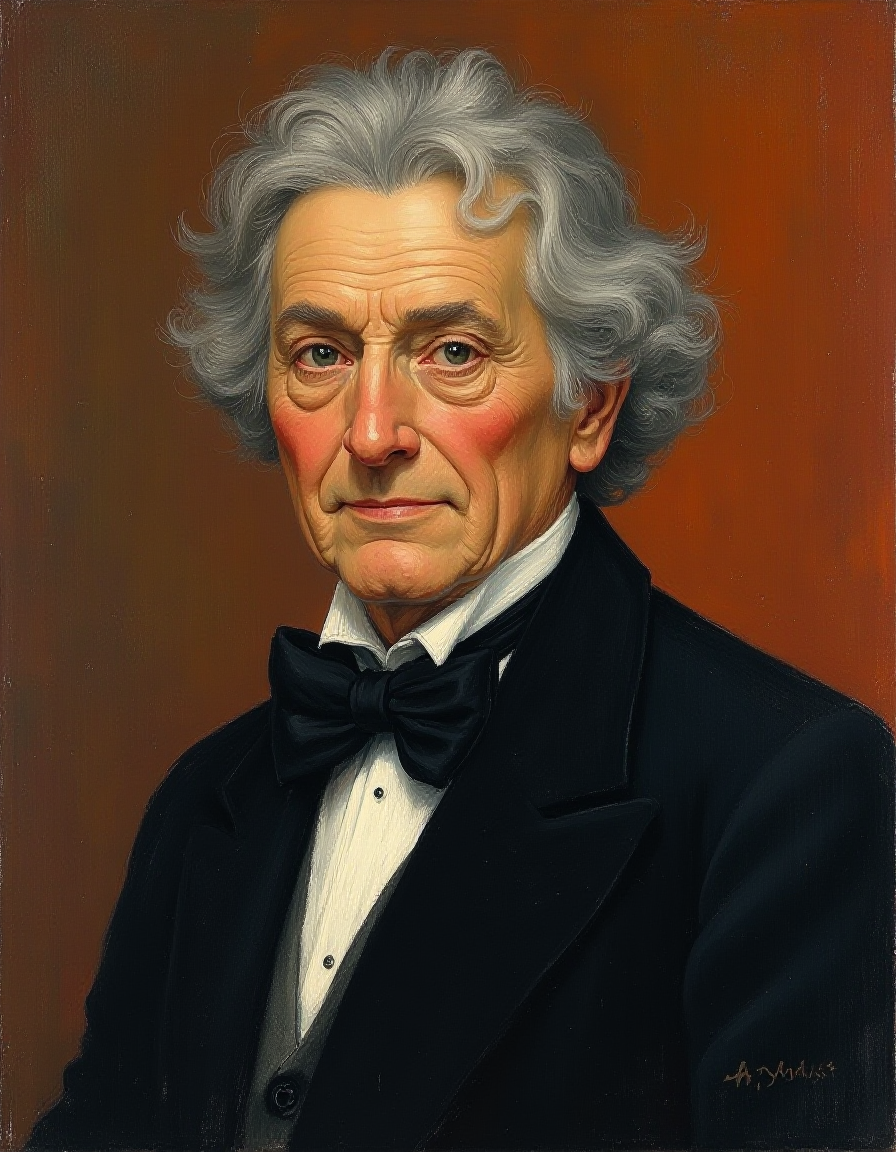
artist's portrait of a man with gray hair and a bow tie.
CAPTION
The image depicts a portrait of a man with gray hair, wearing a black suit and a bow tie. The background is a solid orange color, which contrasts with the man's dark attire. The man's expression is serious, and his gaze is directed towards the viewer.
MONOLOGUE
The next morning on his arrival in town, Roger went to his office. He had little cause for uneasiness there, for twice in the summer he had come down to keep an eye on the business, while John had taken brief vacations at a seaside place nearby. The boy had no color now in his cheeks; as always, they were a sallow gray with the skin drawn tight over high cheek bones; his vigor was all in his eyes. But here was a new John, nevertheless, a successful man of affairs. He had on a spruce new suit of brown, no cheap ready-made affair but one carefully fitted to conceal and soften his deformity. He was wearing a bright blue tie and a cornflower in his buttonhole, and his sandy hair was sleekly brushed. He showed Roger into his private room, a small place he had partitioned off, where over his desk was a motto in gold: "This is no place for your troubles or mine."
SUMMARY
man in suit sitting in chair with american flag in background.
CAPTION
The image depicts a man in a formal setting, seated in a chair with an American flag in the background. The man is dressed in a dark suit with a white shirt and a red patterned tie. He is positioned in the center of the image, with his hands resting on his lap.
MONOLOGUE
"At the center table, where a game of draw poker was in full blast, was noticed two celebrated professionals, a couple of race-horse owners and two clerks in a public department office down-town. At a side table were the sons of a prominent Hebrew merchant and property owner, two college students and several young men whose appearance would indicate they were employed in mercantile houses. Another side table was surrounded by a gathering of Broadway statues and gambling house hangers-on, who were engaged in a game called 'hide the heart,' and the last table had a circle of big, heavy-bodied and solid-looking men about it who were putting up on a game known as 'stud-horse poker.' The reporter and the clerk were quickly accommodated with seats at the center table, where 'draw poker' was in operation. The colored attendant with the white tie was at hand, and pulling out a ten-dollar bill the clerk gave it to the negro with the request to get him that amount of chips in return. The reporter followed suit with a crisp five-dollar bill. The colored man went away with the money to the further end of the room, where he passed it over to a clean-shaven and well-dressed young man with a big diamond in his shirt front. This, the clerk informed him, was the proprietor of the place, who sat at a separate table, and, after receiving the cash, handed out to the waiter several stacks of white and red ivory chips, which were then brought back for the money. The play or 'ante' to the game was fifty cents, with no limit. The white chips
SUMMARY
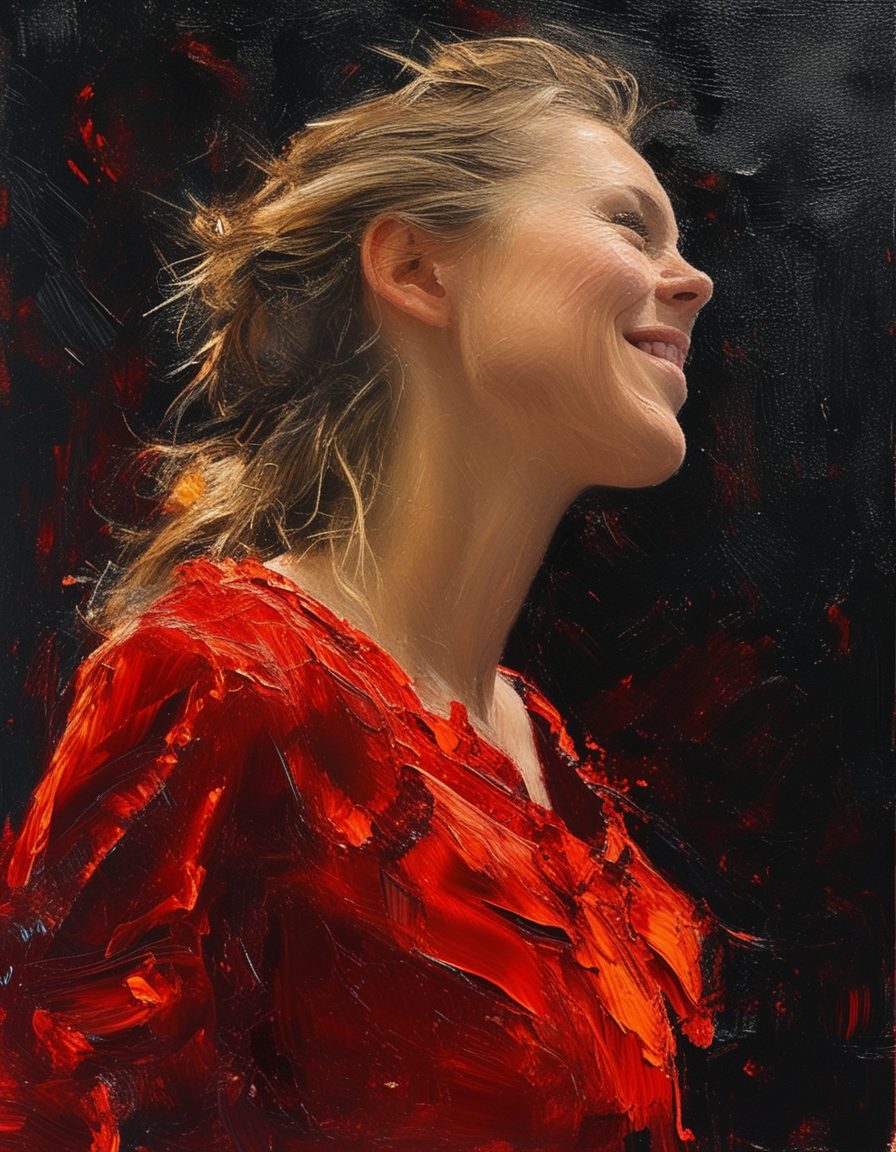
a woman in a red dress is smiling and looking to the side
CAPTION
The image depicts a portrait of a woman with a serene expression, painted in a vibrant red color palette. The woman is depicted from the side, her face turned slightly to the right, and her hair is styled in a bun. The background is dark, providing a stark contrast to the bright red of the woman's attire.
MONOLOGUE
Two, however, of Mme. Vauquer’s boarders formed a striking contrast to the rest. There was a sickly pallor, such as is often seen in anaemic girls, in Mlle. Victorine Taillefer’s face; and her unvarying expression of sadness, like her embarrassed manner and pinched look, was in keeping with the general wretchedness of the establishment in the Rue Nueve-Saint-Genevieve, which forms a background to this picture; but her face was young, there was youthfulness in her voice and elasticity in her movements. This young misfortune was not unlike a shrub, newly planted in an uncongenial soil, where its leaves have already begun to wither. The outlines of her figure, revealed by her dress of the simplest and cheapest materials, were also youthful. There was the same kind of charm about her too slender form, her faintly colored face and light-brown hair, that modern poets find in mediaeval statuettes; and a sweet expression, a look of Christian resignation in the dark gray eyes. She was pretty by force of contrast; if she had been happy, she would have been charming. Happiness is the poetry of woman, as the toilette is her tinsel. If the delightful excitement of a ball had made the pale face glow with color; if the delights of a luxurious life had brought the color to the wan cheeks that were slightly hollowed already; if love had put light into the sad eyes, then Victorine might have ranked among the fairest; but she lacked the two things which create woman a second time--pretty dresses and love-letters.
SUMMARY
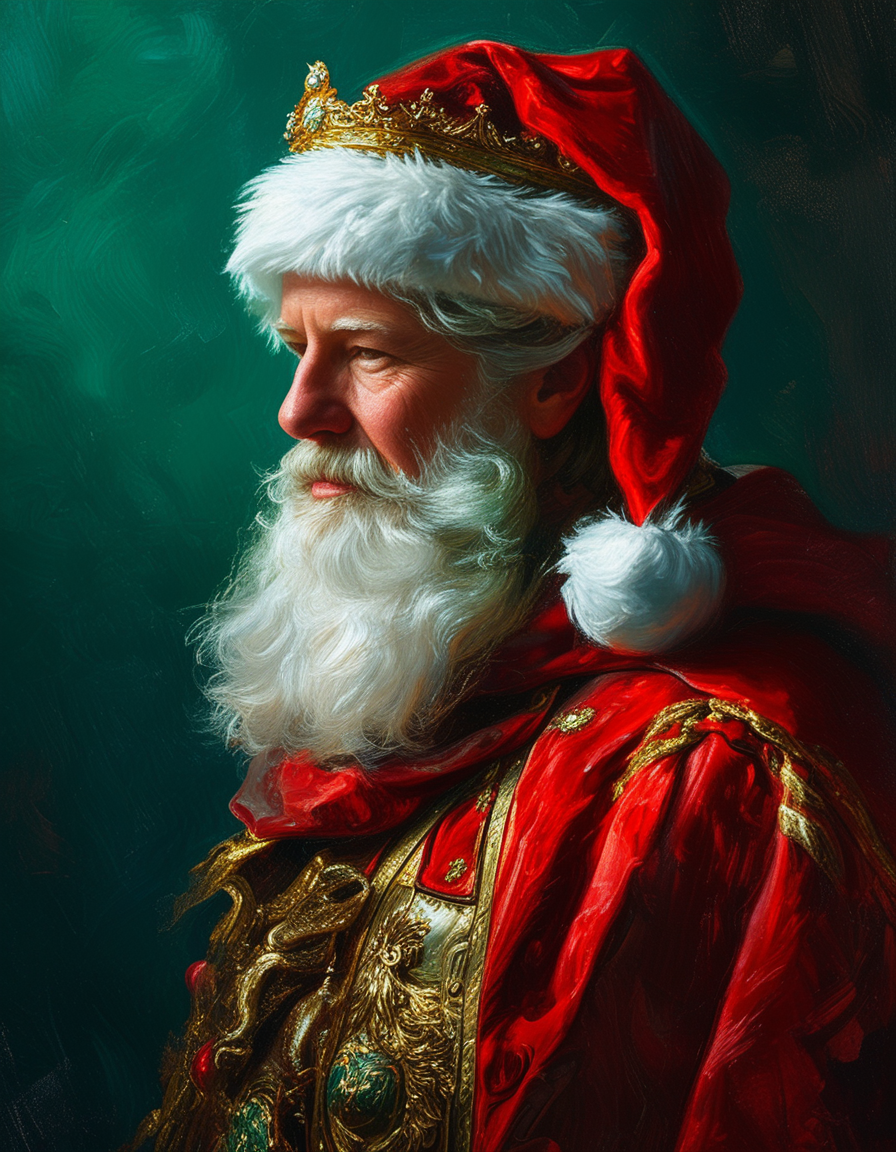
the man is wearing a red suit and a red hat with a gold crown on his head. he is looking to the side and has a beard.
CAPTION
The image depicts a man dressed in a red Santa Claus outfit, complete with a red and gold crown and a white beard. The background is dark, creating a contrast that highlights the man's attire. The man's expression is serious, and his eyes are directed towards the viewer.
MONOLOGUE
[UNDERWOOD comes in again, followed by ROBERTS, GREEN, BULGIN, THOMAS, ROUS. They file in, hat in hand, and stand silent in a row. ROBERTS is lean, of middle height, with a slight stoop. He has a little rat-gnawn, brown-grey beard, moustaches, high cheek-bones, hollow cheeks, small fiery eyes. He wears an old and grease-stained blue serge suit, and carries an old bowler hat. He stands nearest the Chairman. GREEN, next to him, has a clean, worn face, with a small grey goatee beard and drooping moustaches, iron spectacles, and mild, straightforward eyes. He wears an overcoat, green with age, and a linen collar. Next to him is BULGIN, a tall, strong man, with a dark moustache, and fighting jaw, wearing a red muffler, who keeps changing his cap from one hand to the other. Next to him is THOMAS, an old man with a grey moustache, full beard, and weatherbeaten, bony face, whose overcoat discloses a lean, plucked-looking neck. On his right, ROUS, the youngest of the five, looks like a soldier; he has a glitter in his eyes.]
SUMMARY
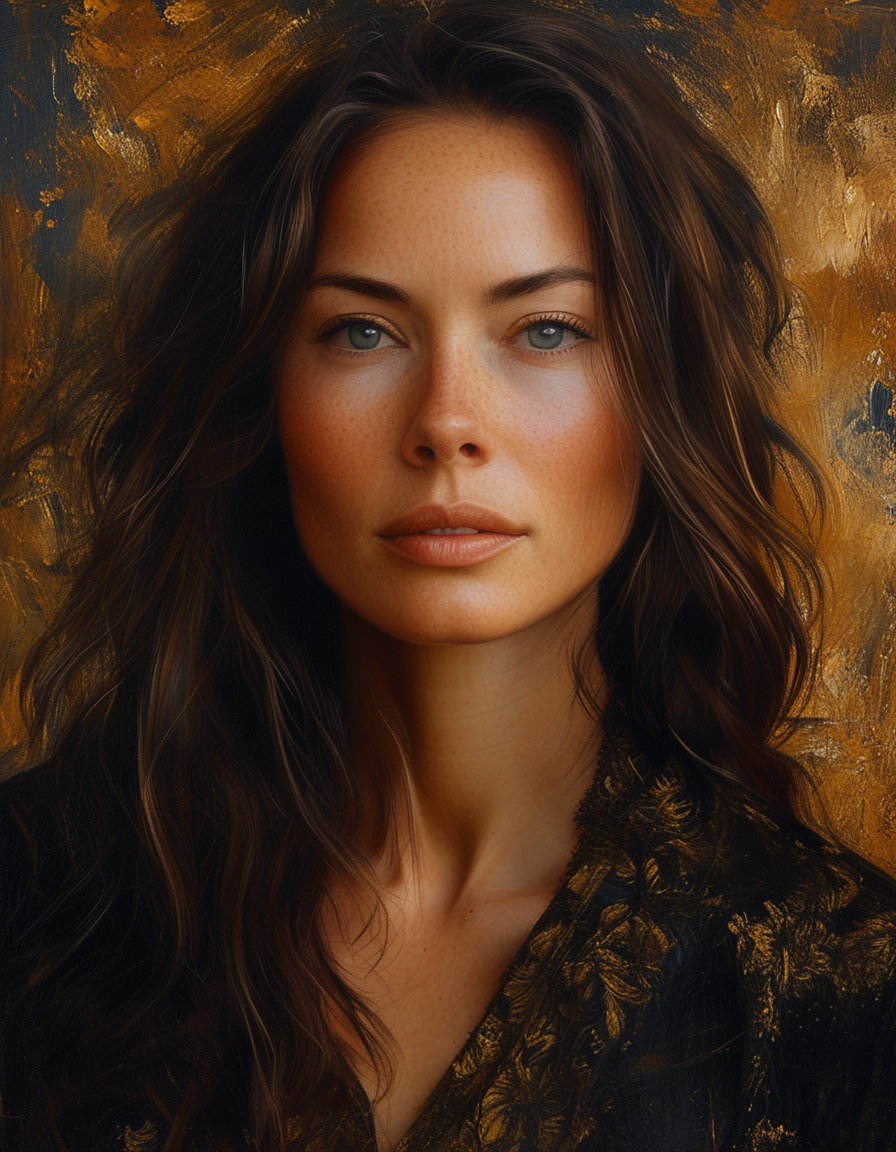
a woman with long dark hair wearing a black dress with gold patterns.
CAPTION
The image depicts a woman with long, wavy hair, wearing a dark, textured garment. The background is a warm, golden hue, creating a sense of depth and atmosphere. The woman's expression is serious, and her gaze is directed towards the viewer.
MONOLOGUE
He moved forward amidst the ferns and the tall plants, until he found himself on the farther side of a thick network of creepers. Then he paused, for he was in the presence of a woman, of her who dwelt among the flowers. She was sitting before him, motionless and upright in a high, carved chair, and so placed that the pointed leaves of the palm which rose above her cast sharp, star-shaped shadows over the broad folds of her white dress. One hand, as white, as cold, as heavily perfect as the sculpture of a Praxiteles or a Phidias, rested with drooping fingers on the arm of the chair. The other pressed the pages of a great book which lay open on the lady's knee. Her face was turned toward the visitor, and her eyes examined his face; calmly and with no surprise in them, but not without a look of interest. Their expression was at once so unusual, so disquieting, and yet so inexplicably attractive as to fascinate the Wanderer's gaze. He did not remember that he had ever seen a pair of eyes of distinctly different colours, the one of a clear, cold gray, the other of a deep, warm brown, so dark as to seem almost black, and he would not have believed that nature could so far transgress the canons of her own art and yet preserve the appearance of beauty. For the lady was beautiful, from the diadem of her red gold hair to the proud curve of her fresh young lips; from her broad, pale forehead, prominent and boldly modelled at the angles of the brows, to the strong mouldings of the well-balanced chin, which gave evidence of
SUMMARY
a man wearing a turban and a brown robe with a white cloth draped over his shoulder.
CAPTION
The image depicts a man with a beard and turban, wearing a brown robe. The background is dark, creating a dramatic effect that draws attention to the man. The man's expression is serious, and his gaze is directed towards the viewer.
MONOLOGUE
For myself, I was no longer regarded, any more than if I had been one of the dead-woods that stood around the clearing. The squatter passed, without even looking at me--his whole attention seemingly absorbed by the new arrival! It was natural I should regard with curiosity an individual, whose presence had produced such a wonderful effect; and my scrutinising gaze may have appeared rude enough to him. I cannot say that he elicited my admiration. On the contrary, his appearance produced an opposite effect. I beheld him with, what might be termed an instinct of repulsion: since I could assign no precise reason for the dislike with which he had inspired me on sight. He was a man of about thirty years of age; of a thin spare body, less than medium height; and features slightly marked with, the _bar sinister_. A face without beard--skin of cadaverous hue--nose sharply pointed--chin and forehead both receding--eyes small, but sparkling like those of a ferret--and long lank black hair, thinly shading his cheeks and brows--were the prominent characteristics of this man's portrait. His dress was of a clerical cut and colour--though not of the finest fabric. The coat, trousers, and vest were of black broad-cloth--the coat and waistcoat being made with standing collars, similar in style to those worn by Wesleyan ministers--or more commonly by Catholic priests--while a white cravat not over clean and a hat with curving boat-brim, completed the saintly character of the costume.
SUMMARY
the artist has created a detailed and realistic depiction of a soldier in a red cape and black uniform, holding a sword in his right hand.
CAPTION
The image depicts a man dressed in a black and red military uniform, complete with a red cape and a gold helmet. He is holding a sword in his right hand, which is extended forward, and is positioned in a stance that suggests readiness for action. The background is a gradient of dark red and black, creating a dramatic effect that draws the viewer's attention to the man.
MONOLOGUE
This is the great duel between the single man and the bull. The _matador_ advances, sword in hand, with the _muleta_, the red cloth for the passes, over his arm. Under the president's box he takes off his hat, and with fine gesture makes a grandiloquent speech, wherein he vows either to conquer or to die: the harangue is finished with a wheel round and a dramatic flinging of his hat to attendants on the other side of the barrier. He pensively walks forward. All eyes are upon him--and he knows it. He motions his companions to stand back and goes close to the bull. He is quite alone, with his life in his hands--a slender figure, very handsome in the gorgeous costume glittering with fine gold. He arranges the _muleta_ over a little stick, so that it hangs down like a flag and conceals his sword. Then quite solemnly he walks up to the bull, holding the red rag in his left hand. The bull watches suspiciously, suddenly charges, and the _muleta_ is passed over its head; the _matador_ does not move a muscle, the bull turns and stands quite motionless. Another charge, another pass. And so he continues, making seven or eight of various sorts, to the growing approbation of the public. At last it is time to kill. With great caution he withdraws the sword; the bull looks warily. He makes two or three passes more and walks round till he gets the animal into proper position: the forefeet must be set squarely on the ground. '_Ora! Ora!_' cry the people. 'Now! Now!' The bull is well placed. The _matador_ draws the sword back a
SUMMARY
a silhouette of a person in a long coat stands in a dark, misty forest, looking up at a bright red sun in the sky
CAPTION
The image depicts a silhouette of a person standing in a dark, misty landscape. The person is dressed in a long, flowing cloak, and their silhouette is prominently displayed against the backdrop of a red, fiery sky. The sky is filled with swirling clouds, adding to the dramatic atmosphere of the scene.
MONOLOGUE
But one morning the clouds had gathered black and heavy. The sea fogs had pitched their tents to landward, and their misty battalions were driving gray across the landscape. Dim reaches of blank water--lay beyond, weltering with an uneasy, rocking motion against the low, dark sky. White, ghostly sea birds wheeled low, a fretful wind grieved about the house, and a New England northeast storm was in progress. She was standing at the window, looking out with eyes farther away than ever over the haze-draped sea. Some fine, heavy material, the same indistinct hue as the day outside, fell about her in large, sweeping folds. A breath of sudden, penetrating perfume struck across his senses as he approached her. 'And gray heliotrope!' he said; but the heliotrope vanished as she turned and displayed the blaze of carnations at her throat, and the gleam of crimson silk under the jaunty zouave.
SUMMARY
a woman with a glowing halo and a glowing moon behind her, wearing a necklace and a bracelet, with her hand raised in a gesture
CAPTION
The image depicts a woman with dark hair, wearing a sleeveless dress, standing against a backdrop of a fiery, orange-red sky. The woman's right hand is raised, palm facing upwards, and she is looking to the left. The background is filled with a swirling pattern of orange and red hues, creating a dramatic and intense atmosphere.
MONOLOGUE
"The days were all alike,--long, dreary, and desolate; so I scarcely know how the time went. My stepmother brought me religious books, and told me to read them; but they were hard, difficult books, and I couldn't find one word of comfort in them. They must have been written to frighten very obstinate and wicked people, I think. The only book that ever gave me any comfort, was that dear Book I used to read to papa on a Sunday evening in Oakley Street. I read that, Edward, in those miserable days; I read the story of the widow's only son who was raised up from the dead because his mother was so wretched without him. I read that sweet, tender story again and again, until I used to see the funeral train, the pale, still face upon the bier, the white, uplifted hand, and that sublime and lovely countenance, whose image always comes to us when we are most miserable, the tremulous light upon the golden hair, and in the distance the glimmering columns of white temples, the palm-trees standing out against the purple Eastern sky. I thought that He who raised up a miserable woman's son chiefly because he was her only son, and she was desolate without him, would have more pity upon me than the God in Olivia's books: and I prayed to Him, Edward, night and day, imploring Him to bring you back to me.
SUMMARY
a man in a uniform is sitting on a staircase with his head down and his hands on his hips. he is wearing a helmet and a backpack. the background is a bright pink color.
CAPTION
The image depicts a person sitting on a staircase, wearing a helmet and a uniform, with a backpack slung over their shoulder. The person is holding a rifle, suggesting they might be a soldier or a member of a military unit. The background is a vibrant pink color, which contrasts with the person's dark clothing and the wooden steps.
MONOLOGUE
Within the mansion all was light and gay. Weddings in those times were conducted with even more pomp and ceremony than in our day, and the entertainments, though not upon the present scale, were fully as lavish. Wax candles shone at every possible point, and lit up the broad reception-hall, the polished floors and high ceilings, while mirrors on mantels and walls reflected back many times the stately figures which passed and repassed before them. And then there came a pause, when voices were hushed, and down the oak staircase came Kitty, led by Gulian Verplanck (her nearest male relative), wearing a white satin petticoat (though somewhat scanty to our ideas in width and length), and over it a, train of silver brocade, stiff and rustling, while a long scarf of Mechlin lace covered her pretty dark head and hung in soft folds down her back. The high-heeled slippers, the long lace mitts, with their white bows at the elbow, completed her toilet. She stood before the assembled company a fair young bride of the olden days, and behind her came Miss Moppet and Peter Provoost, holding her silver train with the tips of their fingers. Oliver, in full Continental uniform, his cocked hat under his arm, awaited her at the end of the great drawing-room, and with somewhat shortened service, the rector of old St. Paul's said the words which made the pair man and wife.
SUMMARY
a zombie soldier with a glowing red eye and a bandolier of bullets
CAPTION
The image depicts a zombie-like figure with a distressed, decayed appearance, wearing a leather jacket. The figure is positioned in the center of the frame, facing the viewer, and is surrounded by a group of zombies. The background is a dark, murky environment with a greenish hue, suggesting a setting that could be a graveyard or a similar location.
MONOLOGUE
I retreated a few steps, yet without turning to flee. I was not, however, without apprehension, which, indeed, the appearance of these two people was well calculated to inspire; the woman was a stout figure, seemingly between thirty and forty; she wore no cap, and her long hair fell on either side of her head like horse-tails half way down her waist; her skin was dark and swarthy, like that of a toad, and the expression of her countenance was particularly evil; her arms were bare, and her bosom was but half concealed by a slight boddice, below which she wore a coarse petticoat, her only other article of dress. The man was somewhat younger, but of a figure equally wild; his frame was long and lathy, but his arms were remarkably short, his neck was rather bent, he squinted slightly, and his mouth was much awry; his complexion was dark, but, unlike that of the woman, it was more ruddy than livid; there was a deep scar on his cheek, something like the impression of a halfpenny. The dress was quite in keeping with the figure: in his hat, which was slightly peaked, was stuck a peacock’s feather; over a waistcoat of hide, untanned and with the hair upon it, he wore a rough jerkin of russet hue; smallclothes of leather, which had probably once belonged to a soldier, but with which pipeclay did not seem to have come in contact for many a year, protected his lower man as far as the knee; his legs were cased in long stockings of blue worsted, and on his shoes he wore immense old-fashioned buckles.
SUMMARY
a young woman in a dark, icy environment with a glowing, ethereal quality.
CAPTION
The image depicts a woman with her face turned to the left, gazing into the distance. She is wearing a dark, textured garment that contrasts with her light-colored hair. The background is a dark, underwater scene with a glowing, ethereal quality, suggesting a magical or mystical setting.
MONOLOGUE
She did not observe a young man at a little distance, leaning back against an aged birch, on whose silvery bark the dark outlines of his figure were finely daguerreotyped. He was the beau ideal of an artist, with his long brown hair carelessly pushed back from his white temples, his portfolio in his left hand, his pencil in his right, and his dark, restless eyes glancing round him with the fervor of enthusiasm, while they beamed with the inspiration of genius. He was evidently sketching the scene, which with bold, rapid lines he was transferring to the paper. All at once his gaze was fixed on Edith, and he seemed spellbound. I did not wonder,--for a lovelier, more ethereal object never arrested the glance of admiration. Again his pencil moved, and I knew he was attempting to delineate her features. I was fearful lest she should move and dissolve the charm; but she sat as still as the tree, whose gray trunk formed an artistic background to her slight figure.
SUMMARY
a man in a red cape and black tunic with gold accents stands in front of a halo
CAPTION
The image depicts a male figure standing against a backdrop of a cloudy sky. He is dressed in a dark, flowing robe adorned with gold and red accents, and his hair is styled in a bun atop his head. The figure's face is turned slightly to the left, and he appears to be gazing off into the distance.
MONOLOGUE
“To death!” said Fontrailles, in a deep, stern voice which silenced all around. Nothing was heard but the slow tramp of the horses, which suddenly stopped, from one of those delays that happen in all processions. They then beheld a painful and singular spectacle. An old man with a tonsured head walked with difficulty, sobbing violently, supported by two young men of interesting and engaging appearance, who held one of each other’s hands behind his bent shoulders, while with the other each held one of his arms. The one on the left was dressed in black; he was grave, and his eyes were cast down. The other, much younger, was attired in a striking dress. A pourpoint of Holland cloth, adorned with broad gold lace, and with large embroidered sleeves, covered him from the neck to the waist, somewhat in the fashion of a woman’s corset; the rest of his vestments were in black velvet, embroidered with silver palms. Gray boots with red heels, to which were attached golden spurs; a scarlet cloak with gold buttons--all set off to advantage his elegant and graceful figure. He bowed right and left with a melancholy smile.
SUMMARY
a rat is standing on a grassy field in front of a castle at sunset
CAPTION
The image depicts a dramatic scene of a sunset over a ruined city. The sky is ablaze with hues of orange and red, creating a fiery backdrop that contrasts with the dark silhouettes of the ruins. The ruins, bathed in the warm glow of the setting sun, are scattered across the landscape, their structures and rooftops illuminated by the fire.
MONOLOGUE
If you live in the city of New York, or if you have ever been in the city of New York for any long time, you know how disheartening, how terrible, and how altogether unreasonable the climate can be at times. But you also know how heavenly it can be on an autumn day, when the sky and the air and the water are all in a good humor. To see and to feel the best of it, you must be down in the Narrows, or somewhere near there. The fierce heat has gone out of the air, but there is a gentle warmth left in it. All the shores near you are turning from green to brown and yellow, with here and there a dash of red. The sun makes every sail in the bay a gleaming spot of white. Far up the bay you see just an end of the city, with the tall buildings standing so close that it looks like one great castle, built all over a hill that slopes steeply down to the water on both sides. The Bridge looks like a spider's web, spun across to the other shore. Beyond it all the hills look purple, through the thin mist. If, instead of having seen all this often, you saw it for the first time--if you were coming from a far country, where you had always been poor--if you had toiled all your life to pay your rent, never expecting to do more--then perhaps you would look, more than anything else, at the giant woman standing before you and holding her torch high into the sky to light the world.
SUMMARY
a woman in a black dress is posing in front of a string of lights
CAPTION
The image depicts a woman with her head tilted upwards, her face lit up with a warm glow, and her hair styled in a bun. She is positioned in front of a backdrop of twinkling lights, creating a serene and enchanting atmosphere. The woman's attire is dark, adding to the mystical ambiance of the scene.
MONOLOGUE
Now it is impossible for a woman who is perpetually at war with herself and living in contradiction to her true life, to leave others in peace or refrain from envying their happiness. The whole range of these sad truths could be read in the dulled gray eyes of Mademoiselle Gamard; the dark circles that surrounded those eyes told of the inward conflicts of her solitary life. All the wrinkles on her face were in straight lines. The structure of her forehead and cheeks was rigid and prominent. She allowed, with apparent indifference, certain scattered hairs, once brown, to grow upon her chin. Her thin lips scarcely covered teeth that were too long, though still quite white. Her complexion was dark, and her hair, originally black, had turned gray from frightful headaches,--a misfortune which obliged her to wear a false front. Not knowing how to put it on so as to conceal the junction between the real and the false, there were often little gaps between the border of her cap and the black string with which this semi-wig (always badly curled) was fastened to her head. Her gown, silk in summer, merino in winter, and always brown in color, was invariably rather tight for her angular figure and thin arms. Her collar, limp and bent, exposed too much the red skin of a neck which was ribbed like an oak-leaf in winter seen in the light. Her origin explains to some extent the defects of her conformation. She was the daughter of a wood-merchant, a peasant, who had risen from the ranks. She might have been plump at eighteen, but no trace remained of
SUMMARY
The silhouette of a man in a white shirt and a dark vest is set against a backdrop of a glowing fire, creating a dramatic and intimate scene.
CAPTION
The image depicts a silhouette of a person, likely a man, with a beard, dressed in a white shirt and a dark vest. The person is facing away from the viewer, creating a sense of depth and perspective. The background is filled with a warm, golden light that illuminates the scene, casting a soft glow on the person and the surrounding area.
MONOLOGUE
gathered in the west during the hours of the night. Suddenly, in the hush of dawn, a delicate pink light gleams on a minaret here or a dome yonder. It tints minaret after minaret, dome after dome, house after house. It spreads downwards and athwart, transfiguring everything its rosy fingers touch, until the city, still set against a dark background, is radiant with indescribable grace. Very beautiful also is the scene towards sunset, when the slopes descending to the Marmora are in shade, and the glowing vault of heaven is a canopy of glory; when the windows in the dome of S. Sophia, as the last beams of day shine through them, sparkle like jewels in a coronet, and the sea beneath seems woven of crimson, gold, and purple. Nor can one fail to recall the soft tranquil beauty of the scene when the Sea of Marmora glitters in the moonlight, and the golden waters kiss the shadows of the broken towers and battlements that watched and guarded the city in the days of old.
SUMMARY
a female figure with wings and a hood is holding a glowing object in her hand. she is standing in a forest with a red background
CAPTION
The image depicts a person dressed in a dark cloak, with their arms outstretched, holding a glowing red object. The person is surrounded by a vibrant, red-hued background, which is illuminated by a spotlight, creating a dramatic effect. The person's attire is detailed, with intricate patterns and textures, and they are positioned in the center of the image.
MONOLOGUE
Concerning the southernmost porch of the west front.--The doorway of this porch also has on the centre pillar of it a statue of the Virgin standing, holding the Divine Child in her arms. Both the faces of the Virgin Mother and of her Son, are very beautiful; I like them much better than those in the south transept already spoken of; indeed I think them the grandest of all the faces of the Madonna and Child that I have seen carved by the French architects. I have seen many, the faces of which I do not like, though the drapery is always beautiful; their faces I do not like at all events, as faces of the Virgin and Child, though as faces of other people even if not beautiful they would be interesting. The Child is, as in the transept, draped down to the feet; draped too, how exquisitely I know not how to say. His right arm and hand is stretched out across His mother's breast, His left hangs down so that His wrist as His hand is a little curved upwards, rests upon His knee; His mother holds Him slightly with her left arm, with her right she holds a fold of her robe on which His feet rest. His figure is not by any means that of an infant, for it is slim and slender, too slender for even a young boy, yet too soft, too much rounded for a youth, and the head also is too large; I suppose some people would object to this way of carving One who is supposed to be an infant; yet I have no doubt that the old sculptors were right in doing so, and to my help in this matter comes the remembrance of Ruskin's answer to what Lord Lindsay says concerning the
SUMMARY
a black cat wearing a gold bandana sits in front of a moon and a door
CAPTION
The image depicts a black cat with piercing green eyes, wearing a gold-colored bandana around its neck. The cat is sitting in front of a large, glowing moon, which is positioned in the center of the image. The background is dark, with intricate, ornate designs that add to the mystical atmosphere.
MONOLOGUE
But now Zues showed at the door, her mien even more solemn than usual, and at the head of the little procession she went on with the three courageously to beyond the town gate. In their honor she had donned some of her choicest finery. She wore a huge hat draped with broad yellow ribbons, a pink calico dress trimmed in a style of ten years ago, a black velvet scarf and shoes of red morocco with fringes. With this costume she also carried a reticule of green silk filled with dried pears and prunes, and had a small parasol in her other hand on top of which there could be seen an ivory ornament carved in the shape of a lyre. She had also hung around her fair neck the locket with the monument of hair, and in front of her chaste bosom had pinned on the gold forget-me-not, and wore white knit gloves. Dainty and pleasant she looked in this guise; her countenance was slightly flushed and her bosom heaved higher than its wont, and the departing combmakers scarcely were able to conceal their feelings of utter woe and sorrow at the prospect of losing her. For even their extreme situation, the lovely spring weather, and Zues' exquisite finery, or all of it together mingled with their sentiments of expectation and anxiety something of what habitually is denominated Love. Arrived beyond the town gate, though, the winsome maiden encouraged her three admirers to place their heavy knapsacks upon those tiny wheels and to pull their loads, so as not to tire themselves needlessly. This they did, and as
SUMMARY
a person stands on a beach at sunset, looking out at the ocean
CAPTION
The image presents a surreal and vibrant scene set in a futuristic environment. Dominating the foreground is a solitary figure, silhouetted against the backdrop of a sunset. The figure, dressed in a dark, hooded cloak, stands on a rocky surface, their silhouette stark against the vibrant hues of the sunset.
MONOLOGUE
The conversation languished, and Claudius left the Duke and Barker, and went towards his quarters. It was a warm night for the Atlantic, and though there was no moon, the stars shone out brightly, their reflection moving slowly up and down the slopes of the long ocean swell. Claudius walked aft, and was going to sit down for a few minutes before turning in, when he was suddenly aware of a muffled female figure leaning against the taffrail only a couple of paces from where he was. In spite of the starlight he could not distinguish the person. She was wrapped closely in a cloak and veil, as if fearing the cold. As it must be one of the three ladies who constituted the party, Claudius naturally raised his cap, but fearing lest he had chanced on the Duke's sister, or still worse, on Miss Skeat, he did not speak. Before long, however, as he leaned against the side, watching the wake, the unknown remarked that it was a delightful night. It was Margaret's voice, and the deep musical tones trembled on the rise and fall of the waves, as if the sounds themselves had a distinct life and beating in them. Did the dark woman know what magic lay in her most trivial words? Claudius did not care a rush whether the night were beautiful or otherwise, but when she said it was a fine evening, it sounded as if she had said she loved him.
SUMMARY
artist is painting a man in a red coat writing in a book
CAPTION
The image depicts a man seated at a desk, engrossed in writing. He is dressed in a red coat and a white cravat, adding a touch of elegance to his attire. His hair is dark and appears to be styled in a manner that suggests he is in his late 30s or early 40s.
MONOLOGUE
Although the narrow stall, flooded with heaped-up books and papers, left the visitor just room enough to stir, and although that visitor was one of his regular customers, the old bookseller did not deign to move from the stool upon which he was seated, while writing on an unsteady desk. His odd head, with its long, white hair, peeping from beneath a once black felt hat with a broad brim, was hardly raised at the sound of the opening and shutting of the door. The newcomer saw an emaciated, shriveled face, in which, from behind spectacles, two brown eyes twinkled slyly. Then the hat again shaded the paper, which the knotty fingers, with their dirty nails, covered with uneven lines traced in a handwriting belonging to another age, and from the thin, tall form, enveloped in a greenish, worn-out coat, came a faint voice, the voice of a man afflicted with chronic laryngitis, uttering as an apology, with a strong Italian accent, this phrase in French:
SUMMARY
the man is seated in a chair with a pillow behind him, wearing a black coat and a white cravat, and has a serious expression on his face.
CAPTION
The image depicts a man seated in a chair, dressed in a black coat and a white cravat. He is looking directly at the viewer, with a serious expression on his face. The background is dark, with a candle-like light source on the left side of the image, casting a warm glow on the man.
MONOLOGUE
"Seated within the railed space--his arms folded on his breast, his face raised upward in attentive listening attitude--was a man who instantly struck me as being singular among the throng around him. He might be sixty years of age; a powerfully built frame and expansive chest gave indication of physical strength and energy; but it was _the face_ that impressed me. It was one of those that Rembrandt loved to paint; the grave serenity of strength in repose; the warm glow of life's autumn evening upon a countenance expressive of quiet dignity and intellectual power. The spacious dome of a massive head was covered with silvery--nay, snow-white hair, lending a venerable, though not an aged, aspect to the man. He was very plainly dressed; the blue cloth body-coat, with brass buttons, was perfectly American; the large high shirt-collar standing out from the lower part of a face entirely shaven; and a black silk neckerchief loosely fastened around in the very carelessness of effect or appearance, was in perfect keeping with the simplicity of his _tout ensemble_. This was the Honorable D. S. Dickinson, the contemporary in politics of Webster, who found in him, in many a passage of arms, a foeman worthy of his steel. For some years Mr. Dickinson has remained in retirement from active public life, notwithstanding many efforts to induce him to reenter the arena. Yet it is shrewdly suspected that his counsel is not seldom sought and acted upon by the great ones of that party of which he once was so active and able a leader."
SUMMARY
The image depicts a man with a serious expression, wearing a shirt, and has a detailed and realistic art style.
CAPTION
The image is a black and white portrait of a man with a chiseled face and a well-defined beard. The man's hair is styled in a way that it appears to be cut short, and his eyes are directed towards the right side of the image. The background is a plain, light-colored wall, which contrasts with the man's dark features.
MONOLOGUE
their look--no light-brown hair have they, no ruddy cheeks, no blue quiet glances belong to them; their features are dark, their locks long, black, and shining, and their eyes are wild; they are admirable horsemen, but they do not sit the saddle in the manner of common jockeys, they seem to float or hover upon it, like gulls upon the waves; two of them are mere striplings, but the third is a very tall man with a countenance heroically beautiful, but wild, wild, wild. As they rush along, the crowd give way on all sides, and now a kind of ring or circus is formed, within which the strange men exhibit their horsemanship, rushing past each other, in and out, after the manner of a reel, the tall man occasionally balancing himself upon the saddle, and standing erect on one foot. He had just regained his seat after the latter feat, and was about to push his horse to a gallop, when a figure started forward close from beside me, and laying his hand on his neck, and pulling him gently downward, appeared to whisper something into his ear; presently the tall man raised his head, and, scanning the crowd for a moment in the direction in which I was standing, fixed his eyes full upon me, and anon the countenance of the whisperer was turned, but only in part, and the side-glance of another pair of wild eyes was directed towards my face, but the entire visage of the big black man, half stooping as he was, was turned full upon mine.
SUMMARY
a woman in a suit with her back to the camera, wearing a dark suit with a white shirt and a black tie, standing against a pink background
CAPTION
The image depicts a woman with long, dark hair, styled in a bob cut, wearing a dark suit jacket. The background is a gradient of pink and purple, creating a dramatic effect. The woman is facing away from the camera, giving a sense of depth and perspective.
MONOLOGUE
"Miriam!" he cried, his hands eagerly seeking and seizing hers, only faintly resisting. "There was no _need_ to tell." He was standing facing her now, close to the curtained window, his back toward the twittering trio near the dining-room door and imperceptibly edging thither at Mrs. Stannard's suggestion of coffee. Was this prearranged? Bob never saw nor heeded. _She_ did, however, and well knew its meaning, and the woman in her, that thrilled and throbbed at sight of the passion in his eyes the worship in his face coquetting with her own delight would have torn herself away to follow them, but her little hands were held in a grasp against which she might struggle in vain. He was lifting them to his heart, and as he drew them he was drawing her. She had to come, her long curling lashes sweeping the soft cheeks, now once more blushing like the dawn. "Oh, Mr. Lanier," he heard her murmur, as though pleading and warning. One swift glance he tossed over his shoulder at the last form vanishing through the doorway, then his dark eyes, glowing and rejoiceful, fastened on hers, and quick and fervent came the next words: "There is only one thing that need be told--that _must_ be told, because I've just been brimming over with it all these weeks" (ah, how the bonny head was drooping now, but drooping toward him), "and now I can keep it back no longer. Miriam, Miriam, I love you--I love you! Have you nothing to tell me?"
SUMMARY
man in a suit with a beard and white shirt, looking to the side, with a window in the background.
CAPTION
The image depicts a man with a white beard and gray hair, dressed in a dark suit with a white shirt underneath. He is seated in a room with wooden furniture, including a window with a view of the outside. The man appears to be in a contemplative or reflective mood, with his head slightly tilted to the side and his eyes looking directly at the camera.
MONOLOGUE
Farther back, among the more ordinary herd, Ethel perceived Mrs. Pugh, bridling demurely, with Tom on guard over her on one side, and Henry Ward looking sulky on the other, with his youngest sister in his charge. The other was looking very happy upon Leonard's knee, close to Averil and Mary, who were evidently highly satisfied to have coalesced. Averil was looking strikingly pretty--the light fell favourably on her profuse glossy hair, straight features, and brilliant colouring; her dark eyes were full of animation, and her lips were apart with a smile as she listened to Leonard's eager narration; and Ethel glanced towards Harry to see whether he were admiring. No; Harry was bringing in a hall arm-chair in the background, for a vary large, heavy, vulgar-looking old man, who seemed too ponderous and infirm for a place on the benches. Richard made one of a black mass of clergy, and Aubrey and Gertrude had asserted their independence by perching themselves on a window-seat, as far as possible from all relations, whence they nodded a merry saucy greeting to Ethel, and she smiled back again, thinking her tall boy in his gray tunic and black belt, and her plump girl in white with green ribbons, were as goodly a pair as the room contained.
SUMMARY
the king is wearing a crown and has a beard
CAPTION
The image depicts a man with a beard and a crown on his head, dressed in a red and gold robe. The background is dark, creating a dramatic effect that accentuates the man's figure. The man's expression is serious, and his gaze is directed towards the viewer.
MONOLOGUE
As I continued to gaze, a shock went through me; the dimness of sleep and fatigue lifted from my eyes, as fog lifts in the Channel; and I beheld with startled clearness the photographic presentment of a crowd of strangers. "J. Trent, Master" at the top of the card directed me to a smallish, wizened man, with bushy eyebrows and full white beard, dressed in a frock-coat and white trousers; a flower stuck in his button-hole, his bearded chin set forward, his mouth clenched with habitual determination. There was not much of the sailor in his looks, but plenty of the martinet; a dry, precise man, who might pass for a preacher in some rigid sect; and, whatever he was, not the Captain Trent of San Francisco. The men, too, were all new to me: the cook, an unmistakable Chinaman, in his characteristic dress, standing apart on the poop steps. But perhaps I turned on the whole with the greatest curiosity to the figure labelled "E. Goddedaal, 1st off." He whom I had never seen, he might be the identical; he might be the clue and spring of all this mystery; and I scanned his features with the eye of a detective. He was of great stature, seemingly blonde as a Viking, his hair clustering round his head in frowsy curls, and two enormous whiskers, like the tusks of some strange animal, jutting from his cheeks. With these virile appendages and the defiant attitude in which he stood, the expression of his face only imperfectly harmonised. It was wild, heroic, and womanish-looking; and I felt I was prepared to hear he was a
SUMMARY
a man with dreadlocks and a leather jacket is looking to the side with a serious expression.
CAPTION
The image depicts a person with long, curly hair that is adorned with red and black tentacles. The individual is wearing a black leather jacket and has a serious expression on their face. The background is a dark, fiery red, suggesting a dramatic or intense setting.
MONOLOGUE
As Francis had remarked, before I could follow her into the house "half the garrison turned out" to salute us in the person of the Captain, whom I immediately recognized from the description I had had of him. He wore a blue jacket and trousers, a waistcoat buttoned close up to his chin, and the military black-leather collar, which he had not yet been able to dispense with. The William's Order [3] adorned his breast; and he stood erect in spite of his stiff leg, which obliged him to support himself with a stick. He had placed his cap jauntily and soldier-like on one side of his head, and his entire bearing called up the idea of a military man only half at his ease in civilian dress. Though deep in the fifties, his hair is still jet black, and the length and stiffness of his mustachios, la Napolon, indicate a constant use of cosmetics. His face is very red, his eyes brown and bold, his features rude, and his thick red lips and short round chin give him a sensual appearance. He had in his mouth a long German pipe, from which he puffed clouds of smoke, and after a military salute he accosted us in these words--
SUMMARY
a woman with a serious expression, looking to the right, with her eyes wide open, her lips slightly parted, her hair tied back, and her skin is pale
CAPTION
The image depicts a woman with a serious expression, her eyes wide open and her gaze directed towards the camera. Her hair is dark and pulled back, and she is wearing a white shirt. The background is dark, creating a contrast that highlights the woman's features.
MONOLOGUE
I turned round, as if by accident, and gave a passing glance, where Irene waved her fan, at the girl beside me. She was beautiful, certainly, in a terrible, grand, statuesque style of beauty; and I saw at a glimpse that she had Southern blood in her veins, perhaps Negro, perhaps Moorish, perhaps only Spanish, or Italian, or Provenal. Her features were proud and somewhat Jewish-looking; her eyes large, dark, and haughty; her black hair waved slightly in sinuous undulations as it passed across her high, broad forehead; her complexion, though a dusky olive in tone, was clear and rich, and daintily transparent; and her lips were thin and very slightly curled at the delicate corners, with a peculiarly imperious and almost scornful expression of fixed disdain. I had never before beheld anywhere such a magnificently repellent specimen of womanhood. For a second or so, as I looked, her eyes met mine with a defiant inquiry, and I was conscious that moment of some strange and weird fascination in her glance that seemed to draw me irresistibly towards her, at the same time that I hardly dared to fix my gaze steadily upon the piercing eyes that looked through and through me with their keen penetration.
SUMMARY
a woman with curly hair is posing in a dark dress with a sequined bodice and a necklace
CAPTION
The image depicts a woman with short, curly hair, wearing a dark, sequined dress. The background is a vibrant mix of red and purple hues, creating a dramatic and eye-catching effect. The woman's gaze is directed to the right, and her expression is serious.
MONOLOGUE
Hence they were predisposed in the ministrant’s favor as she appeared, and were surprised to find that Meddlesome, instead of masterful and middle-aged, was a girl of eighteen, looking very shy and appealing as she paused on the verge of the flaring sumac copse, one hand lifted to a swaying bough, the other arm sustaining a basket. Even her coarse gown lent itself to pleasing effect, since its dull-brown hue composed well with the red and russet glow of the leaves about her, and its short waist, close sleeves, and scant skirt, reaching to the instep, the immemorial fashion of the hills, were less of a grotesque rusticity since there was prevalent elsewhere a vogue of quasi-Empire modes, of which the cut of her garb was reminiscent. A saffron kerchief about her throat had in its folds a necklace of over-cup acorns in three strands, and her hair, meekly parted on her forehead, was of a lustrous brown, and fell in heavy undulations on her shoulders. There was a delicate but distinct tracery of bine veins in her milky-white complexion, and she might have seemed eminently calculated for meddling disastrously with the peace of mind of the mountain youth were it not for the preoccupied expression of her eyes. Though large, brown and long-lashed, they were full of care and perplexity, and a frowning, disconcerted line between her eye-brows was so marked as almost to throw her face out of drawing. Troubled about many things, evidently, was Meddlesome. She could not even delegate the opening of a basket that her little brother had
SUMMARY
a woman wearing a headpiece of pink flowers and a dress with a sheer skirt and a long veil.
CAPTION
The image depicts a woman with a large, elaborate headdress that is composed of pink and white flowers, set against a backdrop of warm, glowing orange and pink lights. The woman is dressed in a dark, flowing dress that contrasts with the bright, colorful elements of the background.
MONOLOGUE
After a quiet Christmas greeting to those around me, I took my seat, and the dinner was then served. A bottle of wine was ordered by the host for me, and brought by the waiter, who placed it with a glass beside my plate. At each plate there had already been placed the same accompaniments to the dinner, with which great care had been taken by the two French cooks in the kitchen, and upon which no expense had been spared by the captain, who was host. While the waiters were serving the courses, and conversation around the table near me became quite general, on the aside I studied the company. It was cosmopolitan to the last degree. Opposite me sat the hostess (Mollie) with her little Jennie, dressed in their very best, the woman wearing a fashionable trained skirt, pink silk waist and diamond brooch, while the little child wore light tan cloth in city fashion, and looked very pretty. Below them sat the regular boarders at the hotel, hotel clerk, the bartender, miners, traders and the woman who kept the saloon. The latter appeared about thirty years of age, dark, petite and pretty, richly and becomingly gowned in garments which might have come along with her native tongue from Paris. On our side of the long table, and opposite this woman, sat the only other white woman besides myself present, and she, with her husband, the two neighbors who had given us our first sleigh ride behind the grey horse. On this side sat more miners and the few travelers who happened to be at the hotel at this time. The clerk, next his employer,
SUMMARY
two women in period clothing standing in a field of red flowers.
CAPTION
The image depicts two women standing in a field of red flowers, each dressed in period-appropriate attire. The woman on the left is wearing a light-colored, ruffled dress with puffed sleeves, while the woman on the right is dressed in a dark, long-sleeved coat with a high collar.
MONOLOGUE
There was very little ostentation in dress at the ball, but there was also very little taste in dressing. Patrician broadcloth and silk were the rare exceptions, generally ill-made and ill-worn, but they cordially associated with the great mass of plebeian tweed and calico. Few ladies wore jewelry or feathers. There were some pretty girls swimming about in tasteful whip-syllabub of puffed tarlatan. Where saintly gentlemen came with several wives, the oldest generally seemed the most elaborately dressed, and acted much like an Eastern chaperon toward her younger sisters. (Wives of the same man habitually besister each other in Utah. Another triumph of grace!) Among the men I saw some very strong and capable faces; but the majority had not much character in their looks,--indeed, differed little in that regard from any average crowd of men anywhere. Among the women, to my surprise, I found no really degraded faces, though many stolid ones,--only one deeply dejected, (this belonged to the wife of a hitherto monogamic husband, who had left her alone in the dress-circle, while he was dancing with a chubby young Mormoness, likely to be added to the family in a month or two,) but many impassive ones; and though I saw multitudes of kindly, good-tempered countenances, and a score which would have been called pretty anywhere, I was obliged to confess, after a most impartial and anxious search, that I had not met a single woman who looked high-toned, first-class, capable of poetic enthusiasm or heroic self-devotion,--not a single
SUMMARY
a young woman with a colorful headband and a necklace is standing in a field with a cloudy sky in the background.
CAPTION
The image depicts a young woman with dark hair, wearing a colorful headscarf and a patterned dress. The background is blurred, suggesting an outdoor setting, possibly a field or a natural landscape. The woman's expression is serious, and her gaze is directed towards the camera.
MONOLOGUE
Once, with the aid of the girls of the hotel, she arrayed herself in the garments of a Japanese lady of position with her hair dressed in the shiny black helmet-shape, and her waist encased in the broad, tight _obi_ or sash, which after all was no more uncomfortable than a corset. Thus attired she came down to dinner one evening, trotting behind her husband as a well-trained Japanese wife should do. In foreign dress she appeared _petite_ and exotic, but one would have hesitated to name the land of her birth. It was a shock to Geoffrey to see her again in her native costume. In Europe, it had been a distinction, but here, in Japan, it was like a sudden fading into the landscape. He had never realised quite how entirely his wife was one of these people. The short stature and the shuffling gait, the tiny delicate hands, the grooved slit of the eyelids, and the oval of the face were pure Japanese. The only incongruous elements were the white ivory skin which, however, is a beauty not unknown among home-reared Japanese women also, and, above all, the expression which looked out of the dancing eyes and the red mouth ripe for kisses, an expression of freedom, happiness, and natural high spirits, which is not to be seen in a land where the women are hardly free, never natural, and seldom happy. The Japanese woman's face develops a compressed look which leaves the features a mere mask, and acquires very often a furtive glance, as of a sharp-fanged animal half-tamed by fear, something weasel-like or vixenish.
SUMMARY
woman in a purple dress with a necklace and earrings, looking to the side with her hand on her chin, in a dimly lit room with a green hue
CAPTION
The image depicts a woman with curly hair, wearing a purple dress with a floral pattern. She is positioned in a close-up shot, with her face and upper body prominently displayed. The background is dark, creating a contrast that highlights the woman's features.
MONOLOGUE
I walked away, and came presently to the most cruel of all these images. It was a _Piet_. The Mother held on her knees the dead Son, looking in His face, and it was a ghastly contrast between her royal array and His naked body. She, too, wore the imperial crown, with its golden aureole, and her cloak was of damask embroidered with heavy gold. Her hair fell in curling abundance about her breast, and the sacristan told me it was the hair of a lady who had lost her husband and her only son. But the dead Christ was terrible, His face half hidden by the long straight hair, long as a woman's, and His body thin and all discoloured: from the wounds thick blood poured out, and their edges were swollen and red; the broken knees, the feet and hands, were purple and green with the beginning of putrefaction.
SUMMARY
a person in a white shirt and black pants is skating on a frozen lake in a foggy area
CAPTION
The image depicts a person in a white shirt and dark pants, ice skating on a frozen lake. The person is positioned in the center of the image, with their arms outstretched, suggesting they are in motion. The background is shrouded in a thick layer of fog, which obscures the details of the surroundings.
MONOLOGUE
As the evening wore on, the great clearing round about it remained drearily void of sound or motion, and filled only with the white stillness of the frosty, snow-lighted night. Once, indeed, a wolf stole from underneath the dark balsams into the white silence, and, running up a huge log that lay aslant a ledge of rocks, looked across and round the great opening in the woods, stood a moment, then gave a shivering sort of a yelp, and scuttled back under the shadows of the forest, as if its darkness was warmer than the frozen stillness of the open space. An owl, perched somewhere amid the pine-tops, snug and warm within the cover of its arctic plumage, engaged from time to time in solemn gossip with some neighbor that lived on the opposite shore of the lake. And once a raven, roosting on the dry bough of a lightning-blasted pine, dreamed that the white moonlight was the light of dawn, and began to stir his sable wings, and croak a harsh welcome; but awakened by his blunder, and ashamed of his mistake, he broke off in the very midst of his discordant call, and again settled gloomily down amid his black plumes to his interrupted repose, making by his sudden silence the surrounding silence more silent than before. It seemed as if the very angels, who, we are taught, fly abroad over all the earth that blessed night, carrying gifts to every household, had forgotten the cabin in the woods, and had left it to the cold hospitality of unsympathetic nature.
SUMMARY
a woman wearing a hat with flowers on it and a necklace with a pendant
CAPTION
The image depicts a woman with a floral headdress, adorned with various flowers and adorned with a necklace. The background is a dark, greenish hue, which contrasts with the woman's vibrant attire. The woman's face is turned slightly to the right, and her expression is serious.
MONOLOGUE
On this February night, at all events, he was extremely late, even beyond his custom, and Mrs. Malcolm, having waited as long as she possibly could, sighed amusedly and told her man to announce dinner. There were only three others besides herself in the drawing-room, Masters--Sir John Masters, the English financier--and his wife, and Mrs. Selden, dark, a little silent, with a flushed, finely cut face and a slightly sorrow-stricken mouth. And already these people had reached the point where talk is interesting. People did in Mrs. Malcolm's house. One went there with anticipation, and came away with the delightful, a little vague, exhilaration that follows an evening where the perfection of the material background--lights, food, wine, flowers--has been almost forgotten in the thrill of contact with real persons, a rare enough circumstance in a period when the dullest people entertain the most. In the presence of Mrs. Malcolm even the very great forgot the suspicions that grow with success and became themselves, and, having come once, came again vividly, overlooking other people who really had more right to their attentions than had she.
SUMMARY
The man is holding a staff with a crown on top.
CAPTION
The image depicts a man dressed in a red and gold medieval outfit, holding a staff in his right hand. He is wearing a crown on his head and has a long white beard. The background is dark, with a painting of a castle visible to the left.
MONOLOGUE
San Pietro ad Vincula, not according to the first design with four sides, but with one side, and that one of the lesser, not detached all round and isolated, but built up against a wall on account of the hindrances mentioned above. It is yet true that, although it is botched and patched up, it is the most worthy monument to be found in Rome, or, perhaps, anywhere else; if for nothing else, at least, for the three statues that are by the hand of the master: among them that most marvellous Moses, leader and captain of the Hebrews, who is seated in an attitude of thought and wisdom, holding under his right arm the tables of the law, and supporting his chin with his left hand, like one tired and full of cares. Between the fingers of that hand escape long waves of his beard—a very beautiful thing to see. And his face is full of life and thought, and capable of inspiring love and terror, which, perhaps, was the truth. It has, according to the usual descriptions, the two horns on his head a little way from the top of the forehead. He is robed and shod in the manner of the antique, with his arms bare. A work most marvellous and full of art, and much more so because all the form is apparent beneath the beautiful garments with which it is covered. The dress does not hide the shape and beauty of the body, as, in a word, may be seen in all Michael Angelo’s clothed figures, whether in painting or sculpture. The statue is more than twice the size of life. At the right hand of this statue, under
SUMMARY
a man in an orange shirt is gazing at the moon
CAPTION
The image depicts a portrait of a man with a serene expression, set against a night sky filled with stars. The man is dressed in a red shirt, and his hair is styled in a curly manner. The background is dark, with a large moon visible in the upper right corner, suggesting a celestial setting.
MONOLOGUE
Their two faces, set close together as in a frame, stared at them from the mirror, and Cuckoo--forced to obedience--examined them as if indeed they were a picture. She saw the man's face, fair, beautiful, refined, triumphant, full of the courage that is based upon experience of itself and of its deeds and possibilities, full of a strange excitement that filled the face with amazingly vivid expression. She saw the bright blue eyes gazing at her, the red lips of the mouth curved in a smile. There was health in the face as well as thought. And there was power, which is greater than health, more beautiful even than beauty. And then she turned her eyes to the face's companion. Thin, sharp, faded, it met her eyes, half-shrouded in the thick, tumbled hair that shone in the mirror with the peculiar frigid glare that can only be imparted by a chemical dye, and can never be simulated by nature. One cheek was chalk-white. The other, which had been pressed against the horsehair of the sofa, showed a harsh, scarlet patch. All the varying haggard expressions of the world seemed crowding in the eyes of this scarecrow, and peering beneath the thickly blackened eyelashes that struck a violent discord against the yellow hair. The thin lips of the mouth were pressed together in an expression of pain, fear, and weariness. Shadows slept under the eyes where the face had fallen into hollows. To-night there seemed no vestige of prettiness in those peaked features. Nothing of health, youth, gaiety,
SUMMARY
The man is sitting in a room with a green wall and a curtain. He is wearing an orange robe and holding a staff.
CAPTION
The image depicts a man dressed in an orange robe with intricate gold embroidery, seated on a chair. He is holding a staff in his right hand, which is adorned with a golden headpiece and a chain. The background is a dark green wall adorned with floral patterns, creating a warm and inviting atmosphere.
MONOLOGUE
When shortly after midnight, unfortunately a little behind time, Doctor Ueberbein appeared on the threshold of the buffet-room, this is what he saw: His young pupil was sitting alone on the green plush sofa by the left-hand wall, his clothes all disarranged and himself decorated in an extraordinary way. A quantity of flowers, which had previously adorned the buffet in two Chinese vases, were stuck in the opening of his waistcoat, between the studs of his shirtfront, even in his collar; round his neck lay the gold chain which belonged to the maiden with the collar-bones, and on his head the flat metal cover of a punch-bowl was balanced like a hat. He kept saying, "What are you doing? What are you doing...?" while the dancers, hand-in-hand in a semicircle, danced a round dance backwards and forwards in front of him with half-suppressed giggles, whispers, smirks, and ho, ho, ho's.
SUMMARY
The man is a man with curly hair, wearing a brown shirt, and has a serious expression on his face.
CAPTION
The image depicts a man with blonde curly hair, wearing a brown jacket. The man's expression is serious, and his eyes are looking directly at the camera. The background is dark, which contrasts with the man's features and makes him stand out.
MONOLOGUE
As he now bends over the journals, there is an air of distinction in the turn of the well-shaped head, with the dark-brown hair--dark in spite of a reddish tinge--cut close behind, and worn away a little toward the crown, so as to give additional height to a commanding forehead. His profile is very handsome, and of that kind of beauty which imposes on men if it pleases women; and is therefore, unlike that of your mere pretty fellows, a positive advantage in public life. It is a profile with large features clearly cut, masculine, and somewhat severe. The expression of his face is not open, like the Squire's; nor has it the cold closeness which accompanies the intellectual character of young Leslie's; but it is reserved and dignified, and significant of self-control, as should be the physiognomy of a man accustomed to think before he speaks. When you look at him, you are not surprised to learn that he is not a florid orator nor a smart debater--he is a "weighty speaker." He is fairly read, but without any great range either of ornamental scholarship or constitutional lore. He has not much humor; but he has that kind of wit which is essential to grave and serious irony. He has not much imagination, nor remarkable subtilty in reasoning; but if he does not dazzle, he does not _bore_: he is too much the man of the world for that. He is considered to have sound sense and accurate judgment. Withal, as he now lays aside the journals, and his face relaxes its austerer lines, you will not be astonished to hear that
SUMMARY
a woman with a necklace and flowers on her head is looking at the camera
CAPTION
The image depicts a woman with a serene expression, wearing a beige dress with lace details and a necklace with a pendant. She is adorned with a large bouquet of red and white flowers in her hair, adding a touch of elegance to her appearance. The background is dark, creating a dramatic effect that draws the viewer's attention to the woman.
MONOLOGUE
When the drawing-room door opened and Dorothea entered, there was a sort of contrast not infrequent in country life when the habits of the different ranks were less blent than now. Let those who know, tell us exactly what stuff it was that Dorothea wore in those days of mild autumn—that thin white woollen stuff soft to the touch and soft to the eye. It always seemed to have been lately washed, and to smell of the sweet hedges—was always in the shape of a pelisse with sleeves hanging all out of the fashion. Yet if she had entered before a still audience as Imogene or Cato’s daughter, the dress might have seemed right enough: the grace and dignity were in her limbs and neck; and about her simply parted hair and candid eyes the large round poke which was then in the fate of women, seemed no more odd as a head-dress than the gold trencher we call a halo. By the present audience of two persons, no dramatic heroine could have been expected with more interest than Mrs. Casaubon. To Rosamond she was one of those county divinities not mixing with Middlemarch mortality, whose slightest marks of manner or appearance were worthy of her study; moreover, Rosamond was not without satisfaction that Mrs. Casaubon should have an opportunity of studying _her_. What is the use of being exquisite if you are not seen by the best judges? and since Rosamond had received the highest compliments at Sir Godwin Lydgate’s, she felt quite confident of the impression she must make on people of good birth. Dorothea put out her hand with her
SUMMARY
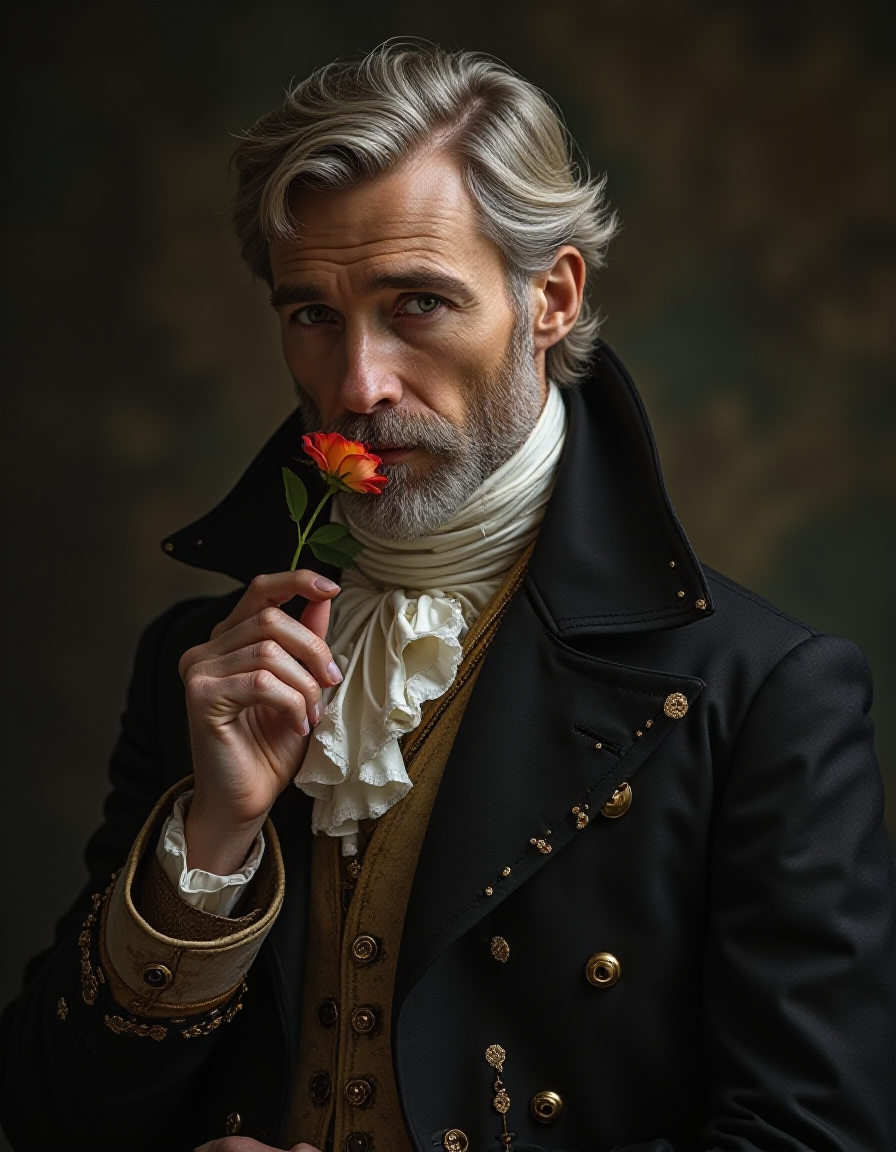
The man in the image is holding a rose in his hand.
CAPTION
The image depicts a man in a formal, vintage-style suit, complete with a green jacket, white shirt, and a black bow tie. He is holding a single flower in his right hand, which is positioned close to his face. The background is dark, providing a stark contrast to the man's attire, and there is a brown curtain to his right.
MONOLOGUE
Late that evening George sat in the Stoics' window overlooking Piccadilly. Before his eyes, shaded by his hand, the hansoms passed, flying East and West, each with the single pale disc of face, or the twin discs of faces close together; and the gentle roar of the town came in, and the cool air refreshed by night. In the light of the lamps the trees of the Green Park stood burnished out of deep shadow where nothing moved; and high over all, the stars and purple sky seemed veiled with golden gauze. Figures without end filed by. Some glanced at the lighted windows and the man in the white shirt-front sitting there. And many thought: 'Wish I were that swell, with nothing to do but step into his father's shoes;' and to many no thought came. But now and then some passer murmured to himself: "Looks lonely sitting there."
SUMMARY
the man is wearing a black leather jacket and a white lace collar and has white hair and is looking at the camera with a serious expression.
CAPTION
The image depicts a man with white hair, wearing a black leather jacket adorned with gold buttons and a white lace collar. He is seated in a chair, with his right hand resting on his chest, and his left hand holding a piece of paper. The background is dark, with a wooden panel and a brass door frame visible.
MONOLOGUE
In Brookes' and White's Selwyn appeared with a twofold fame, that of a pronouncer of _bon-mots_ and that of a lover of horrors. His wit was of the quaintest order. He was no inveterate talker, like Sydney Smith; no clever dissimulator, like Mr. Hook. Calmly, almost sanctimoniously, he uttered those neat and telling sayings which the next day passed over England as 'Selwyn's last.' Walpole describes his manner admirably---his eyes turned up, his mouth set primly, a look almost of melancholy in his whole face. Reynolds, in his Conversation-piece, celebrated when in the Strawberry Collection, and representing Selwyn leaning on a chair, Gilly Williams, crayon in hand, and Dick Edgecumbe by his side, has caught the pseudo-solemn expression of his face admirably. The ease of the figure, one hand _empochee_, the other holding a paper of epigrams, or what not, the huge waistcoat with a dozen buttons and huge flaps, the ruffled sleeve, the bob-wig, all belong to the outer man; but the calm, quiet, almost enquiring face, the look half of melancholy, half of reproach, and, as the Milesian would say, the other half of sleek wisdom; the long nose, the prim mouth and joined lips, the elevated brow, and beneath it the quiet contemplative eye, contemplative not of heaven or hell, but of this world as it had seen it, in its most worldly point of view, yet twinkling with a flashing thought of incongruity made congruous, are the indices of the inner man. Most of our wits, it must have been seen, have
SUMMARY
the portrait is of a woman with a necklace and a green garment
CAPTION
The image depicts a portrait of a woman with a serene expression. The woman is depicted from the side, her face turned slightly to the left. She has short, wavy hair and is wearing a dark green garment.
MONOLOGUE
She was awaiting them in her parlour, enthroned in her best easy chair, a chair of green velvet where purple flowers bloomed riotously, her feet firm-planted upon a hearthrug cunningly enwrought with salmon-pink sunflowers. Bolt upright and stiff of back she sat, making the very utmost of her elbows, for her sleeves being rolled high (as was their wont) and her arms being folded within her apron, they projected themselves to left and right in highly threatening fashion. Sphinx-like she sat, very silent and very still, while her sharp eyes roved over Mr. Ravenslee's person from the toes of his boots to the dark hair that curled short and crisp above his brow. Thus she looked him up and she looked him down, viewing each garment in turn; lastly, she lifted her gaze to his face and stared at him--eye to eye.
SUMMARY
a man with a long white beard and a beard on his face is wearing a dark coat and a brown vest
CAPTION
The image depicts an elderly man with a long white beard, wearing a dark coat and a brown vest over a white shirt. The background is a dark, textured wall, which contrasts with the man's dark attire. The man's expression is serious, and he is looking directly at the viewer.
MONOLOGUE
A disturbed shade seemed to fall upon the baronet's face. She followed his eyes, riveted upon the door. The hum of conversation had suddenly ceased, and every one was looking in the same direction. On the threshold stood a tall, gaunt man, gazing in upon the scene before him with an expression of distinct aversion, mingled with indifference. He was dressed just like the other men, in a long frock coat, and he had a white gardenia in his buttonhole. But there was something about him distinct and noticeable--something in the quiet easy manner with which he at last moved forward to greet his hostess, which seemed to thrill her through and through with a sense of sweet familiarity. And then she caught a turn of his head as he stooped down over Lady Meltoun's hand, and a great wave of bewilderment, mingled with an acute throbbing joy, swept in upon her. This man, whom every one was gazing at with such eager interest, was her father's tenant, Mr. Bernard Brown.
SUMMARY
actor in a medieval costume holding a flower and a staff.
CAPTION
The image depicts a man dressed in a medieval-style outfit, including a brown cloak and a green shirt, sitting on the ground. He is holding a large, ornate flower-shaped object in his right hand, which appears to be a type of flower or plant. The background is a dark, textured wall, which contrasts with the man's colorful attire.
MONOLOGUE
"An orphan girl is left with a cruel stepmother, who has a daughter who is bad-tempered and disagreeable, and extremely jealous of her. She becomes the Cinderella of the house, is ill-treated and beaten, but submits patiently. At last the harsh stepmother is urged by her daughter to get rid of her. It is winter, in the month of January; the snow has fallen, and the ground is frozen. The cruel stepmother in this dreadful weather bids the poor girl to go out in the forest, and not to come back till she brings some violets with her. After many entreaties for mercy the orphan is driven out, and goes out in the snow on the hopeless errand. As she enters the forest she sees a little way on in the deep glade, under the leafless trees, a large fire burning. As she draws near she perceives around the fire are twelve stones, and on the stones sit twelve men. The chief of them, sitting on the largest stone, is an old man with a long snowy beard, and a great staff in his hand. As she comes up to the fire the old man asks her what she wants. She respectfully replies by telling them, with many tears, her sad story. The old man comforts her. 'I am January; I cannot give you any violets, but brother March can.' So he turns to a fine young man near him and says, 'Brother March, sit in my place.' Presently the air around grows softer. The snows around the fire melt. The green grass appears, the flower-buds are to be seen. At the orphan girl's feet a bed of violets appear. She stoops and plucks
SUMMARY
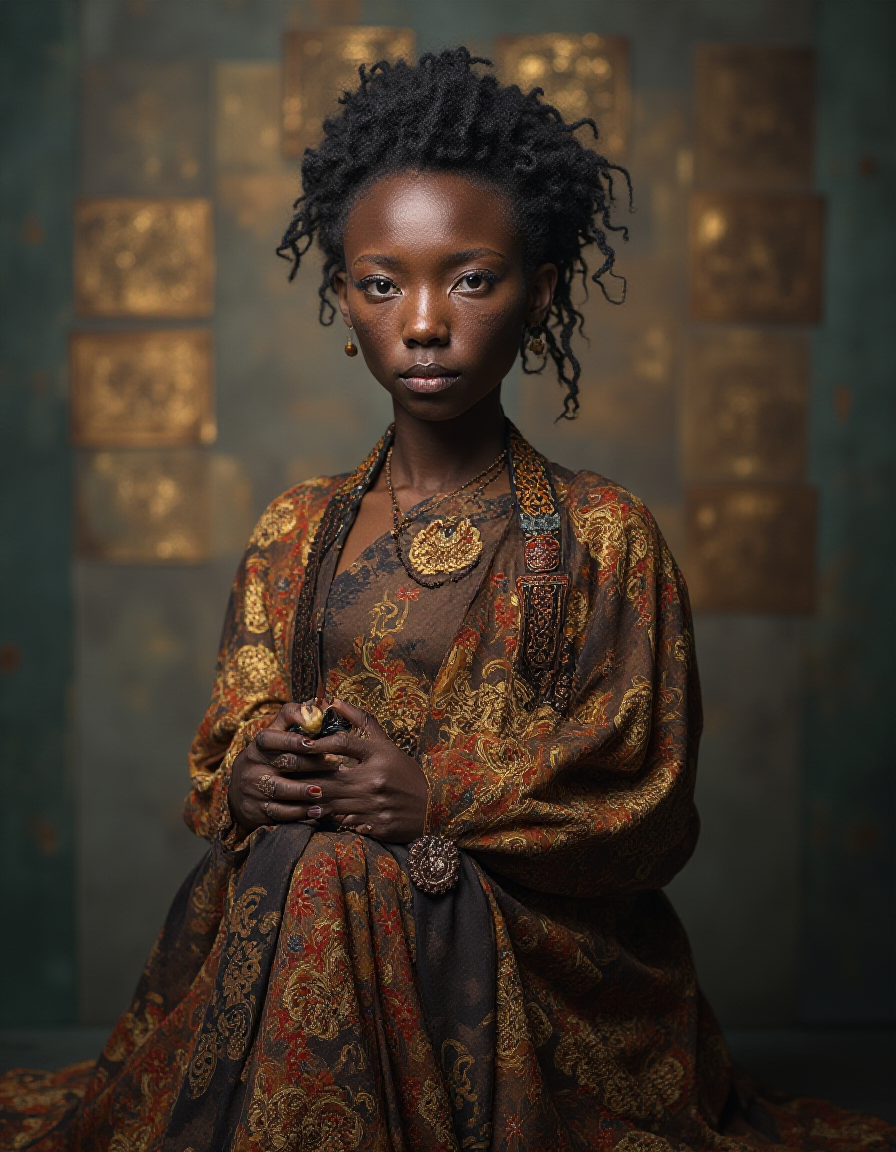
The woman is wearing a brown and gold patterned robe and has her hands clasped together.
CAPTION
The image depicts a woman dressed in a traditional African outfit, which appears to be a vibrant, patterned garment with intricate designs. She is seated in a relaxed pose, with her hands clasped together in front of her, suggesting a moment of contemplation or meditation. The background is a dark, textured wall adorned with gold-colored tiles, adding a warm and elegant ambiance to the scene.
MONOLOGUE
A stone cottage of the everyday sort stood a trifle back from the road and bore over its front door a sign announcing that Mrs. Bruce, Flesher, carried on her business within; and indeed one could look through the windows and see ruddy joints hanging from beams, and piles of pink-and-white steaks and chops lying neatly on the counter, crying, 'Come, eat me!' Nevertheless, one's first glance would be arrested neither by Mrs Bruce's black-and-gold sign, nor by the enticements of her stock-in-trade, because one's attention is rapped squarely between the eyes by an astonishing shape that arises from the patch of lawn in front of the cottage, and completely dominates the scene. Imagine yourself face to face with the last thing you would expect to see in a modest front dooryard,--the figurehead of a ship, heroic in size, gorgeous in colour, majestic in pose! A female personage it appears to be from the drapery, which is the only key the artist furnishes as to sex, and a queenly female withal, for she wears a crown at least a foot high, and brandishes a forbidding sceptre. All this seen from the front, but the rear view discloses the fact that the lady terminates in the tail of a fish which wriggles artistically in mid-air and is of a brittle sort, as it has evidently been thrice broken and glued together.
SUMMARY
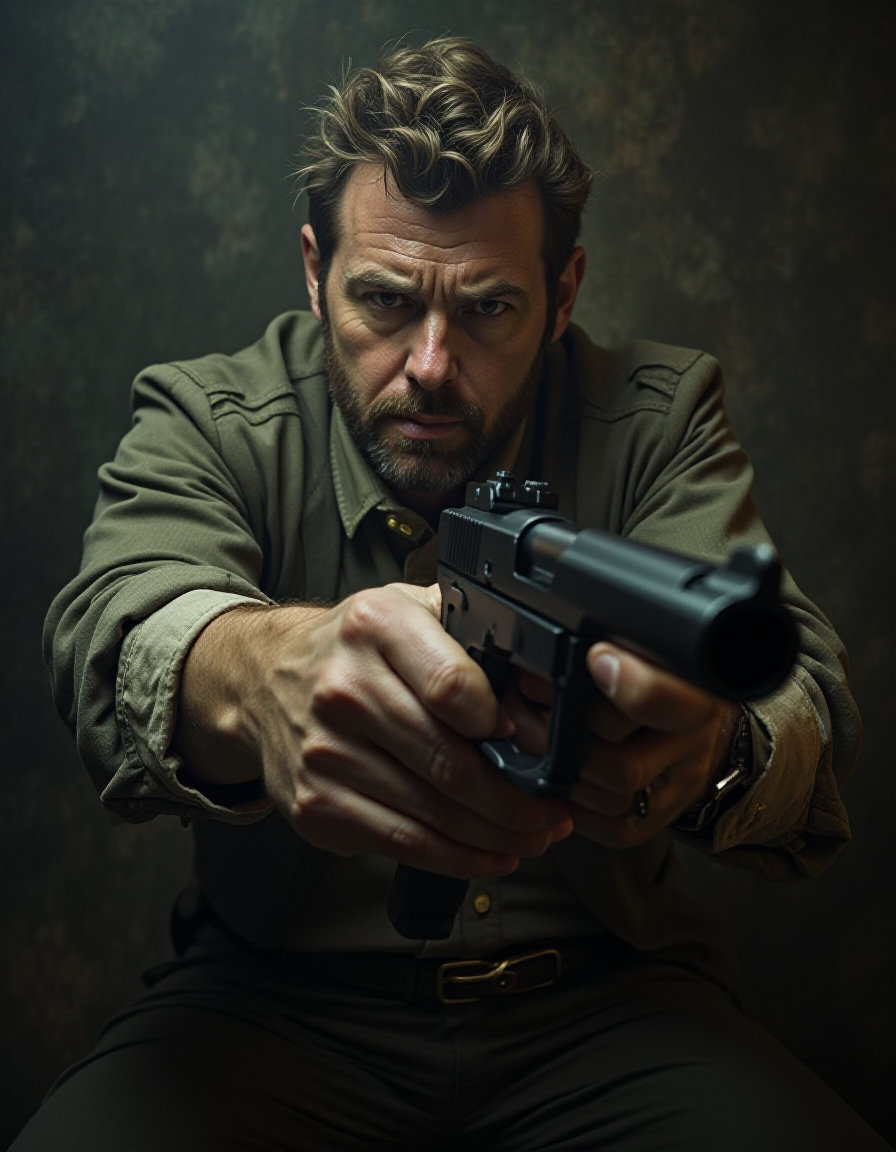
a man in a green shirt is holding a gun and pointing it
CAPTION
The image depicts a man in a green jacket, seated against a dark background. He is holding a black handgun in his right hand, which is pointed towards the camera. The man's expression is serious, and he appears to be in a state of concentration or preparation for action.
MONOLOGUE
He was immediately admitted to the presence of the Duke, whom he found in deep; consultation with Ambrosius. The latter was seated, holding a large swan's pen in one hand and a parchment in the other, which was written over with black, red, and blue ink, in many neat columns. The Duke was playing with a piece of sealing wax, which he held in his hand; and appeared in a state of indecision, first casting a penetrating glance at the chancellor, and then looking at the wax, as if it were destined to seal some important document. They were both so deeply immersed in their occupation, that Lichtenstein stood some minutes in the room, contemplating with intense interest the noble features of the Duke, without being remarked. The various sensations which were agitating him were plainly visible upon his countenance and in his expressive eyes. The frown upon his forehead, giving place in rapid succession to a milder expression, bespoke a mind hesitating between an act of severity and one of grace, whilst his companion, presenting him with the pen which he held in his hand, sat before him like the tempter. He turned and moved about like the serpent; and the eternal hypocritical smile, which his little green eyes could with ease convert into the expression of humility when his master looked at him sharply, appeared to urge him to taste the forbidden fruit.
SUMMARY
The man is wearing a black coat with gold buttons and a white ruffled shirt. He is holding a red rose in his hand and looking at it with a thoughtful expression.
CAPTION
The image depicts a man with gray hair, wearing a black coat adorned with gold buttons and a white ruffled collar. He is holding a single orange rose in his right hand, which is positioned close to his face. The background is dark, creating a dramatic effect that draws attention to the man and his attire.
MONOLOGUE
“As I began to think of retreat I heard footsteps in the adjoining drawing room; and, before I could turn tail and flee, my uncle and his guest appeared in the doorway. To run away after having been seen would have been highly improper, so I stood my ground. My uncle looked surprised to see me; the guest by his side was a spare man, of average stature, buttoned up in a black frock coat and holding himself very erect with a stiffly soldier-like carriage. From the folds of a soft white cambric neck-cloth peeped the points of a collar close against each shaven cheek. A few wisps of thin gray hair were brushed smoothly across the top of his bald head. His face, which must have been beautiful in its day, had preserved in age the harmonious simplicity of its lines. What amazed me was its even, almost deathlike pallor. He seemed to me to be prodigiously old. A faint smile, a mere momentary alteration in the set of his thin lips acknowledged my blushing confusion; and I became greatly interested to see him reach into the inside breastpocket of his coat. He extracted therefrom a lead pencil and a block of detachable pages, which he handed to my uncle with an almost imperceptible bow.
SUMMARY
a woman in a white dress with lace trim and a hood is holding her arms crossed
CAPTION
The image depicts a woman with her arms crossed, wearing a white dress with a floral pattern and a white headscarf. The background is dark, creating a dramatic effect that accentuates the woman's features. The lighting is focused on her face, highlighting her eyes and the texture of her clothing.
MONOLOGUE
presentments seemed to crowd upon him. He tried to get a view of the mother, but her back was turned to him, and a fat German woman, with a pile of unmade trousers from a clothing establishment, almost hid the sight of that. Usually he could not see these poor sewing-women, with their great, hot burdens of woollen cloth on their knees, without a sentiment of pity, but he did not give this one a thought. His mind was wholly absorbed in scanning curiously, though furtively, the baby's poor, little white face, and all that he could see of the mother's dress and figure. Presently the car came to a halt. The German woman got up and labored down the aisle with her burden and got off, but some one quickly moved into the vacant seat. Still he could see better now, and the better he saw the stronger grew the conviction in his heart. Gradually the car thinned out, and he might have gone nearer, but something held him back. He kept his position by the conductor, until he rang his bell and called out the name of a landing from which the excursion boats went out daily. Then the woman rose, lifting her baby with gentle carefulness, and came down the aisle and got out. She passed directly by Noel, but her thick veil was impenetrable, and yet, from the nearer view of her figure and the pose of her head, the feeling he had was deepened and strengthened. He got out, too, and followed her, and as he walked directly behind her, his eyes fastened on the rich coil of her wavy dark hair, he felt sure that this was Christine Dallas.
SUMMARY
actor in a dark jacket with a necklace and a shirt.
CAPTION
The image depicts a man with curly hair, wearing a dark jacket over a purple shirt. He is positioned in front of a blurred background, which suggests a dimly lit setting. The man's expression is serious, and he is looking slightly to the right.
MONOLOGUE
"Schilda has an absurd celebrity among the Germans: it is the Gotham of Teutschland; a fountain of old broad-grins and homely and hearty rustic banter; welling up from the serious extinct Ages to our own day; 'SCHILTburger' (Inhabitant of SCHILDA) meaning still, among all the Teutsch populations, a man of calmly obstinate whims and delusions, of notions altogether contrary to fact, and agreeable to himself only; resolutely pushing his way through life on those terms: amid horse-laughter, naturally, and general wagging of beards from surrounding mankind. Extinct mirth, not to be growled at or despised, in Ages running to the shallow, which have lost their mirth, and become all one snigger of mock-mirth. For it is observable, the more solemn is your background of DARK, the brighter is the play of all human genialities and coruscations on it,--of genial mirth especially, in the hour for mirth. Who the DOCTOR BORDEL of Schilda was, I do not know: but they have had their Bordel, as Gotham had;--probably various Bordels; industrious to pick up those Spiritual fruits of the earth. For the records are still abundant and current; fully more alive than those of Gotham here are.--And yonder, then, is actually Schilda of the absurd fame. A small, cheerful-looking human Village, in its Island among the Woods; you see it lying to the right:--a clean brick-slate congeries, with faint smoke-canopy hanging over it, indicating frugal dinner-kettles on the simmer;--and you remember kindly those good old
SUMMARY
the portrait of a man with a white cravat and a black coat
CAPTION
The image depicts a portrait of a man with a prominent, wavy hairstyle. He is dressed in a black coat and a white cravat, which is tied around his neck. The background of the image is dark, providing a contrast to the man's features.
MONOLOGUE
clear, pale skin, regular features, and white teeth. Those who were disposed to be critical observed that her face and head were rather too massive for her height; and that her figure, sufficiently plump at present, threatened to become too fat as she approached middle life. But at twenty years of age that would have appeared a very remote contingency to Constance Hadlow, supposing her to have ever thought about it. Although circumstances often prevented her from being dressed after the latest fashion, her hair--dark, wavy, and abundant--was always skilfully arranged in the prevalent mode, whatever that might be. It happened just then to be a becoming one to Miss Hadlow's head and face. The crimson colour of the shawl wrapped round her made a fine contrast with the creamy pallor of her skin and the vivid darkness of her eyes. Altogether, she looked handsome enough to excuse Owen Rivers for finding it difficult to remove himself from her society, supposing Mr. Simpson's statement to be true that the young man was "dangling after his cousin instead of minding his business."
SUMMARY
a woman with long curly hair and a flowing dress is surrounded by a fiery aura
CAPTION
The image depicts a woman with long, curly hair, dressed in a black dress that is adorned with intricate, glowing patterns. The woman is positioned in the center of the image, with her arms outstretched, creating a sense of movement and energy. The background is a dark, fiery hue, adding to the dramatic effect of the scene.
MONOLOGUE
Provincial life and the rather careless style of dress into which, for the last ten years, Severine had allowed herself to fall, gave a somewhat common air to that noble profile and those beautiful features; increasing plumpness was destroying the outlines of a figure magnificently fine during the first twelve years of her married life. But Severine redeemed these growing imperfections with a sovereign, superb, imperious glance, and a certain haughty carriage of her head. Her hair, still black and thick and long, was raised high upon her head, giving her a youthful look. Her shoulders and bosom were snowy, but they now rose puffily in a manner to obstruct the free movement of the neck, which had grown too short. Her plump and dimpled arms ended in pretty little hands that were, alas, too fat. She was, in fact, so overdone with fulness of life and health that her flesh formed a little pad, as one might call it, above her shoes. Two ear-drops, worth about three-thousand francs each, adorned her ears. She wore a lace cap with pink ribbons, a mousseline-de-laine gown in pink and gray stripes with an edging of green, opened at the bottom to show a petticoat trimmed with valencienne lace; and a green cashmere shawl with palm-leaves, the point of which reached the ground as she walked.
SUMMARY
a woman with curly hair, wearing a black fur coat, holding a sword in her hand, with a misty background and glowing particles.
CAPTION
The image depicts a person with curly hair, wearing a dark, textured outfit that resembles a cloak. The person is holding a sword with intricate designs, which is positioned in the center of the image. The background is shrouded in mist, adding a mystical and ethereal atmosphere to the scene.
MONOLOGUE
"Isn't this street ridiculous?" said Blunt suddenly, and crossing the room rapidly waved his hand to me, "_A bientot donc_," and was gone. He had seared himself into my mind. I did not understand him nor his mother then; which made them more impressive; but I have discovered since that those two figures required no mystery to make them memorable. Of course it isn't every day that one meets a mother that lives by her wits and a son that lives by his sword, but there was a perfect finish about their ambiguous personalities which is not to be met twice in a life-time. I shall never forget that grey dress with ample skirts and long corsage yet with infinite style, the ancient as if ghostly beauty of outlines, the black lace, the silver hair, the harmonious, restrained movements of those white, soft hands like the hands of a queen--or an abbess; and in the general fresh effect of her person the brilliant eyes like two stars with the calm reposeful way they had of moving on and off one, as if nothing in the world had the right to veil itself before their once sovereign beauty. Captain Blunt with smiling formality introduced me by name, adding with a certain relaxation of the formal tone the comment: "The Monsieur George! whose fame you tell me has reached even Paris." Mrs. Blunt's reception of me, glance, tones, even to the attitude of the admirably corseted figure, was most friendly, approaching the limit of half-familiarity. I had the feeling that I was beholding in her a captured ideal. No common experience! But I didn't care. It was very
SUMMARY
young woman with long brown hair, wearing a dark sweater, looking serious and contemplative.
CAPTION
The image depicts a woman with long, wavy hair, wearing a dark sweater. The background is dark, creating a contrast that highlights the woman's features. The woman's expression is serious, and her gaze is directed towards the camera.
MONOLOGUE
Her brown-gold hair was disposed of with the least ostentation possible and with no fluffiness. Her eyebrows were too well furnished for femininity and nearly met when she frowned--a too frequent practice, as was the belligerent look from her steely grey eyes with their beautiful Irish setting of long dark lashes. She had a straight nose and firm rounded chin, a rather determined look about the mouth--lower lip too much drawn in as if from perpetual self-repression. But all this severity disappeared when she smiled and showed her faultless teeth. The complexion was clear though a little tanned from deliberate exposure in athletics. Altogether a woman that might have been described as "jolly good-looking," if it had not been that whenever any man looked at her something hostile and forbidding came into the countenance, and the eyebrows formed an angry bar of hazel-brown above the dark-lashed eyes. But her "young man" look won for her many a feminine friendship which she impatiently repelled; for sentimentality disgusted her.
SUMMARY
young woman with long curly hair, looking serious, wearing a brown shirt, in a dimly lit room, with a red background.
CAPTION
The image depicts a person with long, wavy hair, wearing a dark, textured garment. The person is positioned in front of a dark, glowing background, which casts a warm, reddish hue on the scene. The individual's expression is serious, and their gaze is directed towards the camera.
MONOLOGUE
The crowd accordingly drew aside, and the individual, in whose behalf the movement had been made immediately stepped forward. He was a young man of about two-and-twenty, who, without having anything remarkable either in dress or appearance, was yet a noticeable person, if only for the indescribable expression of cunning pervading his countenance. His eyes were small and grey; as far apart and as sly-looking as those of a fox. A physiognomist, indeed, would have likened him to that crafty animal, and it must be owned the general formation of his features favoured such a comparison. The nose was long and sharp, the chin pointed, the forehead broad and flat, and connected, without any intervening hollow, with the eyelid; the teeth when displayed, seemed to reach from ear to ear. Then his beard was of a reddish hue, and his complexion warm and sanguine. Those who had seen him slumbering, averred that he slept with his eyes open. But this might be merely a figurative mode of describing his customary vigilance. Certain it was, that the slightest sound aroused him. This astute personage was somewhat under the middle size, but fairly proportioned, inclining rather to strength than symmetry, and abounding more in muscle than in flesh.
SUMMARY
a woman with long curly hair is sitting in a cave with a sword in her hand.
CAPTION
The image depicts a woman with long, wavy hair, dressed in a dark, hooded cloak. She is seated on the ground, with her hands resting on her knees. The background is shrouded in mist, creating an ethereal atmosphere.
MONOLOGUE
In the meantime Lord George, ignorant as yet of the storm which was brewing at home, was shown into his brother's sitting-room. When he entered he found there, with his brother, a lady whom he could recognise without difficulty as his sister-in-law. She was a tall, dark woman, as he thought very plain, but with large bright eyes and very black hair. She was ill-dressed, in a morning wrapper, and looked to him to be at least as old as her husband. The Marquis said something to her in Italian which served as an introduction, but of which Lord George could not understand a word. She curtseyed and Lord George put out his hand. "It is perhaps as well that you should make her acquaintance," said the Marquis. Then he again spoke in Italian, and after a minute or two the lady withdrew. It occurred to Lord George afterwards that the interview had certainly been arranged. Had his brother not wished him to see the lady, the lady could have been kept in the background here as well as at Manor Cross. "It's uncommon civil of you to come," said the Marquis as soon as the door was closed. "What can I do for you?"
SUMMARY
a young man in a black leather jacket is holding a sword and pointing it at the camera
CAPTION
The image depicts a young man sitting on a rock outdoors, holding a sword in his right hand. He is wearing a dark jacket and has a serious expression on his face. The background is a vibrant mix of red and pink hues, with a mountain range visible in the distance.
MONOLOGUE
We bivouacked about four o'clock, after a thirteen-mile march in a raw and very chilly air. Just going into bivouac I saw Major-General John F. Reynolds, who met such a tragic death at Gettysburg the next July. His corps--the First--was in the advance of ours. Our regiment was marching at the head of our brigade column. Lieutenant-Colonel Albright was temporarily absent and I was directing the column. General Reynolds's corps had passed into the field to the left and were already in bivouac; the other troops of our division were not visible at this point, and I was hesitating what direction to give the column. General Reynolds was sitting on his horse looking at us, evidently with much interest, and noticing my dilemma, rode up to my assistance at once. Addressing me as adjutant, he said: "Part of your corps has moved in yonder," pointing out the place. "If I were you I would go in here and occupy this field to the right in column of divisions, and you may say General Reynolds advised this, if you please." His manner and way of doing this little service were so pleasant that he captured me at once. Had he chosen to do so, he could have given me orders, as the senior officer present, but with a gentle courtesy he accomplished his purpose without that, and to reassure me gave his name and rank in this delicate way. I shall never forget his pleasant smile as he returned my salute after thanking him for his suggestion. He was a superb-looking man, dark complexioned, wearing full black whiskers, and sat his fine horse like a Centaur,
SUMMARY
The man is crying in a dimly lit room.
CAPTION
The image depicts a man in a red jacket, who appears to be in a state of distress or emotional turmoil. He is holding his head in his hands, and his facial expression suggests a range of emotions, from sadness to frustration. The background is dark, which contrasts with the man's vibrant attire and adds to the dramatic effect of the scene.
MONOLOGUE
Joe stared at the letter for some moments as if dazed, then he locked the door, and when on the following afternoon his landlady knocked to inquire if anything was wanted he opened it. His bed was still unruffled, showing that he had not occupied it during the night, and when she saw the same letter she had brought to him, its writing blurred and tear-stained, lying open upon the dresser, and noted the red and swollen eyes and woe-begone expression of Joe's face, her motherly heart quickly surmised the pitiful drama that had been enacted behind the closed door of the room. She stepped close to the broken-hearted man, who was sitting upon a chair, mutely holding his head between his hands, and while she lightly stroked his hair she pleaded with him to go to the street, as she thought that mingling with the crowds would prove the best heart-balm for him.
SUMMARY
woman holding a red rose in her hand.
CAPTION
The image depicts a woman with blonde hair styled in a bun, wearing a black lace dress. She is holding a single red rose in her right hand, which is positioned close to the camera. The background is dark, with a spotlight illuminating the scene, creating a dramatic effect.
MONOLOGUE
In that brilliant assemblage, Mrs. King was the centre of attraction. She was still a Rose Royal, as Gerald Fitzgerald had called her twenty-three years before. A very close observer would have noticed that time had slightly touched her head; but the general effect of the wavy hair was as dark and glossy as ever. She had grown somewhat stouter, but that only rendered her tall figure more majestic. It still seemed as if the fluid Art, whose harmonies were always flowing through her soul, had fashioned her form and was swaying all its motions; and to this natural gracefulness was now added that peculiar stylishness of manner, which can be acquired only by familiar intercourse with elegant society. There was nothing foreign in her accent, but the modulations of her voice were so musical, that English, as she spoke it, seemed all vowels and liquid consonants. She had been heralded as La Seorita, and her dress was appropriately Spanish. It was of cherry-colored satin, profusely trimmed with black lace. A mantilla of very rich transparent black lace was thrown over her head, and fastened on one side with a cluster of red fuchsias, the golden stamens of which were tipped with small diamonds. The lace trimming on the corsage was looped up with a diamond star, and her massive gold bracelets were clasped with, diamonds.
SUMMARY
dancer in a red dress performing a dance in a dark room.
CAPTION
The image depicts a woman in a red dress, performing a dance. She is in a dynamic pose, with her arms extended outward and her body twisted to the side. The background is dark, creating a dramatic effect that highlights the woman's figure.
MONOLOGUE
"And she was. In a minute or two, as we stood watching, she threw open the door, and in an instant I saw that whatever hope I may have cherished of her creating a good impression in her partially recovered state, was an ill-founded one. She was not in one of her depressed moods, but, what was worse, perhaps, in one of her ecstatic ones. All her genius, and she had much, had taken fire under some impulse of her erratic brain, and she came into the room prepared to conquer in the only way she knew how. Still young, still beautiful in her own way, which was that of no other woman, she glided into our presence in one rapturous whirl, a scarf floating from her neck, and a wreath of wild vine about her head. I rushed to prevent her, but it was too late. She _would_ dance, and she did, while my father, who had never seen her in this glowing state, drew me aside and watched with hard eyes, while she swayed and dipped and palpitated in what would have been a glorious ebullition of pure delight, had she not been my wife, and the man at my side as cold to her charm as the dew which stood out on my wretched forehead. When I could bear no more, I flung my arms about her and she stopped, panting and frightened, like a bird caught in full flight. 'Sing,' I whispered to her; 'sing that air from _none_'. I thought the tragic pathos of her tones might make her dancing forgotten. And they did in a way. My father had never listened to any such dramatic rendering of a simple song before, and I saw that he was
SUMMARY
a woman in a red dress sits on a bed with holly leaves and berries in the background.
CAPTION
The image depicts a woman dressed in a red dress, sitting on a red couch adorned with holly leaves and berries. The woman is positioned in the center of the image, with her back to the viewer, and her head is turned slightly to the right. The background is dark, with a subtle gradient transitioning from black to dark red, creating a dramatic effect.
MONOLOGUE
I place upon my bed a shirt, an abbe’s neckband, a pair of drawers, black silk stockings--in fact, a complete fit-out. Coming near the bed, Juliette drops her skirt, and cleverly gets into the drawers, which were not a bad fit, but when she comes to the breeches there is some difficulty; the waistband is too narrow, and the only remedy is to rip it behind or to cut it, if necessary. I undertake to make everything right, and, as I sit on the foot of my bed, she places herself in front of me, with her back towards me. I begin my work, but she thinks that I want to see too much, that I am not skilful enough, and that my fingers wander in unnecessary places; she gets fidgety, leaves me, tears the breeches, and manages in her own way. Then I help her to put her shoes on, and I pass the shirt over her head, but as I am disposing the ruffle and the neck-band, she complains of my hands being too curious; and in truth, her bosom was rather scanty. She calls me a knave and rascal, but I take no notice of her. I was not going to be duped, and I thought that a woman who had been paid one hundred thousand ducats was well worth some study. At last, her toilet being completed, my turn comes. In spite of her objections I quickly get rid of my breeches, and she must put on me the chemise, then a skirt, in a word she has to dress me up. But all at once, playing the coquette, she gets angry because I do not conceal from her looks the very apparent proof that her charms have some effect on a particular part of my being, and she refuses to grant me the favour which would soon afford both relief and calm. I try to kiss her, and she repulses me, whereupon I lose patience, and in spite of herself she has to witness the last stage of my excitement. At the sight of this, she pours out every insulting word she can think of; I endeavour to prove that she is to blame, but it is all in vain.
SUMMARY
a man in a black leather jacket and pants is holding a gun and firing it
CAPTION
The image depicts a dynamic scene of a person in a dynamic pose, holding a weapon in a fiery, chaotic environment. The individual is dressed in a dark, leather-like outfit, suggesting a sense of urgency or action. The background is filled with flames and debris, indicating a high-stakes situation.
MONOLOGUE
Outwardly speaking, the captain had not altered for the better since the memorable spring day when he had presented himself to Miss Garth at the lodge-gate at Combe-Raven. The railway mania of that famous year had attacked even the wary Wragge; had withdrawn him from his customary pursuits; and had left him prostrate in the end, like many a better man. He had lost his clerical appearance—he had faded with the autumn leaves. His crape hat-band had put itself in brown mourning for its own bereavement of black. His dingy white collar and cravat had died the death of old linen, and had gone to their long home at the paper-maker’s, to live again one day in quires at a stationer’s shop. A gray shooting-jacket in the last stage of woolen atrophy replaced the black frockcoat of former times, and, like a faithful servant, kept the dark secret of its master’s linen from the eyes of a prying world. From top to toe every square inch of the captain’s clothing was altered for the worse; but the man himself remained unchanged—superior to all forms of moral mildew, impervious to the action of social rust. He was as courteous, as persuasive, as blandly dignified as ever. He carried his head as high without a shirt-collar as ever he had carried it with one. The threadbare black handkerchief round his neck was perfectly tied; his rotten old shoes were neatly blacked; he might have compared chins, in the matter of smooth shaving, with the highest church dignitary in York. Time, change, and poverty had all attacked the captain together,
SUMMARY
a woman in a black off-shoulder swimsuit is underwater, touching her finger to her lips
CAPTION
The image depicts a woman with long blonde hair, wearing a black off-shoulder swimsuit, standing in the dark depths of the ocean. She is positioned in the center of the frame, with her right hand raised to her face, touching her nose, and her left hand resting on her hip.
MONOLOGUE
The door opened noiselessly, and Chonita entered. Again I saw only her white face, rigid as death, but the eyes flamed with the terrible passions that her soul had flung up from its depths at last. Then I saw another white object,--her hand. But there was no knife in it. Had there been, I think I should have shaken off the spell which controlled me: I never would see murder done. It was the awe of the unknown that paralyzed my muscles. She bent over Valencia, who moved uneasily and cast her arms above her head. I saw her touch her finger to the sleeping woman's mouth, inserting it between the lips. Then she moved backward and stood by the head of the bed, facing the window. She raised herself to her full height and extended her arms horizontally. The position gave her the form of a cross--a black cross, topped and pointed with malevolent white; one hand was spread above Valencia's face. She was the most awful sight I ever beheld. She uttered no sound; she scarcely breathed. Suddenly, with the curve of a panther, her figure glided above the unconscious woman, her open hand describing a strange motion; then she melted from the room.
SUMMARY
a man wearing a red beanie and a red sweater with a red necklace and a red and black cord necklace.
CAPTION
The image depicts a person wearing a red beanie and a red and black knit hat, with a red scarf around their neck. The person is dressed in a black coat, which is partially obscured by smoke. The background is dark, creating a dramatic effect that draws attention to the person and their attire.
MONOLOGUE
"You must remember that ring," said the father. Mead nodded. Colonel Whittaker slipped it from the finger, dried and burned by the sun, and showed the four men the initials, "W. W.," on the inside. The clothing was badly tattered and much of it had been torn away. Part of a pongee silk shirt still hung on the body. On the inside of the collar were the young man's initials worked in red silk. "His mother did that," said Colonel Whittaker. Around the neck was a dark-colored scarf, and in it was an odd, noticeable pin, a gold nugget of curious shape. The four men had all seen Will Whittaker wear it many times. A ragged remnant of a coat hung on the mangled body. In the breast pocket Colonel Whittaker showed them some letters and a small memorandum book. From the book had been torn some leaves and all the remaining pages were blank. But on the inside of the leather cover the name, "Will Whittaker," had been printed in heavy black letters. Rain and sun had almost obliterated the addresses on the two envelopes in the pocket, but enough of the letters could still be made out to show what the words had probably been.
SUMMARY
man in white shirt jumping on a staircase with pink light.
CAPTION
A man is captured mid-air in a vibrant pink and white neon-lit environment. He is dressed in a white shirt and dark pants, and his arms are raised in a dynamic pose. The background is a bright pink, creating a striking contrast with the man's attire.
MONOLOGUE
Brother Wyso is a man of between fifty and sixty years, stout and somewhat short of breath; for although Saint Benedict forbids the use of meat there are many other excellent gifts of God, and brother Wyso is very ready to give his attention to all permitted delicacies. On this occasion he makes a by no means cheerful face, for the Abbot has assembled them with fasting stomachs, and has not allowed them their morning-meal after the cold early mass. He pushes his short fat hands with a rueful shiver under the sleeves of his hood, and slaps the back of his left hand with the fingers of his right, casting a side-long glance meanwhile at his neighbour, brother Correntian, with a sort of mischievous curiosity as to whether any trace of the weakness of the flesh could be detected on his stony countenance; but he seems not even to perceive this, and his passive face is turned to the Abbot with unmoved attention. This brother is the strongest contrast to the smug little monk by whom he is sitting. A noble countenance is his, but furrowed by many a moral struggle, and set to stoniness by an assumed calm; a tall, lean form mortified by hair-cloth, scourging and chastisement; deep-set, dark, reproachful eyes--reproachful of the patience of Heaven that never falls on the sinner to smite him; of the light that shines alike on the evil and the good; of rosy cheeks and white arms, such as are often to be met in the village; in short of all that they gaze on, of all that thrives and rejoices or that is
SUMMARY
a knight in black armor is wielding a glowing staff in a misty cave.
CAPTION
The image depicts a figure dressed in dark armor, wielding a glowing object in their hand. The figure is positioned in a dynamic pose, with one arm extended forward and the other bent at the elbow, suggesting a sense of motion and readiness. The background is a rugged landscape with rocky terrain and a misty atmosphere, adding to the sense of adventure and exploration.
MONOLOGUE
Next to Isabel Beauchamp, the only daughter of the old knight, was another lady, perhaps a year younger. She was in several respects strikingly contrasted to her fair companion, though hardly less beautiful. Her hair was of a light glossy brown, catching a warm gleam wherever the light fell upon it, as fine as silk new spun from the cone, yet curling in large bunches wherever it could escape from the bands that confined it. Her complexion was fair and glowing; her cheek warm with health, and her skin as soft and smooth as that of a child. To look upon her at a little distance, one would have expected to find the merry grey or blue eye, so often seen in the pretty village maid; but hers was dark brown, large, and full, and soft, yet with a laughing light therein, that seemed to speak a buoyant and a happy heart. In form she was somewhat taller than the other; but though her waist looked as if it would have required no giant's hand to span it round, yet there was that sort of full and graceful sweep in all the lines, which painters and statuaries, I believe, call _contour_. Nought but the tip of one foot was seen from beneath the long and flowing petticoat then in fashion; but even from that, one might judge that nothing much more neat and small ever beat the turf, except amongst the elves of fairy land. Her hand rested upon a frame of embroidery, at which she had been working, and her head was slightly bent forward, as if to hear something said by the good Abbot of the convent, who sat opposite to his brother, in the seat within the
SUMMARY
The painting depicts a woman in a red dress lying on a bed.
CAPTION
The image depicts a woman lying on her side, her head resting on a pillow, with her eyes closed and her body relaxed. She is wearing a red dress, which contrasts with the dark background. The painting is done in a realistic style, with attention to detail in the texture of the clothing and the folds of the fabric.
MONOLOGUE
One of these bodies is that of a woman near whom were picked up ninety-one pieces of coin, two silver urns, and some keys and jewels. She was endeavoring to escape, taking with her these precious articles, when she fell down in the narrow street. You still see her lying on her left side; her head-dress can very readily be made out, as also can the texture of her clothing and two silver rings which she still has on her finger; one of her hands is broken, and you see the cellular structure of the bone; her left arm is lifted and distorted; her delicate hand is so tightly clenched that you would say the nails penetrate the flesh; her whole body appears swollen and contracted; the legs only, which are very slender, remain extended. One feels that she struggled a long time in horrible agony; her whole attitude is that of anguish, not of death.
SUMMARY
young woman in a suit with a necklace and earrings, looking to the side, with a dark background.
CAPTION
The image depicts a woman with long hair, wearing a dark blazer, and a necklace with a large pendant. The background is dark, creating a contrast that highlights the woman's features. The lighting is focused on her face, giving it a dramatic and intense appearance.
MONOLOGUE
In the magnificent parlor, giving evidence of that superfluity of expensive comfort and luxury which to wealthy Americans seems an absolute necessity of life, sits a young lady, in an elaborate and costly home dress. She is a girl of some twenty summers, and sitting near the open fire, whose shifting gleams light up her face and form, with her head resting thoughtfully in her hand, she listens to the conversation of the man opposite her. The face a perfect oval, of a clear, colorless, brunette complexion, with large, brown eyes and perfectly regular features, is set in a frame of dark, luxuriant hair, and possesses undeniable claims to beauty. And yet there is something wanting in this exquisite face. It is that joyous, artless expression which so seldom fails in youth; that breath of timidity we look for in young maidenhood, and that look of gentleness a woman's face seldom entirely lacks, and never to its advantage. There is a chilling gravity in this young girl's whole appearance, a confident repose, an undeniable self-consciousness; and yet it does not seem as if heavy life-storms or premature sorrows can have brought to her the sad experiences of later years. For this her brow is all too smooth--her eyes too bright. Either inborn or inbred must be that seriousness through which her beauty gains so much in expression, although it loses infinitely in the tender grace and charm of both.
SUMMARY
a person wielding a glowing sword in a dark, fiery environment
CAPTION
The image depicts a person in a medieval-style outfit, wielding a glowing sword. The person is dressed in a dark, hooded cloak, and their face is obscured by a mask. The background is a deep red, with a halo of light surrounding the person, creating a dramatic and intense atmosphere.
MONOLOGUE
A curious phenomenon, to which the name of "anthelia" has been given, and which may probably have suggested to the early painters the idea of the glory surrounding the heads of beatified saints, is to be seen in singular beauty, at early morning, in Ceylon. When the light is intense, and the shadows proportionally dark--when the sun is near the horizon, and the shadow of a person walking is thrown on the dewy grass--each particle of dew furnishes a double reflection from its concave and convex surfaces; and to the spectator his own figure, but more particularly the head, appears surrounded by a halo as vivid as if radiated from diamonds.[1] The Buddhists may possibly have taken from this beautiful object their idea of the _agni_ or emblem of the sun, with which the head of Buddha is surmounted. But unable to express a _halo_ in sculpture, they concentrated it into a _flame_.
SUMMARY
The man is wearing a black coat and has a serious expression on his face.
CAPTION
The image depicts a man with a serious expression, wearing a dark coat. He is positioned in front of a dark background, which contrasts with his dark attire. The man's hair is styled in a way that it appears to be slightly messy, and he has a beard.
MONOLOGUE
and the Finn Blomqvist (his real name was Melenius). Fisher has since told me that he at once thought it must be me when he saw a man out on the ice; but he quite gave up that idea when he met me, for he had seen me described as a fair man, and here was a dark man, with black hair and beard. When they were all there, Jackson said that I had reached 86 deg. 15' north latitude, and from seven powerful lungs I was given a triple British cheer that echoed among the hummocks. Jackson immediately sent his men off to fetch sledges and go out to Johansen, while we went on towards the house, which I now thought I could see on the shore. Jackson now told me that he had letters for me from home, and that both last spring and this he had had them with him when he went north, on the chance of our meeting. We now found that in March he must have been at no great distance south of our winter-hut, [78] but had to turn there, as he was stopped by open water--the same open water over which we had seen the dark atmosphere all the winter. Only when we came up nearly to the houses did he inquire more particularly about the Fram and our drifting, and I briefly told him our story. He told me afterwards that from the time we met he had believed that the ship had been destroyed, and that we two were the only survivors of the expedition. He thought he had seen a sad expression in my face when he first asked about the ship, and was afraid of touching on the subject again. Indeed, he had even quietly warned his men not to ask. It was
SUMMARY
shirtless man with short hair, looking at the camera, wearing a shirt
CAPTION
The image depicts a shirtless man with short, dark hair, wearing a black shirt. The man's eyes are open and he is looking directly at the camera. His facial features are well-defined, and his skin is smooth and well-groomed.
MONOLOGUE
Winifred talked more than usual at the short dinner which they had at a famous cafe close to the Opera House. Deane, a little weary with the strain of the day, was at first irresponsive, but gradually he forgot himself in the interest of playing his new part. She was wearing a dress of black velvet, a rope of pearls which had been sent for her inspection only that afternoon, and pearl earrings, concerning which she gravely asked his opinion. There was something a little un-English-looking about her to-night,--about the small, delicate head with the masses of brown hair, the pale complexion, the deep eyes with their hidden depths, the pearls which fell so gracefully over her black gown. Many people knew him by sight, and pointed him out to others,--the man whom everyone was talking about, the man who was supposed to be shivering on the brink of social and financial ruin, whose very freedom from justice might be a matter of hours,--sitting there with a girl who was unknown to all of them, yet without a doubt one of his own world! Some of them wondered that she should care to be seen about with him at such a time. These, however, were mostly the men. The women, who saw him as usual, well-groomed, good-looking, debonair, only admired him the more for his courage.
SUMMARY
man and woman shake hands in front of a plain background.
CAPTION
The image depicts a man and a woman standing side by side, holding hands, in front of a plain, dark background. The man is dressed in a dark suit with a white shirt and tie, while the woman is wearing a dark dress with a white pattern. They are both smiling and appear to be in a friendly or casual interaction.
MONOLOGUE
I entered a well-sanded kitchen, and seated myself on a bench, on one side of a long white table; the other side, which was nearest the wall, was occupied by a party, or rather family, consisting of a grimy-looking man, somewhat under the middle size, dressed in faded velveteens, and wearing a leather apron--a rather pretty-looking woman, but sun-burnt, and meanly dressed, and two ragged children, a boy and girl, about four or five years old. The man sat with his eyes fixed upon the table, supporting his chin with both his hands; the woman, who was next to him, sat quite still, save that occasionally she turned a glance upon her husband with eyes that appeared to have been lately crying. The children had none of the vivacity so general at their age. A more disconsolate family I had never seen; a mug, which, when filled, might contain half-a-pint, stood empty before them; a very disconsolate party indeed.
SUMMARY
man with beard wearing glasses and looking serious.
CAPTION
The image depicts a man with a beard and glasses, wearing a brown tweed jacket over a dark shirt. The man's expression is serious, and his gaze is directed towards the camera. The background is dark, providing a stark contrast to the man's features.
MONOLOGUE
On the afternoon of the second day his new playfellows all threw off their little skin cloaks and plunged into the stream to bathe; and Martin, seeing how much they seemed to enjoy being in the water, undressed himself and went in after them. The water was not too deep in that place, and as it was rare fun splashing about and trying to keep his legs in the swift current and clambering over slippery rocks, he went out some distance from the bank. All at once he discovered that the others had left him, and looking back he saw that they were all scrambling out on to the bank and fighting over his clothes. Back he dashed in haste to rescue his property, but by the time he reached the spot they had finished dividing the spoil, and jumping up they ran away and scattered in all directions, one wearing his jacket, another his knickerbockers, another his shirt and one sock, another his cap and shoes, and the last the one remaining sock only. In vain he pursued and called after them; and at last he was compelled to follow them unclothed to the camping ground, where he presented himself crying piteously; but the women who had been so kind to him would not help him now, and only laughed to see how white his skin looked by contrast with the dark copper-coloured skins of the other children. At length one of them compassionately gave him a small soft-furred skin of some wild animal, and fastened it on him like a cloak; and this he was compelled to wear with shame and grief, feeling very strange and uncomfortable in it. But the feeling
SUMMARY
the artist has created a portrait of a man with a serious expression and a serious expression
CAPTION
The image depicts a man with gray hair and large ears, wearing a dark, ornate outfit adorned with various decorations and jewels. He is positioned in front of a plain, light-colored background, which contrasts with the dark attire. The man's expression is serious, and his gaze is directed towards the camera.
MONOLOGUE
such rays would be, we need only consider why it is that the camera _is_ made 'obscura,' or dark. The effect of the transfusion of light through a telescopic image may be easily tried by any one who cares to make the experiment. He has only to do away with the tube of his telescope (substituting two or three straight rods to hold the glass in its place), and then in the blaze of a strong sun to direct the telescope on some object lying nearly towards the sun. Or if he prefer artificial light for the experiment, then at night let him direct the telescope so prepared upon the moon, while a strong electric light is directed upon the place where the focal image is formed (close in front of the eye). The experiment will not suggest very sanguine hopes of good result from the transfusion of artificial light. Yet, to my own knowledge, not a few who were perfectly well aware that the lunar hoax was not based on facts, have gravely reasoned that the principle suggested might be sound, and, in fact, that they could see no reason why astronomers should not try it, even though it had been first suggested as a joke.
SUMMARY
actor wearing a black shirt and a necklace with a cross on it sitting at a table with a bowl of food
CAPTION
The image depicts a man with tattoos on his arms, seated on a couch in a cozy, rustic setting. He is wearing a dark shirt and a gold chain necklace, adding a touch of elegance to his appearance. The man's expression is serious, suggesting he might be deep in thought or reflecting on something.
MONOLOGUE
All day long, even at this hour, plunged in the black abyss of his thoughts, following the fatal track--going whither he was guided by the invisible hand, with head bowed on his breast, and eyes fixed upon the ground, the wanderer had passed over the plain, and ascended the mountain, without once looking at the sky--without even perceiving the Calvary--without seeing the image upon the cross. He thought of the last descendants of his race. He felt, by the sinking of his heart, that great perils continued to threaten him. And in the bitterness of a despair, wild and deep as the ocean, the cobbler of Jerusalem seated himself at the foot of the cross. At this moment a farewell ray of the setting sun, piercing the dark mass of clouds, threw a refection upon the Calvary, vivid as a conflagration's glare. The Jew rested his forehead upon his hand. His long hair, shaken by the evening breeze, fell over his pale face--when sweeping it back from his brow, he started with surprise--he, who had long ceased to wonder at anything. With eager glance he contemplated the long lock of hair that he held between his fingers. That hair, until now black as night, had become gray. He also, like unto Herodias, was growing older.
SUMMARY
young woman sitting on a rock in the desert with mountains in the background.
CAPTION
The image depicts a young woman sitting on a rock in a desert-like environment. She is wearing a white tank top and dark jeans, and her hair is short and styled in a bob. The background features a vast expanse of sand dunes under a clear sky, with a few scattered clouds visible.
MONOLOGUE
At six o'clock the sky became clear, the clouds had indeed left the mountain and, as soon as it was day, I mounted the frozen rock. In the dawn however all lower objects were blended in one grey shade, like the dead colouring of a picture. I could distinguish only a pool of water, apparently near the foot of the mountain. This water I afterwards found to be a lake eight miles distant and in my map I have named it Lake Lonsdale, in honour of the Commandant then or soon after appointed at Port Phillip. I hastily levelled my theodolite but the scene, although sublime enough for the theme of a poet, was not at all suited to the more commonplace objects of a surveyor. The sun rose amid red and stormy clouds, and vast masses of a white vapour concealed from view both sea and land save where a few isolated hills were dimly visible. Towards the interior the horizon was clear and, during a short interval, I took what angles I could obtain. To the westward the view of the mountain ranges was truly grand. Southward or towards the sea I could at intervals perceive plains clear of timber and that the country was level, a circumstance of great importance to us; for I was apprehensive that between these mountains and the coast it might be broken by mountain gullies as it is in the settled colony and all along the Eastern coast. If such had proved to be the case the carts could not have been taken there; and I must have altered the plan of my intended route. Before I could observe the angles so desirable clouds again enveloped the
SUMMARY
The artist has created a portrait of a man with a beard and a mustache, wearing a leather jacket with gold buttons and a shirt underneath.
CAPTION
The image depicts an elderly man with gray hair and a white beard, seated in a dark room. He is wearing a black leather jacket adorned with gold buttons and a black shirt underneath. The man's hands are resting on his lap, and he is looking directly at the viewer.
MONOLOGUE
The question, however, remained, Who should be so bold as to take the first step and lay hands upon the favourite? It was now that Lord Gray, one of the conspirators, told, with that humour which comes in so grimly in many dark historic scenes, the story of the mice and the cat--how the mice conspired to save themselves by attaching a bell to the cat to warn them of her movements--until the terrible question arose which among them should attach to the neck of the enemy this instrument of safety. One can imagine the grave barons with half a smile looking at each other consciously, in acknowledgment of a risk which it needed a brave man to run. Angus, the head of the existing branch of the Douglas family, who had already risen into much of the power and importance of his forfeited kinsman, answered with equally grim brevity "I'se bell the cat." But while he spoke, the general enemy, mad with arrogance and self-confidence, and not believing in any power or boldness which could stop him in his career, forestalled the necessity. He came to the kirk, where no doubt he had heard there was some unauthorised assembly, arrayed in black velvet with bands of white, the livery he had chosen, a great gold chain round his neck, a hunting horn slung about him adorned with gold and jewels, and probably a marvel of medival art--and "rushed rudlie at the kirk door." The hum of fierce satisfaction which arose when the keeper of the door challenged the applicant for admission, and the answer, "The Earl of Mar," rang into the silence in which each man
SUMMARY
a female character with long dark hair and a red bikini top holding a fireball in her hand.
CAPTION
The image depicts a woman with long, dark hair, wearing a red bikini top and a red skirt. She is holding a glowing, fiery object in her right hand, which appears to be a staff or a wand. The background is dark, with a gradient of shades of gray and black, creating a dramatic and mysterious atmosphere.
MONOLOGUE
Imagine such sentiments so expressed by a tall austere lady, with high manly features, piercing dark eyes, a _front_ of jet-black hair coming low down on a somewhat furrowed brow. Cousin John says all dark women are inclined to be cross; and I own I think we _blondes_ have the best of it as far as good temper is concerned. My aunt is not altered in the slightest degree from what she was then. She dresses invariably in gray silks of the most delicate shades and texture; carries spectacles low down upon her nose, where they can be of no earthly use except for inspection of the carpet; and wears lavender kid gloves at all hours of the day and night--for Aunt Deborah is vain of her hand, and preserves its whiteness as a mark of her birth and parentage. Most families have a crotchet of some sort on which they plume themselves; some will boast that their scions rejoice one and all in long noses; others esteem the attenuated frames which they bequeath to their descendants as the most precious of legacies; one would not part with his family squint for the finest pair of eyes that ever adorned an Andalusian maiden; another cherishes his hereditary gout as a priceless patent of nobility; and even insanity is prized in proportion to the tenacity with which it clings to a particular race. So the Horsinghams never cease talking of the Horsingham hand; and if I want to get anything out of Aunt Deborah, I have only to lend her a pair of my gloves, and apologize to her for their being so _large_
SUMMARY
a woman with long dark hair and a red dress with gold trim is posing in front of a dark background
CAPTION
The image depicts a woman with long, wavy hair, wearing a red and green dress adorned with gold and silver jewelry. She is standing against a dark background, which contrasts with the vibrant colors of her attire. The woman's expression is serious, and her gaze is directed towards the camera.
MONOLOGUE
It was only beginning to be daylight when they left the house and went out to the carriage in which Victoria had been driven the night before. She and Lella M'Barka were both veiled, though there was no eye to see them. Hsina and Fafann took out several bundles, wrapped in dark red woollen haicks, and the Negro servants carried two curious trunks of wood painted bright green, with coloured flowers and scrolls of gold upon them, and shining, flat covers of brass. In these was contained the luggage from the house; Maieddine's had already gone to the railway station. He wore a plain, dark blue burnous, with the hood up, and his chin and mouth were covered by the lower folds of the small veil which fell from his turban, as if he were riding in the desert against a wind storm. It would have been impossible even for a friend to recognize him, and the two women in their white veils were like all native women of wealth and breeding in Algiers. Hsina was crying, and Fafann, who expected to go with her mistress, was insufferably important. Victoria felt that she was living in a fairy story, and the wearing of the veil excited and amused her. She was happy, and looked forward to the journey itself as well as to the journey's end.
SUMMARY
a person in a yellow hoodie is holding a lightsaber and is in a fighting stance.
CAPTION
The image depicts a person in a dynamic pose, holding a lightsaber in their right hand. The person is dressed in a yellow hoodie and dark pants, and their face is partially obscured by a black strap. The background is dark, creating a contrast that highlights the person and their action.
MONOLOGUE
The variation in the inhabitants of New Guinea has often been recognised and is well described by C. G. Seligman who remarks[322] that the contrast between the relatively tall, dark-skinned, frizzly-haired inhabitants of Torres Straits, the Fly River and the neighbouring parts of New Guinea on the one hand, and the smaller lighter coloured peoples to the east, is so striking that the two peoples must be recognised as racially distinct. He restricts the name Papuan to the congeries of frizzly-haired and often mop-headed peoples whose skin colour is some shade of brownish black, and proposes the term Papuo-Melanesian for the generally smaller, lighter coloured, frizzly-haired races of the eastern peninsula and the islands beyond. Besides these conspicuous differences "The Papuan is generally taller and is more consistently dolichocephalic than the Papuo-Melanesian: he is always darker, his usual colour being a dark chocolate or sooty brown; his head is high and his face, is, as a rule, long with prominent brow-ridges, above which his rather flat forehead commonly slopes backwards. The Papuo-Melanesian head is usually less high and the brow ridges less prominent, while the forehead is commonly rounded and not retreating. The skin colour runs through the whole gamut of shades of _caf-au-lait_, from a lightish yellow with only a tinge of brown, to a tolerably dark bronze colour. The lightest shades are everywhere uncommon, and in many localities appear to be limited to the female sex. The Papuan nose is longer and stouter and is
SUMMARY
a woman in a suit is standing in a mountainous landscape with her hands clasped together in front of her
CAPTION
The image depicts a woman standing on a mountain peak, her arms crossed in a gesture of prayer or contemplation. She is dressed in a dark business suit, which contrasts with the natural beauty of the mountainous landscape. The sky above her is a gradient of orange and pink, suggesting a sunset, and the clouds are scattered across the sky.
MONOLOGUE
Stratz, who criticizes the above statement, argues (with photographs of nude women in illustration) that the normal type of European surprised modesty is shown by an attitude in which the arms are crossed over the breast, the most sexually attractive region, while the thighs are pressed together, one being placed before the other, the shoulder raised and the back slightly curved; occasionally, he adds, the hands may be used to cover the face, and then the crossed arms conceal the breasts. The Medicean Venus, he remarks, is only a pretty woman coquetting with her body. Canova's Venus in the Pitti (who has drapery in front of her, and presses her arms across her breast) being a more accurate rendering of the attitude of modesty. But Stratz admits that when a surprised woman is gazed at for some time, she turns her head away, sinks or closes her eyes, and covers her pubes (or any other part she thinks is being gazed at) with one hand, while with the other she hides her breast or face. This he terms the secondary expression of modesty. (Stratz, _Die Frauenkleidung_, third ed., p. 23.)
SUMMARY
the woman is wearing a red and gold outfit and has multiple necklaces on her head
CAPTION
The image showcases a woman adorned in elaborate jewelry, including multiple necklaces, earrings, and bracelets, set against a plain, dark background. Her attire is a vibrant red and gold, with intricate patterns and designs. The woman's hands are raised, with one hand resting on her head and the other on her chest, adding a touch of elegance to her appearance.
MONOLOGUE
Contrary to expectation, the day has passed-off without event. One reason for this was, that Mrs. Flad and her children were still in Theodore’s hands, as also were some of the European workmen. At two o’clock, however, they came in; and we have now the whole of the captives safe in our hands. We have quite a native camp within our own, indeed, so large is the number of their attendants and following. The principal English prisoners have done very well with the money constantly supplied to them; but many of the German workmen have a miserably pinched and starved appearance. There are several half-castes among the party that have come in; their fathers being English or other Europeans who have resided in Abyssinia, their mothers natives. The natives who have come in have an idea that wearing a piece of red cloth round the head is a sign of friendliness to us, and they therefore are generally so adorned. The released captives start to-morrow for England. Theodore this morning sent down a thousand cattle and five hundred sheep as a propitiatory offering; but Sir Robert Napier refused to receive them, and has sent-in a renewed demand for the surrender of the fortress. It has been all day thought that the assault would take place to-night, or rather at daybreak to-morrow. No orders have, however, yet been issued, and it is now believed that the attack will take place to-morrow, in which case it is doubtful whether any description of the affair will reach you, as I had hoped, by this mail.
SUMMARY
The woman is sitting on the floor with her arms crossed and wearing a purple outfit.
CAPTION
The image depicts a woman sitting cross-legged on a textured floor, wearing a purple outfit consisting of a long-sleeved top and pants. She has long, wavy hair and is wearing a gold necklace. The background is dark, creating a dramatic contrast that highlights the woman's figure and attire.
MONOLOGUE
At the time of his introduction here, his legs were as quiet as in their nature they could be, having been elevated, for the greater comfort of the owner, to the top of a pianoforte, and presenting an inclination of forty-five degrees to Mr. Wilkeson's body, reposing calmly and smoking an antique pipe in his favorite chair below. One of his long arms was hanging listlessly by his side, and the other made a sharp projecting elbow, and terminated in the interior of his vest. This was the attitude which, of all possible adjustments of the human anatomy, Mr. Wilkeson preferred; and he always assumed it and his pipe the moment he had put on his dressing gown and Turkey slippers. He was well aware that popular treatises on the "Art of Behavior" and the "Code of Politeness" were extremely hard upon this disposition of the legs. His half-sister, Philomela Wilkeson, who was high authority, had often visited his legs with the severest censure, when, upon suddenly entering the room where he was seated, she found the offending members confronting her from the top of the piano, or the table, or a chair, or sometimes from the mantelpiece. While Marcus Wilkeson admitted the full force of her strictures as applied to legs in general, he claimed an exception for his legs, which were always in his own or other people's way when they rested on the floor, or were crossed after the many fashions popular with the short-legged part of mankind.
SUMMARY
a woman with long curly hair and a red cape is holding a glowing object in her hand. she is standing in front of a dark background with a faint light source in the top left.
CAPTION
The image depicts a woman with long, wavy hair, wearing a red and gold outfit. She is holding a glowing object in her right hand, which appears to be a wand or a similar magical tool. The background is dark, with a faint outline of a cityscape visible, suggesting an urban setting.
MONOLOGUE
Saturday Marquise de Bailleul and I were received by the Queen. Our audience was at four. I went for her a little before. We drove straight to the Quirinal, the great entrance on the piazza. Two swell porters were at the door, but no guards nor soldiers visible anywhere. We went up the grand staircase, where there was a red carpet and plenty of flowers, but no servants on the steps. The doors of a large anteroom at the top of the stairs were open, and there were four footmen in powder, culottes, and royal red liveries, and three or four men in black. We left our wraps. I wore my grey velvet and Marquise de Bailleul was in black with a handsome sable cape (which she was much disgusted at leaving). We went at once into a large room, where the dame de palais de service was waiting for us. She had a list in her hand, came forward at once and named herself, Duchesse d'Arscoli, said she supposed I was Madame Waddington. I introduced Marquise de Bailleul. The gentleman also came up and said a few words. There were one or two other ladies in the room, evidently waiting their turn. In a few minutes the door into the next room opened and two ladies came out. The duchess went in, remained a second, then coming back, waved us in. She didn't come in herself, didn't announce us, and shut the door behind us. We found ourselves in a large, rather bare room, with no trace of habitation--I fancy it is only used for official receptions. The Queen was standing at a table about the middle of the room. She is tall, dark, with fine eyes and a pretty
SUMMARY
a man in a leather jacket and jeans is holding a revolver in a foggy night with a gunshot in the background.
CAPTION
The image depicts a man in a dark, overcast setting, holding a revolver. He is dressed in a leather jacket and appears to be in a state of distress or urgency. The background is shrouded in mist, adding to the eerie atmosphere.
MONOLOGUE
And so, after little Stanislovas had stood gazing timidly about him for a few minutes, a man approached him, and asked what he wanted, to which Stanislovas said, “Job.” Then the man said “How old?” and Stanislovas answered, “Sixtin.” Once or twice every year a state inspector would come wandering through the packing plants, asking a child here and there how old he was; and so the packers were very careful to comply with the law, which cost them as much trouble as was now involved in the boss’s taking the document from the little boy, and glancing at it, and then sending it to the office to be filed away. Then he set some one else at a different job, and showed the lad how to place a lard can every time the empty arm of the remorseless machine came to him; and so was decided the place in the universe of little Stanislovas, and his destiny till the end of his days. Hour after hour, day after day, year after year, it was fated that he should stand upon a certain square foot of floor from seven in the morning until noon, and again from half-past twelve till half-past five, making never a motion and thinking never a thought, save for the setting of lard cans. In summer the stench of the warm lard would be nauseating, and in winter the cans would all but freeze to his naked little fingers in the unheated cellar. Half the year it would be dark as night when he went in to work, and dark as night again when he came out, and so he would never know what the sun looked like on weekdays. And for this, at the end of
SUMMARY
a muscular man with a beard is welding a piece of metal
CAPTION
The image depicts a muscular man with a beard, wearing a sleeveless shirt, working at a forge. He is focused on a glowing piece of metal, which is being shaped by a hammer. The man's muscles are well-defined, and his hair is short and dark.
MONOLOGUE
At Tangier, where a murder in a "coffee-house" had closed these hovels, pending a sufficient payment to the Pasha; and where, during the hard winter of 1885-86, the poorer classes were compelled to puff their Kayf (Bhang, cannabis indica) and sip their black coffee in the muddy streets under a rainy sky, I found the Ráwi active on Sundays and Thursdays, the market days. The favourite place was the "Soko de barra," or large bazar, outside the town whose condition is that of Suez and Bayrut half a century ago. It is a foul slope; now slippery with viscous mud, then powdery with fetid dust, dotted with graves and decaying tombs, unclean booths, gargottes and tattered tents, and frequented by women, mere bundles of unclean rags, and by men wearing the haik or burnús, a Franciscan frock, tending their squatting camels and chaffering over cattle for Gibraltar beef- eaters. Here the market-people form a ring about the reciter, a stalwart man affecting little raiment besides a broad waist-belt into which his lower chiffons are tucked, and noticeable only for his shock hair, wild eyes, broad grin and generally disreputable aspect. He usually handles a short stick; and, when drummer and piper are absent, he carries a tiny tom-tom shaped like an hour- glass, upon which he taps the periods. This Scealuidhe, as the Irish call him, opens the drama with extempore prayer, proving that he and the audience are good Moslems: he speaks slowly and with emphasis, varying the diction with breaks of animation,
SUMMARY
two chess players are playing a game of chess in a room with a computer monitor in the background.
CAPTION
The image depicts a scene of two individuals engaged in a chess match. The man, positioned on the left, is dressed in a dark sweater and glasses, while the woman, on the right, is wearing a gray cardigan and a white blouse. They are seated at a wooden table, with the chessboard in front of them.
MONOLOGUE
Around the room, beneath the paintings, were arranged many small tables, at most of which three or four individuals were seated, some alternately sipping negus and puffing their segars, which are as indispensable necessaries to a Creole at all times, as his right hand, eye-brows, and left shoulder in conversation. Others were reading newspapers, and occasionally assisting their comprehension of abstruse paragraphs, by hot "coffee," alias warm punch and slings, with which, on little japanned salvers, the active attendants were flying in all directions through the spacious room, at the beck and call of customers. The large circular bar was surrounded by a score of noisy applicants for the liquid treasures which held out to them such strong temptations. Trios, couples and units of gentlemen were promenading the well sanded floor, talking in loud tones, and gesticulating with the peculiar vehemence and rapidity of Frenchmen. Others, and by far the majority, were gathered by twos and by fours around the little tables, deeply engaged in playing that most intricate, scientific, and mathematical of games termed "Domino." This is the most common game resorted to by the Creoles. In every caf and cabaret, from early in the morning, when the luxurious mint-julep has thawed out their intellects and expanded their organ of combativeness, till late at night, devotees to this childish amusement will be found clustered around the tables, with a tonic, often renewed and properly sangareed, at their elbows. Enveloped in dense clouds of
SUMMARY
a hand with a tattoo pointing upwards in space
CAPTION
The image presents a hand with a tattooed forearm, positioned in the center of the frame. The hand is raised in a gesture, with the index finger pointing upwards, and the thumb extended. The background is a dark space filled with stars, creating a cosmic atmosphere.
MONOLOGUE
(11) An imaginary line indicated with the extended and inverted index from a short distance before the body to a place on the right--_I went_, (12) repeat gesture No. 6--_a stopping place_, (13) inclining the head, with eyes closed, toward the right, bring the extended right hand, palm up, to within six inches of the right ear--_where I slept_. (14) Place the spread and extended index and thumb of the right hand, palm downward, across the right side of the forehead--_white man_ (American), (15) elevating both hands before the breast, palms forward, thumbs touching, the little finger of the right hand closed--_nine_, (16) touch the breast with the right forefinger suddenly--_and myself_, (17) lowering the hand, and pointing downward and forward with the index still extended (the remaining fingers and thumb being loosely closed) indicate an imaginary line along the ground toward the extreme right--_went_, (18) extend the forefinger of the closed left hand, and place the separated fore and second fingers of the right astraddle the forefinger of the left, and make a series of arched or curved movements toward the right--_rode horseback_, (19) keeping the hands in their relative position, place them a short distance below the right ear, the head being inclined toward that side--_sleep_, (20) repeat the signs for _riding_ (No. 18) and _sleeping_ (No. 19) three times--_four days and nights_, (21) make sign No. 18, and stopping suddenly point toward the east with the extended index-finger of the right (others being closed) and follow
SUMMARY
a man in a green military uniform holding a golden trophy
CAPTION
The image depicts a man in a regal outfit, holding a golden trophy in his hands. He is dressed in a dark green military uniform adorned with gold epaulettes and medals, and is wearing a white cravat. The background is a dark, textured wall, which contrasts with the man's attire and the trophy.
MONOLOGUE
A week later, and much about the same hour, Captain Rames was driven along the Mall in St. James's Park. Friday had come round again, and the light did not burn in the clock-tower at Westminster. But the windows of the admiralty blazed upon the horse-guards' parade, and its great doors stood open for a glittering company. It was the night of official dinners and receptions in honor of the king's birthday. Soldiers in scarlet, sailors in blue, ministers and privy councillors in gold, and ladies in their shimmering gowns thronged with the smaller fry in black coats up the shallow steps into a hall decorated with Union Jacks. There was a thrill of expectancy in the air that evening. Rumors were rife that the government was inclined to advise a dissolution. Members' wives were speculating whether they must go back to the constituencies and tread the ways of deference; their husbands how soon the time would come when they must exchange the erect dignity of the member for the supple curves of the candidate; and curious eyes dwelt, as if in hope of answer upon a sturdy white-haired man with a blunt, good-humored face, who, wearing a uniform with epaulets, left you in doubt whether he was a fireman or an admiral. He was, however, the Prime-Minister, and he stood in the hall amongst his friends, bearing the world lightly according to his wont. He stepped forward and shook hands with Rames as he passed, and so turned again to his friends. He was heard to say, "I have to-day achieved the ambition of
SUMMARY
the character is holding a wand with a fireball on it.
CAPTION
The image depicts a man with a long, wavy beard and a wild, twisted appearance, wearing a black coat with gold embroidery and a white cravat. He is holding a lit torch in his right hand, which is surrounded by a fiery aura. The background is dark and foggy, with a few scattered stars visible, giving the impression of a mystical or supernatural setting.
MONOLOGUE
They had now arrived within half a mile of the moor, when they felt themselves overtaken by a man whose figure was of a very singular and startling description, being apparently as wild and untamed as the barren waste on which he made his appearance. He was actually two or three inches above the common height, but in addition to this fact, and as if not satisfied with it, he wore three hats, one sheathed a little into the other, so that they could not readily separate, and the under one he kept always fastened to his head, in order to prevent the whole pyramid from falling off. His person seemed to gain still greater height from the circumstance of his wearing a long surtout that reached to his heels, and which he kept constantly buttoned closely about him. His feet were cased in a tight pair of leather buskins, for it was one of his singularities that he could endure neither boot nor shoe, and he always wore a glove of some kind on his left hand, but never any on his right. His features might be termed regular, even handsome; and his eyes were absolutely brilliant, yet, notwithstanding this, it was impossible to look for a moment upon his _tout ensemble_ without perceiving that that spirit which stamps the impress of reason and intellect upon the human countenance, was not visible in his. Like a new and well-proportioned house which had never been occupied, everything seemed externally regular and perfect, whilst it was evident by its still and lonely character, as contrasted with the busy marks of on-going life in those
SUMMARY
The painting depicts a young woman with a crown of flowers on her head. She is standing in front of a green background with flowers and a decorative frame.
CAPTION
The image depicts a woman dressed in a black dress with a white lace collar, adorned with a large red flower crown and multiple necklaces. The background is a dark green color, and the woman is positioned in the center of the frame, with her right hand resting on a stone surface.
MONOLOGUE
This affair arranged, the regular lesson followed. During a brief interval, employed by the pupils in ruling their books, my eye, ranging carelessly over the benches, observed, for the first time, that the farthest seat in the farthest row--a seat usually vacant--was again filled by the new scholar, the Mdlle. Henri so ostentatiously recommended to me by the directress. To-day I had on my spectacles; her appearance, therefore, was clear to me at the first glance; I had not to puzzle over it. She looked young; yet, had I been required to name her exact age, I should have been somewhat nonplussed; the slightness of her figure might have suited seventeen; a certain anxious and pre-occupied expression of face seemed the indication of riper years. She was dressed, like all the rest, in a dark stuff gown and a white collar; her features were dissimilar to any there, not so rounded, more defined, yet scarcely regular. The shape of her head too was different, the superior part more developed, the base considerably less. I felt assured, at first sight, that she was not a Belgian; her complexion, her countenance, her lineaments, her figure, were all distinct from theirs, and, evidently, the type of another race--of a race less gifted with fullness of flesh and plenitude of blood; less jocund, material, unthinking. When I first cast my eyes on her, she sat looking fixedly down, her chin resting on her hand, and she did not change her attitude till I commenced the lesson. None of the Belgian girls would have
SUMMARY
a young woman with a flower crown and earrings is standing in front of a full moon
CAPTION
The image depicts a woman with a serene expression, wearing a dark, patterned dress adorned with white flowers. She is facing away from the viewer, with her head slightly tilted to the right. The background is a warm, golden hue, suggesting a sunset or sunrise.
MONOLOGUE
The stove had been the first thing to be unpacked, and by the time the last guy-rope was made fast, the last roll of bedding opened and arranged in its place, the welcome call to supper was sounded, and they gathered about the long table, spread in the open air, in the golden sunset light. Then the elders settled themselves for the evening, glad to rest after their long ride, while the children raced up and down the camp, exploring all the nooks and corners of their little domain, before throwing themselves down on a pile of blankets to watch the full moon as it rose from a bank of cloud just above the low hills to the eastward, and threw its white light over their gay group. Fifteen feet away from them Mrs. Burnam sat in the doorway of her tent, with Louise at her feet. The girl's golden hair was glistening in the moonlight, as she raised her head to speak to the topographer of the party, a sandy-haired, jovial young fellow, so lately come from "Sheff" that he retained all the slang and easy assurance of the genuine college boy. Ten months of camp life had made him hail with delight the prospect of paying court to a pretty girl; and he had attached himself to her side to the utter exclusion of Dr. Brownlee and the grave, taciturn leveller, who had retired from the contest and was devoting himself to Mrs. Burnam, whom he had known for years. For a few moments, the doctor stood looking on; then he turned away and joined the group of children, who received him enthusiastically.
SUMMARY
a young woman with a flower crown and earrings is standing in front of a full moon
CAPTION
The image depicts a woman with a serene expression, wearing a dark, floral-patterned robe. She is facing away from the viewer, with her head slightly tilted to the right. The background is a warm, golden hue, suggesting a sunset or sunrise.
MONOLOGUE
True indeed, but her Majesty, Queen Victoria, even at the moment of doffing her crown to give her dog a bath, could with equal grace and capability have answered a summons to discuss grave national issues, and would have shown both good judgment and wisdom in the discussion. A wonderful little woman she was, young for her task, but old for her age, and as we see her standing in the famous portrait painted in her coronation robes we see all that is fairest and noblest in both girl and Queen. She stands there as though mounting the steps to her throne, her head slightly turned, looking back over her shoulder, and we feel the buoyancy of her youth and the dignity of her purity, a far more royal robe than the one of velvet and ermine which is over her shoulders, and we know that she is already worthy of the homage so universally paid her, this girl Queen of England awaiting what the future may bring.
SUMMARY
a young woman with a flower crown and earrings is standing in front of a full moon
CAPTION
The image depicts a woman with a serene expression, wearing a dark, patterned dress adorned with white flowers. She is facing away from the viewer, with her head slightly tilted to the right. The background is a warm, golden hue, suggesting a sunset or sunrise.
MONOLOGUE
As we were returning to the chateau, we heard a great noise of voices and laughter, and we saw at the foot of the stoop some ten or twelve young men who were jumping and bounding, as if trying to reach, without the help of the steps, the platform that crowns the double staircase. We were enabled to understand the explanation of these passionate gymnastics as soon as the light of the moon enabled us to distinguish a white dress on the platform. It was evidently a tournament of which the white dress was to crown the victor. The young lady (had she not been young, they would not have jumped so high) was leaning over the balustrade, exposing boldly to the dew of an autumn night, and to the kisses of Diana, her flower-wreathed head and her bare shoulders; she was slightly stooping down, and held out to the competitors an object somewhat difficult to discern at a distance; it was a slender cigarette, the delicate handiwork of her white fingers and her rosy nails. Although there was nothing in the sight that was not charming, Monsieur de Malouet probably found in it something he did not like, for his tone of cheerful good-humor became suddenly shaded with a perceptible tint of annoyance, when he murmured:
SUMMARY
woman posing in a denim jacket with a floral pattern and gold studs
CAPTION
The image depicts a young woman with dark hair, wearing a denim jacket adorned with gold studs and a necklace. The background is a blurred, colorful pattern, which suggests a casual or artistic setting. The woman's expression is serious, and her gaze is directed towards the camera.
MONOLOGUE
There were reasons for suspecting that this "G" was a certain Gumersinda, the wife of a corn merchant, a woman remarkable for her stout figure, which caused her some difficulty in walking. Periquito had a particular fancy for ladies who were plump and married. When both these qualities were combined in one being his passion knew no bounds. And such was the present case. One must not think by this that the young man was a vicious creature. The husbands of Sarrio were not disturbed about him. Periquito was always in love, sometimes with one, sometimes with another lady, but he never dared to address them or send a love letter. Such courses were not in his line, which consisted chiefly in fascinating them by his gaze. Therefore, whenever he came across one of these fair creatures at church, or in the theatre, he first managed to take a seat at a convenient distance, and once he had taken up his position, he directed the magnetic power of his eyes straight at the passive object of his experiment until she occasionally glanced at him with an expression of surprise. The respectable matron, often not considering herself worthy of such particular attention, would look round and ask those with her if she had a spot on her face, or if her hair were out of order.
SUMMARY
man in black coat with gold buttons and white cravat sitting in a chair with ornate chair and floral wallpaper
CAPTION
The image depicts a man dressed in a black military uniform, seated in a chair with ornate details. He is wearing a white cravat and has a serious expression. The background features a floral wallpaper with a rich, dark green color, adding a touch of elegance to the scene.
MONOLOGUE
Meanwhile, Rupert returned to the drawing-room and found the Marquis paying attentions to his wife. Lo-Keong was a tall, fine-looking man, grave and extremely polite. He had admirable manners, and his clothes were of the finest. Olivia in her rich dinner dress, felt quite plainly dressed beside this gorgeous gentleman, who wore a jacket of rose-pink, a coat of grass green satin, pale blue silk trousers, and thick-soled white green shoes. He also had a glossy pig-tail woven with silk, and carried a small fan--at which Olivia shuddered. Seated in a deep arm-chair, he looked a potentate, quite out of place in that sober English drawing-room. The Marquis was very affable, and deferential to Mrs. Ainsleigh, who quite overcame her dislike to Celestials after a few moments converse with this splendid specimen of the aristocracy of Cathay.
SUMMARY
woman wearing a hat and a shirt standing on a beach.
CAPTION
The image depicts a woman standing on a beach, wearing a hat and a light-colored shirt. She is also wearing dark pants and brown boots. The background of the image shows the ocean with waves crashing onto the shore, and the sky is clear with a few clouds.
MONOLOGUE
When we had got out of the Straits, and were fairly in the great Pacific Ocean, we had a steady wind for the first time since leaving Ternate, but unfortunately it was dead ahead, and we had to beat against it, tacking on and off the coast of New Guinea. I looked with intense interest on those rugged mountains, retreating ridge behind ridge into the interior, where the foot of civilized man had never trod. There was the country of the cassowary and the tree-kangaroo, and those dark forests produced the most extraordinary and the most beautiful of the feathered inhabitants of the earth--the varied species of Birds of Paradise. A few days more and I hoped to be in pursuit of these, and of the scarcely less beautiful insects which accompany them. We had still, however, for several days only calms and light head-winds, and it was not till the l0th of April that a fine westerly breeze set in, followed by a squally night, which kept us off the entrance of Dorey harbour. The next morning we entered, and came to anchor off the small island of Mansinam, on which dwelt two German missionaries, Messrs. Otto and Geisler. The former immediately came on board to give us welcome, and invited us to go on shore and breakfast with him. We were then introduced to his companion who was suffering dreadfully from an abscess on the heel, which had confined him to the house for six months--and to his wife, a young German woman, who had been out only three months. Unfortunately she could speak no Malay or
SUMMARY
a woman with long dark hair, wearing a dark shirt, is standing in front of a door
CAPTION
The image depicts a person with long, dark hair, wearing a dark shirt. The person is positioned in front of a white wall, and the background is slightly blurred, suggesting a dimly lit environment. The individual's expression is serious, and their gaze is directed towards the camera.
MONOLOGUE
a pantomime--it is a thing that you will not gaze on for long; and you rush instinctively from daylight to candle-light. I stopped in front of an old-fashioned public-house, and soon (being a connoisseur in these matters) satisfied myself that if comfort were the desideratum, "The heart that was humble might hope for it here." I shook the snow from my "Petersham," and seeing the word "parlour" painted in white letters on a black door, bent my steps towards it. I was on the point of opening the door, when a slim young man, with a remarkable small quantity of hair, stopped my onward coarse by gurgling rather than ejaculating--for the sentence seemed a continuous word--
SUMMARY
a skeletal figure with a glowing sun behind it.
CAPTION
The image presents a surreal and eerie depiction of a skeletal figure, rendered in a dark, almost monochromatic palette. The figure is centrally positioned, facing the viewer, and is adorned with a multitude of white, tentacle-like appendages that extend from its body, reaching towards the sky. These appendages are intertwined in a complex pattern, creating a sense of movement and dynamism.
MONOLOGUE
The appearance of the aurora at Behring's Straits in 1878-79 is shown in the accompanying woodcuts. We never saw here the magnificent bands or draperies of rays which we are so accustomed to in Scandinavia, but only halo-like luminous arcs, which hour after hour, day after day, were unaltered in position. When the sky was not clouded over and the faint light of the aurora was not dimmed by the rays of the sun or the full moon, these arcs commonly began to show themselves between eight and nine o'clock P.M., and were then seen without interruption during midwinter till six, and farther on in the year to three o'clock in the morning. It follows from this that the aurora even during a minimum year is a permanent natural phenomenon. The nearly unalterable position of the arcs has further rendered possible a number of measurements of its height, extent, and position from which I believe I may draw the following inferences that our globe even during a minimum aurora year is adorned with an almost constant, single, double, or multiple luminous crown, whose inner edge is situated at a height of about 200 kilometres or 0.03 radius of the earth above its surface, whose centre, "the aurora-pole," lies somewhat under the earth's surface, a little north of the magnetic-pole, and which, with a diameter of 2,000 kilometres or 0.3 radius of the earth, extends in a plane perpendicular to the radius of the earth, which touches the centre of the circle.
SUMMARY
man in suit writing in notebook with pen on wooden table
CAPTION
The image depicts a man in a formal setting, seated at a desk with a microphone in front of him. He is dressed in a dark suit with a white shirt and a patterned tie. The man's expression is serious, and he appears to be engaged in a conversation or presentation.
MONOLOGUE
Monsieur le Maire to-day was no longer the genial, ruddy old raiser of cattle, who stops me whenever I pass his gate with a hearty welcome. He was all Mayor to-day, clean shaven to the raw edges of his cropped gray side-whiskers with a look of grave importance in his shrewd eyes and a firm setting of his wrinkled upper lip, that indicated the dignity of his office; a fact which was further accentuated by his carefully brushed suit of black, a clean starched collar and the tri-coloured silk sash, with gold tassels, which he is forced to gird his fat paunch with, when he either marries you or sends you to jail. The clock ticked on, its oaken case reflecting the copper light from the line of saucepans hanging beside it on the wall. Presently, the Municipal Council filed in and seated themselves about a centre table, upon which lay in readiness the official seal, pen, ink and paper. Being somewhat ill at ease in his starched shirt, the florid grocer coughed frequently, while the two cattle-raisers in their black blouses, talked in gutteral whispers over a bargain in calves. Through the open window, screened with cool vines, came the faint murmur of the village--suddenly it ceased. I rose, and going to the window, looked up the street. The cur was coming down it, striding along as straight as a savage, nodding to those who nodded to him. An old fisherwoman hobbled forth and kissed his hand. Young and old, gamblers of the sea, lifted their caps as he passed.
SUMMARY
couple kissing in a night sky with fireworks
CAPTION
The image captures a romantic moment between two individuals, set against a backdrop of a vibrant, blurred light display. The woman, positioned on the left, is dressed in a dark, patterned dress, her hair tied back in a ponytail. She is leaning towards the man, who is on the right, wearing a light-colored shirt.
MONOLOGUE
But here the misunderstandings between the engaged couple began. That golden-hair, that good friend, gazing with a heavenly light, that rose-colored, gay comrade who dressed herself in a light dress and spring hat, was so charming that Ladislaus cherished indeed without limit, but at every tete-a-tete lost his head. To Hanka it appeared that her betrothed, though he was enamoured to distraction and at the same time was a friend, should be the kind of a man upon whose shoulders she could at every moment press her head with perfect confidence that he would not abuse her trust and would not take advantage of their seclusion nor of any temporary weakness, nor of the gray hour, nor of the fact that love disarms and weakens a woman. He, on the contrary, perhaps because he lost his head, acted as if he thought that friendship and the relations of a comrade only added to the rights of betrothal. From this there was generated a mutual vigilance; in him a watchfulness for everything of which he might take advantage; in her a wariness of that which she ought to avoid. This vigilance, at first silent, soon lapsed into quarrels. They were followed by apologies, which would have intensified the love of both were it not that Ladislaus apologized too passionately. And this misunderstanding was in reality deeper than both thought, for when Hanka, remembering what once had taken place between them, believed that he should on that account be more continent, he, in moments when blinded by desire, seemed to fancy that very past, together with the
SUMMARY
The image depicts a woman wearing a black lace dress with intricate patterns and a black mask. She is standing in a dimly lit room, with the light source coming from the right side of the frame.
CAPTION
The image depicts a woman with a dark, dramatic, and slightly eerie atmosphere. She is facing away from the camera, giving a sense of mystery and intrigue. Her attire is a striking black and white, with intricate lace details that add a touch of elegance and sophistication.
MONOLOGUE
That evening he realized completely what Fanny had meant when she said that Philippa was more so than ever. He observed this increase in her quality, not only in the broad, massive impression that she spread, but in everything about her, her gestures, her phrases, the details of her dress. Every turn of her head and of her body displayed a higher flamboyance, a richer audacity, a larger volume of intention. He was almost afraid for her lest she should overdo it by a shade, a touch, a turn. You couldn't get away from her. The drawing-room at Amberley was filled with her, filled with white surfaces of neck and shoulders, with eyes somber yet aflood with light, eyes that were perpetually at work upon you and perpetually at play, that only rested for a moment to accentuate their movement and their play. This effect of her was as of many women, approaching, withdrawing, and sliding again into view, till you were aware with a sort of shock that it was one woman, Philippa Tarrant, all the time, and that all the play and all the movement were concentrated on one man, Laurence Furnival.
SUMMARY
a silhouette of a woman with her hair tied back, facing left, with a sunburst in the background
CAPTION
The image depicts a silhouette of a person with their hair tied back, facing the left side of the frame. The person is wearing a dark shirt and has a ponytail. The background is a warm, orange-hued sunset, with the sun positioned behind the person, casting a bright, glowing effect on the scene.
MONOLOGUE
The scene now shifts to the Hostel, where the king's party has arrived and is preparing for the night. A solitary woman comes to the door and seeks admission. "As long as a weaver's beam were each of her two shins, and they were as dark as the back of a stag-beetle. A greyish, woolly mantle she wore. Her hair reached to her knee. Her mouth was twisted to one side of her head." It was the Morrigan, the Danaan goddess of Death and Destruction. She leant against the doorpost of the house and looked evilly on the king and his company. "Well, O woman," said Conary, "if thou art a witch, what seest thou for us?" "Truly I see for thee," she answered, "that neither fell nor flesh of thine shall escape from the place into which thou hast come, save what birds will bear away in their claws." She asks admission. Conary declares that his _geis_ forbids him to receive a solitary man or woman after sunset. "If in sooth," she says, "it has befallen the king not to have room in his house for the meal and bed of a solitary woman, they will be gotten apart from him from some one possessing generosity." "Let her in, then," says Conary, "though it is a _geis_ of mine."
SUMMARY
a young man with blond hair and a brown coat is looking at the camera with a serious expression.
CAPTION
The image depicts a young man with blonde hair, wearing a brown coat and a dark tie. He is set against a plain, light-colored background, which contrasts with his dark attire. The man's expression is serious, and his eyes are directed towards the camera.
MONOLOGUE
Mr. Horace Awtry was a native of the State of New York, and was, at the time of writing, about thirty-live years of age. He was a tall and well-formed man, with light hair clustering in curls on a broad and noble looking forehead; his features were well chiselled, and his upper lip was ornamented with a mustache of the same color as his hair. Notwithstanding his handsome features and extravagant display of dress, there was an expression in his dark blue eyes, which, though likely to captivate the young and innocent portion of the fair sex, was not deemed elegant by those who are accustomed to read the features of man. He was very wealthy, but was a perfect type of the _roue_, although a good education and remarkable control of himself rendered it difficult for his acquaintances to charge him with dissipation, or any conduct unworthy of ft gentleman. As this gentleman will occupy a somewhat conspicuous position in our tale, we deem it necessary to go into these particulars.
SUMMARY
couple walking on a wooden deck at sunset with city lights in the background
CAPTION
The image captures a romantic moment between a man and a woman on a wooden deck overlooking a cityscape at dusk. The couple is holding hands, and the woman is wearing a white dress, while the man is dressed in a dark suit. The city lights in the background create a warm glow, enhancing the serene atmosphere of the scene.
MONOLOGUE
And Razumihin ventured to look more boldly at Avdotya Romanovna at last. He glanced at her often while he was talking, but only for a moment and looked away again at once. Avdotya Romanovna sat at the table, listening attentively, then got up again and began walking to and fro with her arms folded and her lips compressed, occasionally putting in a question, without stopping her walk. She had the same habit of not listening to what was said. She was wearing a dress of thin dark stuff and she had a white transparent scarf round her neck. Razumihin soon detected signs of extreme poverty in their belongings. Had Avdotya Romanovna been dressed like a queen, he felt that he would not be afraid of her, but perhaps just because she was poorly dressed and that he noticed all the misery of her surroundings, his heart was filled with dread and he began to be afraid of every word he uttered, every gesture he made, which was very trying for a man who already felt diffident.
SUMMARY
couple standing in front of a sunset sky
CAPTION
The image depicts a couple standing side by side against a backdrop of a sunset. The woman is dressed in a black dress with a long skirt, while the man is wearing a white shirt and dark pants. The sky is painted in hues of red and orange, with clouds scattered throughout, creating a dramatic and romantic atmosphere.
MONOLOGUE
Thanks to the use of a flame machine, the Germans succeeded in regaining the part of the ridge they had lost, but the French made it so hot for them that they abandoned it, and the contested trenches now lie in No Man's Land. All that night the whole Wood was illuminated, trench light after trench light rising over the dark branches. There would be a rocket like the trail of bronze-red powder sparks hanging for an instant in the sky, then a loud Plop! and the French light would spread out its parachute and sail slowly down the sky toward the river. The German lights (fuses clairantes), cartridges of magnesium fired from a gun resembling a shotgun, burned only during their dazzling trajectory. At midnight the sky darkened with low, black rain clouds, upon whose surface the constant cannon fire flashed in pools of violet-white light. Coming down from the plateau at two in the morning, I could see sharp jabs of cannon fire for thirty miles along the front on the other side of the Moselle.
SUMMARY
couple standing on a hill overlooking a city at sunset.
CAPTION
The image depicts a romantic scene where a man and a woman are standing on a hill overlooking a cityscape at sunset. The man is dressed in a dark suit, while the woman is wearing a light-colored dress. They are both looking out at the breathtaking view of the city, which is bathed in the warm hues of the sunset.
MONOLOGUE
"There is a prison in this same city, and indeed in the same building, where prisoners for grave offenses await their trial, and to which they are sent back when under remand. It sometimes happens that a man or woman will remain here for twelve months, waiting the result of motions for new trial, and in arrest of judgment, and what not. I went into it the other day: without any notice or preparation, otherwise I find it difficult to catch them in their work-a-day aspect. I stood in a long, high, narrow building, consisting of four galleries one above the other, with a bridge across each, on which sat a turnkey, sleeping or reading as the case might be. From the roof, a couple of wind-sails dangled and drooped, limp and useless; the sky-light being fast closed, and they only designed for summer use. In the centre of the building was the eternal stove; and along both sides of every gallery was a long row of iron doors--looking like furnace-doors, being very small, but black and cold as if the fires within had gone out.
SUMMARY
a man playing a saxophone in the sun
CAPTION
The image depicts a person playing a saxophone outdoors during sunset. The individual is wearing a dark cap and a dark shirt, and is positioned in front of a sunset. The sun is prominently visible in the background, casting a warm glow over the scene.
MONOLOGUE
God is outside of Nature and yet in a sense inside also, because there is a divine life or virtue in Nature which, longing to re-unite itself with its source, is a cause of anguish while divided, and of joy when united. So, in the outer world, the seed buried in earth contains a power kindred to the virtue of the sun. It is this which breaks forth from the seed, forces itself up through the dark, imprisoning, and yet nourishing and necessary earth, and at last, if it can win its way through obstacles, cheerfully expands in the light of the sun and feeds upon his warmth. That, in man's inner nature, which answers to this power or life in the seed, is called by Behmen the Life or Spirit of Jesus Christ. Egoism or _Ihood_, the old contracting, narrowing cell, is destroyed as this expansive and expanding force grows and breaks forth. Behmen says: "As the Sun in the visible world ruleth over Evil and Good, and, with its light and power, and all whatsoever itself is, is present everywhere, and penetrates into every Being, and wholly giveth itself to every Being, and yet ever remaineth whole, and nothing of its being goeth away therewith. Thus also it is to be understood concerning Christ's person and office which ruleth in the inward spiritual world, and penetrateth into the faithful man's soul, spirit and heart. As the Sun worketh through a herb, so that the herb becometh filled with the virtue of the Sun, and, as it were, so converted by the Sun that it becometh wholly of the nature of the Sun, so Christ ruleth in the
SUMMARY
two people walking in a hallway with neon lights
CAPTION
The image depicts two individuals walking down a dimly lit hallway. The person on the left is dressed in a long, flowing black dress with a high slit, while the person on the right is wearing a white t-shirt and dark pants. Both individuals are carrying backpacks, and the person on the right is holding a cell phone.
MONOLOGUE
The people separated, and the Mahdi turned towards the Kasbah. As he approached it, the lanes leading to the Feddan were being cleared for the mad antics of the Aissawa. Before they saw him the fanatics came out in all the force of their acting brotherhood, a score of half-naked men, and one other entirely naked, attended by their high-priests, the Mukaddameen, three old patriarchs with long white beards, wearing dark flowing robes and carrying torches. Then goats and dogs were riven alive and eaten raw; while women and children; crouching in the gathering darkness overhead looked down from the roofs and shuddered. And as the frenzy increased among the madmen, and their victims became fewer, each fanatic turned upon himself, and tore his own skin and battered his head against the stones until blood ran like water.
SUMMARY
couple embracing in front of a house at sunset
CAPTION
The image captures a romantic moment between a man and a woman in a field during sunset. The man, dressed in a dark jacket, is holding the woman's hand, who is wearing a red and gold patterned dress. The sun is setting behind them, casting a warm glow over the scene.
MONOLOGUE
De Spain was unconvinced. But apprehension is short-lived in young hearts. The sun shone, the sky spread a speckless blue over desert and mountain, the day was for them together. They did not promise all of it to themselves at once--they filched its sweetness bit by bit, moment by moment, and hour by hour, declaring to each other they must part, and dulling the pain of parting with the anodyne of procrastination. Thus, the whole day went to their castles and dreams. In a retired corner of the cool dining-room at the Mountain House, they lingered together over a long-drawn-out dinner. The better-informed guests by asides indicated their presence to others. They described them as the hardy couple who had first met in a stiff Frontier Day rifle match, which the girl had won. Her defeated rival--the man now most regarded and feared in the mountain country--was the man with the reticent mouth, mild eyes, curious birthmark, and with the two little, perplexed wrinkles visible most of the time just between his dark eyebrows, the man listening intently to every syllable that fell from the lips of the trimly bloused, active girl opposite him, leaning forward in her eagerness to tell him things. Her jacket hung over the back of her chair, and she herself was referred to by the more fanciful as queen of the outlaw camp at Music Mountain.
SUMMARY
woman posing in a black dress with a necklace and earrings.
CAPTION
The image depicts a woman with long, dark hair styled in a bun, wearing a black off-shoulder dress with a lace-up back. She is facing away from the camera, giving a side profile view. The woman is adorned with large, dangling earrings and a necklace, adding to her elegant appearance.
MONOLOGUE
We had not heard much of them while they were gone. Loulie had no one to correspond with, and Willie, like most men, never wrote letters; but we all were very curious to see them, and willing to welcome them, though we did not know how much they were going to surprise us. Willie Williams, indeed, was just the same as ever--in fact, our only surprise in him was to see him look no older than when he went away; but as for Mrs. Williams, she gave us quite a shock. For my part, I shall never forget how taken aback I was, when, strolling down to the station one afternoon with the children, with a vague idea of meeting Tom, who might come on that train, but who didn't, I came suddenly upon a tall, splendidly shaped, stately creature, in the most magnificent clothes; at least they looked so, though they were all black, and the dress was only cashmere, but it was draped in an entirely new way. She wore a shoulder-cape embroidered in jet, and a large black hat and feather set back over great masses of rich dark auburn hair; and, though so late in the season, she carried a large black lace parasol. To be sure, it was still very warm and pleasant. I never should have ventured to speak to her, but she stopped at once, and said, "Perhaps you have forgotten me, Mrs. White?"
SUMMARY
woman wearing a black turtleneck sweater with red lipstick.
CAPTION
The image features a woman with dark hair styled in a bun, wearing a dark turtleneck sweater. She has bright red lipstick on her lips and is looking directly at the camera. The background is a plain gray color, which contrasts with the woman's dark attire.
MONOLOGUE
Just at the climax of his reflections his wife entered the room. She was a silent little woman, with weary eyes. Perhaps her burden of household cares, and the complaints of an exacting husband, had made her prematurely old, for there were already silver threads among the dark brown coils of hair that were neatly twisted in a bygone fashion, though she was young enough to have had a bright colour in her cheek, a merry light in her dark eyes, and a smile on her lips. These, and a becoming dress, would have made her a pretty woman; but a friendless, convent girlhood, followed by an early marriage, and unswerving obedience to the calls of a husband and family who demanded and accepted her unceasing attention and the sacrifice of her youth, without a word of gratitude or sympathy, had made her what she was--a plain, insignificant, faded-looking creature, with unsatisfied yearnings, and heartaches that she did not betray, fearing to be misunderstood or ridiculed.
SUMMARY
The subject of the image is an elderly man with a long white beard and a mustache, wearing a black suit.
CAPTION
The image depicts an elderly man with a long white beard and a mustache, wearing a black suit jacket. The man's face is turned to the left, giving a side profile view. The background is a dark, solid color, which makes the man stand out prominently.
MONOLOGUE
The 10.15 train glided from Paddington, May 7, 1847. In the left compartment of a certain first-class carriage were four passengers; of these, two were worth description. The lady had a smooth, white, delicate brow, strongly marked eyebrows, long lashes, eyes that seemed to change color, and a good-sized delicious mouth, with teeth as white as milk. A man could not see her nose for her eyes and mouth; her own sex could and would have told us some nonsense about it. She wore an unpretending grayish dress buttoned to the throat with lozenge-shaped buttons, and a Scottish shawl that agreeably evaded color. She was like a duck, so tight her plain feathers fitted her, and there she sat, smooth, snug, and delicious, with a book in her hand, and a _soupcon_ of her wrist just visible as she held it. Her opposite neighbor was what I call a good style of man,--the more to his credit, since he belonged to a corporation that frequently turns out the worst imaginable style of young men. He was a cavalry officer, aged twenty-five. He had a mustache, but not a very repulsive one; not one of those subnasal pigtails on which soup is suspended like dew on a shrub; it was short, thick, and black as a coal. His teeth had not yet been turned by tobacco smoke to the color of juice, his clothes did not stick to nor hang to him; he had an engaging smile, and, what I liked the dog for, his vanity, which was inordinate, was in its proper place, his heart, not in his face, jostling mine and other people's who have none,--in a word, he
SUMMARY
a man and a woman are embracing each other in a room with ornate wallpaper
CAPTION
The image depicts a romantic scene between a man and a woman. The man is dressed in a dark green jacket and a white shirt, while the woman is wearing a black dress with a red belt. They are both holding each other tightly, suggesting a deep emotional connection.
MONOLOGUE
The current explanation of the Acvins is that they represent two periods between darkness and dawn, the darker period being nearer night, the other nearer day. But they probably, as inseparable twins, are the twinlights or twilight, before dawn, half dark and half bright. In this light it may well be said of them that one alone is the son of bright Dyaus, that both wed Dawn, or are her brothers. They always come together. Their duality represents, then, not successive stages but one stage in day's approach, when light is dark and dark is light. In comparing the Acvins to other pairs[111] this dual nature is frequently referred to; but no less is there a triality in connection with them which often in describing them has been ignored. This is that threefold light which opens day; and, as in many cases they join with Dawn, so their color is inseparable. Strictly speaking, the break of red is the dawn and the white and yellow lights precede this[112]. Thus in V. 73. 5: "Red birds flew round you as S[=u]ry[=a] stepped upon your chariot"; so that it is quite impossible, in accordance with the poets themselves, to limit the Acvins to the twilight. They are a variegated growth from a black and white seed. The chief function of the Acvins, as originally conceived, was the finding and restoring of vanished light. Hence they are invoked as finders and aid-gods in general (the myths are given in Myriantheus).
SUMMARY
The woman in the image is making a surprised expression.
CAPTION
The image depicts a woman with blonde hair, wearing a red bikini top, sitting in a dimly lit room. The woman's expression is serious, and her eyes are focused on the camera. The background is dark, creating a contrast that highlights the woman's features.
MONOLOGUE
"Yes, madam," he replied respectfully, and he motioned Rosamund into a large, cool hall, beautifully furnished with all sorts of antique specimens of oak and Sheraton furniture. From here he took her into a little room rendered beautifully cool by green silk blinds, which were partly let down at the windows, one of which was altogether open and looked out on a flower-garden partly sheltered by trees. Here Rosamund saw, just for a brief moment, a girl in red, swinging backward and forward idly in a swing suspended from two stalwart boughs. The girl had somewhat wild eyes, a very bright face, and a mischievous expression round her lips. When she saw Rosamund she leaped from the swing, and disappeared from view, and the next moment Lady Jane sailed into the room. The contrast between the girl in red and the lady in deep mourning who now appeared puzzled the girl a good deal; also the extreme calm and graciousness of Lady Jane's bearing, the absence of all that wildness in the eyes which Rosamund's own mother had explained so fully. In short, the graciousness of a perfectly balanced nature seemed to surround this charming woman. She thanked Rosamund for coming, and sitting down near her, proceeded to question her with regard to her mother.
SUMMARY
A woman in a black outfit rides a horse in a forest at night.
CAPTION
The image depicts a person riding a horse in a misty forest at night. The rider, dressed in a dark outfit, is holding a lit candle in their hand, which casts a warm glow on the surrounding environment.
MONOLOGUE
He forgot Tull--the running riders--the race. He let Night have a free rein and felt him lengthen out to suit himself, knowing he would keep to Black Star's course, knowing that he had been chosen by the best rider now on the upland sage. For Jerry Card was dead. And fame had rivaled him with only one rider, and that was the slender girl who now swung so easily with Black Star's stride. Venters had abhorred her notoriety, but now he took passionate pride in her skill, her daring, her power over a horse. And he delved into his memory, recalling famous rides which he had heard related in the villages and round the camp-fires. Oldring's Masked Rider! Many times this strange rider, at once well known and unknown, had escaped pursuers by matchless riding. He had to run the gantlet of vigilantes down the main street of Stone Bridge, leaving dead horses and dead rustlers behind. He had jumped his horse over the Gerber Wash, a deep, wide ravine separating the fields of Glaze from the wild sage. He had been surrounded north of Sterling; and he had broken through the line. How often had been told the story of day stampedes, of night raids, of pursuit, and then how the Masked Rider, swift as the wind, was gone in the sage! A fleet, dark horse--a slender, dark form--a black mask--a driving run down the slope--a dot on the purple sage--a shadowy, muffled steed disappearing in the night!
SUMMARY
a young woman in a white lace dress with a hat and hat, with a glowing, starry background, and a large, ornate, oval-shaped mirror with a starry background.
CAPTION
The image depicts a woman dressed in a white lace dress with a matching hat, seated in a dark, starry night sky. The woman is facing away from the viewer, her gaze directed towards the right side of the frame. She is holding a small, round object in her right hand, which appears to be a crystal or a similar reflective item.
MONOLOGUE
She stood alone. Her small, bare, and silvery feet gleamed in the black mirror of marble beneath her. Her hair, not as yet more than half loosened for the night from its ball-room array, clustered, amid a shower of diamonds, round and round her classical head, in curls like those of the young hyacinth. A snowy-white and gauze-like drapery seemed to be nearly the sole covering to her delicate form; but the mid-summer and midnight air was hot, sullen, and still, and no motion in the statue-like form itself, stirred even the folds of that raiment of very vapor which hung around it as the heavy marble hangs around the Niobe. Yet—strange to say!—her large lustrous eyes were not turned downwards upon that grave wherein her brightest hope lay buried—but riveted in a widely different direction! The prison of the Old Republic is, I think, the stateliest building in all Venice—but how could that lady gaze so fixedly upon it, when beneath her lay stifling her only child? Yon dark, gloomy niche, too, yawns right opposite her chamber window—what, then, _could_ there be in its shadows—in its architecture—in its ivy-wreathed and solemn cornices—that the Marchesa di Mentoni had not wondered at a thousand times before? Nonsense!—Who does not remember that, at such a time as this, the eye, like a shattered mirror, multiplies the images of its sorrow, and sees in innumerable far-off places, the woe which is close at hand?
SUMMARY
man wearing a cowboy hat and shirt with blood stains, looking serious and focused.
CAPTION
The image depicts a man wearing a red cowboy hat and a faded shirt, set against a dark background. The man's face is partially obscured by a red bandana, and his eyes are visible, giving him a serious expression. The background is dark, with a few scattered red particles, possibly indicating a fiery or intense atmosphere.
MONOLOGUE
"One day (knowing how green I was) they set to talking about fixing up a table in the forecastle, and one of them said, 'What a fine thing it would be if the mate (who turned out to be the red-faced man I had met in the street, and who took me to the shipping-office) would only let us have the keelson.' So this being agreed to in a very serious manner (which I hadn't wit enough to see was all put on), I was sent to carry their petition. Seeing the mate on the quarter-deck, I approached, and in a very respectful manner thus addressed him: 'If you please, sir, I come to ask if you will let us have the keelson for a table?' Whereupon the mate turned fiercely upon me, and, to my great astonishment, roared out at the very top of his voice, 'What! what's that you say? Say that again, will you?' So I repeated the question as he had told me to,--feeling all the while as if I should like the deck to open and swallow me up. I had scarcely finished before I perceived that the mate was growing more and more angry; if, indeed, anything could possibly exceed the passion he was in already. His face was many shades redder than it was before,--and, indeed, it was so very red that it looked as if it might shine in the dark. His hat fell off, as it seemed to me, in consequence of his stiff red hair rising up on end, and he raised his voice so loud that it sounded more like the howl of a wild beast than anything I could compare it to. 'You lubber!' he shouted. 'You villain!' he shrieked; 'you, you!'--and here it seemed as if he was choking with
SUMMARY
a woman in a red and gold dress with a large hat and a large moon behind her.
CAPTION
The image depicts a woman dressed in a vibrant red and gold traditional outfit, standing in front of a full moon. She is adorned with a large, ornate hat and a necklace, and her hair is styled in loose waves. The background is a night sky filled with stars, and there are several figures in the distance, some of whom are dressed in dark robes.
MONOLOGUE
But for all the exuberance of Aurora's spirits, there was a cloud in her sky. Indeed, we know it is only when clouds are in the sky that we get the rosiest tints; and so it was with Aurora. One night, when she had heard the wicket in the _porte-cochere_ shut behind three evening callers, one of whom she had rejected a week before, another of whom she expected to dispose of similarly, and the last of whom was Joseph Frowenfeld, she began such a merry raillery at Clotilde and such a hilarious ridicule of the "Professor" that Clotilde would have wept again had not Aurora, all at once, in the midst of a laugh, dropped her face in her hands and run from the room in tears. It is one of the penalties we pay for being joyous, that nobody thinks us capable of care or the victim of trouble until, in some moment of extraordinary expansion, our bubble of gayety bursts. Aurora had been crying of nights. Even that same night, Clotilde awoke, opened her eyes and beheld her mother risen from the pillow and sitting upright in the bed beside her; the moon, shining brightly through the mosquito-bar revealed with distinctness her head slightly drooped, her face again in her hands and the dark folds of her hair falling about her shoulders, half-concealing the richly embroidered bosom of her snowy gown, and coiling in continuous abundance about her waist and on the slight summer covering of the bed. Before her on the sheet lay a white paper. Clotilde did not try to decipher the writing on it; she knew, at sight, the slip that had
SUMMARY
The man is holding a gun and looking to the side.
CAPTION
The image presents a man with a white cowboy hat and a beard, wearing a brown shirt and a red tie. He is holding a golden sword in his right hand, which is prominently displayed in the center of the image. The background is dark, creating a dramatic effect that draws attention to the man and his attire.
MONOLOGUE
Around lay the broad, rolling country; here and there in the distance might be seen the white walls of a homestead or two, glistening in the sun; or a clump of Kafir huts, smoky, squalid-looking, and tumble-down, lay about, whence a tribe of yelling mongrels rushed clamouring down to the path to mouth at the equestrian and snap at his horse's heels, while their owners stood, with kerries grasped in their dark, sinewy hands, scowling at the passer-by, and making no attempt to call off their detestable property. But the horseman cared little or nothing for this. If the four-footed pests came too near, he slashed them unmercifully with his long raw-hide whip, sending them howling back to their savage masters. At length he drew rein before a thatched, white-washed dwelling, a typical specimen of the rougher class of frontier farmhouse. A man came out--a tall man, clad in a grey flannel shirt and corduroy trousers; a slouch hat was stuck on one side of his head, a mighty red heard descended over his chest, and in his mouth was a short wooden pipe.
SUMMARY
The man is wearing a red cloak and has a beard.
CAPTION
The image depicts a man with a beard and a beard-covered head, wearing a beige garment with a red cloth draped over his shoulder. The man's expression is serious, and his gaze is directed slightly to the side. The background is dark, creating a contrast that highlights the man's features.
MONOLOGUE
A fashion is born, not made. Necessity is the mother of Art, and Art is the father of Invention. A man must cover his head, and if he has a cloak, it is an easy thing in rain or sunshine to pull the folds of the cloak over his head. An ingenious fellow in the East has an idea: he takes his 8 feet--or more--of material; he folds it in half, and at about a foot and a half, or some such convenient length, he puts several neat and strong stitches joining one point of the folded material. When he wraps this garment about him, leaving the sewn point in the centre of his neck at the back, he finds that he has directed the folds of his coat in such a manner as to form a hood, which he may place on or off his head more conveniently than the plain unsewn length of stuff. The morning sun rises on the sands of Sahara and lights upon the first burnoose. By a simple process in tailoring, some man, who did not care that the peak of his hood should be attached to his cloak, cut his cloth so that the cloak had a hood, the peak of which was separate and so looser, and yet more easy to pull on or off. Now comes a man who was taken by the shape of the hood, but did not require to wear a cloak, so he cut his cloth in such a way that he had a hood and shoulder-cape only. From this to the man who closed the front of the hood from the neck to the edge of the cape is but a quick and quiet step. By now necessity was satisfied and had given birth to art. Man, having admired his face in the still waters of a pool,
SUMMARY
a man in a white shirt and vest is writing in a book in a room with a window
CAPTION
The image depicts an elderly man seated at a desk, engrossed in writing. He is dressed in a white shirt and a dark vest, with a red tie. His hair is neatly combed back, and he has a beard that adds a touch of age to his appearance.
MONOLOGUE
A book just published in Germany under the title of _Berlin und die Berliner_ contains some exceedingly interesting details concerning the great naturalist ALEXANDER VON HUMBOLDT, from which the _International_ translates the following: "When, in the years 1834-5, we young students thronged into lecture room No. VIII., at eight o'clock on winter mornings, to hear Boeckh on Greek literature and antiquities, we used to see in the crowd of students in the dark corridor a small, white-haired, old, and happy-looking man, dressed in a long brown coat. This man was the _studiosus philologiae_, Alexander von Humboldt, who came, as he said, to go through again what he had neglected in his youth. When we met him in the lecture-room we respectfully made way for him; for though we had no respect for any body, especially professors, Humboldt was an exception, for he knew 'a hellish deal.' To his own honor, the German student still respects this quality. During the lecture Humboldt sat on the fourth or fifth bench near the window, where he drew a piece of paper from a portfolio in his pocket, and took notes. In going home he liked to accompany Boeckh, so as in conversation to build some logical bridge or other from the old world to the new, after his ingenious fashion. There was then in the class a man who has since distinguished himself in political literature, but whom we had nicknamed 'Mosherosh,' that is Calves'-head, on account of his stupid appearance. As Mosherosh generally came in late, it was the fashion to receive him with a
SUMMARY
The woman is sitting on a red velvet couch with a floral pattern. She is wearing a red dress with puffed sleeves and has long brown hair.
CAPTION
The image depicts a woman seated on a red velvet couch, dressed in a red dress with puffed sleeves. The woman has long, wavy brown hair and is looking directly at the camera. The background features a floral wallpaper with a dark green hue, adding a touch of elegance to the scene.
MONOLOGUE
If the old adage is true that says a woman may be judged of from her front door, her rooms must express her mind with even greater fidelity. Madame de Granville had perhaps stamped the various things she had ordered with the seal of her own character; the young lawyer was certainly startled by the cold, arid solemnity that reigned in these rooms; he found nothing to charm his taste; everything was discordant, nothing gratified the eye. The rigid mannerism that prevailed in the sitting-room at Bayeux had invaded his home; the broad panels were hollowed in circles, and decorated with those arabesques of which the long, monotonous mouldings are in such bad taste. Anxious to find excuses for his wife, the young husband began again, looking first at the long and lofty ante-room through which the apartment was entered. The color of the panels, as ordered by his wife, was too heavy, and the very dark green velvet used to cover the benches added to the gloom of this entrance--not, to be sure, an important room, but giving a first impression--just as we measure a man's intelligence by his first address. An ante-room is a kind of preface which announces what is to follow, but promises nothing.
SUMMARY
The image depicts a breathtaking aerial view of a mountainous landscape under a dramatic sunset. The sun is setting on the left side of the image, casting a warm glow over the mountains and creating a vibrant contrast with the surrounding darkness. The mountains, with their rugged peaks and deep valleys, are illuminated by the intense orange and red hues of the sunset, adding
CAPTION
The image captures a breathtaking view of a mountainous landscape under a dramatic sky. The sun, positioned high in the sky, casts a warm glow over the scene, illuminating the rugged terrain and creating a sense of depth and perspective. The mountains, with their dark, jagged peaks, stand out against the vibrant hues of the sky.
MONOLOGUE
The Copernican theory, which once and forever "brushed the cobwebs out of the sky," by clearing away the mists of pre-existing error, first completely explained the varying positions of the Shepherd's star, irradiating the first or last watch of night, according to her alternate function as the follower or precursor of the sun. As she travels on a path nearer to him by more than twenty-five and a half million miles than that of the earth, she is seen by us on each side of him in turn after passing behind or in front of him. The points at which her orbit expands most widely to our eyes--an effect of course entirely due to perspective, as her distance from the sun is not then actually increased--are called her eastern and western elongations; that at which she passes by the sun on the hither side her inferior, and on the farther side her superior conjunction. At both conjunctions she is lost to our view, since she accompanies the sun so closely as to be lost in his beams, rising and setting at the same time, and travelling with him in his path through the heavens during the day. When at inferior conjunction, or between us and the sun, she turns her dark hemisphere to us like the new moon, and would consequently be invisible in any case, but when in the opposite position, shows us her illuminated face, and is literally a day star, invisible only because effaced by the solar splendor. It is as she gradually separates from him, after leaving this latter position, circling over that half of
SUMMARY
a man wearing a knitted hat and a dark jacket with a fur collar.
CAPTION
The image depicts a man wearing a knitted hat and a dark jacket. The man's face is the main focus, and his eyes are directed towards the camera. The background is blurred, making it difficult to discern any specific details.
MONOLOGUE
But the knowledge that he is carrying out a perfectly definite order does not make the subaltern turn any the less pink the first time he ticks off a civilian for failing to comply with the regulations. No, you can't produce a really good Hun without lots of practice. I made almost a companion of the Sergeant-Major at first, because he used to say it for me; but the second day I got caught. It came as I was picking my way down the main (and only) street of the village. My attention being riveted upon keeping my feet, for there are little streams on either side of the street which freeze and flood it, making life in army boots difficult, I did not notice the approach of the fellow until he was on me. And then I saw it was a real Hunnish Hun; and, oh joy! he had a fur coat and a face which I had not thought could exist outside bad dreams. His wicked little eyes glared insolently at me, and he strolled by with his hat stuck at a rakish angle; and for the life of me, would you believe it? I could _not_ remember the magic words. Turning in desperation I commanded him without further delay to "hot hoop." He appeared surprised. He made no sort of motion to comply with my order. "Hut hop!" I cried, purple with vexation, and still the abominable article of headgear remained jauntily perched over his square ugly face. Advancing threateningly I thundered out that it was my firm intention that he should, under peril of instant arrest, "_take his confounded, hat off_!" At this final command (the first he had found intelligible) he grabbed hastily
SUMMARY
a woman wearing a red headscarf with gold embroidery and a red and gold headpiece.
CAPTION
The image depicts a woman with a red headscarf adorned with gold embroidery, set against a dark background. The woman's face is the focal point of the image, with her eyes looking directly at the viewer. Her expression is serious and contemplative, with a hint of a smile on her lips.
MONOLOGUE
One of the first, though a scarcely acknowledged principle of beauty, is that of reflection of the fairness of the observer. Ellen being as innocently self-seeking for love and admiration as any young thing for its natural sustenance, was quick to recognize it, though she did not understand that what she saw was herself in the teacher's eyes, and not the teacher. She gazed up in that roseate face with the wide mouth set in an inverted bow of smile, curtained, as it were, with smoothly crinkled auburn hair clearly outlined against the cheeks, at the palpitating curve of shiny black-silk bosom, adorned with a festoon of heavy gold watch-chain, and thought that here was love, and beauty, and richness, and elegance, and great wisdom, calling for reverence but no fear. She answered not one word to the teacher's question, but continued to gaze at her with that look of wide-eyed and contemplative regard.
SUMMARY
The artist has created a portrait of a man in a black leather jacket, sitting in front of a textured background.
CAPTION
The image depicts a man seated against a textured, orange background. He is dressed in a black leather jacket, which contrasts with his dark hair and beard. His hands are clasped together in front of him, suggesting a contemplative or introspective mood.
MONOLOGUE
Leaving the great St. Peter’s and the Vatican to return to our hotel for dinner, we noticed the mixed crowds jostling one another in the streets. The men seemed to be broad shouldered, and their rugged bronze faces and dark piercing eyes give you an idea that they look upon you with curiosity. Men dressed in home-spun blue cloth as a rule. The women dress in colours, no unusual thing to see them apparently enjoying a feed of raw onions and salad with a good square piece of black bread. Here we passed a professional letter writer, sitting in the open-air in the street with a table before him on which are pens, ink and paper. Here he is ready to read or write letters for the unlearned, and they are by no means few in the city of Rome. Many a declaration of passionate love must have been whispered into the ear of this old Italian, to be transmitted to some village maiden on the mountain heights, or in some sequestered village. A rustic approaches the old scribe as we watch him, he has received an epistle from some Italian beauty far away. As he waits his turn he looks over the precious documents with wandering eyes. Oh! if only he could himself spell out its sacred contents. His cheeks are flushed, his heart throbs as he hands the paper to the scribe; and, as the old man reads, the smile plays upon his face, his dark eyes brighten with delight. Yes! she is true to the boy who is far away, what a joy to know their hearts beat in unison and in passionate love. What a strange task! that of the Italian scribe. Sometimes his task is to read
SUMMARY
The man is wearing a suit of armor and has a beard.
CAPTION
The image depicts a man with a beard, wearing a dark, intricately designed outfit that appears to be made of metal or leather. The man's face is illuminated by a warm, orange light, which casts a glow on his features and the intricate details of his attire.
MONOLOGUE
The feast to which He thus quietly went up was the Feast of Tabernacles. This feast was a kind of national harvest home; and consequently in appointing it God commanded that it should be held "in the end of the year, when thou hast gathered in thy labours out of the field;" that is to say, in the end of the _natural_ year, or in early autumn, when the farm operations finished one rotation and began a new series. It was a feast, therefore, full of rejoicing.[29] Every Israelite appeared in holiday attire, bearing in his hands a palm-branch, or wearing some significant emblem of earth's fruitfulness. At night the city was brilliantly illuminated, especially round the Temple, in which great lamps, used only on these occasions, were lit, and which possibly occasioned our Lord's remark at this time, as reported in the following chapter, "I am the Light of the world." There can be little doubt that when, on the last day of the feast, He stood and cried, "If any man thirst, let him come unto Me and drink," the form of his invitation was moulded by one of the customs of the feast. For one of the most striking features of the feast was the drawing of water in a golden vessel from the pool of Siloam, and carrying it in procession to the Temple, where it was poured out with such a burst of triumph from the trumpets of the Levites, aided by the Hallelujahs of the people, that it became a common Jewish saying, "He who has not seen the rejoicing at the pouring out of the water from the pool of Siloam has never seen rejoicing in his life."
SUMMARY
actor in a black leather jacket with a serious expression.
CAPTION
The image depicts a man with long, wavy hair, wearing a black leather jacket. His expression is serious and intense, with a focused gaze. The background is dark, creating a dramatic effect that accentuates the man's features.
MONOLOGUE
The Clemens family is in grand gala, and awaits the guests who are to come. The Clemens family consists of four persons: father, mother, and two grown daughters. Rector Clemens is a man of fifty years, who must have been very handsome in his youth, and who may still pass for very good-looking. He wears his curly brown hair very long, and, contrary to all fashion, his collar turned down _ la Byron_ over a loosely-tied handkerchief, which gives him, in connection with a somewhat vague softness of his features, an ideal, not to say an effeminate expression. He is fully conscious of the soft character of his appearance, and does all he can to heighten the effect. His speech is soft, his voice is soft, his movements are soft. "I am called Clemens, and I try to do honor to my name," he is accustomed to say, modestly, whenever anybody compliments him on the "perfect humanity" of his manner and his appearance. "Humanity" is his pet word. The learned world knows him as the author of a moral philosophical work "Purification of Man towards Perfect Humanity;" and the public at large through his dramatic poem, "John at Patmos," which has appeared in a second edition in the bookstores of the University of Grunwald, and bears the motto, "_Homo sum, nihil humani mihi alienum puto_."
SUMMARY
actor with long curly hair, beard, and mustache, wearing a dark cloak, looking serious and contemplative.
CAPTION
The image depicts a man with a beard and a beard-covered head, wearing a dark cloak. The man's face is turned towards the camera, giving a close-up view of his features. His eyes are focused and intense, suggesting a serious or contemplative expression.
MONOLOGUE
"To find my way, then, to the hospital seemed a part of my pleasure in New York. The gate shut me in with a heavy clang, and I walked up the path to the main building with, I confess, no little trepidation at my boldness. In answer to the request `to see Captain Mayne Reid,' I was conducted through a broad hall into a long ward furnished with an infinite number of low, narrow cots, that looked too small for any practical purpose. A turn through a short hall and what appeared to be an apothecary's closet brought us to the private room of the author. He was lying upon a bedstead (similar to the ones in the ward) which was placed in the centre of the apartment. As he turned his head and raised himself upon his elbow to address me, he presented the view of a middle-aged, sturdy-looking English squire. The head is compact and covered by a profusion of dark brown hair, which, in contrast with the pallid complexion, stood out as if it had no part and parcel with the corpse-like whiteness of the scalp. The brow was smooth and fair, rounded out to gigantic proportions by ideality, causality and reverence. The nose, nervous and scornful, would have been remarkable but for the large and beautiful eyes, that are restless habitually, but when fixed upon an object have a lancellating effect, and withal an expression of great good heart, that is seconded by one of the most winning smiles I ever beheld. Hands of uncommon grace and beauty somehow complete the charm of his lips and eyes.
SUMMARY
a woman with long black hair wearing a necklace and a necklace with a cross on it.
CAPTION
The image depicts a woman with long, dark hair, wearing a necklace with a pendant. She is wearing a dark off-shoulder top and has a serious expression on her face. The background is blurred, but it appears to be a light-colored surface, possibly a wall or a window.
MONOLOGUE
The instant he said the word, a tremendous blast of wind crashed in a board of the wall, and swept the clothes off Diamond. He started up in terror. Leaning over him was the large, beautiful, pale face of a woman. Her dark eyes looked a little angry, for they had just begun to flash; but a quivering in her sweet upper lip made her look as if she were going to cry. What was the most strange was that away from her head streamed out her black hair in every direction, so that the darkness in the hay-loft looked as if it were made of her hair but as Diamond gazed at her in speechless amazement, mingled with confidence--for the boy was entranced with her mighty beauty--her hair began to gather itself out of the darkness, and fell down all about her again, till her face looked out of the midst of it like a moon out of a cloud. From her eyes came all the light by which Diamond saw her face and her hair; and that was all he did see of her yet. The wind was over and gone.
SUMMARY
a woman with long black hair and a flower in her hair is posing in front of a forest
CAPTION
The image depicts a woman with long, dark hair, adorned with a floral headpiece. The woman is facing the camera, and her face is lit with a warm, golden light, giving her a radiant appearance. The background is blurred, suggesting a natural setting, possibly a garden or a forest.
MONOLOGUE
Among the chieftains of the court of Emain was one Usnac, of whom were three sons, with Naisi strongest and handsomest of the three. Naisi was dark, with black locks hanging upon his shoulders and dark, gleaming eyes; and so strongly is unlike drawn to unlike that golden-haired Deirdre, seeing him in one of her wanderings, felt her heart go forth to him utterly. Falling into talk with him, they exchanged promises of enduring love. Thus the heart of Naisi went to Deirdre, as hers had gone to him, so that all things were changed for them, growing radiant with tremulous hope and wistful with longing. Yet the fate that lay upon Deirdre was heavy, and all men dreaded it but Naisi; so that even his brothers, the sons of Usnac, feared greatly and would have dissuaded him from giving his life to the ill-fated one. But Naisi would not be dissuaded; so they met secretly many times, in the twilight at the verge of the wood, Deirdre's golden hair catching the last gleam of sunlight and holding it long into the darkness, while the black locks of Naisi, even ere sunset, foreshadowed the coming night. In their hearts it was not otherwise; for Deirdre, full of wonder at the change that had come over her, at the song of the birds that echoed ever around her even in her dreams, at the radiance of the flowers and trees, the sunshine on the waters of the river, the vivid gladness over all,--Deirdre knew nothing of the dread doom that was upon her, and was all joy and wonderment at the meetings with her lover, full of fancies and tender
SUMMARY
a woman in a bikini is sitting on a textured carpet in a dark tunnel with a helicopter flying overhead.
CAPTION
The image depicts a woman sitting on a textured, dark surface, possibly a beach or a rocky shore, with her legs crossed and her hands resting on her knees. She is wearing a light-colored bikini top and has long blonde hair. The background is a dark, underwater scene with a helicopter hovering above the water, creating a sense of depth and mystery.
MONOLOGUE
That night in the bridal chamber of Clare the fifth earl chose a not altogether suitable costume of pink-silk pajamas in which to give utterance to his plans for the future. If Dorothy had been beautiful in the dowager's bower, she was much more fatally beautiful now in a dishabille of peach bloom and with her fawn-colored hair glinting in the candle-light against the dark panels of this ancient and somber room. When Clarehaven began to walk up and down in the excitement of his projects she went slowly across to a Caroline chair with high wicker back, sitting down in which she waited severely and serenely until he had finished. Tony might prance about in his pajamas, but he was no more free than a colt which a horse-breaker holds in tether to be jerked down upon his four legs when he has kicked his heels long enough.
SUMMARY
a man sits on a balcony overlooking a cityscape with a cityscape in the background.
CAPTION
The image depicts a man sitting on a balcony overlooking a cityscape. The man is dressed in a dark suit and is seated on a wrought iron railing. He appears to be looking out at the city, which is bathed in a warm, golden light.
MONOLOGUE
Of this room in Casa Guidi, Kate Field wrote in the _Atlantic Monthly_, September, 1861: "They who have been so favored can never forget the square ante-room, with its great picture and piano-forte, at which the boy Browning passed many an hour; the little dining room covered with tapestry, and where hung medallions of Tennyson, Carlyle, and Robert Browning; the long room filled with plaster casts and studies, which was Mr. Browning's retreat; and, dearest of all, the large drawing-room, where _she_ always sat. It opens upon a balcony filled with plants, and looks out upon the old iron-gray church of Santa Felice. There was something about this room that seemed to make it a proper and especial haunt for poets. The dark shadows and subdued light gave it a dreamy look, which was enhanced by the tapestry-covered walls, and the old pictures of saints that looked out sadly from their carved frames of black wood. Large bookcases, constructed of specimens of Florentine carving selected by Mr. Browning, were brimming over with wise-looking books. Tables were covered with more gayly bound volumes, the gifts of brother authors. Dante's grave profile, a cast of Keats' face and brow taken after death, a pen-and-ink sketch of Tennyson, the genial face of John Kenyon, Mrs. Browning's good friend and relative, little paintings of the boy Browning, all attracted the eye in turn, and gave rise to a thousand musings. But the glory of all, and that which sanctified all, was seated in a low armchair near the door. A small table, strewn with
SUMMARY
The subject of the image is a young man with curly hair, wearing a black cloak. He is standing in front of a red background, which is covered with a pattern of leaves.
CAPTION
The image depicts a portrait of a young man with curly hair, wearing a black cloak. The background is a vibrant red, which contrasts with the man's dark attire. The man's expression is serious, and his gaze is directed towards the viewer.
MONOLOGUE
Through the little square of St. Anna, towards a certain tavern, where the best wine is to be quaffed in Seville, there walked in measured steps two men whose demeanor clearly manifested the soil which gave them birth. He who walked in the middle of the street, taller than the other by about a finger's length, sported with affected carelessness the wide, slouched hat of Ecija, with tassels of glass beads and a ribbon as black as his sins. He wore his cloak gathered under his left arm; the right, emerging from a turquoise lining, exposed the merino lambskin with silver clasps. The herdsman's boots--white, with Turkish buttons,--the breeches gleaming red from below the cloak and covering the knee, and, above all, his strong and robust appearance, dark curly hair, and eye like a red-hot coal, proclaimed at a distance that all this combination belonged to one of those men who put an end to horses between their knees and tire out the bull with their lance.
SUMMARY
The man is wearing a hat and a coat and has a beard.
CAPTION
The image depicts a portrait of a man with a serious expression. He is dressed in a black coat and hat, and his attire is detailed with buttons and a white cravat. The background is dark, creating a contrast that highlights the man's features.
MONOLOGUE
Except for the black eyes, full of energy and the heat of the sun, which he derived from his father, Calyste in other respects resembled his mother; he had her beautiful golden hair, her lovable mouth, the same curving fingers, the same soft, delicate, and purely white skin. Though slightly resembling a girl disguised as a man, his physical strength was Herculean. His muscles had the suppleness and vigor of steel springs, and the singularity of his black eyes and fair complexion was by no means without charm. His beard had not yet sprouted; this delay, it is said, is a promise of longevity. The chevalier was dressed in a short coat of black velvet like that of his mother's gown, trimmed with silver buttons, a blue foulard necktie, trousers of gray jean, and a becoming pair of gaiters. His white brow bore the signs of great fatigue, caused, to an observer's eye, by the weight of painful thoughts; but his mother, incapable of supposing that troubles could wring his heart, attributed his evident weariness to passing excitement. Calyste was as handsome as a Greek god, and handsome without conceit; in the first place, he had his mother's beauty constantly before him, and next, he cared very little for personal advantages which he found useless.
SUMMARY
a woman sits on a red car in a snowy landscape. she is wearing a white jacket and a red scarf.
CAPTION
The image depicts a woman sitting on a red car seat, with her head resting on the backrest. She is wearing a white jacket and a red scarf, and her hair is tied back in a bun. The background is dark, suggesting that the scene is taking place in a dimly lit environment.
MONOLOGUE
"There is just one main essential, to use your big word," she said, her fine, eyes resting on his in a wise gaze, "and that is love--the genuine article. At one time I thought it was a fine house, and things to wear, and comfort for them I love and protect that I needed, but it was downright, unselfish love for somebody. Alfred, to my dying day I shall shudder over all that parade yesterday. The man or woman who attempts to get pleasure out of sitting in a finer seat, or living in a finer house, or wearing finer duds than his neighbor, or even his enemy, will miss it, unless he is of a low order and taste. When I saw all them good folks gaping and staring at me like I was a comet with a tail, right there in the house of God, while a good man was teaching humility, and prayers, and songs was going up to the throne--I say, while all that was taking place I felt like a cheat and a swindler hiding under plumes, clap-trap flowers, and flounces that ud fade. I looked across and saw Carrie--poor Carrie!--with that blank stare of death in her eyes. She seemed to say, 'You've whipped me clean to the earth, Dix; I'm done; I'm all in; but have mercy, don't you see how awful it is?' She may have thought I was crowing over her, but I wasn't--God knows I wasn't. During the first prayer I knelt down and prayed for her and begged forgiveness for my silly caper. The poor thing has lost even her boy-lover. She's yearning for something she may never lay her hands on. As God is my judge, if I could give her this man that was here yesterday I'd do it at
SUMMARY
The woman is in a state of ecstasy, her arms outstretched in a gesture of surrender. She is surrounded by a swirling mist, adding to the mystical and ethereal atmosphere of the image.
CAPTION
The image depicts a woman with her arms outstretched, seemingly in a state of ecstasy or deep contemplation. She is dressed in a dark, flowing dress that contrasts with the lighter tones of her surroundings. The background is shrouded in a thick layer of mist or smoke, which adds a mystical and ethereal quality to the scene.
MONOLOGUE
Toward evening he secured another interview with the maid, and received directions for the night. He and his companion hid in the ditch before the castle, skulking from the observation of the patrol, until well after dark; then when the signal light appeared at a certain window he went beneath it, and found a rope made of clothes hanging down. In this he fastened himself, and hands above began to raise him, but when he was half way up they could raise him no farther, and he was let down to the ground. This happened three times; and yet, guileless Ulrich, you had no glimmering that perhaps it was a joke? The companion was lighter than his lord, and it occurred to the two that they had better change places. So they did, and the substitute was lifted into the window by the waiting ladies above, and then Ulrich himself arrived there. He was given a coat (an accident below had compelled him to leave his on the ground), and, blissful moment, he was ushered into the presence of the woman whom he had so long served without even a glimpse. It was a brilliant social scene which broke upon those enamoured eyes, indeed too brilliant and too social to correspond with a lover's sentiment for "dual solitude." His soul's desire, richly dressed, sat upon a couch, surrounded by a bevy of ladies. Her husband, it is true, was not present, but with an absence of tact (as it must have seemed to Ulrich) she fell to talking about him and her complete happiness in his love. Their mutual confidence is so strong that he is quite willing to have
SUMMARY
volcanic eruption with lava flowing down a slope and a large plume of smoke rising from the crater.
CAPTION
The image depicts a dramatic scene of a volcanic eruption. The sky is filled with dark, billowing clouds that are illuminated by the intense heat of the volcano, creating a striking contrast between the fiery hues and the cool, dark sky.
MONOLOGUE
How do these beds rise up again, so that we find them with their sea shells in the quarry? Well, we look at the sea heaving up and down with the tides, and we think of the land as firm and fixed. And yet the land also is continually heaving up and down--very slowly,--far too slowly for it to be noticed, but none the less surely. The exact causes of this are not yet well understood, because we know but little about the inside of the earth. The deepest mine goes a very little way. We know that parts of the interior are intensely hot. The temperature in a mine becomes hotter, about 1 deg.F. for every 60 ft. we go down on the average. We know that there are great quantities of molten rock in places, which, in a volcanic eruption is poured out in sheets of lava over the land. There are great quantities of water turned into steam by the heat, and in an eruption the steam pours out of the crater of the volcano like the clouds of steam out of the funnel of a locomotive. The people who live about a volcano are living, as it were, on the top of the boiler of a steam engine; and their country is sometimes shaken up and down like the lid of a kettle by the escaping steam. In such a country the land is often changing its level. A few miles from Naples at Pozzuoli, the ancient Puteoli, may be seen columns of what appears to be an ancient market hall, though it goes by the name of the Temple of Serapis. About half way up the columns are holes bored by boring shellfish, such as we may find on the shore
SUMMARY
a woman with long wavy brown hair wearing a black dress with lace details and a crown of flowers around her head.
CAPTION
The image depicts a woman with long, wavy, dark brown hair, wearing a black dress with intricate lace details. She is adorned with a crown of black flowers, adding a touch of elegance to her appearance. The background is blurred, focusing attention on the woman and her attire.
MONOLOGUE
With a flushed face Ethel read and reread her mother's letter. She blushed with shame. Already she had remodeled some of Aunt Susan's gowns. She was glad that she had done so before the letter came. From an old silk tissue skirt she had fashioned her a lovely neckpiece with long ends. She had also made her a dainty hat of fine straw and lace. She had persuaded her to allow her to dress her hair which grew quite thick on her head. First, as her hair had originally been black, she washed and _blued_ it, making it like silver. Then, parting it in front, she waved it either side and coiled it loosely in the back, and really Aunt Susan looked like another woman,--most lovely and aristocratic. Tom was delighted with the metamorphosis and insisted upon Ethel's taking twenty dollars from him to buy her aunt a new stylish wrap.
SUMMARY
The image depicts a man wearing a hat and a jacket with intricate patterns. The man is positioned in front of a circular background, which is illuminated with a green hue, giving the image a mystical and ethereal feel.
CAPTION
The image depicts a man wearing a hat and a jacket adorned with intricate patterns. The background is a dark green, creating a dramatic effect that contrasts with the man's attire. The man's face is turned to the side, giving a sense of depth to the image.
MONOLOGUE
In his present attire: dark trousers, and a short close jacket buttoned up round him and generally worn when gardening, the worthy man might decidedly have been taken for an animated lamp-post by any stranger who happened to come that way. He was applying himself this morning, first to the nailing of sundry choice fruit-trees against the wall that ran down one side of his garden--a wall that had been built by the clerk himself in happier days; and next, to plucking some green walnuts for his wife to pickle. As he stood on tip-toe, his long thin body and long thin arms stretched up to the walnut-tree, he might have made the fortune of any travelling caravan that could have hired him. The few people who passed him greeted him with a "Good morning," but he rarely turned his head in answering them. Clerk Gum had grown somewhat taciturn of late years.
SUMMARY
a woman wearing a hat and a cape with a glowing effect
CAPTION
The image depicts a person wearing a wide-brimmed hat and a long-sleeved, intricately patterned shirt. The person is positioned in front of a dark, glowing background that appears to be a nebula or a cosmic landscape. The lighting in the image is dramatic, with a purple hue that accentuates the person's features and the intricate patterns on their clothing.
MONOLOGUE
My first view of the capital of Iceland was through a chilling rain. A more desolate-looking place I had rarely if ever seen, though, like Don Quixote's market-woman on the ass, it was susceptible of improvement under the influence of an ardent imagination. As a subject for the pencil of an artist, it was at least peculiar, if not picturesque. A tourist whose glowing fancies had not been nipped in the bud by the vigors of an extended experience might have been able to invest it with certain weird charms, but to me it was only the fag-end of civilization, abounding in horrible odors of decayed polypi and dried fish. A cutting wind from the distant Jokuls and a searching rain did not tend to soften the natural asperities of its features. In no point of view did it impress me as a cheerful place of residence except for wild ducks and sea-gulls. The whole country for miles around is a black desert of bogs and lava. Scarcely an arable spot is to be seen save on the tops of the fishermen's huts, where the sod produces an abundance of grass and weeds. A dark gravelly slope in front of the town, dotted with boats, oars, nets, and piles of fish; a long row of shambling old store-houses built of wood, and painted a dismal black, varied by patches of dirty yellow; a general hodge-podge of frame shanties behind, constructed of old boards and patched up with drift-wood; a few straggling streets, paved with broken lava and reeking with offal from the doors of the houses; some dozens of idle citizens and drunken boatmen lounging around the
SUMMARY
young woman wearing a black dress with white lace details and a hat with a flower on it.
CAPTION
The image depicts a woman with long, wavy brown hair, wearing a black dress with white lace details. She is adorned with a black hat featuring a white flower on the front, adding a touch of elegance to her appearance. The background is dark, creating a dramatic effect that accentuates the woman's features.
MONOLOGUE
Two ladies beyond Mrs. Phillips made vague inclinations, and young Barnes raised his hat. The whole party walked on up the hill. The General and Captain Boyson fell into a discussion of some military news of the morning. Roger Barnes was mostly occupied with Miss Boyson, who had a turn for monopoly; and he could only glance occasionally at the two ladies with Mrs. Phillips. But he was conscious that the whole group made a distinguished appearance. Among the hundreds of young women streaming over the lawn they were clearly marked out by their carriage and their clothes--especially their clothes--as belonging to the fastidious cosmopolitan class, between whom and the young school-teachers from the West, in their white cotton blouses, leathern belts, and neat short skirts, the links were few. Miss Floyd, indeed, was dressed with great simplicity. A white muslin dress, _a la_ Romney, with a rose at the waist, and a black-and-white Romney hat deeply shading the face beneath--nothing could have been plainer; yet it was a simplicity not to be had for the asking, a calculated, a Parisian simplicity; while her companion, Mrs. Verrier, was attired in what the fashion-papers would have called a "creation in mauve." And Roger knew quite enough about women's dress to be aware that it was a creation that meant dollars. She was a tall, dark-eyed, olive-skinned woman, thin almost to emaciation: and young Barnes noticed that, while Miss Floyd talked much, Mrs. Verrier answered little, and smiled less. She moved
SUMMARY
a woman wearing a black dress with lace details and a large hat with a feather.
CAPTION
The image depicts a woman dressed in a black Victorian-style dress with lace details and a large black hat adorned with a feather. The woman's face is turned to the side, revealing her bright red lipstick and a subtle hint of a smile. The background is a blurred, warm-toned color, which contrasts with the woman's dark attire and adds depth to the image.
MONOLOGUE
Having executed this sad commission, I went down into the courtyard, where I mingled with the crowd. I heard a thousand vociferations; it was easy to see, by the difference between the language and the dress of some persons among the mob, that they were in disguise. A woman, whose face was covered with a black lace veil, seized me by the arm with some violence, and said, calling me by my name, "I know you very well; tell your Queen not to meddle with government any longer; let her leave her husband and our good States General to effect the happiness of the people." At the same moment a man, dressed much in the style of a marketman, with his hat pulled down over his eyes, seized me by the other arm, and said, "Yes, yes; tell her over and over again that it will not be with these States as with the others, which produced no good to the people; that the nation is too enlightened in 1789 not to make something more of them; and that there will not now be seen a deputy of the 'Tiers Etat' making a speech with one knee on the ground; tell her this, do you hear?" I was struck with dread; the Queen then appeared in the balcony. "Ah!" said the woman in the veil, "the Duchess is not with her."--"No," replied the man, "but she is still at Versailles; she is working underground, molelike; but we shall know how to dig her out." The detestable pair moved away from me, and I reentered the palace, scarcely able to support myself. I thought it my duty to relate the dialogue of these two strangers to the Queen; she made me repeat the particulars to the King.