cloud














SUMMARY
The image depicts a serene sunset over the ocean, with the sun positioned in the upper right corner, casting a warm glow over the water. The sky is filled with clouds, adding a sense of depth and atmosphere to the scene. The waves are gently lapping at the shore, creating a sense of tranquility and peace.
CAPTION
The image depicts a serene sunset over a vast ocean. The sky is filled with a multitude of clouds, their hues ranging from deep oranges and yellows to lighter blues and purples. The sun, positioned in the upper right corner of the image, is partially obscured by the clouds, casting a warm glow over the scene.
MONOLOGUE
Accordingly, the Fairy Queen commenced his poetical training, and for some time she flattered herself that it advanced charmingly. As the attraction of novelty had worn off from her extensive pleasure-grounds, she caused the landscape daily to change, so that all the beauties, scattered over the wide earth, were in succession placed before him. At one time, the lofty Alps rose to the sky, filling his soul with the sense of the sublime; and the chamois, with fleet foot, climbed their snowy pinnacles; while the deep, frowning precipices and the dark valleys gave him a sensation of terror, not unmingled with pleasure. Suddenly the scene would change, and he stood upon an island of the Pacific, a little emerald gem of the ocean. Around the coral reefs the waves lashed themselves into fury, and the white surf flew upward; but one little opening admitted the water gently into a quiet bay, where the deep blue rivalled that of the sky, and the water-birds swam in peace. The cocoa-nut, the plantain, and the banana spread their broad leaves to the sun, and flowers of brilliant hues and exquisite fragrance enlivened the landscape. Behind, there uprose tall cliffs covered with the richest foliage, and cascades, like silver threads, dashed downward to the sea. Again the spectacle changed, and Vesuvius appeared in flames, reddening the sky, and paling the moon; floods of lava rolled down, and rocks and ashes were tossed aloft. It seemed as if evil spirits were sporting beneath, and the mountain shook in agony. In the distance, peacefully
SUMMARY
two old sailing ships on a stormy sea with a large sun in the sky.
CAPTION
The image depicts a dramatic scene of two old sailing ships on a stormy sea. The sky is filled with swirling clouds, creating a sense of movement and energy. The sun is setting, casting a warm glow over the scene, which is enhanced by the fiery hues of the clouds.
MONOLOGUE
Seen in the afternoon when the setting sun is casting long shadows over the landscape, the scene in the Tjidani Valley is calculated to arouse the artistic senses of the most insusceptible. Miles away, the Salak raises his majestic cone against the blue sky. In the distance, the mountain forms a purple background for the picture, purple flecked with soft white patches of floating cloud. Beneath his massive form, colour is lost in shadowy but closer at hand are the dark pervading greens of the trees and vegetation, palms and tree ferns and banana trees helping by their graceful form to provide the truely tropical features, while the equally graceful clumps of bamboo sway and creak in the light breeze, their pointed leaves supplying that perpetual flutter and movement which one associates with the birches and beeches of one's native land. The cultivated patches on hillside and valley are rich in colour. Here, the yellow paddy is ripening for the sickle; there, it is bright green; alongside, the patient buffaloes are dragging a clumsy wooden plough through water-covered soil to prepare for the next crop. The lake-like patches reflect weird outlines, and one almost imagines that they catch the brilliant colours from the sun-painted clouds.
SUMMARY
The image depicts a field of tall grass under a sky filled with red and orange clouds.
CAPTION
The image depicts a vibrant scene of a sunset, with the sky and clouds in a striking red and orange hue. The clouds are scattered across the sky, creating a dynamic and colorful display. The perspective of the image is from the ground, looking up at the sky, which is filled with clouds.
MONOLOGUE
When Carmen had looked past the fountain across the lawn, down the path cut between pink oleanders, where the man she expected ought to appear, she trailed her white dress over terrace and grass to peer under the green roof of the bamboo forest. It was like a temple with tall pillars of priceless jade that supported a roof of the same gray-green, starred in a vague pattern with the jewels of sunset. Carmen did not see the beauty of the magic temple, though she was conscious of her own. She hated to think that Nick Hilliard should keep her waiting, and there was cruelty in the clutch she made at a cluster of orange blossoms as she passed a long row of trees in terra-cotta pots on the terrace. Under the bamboos she scattered a handful of creamy petals on the golden brown earth, and rubbed them into the ground with the point of her bronze shoe. Then she held up her hand to her face, to smell the sweetness crushed out of the blossoms.
SUMMARY
The image depicts a vast, swirling mass of clouds in shades of pink and purple, set against a backdrop of stars. The clouds are in motion, creating a dynamic and ethereal scene.
CAPTION
The image presents a vibrant and dynamic scene of a cosmic landscape. Dominating the frame are clouds of various hues, predominantly pink and purple, with hints of blue and white. The clouds are set against a backdrop of a starry night sky, adding to the sense of depth and vastness.
MONOLOGUE
A rich and mellow light, singularly clear, seemed to flood out of some unknown source. For the sun was hidden. The clouds just above Carley hung low, and they were like thick, heavy smoke, mushrooming, coalescing, forming and massing, of strange yellow cast of nature. It shaded westward into heliotrope and this into a purple so royal, so matchless and rare that Carley understood why the purple of the heavens could never be reproduced in paint. Here the cloud mass thinned and paled, and a tint of rose began to flush the billowy, flowery, creamy white. Then came the surpassing splendor of this cloud pageant—a vast canopy of shell pink, a sun-fired surface like an opal sea, rippled and webbed, with the exquisite texture of an Oriental fabric, pure, delicate, lovely—as no work of human hands could be. It mirrored all the warm, pearly tints of the inside whorl of the tropic nautilus. And it ended abruptly, a rounded depth of bank, on a broad stream of clear sky, intensely blue, transparently blue, as if through the lambent depths shone the infinite firmament. The lower edge of this stream took the golden lightning of the sunset and was notched for all its horizon-long length by the wondrous white glistening-peaked range of the Rockies. Far to the north, standing aloof from the range, loomed up the grand black bulk and noble white dome of Pikes Peak.
SUMMARY
sunset over the ocean with a large sun setting over the horizon.
CAPTION
The image captures a breathtaking sunset over a mountainous landscape. The sky is ablaze with vibrant hues of orange, red, and yellow, creating a dramatic contrast with the dark blue of the clouds. The sun, positioned in the center of the image, is partially obscured by clouds, casting a warm glow over the scene.
MONOLOGUE
Here are a few facts culled from the report of the Royal Society of London. On the 28th, at Seychelles, the sun was seen as through a fog at sunset, and there was a lurid glare all over the sky. At the island of Rodriguez, on that day, "a strange, red, threatening sky was seen at sunset." At Mauritius (28th), there is the record "Crimson dawn, sun red after rising, gorgeous sunset, first of the afterglows; sky and clouds yellow and red up to the zenith." 28th and 29th, Natal--"most vivid sunsets, also August 31st and September 5th, sky vivid red, fading into green and purple." On the last days of August and September 1st, the sun, as seen from South America, appeared blue, while at Panama on the 2nd and 3d of that month, the sun appeared green. "On the 2nd of September, Trinidad, Port of Spain--Sun looked like a blue ball, and after sunset the sky became so red that there was supposed to be a big fire." "On the 5th of September, Honolulu--Sun set green. Remarkable afterglow first seen. Secondary glow lasted till 7:45 P. M., gold, green and crimson colors. Corona constantly seen from September 5th to December 15th. Misty rippled surface of haze."
SUMMARY
volcanic eruption with large flames and smoke in the sky.
CAPTION
The image depicts a large, dark, and ominous-looking storm cloud that occupies the majority of the frame. The cloud is predominantly dark blue and is filled with a mix of dark and lighter shades, giving it a dramatic and intense appearance. The cloud is positioned in the upper right corner of the image, dominating the scene.
MONOLOGUE
"Like a fairy tale," she had said. And this was like being in a fairy tale, too. The walls were covered with rough household utensils. The huge open chimney-place was all encrusted with glittering flakes of soot that struggled upwards in fantastic zigzag shapes, and when loosened from the velvet cloud of smoke, rained down on to the hearth in a shower of metallic scales. Above the fire of crackling logs, along which the blue flames greedily felt their way before plunging into their heart, the steaming flower-patterned blouse belonging to the careless child wreathed the hearth with a festive-looking garland. The quivering reflection of the flames shot up brilliantly and filled the room one moment, the next they sank, giving place to dark shadows, his own shadow most conspicuous, magnified to gigantic proportions on the wall and rising to the ceiling, with a black hatchet grasped in his hand ... a grim sentinel.
SUMMARY
The image depicts a dramatic display of a cumulonimbus cloud formation, with the sun positioned at the bottom of the image, casting a warm glow on the clouds.
CAPTION
The image captures a dramatic scene of a cumulonimbus cloud formation in the sky. The cloud, which is the central focus of the image, is a towering mass of dark, billowing clouds that stretch upwards, creating a sense of depth and grandeur. The cloud is illuminated by the setting sun, casting a warm glow on the surrounding landscape.
MONOLOGUE
Finding it nearly hopeless to push my way through the wood, I followed the course of a mountain torrent. At first, from the waterfalls and number of dead trees, I could hardly crawl along; but the bed of the stream soon became a little more open, from the floods having swept the sides. I continued slowly to advance for an hour along the broken and rocky banks, and was amply repaid by the grandeur of the scene. The gloomy depth of the ravine well accorded with the universal signs of violence. On every side were lying irregular masses of rock and torn-up trees; other trees, though still erect, were decayed to the heart and ready to fall. The entangled mass of the thriving and the fallen reminded me of the forests within the tropics—yet there was a difference: for in these still solitudes, Death, instead of Life, seemed the predominant spirit. I followed the watercourse till I came to a spot where a great slip had cleared a straight space down the mountain side. By this road I ascended to a considerable elevation, and obtained a good view of the surrounding woods. The trees all belong to one kind, the Fagus betuloides; for the number of the other species of Fagus and of the Winter’s Bark is quite inconsiderable. This beech keeps its leaves throughout the year; but its foliage is of a peculiar brownish-green colour, with a tinge of yellow. As the whole landscape is thus coloured, it has a sombre, dull appearance; nor is it often enlivened by the rays of the sun.
SUMMARY
a person stands in the center of a vast, cloud-filled sky, looking up at the sky, which is filled with clouds and has a warm, golden glow.
CAPTION
The image presents a surreal scene where a figure stands on a body of water, surrounded by a vast expanse of clouds. The clouds, painted in hues of red and orange, are so dense that they almost seem to envelop the figure. The water below mirrors the sky above, creating a mirrored surface that reflects the clouds.
MONOLOGUE
The day has vanished, when to go up or down the Bosporus was to move through a scene in which the charms of nature were heightened by the fascinating primitiveness and fancifulness of the Orient. The large old-fashioned Turkish house, almost nothing but stories of windows, painted deep red, or left to assume the natural grey of the wood, with broad eaves under which small attic windows, filled with little diamond-shaped panes of glass nestled, have disappeared, or are fast falling into decay. Venetian shutters are replacing the latticed screens, which invested a Turkish home with so much mystery; conservatories have taken the room of the old green-houses of orange-trees and lemon-trees. And, worst of all, boats of European form are supplanting the caïque, so light, so graceful, floating upon the water like a seabird, and making the Bosporus seem a stream in fairyland.
SUMMARY
A silhouette of a person stands in the center of a vast, open sky filled with clouds, with rays of sunlight emanating from behind them, creating a dramatic and awe-inspiring scene.
CAPTION
The image depicts a person standing in the center of a vast, open field under a dramatic sky filled with clouds. The sky is predominantly dark with hues of orange and red, suggesting a sunset or sunrise. The clouds are scattered throughout the sky, with some appearing closer to the foreground and others stretching into the distance.
MONOLOGUE
Clouds are often seen to advantage in mountainous countries. Here the aspect of the heavens may be entirely different at different elevations. A single cloud in the valley may conceal the whole of the upper sky from an observer; but as he ascends he may gradually get above this and other layers or bands of cloud, and see a beautifully variegated sky above him, while the clouds which conceal the valley may be rolling at his feet. Evelyn, in his Memoirs, notices a scene of this kind. He says,--"Next morning we rode by Monte Pientio, or, as vulgarly called, Monte Mantumiato, which is of an excessive height, ever and anon peeping above airy clouds with its snowy head, till we had climbed to the inn at Radicofany, built by Ferdinand the greate Duke for the necessary refreshment of travellers in so inhospitable a place. As we ascended we entered a very thick, solid, and dark body of cloudes, which looked like rocks at a little distance, which lasted neare a mile in going up; they were dry, misty vapours, hanging undissolved for a vast thicknesse, and obscuring both sun and earth, so that we seemed to be in the sea rather than in the cloudes, till, having pierced through it, we came into a most serene heaven, as if we had been above all human conversation, the mountain appearing more like a great island than joyn'd to any other hills, for we could perceive nothing but a sea of very thick cloudes rowling under our feete like huge waves, every now and then suffering the top of some other mountain to peepe through, which we could discover many
SUMMARY
The image depicts a sunset with a large sun in the center, surrounded by a multitude of clouds in various shades of orange and pink.
CAPTION
The image captures a serene sunset scene with a large sun positioned centrally in the sky. The sun is surrounded by a multitude of clouds, their colors ranging from deep oranges and yellows to lighter blues and purples. The clouds are scattered throughout the sky, creating a dynamic and colorful display.
MONOLOGUE
In the above figure we have a _Promenade or Carriage Costume_, of rich figured silk; the sleeves open at the ends, with under sleeves of white muslin; with a Leghorn bonnet, trimmed with fancy straw and violet-colored ribbon, tastefully intermingled; on one side a Leghorn colored feather, waving spirally. Under-trimming, loops of narrow ribbon in various shades of violet; and gloves of pale yellow kid. The _taffetas d'Athenes_ is appropriate for ball dresses, and obtains generally; the ground is white, blue, or pale pink, brochees in silk of all colors in wreaths, or bouquets, forming undulating festoons round the bottoms of the triple skirts. The upper skirt is flowered over in small designs to the waist, as is also the body and sleeves. The _taffetas flore_ has a white ground, covered with small bouquets of wild field flowers. The _taffetas rose_ has wreaths of large roses, brochees in white silk round each skirt, and rose-buds over the top skirt and body. This toilet should be accompanied with a coiffure, of a wreath of white roses, fixed behind by a bow and long floating ends of satin ribbon, forming an elegant evening toilette for a bride. The manteaux, with hoods, continue in fashion; they are generally made of cloth. The mantelet-echarpe has been cited for its elegance and taste. It is more dressy than the manteaux, marking the waist, and descending in front in square ends. Sorties de bal, are very fanciful. Some of white cachemire, trimmed with beads, silk, and jet, with magnificent lace or deep fringe.
SUMMARY
a silhouette of a person standing on a rocky beach at sunset with the sun in the sky behind them
CAPTION
The image depicts a person standing on a rocky outcrop, facing towards the right side of the frame. The person is silhouetted against the backdrop of a dramatic sky filled with clouds. The clouds are predominantly dark, with some lighter areas, possibly indicating the sun's rays.
MONOLOGUE
And under them, again, the crater seethed with gray mist, among which, at one moment, we could discern portions of its lip; not smooth, like that of Vesuvius, but broken into awful peaks and chasms hundreds of feet in height. As the sun rose, level lights of golden green streamed round the peak right and left over the downs: but only for a while. As the sky-clouds vanished in his blazing rays, earth-clouds rolled up below from the valleys behind; wreathed and weltered about the great black teeth of the crater; and then sinking among them, and below them, shrouded the whole cone in purple darkness for the day; while in the foreground blazed in the sunshine broad slopes of cane-field: below them again the town, with handsome houses and old-fashioned churches and convents, dating possibly from the seventeenth century, embowered in mangoes, tamarinds, and palmistes; and along the beach a market beneath a row of trees, with canoes drawn up to be unladen, and gay dresses of every hue. The surf whispered softly on the beach. The cheerful murmur of voices came off the shore, and above it the tinkling of some little bell, calling good folks to early mass. A cheery, brilliant picture as man could wish to see: but marred by two ugly elements. A mile away on the low northern cliff, marked with many a cross, was the lonely cholera cemetery, a remembrance of the fearful pestilence which a few years since swept away thousands of the people: and above frowned that black giant, now asleep; but for how
SUMMARY
The image depicts a dramatic scene of a thunderstorm with multiple lightning strikes.
CAPTION
The image captures a dramatic scene of a thunderstorm at night. The sky is dark, filled with thick, dark clouds that stretch across the entire frame. The clouds are illuminated by a bright flash of lightning, which is positioned centrally in the image.
MONOLOGUE
The warping gloom of night is gather'd round; And varied darkness marks the uneven ground. A dimmer shade is on the mountain's brow, And deeper low'rs the lengthen'd vale below; While nearer objects all enlarged and dark, Their strange and shapeless forms uncouthly mark; Which thro' muddy night are dimly shown, Like old companions in a garb unknown. The heavy sheeted clouds are spread on high, And streaky darkness bounds the farther sky: And swift along the lighter vagrants sweep, Whilst clear stars thro' their riven edges peep. Soft thro' each ragged breach, and streamy rent, And open gaps in dusky circle pent, The upper heaven looks serenely bright In dappled gold, and snowy fleeces dight: And on the middle current lightly glides The lesser cloud, with silver wreathy sides. In sudden gusts awakes the nightly breeze Across the wood, and rustles thro' the trees; Or whistles on the plain with eddying sweep; Or issues from the glen in wailings deep, Which die away upon the open vale: Whilst in the pauses of the ruffling gale The buzzing night-fly rises from the ground, And wings his flight in many a mazy round; And lonely owls begin their nightly strain, So hateful to the ear of 'nighted swain. Thou do'st the weary trav'ller mislead; Thy voice is roughsome, and uncooth thy weed, O gloomy Night! for black thy shadows be, And fools have rais'd a bad report on thee. Yet art thou free and friendly to the gay, And light hearts prize thee equal to the day.
SUMMARY
The image depicts a serene lakeside scene with a sunset. The sky is filled with vibrant hues of orange and pink, casting a warm glow over the landscape. The sun is setting on the left side of the image, casting a golden light over the water and the surrounding trees. The water is calm, reflecting the colors of the sky, while the
CAPTION
The image depicts a serene lakeside scene bathed in warm hues of orange and red. The sky is filled with a vibrant display of clouds, casting a dramatic effect over the landscape. The sun, positioned high in the sky, is partially obscured by the clouds, creating a sense of depth and distance.
MONOLOGUE
I was much struck with the extraordinary beauty of Funchal and the surrounding country, as we brought up in the roads, which are on the south side of the island. Before us, piled one upon another, were numberless precipitous hills, separated by ravines, with houses, churches, and public buildings perched on every accessible point, and climbing up, as it were, from the sea-beach to a considerable height above the water. On our left, on the summit of some rocks, were two forts of somewhat ancient appearance, the guardians of the town, while on the west was another fort of no very terrific aspect. But perhaps the chief attraction of the landscape, next to the picturesque outline, was its exquisitely varied tinting and colouring, and the ever-changeful shadows which were cast over it by the passing clouds. White and bright are the houses in the town, with their red tiles; and green and shining are the quintas in the suburbs, with orange groves and coffee plantations, extending far and wide up the hills to the height of 1500 feet or more. One of the most conspicuous objects, standing high above the town, is the Church of Nossa Senhora do Monte--the Lady of the Mount--a well-known landmark to heretics as well as Catholics. The latter, however, offer up their vows while they look towards it as they start on their voyage, and pay their tribute to it, if they have escaped the perils to which they may have been exposed, on their return.
SUMMARY
a silhouette of a person stands in a field of wheat under a dramatic red sky
CAPTION
The image depicts a dramatic scene of a person standing in a field of tall grass, surrounded by a large, fiery cloud of smoke. The sky is a vivid orange, indicating the intensity of the fire. The person appears to be looking up at the cloud, possibly observing its movement or trying to escape it.
MONOLOGUE
and on every side the carriage in which we were following the Duke was hemmed in and surrounded, and everything became mixed up in one thick cloud of red dust, in which helmets, swords, hats, puggeries, turbans, and horses almost disappeared. The crowd hurraed louder than ever, pigs squealed, dogs howled, riders tumbled off; the excitement was irresistible. 'Oh! this is fun; stand up--never mind dignity. Whoo-whoop!' and we were rushed into the cloud of dust, to escape being utterly swamped and left astern of the Duke, standing up in the carriage, and holding on in front, to catch what glimpses we could of what was going on.... Some of the arches were very beautiful; they were all decorated with flowering shrubs, flowers (particularly the arum lily) and leaves of the silver-tree. In one the words WELCOME BACK(118) were formed with oranges. One of the most curious had on its top a large steamship, with _Galatea_ inscribed upon it, and a funnel out of which real smoke was made to issue as the Duke passed under. Six little boys dressed as sailors formed the crew, and stood up singing 'Rule Britannia.'" And so they arrived in Cape Town, to have _levees_, receptions, entertainments, and balls by the dozen.
SUMMARY
The silhouette of a tree against a colorful sky.
CAPTION
The image depicts a silhouette of a tree against a vibrant, dynamic background. The tree, with its bare branches, stands out against the colorful, swirling clouds that fill the background. The colors of the clouds are predominantly red, orange, and yellow, creating a striking contrast with the dark silhouette of the tree.
MONOLOGUE
The weather of spring and summer in the middle region of the Sierra is usually well flecked with rains and light dustings of snow, most of which are far too obviously joyful and life-giving to be regarded as storms; and in the picturesque beauty and clearness of outlines of their clouds they offer striking contrasts to those boundless, all-embracing cloud-mantles of the storms of winter. The smallest and most perfectly individualized specimens present a richly modeled cumulous cloud rising above the dark woods, about 11 A.M., swelling with a visible motion straight up into the calm, sunny sky to a height of 12,000 to 14,000 feet above the sea, its white, pearly bosses relieved by gray and pale purple shadows in the hollows, and showing outlines as keenly defined as those of the glacier-polished domes. In less than an hour it attains full development and stands poised in the blazing sunshine like some colossal mountain, as beautiful in form and finish as if it were to become a permanent addition to the landscape. Presently a thunderbolt crashes through the crisp air, ringing like steel on steel, sharp and clear, its startling detonation breaking into a spray of echoes against the cliffs and caon walls. Then down comes a cataract of rain. The big drops sift through the pine-needles, plash and patter on the granite pavements, and pour down the sides of ridges and domes in a network of gray, bubbling rills. In a few minutes the cloud withers to a mesh of dim filaments and disappears, leaving the sky perfectly clear and
SUMMARY
The image depicts a complex network of pink and orange clouds that are intertwined and flowing in a swirling pattern against a backdrop of blue and orange hues.
CAPTION
The image is a digital artwork depicting a complex network of pink and orange clouds against a backdrop of a blue sky. The clouds are intricately intertwined, creating a sense of depth and movement. The colors are vibrant and saturated, with the pink clouds dominating the scene.
MONOLOGUE
"The weather? Shame upon your insinuations. I will not hear one syllable against it. The weather? There never _was_ such weather. The weather? Oh, for the tongues of men and angels, to chant the glory of the weather. The weather is made of sugar and spice, of frankincense and myrrh, of milk and honey, of every conceivable ingredient that's nice. The sky is an inverted bowl of Svres--that priceless bleu-royal; and there are appetising little clouds of whipped cream sticking to it. The air is full of gold, like eau-de-vie de Dantzic;--if we only had a liquefying apparatus, we could recapture the first fine careless nectar of the gods, the poor dead gods of Greece. The earth is as aromatic as an orange stuck with cloves; I can't begin to tell you all the wondrous woody, mossy, racy things it smells of. The sea is a great sheet of watered-silk, as blue as my blue eyes. And the birds, the robins and the throstles, the blackbirds and the black-caps, the linnets and the little Jenny Wrens, knowing the value of silence, are hoarding it like misers; but like prodigals, they 're squandering sound. The ear of mortal never heard such a delirious, delicious, such a crystalline, argentine, ivory-smooth, velvety-soft, such a ravishing, such an enravished tumult of sweet voices. Showers, cascades, of pearls and rubies, emeralds, diamonds, sapphires. The weather, says Anthony Rowleigh. He could n't stand the weather. The weather is as perfect as a perfect work of art--as perfect as one of my own incomparable madrigals. It is
SUMMARY
The image shows a nebula with a bright light in the center, surrounded by a cloud of red and orange gas.
CAPTION
The image presents a breathtaking view of a galaxy, rendered in a digital art style. The galaxy is depicted as a swirling mass of red and orange clouds, with a bright, glowing center that illuminates the surrounding space. The clouds are densely packed, creating a sense of depth and volume.
MONOLOGUE
It would be impossible in the brief space of an introduction such as this to discuss at any length the characteristics of Hugo as a literary artist, but a few remarks may be made on some of the features of his art which are most conspicuous in the poems selected for this volume. It is scarcely necessary to dwell upon the poet's extraordinary fecundity of words and images. Occasionally, especially in his later works, this degenerates into diffuseness, and he exhibits a tendency to repetition and a fondness for long enumeration of names and details. On the other hand, he constantly shows how well he understood the power of brevity and compression. There is not a superfluous word nor a poetic image in _La Conscience_, the severe and simple style of which is well suited to the sternness of the subject. The story of _Apres la Bataille_ is related with telling conciseness, while in the highly finished work of _Booz endormi_ there are no redundant phrases. The many variations on the same theme in _Aymerillot_ may be criticized as tedious, but there underlies them the artistic purpose of intensifying the reader's sense of the cowardice of the nobles by an accumulation of examples. A like criticism and a like defence may be made of the long list of the crimes of Sultan Mourad, though here perhaps the poet's torrent of facts goes beyond the point at which the amassing of details is effective. On the other hand, the swiftness of the narrative of the _Mariage de Roland_, and the soldierly brevity of the _Cimetiere d'Eylau_, a piece not
SUMMARY
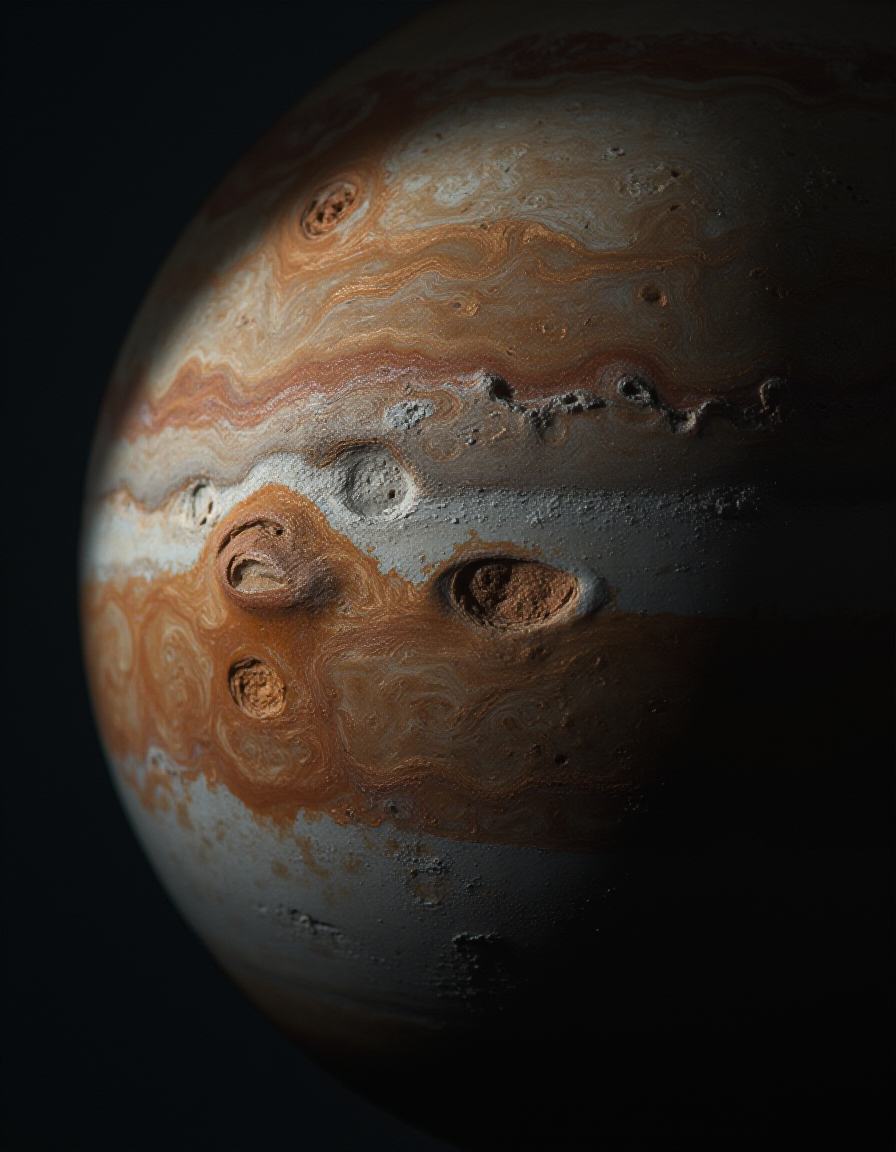
planet mars with a large crater in the center.
CAPTION
The image showcases a detailed and realistic rendering of the planet Jupiter, captured in a high-resolution 3D model. The planet is depicted in a close-up view, with its surface exhibiting a complex network of swirling clouds and a prominent storm system. The clouds are predominantly white and orange, with darker shades indicating the cooler regions of the atmosphere.
MONOLOGUE
The size of Mars taught us that we have in it a planet with an atmosphere of but one half the density of that prevailing on the top of our highest mountain; the distance of Mars from the Sun showed us that it must have a mean temperature close to that of freezing mercury. What chance would there be for life on a world the average condition of which would correspond to that of a terrestrial mountain top, ten miles high and in the heart of the polar regions? But Mars in the telescope does not look like a cold planet. As we look at it, and note its bright colour, the small extent of the white caps presumed to be snow, and the high latitudes in which the dark markings--presumed to be water or vegetation--are seen, it seems difficult to suppose that the mean temperature of the planet is lower than that of the Earth. Thus on the wonderful photographs taken by Prof. Barnard in 1909, the Nilosyrtis with the Protonilus is seen as a dark canal. Now the Protonilus is in North Lat. 42, and on the date of observation--September 28, 1909--the winter solstice of the northern hemisphere of Mars was just past. There would be nothing unusual for the ground to be covered with snow and the water to be frozen in a corresponding latitude if in a continental situation on the Earth. Then, again, in the summer, the white polar caps of Mars diminish to a far greater extent than the snow and ice caps of the Earth; indeed, one of the Martian caps has been known to disappear completely.
SUMMARY
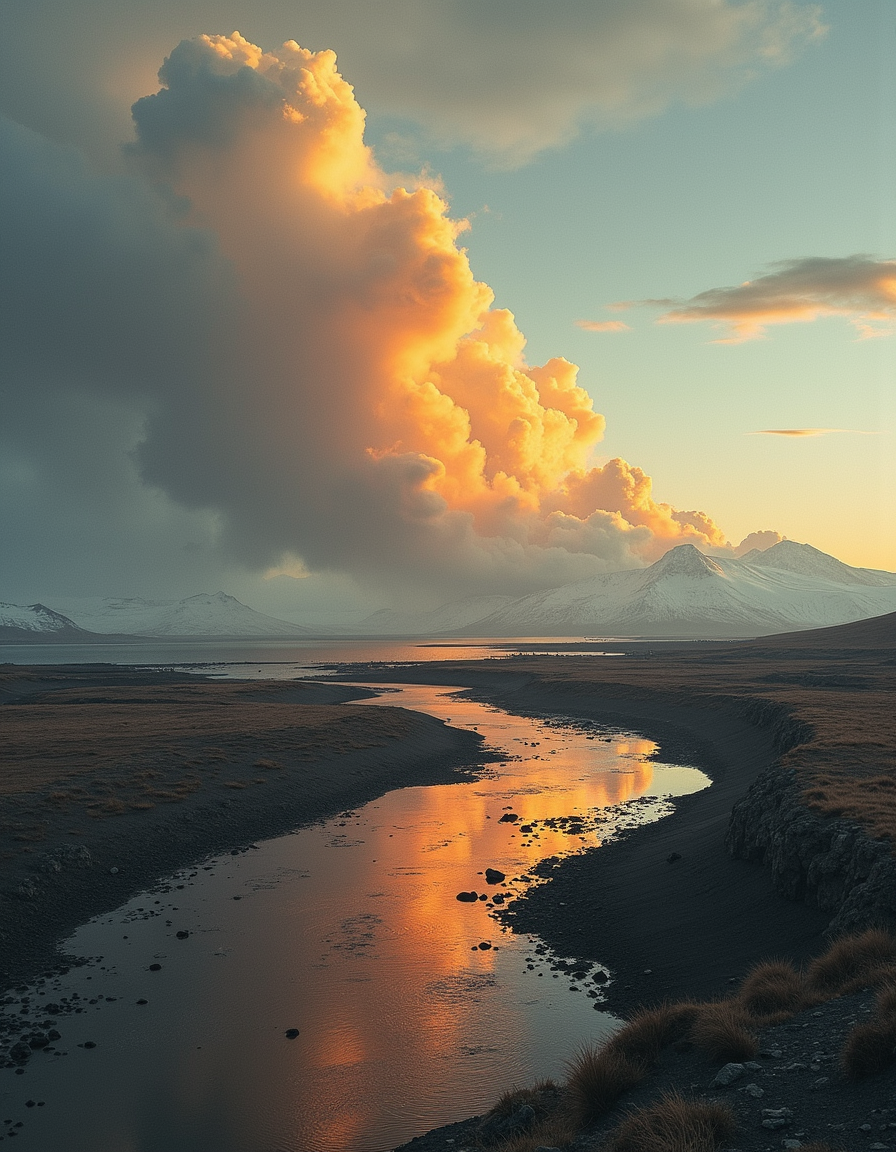
The image depicts a serene landscape featuring a winding river, surrounded by a mountainous backdrop under a dramatic sky filled with clouds.
CAPTION
The image captures a serene landscape at sunset, dominated by a dramatic cloud formation that dominates the sky. The cloud, a vibrant mix of orange and yellow hues, is set against a backdrop of a clear blue sky. The sun, just below the horizon, casts a warm glow on the cloud, creating a beautiful contrast between the sky and the cloud.
MONOLOGUE
When Joe came into the room with what dishes Val could not carry, he found every one up from the table and crowded at the west windows. The lamplight had paled. Into the windows was pouring the last rays of the setting sun, over behind the Livingston Range, the other side of the caon. These rays came out of a great, blue hole in the wall of clouds, and seemed to stream like a vast search-light along the under side of the cloud wrack overhead. They pierced right through the falling snow, which turned to a dancing, dazzling veil of golden crystals between the windows and the sun. And, against the hole into the west, stood up the snow-crowned pyramid of Trapper's Peak, while, to the south, just emerging from the clouds, its great snow-fields tinged with sunset as with blood and gold, rose the beautiful cone of Heaven's Peak, shining, mysterious, magnificent.
SUMMARY
volcanic landscape with dark rocks and pink clouds.
CAPTION
The image depicts a dramatic scene of a volcanic landscape. The sky is filled with a mix of blue and pink clouds, creating a striking contrast against the dark, rocky terrain. The clouds are dense and appear to be moving rapidly, adding a sense of dynamism to the scene.
MONOLOGUE
On clear windless days the intermittent clouds of vapour sent up from the crater assume the most fantastic shapes—trees, ships, men, birds, animals—ever changing like the forms of Proteus. It would seem as if the Spirit of the Mountain were idly amusing himself, like a child blowing bubbles, or a vendor at a fair-stall carving out little figures of gingerbread to tickle the fancy of country boys and girls. The clouds so formed sometimes cause amusement by their uncanny shapes, but not unfrequently they inspire alarm. The superstitious peasant of the _Paduli_, looking up suddenly from his work amidst the early peas or tomatoes, beholds against the blue sky a vague nebulous form that to his untutored mind suggests a gigantic crucifix upheld in mid-air above the Mountain, and he crosses himself devoutly ere he bends down to earth once more to his work in the rich dark soil. “Such stuff as dreams are made of” appear in truth the weird phantoms that the sly Demon of Vesuvius flings up into the pure aether, and if credulous mankind likes to draw inferences for good or bad from these unsubstantial creations of his fancy, he laughs to himself with a hollow reverberating sound. It must, however, have been in the true spirit of prophecy on the occasion of King Manfred’s birth, that the genius of the Mountain despatched two cloud-forms into the sky (so the unabashed old chroniclers gravely relate), one having the appearance of a warrior armed cap-à-pie, and the other that of a fully vested priest. The affrighted gazers below, struck with the strange
SUMMARY
a silhouette of a person standing on a cloud in the night sky with stars and a pink and purple sky
CAPTION
The image depicts a serene night sky filled with a multitude of clouds in shades of pink, purple, and blue. The clouds are scattered across the sky, with some appearing closer to the foreground and others further back. A silhouette of a person is visible in the center of the image, standing on a cloud, adding a sense of solitude and contemplation to the scene.
MONOLOGUE
'Good God, how I love that woman!' the priest said, awaking from his reverie, for the clock told him that he had sat for nearly three-quarters of an hour, her letter in his hand, after having read it. And lying back in his armchair, his hands clasped, his eyes fixed on the window, listening to the birds singing in the vine--it was already in leaf, and the shadows of the leaves danced across the carpet--he sought to define that sense of delight--he could find no other words for it--which she exhaled unconsciously as a flower exhales its perfume, that joy of life which she scattered with as little premeditation as the birds scattered their songs. But though he was constantly seeking some new form of expression of her charm, he always came back to the words 'sense of delight.' Sometimes he added that sense of delight which we experience when we go out of the house on an April morning and find everything growing about us, the sky wilful and blue, and the clouds going by, saying, 'Be happy, as we are.'
SUMMARY
The image depicts a vast expanse of colorful clouds against a vibrant sunset sky.
CAPTION
The image depicts a vibrant and dynamic scene of a colorful sky filled with various shades of blue, pink, and orange clouds. The clouds are arranged in a way that creates a sense of depth and movement, with some clouds appearing closer to the viewer and others farther away.
MONOLOGUE
entire annual course there is no material for landscape effect except the straight line of the horizon with a featureless breadth of sun-faded brown below it and above a merely broader space of faded blue. There is nowhere a curved line, and though as a scientific fact there is vast expanse of flat plain, there is little to suggest it when the sky is empty of clouds. In June the clouds come with a gradual maturing at some point along the even sky-line, and increase rapidly until the heavens are filled with magnificent vapour banks; but the display is simply spectacular, and passes away in a few hours as quickly as it came, with only local showers to refresh the land.
SUMMARY
The image depicts a dramatic scene of a storm cloud, with the colors of the sky and the cloud itself being vivid and contrasting. The cloud is a mix of blue and orange hues, with the blue being more prominent in the center and the orange at the edges, creating a striking visual effect. The cloud appears to be in motion, with the edges
CAPTION
The image depicts a dramatic scene of a vast, swirling mass of clouds, predominantly blue and orange, with a gradient of colors from light to dark. The clouds are densely packed, creating a sense of depth and movement. The colors are vivid and saturated, with the blue and orange hues dominating the scene.
MONOLOGUE
Now is this perpetual consistency in all points, this concentration of every fact which can possibly bear upon what we are to be told, this watchfulness of the entire meaning and system of nature, which fills every part and space of the picture with coincidences of witness, which come out upon us, as they would from the reality, more fully and deeply in proportion to the knowledge we possess and the attention we give, admirable or not? I could go on writing page after page on every sky of Turner's, and pointing out fresh truths in every one. In the Havre, for instance, of the Rivers of France we have a new fact pointed out to us with respect to these cirri, namely, their being so faint and transparent as not to be distinguishable from the blue of the sky, (a frequent case,) except in the course of a sunbeam, which, however, does not illumine their edges, they being not solid enough to reflect light, but penetrates their whole substance, and renders them flat, luminous forms in its path, instantly and totally lost at its edge. And thus a separate essay would be required by every picture, to make fully understood the new phenomena which it treated and illustrated. But after once showing what are the prevailing characteristics of these clouds, we can only leave it to the reader to trace them wherever they occur. There are some fine and characteristic passages of this kind of cloud given by Stanfield, though he dares not use them in multitude, and is wanting in those refined qualities of form which it is totally impossible to
SUMMARY
The image depicts a large, swirling cloud of blue smoke against a dark background.
CAPTION
The image presents a striking blue and white cloud formation against a dark background. The cloud is composed of numerous white clouds, some of which are more prominent and others smaller, creating a sense of depth and dimensionality. The cloud is centrally located, drawing the viewer's attention.
MONOLOGUE
Those innumerable groups of islands, keys and sandbanks, known as the West-Indies, are peculiarly adapted from their locality and formation, to be a favorite resort for pirates; many of them are composed of coral rocks, on which a few cocoa trees raise their lofty heads; where there is sufficient earth for vegetation between the interstices of the rocks, stunted brushwood grows. But a chief peculiarity of some of the islands, and which renders them suitable to those who frequent them as pirates, are the numerous caves with which the rocks are perforated; some of them are above high-water mark, but the majority with the sea water flowing in and out of them, in some cases merely rushing in at high-water filling deep pools, which are detached from each other when the tide recedes, in others with a sufficient depth of water to allow a large boat to float in. It is hardly necessary to observe how convenient the higher and dry caves are as receptacles for articles which are intended to be concealed, until an opportunity occurs to dispose of them. The Bahamas, themselves are a singular group of isles, reefs and quays; consisting of several hundred in number, and were the chief resort of pirates in old times, but now they are all rooted from them; they are low and not elevated, and are more than 600 miles in extent, cut up into numerous intricate passages and channels, full of sunken rocks and coral reefs. They afforded a sure retreat to desperadoes. Other islands are full of mountain fastnesses, where all pursuit can be eluded. Many of
SUMMARY
The image depicts a cloud of white smoke against a black background.
CAPTION
The image depicts a large, fluffy white cloud formation against a black background. The cloud is composed of numerous white, cotton-like particles that are dispersed throughout the cloud, giving it a cotton-like appearance. The cloud is centrally located in the image, occupying a significant portion of the frame.
MONOLOGUE
The Bamangwato hills are part of the range called Bakaa. The Bakaa tribe, however, removed to Kolobeng, and is now joined to that of Sechele. The range stands about 700 or 800 feet above the plains, and is composed of great masses of black basalt. It is probably part of the latest series of volcanic rocks in South Africa. At the eastern end these hills have curious fungoid or cup-shaped hollows, of a size which suggests the idea of craters. Within these are masses of the rock crystallized in the columnar form of this formation. The tops of the columns are quite distinct, of the hexagonal form, like the bottom of the cells of a honeycomb, but they are not parted from each other as in the Cave of Fingal. In many parts the lava-streams may be recognized, for there the rock is rent and split in every direction, but no soil is yet found in the interstices. When we were sitting in the evening, after a hot day, it was quite common to hear these masses of basalt split and fall among each other with the peculiar ringing sound which makes people believe that this rock contains much iron. Several large masses, in splitting thus by the cold acting suddenly on parts expanded by the heat of the day, have slipped down the sides of the hills, and, impinging against each other, have formed cavities in which the Bakaa took refuge against their enemies. The numerous chinks and crannies left by these huge fragments made it quite impossible for their enemies to smoke them out, as was done by the Boers to the people of Mankopane.
SUMMARY
fluffy white clouds against a dark blue sky.
CAPTION
The image presents a serene scene of a cloud formation against a dark blue background. The cloud, composed of white fluffy shapes, is centrally located and appears to be the main focus of the image. The cloud is not perfectly round, but rather has a slightly irregular shape, giving it a dynamic and lively appearance.
MONOLOGUE
Who has not felt in traveling through France, where the eye is often wearied by the monotony of plains, the charming sensation of coming suddenly, when the eye is prepared for a barren landscape, upon a fresh cool valley, watered by a river, with a little town sheltering beneath a cliff like a swarm of bees in the hollow of an old willow? Wakened by the "hu! hu!" of the postilion as he walks beside his horses, we shake off sleep and admire, like a dream within a dream, the beautiful scene which is to the traveler what a noble passage in a book is to a reader,--a brilliant thought of Nature. Such is the sensation caused by a first sight of Nemours as we approach it from Burgundy. We see it encircled with bare rocks, gray, black, white, fantastic in shape like those we find in the forest of Fontainebleau; from them spring scattered trees, clearly defined against the sky, which give to this particular rock formation the dilapidated look of a crumbling wall. Here ends the long wooded hill which creeps from Nemours to Bouron, skirting the road. At the bottom of this irregular amphitheater lie meadow-lands through which flows the Loing, forming sheets of water with many falls. This delightful landscape, which continues the whole way to Montargis, is like an opera scene, for its effects really seem to have been studied.
SUMMARY
a planet with a large red and orange nebula in the background.
CAPTION
The image depicts a vibrant and detailed space scene. Dominating the center of the image is a large, fiery planet with a reddish hue, surrounded by a swirling cloud of clouds that range in hues of blue, orange, and yellow. The planet is set against a backdrop of a starry sky, with numerous stars scattered across the expanse.
MONOLOGUE
Nevia, the home planet of the marauding space-ship, would have appeared peculiar indeed to Terrestrial senses. High in the deep red heavens a fervent blue sun poured down its flood of brilliant purplish light upon a world of water. Not a cloud was to be seen in that flaming sky, and through that dustless atmosphere the eye could see the horizon--a horizon three times as distant as the one to which we are accustomed--with a distinctness and clarity impossible in our Terra's dust-filled air. As that mighty sun dropped below the horizon the sky would fill suddenly with clouds and rain would fall violently and steadily until midnight. Then the clouds would vanish as suddenly as they had come into being, the torrential downpour would cease, and through that huge world's wonderfully transparent gaseous envelope the full glory of the firmament would be revealed. Not the firmament as we know it--for that hot blue sun and Nevia, her one planet-child, were light-years distant from Old Sol and his numerous brood--but a strange and glorious firmament containing few constellations familiar to Earthly eyes.
SUMMARY
a large blue and black sphere with a yellow and orange glow in the background.
CAPTION
The image is a digital painting of a celestial body, possibly a planet or moon, set against a dark, stormy sky. The planet is depicted in shades of blue and orange, with a gradient effect that transitions from dark blue at the top to orange at the bottom. The planet is surrounded by swirling clouds of dark blue and orange, with some clouds appearing to be in motion.
MONOLOGUE
Mr Bowles had the first watch, and Bob was posted at the now all but useless helm. The wind had subsided until it was faint as the breath of a sleeping infant, and the boat's sails flapped gently against the masts as she rode with a scarcely perceptible swinging motion over the long stately slow-moving swell which followed her. The vast blue-black dome of the heavens above was devoid of the faintest trace of cloud, and the countless stars which spangled the immeasurable vault beamed down upon the tiny waif with a soft and mellow splendour which was repeated in the dark bosom of the scarcely ruffled ocean, where the reflected starbeams mingled, far down in its mysterious depths, with occasional faint gleams and flashes of pale greenish phosphorescent light. The thin golden crescent of the young moon hung low down in the velvety darkness of the western sky, and a long thin thread of amber radiance streamed from the horizon beneath her toward the boat, becoming more and more wavering and broken up as it neared her, until within some twenty fathoms of the launch it dwindled away to a mere occasional fluttering gleam. A great and solemn silence prevailed, upon which such slight sounds as the flap of the sails, the pattering of the reef-points, the creak of the rudder, or the stir of some uneasy sleeper broke with almost painful distinctness.
SUMMARY
a large white cloud in the sky with several birds flying in it
CAPTION
The image depicts a vast, fluffy white cloud formation against a clear blue sky. The cloud is the central focus of the image, with several smaller clouds scattered around it. The cloud is predominantly white, with some areas appearing orange due to the reflection of sunlight.
MONOLOGUE
It was a clear moonlight night, with hardly a breath of air blowing, and all the countryside was made visible by the moon's rays, which silvered the roofs of all the villages and made every road like a white tape. Our planes went out over the enemy's lines laden with bombs, and patrolled up and down the tracks and made some thirty attacks upon the German transport and his marching columns. All his lines of approach were kept under continual fire by our guns of heavy calibre, and for miles around shells swept the points which marching men would have to pass, so that their way was hellish. Our aircraft went out and flew very low, and dropped bombs wherever they saw men moving through the luminous mists of the night. Behind our own lines air patrols guarded the countryside. They carried lights, and as they flew in the starlit sky they themselves looked like shooting stars until they dropped low, when their planes were diaphanous as butterfly's wings in sunlight. On the battlefield then was no unusual gun-fire for several hours after dark. Guns on both sides kept up the usual night bombardment in slow sullen strokes, but at least on the Australian front it was not until about 4.45 in the morning that the enemy opened a heavy barrage in Glencorse Wood. The Australian troops were already massed beyond that ground for the attack which was shortly due. On the north, up by Wurst Farm, on the lower slopes of the Gravenstafel, our London Territorials were also waiting to go "over the bags," as they call it. Against them the German guns put over a heavy
SUMMARY
The painting depicts a vibrant sunset over a mountain range, with a winding road leading into the distance. The sky is a deep orange, while the sun is a bright yellow, creating a dramatic contrast. The trees are silhouetted against the sky, adding depth to the scene.
CAPTION
The image depicts a vibrant landscape with a large, glowing sun in the center, surrounded by a cloud of red and orange clouds. The sun is positioned in the upper right corner of the image, casting a warm glow over the scene. The sky is a deep blue, and the ground is a mix of green and brown, with a winding path leading into the distance.
MONOLOGUE
Ahead and on either hand the desert soon began to break and lift. As they went on the dunes grew to be hills and heights, growing, looming, closing in upon them. Now and again a clump of trees or a shoulder of rock or a stretch of foliage stepped out in relief against the brown of the landscape, revealing more than once ideal grazing-land. Also, as they penetrated deeper into this broken country, the sky overhead showed change. From a spotless blue it revealed tiny splotches of gray-white cloud scudding before upper currents. With the passing hours these clouds became heavy, sullen, and threatening, until the sun, dipping into the west, sinking in a kind of hazy moisture, left the heavens completely overcast, cold and bleak and forbidding--a dense mass of cloud-banks down to the tip of ridge and range. And now came dusk, short and chill, and with it the slow ascent of a long grade, leading them up to a ridge, low and ragged, trailing away interminably to north and south in the gloom. Complete darkness found them deep among high hills.
SUMMARY
a large orange planet with rings around it is surrounded by orange clouds and dust
CAPTION
The image presents a surreal depiction of a planet, rendered in a vibrant orange hue with swirling patterns of white and yellow. The planet is encircled by a ring of orange and white clouds, which are scattered throughout the scene. The background is a dark blue, providing a stark contrast to the planet and the clouds.
MONOLOGUE
other. Later in the day there came another, which was also shot. On picking this one up I found it was not quite dead, and it vomited up a couple of large shrimps, which it must have caught in some channel or other. All three were young birds, about 12 inches in length, with dark mottled gray plumage on the back and wings; the breast and under side white, with a scarcely perceptible tinge of orange-red, and round the neck a dark ring sprinkled with gray." At a somewhat later age this mottled plumage disappears; they then become blue on the back, with a black ring round the neck, while the breast assumes a delicate pink hue. Some few days afterwards (August 6th and 8th) some more of these birds were shot, making eight specimens in all.
SUMMARY
The image depicts a serene seascape at sunset, with the sky and clouds in a gradient of orange and yellow hues, reflecting the warm tones of the sunset. The ocean is calm, with gentle waves lapping at the shore, creating a peaceful and tranquil atmosphere.
CAPTION
The image depicts a serene scene of a vast body of water, possibly a lake or ocean, with a clear sky and a few clouds. The water is calm, with gentle ripples on the surface, reflecting the light from the sky. The sky is a gradient of blue, transitioning from light to dark, with the light orange and yellow hues of the clouds adding a warm, inviting atmosphere.
MONOLOGUE
On the morning of the 10th of September, it was announced that the British fleet was coming out of Malden, and Perry immediately set sail to meet it. His squadron consisted of three brigs, the Lawrence, Niagara and Caledonia, the Trippe, a sloop, and five schooners, carrying in all fifty-four guns. That of the British was composed of six vessels, mounting sixty-three guns. It was a beautiful morning, and the light breeze scarcely ruffled the surface of the water as the two squadrons, with all sails set, slowly approached each other. The weather-gauge, at first, was with the enemy, but Perry impatient to close, resolved to waive this advantage, and kept standing on, when the wind unexpectedly shifted in his favor. Captain Barclay observing this, immediately hove to, and lying with his topsails aback, waited the approach of his adversary. With all his canvass out, Perry bore slowly and steadily down before the wind. The breeze was so light that he could scarcely make two miles an hour. The shore was lined with spectators, gazing on the exciting spectacle, and watching with intense anxiety the movements of the American squadron. Not a cloud dimmed the clear blue sky over head, and the lake lay like a mirror, reflecting its beauty and its purity. Perry, in the Lawrence, led the line.
SUMMARY
The image depicts a vast body of water under a cloudy sky, with the sun reflecting off the surface.
CAPTION
The image depicts a vast expanse of water under a cloudy sky. The sky is filled with dark, ominous clouds that are scattered across the sky, creating a dramatic and foreboding atmosphere. The clouds are predominantly dark gray and white, with some areas appearing to be lighter in color.
MONOLOGUE
I had myself called with the four o'clock watch, mornings, for one cannot see too many summer sunrises on the Mississippi. They are enchanting. First, there is the eloquence of silence; for a deep hush broods everywhere. Next, there is the haunting sense of loneliness, isolation, remoteness from the worry and bustle of the world. The dawn creeps in stealthily; the solid walls of black forest soften to gray, and vast stretches of the river open up and reveal themselves; the water is glass-smooth, gives off spectral little wreaths of white mist, there is not the faintest breath of wind, nor stir of leaf; the tranquillity is profound and infinitely satisfying. Then a bird pipes up, another follows, and soon the pipings develop into a jubilant riot of music. You see none of the birds; you simply move through an atmosphere of song which seems to sing itself. When the light has become a little stronger, you have one of the fairest and softest pictures imaginable. You have the intense green of the massed and crowded foliage near by; you see it paling shade by shade in front of you; upon the next projecting cape, a mile off or more, the tint has lightened to the tender young green of spring; the cape beyond that one has almost lost color, and the furthest one, miles away under the horizon, sleeps upon the water a mere dim vapor, and hardly separable from the sky above it and about it. And all this stretch of river is a mirror, and you have the shadowy reflections of the leafage and the curving shores and the receding capes pictured in
SUMMARY
aerial view of clouds in the sky with a white cloud in the center.
CAPTION
The image captures a vast expanse of clouds stretching across the sky, creating a serene and tranquil scene. The clouds, varying in size and shape, are predominantly white and gray, with some exhibiting a hint of blue. The sky above is a clear blue, providing a stark contrast to the clouds below.
MONOLOGUE
And there is that tiny mezzotint in which we find ourselves at the base of a rude little hill. The shock of the quaking earth, the silent passing of the sheeted dead and the rush of the affrighted multitudes tell us that a cosmic tragedy is at hand. In a flare of lightning we see silhouetted against an angry sky three crosses at the top of a sad little hill. It is a crucifixion infinitely more real, more intense than Doré's. Another scene--also engraved by Le Keux: On a stony platform, vast and crowded, the people kneel in sackcloth and ashes; the heavens thunder over the weeping millions of Nineveh, and the Lord of Hosts will not be appeased. Stretching to the clouds are black basaltic battlements, and above rear white-terraced palaces as swans that strain their throats to the sky. The mighty East is in penitence. Or, Elijah is rapt to heaven in a fiery whirlwind; or God creates light. This latter is one of the most extraordinary conceptions of a great visionary and worthy of William Blake. Or Sadak searching for the waters of oblivion. Alas, poor humanity! is here the allegory. A man, a midget amid the terrifying altitudes of barren stone, lifts himself painfully over a ledge of rock. Above him are vertiginous heights; below him, deadly precipices. Nothing helps him but himself--a page torn from Max Stirner is this parable. Light streams upon the struggling egoist as he toils to the summit of consciousness. Among the designs of nineteenth-century artists we can recall none so
SUMMARY
a large cloud formation in the sky with orange and pink hues.
CAPTION
The image captures a dramatic sunset scene with a large, fluffy cloud in the center, illuminated by the warm hues of the setting sun. The cloud is predominantly orange and pink, with some darker patches, suggesting the presence of clouds in the sky.
MONOLOGUE
43. I commend, therefore, in conclusion, the precipice to the artist's _patience_; to which there is this farther and final encouragement, that, though one of the most difficult of subjects, it is one of the kindest of sitters. A group of trees changes the color of its leafage from week to week, and its position from day to day; it is sometimes languid with heat, and sometimes heavy with rain; the torrent swells or falls in shower or sun; the best leaves of the foreground may be dined upon by cattle, or trampled by unwelcome investigators of the chosen scene. But the cliff can neither be eaten nor trampled down; neither bowed by the shower nor withered by the heat: it is always ready for us when we are inclined to labor; will always wait for us when we would rest; and, what is best of all, will always talk to us when we are inclined to converse. With its own patient and victorious presence, cleaving daily through cloud after cloud, and reappearing still through the tempest drift, lofty and serene amidst the passing rents of blue, it seems partly to rebuke, and partly to guard, and partly to calm and chasten, the agitations of the feeble human soul that watches it; and that must be indeed a dark perplexity, or a grievous pain, which will not be in some degree enlightened or relieved by the vision of it, when the evening shadows are blue on its foundation, and the last rays of the sunset resting in the fair height of its golden Fortitude.
SUMMARY
The sky is filled with white clouds and a white bird is flying in the sky.
CAPTION
The image depicts a serene sky with a multitude of white clouds scattered across the sky. The clouds are of varying sizes and shapes, creating a dynamic and lively scene. The sky itself is a clear blue, with no visible clouds or other objects in the background.
MONOLOGUE
We notice some French soldiers, Alpine _chasseurs_, or cavalry on their horses, scattered in groups about this plain, as it may be called, situated at such an altitude. At this moment all lift their heads and look in the same direction; this is because one of those great dangerous birds has just been signalled; it is flying proudly, remote in the open sky, in the clear blue. But immediately it is pursued by white clouds, quite miniature clouds, which give the effect of being created instantaneously, only to vanish as quickly--little explosions of white cotton wool, one might say--and it seems impossible that they should be freighted with death. However, that evil bird has understood; he is aware that good marksmen are aiming at him, and he turns back on hasty wing, while our soldiers gaily burst out laughing.
SUMMARY
a large cumulonimbus cloud with a bright sun in the center of the cloud.
CAPTION
The image depicts a dramatic sky filled with large, fluffy clouds that are illuminated by the setting sun. The clouds are predominantly white and orange, with some areas appearing darker due to the silhouette of the trees and buildings in the foreground. The sky is a gradient of orange and yellow hues, with the sun casting a warm glow on the clouds.
MONOLOGUE
How they flashed and fluttered about the lantern, or circled about the trees upon which the feast had been spread! The big yellow-banded sphinx whirred hither and thither on his owl-like wings, his large eyes glowing like rubies, hung quivering above some flower for a moment, and then was off again as swift as thought. The light drew the great Regalis, all burnished tawny brown, striped and spotted with raw gold; and the Cynthia, banded with lilac, her heavy body tufted with white. The darkness in which they moved, the light which, for a moment revealed them, seemed to make their colors _alive_; for they show no such glow and glory in the common day; they pale when the moon pales, and when the sun is up they are merely moths; they are no longer the fantastic, glittering, gorgeous, throbbing Children of the Dark.
SUMMARY
large, fluffy, white cumulus clouds in the sky.
CAPTION
The image depicts a large, fluffy white cloud in the sky, which appears to be a cumulonimbus cloud. The cloud is positioned in the center of the image and is surrounded by a hazy sky. The cloud is very detailed, with visible texture and shadows, indicating that it is a large, dense cloud.
MONOLOGUE
This is a blending of two kinds of cloud (hence the name of _twain-cloud_,) and it often presents a grand and beautiful appearance, being a collection of large fleecy clouds overhanging a flat stratum or base. When a cumulus increases rapidly a cumulo-stratus frequently forms around its summit, resting thereon as on a mountain, while the former cloud continues to be seen, in some degree, through it. This state of things does not continue long. The cumulo-stratus speedily becomes denser and spreads, while the upper part of the cumulus extends likewise, and passes into it, the base continuing as it was. A large, lofty, dense cloud is thus formed which may be compared to a mushroom with a very thick, short stem. The cumulo-stratus, when well formed and seen singly, and in profile, is quite as beautiful an object as the cumulus. Mr. Howard has occasionally seen specimens constructed almost as finely as a Corinthian capital; the summit throwing a well-defined shadow upon the parts beneath. It is sometimes built up to a great height. The finest examples occur between the first appearance of the fleecy cumuli and the commencement of rain, while the lower atmosphere is comparatively dry, and during the approach of thunder storms. The appearance of the cumulo-stratus, among ranges of hills, presents some interesting phenomena. It appears like a curtain dropping among them and enveloping their summits; the hills reminding the spectator of the massy Egyptian columns which support the flat-roofed temples of Thebes. But when a
SUMMARY
The image depicts a dramatic sky with a large, fluffy white cloud in the center, surrounded by smaller, darker clouds. The sun is visible in the top left corner of the image, casting a bright light on the clouds.
CAPTION
The image captures a dramatic scene of a vast, cloud-filled sky at sunset. The sky is predominantly blue, with the sun positioned in the upper left corner, casting a warm glow that illuminates the clouds. The clouds, varying in size and shape, are scattered across the sky, creating a sense of depth and volume.
MONOLOGUE
It is the contrast of lights and shadows that not only reveals them to us, but enables us to measure their height. On the moon shadows are very much darker than upon the earth, because of the extreme rarity of the moon's atmosphere, if indeed it has any atmosphere at all. By stepping around the corner of a rock there, one might pass abruptly from dazzling noonday into the blackness of midnight. The surface of the moon is extraordinarily rough and uneven. It possesses broad plains, which are probably the bottoms of ancient seas that have now dried up, but these cover only about two fifths of the surface visible to us, and most of the remaining three fifths are exceedingly rugged and mountainous. Many of the mountains of the moon are, foot for foot, as lofty as the highest mountains on the earth, while all of them, in proportion to the size of the moon's globe, are much larger than the earth's mountains. It is obvious, then, that the sunshine, as it creeps over these Alpine landscapes in the moon, casting the black shadows of the peaks and craters many miles across the plains, and capping the summits of lofty mountains with light, while the lower regions far around them are yet buried in night, must clearly reveal the character of the lunar surface. Mountains that can not be seen at all when the light falls perpendicularly upon them, or, at the most, appear then merely as shining points, picture themselves by their shadows in startling silhouettes when illuminated laterally by the rising sun.
SUMMARY
aerial view of clouds in the sky.
CAPTION
The image captures a vast expanse of clouds stretching across the sky, creating a serene and tranquil scene. The clouds, varying in size and shape, are predominantly white and fluffy, with some appearing more dense and others more sparse. The sky above is a clear blue, providing a stark contrast to the clouds below.
MONOLOGUE
The atmosphere of this region is so clear that the grand, solitary, sulphurous cone of Mount tna can be sometimes seen, though it is situated a hundred and thirty miles away, in Sicily. The coast, stretching east and west from Cape Passaro, which is the nearest point to the Maltese islands, is also occasionally visible. The mountain, when seen against the northern sky, assumes the shape of an irregular cone with a widespread base. Some not clearly understood law of refraction must aid the human vision to discern these objects at such great distances beyond the horizon. The most favorable time of the day to seek a view of far-away tna is at sunrise or near sunset. The reader familiar with the White Mountains of New Hampshire has doubtless seen Portland harbor, in the State of Maine, from the top of Mount Washington, though this is a distance of about eighty miles. In this case, the object which is sighted at such long range is at sea level, while tna is over ten thousand feet above the surface of the Mediterranean Sea. Sailors describe the view of far-distant objects as promoted by "atmospheric looming," which perhaps applies in this instance, when one not only sees the low-lying coast of Italy, but it appears to be hardly more than twenty or thirty miles away.
SUMMARY
silhouette of a man wearing a hat and jacket standing in the water at sunset.
CAPTION
The image depicts a silhouette of a person standing on the shore, facing away from the viewer, with the sun setting behind them. The sky is filled with clouds, and the sun is partially obscured by the clouds, casting a warm glow over the scene. The person is wearing a hat and appears to be in a relaxed posture, possibly contemplating the sunset.
MONOLOGUE
clear and cloudless, and the sun shone bright over a country drenched and covered with water. I wished that day to reach Inverness, but a new difficulty appeared. I was told that the Findhorn was so swollen that no mortal man could get across. I saw the boatman going to his ferry-house, and I followed him to see how the matter stood. I soon came to a deep and rapid sweep of water, which appeared to spread far beyond two narrow banks which might have formerly bounded it. This I thought to be the Findhorn, but ere I went many paces farther another sight met my eyes--the real river itself dashing through the glen with an awful majesty, and carrying roots, trees, and herbage of every description hurriedly over its broad breast. In the midst of this scene of devastation appeared the ruins of a noble bridge, nothing but the piers remaining, and these dashing to pieces in the furious current. The stream I had seen at first was the river flowing down the road. The river fell in the evening, and I crossed the ferry. I had two days of most delightful weather, and yesterday evening I had a sunset and moonlight walk by the side of Loch Ness, among the most noble scenery I ever beheld. The sky was perfectly clear, and without a single cloud.
SUMMARY
The image depicts a vast expanse of ocean under a clear blue sky, with a few clouds scattered across the sky. The ocean is calm, with gentle waves rippling across the surface.
CAPTION
The image captures a vast expanse of the ocean under a clear blue sky. The sky is filled with a multitude of white clouds, their fluffy shapes contrasting with the deep blue of the ocean. The clouds are scattered across the sky, with some closer to the horizon and others higher up.
MONOLOGUE
The sea has ever been an inexhaustible subject for the pens of most classes of writers. The poet, the traveller, and the novelist has each devoted a portion of his time and talents to the mighty ocean; but that part of it which it has fallen to my lot to describe is very different from those portions about which poets have sung with rapture. Here, none of the many wonders of the tropical latitudes beguile the tedium of the voyage; no glittering dolphins force the winged inhabitants of the deep to seek shelter on the vessel's deck; no ravenous sharks follow in our wake to eat us if we chance to fall overboard, or amuse us by swallowing our baited hook; no passing vessel cheers us with the knowledge that there are others besides ourselves roaming over the interminable waste of waters. All was dreary and monotonous; the same unvarying expanse of sky and water met our gaze each morning as we ascended to the deck, to walk for half an hour before breakfast, except when the topsails of the other two vessels fluttered for a moment on the distant horizon. Occasionally we approached closer to each other, and once or twice hailed with the trumpet; but these breaks in the solitude of our existence were few and far between.
SUMMARY
The mystical landscape of the underworld is depicted in this digital painting. The sky is a vibrant mix of purple and pink, with clouds swirling around the rocky terrain. A bright, fiery light emanates from the center of the image, adding a sense of drama and intensity to the scene.
CAPTION
The image presents a breathtaking fantasy landscape dominated by a dramatic sky filled with swirling clouds of purple and pink hues. The clouds are illuminated by a radiant light source, casting a kaleidoscope of colors across the scene. The foreground is a rocky terrain, covered in a variety of colors including shades of purple, pink, and orange.
MONOLOGUE
At first, the talk moved somewhat heavily. Neighbor chattered nothings to neighbor in low tones. It was as though the foreboding presence of some grim, unbidden guest overshadowed the spirits of the company But gradually the scene became more animated The glitter of silver and crystal on the board; the sparkle of jewels and the wealth of shimmering colors that costumed the diners; with the strains of music that came from somewhere behind a floral screen that filled the air with fragrance; concealed, as it were, the hideous image of immorality which was the presiding genius of the feast. As the glare of a too bright light blinds the eyes to the ditch across one's path, so the brilliancy of their surroundings blinded the eyes of his guests to the meaning of that horrid figure in the seat of highest honor. But rich foods and rare wines soon loose the tongues that chatter the thoughts of those who do not think. As the glasses were filled and refilled again, the scene took color from the sparkling goblets. Voices were raised to a higher pitch. Shrill or boisterous laughter rang out, as jest and story went the rounds. It was Mrs. Taine, now, rather than her husband, who dominated the scene. With cheeks flushed and eyes bright she set the pace, nor permitted any laggards.