boat





SUMMARY
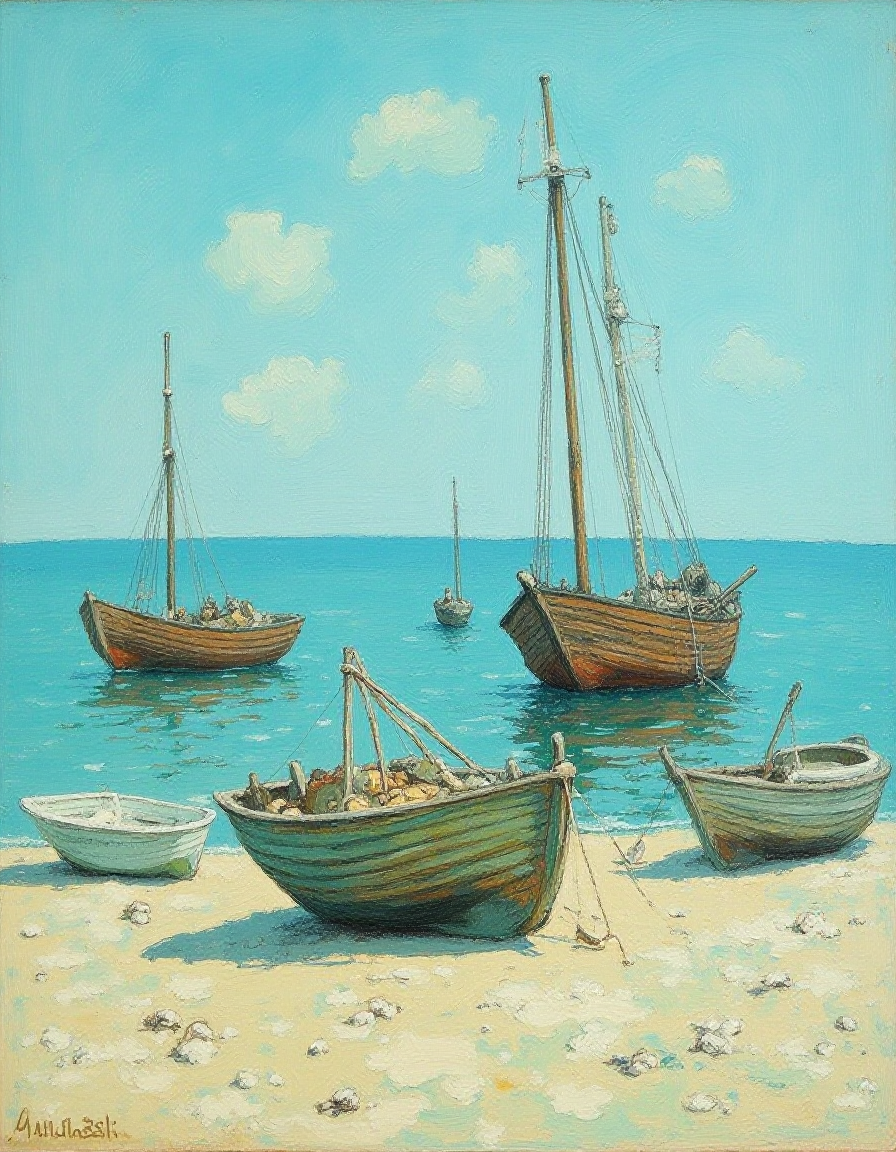
painting of sailboats on a beach with a clear blue sky
CAPTION
The image depicts a serene scene of a beach with several boats anchored in the water. The boats are painted in a light blue color, with some of them having white sails. The sky above is a clear blue, and there are a few clouds scattered across it.
MONOLOGUE
32. LANDSCAPE PAINTING ON WALLS OF ROOMS.--Dissolve half a pound of glue in a gallon of water, and with this sizing, mix whatever colours may be required for the work. Strike a line round the room, nearly breast high; this is called the horizon line: paint the walls from the top to within six inches of the horizon line, with sky blue, (composed of refined whiting and indigo, or slip blue,) and at the same time, paint the space from the horizon line to the blue, with horizon red, (whiting, coloured a little with orange lead and yellow ochre,) and while the two colours are wet, incorporate them partially, with a brush. Rising clouds may be represented by striking the horizon red colour upon the blue, before it is dry, with a large brush. Change some sky blue about two shades with slip blue and paint your design for rivers, lakes or the ocean. Change some sky blue one shade with forest green, (slip blue and chrome yellow,) and paint the most distant mountains and highlands; shade them while wet, with blue, and heighten them with white, observing always to heighten the side that is towards the principal light of the room. The upper surface of the ocean must be painted as high as the horizon line, and the distant highlands must rise from ten to twenty inches above it.--Paint the highlands, islands, &c. of the second distance, which should appear from four to six miles distant, with mountain green, (two parts sky blue with one of forest green,) heighten them, while wet, with sulphur
SUMMARY
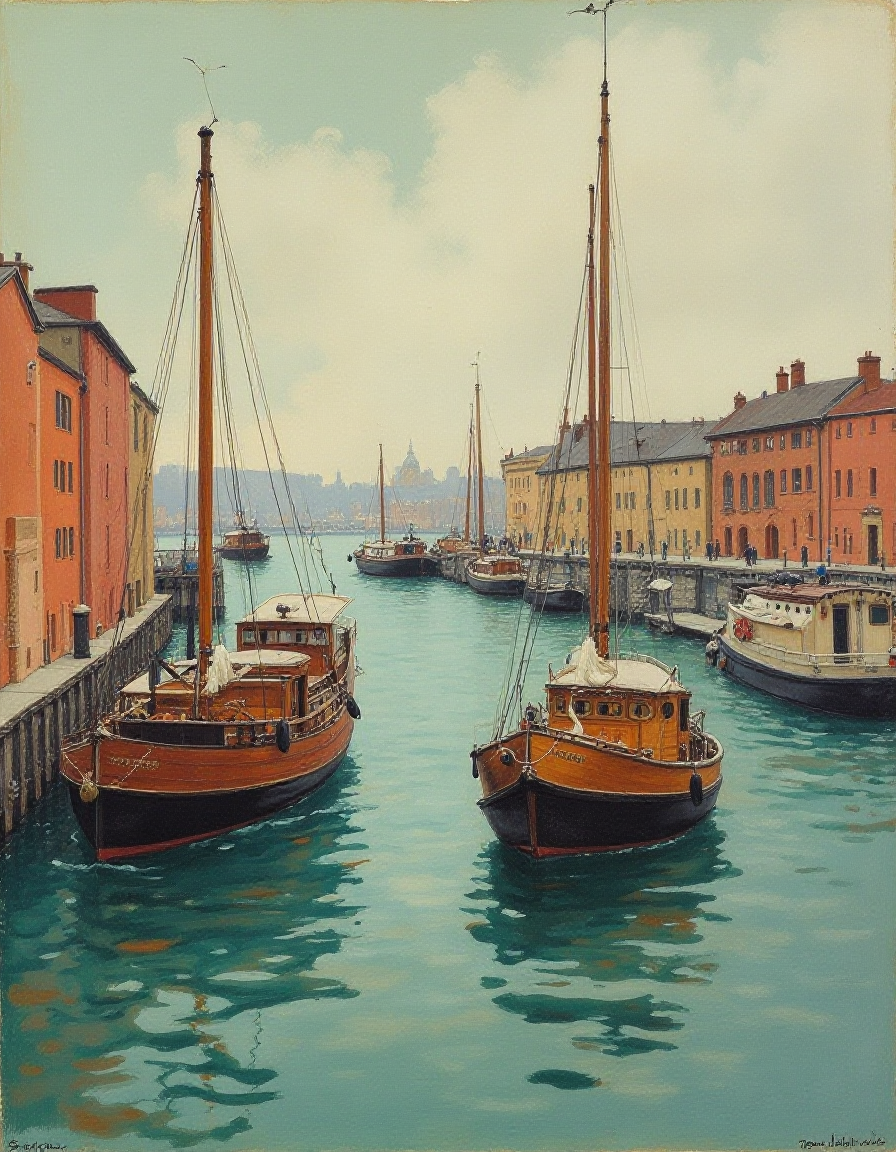
The painting depicts a harbor with several boats and buildings in the background.
CAPTION
The image depicts a picturesque harbor scene with several boats moored in the water. The boats are of various sizes and colors, with some being larger and others smaller. The water is a deep blue-green color, reflecting the sky above.
MONOLOGUE
The skaters and water-bugs finally disappear in the latter part of October, when the severe frosts have come; and then and in November, usually, in a calm day, there is absolutely nothing to ripple the surface. One November afternoon, in the calm at the end of a rain storm of several days’ duration, when the sky was still completely overcast and the air was full of mist, I observed that the pond was remarkably smooth, so that it was difficult to distinguish its surface; though it no longer reflected the bright tints of October, but the sombre November colors of the surrounding hills. Though I passed over it as gently as possible, the slight undulations produced by my boat extended almost as far as I could see, and gave a ribbed appearance to the reflections. But, as I was looking over the surface, I saw here and there at a distance a faint glimmer, as if some skater insects which had escaped the frosts might be collected there, or, perchance, the surface, being so smooth, betrayed where a spring welled up from the bottom. Paddling gently to one of these places, I was surprised to find myself surrounded by myriads of small perch, about five inches long, of a rich bronze color in the green water, sporting there, and constantly rising to the surface and dimpling it, sometimes leaving bubbles on it. In such transparent and seemingly bottomless water, reflecting the clouds, I seemed to be floating through the air as in a balloon, and their swimming impressed me as a kind of flight or hovering, as if they
SUMMARY
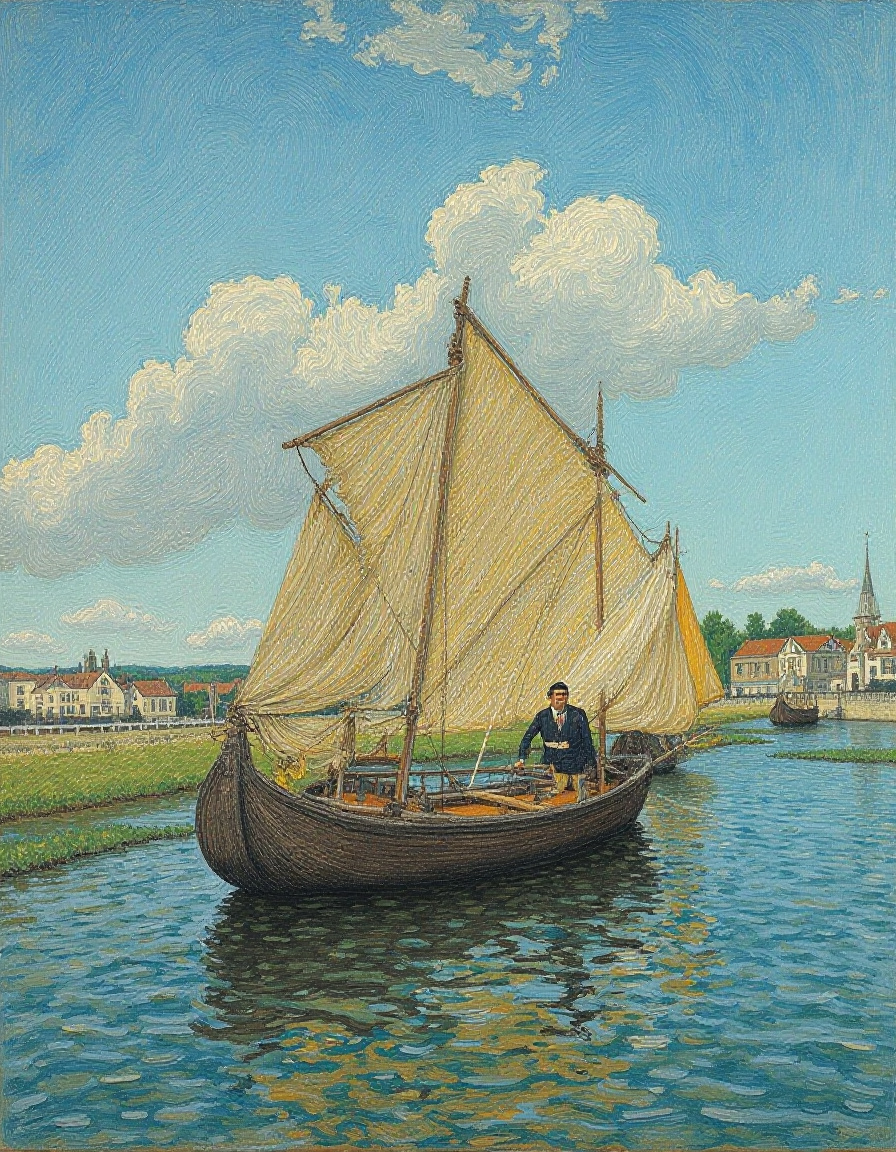
The painting depicts a man in a boat on a river, with a church in the background.
CAPTION
The image depicts a painting of a man sailing a boat on a river. The man is standing in the middle of the boat, holding a rope that is attached to the boat's mast. The boat is brown and is being pulled by a large sail.
MONOLOGUE
It was already nearly midnight; we therefore commenced our preparations without delay. Upon this occasion, I decided to take my friend as a companion; we each dressed in black clothes, and besides taking our revolvers, placed a couple of rifles in the boat. In the meanwhile, according to my instructions, Philip had made the crew prepare a large drag, in the form of a cross, made with two short and broad spars, lashed together at their centres. When this was ready, the end of a long coir rope was made fast to the middle, the other end being fastened to our canoe, with a few fathoms to spare, which were passed ashore. The drag was now placed in our large boat, and being pulled far out on the river, was tossed overboard; this was signalled by showing a lamp. Directly I saw the light, I gave the word to start away: Philip and three of the crew, well armed, taking the end of the rope, walked down the bank, keeping our canoe close under its shadow, and progressing as fast as the drag at the other end of the rope was drifting with the current. After proceeding in this order for twenty minutes, during which we had slowly been hauling in the line till we had coiled nearly half of it in the canoe, we arrived fairly abeam of the lorcha, and, almost immediately afterwards, felt the jerk of the rope as it caught across her cable. Gradually easing it out, our companions dragged us carefully past the vessel--scarcely a hundred feet distant. At length the rope was all payed out to the bare end, and taking a small line, one end of which
SUMMARY
a cartoon duck in a red boat on a lake with a cloudy sky
CAPTION
The image depicts a serene scene of a small, yellow duckling in a red boat floating on a calm body of water. The duckling is positioned in the center of the boat, looking towards the right side of the image, with its head turned slightly to the left.
MONOLOGUE
M. got into a portable, square, flat-bottomed canvas boat he had sent the day before, and his heathen boatman, who swore he could row, cut branches to hide both of them from the duck. This arrangement looked like a fair sized table decoration, a conspicuous man in a topee with a gun at one end, and a black white-turbaned native at the other. Away they went, left oar, right oar! I watched these simple manoeuvres from the far side, where, like the other guns, I was posted at the water's edge, in full view of the duck which were swimming about in mid water, chuckling at us I am sure. The native's rowing was a sight! first one oar high in the air, then the other. I saw Monteith had to change and did both rowing and shooting, probably the native had never seen a boat in his life! When M. began firing at the duck at long range, they got up the usual way, straight up, and then flew round and round, high up. I didn't know whether to watch the duck or enjoy looking at the village scene opposite, for it was at once delightfully new and delightfully familiar. There were mud-built cottages among feathery-foliaged trees with wide roofs of thatch of a silver grey colour, and above them were two or three palms against the sky. Biblical looking ladies went to and fro between lake and village, and each carried on her head a large, black, earthenware bowl steadied by one hand, and a smaller brass pot swinging in the other. Blue-black buffaloes and white and yellow cows sauntered on the sloping banks, watched by men in white clothes and
SUMMARY
a group of seven small boats are anchored in the shallow turquoise waters of a beach
CAPTION
The image depicts a serene beach scene with a clear blue sky and a few boats anchored in the calm water. The boats, varying in size and color, are positioned in the center of the image, with some closer to the foreground and others further back. The waves gently crash onto the shore, creating a soothing and peaceful atmosphere.
MONOLOGUE
Concerning themselves little about their own steeds, the party took those which first offered, and embarking man and horse in the boat, soon pushed across the waters of the lutulent Don. Arrived at the opposite banks of the river, they mounted, and, guided by Luke, after half an hour's sharp riding, arrived at the skirts of Rookwood Park. Entering this beautiful sylvan domain, they rode for some time silently among the trees, till they reached the knoll whence Luke beheld the hall on the eventful night of his discovery of his mother's wedding ring. A few days only had elapsed, but during that brief space what storms had swept over his bosom--what ravages had they not made! He was then all ardor--all impetuosity--all independence. The future presented a bright unclouded prospect. Wealth, honors, and happiness apparently awaited him. It was still the same exquisite scene, hushed, holy, tranquil--even solemn, as upon that glorious night. The moon was out, silvering wood and water, and shining on the white walls of the tranquil mansion. Nature was calm, serene, peaceful as ever. Beneath the trees, he saw the bounding deer--upon the water, the misty wreaths of vapor--all, all was dreamy, delightful, soothing, all save his heart--_there_ was the conflict--_there_ the change. Was it a troubled dream, with the dark oppression of which he was struggling, or was it stern, waking, actual life? That moment's review of his wild career was terrible. He saw to what extremes his ungovernable passions had hurried him; he saw their
SUMMARY
The image depicts a serene scene of a harbor with several sailboats docked, with a person standing on one of the boats.
CAPTION
The image depicts a serene scene of a calm body of water, likely a lake or a river, with several sailboats moored along the shore. The boats are docked in a line, with one boat prominently positioned in the foreground, close to the camera, and the others further back, creating a sense of depth.
MONOLOGUE
Sahwah lingered on the river after the others had gone in a body to try to climb to the top of the rocky fireplace. She was all alone in the _Keewaydin_, and sent it darting around like a water spider on the surface of the stream. So absorbed was she in the joy of paddling that she did not see a sign on a tree beside the river which warned people in boats to go no further than that point, neither did she realize the significance of the quicker progress which the _Keewaydin_ was making. When she did realize that she was getting dangerously near the edge of the dam, and attempted to turn back, she discovered to her horror that it was impossible to turn back. The _Keewaydin_ was being swept helplessly and irresistibly onward. Recent rains had swollen the stream and the water was pouring over the dam. Sahwah screamed aloud when she saw the peril in which she was. Nyoda and Mrs. Evans and the girls, standing up on the rocks, turned and saw her. Help was out of the question. Frozen to the spot they saw her rushing along to that descent of waters. Gladys moaned and covered her face with her hands. Below the falls the great rocks jutted out, jagged and bare. Any boat going over would be dashed to pieces.
SUMMARY
The image depicts a serene scene of several boats anchored in calm waters, with a clear blue sky in the background.
CAPTION
The image depicts a serene scene of several boats anchored in calm water. There are three boats in the image, each with distinct characteristics. The first boat, positioned towards the left, is a small white boat with a green canopy.
MONOLOGUE
The breadth of the wooded valley, at the commencement, is probably more than half a mile, and there is a tolerably clear view for a considerable distance on each side of the water-path through the irregular colonnade of trees; other paths also, in this part, branch off right and left from the principal road, leading to the scattered houses of Indians on the mainland. The dell contracts gradually towards the head of the rivulet, and the forest then becomes denser; the water-path also diminishes in width, and becomes more winding, on account of the closer growth of the trees. The boughs of some are stretched forth at no great height over one’s head, and are seen to be loaded with epiphytes; one orchid I noticed particularly, on account of its bright yellow flowers growing at the end of flower-stems several feet long. Some of the trunks, especially those of palms, close beneath their crowns, were clothed with a thick mass of glossy shield-shaped Pothos plants, mingled with ferns. Arrived at this part we were, in fact, in the heart of the virgin forest. We heard no noises of animals in the trees, and saw only one bird, the sky-blue chatterer, sitting alone on a high branch. For some distance the lower vegetation was so dense that the road runs under an arcade of foliage, the branches having been cut away only sufficiently to admit of the passage of a small canoe. These thickets are formed chiefly of bamboos, whose slender foliage and curving stems arrange themselves in elegant, feathery bowers; but other social plants,—slender green climbers with
SUMMARY
painting of sailboats on a body of water with a cloudy sky
CAPTION
The image depicts a serene scene of sailboats on a calm body of water. The boats, each with multiple sails, are arranged in a line, with the closest boat slightly ahead of the others. The water is a light blue-green color, reflecting the sky above.
MONOLOGUE
Fishing and hunting are not the sole diversions. As long ago as in 1811, when young Captain Nairne came here fresh from Europe, the boating attracted him and he spent much time on the bay and the river. No doubt the young seigneur was soon skilful in the art of paddling a canoe. In those days there were real Indians and no other canoes than those of birch bark; now these have well-nigh disappeared and, indeed, few visitors at Murray Bay, use any kind of a canoe. The pastime is thought too dangerous for all but the initiated. Amid these mountains, winds rise quickly and beat up a sea, and it is well to keep near the shore. The rising tide sweeps like a mill race over the bar at the mouth of the bay and when one has passed out to the great river it is like being afloat on the open sea. On perfectly calm days we may go far out to be swept up with the tide; but it is both safer and pleasanter to glide along close to shore under the shadow of the cliffs, around sharp corners, dodging in and out among boulders submerged, or now being submerged, by the rising tide. The successive sandy beaches are each backed by high cliffs. The river is a shining, spangled, surface of light blue and white, reflecting the sky sprinkled with fleecy clouds. Here a chattering stream, the Petit Ruisseau, falls over white rocks to lose itself in the sand. Far ahead now one can see the Church of Ste. Irenee perched on a level table-land, two or three hundred feet above the river. Soon a dark green line on the high birch-clad shore marks the
SUMMARY
The boat is in the middle of the river, surrounded by rocks and water.
CAPTION
The image depicts a serene underwater scene with a boat navigating through a narrow passage between two rocky cliffs. The water is a vibrant turquoise, reflecting the warm hues of the setting sun. The boat, which is black, is positioned centrally in the image, with its bow facing towards the left side of the frame.
MONOLOGUE
"And at last when its walls were reached, and the outmost of its untrodden streets was entered, not through towered gate or guarded rampart, but as a deep inlet between two rocks of coral in the Indian Sea; when first upon the traveller's sight opened the long ranges of columned palaces--each with its black boat moored at the portal, each with its image cast down beneath its feet upon that green pavement which every breeze broke into new fantasies of rich tessellation when first, at the extremity of the bright vista, the shadowy Rialto threw its colossal curve slowly forth from behind the palace of the Camerlemghi, that strange curve, so delicate, so adamantine, strong as a mountain cavern, graceful as a bow just bent; when first, before its moonlike circumference was all risen, the gondolier's cry, 'Ah! Stali!" struck sharp upon the ear, and the prow turned aside under the mighty cornices that half met over the narrow canal, where the plash of the water followed close and loud, ringing along the marble by the boat's side; and when at last the boat darted forth upon the breadth of silver sea, across which the front of the Ducal palace, flushed with its sanguine veins, looks to the snowy dome of Our Lady of Salvation, it was no marvel that the mind should be so deeply entranced by the visionary charm of a scene so beautiful and so strange as to forget the darker truths of its history and its being, "Well might it seem that such a city had owed her existence rather to the rod of the enchanter, than the fear of the fugitive; that the
SUMMARY
a painting of a man in a boat at sunset.
CAPTION
The image depicts a tranquil scene of a small boat on a body of water, with the sun setting in the background. The boat is positioned centrally in the image, with the sun casting a warm glow over the water. The sky is a vibrant mix of orange and yellow hues, with the sun positioned in the upper right corner of the image.
MONOLOGUE
The tea, sugar, and biscuit, having got wet in the sunken boat, I was compelled to halt this day in order to dry these articles if possible, in the sun, and the heat being very intense, we were tolerably successful. The sugar, in a liquid state, was laid out in small quantities on tarpaulins; the tea was also spread out thinly before the sun, and thrown about frequently--and thus we were enabled, by the evening, to pack it up quite dry in canisters; the whole having lost in weight two and a half pounds. The sugar had crystallised sufficiently to be put up again, without any danger of fermentation. During many days I had anxiously watched the smoky red hot sky for some appearance of rain: no dew nourished the grass, which had become quite yellow, and the river upon which I set my hopes was rapidly drying up. In my tent the thermometer generally reached 100 degrees of Fahrenheit during the day. At length the welcome sound of thunder was heard, and dark clouds cooled the atmosphere long before sunset. These clouds at length poured a heavy shower on the yawning earth; flakes of ice or hail accompanied it, and we enjoyed a cool draught of iced water, where the air had just before been nearly as warm as the blood.
SUMMARY
a group of people are in a canoe on a lake with mountains in the background
CAPTION
The image depicts a serene lakeside scene with a boat in the foreground. The boat, painted in a deep purple hue, is being rowed by two individuals. The boat is positioned on the calm water, which reflects the vibrant colors of the sky and the surrounding landscape.
MONOLOGUE
swell. It is possible that a philosophic idea is intended to be suggested--the passage of the soul through the pleasant delights of earth to the contemplation of the infinite.'--Laurence Binyon, _Painting in the Far East_ (1908), pp. 75-6. The section of the roll which has been chosen for reproduction here has already been reproduced in S.W. Bushell, _Chinese Art_ (1910), II, Fig. 127, where it is thus described: 'A lake with a terraced pavilion on an island towards which a visitor is being ferried in a boat, while fishermen are seen in another boat pulling in their draw-net; the distant mountains, the pine-clad hills in the foreground, the clump of willow opposite, and the line of reeds swaying in the wind along the bank of the water are delightfully rendered, and skilfully combined to make a characteristic picture.'--_Ibid_., II, p. 134. Other sections of the same roll are reproduced in H.A. Giles, _Introd. to the Hist, of Chinese Pictorial Art_ (2nd ed., 1918) facing p. 56; and in L. Binyon, _op. cit_., plate III (facing p. 66). It is exceedingly interesting to compare this landscape roll with the MS of Marco Polo, illuminated about a century later, from which the scene of the embarkation at Venice has been taken; the one is so obviously the work of a highly developed and the other of an almost nave and childish civilization.
SUMMARY
The image depicts a heart-shaped light effect in the sky, which is illuminated by the sun, creating a dramatic and visually striking scene. Two boats are visible in the water, with one boat positioned closer to the foreground and the other further back. The boats are positioned on the water, with the closer boat having a person on board, and the
CAPTION
The image captures a serene sunset scene with two boats on the ocean. The boats, one on the left and the other on the right, are positioned in the middle of the image, with the sun setting behind them. The sun is prominently displayed in the sky, casting a warm glow over the scene.
MONOLOGUE
The whole of the next day we were obliged to stop near the village of Tidore, owing to a strong wind right in our teeth. The country was all cultivated, and I in vain searched for any insects worth capturing. One of my men went out to shoot, but returned home without a single bird. At sunset, the wind having dropped, we quitted Tidore, and reached the next island, March, where we stayed till morning. The comet was again visible, but not nearly so brilliant, being partly obscured by clouds; and dimmed by the light of the new moon. We then rowed across to the island of Motir, which is so surrounded with coral-reefs that it is dangerous to approach. These are perfectly flat, and are only covered at high water, ending in craggy vertical walls of coral in very deep water. When there is a little wind, it is dangerous to come near these rocks; but luckily it was quite smooth, so we moored to their edge, while the men crawled over the reef to the land, to make; a fire and cook our dinner-the boat having no accommodation for more than heating water for my morning and evening coffee. We then rowed along the edge of the reef to the end of the island, and were glad to get a nice westerly breeze, which carried us over the strait to the island of Makian, where we arrived about 8 P.M, The sky was quite clear, and though the moon shone brightly, the comet appeared with quite as much splendour as when we first saw it.
SUMMARY
Two women in a boat, one in an orange dress, are conversing, with the woman in the orange dress looking at the other woman.
CAPTION
The image depicts two women in a boat, both dressed in orange, with one woman holding a small object in her hand. The background is dark, with a faint light source above them, creating a dramatic effect. The water in the boat is calm, reflecting the light from the background.
MONOLOGUE
houses look, and where the annual dances take place. The houses have the effect of being built in terraces rising one above the other, but it is hard to say exactly what a house is--whether it is anything more than one room. You can reach some of the houses only by aid of a ladder. You enter others from the street. If you will go farther you must climb a ladder which brings you to the roof that is used as the sitting-room or door-yard of the next room. From this room you may still ascend to others, or you may pass through low and small door-ways to other apartments. It is all haphazard, but exceedingly picturesque. You may find some of the family in every room, or they may be gathered, women and babies, on a roof which is protected by a parapet. At the time of our visit the men were all away at work in their fields. Notwithstanding the houses are only sun-dried bricks, and the village is without water or street commissioners, I was struck by the universal cleanliness. There was no refuse in the corners or alleys, no odors, and many of the rooms were patterns of neatness. To be sure, an old woman here and there kept her hens in an adjoining apartment above her own, and there was the litter of children and of rather careless house-keeping. But, taken altogether, the town is an example for some more civilized, whose inhabitants wash oftener and dress better than these Indians.
SUMMARY
woman in uniform steering ship with cityscape in the background
CAPTION
The image depicts a woman standing on a boat, wearing a black hat with a gold badge and a dark green coat. She is holding onto the boat's steering wheel with her right hand, and her left hand is resting on her chest. The background features a body of water with a few buildings visible in the distance, suggesting a coastal or harbor setting.
MONOLOGUE
Neither had the wayfarer trusted entirely to her own judgment. In spite of Ruth's repeated warnings against talking to strangers, she had once accosted a man in a queer uniform, thinking him a policeman. He wore a dark blue coat, blue-gray trousers, a white cap and belt, so how could a newcomer have known him to be a member of the Roman garrison? However, when once the soldier had discovered Frieda's desire, his directions were so explicit, so accompanied by much waving of his hand and statements of "destra" (right) and "sinistra" (left), that Frieda believed her way clear at last. Nevertheless, though doing exactly what she believed she had been told, the result was the same. Frieda had again to return to her fountain, a now painfully familiar spot. In the course of this wandering, however, she had passed an ancient church with a high flight of steps, where she paused to gaze for a few moments in awe and wonder. A number of pilgrims were climbing the wooden steps on their knees and children were running about among them offering rosaries and small wooden images for sale. Frieda had purchased a St. Joseph and then regretted her investment, for at least half the crowd of children followed her back to her resting place. They were still whining about her begging for pennies, when some time ago she had given them all the change she had. Yet they would _not_ leave her alone. Happening to glance down at her arm Frieda now made the painful discovery that her beloved gold-link purse had disappeared. Still the poor child had her
SUMMARY
The boat is in the middle of the ocean and there is a person in it.
CAPTION
The image depicts a serene scene of a small boat floating on a vast expanse of clear turquoise water. The boat, painted in a striking red, is positioned centrally in the frame, with its bow pointing towards the left side of the image. The water surrounding the boat is a deep shade of green, creating a harmonious contrast with the vibrant red of the boat.
MONOLOGUE
While our young mariner and his companion were working their way up to the table-land, which lay fully three hundred feet above the level of the sea, there was little opportunity for further discourse, so rough was the way, and so difficult the ascent. At the summit, however, there was a short pause, ere the two undertook the mountain proper, and they came to a halt to take a look at the aspect of things around them. There was the boat, a mere white speck on the water, flying away with a fresh northerly breeze towards the volcano, while the smoke from the latter made a conspicuous and not very distant land-mark. Nearer at home, all appeared unusually plain for a region in which fogs were so apt to prevail. The cove lay almost beneath them, and the schooner, just then, struck the imagination of her commander as a fearfully small craft to come so far from home and to penetrate so deep among the mazes of the ice. It was that ice, itself, however, that attracted most of Roswell's attention. Far as the eye could reach, north, south, east and west, the ocean was brilliant and chill with the vast floating masses. The effect on the air was always perceptible in that region, 'killing the summer,' as the sealers expressed it; but it seemed to be doubly so at the elevation to which the two adventurers had attained. Still, the panorama was magnificent. The only part of the ocean that did not seem to be alive with ice-bergs, if one may use such an expression, was the space within the group, and that was as clear as an
SUMMARY
The man in the boat is rowing with a stick.
CAPTION
The image depicts a scene of a man in a traditional boat, navigating through a bustling waterfront. The man, dressed in a white shirt and a red hat, is holding a long pole in his hand, possibly a fishing rod. The boat he is in is wooden and is being tossed by the waves, indicating a lively and active environment.
MONOLOGUE
At length we were fairly on our voyage, far away out on the wide ocean without the most distant glimpse of land. Nothing but dark, heaving, white-crested waves around us. To me, as I looked over the bulwarks, the scene was inexpressibly strange, and grand, and awe-producing. I should have liked to have been for a short time perfectly alone, to have enjoyed it to the full, not another human being near me, with only Solon, my dumb companion, by my side. Far more I could have enjoyed it, I thought, than among the noisy, quarrelling crowd of passengers who formed the little coarsely composed world confined within those wooden walls, as the expression runs. Still, I did not think that I could have endured the solitude I wished for during any long period, but felt that I should soon have been glad to return to the midst of my noisy associates, Solon seemed as much surprised as I was when, looking out first at one port, then through the other, he found that there was no land to be seen. Several times he ran backwards and forwards, evidently trying to settle in his mind the state of the case. At last he was satisfied; then came up and licked my hand, as much as to say,--"I understand it all now, master. We are embarked in the same boat; and whatever befalls us, I intend to stick by you." Thanks to Mr Henley's kindness, I had been allowed to arrange a berth for Solon just outside his cabin, between two chests, and within sight of my hammock. I made a mattress for him with some bits of old canvas stuffed with straw; for
SUMMARY
a large red crab is in a wooden boat on the ocean
CAPTION
The image depicts a vibrant scene of a wooden boat navigating through choppy waters. The boat, painted in a palette of blues and greens, is adorned with a red crab that appears to be the main focus of the scene.
MONOLOGUE
This very beautiful scene is taken from a roll painted by Chao Mêng-fu in 1309 in the style of Wang Wei, a poet and artist of the T'ang dynasty (A.D. 699-759). A fine description of it is given by Mr Laurence Binyon: 'In the British Museum collection is a long roll, over seventeen feet long, painted almost entirely in blues and greens on the usual warm brown silk.... It is one continuous landscape, in which the scenes melt into one another. Such rolls are not meant to be exhibited or looked at all at once, but enjoyed in small portions at a time, as the painting is slowly unrolled and the part already seen rolled up again. No small mastery is requisite, as may be imagined, to contrive that wherever the spectator pauses an harmonious composition is presented. One has the sensation, as the roll unfolds, of passing through a delectable country. In the foreground water winds, narrowing and expanding, among verdant knolls and lawns, joined here and there by little wooden bridges; and the water is fed by torrents that plunge down among pine-woods from crags of fantastic form, glowing with hues of lapis-lazuli and jade; under towering peaks are luxuriant valleys, groves with glimpses of scattered deer, walled parks, clumps of delicate bamboo, and the distant roofs of some nestling village. Here and there is a pavilion by the water in which poet or sage sits contemplating the beauty round him. These happy and romantic scenes yield at last to promontory and reed-bed on the borders of a bay where a fisherman's boat is rocking on the
SUMMARY
The image depicts a picturesque landscape featuring a mountain, a lake, and several boats. The sky is filled with fluffy white clouds, and the overall scene exudes a sense of tranquility and natural beauty.
CAPTION
The image depicts a serene landscape featuring a mountain range in the background, with a body of water in the foreground. The mountain range is lush with greenery, and the water is a deep blue, reflecting the clear sky above. Several boats are scattered across the water, with one boat prominently positioned in the center, close to the camera.
MONOLOGUE
As these thoughts are drifting through our enchanted dream we suddenly hear a deep and threatening roar from the mountain-side. We look up and see an avalanche falling down the rocks of the Jungfrau. The vast mountain, with its dazzling vestment of eternal snow, and its slowly creeping, green-fissured glaciers, towers above into the cloudless sky. In an instant the mind travels from the microscopic details of organic beauty, which but a moment ago held it entranced, to the contemplation of the gigantic and elemental force whose tremendous work is even now going on close to where we stand. The contrast, the range from the minute to the gigantic, is prodigious yet exhilarating, and strangely grateful. How many millions of years did it take to form those rocks (many of them are stratified, water-laid deposits) in the depths of the ocean? How many more to twist and bend them and raise them to their present height? And what inconceivably long persistence of the wear and tear of frost and snow and torrent has it required to excavate in their hard bosoms these deep, broad valleys thousands of feet below us, and to leave these strangely moulded mountain peaks still high above us? And that beauty of the sun-lit sky and of the billowy ice-field and of the colours of the lake below and of the luminous haze and the deep blue shade in the valley--how is that related to the beauty of the flowers? Truly enough, it is not a beauty called forth by natural selection. It is primordial; it is the beauty
SUMMARY
The boat is sailing on the ocean and is being tossed by the waves.
CAPTION
The image captures a serene scene of a small sailboat navigating the vast expanse of the ocean. The boat, painted in a light brown hue, is equipped with a single mast and a sail that is partially unfurled. The boat is positioned in the center of the image, with its bow facing towards the left side of the frame.
MONOLOGUE
The boat was what is called a Whitehall row-boat. She was seventeen feet long, and rowed very easily, and she carried a small mast with a spritsail. By Uncle John's orders an air-tight box, made of tin, was fitted into each end of the boat, so that, even if she were to be filled with water, the air in the tin boxes would float her. She was painted white outside, with a narrow blue streak, and dark brown inside. Harry named her the _Whitewing_; and his mother made a beautiful silk signal for her, which was to be carried at the sprit when under sail, and on a small staff at the bow of the boat at other times. For oars there were two pairs of light seven-foot sculls, and a pair of ten-foot oars, each of which was to be pulled by a single boy. The rudder was fitted with a yoke and a pair of lines, and the sail was of new and very light canvas. On one side of the boat was a little locker, made to hold a gun; and on the other side were places for fishing-rods and fishing-tackle. When she was brought around to Harlem, and Harry saw her for the first time, he was so overjoyed that he turned two or three hand-springs, bringing up during the last one against a post--an exploit which nearly broke his shin, and induced his uncle to remark that he would never rise to distinction as a Moral Pirate unless he could give up turning hand-springs while on duty.
SUMMARY
The boat is illuminated with a blue light, creating a magical ambiance. The reflection of the boat on the water's surface adds depth and dimension to the scene.
CAPTION
The image depicts a tranquil scene of a small boat floating on a calm body of water. The boat, painted in a dark color, is adorned with a vibrant array of white lights that illuminate the water around it. The boat is positioned centrally in the image, with the lights reflecting off the water's surface, creating a shimmering effect.
MONOLOGUE
The _Drake_, ready for sea, had hauled out into the stream. She might at once have been known as a South-Sea whaler by the height she was out of the water, and by the boats which hung from their davits around her, painted white, light though strongly-built, with their stems and sterns sharp alike, and with a slight curve in their keels--each from about twenty-six to nearly thirty feet in length. Although she had provisions enough on board--casks of beef, and pork, and bread, (meaning biscuit), and flour, and suet, and raisins, and rum, and lime-juice, and other antiscorbutics--to last us for nearly four years, they were not sufficient to bring her much down in the water, as she was built to carry many hundred barrels of oil, which we hoped to collect before our return. I may as well here describe the fittings of a whale-boat. In the after-part is an upright rounded post, called the loggerhead, by which to secure the end of the harpoon-line; and in the bows is a groove through which it runs out. It is furnished with two lines, each of which is coiled away in a tub ready for use. It has four harpoons; three or more lances; several small flags, called "whifts," to stick into the dead whale, by which it may be recognised at a distance when it may be necessary to chase another; and two or more "drogues," four-sided pieces of board to be attached to the end of the whale-line when it is hove overboard, and which, being dragged with its surface against the water, impedes the progress of the whale. Besides these things, each
SUMMARY
a large fishing boat with a red and white hull is moving through the ocean at sunset
CAPTION
The image captures a serene scene of a large fishing boat, painted in a vibrant shade of blue, cutting through the azure waters of the ocean. The boat, with its white hull and red accents, is moving from the left to the right of the frame, creating a sense of motion and dynamism. The boat's wake is visible, adding to the sense of movement and energy.
MONOLOGUE
Arriving, as I did, from New York, which I had left deep in snow, this summer scene was most exhilarating, and the exceeding transparency of the Cuban atmosphere added considerably to its beauty. Everything seemed unusual, novel, and, above all, utterly unlike what I expected. The impress of the mother-country, Spain, is felt and seen everywhere, and modern American influences are barely perceptible as yet. From the sea, Havana might be Malaga or Cadiz, but when you land, memories of Pompeii immediately crowd upon you. What we should call the city proper, the commercial quarter of the Cuban capital, consists of a labyrinth of narrow lanes, traversed by one or two broadish streets, the two principal of which are known all over Southern America and the West Indies as Calle O'Reilly and Calle O'Bisbo, and run from the Governor's Palace right out to the walls of the city. Few of the houses which line these lanes and alleys are more than one storey high, but that one storey is so exceedingly lofty that it would make three in an average London dwelling. The lower half of every house is painted either a deep darkish blue, a deep Egyptian red, or a vivid yellow ochre; the upper part is always a dazzling white. As in Pompeii, you notice rows of stucco columns, painted half one colour half another. Peeping through the ever-open doorways you may, as you pass along, obtain something more than a mere casual glimpse of the interior of the dwellings. If you are early enough, you may behold the family at its toilet, for there is very
SUMMARY
painting of a boat on the water with a sunset in the background
CAPTION
The image depicts a serene scene of a wooden boat floating on a body of water. The boat, painted in a warm, golden hue, is positioned centrally in the frame. The water is a deep blue, reflecting the warm tones of the sky above.
MONOLOGUE
Two mornings later I came upon another school, rather larger boats these, which I found to be Brittany cod-fishers. Most of these, too, I boarded. In every below-decks was a wooden or earthenware image of the Virgin, painted in gaudy faded colours; and in one case I found a boy who had been kneeling before the statue, but was toppled sideways now, his knees still bent, and the cross of Christ in his hand. These stalwart blue woollen blouses and tarpaulin sou'-westers lay in every pose of death, every detail of feature and expression still perfectly preserved. The sloops were all the same, all, all: with sing-song creaks they rocked a little, nonchalantly: each, as it were, with a certain sub-consciousness of its own personality, and callous unconsciousness of all the others round it: yet each a copy of the others: the same hooks and lines, disembowelling-knives, barrels of salt and pickle, piles and casks of opened cod, kegs of biscuit, and low-creaking rockings, and a bilgy smell, and dead men. The next day, about eighty miles south of the latitude of Mount Hekla, I sighted a big ship, which turned out to be the French cruiser _Lazare Tréport_. I boarded and overhauled her during three hours, her upper, main, and armoured deck, deck by deck, to her lowest black depths, even childishly spying up the tubes of her two big, rusted turret-guns. Three men in the engine-room had been much mangled, after death, I presume, by a burst boiler; floating about 800 yards to the north-east lay a long-boat of hers, low in the water,
SUMMARY
painting of a group of boats on the water with a sun in the sky
CAPTION
The image depicts a serene scene of a calm sea with several small boats anchored in the water. The boats are evenly spaced and appear to be of varying sizes, with one boat positioned closer to the foreground and the others further back. The boats are painted in a light blue color, and the water is a deep blue, reflecting the light from the setting sun.
MONOLOGUE
Both the boats were put in capital order, and the crews of both were sanguine of success. The launchers depended upon the power they possessed in a double bank of oars; the first cutters upon the qualities and lightness of their boat. Impelled by these hopes, they started. I happened to be in the launch; we took the lead after a fair start, and led the cutter around the stake boat, a distance of more than a mile; but that which had given the launch a great advantage on the first stretch, proved a serious drawback on her return, the prevalence of a very high wind, which increasing, kicked up a tremendous sea, and causing her to roll and pitch, very much deadened her headway. Gradually the first cutter crawled up; gallantly the launchers contested the space they had gained. "Give way, lads! give way, they're gaining on us!" and the oars bent like willows in the hands of the hardy launchers; but in vain this expenditure of strength; one half of it was lost in a heavy lurch, which sent the starboard oars glancing in the sunbeams, dripping salt tears from their blades into the exulting wave, and nearly unseating the men. Like the Giselle, the agile cutter skips alongside. "Pull steadily now, men!" "Pull with a will!" It is vain; side by side we plunge, but the cutter evidently gains; a glimpse of blue sky is apparent at the back of her steerer; it increases; the slanting beams of the setting sun shines full in our eyes. It is noticed by the crew--sailors are superstitious, and their hopes sink with the sun; "But
SUMMARY
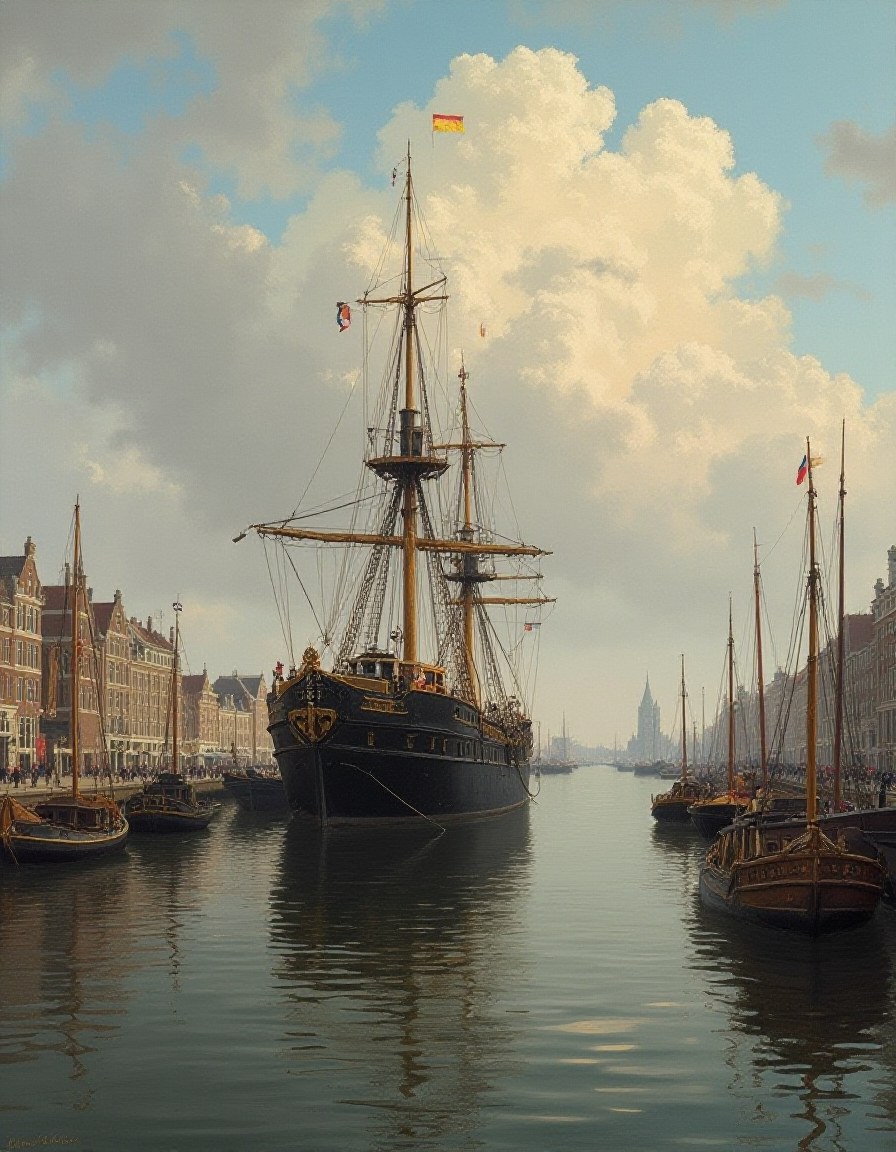
The image depicts a large black ship with a yellow flag flying from the top of it, docked in a canal with several other boats in the background.
CAPTION
The image depicts a bustling harbor scene with several boats docked along the waterfront. The boats are of various sizes and colors, with some being larger and others smaller. One prominent boat is a large, black sailing ship with a yellow flag on top, positioned in the center of the image.
MONOLOGUE
As soon as our people had breakfasted, I proceeded with a small party of men to sound and to mark with boarding-pikes upon the ice the most direct channel we could find to the anchorage, having left directions for every other officer and man in both ships to be employed in cutting the canal. This operation was performed by first marking out two parallel lines, distant from each other a little more than the breadth of the larger ship. Along each of these lines a cut was then made with an ice saw, and others again at right angles to them, at intervals of from ten to twenty feet; thus dividing the ice into a number of square pieces, which it was again necessary to subdivide diagonally, in order to give room for their being floated out of the canal. On returning from the upper part of the harbour, where I had marked out what appeared to be the best situation for our winter-quarters, I found that considerable progress had been made in cutting the canal and in floating the pieces out of it. To facilitate the latter part of the process, the seamen, who are always fond of doing things in their own way, took advantage of a fresh northerly breeze, by setting some boats sails upon the pieces of ice, a contrivance which saved both time and labour. This part of the operation, however, was by far the most troublesome, principally on account of the quantity of young ice which formed in the canal, and especially about the entrance, where, before sunset, it had become so thick that a passage could no longer be found for the detached
SUMMARY
The painting depicts a group of people on a small boat in a harbor, with a clear blue sky and a church in the background.
CAPTION
The image depicts a serene scene of a small wooden boat on a calm body of water, likely a Mediterranean sea. The boat, painted in a vibrant shade of blue, is positioned on the left side of the image, with a group of people gathered around it. The people are engaged in various activities, such as standing, sitting, and holding hands, suggesting a leisurely or social gathering.
MONOLOGUE
ecclesiastical world, the young and old. With a few strokes he creates the individual and also the type;--the careless rover; the responsible magistrate; the shrewd, practical man of business; the young men, full of their own plans, but pausing to look on at one of the great religious sights of their city. In the "Finding of the Cross" he produces the effect of the whole city _en fête_. It was a sight which often met his eyes. The Doge made no fewer than thirty-six processions annually to various churches of the city, and on fourteen of these occasions he was accompanied by the whole of the nobles dressed in their State robes. Every event of importance was seized on by the Venetian ladies as an opportunity for arraying themselves in the richest attire, cloth of gold and velvet, plumes and jewels. Gentile has massed the ladies of Queen Catherine Cornaro's Court around their Queen upon the left side of the canal. The light from above streams upon the keeper of the School, who holds the sacred relic on high. All round are the old, irregular Venetian houses, and in the crowd he paints the variety of men he saw around him every day in Venice. Yet even in this animated scene he retains his old quattrocento calm. The groups are decorously assisting: only here and there he is drawn off to some small detail of reality, such as an oarsman dexterously turning his boat, or the maid letting the negro servant pass out to take a header into the canal. The spectators look on coolly at one more of the oft-seen, miraculous events. The
SUMMARY
a boat filled with crocheted balls of yarn on the water.
CAPTION
The image captures a serene scene of a wooden boat on a calm sea. The boat, with its white sails and a brown hull, is positioned on the left side of the frame. On the right side of the boat, a basket filled with various colorful yarns is prominently displayed.
MONOLOGUE
At Suez a short stay is made. The water is a wonderful opal colour; the great Desert on our left, the barren rocks, sunburnt and bare on our right, help to make a fascinating picture. One remembers the first time one had passed through the Canal, years before in time of peace, and how one had been filled with admiration for the Medical Officer who came out to the Mail Boat to give it a clean bill of health to pass through the Canal, because she was a woman, and standing month after month of Suez summer weather, which proves too much for many men, leave alone women. But the stay is short and so as the Sun sets, making wonderful colouring over the Desert and sea, the journey down the Red Sea is commenced. The Red Sea in December is shorn of its terrors and can be quite enjoyable. Aden is passed, two or three days steaming along the inhospitable coast of Southern Arabia and the entrance of the Persian Gulf is reached. The Straits of Ormuz have the reputation of being one of the hottest places on earth. The rocky, and wild Arabian coast looks very beautiful in the sunshine with its innumerable islands, and the sea is a dead calm. For some hours the shores on our left are visible, then we steam, up along the Persian shore and get a good view of the barren, rocky mountain range running parallel with the coast. Those who have good glasses make out villages on the shore. The Captain is pestered with questions about the date and time of arrival at Basrah. Excitement is being felt again; one wonders what the news will be, and what has happened to
SUMMARY
a painting of a boat on a lake with a large sun in the sky
CAPTION
The image depicts a serene scene of a boat on a body of water, with a large, glowing sun in the sky. The sun is positioned in the upper right corner of the image, casting a warm orange glow over the scene. The boat, which is dark in color, is positioned in the center of the image, with its reflection visible on the water.
MONOLOGUE
The boat had rounded the corner of the wharf and fell into its upward track, owing all its speed now to the rower's good arm; for a very strong down tide was running against them. They crept up, close under the shore, the oars almost touching the rocks; but always, as if a spirit of divination were in her, the little boat turned its head from the threatened danger, edged in and out of the mimic bays and hollows in the shores, and kept its steady onward way. The scene was a fairy-land scene now. Earth, water, and air, were sparkling with freshness and light. The sunlight lay joyously in the nest of the southern mountains, and looked over the East, and smiled on the heads of the hills in the north; while cool shadows began to walk along the western shore. Far up, a broad shoulder of the mountain stood out in bright relief under the sun's pencil; then lower down, the same pencil put a glory round the heads of the valley cedars; the valley was in shadow. Sharp and clear shewed sun-touched points of rock on the east shore, in glowing colours; and on the west the hills raised huge shadowy sides towards the sun, whom they threatened they would hide from his pensioners. And the sun stood on the mountain's brow and blinked at the world, and then dropped down; and the West had it! Not yet, but soon.
SUMMARY
painting of a sailboat on a river with a cityscape in the background
CAPTION
The image depicts a serene scene of a boat on a river. The boat, which is the main focus of the image, is a traditional sailboat with a white sail and a brown hull. The boat is positioned on the left side of the image, with a small boat in the distance on the right side.
MONOLOGUE
“Thereafter I worked up-stream very slowly and lazily, and a little above Monghyr there came down a boatful of white-faces--alive! They were, as I remember, women, lying under a cloth spread over sticks, and crying aloud. There was never a gun fired at us, the watchers of the fords in those days. All the guns were busy elsewhere. We could hear them day and night inland, coming and going as the wind shifted. I rose up full before the boat, because I had never seen white-faces alive, though I knew them well--otherwise. A naked white child kneeled by the side of the boat, and, stooping over, must needs try to trail his hands in the river. It is a pretty thing to see how a child loves running water. I had fed that day, but there was yet a little unfilled space within me. Still, it was for sport and not for food that I rose at the child’s hands. They were so clear a mark that I did not even look when I closed; but they were so small that though my jaws rang true--I am sure of that--the child drew them up swiftly, unhurt. They must have passed between tooth and tooth--those small white hands. I should have caught him cross-wise at the elbows; but, as I said, it was only for sport and desire to see new things that I rose at all. They cried out one after another in the boat, and presently I rose again to watch them. The boat was too heavy to push over. They were only women, but he who trusts a woman will walk on duckweed in a pool, as the saying is: and by the Right and Left of Gunga, that is truth!”
SUMMARY
painting of a boat on a river with people in it
CAPTION
The image depicts a serene scene of a boat on a river. The boat, painted in a vibrant shade of blue, is adorned with a large orange umbrella, adding a splash of color to the otherwise muted tones of the scene. The boat is populated with several people, some of whom are seated and others standing, creating a sense of movement and activity.
MONOLOGUE
It was not so easy to hire a boat as I had been led to expect. The large crowd had made the boatmen somewhat exorbitant in their demands, and there were several reasons why I should engage one for my own exclusive use, instead of sharing one with some of my travelling companions. In the first place, my luggage was somewhat bulky; and, in the second place, my experience of travel had not failed to teach me that Americans (even from the Northern States) are always uncomfortable in the company of coloured people, and very often show this feeling in stronger ways than by sour looks and rude words. I think, if I have a little prejudice against our cousins across the Atlantic--and I do confess to a little--it is not unreasonable. I have a few shades of deeper brown upon my skin which shows me related--and I am proud of the relationship--to those poor mortals whom you once held enslaved, and whose bodies America still owns. And having this bond, and knowing what slavery is; having seen with my eyes and heard with my ears proof positive enough of its horrors--let others affect to doubt them if they will--is it surprising that I should be somewhat impatient of the airs of superiority which many Americans have endeavoured to assume over me? Mind, I am not speaking of all. I have met with some delightful exceptions.
SUMMARY
two boats on a calm sea with a cloudy sky
CAPTION
The image depicts two boats floating on a calm sea, with the sky above them appearing overcast. The boats are painted in a realistic style, with the one on the left being slightly closer to the viewer and the one on the right being farther away. The boats are both blue and white, and the one on the left has a flag flying from its mast.
MONOLOGUE
On the morning of the 28th, after a breakfast that seemed like a funeral, the three deserters--one can scarcely find the heart to blame them--climbed a crag to see their former comrades depart. One boat is left behind. The other two push out into the stream and in less than a minute have safely run the dangerous rapids, which seemed bad enough from above, but were in reality less difficult than many others previously experienced. A succession of rapids and falls are safely run, but after dinner they find themselves in another bad place. The river is tumbling down over the rocks in whirlpools and great waves and the angry waters are lashed into white foam. There is no possibility of a portage and both boats must go over the falls. Away they go, dashing and plunging, striking the rocks and rolling over and over until they reach the calmer waters below, when as if by miracle it is found that every man in the party is uninjured and both the boats are safe. By noon of the next day they have emerged from the Grand Caon into a valley where low mountains can be seen in the distance. The river flows in silent majesty, the sky is bright overhead, the birds pour forth the music of a joyous welcome, the toil and pain are over, the gloomy shadows have disappeared, and their joy is exquisite as they realize that the first passage of the long and terrible river has been safely accomplished and all are alive and well.
SUMMARY
The image depicts three sailboats on the ocean, with people on board.
CAPTION
The image captures a serene scene of sailboats on a calm sea. The boats, each with their sails unfurled, are positioned in the middle of the image, with one boat slightly ahead of the other. The sky above is a clear blue, dotted with a few clouds, suggesting a bright and sunny day.
MONOLOGUE
Their conversation was here interrupted by old Jones, who gave the word to cast off the warp which held them to the quay--an order which was speedily obeyed by the seamen; and the vessel soon _paid off_, under the influence of the jib. The same orders were given on board of the _Princess Charlotte_ and the _Olive_, the other two smacks; and, in a few minutes more, all the three vessels were holding their course, smoothly and peaceably, down the river. It was a beautiful morning. A slight breath of wind was stirring, just sufficient to fill the sails of the vessels: light, however, as it was, it was fresh and invigorating. The sun was just rising; and his upper limb only was as yet visible, peering above the cloud with which his body was enveloped, as if to take a peep at the ocean and the land before rising from his couch. Gradually, however, the king of day emerged from the cloud, and again his upper limb was concealed in another cloud higher up in the heavens, leaving a broad band of light alone visible. These alternations of light and shade continued for a short time, till the sun ascended higher in the sky, and then the middle of his body was covered by a dark vapour, which was passed round him like a ribbon. This also passed off; and the "father of ten thousand days" burst forth in a flood of glory--of bright, effulgent light--making the gentle undulations of the waves to glitter as if studded with millions of gems; whilst the dewdrops of the morning, hanging from the sails and cordage of the vessels, glistening
SUMMARY
boat on calm water with trees in the background.
CAPTION
The image depicts a small wooden boat floating on a body of water. The boat is positioned centrally in the frame, with its bow facing towards the left side of the image. The water is calm, with gentle ripples indicating the boat's movement.
MONOLOGUE
These vessels are crescent-shaped. Consequently, there is but a small keel, or little of it in the water, and that part which they rob from stern and bow is left out of the water--three or four brazas of keel or stem, all of which serves for its speed, and there is little to hold the boat back because of its narrowness. Therefore the helm is not managed like the Spanish helm, by the sweep from the end; accordingly, they use two rudders, one at one side and one at the other, where the flat part of the keel begins. One is usually employed for managing the boat, and both of them when it is stormy. With the second they keep the boat from getting unsteady, which would follow from its lightness, that rudder giving the boat more stiffness and serving as ballast. That is a precaution rendered necessary by its very lightness, the vessels that are lightest being those that require most care by being unsteady. In the middle they have a scaffold, four or six brazas long, which they call burulan or baileo. This consists of a floor raised above the rowers, and has its awning, which is called cayanes. Those awnings are made from the leaves of a small palm which grows in the water. That is the quarters for the fighters and the chiefs, for those vessels do not have any stern-cabin; it is, at the same time, the little castle from which they fight. All that structure finds its support and staunchness in what they call the cates, which are the buoys of which we have spoken. They are made of three or four bamboos as thick as the arm, and even larger, and reach
SUMMARY
The painting depicts a harbor with numerous boats and a large ship in the center.
CAPTION
The image depicts a tranquil harbor scene with numerous boats docked along the water's edge. The boats are of various sizes and colors, with some being larger and others smaller. The water is calm, reflecting the sky above, which is partly cloudy.
MONOLOGUE
I left New Westminster at seven o'clock Monday morning on the steamer Adelaide, for the mouth of Harrison river, sixty miles up the Frazer. There were over twenty Indians on board, going up to the mouth of the Chilukweyuk, to attend the funeral of Douglass Bill's deceased relative. As soon as I learned their destination I inquired if he were among them, but they said he was not. He had come aboard before we left, but for some reason had decided to go on another boat that left half an hour ahead of the Adelaide. The voyage proved intensely interesting. The Frazer is from a quarter to half a mile wide, and is navigable for large steamers for a hundred miles above its mouth. There are portions of the valley that are fertile, thickly settled, and well cultivated. The valleys of some of its tributaries are also good farming districts, and grain, fruits, and vegetables of various kinds grow in abundance. At the mouth of the Chilukweyuk I saw fine peaches that had grown in the valley, within ten miles of perpetual snow. The river became very crooked as we neared the mountains, and finally we entered the gorge, or caon, where the rocky-faced mountains rise, sheer from the water's edge, to heights of many hundreds of feet, and just back of them tower great peaks, clad in eternal snows. The little camera was again brought into requisition and, as we rounded some of these picturesque bends and traversed some of the beautiful reaches, I secured many good views, though the day was cloudy and lowery. The boat being in motion, I was,
SUMMARY
drawing of sailboats on a lake with a castle in the distance
CAPTION
The image depicts a serene scene of three small sailboats on a body of water. The boats are orange and are positioned in a line, with the closest boat slightly ahead of the others. The water is calm, reflecting the sky above.
MONOLOGUE
The _Oulujrvi_ lake is a terror to the tar-boats, for it is one of the largest lakes in Finland, and when there is a storm the fragile tar-boat is forced to hug the land for safety, or draw up altogether and lie-to until the storm has spent itself. Many of these small craft have been taken unawares when out in the middle of the lake, and come to signal grief accordingly. Then again, in times of dead calm, the heavily-laden boat does not even have the benefit of the quickly-running water to bear her on her way, and the three occupants of the vessel have to row the entire distance, for the steersman, no longer requiring to guide her with his enormous pole, ships it and rows at the side with one oar,--with which at the same time he guides. These steering poles are really remarkable; they are about twelve or fifteen feet long, and are simply a solid trunk of a pine tree as wide as a man's hand can grasp at the thinnest end, broadening out, and trimmed in such a way that they form a kind of flat solid paddle at the other end. The weight of these poles is overpowering, even when slipped through the ring of plaited tree branches which keeps them in place, and makes them easier to hold securely. When the cataracts are reached, even these strong poles shiver with the force of the water, and the steersman has all his work to do to combat the rushing waters; his whole bodily weight must be brought to bear in order to fight those waves and steer his craft safely through them. Every muscle is strained to meet the power of those swirling
SUMMARY
The image depicts a group of people on a boat, with the sun setting in the background.
CAPTION
The image depicts a serene scene of a small sailboat with a red sail, positioned in the middle of the ocean, with the sun setting in the background. The boat is being sailed by a group of people, with one person standing on the deck and another sitting on the boat, while others are seated on the boat.
MONOLOGUE
While yet, on 16th September, 1858, five or six knots distant from the island of Puynipet,[191] first discovered in 1828 by the Russian Admiral Ltke, and just as we found ourselves off what is called "Middle Harbour," we remarked a boat of European construction making for the frigate. Two hours later it came alongside, with four natives and a white man, the latter of whom came on deck and offered his services to the Commodore as pilot. He proved to be a Yankee named Alexander Tellet, who had lived 20 years on the island as smith and carpenter, to which he added the functions of pilot for the harbour in which he lived. Presently we were surrounded by a considerable number of natives in elegant canoes streaked with red, and formed of hollowed-out trunks of trees with outriggers, which have very peculiar scaffold-like supports, so that there is a kind of platform formed in the centre of the canoe, whereon the master usually seats himself, but which serves on occasion for festive meetings, and even for a small dance! The sails, made of mats, are triangular, the most acute angle being confined between two long bamboos, while a third serves as a mast, the whole capable of being shifted to either end of the boat by one of the crew, according to the direction of the wind. While some were doing what they could in their small boats to keep within the speed of the frigate, though we were going pretty fast, just as parasites make fast to the shark, others followed us a little distance, like dolphins, those
SUMMARY
The painting depicts a small wooden boat with a sail on the water.
CAPTION
The image depicts a serene scene of a wooden sailing boat on a calm body of water. The boat, with its mast and sails, is positioned centrally in the frame, facing towards the right side of the image. The boat is relatively small, with a length of approximately 10 meters and a width of 5 meters.
MONOLOGUE
If the deck is a varnished one, remove all the remains of last year's varnish with sandpaper, and give the deck several coats of marine varnish. The deck should be varnished at least once a month during the season to keep it in good condition. At this time it would be well to bring your sail out and lay it on the ground in the sun so as to allow it to bleach, and give the centreboard a good scraping and varnishing or painting, as the case may be. The boat is now ready to be put in the water. Bring out the mast and spars, scrape with glass and sandpaper, and varnish them. Now step the mast. If the boat is a small one it may be lifted in by hand, but if it is a large one a pair of shears must be rigged. (See sketch.) The shears consist of two poles, about half the length of the mast (better if longer), two extremities of which are lashed together, and the others planted firmly in the ground, the whole being supported at an angle of about 45 by a guy-rope. At the junction of the two poles lash one of the blocks of the throat-halyards, allowing the other to swing free. Attaching the mast or any other very heavy weight to this block it may be lifted in with ease. Put the gaff and boom in place, and lace the sail on. It will be quite a time before the sail will stretch to its fullest extent, and it will be necessary to stretch it along the gaff and boom after every outing for some time to come or it will not set properly.
SUMMARY
airplane flying over two boats in the ocean at sunset
CAPTION
The image captures a serene scene of two small boats on the ocean at sunset. The boats, both white, are positioned on the left and right sides of the image, with the one on the left slightly closer to the viewer. The sky above is painted in hues of pink and orange, suggesting the setting sun.
MONOLOGUE
He looked puzzled at first, then smote his hands together as he remembered. “Oh, yes, yes! A big white bird with long wings and pink feet. My! what a voice she had! She came in the afternoon and kept flying about the pond and screaming until dark. She was in trouble of some sort, but I could not understand her. She was going over to the other ocean, maybe, and did not know how far it was. She was afraid of never getting there. She was more mournful than our birds here; she cried in the night. She saw the light from my window and darted up to it. Maybe she thought my house was a boat, she was such a wild thing. Next morning, when the sun rose, I went out to take her food, but she flew up into the sky and went on her way.” Ivar ran his fingers through his thick hair. “I have many strange birds stop with me here. They come from very far away and are great company. I hope you boys never shoot wild birds?”
SUMMARY
The boat is moving across the water, leaving a trail of white spray behind it.
CAPTION
The image captures a majestic blue-hulled fishing boat, adorned with a vibrant purple stripe, gliding across the azure expanse of the ocean. The boat, with its two masts and a sail, is positioned in the center of the frame, its wake trailing behind it. The boat is angled slightly to the right, giving a sense of motion and dynamism to the scene.
MONOLOGUE
The voyager who sails from the dark waters of the restless Atlantic into the deep blue Mediterranean, notices at sunset a rich purple haze which rises apparently from the surface of that fair inland sea, and drapes the hills and vales along the beautiful shore with a glory that fills the heart of the beholder with unutterable gladness. The distant, snow-covered peaks of old Granada, clad in the same bright robe, seem by their regal presence to impose silence on those whom their majestic beauty has blessed with a momentary poetic inspiration which defies all power of tongue or pen. It touches nothing which it does not adorn, and the commonest objects are transmuted by its magic into fairy shapes which abide ever after in the memory. Under its softening influence, the dingy sail of a fisherman's boat becomes almost as beautiful an object to the sight as the ruins of the temple which crowns the height of Cape Colonna. But when you approach nearer to that which had seemed so charming in its twilight robes, your poetic sense is somewhat interfered with. You find the fishing boat as unattractive as any that anchor on the Banks from which we obtain such frequent discounts of nasty weather, and the shore, though it may still be very beautiful, lacks the supernal glory imparted to it by distance. It is very much after this fashion with manhood, when we compare its reality with our childish expectations. We find that we have been deceived by a mere atmospheric phenomenon. But the destruction of the charm which age had for our eyes
SUMMARY
the boat is sailing on the water at sunset
CAPTION
The image depicts a large, dark-colored boat floating on a calm body of water, with a purple sky and clouds in the background. The boat is positioned centrally in the image, with its bow pointing towards the left side of the frame. The water appears to be relatively still, with no visible waves or ripples.
MONOLOGUE
The sun declining to the horizon lit up the promontory of Kelerne, and painted in the passage of Goulet a stream of purple and gold. A breeze began to play over the bay, and chequered it with undulating ripples. The perfume exhaled from the saps was wafted in puffs of wind from the main land, as were the tinklings of the Angelus, and the lowing of the cattle driven home. A consciousness of strength in repose was perceivable, together with an indescribable air of serenity, that stole from surrounding objects upon the senses, and found its way to the very depths of the soul. The sky, the earth, and the water seemed by mutual consent to have subdued their voices, in order to mingle them in one harmonious murmur. Without analyzing the soft but not enervating influence that surrounded them, the two keepers with their families were alive to its effects. Silently they went down the foot-path, pausing upon their steps, as though to lengthen out the sense of enjoyment, or to taste of it drop by drop. Having, however, reached the boat, it became necessary to part. Josephe made the sergeant promise to come for them early in the morning. The sail at last was hoisted; and the skiff, launched out upon the yielding waves, sped her way towards the powder-magazine.