blue







































SUMMARY
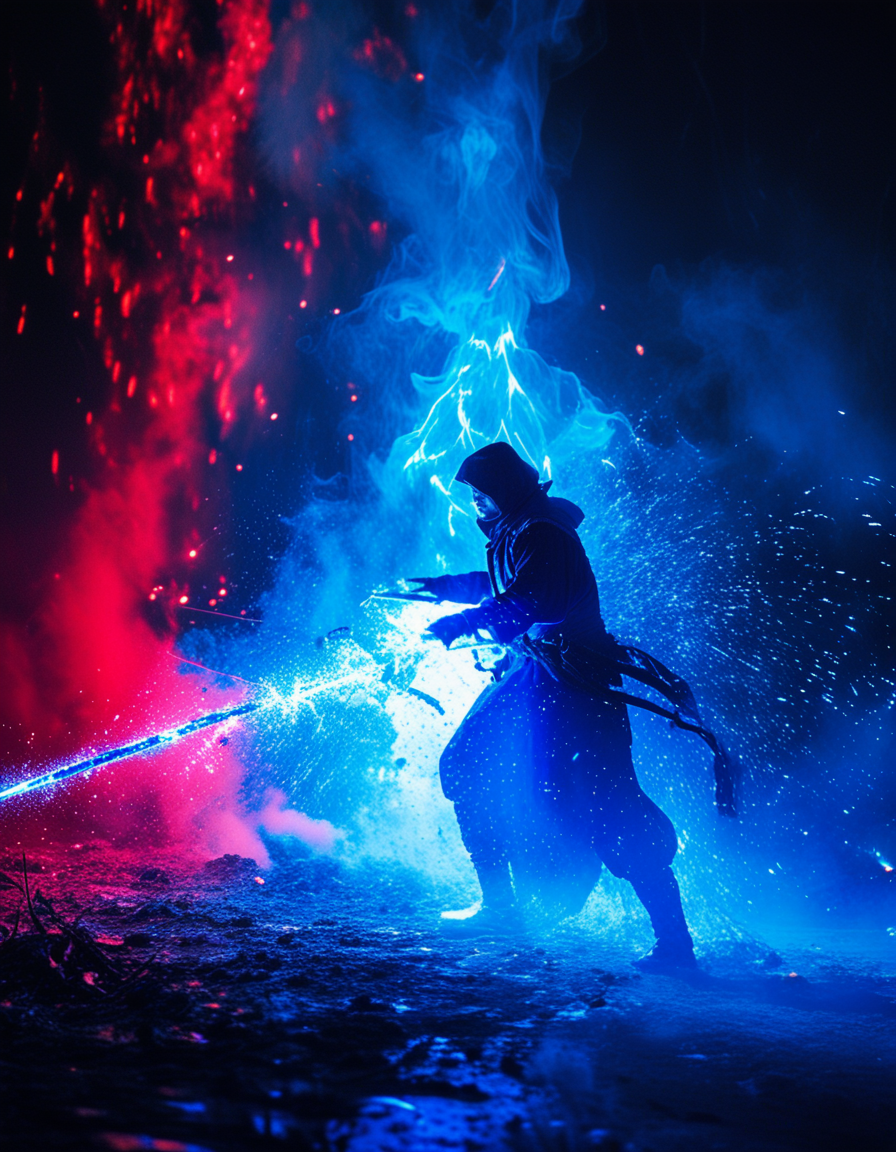
silhouette of a person in a karate stance with a sword.
CAPTION
The image depicts a silhouette of a person engaged in martial arts, with a striking contrast between the dark figure and the vibrant pink and blue background. The person is dressed in traditional martial arts attire, including a helmet and a belt, suggesting a focus on combat or self-defense.
MONOLOGUE
At this point of the conversation they arrived at the meeting-house. Keeping close together, Pepeeta light and graceful, the doctor heavy and awkward, both of them thoroughly embarrassed, they ascended the steps as a bear and gazelle might have walked the gang-plank into the ark. They entered unobserved save by a few of the younger people who were staring vacantly about the room, and took their seats on the last bench. The Quaker maidens who caught sight of Pepeeta were visibly excited and began to preen themselves as turtle doves might have done if a bird of paradise had suddenly flashed among them. One of them happened to be seated next her. She was dressed in quiet drabs and grays. Her face and person were pervaded and adorned by simplicity, meekness, devotion; and the contrast between the two was so striking as to render them both self-conscious and uneasy in each other's presence.
SUMMARY
a shirtless woman with tattoos on her neck and arms is looking off to the side
CAPTION
The image depicts a young woman with blonde hair, adorned with tattoos on her neck and chest. Her skin is pale, and her eyes are blue, giving her a serene and contemplative expression. The background is a blurred forest scene, suggesting a natural setting.
MONOLOGUE
Susie did at once as she was bidden: but she looked so very serious about it, and walked so very slowly, that Jim would just at that moment have preferred being in the boat by the side of Sam. She came directly towards him with the silver plate in her hand, and some rich-looking cake lying on it; so he had no alternative but to step towards her, and in the politest manner he could, select a piece. His attention was, of necessity, directed to the plate; but he could not help giving a glance at other things. And indeed, Jim, you are not to blame for blushing as you did, when you encountered the gaze of those sweet blue eyes, which, in all the unaffected simplicity of youth, were fastened upon you. Her golden-colored hair, parted smoothly from the fair forehead, and hung in such a cluster of curls upon her snow-white neck--the rich color that painted her parting lips, just tinged with the slightest blush her dimpled cheek. She meant nothing by her gaze; it was only the expression of an innocent curiosity in reference to the young gentleman she was waiting upon. His clothes, to be sure, were coarse, and such as well became the work in which he was engaged; but his collar was very white, and neatly tied with a black ribbon; and his light-brown hair, so soft and silky; his fair complexion, his pleasant voice, and good manners, all made a contrast which she did not understand; and it would seem that some of the company present, much older than Susie, were equally surprised.
SUMMARY
a woman in a bikini is dancing in front of a spotlight
CAPTION
The image depicts a woman in a vibrant, glowing outfit, standing in front of a backdrop of blue and purple hues. The woman is adorned with a necklace and earrings, and her attire is adorned with sparkling details. Her arms are raised in the air, and she appears to be in a state of celebration or joy.
MONOLOGUE
The news, the joyous news, sped quickly to Greenwich; and within four-and-twenty hours, on Saturday, 9th January, Henry heard with exultation that the incubus was raised from his shoulders. "God be praised," was his first exclamation, "we are free from all suspicion of war." Now, he continued, he would be able to manage the French better. They would be obliged to dance to his tune, for fear he should join the Emperor, which would be easy now that the cause for disagreement had gone. Thus, heartlessly, and haggling meanly over his wife's little bequests, even that to her daughter, Henry greeted the death of the woman he once had seemed to love. He snivelled a little when he read the affecting letter to him that she had dictated in her last hour;[138] but the word went forth that on the next day, Sunday, the Court should be at its gayest; and Henry and Anne, in gala garb of yellow finery, went to Mass with their child in full state to the sound of trumpets. After dinner the King could not restrain his joy even within the bounds of decency. Entering the hall in which the ladies were dancing, he pirouetted about in the exuberance of his heart, and then, calling for his fair little daughter Elizabeth, he proudly carried her in his arms from one courtier to another to be petted and praised. There was only one drop of gall in the cup for the Boleyns, and they made no secret of it, namely, that the Princess Mary had not gone to accompany her mother. If Anne had only known it, her last chance of keeping at the King's side as his wife was the
SUMMARY
a woman playing a guitar with a hat on her head
CAPTION
The image is a painting depicting a woman in a vibrant, colorful dress, holding a large red apple in her right hand. She is adorned with a large hat and a necklace, adding to the surreal and whimsical atmosphere of the piece. The background is a simple blue, providing a stark contrast to the colorful subject.
MONOLOGUE
This scene represents a group of peasants resting on their journey. The party comprises an aged couple and three children. They are seated on a grassy mound at the side of the road. The children lie in the foreground of the mound in various positions, and are asleep. The old gentleman is seated on the back side of the mound, which is higher than the front, and in such a position that a side view is had of the body. His head rests on his left hand, the elbow resting on the knee; the right hand holds a cane; countenance calm. Costume consists of a long, loose blue frock, brown pants, black beaver hat, considerably worn and out of shape, white hair and beard. At the side of the old man, on the lower part of the mound, is seated the old lady. She faces the audience, and leans her head on her right hand, the elbow placed on the knee, eyes directed to the children, countenance expressing deep thought. Costume consists of a brown dress, white handkerchief tied about the neck, and a hood on the head. In front of these figures is a young girl, her back resting against the highest part of the mound, the head inclined to one side, one arm placed across the form of a boy at her side, her eyes closed. She is dressed in a white robe, blue apron, and stout shoes, head uncovered. A small boy reclines at her side, and rests his head on her lap. Costume consists of a red frock, trimmed with white. In front of these two figures is a large boy. He lies on the grass, and rests his head on his arm; his eyes are
SUMMARY
sunrise with clouds and a mountain in the foreground.
CAPTION
The image depicts a breathtaking sunset with a dramatic and colorful display of light and color. The sky is predominantly blue with hues of red and orange, creating a striking contrast against the dark silhouette of the mountains. The clouds are scattered across the sky, adding to the dynamic and colorful effect.
MONOLOGUE
It is a morning of alternate sun and shadow. The clouds are flying low across the city, so that now one dome and now another flashes into light and the orange groves shine green and gold among the square white houses. All the high range of the Sorrento mountains lies in shadow, but on the sea the colours are glowing warm and bright, here a tender blue, there deepening into grey, and again, nearer into shore, a marvellous rich tint which has no name, but is azure and emerald in a single moment. Away across the crescent of the gulf a crowd of fishing boats are putting forth from Torre del Greco or Torre dell' Annunziata. Even at this distance one can see how they set their huge triangular sails and scatter, some one way, some another, searching each perhaps for his favourite volcanic shoal; for the largest fish lurk always in the hollows of those lava reefs which have from time to time burst out of the bottom of the bay. Some, perhaps, are sailing for the coral fishery upon the coast of Africa, to which great numbers go still in this month of April out of all the harbours beneath Vesuvius, though the profits are not what they were, and the trade is falling upon evil days. As for the mountain, he has cleared himself of clouds, and from his summit a heavy coil of smoke uncurls itself lazily and spreads like a pennant stretching far across the sky.
SUMMARY
a man and a woman are embracing in a field of white flowers
CAPTION
The image depicts a serene scene of a man and a woman standing in a lush, green field. The man, dressed in a blue robe, is holding the woman close, with his hand gently resting on her shoulder. The woman, wearing a blue dress, is positioned on the left side of the image, with her head slightly tilted towards the man.
MONOLOGUE
Sir Bale put the liquor to his lips. Wine? Whatever it was, never had he tasted so delicious a flavour. He drained it to the bottom, and placing it on the grass beside him, and looking again at the old dicer, who was also setting down his glass, he saw, for the first time, the graceful figure of a young woman seated on the grass. She was dressed in deep mourning, had a black hood carelessly over her head, and, strangely, wore a black mask, such as are used at masquerades. So much of her throat and chin as he could see were beautifully white; and there was a prettiness in her air and figure which made him think what a beautiful creature she in all likelihood was. She was reclining slightly against the burly man in bottle-green and gold, and her arm was round his neck, and her slender white hand showed itself over his shoulder.
SUMMARY
The female subject is captured in a moment of intense focus, her eyes locked onto the viewer with a sense of determination and intensity. The image is a digital illustration, rendered in a realistic style with a focus on detail and texture. The subject's hair is styled in loose curls, adding a touch of elegance to her appearance. The background is
CAPTION
The image depicts a stylized, underwater portrait of a woman with wavy brown hair. She is positioned in the center of the frame, facing the viewer with a serious expression. The background is a deep blue, with a splash of white water around her, suggesting the presence of a powerful force or current.
MONOLOGUE
The Amazonian division muster in great force, displaying every variety of head-gear, coquettish and business-like. There is one of the number--far in the background, with a solitary attendant--that even a stranger would single out instantly, but with an instinctive feeling that his glance ought not to rest there long. To be sure, her horse is well worth looking at; for if shape and "manners" go for anything, Don Juan must be a very cheap three hundred guineas' worth. But the rider's appearance is still more remarkable. It would be rather difficult to define exactly why. There is nothing particularly eccentric or "fast" in her demeanour, or so far as one can judge while she is in repose; her equipment and appointments, though faultless in every respect, are perfectly quiet and unobtrusive; only a very stern critic would remark that the miraculous habit fits her superb bust a shade _too_ well. You see a frank fearless face, at times perhaps a trifle too mutinously defiant; a broad, brent, white forehead; clear, bold blue eyes, flashing often in merriment, seldom in anger; and thick coils of soft gold-brown hair, braided tightly under the compact riding-hat. It is not exactly a pretty picture, though its piquancy might be attractive to such as admire that peculiar style.
SUMMARY
a woman wearing a tiara and a dress with a blue hue and sparkling details, with a large moon in the background, and rain falling around her
CAPTION
The image depicts a woman with long, wavy blonde hair adorned with a sparkling tiara, set against a backdrop of a night sky with a full moon and a dark blue hue. The woman is positioned in the center of the image, her gaze directed towards the viewer, and her expression is serious.
MONOLOGUE
Mr. Watts has painted several pictures of Orpheus and Eurydice. Some of them show the figures at full length, but the one in our illustration is less complete. Still it contains the principal points that are to be seen in the other companion paintings. The scene is the gloomy gateway of the world of the dead. It is all rough and rocky and dark. Through its opening you catch a glimpse of the bright upper world, and of the blue sky with its white clouds. Orpheus stands in the shadow. His body has the glow of life and health. He wears his minstrel's garland on his brow. But his face is full of anguish. For he has looked backwards, and he sees that Eurydice, who is close behind him, is a pale corpse again. Her arms, that have just been stretched out to clasp his neck, have lost their power and are falling down lifelessly. Her head is drooping upon her shoulder. Her eyes are closed, and her fair face is turned towards the under world. One of the pictures shows a lily which has dropped from her hand, and lies trailing and broken among the stones at her feet. Her long golden hair is blowing backwards into the dark. The right arm of Orpheus is stretched out in a vain attempt to grasp her, and to hold her back from being carried away by the resistless power that draws her. His left hand holds his lyre, and all its strings save one are broken. His eye is fixed on Eurydice's face in a gaze of hopeless pain. The picture is terrible rather than beautiful to look upon. It tells us how, in the
SUMMARY
a man wearing a hat and glasses is holding a lit sparkler in his hand. he is standing in a dark forest with a blue hue
CAPTION
The image depicts a man with a long white beard and a pointed hat, holding a glowing blue crystal in his right hand. He is dressed in a dark green outfit adorned with gold embroidery, and his attire is adorned with a red ribbon. The background is a dark, misty forest, creating a mystical atmosphere.
MONOLOGUE
An Afghan guard of honour was drawn up at the entrance of the palace, wearing the nearest approach to a uniform I had yet seen--dark-green tunics, light-blue trousers, and white turbans, clean, well fitting, and evidently kept for state occasions. Each man carried a Berdn rifle and cavalry sabre. It struck me as a curious coincidence that the former rifle is in general use throughout the Russian army. Leaving my escort with strict injunctions to keep their tempers, and under no circumstances to allow themselves to be drawn into a quarrel, I followed the Wazir and his attendants into the Mir. The entrance is through an underground passage about forty yards long by seven wide, ill-smelling and in total darkness. Arrived at the end, we again emerged into daylight, and, ascending a flight of rickety wooden steps, found ourselves in the durbar-room--a spacious apartment, its walls decorated with green, gold, and crimson panels, alternating with large looking-glasses. Costly rugs and carpets from Persia and Bokhra strewed the grimy floor of the chamber, which is about sixty feet long, and commands a splendid view of the city and fertile plains beyond. Awaiting me upon the balcony was the Khan, surrounded by his suite and another guard of Afghans. A couple of dilapidated cane-bottomed chairs were then brought and set one on each side of the crimson velvet divan occupied by his Highness. Having made my bow, which was acknowledged by a curt nod, I was conducted to the seat on the right hand of the Khan by Azim Khan, his son, who seated himself
SUMMARY
woman in a shiny silver dress holding a glass of wine with a lit candle in the background.
CAPTION
The image depicts a woman with blonde hair, wearing a shiny silver dress, holding a glass of red wine in her right hand. The background is a vibrant mix of red and blue hues, creating a lively and energetic atmosphere. The woman's expression is one of enjoyment and relaxation, with her eyes closed and a slight smile on her face.
MONOLOGUE
Nellie, too, was well beloved, but he soon grew weary of her company, for she seldom talked of anything save herself and the compliments which were given to her youthful beauty. And Nellie, at the age of eighteen, was beautiful, if that can be called beauty which is void of heart or soul or intellect. She was very small, and the profusion of golden curls which fell about her neck and shoulders gave her the appearance of being younger than she really was. Her features were almost painfully regular, her complexion dazzlingly brilliant, while her large blue eyes had in them a dreamy, languid expression exceedingly attractive to those who looked for nothing beyond--no inner chamber where dwell the graces which make a woman what she ought to be. Louis' artist eye, undeveloped though it was, acknowledged the rare loveliness of Nellie's face. She would make a beautiful picture, he thought; but for the noble, the good, the pure, he turned to the dark-eyed Maude, who was as wholly unlike her stepsister as it was possible for her to be. The one was a delicate blonde, the other a decided brunette, with hair and eyes of deepest black. Her complexion, too, was dark, but tinged with a beautiful red, which Nellie would gladly have transferred to her own paler cheek. It was around the mouth, however, the exquisitely shaped mouth, and white even teeth, that Maude's principal beauty lay, and the bright smile which lit up her features when at all animated in conversation would have made a plain face handsome. There were some who gave her the preference,
SUMMARY
the character is wearing a blue shirt and has long red hair and is in a mystical pose with her hands on her hips.
CAPTION
The image depicts a stylized illustration of a woman with long red hair, wearing a blue blouse and a purple skirt. She is adorned with various accessories, including a necklace with blue stones, a bracelet, and a pair of earrings. The background is a vibrant mix of purple and pink hues, creating a mystical and ethereal atmosphere.
MONOLOGUE
He had known her for so many years, and thought of her so intensely that every feature of her face could be recalled in its minutest line and expression; not only the general colour of her face, but the whiteness of the forehead, and where the white skin freckled. How strange it was that freckles should suit her, though they suited no other woman! And the blue tints under the eyes, he remembered them, and how the blue purpled, the rose red in the cheeks, and the various changes--the greys in the chin, the blue veins reticulating in the round white neck, and the pink shapes of the ear showing through the shadow. Her hair was visible to him, its colour in the light and in the shadow; and her long thin hands, the laces she wore at the wrists, her rings, the lines of the shoulders, and of the arms, the breasts--their size, their shape, and their very weight-- every attitude that her body fell into naturally. From long knowledge and intense thinking he could see her at will; and there she was at the end of the sofa crossing and uncrossing her lovely legs, so long from the knees, showing through the thin evening gown; he thought of their sweetness and the seduction of the foot advancing, showing an inch or two beyond the skirt of her dress. And then she drew her rings from her fingers, dropping them into her lap, and unconsciously placed them again over the knuckles.
SUMMARY
a woman in a purple dress with a red belt is standing in a snowy landscape with a blue bird perched on her shoulder.
CAPTION
The image depicts a woman dressed in a vibrant purple dress adorned with red and pink floral patterns, standing in a snowy landscape. She is holding a blue bird in her left hand, which is perched on her shoulder. The background features a mountain range under a clear sky, with the sun casting a warm glow on the scene.
MONOLOGUE
Ah! what splendid sunsets they beheld during those weekly strolls. The sun accompanied them, as it were, amid the throbbing gaiety of the quays, the river life, the dancing ripples of the currents; amid the attractions of the shops, as warm as conservatories, the flowers sold by the seed merchants, and the noisy cages of the bird fanciers; amid all the din of sound and wealth of colour which ever make a city's waterside its youthful part. As they proceeded, the ardent blaze of the western sky turned to purple on their left, above the dark line of houses, and the orb of day seemed to wait for them, falling gradually lower, slowly rolling towards the distant roofs when once they had passed the Pont Notre-Dame in front of the widening stream. In no ancient forest, on no mountain road, beyond no grassy plain will there ever be such triumphal sunsets as behind the cupola of the Institute. It is there one sees Paris retiring to rest in all her glory. At each of their walks the aspect of the conflagration changed; fresh furnaces added their glow to the crown of flames. One evening, when a shower had surprised them, the sun, showing behind the downpour, lit up the whole rain cloud, and upon their heads there fell a spray of glowing water, irisated with pink and azure. On the days when the sky was clear, however, the sun, like a fiery ball, descended majestically in an unruffled sapphire lake; for a moment the black cupola of the Institute seemed to cut away part of it and make it look like the waning moon; then the globe assumed a violet
SUMMARY
a woman wearing a hat with a black band and a brown jacket is looking to the side with her mouth slightly open.
CAPTION
The image depicts a woman wearing a black hat, with her face illuminated by a blue light. The background is a gradient of orange and blue, creating a dramatic effect. The woman's expression is serious, and her eyes are wide open, giving the impression of intense focus.
MONOLOGUE
The road to Kronstadt through the Boza Pass leads to this little castle in a few hours, and at the very time when John Kemény had abandoned himself utterly to pleasure in Hermanstadt, a long line of horsemen was moving out of the castle; there might have been two thousand Turkish riders, recognizable from afar by their red turbans and their snow-white caftans; with them were a few hundred Wallachian howitzers in charge of men in brown woolen cloaks and black turbans. The way was so narrow here that the horsemen could ride only two by two, and those in the rear had hardly emerged from the mountain pass when the first riders were already in Tatrang. Their leader was a medium sized, sunburned man, with eyes like an eagle's; there was a long scar across his forehead; the sharp upward turn of his moustache indicated an unusually hot temper, an impression confirmed by the short, crisp speech, the proud turn of the head, and the abrupt movements. Beyond the village he called a halt to await the rear; at the very end rumbled two baggage-wagons and a melon-shaped calêche, the entire baggage of the Turk. A child followed, whose serious expression and gleaming short sword seemed hardly appropriate to the full round face; he might have been twelve years old. Within the carriage, the curtains of which had been thrown wide open to give free play to the evening breeze, sat a young woman of possibly two and thirty, whose dress was partly Turkish, partly Christian; for she wore the loose silk trousers and short blue caftan of Turkish women, but
SUMMARY
The image depicts a person with a glowing blue aura around their head, which is illuminated by a bright lightning bolt. The person is positioned in a dramatic and intense setting, with the lightning bolt adding a sense of drama and intensity to the scene.
CAPTION
The image depicts a person with a striking blue and black color scheme. The individual is facing the left side of the frame, with their face prominently displayed. The person is adorned with a large, curly hairstyle that extends down their shoulders, adding a touch of wildness to the scene. In the background, there are several bolts of lightning, which are also blue and black in color.
MONOLOGUE
TWO CENTS TO TEN CENTS, inclusive, emblematical figure of America, looking to the right and modeled after Crawford's statue surmounting the dome of the capitol. The left hand rests on a shield, and holds a wreath; the right rests on a sword. The head is adorned with a head dress consisting of a coronet of stars, surmounted by an eagle's head and plumes. The background is horizontally lined and in parts diagonally also. The vignette stands in an arched frame, composed of vertical lines; and on either side of this frame, and at the top are slabs containing the inscriptions (the upper in colored letters on horizontally lined ground, the others in colorless block capitals, the sides upon vertically lined ground), "_Newspapers_" and "_Periodicals_" (at the sides), "_U. S. Postage_" (at top). At the bottom are shaded outline block letters, representing the value, which is also indicated by large outlined figures shaded on the face, in the upper corners, on foliated scrolls. The lower corners are ornamented with shields. The color of these stamps is black.
SUMMARY
two women in a body of water with a fiery background.
CAPTION
The image depicts two women, one on the left and the other on the right, both facing the same direction, with their faces turned towards the viewer. They are immersed in a vibrant, fiery scene with a dark background that is illuminated by a bright light source. The women are surrounded by a multitude of glowing pink and blue particles, which add a surreal and dreamlike quality to the scene.
MONOLOGUE
As regards maximum sensation in the two retin there is then a relative retardation of half a period. This may be seen by means of a stereoscope, carrying, instead of stereo-photographs, incised plates through which we look at light. The design consists of two slanting cuts at a suitable distance from each other. One cut, R, slants to the right, and the other, L, to the left (see fig.111). When the design is looked at through the stereoscope, the right eye will see, say R, and the left L, the two images will appear superimposed, and we see an inclined cross. When the stereoscope is turned towards the sky, and the cross looked at steadily for some time, it will be found, owing to the alternation already referred to, that while one arm of the cross begins to be dim, the other becomes bright, and _vice versa_. The alternate fluctuations become far more conspicuous when the eyes are closed; the pure oscillatory after-effects are then obtained in a most vivid manner. After looking through the stereoscope for ten seconds or more, the eyes are closed. The first effect observed is one of darkness, due to the rebound. Then _one_ luminous arm of the cross first projects aslant the dark field, and then slowly disappears, after which the second (perceived by the other eye) shoots out suddenly in a direction athwart the first. This alternation proceeds for a long time, and produces the curious effect of two luminous blades crossing and recrossing each other.
SUMMARY
a lone figure walks along a rocky path in the mountains at sunset
CAPTION
The image depicts a serene mountainous landscape bathed in the soft glow of a vibrant sunset. The sky, painted in hues of pink and purple, stretches across the top of the image, meeting the horizon at the bottom. The mountains, silhouetted against the sky, are a deep blue, their peaks reaching towards the sky.
MONOLOGUE
The first world-sound that fell upon my ear Was that of the great winds along the coast Crushing the deep-sea beryl on the rocks-- The distant breakers' sullen cannonade. Against the spires and gables of the town The white fog drifted, catching here and there At overleaning cornice or peaked roof, And hung--weird gonfalons. The garden walks Were choked with leaves, and on their ragged biers Lay dead the sweets of summer--damask rose, Clove-pink, old-fashioned, loved New England flowers Only keen salt-sea odors filled the air. Sea-sounds, sea-odors--these were all my world. Hence is it that life languishes with me Inland; the valleys stifle me with gloom And pent-up prospect; in their narrow bound Imagination flutters futile wings. Vainly I seek the sloping pearl-white sand And the mirage's phantom citadels Miraculous, a moment seen, then gone. Among the mountains I am ill at ease, Missing the stretched horizon's level line And the illimitable restless blue. The crag-torn sky is not the sky I love, But one unbroken sapphire spanning all; And nobler than the branches of a pine Aslant upon a precipice's edge Are the strained spars of some great battle-ship Plowing across the sunset. No bird's lilt So takes me as the whistling of the gale Among the shrouds. My cradle-song was this, Strange inarticulate sorrows of the sea, Blithe rhythms upgathered from the Sirens' caves. Perchance of earthly voices the last voice That shall an instant my freed spirit stay On this world's verge, will be some message blown
SUMMARY
a woman with long hair, looking at the camera with a serious expression, with a glowing orange light on her face
CAPTION
The image depicts a woman with long, wavy hair, set against a dark background. The woman's face is illuminated by a warm, orange glow, which casts a dramatic effect on her features. Her eyes are bright blue, and her lips are slightly parted, suggesting a serious expression.
MONOLOGUE
She was not more than fifteen. Her form, voice, and manner belonged to the period of transition from girlhood. Her face was perfectly oval, her complexion more pale than fair. The nose was faultless; the lips, slightly parted, were full and ripe, giving to the lines of the mouth warmth, tenderness, and trust; the eyes were blue and large, and shaded by drooping lids and long lashes; and, in harmony with all, a flood of golden hair, in the style permitted to Jewish brides, fell unconfined down her back to the pillion on which she sat. The throat and neck had the downy softness sometimes seen which leaves the artist in doubt whether it is an effect of contour or color. To these charms of feature and person were added others more--an indefinable air of purity which only the soul can impart, and of abstraction natural to such as think much of things impalpable. Often, with trembling lips, she raised her eyes to heaven, itself not more deeply blue; often she crossed her hands upon her breast, as in adoration and prayer; often she raised her head like one listening eagerly for a calling voice. Now and then midst his slow utterance, Joseph turned to look at her, and, catching the expression kindling her face as with light, forgot his theme, and with bowed head, wondering, plodded on.
SUMMARY
The image depicts a serene beach scene with a sunset. The sky is painted in hues of pink and purple, casting a warm glow over the ocean and the rocky shore. The waves gently lap against the shore, creating a tranquil atmosphere. The image is a digital illustration, likely created using a computer program, and is a high-resolution photograph.
CAPTION
The image depicts a serene beach scene bathed in the soft glow of a sunset. The sky is painted in hues of pink and purple, with the sun just beginning to set on the horizon. The ocean, a deep blue, mirrors the colors of the sky, creating a mirror-like effect.
MONOLOGUE
Sheila stood and drew breath. The shadow of the high peak, in the lap of which she stood, poured itself eastward across the warm, lush, narrow land. This was different from the hard, dull gold and alkali dust of the Millings country: here were silvery-green miles of range, and purple-green miles of pine forest, and lovely lighter fringes and groves of cottonwood and aspen trees. Here and there were little dots of ranches, visible more by their vivid oat and alfalfa fields than by their small log cabins. Down the valley the river flickered, lifted by its brightness above the hollow that held it, till it seemed just hung there like a string of jewels. Beyond it the land rose slowly in noble sweeps to the opposite ranges, two chains that sloped across each other in a glorious confusion of heads, round and soft as velvet against the blue sky or blunt and broken with a thundery look of extinct craters. To the north Sheila saw a further serenity of mountains, lying low and soft on the horizon, of another and more wistful blue. Over it all was a sort of magical haze, soft and brilliant as though the air were a melted sapphire. There was still blessedness such as Sheila had never felt. She was filled with a longing to ride on and on until her spirit should pass into the wide, tranquil, glowing spirit of the lonely land. It seemed to her that some forgotten medicine man sat cross-legged in a hollow of the hills, blowing, from a great peace pipe, the blue smoke of peace down and along the hollows and the cañons and the level lengths of range. In the
SUMMARY
a person in a dark hoodie is wielding a glowing blue and red weapon in a dark, mystical forest.
CAPTION
The image depicts a person in a dark, mystical setting. The individual is dressed in a dark, hooded cloak and is wielding a glowing blue and red weapon. The background is filled with swirling blue and red smoke, creating a sense of ethereal energy.
MONOLOGUE
Verestchagin says the old-fashioned way of setting a portrait-head against a dark ground is not only unnecessary, but being usually untrue when a person is seen by daylight, should be exploded as false and unreal. But it is certain a light garish background behind a painted head will not permit that head to have the importance it should have in reality, when the actual facts, solidity, movement, play of light and shadow, personal knowledge of the individual or his history, joined to the effects of different planes, distances, materials, &c., will combine to invest the reality with interests the most subtle and dexterous artistic contrivances cannot compete with, and which certainly the artist cannot with reason be asked to resign. A sense of the power of an autocrat, from whose lips one might be awaiting consignment to a dungeon or death, would be as much felt if he stood in front of the commonest wall-paper, in the commonest lodging-house, in the meanest watering-place, but no such impressions could be conveyed by the painter who depicted such surroundings. Lastly, I must strongly dissent from the opinion recently expressed by some, that seems to imply that a portrait-picture need have no interest excepting in the figure, and that the background had better be without any. This may be a good principle for producing an effect on the walls of an exhibition-room, where the surroundings are incongruous and inharmonious; an intellectual or beautiful face should be more interesting than any accessories the
SUMMARY
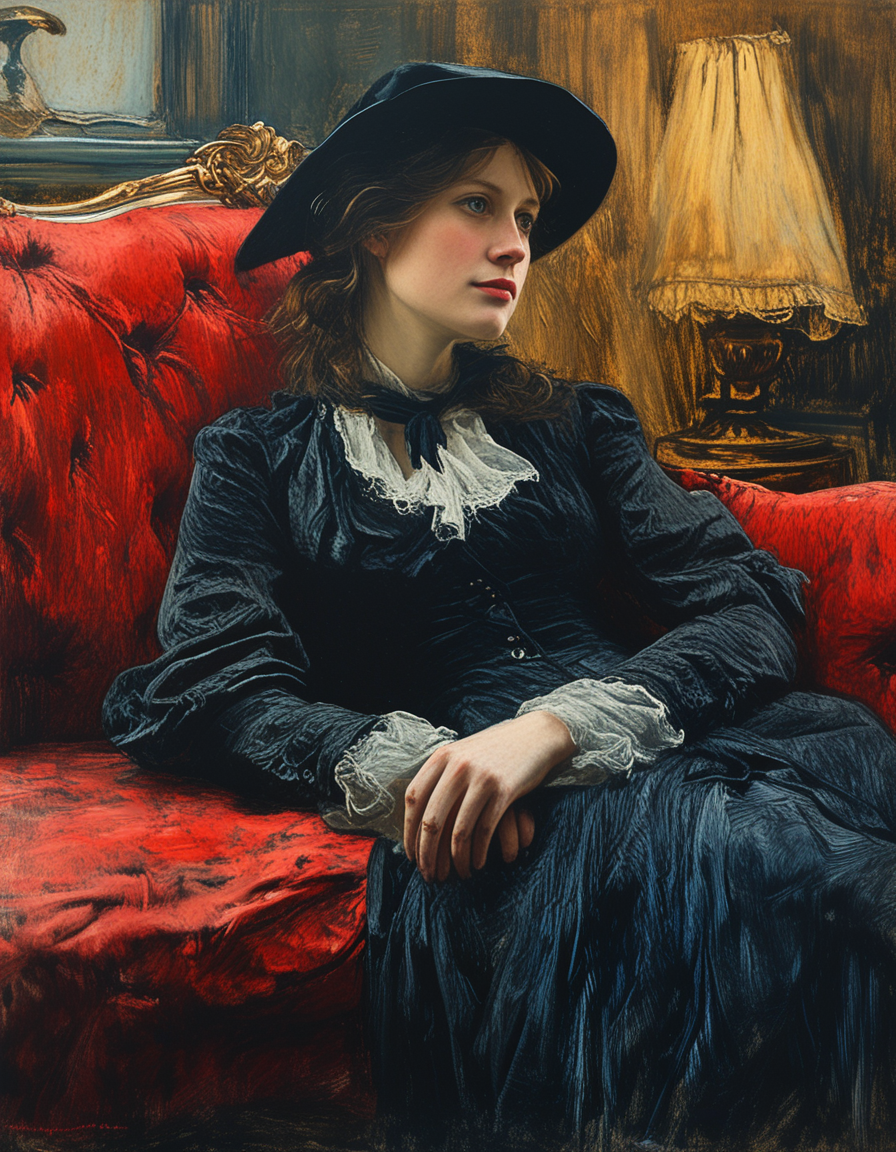
The artist has used a palette of dark blues and greys to create a moody and atmospheric painting of a woman seated on a red velvet sofa. The woman is dressed in a black dress with a white lace collar, and her face is turned away from the viewer, adding a sense of mystery and introspection to the scene. The painting is done
CAPTION
The image depicts a woman seated on a red velvet couch, dressed in a black dress with a white lace collar. She is wearing a black hat and has her hands resting on her lap. The background features a large, ornate lamp with a golden shade, suggesting a luxurious setting.
MONOLOGUE
"'The Captain WITSE' is placed at the head of the table, and attracts our attention first. He is dressed in black velvet, his breast covered with a cuirass, on his head a broad-brimmed black hat with white plumes. He is comfortably seated on a chair of black oak, with a velvet cushion, and holds in his left hand, supported on his knee, a magnificent drinking-horn, surrounded by a St. George destroying the dragon, and ornamented with olive-leaves. The captain's features express cordiality and good-humor; he is grasping the hand of 'Lieutenant VAN WAVERN' seated near him, in a habit of dark gray, with lace and buttons of gold, lace-collar and wristbands, his feet crossed, with boots of yellow leather, with large tops, and gold spurs, on his head a black hat and dark-brown plumes. Behind him at the centre of the picture, is the standard-bearer, 'JACOB BANNING,' in an easy martial attitude, hat in hand, his right hand on his chair, his right leg on his left knee. He holds the flag of blue silk, in which the Virgin is embroidered, (such a silk! such a flag! such a piece of painting!) emblematic of the town of Amsterdam. The banner covers his shoulder, and he looks towards the spectator frankly and complacently.
SUMMARY
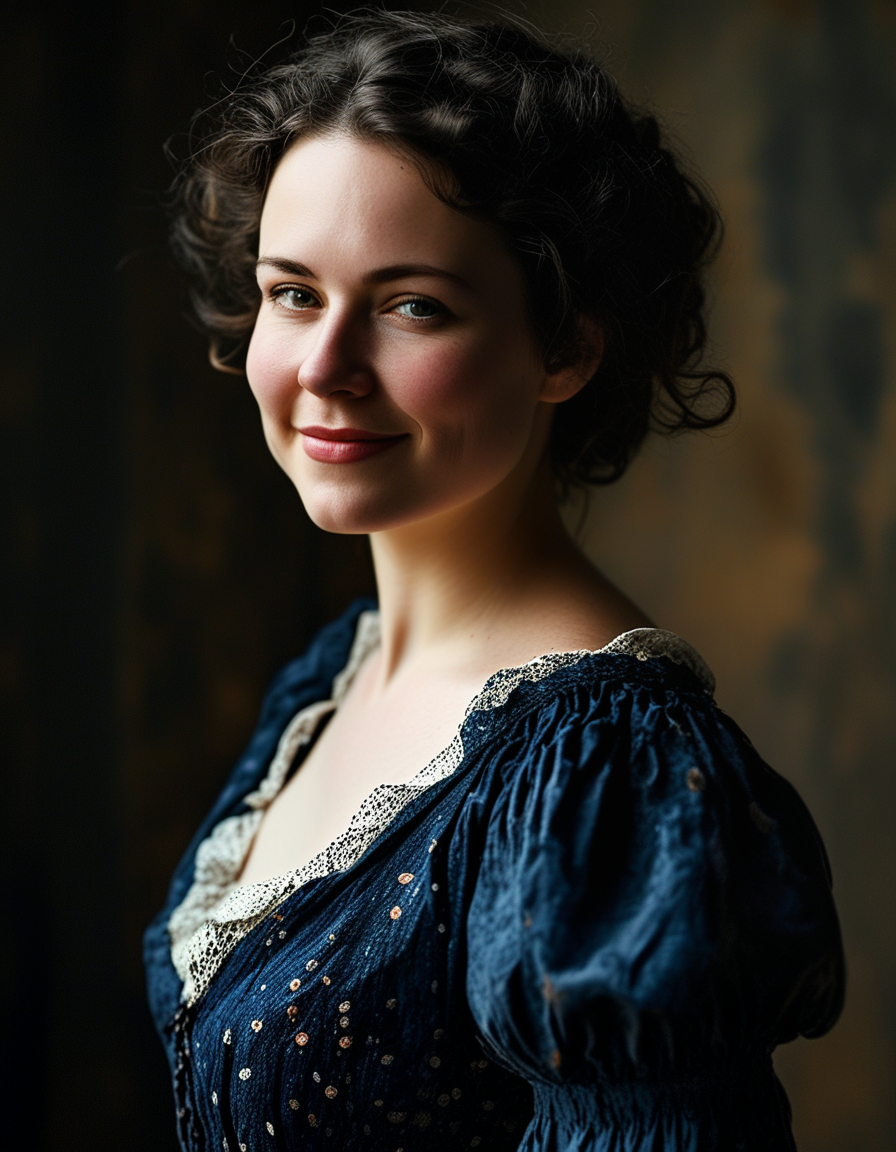
woman in blue dress with lace collar and white trim smiling.
CAPTION
The image depicts a woman with dark hair, wearing a blue dress with a white lace collar. The background is dark, creating a contrast that highlights the woman's features. The woman's expression is one of happiness, and she is smiling.
MONOLOGUE
How awful these young girls looked. The one in bright pink, the other in bright blue, the third in almost orange, the fourth in the colour of arsenic. And then the women! Mrs. Rózycki, the butcher's wife, shone in a stiff silk--dark reddish brown, trimmed with yellow lace--not at all bad in itself, but how common her fat face looked over her tight silk bodice that seemed ready to burst. And then the others! Mrs. Jokisch, in black, trimmed with mauve and a white lace collar, looked exactly like her own grandmother. How a man's soul seems to show itself in his garments. Mr. Böhnke, the schoolmaster, stood in a corner of the ballroom criticizing the company. He had never laid so much weight on appearances before--his mother was a very unassuming woman, and his sisters, oh, dear!--but he had been spoiled since he had made Mrs. Tiralla's acquaintance. She was always beautiful, and especially so this evening. He almost devoured her with his eyes. How splendid she looked in that dainty white dress. She was harmony personified in this confused mass of gaudy [Pg 94] colours. The only coloured thing about her was her smooth, silky dark hair, with the rosebuds in it, and the little bouquet at her bosom.
SUMMARY
a man and a woman shake hands in front of a door
CAPTION
The image depicts a scene of two people standing in front of a door. The woman is dressed in a black dress with blue polka dots, while the man is dressed in a black suit. They are shaking hands, suggesting a moment of greeting or agreement.
MONOLOGUE
That evening when we went over together I found myself pushed against a tall man with an immense gray moustache standing out across his face like the horns of a beetle. He looked down on me from time to time, and when I apologised for crowding him his face flushed a little, and he tried to bow as well as he could in the press, and said something with a German accent which seemed to be courteous. But I was separated from Nino by him. Maestro Ercole sang, and all the others, turn and turn about, and so at last it came to the benediction. The tall old foreigner stood erect and unbending, but most of the people around him kneeled. As the crowd sank down I saw that on the other side of him sat a lady on a small folding stool, her feet crossed one over the other, and her hands folded on her knees. She was dressed entirely in black, and her fair face stood out wonderfully clear and bright against the darkness. Truly she looked more like an angel than a woman, though perhaps you will think she is not so beautiful after all, for she is so unlike our Roman ladies. She has a delicate nose, full of sentiment, and pointed a little downward for pride; she has deep blue eyes, wide apart and dreamy, and a little shaded by brows that are quite level and even, with a straight pencilling over them, that looks really as if it were painted. Her lips are very red and gentle, and her face is very white, so that the little ringlet that has escaped control looks like a gold tracery on a white marble
SUMMARY
a young woman with long blonde hair and a headband with bubbles is posing in front of a red background
CAPTION
The image depicts a young woman with long, wavy blonde hair, adorned with a large, glittery headband. She is wearing a white top and has a neutral expression. The background is a vibrant mix of red and blue hues, creating a striking contrast that draws attention to the woman's features.
MONOLOGUE
In 1912 representatives of the association attended the State conventions of all the parties and extended hearings were granted by the Resolutions Committees. Their treatment was in great contrast to that of earlier days when they could scarcely obtain five or ten minutes before a committee. This year every party declared for woman suffrage in its platform. It was a gratification to sit in the great convention hall at Saratoga and hear the Hon. Horace White of Syracuse, who throughout his long years in the State Senate had constantly opposed the amendment, report in his capacity as chairman of the Resolutions Committee that the Republican party favored a speedy referendum on woman suffrage. Many dramatic features of propaganda characterized these years, which marked the awakening of the women of the entire State and brought into the ranks many wide-awake, independent young women, who wanted to use aggressive and spectacular methods, and these the older workers did not discourage. Those that attracted the most attention were the suffrage "hikes," in which Miss Rosalie Jones, a girl of wealth and position, was the leading spirit. She sent a picturesque account of these "hikes," which has had to be condensed for lack of space.
SUMMARY
a woman in a red shirt with white patterns is looking to the side
CAPTION
The image depicts a woman with a serene expression, wearing a red patterned shirt. The background is a vibrant mix of red and blue hues, creating a striking contrast that draws the viewer's attention to the woman. The woman's hair is styled in a bun, and her attire is simple yet elegant.
MONOLOGUE
So they talked on whilst supper was served, falling easily into the spirit of the place, and yet both of them conscious of some new thing underlying the gaiety of their tongues and manner. Anna, in her strange striking way, was radiantly beautiful. Without a single ornament about her neck, or hair, wearing the plainest of black gowns, out of which her shoulders shone gleaming white, she was easily the most noticeable and the most distinguished-looking woman in the room. To-night there seemed to be a new brilliancy in her eyes, a deeper quality in her tone. She was herself conscious of a recklessness of spirits almost hysterical. Perhaps, after all, the others were right. Perhaps she had found this new thing in life, the thing wonderful. The terrors and anxieties of the last few months seemed to have fallen from her, to have passed away like an ugly dream, dismissed with a shudder even from the memory. An acute sense of living was in her veins, even the taste of her wine seemed magical. Ennison too, always handsome and _debonnair_, seemed transported out of his calm self. His tongue was more ready, his wit more keen than usual. He said daring things with a grace which made them irresistible, his eyes flashed back upon her some eloquent but silent appreciation of the change in her manner towards him.
SUMMARY
a woman with blonde hair is sitting on a bed with a red and blue background
CAPTION
The image depicts a woman with wavy blonde hair, set against a backdrop of red and blue hues. The woman is positioned in a frontal view, with her head turned slightly to the right. Her eyes are directed towards the camera, and her expression is serious.
MONOLOGUE
'He _is_ my novelist. So I've a right to be sorry he knows nothing about women. See here! Even in his most rationalized vision of the New Time, he can't help betraying his old-fashioned prejudice in favour of the "dolly" view of women. His hero says, "I prayed that night, let me confess it, to an image I had set up in my heart, an image that still serves with me as a symbol for things inconceivable, to a Master Artificer, the unseen captain of all who go about the building of the world, the making of mankind----"' Vida's finger skipped, lifting to fall on the heroine's name. '"Nettie... She never came into the temple of that worshipping with me."' Swiftly she turned the pages back. 'Where's that other place? Here! The man says to the heroine--to his ideal woman he says, "Behind you and above you rises the coming City of the World, and I am in that building. Dear heart! you are only happiness!" That's the whole view of man in a nutshell. Even the highest type of woman such an imagination as this can conjure up----' She shook her head. '"You are only happiness, dear"--a minister of pleasure, negligible in all the nobler moods, all the times of wider vision or exalted effort! Tell me'--she bent her head and looked into her companion's face with a new passion dawning in her eyes--'in the building of that City of the Future, in the making of it beautiful, shall women really have no share?'
SUMMARY
a young woman with long hair in a red dress with white flowers is looking at the camera
CAPTION
The image depicts a young woman with long, wavy hair, wearing a red shirt with white floral patterns. The background is a vibrant mix of red and blue lights, creating a dramatic and somewhat surreal atmosphere. The woman's expression is serious, and her gaze is directed towards the camera.
MONOLOGUE
singing, and patting her shoulders in time with the tune, up and down the room, so that the sparrows were frightened and fluttered out at the window. Then she stood still for a long while and looked at the casts and clay models around her on the walls; and seemed especially interested in the half-finished marble bust. It reminded her again of the stranger outside in the arbor, whose head sprung just so from his stately shoulders. Finally she tired of this also; and besides, she began to feel a little hungry. She found in the cupboard, behind her in the corner to which the sculptor had directed her, a few rolls and an opened bottle of red wine. There was all sorts of rubbish besides in the cupboard; a masquerader's costume, pieces of gold-stamped leather tapestry, of blue and red silk and brocade, with large flowers in their patterns, and a saint's halo, cut out of paper and painted with beautiful golden rays--that might have done service for a _tableau vivant_, or some other profane purpose. The idle girl seized upon this last, fastened it on her head with the two ribbons still attached to it, and went again before the looking-glass, where she smiled and made faces at her own reflection. Then she took a piece of blue damask out of the pile of things, and threw it like a cloak over her white shoulders. Her hair flowed freely over it, so that at a distance, when one did not see her uncovered neck, she looked like a mediaeval madonna, who had stepped out of her frame and had wandered into some merry
SUMMARY
a man with glowing red eyes and a cross necklace is standing in front of a dark background
CAPTION
The image depicts a man with long, curly hair, wearing a red jacket and a necklace with a cross pendant. The man's eyes are glowing red, indicating a supernatural or mystical aura. The background is dark, with a subtle gradient of blue and green hues, creating a dramatic effect.
MONOLOGUE
Tact, discretion, and knowledge are required when we undertake to adorn the home to be lived in; and while employing the art of embroidery to embellish it, we must never forget that harmony, and the absence of anything startling, tends to the grandiose as well as the comfortable. Bright bits of colouring should be reserved for pictorial art, or for small objects, such as cushions and stools. If for the general tint blue be chosen, let it be either pure pale colour, like the ther, or a soft one, pale or dark, such as indigo; but the startling aniline blues should be avoided as being offensive to the nerves of the eye. If red be the foundation colour, let it be Venetian red, part scarlet, part crimson; or pure crimson (Tyrian purple), or pure scarlet (cochineal). Never employ scarlet with a yellow tinge; it may not affect yourself, but it is blinding to many eyes. Avoid brickdust, which is simply a dirty mixture of earthy colours. Of green there are few shades that are not beautiful, soothing, and more or less fitted for a background to needlework. Olive-green, sea-green, pea-green, emerald-green, and sage-green,--Nature teaches us how these harmonize together and with all other colours. Only arsenical green is impracticable and repulsive. Yellow, pale as a primrose, glowing as gold, or tender as butter, is always beautiful; but one tint we would exclude from our list, called "buff," which never can assimilate with any other colour, and is often the refuge of the weak-minded man that cannot face the responsibility of choosing an
SUMMARY
a woman in a long red dress stands on a rock with her arms outstretched in front of a sky filled with glowing red and orange spheres.
CAPTION
The image depicts a woman standing on a rocky outcrop, with her arms outstretched, facing away from the camera. She is wearing a long, flowing red dress that contrasts with the blue sky and clouds in the background. The sky is filled with numerous small, glowing orbs, creating a magical and dreamlike atmosphere.
MONOLOGUE
"Venus is seated in front of a gorgeous red-brown drapery; her head is crowned with a diadem, and her luxuriant hair falls in heavy locks on her neck. Her arms are bare, but her tunic is bound with a sash, which meets in a cross at her bosom and winds away under the arms, whilst a flap of a blue mantle crosses the knees. With both hands she is binding the eyes of Eros leaning on her lap, whilst she turns to listen to the whispering of another Eros resting on her shoulder. A girl with naked throat and arm carries Cupid's quiver, whilst a second holds his bow. Behind the group a sky overcast with pearly clouds lowers over a landscape of hills.... Light plays upon every part," says Crowe, "creating, as it falls, a due projection of shadow, producing all the delicacies of broken tone and a clear silvery surface full of sparkle, recalling those masterpieces of Paolo Veronese, in which the gradations are all in the cinerine as opposed to the golden key."
SUMMARY
a woman with long hair in a white tank top and black pants is standing in front of a door with red and blue lights
CAPTION
The image depicts a woman standing in front of a door, illuminated by two vertical red and blue light strips. The woman is positioned centrally in the frame, with her back to the viewer. She is wearing a white tank top and a black skirt, and her hair is flowing in the wind.
MONOLOGUE
From a long recital of her domestic misery, Mrs. Hoertel went on to tell, how on the night of the murder she had started out to find her husband, who, as usual, was away from home. After going some distance her heart failed her, and she started to return. As she entered North Ashland avenue from Cornelia street, she saw a white horse attached to a top-buggy, coming toward her at a lively pace from the direction of the city. There were two men in the vehicle, and the horse was brought to a full stop immediately in front of the Carlson cottage. A tall man, with a black satchel or box in his left hand, jumped from the vehicle, and, after reaching out his arm toward the buggy as if to take something, crossed over the sidewalk toward the steps. Mrs. Hoertel was at this time on the same side of the street and walking in the direction of the cottage. As soon as the man had gotten out of the vehicle, his companion lashed the white horse into a gallop, and started back toward the town. The tall man walked briskly up the long flight of stairs, and, upon reaching the threshold of the cottage, the door was opened by somebody within. A bright light was burning in the front room of the building, and when the door was opened its reflection was seen on the steps. Mrs. Hoertel reached the front of the cottage just as the door closed. An instant later she heard some one cry in a loud voice, "Oh, God!" Then there was a noise that sounded like a blow, followed by a heavy fall, and again the now frightened woman heard the exclamation, "Jesus!"
SUMMARY
a woman with a large bouquet of white flowers in her hand, wearing a blue dress with gold embroidery, is standing in front of a dark background with orange and red flames.
CAPTION
The image depicts a woman with a vibrant, fiery hairstyle, adorned in a blue dress with intricate gold embroidery. The background is a dark, textured pattern that contrasts with the bright colors of the woman's attire. The woman's hair is a mix of orange and yellow, and she is holding a bouquet of white flowers.
MONOLOGUE
I am glad to have a day of rest, Dear. I didn't even get up for church. The standing at the dressmaker's is something awful. Yesterday I tried 12 dresses (finished), 6 at Delannoy's before breakfast, and 6 at Philippe's afterwards. They are all handsome--I think the Court dresses will be handsome. The principal one for the day of the Coronation is sapphire blue satin embroidered all round the train (3 metres long), with a beautiful wreath of flowers in chenille, and silk, and gold and silver leaves; very showy, in fact rather clinquant (not at all like me), but they said I must have "des toilettes a effet qui seraient remarquees." The under-dress is salmon pink satin, the front all covered with flowers to match the embroidery. I shall wear blue feathers (short ones) in my hair. I am happy to say that the regulation white waving plumes of the English Court are not de rigueur in Russia. The other train is a pale pink satin with raised dark red flowers and velvet leaves, all the front my old point de Venise flounces which look handsome. I suppose I shall take about 18 dresses in all.
SUMMARY
A person in a red coat is walking through a field of tall grass, surrounded by a large, glowing blue cloud.
CAPTION
The image depicts a person standing on a dirt path in a field, surrounded by tall grass and wildflowers. The person is dressed in a red coat and is facing away from the camera, looking towards a large, blue, cloud-like formation that appears to be floating in the sky. The sky is dark, suggesting it might be dusk or night.
MONOLOGUE
It was winter now, for he heard the rain and the wind, and the swaying of the trees, but in those old days how sweet the summer had been. The great hawthorn bush in blossom, like a white cloud upon the earth, had appeared to him in twilight, he had lingered in the enclosed valley to hear the nightingale, a voice swelling out from the rich gloom, from the trees that grew around the well. The scent of the meadowsweet was blown to him across the bridge of years, and with it came the dream and the hope and the longing, and the afterglow red in the sky, and the marvel of the earth. There was a quiet walk that he knew so well; one went up from a little green byroad, following an unnamed brooklet scarce a foot wide, but yet wandering like a river, gurgling over its pebbles, with its dwarf bushes shading the pouring water. One went through the meadow grass, and came to the larch wood that grew from hill to hill across the stream, and shone a brilliant tender green, and sent vague sweet spires to the flushing sky. Through the wood the path wound, turning and dipping, and beneath, the brown fallen needles of last year were soft and thick, and the resinous cones gave out their odour as the warm night advanced, and the shadows darkened. It was quite still; but he stayed, and the faint song of the brooklet sounded like the echo of a river beyond the mountains. How strange it was to look into the wood, to see the tall straight stems rising, pillar-like, and then the dusk, uncertain, and then the blackness. So he came out
SUMMARY
a woman in a cowboy hat and red shirt is standing in a field with a large moon behind her
CAPTION
The image depicts a woman standing in a field, dressed in a cowboy hat, a red leather jacket, and blue jeans. She is holding a lasso in her right hand and a gun in her left hand. The background is a night sky filled with stars and a large moon, creating a mystical and mysterious atmosphere.
MONOLOGUE
Nothing in England had impressed Isabel like this atmosphere of peace that broods over its fields and lanes, its woods and fells, in the evening and early morning hours; the atmosphere that makes it seem to be set to the tune of Wordsworth's verses, and to keep it everlastingly old-fashioned and out of all relation to its towns. As she left the wood she saw a big hay-stack, as firm and shapely of outline as a house, not a loose wisp anywhere. A girl, bareheaded, was driving a cow across a field. A narrow river moved as slowly as if the world had never awakened. The road turned to her right and led to an old stone village with a winding broken street and several oak-trees, a pump, and a long green bench. It might have been the Deserted Village, for the English rise far later than the Southern races that have fallen so far behind them in importance and wealth. Beyond the village, on a rise of ground, was the church, its square gray tower crumbling down upon its ancient graves. In the distance were farms, coverts, another village, a gray spire against the blossoming red of the sky; and over all--peace--peace. Had anything ever really disturbed it? Would there ever be any change? England had been devastated to the roots, would be again, no doubt, but unless it became one vast London, it would brood on into eternity with the slight defiant smile of a beautiful woman in an enchanted sleep.
SUMMARY
man wearing a cowboy hat and a red and black patterned coat with a red shirt.
CAPTION
The image depicts a man wearing a cowboy hat and a red and black patterned coat. The man is positioned in front of a backdrop that includes a blue and pink gradient, creating a vibrant and colorful effect. The man's face is visible, and he appears to be looking directly at the camera.
MONOLOGUE
"The decreet's oot the morn, Mr Fairly, against that man Simmins," quoth an equivocal-looking gentleman, with a stick under his arm, a marvellously shabby hat, a rusty black coat, waistcoat pinned up to the throat, and followed out by a battered stock, glazed and greasy, with its edges worn to the bone; and thus making an unseemly exhibition of the internal composition of said article of wearing apparel. No shirt, or at least none visible; countenance bearing strong marks of dissipation; voice loud and ferocious; look equivocal. Such was the personage who conveyed the information above recorded to Mr Fairly; and, considering the very particular nature of that information, together with certain other little circumstances thereafter following, the reader will be at no great loss, we should suppose, to guess both the nature of his profession and the purpose of his call. In case, however, he should not, we beg to inform him that the speaker was one of those meritorious enforcers of the law, called, in Scotland, messengers--in England, bailiffs.
SUMMARY
a woman wearing a large blue dress with a white hat and a white dress with a white hat and a white dress with a white hat and a white dress with a white hat and a white dress with a white hat and a white dress with a white hat and a white dress with a white hat and a white dress with a white hat and a white
CAPTION
The image depicts a woman standing on a beach at sunset, wearing a blue dress that is flowing in the water. The sky is painted in hues of orange and pink, with the sun setting behind her. The woman is facing away from the viewer, her gaze directed towards the ocean.
MONOLOGUE
The sun was setting--the western sky was all aflame, great crimson clouds floated away with vapors of rose and orange--crimson clouds that threw a rosy light on the trees and fields. In the distance stood the old farmhouse, the light falling on the roof with its moss and lichen, the great roses and white jasmine that wreathed the windows, the tall elms that stood on either side of the fertile meadows, the springing corn, the ricks of sweet-smelling hay. The light from the western sky fell on them all. From beneath the tall elms with the trailing scarlet creepers came a tall, graceful woman, whose face was covered with a thick veil; she stood for some time watching the farmhouse, her beautiful face white and set as the face of the dead; she threw back her veil as though she was gasping for breath, and then she stood still and motionless as a marble statue.
SUMMARY
The artist has created a portrait of a young woman with a tattoo on her arm. She is wearing a red dress and has a flower in her hair. The background is a gradient of colors, with the top left being orange and the bottom right being blue.
CAPTION
The image depicts a woman with a serene expression, wearing a red dress with a white underskirt. She is adorned with a necklace and earrings, and her hair is styled in a bun. The background is a gradient of orange and purple, with a few scattered white specks, possibly representing clouds or mist.
MONOLOGUE
Little Jem's turn now came; the poor lad was, however, so excited by the recollection of what his companions called "Jem's Ghost," that he was unable to describe it in any coherent language. To his imagination it had been a lovely vision--the one "bright consummate flower" of his life, which he treasured up as the most sacred image in his heart. He endeavored, in wild and hasty words, to set forth, how that he had been bred a chimney-sweep; that one Sunday afternoon he had left a set of companions, most on 'em sweeps, who were all playing at marbles in the church-yard, and he had wandered to the dust-heap, where he had fallen asleep; that he was awoke by a sweet voice in the air, which said something about some one having lost her way!--that he, being now wide awake, looked up, and saw with his own eyes a young angel, with fair hair and rosy cheeks, and large white wings at her shoulders, floating about like bright clouds, rise out of the dust! She had on a garment of shining crimson, which changed as he looked upon her to shining gold, then to purple and gold. She then exclaimed, with a joyful smile, "I see the right way!" and the next moment the angel was gone.
SUMMARY
a woman wearing a blue shirt with a floral pattern is looking to the side with her head tilted slightly to the right.
CAPTION
The image depicts a woman with wet hair, wearing a blue floral shirt, set against a vibrant background. The background is a mix of red and orange hues, creating a dynamic and visually striking scene. The woman's expression is serious, and her gaze is directed towards the camera, suggesting a contemplative or introspective mood.
MONOLOGUE
They followed a branch of the brick walk and passed round the south side of the house, where a small orchard of apple-trees showed generous promise. Hundreds of gay little round apples among the leaves glanced the high lights to and fro on their polished green cheeks as a breeze hopped through the yard, while the shade beneath trembled with coquettishly moving disks of sunshine like golden plates. A pattern of orange light and blue shadow was laid like a fanciful plaid over the lattice and the wide, slightly sagging steps of the elderly "back porch"; and here, taking her ease upon these steps, sat a middle-aged coloured woman of continental proportions. Beyond all contest, she was the largest coloured woman in that town, though her height was not unusual, and she had a rather small face. That is to say, as Florence had once explained to her, her face was small but the other parts of her head were terribly wide. Beside her was a circular brown basket, of a type suggesting arts-and-crafts; it was made with a cover, and there was a bow of brown silk upon the handle.
SUMMARY
young woman posing in a room with red and blue lights.
CAPTION
The image depicts a young woman with long, wavy hair, wearing a sleeveless orange top. She is standing against a backdrop of red and blue lights, creating a dramatic and moody atmosphere. The lighting on her face and the background highlights her features, giving her a striking appearance.
MONOLOGUE
Captain Brown had taken a small house on the outskirts of the town, where he had lived with his two daughters. He must have been upwards of sixty at the time of the first visit I paid to Cranford after I had left it as a residence. But he had a wiry, well-trained, elastic figure, a stiff military throw-back of his head, and a springing step, which made him appear much younger than he was. His eldest daughter looked almost as old as himself, and betrayed the fact that his real was more than his apparent age. Miss Brown must have been forty; she had a sickly, pained, careworn expression on her face, and looked as if the gaiety of youth had long faded out of sight. Even when young she must have been plain and hard-featured. Miss Jessie Brown was ten years younger than her sister, and twenty shades prettier. Her face was round and dimpled. Miss Jenkyns once said, in a passion against Captain Brown (the cause of which I will tell you presently), that "she thought it was time for Miss Jessie to leave off her dimples, and not always to be trying to look like a child." It was true there was something childlike in her face; and there will be, I think, till she dies, though she should live to a hundred. Her eyes were large, blue, wondering eyes, looking straight at you; her nose was unformed and snub, and her lips were red and dewy; she wore her hair, too, in little rows of curls, which heightened this appearance. I do not know whether she was pretty or not; but I liked her face, and so did everybody, and I do not think she could help her
SUMMARY
the man is holding a sword and a cane in his hand. he is wearing a top hat and a blue coat.
CAPTION
The image depicts a man dressed in a blue military uniform with gold epaulettes and a red sash, holding a sword in his right hand. He is wearing a black top hat and a red cape. The background is a vibrant mix of red, yellow, and blue, with a gradient effect that creates a sense of depth and movement.
MONOLOGUE
Marshal Pierre Simon, Duke de Ligny, was a man of tall stature, plainly dressed in a blue frock-coat, buttoned up to the throat, with a red ribbon tied to the top buttonhole. You could not have wished to see a more frank, honest, and chivalrous cast of countenance than the marshal's. He had a broad forehead, an aquiline nose, a well formed chin, and a complexion bronzed by exposure to the Indian sun. His hair, cut very short, was inclined to gray about the temples; but his eyebrows were still as black as his large, hanging moustache. His walk was free and bold, and his decided movements showed his military impetuosity. A man of the people, a man of war and action, the frank cordiality of his address invited friendliness and sympathy. As enlightened as he was intrepid as generous as he was sincere, his manly, plebeian pride was the most remarkable part of his character. As others are proud of their high birth, so was he of his obscure origin, because it was ennobled by the fine qualities of his father, the rigid republican, the intelligent and laborious artisan, who, for the space of forty years, had been the example and the glory of his fellow-workmen. In accepting with gratitude the aristocratic title which the Emperor had bestowed upon him, Pierre Simon acted with that delicacy which receives from a friendly hand a perfectly useless gift, and estimates it according to the intention of the giver. The religious veneration of Pierre Simon for the Emperor had never been blind; in proportion as his devotion and love for his idol
SUMMARY
The woman in the image is wearing a blue dress and is sitting in a room with a window.
CAPTION
The image depicts a woman dressed in a blue dress with intricate lace details, sitting in a room with a window in the background. The woman is positioned in the center of the image, with her gaze directed towards the right side of the frame. She is wearing a necklace and earrings, and her hair is styled in a bun.
MONOLOGUE
The former of these belonged to a gang of fortune-telling impostors, who lived in the poor neighbourhoods of West London. One of these was a scissors-grinder, whose wife was a mulatto. When travelling with his machine he used to circulate cards among female servants, with his address, and the announcement that his wife "repaired parasols and cut cards." Another of the party was a vulgar over-dressed man, who styled himself "professor," and kept a magic mirror, to which silly girls were attracted by the promise of a peep at their future partners. The "'strology woman" assisted those persons when so pressed with business as to require aid, and she did a little lying on her own account among a lower class of dupes. The room at the corner of the Court was suited for her black-art purposes, as persons could slip in unnoticed, and there was no passage for other lodgers. She was about forty years of age, and unmarried. She only received her inquirers after six in the evening, and then she dressed in a gaudy kind of Eastern costume, with fantastic head-dress, and large coral necklace, from which was suspended a bunch of heavy charms. The front was the waiting room, and the back was the audience chamber. This latter was well furnished and strangely decorated. Over the mantle-shelf was a badly painted chart of the twelve signs of the zodiac, and at the side a picture of Daniel's vision of the four beasts. Upon the table was a Prayer-Book, several well-worn packs of cards, a celestial globe, and a number of "nativity" papers,
SUMMARY
a young woman in a red and gold traditional outfit holding a rifle
CAPTION
The image depicts a young woman dressed in traditional attire, holding a rifle. She is adorned with a red and gold patterned robe, a necklace, and bracelets. The background is a textured blue with yellow floral patterns, adding a vibrant and lively atmosphere to the scene.
MONOLOGUE
Sylvia took off her hat, rolled up her sleeves, and began on vigorous ablutions. She had laughed, yes, and heartily, but in her complicated many-roomed heart a lively pique rubbed shoulders with her mirth, and her merriment was tinctured with a liberal amount of the traditional feminine horrified disgust at having been uncomely, at having unconsciously been subjected to an indignity. She was determined that no slightest stain should remain on her smooth, fine-textured skin. She felt, as a pretty woman always feels, that her personality was indissolubly connected with her looks, and it was a symbolic act which she performed as she fiercely scrubbed her face with the yellow soap till its acrid pungency blotted out for her the woodland aroma of moist earth and green leaves. She dashed the cold water up on her cheeks till the spattering drops gleamed like crystals on the crisp waviness of her ruddy brown hair. She washed her hands and arms in the icy mountain water till they were red with the cold, hot though the day was. She was chilled, and raw with the crude astringency of the soap, but she felt cleansed to the marrow of her bones, as though there had been some mystic quality in this lustration in running water, performed under the open sky. The racy, black-birch tang still lingering on her tongue was a flavor quite in harmony with this severely washed feeling. It was a taste notably clean.
SUMMARY
girl holding a toy gun and a lizard.
CAPTION
The image depicts a young girl with a joyful expression, holding a small, intricately carved wooden toy with a lizard on her finger. She is dressed in an orange dress adorned with floral patterns, and her hair is tied up in a bun. The background is a soft, blurred light blue, which provides a calming and serene atmosphere.
MONOLOGUE
A large, handsome room. Reclining in an easy-chair was a pretty and pleasing woman, looking considerably younger than she really was. Small features, a profusion of curling auburn hair, light blue eyes, a soft, yielding expression, and a gentle voice, were the adjuncts of a young woman, rather than of one approaching middle-age. A stranger, entering, might have taken her for a young unmarried woman; and yet she was mistress of Trevlyn Hold, the mother of that great girl of sixteen at the table, now playing backgammon and quarrelling with her brother Christopher. Mistress in name only. Although the wife of its master, Mr. Chattaway, and daughter of its late master, Squire Trevlyn; although universally called _Madam_ Chattaway--as from time immemorial it had been customary to designate the mistress of Trevlyn Hold--she was in fact no better than a nonentity in it, possessing little authority, and assuming less. She has been telling her children several times that their hour for bed has passed; she has begged them not to quarrel; she has suggested that if they will not go to bed, Maude should do so; but she may as well talk to the winds.
SUMMARY
The angel is holding a flower in her hand and looking at the viewer.
CAPTION
The image depicts a serene scene of a young woman with curly hair, adorned with a floral dress and a halo of light around her head. She is holding a daisy flower in her hands, which is prominently displayed in the foreground. The background is a gradient of blue and yellow, with a sunburst effect, suggesting a bright and uplifting atmosphere.
MONOLOGUE
During that period of waiting--whether in itself brief or prolonged, he knew not--sensation and thought alike were curiously in abeyance. Richard neither slept nor woke. He knew that he existed, but all active relation to being had ceased. And it was with painful effort he in a measure returned to more ordinary correspondence with fact, aroused by the sound of low-toned, emphatic speech close at hand, and by a scratching as of some animal denied and seeking admittance. Then he perceived that the door yielded, letting in a spread of yellow brightness from the corridor. And in the midst of that brightness, part and parcel of it thanks to the lustre of her crocus-yellow dress, her honey-coloured hair, her fair skin and softly-gleaming ornaments, stood Helen de Vallorbes. Behind her, momentarily, Richard caught sight of the young man whose face had impressed him as a ribald travesty of that of some being altogether worshipful and holy. The face peered at him with, as it seemed, malicious curiosity over the rounded shoulder of the woman of ivory and gold, The effect was very hateful, and, with a sense of thankfulness, Richard saw Helen close the door and come, alone, down the two steps leading from the back of the box. As she passed from the dimness into the clearer light, he watched her, quiescent, yet with absorbing interest. For he perceived that the hands of the clock had been put back somehow. Intervening years and the many events of them had ceased to obtain, so that, of all the many Helens,
SUMMARY
two women in colorful outfits embrace each other in front of a blue background
CAPTION
The image captures a striking moment between two individuals, both adorned in vibrant orange and yellow floral dresses. The person on the left, with long, curly hair, is positioned closer to the camera, their face turned towards the viewer. They are wearing a necklace with a large pendant, and their hands are gently touching the other person's shoulder.
MONOLOGUE
This irresistible witticism alone would have been enough to satisfy us--we did nothing but repeat it to each other all the next day--but we were positively transported when we saw her suddenly gather her dainty skirts in one hand and trip off through the red dust toward Bones, who, with his eyes over his yellow shoulder, had halted in the road, and half-turned in mingled disgust and rage at the spectacle of the descending trombone. We held our breath as she approached him. Would Bones evade her as he did us at such moments, or would he save our reputation, and consent, for the moment, to accept her as a new kind of inebriate? She came nearer; he saw her; he began to slowly quiver with excitement--his stump of a tail vibrating with such rapidity that the loss of the missing portion was scarcely noticeable. Suddenly she stopped before him, took his yellow head between her little hands, lifted it, and looked down in his handsome brown eyes with her two lovely blue ones. What passed between them in that magnetic glance no one ever knew. She returned with him; said to him casually: “We're not afraid of brass bands, are we?” to which he apparently acquiesced, at least stifling his disgust of them while he was near her--which was nearly all the time.
SUMMARY
a young woman with blonde hair is looking down with her hand on her chin
CAPTION
The image depicts a person with blonde hair, wearing a dark-colored hoodie, against a dark background. The person is positioned in the center of the image, with their head tilted slightly downwards, and their hand resting on their chin. The lighting in the image is dramatic, with a blue hue dominating the scene, creating a moody and intense atmosphere.
MONOLOGUE
Every one knows the youthful portrait of Raphael to which I have alluded. It represents a youth of sixteen, whose face is somewhat paled by the rays of a Roman sun, but on whose cheek still blooms the soft down of childhood. A glancing ray of light seems to play on the velvet of the cheek. He leans his elbow on a table; the arm is bent upwards to support the head, which rests on the palm of the hand, and the admirably modelled fingers are lightly imprinted on the cheek and chin; the delicate mouth is thoughtful and melancholy; the nose is slender at its rise, and slightly tinged with blue, as though the azure veins shone through the fair transparency of the skin; the eyes are of that dark heavenly hue which the Apennines wear at the approach of dawn, and they gaze earnestly forward, but are slightly raised to heaven, as though they ever looked higher than Nature,--a liquid lustre illuminates their inmost depths, like rays dissolved in dew or tears. On the scarcely arched brow, beneath the delicate skin, we trace the muscles, those responsive chords of the instrument of thought; the temples seem to throb with reflection; the ear appears to listen; the dark hair, unskilfully cut by a sister or some young companion of the studio, casts a shadow upon the hand and cheek; and a small cap of black velvet, placed on the crown of the head, shades the brow. One cannot pass before this portrait without musing sadly, one knows not why. It represents the revery of youthful genius pausing on the
SUMMARY
a woman wearing a wide-brimmed hat and a necklace is standing in a field with a large moon in the background.
CAPTION
The image depicts a woman standing in a field of red flowers, facing away from the camera. She is wearing a wide-brimmed hat and a blue dress with a floral pattern. The background is a vibrant sunset, with a large, glowing moon in the sky.
MONOLOGUE
I can clearly recall the picture, as these two, so widely different, sat facing each other in silence, the golden sunshine checkered over them through an arch of limbs, the broad river shining away to the southward, and De Noyan resting upon his back, with face turned up toward the clear blue sky. The woman, with her soft silken hair smoothed back from the wide, white brow, her intelligent face lighted by eyes of deepest brown, looking, what in truth she was, the aristocratic daughter of a gentleman of France, one whose home had ever been amid refinements of civilization, and whose surroundings those of love and courtesy. Even there, in the heart of that wilderness, the social training of years remained paramount, and she sat silent, toying with untasted food, out of respect to this stranger guest. And he, with shoulders so abnormally broad as to appear deformed, clad in sober Puritan garb, ate serenely on, unconscious of her glances, making use of both his huge hands in the operation, his little gimlet eyes twinkling greedily, his head, oddly resembling a cone, blazing like a fire whenever a ray of sun chanced to fall across it. I noticed he occasionally stole shy glances at her, nor could I wonder, for, in spite of fatigue and exposure, Madame remained a winsome sight, to do the heart of any man good to look upon.
SUMMARY
The man is holding a revolver in his hand.
CAPTION
The image depicts an elderly man seated at a wooden desk, holding two revolvers. He is dressed in a brown coat and a blue tie, and his face is adorned with a white beard and a mustache. The background is a dark, textured wall, which contrasts with the man's warm, golden-brown skin.
MONOLOGUE
At the steps there stood a trap tightly covered with iron and leather, with a sleek horse tightly harnessed with broad collar-straps. In the trap sat the chubby, tightly belted clerk who served Ryabinin as coachman. Ryabinin himself was already in the house, and met the friends in the hall. Ryabinin was a tall, thinnish, middle-aged man, with mustache and a projecting clean-shaven chin, and prominent muddy-looking eyes. He was dressed in a long-skirted blue coat, with buttons below the waist at the back, and wore high boots wrinkled over the ankles and straight over the calf, with big galoshes drawn over them. He rubbed his face with his handkerchief, and wrapping round him his coat, which sat extremely well as it was, he greeted them with a smile, holding out his hand to Stepan Arkadyevitch, as though he wanted to catch something.
SUMMARY
two women in traditional Korean clothing sitting side by side.
CAPTION
The image depicts two women seated side by side, both dressed in traditional Korean attire. The woman on the left is wearing a yellow and blue floral dress with a white underskirt, while the woman on the right is dressed in a light blue and white floral dress with a white underskirt. Both women are adorned with elaborate headpieces and jewelry, including a necklace and earrings.
MONOLOGUE
The idea of uniformity with which we are impressed when examining the faces of these people is confirmed and extended when we come to study their costumes. Men and women--we may say all Syrians according to their condition of life--had a choice between only two or three modes of dress, which, whatever the locality, or whatever the period, seemed never to change. On closer examination slight shades of difference in cut and arrangement may, however, be detected, and it may be affirmed that fashion ran even in ancient Syria through as many capricious evolutions as with ourselves; but these variations, which were evident to the eyes of the people of the time, are not sufficiently striking to enable us to classify the people, or to fix their date. The peasants and the lower class of citizens required no other clothing than a loin-cloth similar to that of the Egyptians,* or a shirt of a yellow or white colour, extending below the knees, and furnished with short sleeves. The opening for the neck was cruciform, and the hem was usually ornamented with coloured needlework or embroidery. The burghers and nobles wore over this a long strip of cloth, which, after passing closely round the hips and chest, was brought up and spread over the shoulders as a sort of cloak. This was not made of the light material used in Egypt, which offered no protection from cold or rain, but was composed of a thick, rough wool, like that employed in Chaldaea, and was commonly adorned with stripes or bands of colour, in addition to spots and other conspicuous
SUMMARY
two human-like faces with blue and orange skin, kiss each other, with a blurred background
CAPTION
The image captures a surreal and captivating scene of two individuals, each with their own distinct color palette. The left individual, painted in a vibrant blue hue, is adorned with a textured, curly hairstyle that adds a touch of whimsy to their appearance. Their eyes are closed, suggesting a moment of deep thought or contemplation.
MONOLOGUE
Well, caps, collars, jackets, socks, dainty little shoes, pink garters, the muslin frock with silk embroidery,--all was laid out on my bed. Then the little brown heads had to be brushed, twittering merrily all the time like birds, answering each other's call. Armand's hair is in curls, while Nais' is brought forward softly on the forehead as a border to the pink-and-white cap. Then the shoes are buckled; and when the little bare legs and well-shod feet have trotted off to the nursery, while two shining faces (_clean_, Mary calls them) and eyes ablaze with life petition me to start, my heart beats fast. To look on the children whom one's own hand has arrayed, the pure skin brightly veined with blue, that one has bathed, laved, and sponged and decked with gay colors of silk or velvet--why, there is no poem comes near to it! With what eager, covetous longing one calls them back for one more kiss on those white necks, which, in their simple collars, the loveliest woman cannot rival. Even the coarsest lithograph of such a scene makes a mother pause, and I feast my eyes daily on the living picture!
SUMMARY
the artist painted a portrait of a man with a rose in his hand
CAPTION
The image depicts a portrait of a man with curly hair, wearing a black coat with a white lace collar. He is holding a small plant in his right hand, which is positioned close to his face. The background is a blue sky with white clouds, and the man's attire is detailed with intricate patterns.
MONOLOGUE
The Sieur Ragon was a little man, not over five feet high, with a face like a nut-cracker, in which could be seen only two eyes, two sharp cheek-bones, a nose and a chin. Having no teeth he swallowed half his words, though his style of conversation was effluent, gallant, pretentious, and smiling, with the smile he formerly wore when he received beautiful great ladies at the door of his shop. Powder, well raked off, defined upon his cranium a nebulous half-circle, flanked by two pigeon-wings, divided by a little queue tied with a ribbon. He wore a bottle-blue coat, a white waistcoat, small-clothes and silk stockings, shoes with gold buckles, and black silk gloves. The most marked feature of his behavior was his habit of going through the street holding his hat in his hand. He looked like a messenger of the Chamber of Peers, or an usher of the king's bedchamber, or any of those persons placed near to some form of power from which they get a reflected light, though of little account themselves.
SUMMARY
a woman wearing a straw hat and a necklace is holding a glowing red object in her hand.
CAPTION
The image depicts a woman standing in a field at sunset, holding a glowing red object in her hand. She is wearing a straw hat and a necklace, and her attire is casual. The background is a gradient of blue and orange, suggesting a sunset or sunrise.
MONOLOGUE
The lights were burning dimly in the apartment. There was a window on each side of the door, and the farthest of these she fancied she saw shaded by a human form from without. She stopped suddenly, and kept her eyes riveted on the object, holding in her breath that she might not betray her presence. Presently the shadow was removed from the window, and lost altogether to her sight. A movement of the light now made within was reflected on the figure of Ronayne, who, with a candle in his hand, seemed to be approaching the door. He was still dressed as he had thrown himself on his bed, on entering, in the deerskin hunting-frock he had worn during the day, and his temples were bound with a blue-bordered scarlet bandanna handkerchief--for he had ever loathed the abomination of a nightcap as being symbolical of the gibbet. As he came nearer to the window, the light which he bore reflected distinctly without and upon an Indian standing in the doorway, similarly habited, even to the very turban.
SUMMARY
a person wearing a blue jacket with white patterns is sitting on a chair with a large flower in the background.
CAPTION
The image depicts a person sitting on a chair with a vibrant, glowing background. The person is dressed in a blue jacket with white patterns and white pants, and they are holding a microphone in their right hand. The background is filled with a multitude of pink and purple flowers, creating a surreal and dreamlike atmosphere.
MONOLOGUE
The weeks went on now without any change but the changes of the season. Rotha's flower borders bloomed up into beauty; somewhat old-fashioned beauty, but none the worse for that. Hypericum and moss pink faded away; the roses blossomed and fell; sweet English columbines lifted their sonsy heads, pale blue and pale rose, and dark purple; poppies sprang up, as often in the gravel road as in the beds; lilies came and went; the laburnum shook out its clusters of gold; old honeysuckles freshened out and filled all the air with the fragrance of their very sweet flowers. Rotha's tulip tree came into blossom, and was a beautiful object from her high window which looked right into the heart of it. Rotha grew very fond of that tulip tree. There were fruits too. The door in the fence, which she had noticed on her first expedition to the barnyard, was found to be the entrance to a large kitchen garden. Truly, Joe Purcell cultivated few vegetables; cabbages however were in number and variety, also potatoes, and that resource of the poor, onions.
SUMMARY
a woman with blue and red hair is shown in a portrait with a dramatic background
CAPTION
The image depicts a woman with long, flowing hair, set against a vibrant, swirling background. The colors are predominantly red and blue, creating a dynamic and visually striking effect. The woman's face is tilted downwards, and her eyes are closed, adding a sense of serenity to the scene.
MONOLOGUE
A very simple and obvious step too, it will be said, the natural device of the story-teller for giving his tale a look of truth. It is so indeed; but the interest of the matter lies in recognizing exactly what it is that is gained, what it is that makes that look. Esmond tells the story quite as Thackeray would; it all comes streaming out as a pictorial evocation of old times; there is just as little that is strictly dramatic in it as there is in Vanity Fair. Rarely, very rarely indeed, is there anything that could be called a scene; there is a long impression that creeps forward and forward, as Esmond retraces his life, with those piercing moments of vision which we remember so well. But to the other people in the book it makes all the difference that the narrator is among them. Now, when Beatrix appears, we know who it is that so sees her, and we know where the seer is placed; his line of sight, striking across the book, from him the seer to her the seen, is measurable, its angle is shown; it gives to Beatrix a new dimension and a sharper relief. Can you remember any moment in Vanity Fair when you beheld Becky as again and again you behold Beatrix, catching the very slant of the light on her face? Becky never suddenly flowered out against her background in that way; some want of solidity and of objectivity there still is in Becky, and there must be, because she is regarded from anywhere, from nowhere, from somewhere in the surrounding void. Thackeray's language about her does not carry the same weight as Esmond's about Beatrix, because
SUMMARY
man in suit with sunglasses, holding a cigar, in a dimly lit room
CAPTION
The image depicts a man in a suit and tie, seated in a dimly lit room with a blue hue. The man is wearing glasses and appears to be engaged in a conversation or presentation. His attire is formal, and he is holding a pen in his right hand.
MONOLOGUE
The dark-featured man glanced at me, and turned back into the house, and Kent introduced me to the others, none of whom I recognized. This was not Sheridan's staff, but before I could question any of them, the messenger returned, and motioned for me to follow. It was a large room, low-ceilinged, with three windows, the walls of bare logs whitewashed, the floor freshly swept, the only furniture a table and a few chairs. But two men were present, although a sentinel stood motionless at the door,--a broad-shouldered colonel of engineers, with gray moustache and wearing glasses, sitting at a table littered with papers, and a short stocky man, attired in a simple blue blouse, with no insignia of rank visible, his back toward me, gazing out of a window. I took a single step within, and halted. The short man wheeled about at the slight sound, his eyes on my face; I recognized instantly the closely trimmed beard, the inevitable cigar between the lips, and, with a leap of the heart, my hand rose to the salute.
SUMMARY
The elderly woman in the image is gazing upwards, her eyes closed and her head tilted back, as if in deep thought or contemplation. The image is a surreal and dreamlike representation, with the woman's face and body rendered in a dark blue hue, creating a sense of depth and mystery. The background is a deep blue, with sunlight filtering through
CAPTION
The image depicts an elderly woman with a serene expression, her face turned towards the left side of the frame. She is wearing a dark-colored, textured garment that appears to be a long-sleeved shirt. The background is a deep blue, suggesting an underwater setting.
MONOLOGUE
And these raw blustering days of late winter and early spring--or something--had left their mark upon poor Jenny's grave and gentle face. The circles seemed purpler and deeper under the soft dark eyes. There was even less of color in the pallid skin. There was something languid, almost droopy, in her carriage now. She had fought her fight without repining or complaint all the long months through, and knew, alas! that she was only losing ground. A year agone she looked forward with joy to this position, and now she was loaded with even heavier cares and burdens. She had found some outside work, but everything she made was rapidly swallowed up by her home cormorants. "It would be just the same, perhaps, if I had five hundred dollars a month," said Jenny. She was blue, disheartened, and discouraged,--perhaps a little weak,--as she walked rapidly on. She thought a sight of the foam-crested waves might stir her sluggish blood, and so sped eastward a block or two and out upon the lake front. Passing the Allison homestead south of the Park, she saw the family carriage just rolling away,--not the open barouche that had once so nearly run her down, but the heavy, closed carriage. She knew the coachman and the handsome bays at a glance. A few blocks farther south she again turned westward to resume her way to the library, and came suddenly upon two men standing in close conversation. One was haranguing the other, speaking in nasal, querulous, unmistakable tones and the speaker's back was towards her. Overcome by a sudden sense
SUMMARY
a young man in a red raincoat standing in front of a cloudy sky
CAPTION
The image depicts a young man standing in front of a vast, cloudy sky. He is dressed in a vibrant red jacket and a gray scarf, which contrasts with the blue sky. The man's expression is serious, and he is looking directly at the camera.
MONOLOGUE
After the bards and minstrels came the gentry of the county, the clergy, and distinguished strangers, before and behind whom banners floated and flags streamed. On many of these banners were fancy portraits of Saint David, the Patron Saint of Wales, always with a harp in his hand. But the Saint must have had a singularly varied expression of countenance, or else his portrait-painters must have been mere block-heads, for no two of their productions were alike. I saw smiling Davids, frowning Davids, mild Davids, and ferocious Davids,--Davids with oblique eyes, red noses, and cavernous mouths,--and Davids as blind as bats, or with great goggle-orbs, aquiline nasal organs, blue at the tips, and lips made for a lisp. One David had a brown Welsh wig on his head, and was anachronistically attired in a snuff-colored coat, black small-clothes, gray, coarse, worsted stockings, high-low boots, with buckles, and he wore on his head a three-cornered hat, and used spectacles as big as tea-saucers. On my remarking to a bystander, that I was not aware knee-breeches were worn in the time of the ancient kings, I was condescendingly informed that _this_ David was not the celebrated Monarch-Minstrel, but a Mr. Pryce David, the founder of the Cymreiggddyon Society. But the most amusing David was one depicted on a banner carried in front of a company of barbers belonging to the order of Odd Fellows. In that magnificent work of art David was represented bewailing the death of Absalom, that unhappy young man being seen
SUMMARY
man in blue jacket with a beard, looking to the side, with red and blue background
CAPTION
The image depicts a man with a beard and a blue jacket, set against a red and blue background. The man's face is illuminated by a blue light, creating a dramatic effect. The background is divided into two distinct sections: the left side is red, and the right side is blue.
MONOLOGUE
He wore no overcoat, and for protection against the inclement weather he was able only to turn up the collar of his well-worn blue serge coat. The damp of a ceaselessly wet day seemed to have laid its cheerless pall upon the whole exceedingly ugly landscape. The hedges, blackened with smuts from the colliery on the other side of the slope, were dripping also with raindrops. The road, flinty and light grey in colour, was greasy with repellent-looking mud--there were puddles even in the asphalt-covered pathway which he trod. On either side of him stretched the shrunken, unpastoral-looking fields of an industrial neighbourhood. The town-village which stretched up the hillside before him presented scarcely a single redeeming feature. The small, grey stone houses, hard and unadorned, were interrupted at intervals by rows of brand-new, red-brick cottages. In the background were the tall chimneys of several factories; on the left, a colliery shaft raised its smoke-blackened finger to the lowering clouds.
SUMMARY
a woman with long dark hair and a necklace with a large earring is standing in a forest with a spider web in the background.
CAPTION
The image depicts a woman with long, wavy hair, wearing a dark blue, off-the-shoulder dress that has a ruffled texture. She is adorned with a pair of dangling earrings that resemble spider web-like structures.
MONOLOGUE
All the men and older boys wore white fillets of bamboo. The married men had smeared paint on their faces, and one of them was wearing the characteristic lip ornament of the Campas. Some of the children wore no clothing at all. Two of the wives wore long tunics like the men. One of them had a truly savage face, daubed with paint. She wore no fillet, had the best tunic, and wore a handsome necklace made of seeds and the skins of small birds of brilliant plumage, a work of art which must have cost infinite pains and the loss of not a few arrows. All the women carried babies in little hammocks slung over the shoulder. One little girl, not more than six years old, was carrying on her back a child of two, in a hammock supported from her head by a tump-line. It will be remembered that forest Indians nearly always use tump-lines so as to allow their hands free play. One of the wives was fairer than the others and looked as though she might have had a Spanish ancestor. The most savage-looking of the women was very scantily clad, wore a necklace of seeds, a white lip ornament, and a few rags tied around her waist. All her children were naked. The children of the woman with the handsome necklace were clothed in pieces of old tunics, and one of them, evidently her mother's favorite, was decorated with bird skins and a necklace made from the teeth of monkeys.
SUMMARY
the woman is wearing large blue crystal earrings and has long blonde hair and is wearing a red dress
CAPTION
The image depicts a woman with long, wavy blonde hair, wearing a red dress. She is adorned with large, blue crystal earrings that dangle from her ears. The background is dark, creating a dramatic effect that draws the viewer's attention to the woman.
MONOLOGUE
A letter yesterday from our cousin Estelle Greeley, signed, however, by a new name, for she was married last week. Estelle is Aunt Arminda's youngest daughter, and although not yet eighteen, was before the death of Theresa's children a great-aunt. She sent us her picture, taken with her husband. She is a very pretty girl, with large, dreamy, blue eyes, and lashes so long and dark as to cast deep shadows--a languishing effect often produced on city belles by artificial means. Her hair is of that sunny brown shade peculiar to so many of our cousins, and she has hitherto worn it floating over her shoulders _a la belle sauvage_; but now I suppose she thinks so _negligee_ and girlish a coiffure incompatible with her new dignity as a married woman, for I observed in her picture that it was wreathed into an imposing diadem braid.
SUMMARY
a man and a woman are embracing each other in a painting
CAPTION
The image depicts a romantic scene between a man and a woman. The man is dressed in a white shirt and a green hat with a purple flower, while the woman is wearing a blue dress. They are embracing each other, with the man's hand gently resting on the woman's shoulder.
MONOLOGUE
isolated spots, but all is gentle, mild, inviting,--all is accessible. In following this winding, hilly road for four or five miles, I think I counted at least a dozen new kinds of wild flowers, not timid, retiring little plants like ours, but bold flowers of rich colors, covering the ground in abundance. One very common flower resembles our cardinal flower, though not of so deep a color, another is very like rocket or phlox, but smaller and of various colors, white, blue and purple. Beautiful white lupines I find too, violets white and purple. The vines and parasites are magnificent. I followed on this road till I came to the prairie which skirts the river, and this, of all the beauties of this region, is the most peculiar and wonderful. Imagine a vast and gently-swelling pasture of the brightest green grass, stretching away from you on every side, behind, toward these hills I have described, in all other directions, to a belt of tall trees, all growing up with noble proportions, from the generous soil. It is an unimagined picture of abundance and peace. Somewhere about, you are sure to see a huge herd, of cattle, often white, and generally brightly marked, grazing. All looks like the work of man's hand, but you see no vestige of man, save perhaps an almost imperceptible hut on the edge of the prairie. Reaching the river, I ferried myself across, and then crossed over to take the Jacksonville railroad, but, finding there was no train, passed the night at a farm house. And here may find its place this converse between the
SUMMARY
hot air balloon in the sky above a cityscape with a river and cathedral
CAPTION
The image depicts a picturesque scene of a cityscape during autumn. The sky is a clear blue with scattered clouds, and the sun is shining brightly, casting a warm glow over the scene. A large, vibrant hot air balloon with a red and yellow color scheme is flying high in the sky, adding a sense of movement and energy to the otherwise serene landscape.
MONOLOGUE
At length we emerged from the forest-path into a plain, through which ran a beautiful river (my old acquaintance the Thames), "winding at its own sweet will," and farmhouses with white walls and green shutters were scattered along its banks, and cheerful voices were heard, shouts of boys at play, sounds of labour and of life; and over all lay the last glow of the sinking sun. How I blessed the whole scene in my heart! Yes, I can well conceive what the exulting and joyous life of the hunter may be, roaming at large and independent through these boundless forests; but, believe me, that to be dragged along in a heavy cart through their impervious shades, tormented by mosquitoes, shut in on every side from the light and from the free air of heaven, is quite another thing; and its effect upon me, at least, was to bring down the tone of the mind and reflections to a gloomy, inert, vague resignation, or rather dejection, which made it difficult at last to speak. The first view of the beautiful little town of Chatham made my sinking spirits bound like the sight of a friend. There was, besides, the hope of a good inn; for my driver had cheered me on during the last few miles by a description of "Freeman's Hotel," which he said was one of the best in the whole district. Judge then of my disappointment to learn that Mr. Freeman, in consequence of the "high price of wheat," could no longer afford to take in hungry travellers, and had "no accommodation." I was driven to take refuge in a miserable little place, where I fared as ill as possible. I
SUMMARY
a man in a dark blue leather jacket is holding a lit torch in his hand. he is standing in a dimly lit room with a blue hue
CAPTION
The image depicts an elderly man with a white beard, dressed in a dark blue leather jacket, holding a glowing ember in his right hand. The background is dimly lit, with a blue hue that creates a dramatic effect. The man's expression is serious, and he appears to be in a contemplative or reflective mood.
MONOLOGUE
As she served coffee in the library after dinner Jerry pondered over those low-spoken words. The firelight set the sequins on her pale blue gown glittering like jewels; it accentuated the satiny sheen of her hair, betrayed the troubled expression in her lovely eyes. Nicholas Fairfax was in his room. He had collapsed when he went up to dress for dinner. Doctor Rand, whom he had brought with him, stood back to the fire stirring his coffee. There was a suggestion of fat and wheeze about the little man. His weather-stained face had the wrinkled effect of a quite elderly, quite plump russet apple. His white hair bushed a la Golliwog. His frock coat was of finest, pre-war broadcloth. The flamboyant effect of his black necktie made the girl think of the bow on the neck of a pet kitten. He tested his coffee before he observed dryly:
SUMMARY
a person wearing a blue jacket with white patterns is sitting on a chair with a large flower in the background.
CAPTION
The image depicts a person sitting on a chair with a vibrant, glowing background. The person is dressed in a blue jacket with white patterns and white pants, and they are holding a microphone in their right hand. The background is filled with a multitude of pink and purple flowers, creating a surreal and dreamlike atmosphere.
MONOLOGUE
On the right stands an antique writing table, with pigeon-hole drawers, and old blue china grouped over the top. The two ancient oak cabinets are covered with pretty "bits"; growing in a cunningly-concealed basket is an immense pyramid of ferns and palms, which are Miss Broughton's particular delight. On the little plush-covered table by the side of a delicately wrought iron Italian stand--whereof the copper bowl is filled with autumnal flowers--lies a business-like work-bag, filled to overflowing, which gives a home-like look to the room and indicates that it is useful as well as ornamental. On asking Miss Broughton for a peep into her sanctuary, she smiles indulgently, and begs you to descend. The white-painted fresh-looking staircase is partially covered with Persian carpet of warm colour, and, throughout, the dado is composed of Indian matting, above which hang many engravings and photographs. The large black-and-white lozenge-shape tiles give the hall an indescribably bright appearance, which here and there the long Indian rugs subdue, yet throw up into relief. You enter the room sacred to the gifted authoress, and look round. Where are the manuscripts, the "copy," the "proofs," which might reasonably have been expected? There is no indication of her work on the old oak knee-hole writing-table beyond a single blank sheet of paper reposing on a large wooden portfolio, exquisitely painted on both sides by her friend Mrs. Andrew Spottiswoode at Dresden. A solitary penholder lies on a china inkstand, flanked by a pair of large green
SUMMARY
man in suit with sunglasses, holding a cigar, in a dimly lit room
CAPTION
The image depicts a man in a suit and tie, seated in a dimly lit room with a blue hue. The man is wearing glasses and appears to be engaged in a conversation or presentation. His attire is formal, and he is holding a pen in his right hand.
MONOLOGUE
The first Monday in May was a bright and lovely day, and at an early hour I mounted a horse and started for G----, arriving there before noon. On my way into the village I had to pass the house of Deacon Hubbard, who, knowing that I was expected that day, was looking for my approach, and as I drew near the house I saw his venerable form in the road. It was my intention to pass his house without being seen, but that was impossible. He insisted on my going into the house. His good wife met me at the door with a cordial greeting, but, with tearful eyes, said she feared there was some dreadful trouble in store for me, for the deacons of the church had been watching for me all the morning. After explaining as well as I could the reason of my visit, with the little information I had, Deacon Hubbard exclaimed--'Well, I don't know but they'll make you walk the church aisle, for there's some trouble somewhere.' We had but little time for conversation before Mrs. H. saw the venerable deacons approaching the house; and I shall never forget the solemn look and steps with which they advanced, the senior deacon, Flagg, leading the procession. As they were ushered into the front room they seated themselves in a row according to their respective ages, each wearing the solemn countenance of a Pilgrim father. When I entered the room they all arose and took me by the hand, thanking me for faithfully keeping my promise, and hoped the Lord would reward me therefor. Deacon Flagg, after a few preliminary remarks, said: 'Young man, there has been a grievous
SUMMARY
young woman with long hair in a red and blue light.
CAPTION
The image depicts a person with long, wavy hair, which is predominantly red and blue in color. The person is positioned in a close-up shot, with their head tilted slightly to the right. The background is blurred, but it appears to be a dark setting, possibly a room or a studio.
MONOLOGUE
Lingering farewells there certainly were. Many a young soldier and many a lass "paired off" in little nooks and corners among the stacks of bales and boxes, but at the table nearest the staging all seemed gay good humor. A merry little woman with straw-colored hair and pert, tip-tilted nose and much vivacity and complexion, had apparently taken the lead in the warfare of chaff and fun. Evidently she was no stranger to most of the officers. Almost as evidently, to a very close observer who stood a few paces away, she was no intimate of the group of women who with good right regarded that table as their especial and personal charge. Her Red Cross badge was very new; her garb and gloves were just as fresh and spotless. _She_ had not been ladling out milk and cream, or buttering sandwiches, or pinning souvenirs on dusty blue blouses ever since early morning. Other faces there showed through all their smiles and sweetness the traces of long days of unaccustomed work and short nights of troubled sleep. Marvelous were Mrs. Frank Garrison's recuperative powers, thought they who saw her brought home in the Primes' stylish carriage, weak and helpless and shaken after her adventure of the previous day. She had not been at the Presidio a week, and yet she pervaded it. She had never thought of such a thing as the Red Cross until she found it the center of the social firmament after her arrival at San Francisco, and here she was, the last comer, the foremost ("most forward" I _think_ some one
SUMMARY
woman in a dark suit with blue earrings, looking serious, in a dimly lit room
CAPTION
The image depicts a woman with her hair tied back, wearing a dark blazer. She is looking to the side with a serious expression. The background is a blue-lit room with a window, creating a dramatic effect.
MONOLOGUE
In the next room the flames of a large fire were sending reflections over the polished surfaces of massive bedroom furniture. The wind blew against this side of the house and rattled the windows, as if angry to see the picture of luxury and warmth within. It was a handsome stately room, and all that was in it dated back many a year. In a chintz arm-chair by the fireside its mistress sat--a very old lady, but there was still dignity in her pose. Her hair, perfectly white, was still plentiful; her eye had still something of brightness, and there was upon the aged features the cast of thought and the habitual look of intelligence. Beside her upon a small table were such accompaniments of age as daughter and nurse deemed suitable--the large print Bible, the big spectacles and caudle cup. The lady sat looking about her with a quick restless expression, like a prisoner alert to escape; she was tied to her chair--not by cords--by the failure of muscular strength; but perhaps she did not know that. She eyed her attendant with bright furtive glances, as if the meek sombre woman who sat sewing beside her were her jailer.
SUMMARY
A silhouette of a woman in a swimsuit is suspended in the ocean, her arms outstretched, and her legs bent at the knees, as if she is floating on the surface of the water.
CAPTION
The image depicts a silhouette of a person in mid-air, suspended in the air against a backdrop of a deep blue ocean. The person is positioned in the center of the image, with their arms outstretched and legs bent at the knees, creating a dynamic and dynamic pose. The person's hair is flowing freely, adding to the sense of motion and freedom.
MONOLOGUE
Then it was that clearly, as if I had been a welcomer standing on land in one of the wharf gaps, I saw her come--slow, slow, creeping up the narrow channel, in beside the wharf, a great grey silent ship. At first I thought her utterly empty, deserted, possessed only by the thick coiled cables forward, the huge rusty anchors, the piled-up machinery of structure and funnel and mast, weird in the blue darkness. A lantern on the wharf cast a bobbing golden gleam deep into the oily water at her side. Gun-grey, perfectly mute, she ceased to move, coming to rest against the wharf. And then, with a shiver, I saw that something clung round her, a grey film or emanation, which shifted and hovered, like the invisible wings of birds in a thick mist. Gradually to my straining eyes that filmy emanation granulated, and became faces attached to grey filmy forms, thousands on thousands, and every face bent towards the shore, staring, as it seemed, through me, at all that was behind me. Slowly, very slowly, I made them out--faces of helmeted soldiers, bulky with the gear of battle, their arms outstretched, and the lips of every one opened, so that I expected to hear the sound of cheering; but no sound came. Now I could see their eyes. They seemed to beseech--like the eyes of a little eager boy who asks his mother something she cannot tell him; and their outstretched hands seemed trying to reach her, lovingly, desperately trying to reach her! And those opened lips, how terribly they seemed trying to speak! "Mother! Mother Canada!" As if I had heard,
SUMMARY
The image depicts a breathtaking sunset over a rocky coastline. The sky is ablaze with hues of orange and red, creating a dramatic contrast with the dark blue of the ocean. The sun, positioned in the upper right corner of the image, is setting, casting a golden glow over the scene. The waves, crashing against the rocky shore, add
CAPTION
The image depicts a breathtaking sunset over a rugged coastline. The sky is ablaze with hues of orange and red, creating a dramatic contrast with the deep blue of the ocean. The sun, positioned in the upper right corner of the image, is partially obscured by clouds, adding depth to the scene.
MONOLOGUE
Any pretext to seek to quit the place before the definite arrangements of his negotiation were consummated seemed even to him, despite his eagerness to be off, too tenuous, too transparent, to be essayed, although he devised several as he sat meditative and silent amongst the group about the still. The prospect grew less and less inviting as the lingering day waned, and the evening shadows, dank and chill, perceptibly approached. The brown and green recesses of the grotto were at once murkier, and yet more distinctly visible, for the glow of the fire, flickering through the crevices of the metal door of the furnace, had begun to assert its luminous quality, which was hardly perceptible in the full light of day, and brought out the depth of the shadows. The figures and faces of the moonshiners showed against the deepening gloom. The sunset clouds were still red without; a vague roseate suffusion was visible through the falling water. The sun itself had not yet sunk, for an oblique and almost level ray, piercing the cataract, painted a series of faint prismatic tints on one side of the rugged arch. But while the outer world was still in touch with the clear-eyed day, night was presently here, with mystery and doubt and dark presage. The voice of Hoho-hebee Falls seemed to him louder, full of strange, uncomprehended meanings, and insistent iteration. Vague echoes were elicited. Sometimes in a seeming pause he could catch their lisping sibilant tones repeating, repeating--what? As the darkness encroached yet more heavily
SUMMARY
couple in formal attire shaking hands in a room with ornate decorations
CAPTION
The image captures a moment of a man and a woman in formal attire, likely a couple, standing in a room adorned with ornate gold and red decorations. The man, dressed in a dark suit with a white shirt and tie, is holding the hand of the woman, who is elegantly dressed in a navy blue dress with white polka dots.
MONOLOGUE
Anyhow, she sat down opposite me and then, for the first time, she paid any attention to my existence. She gave me, suddenly, yet deliberately, one long stare. Her eyes too were blue and dark and the eyelids were so arched that they gave you the whole round of the irises. And it was a most remarkable, a most moving glance, as if for a moment a lighthouse had looked at me. I seemed to perceive the swift questions chasing each other through the brain that was behind them. I seemed to hear the brain ask and the eyes answer with all the simpleness of a woman who was a good hand at taking in qualities of a horse—as indeed she was. "Stands well; has plenty of room for his oats behind the girth. Not so much in the way of shoulders," and so on. And so her eyes asked: "Is this man trustworthy in money matters; is he likely to try to play the lover; is he likely to let his women be troublesome? Is he, above all, likely to babble about my affairs?"
SUMMARY
a young woman in a black hat and jacket holding a sword.
CAPTION
The image depicts a young woman dressed in a black leather jacket and a black hat, holding a sword in her right hand. The background is a vibrant mix of colors, with shades of blue, orange, and yellow, creating a dynamic and energetic atmosphere. The woman's expression is serious, and her gaze is directed towards the viewer.
MONOLOGUE
It was all that was said. Another boat might be procured at any time by Lucius Ahenobarbus; and with only one paddle Cappadox could make but slow headway. Stiff and bruised, the young man flung himself on the bottom of the skiff, and panted and nursed himself after his mortal struggle. Now that the combat was over he felt weak and sore enough, and was quite content to let Cappadox adjust such improvised bandages as were available, and scull him toward Puteoli. Fortunately none of the bruises was caused by any harder weapons than fists, and, though his body was black and blue, he had sustained no serious hurt. And so he rested his head on a wrap, and closed his eyes, and called up before his mind the vision of Cornelia. How beautiful she had been when he met her! How much more beautiful when she thrust her way through the fighting slaves and put the sword in his hand, at that moment of mortal combat, which he expected to be his last! Did he only love her because her face was sweet, her voice was sweet, and the touch of her hair was sweet? Happy was he, her lover;--he could say "no," and have never a fear that his sincerity would be tested. And Lucius Ahenobarbus? He hated him with a perfect hatred. A Roman who was no Roman! A womanish man whom every true woman must despise! A serpent who had not even the bright scales of a serpent! What would he do to Cornelia? Drusus's face grew hard. Had he, Drusus, yet done any injury worth mentioning to his enemy? Why had he not used the moment
SUMMARY
The painting depicts a group of people enjoying a day on a hillside overlooking a lake.
CAPTION
The image depicts a vibrant scene of a serene outdoor landscape. The sky is a clear blue with fluffy white clouds, suggesting a sunny day. The ground is covered with a variety of wildflowers in shades of yellow, orange, and red, indicating a rich and colorful environment.
MONOLOGUE
If any friend of ours goes to India or New Zealand or America, we look upon him as a great traveller; yet every baby who has lived one year on the earth has travelled millions of miles without the slightest effort. Every day of our lives we are all flung through space without knowing it or thinking of it. It is as if we were all shut up in a comfortable travelling car, and were provided with so many books and pictures and companions that we never cared to look out of the windows, so that hour by hour as we were carried along over miles of space we never gave them a thought. Even the most wonderful car ever made by man rumbles and creaks and shakes, so that we cannot help knowing it is moving; but this beautiful travelling carriage of ours called the earth makes never a creak or groan as she spins in her age-long journey. It is always astonishing to me that so few people care to look out of the window as we fly along; most of them are far too much absorbed in their little petty daily concerns ever to lift their eyes from them. It is true that sometimes the blinds are down, for the sky is thickly covered with clouds, and we cannot see anything even if we want to. It is true also that we cannot see much of the scenery in the daytime, for the sun shining on the air makes a veil of blue glory, which hides the stars; but on clear nights we can see on every side numbers of stars quite as interesting and beautiful as any landscape; and yet millions of people never look up, never give a thought to the wonderful scenery through
SUMMARY
The artist has painted a man wearing a denim jacket with a white shirt underneath.
CAPTION
The image depicts a man with a beard and a beard-covered head, wearing a denim jacket over a white shirt. The background is a floral pattern in shades of green and pink, with a blue hue dominating the scene. The man's expression is serious, and his gaze is directed towards the viewer.
MONOLOGUE
white silk bows; the hilt of the rapier is overlaid with gold; purple garters, embroidered in silver thread, fasten the white stockings below the knee. Light body armour, richly damascened, lies on the ground to the right of the figure; and a white-plumed helmet stands to the left on a table covered with a cloth of purple velvet embroidered in gold. Such gorgeous raiment suggests that its wearer bestowed much attention on his personal equipment. But the head is more interesting than the body. The eyes are blue, the cheeks pink, the complexion clear, and the expression sedate; rings are in the ears; beard and moustache are at an incipient stage, and are of the same, bright auburn hue as the hair in a picture of Southampton's mother that is also at Welbeck. {146a} But, however scanty is the down on the youth's cheek, the hair on his head is luxuriant. It is worn very long, and falls over and below the shoulder. The colour is now of walnut, but was originally of lighter tint.
SUMMARY
The painting depicts a serene lakeside scene with a group of people enjoying the view.
CAPTION
The image depicts a serene lakeside scene with a picturesque landscape. The sky is a clear blue, adorned with fluffy white clouds, suggesting a sunny day. The lake, a tranquil body of water, is surrounded by lush green mountains, their peaks reaching towards the sky.
MONOLOGUE
Presently he returned and signalled us to join him, but to move cautiously. When we came up with him he led us to the bend in the caon, and there a broad view opened to us; for the caon suddenly widened into a great valley, that was everywhere, so far as we could see, surrounded by walls of rock almost perpendicular and vastly high. In the bottom of the valley was a broad expanse of delectably green meadow-land, broken here and there by groves of trees; and in the valley's middle part, reaching from side to side of it, was a lovely lake, whereof the blue was flecked by white reflections of certain little idly drifting clouds: the sight of all which greenness and fair water and broad range of sky--after being for so long a season pent up in rocky fastnesses and wandering over brown, sun-baked plains--fairly brought tears into my eyes because of its fresh and open loveliness. And in the tender feeling that thus stirred my heart, as I could see in the quick glance that he gave me, Fray Antonio also keenly sympathized; for his nature was very open at all times to such gentle influences.
SUMMARY
a female character with long brown hair and a red cape is holding a teddy bear in her hands. she is standing in a cloudy sky with a red and orange hue
CAPTION
The image depicts a woman dressed in a vibrant, medieval-inspired costume, complete with a red cape, blue outfit, and gold accessories. She is holding a small, brown teddy bear in her left hand, which appears to be a symbol of her character. The background is filled with a soft, cloud-like pattern, suggesting a magical or mystical setting.
MONOLOGUE
He heard the history of the woman who fell in love with her slave-boy, and tempted him for three years in vain. He heard the tale from the woman’s full red lips, and watched her face, full of the ineffable sadness of lust, as she described her curious stratagems in mellow phrases. She was drinking a sweet yellow wine from a gold cup as she spoke, and the odour in her hair and the aroma of the precious wine seemed to mingle with the soft strange words that flowed like an unguent from a carven jar. She told how she bought the boy in the market of an Asian city, and had him carried to her house in the grove of fig-trees. “Then,” she went on, “he was led into my presence as I sat between the columns of my court. A blue veil was spread above to shut out the heat of the sun, and rather twilight than light shone on the painted walls, and the wonderful colours of the pavement, and the images of Love and the Mother of Love. The men who brought the boy gave him over to my girls, who undressed him before me, one drawing gently away his robe, another stroking his brown and flowing hair, another praising the whiteness of his limbs, and another caressing him, and speaking loving words in his ear. But the boy looked sullenly at them all, striking away their hands, and pouting with his lovely and splendid lips, and I saw a blush, like the rosy veil of dawn, reddening his body and his cheeks. Then I made them bathe him, and anoint him with scented oils from head to foot, till his limbs shone and glistened
SUMMARY
a woman with long brown hair sits on a rock in the sky
CAPTION
The image depicts a woman sitting on a rock, with a serene and peaceful atmosphere. She is dressed in a white top and blue jeans, and her hair is blowing in the wind. The background is a clear blue sky with fluffy white clouds, creating a calm and tranquil scene.
MONOLOGUE
With a cry of delight, she recognised her old favourite, "The Lights and Shadows of Scottish Life." The very same! though this was glittering in blue and gold, a perfect contrast to the little, brown-covered book, with the title-page lost, which had made Christie forget her bread and her cooling oven on that unhappy day. But the remembrance of the old time and the old favourite came back all the more vividly because of the contrast. The memory of the old times came back. Oh, how long ago it seemed since that summer afternoon when she lay on the grass and read it for the first time! Yet how vividly it all came back! The blue sky, with the white clouds passing over it now and then, the sound of the wind among the low fir-trees, the smell of the hawthorn hedge, the voices of the children in the lane beyond, seemed once more above her and around her. And then the sound of her mother's gentle chiding, when she found her sitting there after the shadows had grown long, came back. Her voice, her smile, the very gown and cap she wore, and the needlework she carried in her hand, came sensibly before her. Yet how long ago it seemed! Christie remembered how many times she had taken it with her to the fields, when the incompleteness of their fences during the first year of their stay on the farm had made the "herding" of the sheep and cows necessary that the grain might be safe. She had read it in the woods in spring-time, by the firelight in the long winter evenings, and by stealth on Sundays, when the weather had kept her from
SUMMARY
the character is sitting on a window sill with her legs crossed and her hands resting on her lap. she is wearing a suit and has blonde hair.
CAPTION
The image depicts a young woman with long blonde hair, dressed in a dark business suit. She is seated on a windowsill, with her legs crossed and her hands resting on her lap. The windowsill is framed by a white wall, and the background is a light blue color.
MONOLOGUE
Lady Clifford had crossed to the hard couch by the window, and was now seated, leaning up against the cushions at the end, cautiously, so as not to disarrange her hat. Esther drew up the narrow skirt, exposing slender legs encased in gossamer stockings and six inches or so of a diaphanous under-garment, pink georgette, delicate as a cobweb and scented like the rest of its owner with an indefinable and slightly cloying perfume. On the white skin just below the hip there showed startlingly a blue-black bruise, the size of a franc piece--the visible mark of repeated injections. Esther sponged a fresh spot and the doctor shot in the long needle with a casual indifference. Simultaneously the woman on the couch closed her eyes and stretched out her limbs with a feline luxurious movement. Esther was tempted to believe she enjoyed the stabbing pain. There were people who took a sensual delight in suffering, or at least she had heard that there were. She watched curiously the sort of rapturous twist of the patient's body, the convulsive grip of her hands on the rim of the couch.
SUMMARY
The man is posing for a photo in a blue suit and cowboy hat.
CAPTION
The image depicts a man dressed in a blue suit, a brown cowboy hat, and a light blue shirt. He is standing with his hands in his pockets, looking directly at the camera with a neutral expression. The background is a dark, nondescript color, which makes the man stand out prominently.
MONOLOGUE
"Neither tall nor short--rather thin--quiet and graceful in all his movements--dressed plainly, in perfect taste. How can I describe him? When his friend brought him on board, he stood at the side of the vessel, looking out thoughtfully toward the sea. Such eyes I never saw before, Adelaide, in any human face--so divinely tender and sad--and the color of them that dark violet blue, so uncommon and so beautiful--too beautiful for a man. I may say the same of his hair. I saw it completely. For a minute or two he removed his hat--his head was fevered, I think--and he let the sea breeze blow over it. The pure light brown of his hair was just warmed by a lovely reddish tinge. His beard was of the same color; short and curling, like the beards of the Roman heroes one sees in pictures. I shall never see him again--and it is best for me that I shall not. What can I hope from a man who never once noticed me? But I _should_ like to hear that he had recovered his health and his tranquillity, and that his life was a happy one. It has been a comfort to me, Adelaide, to open my heart to you. I am getting bold enough to confess everything. Would you laugh at me, I wonder, if I--?"
SUMMARY
The man in the image is looking to the side with a serious expression.
CAPTION
The image depicts a man with curly hair, wearing a red jacket over a light blue shirt. The man's expression is serious, and his eyes are looking directly at the camera. The background is blurred, but it appears to be a dark, nondescript setting.
MONOLOGUE
Four-Eyes sat up deliberately, and struck himself on the chest several times as though to knock the sleep out of him. He seemed to be a brawny, thick-set Irishman, gigantic in limb, and with a more honest countenance than his fellows. He wore a short pea-jacket over the dirty red shirt, and a great pair of carpet slippers in place of the sea-boots which many of the others displayed. His hair was light and curly, and his eyes, keen-looking and large, were of a grey-blue and not unkindly-looking. I thought him a man of some deliberation, for he stared at the Captain and at Hall before he answered the question put to him, and then he drank a full and satisfying draught from the cup before him. When he did give reply, it was in a rich rolling voice, a luxurious voice which would have given ornament to the veriest common-place.
SUMMARY
The image depicts an elderly man with a long white beard and a red turban. He is wearing a red garment and has a serious expression on his face.
CAPTION
The image depicts an elderly man with a long white beard and a red turban. He is wearing a red garment, which is partially visible around his neck. The background is a textured blue, possibly depicting a wall or a canvas.
MONOLOGUE
To begin with, he speaks perfect English, and his cordial welcome, beginning as he entered the door, continued while he traversed the length of the long room, holding out both hands to me, in one of which was my letter from the ambassador. He examined our party with as much curiosity and interest as we studied him. He wore the ordinary peasant's costume. His blue blouse and white under-garment, which showed around the neck, had brown stains on it which might be from either coffee or tobacco. His eyes were set widely apart and were benignant and kind in expression. His brow was benevolent, and counteracted the lower part of his face, which in itself would be pugnacious. His nose was short, broad, and thick. His jaw betrayed the determination of the bulldog. The combination made an exceedingly interesting study. His coarse clothes formed a curious contrast to the elegance of his speech and the grace of his manner. He was simple, unaffected, gentle, and possessed, in common with all his race, the trait upon which I have remarked before, a keen, intelligent interest in America and Americans.
SUMMARY
a young girl with blonde hair and horns on her head is holding a red heart
CAPTION
The image depicts a young girl with blonde hair, wearing a brown jacket and a gray scarf. She is holding a red heart in her hands, which appears to be made of ice or snow. The background is a gradient of light blue, creating a soft and dreamy atmosphere.
MONOLOGUE
With Mr. Warlock and his son also Miss Smith seemed perfectly at home, chattering, laughing up into young Warlock's eyes, as though there were some especial understanding between them. Maggie, nevertheless, fancied that he, young Warlock, was not listening to her. His eyes wandered. He had that same restlessness of body that she had before noticed in him, swinging a little on his legs set apart, his hands clasped behind his thick broad back. He had some compelling interest for her. He had had that, she now realised, since the first moment that she had seen him. It might be that the things that that girl had told her about him increased her interest and, perhaps her sympathy? But it was his strange detached air of observation that held her--as though he were a being from some other planet watching them all, liking them, but bearing no kind of relation to them except that of a cheerful observer--it was this that attracted her. She liked his thick, rough untidy hair, the healthy red brown of his cheeks, his light blue eyes, his air of vigour and bodily health.
SUMMARY
a woman with curly hair is sitting on a bed with flowers in the background.
CAPTION
The image depicts a woman with long, curly hair, wearing a white strapless dress, sitting on a bed adorned with a floral pattern. The background is a vibrant blue, filled with orange flowers, adding a touch of color to the scene. The woman's pose is relaxed, with her legs crossed and her hands resting on her knees.
MONOLOGUE
She said, "I shall not live to see it"; but she did,-- little sickly face, a wan, thin face. Then she grew eager, and her eyes were bright When she would plead with them: "Take me away, Let me go south; it is the bitter blast That chills my tender babe; she cannot thrive Under the desolate, dull, mournful cloud." Then all they journeyed south together, mute With past and coming sorrow, till the sun, In gardens edging the blue tideless main, Warmed them and calmed the aching at their hearts, And all went better for a while; but not For long. They sitting by the orange-trees Once rested, and the wife was very still: One woman with narcissus flowers heaped up Let down her basket from her head, but paused With pitying gesture, and drew near and stooped, Taking a white wild face upon her breast,-- The little babe on its poor mother's knees, None marking it, none knowing else, had died.
SUMMARY
a young woman is sitting on a blue couch with her hand on her head and her legs crossed
CAPTION
The image depicts a young woman sitting on a blue couch, with her legs crossed and her hand resting on her head. She is wearing a white blouse and a blue skirt. The background features a wall with a textured pattern, and the lighting suggests it is daytime.
MONOLOGUE
I have dressed her, first sousing her thoroughly with sponge and soap in luke-warm rose-water in the silver cistern of the harem-bath, which is a circular marbled apartment with a fountain and the complicated ceilings of these houses, and frescoes, and gilt texts of the Koran on the walls, and pale rose-silk hangings. On the divan I had heaped a number of selected garments, and having shewed her how to towel herself, I made her step into a pair of the trousers called _shintiyan_ made of yellow-striped white-silk; this, by a running string, I tied loosely round the upper part of her hips; then, drawing up the bottoms to her knees, tied them there, so that their voluminous baggy folds, overhanging still to the ankles, have rather the look of a skirt; over this I put upon her a blue-striped chiffon chemise, or quamis, reaching a little below the hips; I then put on a short jacket or vest of scarlet satin, thickly embroidered in gold and precious stones, reaching somewhat below the waist, and pretty tight-fitting; and, making her lie on the couch, I put upon her little feet little yellow baboosh-slippers, then anklets, on her fingers rings, round her neck a necklace of sequins, finally dyeing her nails, which I cut, with henna. There remained her head, but with this I would have nothing to do, only pointing to the tarboosh which I had brought, to a square kerchief, to some corals, and to the fresco of a woman on the wall, which, if she chose, she might copy. Lastly, I pierced her ears with the silver
SUMMARY
couple dancing in a dimly lit room with a large window in the background
CAPTION
The image depicts a couple dancing in a dimly lit, ornate room with a large, glowing window in the background. The woman is dressed in a vibrant red dress, while the man is wearing a blue shirt and black pants. They are both holding hands and appear to be enjoying their dance.
MONOLOGUE
“‘Thank you--aw--I do not dance,’ is now a very common reply from a well-dressed, handsome man, who is leaning against the side of the door, to the anxious, heated hostess, who feels it incumbent on her to find a partner for poor Miss Wallflower. I say the reply is not only common, but even regarded as rather a fine one to make. In short, men of the present day don’t, won’t, or can’t dance; and you can’t make them do it, except by threatening to give them no supper. I really cannot discover the reason for this aversion to an innocent amusement, for the apparent purpose of enjoying which they have spent an hour and a half on their toilet. There is something, indeed, in the heat of a ball room, there is a great deal in the ridiculous smallness of the closets into which the ball-giver crowds two hundred people, with a cruel indifference only equalled by that of the black-hole of Calcutta, expecting them to enjoy themselves, when the ladies’ dresses are crushed and torn, and the gentlemen, under the despotism of theirs, are melting away almost as rapidly as the ices with which an occasional waiter has the heartlessness to insult them. Then, again, it is a great nuisance to be introduced to a succession of plain, uninteresting young women, of whose tastes, modes of life, &c., you have not the slightest conception: who may look gay, yet have never a thought beyond the curate and the parish, or appear to be serious, while they understand nothing but the opera and So-and-so’s ball--in fact, to be in perpetual risk of either shocking
SUMMARY
couple dancing in a dimly lit room with blue light
CAPTION
The image depicts a couple dancing in a dimly lit room with a blue hue. The man and woman are positioned in the center of the image, facing each other, with the man's back to the viewer. They are dressed in traditional attire, with the woman wearing a long, flowing dress and the man in a tuxedo.
MONOLOGUE
Nobody is in the streets: wandering from ghostly passage to passage, one hears no step but that of the watchman with staff and lantern. Presently there appears, far off, a light like a low-flying firefly; as it comes nearer, it is seen to proceed from the _Mellah_ lamp of open-work brass that a servant carries ahead of two merchants on their way home from Elbali. The merchants are grave men: they move softly and slowly on their fat slippered feet, pausing from time to time in confidential talk. At last they stop before a house wall with a low blue door barred by heavy hasps of iron. The servant lifts the lamp and knocks. There is a long delay; then, with infinite caution, the door is opened a few inches, and another lifted light shines faintly on lustrous tiled walls, and on the face of a woman slave who quickly veils herself. Evidently the master is a man of standing, and the house well guarded. The two merchants touch each other on the right shoulder, one of them passes in, and his friend goes on through the moonlight, his servant's lantern dancing ahead.
SUMMARY
two figures dance in a room with a large window and blue lighting
CAPTION
The image depicts a scene of two dancers in a dimly lit room, with a large window in the background. The dancers are dressed in traditional attire, with one dancer wearing a long, flowing dress and the other in a shorter, more formal outfit. They are holding hands and appear to be in a moment of celebration or dance.
MONOLOGUE
[Footnote 26: "The true 'shout' takes place on Sundays or on 'praise'-nights through the week, and either in the praise-house or some cabin in which a regular religious meeting has been held. Very likely more than half the population of the plantation is gathered together. Let it be the evening, and a light-wood fire burns red before the door to the house and on the hearth.... The benches are pushed back to the wall when the formal meeting is over, and old and young, men and women, sprucely-dressed young men, grotesquely half-clad field-hands--the women generally with gay handkerchiefs twisted about their heads and with short skirts--boys with tattered shirts and men's trousers, young girls barefooted, all stand up in the middle of the floor, and when the 'sperichil' is struck up, begin first walking and by-and-by shuffling round, one after the other, in a ring. The foot is hardly taken from the floor, and the progression is mainly due to a jerking, hitching motion, which agitates the entire shouter, and soon brings out streams of perspiration. Sometimes they dance silently, sometimes as they shuffle they sing the chorus of the spiritual, and sometimes the song itself is also sung by the dancers. But more frequently a band, composed of some of the best singers and of tired shouters, stand at the side of the room to 'base' the others, singing the body of the song and clapping their hands together or on the knees. Song and dance are alike extremely energetic, and often, when the shout lasts into the middle of the night, the monotonous
SUMMARY
a young man wearing a varsity jacket with a letter b on it.
CAPTION
The image depicts a young man standing against a backdrop of a fiery orange and red wall. He is wearing a dark blue varsity jacket with a white letter "B" on the left side, a beige shirt underneath, and dark pants. His hands are in his pockets, and he has a serious expression on his face.
MONOLOGUE
The old house--we all know our way thither--has stood for many a year, and seen many a change, and sheltered many an honoured head. One can fancy Addison wandering in the lanes round about, and listening to the nightingale 'with a much better voice than Mrs. Tofts, and something of Italian manners in her diversions;' or Newton, an old man with faded blue eyes, passing by on his way from Pitt House, hard by. Gentle Mrs. Opie used to stay here, and ugly Wilkes to come striding up the lane in the days of Fox and Pitt and fiery periwigs. Into one of the old raftered rooms poor Lord Camelford was carried to die, when he fell in his fatal duel with Mr. Best in the meadows hard by. Perhaps Sir Joshua may have sometimes walked across from Holland House, five minutes off, where he was, a hundred years ago, painting two beautiful young ladies. Only yesterday I saw them; one leant from a window in the wall, the other stood without, holding a dove in her extended hand; a boy was by her side. Those ladies have left the window long since; but others, not less beautiful, still come up Nightingale Lane, to visit the Sir Joshua of our own time in his studios built against the hospitable house. My heroine comes perforce, and looks at the old gables and elm-trees, and stands under the rustic porch.
SUMMARY
a woman wearing a black hat and a gold and pink dress with a necklace and earrings.
CAPTION
The image presents a woman dressed in a vibrant, glittery pink dress with a matching black hat, set against a backdrop of a cosmic landscape. The backdrop is a swirling galaxy with a bright orange and blue hue, suggesting a starry night sky. The woman is positioned in the center of the image, her gaze directed towards the camera, and her expression is neutral.
MONOLOGUE
To say that Clara Morris made a success in Cincinnati is the barest truth. Her first appearance was in the role of a country girl, _Cicely_, a simple milkmaid with only one speech to make, but one which taxed the ability of an actress to the uttermost to express what was meant. Clara played this part in a demure black-and-white print gown, with a little hat tied down under her chin. On the second night, she played what is called a "dressed part," a bright, light-comedy part in which she wore fine clothes; on the third night hers was a "tearful" part. In three nights she completely won the public, and on the third she received her first anonymous gift, a beautiful and expensive set of pink corals set in burnished gold. "Flowers, too, came over the foot-lights, the like of which she had never seen before, some of them costing more than she earned in a week. Then one night came a bolder note with a big gold locket, which, having its sender's signature, went straight back to him the next morning. As a result it began to be whispered about that the new star sent back all gifts of jewelry; but when one matinee a splendid basket of white camelias came with a box of French candied fruit, it delighted her and created a sensation in the dressing-room. That seemed to start a fashion, for candies in dainty boxes came to her afterward as often as flowers."
SUMMARY
The painting depicts two muscular men fighting in the ocean at night.
CAPTION
The image depicts a scene of two muscular men engaged in a struggle against a large wave. The man on the left is holding a staff, possibly a weapon, while the man on the right is wielding a club. The background is a dark blue, suggesting a nighttime setting, and there is a full moon visible in the sky.
MONOLOGUE
When he woke, the moon was high in the heavens, and had melted the veil of the darkness from the scene of still, well-ordered comfort. A short distance from his couch, stood a little army of ricks, between twenty and thirty of them, constructed perfectly--smooth and upright and round and large, each with its conical top netted in with straw-rope, and finished off with what the herd-boy called a toupican--a neatly tied and trim tuft of the straw with which it was thatched, answering to the stone-ball on the top of a gable. Like triangles their summits stood out against the pale blue, moon-diluted air. They were treasure-caves, hollowed out of space, and stored with the best of ammunition against the armies of hunger and want; but Gibbie, though he had seen many of them, did not know what they were. He had seen straw used for the bedding of cattle and horses, and supposed that the chief end of such ricks. Nor had he any clear idea that the cattle themselves were kept for any other object than to make them comfortable and happy. He had stood behind their houses in the dark, and heard them munching and grinding away even in the night. Probably the country was for the cattle, as the towns for the men; and that would explain why the country-people were so inferior. While he stood gazing, a wind arose behind the hills, and came blowing down some glen that opened northwards; Gibbie felt it cold, and sought the shelter of the ricks.
SUMMARY
a watercolor painting of a woman with wings holding a basket of flowers.
CAPTION
The image depicts a watercolor painting of a woman with wings, holding a basket. The woman is dressed in a blue dress and has long, wavy hair. The background is a gradient of orange and yellow, with a large sun at the top, creating a warm and vibrant atmosphere.
MONOLOGUE
Billy and the kid played out-doors all day and his face got sun burnt and his eyes sparkled, and he looked just like another baby. Her boy is only six months older than Billy, but he is so much bigger, and it just makes me sick to think I can't give this to Billy and let him have a chance to grow up big and strong like other boys. All the way in on the train, I kinda cussed under my breath, to think I had to take him back to that dirty little room, and the girls who were always talking to him and feeding him things he orter not have, and him a hearing things that perhaps he will remember when he grows up, and it may make him do a lot of thinking by himself. I wish I could do something, but I don't know what I can do. I feel helpless, as if my hands was tied down by my sides, and I couldn't get them loose. Good-bye, I am kinda sore to-night. Seems to me we got in wrong somewhere, Kate, and I don't know where nor how. It ain't your fault, and it ain't mine, but it don't seem to me we have had our chance like other women have. I saw a picture the other day on a calendar. It was a happy looking woman dressed in a long blue gown carrying a baby up a beautiful stairs with flowers everywhere, and they were looking over her shoulder at the father down below. Now, can you imagine anything nicer than that to be in a home of your own with a pretty dress on, your baby in your arms, going to put it in its bed and your husband looking up at you proud? Nothing to be ashamed of, and nothing to be afraid of. That is the biggest kind of heaven I know,
SUMMARY
A woman in a purple dress is holding a yellow umbrella and jumping in the air in a snowy mountain landscape.
CAPTION
The image depicts a person in a purple dress, holding a yellow umbrella, suspended in mid-air against a backdrop of snow-covered mountains and a clear blue sky. The person is in a dynamic pose, with their arms outstretched and legs spread wide, suggesting they are in the midst of a leap or a dance.
MONOLOGUE
A country of such striking natural beauty must, surely, at some period of its history have produced a refined and noble people? Amid these glorious mountains, breathing their free and bracing air, and brightened by the constant sunshine, there must have sprung a strong virile and yet aesthetic race? The beautiful Greece, with its purple hills and varied contour, its dancing seas and clear blue sky, produced the graceful Greeks. But Kashmir is more beautiful than Greece. It has the same blue sky and brilliant sunshine, but its purple hills are on a far grander scale, and if it has no sea, it has lake and river, and the still more impressive snowy mountains. It has, too, greater variety of natural scenery, of field and forest, of rugged mountain and open valley. And to me who have seen both countries, Kashmir seems much the more likely to impress a race by its natural beauty. Has it ever made any such impression?
SUMMARY
The image depicts a young woman with long blonde hair, wearing a fur-lined vest and a headpiece with a jeweled headband.
CAPTION
The image depicts a young woman with long blonde hair, wearing a fur-lined vest and a headpiece adorned with gold and blue beads. The woman's face is turned slightly to the right, and her eyes are directed towards the camera. The background is blurred, suggesting an outdoor setting, possibly a forest or a wooded area.
MONOLOGUE
He turned to his hostess and her friend. While they talked together Burns regarded Amy Mathewson, his long-time associate, with renewed wonder, and presently found himself addressing her from an entirely new point of view. This fair girl with the graceful head and the glowing blue eyes could not possibly be the sedate young woman who was accustomed to hand him instruments and sutures, ligate arteries, and attend to various minor matters from the other side of his operating-table. He wondered why he had never before noticed how much real individuality she possessed, nor how really attractive she was of face and person. He decided afresh that his wife was the most wonderful woman in the world, to be able to see at a glance that which had escaped his attention for so long, and he congratulated Miss Mathewson, in his mind, on the possibilities he for the first time saw ahead of her. Clearly after all she was a woman, not a machine!
SUMMARY
couple standing on balcony overlooking cityscape at sunset
CAPTION
The image depicts a couple standing on a balcony overlooking a scenic mountain range at dusk. The woman, dressed in a blue dress, is holding the man's arm, suggesting a romantic or intimate moment. The man, wearing a gray suit, is positioned to the right of the woman, with his arm around her waist.
MONOLOGUE
justice to woman. Mother, if you must look with scorn and contempt upon the woman who through her love for some man has gone down to destruction, do not smilingly acknowledge her paramour a worthy suitor for your own unsullied daughter. Maiden, if you must sneeringly raise your white hand and push back into the depths of pollution the woman who seeks to reinstate herself in the path of rectitude, do not permit the man who keeps half a dozen mistresses to clasp his arm around your waist and whirl you away to the soft measure of the "Beautiful Blue Danube." If the ban of society forbids that you say to a penitent sin-sick sister, "Go and sin no more," if you must consign her to the life of infamy which inevitably follows the deaf ear which you turn upon her appeal, then do it; but in God's name do not turn around and throw open the doors of your homes and welcome to the sanctity of your family altars the man who enticed her to ruin. Ah, woman, by your tireless efforts you may win the right to vote, your voice may be heard in the Assembly Halls of the Nation; but if you administer as one-sided a justice in political life as you do in social life, the reform for which you pray will never come!
SUMMARY
woman in black leather jacket posing in front of a blurred background with red and blue lights
CAPTION
The image depicts a woman standing in front of a blurred background, which appears to be a night scene with red and blue lights. The woman is wearing a black leather jacket, and her hair is styled in a bun. She has a serious expression on her face and is looking directly at the camera.
MONOLOGUE
Andy M'Gee was a fireman, and was detailed every evening to theatre duty at the Grand Opera House, where the Ada Howard Burlesque and Comic Opera Company was playing "Pocahontas." He had nothing to do but to stand in the first entrance and watch the border lights and see that the stand lights in the wings did not set fire to the canvas. He was a quiet, shy young man, very strong-looking and with a handsome boyish face. Miss Agnes Carroll was the third girl from the right in the first semi-circle of amazons, and very beautiful. By rights she should have been on the end, but she was so proud and haughty that she would smile but seldom, and never at the men in front. Brady, the stage manager, who was also the second comedian, said that a girl on the end should at least look as though she were enjoying herself, and though he did not expect her to talk across the footlights, she might at least look over them once in a while, just to show there was no ill feeling. Miss Carroll did not agree with him in this, and so she was relegated to the third place, and another girl who was more interested in the audience and less in the play took her position. When Miss Carroll was not on the stage she used to sit on the carpeted steps of the throne, which were not in use after the opening scene, and read novels by the Duchess, or knit on a pair of blue woollen wristlets, which she kept wrapped up in a towel and gave to the wardrobe woman to hold when she went on. One night there was a quicker
SUMMARY
two people sitting on a train with a woman wearing a blue coat and a man wearing a brown coat.
CAPTION
The image depicts a scene inside a train car, where two individuals are seated on a bench. The person on the left is wearing a brown jacket and a yellow hoodie, while the person on the right is dressed in a blue coat and a patterned dress. Both individuals are looking towards the camera, suggesting a moment of interaction or conversation.
MONOLOGUE
All sorts of diversions were going on. Monkeys, organs, girls on stilts, a conjurer, and a troop of negro minstrels, were all at work to amuse the visitors. I thought the varied color and bustling enjoyment of the crowd, with the bright blue sea beyond, and the glorious sunshine overhead, quite delightful--I declare I felt as if two eyes were not half enough to see with! A nice old lady, sitting near, entered into conversation with me; hospitably offering me biscuits and sherry out of her own bag. Oscar, to my disappointment, looked quite disgusted with all of us. He thought my nice old lady vulgar; and he called the company on the beach "a herd of snobs." While he was still muttering under his breath about the "mixture of low people," he suddenly cast a side-look at some person or thing--I could not at the moment tell which--and, rising, placed himself so as to intercept my view of the promenade on the sands immediately before me. I happened to have noticed, at the same moment, a lady approaching us in a dress of a peculiar color; and I pulled Oscar on one side, to look at her as she passed in front of me. "Why do you get in my way?" I asked. Before he could answer the question the lady passed, with two lovely children, and with a tall man at her side. My eyes, looking first at the lady and the children, found their way next to the gentleman--and saw repeated in his face, the same black-blue complexion which had startled me in the face of Oscar's brother, when I first opened
SUMMARY
two women are kissing in a dimly lit room with a blue wall.
CAPTION
The image depicts two women standing side by side in a dimly lit room. The woman on the left is wearing a black sweater, while the woman on the right is dressed in a black dress with lace details. Both women are wearing large hoop earrings and have their hair styled in a ponytail.
MONOLOGUE
"I did not always do things right. We Norwegians do not learn anything. No, there was a nobility, a beauty and kindness, and it was all so bright and yet so stately; none of the Princes were there, though. What we had to eat (I hardly touched anything) I can say by heart, for I wrote it down in my diary, and I will copy it for Tora; that and the furniture of the castle, and a thousand other things which you do not care about. You do not understand anything about nice dishes, but I arrange it so as to tell you all the more intellectual things, and you must not show it to any one. My word, if you do! Nora, you don't know, but I must have one confidante, or happiness would be a burden. I have never felt as I have done yesterday and to-day. I am quite upset. I will write to Tora about my dress. Of course I have a new one, which I think would have surprised you all, although there is not much to be done in black. Still I think it suits me. I got a glimpse of myself in several mirrors at the castle, for you must understand that we were shown over it. On the side where we came in first, to the left, is the great apartment where the royal entertainments are held in all their grandeur. Ah! if one could only be present. This room is decorated in white, with an arabesque on a blue ground, and great big pictures, one by Markus Larsson, full of sunlight, but I don't know what it is, it is so extraordinary; and divans and chairs in blue silk--an enormous chandelier of different coloured glass, magnificent! Near the wall two
SUMMARY
couple kissing in a forest at night with blue light
CAPTION
The image depicts a romantic scene in a forest at night. The couple is positioned in the center of the frame, with the man on the left and the woman on the right. The man is dressed in a floral shirt, while the woman is wearing a white dress.
MONOLOGUE
Across the broad, resplendent ranks she looks now left, now right, Now straight before her, but as yet no smiles her features light; More than one mounted officer, with flashing sabre, wheels His well-groomed horse, and calls to him the sergeant at his heels; And makes excuse of some detail, endeavoring the while, Perhaps half consciously, to win the favor of a smile. In vain; the glance he hopes to gain, as hero of her heart, Comes not; but rank forbids delay, he must at once depart. The Colonel even has remarked this charming thoughtful girl, And gives to his fine gray moustache the customary twirl; A handsome man, with uniform whose gilded lustre shines From clanking spur to epaulette with stars and golden lines; He knows how potent is the spell such ornaments impart To make of soldiers demi-gods in woman's gentle heart. "The Flag! The Flag!" The crowd is thrilled to see it now advance! Hail, Colors of the Fatherland! Hail, Banner of Fair France! Hail, wounded emblem of the brave; blood-red, and heaven's blue, And purest white,--the noble Flag, now waving in our view!
SUMMARY
a woman with curly hair is posing in front of a bokeh background with a blue and red hue
CAPTION
The image depicts a woman with her face turned to the left, her hair flowing in the wind, and her gaze directed towards the right side of the frame. She is wearing a patterned dress with intricate designs and has a necklace with large, dangling earrings.
MONOLOGUE
It was some moments before she felt herself under sufficient control to cross by the big Jacobean table, and face the hooded fireplace--"to the left, the second panel." She stared at it. To all appearances it was reassuringly the same as all the others. Gently she pushed it right and left, then up and down, but her pressure was so slight and nervous that it did not stir the heavy wood. She breathed a great sigh of relief, and beginning now to believe herself the victim of some cruel hoax, she dared a firmer pressure. The panel responded--moved--slid slowly behind its fellow--revealing the steel muzzle of a safe let into the solid masonry. It seemed the result of some evil witchcraft; her blood chilled. Yet, with renewed eagerness, she turned the combination. She did not need to refer to the letter, she knew it by heart--the numbers were seared there. The heavy door swung outward. Within she saw well-remembered cases of velvet and morocco. This contained her mother's diamond collar; that her lavallière; the emerald pendant was in the box of ivory velvet; the earrings and the antique diamond rings in the little round-topped casket, embossed and inlaid. Sliding her finger along the inner frame of the safe, she felt a knob, and pressed it. One side of the receptacle clicked open, revealing an inner compartment.
SUMMARY
a shirtless man with tattoos on his arms and a gun in his hand is standing in front of a glowing yellow background
CAPTION
The image depicts a muscular man with a bald head, wearing a chain necklace and a black belt, standing in front of a dark background. He is adorned with multiple tattoos on his arms and chest, and he is holding a gun in his right hand. The man's attire includes blue jeans and black boots, and he is positioned in a way that suggests he is posing for a photo.
MONOLOGUE
But now came the real excitement. The train had slowed down almost to a standstill, in the very heart of town. Somebody shouted: "There he goes, on top of the train!" And sure enough, somebody was going. It was a Negro, too, and he was making a bee-line for the front end of the train. A veritable shower of bullets, shot and rifle balls greeted the flying form, but on it sped. The locomotive had stopped in the middle of the square between La voisier and Newton Streets, and the Negro, flying with the speed of the wind along the top of the cars, reached the first car of the train and jumped to the tender and then into the cab. As he did several white men standing at the locomotive made a rush into the cab. The Negro sprang swiftly out of the other side, on to the sidewalk. But there were several more men, and as he realized that he was rushing right into their arms he made a spring to leap over the fence of Mrs. Linden's home, on the wood side of the track. Before the Negro got to the top one white man had hold of his legs, while another rushed up, pistol in hand. The man who was holding the darkey's legs was jostled out of the way and the man with the pistol, standing directly beneath the Negro, sent two bullets at him.
SUMMARY
shirtless man posing in front of a gray background with a necklace and bracelets on his wrists.
CAPTION
The image depicts a muscular man with a chiseled physique, wearing a pair of blue ripped jeans with holes at the knees. He is also wearing multiple bracelets on his left wrist and a necklace with a pendant. The man is standing against a plain gray background, which contrasts with his vibrant clothing and accessories.
MONOLOGUE
The shout came frantically from somewhere and Clint saw the pigskin, squeezed from the half-back's arms, bound into air. A blue-sleeved arm shot toward it, and another, but the ball, bouncing away from an eager hand, went, turning lazily over and over in its flight, toward the side line. Clint turned swiftly and pursued, elbowed by others. He shot an arm out to the left and cleared his path. Cries and pounding footsteps came to his ears. Away rolled the ball, spurning the five-yard line, seemingly bent on trickling out of bounds. A blue-jerseyed player tried to edge past Clint, but the latter swung in front of him. Then he was on the ball, and up again with it tucked against his stomach, and was plunging toward the goal line, a scant six yards away! A Claflin man dived at him and strove to pinion his knees, but with a wrench Clint tore one leg free and staggered on another stride. Arms clutched him about the shoulders and it seemed that he was pulling a ton of weight with him. Then there was a shock, his legs went from under him and he toppled to earth. But as he fell, and as the last breath in his body seemed to leave him forever, he pushed the ball away from him at arm's length and set his fingers about it like so many vises! And that was the last he knew.
SUMMARY
woman with long black hair, wearing a blue shirt, posing against a red background.
CAPTION
The image depicts a woman with long, straight black hair, wearing a dark blue top. She is facing to the right side of the frame, giving a side profile view. The background is a solid red color, which contrasts sharply with the woman's dark blue top and her long, straight black hair.
MONOLOGUE
eyes aflame, their teeth gleaming in their excitement; then Hay himself, and with him,--her dark face almost livid, her hair disordered and lips rigid and almost purple, with deep lines at the corners of her mouth,--Nanette Flower. Who that saw could ever forget her as she forced her way through the crowd and stood at the very brink, saying never a word, but swiftly focussing her ready glasses? Hardly had she reached the spot when wild, sudden, exultant, a cheer burst fiercely from the lips of the throng. "Look!" "Look!" "By God, they've got 'em!" yelled man after man, in mad excitement. Three black dots had suddenly swept into view, well to the right of Blake's men, and came whirling down grade straight for the lone courier on the gray. Theirs had been the short side, ours the long diagonal of the race. Theirs was the race, perhaps, but not the prize, for he had turned up far from the expected point. Still they had him, if only,--if only those infernal troopers failed to see them. There was their hope! Plainly in view of the high bluff at the fort, they were yet hidden by a wave of the prairie from sight of the interceptors, still heading for the ridge the warriors had just left behind. Only for a second or two, however. A yell of fierce rejoicing went up from the crowd on the bluff as the easternmost of Blake's black specks was seen suddenly to check, then to launch out again, no longer to the north, but straight to his right, followed almost immediately by every one of the seven. Then, too, swerved the
SUMMARY
man with short hair wearing a blue shirt.
CAPTION
The image depicts a man with short, neatly styled hair, wearing a dark blue polo shirt. He is facing the camera directly, giving a clear and direct view of his face. The background is a dark color, which contrasts with the man's attire and makes him stand out.
MONOLOGUE
"Called on Miss Emily, in great anxiety about the discoveries which she might make among her aunt's papers. Papers all destroyed, thank God--except the Handbill, offering a reward for discovery of the murderer, which she found in the scrap-book. Gave her back the Handbill. Emily much surprised that the wretch should have escaped, with such a careful description of him circulated everywhere. She read the description aloud to me, in her nice clear voice: 'Supposed age between twenty-five and thirty years. A well-made man of small stature. Fai r complexion, delicate features, clear blue eyes. Hair light, and cut rather short. Clean shaven, with the exception of narrow half-whiskers'--and so on. Emily at a loss to understand how the fugitive could disguise himself. Reminded her that he could effectually disguise his head and face (with time to help him) by letting his hair grow long, and cultivating his beard. Emily not convinced, even by this self-evident view of the case. Changed the subject."
SUMMARY
man in a blue shirt with a beard and a serious expression.
CAPTION
The image depicts a man with short, dark hair, wearing a blue shirt. He is facing the left side of the frame, giving a side profile view. The man's facial expression is neutral, with his eyes looking slightly to the right.
MONOLOGUE
How appropriate were the words of the great poet to our feelings. We went and sat down." "As we were seated by our camp fire, a tall, old man, looking round our tents, came and stood contemplating us at our tea. He looked as if he thought we were enjoying a life of happiness. Nor was he wrong. He viewed us with a pleased and kindly expression, as he seemed half lost in contemplation. We sent for the flask of brandy. Returning to our tents we put on our Napoleon boots and made some additions to our toilette." Of course, kind Mr. Petalengro would assist lovely Esmeralda with hers. "Whilst we were engaged some women came to our tents. The curiosity of the sex was exemplified, for they were dying to look behind the tent partition which screened us from observation. We did not know what they expected to see; one, bolder than the rest, could not resist the desire to look behind the scenes, and hastily drew back and dropped the curtain, when we said rather sharply, 'Nei! nei!' Esmeralda shortly afterwards appeared in her blue dress and silver buttons. Then we all seated ourselves on a mossy bank, on the side of the terrace, with a charming view across the valley of the Logan. At eight o'clock the music commenced. The sun shone beautifully, and the mosquitoes and midges bit right and left with hungry determination. We sat in a line on the soft mossy turf of the grassy slope, sheltered by foliage. Esmeralda and Noah with their tambourines, myself with the castanets, and Zachariah with his violin. Some peasant women and girls
SUMMARY
man in blue suit with a speech bubble on his chest.
CAPTION
The image depicts a man in a blue suit standing against a dark blue background. He is wearing a dark blue shirt and dark blue pants, and he is holding his right hand up in a fist. His left hand is extended outward, and he has a slight smile on his face.
MONOLOGUE
The general had a fit of coughing as a result of shouting and of the powder smoke and stopped in despair. Everything seemed lost. But at that moment the French who were attacking, suddenly and without any apparent reason, ran back and disappeared from the outskirts, and Russian sharpshooters showed themselves in the copse. It was Timókhin’s company, which alone had maintained its order in the wood and, having lain in ambush in a ditch, now attacked the French unexpectedly. Timókhin, armed only with a sword, had rushed at the enemy with such a desperate cry and such mad, drunken determination that, taken by surprise, the French had thrown down their muskets and run. Dólokhov, running beside Timókhin, killed a Frenchman at close quarters and was the first to seize the surrendering French officer by his collar. Our fugitives returned, the battalions re-formed, and the French who had nearly cut our left flank in half were for the moment repulsed. Our reserve units were able to join up, and the fight was at an end. The regimental commander and Major Ekonómov had stopped beside a bridge, letting the retreating companies pass by them, when a soldier came up and took hold of the commander’s stirrup, almost leaning against him. The man was wearing a bluish coat of broadcloth, he had no knapsack or cap, his head was bandaged, and over his shoulder a French munition pouch was slung. He had an officer’s sword in his hand. The soldier was pale, his blue eyes looked impudently into the commander’s face,
SUMMARY
angel with wings and dolphin in the sky.
CAPTION
The image depicts a serene scene of a woman with angelic wings, floating in the vast expanse of space. She is dressed in a flowing white dress and is positioned centrally in the image, with her arms outstretched, as if reaching out to the sky. The background is a deep blue, dotted with numerous stars, creating a sense of depth and vastness.
MONOLOGUE
In a moment's space Malua knew the utter pangs of death Strong as his soul. And Taka must be free, Free to decide between the mighty dead And him, the weakest of all living men. He spoke no word, the blood of youth once more Fought with the skill, the power, the eloquence Of great familiar age. If Taka drew From out his arms and love a heart-beat's time, She had decided, and Uhila won. This the boy knew. Taka had seen him, Ah! Her woman's heart in pity and distress Shivered as tho' cold death had laid a hand Upon her brow. Malua felt a hell Deep as the world, and then--the sky, pale stars, Rose dawn, unfathomed heaven rocked in his heart With tumult of his glory. Taka turned, Drew closer in his arm, and raising up Her flowery face smiled in his eyes. 'Twas done-- Death, life and passionate passion burned away In the white flame of love. Uhila lay Vanquished, forgotten. Turning to the sea, Taka, Malua, children of the sun, Went forth to meet the sunrise and the day.
SUMMARY
a man is running on a basketball court with another man in the background.
CAPTION
The image captures a lively scene on a basketball court. A man, dressed in a blue shirt and maroon pants, is in the foreground, mid-stride, with his right foot lifted in the air. His body is angled towards the right side of the image, suggesting he is in motion.
MONOLOGUE
Luckily Nosey owned two horses, one of which was old and quiet. He told Julia to fasten the door, and to open it on no account whatever, while he went for the horse, which was feeding in the Rises hobbled, and with a bell tied round his neck. When he returned he saddled the animal, and Julia held the bridle while he went into the hut for the body. He observed Baldy's pipe on the floor near the fire-place, and he replaced it in the pocket in which it had been usually kept, as it might not be safe to leave anything in the hut belonging to the murdered man. There was a little blood on the floor, but he would scrape that off by daylight, and he would then also look at the axe and put away the two bottles of gin somewhere; he could do all that next morning before Baldy was missed. But the corpse must be taken away at once, for he felt that every minute of delay might endanger his neck. He dragged the body outside, and with Julia's help lifted it up and placed it across the saddle. Then he tried to steady his load with his right hand, and to guide the horse by the bridle with his left, but he soon found that a dead man was a bad rider; Baldy kept slipping towards the near side or the off side with every stride of the horse, and soon fell to the ground.
SUMMARY
The man is wearing a black jacket and has white hair.
CAPTION
The image depicts an elderly man with white hair, wearing a dark jacket over a buttoned shirt. The man's expression is serious, and his eyes are looking directly at the camera. The background is a textured, greenish-blue wall, which contrasts with the man's dark attire.
MONOLOGUE
Edinburgh has ever been distinguished for its preachers. In former times the classic Blair, the fervid Walker, the impassioned Logan, the judicious Erskine, the learned Jamieson, the exquisite Alison, the candid Wellwood and the energetic Thomson delighted and instructed all classes of the community. To these have succeeded a host of learned and truly eloquent men, some of whom are members of "the Kirk," others of the Episcopal communion, and others of the various bodies of Presbyterian "Seceders," Congregationalists and Baptists. Among the clergymen of the Free Church, Dr. Chalmers of course is "_facile princeps_;" Dr. Candlish, in effectiveness and popularity probably stands next, while Drs. Cunningham, Bruce, Gordon and Buchanan, the Rev. James Begg, and one or two others form a cluster of influential and eloquent preachers. Among the Congregationalists, Rev. William L. Alexander is the most learned and polished. He has written ably on the Tractarian controversy and on the connection of the Old and New Testaments, and recently received a pressing invitation to become associated with Dr. Wardlaw of Glasgow, as assistant pastor and Professor of Theology. He is a fine looking man, being some six feet high, with expressive features, dark penetrating eyes, and massive black hair, clustering over a fair and lofty forehead. His manner is dignified and agreeable, but not particularly impassioned.
SUMMARY
woman with tattoos posing in front of a neon sign with a cross.
CAPTION
The image depicts a woman with a prominent tattoo on her left shoulder, which appears to be a floral design. She is wearing a white headscarf and a necklace with a large pendant. The background is a vibrant mix of red and blue lights, creating a striking contrast.
MONOLOGUE
"The Rev. Mr. M----, now of the Huntingdon Presbytery, after an absence of many months, was about visiting his old friends on what is commonly called the 'Eastern Shore.' Late in the afternoon, on his journey, he called at the house of Rev. A.C. of P----town, Md. With this brother he had been long acquainted. Just at that juncture Mr. C. was about proceeding to whip a colored female, who was his slave. She was firmly tied to a post in FRONT of his dwelling-house. The arrival of a clerical visitor at such a time, occasioned a temporary delay in the execution of Mr. C's purpose. But the delay was only temporary; for not even the presence of such a guest could destroy the bloody design. The guest interceded with all the mildness yet earnestness of a brother and new visitor. But all in vain, 'the woman had been saucy and must be punished.' The cowhide was accordingly produced, and the _Rev. Mr. C_., a large and very stout man, applied it 'manfully' on 'woman's' bare and 'shrinking flesh.' I say bare, because you know that the slave women generally have but three or four inches of the arm near the shoulder covered, and the neck is left entirely exposed. As the cowhide moved back and forward, striking right and left, on the head, neck and arms, at every few strokes the sympathizing guest would exclaim, 'O, brother C. desist' But brother C. pursued his brutal work, till, after inflicting about sixty lashes, the woman was found to be suffused with blood on the hinder part of her neck, and under
SUMMARY
The man is gesturing with his right hand while his left hand is on his hip.
CAPTION
The image depicts a man with a long, white beard and a mustache, wearing an orange and white outfit adorned with floral patterns. He is standing against a backdrop of a golden circular design, which is framed by a dark blue curtain. The man's attire includes a white shirt and a red and white striped cape.
MONOLOGUE
By this time the people of the house were all gathered at the gate, but Irene stood alone in front of them. When the horseman pulled up, she ran to the side of the white horse, and held up her arms. The king stooped, and took her hands. In an instant she was on the saddle, and clasped in his great strong arms. I wish I could describe the king, so that you could see him in your mind. He had gentle blue eyes, but a nose that made him look like an eagle. A long dark beard, streaked with silvery lines, flowed from his mouth almost to his waist, and as Irene sat on the saddle and hid her glad face upon his bosom, it mingled with the golden hair which her mother had given her, and the two together were like a cloud with streaks of the sun woven through it. After he had held her to his heart for a minute, he spoke to his white horse, and the great beautiful creature, which had been prancing so proudly a little while before, walked as gently as a lady--for he knew he had a little lady on his back--through the gate and up to the door of the house. Then the king set her on the ground, and, dismounting, took her hand and walked with her into the great hall, which was hardly ever entered except when he came to see his little princess. There he sat down with two of his councillors who had accompanied him, to have some refreshment, and Irene bestowed herself on his right hand, and drank her milk out of a wooden bowl curiously carved.
SUMMARY
young woman posing in a blue and orange swimsuit with sunglasses on her head.
CAPTION
The image depicts a young woman standing in the shallow water of a beach, wearing a blue and orange patterned swimsuit. She is positioned in the center of the frame, with her hair blowing in the wind, and her gaze directed towards the camera. The background of the image shows the ocean and a distant shoreline, with the sky visible in the top left corner.
MONOLOGUE
In the centre of this room there was a large square table with a telephone, a telephone-book, various other books of reference and a shallow wicker basket for letters. Besides this there were the typing tables for each of the three girl-clerks. Gwenna's and Miss Baker's were side by side. The German girl sat nearest to the window that gave the view up the river, with Lambeth Bridge and the Houses of Parliament looming grey and stately against the smiling June sky, and a distant glimpse of Westminster Abbey. On the frame of the pane just above her Miss Baker had fastened, with drawing-pins, two photographs. One was a crude coloured postcard of a red-roofed village among pine-forests. The other was a portrait of a young man, moustached and smiling under a spiked German helmet; across this photograph ran the autograph, "_Karl Becker_." Thus the blue and guileless eyes of this young foreigner in our midst could rest upon mementoes of her Fatherland and her family any time she raised her blonde head from bending over her work. Both girls looked up this morning as Gwenna, the last arrival, came in. They scolded her good-naturedly because she'd brought none of those chocolates she'd promised from the dinner-table. They asked how she'd enjoyed herself at that party.
SUMMARY
The image depicts a vast ocean with a dramatic sunset sky. The sky is filled with vibrant hues of orange and pink, creating a breathtaking scene. The ocean waves are in motion, adding a dynamic element to the otherwise serene landscape.
CAPTION
The image captures a dramatic scene of a stormy sea at sunset. The sky is ablaze with hues of orange and pink, creating a breathtaking contrast with the dark blue of the ocean. The waves, white and frothy, are churned up by the wind, adding to the sense of movement and energy in the scene.
MONOLOGUE
The prospect from the top of Wachusett is the finest that I have seen,--the elevation being not so great as to snatch the beholder from all sympathy with earth. The roads that wind along at the foot of the mountain are discernible; and the villages, lying separate and unconscious of one another, each with their little knot of peculiar interests, but all gathered into one category by the observer above them. White spires, and the white glimmer of hamlets, perhaps a dozen miles off. The gleam of lakes afar, giving life to the whole landscape. Much wood, shagging hills and plains. On the west, a hill-country, swelling like waves, with these villages sometimes discovered among them. On the east it looks dim and blue, and affects the beholder like the sea, as the eye stretches far away. On the north (?) appears Monadnock, in his whole person, discernible from the feet upwards, rising boldly and tangibly to the sense, so that you have the figure wholly before you, fair and blue, but not dim and cloudlike.
SUMMARY
a woman with long wavy hair wearing a leather jacket is looking at the camera.
CAPTION
The image depicts a woman with long, wavy hair, styled in loose waves, and wearing a black leather jacket. The woman's face is turned towards the camera, and her gaze is directed slightly to the right. Her skin tone is fair, and her eyes are a striking blue.
MONOLOGUE
We will call this friendly pair Orestes and Pylades for the present, until we ascertain their real names. The former was about one or two and twenty, and remarkably handsome and distinguished--strikingly so--with a very white skin, intensely black hair and eyes, a tall, slender, lithe figure, shown to advantage by the rich costume of tan-coloured velvet he wore; and well-formed feet, with high, arched insteps, small and delicate enough for a woman's--that more than one woman had envied him--encased in dainty, perfectly fitting boots, made of white Russia leather. From the careless ease of his manners, and the haughty grace of his carriage, one would readily divine that he was a great noble; one of the favoured few of the earth, who are sure of being well received everywhere, and courted and flattered by everybody. Pylades, though a good-looking fellow enough, with auburn hair and mustache, was not nearly so handsome or striking, either in face or figure, as his companion. They were talking of women; Orestes declaring himself a woman-hater from that time forward, because of what he was pleased to call the persecutions of his latest mistress, of whom he was thoroughly tired--no new thing with him--but who would not submit to be thrown aside, like a cast-off glove, without making a struggle to regain the favour of her ci-devant admirer. He was anathematizing the vanity, treachery, and deceitfulness of all women, without exception, from the duchess down to the dairy-maid, and declaring that he should renounce
SUMMARY
a woman with her face turned to the side, with a red and blue background
CAPTION
The image depicts a woman with her face turned to the left, her eyes closed, and her lips slightly parted. The background is a vibrant mix of red and blue hues, creating a dramatic and intense atmosphere. The woman's skin is a deep, rich red, and her hair is styled in a way that suggests she is wearing makeup.
MONOLOGUE
and shoulders as white as jeweler's cotton, and his tail and ears ornamented with long blue ribbons. He stepped along stiffly and solemnly beside his mistress, with an air of conscious elegance. There was something at first slightly ridiculous in the sight of a young lady gravely appended to an animal of these incongruous attributes, and Roderick, with his customary frankness, greeted the spectacle with a confident smile. The young girl perceived it and turned her face full upon him, with a gaze intended apparently to enforce greater deference. It was not deference, however, her face provoked, but startled, submissive admiration; Roderick's smile fell dead, and he sat eagerly staring. A pair of extraordinary dark blue eyes, a mass of dusky hair over a low forehead, a blooming oval of perfect purity, a flexible lip, just touched with disdain, the step and carriage of a tired princess--these were the general features of his vision. The young lady was walking slowly and letting her long dress rustle over the gravel; the young men had time to see her distinctly before she averted her face and went her way. She left a vague, sweet perfume behind her as she passed.
SUMMARY
The man and woman are engaged in a conversation in a richly decorated room.
CAPTION
The image depicts a scene from a historical romance novel. The central figures are a man and a woman, both dressed in period-appropriate attire. The man is dressed in a blue coat with gold buttons, while the woman is wearing a red dress with white lace details.
MONOLOGUE
Maturin was an eccentric Irish clergyman, who diverted himself by weaving romances and constructing tragedies. He loved to mingle with the gay and frivolous; he affected foppish attire, and prided himself on his exceptional skill in dancing. His indulgence in literary work was probably but another expression of his longing to escape from the strait and narrow way prescribed for a Protestant clergyman. Wild anecdotes are told of his idiosyncrasies.[58] He preferred to compose his stories in a room full of people, and he found a noisy argument especially invigorating. To prevent himself from taking part in the conversation, he used to cover his mouth with paste composed of flour and water. Sometimes, we are told, he would wear a red wafer upon his brow, as a signal that he was enduring the throes of literary composition and expected forbearance and consideration. It is said that he once missed preferment in the church because he absentmindedly interviewed his prospective vicar with his head bristling with quills like a porcupine. He is said to have insisted on his wife's using rouge though she had naturally a high colour, and to have gone fishing in a resplendent blue coat and silk stockings. Such was the flamboyant personality of the man whose first novel attracted the kindly attention of Scott. His oddities, which would have rejoiced the heart of Dickens, are not without significance in a study of his literary work, for his love of emphasis and exaggeration are reflected in both the substance and style of his novels.
SUMMARY
a woman with long black hair and blue eyes is posing in front of a green plant
CAPTION
The image depicts a woman with long, dark hair, wearing a black top. She is positioned in front of a lush green background, which is filled with various plants and foliage. The woman's face is turned slightly to the left, giving a sense of depth to the image.
MONOLOGUE
The pickers are at their work. A score of them are close at hand, with their baskets already filled. Observe how they choose the dark red, and eschew the unripe green, or the black and overdone berry. The second overseer, whip in hand, is ever behind, to see that the pickers do not flag. He is a genuine white; but his complexion is so bronzed, that you would scarcely distinguish him from a mulatto, save for his lank hair and thin lips. He volunteers explanation. He points to the big fruit of the cacao, or cocoa plant, and shows which are the bread, the milk and the cotton trees. Learning that I am a foreigner and an Englishman, he offers some useful information respecting certain trees and plants which yield invaluable products, such as might be turned to good account by an enterprising European, but which are unnoticed and neglected by the wealthy independent native. At our request, he unsheathes his machete and cuts us a few odd-shaped twigs from a coffee bush, with which we may manufacture walking-sticks. He exhibits one of his own handiwork. It is engraved all over, polished and stained in imitation of a snake; and, as it rests in the green grass, it looks the very counterpart of such a reptile, with beady eyes and scaly back. On closer acquaintanceship, I find the second overseer to be a great connoisseur in canes.
SUMMARY
a woman dancing in a red and blue dress with her arms outstretched
CAPTION
The image depicts a woman dancing in a vibrant, colorful setting. She is dressed in a blue and red dress that drapes around her body, adding a dynamic element to the scene. Her hair is flowing in the wind, creating a sense of motion and energy.
MONOLOGUE
Thus, seeing crowds of the most distinguished and delightful people, receiving piles of the most interesting and adoring letters, happy, self-satisfied, Mme. d'Albany grew into an old woman. Every evening until ten, the rooms of the Casa Alfieri were thrown open; the servants in the Stuart liveries ushered in the guests, the tea was served in those famous services emblazoned with the royal arms of England. The Countess had not yet abandoned her regal pretensions; for all her condescending cordiality towards the elect, she could assume airs of social superiority which some folk scarcely brooked, and she was evidently pleased when, half in earnest, Mme. de Stal addressed her as "My dear Sovereign," "My dear Queen," and even when that vulgar woman of genius, Lady Morgan, made a buffoonish scene about the "dead usurper," on the death of George III. But Mme. d'Albany herself was getting to look and talk less and less like a queen, either the Queen of Great Britain or the Queen of Hearts; she was fat, squat, snub, dressed with an eternal red shawl (now the property of an intimate friend of mine), in a dress extremely suggestive of an old house-keeper. She was, when not doing the queen, cordial, cheerful in manner, loving to have children about her, to spoil them with cakes and see them romp and dance; free and easy, cynical, Rabelaisian, if I may use the expression, as such mongrel Frenchwomen are apt to grow with years; the nick-name which she gave to a member of a family where the tradition of her and
SUMMARY
The image depicts a dramatic and colorful sky filled with clouds, creating a sense of awe and wonder. The sky is predominantly pink and blue, with the clouds adding a vibrant contrast. The clouds are swirling and moving, creating a sense of dynamism and energy. The image is taken from a low angle, giving the viewer a sense of being at the
CAPTION
The image depicts a dramatic scene of a stormy sky, with vibrant hues of pink, blue, and purple dominating the sky. The clouds are intricately intertwined, creating a sense of movement and energy. The ocean is visible in the foreground, with waves crashing against the rocky shore.
MONOLOGUE
By this time, so strange are the chops and changes of the weather in that part of the world, the sea and sky were as gentle as on a summer's day. I have heard the phrase 'as smooth as a mill-pond' applied to salt water many a thousand times, but never, indeed, with so much truth as if it had been applied to the ocean that day. It lay all around us, one tranquillity of blue, and above it the heavens were domed with an azure fretted here and there with fleeces of clouds, even as the water was fretted here and there with laces of foam. In the clear air we could see the islands ahead of us sharply dark against the sky, and as we watched them our longing to be at them, to tread dry land again, was so great as to be almost unbearable. Those who have lived on shore all their lives can form little or no idea of the way in which the thoughts of a man who is tasting the terrors of shipwreck for the first time turn to a visible land, and how they burn within him for longing to walk upon turf or highway once again in his jeopardised life.
SUMMARY
a clown playing a guitar in a dimly lit alleyway
CAPTION
The image depicts a vibrant and stylized depiction of a clown, characterized by a striking blue and white face, a red and white striped outfit, and a large, elaborate headdress adorned with feathers.
MONOLOGUE
When Brand did at length go down, he found that his visitor had frankly accepted this permission, and had before him a large plate of corned-beef, with a goodly tankard of beer. Mr. John Molyneux, although he was a great authority among English workmen generally, and especially among the trades-unionists of the North, had little about him of the appearance of the sleek-haired demagogue as that person is usually represented to us. He was a stout, yeoman-looking man, with a frosty-red face and short silver-white whiskers; he had keen, shrewd blue eyes, and a hand that gave a firm grip. The fact is, that Molyneux had in early life been a farmer, and a well-to-do-farmer. But he had got smitten with the writings of Cobbett, and he began to write too. Then he took to lecturing--on the land laws, on Robert Owenism, on the Church of England, but more especially on co-operation. Finding, however, that all this pamphleteering and lecturing was playing ducks and drakes with his farming, and being in many respects a shrewd and sensible person, he resolved on selling out of his farm and investing the proceeds in the government stock of America, the country of his deepest admiration. In the end he found that he had about one hundred and fifty pounds a year, on which he could live very comfortably, while giving up all his time and attention to his energetic propagandism. This was the person who now gave Brand a hearty greeting, and then took a long draught at the tankard of ale.
SUMMARY
The painting depicts a young woman in a blue dress with white lace details, standing in a field of red flowers, with a cloudy sky in the background.
CAPTION
The image depicts a portrait of a young woman, rendered in a style reminiscent of the Impressionist movement. The woman is positioned centrally in the frame, her face and upper body prominently displayed. She is dressed in a dark blue dress with a white lace collar, which adds a touch of elegance to her attire.
MONOLOGUE
There was something more than mere prettiness in Polly's face, though Tom had not learned to see it yet. The blue eyes were clear and steady, the fresh mouth frank and sweet, the white chin was a very firm one in spite of the dimple, and the smooth forehead under the little curls had a broad, benevolent arch; while all about the face were those unmistakable lines and curves which can make even a plain countenance comely, by breathing into it the beauty of a lovely character. Polly had grown up, but she had no more style now than in the days of the round hat and rough coat, for she was all in gray, like a young Quakeress, with no ornament but a blue bow at the throat and another in the hair. Yet the plain suit became her excellently, and one never thought of the dress, looking at the active figure that wore it, for the freedom of her childhood gave to Polly that good gift, health, and every movement was full of the vigor, grace, and ease, which nothing else can so surely bestow. A happy soul in a healthy body is a rare sight in these days, when doctors flourish and every one is ill, and this pleasant union was the charm which Polly possessed without knowing it.
SUMMARY
a woman wearing a hat and a dress with flowers on it is looking to the side
CAPTION
The image depicts a woman wearing a large, ornate hat adorned with red flowers and a blue and white striped hatband. She is dressed in a red and white floral dress that is detailed with intricate patterns and lace details. The woman's face is turned to the side, giving a profile view of her.
MONOLOGUE
Victoria, too, became much attached to the Empress, whose looks and graces she admired without a touch of jealousy. Eugenie, indeed, in the plenitude of her beauty, exquisitely dressed in wonderful Parisian crinolines which set off to perfection her tall and willowy figure, might well have caused some heart-burning in the breast of her hostess, who, very short, rather stout, quite plain, in garish middle-class garments, could hardly be expected to feel at her best in such company. But Victoria had no misgivings. To her it mattered nothing that her face turned red in the heat and that her purple pork-pie hat was of last year's fashion, while Eugenie, cool and modish, floated in an infinitude of flounces by her side. She was Queen of England, and was not that enough? It certainly seemed to be; true majesty was hers, and she knew it. More than once, when the two were together in public, it was the woman to whom, as it seemed, nature and art had given so little, who, by the sheer force of an inherent grandeur, completely threw her adorned and beautiful companion into the shade.
SUMMARY
The woman is a surreal, blue-skinned woman with long, flowing hair that is covered in leaves and flowers. She is looking to the side with her eyes closed.
CAPTION
The image presents a surreal and intricate depiction of a woman's face, rendered in a dark, blue hue. Her hair, a mix of blue and white, is adorned with a multitude of small, golden leaves that seem to be floating around her head. The background is a dense, textured foliage, adding depth and complexity to the scene.
MONOLOGUE
All was silent. The servants were gone, the rooms empty. No sound but the pitiless battering of the rain without. At last she came to Isabel van Cannan's room and rapped sharply. There was no answer, and she made no bones about turning the door-handle, for this was no time for ceremony. But the bedroom, though brightly lighted, was empty. She did not enter, but stood in the doorway, searching with her eyes every corner and place that could conceivably hide a small boy. But there was no likely place. Even the bed stood high on tall brass legs, and its short white quilt showed that nothing could be hidden there. One object, however, that Christine Chaine had not sought forced itself upon her notice--an object that, even in her distress of mind, she had time to find extraordinary and unaccountable in this house of extraordinary and unaccountable things. On the dressing-table was a wig-stand of the kind to be seen in the window of a fashionable _coiffeur_. It had a stupid, waxen face, and on its head was arranged a wig of blond curly hair with long golden plaits hanging down on each side, even as the plaits of Isabel van Cannan hung about her shoulders as she lay among her pillows every morning. The thing gave Christine a thrill such as all the horrors of that day had not caused her. So innocent, yet so sinister, perched there above the foolish, waxen features, it seemed symbolical of the woman who hid cruel and terrible things behind her babylike airs and sleepy laughter.
SUMMARY
The man in the image is standing in front of a blue patterned background, looking directly at the camera with a serious expression.
CAPTION
The image depicts a man in a dark blue suit, standing against a backdrop of intricate blue and black patterns. The man is facing the camera directly, with his hands in his pockets. His attire is formal, with a blue tie and a blue shirt.
MONOLOGUE
The camera clicked just as the rabbit leaped forward; she thought she had caught him against the dark background of a fir from which much of the snow had fallen. Then, just in front of the frightened animal a little branch of a small pine, suddenly released of its weight of snow, whipped up; a new terror came into the creature's panic stricken breast; he stopped sharply, swerved, lost his head as one of his rattle brained species is likely to do, ran directly toward the girl, swerved again and running straight toward the river, essayed the impossible and met destruction. He leaped far out across the water, attempting a jump that none of his kind could have made safely, and fell short. The furry body described a great valiant arc, shot upward for one flashing second, dropped out of sight.